Presented By
Suman Behara
Java Developer
Agenda Overview:
•   What is Spring ?
•   History of Spring
•   Features of Spring
•   Why Spring ?
•   What does Spring offer?
•   Goal of Spring
•   Modules of Spring
•   Types of layers
•   Application Layering
•   Where to use Spring ?
•   Conclusion
What is Spring:

What is Spring:
• Spring is an open source framework created to address the
  complexity of enterprise application development

• One of the chief advantages of the Spring framework is its
  layered architecture, which allows you to be selective about
  which of its components you use while also providing a
  cohesive framework for J2EE application development.

• It makes the application easy to configure and reduces the
  need for many J2EE design patterns. Spring can be used to
  configure declarative transaction management
History of Spring :
• The first version of Spring Framework was developed by
  Rod Johnson. It's first version was released with the
  publication of the book Expert One-on-One J2EE
  Design and Development in the October 2002.
• Year 2002, Rod Johnson release it's first version
• March 2004, first version release under Apache 2.0
  license
• In Year 2004 and 2005 further milestone release was
  make available to the developers
• Year 2006 Spring 1.2.6 released
• In December 2009, version 3.0 GA was released
• June 15, 2010, Spring 3.0.3 released
• Dec 12th,2011, Spring 3.1.0 GA was released
• Sep 10th,2012, Spring 3.2 M2 released
Features of Spring :
•   Spring is Lightweight container
•   No App Server Dependent – like EJB JNDI Calls
•   Objects are created Lazily , Singleton - configuration
•   Components can added Declaratively
•   Initialization of properties is easy – no need to read from properties
    file
•   Declarative transaction, security and logging service – AOP
•   application code is much easier to unit test
•   With a Dependency Injection approach, dependencies are explicit,
    and evident in constructor or JavaBeans properties
•   Spring's configuration management services can be used in any
    architectural layer, in whatever runtime environment.
•   Spring can effectively organize your middle tier objects
•   Not required special deployment steps
Why Spring :
• The Spring Framework was developed to ease the development of
  Enterprise Java applications
• Reducing the writing code while development application.
• Easy to integrate with any existing framework
• Needed a solution to loosely couple business logic in a POJO
  fashion.
• Wanted to build portable applications that provided clearer
  separation of presentation, business, and persistence logic.
• Simplify use of popular technologies
     handle common error conditions
• Well designed
   ▫ Easy to extend
   ▫ Many reusable classes
Simplify your code with Spring :
• Enables you to stop polluting code
• No more custom singleton objects
  ▫ Beans are defined in a centralized configuration file
• No more custom factory object to build and/or locate other objects
• DAO simplification
  ▫ Consistent CRUD
  ▫ Data access templates
  ▫ No more copy-paste try/catch/finally blocks
  ▫ No more passing Connection objects between methods
  ▫ No more leaked connections
• POJO Based
• Refactoring experience with Spring
• Caution Spring is addictive!
What does Spring offer?
• Dependency Injection
 ▫ Also known as IoC (Inversion of Control)
• Aspect Oriented Programming
 ▫ Runtime injection-based
• Portable Service Abstractions
 ▫ The rest of spring
    ORM, DAO, Web MVC, Web, etc.
    Allows access to these without knowing how they
     actually work
• Spring Security
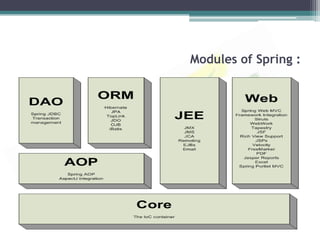
Modules of Spring :
Spring is Non-Invasive :
• What does that mean ?
    You are not forced to import or extend any spring APIs
Anti-Patterns
• EJB force you to use JNDI
• Struts force you to extend Action, ActionSupport
• Invasive frameworks are inheritently difficult to
  test(especially unit test)
• You to stub the runtime that is supplied by the
  application server.
Layer’s are 4 types:
1.Presentation or UI (User Interface) Layer
     (Struts/Jsps/JSF/Velocity etc.)
2.Bussiness or Service Layer
   (Servlets/EJB/Spring)
3. Data Access Layer or Persistence layer (ORM’s or JDBC)
    (Hibernate/JPA/Ibaties/Toplink etc.)
4. Data Layer (Database)
    (MySql/Oracle/IBM DB2/Postgress/Ingress/
     SQL Server etc.)
Application Layering :
• A clear separation of application component responsibility.
  ▫ Presentation layer
        Concentrates on request/response actions
        Handles UI rendering from a model.
        Contains formatting logic and non-business related validation logic.
        Handles exceptions thrown from other layers
  ▫ Persistence layer
        Used to communicate with a persistence store such as a relational database.
        Provides a query language
        Possible O/R mapping capabilities
        JDBC, Hibernate, iBATIS, JDO, Entity Beans, etc.
  ▫ Domain layer
        Contains business objects that are used across above layers.
        Contain complex relationships between other domain objects
        May be rich in business logic
        May have ORM mappings
        Domain objects should only have dependencies on other domain objects
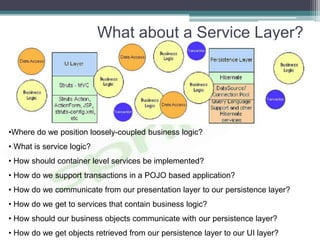
What about a Service Layer?


•Where do we position loosely-coupled business logic?
• What is service logic?
• How should container level services be implemented?
• How do we support transactions in a POJO based application?
• How do we communicate from our presentation layer to our persistence layer?
• How do we get to services that contain business logic?
• How should our business objects communicate with our persistence layer?
• How do we get objects retrieved from our persistence layer to our UI layer?
Application Layering (cont):
▫ Service layer
   Gateway to expose business logic to the
    outside world
   Manages ‘container level services’ such as
    transactions, security, data access logic, and
    manipulates domain objects
   Not well defined in many applications today
    or tightly coupled in an inappropriate layer.
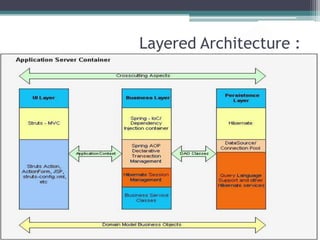
Layered Architecture :
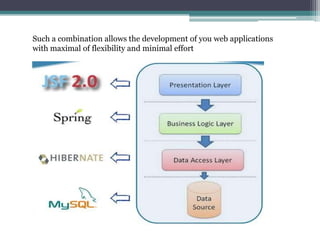
Such a combination allows the development of you web applications
with maximal of flexibility and minimal effort
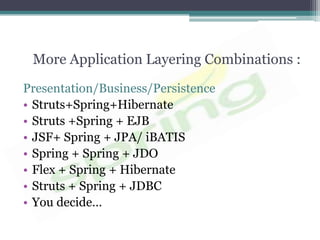
More Application Layering Combinations :

Presentation/Business/Persistence
• Struts+Spring+Hibernate
• Struts +Spring + EJB
• JSF+ Spring + JPA/ iBATIS
• Spring + Spring + JDO
• Flex + Spring + Hibernate
• Struts + Spring + JDBC
• You decide…
Conclusion :

• Layered architecture application development is Long
  life with strong flexibility.
• Migrating from an any framework is very easy in future.
• Technology independent application development is
  providing loose coupling and portability, that supports
  spring.
Resources :
•   http://www.springsource.org/
•   http://www.interface21.com/
•   Reference Manual of Spring
•   http://static.springsource.org/spring/docs/3.0.x
    /spring-framework-reference/html/
Spring Books :

• Spring in Action –by Craig walls and Ryan Bredenbach
• Pro Spring-by Rob Harrop and Jan Machacek
• J2EE Without EJB-by Rod Johnson and Juergen Holler
• Expert One-on-One J2EE Design and Development- by Rod
  Johnson
• Spring Developers Notebook- by Bruce tate and justin Gehtland
• Spring Live- by matt Raible
• Professional Java development With the Spring Framework –Rod &
  others
Thank U….!

Spring

  • 1.
  • 2.
    Agenda Overview: • What is Spring ? • History of Spring • Features of Spring • Why Spring ? • What does Spring offer? • Goal of Spring • Modules of Spring • Types of layers • Application Layering • Where to use Spring ? • Conclusion
  • 3.
    What is Spring: Whatis Spring: • Spring is an open source framework created to address the complexity of enterprise application development • One of the chief advantages of the Spring framework is its layered architecture, which allows you to be selective about which of its components you use while also providing a cohesive framework for J2EE application development. • It makes the application easy to configure and reduces the need for many J2EE design patterns. Spring can be used to configure declarative transaction management
  • 4.
    History of Spring: • The first version of Spring Framework was developed by Rod Johnson. It's first version was released with the publication of the book Expert One-on-One J2EE Design and Development in the October 2002. • Year 2002, Rod Johnson release it's first version • March 2004, first version release under Apache 2.0 license • In Year 2004 and 2005 further milestone release was make available to the developers • Year 2006 Spring 1.2.6 released • In December 2009, version 3.0 GA was released • June 15, 2010, Spring 3.0.3 released • Dec 12th,2011, Spring 3.1.0 GA was released • Sep 10th,2012, Spring 3.2 M2 released
  • 5.
    Features of Spring: • Spring is Lightweight container • No App Server Dependent – like EJB JNDI Calls • Objects are created Lazily , Singleton - configuration • Components can added Declaratively • Initialization of properties is easy – no need to read from properties file • Declarative transaction, security and logging service – AOP • application code is much easier to unit test • With a Dependency Injection approach, dependencies are explicit, and evident in constructor or JavaBeans properties • Spring's configuration management services can be used in any architectural layer, in whatever runtime environment. • Spring can effectively organize your middle tier objects • Not required special deployment steps
  • 6.
    Why Spring : •The Spring Framework was developed to ease the development of Enterprise Java applications • Reducing the writing code while development application. • Easy to integrate with any existing framework • Needed a solution to loosely couple business logic in a POJO fashion. • Wanted to build portable applications that provided clearer separation of presentation, business, and persistence logic. • Simplify use of popular technologies handle common error conditions • Well designed ▫ Easy to extend ▫ Many reusable classes
  • 7.
    Simplify your codewith Spring : • Enables you to stop polluting code • No more custom singleton objects ▫ Beans are defined in a centralized configuration file • No more custom factory object to build and/or locate other objects • DAO simplification ▫ Consistent CRUD ▫ Data access templates ▫ No more copy-paste try/catch/finally blocks ▫ No more passing Connection objects between methods ▫ No more leaked connections • POJO Based • Refactoring experience with Spring • Caution Spring is addictive!
  • 8.
    What does Springoffer? • Dependency Injection ▫ Also known as IoC (Inversion of Control) • Aspect Oriented Programming ▫ Runtime injection-based • Portable Service Abstractions ▫ The rest of spring  ORM, DAO, Web MVC, Web, etc.  Allows access to these without knowing how they actually work • Spring Security
  • 9.
  • 10.
    Spring is Non-Invasive: • What does that mean ? You are not forced to import or extend any spring APIs Anti-Patterns • EJB force you to use JNDI • Struts force you to extend Action, ActionSupport • Invasive frameworks are inheritently difficult to test(especially unit test) • You to stub the runtime that is supplied by the application server.
  • 11.
    Layer’s are 4types: 1.Presentation or UI (User Interface) Layer (Struts/Jsps/JSF/Velocity etc.) 2.Bussiness or Service Layer (Servlets/EJB/Spring) 3. Data Access Layer or Persistence layer (ORM’s or JDBC) (Hibernate/JPA/Ibaties/Toplink etc.) 4. Data Layer (Database) (MySql/Oracle/IBM DB2/Postgress/Ingress/ SQL Server etc.)
  • 12.
    Application Layering : •A clear separation of application component responsibility. ▫ Presentation layer  Concentrates on request/response actions  Handles UI rendering from a model.  Contains formatting logic and non-business related validation logic.  Handles exceptions thrown from other layers ▫ Persistence layer  Used to communicate with a persistence store such as a relational database.  Provides a query language  Possible O/R mapping capabilities  JDBC, Hibernate, iBATIS, JDO, Entity Beans, etc. ▫ Domain layer  Contains business objects that are used across above layers.  Contain complex relationships between other domain objects  May be rich in business logic  May have ORM mappings  Domain objects should only have dependencies on other domain objects
  • 13.
    What about aService Layer? •Where do we position loosely-coupled business logic? • What is service logic? • How should container level services be implemented? • How do we support transactions in a POJO based application? • How do we communicate from our presentation layer to our persistence layer? • How do we get to services that contain business logic? • How should our business objects communicate with our persistence layer? • How do we get objects retrieved from our persistence layer to our UI layer?
  • 14.
    Application Layering (cont): ▫Service layer  Gateway to expose business logic to the outside world  Manages ‘container level services’ such as transactions, security, data access logic, and manipulates domain objects  Not well defined in many applications today or tightly coupled in an inappropriate layer.
  • 15.
  • 16.
    Such a combinationallows the development of you web applications with maximal of flexibility and minimal effort
  • 17.
    More Application LayeringCombinations : Presentation/Business/Persistence • Struts+Spring+Hibernate • Struts +Spring + EJB • JSF+ Spring + JPA/ iBATIS • Spring + Spring + JDO • Flex + Spring + Hibernate • Struts + Spring + JDBC • You decide…
  • 18.
    Conclusion : • Layeredarchitecture application development is Long life with strong flexibility. • Migrating from an any framework is very easy in future. • Technology independent application development is providing loose coupling and portability, that supports spring.
  • 19.
    Resources : • http://www.springsource.org/ • http://www.interface21.com/ • Reference Manual of Spring • http://static.springsource.org/spring/docs/3.0.x /spring-framework-reference/html/
  • 20.
    Spring Books : •Spring in Action –by Craig walls and Ryan Bredenbach • Pro Spring-by Rob Harrop and Jan Machacek • J2EE Without EJB-by Rod Johnson and Juergen Holler • Expert One-on-One J2EE Design and Development- by Rod Johnson • Spring Developers Notebook- by Bruce tate and justin Gehtland • Spring Live- by matt Raible • Professional Java development With the Spring Framework –Rod & others
  • 21.