DET. 675
WEATHER FLIGHT
STORM SPOTTING
MANUAL
This manual covers Standard Operating Procedure on
storm spotting and planning.
1
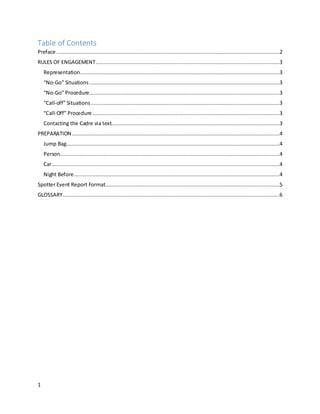
Table of Contents
Preface ..............................................................................................................................................2
RULES OF ENGAGEMENT.....................................................................................................................3
Representation...............................................................................................................................3
“No-Go” Situations .........................................................................................................................3
“No-Go” Procedure.........................................................................................................................3
“Call-off” Situations ........................................................................................................................3
“Call-Off” Procedure .......................................................................................................................3
Contacting the Cadre via text...........................................................................................................3
PREPARATION ....................................................................................................................................4
Jump Bag........................................................................................................................................4
Person............................................................................................................................................4
Car.................................................................................................................................................4
Night Before...................................................................................................................................4
Spotter Event Report Format...............................................................................................................5
GLOSSARY..........................................................................................................................................6
2
Preface: Every spring acrossthe central plainsof theUnited States,theworld bears witnessto whatis
considered to be some of the most violent weather on this pale blue dot we call home. In a matter of
seconds,entireswathsof neighborhoods,memories, and sometimes lives, are erased from existence, as
balls of ice the size baseballs hurl through the air and millions of volts of electricity arc through the
clouds.Forwhatever reason, unbeknownst to me, such power, instability, and chaos becomes the siren
song to a uniquegroup of individualswho are simultaneously curious enough,brave enough, and stupid
enough to study this phenomena.
This is where we come in.
As storm spotters, we have purpose out in the field. We cannot control, nor can we contain Mother
Nature, wecan only observe.In doing so,we providegreatly needed immediateinformation to the Storm
Prediction Center to help issue Tornado Warnings sooner, and in a lesser priority, but still valuable, we
are also able to report back both hail and wind values. But as with anything, there is the right way and
the wrong way to go about storm spotting.
This is where the manual comes in.
There are some, if not most parts, of this manual that are hard limits that are enforced purely for the
preservation of life and [Air Force] property,but in the same right, there are certain parts of this manual
that should be observed more as…guidelines. As this manual is passed down to the next generation of
Weather Flight Storm Spotters, always keep in mind it is designed to be changed when necessity and
experience dictate. However, as in AFROTC, just as we deploy as a team, we train as team; always
discuss changes amongst one another.
When we deploy, no matter the day, no matter the storm, never lose sight of the fact that our number
one goal is to come home. Good luck, and good hunting.
3
RULES OF ENGAGEMENT
Representation
 We are not chasingfor,representing, oraffiliatedwith The Universityof Oklahoma,AirForce
Reserve OfficerTrainingCorp, The National WeatherService,orThe Storm PredictionCenter.
We reportdata to the SPC,but theyare nottellingustogo out.
“No-Go” Situations
 Main stormsexpectedEof HWY 69 goingintothe OuachitaMtns
 Alwayscheckfinancesbeforeyougo;if youcannot affordto go,don’t.
 One personpervehicle ormore thanfour people pervehicle
 Questionable vehiclestatus
 Anypersoninvehicle notspottertrained
“No-Go” Procedure
 Fill outthe “Day of” sectionof the SpotterEventReport,givingadetailedexplanationonwhy
the team decidednottodeploy.
“Call-off” Situations
 Nightfall within45to 30 minutes
 Trackinginto a populatedarea
 Unsure of exitstrategy
 Unsure of road conditions
 Trackinginto EasternOK
 Uncertaintyof storm track
 Anyquestionof safety
“Call-Off” Procedure
 If there is a call off,quicklyandefficientlyassessthe situation,declare atowntoheadfor away
fromactive cells,anddetermine the quickest,safestwaytoarrive there.Recordwhythere was
a call off andthe actiontaken,once safe to doso.
 WheneitheraNo-Goor Call-Off call ismade,there shouldbe supportastowhy that call was
made,butno one shouldeverhave togo on the defensive orfeel hesitantaboutmakingthat
call.It isbetterto have calleditand notneededtothanwithholdbetter judgmentandputthe
entire team’slife andpropertyatrisk.
Contacting the Cadre via text
 Departing: “[Greetingof the day] [Sir/Ma’am].Cadet(s)[Name],[Name],and[Name] are with
me,[Name] isourFPO.”
 Return: “[Greetingof the day] [Sir/Ma’am].Accountabilityis[returning/total] have RTB’d”
 Make sure you always use propercustomsand courtesies,regardlessof contactmedium
4
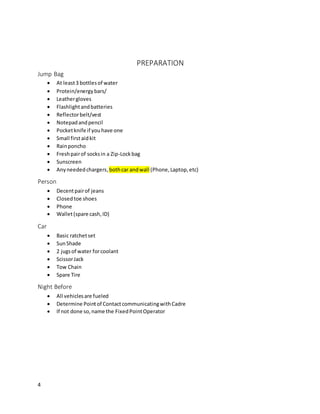
PREPARATION
Jump Bag
 At least3 bottlesof water
 Protein/energybars/
 Leathergloves
 Flashlightandbatteries
 Reflectorbelt/vest
 Notepadandpencil
 Pocketknife if youhave one
 Small firstaidkit
 Rainponcho
 Freshpairof socksin a Zip-Lockbag
 Sunscreen
 Anyneededchargers,bothcar andwall (Phone,Laptop,etc)
Person
 Decentpairof jeans
 Closedtoe shoes
 Phone
 Wallet(spare cash,ID)
Car
 Basic ratchetset
 SunShade
 2 jugsof water forcoolant
 ScissorJack
 Tow Chain
 Spare Tire
Night Before
 All vehiclesare fueled
 Determine Pointof ContactcommunicatingwithCadre
 If not done so,name the FixedPointOperator
5
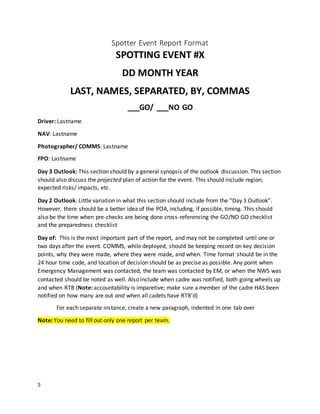
Spotter Event Report Format
SPOTTING EVENT #X
DD MONTH YEAR
LAST, NAMES, SEPARATED, BY, COMMAS
___GO/ ___NO GO
Driver: Lastname
NAV: Lastname
Photographer/ COMMS: Lastname
FPO: Lastname
Day 3 Outlook: This section should by a general synopsis of the outlook discussion. This section
should also discuss the projected plan of action for the event. This should include region,
expected risks/ impacts, etc.
Day 2 Outlook: Little variation in what this section should include from the “Day 3 Outlook”.
However, there should be a better idea of the POA, including, if possible, timing. This should
also be the time when pre-checks are being done cross-referencing the GO/NO GO checklist
and the preparedness checklist
Day of: This is the most important part of the report, and may not be completed until one or
two days after the event. COMMS, while deployed, should be keeping record on key decision
points, why they were made, where they were made, and when. Time format should be in the
24 hour time code, and location of decision should be as precise as possible. Any point when
Emergency Management was contacted, the team was contacted by EM, or when the NWS was
contacted should be noted as well. Also include when cadre was notified, both going wheels up
and when RTB (Note: accountability is imparetive; make sure a member of the cadre HAS been
notified on how many are out and when all cadets have RTB’d)
For each separate instance, create a new paragraph, indented in one tab over
Note: You need to fill out only one report per team.
6
GLOSSARY
“Call-Off”- thisisdifferentthana“No-Go” instance because thisissituationspecific.Dependingonthe
situation,youcancall a teamoff froma storm, but still remained deployed.
COMMS- The personincharge of handlingcommunicationshouldhave experience operatingaradio
and possessthe abilitytocommunicate clearlywithotherteams/FPO.Because the COMMoperatoris
consistentlyincommunication,theywill alsokeepnotes/actasa scribe.If at all possible,skill set
dependent,the COMMoperatorcouldinsome casesbe charged withphotography/media.
Driver- Ideally,the drivershouldbe able todrive bothstick[standard] aswell asautomatic,butatthe
veryleast, be well experiencedwithlongdistancedrivingaswell asdefensive/offensive driving.The
driver’sprimaryconcernshould notbe mapreadingor communicatingwiththe FPO/otherteams.
EM- EmergencyManagement
FixedPointOperator- The fixedpointoperatordesignatedroleistokeepthe teamoutin the field
apprisedasto what isgoingon,evenif itis justfor the sake of confirmation.The FPOshouldutilize the
topographical feature of google maps,the SPCpage/SPCMesoanalysis,andthe variousradars.The FPO
has the benefitof consistentinternetconnectionaswell asconsistentpowersource,sohe/she isa
massive assettohave to the fieldteam.
HWY- Highway
NAV- or Navigatorshouldbe well versedinmapreading/LandNav,andreadilyable tocompare the
rudimentaryidentifiable featuresona Dopplerwithabettermore precise printedmap.
“No-Go”- synonymouswithbeingtakenof flightstatus.Forwhateverreasonthe team(s) didnotdeploy
for thisevent;entire dayscrubbed
POA- Planof Action
RTB- Return(-ed, -ing)toBase
SPC- Storm PredictionCenter

Spotting Manual ver_2

  • 1.
    DET. 675 WEATHER FLIGHT STORMSPOTTING MANUAL This manual covers Standard Operating Procedure on storm spotting and planning.
  • 2.
    1 Table of Contents Preface..............................................................................................................................................2 RULES OF ENGAGEMENT.....................................................................................................................3 Representation...............................................................................................................................3 “No-Go” Situations .........................................................................................................................3 “No-Go” Procedure.........................................................................................................................3 “Call-off” Situations ........................................................................................................................3 “Call-Off” Procedure .......................................................................................................................3 Contacting the Cadre via text...........................................................................................................3 PREPARATION ....................................................................................................................................4 Jump Bag........................................................................................................................................4 Person............................................................................................................................................4 Car.................................................................................................................................................4 Night Before...................................................................................................................................4 Spotter Event Report Format...............................................................................................................5 GLOSSARY..........................................................................................................................................6
  • 3.
    2 Preface: Every springacrossthe central plainsof theUnited States,theworld bears witnessto whatis considered to be some of the most violent weather on this pale blue dot we call home. In a matter of seconds,entireswathsof neighborhoods,memories, and sometimes lives, are erased from existence, as balls of ice the size baseballs hurl through the air and millions of volts of electricity arc through the clouds.Forwhatever reason, unbeknownst to me, such power, instability, and chaos becomes the siren song to a uniquegroup of individualswho are simultaneously curious enough,brave enough, and stupid enough to study this phenomena. This is where we come in. As storm spotters, we have purpose out in the field. We cannot control, nor can we contain Mother Nature, wecan only observe.In doing so,we providegreatly needed immediateinformation to the Storm Prediction Center to help issue Tornado Warnings sooner, and in a lesser priority, but still valuable, we are also able to report back both hail and wind values. But as with anything, there is the right way and the wrong way to go about storm spotting. This is where the manual comes in. There are some, if not most parts, of this manual that are hard limits that are enforced purely for the preservation of life and [Air Force] property,but in the same right, there are certain parts of this manual that should be observed more as…guidelines. As this manual is passed down to the next generation of Weather Flight Storm Spotters, always keep in mind it is designed to be changed when necessity and experience dictate. However, as in AFROTC, just as we deploy as a team, we train as team; always discuss changes amongst one another. When we deploy, no matter the day, no matter the storm, never lose sight of the fact that our number one goal is to come home. Good luck, and good hunting.
  • 4.
    3 RULES OF ENGAGEMENT Representation We are not chasingfor,representing, oraffiliatedwith The Universityof Oklahoma,AirForce Reserve OfficerTrainingCorp, The National WeatherService,orThe Storm PredictionCenter. We reportdata to the SPC,but theyare nottellingustogo out. “No-Go” Situations  Main stormsexpectedEof HWY 69 goingintothe OuachitaMtns  Alwayscheckfinancesbeforeyougo;if youcannot affordto go,don’t.  One personpervehicle ormore thanfour people pervehicle  Questionable vehiclestatus  Anypersoninvehicle notspottertrained “No-Go” Procedure  Fill outthe “Day of” sectionof the SpotterEventReport,givingadetailedexplanationonwhy the team decidednottodeploy. “Call-off” Situations  Nightfall within45to 30 minutes  Trackinginto a populatedarea  Unsure of exitstrategy  Unsure of road conditions  Trackinginto EasternOK  Uncertaintyof storm track  Anyquestionof safety “Call-Off” Procedure  If there is a call off,quicklyandefficientlyassessthe situation,declare atowntoheadfor away fromactive cells,anddetermine the quickest,safestwaytoarrive there.Recordwhythere was a call off andthe actiontaken,once safe to doso.  WheneitheraNo-Goor Call-Off call ismade,there shouldbe supportastowhy that call was made,butno one shouldeverhave togo on the defensive orfeel hesitantaboutmakingthat call.It isbetterto have calleditand notneededtothanwithholdbetter judgmentandputthe entire team’slife andpropertyatrisk. Contacting the Cadre via text  Departing: “[Greetingof the day] [Sir/Ma’am].Cadet(s)[Name],[Name],and[Name] are with me,[Name] isourFPO.”  Return: “[Greetingof the day] [Sir/Ma’am].Accountabilityis[returning/total] have RTB’d”  Make sure you always use propercustomsand courtesies,regardlessof contactmedium
  • 5.
    4 PREPARATION Jump Bag  Atleast3 bottlesof water  Protein/energybars/  Leathergloves  Flashlightandbatteries  Reflectorbelt/vest  Notepadandpencil  Pocketknife if youhave one  Small firstaidkit  Rainponcho  Freshpairof socksin a Zip-Lockbag  Sunscreen  Anyneededchargers,bothcar andwall (Phone,Laptop,etc) Person  Decentpairof jeans  Closedtoe shoes  Phone  Wallet(spare cash,ID) Car  Basic ratchetset  SunShade  2 jugsof water forcoolant  ScissorJack  Tow Chain  Spare Tire Night Before  All vehiclesare fueled  Determine Pointof ContactcommunicatingwithCadre  If not done so,name the FixedPointOperator
  • 6.
    5 Spotter Event ReportFormat SPOTTING EVENT #X DD MONTH YEAR LAST, NAMES, SEPARATED, BY, COMMAS ___GO/ ___NO GO Driver: Lastname NAV: Lastname Photographer/ COMMS: Lastname FPO: Lastname Day 3 Outlook: This section should by a general synopsis of the outlook discussion. This section should also discuss the projected plan of action for the event. This should include region, expected risks/ impacts, etc. Day 2 Outlook: Little variation in what this section should include from the “Day 3 Outlook”. However, there should be a better idea of the POA, including, if possible, timing. This should also be the time when pre-checks are being done cross-referencing the GO/NO GO checklist and the preparedness checklist Day of: This is the most important part of the report, and may not be completed until one or two days after the event. COMMS, while deployed, should be keeping record on key decision points, why they were made, where they were made, and when. Time format should be in the 24 hour time code, and location of decision should be as precise as possible. Any point when Emergency Management was contacted, the team was contacted by EM, or when the NWS was contacted should be noted as well. Also include when cadre was notified, both going wheels up and when RTB (Note: accountability is imparetive; make sure a member of the cadre HAS been notified on how many are out and when all cadets have RTB’d) For each separate instance, create a new paragraph, indented in one tab over Note: You need to fill out only one report per team.
  • 7.
    6 GLOSSARY “Call-Off”- thisisdifferentthana“No-Go” instancebecause thisissituationspecific.Dependingonthe situation,youcancall a teamoff froma storm, but still remained deployed. COMMS- The personincharge of handlingcommunicationshouldhave experience operatingaradio and possessthe abilitytocommunicate clearlywithotherteams/FPO.Because the COMMoperatoris consistentlyincommunication,theywill alsokeepnotes/actasa scribe.If at all possible,skill set dependent,the COMMoperatorcouldinsome casesbe charged withphotography/media. Driver- Ideally,the drivershouldbe able todrive bothstick[standard] aswell asautomatic,butatthe veryleast, be well experiencedwithlongdistancedrivingaswell asdefensive/offensive driving.The driver’sprimaryconcernshould notbe mapreadingor communicatingwiththe FPO/otherteams. EM- EmergencyManagement FixedPointOperator- The fixedpointoperatordesignatedroleistokeepthe teamoutin the field apprisedasto what isgoingon,evenif itis justfor the sake of confirmation.The FPOshouldutilize the topographical feature of google maps,the SPCpage/SPCMesoanalysis,andthe variousradars.The FPO has the benefitof consistentinternetconnectionaswell asconsistentpowersource,sohe/she isa massive assettohave to the fieldteam. HWY- Highway NAV- or Navigatorshouldbe well versedinmapreading/LandNav,andreadilyable tocompare the rudimentaryidentifiable featuresona Dopplerwithabettermore precise printedmap. “No-Go”- synonymouswithbeingtakenof flightstatus.Forwhateverreasonthe team(s) didnotdeploy for thisevent;entire dayscrubbed POA- Planof Action RTB- Return(-ed, -ing)toBase SPC- Storm PredictionCenter