Splitting the Requirement 
A Subatomic Analysis 
The New Business Analyst
What do Requirements Look Like? 
• Have you ever wondered what a requirement 
looks like? 
• What they look like on the inside. 
• If we could split one open, like an atom, what 
would we see? 
The New Business Analyst 
2014-10-20 ©2014 PJM Limited and The New Business Analyst. All rights reserved 2
Think Building Blocks 
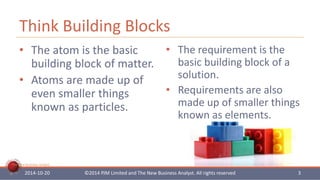
• The atom is the basic 
building block of matter. 
• Atoms are made up of 
even smaller things 
known as particles. 
The New Business Analyst 
• The requirement is the 
basic building block of a 
solution. 
• Requirements are also 
made up of smaller things 
known as elements. 
2014-10-20 ©2014 PJM Limited and The New Business Analyst. All rights reserved 3
It All Starts with a Behaviour 
• Every requirement must do something. 
• What it does, how it does it, when it does it 
and so on, are the elements of the 
requirement. 
• Like an atom, requirements are expressed 
with structure. 
The New Business Analyst 
2014-10-20 ©2014 PJM Limited and The New Business Analyst. All rights reserved 4
The Elements of a Requirement 
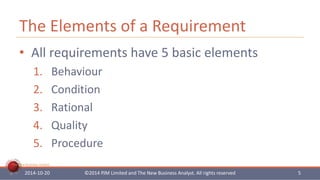
• All requirements have 5 basic elements 
1. Behaviour 
2. Condition 
3. Rational 
4. Quality 
5. Procedure 
The New Business Analyst 
2014-10-20 ©2014 PJM Limited and The New Business Analyst. All rights reserved 5
The Elements of a Requirement 
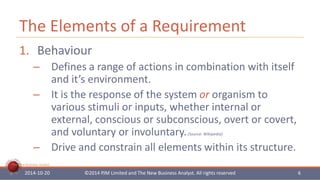
1. Behaviour 
– Defines a range of actions in combination with itself 
The New Business Analyst 
and it’s environment. 
– It is the response of the system or organism to 
various stimuli or inputs, whether internal or 
external, conscious or subconscious, overt or covert, 
and voluntary or involuntary. (Source: Wikipedia) 
– Drive and constrain all elements within its structure. 
2014-10-20 ©2014 PJM Limited and The New Business Analyst. All rights reserved 6
The Elements of a Requirement 
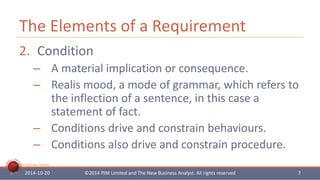
2. Condition 
– A material implication or consequence. 
– Realis mood, a mode of grammar, which refers to 
The New Business Analyst 
the inflection of a sentence, in this case a 
statement of fact. 
– Conditions drive and constrain behaviours. 
– Conditions also drive and constrain procedure. 
2014-10-20 ©2014 PJM Limited and The New Business Analyst. All rights reserved 7
The Elements of a Requirement 
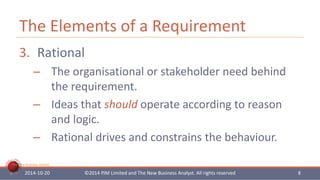
3. Rational 
– The organisational or stakeholder need behind 
The New Business Analyst 
the requirement. 
– Ideas that should operate according to reason 
and logic. 
– Rational drives and constrains the behaviour. 
2014-10-20 ©2014 PJM Limited and The New Business Analyst. All rights reserved 8
The Elements of a Requirement 
4. Quality 
– Qualities are distinctive attributes or 
The New Business Analyst 
characteristics possessed by the behaviour and 
other elements of the requirement. 
– Qualities drive and constrain and are driven and 
constrained by other elements within the 
structure. 
2014-10-20 ©2014 PJM Limited and The New Business Analyst. All rights reserved 9
The Elements of a Requirement 
5. Procedure 
– An established way of proceeding. 
– Steps needed to accomplish the rational. 
– Defines how the behaviour will act. 
– Procedures are driven and constrained by other 
The New Business Analyst 
elements within the structure. 
2014-10-20 ©2014 PJM Limited and The New Business Analyst. All rights reserved 10
The Elements of a Requirement 
• What does the structure look like? 
The New Business Analyst 
2014-10-20 ©2014 PJM Limited and The New Business Analyst. All rights reserved 11
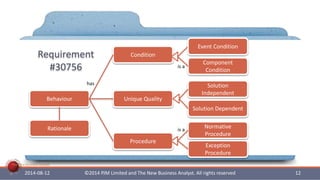
Requirement 
#30756 
Behaviour 
Rationale 
The New Business Analyst 
Condition 
Unique Quality 
Event Condition 
Component 
Condition 
Solution 
Independent 
Solution Dependent 
Procedure 
Normative 
Procedure 
Exception 
Procedure 
has 
is a 
is a 
2014-08-12 ©2014 PJM Limited and The New Business Analyst. All rights reserved 12
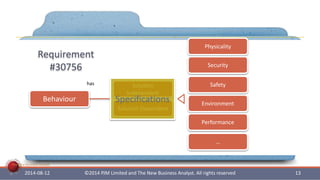
Requirement 
#30756 
Behaviour 
The New Business Analyst 
has 
Physicality 
Security 
Safety 
Environment 
Performance 
… 
Solution 
Independent 
Specifications 
Solution Dependent 
2014-08-12 ©2014 PJM Limited and The New Business Analyst. All rights reserved 13
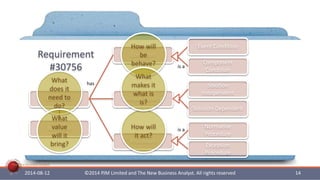
Requirement 
#30756 
What 
does it 
need to 
do? 
What 
value 
will it 
bring? 
Behaviour 
Rationale 
The New Business Analyst 
How will 
be 
Condition 
behave? 
What 
makes it 
what is 
Unique Quality 
Event Condition 
Component 
Condition 
Solution 
Independent 
Solution Dependent 
is? 
How will 
it act? 
Procedure 
Normative 
Procedure 
Exception 
Procedure 
has 
is a 
is a 
2014-08-12 ©2014 PJM Limited and The New Business Analyst. All rights reserved 14
Splitting the Requirement 
The New Business Analyst 
2014-10-20 ©2014 PJM Limited and The New Business Analyst. All rights reserved 15
Social Feeds 
• Twitter: @bsapmcleod 
• LinkedIn: perrymcleod 
• Facebook: pjmsthenewbusinessanalyst 
• Slide Share: perrymcleod 
• Tumblr: perrymcleodbsa 
• Email: perryjmcleod@me.com 
The New Business Analyst 
2014-08-12 ©2014 PJM Limited and The New Business Analyst. All rights reserved 16

Splitting the requirement_slide_share

  • 1.
    Splitting the Requirement A Subatomic Analysis The New Business Analyst
  • 2.
    What do RequirementsLook Like? • Have you ever wondered what a requirement looks like? • What they look like on the inside. • If we could split one open, like an atom, what would we see? The New Business Analyst 2014-10-20 ©2014 PJM Limited and The New Business Analyst. All rights reserved 2
  • 3.
    Think Building Blocks • The atom is the basic building block of matter. • Atoms are made up of even smaller things known as particles. The New Business Analyst • The requirement is the basic building block of a solution. • Requirements are also made up of smaller things known as elements. 2014-10-20 ©2014 PJM Limited and The New Business Analyst. All rights reserved 3
  • 4.
    It All Startswith a Behaviour • Every requirement must do something. • What it does, how it does it, when it does it and so on, are the elements of the requirement. • Like an atom, requirements are expressed with structure. The New Business Analyst 2014-10-20 ©2014 PJM Limited and The New Business Analyst. All rights reserved 4
  • 5.
    The Elements ofa Requirement • All requirements have 5 basic elements 1. Behaviour 2. Condition 3. Rational 4. Quality 5. Procedure The New Business Analyst 2014-10-20 ©2014 PJM Limited and The New Business Analyst. All rights reserved 5
  • 6.
    The Elements ofa Requirement 1. Behaviour – Defines a range of actions in combination with itself The New Business Analyst and it’s environment. – It is the response of the system or organism to various stimuli or inputs, whether internal or external, conscious or subconscious, overt or covert, and voluntary or involuntary. (Source: Wikipedia) – Drive and constrain all elements within its structure. 2014-10-20 ©2014 PJM Limited and The New Business Analyst. All rights reserved 6
  • 7.
    The Elements ofa Requirement 2. Condition – A material implication or consequence. – Realis mood, a mode of grammar, which refers to The New Business Analyst the inflection of a sentence, in this case a statement of fact. – Conditions drive and constrain behaviours. – Conditions also drive and constrain procedure. 2014-10-20 ©2014 PJM Limited and The New Business Analyst. All rights reserved 7
  • 8.
    The Elements ofa Requirement 3. Rational – The organisational or stakeholder need behind The New Business Analyst the requirement. – Ideas that should operate according to reason and logic. – Rational drives and constrains the behaviour. 2014-10-20 ©2014 PJM Limited and The New Business Analyst. All rights reserved 8
  • 9.
    The Elements ofa Requirement 4. Quality – Qualities are distinctive attributes or The New Business Analyst characteristics possessed by the behaviour and other elements of the requirement. – Qualities drive and constrain and are driven and constrained by other elements within the structure. 2014-10-20 ©2014 PJM Limited and The New Business Analyst. All rights reserved 9
  • 10.
    The Elements ofa Requirement 5. Procedure – An established way of proceeding. – Steps needed to accomplish the rational. – Defines how the behaviour will act. – Procedures are driven and constrained by other The New Business Analyst elements within the structure. 2014-10-20 ©2014 PJM Limited and The New Business Analyst. All rights reserved 10
  • 11.
    The Elements ofa Requirement • What does the structure look like? The New Business Analyst 2014-10-20 ©2014 PJM Limited and The New Business Analyst. All rights reserved 11
  • 12.
    Requirement #30756 Behaviour Rationale The New Business Analyst Condition Unique Quality Event Condition Component Condition Solution Independent Solution Dependent Procedure Normative Procedure Exception Procedure has is a is a 2014-08-12 ©2014 PJM Limited and The New Business Analyst. All rights reserved 12
  • 13.
    Requirement #30756 Behaviour The New Business Analyst has Physicality Security Safety Environment Performance … Solution Independent Specifications Solution Dependent 2014-08-12 ©2014 PJM Limited and The New Business Analyst. All rights reserved 13
  • 14.
    Requirement #30756 What does it need to do? What value will it bring? Behaviour Rationale The New Business Analyst How will be Condition behave? What makes it what is Unique Quality Event Condition Component Condition Solution Independent Solution Dependent is? How will it act? Procedure Normative Procedure Exception Procedure has is a is a 2014-08-12 ©2014 PJM Limited and The New Business Analyst. All rights reserved 14
  • 15.
    Splitting the Requirement The New Business Analyst 2014-10-20 ©2014 PJM Limited and The New Business Analyst. All rights reserved 15
  • 16.
    Social Feeds •Twitter: @bsapmcleod • LinkedIn: perrymcleod • Facebook: pjmsthenewbusinessanalyst • Slide Share: perrymcleod • Tumblr: perrymcleodbsa • Email: perryjmcleod@me.com The New Business Analyst 2014-08-12 ©2014 PJM Limited and The New Business Analyst. All rights reserved 16

Editor's Notes

  • #13 RPEAC Framework Alert! a need has been detected! what is needed? why is it needed? who needs it? how will this need be used? how important is this need? when must this need be provided? what other needs does this need relate to? what is driving this need forward? is this a change to an existing behaviour? is this a new behaviour? how will it behave? what conditions will drive and constrain its behaviour what qualities or characteristics will it take on when it is performing its behaviour? how often will this behaviour take place? who will want to use this behaviour? who will receive the value produced by this behaviour? what will they do with this value? who will be responsible for the behaviour? who will be accountable for the behaviour? how long will the behaviour be needed? how will the behaviour be measured? how often will the behaviour be measured how often will the behaviour evaluated?
  • #14 Accuracy Requirements System Requirements Business Requirements Availability Requirements Requirements Prioritization Organizing Requirements Non Functional Requirements Solution Requirements Software Requirements Requirements Design Small Business Requirements Requirements Education Requirements Management Requirements Training Requirements Engineering Functional Requirements Data Requirements Project Requirements Information Requirements Requirements Analysis Requirements Development Requirements Gathering Technical Requirements Requirements Process Requirements Specification Usability Requirements Requirements Visualization Product Requirements Report Requirements Architecture Requirements Requirements Definition Requirements Traceability Customer Requirements Website Requirements
  • #15 RPEAC Framework Alert! a need has been detected! what is needed? why is it needed? who needs it? how will this need be used? how important is this need? when must this need be provided? what other needs does this need relate to? what is driving this need forward? is this a change to an existing behaviour? is this a new behaviour? how will it behave? what conditions will drive and constrain its behaviour what qualities or characteristics will it take on when it is performing its behaviour? how often will this behaviour take place? who will want to use this behaviour? who will receive the value produced by this behaviour? what will they do with this value? who will be responsible for the behaviour? who will be accountable for the behaviour? how long will the behaviour be needed? how will the behaviour be measured? how often will the behaviour be measured how often will the behaviour evaluated?