chapter

  8
          Gender Equity
Chapter Objectives

After reading this chapter, you will know the
  following:
• The various federal gender equity laws and
  how they apply to sport
• The history of Title IX, how it has been
  interpreted, and how it is applied today
• The definition of sexual harassment and
  how it is regulated in sport
• The various types of employment
  discrimination laws
Underrepresentation

• Women always have been and continue to
  be underrepresented in athletics.
  – 1971: 16,000 women in college athletics
  – 2008: 9,101 women’s teams
  – 2005-2006
     • High school: 2,953,355 girls, 4,206,549 boys
     • College: 168,583 women, 224,926 men
• Yet, there has been substantial growth in
  women’s participation since the passage of
  Title IX.
Title IX of the Educational
            Amendments of 1972
• “No person in the United States shall, on the basis of
  sex, be excluded from participation in, be denied the
  benefits of, or be subjected to discrimination under any
  education program or activity receiving federal financial
  assistance.”
• Title IX applies if any department in a school receives
  federal funding, the law applies to the entire school
   – In response to Grove City ruling, Congress passed the Civil
     Rights Restoration Act of 1987
• Today, institutions receiving any form of federal
  assistance must be in compliance with Title IX
Legal Issues:
      Grove City College v. Bell

• 1984 case dealing with the application of
  Title IX. One of the biggest setbacks for
  women since passage in 1972.
• Court found that Title IX was applicable only
  to those parts of the institution that
  received federal funding; thus athletics
  were excluded.
Civil Rights Restoration Act of 1987

Legislation reversed the findings in Grove
  City College and applied Title IX institution-
  wide. Thus, if any part of an institution
  received federal funding, the entire
  institution was subject to the specifications
  in Title IX.
Regulation and Enforcement

• Department of Education
  – 1975 regulations focus on equal opportunity:
     • Program areas (i.e., equipment, locker rooms)
     • Effective accommodation of interests and abilities and
       selection of sports for both genders
     • Equivalency in financial aid
  – 1979 Policy Interpretation designed to provide ways
    for schools to measure whether they comply with Title
    IX and the 1975 regulations
     • Part 1: Financial assistance
     • Part 2: Equality in program areas
     • Part 3: Effective accommodation
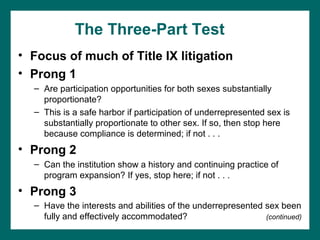
The Three-Part Test
• Focus of much of Title IX litigation
• Prong 1
  – Are participation opportunities for both sexes substantially
    proportionate?
  – This is a safe harbor if participation of underrepresented sex is
    substantially proportionate to other sex. If so, then stop here
    because compliance is determined; if not . . .
• Prong 2
  – Can the institution show a history and continuing practice of
    program expansion? If yes, stop here; if not . . .
• Prong 3
  – Have the interests and abilities of the underrepresented sex been
    fully and effectively accommodated?                      (continued)
The Three-Part Test (continued)

• Do not need to meet each prong
• Any one prong of the three-part test, if met,
  demonstrates compliance with Title IX
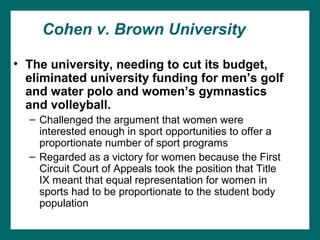
Cohen v. Brown University

• The university, needing to cut its budget,
  eliminated university funding for men’s golf
  and water polo and women’s gymnastics
  and volleyball.
  – Challenged the argument that women were
    interested enough in sport opportunities to offer a
    proportionate number of sport programs
  – Regarded as a victory for women because the First
    Circuit Court of Appeals took the position that Title
    IX meant that equal representation for women in
    sports had to be proportionate to the student body
    population
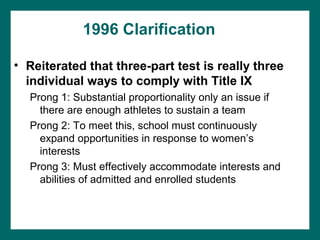
1996 Clarification

• Reiterated that three-part test is really three
  individual ways to comply with Title IX
  Prong 1: Substantial proportionality only an issue if
    there are enough athletes to sustain a team
  Prong 2: To meet this, school must continuously
    expand opportunities in response to women’s
    interests
  Prong 3: Must effectively accommodate interests and
    abilities of admitted and enrolled students
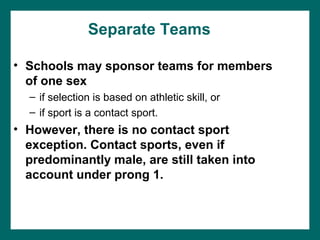
Separate Teams

• Schools may sponsor teams for members
  of one sex
  – if selection is based on athletic skill, or
  – if sport is a contact sport.
• However, there is no contact sport
  exception. Contact sports, even if
  predominantly male, are still taken into
  account under prong 1.
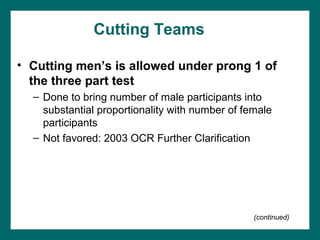
Cutting Teams

• Cutting men’s is allowed under prong 1 of
  the three part test
  – Done to bring number of male participants into
    substantial proportionality with number of female
    participants
  – Not favored: 2003 OCR Further Clarification


                                                 (continued)
Cutting Teams (continued)

• Miami University Wrestling Club v. Miami
  University (2002)
  – 1997: 55% female students, 47% female student
    athletes
  – Men sued after university cut four men’s teams
  – Court dismissed their complaint because members
    of overrepresented sex (men) do not have a claim
    under the three-part test
Cutting Women’s Teams

• Men from cut teams have never won a lawsuit
  against a school
• Cutting of women’s teams is never allowed
  because women tend to be the underrepresented
  sex
• Existence of women’s team is evidence of interest
  and ability
• Roberts v. Colorado State Board of Agriculture
  (1993)
   – In response to disproportionate numbers of women
     participating, university cut women’s and men’s team
   – Women sued
   – Court ordered school to reinstate women’s team
Recent Guidance

• 2005 Additional Clarification
  – Allows for Internet surveys to show interests and
    abilities and meet third prong of three-part test
  – Counts nonresponse as lack of interest, but school
    must receive 85% response level to proceed
Disclosure of Information

• Equity in Athletics Disclosure Act (1998)
  – Requires all universities that receive federal student
    aid and have athletic programs to disclose
    information related to financial aid, athletic
    revenues, and other resources
  – Information available to the public at
    http://ope.ed.gov/athletics
Employment Discrimination

• In 1972, 90% of head coaches of women’s
  sports were women
• In 2008, that figure was 42.8%
Title VII

• Prohibits discrimination against any
  employee on the basis of sex in
  compensation and other benefits associated
  with employment
• Plaintiff merely has to show some negative
  job action (for example, termination) that was
  taken on the basis of the employee’s sex
Equal Pay Act

• Prohibits discrimination in wages between
  employees on the basis of sex for equal
  work on jobs that require equal skill, effort,
  and responsibility under similar working
  conditions.
• Equal work: Two jobs do not have to
  require identical skill, effort, and
  responsibility; instead, the jobs must be
  substantially equal except for the fact that
  one employee is paid more even though he
  performs what is basically the same job.
Implications of Risk Management
• Failure to comply with Title IX can be costly
  to institution:
  – Financial burdens
  – Image of institution
  – Satisfaction of participants
• Coaches and administrators
  – Sexual harassment
  – Lawsuits involving EPA and Title VII

Spengler chap08

  • 1.
    chapter 8 Gender Equity
  • 2.
    Chapter Objectives After readingthis chapter, you will know the following: • The various federal gender equity laws and how they apply to sport • The history of Title IX, how it has been interpreted, and how it is applied today • The definition of sexual harassment and how it is regulated in sport • The various types of employment discrimination laws
  • 3.
    Underrepresentation • Women alwayshave been and continue to be underrepresented in athletics. – 1971: 16,000 women in college athletics – 2008: 9,101 women’s teams – 2005-2006 • High school: 2,953,355 girls, 4,206,549 boys • College: 168,583 women, 224,926 men • Yet, there has been substantial growth in women’s participation since the passage of Title IX.
  • 4.
    Title IX ofthe Educational Amendments of 1972 • “No person in the United States shall, on the basis of sex, be excluded from participation in, be denied the benefits of, or be subjected to discrimination under any education program or activity receiving federal financial assistance.” • Title IX applies if any department in a school receives federal funding, the law applies to the entire school – In response to Grove City ruling, Congress passed the Civil Rights Restoration Act of 1987 • Today, institutions receiving any form of federal assistance must be in compliance with Title IX
  • 5.
    Legal Issues: Grove City College v. Bell • 1984 case dealing with the application of Title IX. One of the biggest setbacks for women since passage in 1972. • Court found that Title IX was applicable only to those parts of the institution that received federal funding; thus athletics were excluded.
  • 6.
    Civil Rights RestorationAct of 1987 Legislation reversed the findings in Grove City College and applied Title IX institution- wide. Thus, if any part of an institution received federal funding, the entire institution was subject to the specifications in Title IX.
  • 7.
    Regulation and Enforcement •Department of Education – 1975 regulations focus on equal opportunity: • Program areas (i.e., equipment, locker rooms) • Effective accommodation of interests and abilities and selection of sports for both genders • Equivalency in financial aid – 1979 Policy Interpretation designed to provide ways for schools to measure whether they comply with Title IX and the 1975 regulations • Part 1: Financial assistance • Part 2: Equality in program areas • Part 3: Effective accommodation
  • 8.
    The Three-Part Test •Focus of much of Title IX litigation • Prong 1 – Are participation opportunities for both sexes substantially proportionate? – This is a safe harbor if participation of underrepresented sex is substantially proportionate to other sex. If so, then stop here because compliance is determined; if not . . . • Prong 2 – Can the institution show a history and continuing practice of program expansion? If yes, stop here; if not . . . • Prong 3 – Have the interests and abilities of the underrepresented sex been fully and effectively accommodated? (continued)
  • 9.
    The Three-Part Test(continued) • Do not need to meet each prong • Any one prong of the three-part test, if met, demonstrates compliance with Title IX
  • 10.
    Cohen v. BrownUniversity • The university, needing to cut its budget, eliminated university funding for men’s golf and water polo and women’s gymnastics and volleyball. – Challenged the argument that women were interested enough in sport opportunities to offer a proportionate number of sport programs – Regarded as a victory for women because the First Circuit Court of Appeals took the position that Title IX meant that equal representation for women in sports had to be proportionate to the student body population
  • 11.
    1996 Clarification • Reiteratedthat three-part test is really three individual ways to comply with Title IX Prong 1: Substantial proportionality only an issue if there are enough athletes to sustain a team Prong 2: To meet this, school must continuously expand opportunities in response to women’s interests Prong 3: Must effectively accommodate interests and abilities of admitted and enrolled students
  • 12.
    Separate Teams • Schoolsmay sponsor teams for members of one sex – if selection is based on athletic skill, or – if sport is a contact sport. • However, there is no contact sport exception. Contact sports, even if predominantly male, are still taken into account under prong 1.
  • 13.
    Cutting Teams • Cuttingmen’s is allowed under prong 1 of the three part test – Done to bring number of male participants into substantial proportionality with number of female participants – Not favored: 2003 OCR Further Clarification (continued)
  • 14.
    Cutting Teams (continued) •Miami University Wrestling Club v. Miami University (2002) – 1997: 55% female students, 47% female student athletes – Men sued after university cut four men’s teams – Court dismissed their complaint because members of overrepresented sex (men) do not have a claim under the three-part test
  • 15.
    Cutting Women’s Teams •Men from cut teams have never won a lawsuit against a school • Cutting of women’s teams is never allowed because women tend to be the underrepresented sex • Existence of women’s team is evidence of interest and ability • Roberts v. Colorado State Board of Agriculture (1993) – In response to disproportionate numbers of women participating, university cut women’s and men’s team – Women sued – Court ordered school to reinstate women’s team
  • 16.
    Recent Guidance • 2005Additional Clarification – Allows for Internet surveys to show interests and abilities and meet third prong of three-part test – Counts nonresponse as lack of interest, but school must receive 85% response level to proceed
  • 17.
    Disclosure of Information •Equity in Athletics Disclosure Act (1998) – Requires all universities that receive federal student aid and have athletic programs to disclose information related to financial aid, athletic revenues, and other resources – Information available to the public at http://ope.ed.gov/athletics
  • 18.
    Employment Discrimination • In1972, 90% of head coaches of women’s sports were women • In 2008, that figure was 42.8%
  • 19.
    Title VII • Prohibitsdiscrimination against any employee on the basis of sex in compensation and other benefits associated with employment • Plaintiff merely has to show some negative job action (for example, termination) that was taken on the basis of the employee’s sex
  • 20.
    Equal Pay Act •Prohibits discrimination in wages between employees on the basis of sex for equal work on jobs that require equal skill, effort, and responsibility under similar working conditions. • Equal work: Two jobs do not have to require identical skill, effort, and responsibility; instead, the jobs must be substantially equal except for the fact that one employee is paid more even though he performs what is basically the same job.
  • 21.
    Implications of RiskManagement • Failure to comply with Title IX can be costly to institution: – Financial burdens – Image of institution – Satisfaction of participants • Coaches and administrators – Sexual harassment – Lawsuits involving EPA and Title VII