Copyright © 2008 by Allyn and Bacon   1
“All great speakers
were bad speakers at
         first.”

   Ralph Waldo Emerson


                     Copyright © 2008 by Allyn and Bacon   2
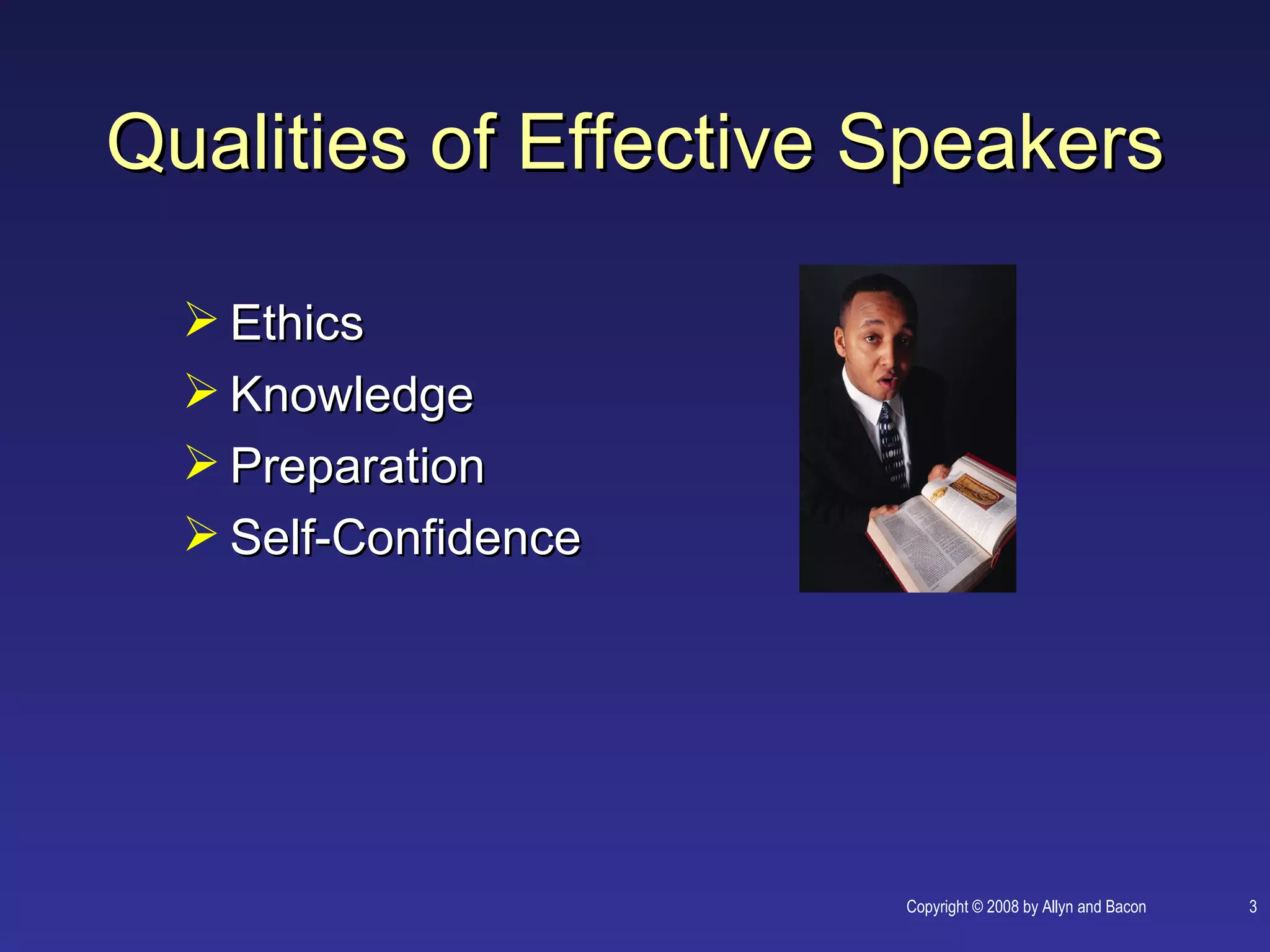
Qualities of Effective Speakers

   Ethics
   Knowledge
   Preparation
   Self-Confidence


                       Copyright © 2008 by Allyn and Bacon   3
Ethics: Avoiding Plagiarism

 Use more than one source for speech
 Use a variety of sources
 Avoid using language identical to original
  author
 Cite sources prior to quoting a source
 Always identify your sources
 Give credit to originator of ideas
                                 Copyright © 2008 by Allyn and Bacon   4
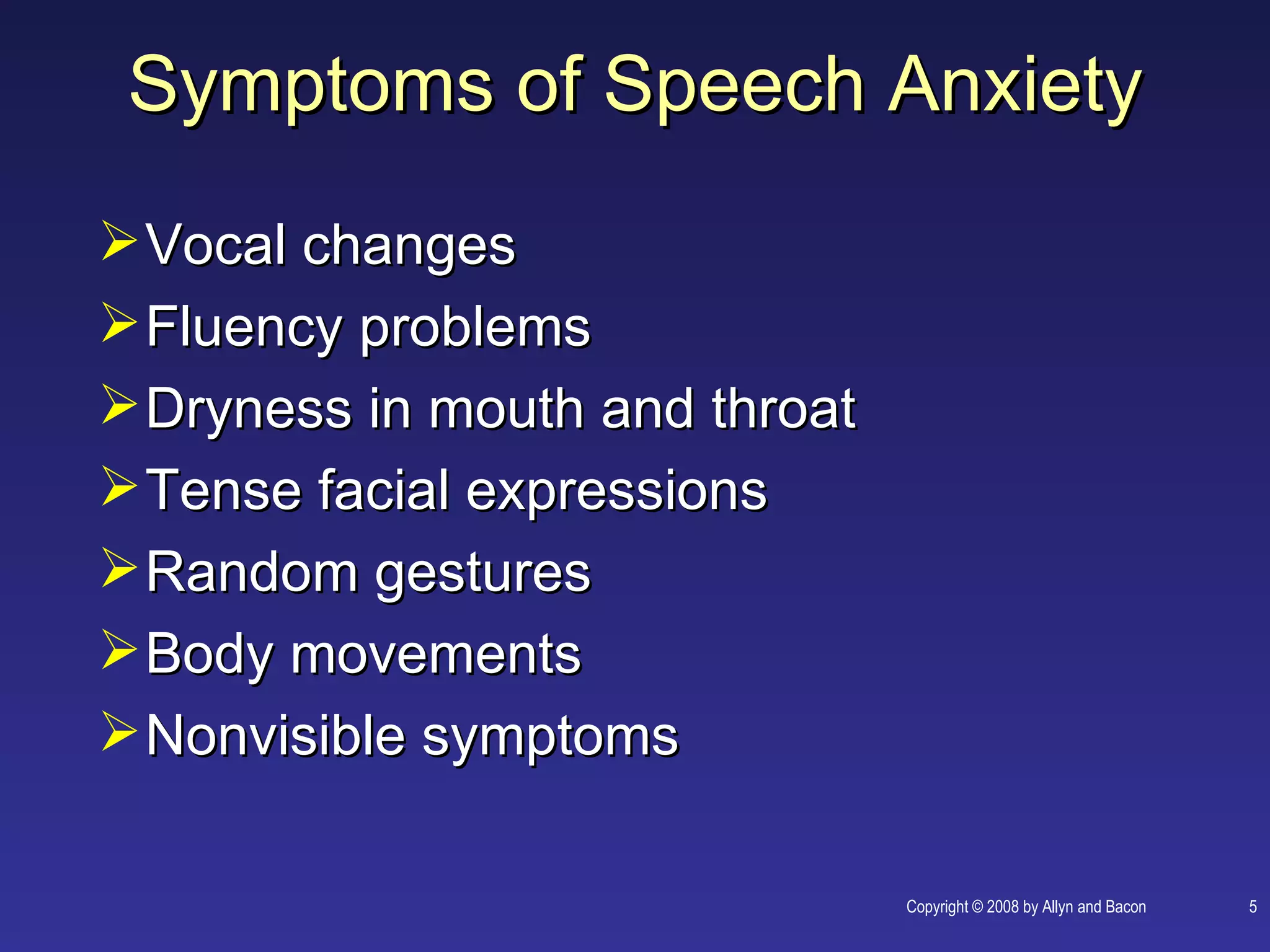
Symptoms of Speech Anxiety
 Vocal changes
 Fluency problems
 Dryness in mouth and throat
 Tense facial expressions
 Random gestures
 Body movements
 Nonvisible symptoms

                                Copyright © 2008 by Allyn and Bacon   5
What Causes Speech Anxiety?

        FEAR?


                    Copyright © 2008 by Allyn and Bacon   6
Treating Speech Anxiety

 Select a topic you enjoy and know.
 Be prepared and know your audience.
 Be confident.
 Think positively.
 Practice, practice, practice.


                            Copyright © 2008 by Allyn and Bacon   7
Additional Tips for Controlling
       Speech Anxiety
 Talk with instructor for additional help.
 Don’t give up!
 Practice relaxation techniques -
  systematic desensitization.
 Realize that everyone feels this way.


                                 Copyright © 2008 by Allyn and Bacon   8
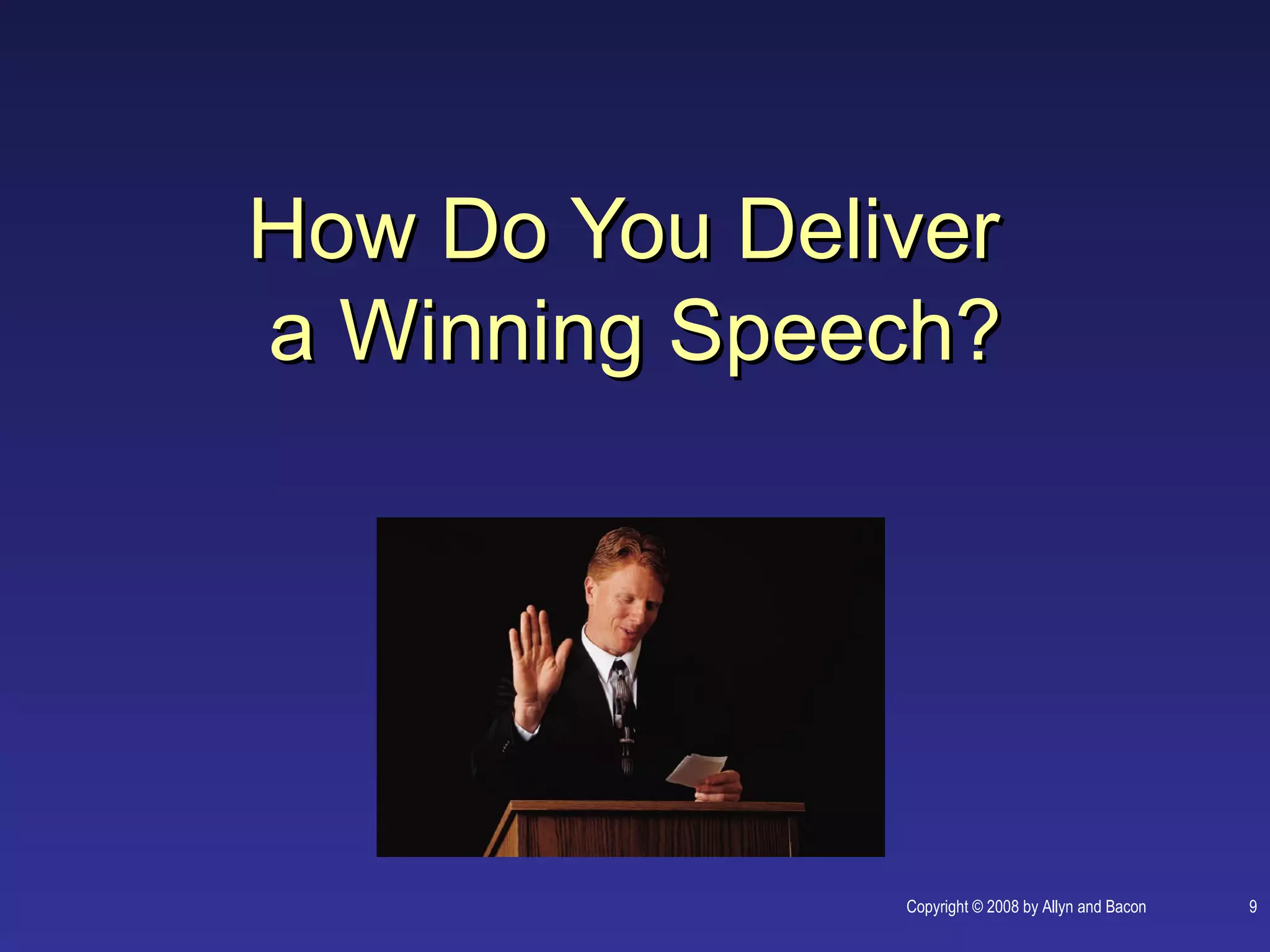
How Do You Deliver
a Winning Speech?


               Copyright © 2008 by Allyn and Bacon   9
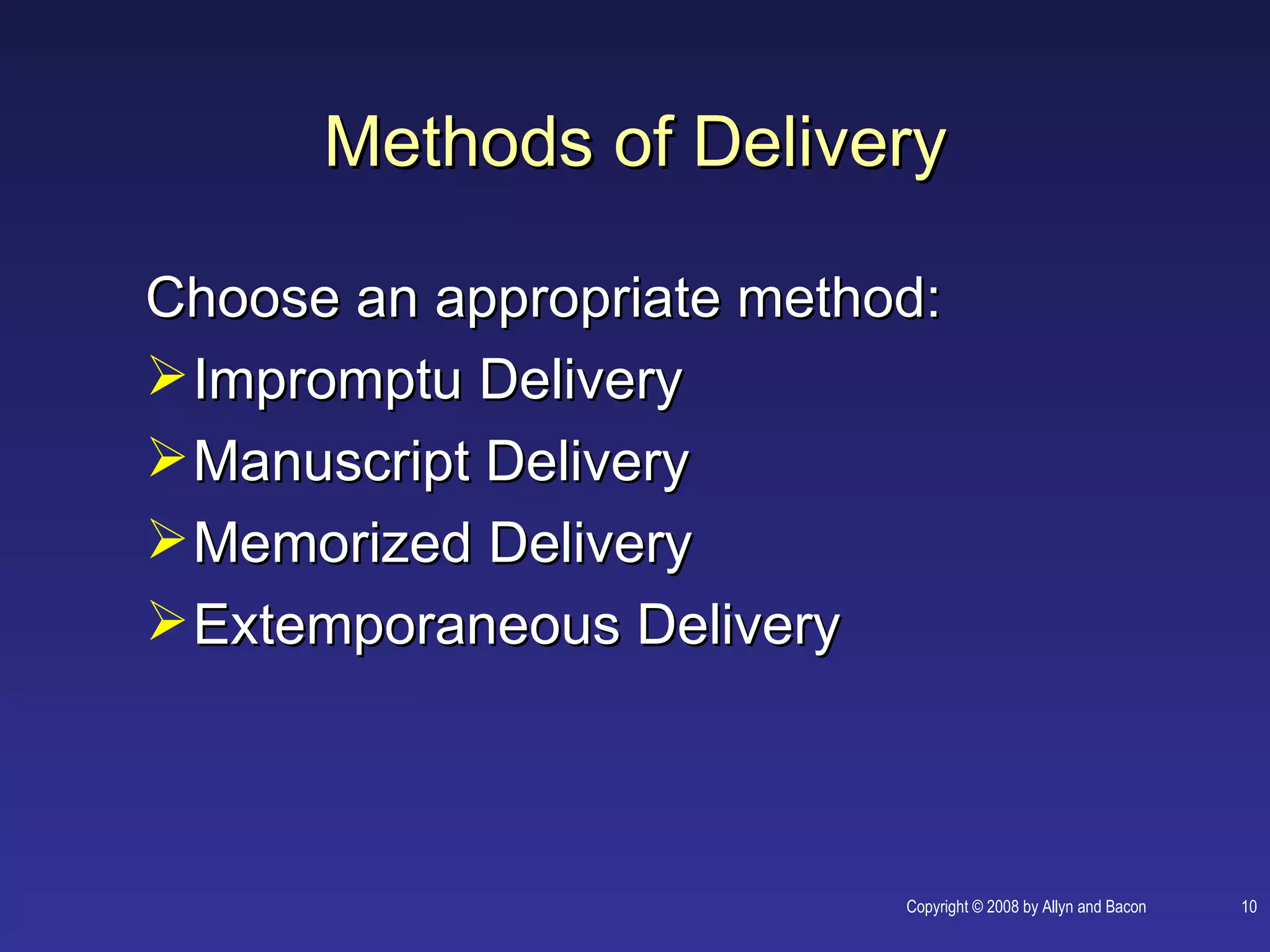
Methods of Delivery

Choose an appropriate method:
 Impromptu Delivery
 Manuscript Delivery
 Memorized Delivery
 Extemporaneous Delivery


                           Copyright © 2008 by Allyn and Bacon   10
How do vocal and physical
 aspects affect delivery?


                    Copyright © 2008 by Allyn and Bacon   11
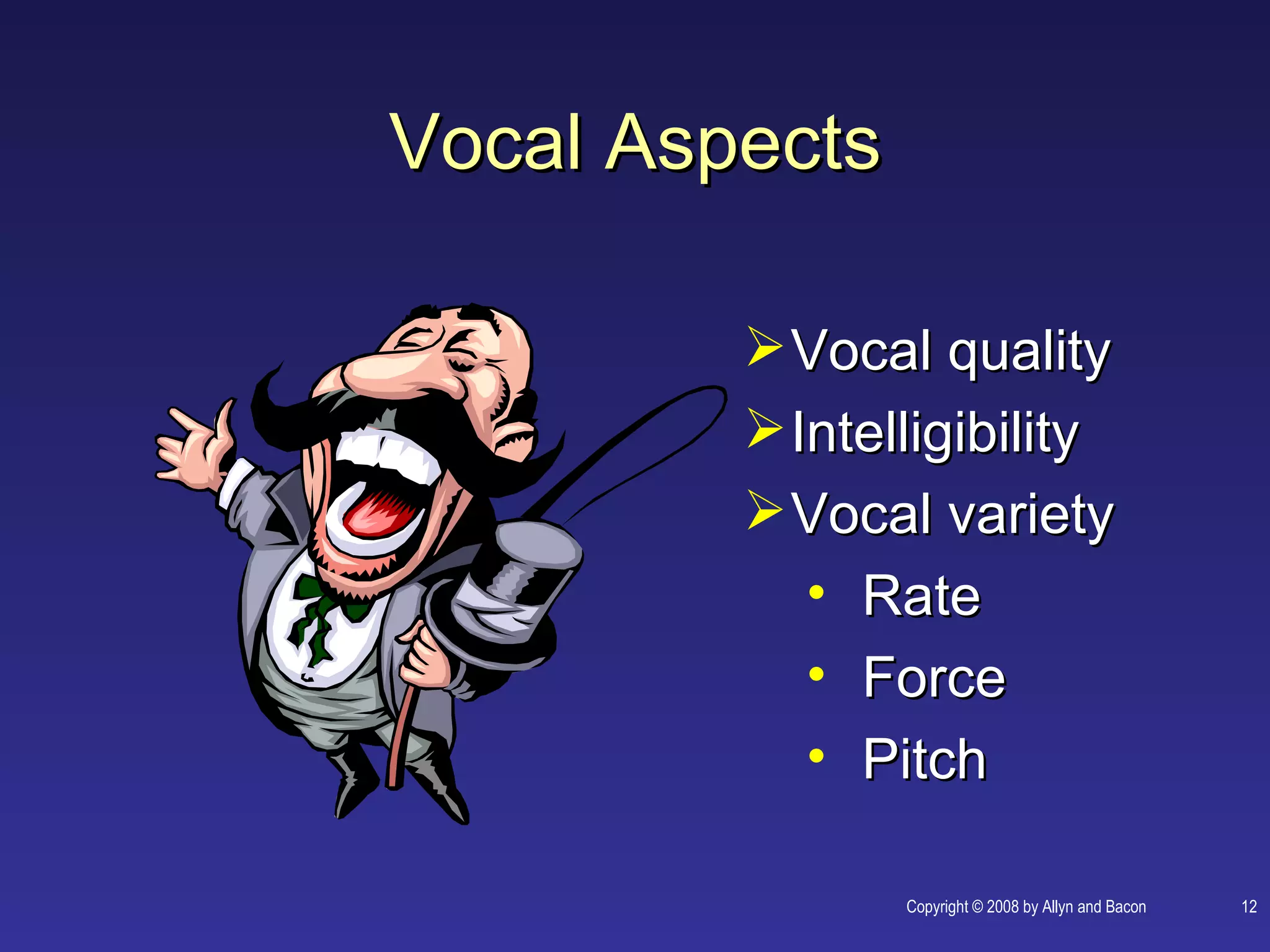
Vocal Aspects

          Vocal quality
          Intelligibility
          Vocal variety
            • Rate
            • Force
            • Pitch

                Copyright © 2008 by Allyn and Bacon   12
Physical Aspects

 Personal appearance
 Body movement
 Gestures
 Facial expressions
         e
 Eye contact


                        Copyright © 2008 by Allyn and Bacon   13
What Are Some Distracting
  Speaker Behaviors?
 rapid speech           tense, rigid
 monotone               sloppy posture
 mumbling               swaying
 awkward pauses         dancing
                         leaning on
 hands in pockets
                          podium
 playing with hair      weight shifts
 looking at floor or    crossing legs
  ceiling
                                Copyright © 2008 by Allyn and Bacon   14
Polishing Your Delivery
 Practice, practice, practice!
 Learn your speech.
 Start learning small pieces first, then practice
  the entire speech.
 Practice in the room in which you will speak.
 Practice alone, then with people.
 Focus on what you’re saying and to whom.
 Be yourself!

                                       Copyright © 2008 by Allyn and Bacon   15
What are your strengths
 and weaknesses as a
      speaker?

What are you hoping to
   improve upon?
                 Copyright © 2008 by Allyn and Bacon   16
Copyright © 2008 by Allyn and Bacon   17

Speech Delivery

  • 1.
    Copyright © 2008by Allyn and Bacon 1
  • 2.
    “All great speakers werebad speakers at first.” Ralph Waldo Emerson Copyright © 2008 by Allyn and Bacon 2
  • 3.
    Qualities of EffectiveSpeakers  Ethics  Knowledge  Preparation  Self-Confidence Copyright © 2008 by Allyn and Bacon 3
  • 4.
    Ethics: Avoiding Plagiarism Use more than one source for speech  Use a variety of sources  Avoid using language identical to original author  Cite sources prior to quoting a source  Always identify your sources  Give credit to originator of ideas Copyright © 2008 by Allyn and Bacon 4
  • 5.
    Symptoms of SpeechAnxiety  Vocal changes  Fluency problems  Dryness in mouth and throat  Tense facial expressions  Random gestures  Body movements  Nonvisible symptoms Copyright © 2008 by Allyn and Bacon 5
  • 6.
    What Causes SpeechAnxiety? FEAR? Copyright © 2008 by Allyn and Bacon 6
  • 7.
    Treating Speech Anxiety Select a topic you enjoy and know.  Be prepared and know your audience.  Be confident.  Think positively.  Practice, practice, practice. Copyright © 2008 by Allyn and Bacon 7
  • 8.
    Additional Tips forControlling Speech Anxiety  Talk with instructor for additional help.  Don’t give up!  Practice relaxation techniques - systematic desensitization.  Realize that everyone feels this way. Copyright © 2008 by Allyn and Bacon 8
  • 9.
    How Do YouDeliver a Winning Speech? Copyright © 2008 by Allyn and Bacon 9
  • 10.
    Methods of Delivery Choosean appropriate method:  Impromptu Delivery  Manuscript Delivery  Memorized Delivery  Extemporaneous Delivery Copyright © 2008 by Allyn and Bacon 10
  • 11.
    How do vocaland physical aspects affect delivery? Copyright © 2008 by Allyn and Bacon 11
  • 12.
    Vocal Aspects  Vocal quality  Intelligibility  Vocal variety • Rate • Force • Pitch Copyright © 2008 by Allyn and Bacon 12
  • 13.
    Physical Aspects  Personalappearance  Body movement  Gestures  Facial expressions e  Eye contact Copyright © 2008 by Allyn and Bacon 13
  • 14.
    What Are SomeDistracting Speaker Behaviors?  rapid speech  tense, rigid  monotone  sloppy posture  mumbling  swaying  awkward pauses  dancing  leaning on  hands in pockets podium  playing with hair  weight shifts  looking at floor or  crossing legs ceiling Copyright © 2008 by Allyn and Bacon 14
  • 15.
    Polishing Your Delivery Practice, practice, practice!  Learn your speech.  Start learning small pieces first, then practice the entire speech.  Practice in the room in which you will speak.  Practice alone, then with people.  Focus on what you’re saying and to whom.  Be yourself! Copyright © 2008 by Allyn and Bacon 15
  • 16.
    What are yourstrengths and weaknesses as a speaker? What are you hoping to improve upon? Copyright © 2008 by Allyn and Bacon 16
  • 17.
    Copyright © 2008by Allyn and Bacon 17