Definition
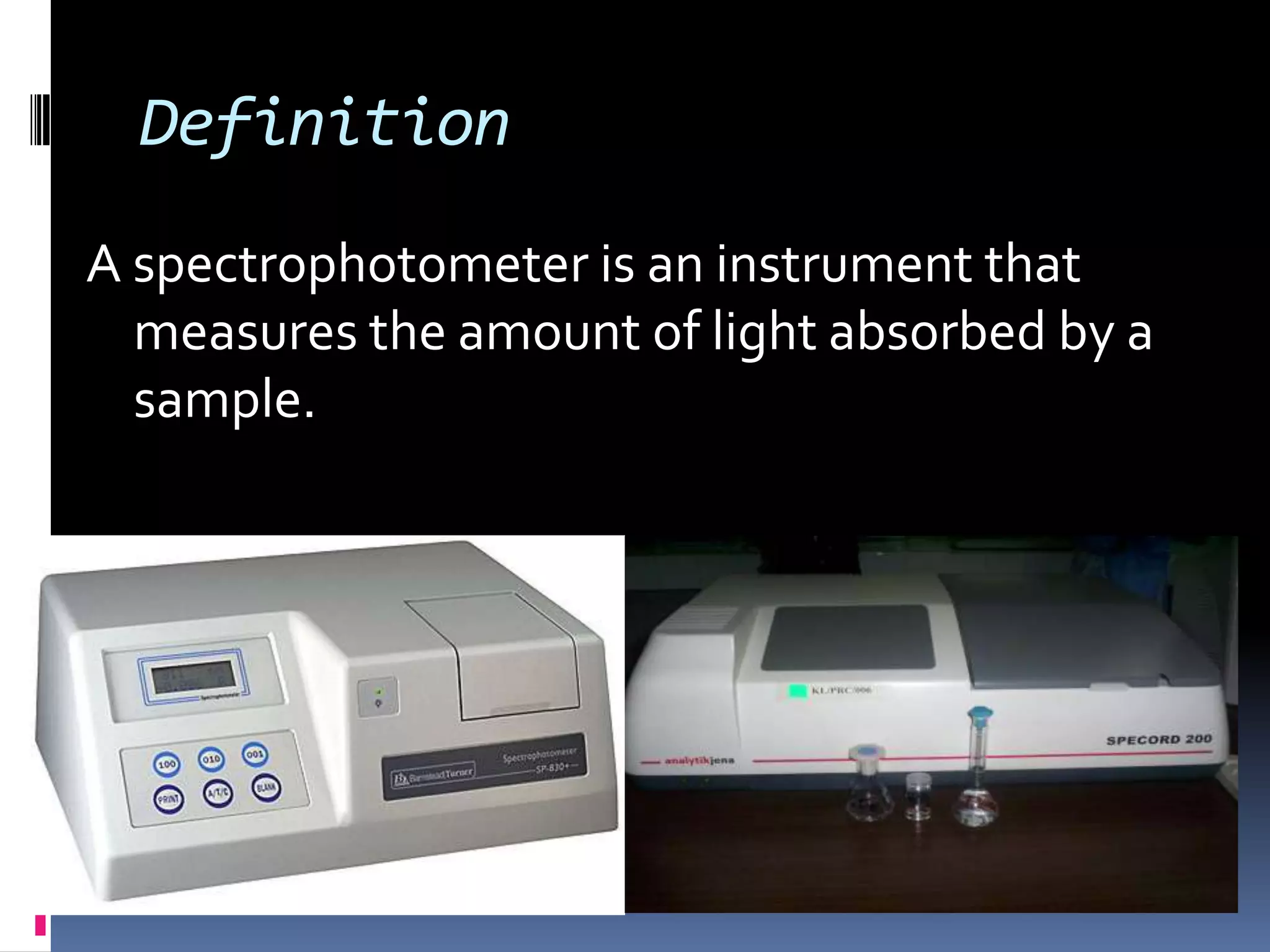
A spectrophotometer is an instrument that
measures the amount of light absorbed by a
sample.
History
 In Older times, it took weeks for the results to
come out and, most of the time, there was
only 25 percent accuracy
 It was rather depressing for these scientists
because quick results are very important to
them, and there wasn’t any good laboratory
equipment at that time to make the process
faster.
Cont…
 A scientist named Arnold J. Beckman and
his colleagues at the National Technologies
Laboratory (NTL) invented the Beckman DU
spectrophotometer in 1940.
 Results come through simple process within
few minutes.
 Results were 99.99 % accurate.
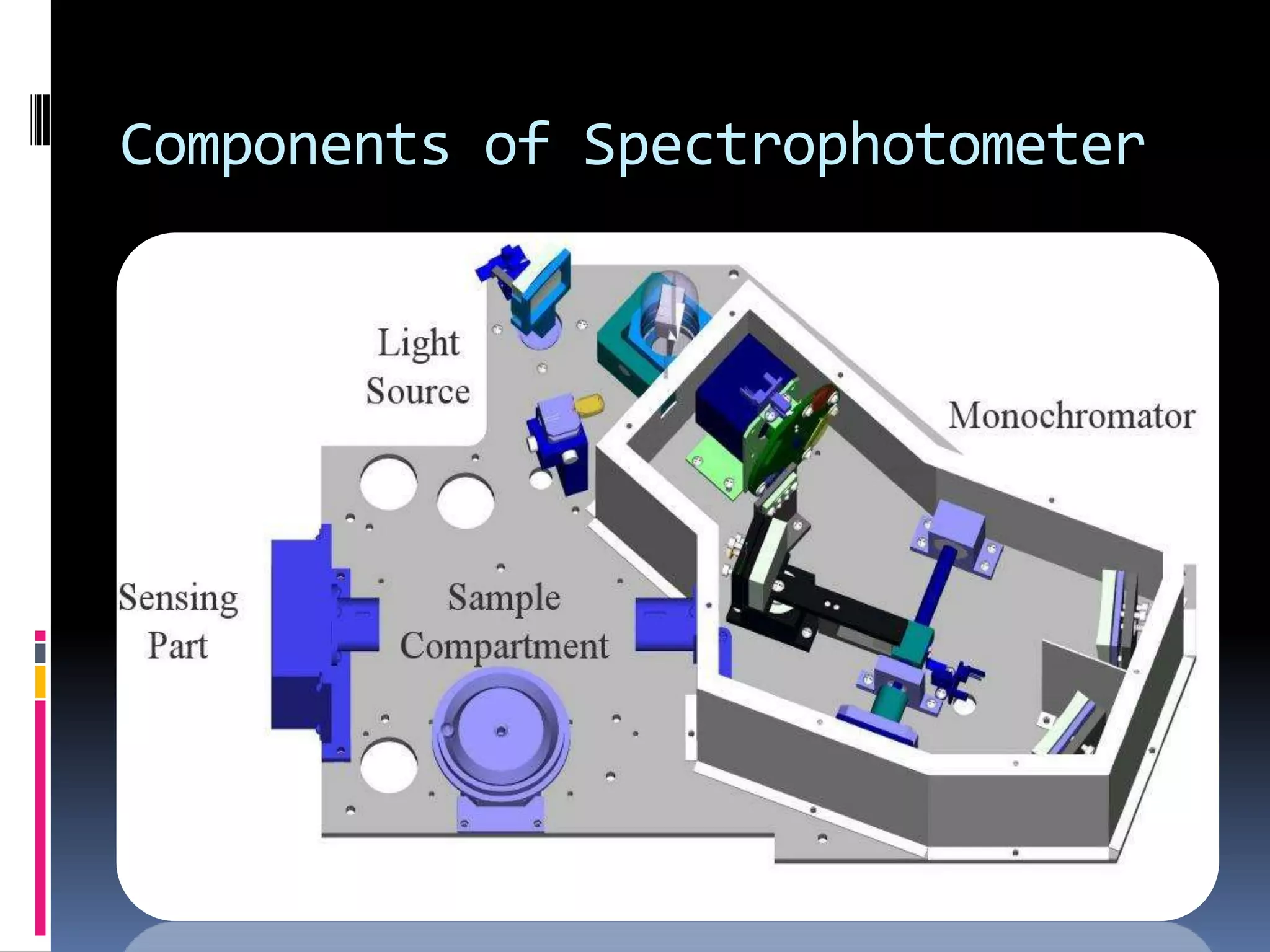
Components of Spectrophotometer
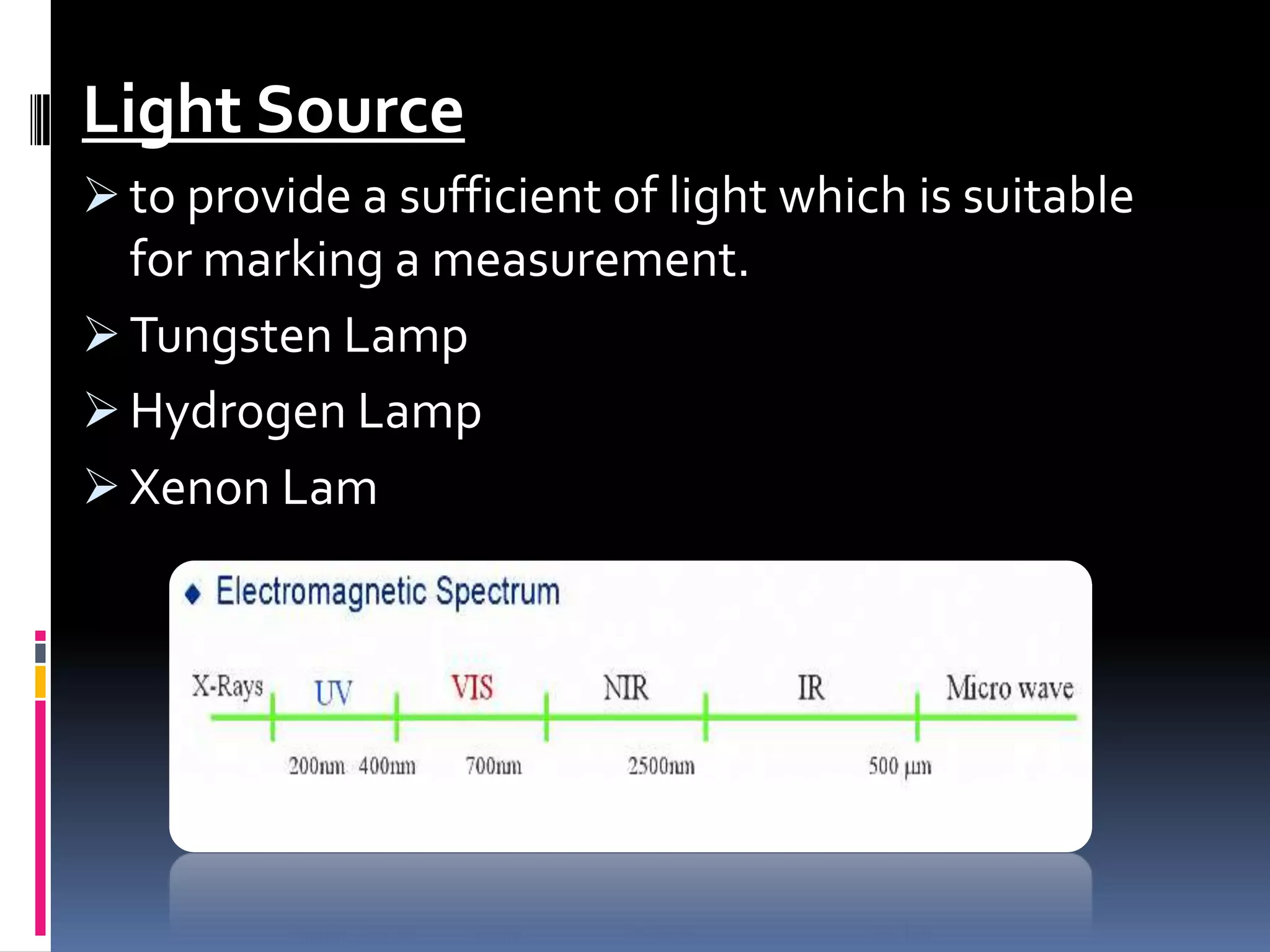
Light Source
 to provide a sufficient of light which is suitable
for marking a measurement.
 Tungsten Lamp
 Hydrogen Lamp
 Xenon Lam
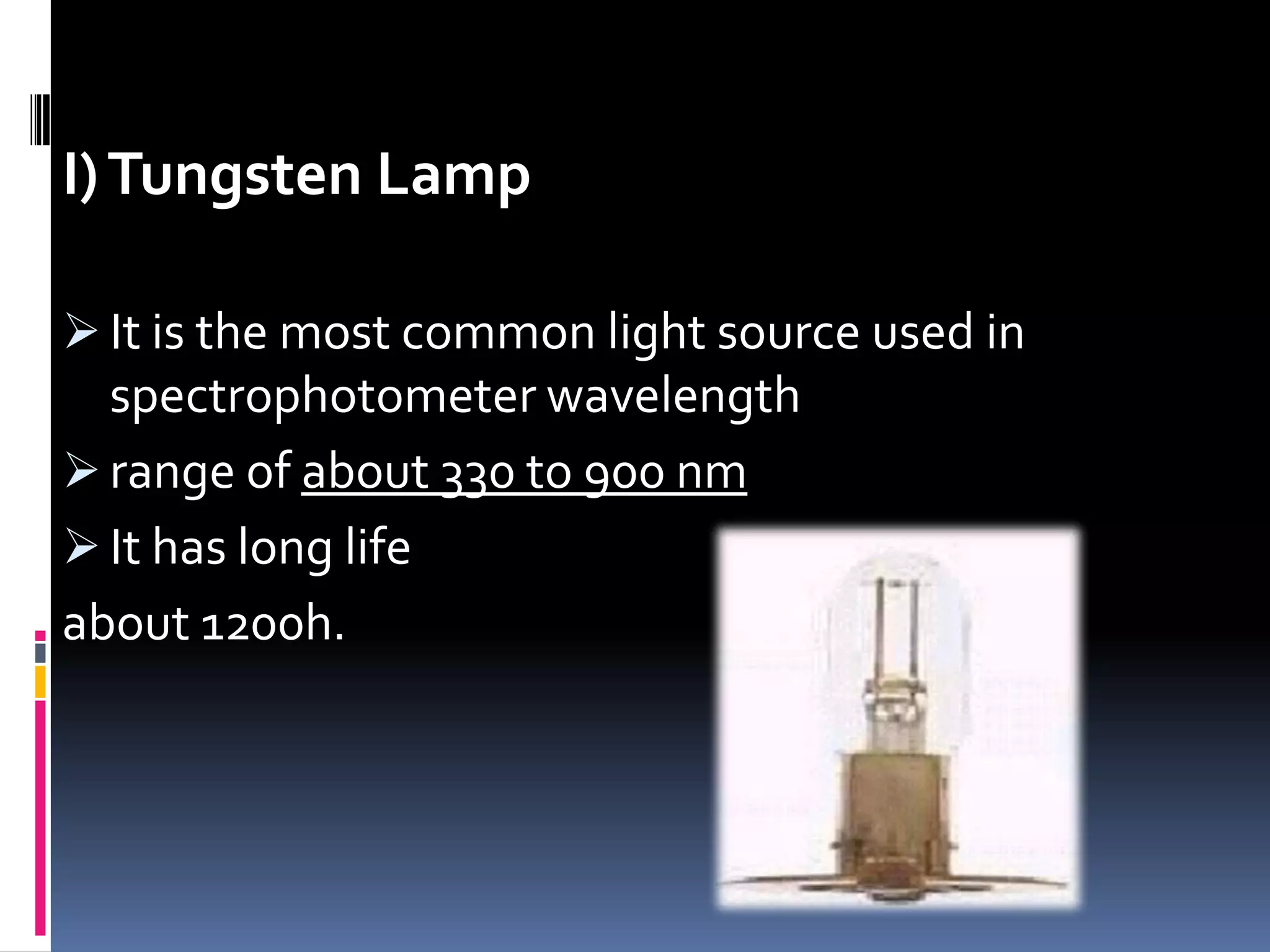
I)Tungsten Lamp
 It is the most common light source used in
spectrophotometer wavelength
 range of about 330 to 900 nm
 It has long life
about 1200h.
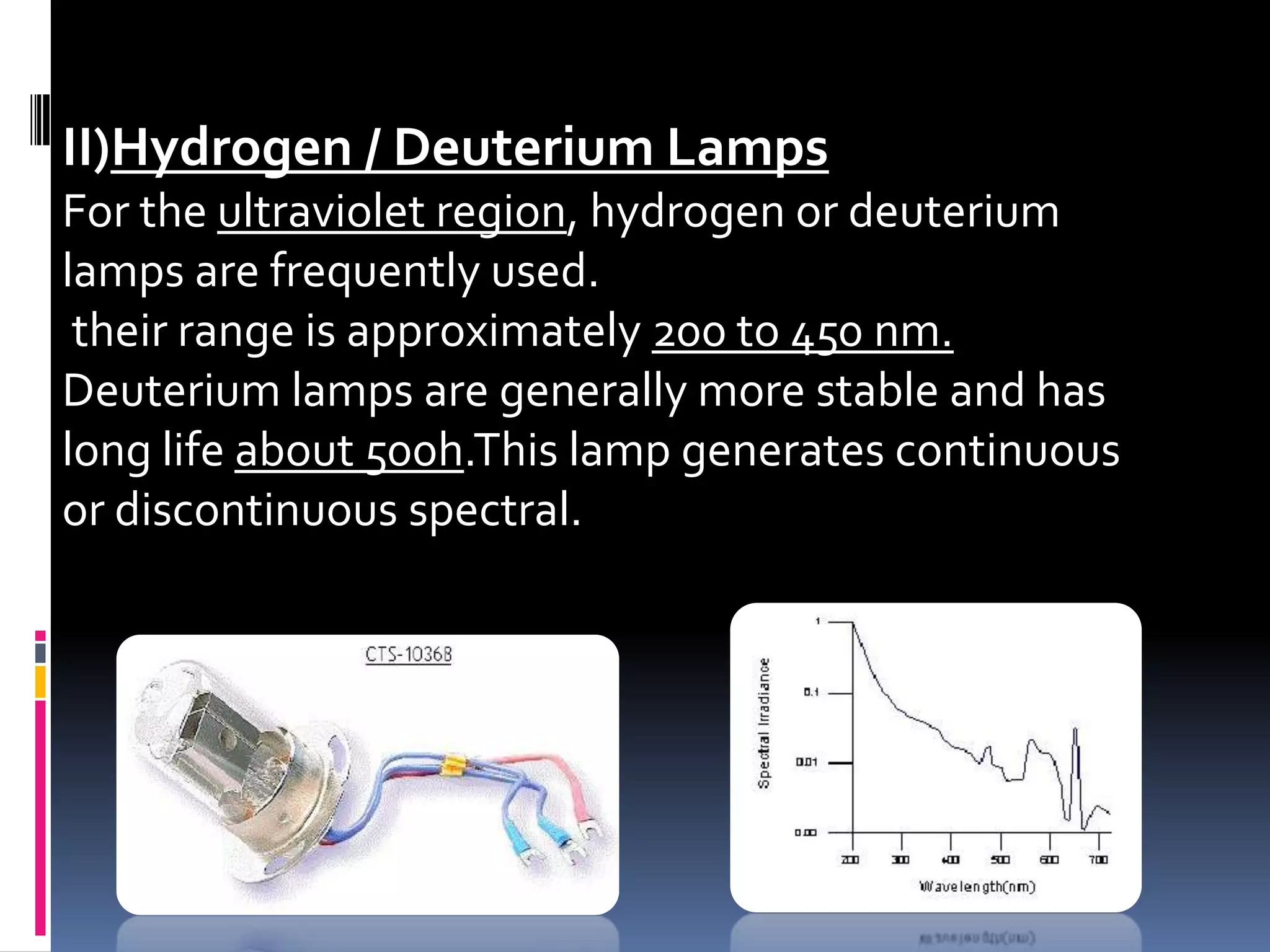
II)Hydrogen / Deuterium Lamps
For the ultraviolet region, hydrogen or deuterium
lamps are frequently used.
their range is approximately 200 to 450 nm.
Deuterium lamps are generally more stable and has
long life about 500h.This lamp generates continuous
or discontinuous spectral.
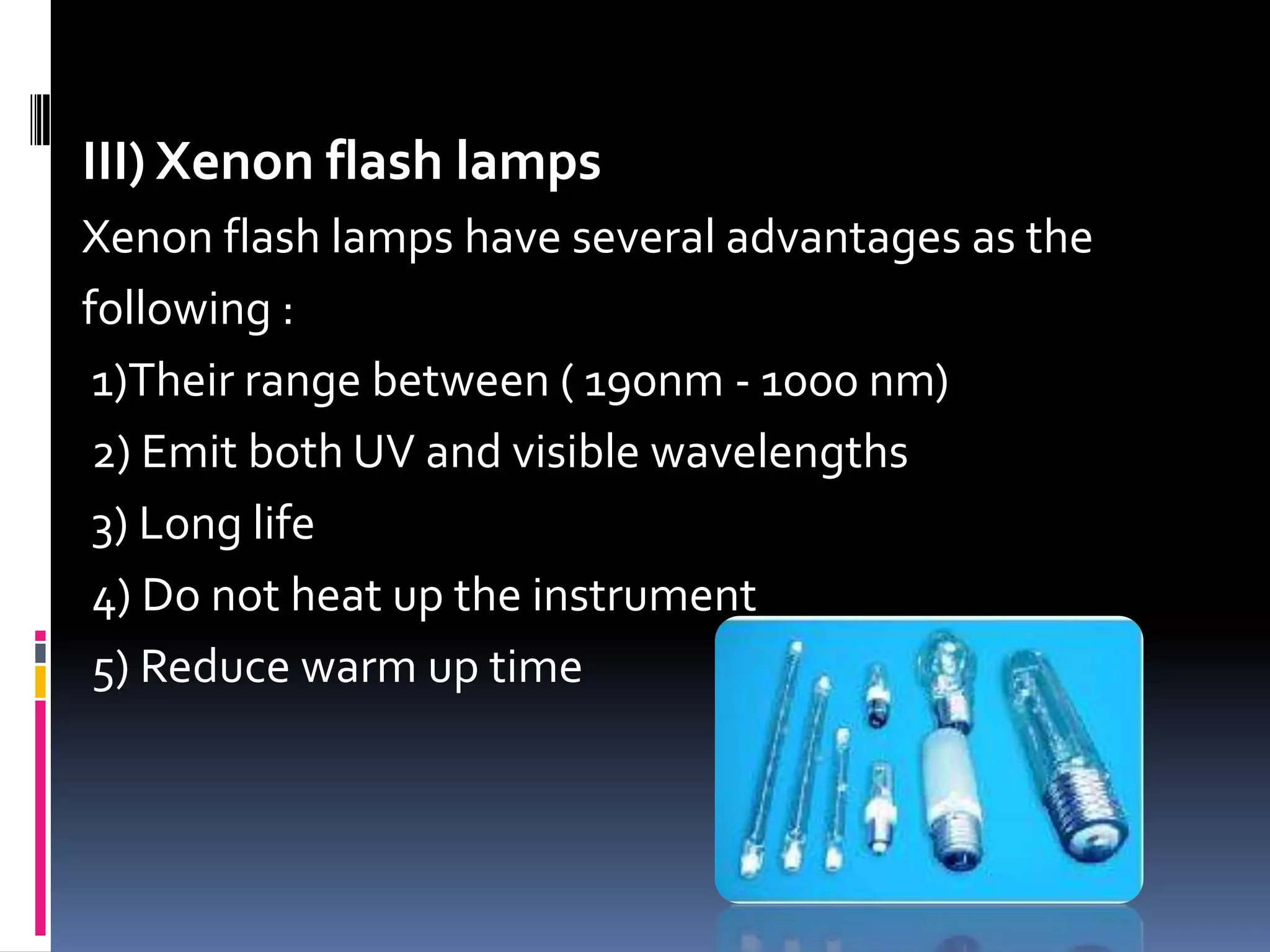
III) Xenon flash lamps
Xenon flash lamps have several advantages as the
following :
1)Their range between ( 190nm - 1000 nm)
2) Emit both UV and visible wavelengths
3) Long life
4) Do not heat up the instrument
5) Reduce warm up time
Dispersion devices
Dispersion devices causes a different wavelength of light to be
dispersion at different angles.
Types of Dispersion devices used are
 Prism
 Filters
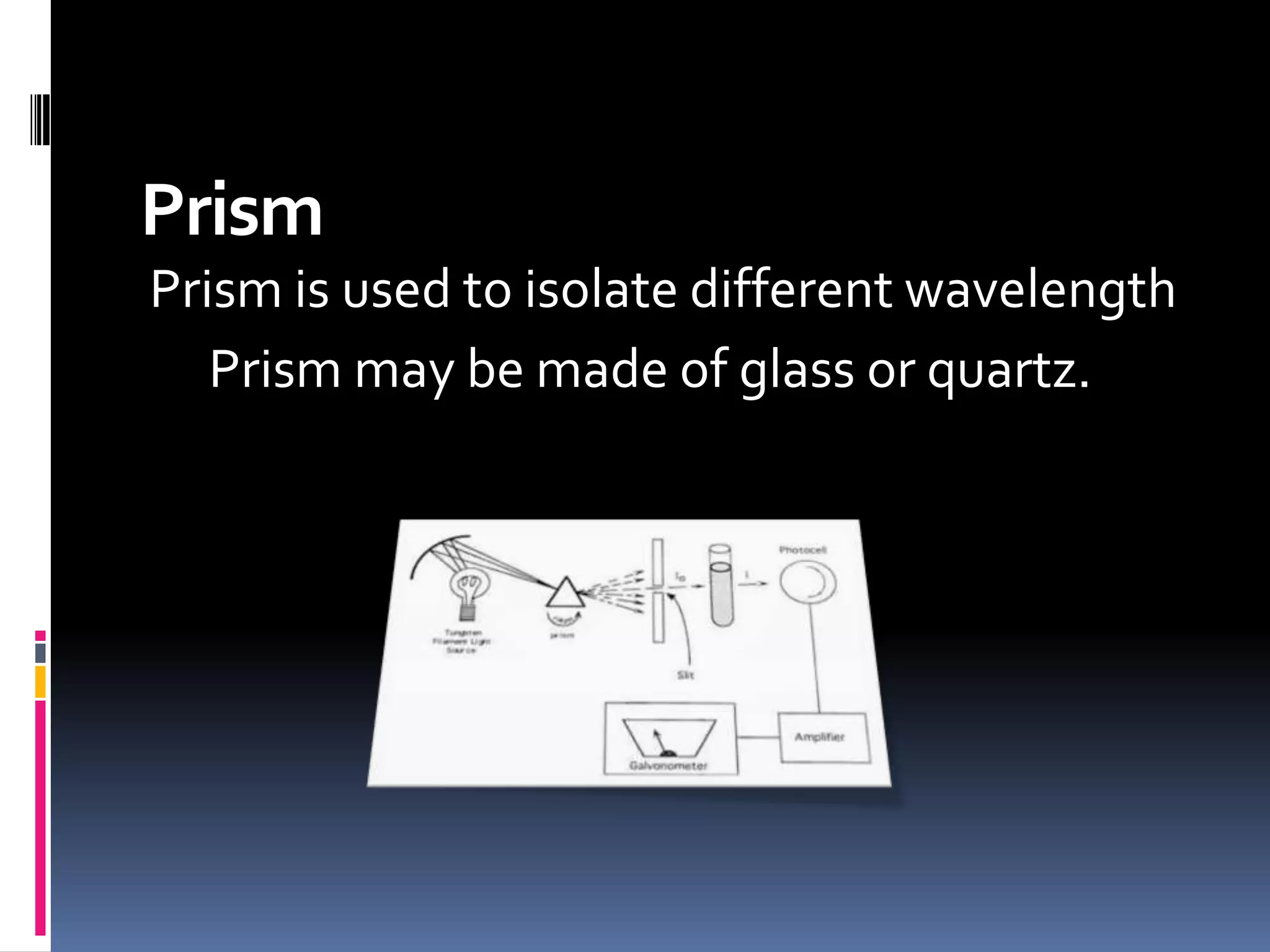
Prism
Prism is used to isolate different wavelength
Prism may be made of glass or quartz.
Filters
Filters separate different parts of the electromagnetic
spectrum by absorbing or reflecting certain
wavelengths and transmitting other wavelengths.
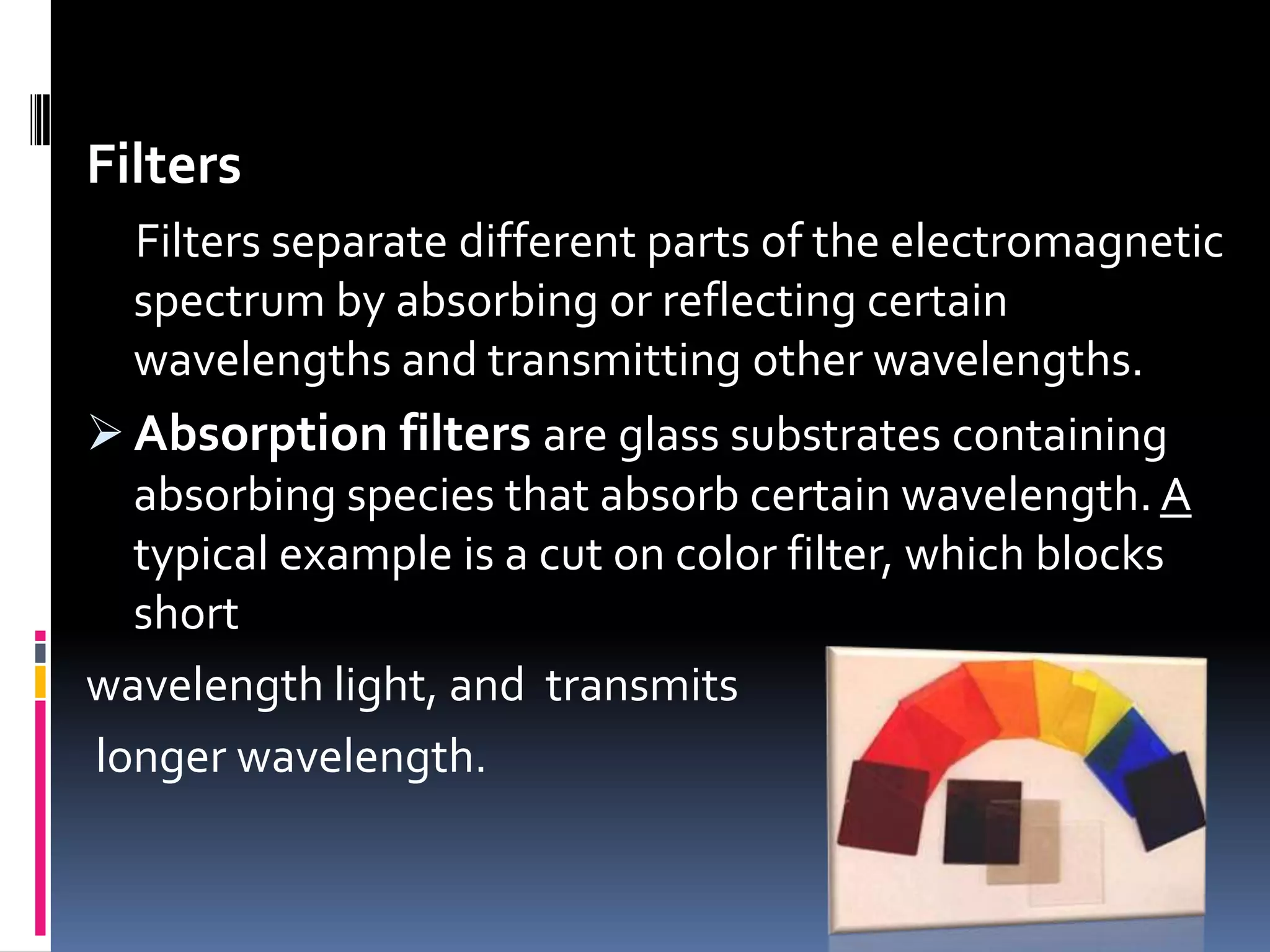
 Absorption filters are glass substrates containing
absorbing species that absorb certain wavelength. A
typical example is a cut on color filter, which blocks
short
wavelength light, and transmits
longer wavelength.
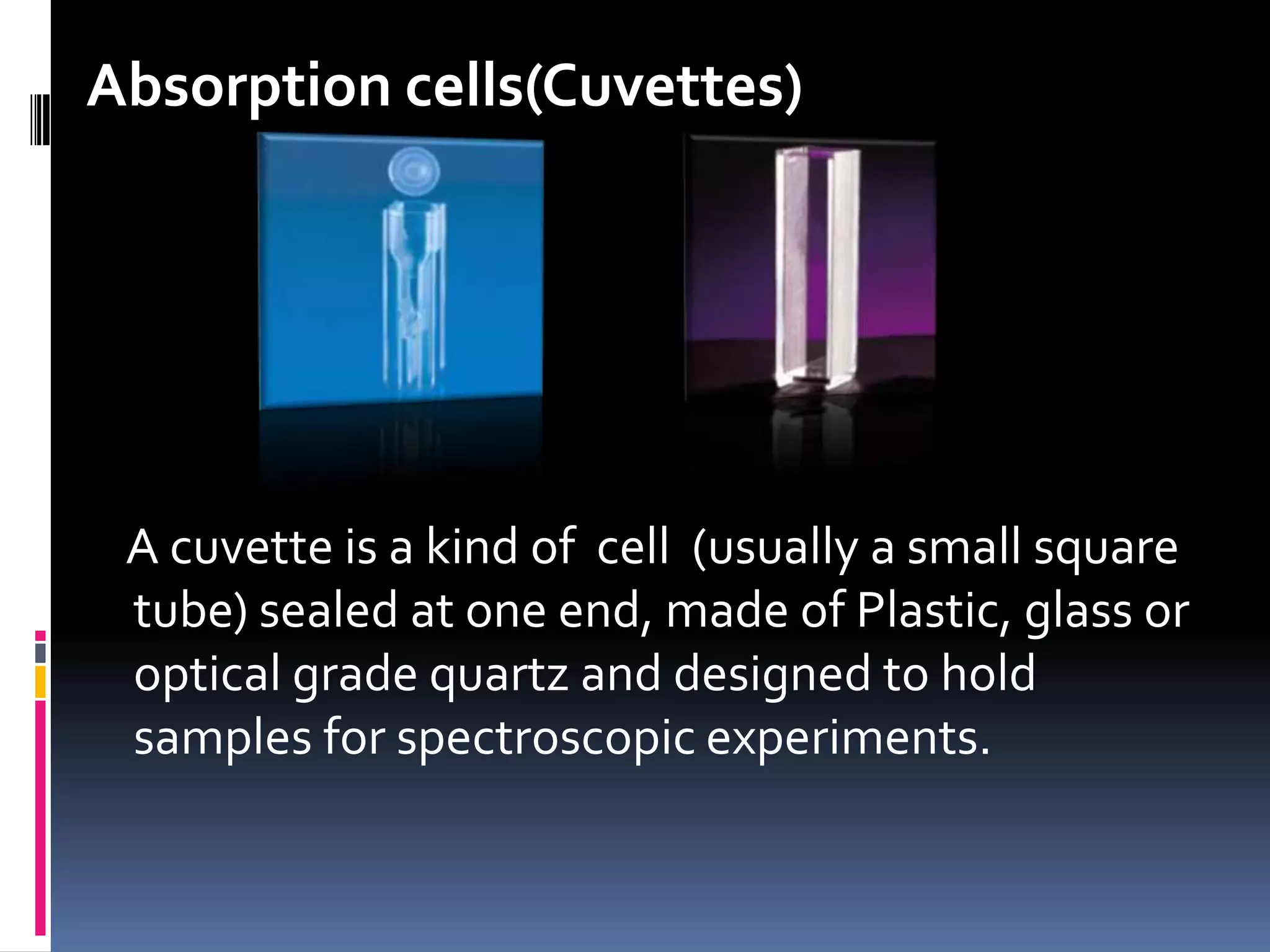
Absorption cells(Cuvettes)
A cuvette is a kind of cell (usually a small square
tube) sealed at one end, made of Plastic, glass or
optical grade quartz and designed to hold
samples for spectroscopic experiments.
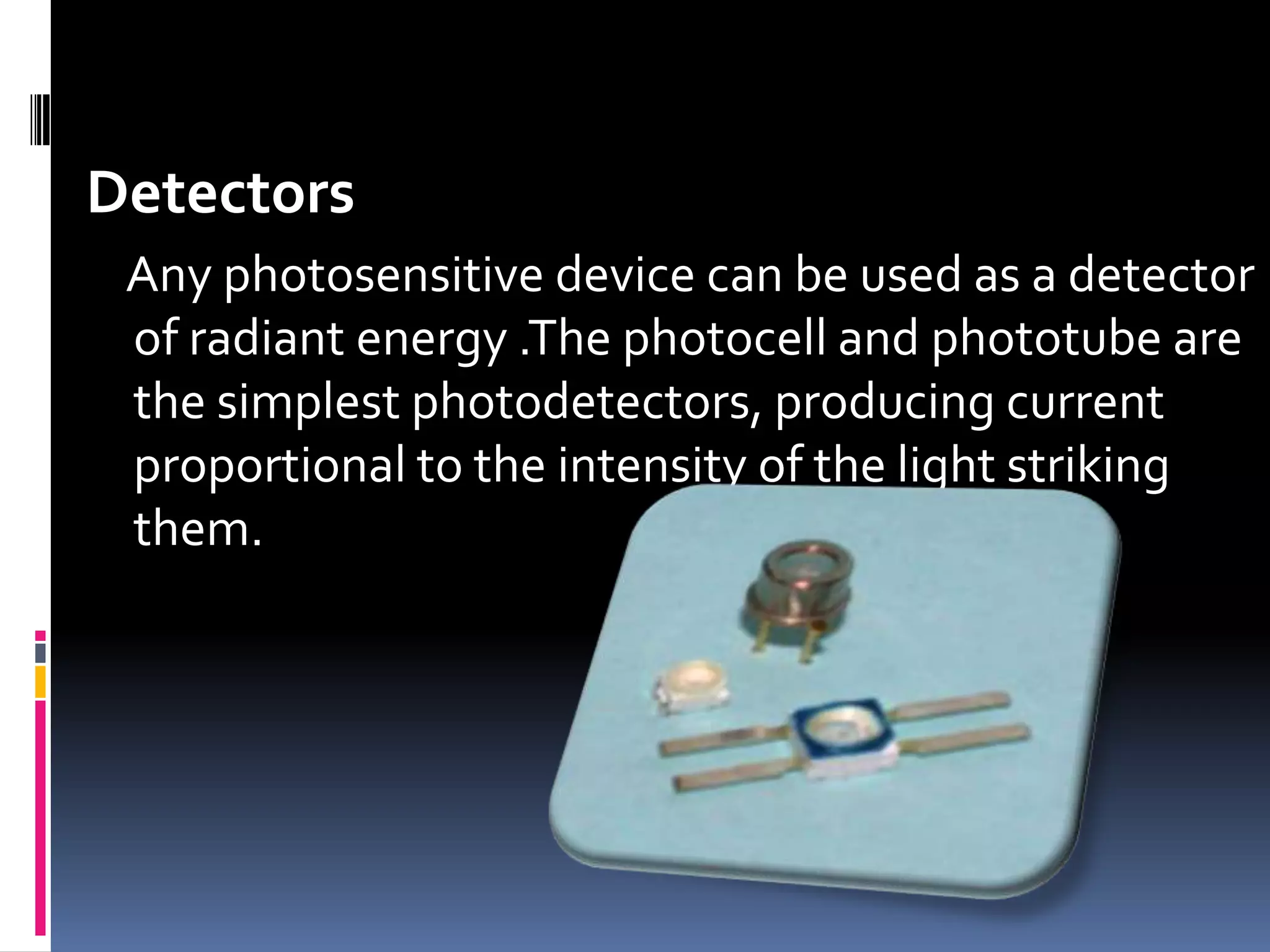
Detectors
Any photosensitive device can be used as a detector
of radiant energy .The photocell and phototube are
the simplest photodetectors, producing current
proportional to the intensity of the light striking
them.
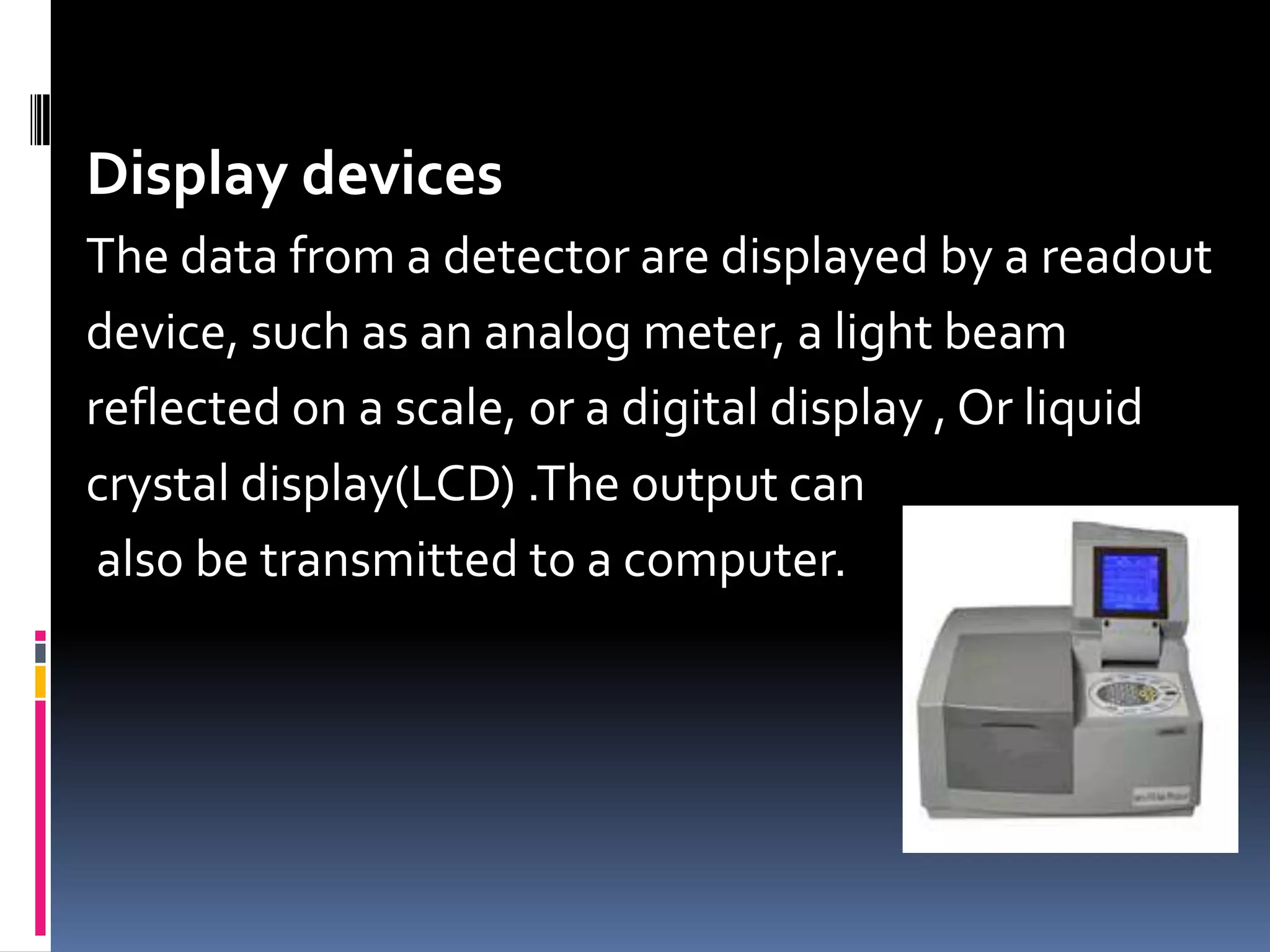
Display devices
The data from a detector are displayed by a readout
device, such as an analog meter, a light beam
reflected on a scale, or a digital display , Or liquid
crystal display(LCD) .The output can
also be transmitted to a computer.
Uses of Spectrophotometer
 To determines the absorbance or transmission of
characteristic wavelengths of radiant energy (light) by
a chemical species in solution.
 Identify organic compounds by determining the
absorption maximum.
 Used for color determination within the spectral range
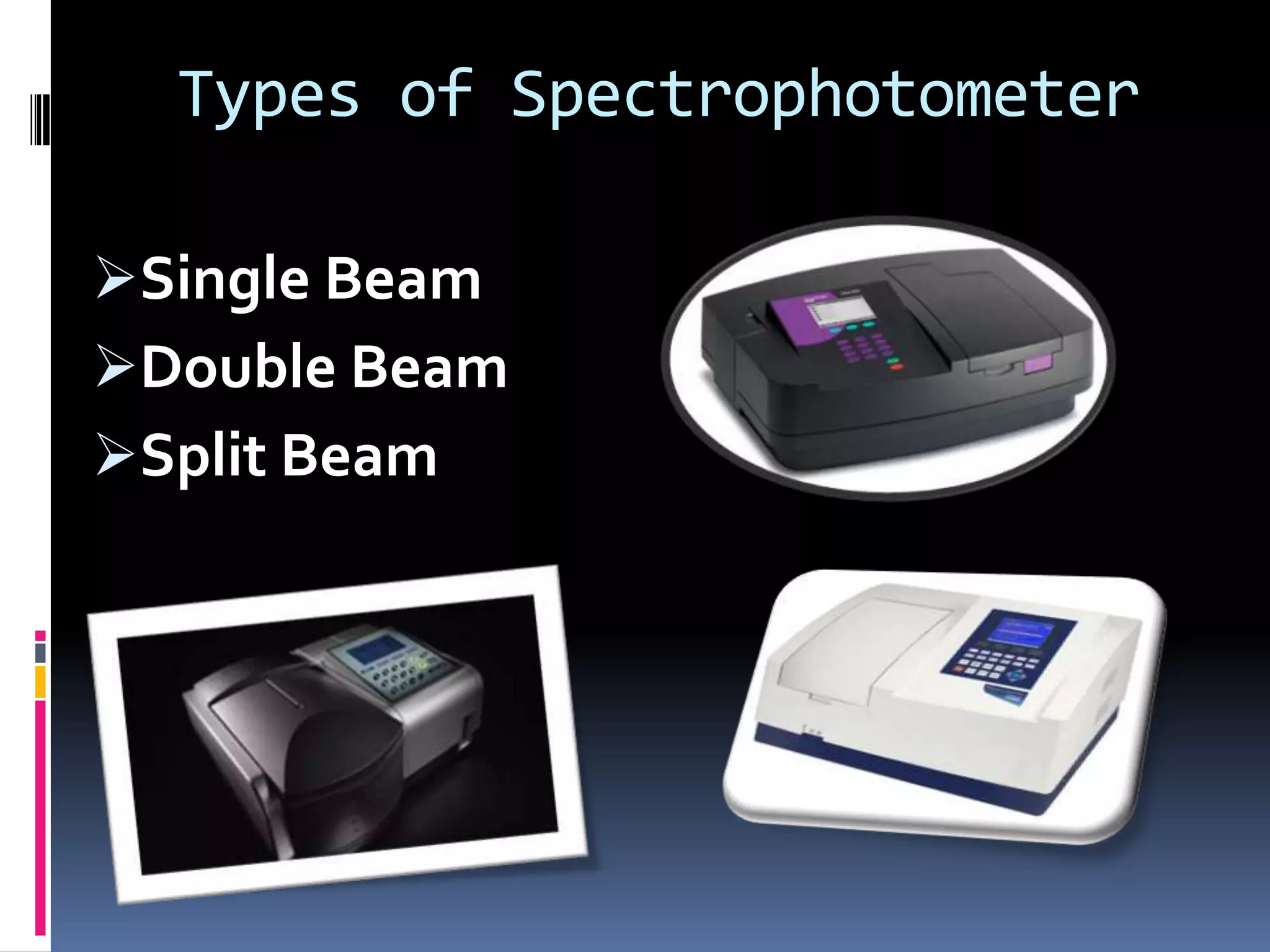
Types of Spectrophotometer
Single Beam
Double Beam
Split Beam
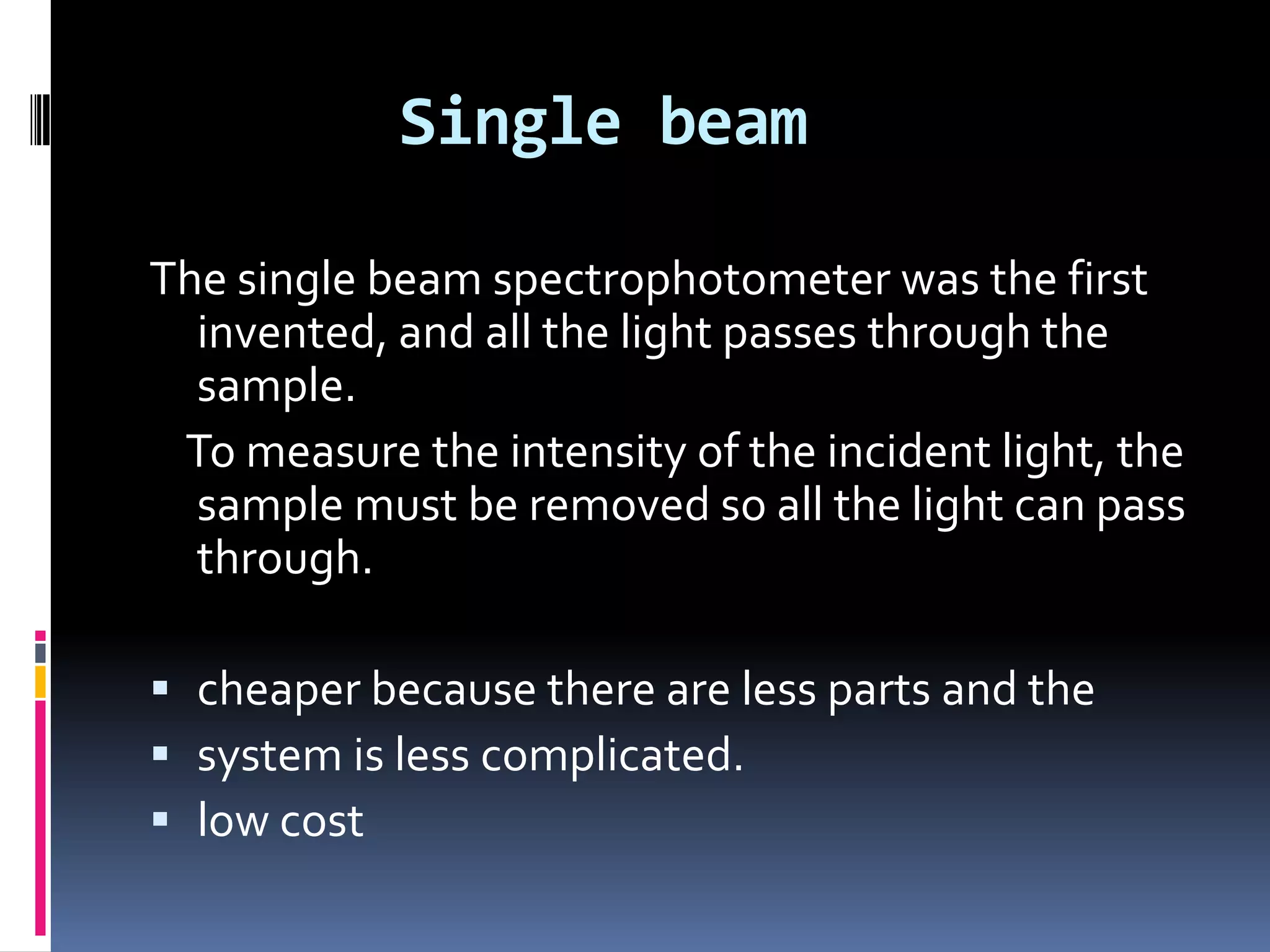
Single beam
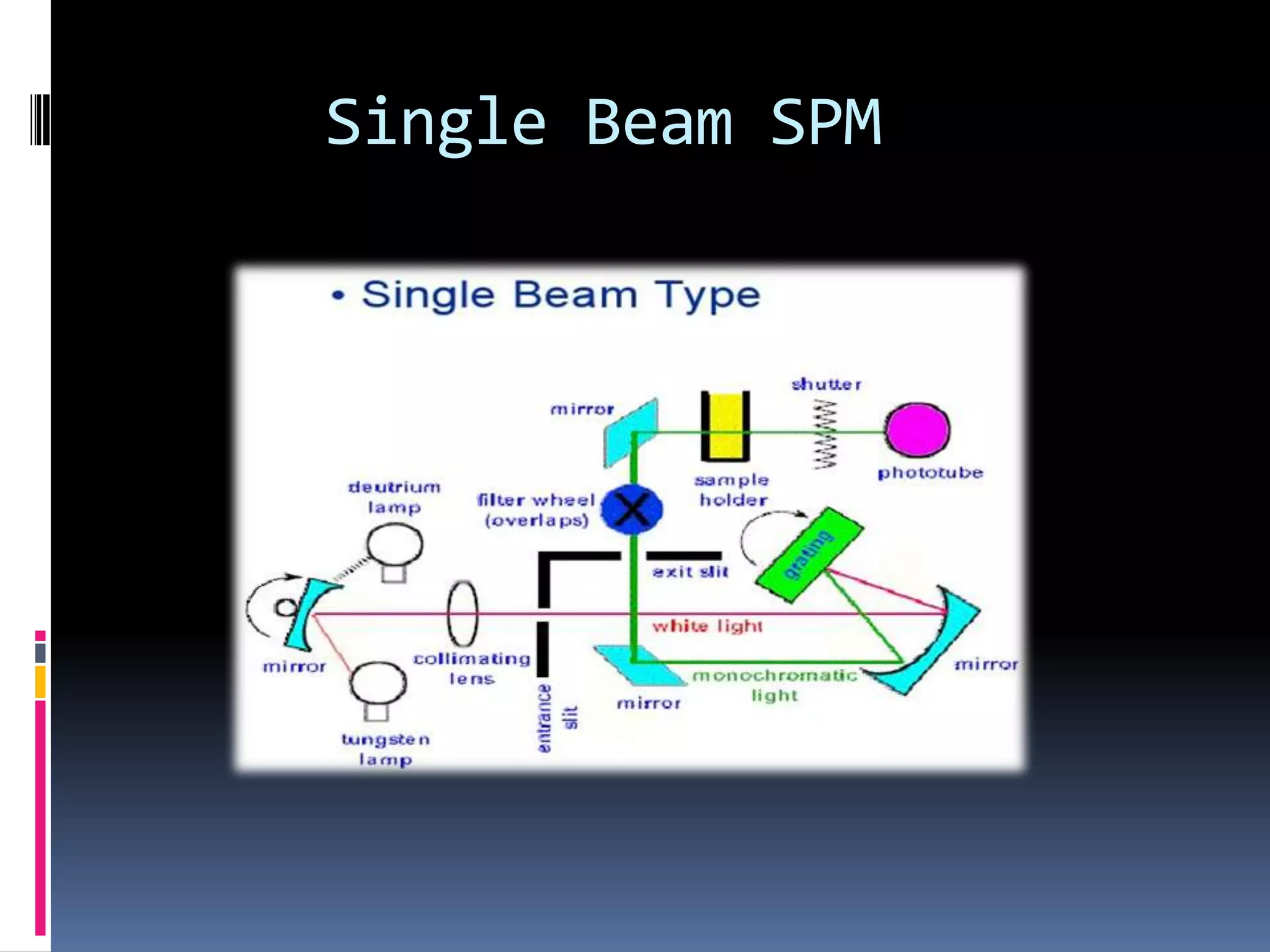
The single beam spectrophotometer was the first
invented, and all the light passes through the
sample.
To measure the intensity of the incident light, the
sample must be removed so all the light can pass
through.
 cheaper because there are less parts and the
 system is less complicated.
 low cost
Single Beam SPM
Double beam
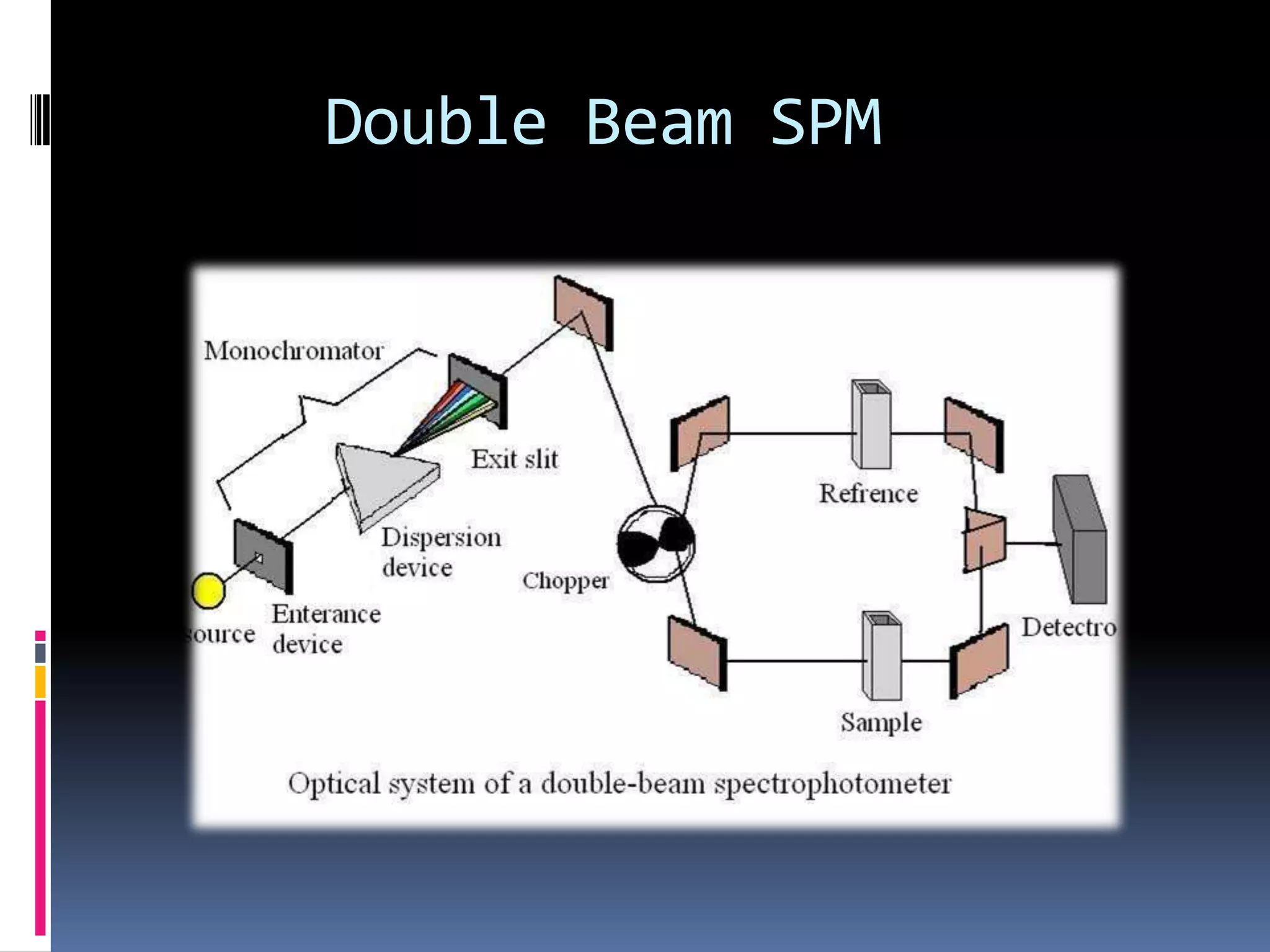
 A double beam spectrophotometer compares
the light intensity between two light paths, one
path containing a reference sample and the
other the test sample.
 Measurements from Double beam instruments
are easier and more stable.
Double Beam SPM
 The Advantage of the double beam design
Is high stability because reference and sample are
measured virtually at the same moment in time.
 The disadvantages are higher cost, lower
sensitivity because throughput of light is poorer
because of the more complex optics and lower
reliability because of the greater complexity.
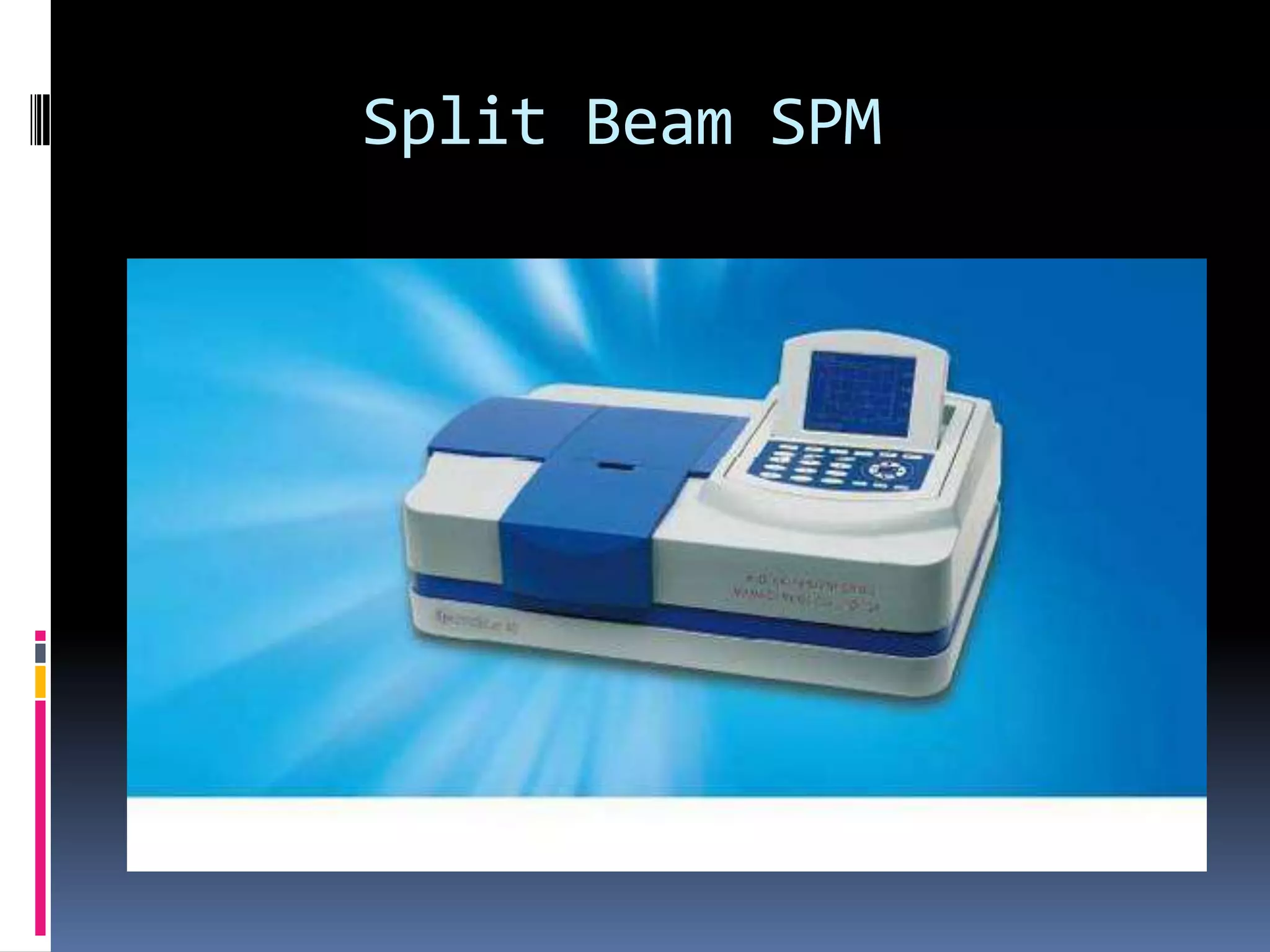
3)Split Beam
 similar to the double beam
spectrophotometer but it uses a beam splitter
instead of a chopper to send light along the
blank
 sample paths simultaneously to two separate
but identical detectors
Split Beam SPM

Spectrophotometer

  • 2.
    Definition A spectrophotometer isan instrument that measures the amount of light absorbed by a sample.
  • 3.
    History  In Oldertimes, it took weeks for the results to come out and, most of the time, there was only 25 percent accuracy  It was rather depressing for these scientists because quick results are very important to them, and there wasn’t any good laboratory equipment at that time to make the process faster.
  • 4.
    Cont…  A scientistnamed Arnold J. Beckman and his colleagues at the National Technologies Laboratory (NTL) invented the Beckman DU spectrophotometer in 1940.  Results come through simple process within few minutes.  Results were 99.99 % accurate.
  • 5.
  • 6.
    Light Source  toprovide a sufficient of light which is suitable for marking a measurement.  Tungsten Lamp  Hydrogen Lamp  Xenon Lam
  • 7.
    I)Tungsten Lamp  Itis the most common light source used in spectrophotometer wavelength  range of about 330 to 900 nm  It has long life about 1200h.
  • 8.
    II)Hydrogen / DeuteriumLamps For the ultraviolet region, hydrogen or deuterium lamps are frequently used. their range is approximately 200 to 450 nm. Deuterium lamps are generally more stable and has long life about 500h.This lamp generates continuous or discontinuous spectral.
  • 9.
    III) Xenon flashlamps Xenon flash lamps have several advantages as the following : 1)Their range between ( 190nm - 1000 nm) 2) Emit both UV and visible wavelengths 3) Long life 4) Do not heat up the instrument 5) Reduce warm up time
  • 10.
    Dispersion devices Dispersion devicescauses a different wavelength of light to be dispersion at different angles. Types of Dispersion devices used are  Prism  Filters
  • 11.
    Prism Prism is usedto isolate different wavelength Prism may be made of glass or quartz.
  • 12.
    Filters Filters separate differentparts of the electromagnetic spectrum by absorbing or reflecting certain wavelengths and transmitting other wavelengths.  Absorption filters are glass substrates containing absorbing species that absorb certain wavelength. A typical example is a cut on color filter, which blocks short wavelength light, and transmits longer wavelength.
  • 13.
    Absorption cells(Cuvettes) A cuvetteis a kind of cell (usually a small square tube) sealed at one end, made of Plastic, glass or optical grade quartz and designed to hold samples for spectroscopic experiments.
  • 14.
    Detectors Any photosensitive devicecan be used as a detector of radiant energy .The photocell and phototube are the simplest photodetectors, producing current proportional to the intensity of the light striking them.
  • 15.
    Display devices The datafrom a detector are displayed by a readout device, such as an analog meter, a light beam reflected on a scale, or a digital display , Or liquid crystal display(LCD) .The output can also be transmitted to a computer.
  • 16.
    Uses of Spectrophotometer To determines the absorbance or transmission of characteristic wavelengths of radiant energy (light) by a chemical species in solution.  Identify organic compounds by determining the absorption maximum.  Used for color determination within the spectral range
  • 17.
    Types of Spectrophotometer SingleBeam Double Beam Split Beam
  • 18.
    Single beam The singlebeam spectrophotometer was the first invented, and all the light passes through the sample. To measure the intensity of the incident light, the sample must be removed so all the light can pass through.  cheaper because there are less parts and the  system is less complicated.  low cost
  • 19.
  • 20.
    Double beam  Adouble beam spectrophotometer compares the light intensity between two light paths, one path containing a reference sample and the other the test sample.  Measurements from Double beam instruments are easier and more stable.
  • 21.
  • 22.
     The Advantageof the double beam design Is high stability because reference and sample are measured virtually at the same moment in time.  The disadvantages are higher cost, lower sensitivity because throughput of light is poorer because of the more complex optics and lower reliability because of the greater complexity.
  • 23.
    3)Split Beam  similarto the double beam spectrophotometer but it uses a beam splitter instead of a chopper to send light along the blank  sample paths simultaneously to two separate but identical detectors
  • 24.