specila penal law discussion for JD program students
1.
SPECIAL PENAL LAWS
FiscalFreddie Nojara
San Sebastian College of Law-Recoletos Manila
Prepared by: Ms. Monica May R. Ramos/Ariane Aquino
I. Nature and Concept
Criminal Law – A branch of municipal law which defines crimes, treats of their nature and
provides for their punishment.
Sources of Criminal Law
1. The Revised Penal Code
2. Special Penal Laws – Acts enacted of the Philippine Legislature punishing offenses or
omissions
II. Mala in se v Mala Prohibita (Bar 1997, 2003, 2005)
Question: Distinguish between crimes mala in se and mala prohibita.
Crimes mala in se are felonious acts committed by dolo or culpa as defined in the Revised
Penal Code. Lack of criminal intent is a valid defense, except when the crime results from
criminal negligence. On the other hand, crimes mala prohibita are those considered wrong only
because they are prohibited by statute. They constitute violations of mere rules of convenience
designed to secure a more orderly regulation of the affairs of society.
Question: May an act be both mala in se and mala prohibita?
Yes, an act may be malum in se and malum prohibitum at the same time. In People v. Sunico,
et aL. (CA 50 OG 5880) it was held that the omission or failure of election inspectors and poll
clerks to include a voter's name in the registry list of voters is wrong per se because it
disenfranchises a voter of his right to vote. In this regard it is considered as malum in se. Since
it is punished under a special law (Sec. 101 and 103, Revised Election Code), it is considered
malum prohibitum.
Note: Test to determine if violation of special law is malum prohibitum or malum in se
Analyze the violation: Is it wrong because there is a law prohibiting it or punishing it as such?
If you remove the law, will the act still be wrong?
If the wording of the law punishing the crime uses the word “willfully”, then malice must be
proven. Where malice is a factor, good faith is a defense.
In violation of special law, the act constituting the crime is a prohibited act. Therefore culpa is
not a basis of liability, unless the special law punishes an omission.
When given a problem, take note if the crime is a violation of the Revised Penal Code or a
special law.
III. Distinction between crimes punished under the Revised Penal Code and crimes
punished under special laws
1
2.
RPC SPL
As tomoral trait of the offender
moral trait of the offender is
considered. This is why
liability would only arise
when there is dolo or culpa
in the commission of the
punishable act.
not considered; it is enough that
the prohibited act was
voluntarily done.
As to use of good faith as defense
valid defense; unless the
crime is the result of culpa
not a defense
As to degree of accomplishment of the crime
taken into account in
punishing the offender;
thus, there are attempted,
frustrated, and
consummated stages in the
commission of the crime.
The act gives rise to a crime
only when it is consummated;
there are no attempted or
frustrated stages, unless the
special law expressly penalize
the mere attempt or frustration
of the crime.
As to mitigating and aggravating circumstances
mitigating and aggravating
circumstances are taken
into account in imposing the
penalty since the moral trait
of the offender is
considered.
mitigating and aggravating
circumstances are not taken
into account in imposing the
penalty.
As to degree of participation
there is more than one
offender, the degree of
participation of each in the
commission of the crime is
taken into account in
imposing the penalty; thus,
offenders are classified as
principal, accomplice and
accessory.
the degree of participation of the
offenders is not considered. All
who perpetrated the prohibited
act are penalized to the same
extent. There is no principal or
accomplice or accessory to
consider.
IV. RPC Applicability
Art. 10 RPC Offenses which are or in the future may be punishable under special laws are not
subject to the provisions of this Code. This Code shall be supplementary to such laws, unless
the latter should specially provide the contrary.
For Special Laws: Penalties should be imprisonment, and not reclusion perpetua, etc.
Offenses that are attempted or frustrated are not punishable, unless otherwise stated.
3.
Plea ofguilty is not mitigating for offenses punishable by special laws.
No minimum, medium, and maximum periods for penalties.
No penalty for an accessory or accomplice, unless otherwise stated.
Provisions of RPC applicable to special laws:
1. Art. 16 Participation of Accomplices
2. Art. 22 Retroactivity of Penal laws if favorable to the accused
3. Art. 45 Confiscation of instruments used in the crime
SUPPLETORY APPLICATION OF THE REVISED PENAL CODE
In Article 10, there is a reservation “provision of the Revised Penal Code may be applied
suppletorily to special laws”. You will only apply the provisions of the Revised Penal Code as a
supplement to the special law, or simply correlate the violated special law, if needed to avoid an
injustice. If no justice would result, do not give suppletorily application of the Revised Penal
Code to that of special law.
For example, a special law punishes a certain act as a crime. The special law is silent as to the
civil liability of one who violates the same.
Question: A person who violated the special law and he was prosecuted. His violation caused
damage or injury to a private party. May the court pronounce that he is civilly liable to the
offended party, considering that the special law is silent on this point?
Yes, because Article 10 of the Revised Penal Code may be given suppletory application to
prevent an injustice from being done to the offended party. Article 100 states that every person
criminally liable for a felony is also civilly liable. That article shall be applied suppletory to avoid
an injustice that would be caused to the private offended party, if he would not be indemnified
for the damages or injuries sustained by him.
In People v. Rodriguez, it was held that the use of arms is an element of rebellion, so a rebel
cannot be further prosecuted for possession of firearms. A violation of a special law can never
absorb a crime punishable under the Revised Penal Code, because violations of the Revised
Penal Code are more serious than a violation of a special law. But a crime in the Revised
Penal Code can absorb a crime punishable by a special law if it is a necessary ingredient of the
crime in the Revised Penal Code
In the crime of sedition, the use of firearms is not an ingredient of the crime. Hence, two
prosecutions can be had: (1) sedition; and (2) illegal possession of firearms.
But do not think that when a crime is punished outside of the Revised Penal Code, it is already
a special law. For example, the crime of cattle-rustling is not a mala prohibitum but a
modification of the crime theft of large cattle. So Presidential Decree No. 533, punishing cattle-
rustling, is not a special law. It can absorb the crime of murder. If in the course of cattle
rustling, murder was committed, the offender cannot be prosecuted for murder. Murder would
be a qualifying circumstance in the crime of qualified cattle rustling. This was the ruling
in People v. Martinada.
4.
The amendments ofPresidential Decree No. 6425 (The Dangerous Drugs Act of 1972) by
Republic Act No. 7659, which adopted the scale of penalties in the Revised Penal Code, means
that mitigating and aggravating circumstances can now be considered in imposing penalties.
Presidential Decree No. 6425 does not expressly prohibit the suppletory application of the
Revised Penal Code. The stages of the commission of felonies will also apply since suppletory
application is now allowed.
Part II.
I. Against National Security
A. Human Security Act
-It created the crime known as terrorism and declared it to be “a crime against the Filipino
people, against humanity, and against the law of nations”.
-act punished: sowing and creating a condition of
1. widespread and extraordinary fear &
2. panic among the populace, in order to coerce the government to give in to an unlawful
demand”
Defines the crime of terrorism to be the commission of “any of the crimes of :
Under the Revised Penal Code. Special Laws
i. Piracy in general and Mutiny in
the High Seas or in the Philippine
Waters
ii. rebellion
iii. Coup d’etat
iv. Murder
v. Kidnapping and Serious Illegal
Detention
Arson under P.D. 1613
ii. Violation of R.A. 6969 ( Toxic Substance ad
Nuclear Waste Control)
iii. R.A. 5207 ( Atomic Energy Regulatory and
Liability Act of 1968)
iv. Hijacking
v. Piracy in Phil. Waters and Highway Robbery
vi. P.D. 1866 ( Possession and Manufacture of
Firearms/explosives)
III. Requirements for Terrorism
A. The accused (maybe a single individual or a group) must commit any of the enumerated
crimes
B. There results a condition of widespread and extraordinary fear and panic among the
populace
i. The extent and degree of fear and panic, including the number of people affected in
order to meet the term “populace”, are questions of facts to be determined by the
courts and on a case to case basis.
5.
ii. Is theterm “populace’ to be interpreted as referring to the local inhabitants where the
acts were committed, or does it refer to the national population?
C. The purpose of the accused must be to coerce the government to give into an unlawful
demand
i. The word “demand” is too broad as to cover not only political, criminal or monetarial
demands but also those which maybe categorized as social or economic. This however
is qualified by the word “ unlawful”.
IV. Other Acts/Persons Liable
A. Conspiracy to commit terrorism. The penalty is the same as terrorism itself ( i.e. 40 years
of imprisonment)
B. Accomplices- he cooperates in the execution of either terrorism or conspiracy to commit
terrorism by previous or simultaneous
C. Accessory-The acts punished are the same as that under Article 19 of the RPC.
1. The law however adopts the absolutory cause of exemption of accessories from liability
with respect to their relatives
B. Anti-Piracy Act
PD 532 (ANTI-PIRACY AND ANTIHIGHWAY ROBBERY LAW OF 1974)
Vessel – any vessel or watercraft used for (a) transport of passengers and cargo or (b) for
fishing. Punishes the act of AIDING OR ABETTING PIRACY.
Requisites:
1. Knowingly aids or protects pirates;
2. Acquires or receives property taken by such pirates, or in any manner derives any benefit
therefrom; 3. Directly or indirectly abets the commission of piracy. NOTE: Under PD 532, piracy
may be committed even by a passenger or member of the complement of the vessel
Robbery in Band
RPC
Brigandage
RPC
Brigandage under
PD 532
offender At least 4 armed
men
4 armed men Any
person/group(even
one)
Venue anywhere PH Highway PH Highway
purpose Robbery Other unlawful acts
with use of violence
and intimidation
Robbery/extortion
Act punished Robbery / actual Mere formation of
band (4 armed men)
C. ANTI-HIJACKING LAW REPUBLIC ACT 6235
a. ACTS PUNISHED:
6.
i. 1. usurpingor seizing control of an aircraft of Philippine
registry while it is in flight; compelling the pilots thereof to
change its course or destination
ii. 2. usurping or seizing control of an aircraft of foreign registry,
while within Philippine territory, compelling the pilots thereof to
land in any part of Philippine territory
iii. 3. carrying or loading on board an aircraft operating as a public
utility passenger aircraft in the Philippines flammable,
corrosive, explosive or poisonous substances; and
iv. 4. loading, shipping, or transporting on board a cargo aircraft
operating as a public utility in the Philippines, flammable,
corrosive, or poisonous substance if not done in accordance
with the rules and regulations of the Air Transportation Office.
MEANING OF “aircraft is in flight” From the moment all exterior doors are
closed following embarkation until the same doors are again opened for
disembarkation.
Question: Compelling the pilot of an aircraft of Philippine Registry to change its
destination is __________. (0.5%)
(A) grave coercion
(B) a violation of the Anti-Hijacking Law or R.A. No. 6235
(C) grave threats
(D) a violation of the Human Security Act of 2007 or the Anti-Terrorism Law
(E) All of the above.
II. Against Fundamental Law of State
A. Human Security Act/ Terrorism Financing Prevention Act-to protect life, liberty,
and property from acts of terrorism and to condemn terrorism and those who
support and finance it and to recognize it as inimical and dangerous to national
security and the welfare of the people, and to make the financing of terrorism a
crime against the Filipino people, against humanity, and against the law of
nations.
SEC. 3. Definition
(e) Designated persons refers to:
(1) any person or entity designated and/or identified as a terrorist, one who finances
terrorism, or a terrorist organization or group under the applicable United Nations
Security Council Resolution or by another jurisdiction or supranational jurisdiction;
(2) any organization, association, or group of persons proscribed pursuant to Section 17
of the Human Security Act of 2007; or
(3) any person, organization, association, or group of persons whose funds or property,
based on probable cause are subject to seizure and sequestration under Section 39 of
the Human Security Act of 2007.
7.
(f) Forfeiture refersto a court order transferring in favor of the government, after due process,
ownership of property or funds representing, involving, or relating to financing of terrorism as
defined in Section 4 or an offense under Sections 5, 6, 7, 8, or 9 of this Act.
(g) Freeze refers to the blocking or restraining of specific property or funds from being
transacted, converted, concealed, moved or disposed without affecting the ownership thereof.
(h) Property or funds refer to financial assets, property of every kind, whether tangible or
intangible, movable or immovable, however acquired, and legal documents or instruments in
any form, including electronic or digital, evidencing title to, or interest in, such funds or other
assets, including, but not limited to, bank credits, travellers cheques, bank cheques, money
orders, shares, securities, bonds, drafts, or letters of credit, and any interest, dividends or other
income on or value accruing from or generated by such funds or other assets.
(i) Terrorist refers to any natural person who:
(1) commits, or attempts, or conspires to commit terrorist acts by any means,
directly or indirectly, unlawfully and willfully;
(2) participates, as a principal or as an accomplice, in terrorist acts;
(3) organizes or directs others to commit terrorist acts; or
(4) contributes to the commission of terrorist acts by a group of persons acting
with a common purpose where the contribution is made intentionally and with the
aim of furthering the terrorist act or with the knowledge of the intention of the
group to commit a terrorist act.
(j) Terrorist acts refer to the following:
(1) Any act in violation of Section 3 or Section 4 of the Human Security Act of 2007;
(2) Any other act intended to cause death or serious bodily injury to a civilian, or to any
other person not taking an active part in the hostilities in a situation of armed conflict,
when the purpose of such act, by its nature or context, is to intimidate a population, or to
compel a government or an international organization to do or to abstain from doing any
act; xxx
(k) Terrorist organization, association or a group of persons refers to any entity owned or
controlled by any terrorist or group of terrorists that: (1) commits, or attempts to commit, terrorist
acts by any means, directly or indirectly, unlawfully and willfully; (2) participates as an
accomplice in terrorist acts; (3) organizes or directs others to commit terrorist acts; or (4)
contributes to the commission of terrorist acts by a group of persons acting with common
purpose of furthering the terrorist act where the contribution is made intentionally and with the
aim of furthering the terrorist act or with the knowledge of the intention of the group to commit a
terrorist act.
SEC. 4. Financing of Terrorism. – Any person who, directly or indirectly, willfully and without
lawful excuse, possesses, provides, collects or uses property or funds or makes available
property, funds or financial service or other related services, by any means, with the unlawful
and willful intention that they should be used or with the knowledge that they are to be used, in
full or in part: (a) to carry out or facilitate the commission of any terrorist act; (b) by a terrorist
organization, association or group; or (c) by an individual terrorist, shall be guilty of the crime of
financing of terrorism
8.
-person whoorganizes or directs others to commit financing of terrorism under the
immediately preceding paragraph shall likewise be guilty of an offense
-knowledge or intent may be established by direct evidence or inferred from the
attendant circumstances.
-not necessary that the funds were actually used to carry out a crime referred to in
Section 3(j).
SEC. 5. Attempt or Conspiracy– Any attempt to commit any crime under Section 4 or Section 8
under this Act.
Conspiracy - when two (2) or more persons come to an agreement concerning the commission
of such offenses and decided to commit it.
SEC. 6. Accomplice. –not principal under Article 17 of the Revised Penal Code or a conspirator
as defined in Section 5 hereof, cooperates in the execution of either the crime of financing of
terrorism or conspiracy to commit the crime of financing of terrorism by previous or
simultaneous acts.
SEC. 7. Accessory. –person having knowledge of the commission of the crime of financing of
terrorism but without having participated therein as a principal, takes part subsequent to its
commission, by profiting from it or by assisting the principal or principals to profit by the effects
of the crime, or by concealing or destroying the effects of the crime in order to prevent its
discovery, or by harboring, concealing or assisting in the escape of a principal of the crime shall
be imposed a penalty two degrees lower than that prescribed for principals in the crime of
financing terrorism.
a. Anti-Torture Act
No torture, force, violence, threat, intimidation, or any other means which vitiate the free will
shall be used against him. Secret detention places, solitary, incommunicado, or other similar
forms of detention are prohibited. (Section 12, Article III of the 1987 Constitution)
R.A 9745 Anti Torture
(a) to value the dignity of every human person and guarantee full respect for
human rights;
(b) to ensure that the rights of all persons, including suspects, detainees and
prisoners are respected at all times; that no person placed under investigation or
held in custody by any person in authority or agent of a person in authority shall
be subjected to torture, physical harm, force, violence, threat or intimidation or
any act that impairs his/her free will; and that secret detention places, solitary,
incommunicado or other similar forms of detention, where torture may be carried
out with impunity, are hereby prohibited; and
i. (a) Physical torture is a form of treatment or punishment inflicted by a
person in authority or agent of a person in authority upon another in
his/her custody that causes severe pain, exhaustion, disability or
dysfunction of one or more parts of the body, such as:
9.
1. systematic beating,headbanging, punching, kicking, striking with
truncheon or rifle butt or other similar objects, and jumping on the
stomach;
2. food deprivation or forcible feeding with spoiled food, animal or
human excreta and other stuff or substances not normally eaten;
3. electric shock;
4. cigarette burning; burning by electrically heated rods, hot oil, acid;
by the rubbing of pepper or other chemical substances on mucous
membranes, or acids or spices directly on the wound(s);
5. the submersion of the head in water or water polluted with
excrement, urine, vomit and/or blood until the brink of suffocation;
6. being tied or forced to assume fixed and stressful bodily position;
7. rape and sexual abuse, including the insertion of foreign bodies into
the sex organ or rectum, or electrical torture of the genitals;
8. mutilation or amputation of the essential parts of the body such as
the genitalia, ear, tongue, etc.;
9. dental torture or the forced extraction of the teeth;
10. pulling out of fingernails;
11. harmful exposure to the elements such as sunlight and extreme
cold;
12. the use of plastic bag and other materials placed over the head to
the point of asphyxiation;
13. the use of psychoactive drugs to change the perception, memory,
alertness or will of a person, such as: (i) the administration of drugs to
induce confession and/or reduce mental competency; or (ii) the use of
drugs to induce extreme pain or certain symptoms of a disease; and
14. other analogous acts of physical torture; and
(b) Mental/Psychological torture refers to acts committed by a person
in authority or agent of a person in authority which are calculated to
affect or confuse the mind and/or undermine a person’s dignity and
morale, such as:
1. blindfolding;
2. threatening a person(s) or his/her relative(s) with bodily harm,
execution or other wrongful acts;
3. confinement in solitary cells or secret detention places;
4. prolonged interrogation;
5. preparing a prisoner for a “show trial”, public display or public
humiliation of a detainee or prisoner;
6. causing unscheduled transfer of a person deprived of liberty from
one place to another, creating the belief that he/she shall be
summarily executed;
7. maltreating a member/s of a person’s family;
10.
8. causing thetorture sessions to be witnessed by the person’s family,
relatives or any third party;
9. denial of sleep/rest;
10. shame infliction such as stripping the person naked, parading
him/her in public places, shaving the victim’s head or putting marks on
his/her body against his/her will;
11. deliberately prohibiting the victim to communicate with any
member of his/her family; and
12. other analogous acts of mental/psychological torture.
Question: X, a police officer, placed a hood on the head of W, a suspected drug pusher, and
watched as Y and Z, police trainees, beat up and tortured W to get his confession. X is liable as
A. as accomplice in violation of the Anti-Torture Act.
B. a principal in violation of the Anti-Torture Act.
C. a principal in violation of the Anti-Hazing Law.
D. an accomplice in violation of the Anti-Hazing Law.
Such deprivation caused him physical discomfort. What crime, if any, was committed in
connection with the solitary confinement and food deprivation of AA? Explain your answer. (5%)
ANSWER:
The crime committed is Violation of RA 9745, The Anti-Torture Act. Food
deprivation and confinement in solitary cell are considered as physical and psychological
torture under Section 4(2) of RA 9745.
b. Custodial Investigation
Any person under investigation for the commission of an offense shall have the right to be
informed of his right to remain silent and to have competent and independent counsel preferably
of his own choice. If the person cannot afford the services of counsel, he must be provided with
one. These rights cannot be waived except in writing and in the presence of counsel. Section 12
(1), Article III of the 1987 Constitution
This is different from preliminary investigation but it serves the same purpose: to protect the
rights of a detained person.
Custodial investigation involves any questioning by law enforcement people after a person is
taken into custody or deprived of his freedom in any significant manner. That includes "inviting"
a person to be investigated in connection of a crime of which he's suspect and without prejudice
to the "inviting" officer for any violation of law. If a person is taken into custody and the
interrogation/questioning tends to elicit incriminating statements, RA 7438 becomes operative
(People vs. Tan, GR 117321, February 11, 1998.) Application of actual force or restraint isn't
necessary; intent to arrest is sufficient as well as the intent of the detainee/arrested person to
submit while thinking that submission is necessary. It will also apply if the "invitation" is given by
11.
the military andthe designated interrogation site is a military outpost (Sanchez vs. Demetriou,
GR 111771-77, November 9, 1993.)
Once a person has been taken into police custody the rules of RA 7438 are to be applied. The
rights of a person under custodial investigation are the following:
1.) To be assisted by counsel
2.) To be informed by the arresting officer, in a language he can understand, of
his right to remain silent and to counsel (and if he can't afford one, he'll be
provided one)
3.) The custodial investigation report will be null and void if it hasn't been read
and explained to him by counsel before he signed (or thumbmarked if he is
illiterate) it
4.) Extrajudicial confessions must be put in writing and must be signed by him in
the presence of counsel or, if there's a valid waiver, any one of his parents, older
siblings, spouse, municipal mayor, municipal judge, district school supervisor or a
priest or religious minister chosen by him
5.) The waiver of a person under custodial investigation or detained under Art.
125 of the Revised Penal Code (delay in delivering detained persons to the
proper judicial authority) must be put in writing and signed by the detainee in the
presence of counsel or it will be null and void
6.) To be visited by, or have conferences with, members of his immediate family,
counsel, doctor, priest or religious minister or any national NGO duly accredited
by the CHR or international NGO duly accredited by the office of the President
A person under a normal audit investigation is not considered to be under custodial investigation
since a COA audit examiner isn't considered an arresting officer under RA 7438 (Navallo vs.
Sandiganbayan, 234 SCRA 175.)
c. Anti-Wire Tapping Law
-to punish wiretapping and other related violations of the right to privacy of communication. It
also intends to stop the practice by officers of the government of spying on one another—a
"most obnoxious instrument of oppression or arbitrary power." The law also declares
inadmissible such illegally obtained recordings in civil, criminal, administrative and legislative
hearings or investigations.
Does the Anti-Wiretapping Law prohibit the recording of all communications? No. The law
prohibits the recording and interception only of private communications. The law does not
prohibit the recording of public speeches by members of the audience, or other forms of "public"
communication such as press conferences, interviews, and board meetings that are openly
recorded. The law expressly punishes those who secretly record or intercept private
conversations and communications. By private conversations and communications, the law
simply refers to communication between persons privately made:
Private vs. public communications.
12.
In this case,the tape recording captured a heated conversation between a policeman and a
reporter which later led to the violent death of the reporter, and which took place at the police
station in the presence of several people. The Court held that the conversation was not a private
communication, and therefore was admissible in evidence in the homicide case filed against the
policeman for the reporter's death, even if the policeman did not authorize the recording.
Navarro v. Court of Appeals
The law does not prohibit the recording of all private communications, but provides a limited and
narrowly drawn exception for law enforcers. The law provides that police and other law
enforcement agencies may wiretap private communications but
1. law enforcers must first secure a court order; and
2. only in cases involving crimes against national security under the Revised Penal Code
(treason, espionage, rebellion or sedition) and kidnapping; rebellion, conspiracy and
proposal to commit rebellion, inciting to rebellion, sedition, conspiracy to commit
sedition, and inciting to sedition, there must be prior proof that rebellion or acts of
sedition have actually been or are being committed.
The law does not prohibit the recording of private communications that are authorized by ALL
parties.
-ALL the parties to the private conversation expressly or impliedly consent to its being recorded.
-If one party to the communication authorizes the recording, but the other party does not, the
party who recorded the conversation is liable for violating R.A. 4200
What offenses are punished by the Anti-Wiretapping Law?
The law punishes the following acts:
1. Wiretapping or using any other device or arrangement to secretly overhear, intercept or
record a private communication or spoken word, except where the same is done
pursuant to a court order and complies with all the conditions imposed by section 3
of R.A. 4200.
2. Possessing any tape, wire, disc or other record, or copies, of an illegally obtained
recording of a private communication, knowing that it was illegally obtained.
3. Replaying an illegally obtained recording for another person, or communicating its
contents, or furnishing transcripts of the communication, whether complete or partial.
4. Acts of peace officers (law enforcement agents) in violation of section 3 of R.A. 4200 on
the proper procedure for securing and implementing a court order authorizing the
wiretapping of a private communication.
5. Persons who "wilfully or knowingly aid, permit or cause to be done” the acts described
above, equally liable as direct participants to the illegal wiretap or secret recording.
What must be proven to sustain a charge of wiretapping or using any other device or
arrangement to secretly overhear, intercept or record a private communication? The prosecution
13.
must prove thata wiretap or other device was actually used to secretly overhear, intercept or
record a private communication without a court order.
What must be proven to sustain a charge of possessing a tape, wire, disc or other record, or
copies of an illegally obtained recording of a private communication?
R.A. 4200 requires that the accused knowingly possesses the illegally obtained recording. The
Revised Rules on Evidence define personal knowledge as facts derived from one’s own
perception.
(1) that an illegal wiretap actually took place;
(2) that the recording in the possession of the accused emanates from that illegal wiretap; &
(3) that the accused knew, i.e., had personal knowledge, that the recording was obtained
illegally. To hold otherwise would mean that persons could be convicted based on hearsay.
Question: C told his lawyer, Atty. T, to settle the criminal case he filed against L, and so Atty. T
called up through telephone L, and informed him that C is willing to have the case dismissed
provided that L pays P8, 000.00 and makes a public apology. L told Atty. T to call him up the
following day as he would consult his lawyer. The following day when Atty. T called up L, the
latter requested his lawyer Atty. X, who was in his (L's) office at that time, to secretly listen to
the telephone conversation through a telephone extension. When the P8, 000.00 agreed upon
on the telephone was delivered to Atty. T at the appointed place and time, he (Atty, T) was
arrested by the police for Robbery/Extortion on complaint of L who was accompanied by his
lawyer, Atty. X. Atty. X executed an affidavit stating that he heard Atty. T demanding P8,000.00
for the withdrawal of the criminal complaint through a telephone extension. On the basis of this
affidavit, Atty, T filed a criminal complaint against Atty. X and L for violation of sec. 1 of RA. No.
4200, otherwise known as the Anti-Wire Tapping Act. which says: "It shall be unlawful for any
person not being authorized by all the parties to any private conversation or spoken word to tap
any wire or cable or by using any other device or arrangement, to secretly overhear, intercept or
record such communication or spoken word by using a device commonly known as Dictaphone
or dictograph or detectaphone, walkie talkie or tape recorder, or however otherwise described."
If you were the Judge, would you convict or acquit L and his lawyer, Atty. X? Support your
decision with reasons.
Answer: No, because it is a telephone extension and those enumerated by law means an
extension with permanent recording of which a telephone extension is not. (Gaanan vs. IAC,
145 SCRA 112
Does a person who has, listens to, distributes or replays, a copy of the alleged “Gloria-Garci”
recording violate R.A. 4200?
To violate R.A. 4200, there must first be proof that (1) an illegal wiretap actually occurred; (2)
that the recording listened to, replayed or distributed emanates from that illegal wiretap; and (3)
that the person who listened to, replayed or distributed the recording knew (i.e., had personal
knowledge) that the recording was illegally obtained.
14.
Third party’s claimthat the recording was wiretapped is not enough to constitute a violation of
R.A. 4200, since that is hearsay.
Can a person be arrested without a warrant for possessing or playing or distributing the alleged
“Gloria-Garci” recording?
For a person to be validly arrested without a warrant, that person must be caught in the act of
committing or attempting to commit a crime, or when a crime has just been committed and the
arresting officer has personal knowledge that that person probably committed that crime.
Applied to R.A. 4200, law enforcement agents can only arrest a person without a warrant if they
have probable cause based on personal knowledge that the person to be arrested possesses or
plays or distributes the recording knowing that it was illegally obtained. Thus, even if the police
have probable cause to believe that a person possesses the alleged “Gloria-Garci” recordings,
they cannot arrest that person unless they also have probable cause that that person has
personal knowledge that the recording in his possession was illegally obtained.
Can the media be prohibited from airing voice recordings that are allegedly illegally obtained?
Freedom of speech, freedom of the press and freedom to assemble and petition the
government for redress of grievances are founded on the need to discuss publicly and truthfully
any matter of public concern without censorship or punishment. That is why our courts have
consistently rejected any prior restraint on the communication of views and free exchange of
information on matters of public concern.
Are illegally obtained voice recordings admissible in impeachment proceedings? Section 4 of
R.A. 4200 expressly declares that illegally obtained recordings are inadmissible “in any judicial,
quasi-judicial, legislative or administrative hearing or investigation.”
Assuming that a voice recording is admissible in evidence under R.A. 4200, how is it duly
authenticated in civil, criminal and administrative cases? SC requires that “A voice recording is
authenticated by the testimony of a witness (1) that he personally recorded the conversation; (2)
that the tape played in court was the one he recorded; and (3) that the voices on the tape are
those of the persons such are claimed to belong.”
Rule 11, Section 1 of the Rules on Electronic Evidence: “audio, photographic and video
evidence of events, acts or transactions shall be admissible provided it shall be shown,
presented or displayed to the court and shall be identified, explained or authenticated by the
person who made the recording or by some other person competent to testify on the accuracy
thereof.”
What are the penalties for violating the Anti-Wire Tapping Law?
The direct participants to the wiretapping, and any one who aids, permits or causes the violation
are, upon conviction, punished by imprisonment of not less than six months nor more than six
15.
years. If theoffender is a public official at the time of the offense, he shall suffer the accessory
penalty of perpetual absolute disqualification from public office. If the offender is a foreigner, he
shall be subject to deportation.
III. Against Public Order
a. Comprehensive Firearms and Ammunition
Old Law New law
1.Firearm registration
2.Permit to carry
1.License to own and possess
2.Fire arm registration
3.Permit to carry outside
residence
-No absorption principle see Sec. 29
-imitation of firearm is punished
b. Human Security Act (Punishable acts; Absorption Principle)
IV. Against Public Interest
a. RA 9194 Anti-Money Laundering Act
i. covered trans:50M/within one banking day
ii. IBL memory
b. Bank Secrecy
i. All deposits are absolutely confidential xxx
c. Foreign Currency Deposit
i. IBL ….
d. RA 9160 Anti-Money Laundering
V. Comprehensive Dangerous Drugs Act and IRR
Nota bene: Buy-bust operation-form of entrapment repeatedly been accepted to be a
valid means of arresting violators of DD law.
Elements necessary for the prosecution of illegal sale of drugs
1. Identity of the buyer and the seller, object and consideration
2. Delivery of the things sold and the payment thereof
Act Punished
ii. Sale, trading, administration , dispensation, delivery ,distribution and
transportation of DD or CP (sec.5)
iii. Importation of DD or CP
16.
iv. Maintenance ofden dive or resort
v. Manufacture of DD or CP
vi. Possession of DD (Sec.11) (actual/constructive possession)
vii. Possession of equipment .instrument ,apparatus and other
paraphernalia for DD
viii. Possession of DD during parties, social gatherings or meetings
(gathering of at least 2 persons)
b. Case:
i. Rodolfo is an informer who told the police authorities that Aldo is a
drug pusher. Policeman Taba then posed as a buyer and persuaded
Aldo to sell marijuana worth P10.00 to the former. Aldo agreed. He
delivered the goods and so was apprehended with the marked
money. He is now prosecuted for violation of the Dangerous Drugs
Act. a) Aldo's defense is that he was the victim of an instigation of the
police who persuaded him to sell the goods to him. Decide the case
with reasons. b) Suppose policeman Taba told Aldo that he (Taba)
has a supply of marijuana and he persuaded Aldo to sell it to him
because he (Taba) needed the money badly. Aldo succeeded in
selling P20.00 worth of marijuana to Moye, What is the criminal
liability of Aldo if apprehended in the act? Explain.
Answer: b) Aldo is liable for violating the Dangerous Drugs Act (RA
No, 6425, as amended) in performing the act of selling narcotics.
ii. Manny was apprehended In a buy-bust operation during which one (1)
deck of shabu (methamphetamine hydro-chloride) was delivered by
him to the policeman posing as buyer and another deck of shabu was
taken from his pocket after his body was frisked before he was
actually brought to the police precinct. Convicted of violating sections
15 (sale and distribution of regulated drugs] and 16 (possession or
use of regulated drugs] of the Dangerous Drugs Law, he was
sentenced to thirty (30) years of life Imprisonment and payment of a
fine of P20,000.00 (for violating sec. 15) and to imprisonment of eight
(8) years and payment of fine of P6,000.00 (for violating sec. 16). He
then sought the reversal of the decision, on the following grounds:
First, he could not be convicted of having violated sec. 15
because he has not yet received the money from the buyer and the
sale is not yet consummated;
17.
Second, his convictionunder sec. 16 is erroneous because his
possession of shabu Is absorbed in the charge of illegal sale or
delivery; and
Third, it is unbelievable that he would sell the confiscated shabu in
a sari-sari store near the national road open to the public view and to
a stranger.
1) If you were the Solicitor General, how would you rebut the
arguments of the accused? Discuss fully.
2) Give your comment with regard to the penalties imposed.
Answer:
a. Manny is liable. The law provides, "shall sell, dispense,
deliver, transport or distribute".
b. Yes. he is also liable because the shabu taken from
his possession or pocket is different from the shabu he
was to deliver to the seller.
c. As to the third reason, it is not unbelievable because
although it is a public place, this kind of sale can
always be clandestinely be made. [People vs. Rey
Bernardino, Jan. 28, 1991)
With respect to the penalty imposed, life imprisonment
should not be limited to 30 years; and 8 years is wrong,
it should be indeterminate. (People us. Angeles,
because of Eliginio vs. Alvarez (1992)
iii. Superintendent Al Santiago, Chief of the Narcotics Division, Western
Police District, received information that a certain Lee Lay of-No. 8
Tindalo Street, Tondo, Man ila is a member of the 14K Gang
selling shabu and marijuana. SPOl Lorenzo and SPO3 Peralta were
instructed to conduct surveillance and buy-bust operations against
Lay. Their informant contacted Lay and a meeting was arranged at T.
Pinpin Restaurant at 2:00 in the afternoon on February 14, 1993.
SPO1 Lorenzo and SPO3 Peralta, acting as poseur-buyers,
purchased from Lay 10 sticks of marijuana and paid P500. Later, Lay
agreed to sell to them one kilo of dried marijuana fruiting tops which
he gave them at his residence. The policemen arrested Lay and a
search was conducted. Found were 356 grams of marijuana seeds,
932 grams of marijuana fruiting tops and 50 sticks of marijuana
cigarettes. What offense or offenses did Lay commit? [5%]
18.
Answer: Lay committedthe offenses of illegal selling of dangerous
drugs and illegal possession of dangerous drugs which should be
made subject of separate informations. The crime of illegal selling of
dangerous drugs is committed as regards the 10 sticks of marijuana
and as regards the one (1) kilo of dried marijuana fruiting tops, which
should be subject of two (2) separate informations because the acts
were committed at different times and in different places. The crime of
Illegal possession of dangerous drugs is committed as regards the
marijuana seeds, marijuana fruiting tops and marijuana cigarettes
which are not the subject of the sale. Another Information shall be
filed for this.
iv. At about 9 o'clock in the morning, a Narcom Group laid a plan to
entrap and apprehend A, a long suspected drug dealer, through a
"buy-bust" operation. At the appointed time, the poseur-buyer
approached A who was then with B. A marked P100 bill was handed
over to A who in turn, gave the poseur-buyer one (1) tea bag of
marijuana leaves. The members of the team, who were then
positioned behind thick leaves, closed in but evidently were not swift
enough since A and B were able to run away. Two days later, A was
arrested in connection with another incident. It appears that during the
operations, the police officers were not able to seize the marked
money but were able to get possession of the marijuana tea bag. A
was subsequently prosecuted for violation of Section 4, Article II of
Republic Act No. 6425, otherwise known as the Dangerous Drugs Act,
During the trial, the marked money was not presented. Can A be held
liable? Explain.
Suggested Answer: Yes. A can be held liable. The absence of the
marked money will not create a hiatus in the prosecution's evidence
as long as the sale of the dangerous drugs is adequately proven and
the drug subject of the transaction is presented before the court.
There was a perfected contract of sale of the drug (People vs. Ong
Co, 245 SCRA 733; People vs. Zervoulakos, 241 SCRA 625).
v. Edgardo was charged with importation of prohibited drugs in an
information filed with the Regional Trial Court of Kalookan City on
June 4, 1994. The offense is punishable by reclusion perpetua to
death. Can Edgardo avail of plea-bargaining? [2%]
19.
Answer: No, Edgardocannot avail of plea-bargaining because the
imposable penalty for his violation of the Dangerous Drugs Act (R.A.
No. 6425. as amended) is reclusion perpetua to death. Section 20-A
expressly provides that plea-bargaining shall not be allowed where
the imposable penalty for the violation of said law is reclusion
perpetua to death. (Sec. 20-A, R.A. No. 6425, as amended).
vi. Pat. Buensuceso, posing as a buyer, approached Ronnie, a
suspected drug pusher, and offered to buy P300 worth of shabu.
Ronnie then left, came back five minutes later and handed Pat,
Buensuceso an aluminum foil containing the shabu. However, before
Pat, Buensuceso was able to deliver the marked money to Ronnie,
the latter spotted a policeman at a distance, whom Ronnie knew to be
connected with the Narcotics Command of the Police. Upon seeing
the latter, Ronnie ran away but was arrested thirty minutes later by
other policemen who pursued him. Under the circumstances, would
you consider the crime of sale of a prohibited drug already
consummated? Explain.
Answer: Yes, the sale of prohibited drug is already consummated
although the marked money was not yet delivered. When Ronnie
handed the aluminum foil containing the shabu to Pat. Buensuceso
pursuant to their agreed sale, the crime was consummated. Payment
of the consideration is not an element of requisite of the crime. If ever,
the marked money is only evidentiary to strengthen the case of the
prosecution.
vii. A and his fiancee B were walking in the plaza when they met a group
of policemen who had earlier been tipped off that A was in possession
of prohibited drugs. Upon seeing the policemen and sensing that they
were after him, A handed a sachet containing shabu to his fiancee B,
telling her to hide it in her handbag. The policemen saw B placing the
sachet inside her handbag. If B was unaware that A was a drug user
or pusher or that what was inside the sachet given to her was shabu,
is she nonetheless liable under the Dangerous Drugs Act? (5%)
SUGGESTED ANSWER: No. B will not be criminally liable because
she is unaware that A was a drug user or pusher or of the content of
the sachet handed to her by A, and therefore the criminal intent to
20.
possess the drugin violation of the Dangerous Drugs Act is absent.
There would be no basis to impute criminal liability to her in the
absence of animus possidendi.
VI. Crimes against Public Morals
a. Anti- Trafficking in Persons vs Anti- Sexual Harassment
Anti-Trafficking Anti-Sexual
Offended party = minor/adult
Kapag na- abuse and minor, RA
7610 will rule
Influence of moral ascendancy
Offended party =student,
employee…etc
Offender=trainor ,supervisor,
employer etc
b. Anti- Gambling – Horse racing bookies, cock fighting, game fixing, slot
machines, jai-alas bookies
c. Anti- Photo and Video Voyeurism – See below
VII. Crimes Committed by Public Officers
a. Code of Conduct and Ethical Standards for Public Officials and Employees
b. Anti- Graft and Corruption Practices
i. Case:
(1) A is charged with the crime defined in Section 3(e) of the Anti-
Graft and Corrupt Practices Act in an Information that reads:
That from 01 to 30 January 1995, in the City of Pasig and
within the jurisdiction of this Honorable Court, the accused,
being then employed in the Office of the District Engineer,
Department of Public Works and Highways and in the
discharge of his official administrative functions, did then and
there willfully and unlawfully work for and facilitate the
approval of B's claim for the payment of the price of his land
which the government had expropriated, and after the claim
was approved, the accused gave B only P1,000.00 of the
approved claim of P5,000 and willfully and unlawfully
appropriated for himself the balance of P4,000, thus causing
undue injury to B and the Government."
A has filed a motion to quash the information, contending
that it does not charge an offense. Is he correct?
Answer: Yes, the contention of A is correct. The information
failed to allege that the undue injury to B and the government
was caused by the accused's manifest partiality, evident bad
21.
faith, or grossInexcusable negligence, which are necessary
elements of the offense charged, ie., violation of Section 3(e)
of the Anti-Graft and Corrupt Practices Act. The accused is
employed in the Office of the District Engineer of the DPWH.
which has nothing to do with the determination and fixing of
the price of the land expropriated, and for which expropriated
land the Government is legally obligated to pay. There is no
allegation In the information that the land was overpriced or
that the payment of the amount was disadvantageous to the
Government. It appears that the charge was solely based on
the accused having followed up the payment for B's land which
the Government has already appropriated, and that the
accused eventually withheld for himself from the price of the
said land, the amount of P4,000 for his services. No violation
of Section 3(e) of the Anti-Graft and Corrupt Act appears. At
most, the accused should be merely charged administratively
Alternative Answers:
1. Yes, A is correct in filing a motion to quash the information
because Section 3(e) of Republic Act 3019 applies only to
officers and employees of government corporations
charged with the grant of licenses or permits or other
concessions, and not to DPWH, which is not a government
corporation.
2. A is not correct. In the case of Meforda vs.
Sandiganbayan. 151 SCRA 399, which involves a
substantially identical information as the Information
quoted in the question, the Supreme Court held that the
Information was valid. While it is true that the information
quoted In the question, failed to allege evident bad faith,
gross inexcusable negligence or manifest partiality, said
Information Is nevertheless adequate because it averred
the three (3) elements for the violation of Section 3(c) of
RA. 3012 when it stated (1) that the accused is a public
officer at the time of the commission of the crime, being
employed in the Office of the District Engineer, DPWH; (2)
that the accused caused undue Injury to B and the
Government, with the statement that BT the owner of the
land, received only P1,000.00 instead of the full value of
22.
P5,000.00; and (3)that in the discharge of A's official
administrative functions, he "did then and there willfully
and unlawfully work for and facilitate the approval of his
claim xxx and "willfully and unlawfully appropriate for
himself the balance of P4,000.00 x x x". An information
need not employ or use the very words or language of the
statute. It may also use words or language of similar
import.
c. Anti –Plunder
i. Case:
(1) Through kickbacks, percentages or commissions and other
fraudulent schemes /conveyances and taking advantage of his
position, Andy, a former mayor of a suburban town, acquired
assets amounting to P10 billion which is grossly
disproportionate to his lawful income. Due to his influence and
connections and despite knowledge by the authorities of his Ill-
gotten wealth, he was charged with the crime of plunder only
after twenty (20) years from his defeat in the last elections he
participated in. 1) May Andy still be held criminally liable?
Why? 2) Can the State still recover the properties and assets
that he illegally acquired, the bulk of which is in the name of
his wife and children? Reason out.
Answer; 1) Andy will not be criminally liable because Section 6
of RA 7080 provides that the crime punishable under this Act
shall prescribe in twenty years and the problem asked whether
Andy can still be charged with the crime of plunder after 20
years,
2) Can the State still recover? Yes, because Section 6
provides that recovery of properties unlawfully acquired by
public officers from them or their nominees or transferees shall
not be barred by prescription, laches or estoppel.
d. Punishing Public Officials/ Employees who Receive and Private Persons who
Give Gifts on any Occasion, including Christmas
i. Case:
(1) Gino was appointed Collector of Customs and was assigned at
the Ninoy Aquino International Airport, Gerry, an importer,
hosted a dinner for 100 persons at the Westin Philippine Plaza
23.
in honor ofGino. What are the offense or offenses committed
by Gino and Gerry?
Answer; Both Gino and Gerry are liable for violation of
Presidential Decree No. 46, which punishes any public official
or employee who receives, directly or indirectly, and for private
persons who give, offer any gift, present or valuable thing on
any occasion, including Christmas, when such gift or valuable
thing is given by reason of his official position, regardless of
whether or not the same is for past favor or favors, or the giver
hopes or expects to receive a favor or better treatment in the
future. Being an importer, Gerry reasonably expects future
favor from Gino.
Included within the prohibition is the throwing of parties or
entertainment in honor of the official or employee or of his
immediate relatives.
(2) A, who is the private complainant in a murder case pending
before a Regional Trial Court Judge, gave a judge a Christmas
gift, consisting of big basket of assorted canned goods and
bottles of expensive wines, easily worth P10.000.00. The
judge accepted the gift knowing it came from A. What crime or
crimes, if any, were committed?
Answer: The Judge committed the crime of Indirect bribery
under Art. 211 of the Revised Penal Code. The gift was
offered to the Judge by reason of his office. In addition, the
Judge will be liable for the violation of P.D. 46 which punishes
the receiving of gifts by public officials and employees on
occasions like Christmas.
e. Anti –Red Tape = anti fixer law
f. Anti- Torture = see Title 2: Against fundamental law of state
VIII. Crimes Against Persons
a. Anti-Violence against Women and their Children
i. Relationship is material
b. Anti-Child Abuse
Nota bene: Bungalon vs Pp
24.
(1) Not everyinstance of the laying of hands on a child constitute
child abuse
(2) Only the laying of hands is shown beyond reasonable doubt
to be intended by the accused to the base, degrade or
demeaned intrinsic worth and dignity of the child as a human
being
RA 7610 AOL under RPC
17 yrs old and below Under 12 y/o
RA 7610 RPC – statutory rape
17 yrs old and below Under 12 y/o
c. Anti- Child Pornography
i. Involves minor
Child pornography 7610 – Child abuse 9262 VAWC
Minor Minor Woman and child
abuse
Sexual purpose No relationship
consideration
Relationship is
considered
d. Anti-Hazing
i. Case
(1) What is hazing as defined by law? (2%)
SUGGESTED ANSWER: Hazing, as defined by law, is an
initiation rite or practice as a prerequisite for admission into
membership in a fraternity, sorority or organization by placing
the recruit, neophyte or applicant in some embarrassing or
humiliating situations such as forcing him to do menial, silly,
foolish and similar tasks or activities or otherwise subjecting
him to physical or psychological suffering or injury.
B. What does the law require before initiation rites may be
performed? (3%)
SUGGESTED ANSWER: Section 2 of Rep. Act No. 8049
(Anti-Hazing Law) requires that before hazing or initiation rites
may be performed, notice to the school authorities or head of
25.
organizations shall begiven seven (7) days before the conduct
of such rites. The written notice shall indicate (a) the period of
the initiation activities, not exceeding three (3) days; (b) the
names of those to be subjected to such activities, and (c) an
undertaking that no physical violence shall be employed by
anybody during such initiation rites.
IX. Crimes against Personal Liberty and Security
a. Section 29
b. Anti-trafficking in Persons –see above
c. Anti- Wire-Tapping-see above
d. PD603 Section 59-not discussed
X. Crimes against Property
a. Estafa by means of Deceit
Deceit Abuse of confidence
No need of letter of demand Needed
b. Syndicated Estafa = 5 or more persons conspired in the commission of estafa
c. Illegal Recruitment = illegal recruitment shall mean any act of canvassing,
enlisting, contracting, transporting, utilizing, hiring, or procuring workers and
includes referring, contract services, promising or advertising for employment
abroad, whether for profit or not, when undertaken by non-licensee or non-
holder of authority
i. Syndicated - Illegal recruitment is deemed committed by a syndicate
if carried out by a group of three (3) or more persons conspiring or
confederating with one another. It is deemed committed in large scale
if committed against three (3) or more persons individually or as a
group.
d. New Anti- Carnapping- Taking, intent to gain, of motor vehicle belonging to
another without the latter’s consent, or by means of violence against
intimidation of persons, or by using force upon things.
i. Based on RA 10883 new anti-carnapping, spare parts selling is
covered
Motor Vehicle
-any vehicle which is motorized using the streets which are public, not exclusively
for private use, comes w/n the concept of motor vehicle.
-includes all vehicles propelled by power other than muscular power.
26.
Higher penalty- RP-death
-ifowner, driver, occupant of carnapped vehicle is
1. killed (no distinction w/r hom and murder)
2. raped
during the commission of the carnapping or on the occasion thereof.
Qualified Theft/Estafa
-if motor vehicle was not taken by the offender but was delivered by the owner or
the possessor to the offender, who thereafter misappropriated the same.
Qualified Theft
-if material or physical possession was given to the offender.
Estafa
-if material + juridical possession were given to the offender.
Case
(1) Dodoy, possessing only a student driver's permit, found a
parked car with the key left in the ignition, he proceeded to
drive it away, intending to sell it. Just then Ting, the owner of
the car, arrived. Failing to make Dodoy stop. Ting boarded a
taxi and pursued Dodoy, who In his haste to escape, and
because of his inexperience, violently collided with a jeepney
full of passengers. The jeepney overturned and was wrecked.
One passenger was killed; the leg of the other passenger was
crushed and had to be amputated. The car of Ting was
damaged to the tune of P20,000.00. What offense or offenses
may Dodoy be charged with? Discuss.
Answer: Consummated carnapping. Homicide, Serious
Physical Injuries and Damage to Property resulting from
reckless imprudence.
Please take note that with respect to Espiritu Case, taking hold
of the object is enough to consummate the crime; although in
the Dirio case, it is still frustrated because there is inability to
dispose freely the object.
(2) Samuel, a tricycle driver, plied his usual route using a Honda
motorcycle with a sidecar. One evening. Raul rode on the
sidecar, poked a knife at Samuel and instructed him to go near
the bridge. Upon reaching the bridge, Raul alighted from the
27.
motorcycle and suddenlystabbed Samuel several times until
he was dead. Raul fled from the scene taking the motorcycle
with him. What crime or crimes did Raul commit? |5%]
Answer: Raul committed the composite crime of Carnapping
with homicide under Sec. 14 of Rep. Act No. 6539, as
amended, considering that the killing "in the course or "on the
occasion of a carnapping (People vs. De la Cruz, et al. 183
SCRA 763). A motorcycle is included in the definition of a
"motor vehicle" in said Rep. Act, also known as the 'Anti-
Carnapping Act of 1972'. There is no apparent motive for the
killing of the tricycle driver but for Raul to be able to take the
motorcycle. The fact that the tricycle driver was killed brings
about the penalty of reclusion perpetua to death.
Alternative Answer: The crime committed by Raul is
carnapping, punished by Section 14 of Rep. Act No. 6539. The
killing of Samuel is not a separate crime but only an
aggravating circumstance
e. The Law on Arson
Nota bene: Mere conspiracy is a violation.
Case: a small neighborhood one afternoon during the Christmas season, a man was found on
the road holding a lead pipe and breaking bottles. Shouting that he would get even, he also
declared that he would burn his house. That same night, a fire broke out in the man’s house.
Those living nearby tried to call for help and stop the fire but was prevented by the owner of the
house who stood outside his house and fired several gun shots in the air. He also threatened to
kill anyone who would try to put out the fire. In the process, other residential homes were also
destroyed. Although no one actually saw how the fire started, the Bureau of Fire Protection
conducted an investigation and the results revealed that the fire was intentionally started in the
man’s home.
RTC found the circumstances of the case constituted an unbroken chain leading to the
unavoidable conclusion that the man set fire to his own house, to the exclusion of others. Thus,
he was found guilty beyond reasonable doubt of destructive arson, punishable under Article 320
of the Revised Penal Code (RPC). The Court of Appeals (CA) affirmed the RTC judgment in
toto.
The Supreme Court, on the other hand, modified the crime from destructive arson to simple
arson, punishable under Sec. 3(2), P.D. 1613. The Court explained that simple arson was the
proper crime committed since destructive arson “contemplates the malicious burning of
structures, both public and private, hotels, buildings, edifices, trains, vessels, aircraft, factories
28.
and other military,government or commercial establishments by any person or group of
persons” while simple arson contemplates “the malicious burning of public and private
structures, regardless of size” not punished under destructive arson.
Under Sec. 3(2), two elements are required for simple arson:
(a) there is intentional burning; and
(b) what is intentionally burned is an inhabited house or dwelling.
The Court held that both elements were sufficiently proven in court. All property destroyed in
the fire were his own house and several other inhabited homes. Based on the facts, the burning
was clearly intentional.
Other cases of simple arson as provided in Sec. 3, P.D. 1613, include the burning of the
following property:
1) any building used as offices of the government or any of its agencies;
2) any inhabited house or dwelling;
3) any industrial establishment, shipyard, oil well or mine shaft, platform or tunnel;
4) any plantation, farm, pastureland, growing crop, grain field, orchard, bamboo grove or forest;
any rice mill, sugar mill, cane mill or mill central; and
5) any railway or bus station, airport, wharf or warehouse.
Buebos v. People, the Court made a distinction between simple and destructive arson –
The nature of Destructive Arson is distinguished from Simple Arson by the degree of perversity
or viciousness of the criminal offender. The acts committed under Art. 320 of the Revised Penal
Code constituting Destructive Arson are characterized as heinous crimes “for being grievous,
odious, and hateful offenses and which, by reason of their inherent or manifest wickedness,
viciousness, atrocity and perversity are repugnant and outrageous to the common standards
and norms of decency and morality in a just, civilized, and ordered society.” On the other hand,
acts committed under P.D. 1613 constituting Simple Arson are crimes with a lesser degree of
perversity and viciousness that the law punishes with a lesser penalty. In other words, Simple
Arson contemplates crimes with less significant social, economic, political and national security
implications than Destructive Arson (People v. Macabando, G.R. No 188708, 31 July 2013, J.
Brion).
f. PD 22 Bouncing Checks
RQT
1.drawing/issuing …
2. knowledge of insufficiency of funds…
3. subsequently dishonoured…
BP 22 PD 818 amnd. Art. 315
29.
Not material w/ror pertinent Post dated not covered, must be
issued simultaneously
Mala prohibita Mala in se
Good faith not a defense Yes, defense
g. Anti- Electricity Pilferage-Illegal Use of Electricity. - It is hereby declared
unlawful for any person, whether natural or juridical, public or private, to:
(a) Tap, make or cause to be made any connection with overhead
lines, service drops, or other electric service wires, without previous
authority or consent of the private electric utility or rural electric
cooperative concerned;1awphil@alf
(b) Tap, make or cause to be made any connection to the existing
electric service facilities of any duly registered consumer without the
latter's or the electric utility's consent or authority;
(c) Tamper, install or use a tampered electrical meter, jumper, current
reversing transformer, shorting or shunting wire, loop connection or
any other device which interferes with the proper or accurate registry
or metering of electric current or otherwise results in its diversion in a
manner whereby electricity is stolen or wasted;
(d) Damage or destroy an electric meter, equipment, wire or conduit
or allow any of them to be so damaged or destroyed as to interfere
with the proper or accurate metering of electric current; and
(e) Knowingly use or receive the direct benefit of electric service
obtained through any of the acts mentioned in subsections (a), (b),
(c), and (d)
h. Forestry Code
i. Cutting products from forest land w/o license
ii. Entering w/o authority
iii. Grazing w/o authority
iv. Occupying for any length w/o permit
v. Selling any log,lumber etc
i. Illegal Fishing
i. Case:
(1) Two [2] Philippine National Police (PNP) officers. X and Y, on
board on motorboat with Z, a civilian as motor-man, arrested A
and B who were in a banca, for dynamite fishing. The latter's
banca was towed towards the municipality. On the way, the
PNP motorboat was intercepted by a third banca whose
occupants, C, D, and E, tried to negotiate for the release of A
30.
and B andtheir banca. The PNP officers refused and instead
shouted at C, D. and E that they are all under arrest.
Thereupon, C, D, and E simultaneously threw dynamite sticks
at the PNP motorboats. The first explosion killed X. A and B
also reacted by throwing dynamite at the PNP motorboat: its
explosion killed Y and Z. What crime or crimes did A, B, C, D
and E commit?
Suggested Answer: C, D and E are liable for the complex
crime of Murder, qualified by explosion, with direct assault for
the death of X. A and B are liable for the complex crime of
Murder Qualified by explosion as to death "of Y, and simple
Murder qualified by explosion for the death of Z. No crime of
direct assault can be filed insofar as the death of Z is
concerned, he being a civilian. This, of course, assumes that
there is no conspiracy among A, B, C, D and E, otherwise all
would have the same criminal liability as the act of one
becomes the act of all.
Additional Answer: Firstly, A and B committed a violation of
Pres. Decree No. 534 (on illegal fishing] as amended by Pres.
Decree Nos. 704 and 1058. Fishing with the use of explosives
is punishable under said Decree.
j. Access Devise
k. Anti- Cattle Rustling
i. Taking away by any mean without consent of the owner of any large
cattle WON for profit or gain
ii. Large cattle = cow,carabao,horse, mule, ass other domesticated of
bovine family. Di kasama goat
iii. Presumption:
(1) Failure to exhibit required docs
XI. Crimes against Chastity
a. Anti-Photo and Video Voyeurism
i. Photo or video voyeurism" means the act of taking photo or video
coverage of a person or group of persons performing sexual act or
any similar activity or of capturing an image of the private area of a
person or persons without the latter's consent, under circumstances in
which such person/s has/have a reasonable expectation of privacy, or
the act of selling, copying, reproducing, broadcasting, sharing,
showing or exhibiting the photo or video coverage or recordings of
31.
such sexual actor similar activity through VCD/DVD, internet, cellular
phones and similar means or device without the written consent of the
person/s involved, notwithstanding that consent to record or take
photo or video coverage of same was given by such person's.
ii. Prohibited Acts. - It is hereby prohibited and declared unlawful for any
person:
iii. (a) To take photo or video coverage of a person or group of persons
performing sexual act or any similar activity or to capture an image of
the private area of a person/s such as the naked or undergarment
clad genitals, public area, buttocks or female breast without the
consent of the person/s involved and under circumstances in which
the person/s has/have a reasonable expectation of privacy;
iv. (b) To copy or reproduce, or to cause to be copied or reproduced,
such photo or video or recording of sexual act or any similar activity
with or without consideration;
v. (c) To sell or distribute, or cause to be sold or distributed, such photo
or video or recording of sexual act, whether it be the original copy or
reproduction thereof; or
vi. (d) To publish or broadcast, or cause to be published or broadcast,
whether in print or broadcast media, or show or exhibit the photo or
video coverage or recordings of such sexual act or any similar activity
through VCD/DVD, internet, cellular phones and other similar means
or device
b. Anti-Child Abuse
i. Case
(1) Sometime in December, 1992, retired Lt. Col. Agaton,
celebrating the first year of his compulsory retirement from the
Armed Forces of the Philippines, had in his company a
fourteen (14) year-old girl whose parents were killed by the Mt.
Pinatubo eruption and being totally orphaned has been living
or fending for herself in the streets in Manila, They were alone
in one room in a beach resort and stayed there for two (2)
nights. No sexual intercourse took place between them. Before
they parted, retired Lt. Col. Agaton gave the girl P1,000.00 for
her services. She gladly accepted it. 1) What crime may the
retired colonel be charged with, if any? Discuss. 2) What
possible defenses can he interpose? Explain.
Answer:
32.
a. The retiredcolonel may be charged with child abuse, in
violation of Rep. Act 7610, a law providing special
protection against child abuse, exploitation, and
discrimination. One of the acts of child abuse or
exploitation penalized under Article VI of RA 7610 is
that of keeping company of a minor who is ten (10)
years or more younger than the offender in a hotel,
motel, beer house, disco joint, pension house, cabaret,
sauna or massage parlor, beach resort, and similar
places. Considering that Lt. Col. Agaton is a retiree
pursuant to a compulsory retirement, while the child he
kept company within a private room in the beach
resort, is only 14 years old, there must be an age
difference of more than 10 years between them. This
fact plus the circumstance that Lt. Col. Agaton stayed
with the child, a girl, in one room at such beach resort
for two nights, and thereafter he gave her P1,000.00
"for her services", constitutes the very evil punished,
among other acts, in said law.
b. The possible defenses Lt. Col. Agaton may Interpose
are that the child is related to him by affinity, or by
consanguinity within the fourth degree, or by a bond
recognized in law, or local customs and traditions, or
that he was only acting in pursuance of a moral, social,
or legal duty (Sec. 10(b), Art. VI, RA 7610),
c. Anti- Trafficking in Persons
d. Anti-Violence against Women and their Children
XII. Crimes Against the Civil Status of Persons
a. RA 9048 as amended by RA 10172
b. Law Regulating Aliases
c. Domestic Adoption Act
"Simulation of birth" is the tampering of the civil registry making it appear in the birth records
that a certain child was born to a person who is not his/her biological mother, causing such child
to lose his/her true identity and status.
Section 8. Who May Be Adopted. – The following may be adopted:
(a) below eighteen (18) years of age who has been administratively or judicially declared
available for adoption;
(b) legitimate son/daughter of one spouse by the other spouse;
33.
(c) An illegitimateson/daughter by a qualified adopter to improve his/her status to that of
legitimacy;
(d) A person of legal age if, prior to the adoption, said person has been consistently considered
and treated by the adopter(s) as his/her own child since minority;
(e) A child whose adoption has been previously rescinded; or
(f) A child whose biological or adoptive parent(s) has died: Provided, That no proceedings shall
be initiated within six (6) months from the time of death of said parent(s).
XIII. Crime against Honor
a. Cybercrime Prevention
The State recognizes the vital role of information and communications industries such as
content production, telecommunications, broadcasting electronic commerce, and data
processing, in the nation’s overall social and economic development. The State also recognizes
the importance of providing an environment conducive to the development, acceleration, and
rational application and exploitation of information and communications technology (ICT) to
attain free, easy, and intelligible access to exchange and/or delivery of information; and the
need to protect and safeguard the integrity of computer, computer and communications
systems, networks, and databases, and the confidentiality, integrity, and availability of
information and data stored therein, from all forms of misuse, abuse, and illegal access by
making punishable under the law such conduct or conducts.
Section 4. Cybercrime Offenses. — The following acts constitute the offense of cybercrime
punishable under this Act:
(a) Offenses against the confidentiality, integrity and availability of computer data and
systems:
(1) Illegal Access. – The access to the whole or any part of a computer system
without right.
(2) Illegal Interception. – The interception made by technical means without right
of any non-public transmission of computer data to, from, or within a computer
system including electromagnetic emissions from a computer system carrying
such computer data.
(3) Data Interference. — The intentional or reckless alteration, damaging,
deletion or deterioration of computer data, electronic document, or electronic
data message, without right, including the introduction or transmission of viruses.
(4) System Interference. — The intentional alteration or reckless hindering or
interference with the functioning of a computer or computer network by inputting,
transmitting, damaging, deleting, deteriorating, altering or suppressing computer
34.
data or program,electronic document, or electronic data message, without right
or authority, including the introduction or transmission of viruses.
(5) Misuse of Devices.
(i) The use, production, sale, procurement, importation, distribution, or
otherwise making available, without right, of:
(aa) A device, including a computer program, designed or adapted
primarily for the purpose of committing any of the offenses under
this Act; or
(bb) A computer password, access code, or similar data by which
the whole or any part of a computer system is capable of being
accessed with intent that it be used for the purpose of committing
any of the offenses under this Act.
(ii) The possession of an item referred to in paragraphs 5(i)(aa) or (bb)
above with intent to use said devices for the purpose of committing any of
the offenses under this section.
(6) Cyber-squatting. – The acquisition of a domain name over the internet in bad
faith to profit, mislead, destroy reputation, and deprive others from registering the
same, if such a domain name is:
(i) Similar, identical, or confusingly similar to an existing trademark
registered with the appropriate government agency at the time of the
domain name registration:
(ii) Identical or in any way similar with the name of a person other than the
registrant, in case of a personal name; and
(iii) Acquired without right or with intellectual property interests in it.
(b) Computer-related Offenses:
(1) Computer-related Forgery. —
(i) The input, alteration, or deletion of any computer data without right resulting in
inauthentic data with the intent that it be considered or acted upon for legal
purposes as if it were authentic, regardless whether or not the data is directly
readable and intelligible; or
35.
(ii) The actof knowingly using computer data which is the product of computer-
related forgery as defined herein, for the purpose of perpetuating a fraudulent or
dishonest design.
(2) Computer-related Fraud. — The unauthorized input, alteration, or deletion of
computer data or program or interference in the functioning of a computer system,
causing damage thereby with fraudulent intent: Provided, That if no
damage has yet been caused, the penalty imposable shall be one (1) degree lower.
(3) Computer-related Identity Theft. – The intentional acquisition, use, misuse, transfer,
possession, alteration or deletion of identifying information belonging to another, whether
natural or juridical, without right: Provided, That if no damage has yet been caused, the
penalty imposable shall be one (1) degree lower.
(c) Content-related Offenses:
(1) Cybersex. — The willful engagement, maintenance, control, or operation, directly or
indirectly, of any lascivious exhibition of sexual organs or sexual activity, with the aid of a
computer system, for favor or consideration.
(2) Child Pornography. — The unlawful or prohibited acts defined and punishable
by Republic Act No. 9775 or the Anti-Child Pornography Act of 2009, committed through
a computer system: Provided, That the penalty to be imposed shall be (1) one degree
higher than that provided for in Republic Act No. 9775.1âwphi1
(3) Unsolicited Commercial Communications. — The transmission of commercial
electronic communication with the use of computer system which seek to advertise, sell,
or offer for sale products and services are prohibited unless:
(i) There is prior affirmative consent from the recipient; or
(ii) The primary intent of the communication is for service and/or administrative
announcements from the sender to its existing users, subscribers or customers;
or
(iii) The following conditions are present:
(aa) The commercial electronic communication contains a simple, valid,
and reliable way for the recipient to reject. receipt of further commercial
electronic messages (opt-out) from the same source;
(bb) The commercial electronic communication does not purposely
disguise the source of the electronic message; and
36.
(cc) The commercialelectronic communication does not purposely
include misleading information in any part of the message in order to
induce the recipients to read the message.
(4) Libel. — The unlawful or prohibited acts of libel as defined in Article 355 of the
Revised Penal Code, as amended, committed through a computer system or any other
similar means which may be devised in the future.
Section 9. Corporate Liability. — When any of the punishable acts herein defined are knowingly
committed on behalf of or for the benefit of a juridical person, by a natural person acting either
individually or as part of an organ of the juridical person, who has a leading position within,
based on: (a) a power of representation of the juridical person provided the act committed falls
within the scope of such authority; (b) an authority to take decisions on behalf of the juridical
person
Disini case.
In any event, Section 6 of the cybercrime law merely makes the commission of existing crimes
through the internet a qualifying circumstance that raises by one degree the penalties
corresponding to such crimes. This is not at all arbitrary since a substantial distinction exists
between crimes committed through the use of ICT and similar crimes committed using
conventional means.
CONSTITUTIONAL LAW; LIBEL IS NOT A PROTECTED SPEECH. The majority of the
movants believe that the Court’s decision upholding the constitutionality of Section 4(c)(4),
which penalizes online libel, effectively tramples upon the right to free expression.1âwphi1 But
libel is not a protected speech. There is no freedom to unjustly destroy the reputation of a
decent woman by publicly claiming that she is a paid prostitute.
CRIMINAL LAW; ONLINE LIBEL; NOT A NEW CRIME. The movants argue that Section 4(c)(4)
is both vague and overbroad. But, again, online libel is not a new crime. It is essentially the old
crime of libel found in the 1930 Revised Penal Code and transposed to operate in the
cyberspace. Consequently, the mass of jurisprudence that secures the freedom of expression
from its reach applies to online libel. Any apprehended vagueness in its provisions has long
been settled by precedents.
XIV. Criminal Negligence
a. Anti-Drunk and Drugged Driving
The law covers all acts of driving and/or operating a motor vehicle while under the influence of
alcohol, and/or dangerous drugs and similar substances. Motor vehicle refers to any land
transportation vehicle propelled by any power other than muscular power, including: (1) Trucks
and buses, which are motor vehicles with gross vehicle weight from 4501 kg and above; and (2)
Motorcycles, which are two- or three-wheeled motor vehicles and which may include a side-car
attached thereto.
37.
Are there criminalpenalties under R.A. 10586?Yes, offenders can be imprisoned. The law, in
fact, penalizes both the DRIVER and the OWNER of the vehicle involved.
Any of the following causes shall constitute sufficient ground for the revocation of the
deputation: (1) Discourteous conduct; (2) Extortion; (3) Negligence; (4) Insubordination;
(5) Misconduct; (6) Abuse of authority; (7) Incompetence and inefficiency; (8) Corruption;
(9) Failure to submit apprehension report within 24 hours from date and time of apprehension;
(10) Any offense involving moral turpitude; (11) Separation from government service;
(12) Dishonesty; (13) Death; (14) Withdrawal of endorsement by Head of Agency who endorsed
the request for deputation; (15) Use of dangerous drugs and other similar substances before
and during the period of deputation; (16) Intoxication while in the performance of duty; and
(17) Other causes similar to and analogous to the foregoing.
Nota bene: there should be a vehicular accident.
b. Land Transportation and Traffic Regulation Code
"Motor Vehicle" shall mean any vehicle propelled by any power other than muscular power
using the public highways, but excepting road rollers, trolley cars, street-sweepers, sprinklers,
lawn mowers, bulldozers, graders, fork-lifts, amphibian trucks, and cranes if not used on public
highways, vehicles which run only on rails or tracks, and tractors, trailers and traction engines of
all kinds used exclusively for agricultural purposes.
--God is good!---

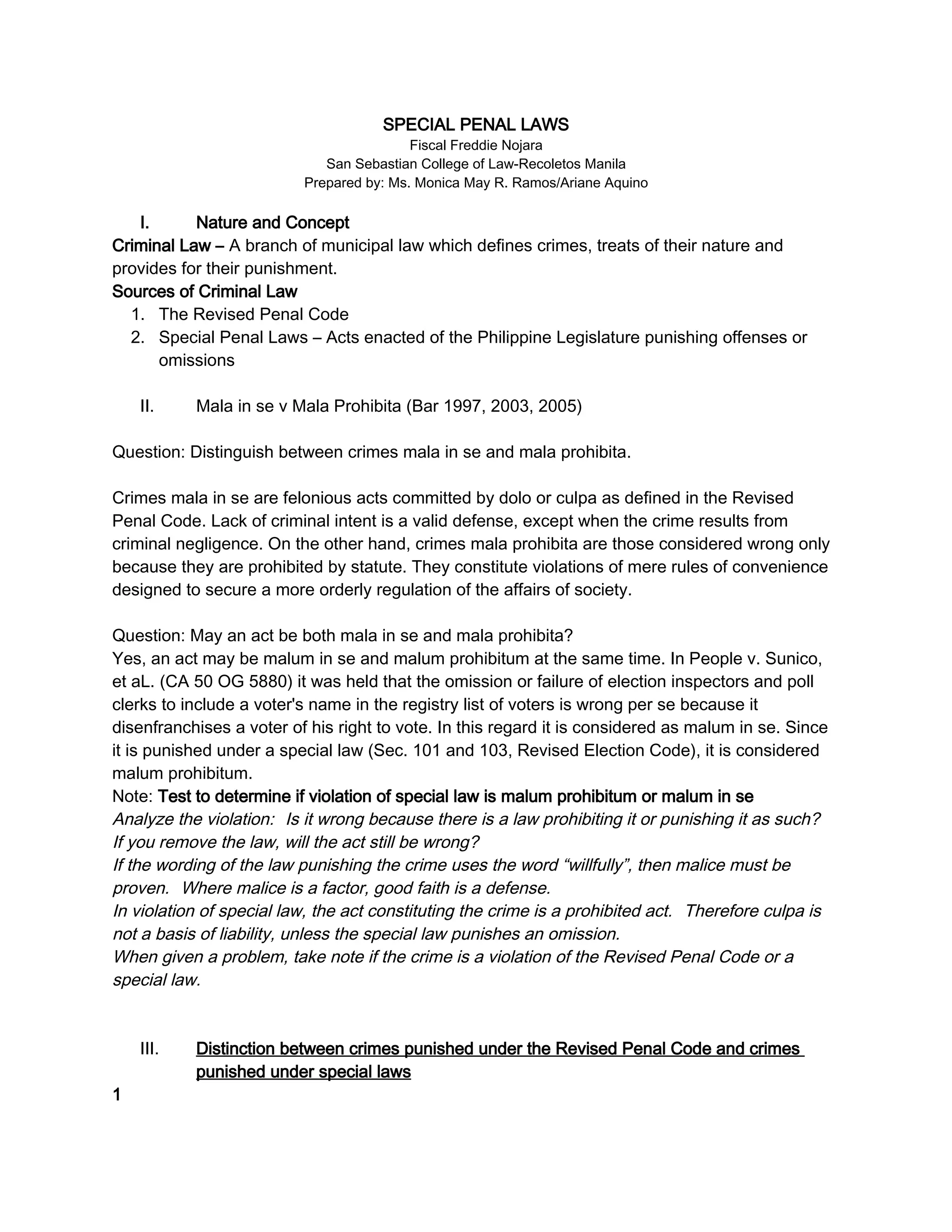
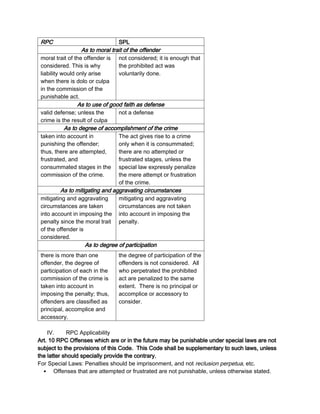
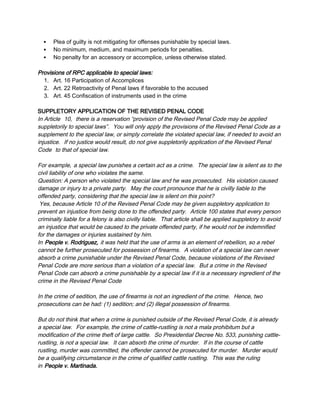
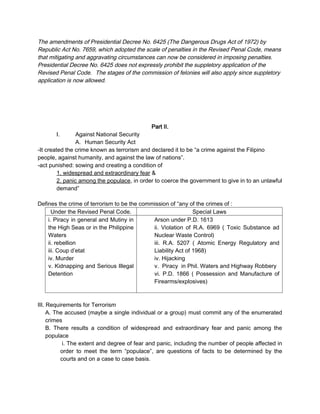
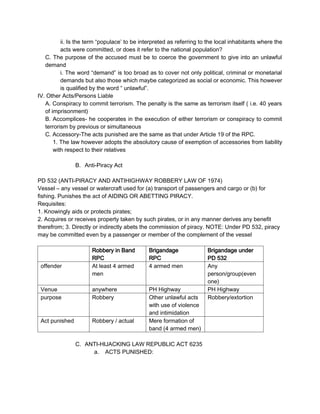
![iv. Maintenance of den dive or resort
v. Manufacture of DD or CP
vi. Possession of DD (Sec.11) (actual/constructive possession)
vii. Possession of equipment .instrument ,apparatus and other
paraphernalia for DD
viii. Possession of DD during parties, social gatherings or meetings
(gathering of at least 2 persons)
b. Case:
i. Rodolfo is an informer who told the police authorities that Aldo is a
drug pusher. Policeman Taba then posed as a buyer and persuaded
Aldo to sell marijuana worth P10.00 to the former. Aldo agreed. He
delivered the goods and so was apprehended with the marked
money. He is now prosecuted for violation of the Dangerous Drugs
Act. a) Aldo's defense is that he was the victim of an instigation of the
police who persuaded him to sell the goods to him. Decide the case
with reasons. b) Suppose policeman Taba told Aldo that he (Taba)
has a supply of marijuana and he persuaded Aldo to sell it to him
because he (Taba) needed the money badly. Aldo succeeded in
selling P20.00 worth of marijuana to Moye, What is the criminal
liability of Aldo if apprehended in the act? Explain.
Answer: b) Aldo is liable for violating the Dangerous Drugs Act (RA
No, 6425, as amended) in performing the act of selling narcotics.
ii. Manny was apprehended In a buy-bust operation during which one (1)
deck of shabu (methamphetamine hydro-chloride) was delivered by
him to the policeman posing as buyer and another deck of shabu was
taken from his pocket after his body was frisked before he was
actually brought to the police precinct. Convicted of violating sections
15 (sale and distribution of regulated drugs] and 16 (possession or
use of regulated drugs] of the Dangerous Drugs Law, he was
sentenced to thirty (30) years of life Imprisonment and payment of a
fine of P20,000.00 (for violating sec. 15) and to imprisonment of eight
(8) years and payment of fine of P6,000.00 (for violating sec. 16). He
then sought the reversal of the decision, on the following grounds:
First, he could not be convicted of having violated sec. 15
because he has not yet received the money from the buyer and the
sale is not yet consummated;](https://image.slidesharecdn.com/spl-250707105415-d9bdd399/85/specila-penal-law-discussion-for-JD-program-students-16-320.jpg)
![Second, his conviction under sec. 16 is erroneous because his
possession of shabu Is absorbed in the charge of illegal sale or
delivery; and
Third, it is unbelievable that he would sell the confiscated shabu in
a sari-sari store near the national road open to the public view and to
a stranger.
1) If you were the Solicitor General, how would you rebut the
arguments of the accused? Discuss fully.
2) Give your comment with regard to the penalties imposed.
Answer:
a. Manny is liable. The law provides, "shall sell, dispense,
deliver, transport or distribute".
b. Yes. he is also liable because the shabu taken from
his possession or pocket is different from the shabu he
was to deliver to the seller.
c. As to the third reason, it is not unbelievable because
although it is a public place, this kind of sale can
always be clandestinely be made. [People vs. Rey
Bernardino, Jan. 28, 1991)
With respect to the penalty imposed, life imprisonment
should not be limited to 30 years; and 8 years is wrong,
it should be indeterminate. (People us. Angeles,
because of Eliginio vs. Alvarez (1992)
iii. Superintendent Al Santiago, Chief of the Narcotics Division, Western
Police District, received information that a certain Lee Lay of-No. 8
Tindalo Street, Tondo, Man ila is a member of the 14K Gang
selling shabu and marijuana. SPOl Lorenzo and SPO3 Peralta were
instructed to conduct surveillance and buy-bust operations against
Lay. Their informant contacted Lay and a meeting was arranged at T.
Pinpin Restaurant at 2:00 in the afternoon on February 14, 1993.
SPO1 Lorenzo and SPO3 Peralta, acting as poseur-buyers,
purchased from Lay 10 sticks of marijuana and paid P500. Later, Lay
agreed to sell to them one kilo of dried marijuana fruiting tops which
he gave them at his residence. The policemen arrested Lay and a
search was conducted. Found were 356 grams of marijuana seeds,
932 grams of marijuana fruiting tops and 50 sticks of marijuana
cigarettes. What offense or offenses did Lay commit? [5%]](https://image.slidesharecdn.com/spl-250707105415-d9bdd399/85/specila-penal-law-discussion-for-JD-program-students-17-320.jpg)
![Answer: Lay committed the offenses of illegal selling of dangerous
drugs and illegal possession of dangerous drugs which should be
made subject of separate informations. The crime of illegal selling of
dangerous drugs is committed as regards the 10 sticks of marijuana
and as regards the one (1) kilo of dried marijuana fruiting tops, which
should be subject of two (2) separate informations because the acts
were committed at different times and in different places. The crime of
Illegal possession of dangerous drugs is committed as regards the
marijuana seeds, marijuana fruiting tops and marijuana cigarettes
which are not the subject of the sale. Another Information shall be
filed for this.
iv. At about 9 o'clock in the morning, a Narcom Group laid a plan to
entrap and apprehend A, a long suspected drug dealer, through a
"buy-bust" operation. At the appointed time, the poseur-buyer
approached A who was then with B. A marked P100 bill was handed
over to A who in turn, gave the poseur-buyer one (1) tea bag of
marijuana leaves. The members of the team, who were then
positioned behind thick leaves, closed in but evidently were not swift
enough since A and B were able to run away. Two days later, A was
arrested in connection with another incident. It appears that during the
operations, the police officers were not able to seize the marked
money but were able to get possession of the marijuana tea bag. A
was subsequently prosecuted for violation of Section 4, Article II of
Republic Act No. 6425, otherwise known as the Dangerous Drugs Act,
During the trial, the marked money was not presented. Can A be held
liable? Explain.
Suggested Answer: Yes. A can be held liable. The absence of the
marked money will not create a hiatus in the prosecution's evidence
as long as the sale of the dangerous drugs is adequately proven and
the drug subject of the transaction is presented before the court.
There was a perfected contract of sale of the drug (People vs. Ong
Co, 245 SCRA 733; People vs. Zervoulakos, 241 SCRA 625).
v. Edgardo was charged with importation of prohibited drugs in an
information filed with the Regional Trial Court of Kalookan City on
June 4, 1994. The offense is punishable by reclusion perpetua to
death. Can Edgardo avail of plea-bargaining? [2%]](https://image.slidesharecdn.com/spl-250707105415-d9bdd399/85/specila-penal-law-discussion-for-JD-program-students-18-320.jpg)
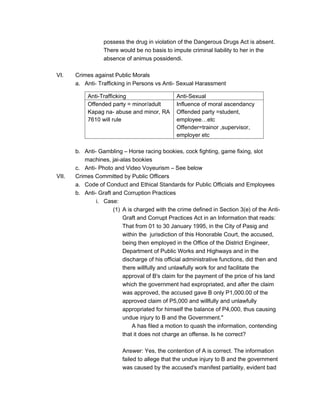
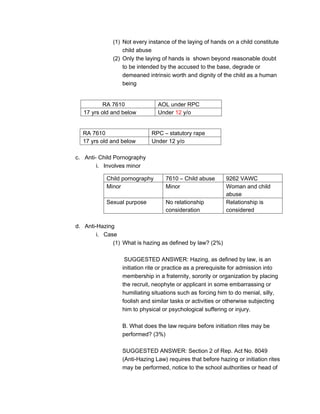
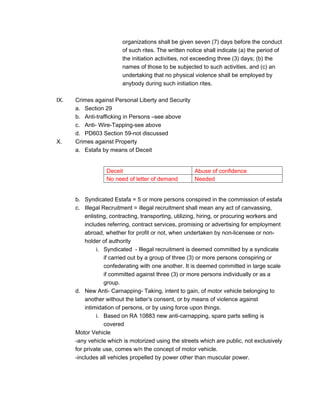
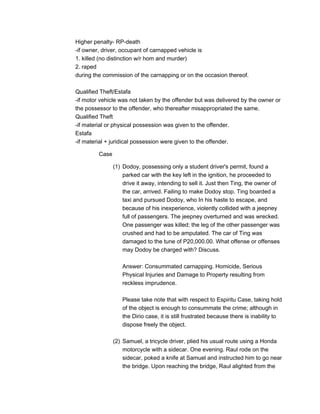
![motorcycle and suddenly stabbed Samuel several times until
he was dead. Raul fled from the scene taking the motorcycle
with him. What crime or crimes did Raul commit? |5%]
Answer: Raul committed the composite crime of Carnapping
with homicide under Sec. 14 of Rep. Act No. 6539, as
amended, considering that the killing "in the course or "on the
occasion of a carnapping (People vs. De la Cruz, et al. 183
SCRA 763). A motorcycle is included in the definition of a
"motor vehicle" in said Rep. Act, also known as the 'Anti-
Carnapping Act of 1972'. There is no apparent motive for the
killing of the tricycle driver but for Raul to be able to take the
motorcycle. The fact that the tricycle driver was killed brings
about the penalty of reclusion perpetua to death.
Alternative Answer: The crime committed by Raul is
carnapping, punished by Section 14 of Rep. Act No. 6539. The
killing of Samuel is not a separate crime but only an
aggravating circumstance
e. The Law on Arson
Nota bene: Mere conspiracy is a violation.
Case: a small neighborhood one afternoon during the Christmas season, a man was found on
the road holding a lead pipe and breaking bottles. Shouting that he would get even, he also
declared that he would burn his house. That same night, a fire broke out in the man’s house.
Those living nearby tried to call for help and stop the fire but was prevented by the owner of the
house who stood outside his house and fired several gun shots in the air. He also threatened to
kill anyone who would try to put out the fire. In the process, other residential homes were also
destroyed. Although no one actually saw how the fire started, the Bureau of Fire Protection
conducted an investigation and the results revealed that the fire was intentionally started in the
man’s home.
RTC found the circumstances of the case constituted an unbroken chain leading to the
unavoidable conclusion that the man set fire to his own house, to the exclusion of others. Thus,
he was found guilty beyond reasonable doubt of destructive arson, punishable under Article 320
of the Revised Penal Code (RPC). The Court of Appeals (CA) affirmed the RTC judgment in
toto.
The Supreme Court, on the other hand, modified the crime from destructive arson to simple
arson, punishable under Sec. 3(2), P.D. 1613. The Court explained that simple arson was the
proper crime committed since destructive arson “contemplates the malicious burning of
structures, both public and private, hotels, buildings, edifices, trains, vessels, aircraft, factories](https://image.slidesharecdn.com/spl-250707105415-d9bdd399/85/specila-penal-law-discussion-for-JD-program-students-27-320.jpg)
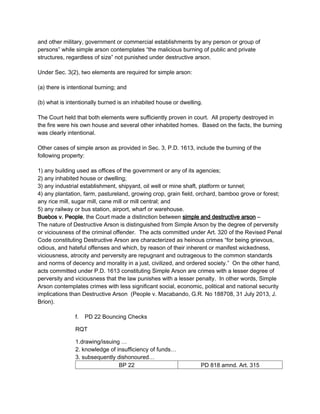
![Not material w/r or pertinent Post dated not covered, must be
issued simultaneously
Mala prohibita Mala in se
Good faith not a defense Yes, defense
g. Anti- Electricity Pilferage-Illegal Use of Electricity. - It is hereby declared
unlawful for any person, whether natural or juridical, public or private, to:
(a) Tap, make or cause to be made any connection with overhead
lines, service drops, or other electric service wires, without previous
authority or consent of the private electric utility or rural electric
cooperative concerned;1awphil@alf
(b) Tap, make or cause to be made any connection to the existing
electric service facilities of any duly registered consumer without the
latter's or the electric utility's consent or authority;
(c) Tamper, install or use a tampered electrical meter, jumper, current
reversing transformer, shorting or shunting wire, loop connection or
any other device which interferes with the proper or accurate registry
or metering of electric current or otherwise results in its diversion in a
manner whereby electricity is stolen or wasted;
(d) Damage or destroy an electric meter, equipment, wire or conduit
or allow any of them to be so damaged or destroyed as to interfere
with the proper or accurate metering of electric current; and
(e) Knowingly use or receive the direct benefit of electric service
obtained through any of the acts mentioned in subsections (a), (b),
(c), and (d)
h. Forestry Code
i. Cutting products from forest land w/o license
ii. Entering w/o authority
iii. Grazing w/o authority
iv. Occupying for any length w/o permit
v. Selling any log,lumber etc
i. Illegal Fishing
i. Case:
(1) Two [2] Philippine National Police (PNP) officers. X and Y, on
board on motorboat with Z, a civilian as motor-man, arrested A
and B who were in a banca, for dynamite fishing. The latter's
banca was towed towards the municipality. On the way, the
PNP motorboat was intercepted by a third banca whose
occupants, C, D, and E, tried to negotiate for the release of A](https://image.slidesharecdn.com/spl-250707105415-d9bdd399/85/specila-penal-law-discussion-for-JD-program-students-29-320.jpg)
![and B and their banca. The PNP officers refused and instead
shouted at C, D. and E that they are all under arrest.
Thereupon, C, D, and E simultaneously threw dynamite sticks
at the PNP motorboats. The first explosion killed X. A and B
also reacted by throwing dynamite at the PNP motorboat: its
explosion killed Y and Z. What crime or crimes did A, B, C, D
and E commit?
Suggested Answer: C, D and E are liable for the complex
crime of Murder, qualified by explosion, with direct assault for
the death of X. A and B are liable for the complex crime of
Murder Qualified by explosion as to death "of Y, and simple
Murder qualified by explosion for the death of Z. No crime of
direct assault can be filed insofar as the death of Z is
concerned, he being a civilian. This, of course, assumes that
there is no conspiracy among A, B, C, D and E, otherwise all
would have the same criminal liability as the act of one
becomes the act of all.
Additional Answer: Firstly, A and B committed a violation of
Pres. Decree No. 534 (on illegal fishing] as amended by Pres.
Decree Nos. 704 and 1058. Fishing with the use of explosives
is punishable under said Decree.
j. Access Devise
k. Anti- Cattle Rustling
i. Taking away by any mean without consent of the owner of any large
cattle WON for profit or gain
ii. Large cattle = cow,carabao,horse, mule, ass other domesticated of
bovine family. Di kasama goat
iii. Presumption:
(1) Failure to exhibit required docs
XI. Crimes against Chastity
a. Anti-Photo and Video Voyeurism
i. Photo or video voyeurism" means the act of taking photo or video
coverage of a person or group of persons performing sexual act or
any similar activity or of capturing an image of the private area of a
person or persons without the latter's consent, under circumstances in
which such person/s has/have a reasonable expectation of privacy, or
the act of selling, copying, reproducing, broadcasting, sharing,
showing or exhibiting the photo or video coverage or recordings of](https://image.slidesharecdn.com/spl-250707105415-d9bdd399/85/specila-penal-law-discussion-for-JD-program-students-30-320.jpg)


![제 23회 보아즈(BOAZ) 빅데이터 컨퍼런스 - [MBOAX] : ABSA를 활용한 소비자 반응 분석 기반 운영 효율화 대시보드 설계](https://cdn.slidesharecdn.com/ss_thumbnails/3-1boaz23rdconferencemboax-260203102709-9d519923-thumbnail.jpg?width=640&height=640&fit=bounds)


