Specific Phobia
Prachi Sanghvi
M.Phil. Clinical Psychology
Gujarat Forensic Sciences University
OVERVIEW
• Anxiety
• Fear v/s Anxiety
• Specific phobia
• ICD-10 v/s DSM-5
• Epidemiology
• Differential diagnosis
• Comorbidity
• Assessment
• Aetiology
• Management
Prachi Sanghvi, M.Phil. Clinical Psychology,
GFSU
ANXIETY
• State of apprehension or worry arising out of
anticipation of danger
• Normal phenomenon- life saving qualities to
prevent threat
• Pathological when it causes significant
impairment in functioning.
(Sadock
et. al, 2015)
Prachi Sanghvi, M.Phil. Clinical Psychology,
GFSU
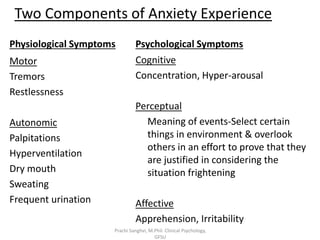
Two Components of Anxiety Experience
Physiological Symptoms
Motor
Tremors
Restlessness
Autonomic
Palpitations
Hyperventilation
Dry mouth
Sweating
Frequent urination
Psychological Symptoms
Cognitive
Concentration, Hyper-arousal
Perceptual
Meaning of events-Select certain
things in environment & overlook
others in an effort to prove that they
are justified in considering the
situation frightening
Affective
Apprehension, Irritability
Prachi Sanghvi, M.Phil. Clinical Psychology,
GFSU
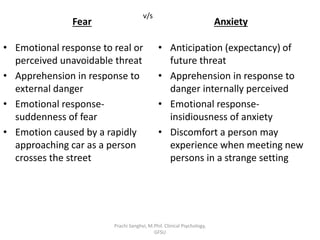
Fear
• Emotional response to real or
perceived unavoidable threat
• Apprehension in response to
external danger
• Emotional response-
suddenness of fear
• Emotion caused by a rapidly
approaching car as a person
crosses the street
Anxiety
• Anticipation (expectancy) of
future threat
• Apprehension in response to
danger internally perceived
• Emotional response-
insidiousness of anxiety
• Discomfort a person may
experience when meeting new
persons in a strange setting
v/s
Prachi Sanghvi, M.Phil. Clinical Psychology,
GFSU
PHOBIA
Recurring, excessive and unreasonable psychological or
autonomic symptoms of anxiety in presence of a specific
feared object or situation leading to avoidance.
(Semple et. al, 2005)
Prachi Sanghvi, M.Phil. Clinical Psychology,
GFSU
SPECIFIC PHOBIA
• Strong, persisting irrational fear of an object or
situation.
• Stimulus is well-defined (in contrast to
agoraphobia/ social phobia where it is
generalised)
• Differs from developmentally normative fear or
anxiety by being excessive or persisting beyond
developmentally appropriate periods.
Prachi Sanghvi, M.Phil. Clinical Psychology,
GFSU
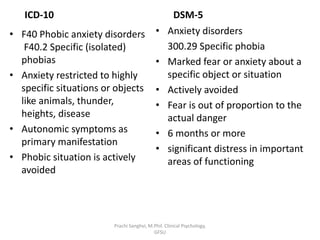
ICD-10
• F40 Phobic anxiety disorders
F40.2 Specific (isolated)
phobias
• Anxiety restricted to highly
specific situations or objects
like animals, thunder,
heights, disease
• Autonomic symptoms as
primary manifestation
• Phobic situation is actively
avoided
DSM-5
• Anxiety disorders
300.29 Specific phobia
• Marked fear or anxiety about a
specific object or situation
• Actively avoided
• Fear is out of proportion to the
actual danger
• 6 months or more
• significant distress in important
areas of functioning
Prachi Sanghvi, M.Phil. Clinical Psychology,
GFSU
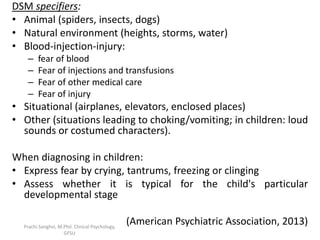
DSM specifiers:
• Animal (spiders, insects, dogs)
• Natural environment (heights, storms, water)
• Blood-injection-injury:
– fear of blood
– Fear of injections and transfusions
– Fear of other medical care
– Fear of injury
• Situational (airplanes, elevators, enclosed places)
• Other (situations leading to choking/vomiting; in children: loud
sounds or costumed characters).
When diagnosing in children:
• Express fear by crying, tantrums, freezing or clinging
• Assess whether it is typical for the child's particular
developmental stage
(American Psychiatric Association, 2013)Prachi Sanghvi, M.Phil. Clinical Psychology,
GFSU
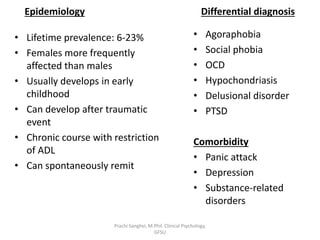
Epidemiology
• Lifetime prevalence: 6-23%
• Females more frequently
affected than males
• Usually develops in early
childhood
• Can develop after traumatic
event
• Chronic course with restriction
of ADL
• Can spontaneously remit
Differential diagnosis
• Agoraphobia
• Social phobia
• OCD
• Hypochondriasis
• Delusional disorder
• PTSD
Comorbidity
• Panic attack
• Depression
• Substance-related
disorders
Prachi Sanghvi, M.Phil. Clinical Psychology,
GFSU
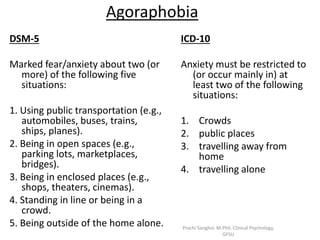
Agoraphobia
DSM-5
Marked fear/anxiety about two (or
more) of the following five
situations:
1. Using public transportation (e.g.,
automobiles, buses, trains,
ships, planes).
2. Being in open spaces (e.g.,
parking lots, marketplaces,
bridges).
3. Being in enclosed places (e.g.,
shops, theaters, cinemas).
4. Standing in line or being in a
crowd.
5. Being outside of the home alone.
ICD-10
Anxiety must be restricted to
(or occur mainly in) at
least two of the following
situations:
1. Crowds
2. public places
3. travelling away from
home
4. travelling alone
Prachi Sanghvi, M.Phil. Clinical Psychology,
GFSU
Assessment
• Fear Survey Schedule (FSS-III)
• Fear Questionnaire
• Acrophobia Questionnaire
• Mutilation Questionnaire
• Medical Fear Survey
• Dental Anxiety Inventory
(Kanwal et. al, 2008)
Prachi Sanghvi, M.Phil. Clinical Psychology,
GFSU
AETIOLOGY
Biological Perspective:
• 64% patients with blood & injection phobia have at least one first degree
relative with same phobia
• Increased norepinephrine- hyperarousal
• Clinical studies of serotonin function in anxiety disorders have shown mixed
results.
• Reduced levels of GABA
(Sadock et. al, 2015)
Prachi Sanghvi, M.Phil. Clinical Psychology,
GFSU
Psychoanalytic Perspective:
• Anxiety as a result of psychic conflict between
unconscious sexual or aggressive wishes and
corresponding threats from the superego
• Focus on content of phobia
• Phobic object as a symbol of important unconscious
fear
• Little Hans
(Sadock et. al, 2015)
Prachi Sanghvi, M.Phil. Clinical Psychology,
GFSU
Behavioural Perspective:
• Watson- Little Albert
• Observational learning
Cognitive Perspective:
• Maladaptive cognitions
• Cognitive distortions (exaggeration)
• Engage in negative self-statements
(Ginsburg & Silverman, 1998)
Prachi Sanghvi, M.Phil. Clinical Psychology,
GFSU
Two Factor Theory (Mowrer, 1960)
• Fear acquired by classical conditioning and
maintained by operant conditioning
Classical conditioning
• Biting of dog(UCS) and pain (UCR) are associated.
• So, dog (CS) invokes fear (CR)
• Link b/w CS and UCS decays overtime and
eventually ceases to elicit CR.
Prachi Sanghvi, M.Phil. Clinical Psychology,
GFSU
• Many times this process is blocked because the
person learns that fear can be minimized by
avoiding or escaping from CS (dog).
• In other words, avoidance or escape is operant
behaviour which is negatively reinforced that
prevents classically conditioned fear from being
unlearned.
• Problem in model- fear in absence of
conditioning or no fear in spite of fear-evoking
situations
Prachi Sanghvi, M.Phil. Clinical Psychology,
GFSU
Pathways to Fear Acquisition (Rachman, 1977)
1) Direct conditioning- fear acquisition through classical
conditioning
2) Modelling- vicarious acquisition due to observational learning
3) Informational and instructional transmission (fear invoking
information/ misinformation)
Latent Inhibition
Aversive conditioning experiences less likely to produce
phobias when person has h/o fearless contact with stimulus
Prachi Sanghvi, M.Phil. Clinical Psychology,
GFSU
Preparedness Theory (Seligman, 1970)
• We are biologically prepared to acquire fears of
some stimuli.
• Evolution has predisposed organisms to learn
those associations easily that facilitate species
survival.
• Some stimuli more likely to be fear evoking than
others (snakes, spiders, height).
Prachi Sanghvi, M.Phil. Clinical Psychology,
GFSU
Anxiety Sensitivity (Reiss, 1980)
• Fear of anxiety-related sensations (fear of palpitations,
dizziness & tremulousness) which arises from beliefs that
these sensations have aversive somatic, psychological or
social consequences.
• AS is one of the 3 fundamental fears including
illness/injury sensitivity & fear of negative evaluation.
• Fundamental fears exacerbate other (common) fears
such as fears of animals, social situations, blood-illness-
injury stimuli and agoraphobia.
Prachi Sanghvi, M.Phil. Clinical Psychology,
GFSU
• Fundamental fears have 2 features that distinguish them
from common fears:
1) They are fears of stimuli that are inherently noxious for
most people.
2) Common fears can be logically reduced to them.
• Fear of flying may be due to fear of plane crashing
(illness/injury sensitivity), fear of anxiety evoked by
turbulence (AS) & fear of embarrassing oneself by
becoming airsick (fear of negative evaluation).
• Thus, a common fear (of flying) may be logically reduced
to one or more fundamental fears.
(Blaney & Millon, 2008)
Prachi Sanghvi, M.Phil. Clinical Psychology,
GFSU
Meta-cognitive Model (Wells and Matthews, 1994)
• Monitors, controls and assesses the products and process of
awareness.
• Anxiety and sadness- internal signals, threat to well-being.
• Normally of limited duration because the person engages
coping strategies to reduce threat and control cognition.
• Psychological disorder results from maintenance of
emotional responses.
• Maintained because of individual’s thinking style and
strategies.
Prachi Sanghvi, M.Phil. Clinical Psychology,
GFSU
• This style is called Cognitive Attentional Syndrome
(CAS)
-Consists of worry/rumination, threat monitoring
-Unhelpful thought control strategies (avoidance)
-Prevents adaptive learning
• CAS is the result of faulty meta-cognitive beliefs
which control and interpret thinking and feeling
states.
• CAS prolongs and intensifies negative emotional
experience.
Prachi Sanghvi, M.Phil. Clinical Psychology,
GFSU
Management
Behaviour therapy
• Systematic desensitization
• Flooding
• Modelling
Cognitive behaviour therapy
To recognize fear as unreasonable, to break the anxiety pattern
Psychodynamic therapy
To uncover repressed conflicts underlying extreme fear
Pharmacotherapy
Benzodiazepines to reduce anticipatory anxiety
Prachi Sanghvi, M.Phil. Clinical Psychology,
GFSU
REFERENCES
• Ahuja, N. (2011). A Short Textbook of Psychiatry (7th
ed.). Jaypee Publishers.
• American Psychiatric Association. (2013). Diagnostic
and Statistical Manual of Mental Disorders (5th ed.).
Arlington, VA, American Psychiatric Association.
• Blaney, P. H., & Millon, T. (2008). Oxford textbook of
psychopathology. Oxford University Press.
• Ginsburg, G. S. & Silverman, W. K. (1998). Specific
Phobias. In Bellack, A. S. and Hersen, M. (Eds.).
Comprehensive Clinical Psychology. Amsterdam,
Netherlands: Elsevier Science. Prachi Sanghvi, M.Phil. Clinical Psychology,
GFSU
• Kanwal, K., Rajender, G. & Grover N. (2008). Management
of specific phobias. Journal of Mental Health & Human
Behavior. 13(2):17-26.
• Sadock, B. J., Sadock, V. A., & Ruiz, P. (2015). Kaplan &
Sadock's synopsis of psychiatry: Behavioral
sciences/clinical psychiatry (11th ed.). Philadelphia:
Wolters Kluwer.
• Semple, D., Smyth R., Burns, J., Darjee, R. & McIntosh, A.
(2005). Oxford Handbook of Psychiatry (1st ed.). Oxford
University Press.
• World Health Organization. (1992). The ICD-10
Classification of Mental and Behavioural Disorders:
Clinical descriptions and diagnostic guidelines. Geneva:
World Health Organisation.
Prachi Sanghvi, M.Phil. Clinical Psychology,
GFSU

Specific phobia

  • 1.
    Specific Phobia Prachi Sanghvi M.Phil.Clinical Psychology Gujarat Forensic Sciences University
  • 2.
    OVERVIEW • Anxiety • Fearv/s Anxiety • Specific phobia • ICD-10 v/s DSM-5 • Epidemiology • Differential diagnosis • Comorbidity • Assessment • Aetiology • Management Prachi Sanghvi, M.Phil. Clinical Psychology, GFSU
  • 3.
    ANXIETY • State ofapprehension or worry arising out of anticipation of danger • Normal phenomenon- life saving qualities to prevent threat • Pathological when it causes significant impairment in functioning. (Sadock et. al, 2015) Prachi Sanghvi, M.Phil. Clinical Psychology, GFSU
  • 4.
    Two Components ofAnxiety Experience Physiological Symptoms Motor Tremors Restlessness Autonomic Palpitations Hyperventilation Dry mouth Sweating Frequent urination Psychological Symptoms Cognitive Concentration, Hyper-arousal Perceptual Meaning of events-Select certain things in environment & overlook others in an effort to prove that they are justified in considering the situation frightening Affective Apprehension, Irritability Prachi Sanghvi, M.Phil. Clinical Psychology, GFSU
  • 5.
    Fear • Emotional responseto real or perceived unavoidable threat • Apprehension in response to external danger • Emotional response- suddenness of fear • Emotion caused by a rapidly approaching car as a person crosses the street Anxiety • Anticipation (expectancy) of future threat • Apprehension in response to danger internally perceived • Emotional response- insidiousness of anxiety • Discomfort a person may experience when meeting new persons in a strange setting v/s Prachi Sanghvi, M.Phil. Clinical Psychology, GFSU
  • 6.
    PHOBIA Recurring, excessive andunreasonable psychological or autonomic symptoms of anxiety in presence of a specific feared object or situation leading to avoidance. (Semple et. al, 2005) Prachi Sanghvi, M.Phil. Clinical Psychology, GFSU
  • 7.
    SPECIFIC PHOBIA • Strong,persisting irrational fear of an object or situation. • Stimulus is well-defined (in contrast to agoraphobia/ social phobia where it is generalised) • Differs from developmentally normative fear or anxiety by being excessive or persisting beyond developmentally appropriate periods. Prachi Sanghvi, M.Phil. Clinical Psychology, GFSU
  • 8.
    ICD-10 • F40 Phobicanxiety disorders F40.2 Specific (isolated) phobias • Anxiety restricted to highly specific situations or objects like animals, thunder, heights, disease • Autonomic symptoms as primary manifestation • Phobic situation is actively avoided DSM-5 • Anxiety disorders 300.29 Specific phobia • Marked fear or anxiety about a specific object or situation • Actively avoided • Fear is out of proportion to the actual danger • 6 months or more • significant distress in important areas of functioning Prachi Sanghvi, M.Phil. Clinical Psychology, GFSU
  • 9.
    DSM specifiers: • Animal(spiders, insects, dogs) • Natural environment (heights, storms, water) • Blood-injection-injury: – fear of blood – Fear of injections and transfusions – Fear of other medical care – Fear of injury • Situational (airplanes, elevators, enclosed places) • Other (situations leading to choking/vomiting; in children: loud sounds or costumed characters). When diagnosing in children: • Express fear by crying, tantrums, freezing or clinging • Assess whether it is typical for the child's particular developmental stage (American Psychiatric Association, 2013)Prachi Sanghvi, M.Phil. Clinical Psychology, GFSU
  • 10.
    Epidemiology • Lifetime prevalence:6-23% • Females more frequently affected than males • Usually develops in early childhood • Can develop after traumatic event • Chronic course with restriction of ADL • Can spontaneously remit Differential diagnosis • Agoraphobia • Social phobia • OCD • Hypochondriasis • Delusional disorder • PTSD Comorbidity • Panic attack • Depression • Substance-related disorders Prachi Sanghvi, M.Phil. Clinical Psychology, GFSU
  • 11.
    Agoraphobia DSM-5 Marked fear/anxiety abouttwo (or more) of the following five situations: 1. Using public transportation (e.g., automobiles, buses, trains, ships, planes). 2. Being in open spaces (e.g., parking lots, marketplaces, bridges). 3. Being in enclosed places (e.g., shops, theaters, cinemas). 4. Standing in line or being in a crowd. 5. Being outside of the home alone. ICD-10 Anxiety must be restricted to (or occur mainly in) at least two of the following situations: 1. Crowds 2. public places 3. travelling away from home 4. travelling alone Prachi Sanghvi, M.Phil. Clinical Psychology, GFSU
  • 12.
    Assessment • Fear SurveySchedule (FSS-III) • Fear Questionnaire • Acrophobia Questionnaire • Mutilation Questionnaire • Medical Fear Survey • Dental Anxiety Inventory (Kanwal et. al, 2008) Prachi Sanghvi, M.Phil. Clinical Psychology, GFSU
  • 13.
    AETIOLOGY Biological Perspective: • 64%patients with blood & injection phobia have at least one first degree relative with same phobia • Increased norepinephrine- hyperarousal • Clinical studies of serotonin function in anxiety disorders have shown mixed results. • Reduced levels of GABA (Sadock et. al, 2015) Prachi Sanghvi, M.Phil. Clinical Psychology, GFSU
  • 14.
    Psychoanalytic Perspective: • Anxietyas a result of psychic conflict between unconscious sexual or aggressive wishes and corresponding threats from the superego • Focus on content of phobia • Phobic object as a symbol of important unconscious fear • Little Hans (Sadock et. al, 2015) Prachi Sanghvi, M.Phil. Clinical Psychology, GFSU
  • 15.
    Behavioural Perspective: • Watson-Little Albert • Observational learning Cognitive Perspective: • Maladaptive cognitions • Cognitive distortions (exaggeration) • Engage in negative self-statements (Ginsburg & Silverman, 1998) Prachi Sanghvi, M.Phil. Clinical Psychology, GFSU
  • 16.
    Two Factor Theory(Mowrer, 1960) • Fear acquired by classical conditioning and maintained by operant conditioning Classical conditioning • Biting of dog(UCS) and pain (UCR) are associated. • So, dog (CS) invokes fear (CR) • Link b/w CS and UCS decays overtime and eventually ceases to elicit CR. Prachi Sanghvi, M.Phil. Clinical Psychology, GFSU
  • 17.
    • Many timesthis process is blocked because the person learns that fear can be minimized by avoiding or escaping from CS (dog). • In other words, avoidance or escape is operant behaviour which is negatively reinforced that prevents classically conditioned fear from being unlearned. • Problem in model- fear in absence of conditioning or no fear in spite of fear-evoking situations Prachi Sanghvi, M.Phil. Clinical Psychology, GFSU
  • 18.
    Pathways to FearAcquisition (Rachman, 1977) 1) Direct conditioning- fear acquisition through classical conditioning 2) Modelling- vicarious acquisition due to observational learning 3) Informational and instructional transmission (fear invoking information/ misinformation) Latent Inhibition Aversive conditioning experiences less likely to produce phobias when person has h/o fearless contact with stimulus Prachi Sanghvi, M.Phil. Clinical Psychology, GFSU
  • 19.
    Preparedness Theory (Seligman,1970) • We are biologically prepared to acquire fears of some stimuli. • Evolution has predisposed organisms to learn those associations easily that facilitate species survival. • Some stimuli more likely to be fear evoking than others (snakes, spiders, height). Prachi Sanghvi, M.Phil. Clinical Psychology, GFSU
  • 20.
    Anxiety Sensitivity (Reiss,1980) • Fear of anxiety-related sensations (fear of palpitations, dizziness & tremulousness) which arises from beliefs that these sensations have aversive somatic, psychological or social consequences. • AS is one of the 3 fundamental fears including illness/injury sensitivity & fear of negative evaluation. • Fundamental fears exacerbate other (common) fears such as fears of animals, social situations, blood-illness- injury stimuli and agoraphobia. Prachi Sanghvi, M.Phil. Clinical Psychology, GFSU
  • 21.
    • Fundamental fearshave 2 features that distinguish them from common fears: 1) They are fears of stimuli that are inherently noxious for most people. 2) Common fears can be logically reduced to them. • Fear of flying may be due to fear of plane crashing (illness/injury sensitivity), fear of anxiety evoked by turbulence (AS) & fear of embarrassing oneself by becoming airsick (fear of negative evaluation). • Thus, a common fear (of flying) may be logically reduced to one or more fundamental fears. (Blaney & Millon, 2008) Prachi Sanghvi, M.Phil. Clinical Psychology, GFSU
  • 22.
    Meta-cognitive Model (Wellsand Matthews, 1994) • Monitors, controls and assesses the products and process of awareness. • Anxiety and sadness- internal signals, threat to well-being. • Normally of limited duration because the person engages coping strategies to reduce threat and control cognition. • Psychological disorder results from maintenance of emotional responses. • Maintained because of individual’s thinking style and strategies. Prachi Sanghvi, M.Phil. Clinical Psychology, GFSU
  • 23.
    • This styleis called Cognitive Attentional Syndrome (CAS) -Consists of worry/rumination, threat monitoring -Unhelpful thought control strategies (avoidance) -Prevents adaptive learning • CAS is the result of faulty meta-cognitive beliefs which control and interpret thinking and feeling states. • CAS prolongs and intensifies negative emotional experience. Prachi Sanghvi, M.Phil. Clinical Psychology, GFSU
  • 24.
    Management Behaviour therapy • Systematicdesensitization • Flooding • Modelling Cognitive behaviour therapy To recognize fear as unreasonable, to break the anxiety pattern Psychodynamic therapy To uncover repressed conflicts underlying extreme fear Pharmacotherapy Benzodiazepines to reduce anticipatory anxiety Prachi Sanghvi, M.Phil. Clinical Psychology, GFSU
  • 25.
    REFERENCES • Ahuja, N.(2011). A Short Textbook of Psychiatry (7th ed.). Jaypee Publishers. • American Psychiatric Association. (2013). Diagnostic and Statistical Manual of Mental Disorders (5th ed.). Arlington, VA, American Psychiatric Association. • Blaney, P. H., & Millon, T. (2008). Oxford textbook of psychopathology. Oxford University Press. • Ginsburg, G. S. & Silverman, W. K. (1998). Specific Phobias. In Bellack, A. S. and Hersen, M. (Eds.). Comprehensive Clinical Psychology. Amsterdam, Netherlands: Elsevier Science. Prachi Sanghvi, M.Phil. Clinical Psychology, GFSU
  • 26.
    • Kanwal, K.,Rajender, G. & Grover N. (2008). Management of specific phobias. Journal of Mental Health & Human Behavior. 13(2):17-26. • Sadock, B. J., Sadock, V. A., & Ruiz, P. (2015). Kaplan & Sadock's synopsis of psychiatry: Behavioral sciences/clinical psychiatry (11th ed.). Philadelphia: Wolters Kluwer. • Semple, D., Smyth R., Burns, J., Darjee, R. & McIntosh, A. (2005). Oxford Handbook of Psychiatry (1st ed.). Oxford University Press. • World Health Organization. (1992). The ICD-10 Classification of Mental and Behavioural Disorders: Clinical descriptions and diagnostic guidelines. Geneva: World Health Organisation. Prachi Sanghvi, M.Phil. Clinical Psychology, GFSU