Introduction Sparse FHT algorithm Analysis of probability of failure Empirical results Conclusion
A Fast Hadamard Transform for Signals with
Sub-linear Sparsity
Robin Scheibler Saeid Haghighatshoar Martin Vetterli
School of Computer and Communication Sciences
École Polytechnique Fédérale de Lausanne, Switzerland
October 28, 2013
SparseFHT 1 / 20 EPFL
Introduction Sparse FHT algorithm Analysis of probability of failure Empirical results Conclusion
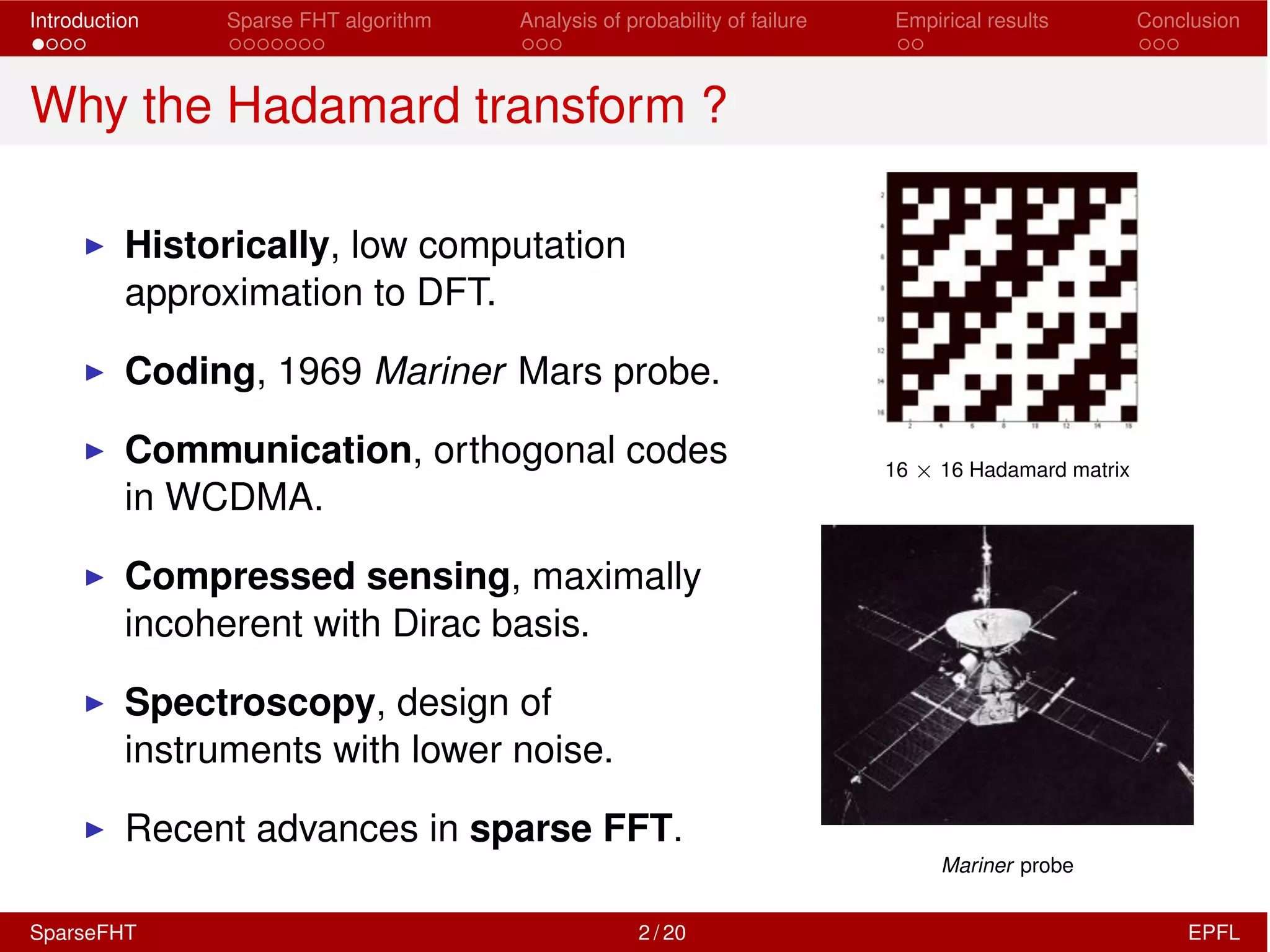
Why the Hadamard transform ?
I Historically, low computation
approximation to DFT.
I Coding, 1969 Mariner Mars probe.
I Communication, orthogonal codes
in WCDMA.
I Compressed sensing, maximally
incoherent with Dirac basis.
I Spectroscopy, design of
instruments with lower noise.
I Recent advances in sparse FFT.
16 ⇥ 16 Hadamard matrix
Mariner probe
SparseFHT 2 / 20 EPFL
Introduction Sparse FHT algorithm Analysis of probability of failure Empirical results Conclusion
Fast Hadamard transform
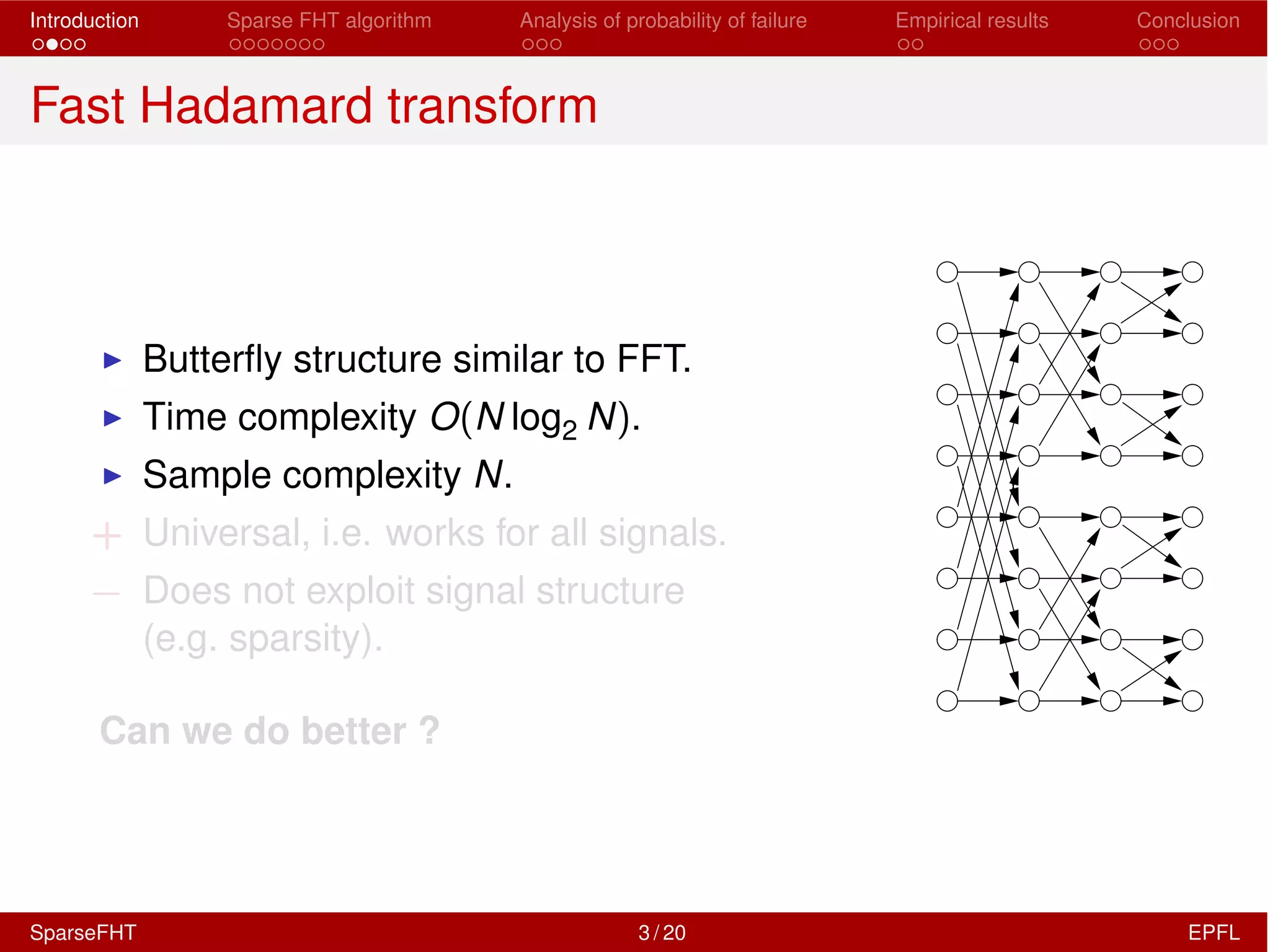
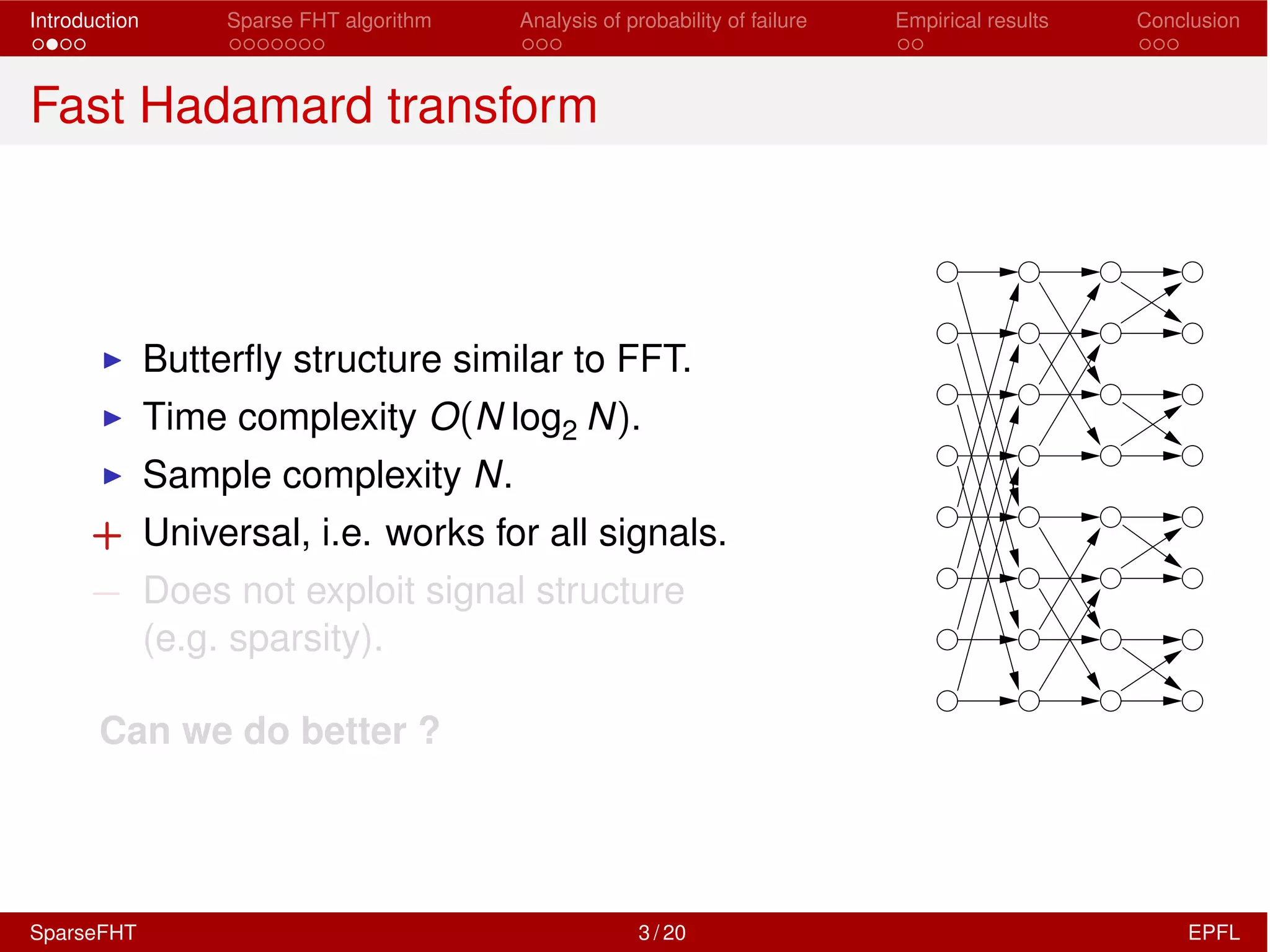
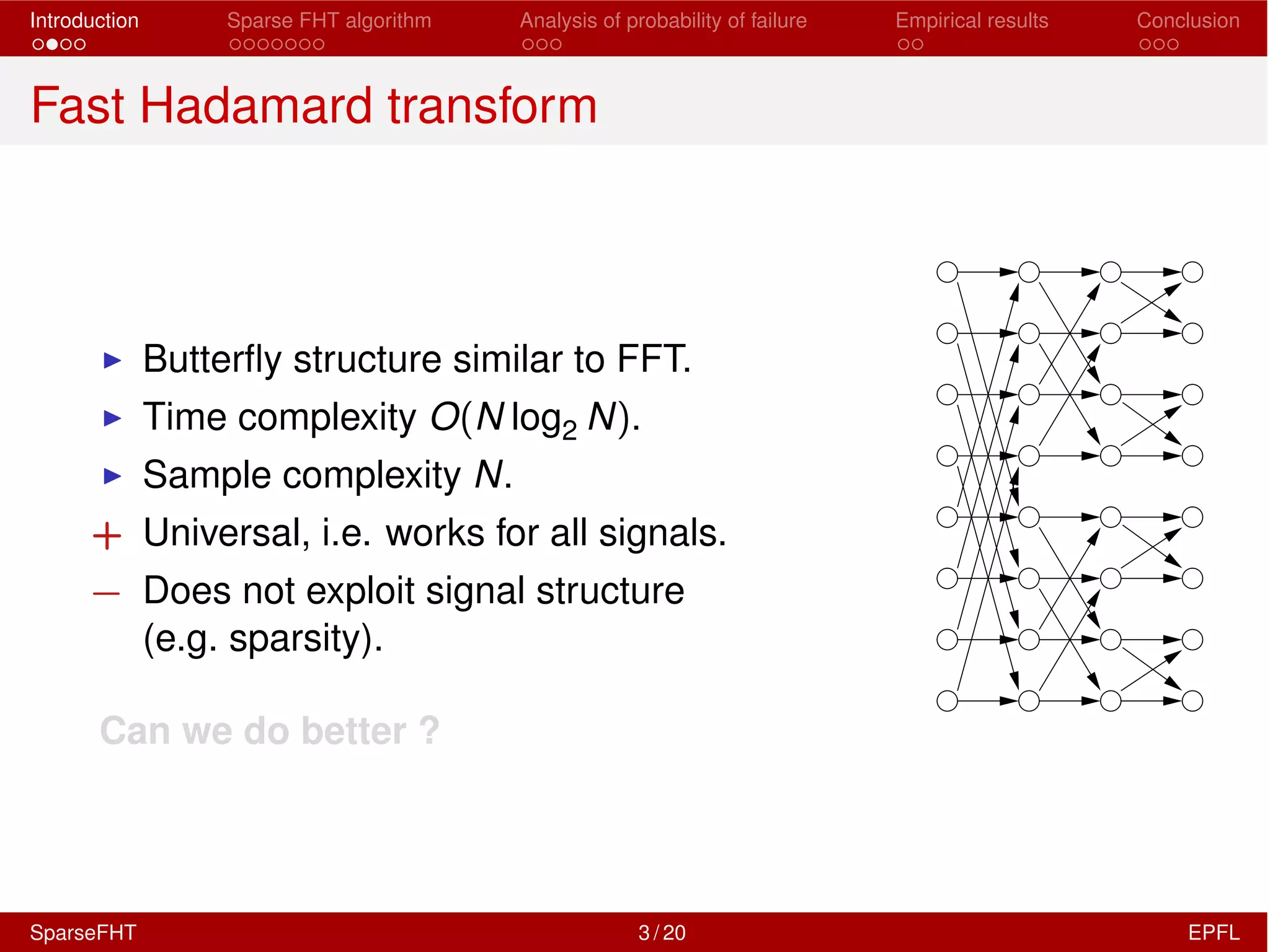
I Butterfly structure similar to FFT.
I Time complexity O(N log2 N).
I Sample complexity N.
+ Universal, i.e. works for all signals.
Does not exploit signal structure
(e.g. sparsity).
Can we do better ?
SparseFHT 3 / 20 EPFL
Introduction Sparse FHT algorithm Analysis of probability of failure Empirical results Conclusion
Fast Hadamard transform
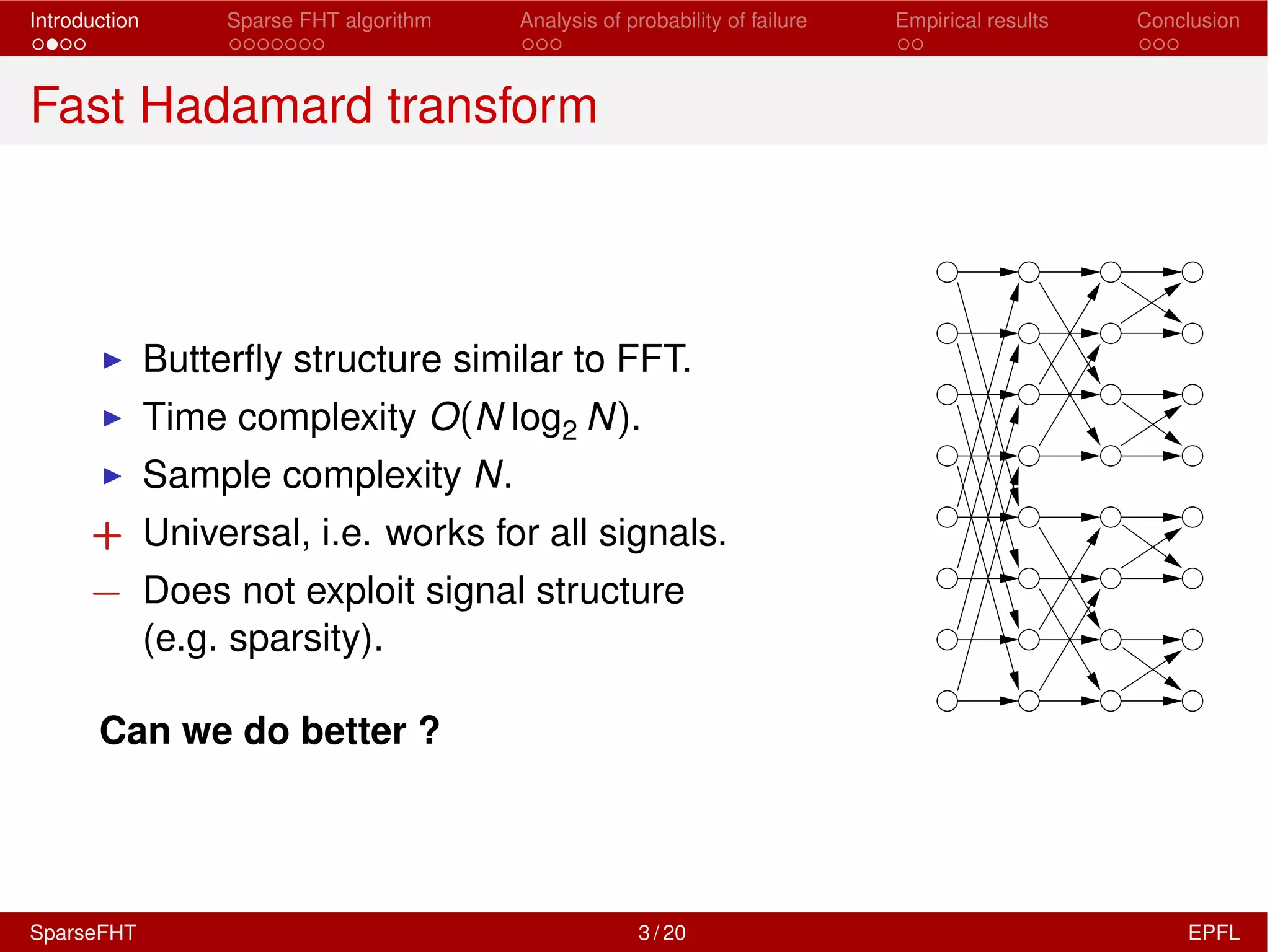
I Butterfly structure similar to FFT.
I Time complexity O(N log2 N).
I Sample complexity N.
+ Universal, i.e. works for all signals.
Does not exploit signal structure
(e.g. sparsity).
Can we do better ?
SparseFHT 3 / 20 EPFL
Introduction Sparse FHT algorithm Analysis of probability of failure Empirical results Conclusion
Fast Hadamard transform
I Butterfly structure similar to FFT.
I Time complexity O(N log2 N).
I Sample complexity N.
+ Universal, i.e. works for all signals.
Does not exploit signal structure
(e.g. sparsity).
Can we do better ?
SparseFHT 3 / 20 EPFL
Introduction Sparse FHT algorithm Analysis of probability of failure Empirical results Conclusion
Fast Hadamard transform
I Butterfly structure similar to FFT.
I Time complexity O(N log2 N).
I Sample complexity N.
+ Universal, i.e. works for all signals.
Does not exploit signal structure
(e.g. sparsity).
Can we do better ?
SparseFHT 3 / 20 EPFL
Introduction Sparse FHT algorithm Analysis of probability of failure Empirical results Conclusion
Contribution: Sparse fast Hadamard transform
Assumptions
I The signal is exaclty K-sparse in the transform domain.
I Sub-linear sparsity regime K = O(N↵), 0 < ↵ < 1.
I Support of the signal is uniformly random.
Contribution
An algorithm computing the K non-zero coefficients with:
I Time complexity O(K log2 K log2
N
K ).
I Sample complexity O(K log2
N
K ).
I Probability of failure asymptotically vanishes.
SparseFHT 4 / 20 EPFL
Introduction Sparse FHT algorithm Analysis of probability of failure Empirical results Conclusion
Contribution: Sparse fast Hadamard transform
Assumptions
I The signal is exaclty K-sparse in the transform domain.
I Sub-linear sparsity regime K = O(N↵), 0 < ↵ < 1.
I Support of the signal is uniformly random.
Contribution
An algorithm computing the K non-zero coefficients with:
I Time complexity O(K log2 K log2
N
K ).
I Sample complexity O(K log2
N
K ).
I Probability of failure asymptotically vanishes.
SparseFHT 4 / 20 EPFL
Introduction Sparse FHT algorithm Analysis of probability of failure Empirical results Conclusion
Outline
1. Sparse FHT algorithm
2. Analysis of probability of failure
3. Empirical results
SparseFHT 5 / 20 EPFL
Introduction Sparse FHT algorithm Analysis of probability of failure Empirical results Conclusion
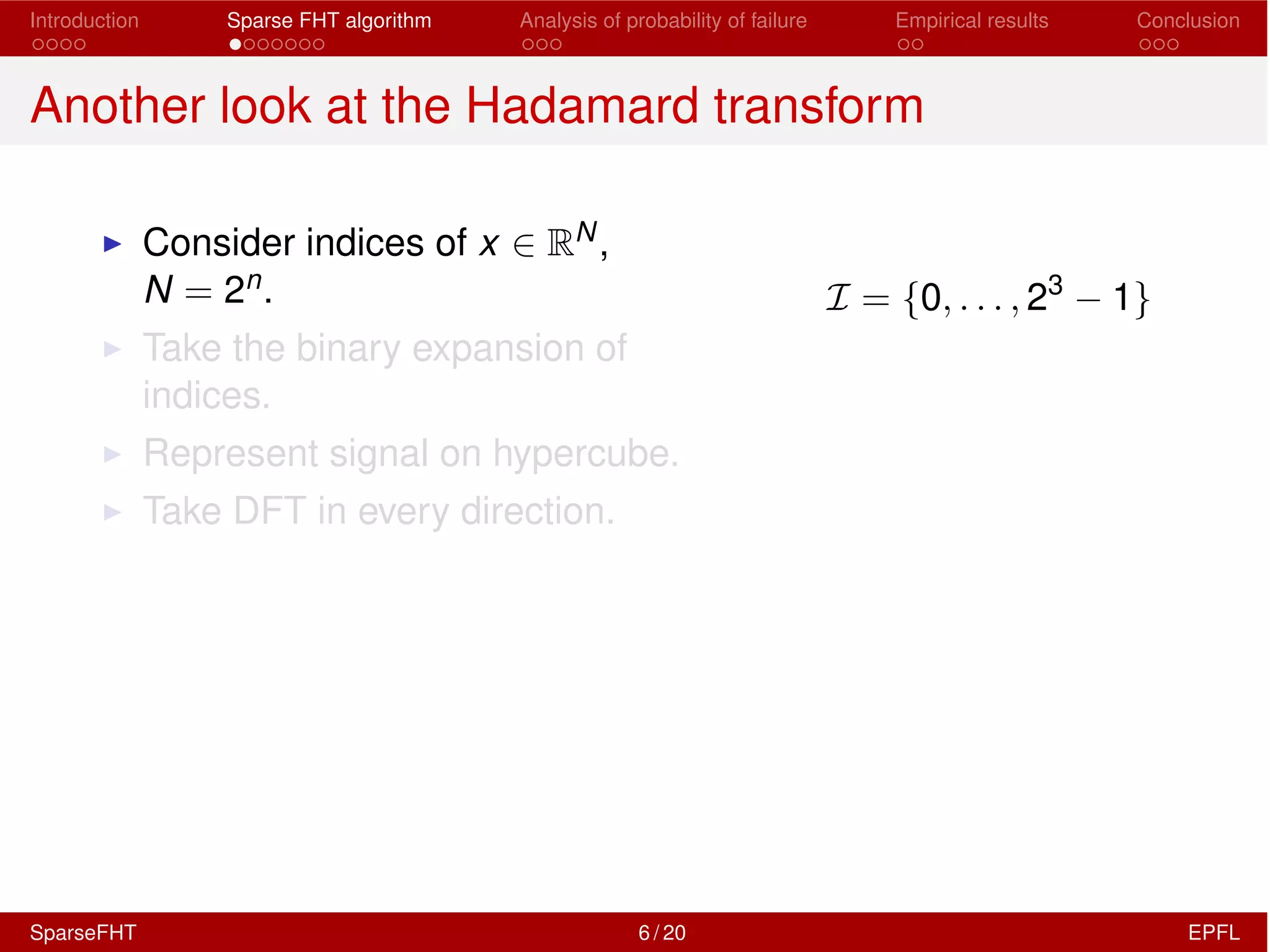
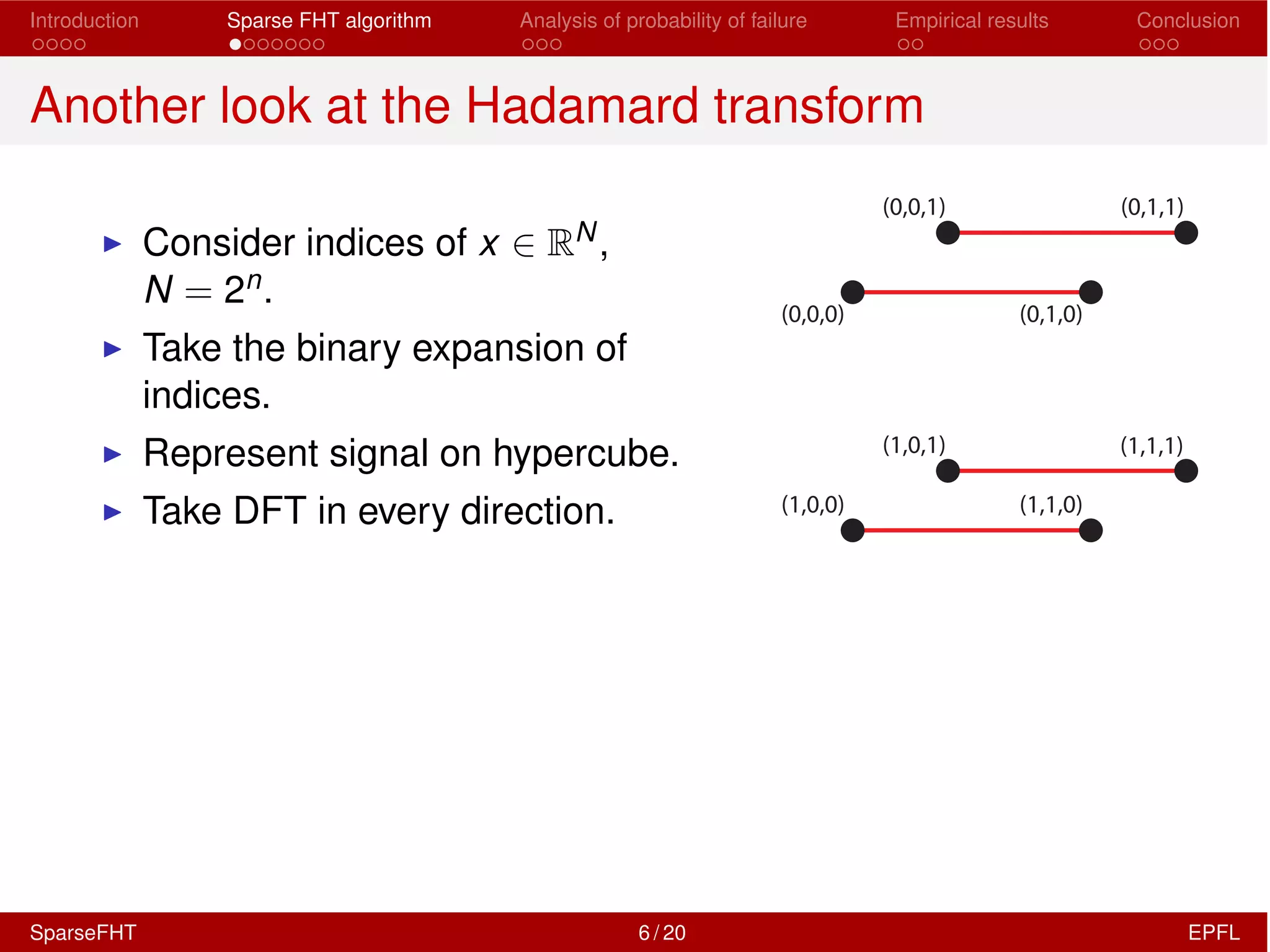
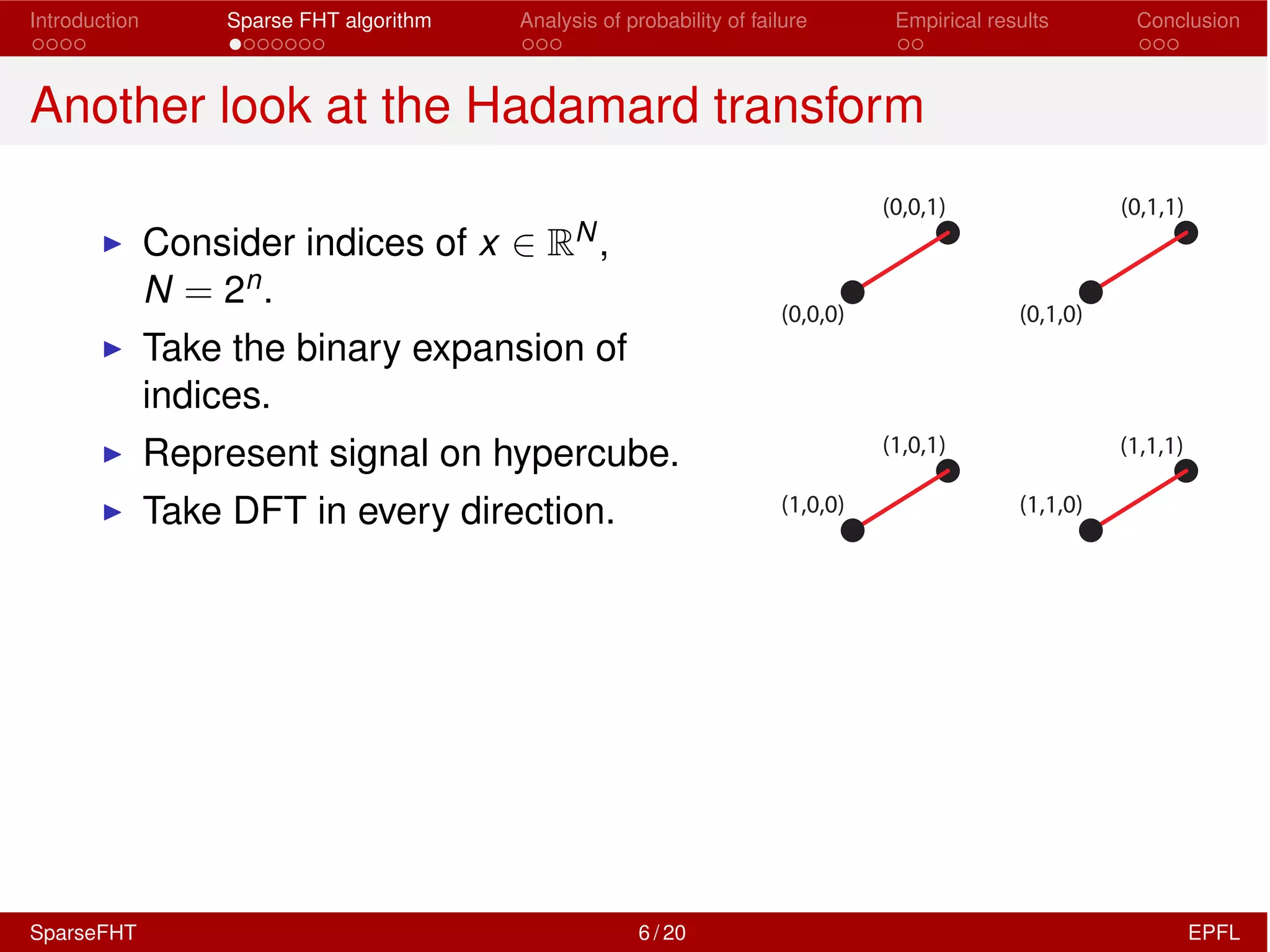
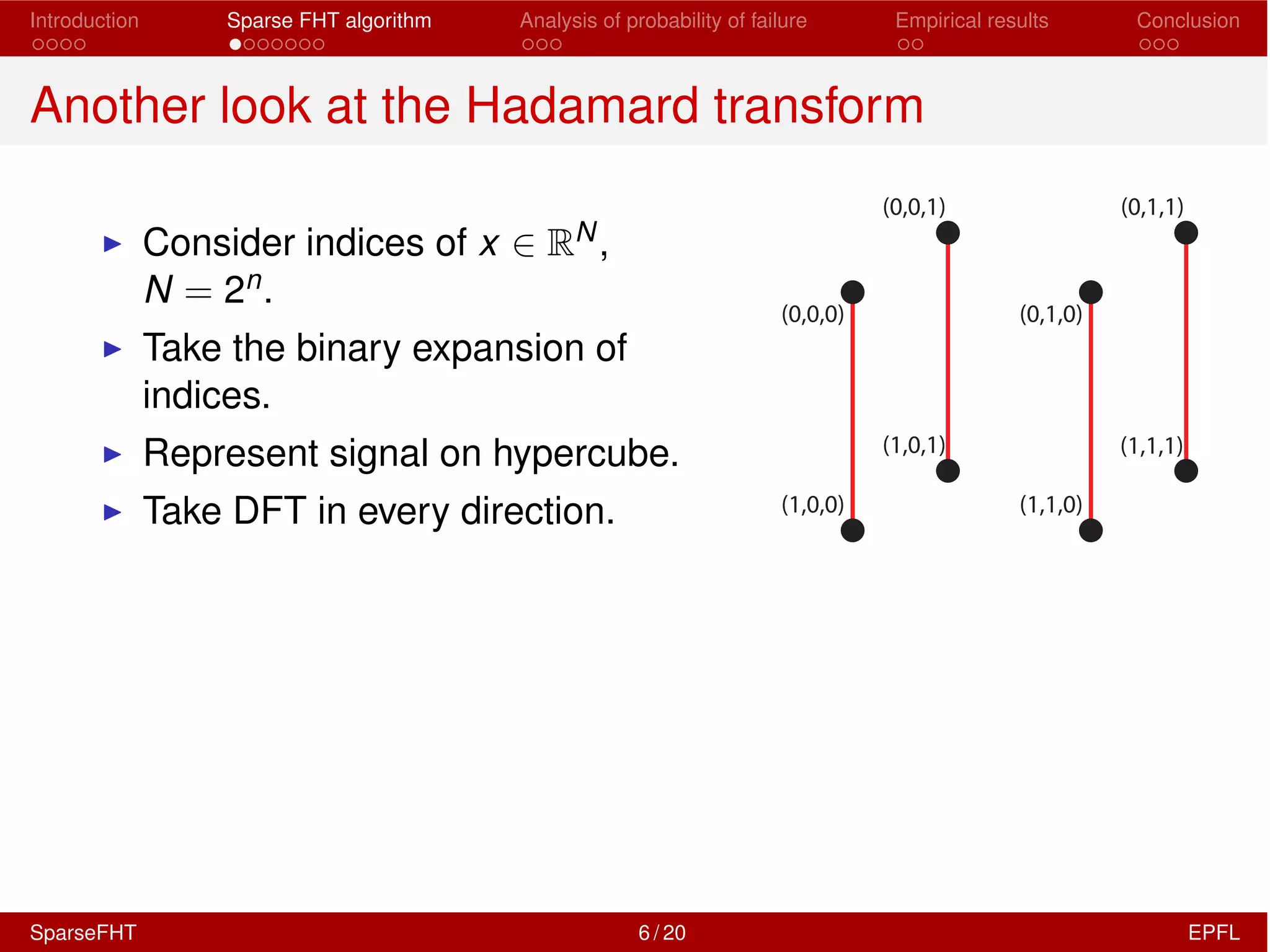
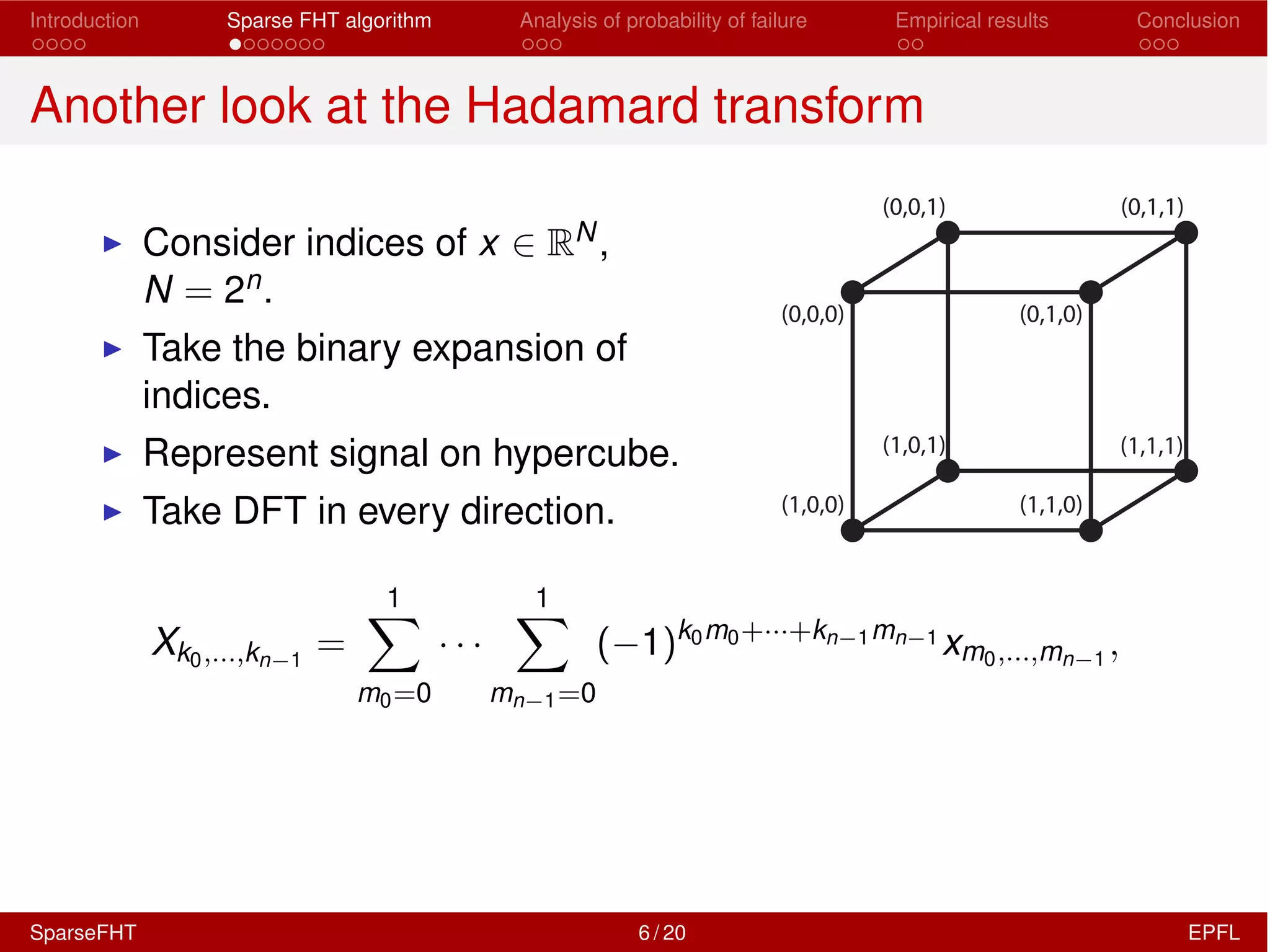
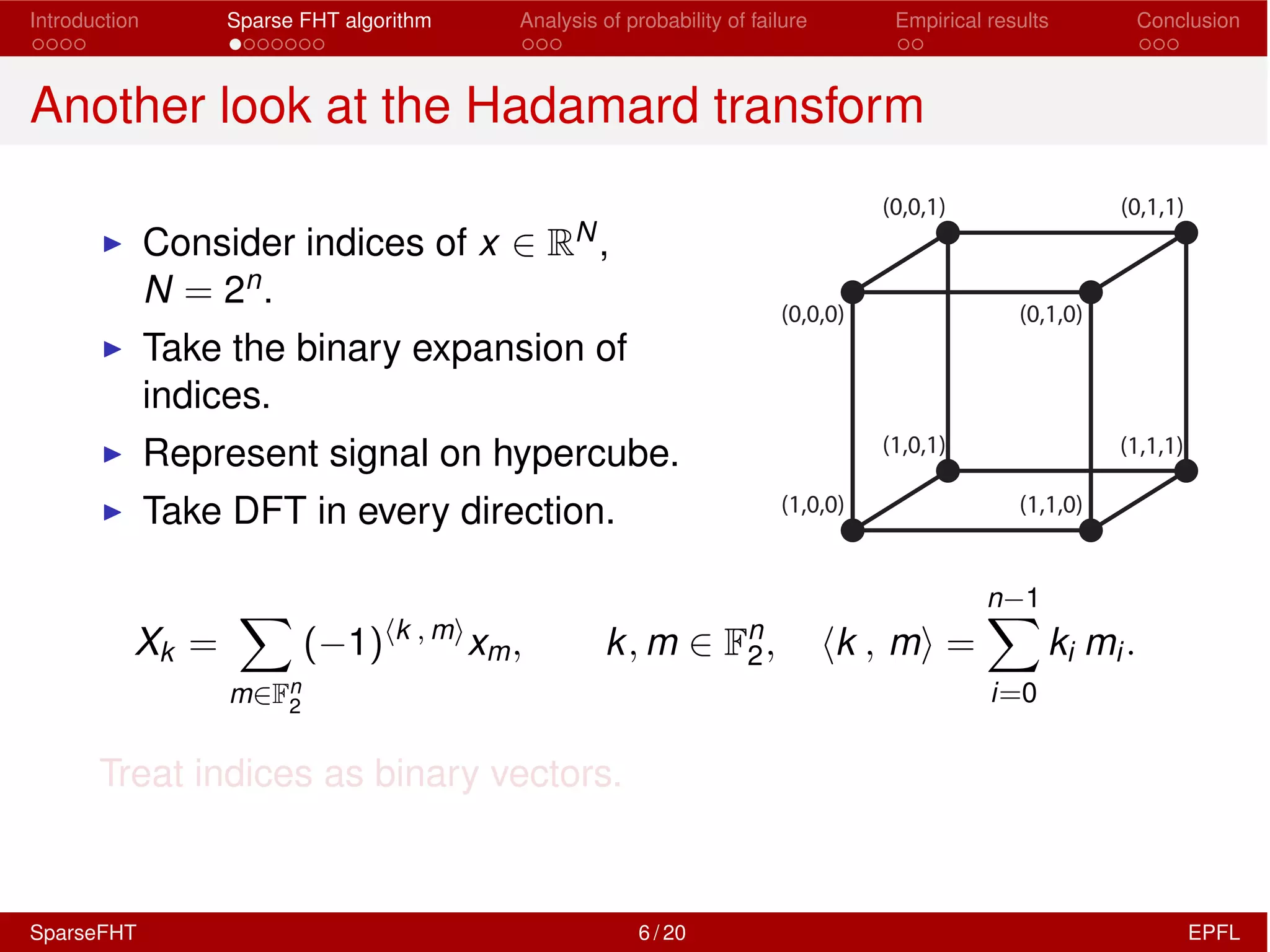
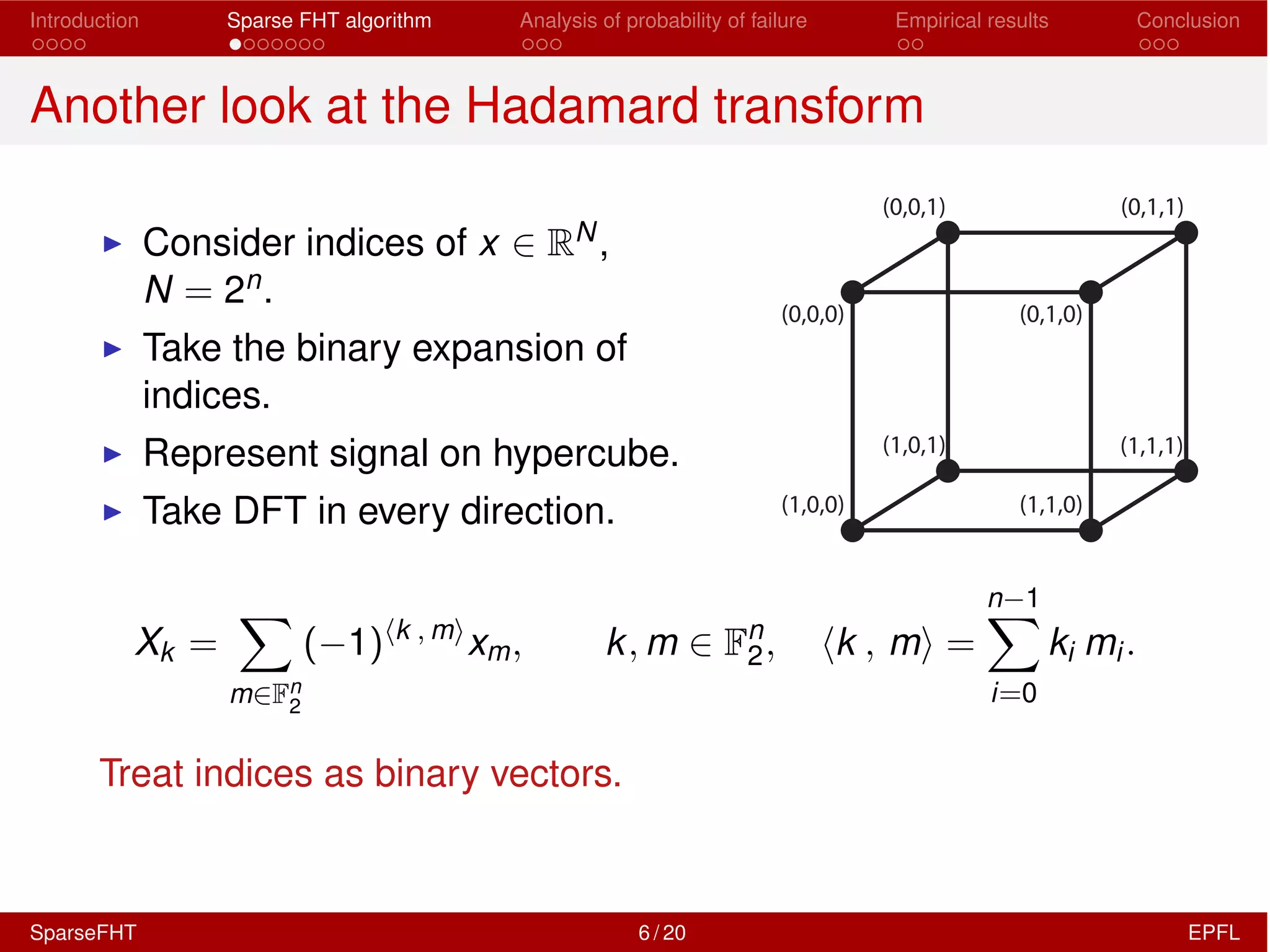
Another look at the Hadamard transform
I Consider indices of x 2 RN,
N = 2n.
I Take the binary expansion of
indices.
I Represent signal on hypercube.
I Take DFT in every direction.
I = {0, . . . , 23
1}
SparseFHT 6 / 20 EPFL
Introduction Sparse FHT algorithm Analysis of probability of failure Empirical results Conclusion
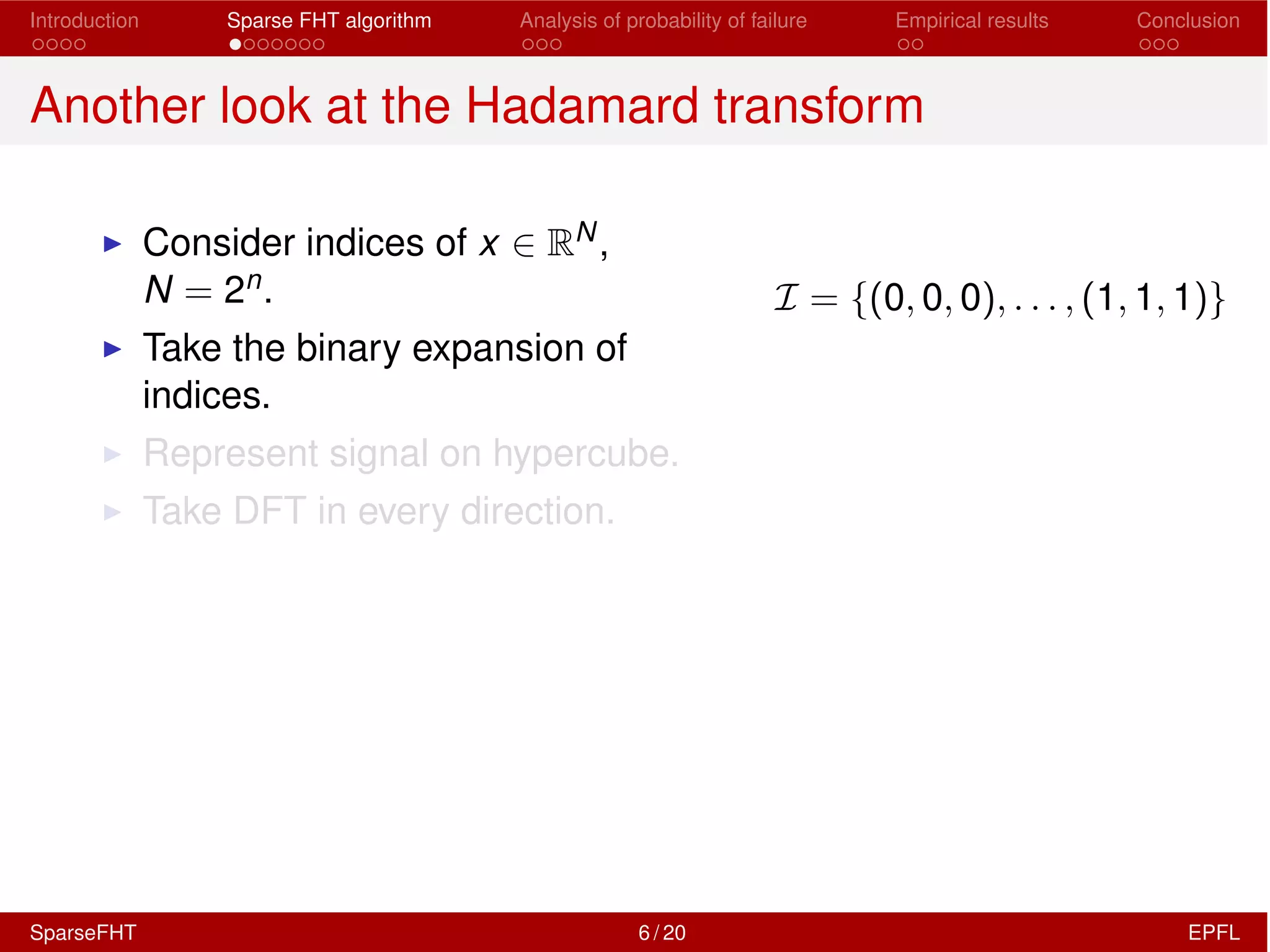
Another look at the Hadamard transform
I Consider indices of x 2 RN,
N = 2n.
I Take the binary expansion of
indices.
I Represent signal on hypercube.
I Take DFT in every direction.
I = {(0, 0, 0), . . . , (1, 1, 1)}
SparseFHT 6 / 20 EPFL
Introduction Sparse FHT algorithm Analysis of probability of failure Empirical results Conclusion
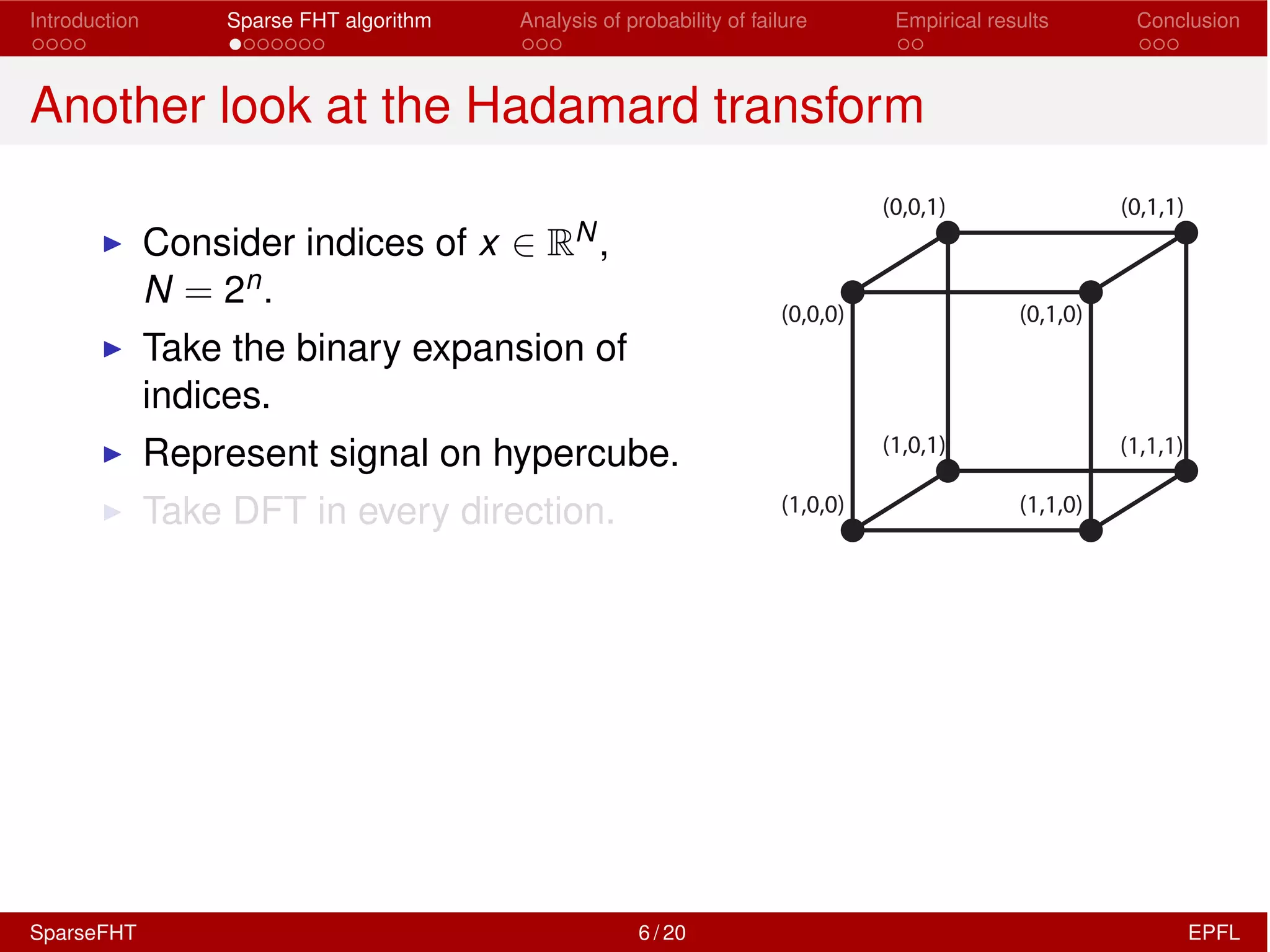
Another look at the Hadamard transform
I Consider indices of x 2 RN,
N = 2n.
I Take the binary expansion of
indices.
I Represent signal on hypercube.
I Take DFT in every direction.
(0,0,0) (0,1,0)
(1,0,1) (1,1,1)
(1,1,0)(1,0,0)
(0,0,1) (0,1,1)
SparseFHT 6 / 20 EPFL
Introduction Sparse FHT algorithm Analysis of probability of failure Empirical results Conclusion
Another look at the Hadamard transform
I Consider indices of x 2 RN,
N = 2n.
I Take the binary expansion of
indices.
I Represent signal on hypercube.
I Take DFT in every direction.
(0,0,0) (0,1,0)
(1,0,1) (1,1,1)
(1,1,0)(1,0,0)
(0,0,1) (0,1,1)
SparseFHT 6 / 20 EPFL
Introduction Sparse FHT algorithm Analysis of probability of failure Empirical results Conclusion
Another look at the Hadamard transform
I Consider indices of x 2 RN,
N = 2n.
I Take the binary expansion of
indices.
I Represent signal on hypercube.
I Take DFT in every direction.
(0,0,0) (0,1,0)
(1,0,1) (1,1,1)
(1,1,0)(1,0,0)
(0,0,1) (0,1,1)
SparseFHT 6 / 20 EPFL
Introduction Sparse FHT algorithm Analysis of probability of failure Empirical results Conclusion
Another look at the Hadamard transform
I Consider indices of x 2 RN,
N = 2n.
I Take the binary expansion of
indices.
I Represent signal on hypercube.
I Take DFT in every direction.
(0,0,0) (0,1,0)
(1,0,1) (1,1,1)
(1,1,0)(1,0,0)
(0,0,1) (0,1,1)
SparseFHT 6 / 20 EPFL
Introduction Sparse FHT algorithm Analysis of probability of failure Empirical results Conclusion
Another look at the Hadamard transform
I Consider indices of x 2 RN,
N = 2n.
I Take the binary expansion of
indices.
I Represent signal on hypercube.
I Take DFT in every direction.
(0,0,0) (0,1,0)
(1,0,1) (1,1,1)
(1,1,0)(1,0,0)
(0,0,1) (0,1,1)
Xk0,...,kn 1
=
1X
m0=0
· · ·
1X
mn 1=0
( 1)k0m0+···+kn 1mn 1
xm0,...,mn 1
,
SparseFHT 6 / 20 EPFL
Introduction Sparse FHT algorithm Analysis of probability of failure Empirical results Conclusion
Another look at the Hadamard transform
I Consider indices of x 2 RN,
N = 2n.
I Take the binary expansion of
indices.
I Represent signal on hypercube.
I Take DFT in every direction.
(0,0,0) (0,1,0)
(1,0,1) (1,1,1)
(1,1,0)(1,0,0)
(0,0,1) (0,1,1)
Xk =
X
m2Fn
2
( 1)hk , mi
xm, k, m 2 Fn
2, hk , mi =
n 1X
i=0
ki mi.
Treat indices as binary vectors.
SparseFHT 6 / 20 EPFL
Introduction Sparse FHT algorithm Analysis of probability of failure Empirical results Conclusion
Another look at the Hadamard transform
I Consider indices of x 2 RN,
N = 2n.
I Take the binary expansion of
indices.
I Represent signal on hypercube.
I Take DFT in every direction.
(0,0,0) (0,1,0)
(1,0,1) (1,1,1)
(1,1,0)(1,0,0)
(0,0,1) (0,1,1)
Xk =
X
m2Fn
2
( 1)hk , mi
xm, k, m 2 Fn
2, hk , mi =
n 1X
i=0
ki mi.
Treat indices as binary vectors.
SparseFHT 6 / 20 EPFL
Introduction Sparse FHT algorithm Analysis of probability of failure Empirical results Conclusion
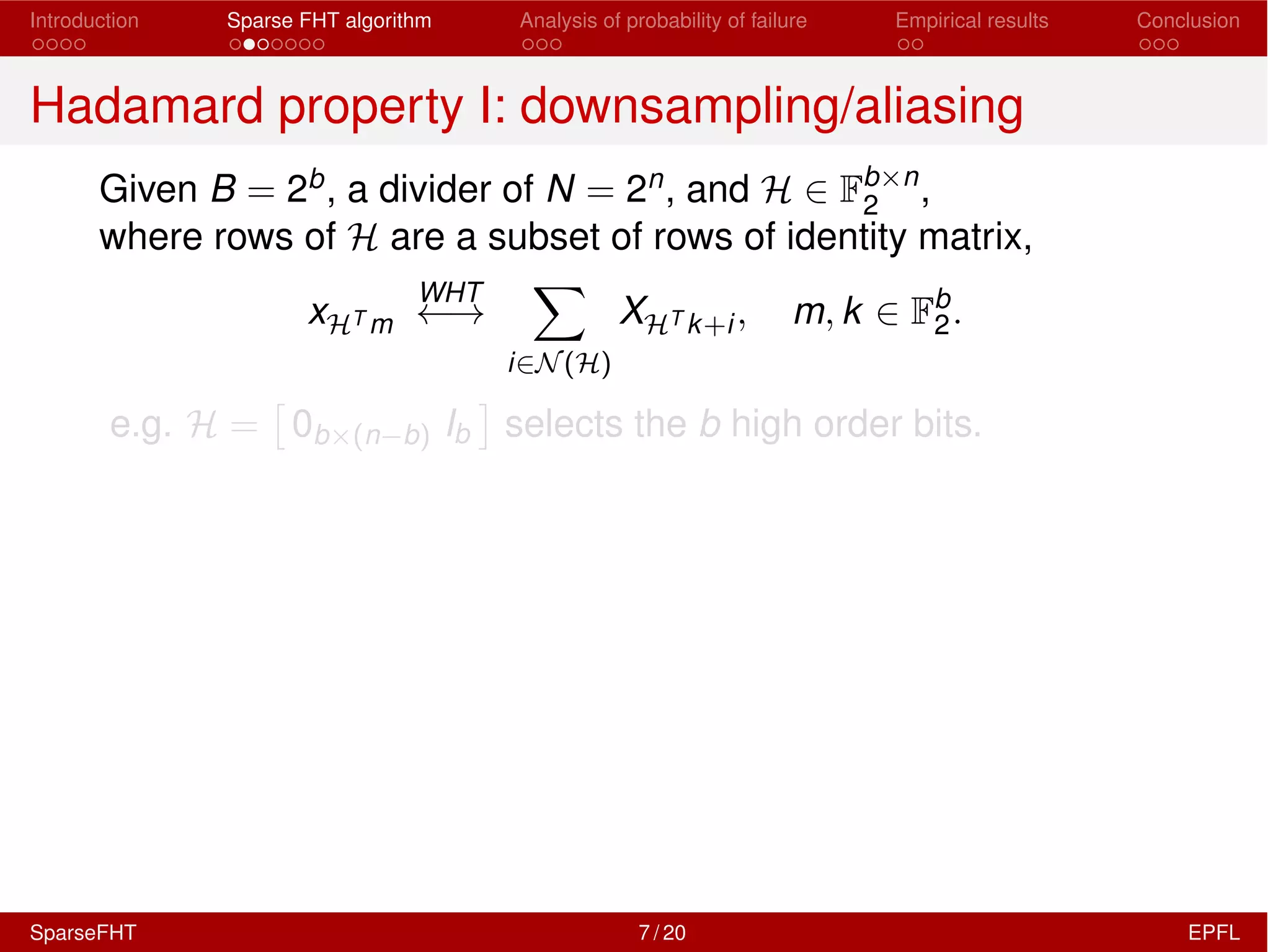
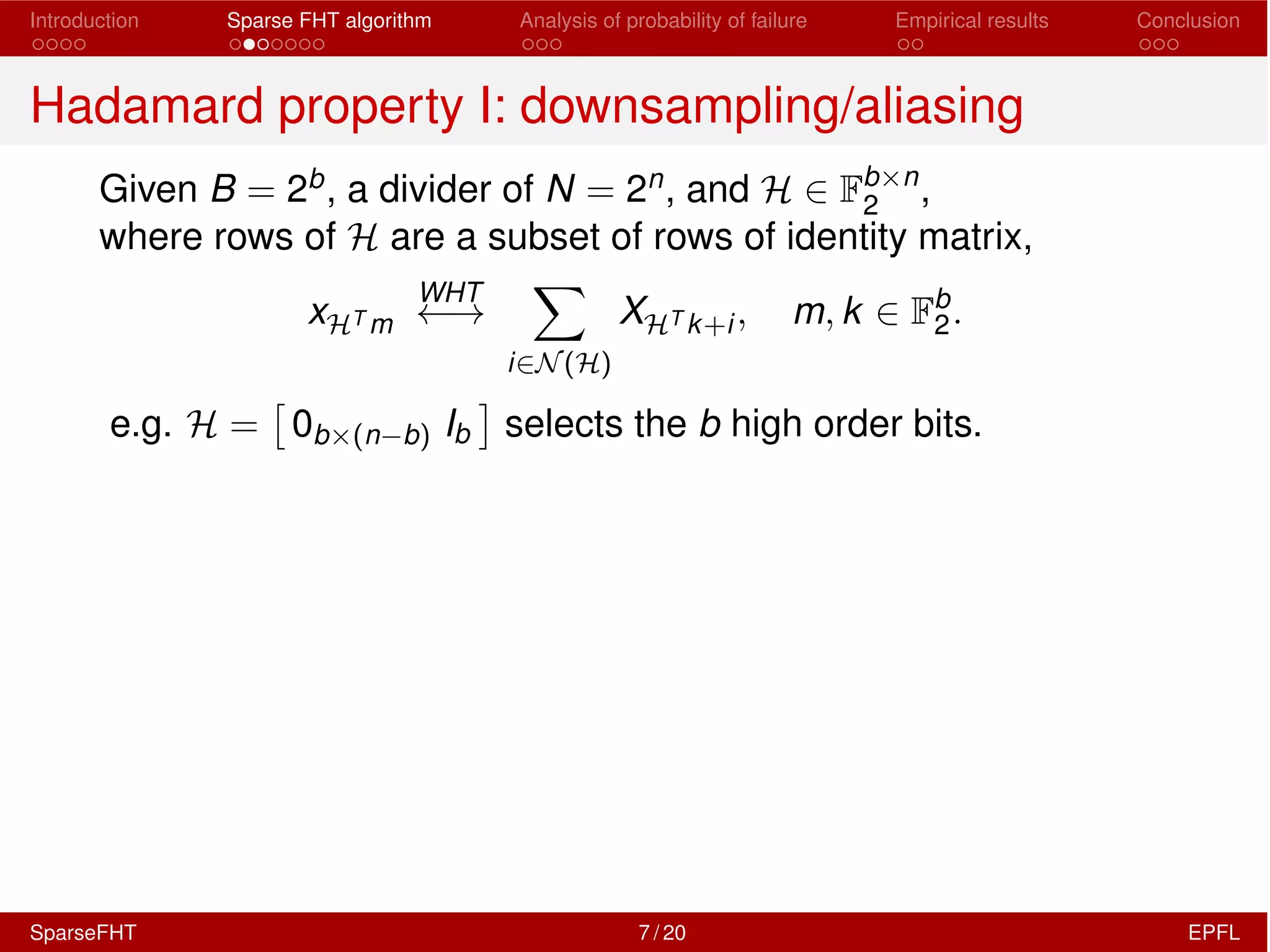
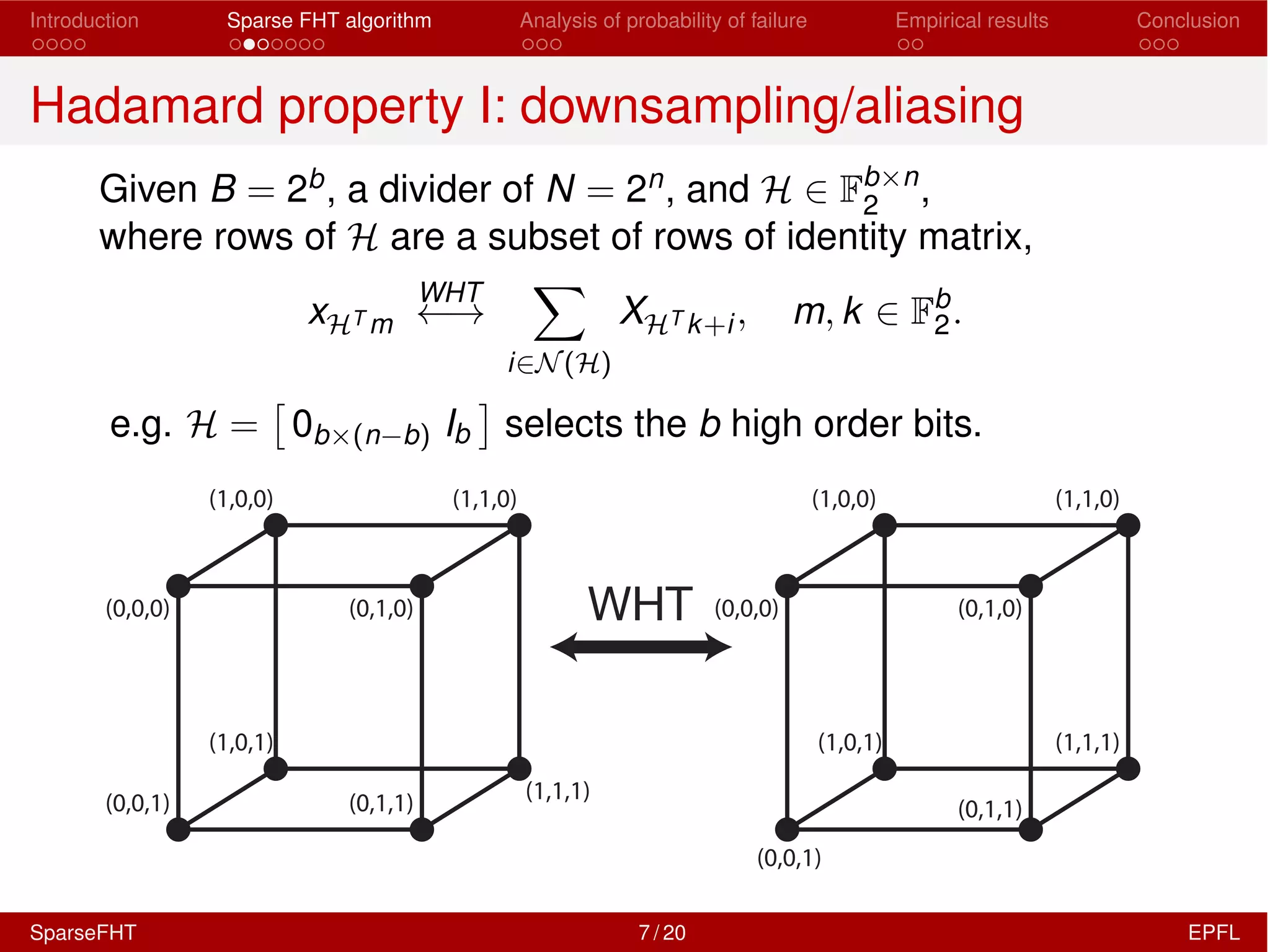
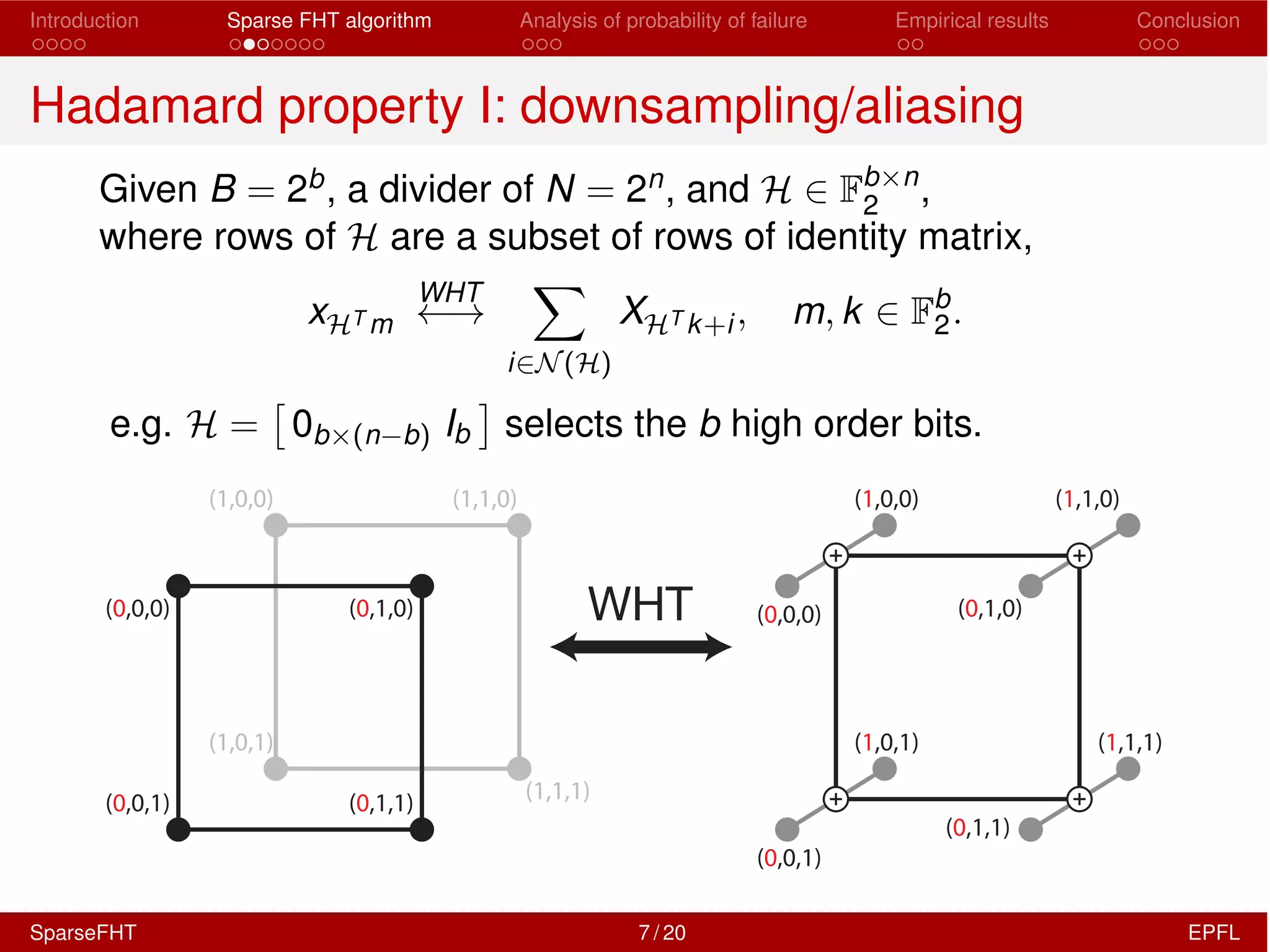
Hadamard property I: downsampling/aliasing
Given B = 2b, a divider of N = 2n, and H 2 Fb⇥n
2 ,
where rows of H are a subset of rows of identity matrix,
xHT m
WHT
!
X
i2N(H)
XHT k+i, m, k 2 Fb
2.
e.g. H =
⇥
0b⇥(n b) Ib
⇤
selects the b high order bits.
SparseFHT 7 / 20 EPFL
Introduction Sparse FHT algorithm Analysis of probability of failure Empirical results Conclusion
Hadamard property I: downsampling/aliasing
Given B = 2b, a divider of N = 2n, and H 2 Fb⇥n
2 ,
where rows of H are a subset of rows of identity matrix,
xHT m
WHT
!
X
i2N(H)
XHT k+i, m, k 2 Fb
2.
e.g. H =
⇥
0b⇥(n b) Ib
⇤
selects the b high order bits.
SparseFHT 7 / 20 EPFL
Introduction Sparse FHT algorithm Analysis of probability of failure Empirical results Conclusion
Hadamard property I: downsampling/aliasing
Given B = 2b, a divider of N = 2n, and H 2 Fb⇥n
2 ,
where rows of H are a subset of rows of identity matrix,
xHT m
WHT
!
X
i2N(H)
XHT k+i, m, k 2 Fb
2.
e.g. H =
⇥
0b⇥(n b) Ib
⇤
selects the b high order bits.
(0,0,0) (0,1,0)
(1,0,1)
(1,1,1)(0,1,1)(0,0,1)
(1,0,0) (1,1,0)
(0,0,0) (0,1,0)
(1,0,1) (1,1,1)
(0,1,1)
(0,0,1)
(1,0,0) (1,1,0)
WHT
SparseFHT 7 / 20 EPFL
Introduction Sparse FHT algorithm Analysis of probability of failure Empirical results Conclusion
Hadamard property I: downsampling/aliasing
Given B = 2b, a divider of N = 2n, and H 2 Fb⇥n
2 ,
where rows of H are a subset of rows of identity matrix,
xHT m
WHT
!
X
i2N(H)
XHT k+i, m, k 2 Fb
2.
e.g. H =
⇥
0b⇥(n b) Ib
⇤
selects the b high order bits.
(0,0,0) (0,1,0)
(0,1,1)(0,0,1)
(0,0,0) (0,1,0)
(1,0,1) (1,1,1)
(0,1,1)
(0,0,1)
(1,0,0) (1,1,0)
(1,0,1)
(1,1,1)
(1,0,0) (1,1,0)
WHT
SparseFHT 7 / 20 EPFL
Introduction Sparse FHT algorithm Analysis of probability of failure Empirical results Conclusion
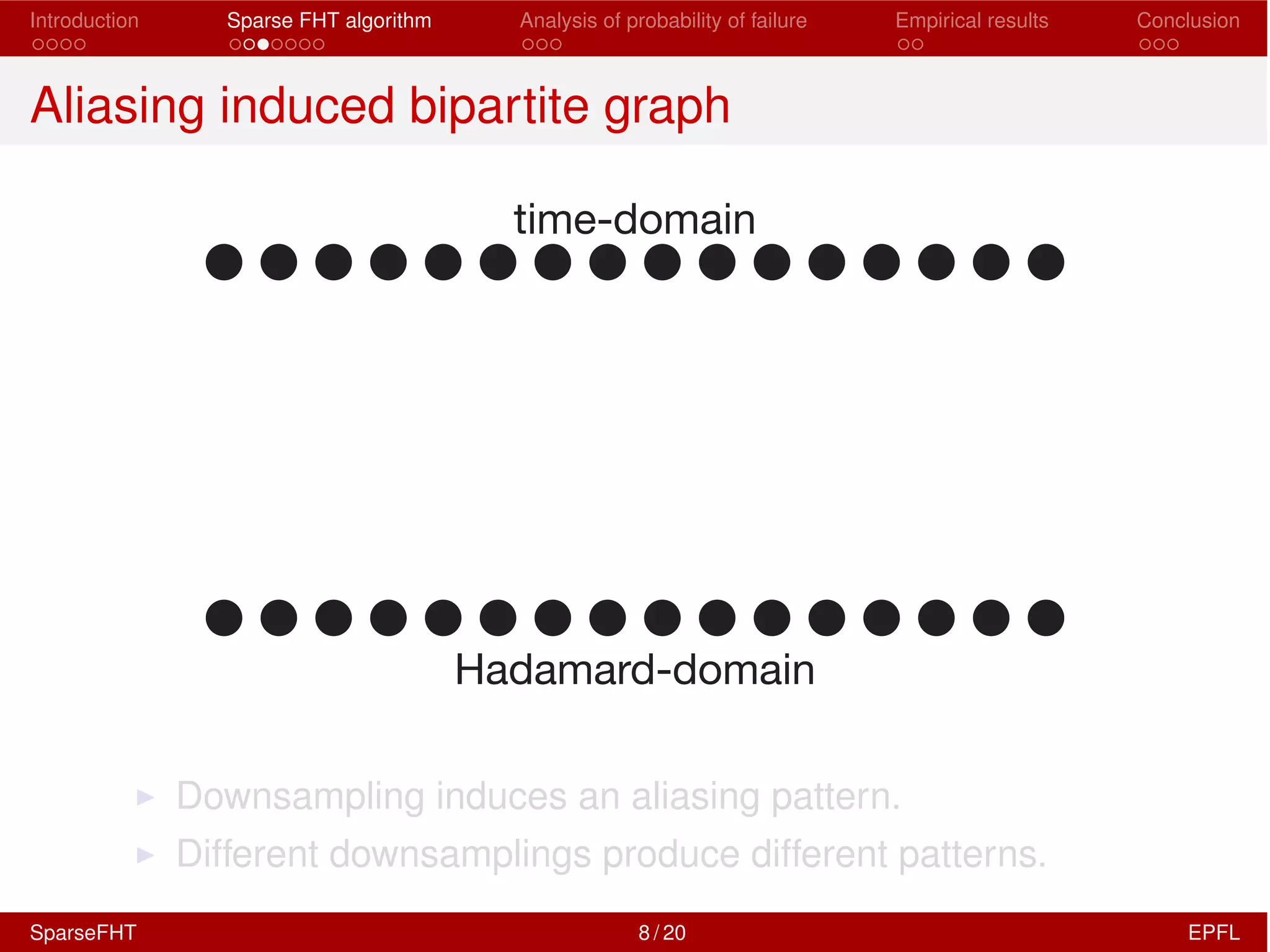
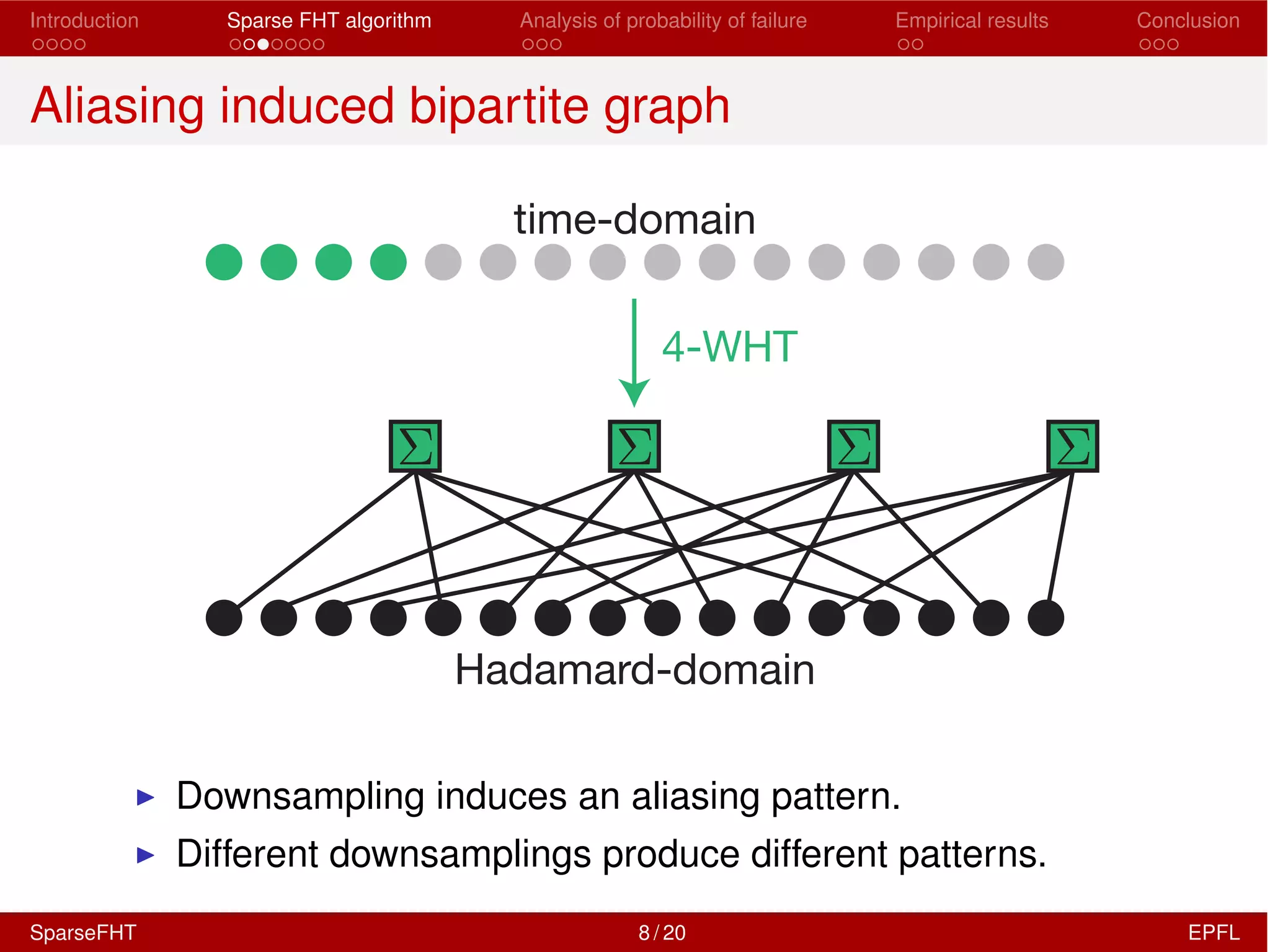
Aliasing induced bipartite graph
time-domain
Hadamard-domain
I Downsampling induces an aliasing pattern.
I Different downsamplings produce different patterns.
SparseFHT 8 / 20 EPFL
Introduction Sparse FHT algorithm Analysis of probability of failure Empirical results Conclusion
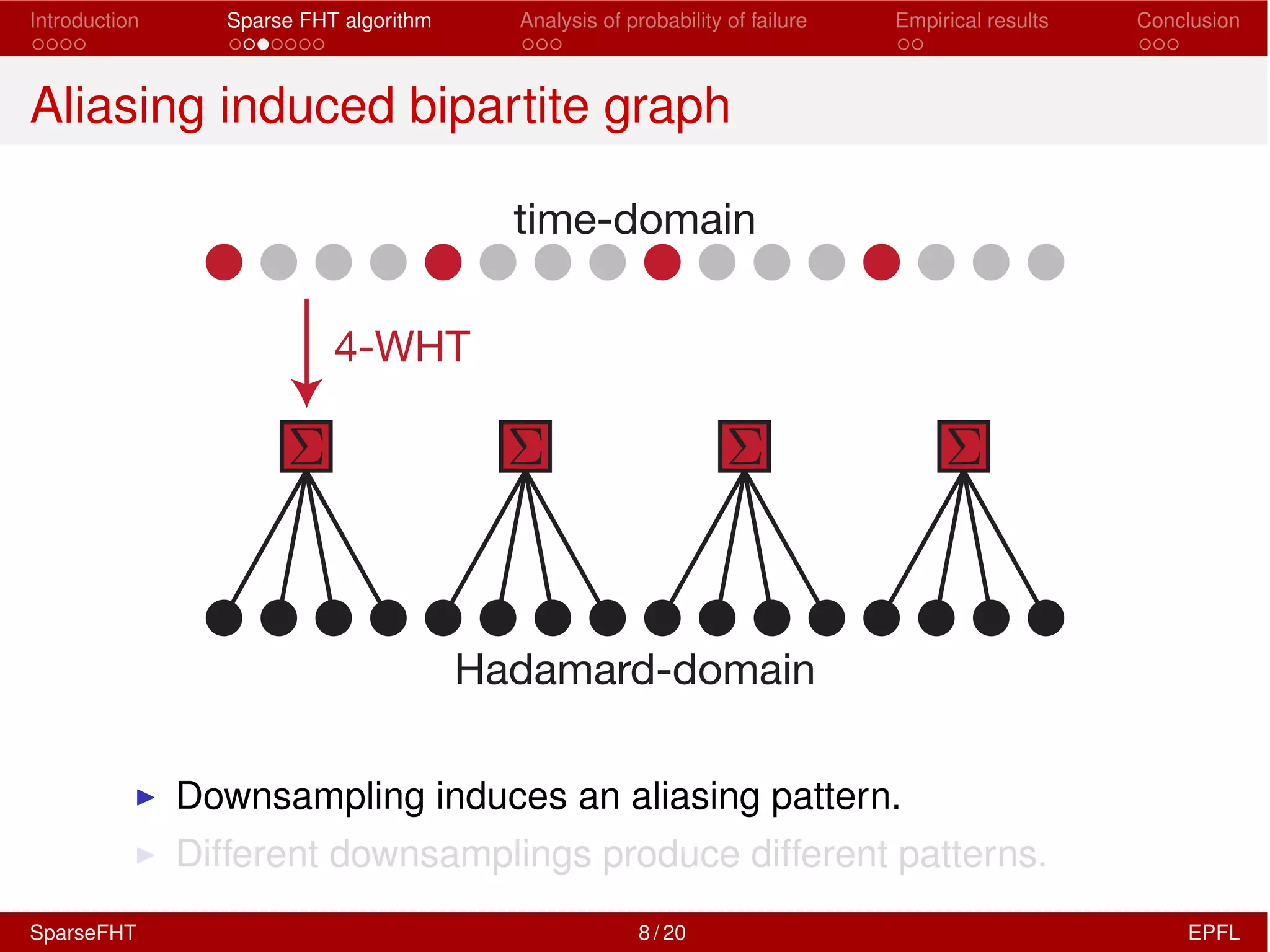
Aliasing induced bipartite graph
time-domain
Hadamard-domain
4-WHT
I Downsampling induces an aliasing pattern.
I Different downsamplings produce different patterns.
SparseFHT 8 / 20 EPFL
Introduction Sparse FHT algorithm Analysis of probability of failure Empirical results Conclusion
Aliasing induced bipartite graph
time-domain
Hadamard-domain
4-WHT
I Downsampling induces an aliasing pattern.
I Different downsamplings produce different patterns.
SparseFHT 8 / 20 EPFL
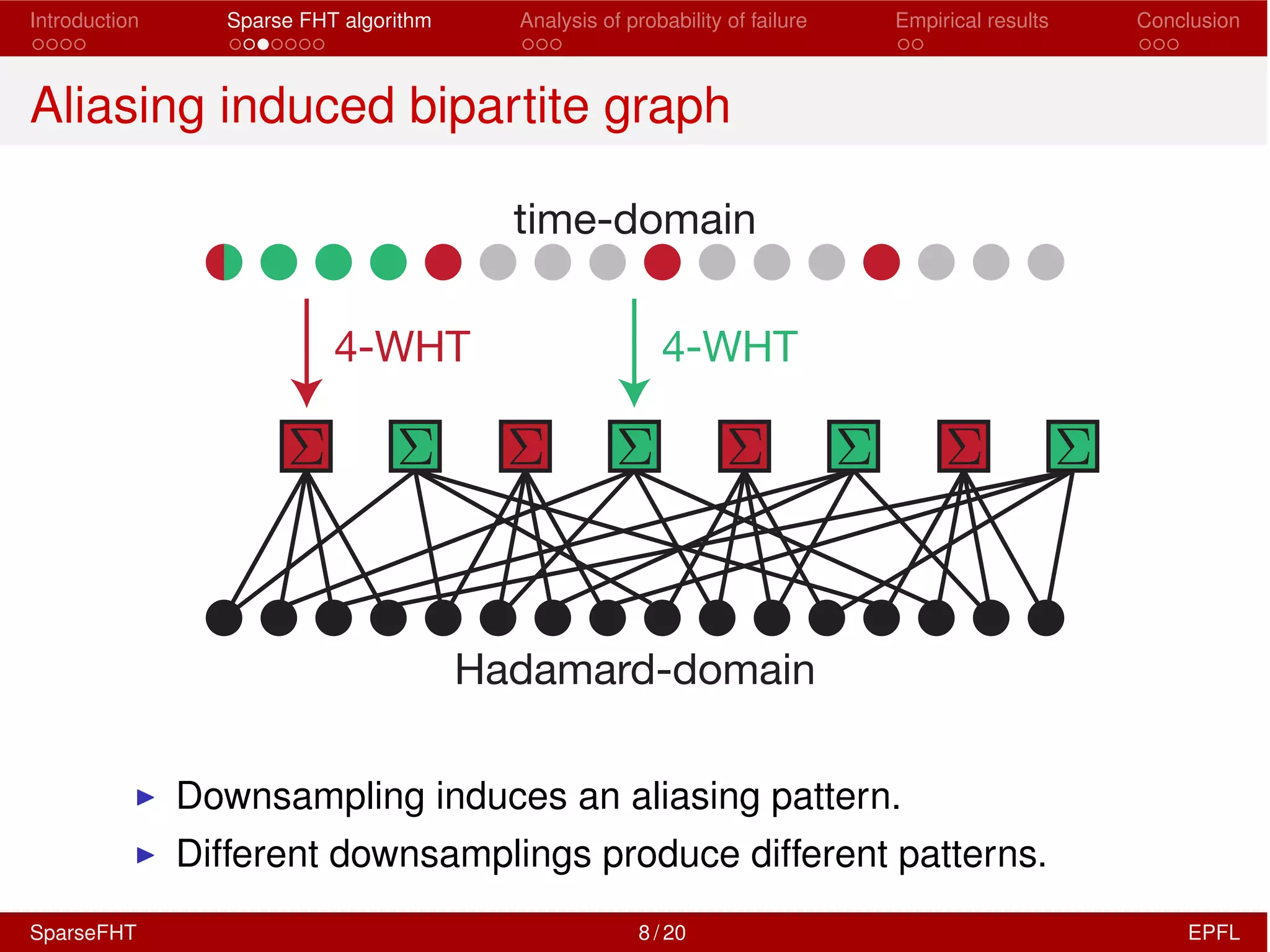
Introduction Sparse FHT algorithm Analysis of probability of failure Empirical results Conclusion
Aliasing induced bipartite graph
time-domain
Hadamard-domain
4-WHT 4-WHT
I Downsampling induces an aliasing pattern.
I Different downsamplings produce different patterns.
SparseFHT 8 / 20 EPFL
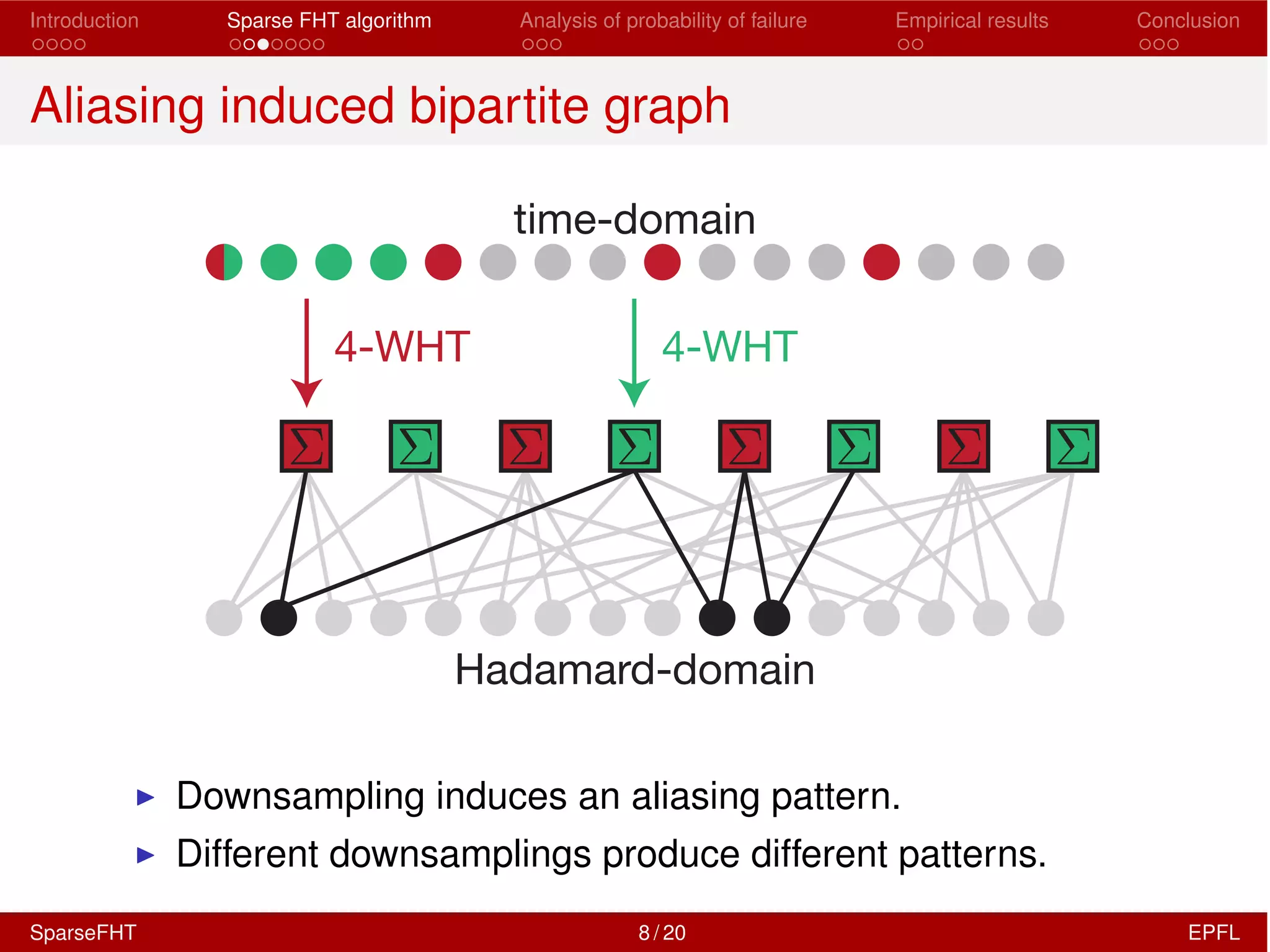
Introduction Sparse FHT algorithm Analysis of probability of failure Empirical results Conclusion
Aliasing induced bipartite graph
time-domain
Hadamard-domain
4-WHT 4-WHT
I Downsampling induces an aliasing pattern.
I Different downsamplings produce different patterns.
SparseFHT 8 / 20 EPFL
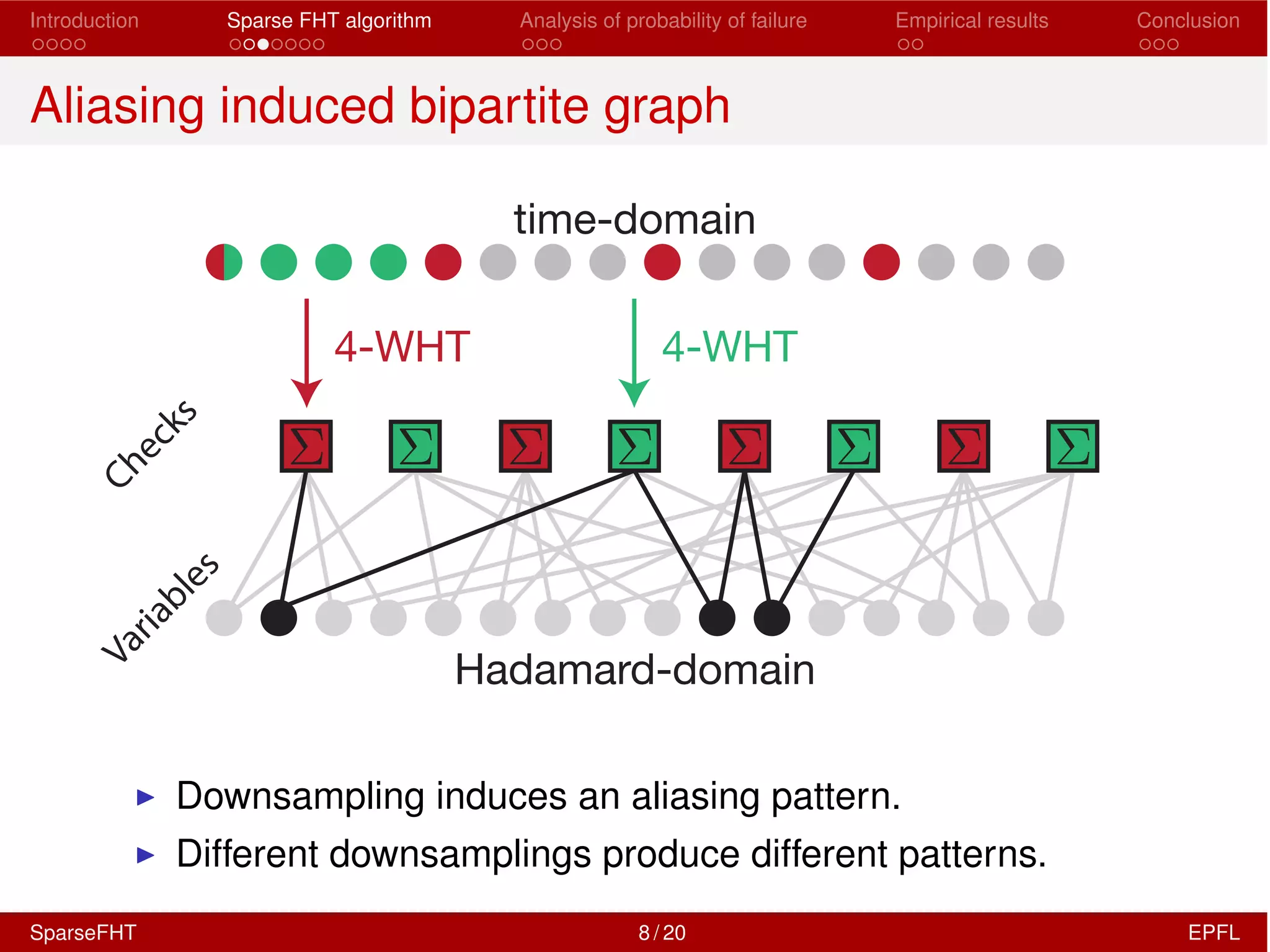
Introduction Sparse FHT algorithm Analysis of probability of failure Empirical results Conclusion
Aliasing induced bipartite graph
time-domain
Hadamard-domain
4-WHT 4-WHT
Checks
Variables
I Downsampling induces an aliasing pattern.
I Different downsamplings produce different patterns.
SparseFHT 8 / 20 EPFL
Introduction Sparse FHT algorithm Analysis of probability of failure Empirical results Conclusion
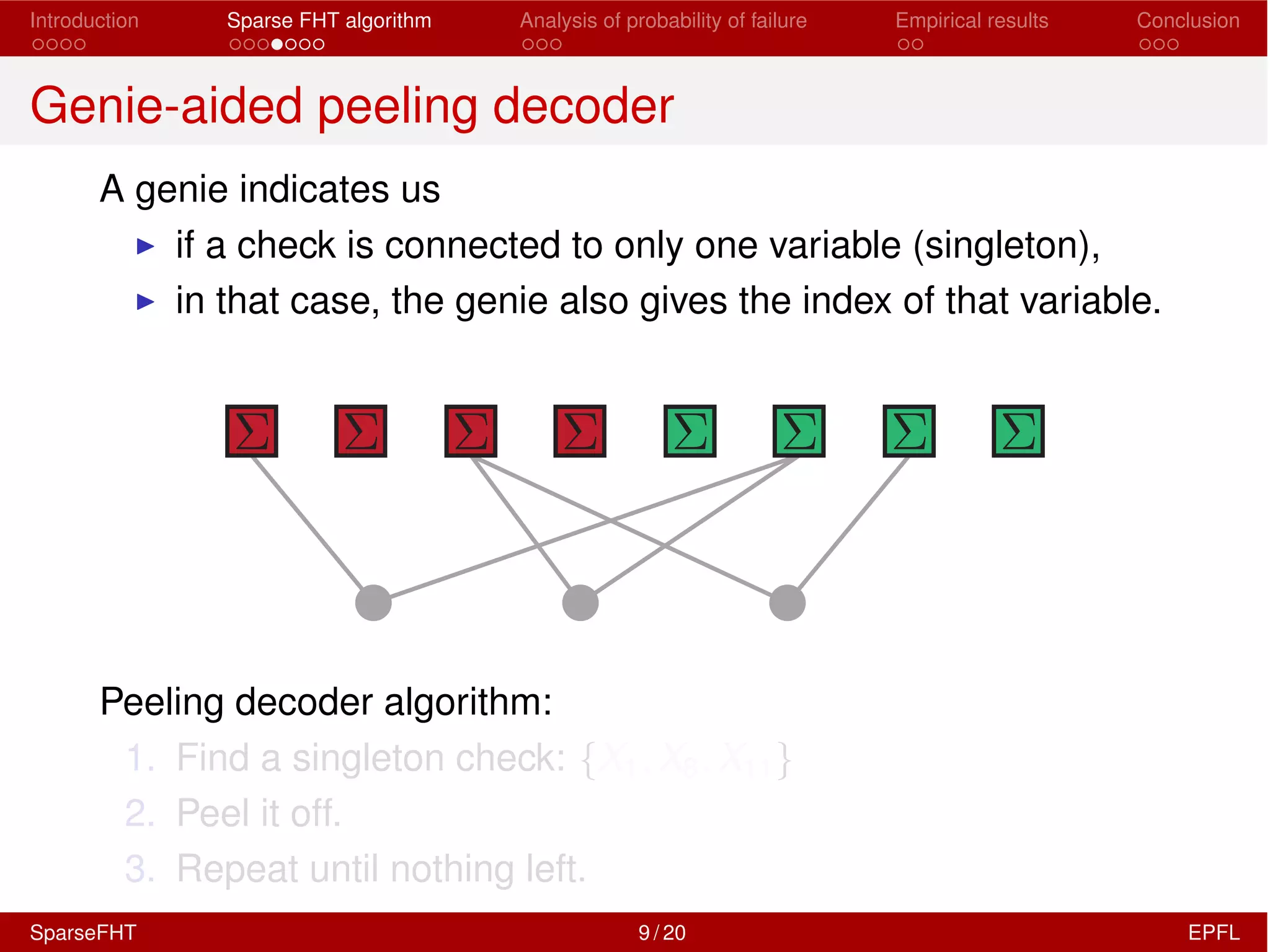
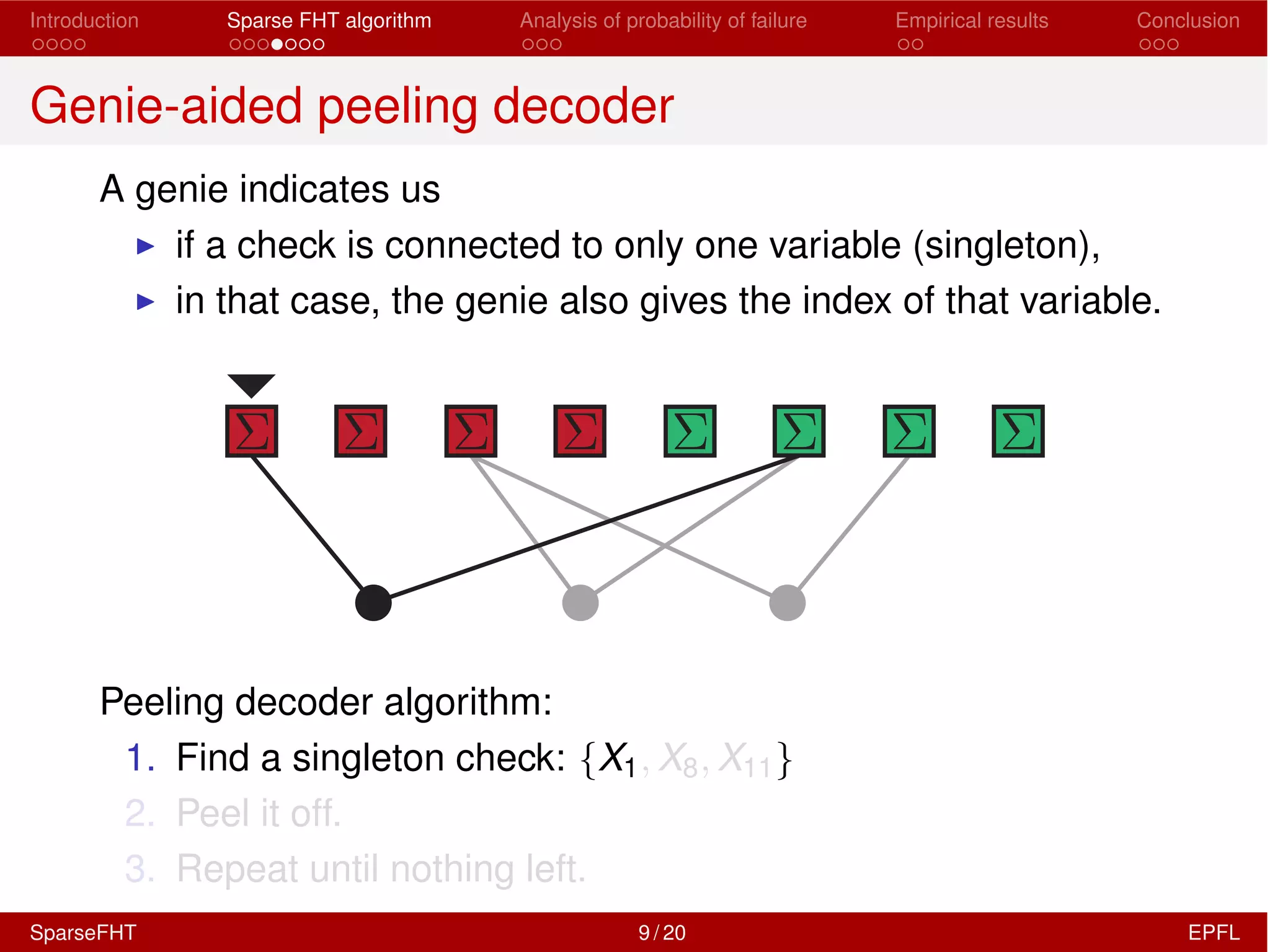
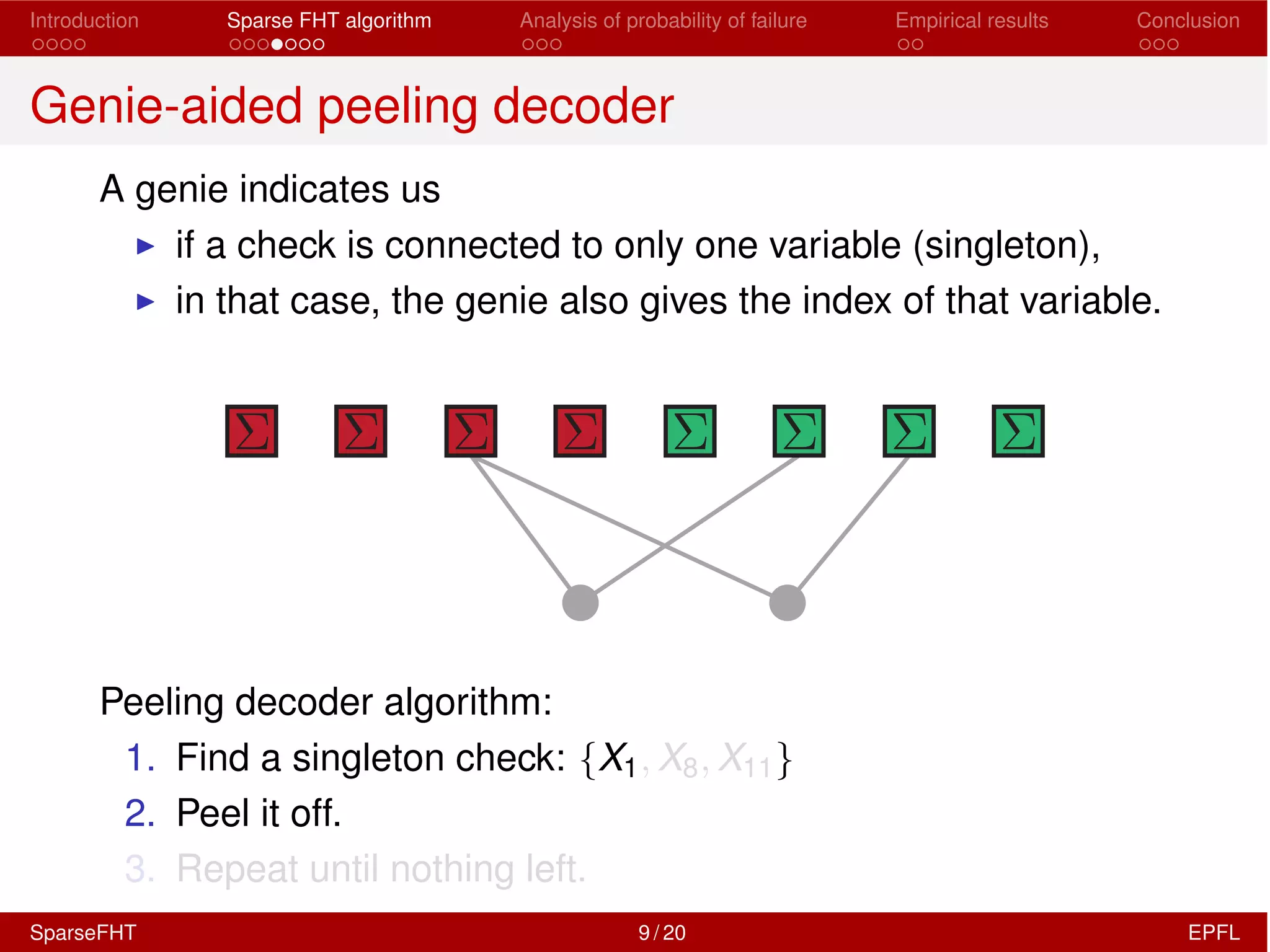
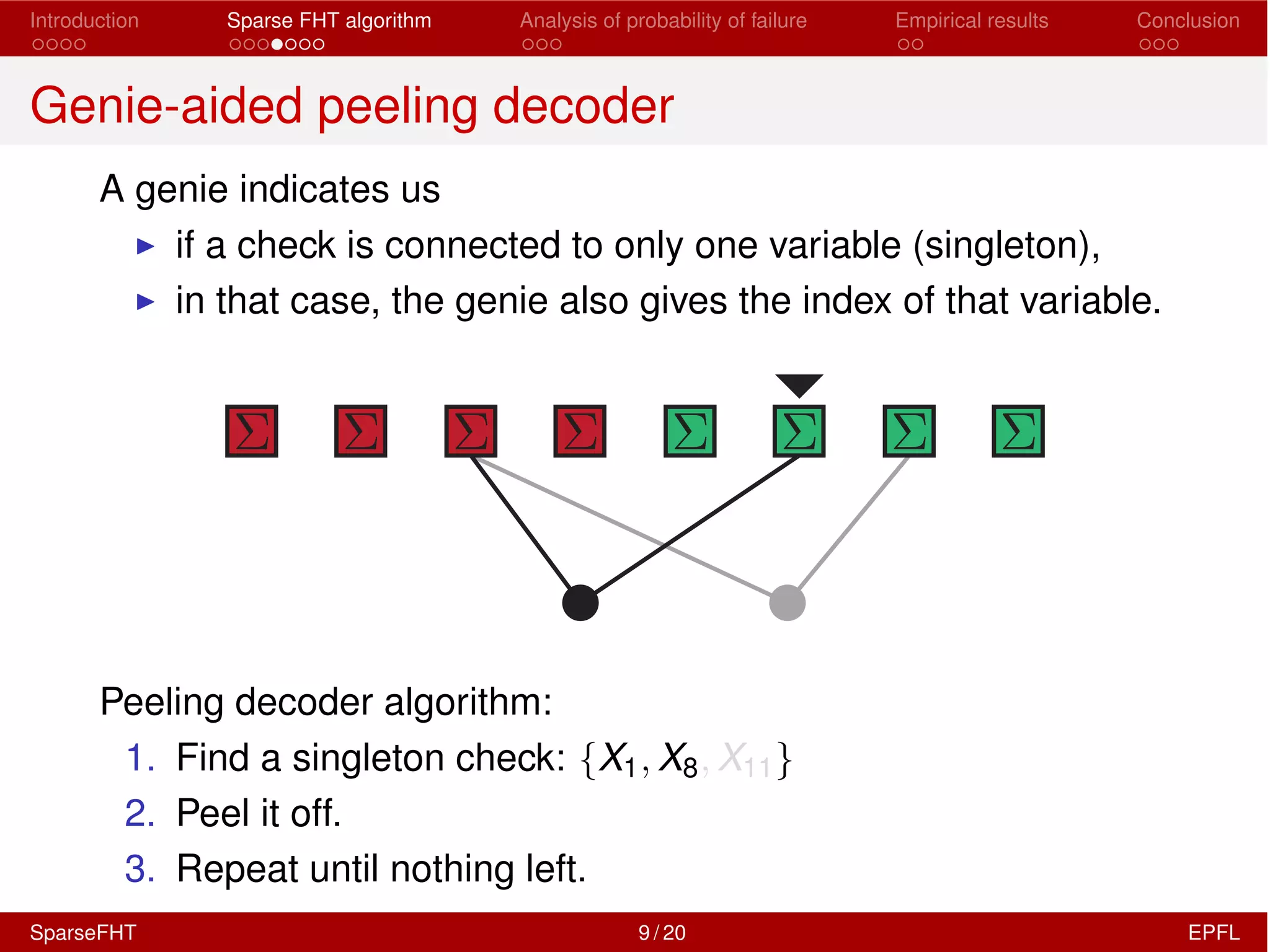
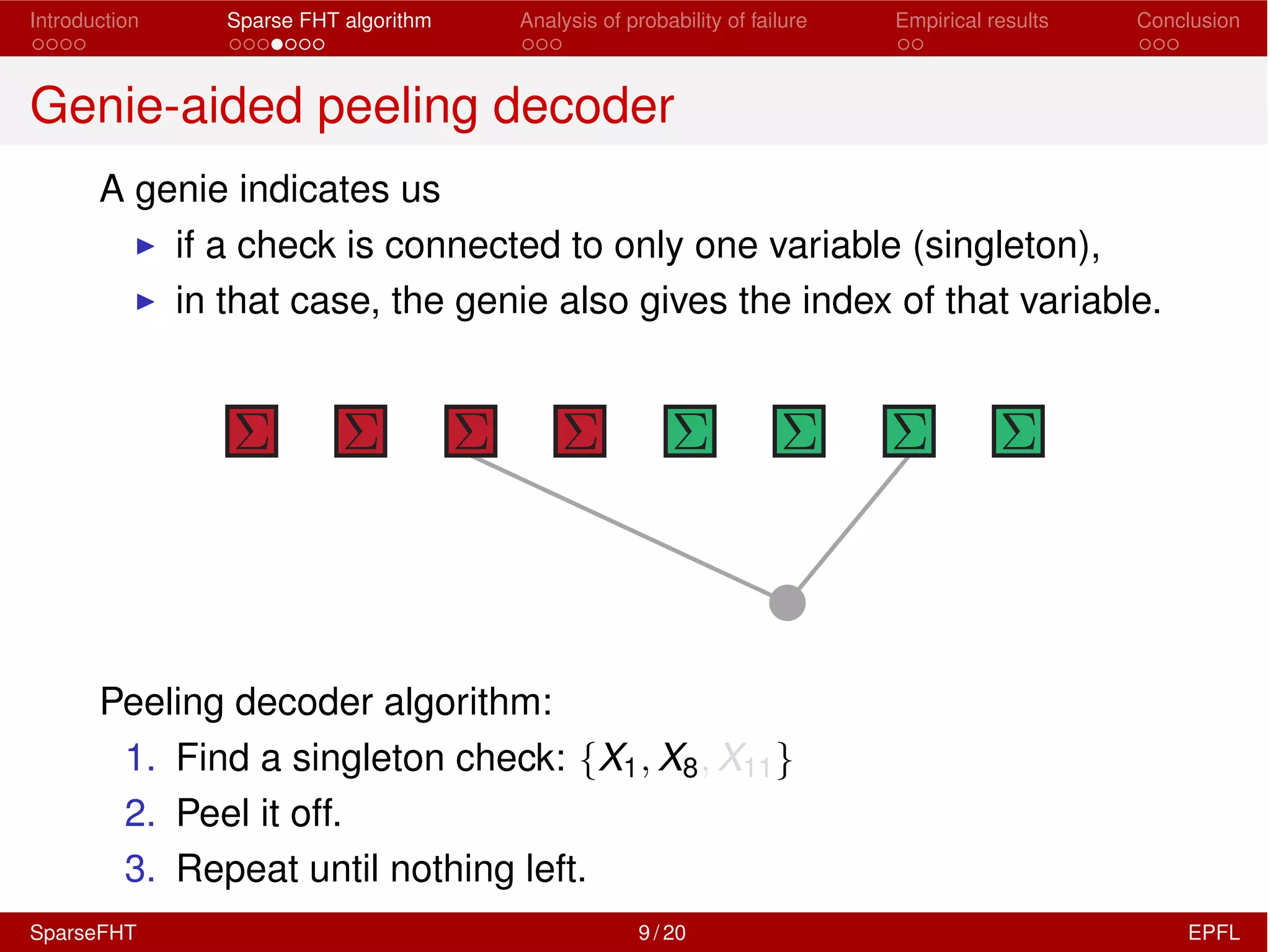
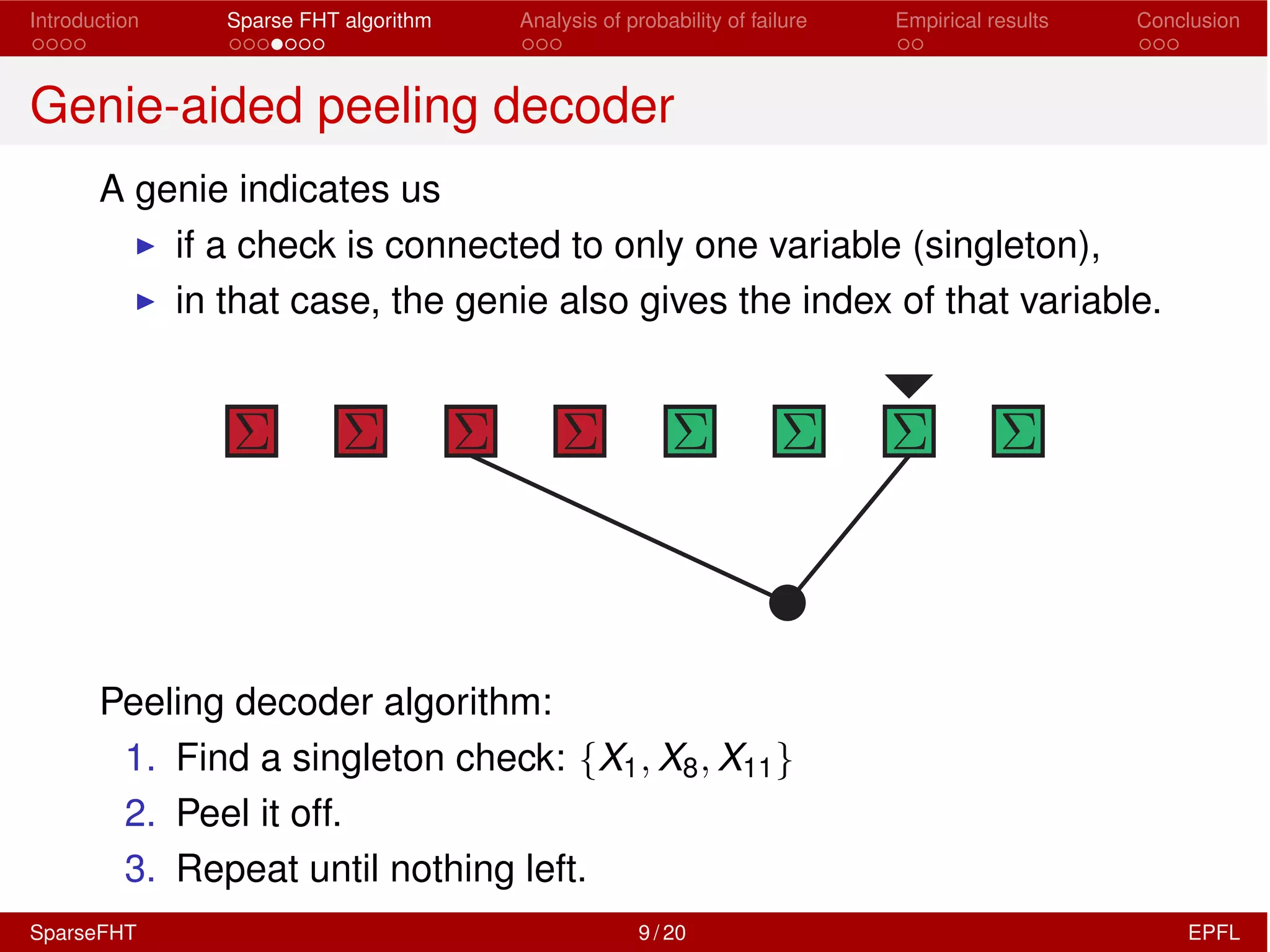
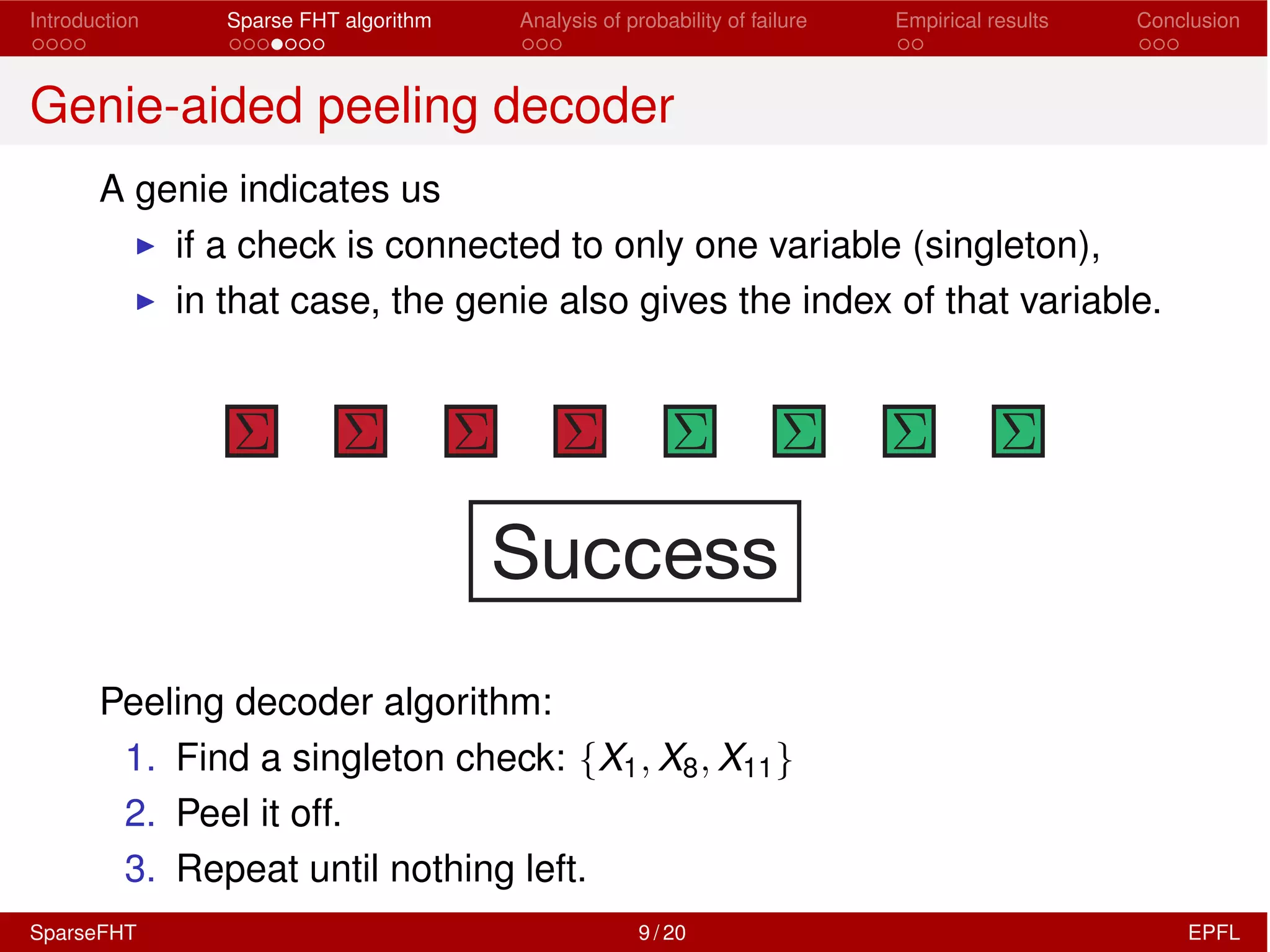
Genie-aided peeling decoder
A genie indicates us
I if a check is connected to only one variable (singleton),
I in that case, the genie also gives the index of that variable.
Peeling decoder algorithm:
1. Find a singleton check: {X1, X8, X11}
2. Peel it off.
3. Repeat until nothing left.
SparseFHT 9 / 20 EPFL
Introduction Sparse FHT algorithm Analysis of probability of failure Empirical results Conclusion
Genie-aided peeling decoder
A genie indicates us
I if a check is connected to only one variable (singleton),
I in that case, the genie also gives the index of that variable.
Peeling decoder algorithm:
1. Find a singleton check: {X1, X8, X11}
2. Peel it off.
3. Repeat until nothing left.
SparseFHT 9 / 20 EPFL
Introduction Sparse FHT algorithm Analysis of probability of failure Empirical results Conclusion
Genie-aided peeling decoder
A genie indicates us
I if a check is connected to only one variable (singleton),
I in that case, the genie also gives the index of that variable.
Peeling decoder algorithm:
1. Find a singleton check: {X1, X8, X11}
2. Peel it off.
3. Repeat until nothing left.
SparseFHT 9 / 20 EPFL
Introduction Sparse FHT algorithm Analysis of probability of failure Empirical results Conclusion
Genie-aided peeling decoder
A genie indicates us
I if a check is connected to only one variable (singleton),
I in that case, the genie also gives the index of that variable.
Peeling decoder algorithm:
1. Find a singleton check: {X1, X8, X11}
2. Peel it off.
3. Repeat until nothing left.
SparseFHT 9 / 20 EPFL
Introduction Sparse FHT algorithm Analysis of probability of failure Empirical results Conclusion
Genie-aided peeling decoder
A genie indicates us
I if a check is connected to only one variable (singleton),
I in that case, the genie also gives the index of that variable.
Peeling decoder algorithm:
1. Find a singleton check: {X1, X8, X11}
2. Peel it off.
3. Repeat until nothing left.
SparseFHT 9 / 20 EPFL
Introduction Sparse FHT algorithm Analysis of probability of failure Empirical results Conclusion
Genie-aided peeling decoder
A genie indicates us
I if a check is connected to only one variable (singleton),
I in that case, the genie also gives the index of that variable.
Peeling decoder algorithm:
1. Find a singleton check: {X1, X8, X11}
2. Peel it off.
3. Repeat until nothing left.
SparseFHT 9 / 20 EPFL
Introduction Sparse FHT algorithm Analysis of probability of failure Empirical results Conclusion
Genie-aided peeling decoder
A genie indicates us
I if a check is connected to only one variable (singleton),
I in that case, the genie also gives the index of that variable.
Success
Peeling decoder algorithm:
1. Find a singleton check: {X1, X8, X11}
2. Peel it off.
3. Repeat until nothing left.
SparseFHT 9 / 20 EPFL
Introduction Sparse FHT algorithm Analysis of probability of failure Empirical results Conclusion
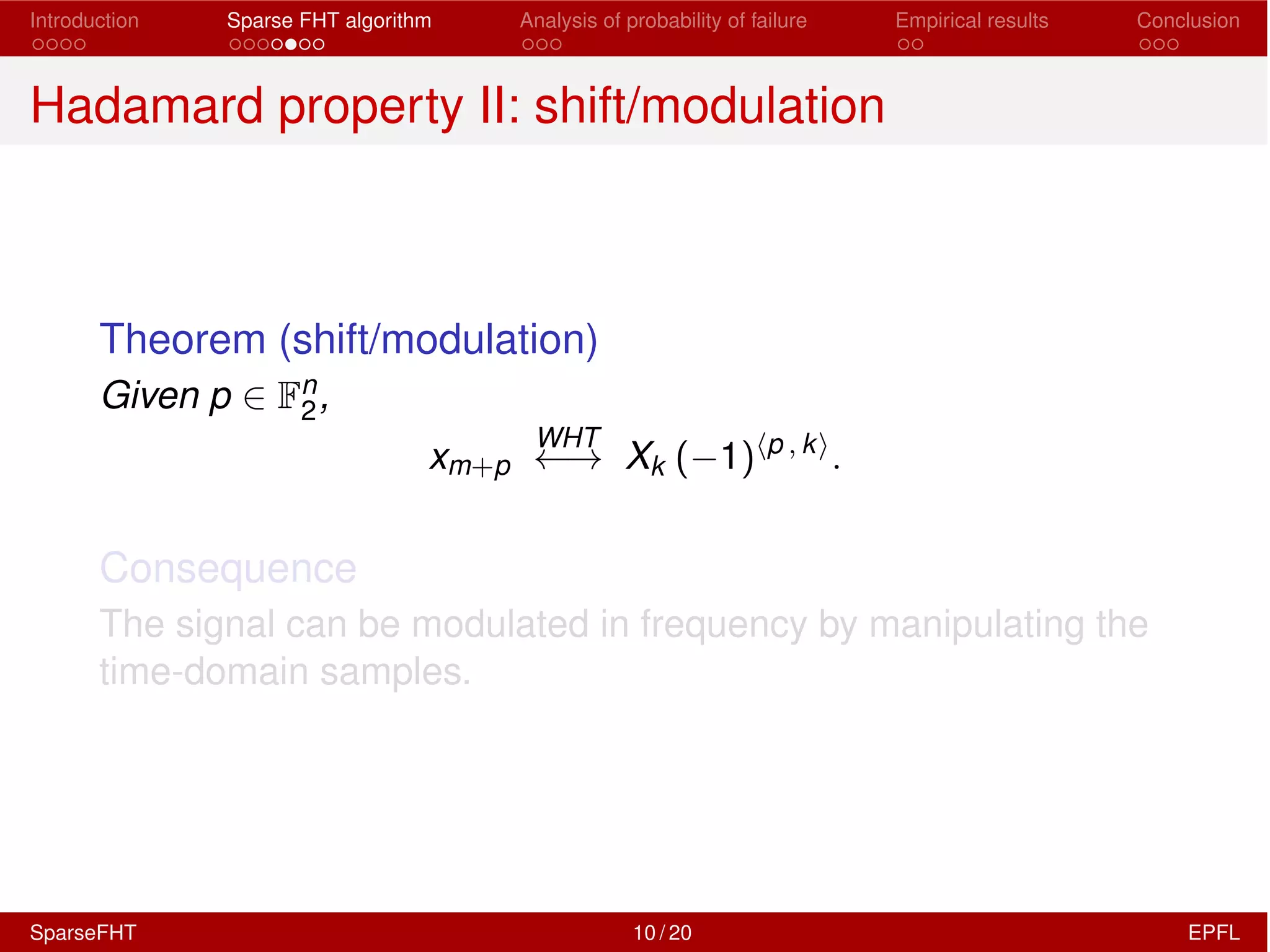
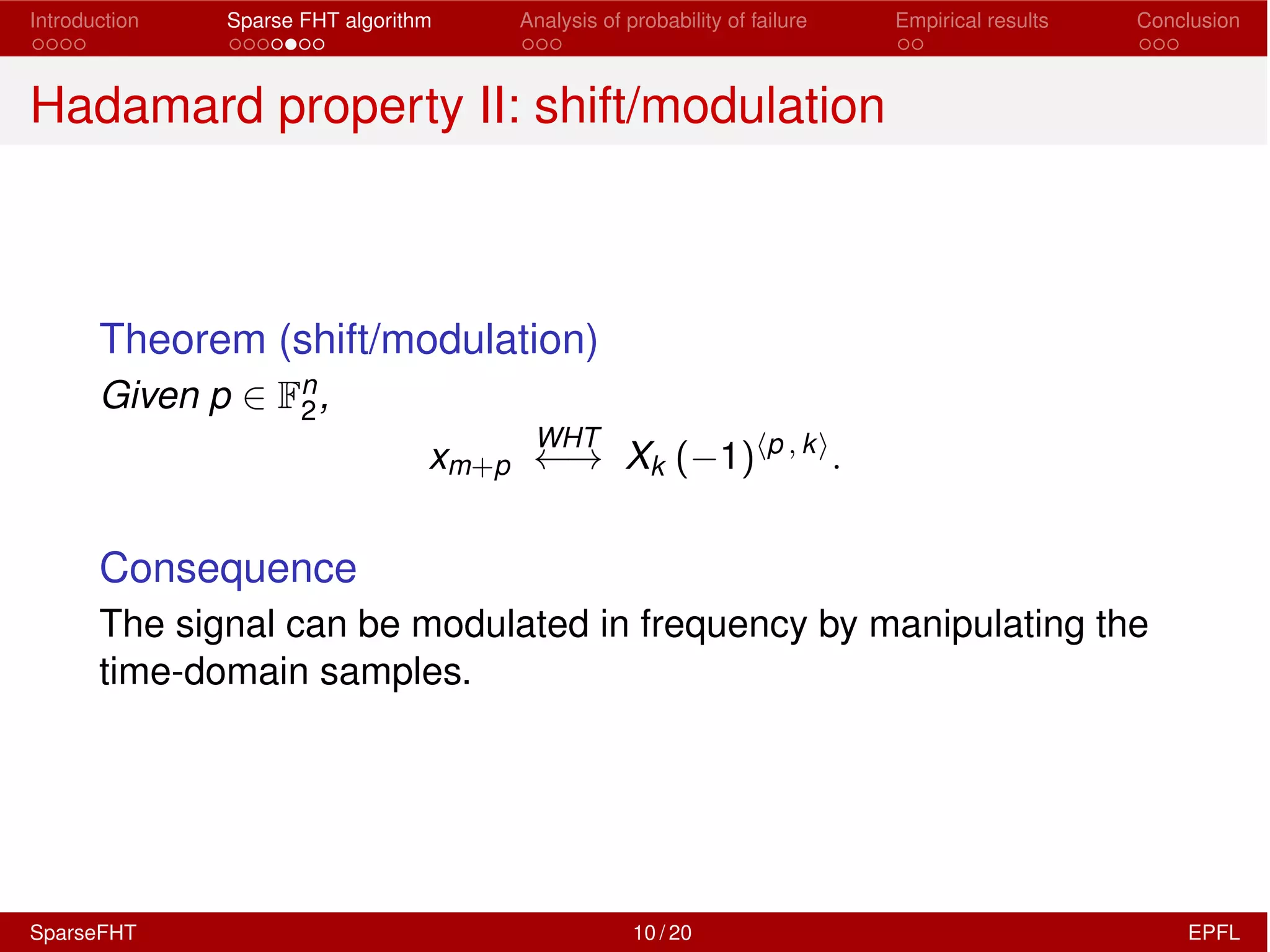
Hadamard property II: shift/modulation
Theorem (shift/modulation)
Given p 2 Fn
2,
xm+p
WHT
! Xk ( 1)hp , ki
.
Consequence
The signal can be modulated in frequency by manipulating the
time-domain samples.
SparseFHT 10 / 20 EPFL
Introduction Sparse FHT algorithm Analysis of probability of failure Empirical results Conclusion
Hadamard property II: shift/modulation
Theorem (shift/modulation)
Given p 2 Fn
2,
xm+p
WHT
! Xk ( 1)hp , ki
.
Consequence
The signal can be modulated in frequency by manipulating the
time-domain samples.
SparseFHT 10 / 20 EPFL
Introduction Sparse FHT algorithm Analysis of probability of failure Empirical results Conclusion
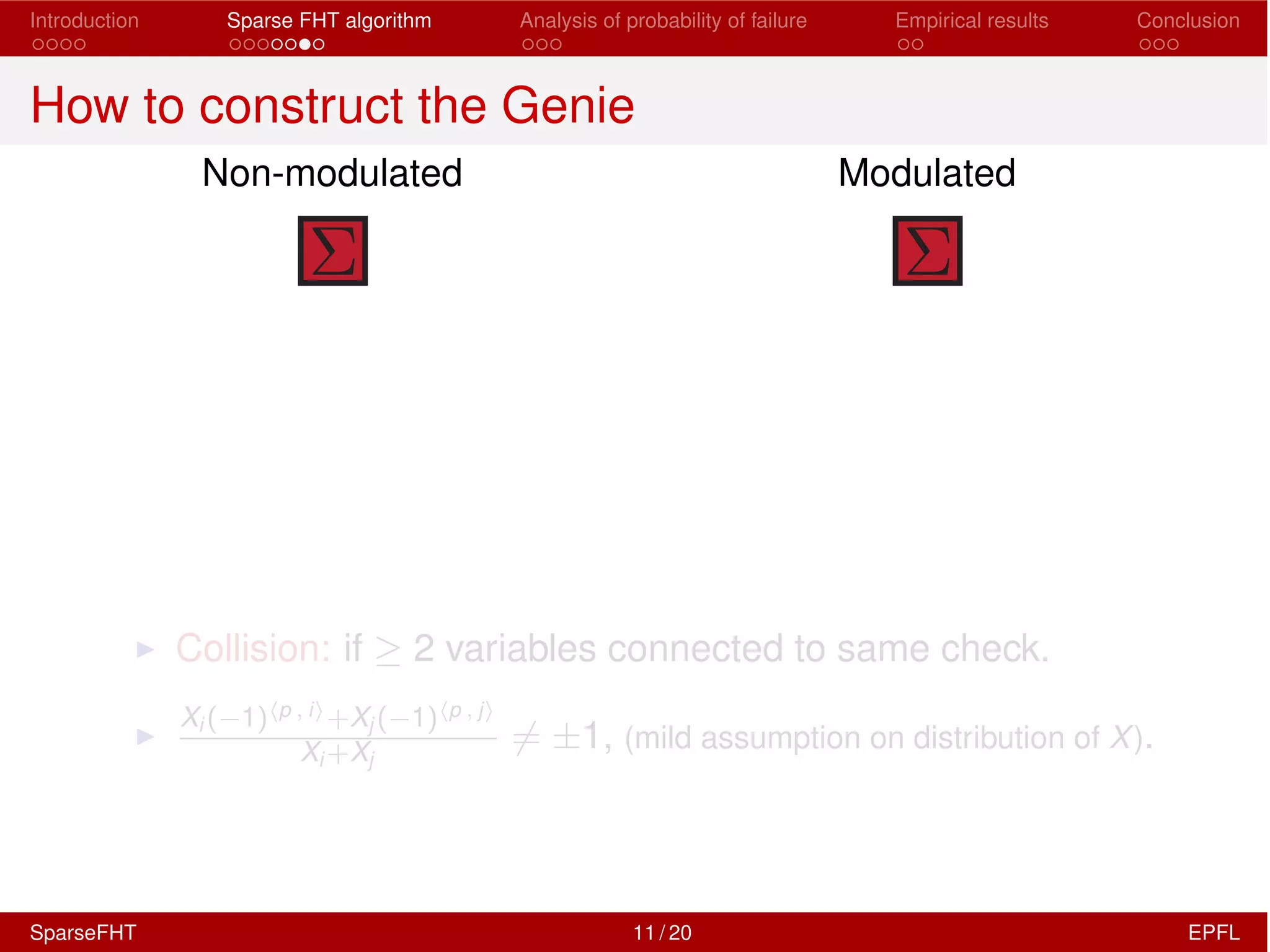
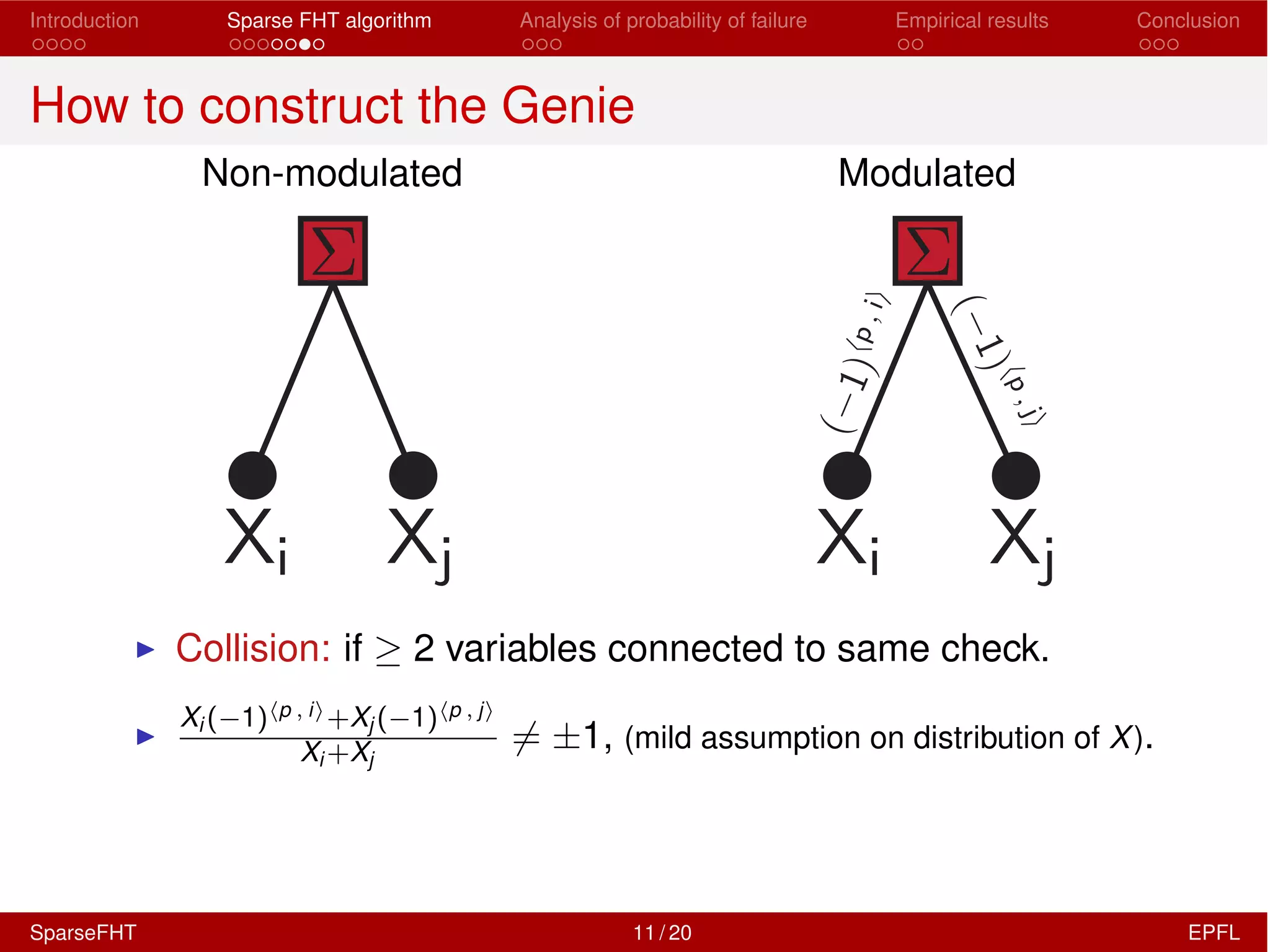
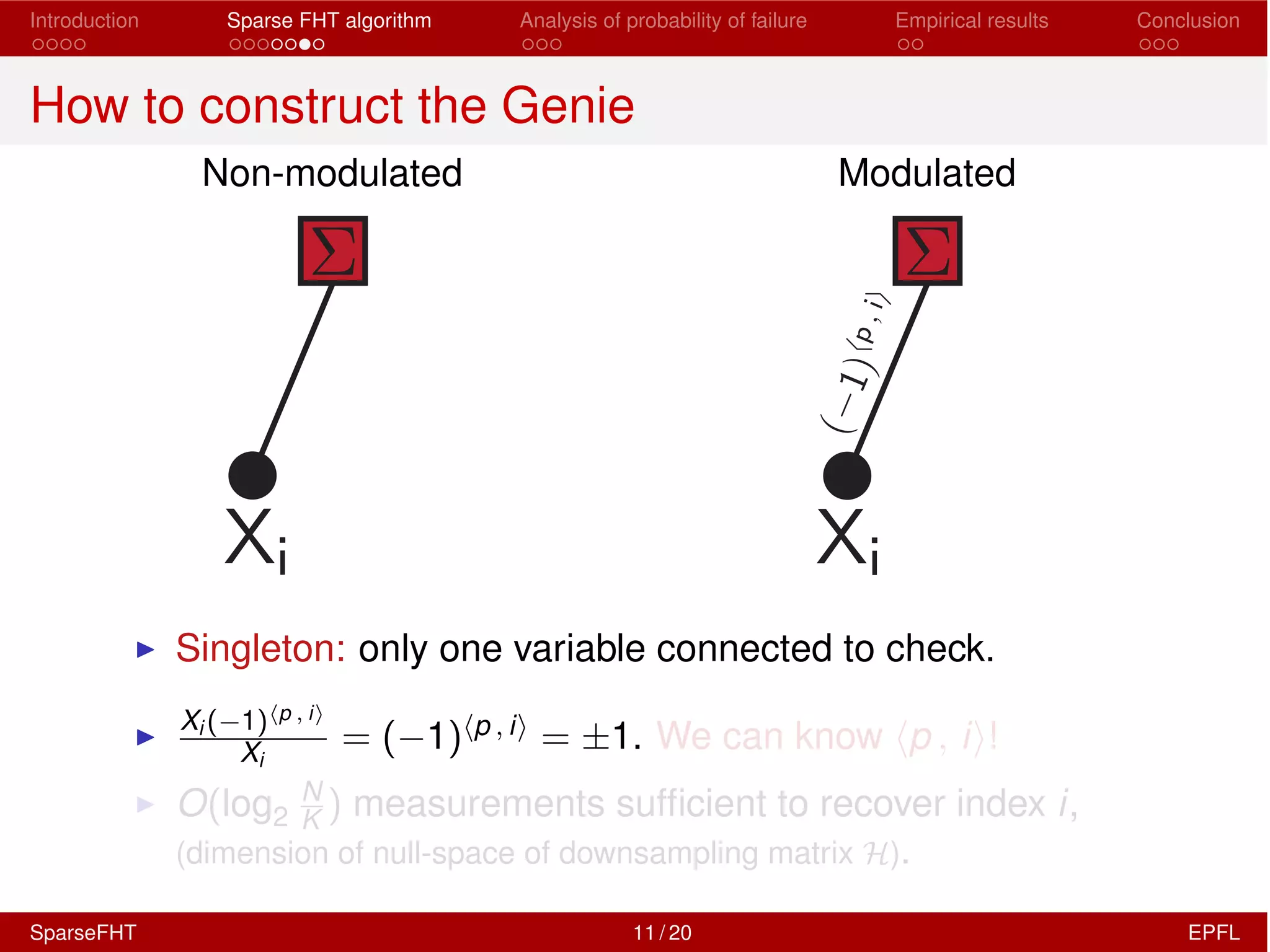
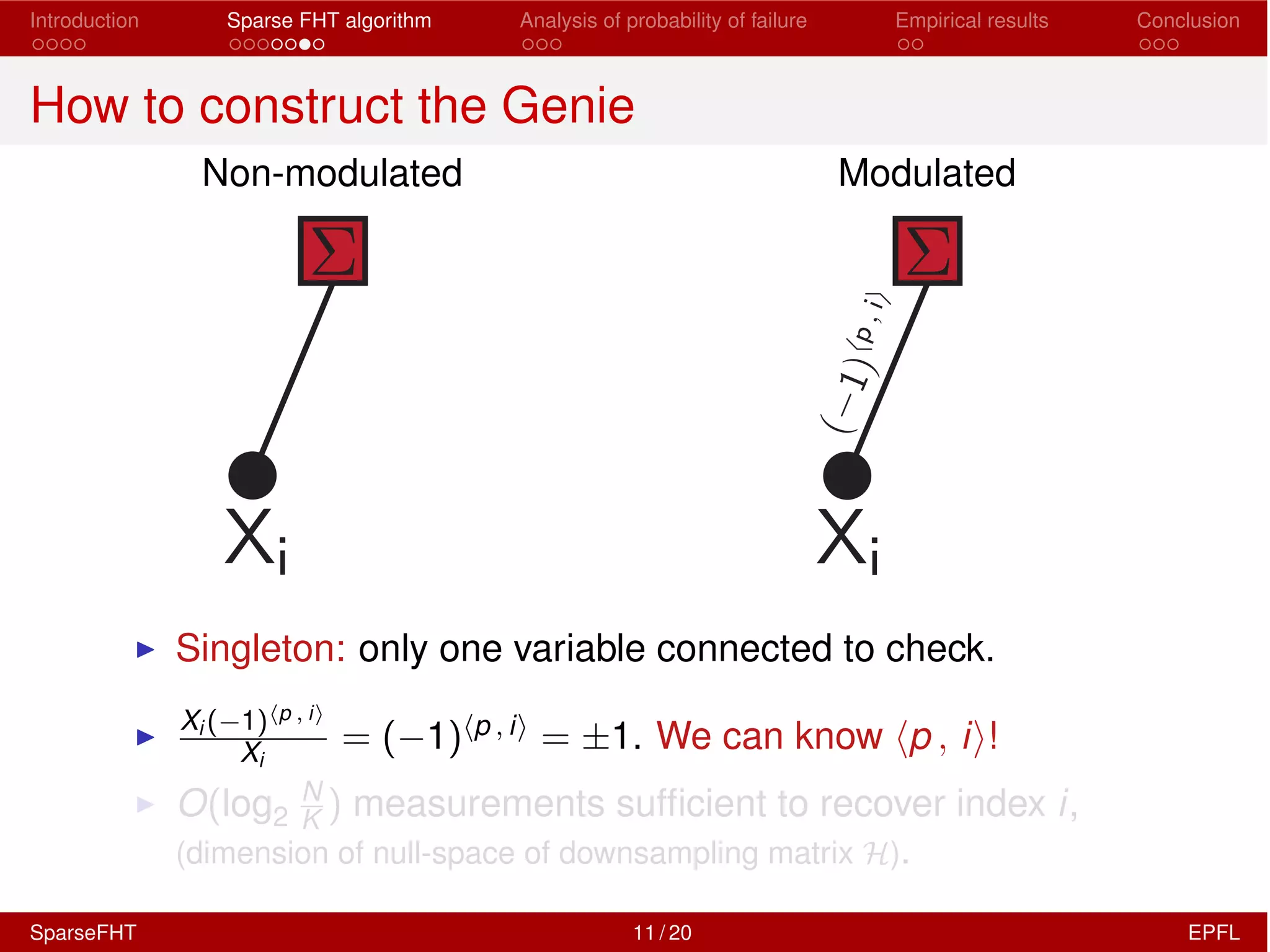
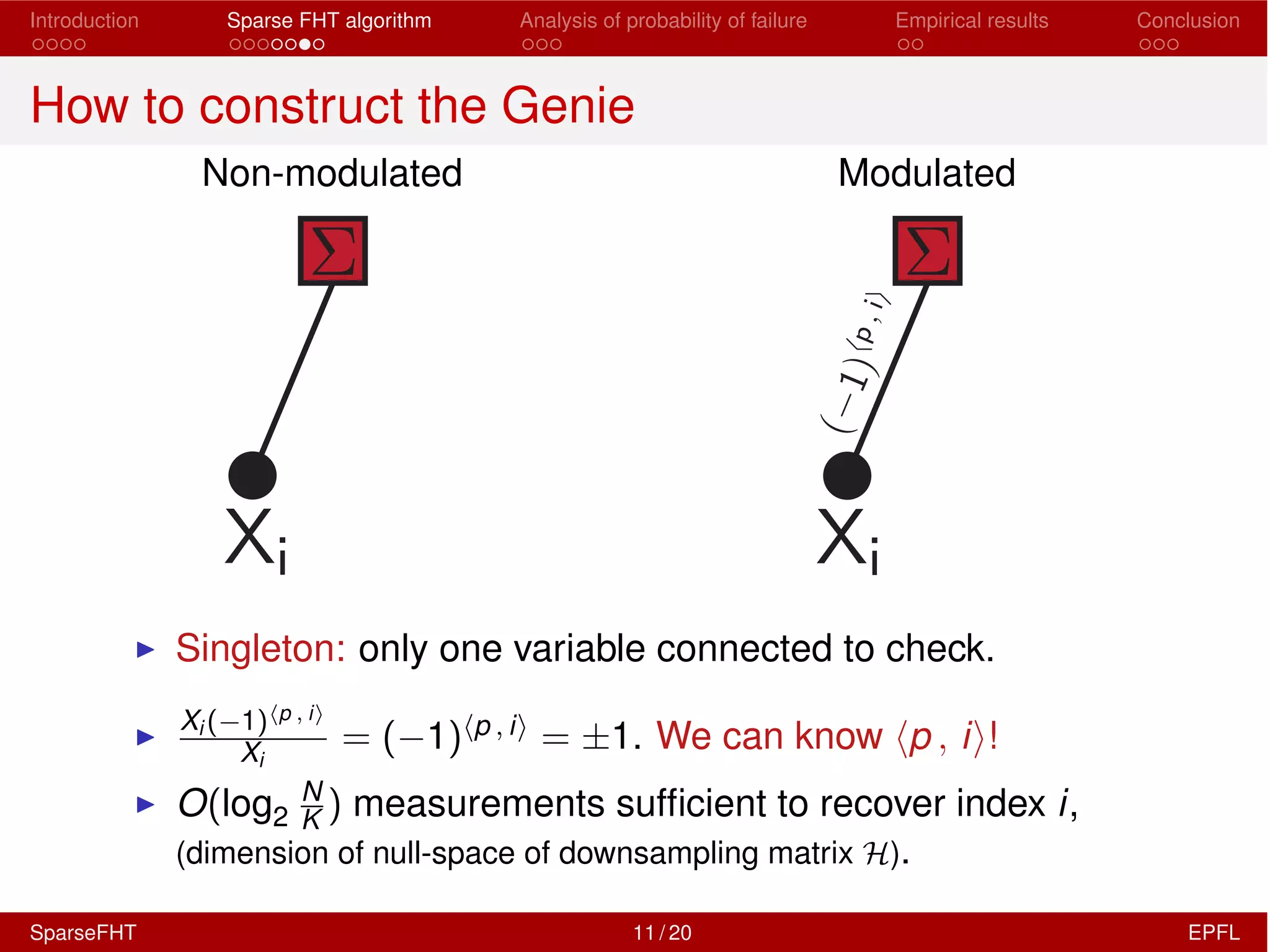
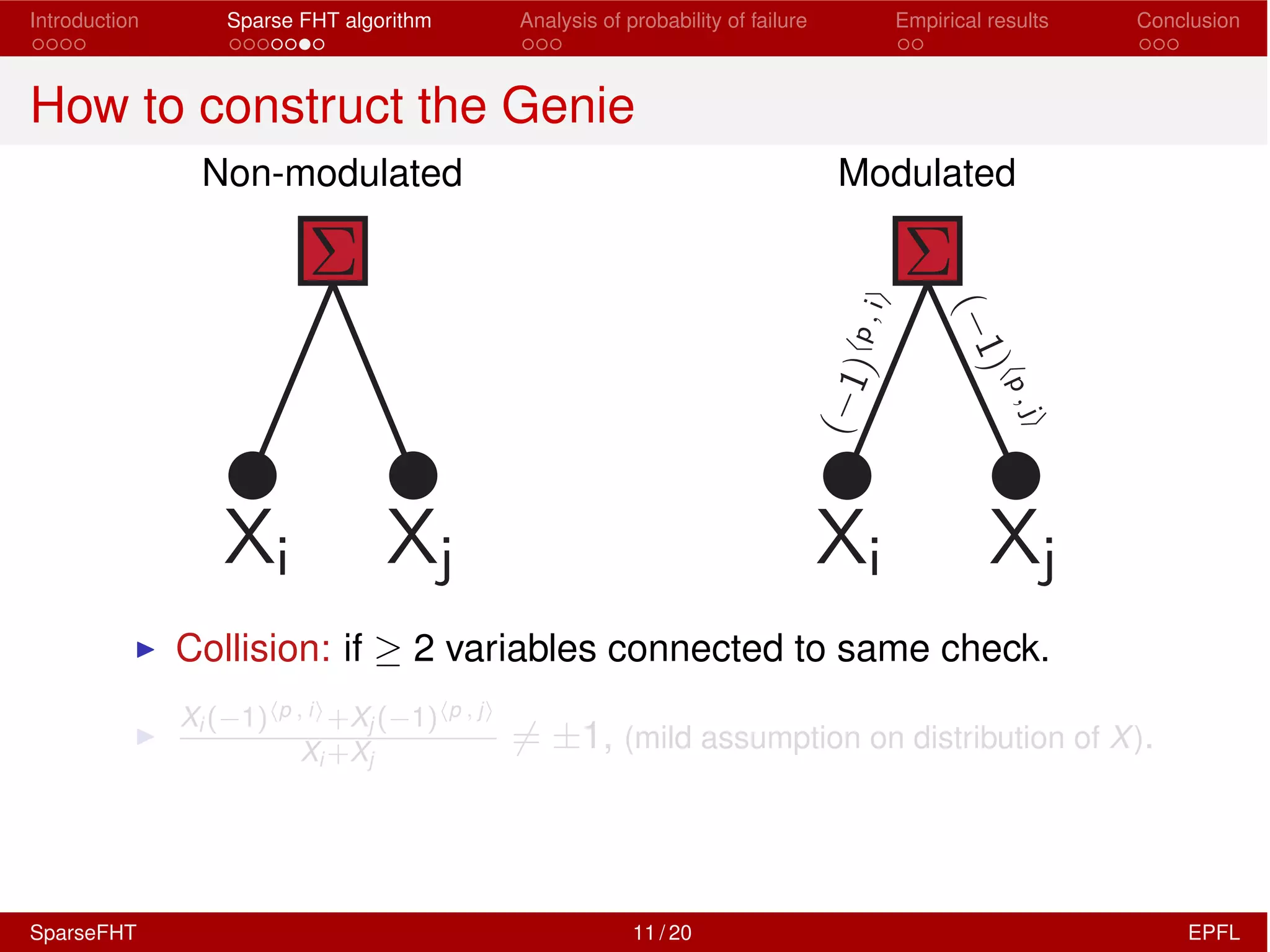
How to construct the Genie
Non-modulated Modulated
I Collision: if 2 variables connected to same check.
I
Xi ( 1)hp , ii+Xj ( 1)hp , ji
Xi +Xj
6= ±1, (mild assumption on distribution of X).
SparseFHT 11 / 20 EPFL
Introduction Sparse FHT algorithm Analysis of probability of failure Empirical results Conclusion
How to construct the Genie
Non-modulated Modulated
I Collision: if 2 variables connected to same check.
I
Xi ( 1)hp , ii+Xj ( 1)hp , ji
Xi +Xj
6= ±1, (mild assumption on distribution of X).
SparseFHT 11 / 20 EPFL
Introduction Sparse FHT algorithm Analysis of probability of failure Empirical results Conclusion
How to construct the Genie
Non-modulated Modulated
I Collision: if 2 variables connected to same check.
I
Xi ( 1)hp , ii+Xj ( 1)hp , ji
Xi +Xj
6= ±1, (mild assumption on distribution of X).
SparseFHT 11 / 20 EPFL
Introduction Sparse FHT algorithm Analysis of probability of failure Empirical results Conclusion
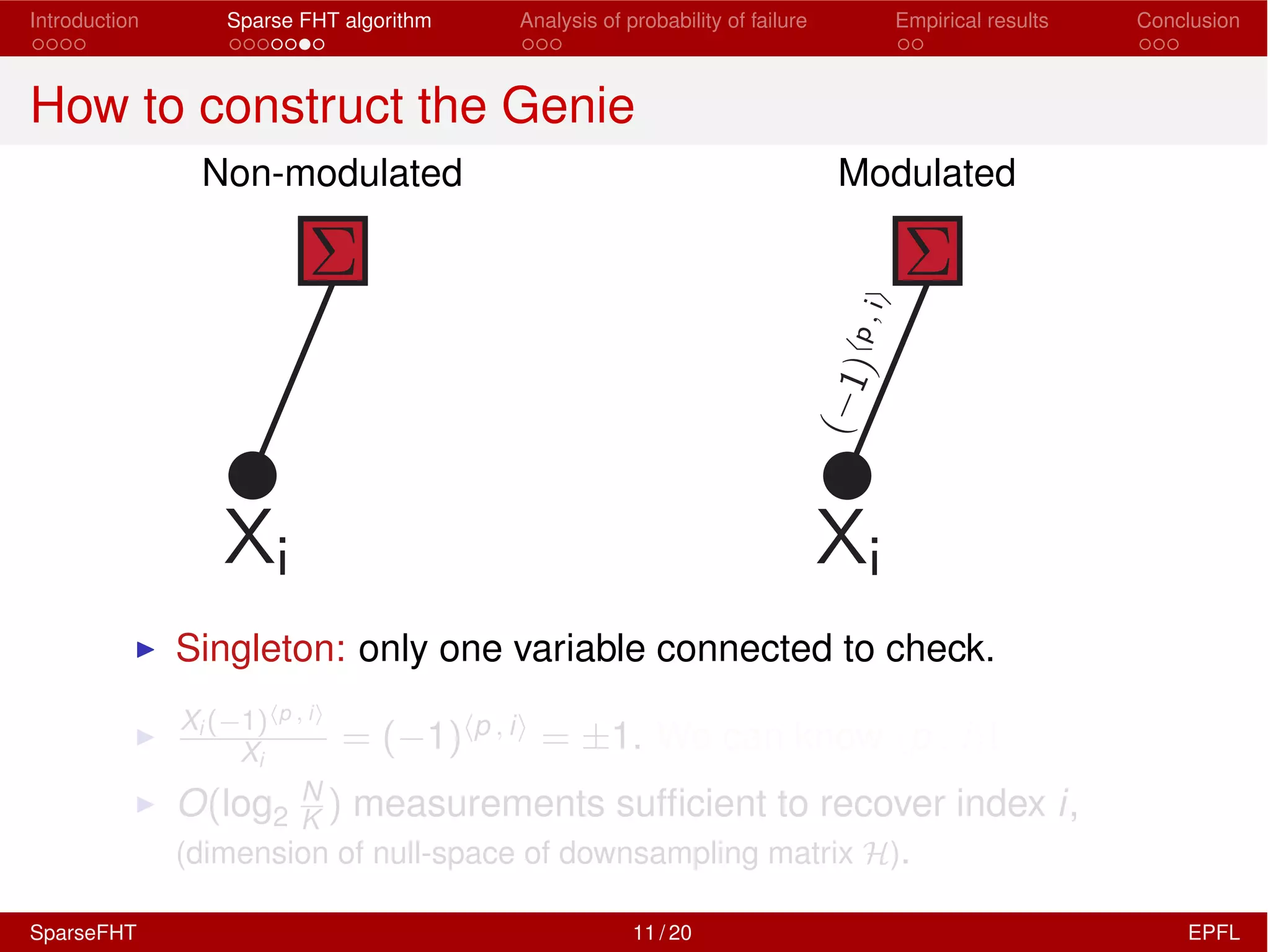
How to construct the Genie
Non-modulated Modulated
I Singleton: only one variable connected to check.
I
Xi ( 1)hp , ii
Xi
= ( 1)hp , ii = ±1. We can know hp , ii!
I O(log2
N
K ) measurements sufficient to recover index i,
(dimension of null-space of downsampling matrix H).
SparseFHT 11 / 20 EPFL
Introduction Sparse FHT algorithm Analysis of probability of failure Empirical results Conclusion
How to construct the Genie
Non-modulated Modulated
I Singleton: only one variable connected to check.
I
Xi ( 1)hp , ii
Xi
= ( 1)hp , ii = ±1. We can know hp , ii!
I O(log2
N
K ) measurements sufficient to recover index i,
(dimension of null-space of downsampling matrix H).
SparseFHT 11 / 20 EPFL
Introduction Sparse FHT algorithm Analysis of probability of failure Empirical results Conclusion
How to construct the Genie
Non-modulated Modulated
I Singleton: only one variable connected to check.
I
Xi ( 1)hp , ii
Xi
= ( 1)hp , ii = ±1. We can know hp , ii!
I O(log2
N
K ) measurements sufficient to recover index i,
(dimension of null-space of downsampling matrix H).
SparseFHT 11 / 20 EPFL
Introduction Sparse FHT algorithm Analysis of probability of failure Empirical results Conclusion
How to construct the Genie
Non-modulated Modulated
I Singleton: only one variable connected to check.
I
Xi ( 1)hp , ii
Xi
= ( 1)hp , ii = ±1. We can know hp , ii!
I O(log2
N
K ) measurements sufficient to recover index i,
(dimension of null-space of downsampling matrix H).
SparseFHT 11 / 20 EPFL
Introduction Sparse FHT algorithm Analysis of probability of failure Empirical results Conclusion
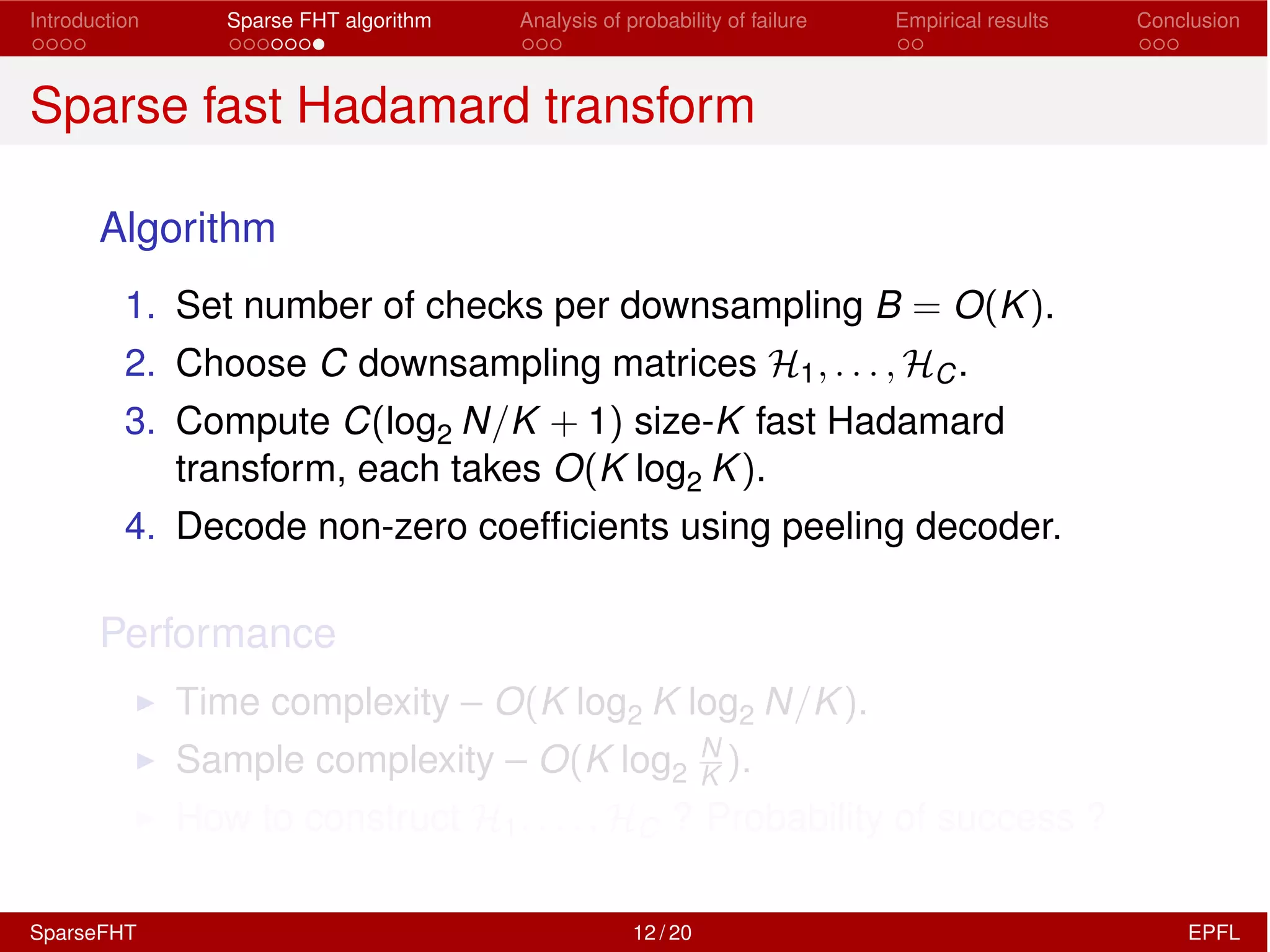
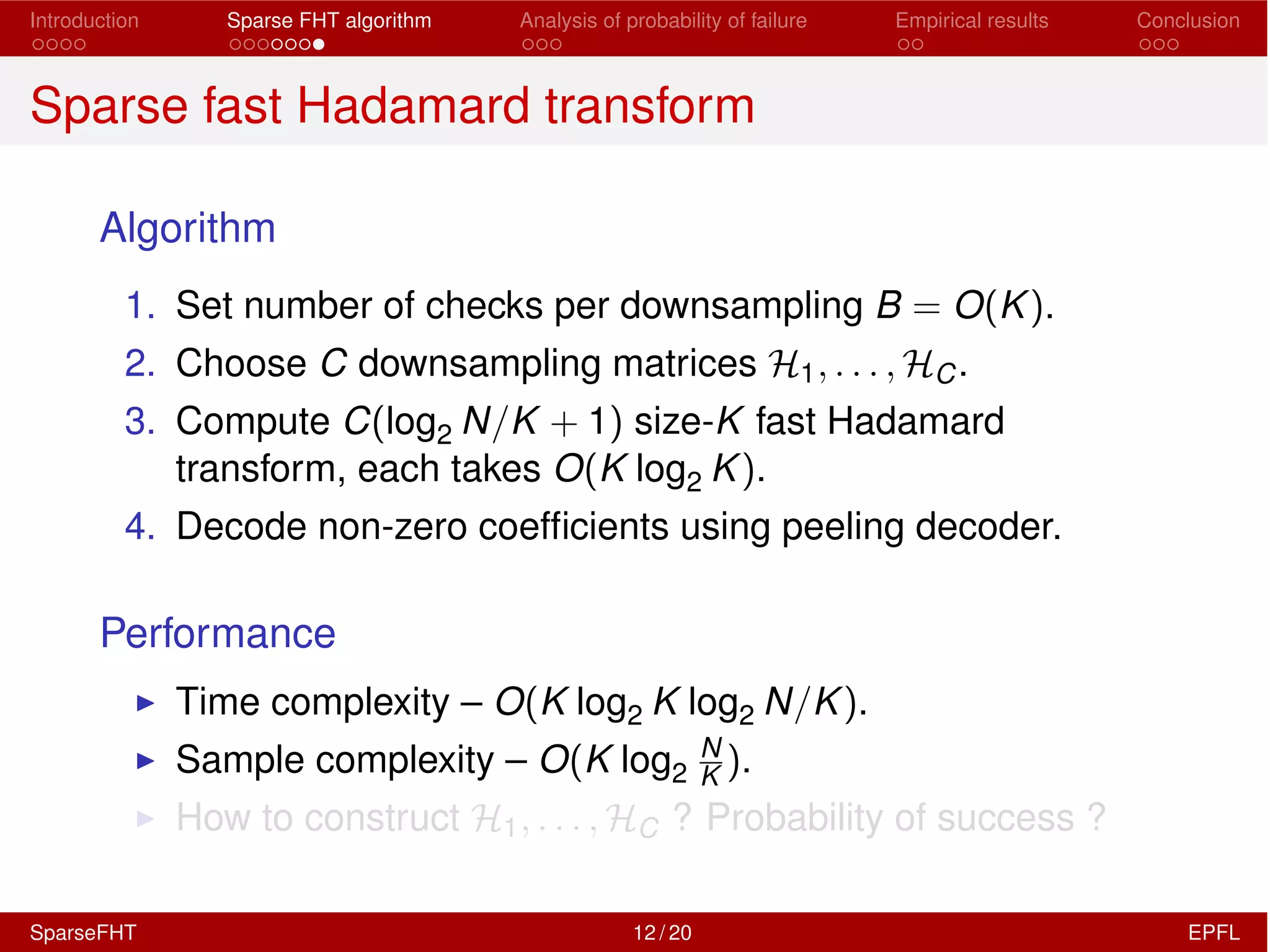
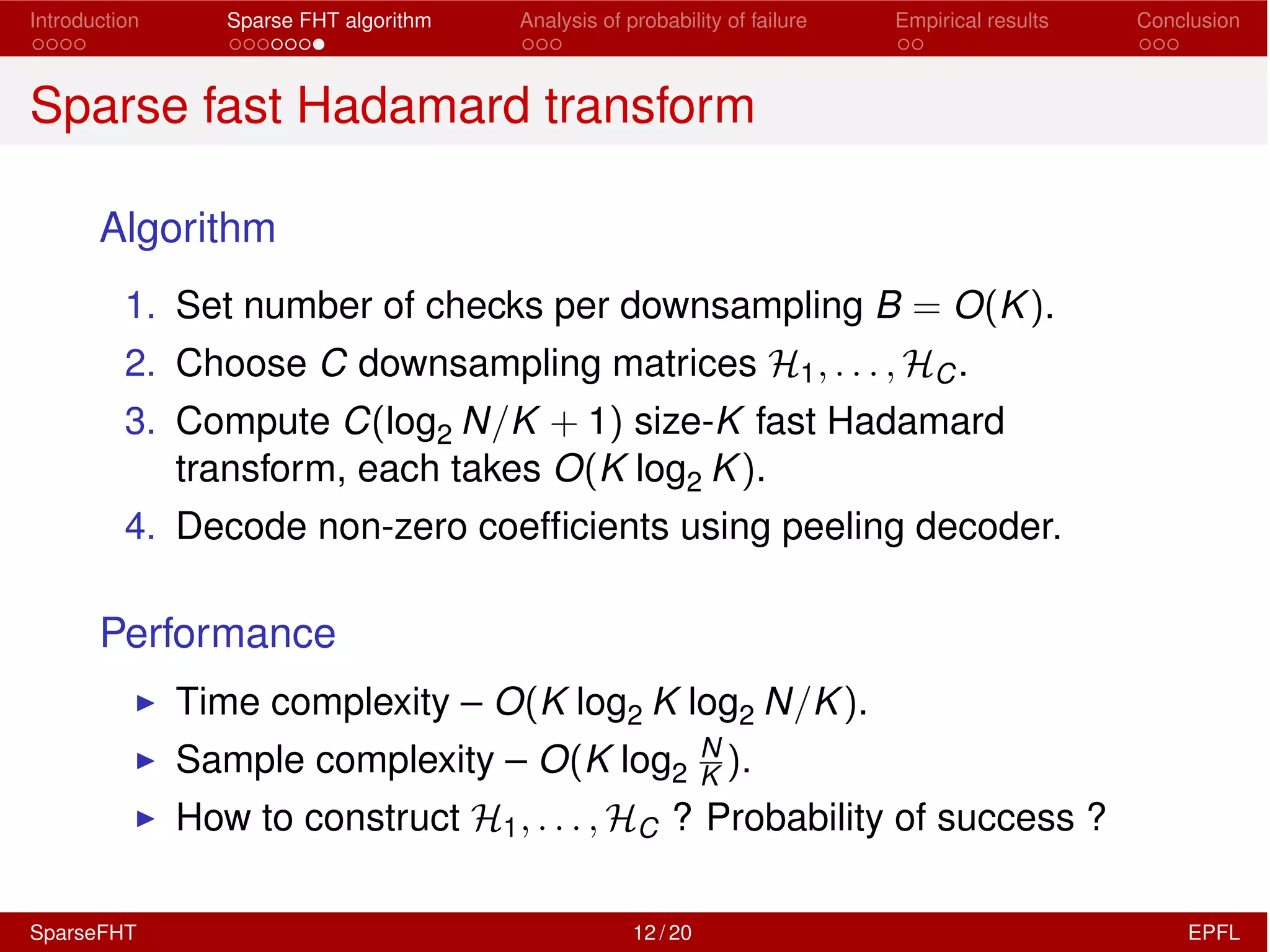
Sparse fast Hadamard transform
Algorithm
1. Set number of checks per downsampling B = O(K).
2. Choose C downsampling matrices H1, . . . , HC.
3. Compute C(log2 N/K + 1) size-K fast Hadamard
transform, each takes O(K log2 K).
4. Decode non-zero coefficients using peeling decoder.
Performance
I Time complexity – O(K log2 K log2 N/K).
I Sample complexity – O(K log2
N
K ).
I How to construct H1, . . . , HC ? Probability of success ?
SparseFHT 12 / 20 EPFL
Introduction Sparse FHT algorithm Analysis of probability of failure Empirical results Conclusion
Sparse fast Hadamard transform
Algorithm
1. Set number of checks per downsampling B = O(K).
2. Choose C downsampling matrices H1, . . . , HC.
3. Compute C(log2 N/K + 1) size-K fast Hadamard
transform, each takes O(K log2 K).
4. Decode non-zero coefficients using peeling decoder.
Performance
I Time complexity – O(K log2 K log2 N/K).
I Sample complexity – O(K log2
N
K ).
I How to construct H1, . . . , HC ? Probability of success ?
SparseFHT 12 / 20 EPFL
Introduction Sparse FHT algorithm Analysis of probability of failure Empirical results Conclusion
Sparse fast Hadamard transform
Algorithm
1. Set number of checks per downsampling B = O(K).
2. Choose C downsampling matrices H1, . . . , HC.
3. Compute C(log2 N/K + 1) size-K fast Hadamard
transform, each takes O(K log2 K).
4. Decode non-zero coefficients using peeling decoder.
Performance
I Time complexity – O(K log2 K log2 N/K).
I Sample complexity – O(K log2
N
K ).
I How to construct H1, . . . , HC ? Probability of success ?
SparseFHT 12 / 20 EPFL
Introduction Sparse FHT algorithm Analysis of probability of failure Empirical results Conclusion
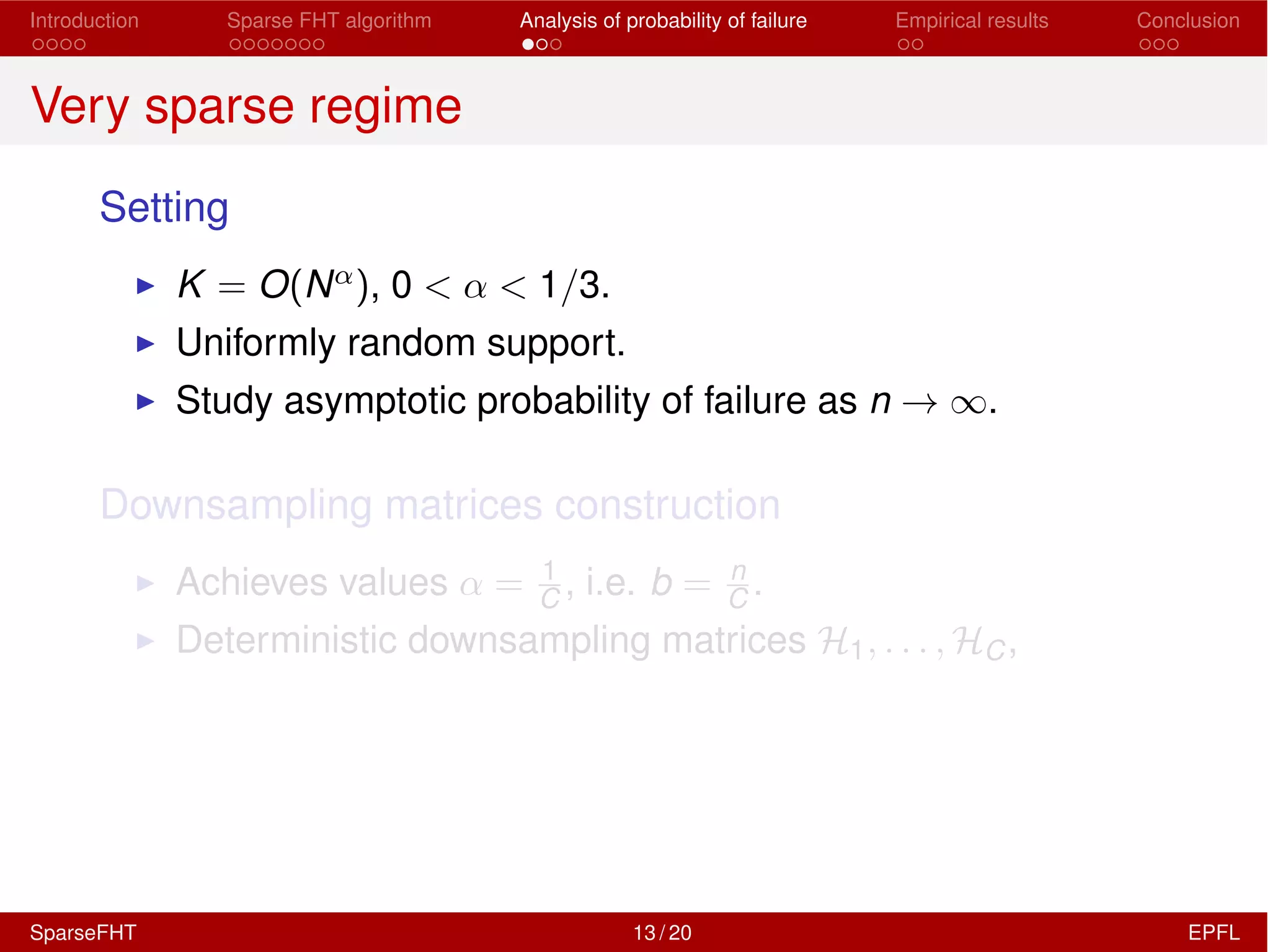
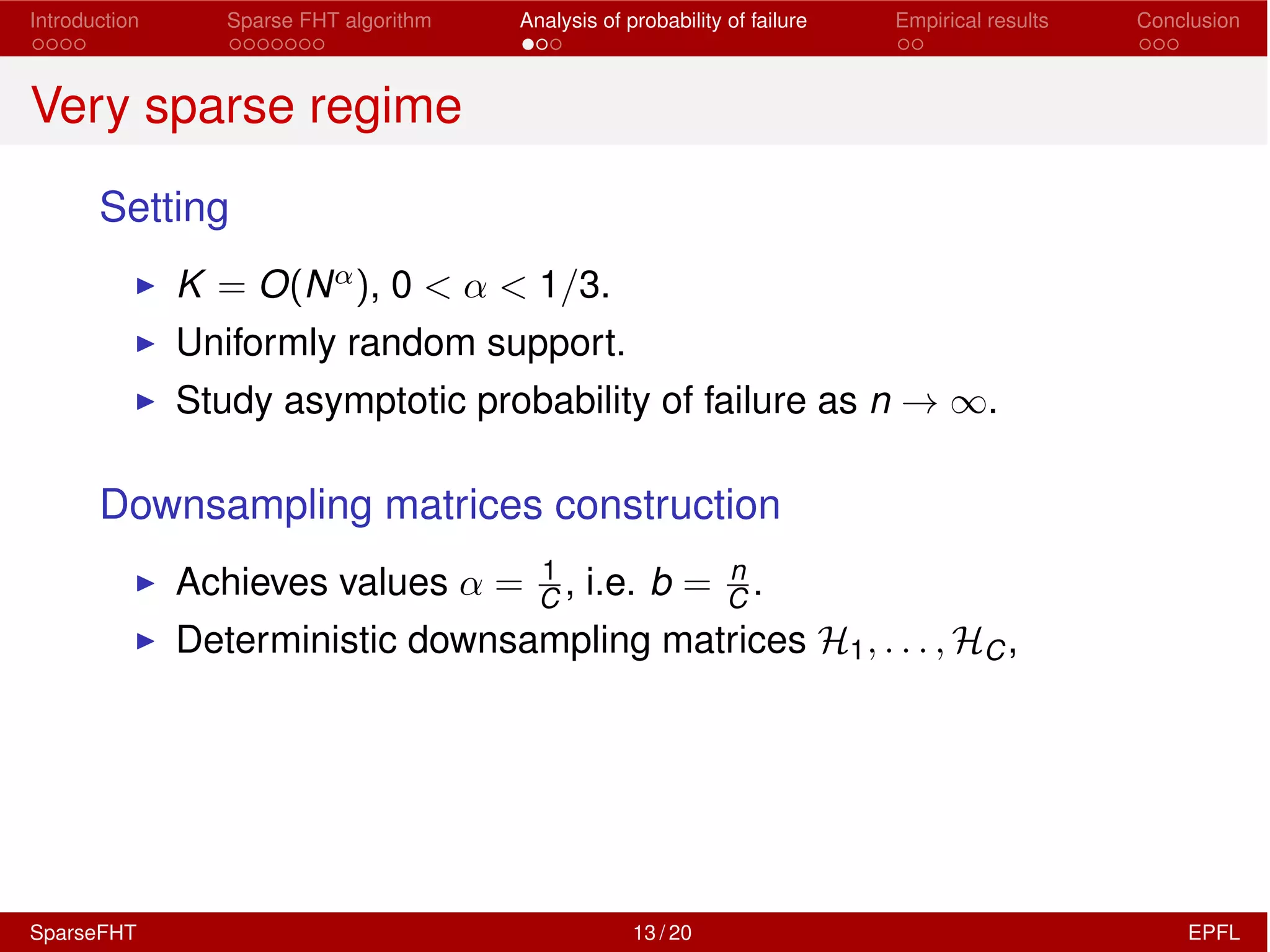
Very sparse regime
Setting
I K = O(N↵), 0 < ↵ < 1/3.
I Uniformly random support.
I Study asymptotic probability of failure as n ! 1.
Downsampling matrices construction
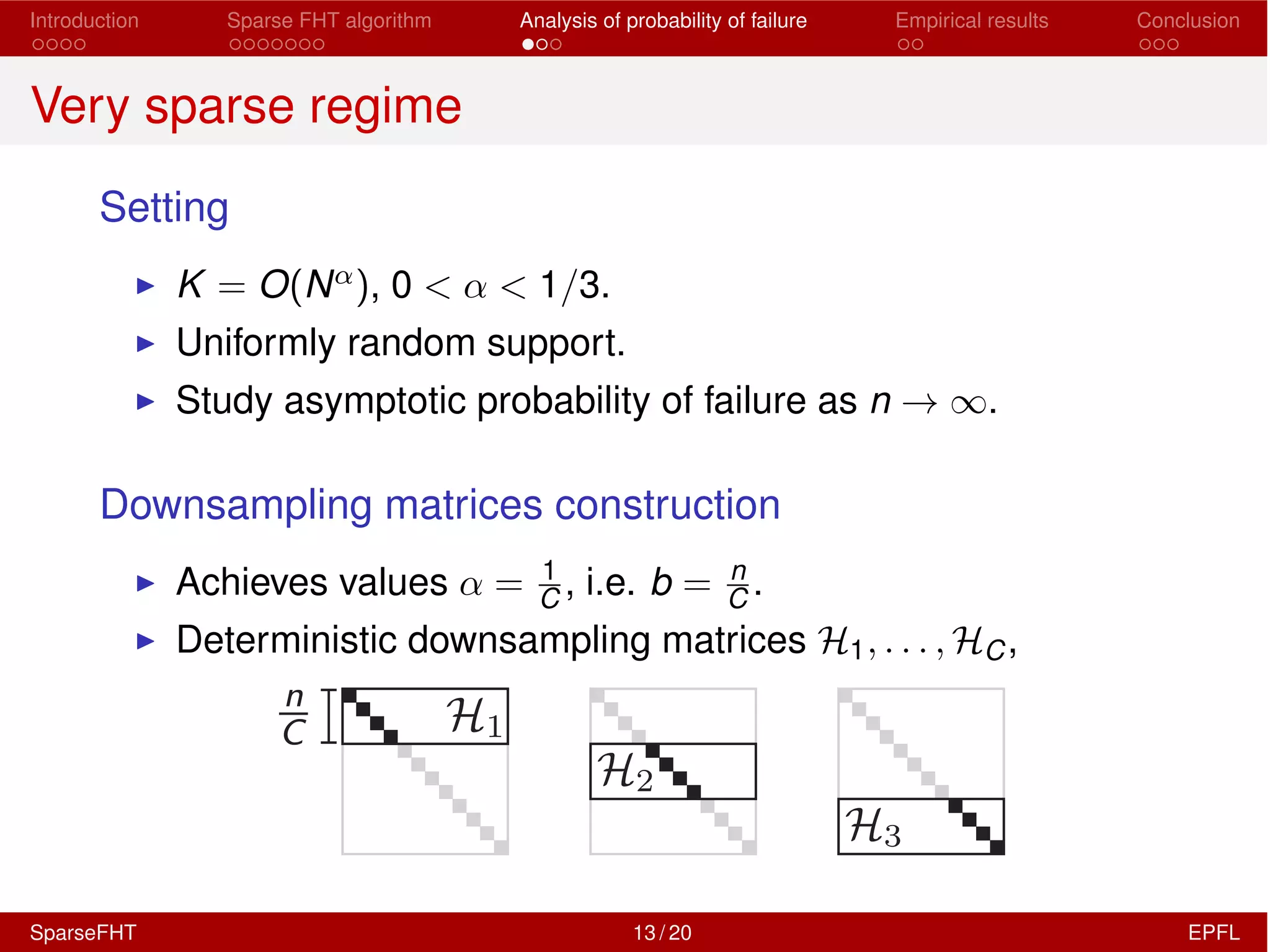
I Achieves values ↵ = 1
C , i.e. b = n
C .
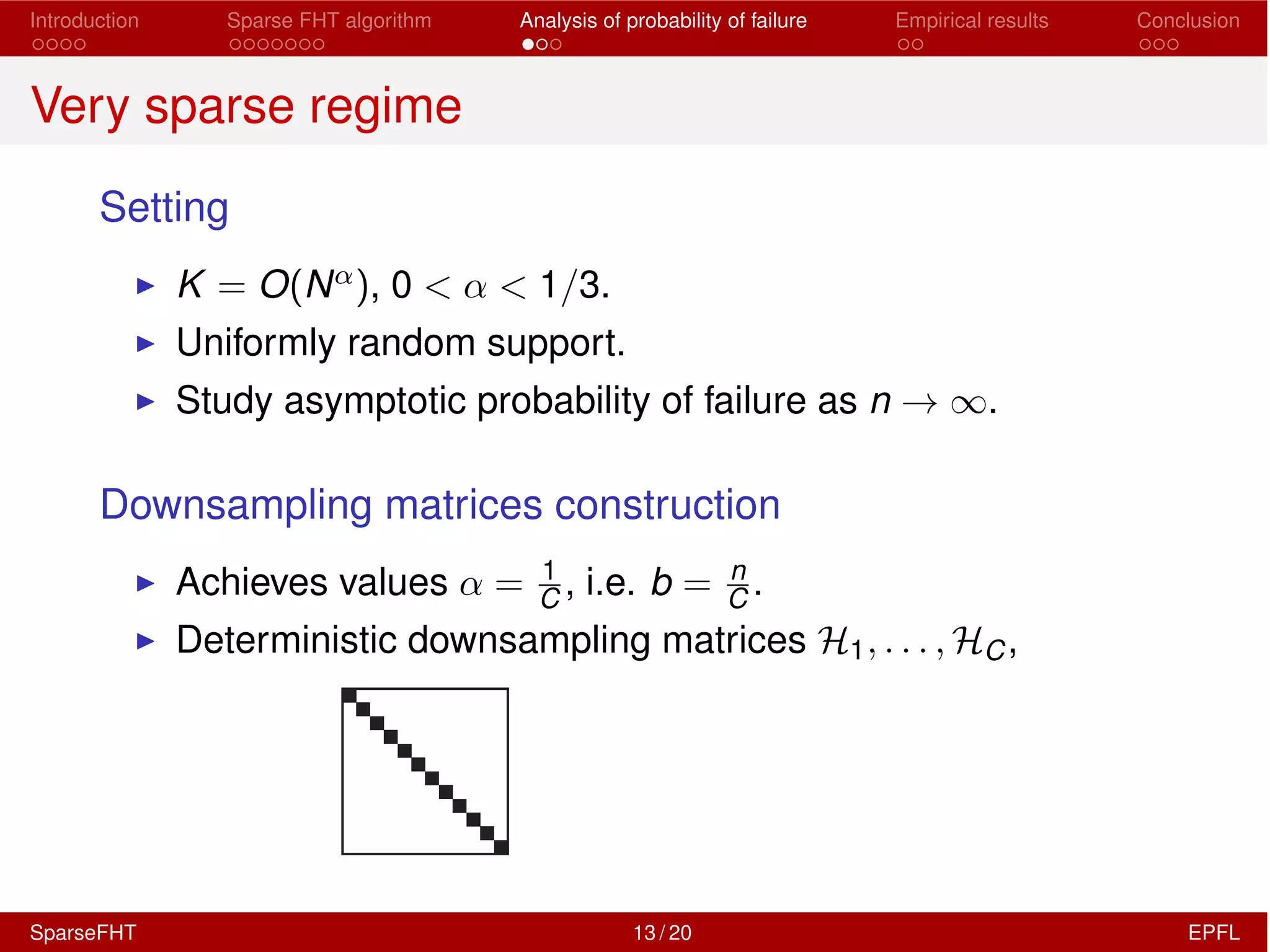
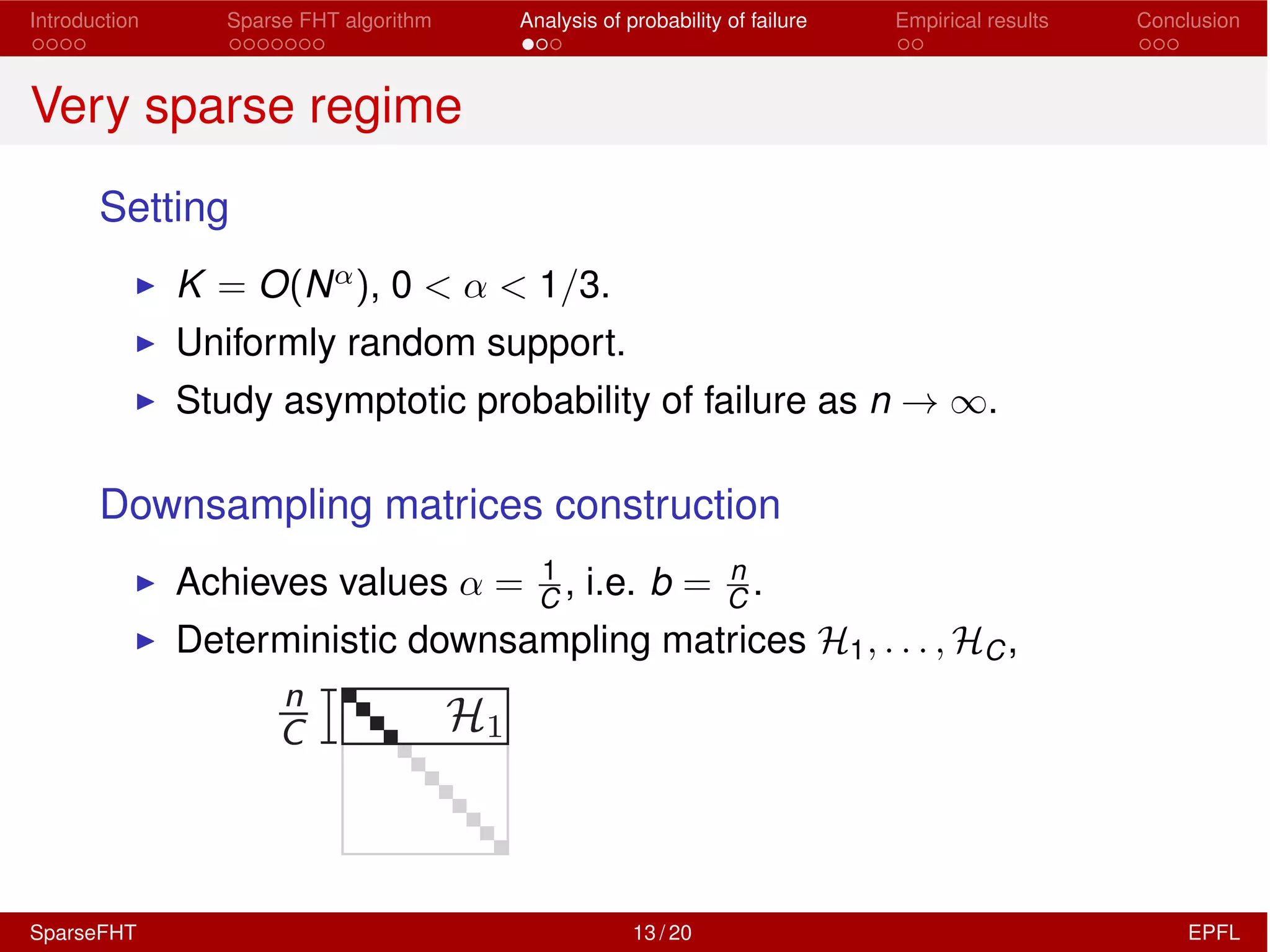
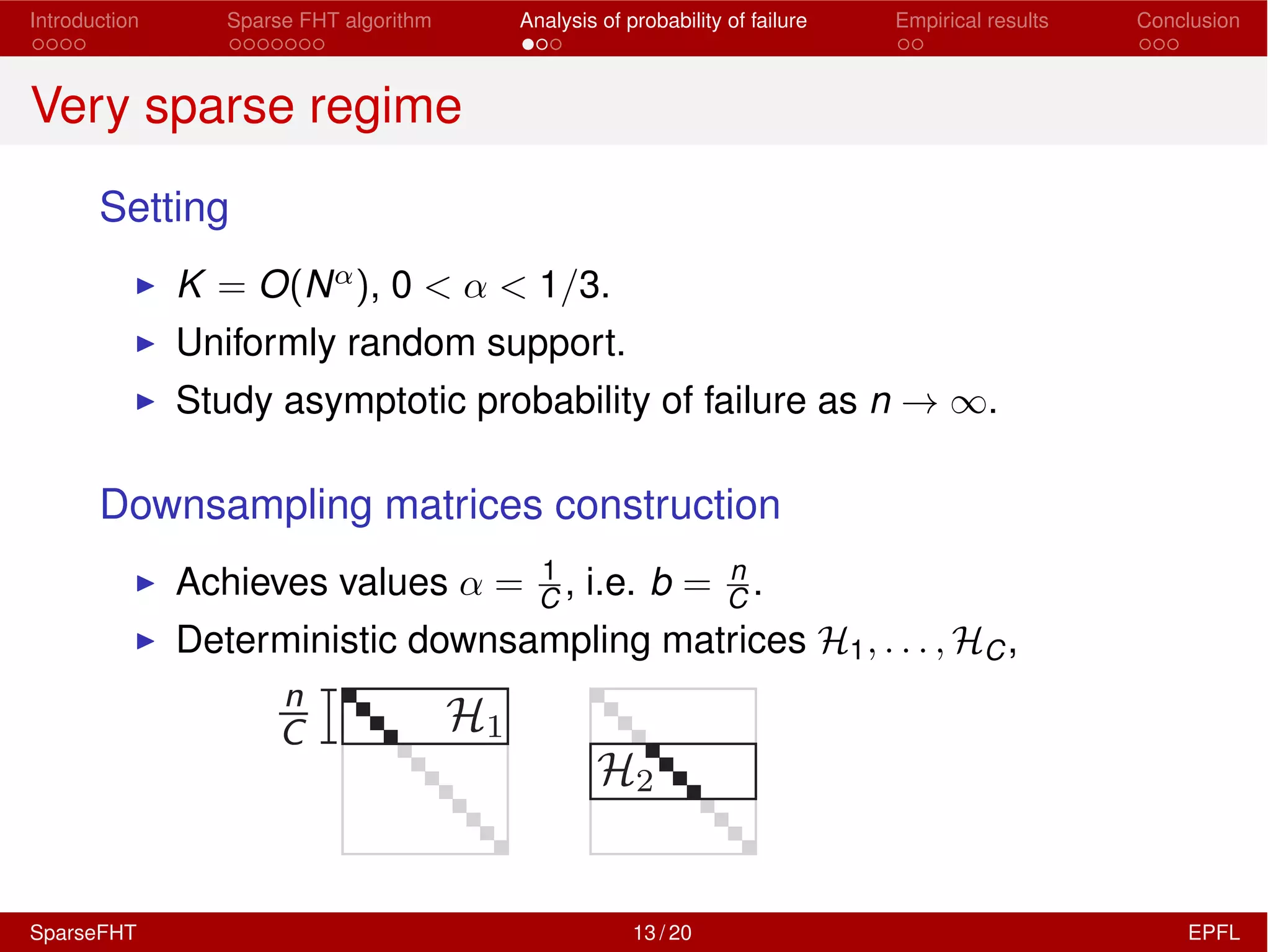
I Deterministic downsampling matrices H1, . . . , HC,
SparseFHT 13 / 20 EPFL
Introduction Sparse FHT algorithm Analysis of probability of failure Empirical results Conclusion
Very sparse regime
Setting
I K = O(N↵), 0 < ↵ < 1/3.
I Uniformly random support.
I Study asymptotic probability of failure as n ! 1.
Downsampling matrices construction
I Achieves values ↵ = 1
C , i.e. b = n
C .
I Deterministic downsampling matrices H1, . . . , HC,
SparseFHT 13 / 20 EPFL
Introduction Sparse FHT algorithm Analysis of probability of failure Empirical results Conclusion
Very sparse regime
Setting
I K = O(N↵), 0 < ↵ < 1/3.
I Uniformly random support.
I Study asymptotic probability of failure as n ! 1.
Downsampling matrices construction
I Achieves values ↵ = 1
C , i.e. b = n
C .
I Deterministic downsampling matrices H1, . . . , HC,
SparseFHT 13 / 20 EPFL
Introduction Sparse FHT algorithm Analysis of probability of failure Empirical results Conclusion
Very sparse regime
Setting
I K = O(N↵), 0 < ↵ < 1/3.
I Uniformly random support.
I Study asymptotic probability of failure as n ! 1.
Downsampling matrices construction
I Achieves values ↵ = 1
C , i.e. b = n
C .
I Deterministic downsampling matrices H1, . . . , HC,
SparseFHT 13 / 20 EPFL
Introduction Sparse FHT algorithm Analysis of probability of failure Empirical results Conclusion
Very sparse regime
Setting
I K = O(N↵), 0 < ↵ < 1/3.
I Uniformly random support.
I Study asymptotic probability of failure as n ! 1.
Downsampling matrices construction
I Achieves values ↵ = 1
C , i.e. b = n
C .
I Deterministic downsampling matrices H1, . . . , HC,
SparseFHT 13 / 20 EPFL
Introduction Sparse FHT algorithm Analysis of probability of failure Empirical results Conclusion
Very sparse regime
Setting
I K = O(N↵), 0 < ↵ < 1/3.
I Uniformly random support.
I Study asymptotic probability of failure as n ! 1.
Downsampling matrices construction
I Achieves values ↵ = 1
C , i.e. b = n
C .
I Deterministic downsampling matrices H1, . . . , HC,
SparseFHT 13 / 20 EPFL
Introduction Sparse FHT algorithm Analysis of probability of failure Empirical results Conclusion
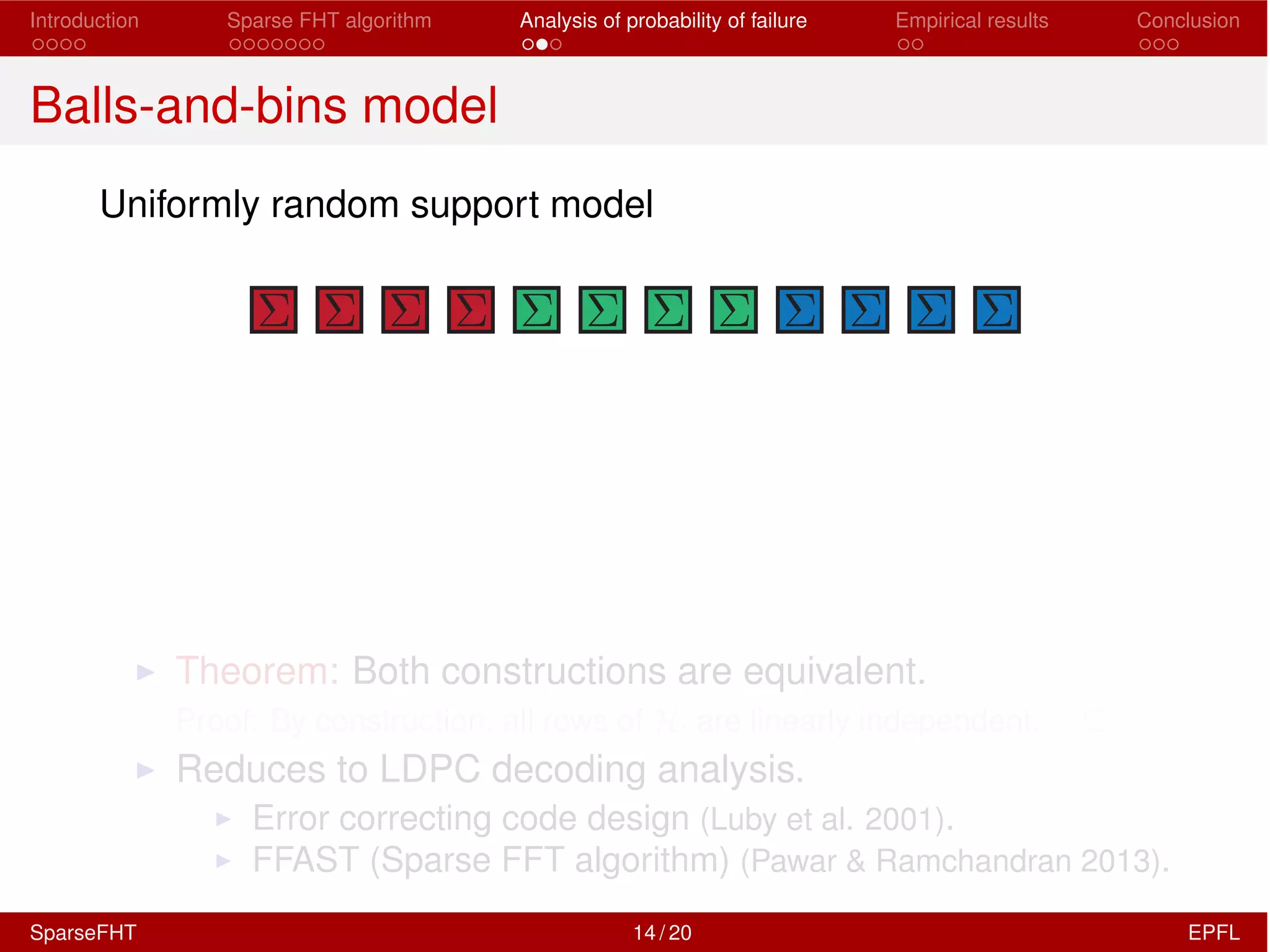
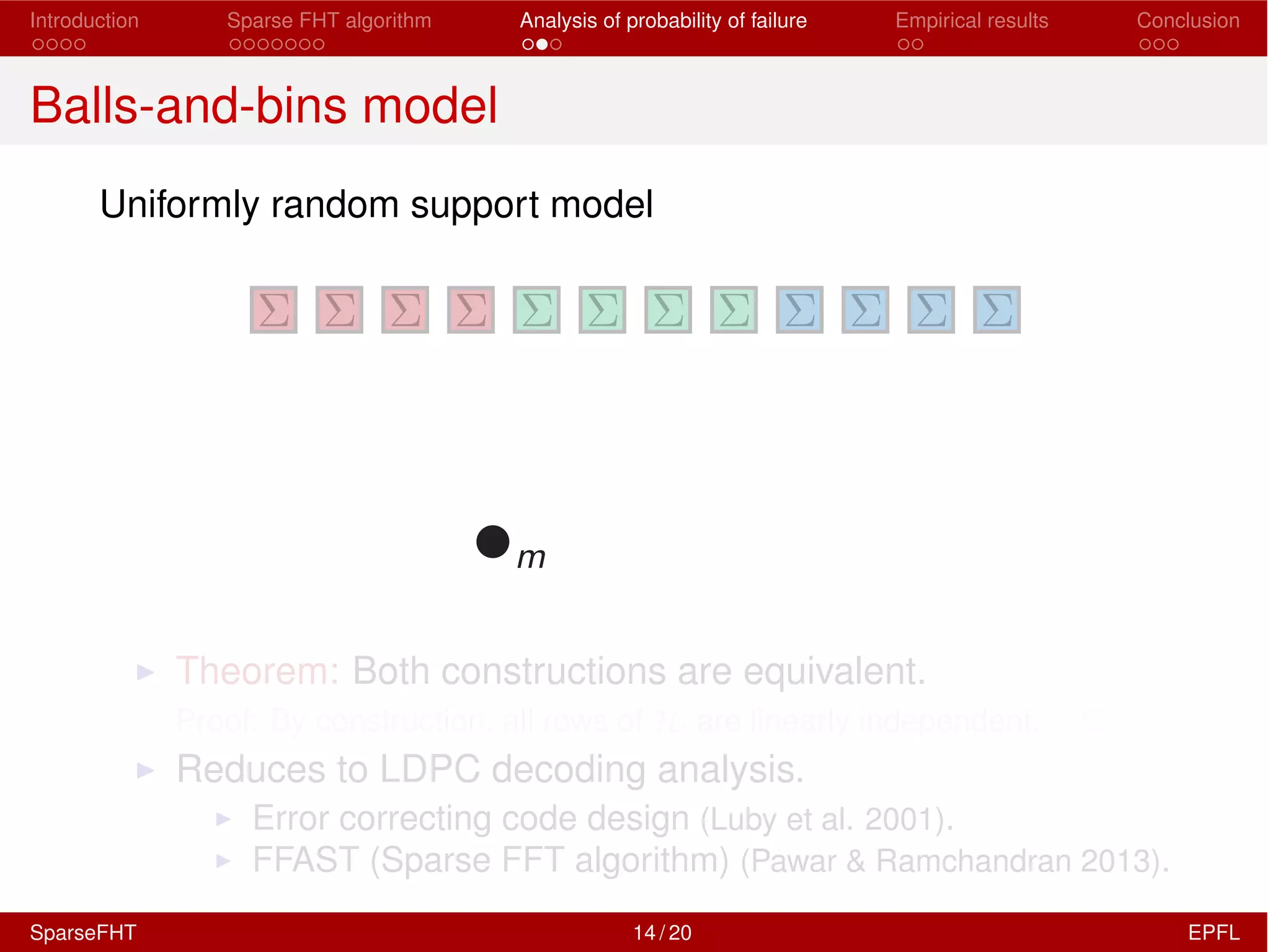
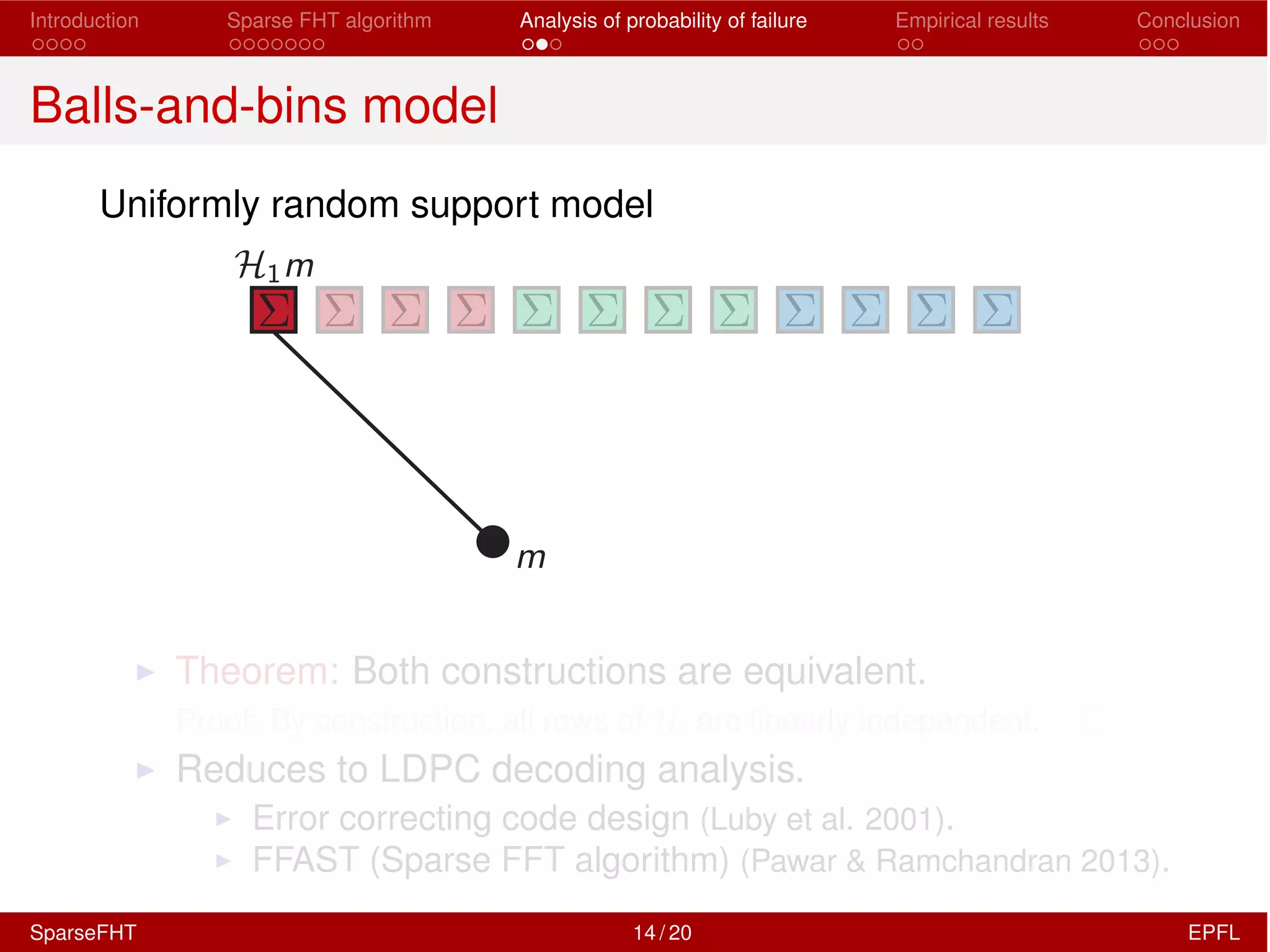
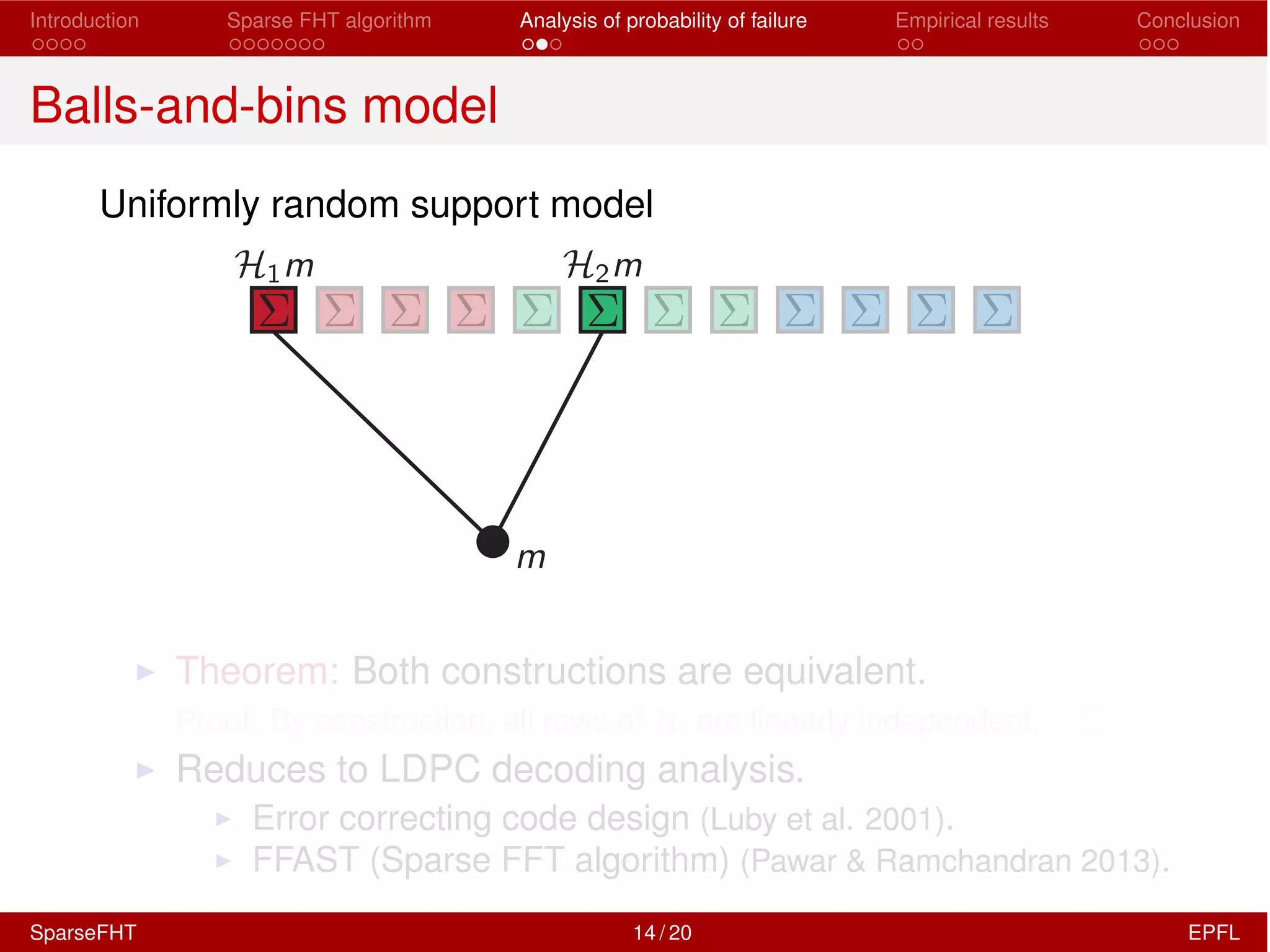
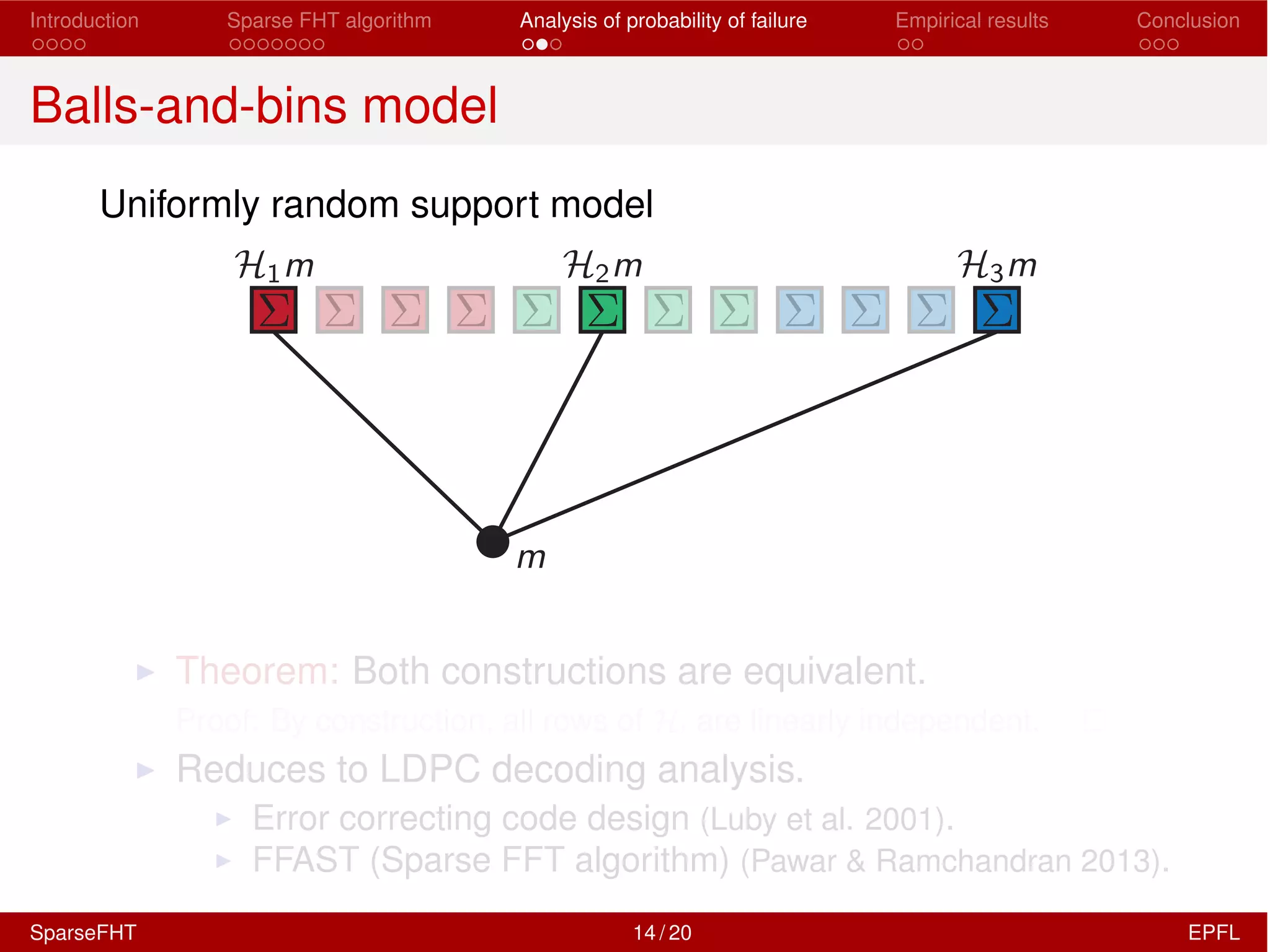
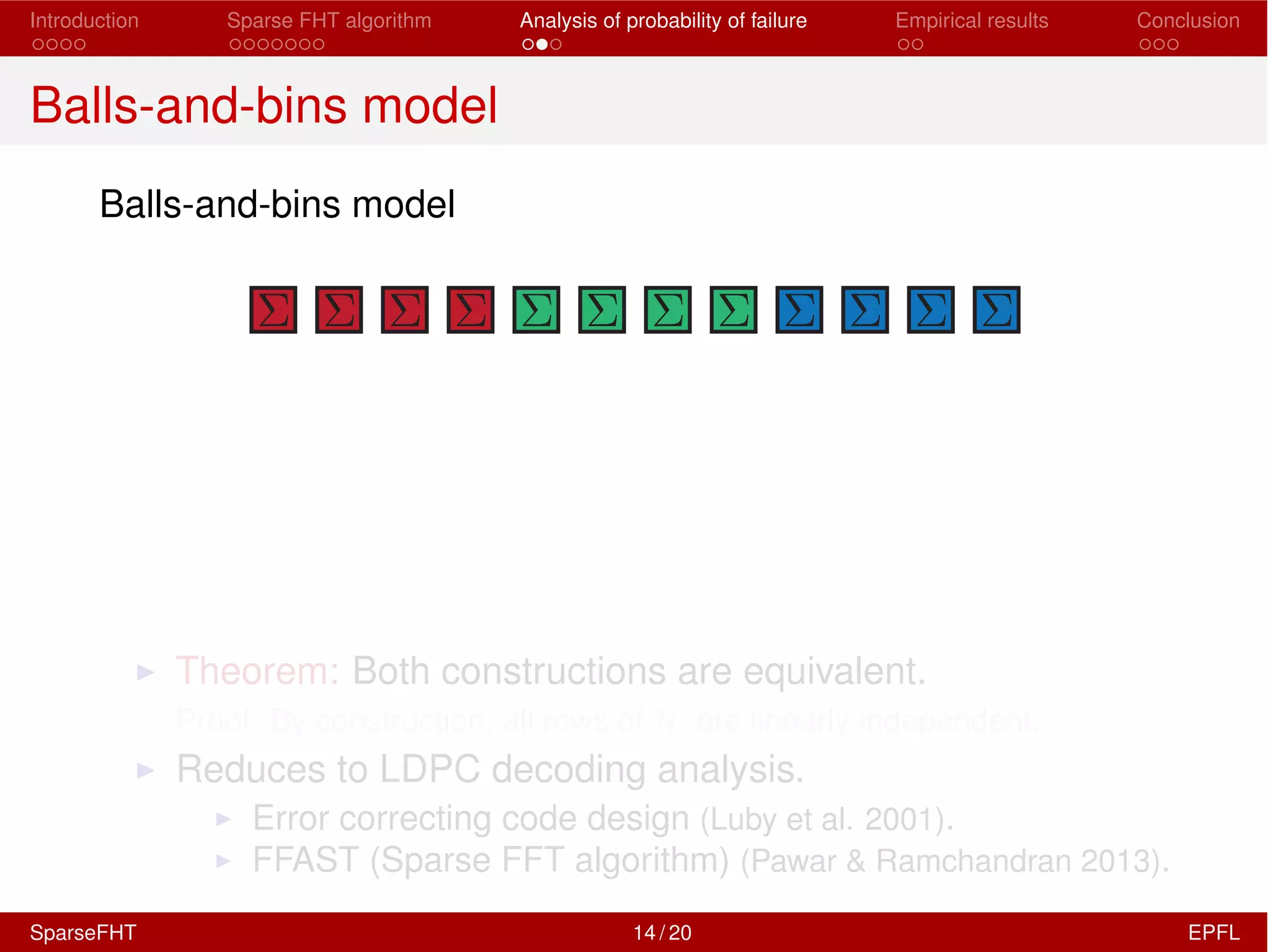
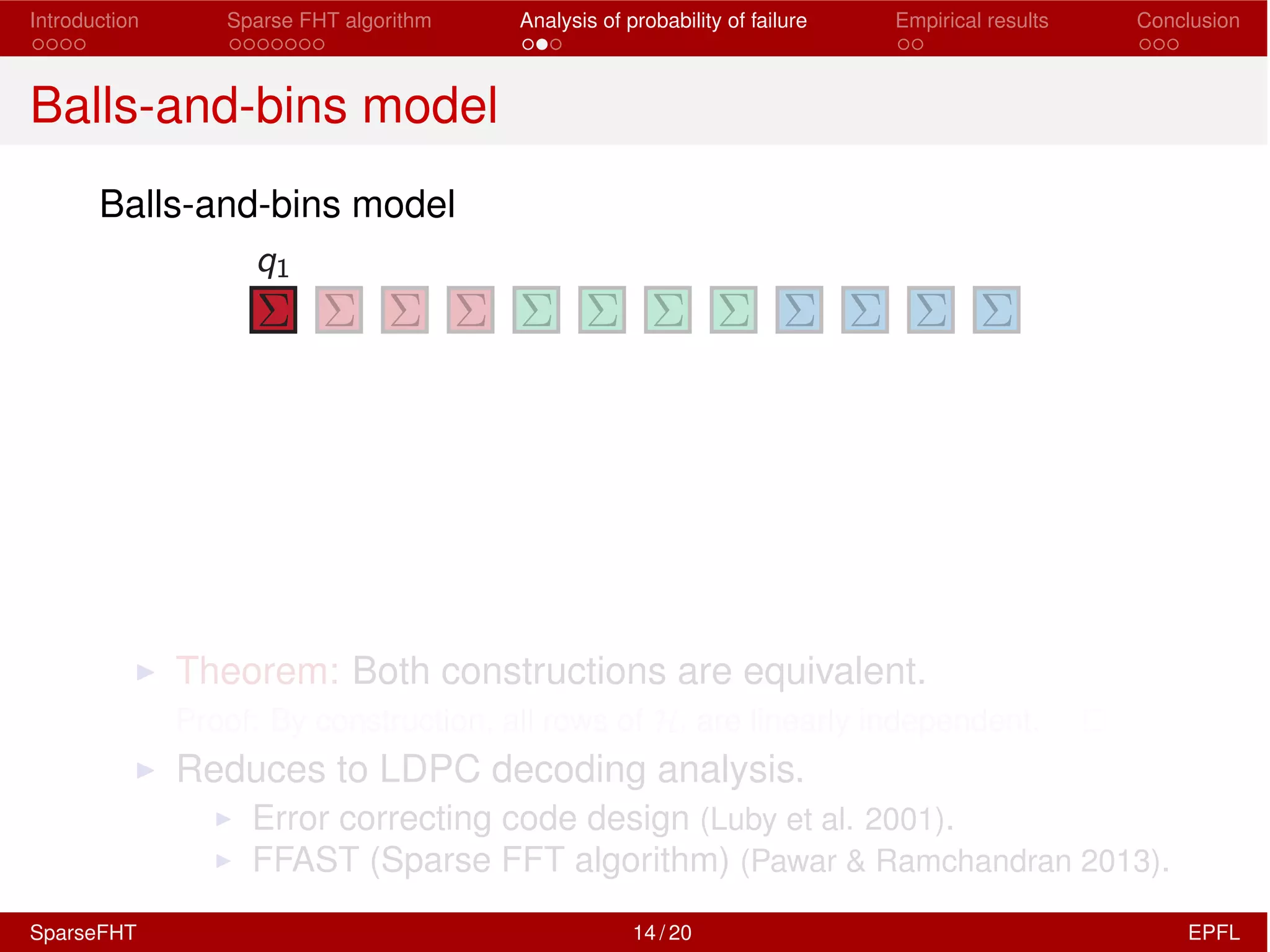
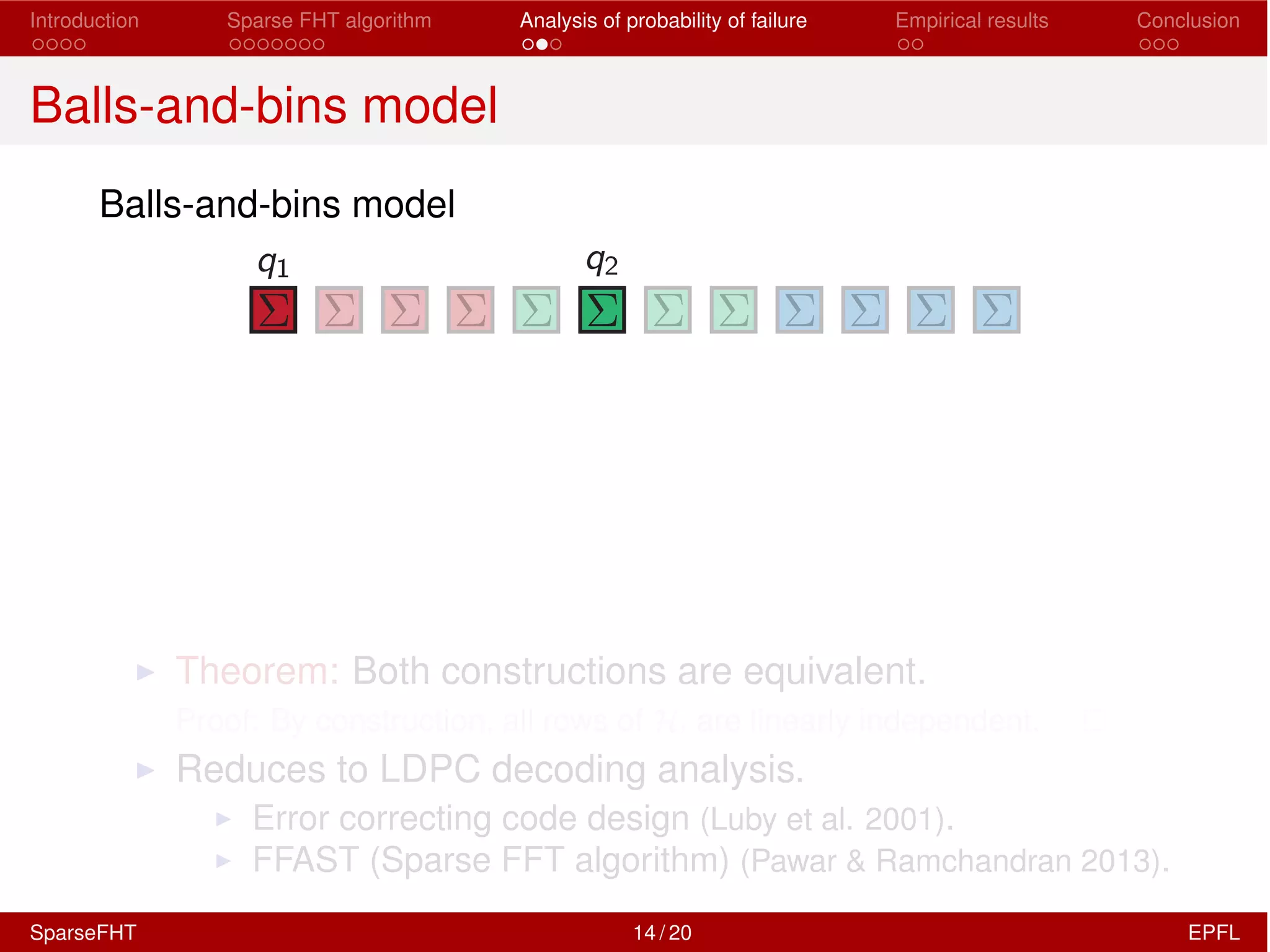
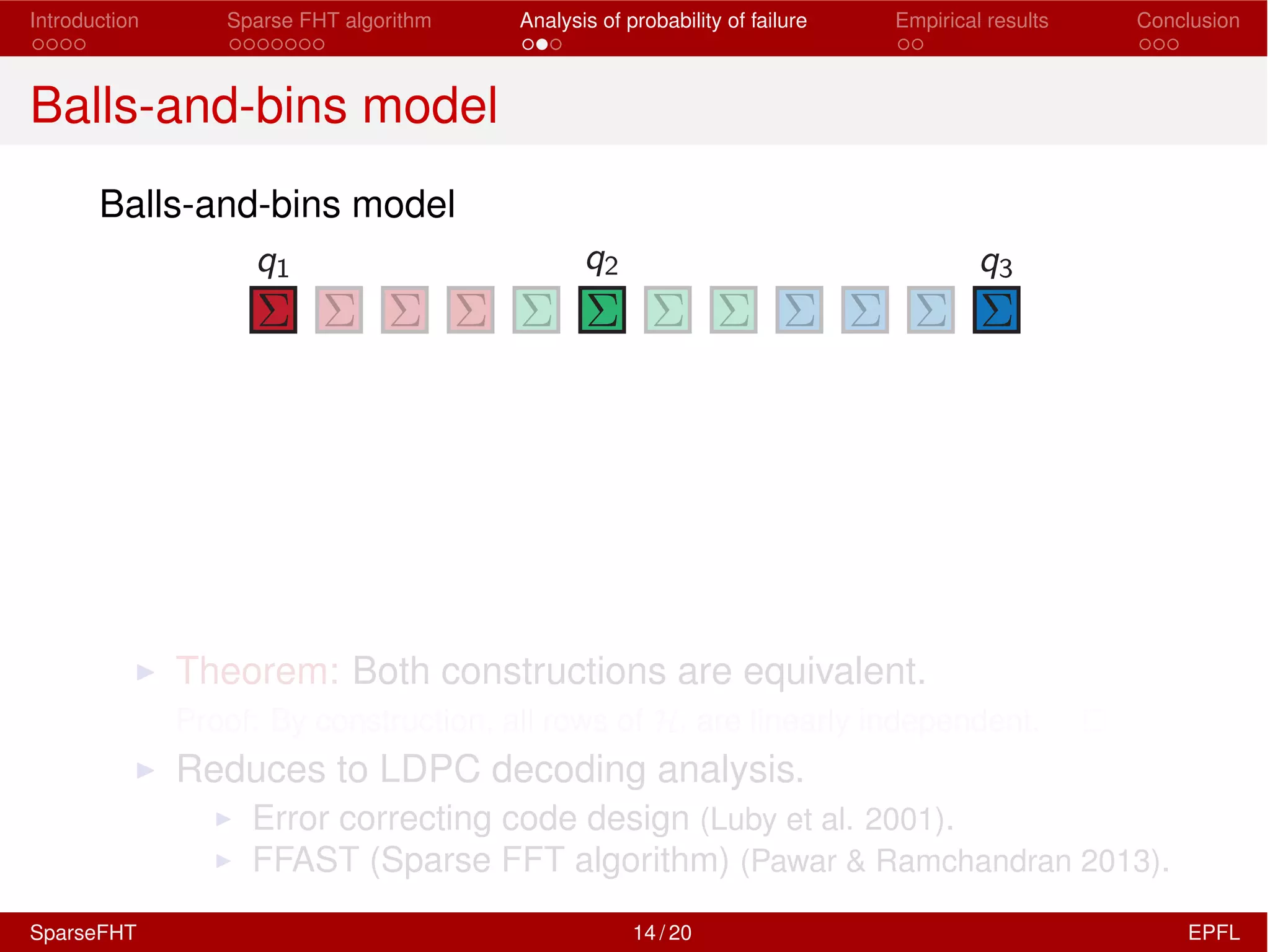
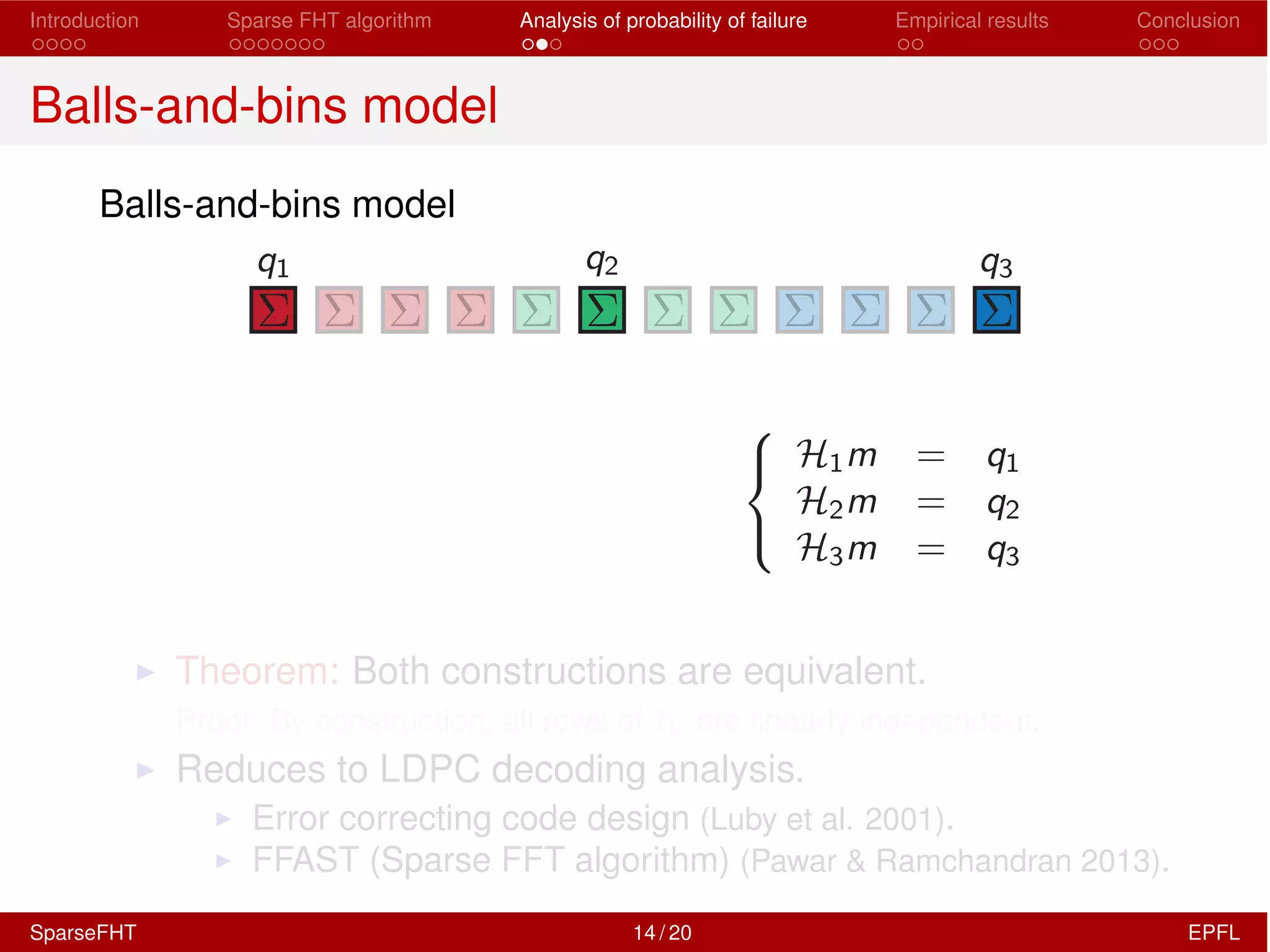
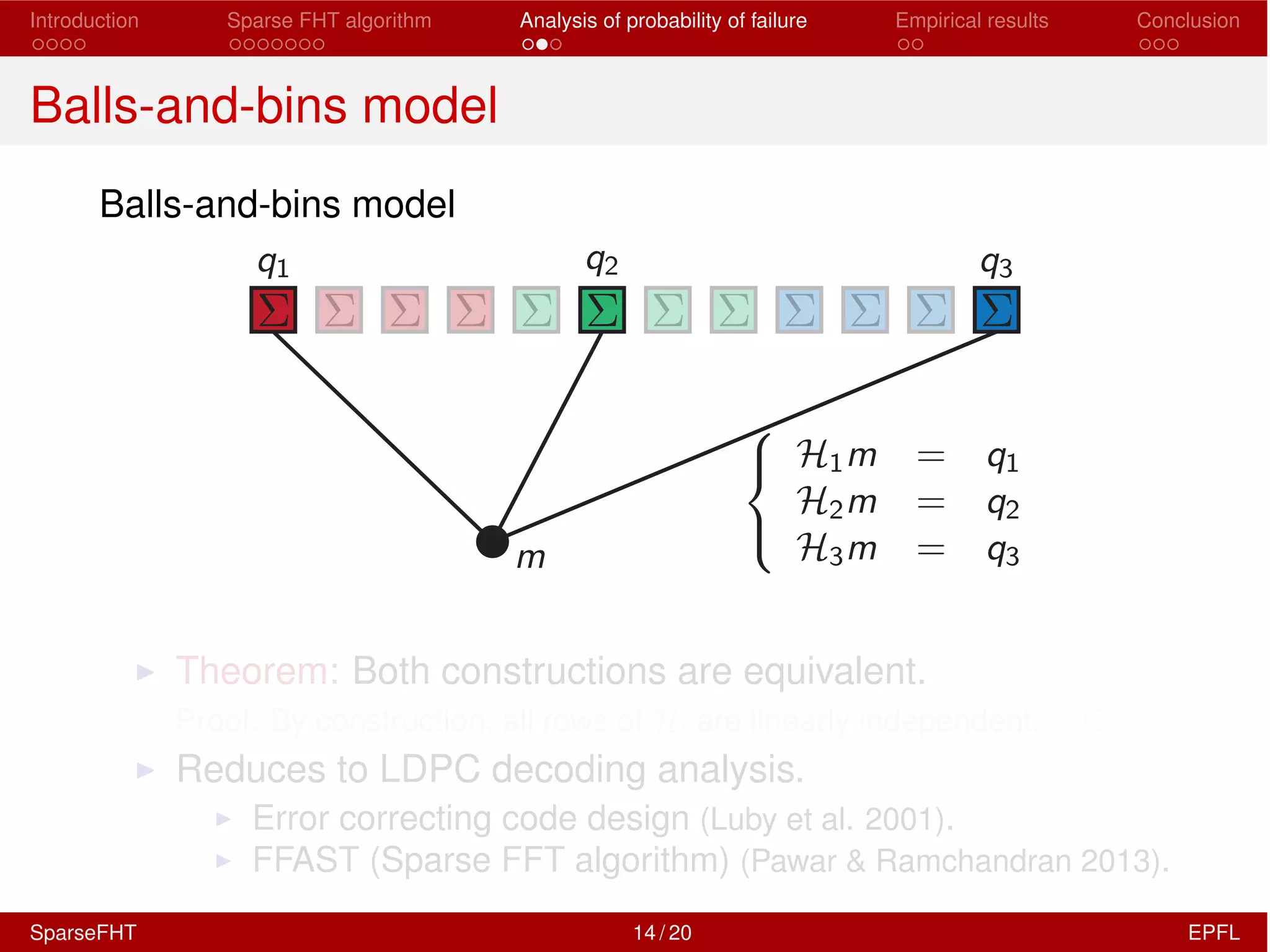
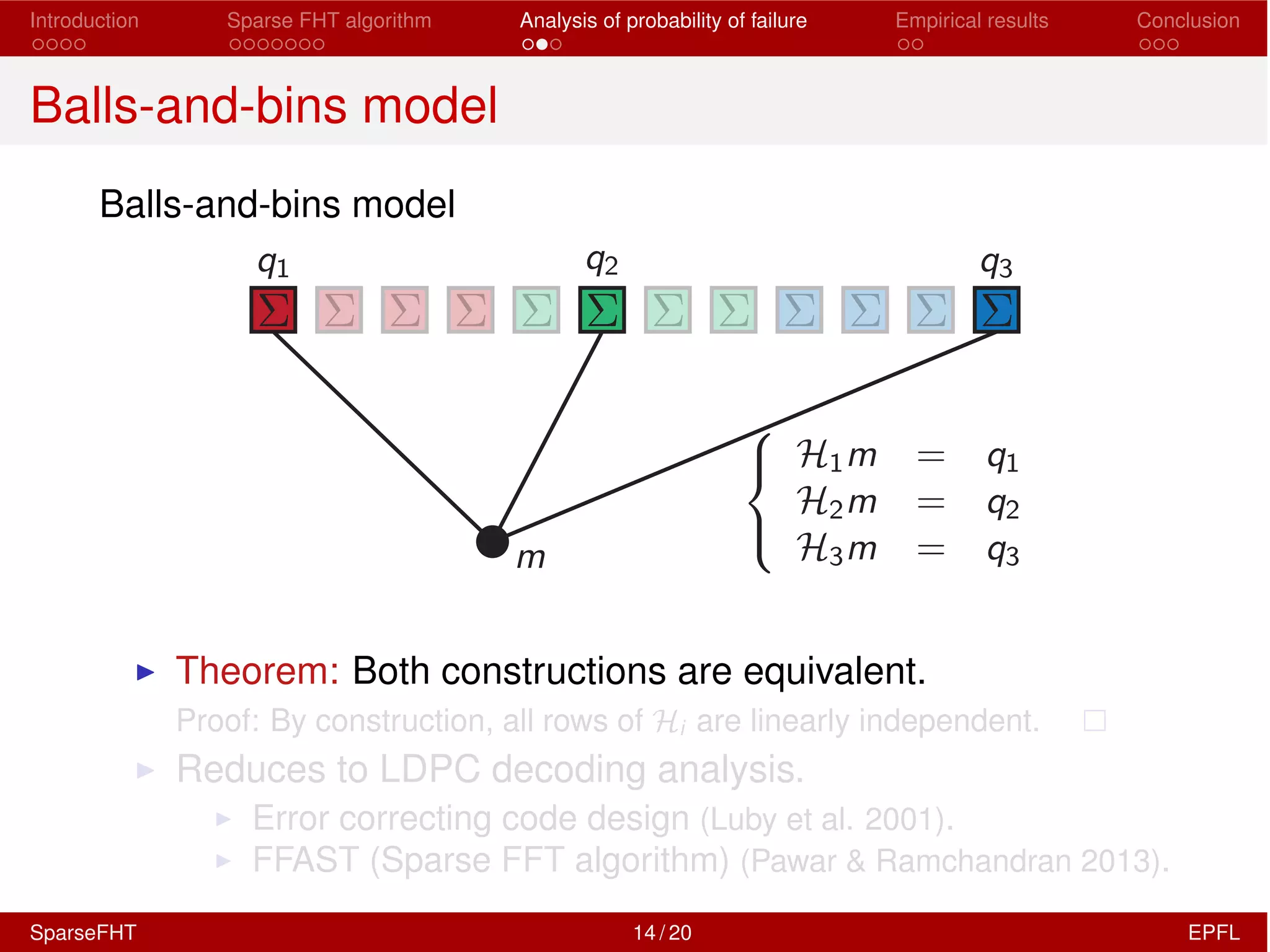
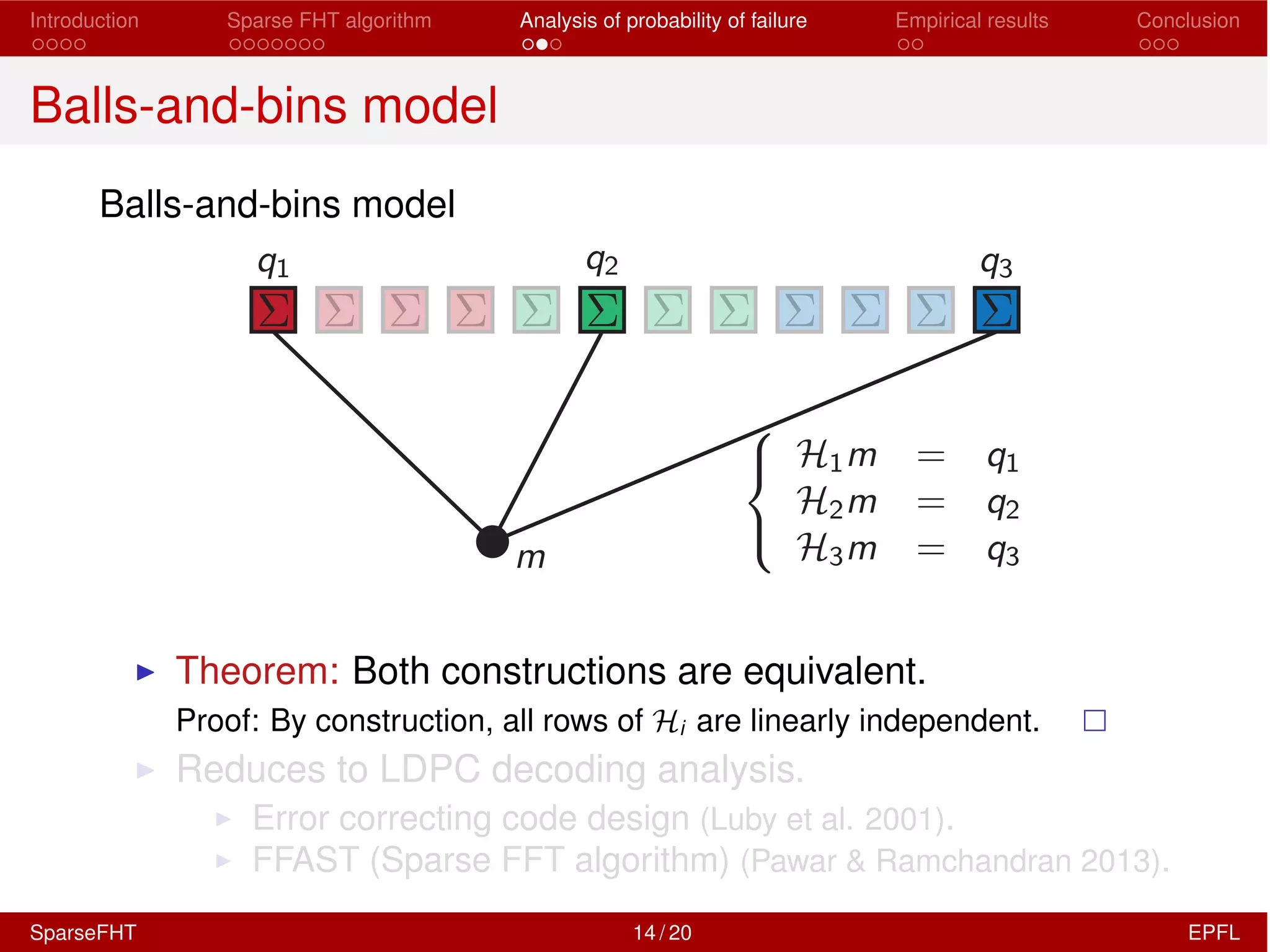
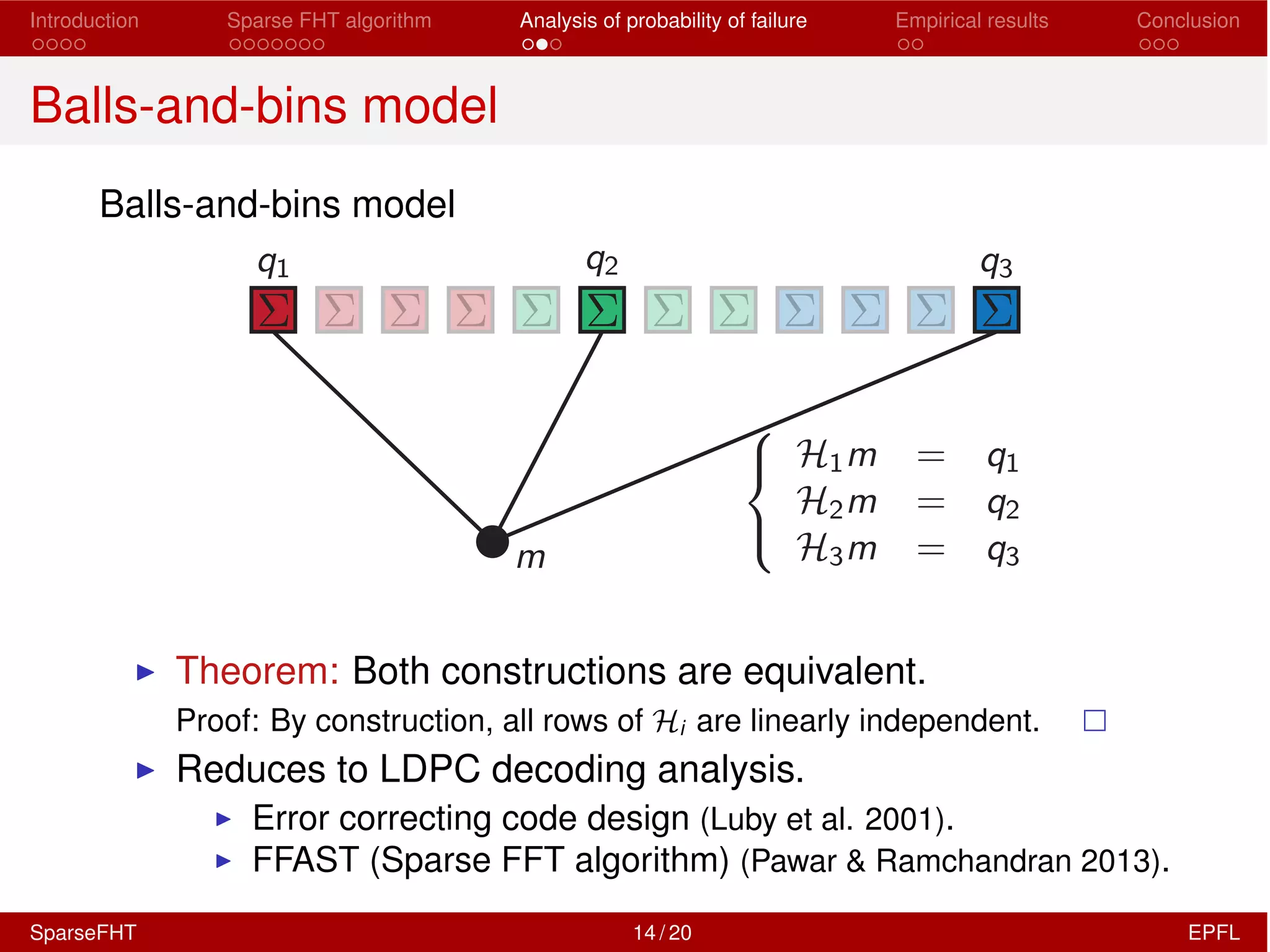
Balls-and-bins model
Uniformly random support model
I Theorem: Both constructions are equivalent.
Proof: By construction, all rows of Hi are linearly independent.
I Reduces to LDPC decoding analysis.
I Error correcting code design (Luby et al. 2001).
I FFAST (Sparse FFT algorithm) (Pawar & Ramchandran 2013).
SparseFHT 14 / 20 EPFL
Introduction Sparse FHT algorithm Analysis of probability of failure Empirical results Conclusion
Balls-and-bins model
Uniformly random support model
I Theorem: Both constructions are equivalent.
Proof: By construction, all rows of Hi are linearly independent.
I Reduces to LDPC decoding analysis.
I Error correcting code design (Luby et al. 2001).
I FFAST (Sparse FFT algorithm) (Pawar & Ramchandran 2013).
SparseFHT 14 / 20 EPFL
Introduction Sparse FHT algorithm Analysis of probability of failure Empirical results Conclusion
Balls-and-bins model
Uniformly random support model
I Theorem: Both constructions are equivalent.
Proof: By construction, all rows of Hi are linearly independent.
I Reduces to LDPC decoding analysis.
I Error correcting code design (Luby et al. 2001).
I FFAST (Sparse FFT algorithm) (Pawar & Ramchandran 2013).
SparseFHT 14 / 20 EPFL
Introduction Sparse FHT algorithm Analysis of probability of failure Empirical results Conclusion
Balls-and-bins model
Uniformly random support model
I Theorem: Both constructions are equivalent.
Proof: By construction, all rows of Hi are linearly independent.
I Reduces to LDPC decoding analysis.
I Error correcting code design (Luby et al. 2001).
I FFAST (Sparse FFT algorithm) (Pawar & Ramchandran 2013).
SparseFHT 14 / 20 EPFL
Introduction Sparse FHT algorithm Analysis of probability of failure Empirical results Conclusion
Balls-and-bins model
Uniformly random support model
I Theorem: Both constructions are equivalent.
Proof: By construction, all rows of Hi are linearly independent.
I Reduces to LDPC decoding analysis.
I Error correcting code design (Luby et al. 2001).
I FFAST (Sparse FFT algorithm) (Pawar & Ramchandran 2013).
SparseFHT 14 / 20 EPFL
Introduction Sparse FHT algorithm Analysis of probability of failure Empirical results Conclusion
Balls-and-bins model
I Theorem: Both constructions are equivalent.
Proof: By construction, all rows of Hi are linearly independent.
I Reduces to LDPC decoding analysis.
I Error correcting code design (Luby et al. 2001).
I FFAST (Sparse FFT algorithm) (Pawar & Ramchandran 2013).
SparseFHT 14 / 20 EPFL
Introduction Sparse FHT algorithm Analysis of probability of failure Empirical results Conclusion
Balls-and-bins model
I Theorem: Both constructions are equivalent.
Proof: By construction, all rows of Hi are linearly independent.
I Reduces to LDPC decoding analysis.
I Error correcting code design (Luby et al. 2001).
I FFAST (Sparse FFT algorithm) (Pawar & Ramchandran 2013).
SparseFHT 14 / 20 EPFL
Introduction Sparse FHT algorithm Analysis of probability of failure Empirical results Conclusion
Balls-and-bins model
I Theorem: Both constructions are equivalent.
Proof: By construction, all rows of Hi are linearly independent.
I Reduces to LDPC decoding analysis.
I Error correcting code design (Luby et al. 2001).
I FFAST (Sparse FFT algorithm) (Pawar & Ramchandran 2013).
SparseFHT 14 / 20 EPFL
Introduction Sparse FHT algorithm Analysis of probability of failure Empirical results Conclusion
Balls-and-bins model
I Theorem: Both constructions are equivalent.
Proof: By construction, all rows of Hi are linearly independent.
I Reduces to LDPC decoding analysis.
I Error correcting code design (Luby et al. 2001).
I FFAST (Sparse FFT algorithm) (Pawar & Ramchandran 2013).
SparseFHT 14 / 20 EPFL
Introduction Sparse FHT algorithm Analysis of probability of failure Empirical results Conclusion
Balls-and-bins model
I Theorem: Both constructions are equivalent.
Proof: By construction, all rows of Hi are linearly independent.
I Reduces to LDPC decoding analysis.
I Error correcting code design (Luby et al. 2001).
I FFAST (Sparse FFT algorithm) (Pawar & Ramchandran 2013).
SparseFHT 14 / 20 EPFL
Introduction Sparse FHT algorithm Analysis of probability of failure Empirical results Conclusion
Balls-and-bins model
I Theorem: Both constructions are equivalent.
Proof: By construction, all rows of Hi are linearly independent.
I Reduces to LDPC decoding analysis.
I Error correcting code design (Luby et al. 2001).
I FFAST (Sparse FFT algorithm) (Pawar & Ramchandran 2013).
SparseFHT 14 / 20 EPFL
Introduction Sparse FHT algorithm Analysis of probability of failure Empirical results Conclusion
Balls-and-bins model
I Theorem: Both constructions are equivalent.
Proof: By construction, all rows of Hi are linearly independent.
I Reduces to LDPC decoding analysis.
I Error correcting code design (Luby et al. 2001).
I FFAST (Sparse FFT algorithm) (Pawar & Ramchandran 2013).
SparseFHT 14 / 20 EPFL
Introduction Sparse FHT algorithm Analysis of probability of failure Empirical results Conclusion
Balls-and-bins model
I Theorem: Both constructions are equivalent.
Proof: By construction, all rows of Hi are linearly independent.
I Reduces to LDPC decoding analysis.
I Error correcting code design (Luby et al. 2001).
I FFAST (Sparse FFT algorithm) (Pawar & Ramchandran 2013).
SparseFHT 14 / 20 EPFL
Introduction Sparse FHT algorithm Analysis of probability of failure Empirical results Conclusion
Balls-and-bins model
I Theorem: Both constructions are equivalent.
Proof: By construction, all rows of Hi are linearly independent.
I Reduces to LDPC decoding analysis.
I Error correcting code design (Luby et al. 2001).
I FFAST (Sparse FFT algorithm) (Pawar & Ramchandran 2013).
SparseFHT 14 / 20 EPFL
Introduction Sparse FHT algorithm Analysis of probability of failure Empirical results Conclusion
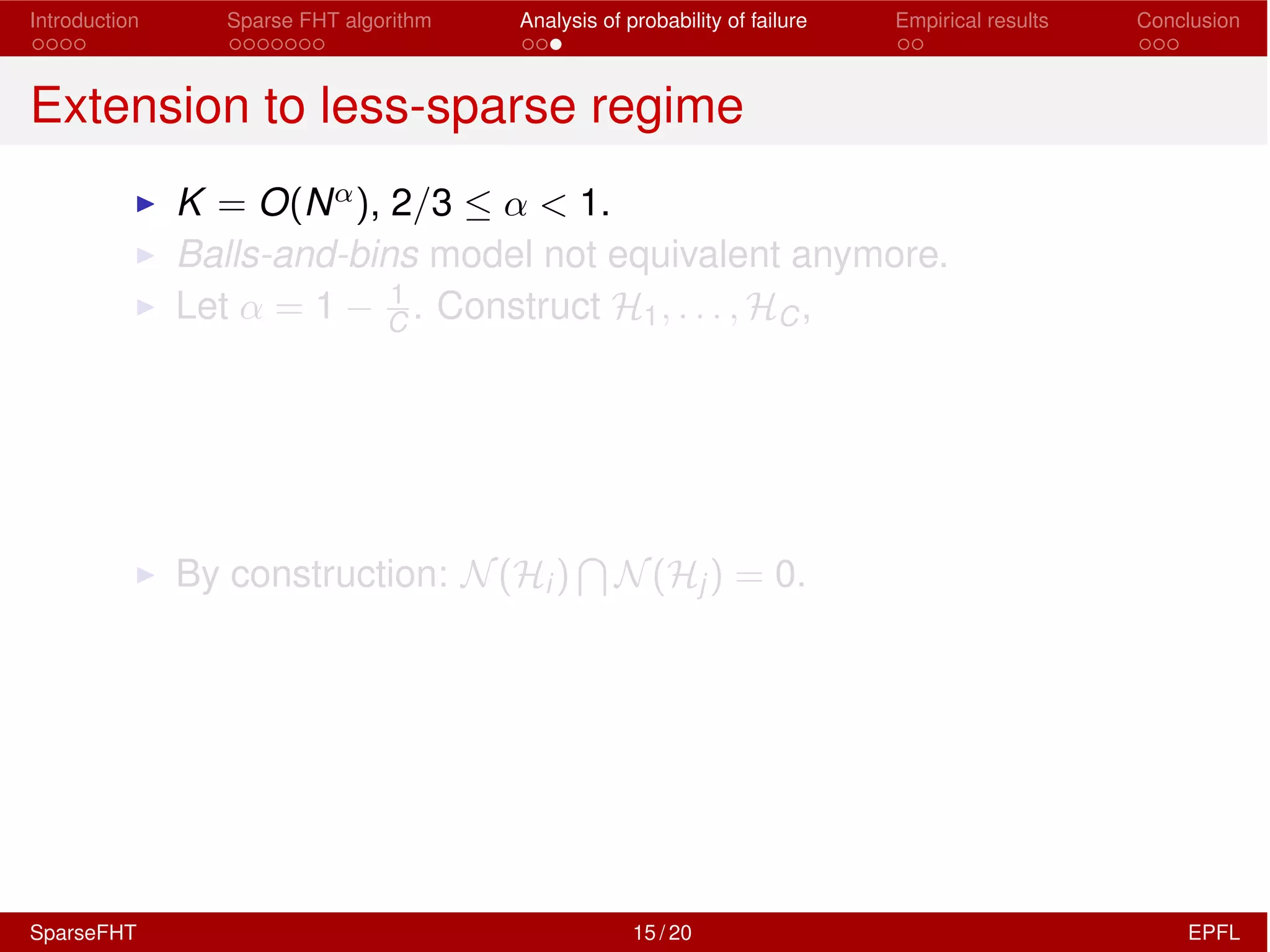
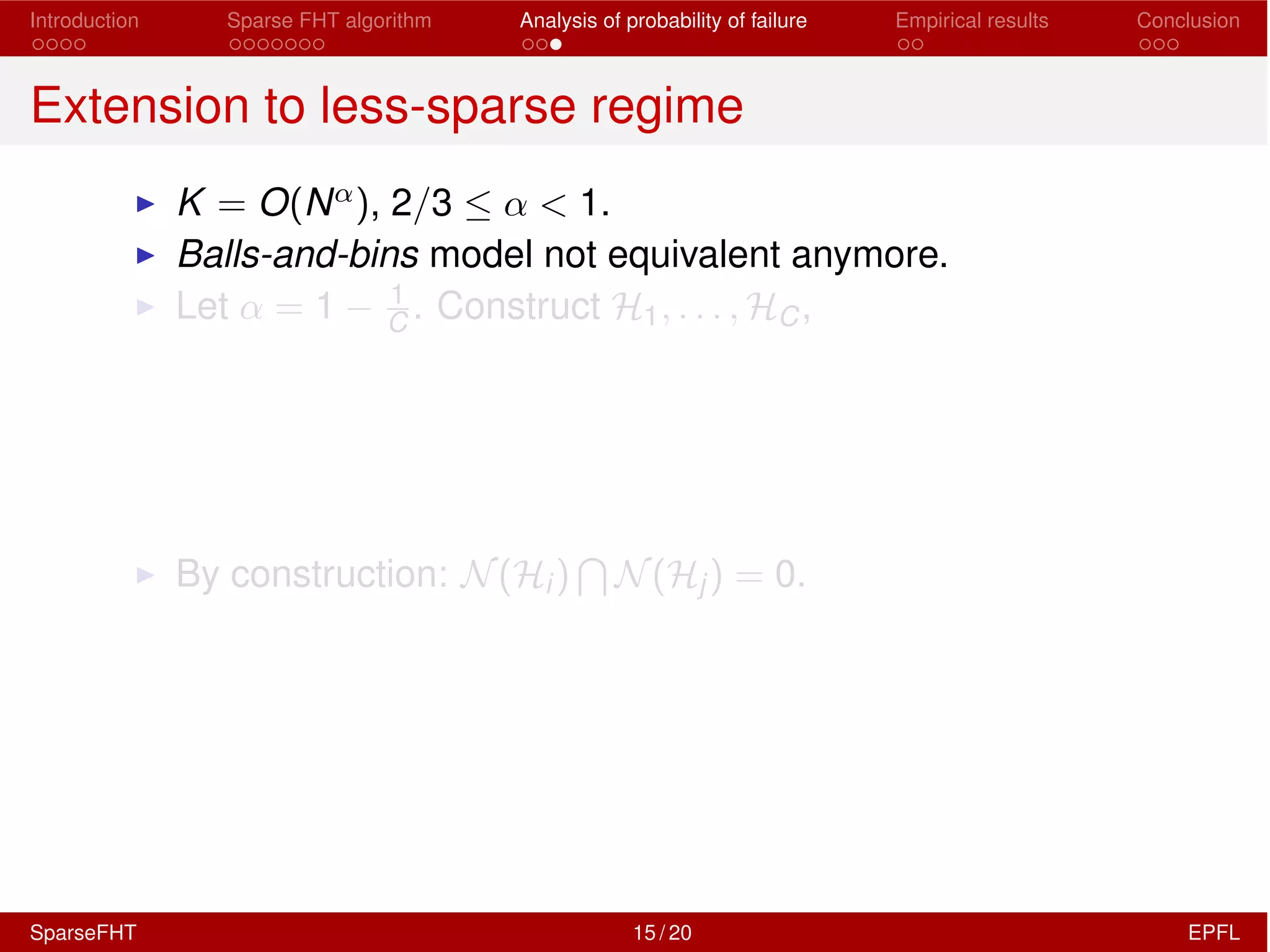
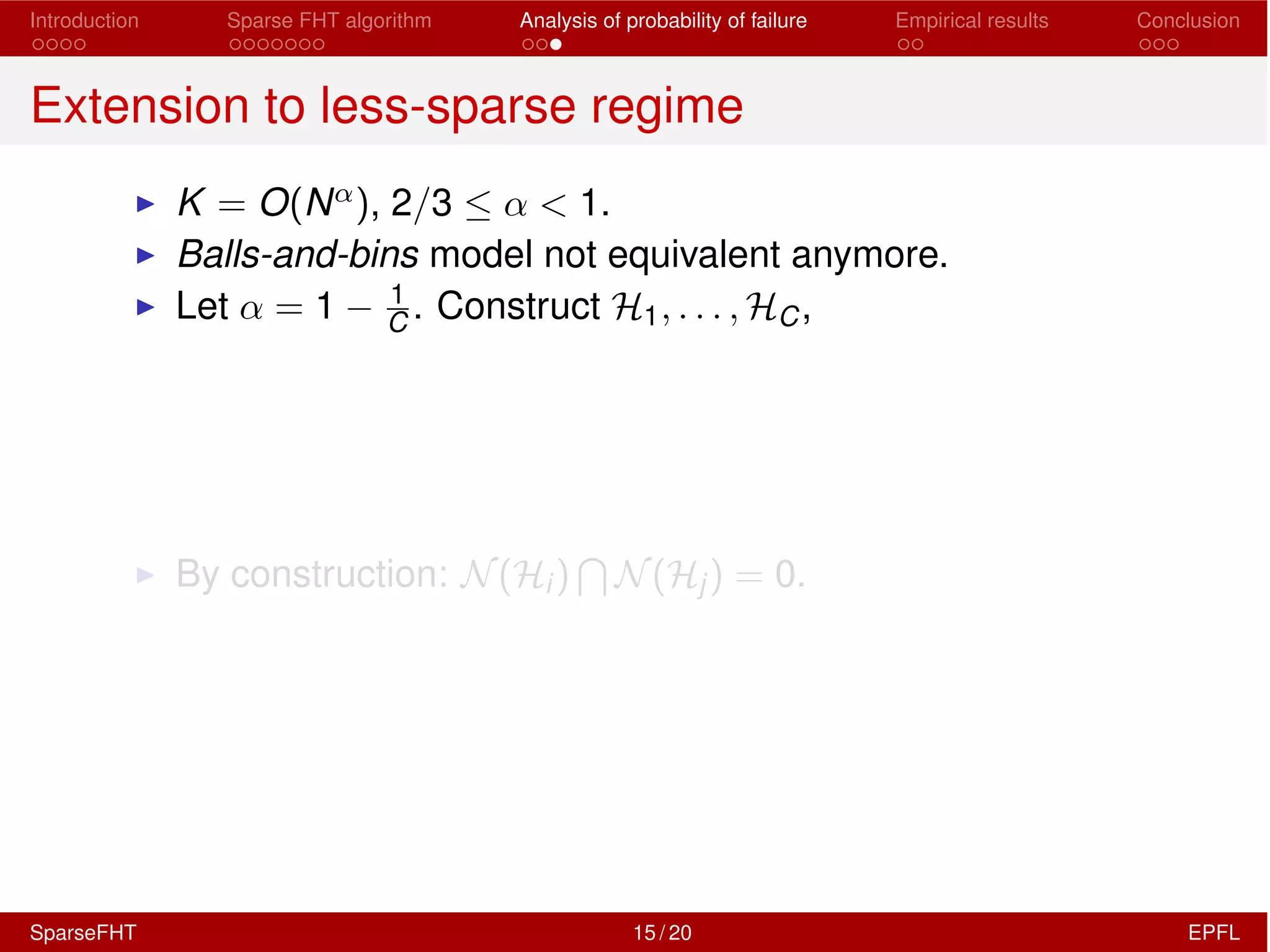
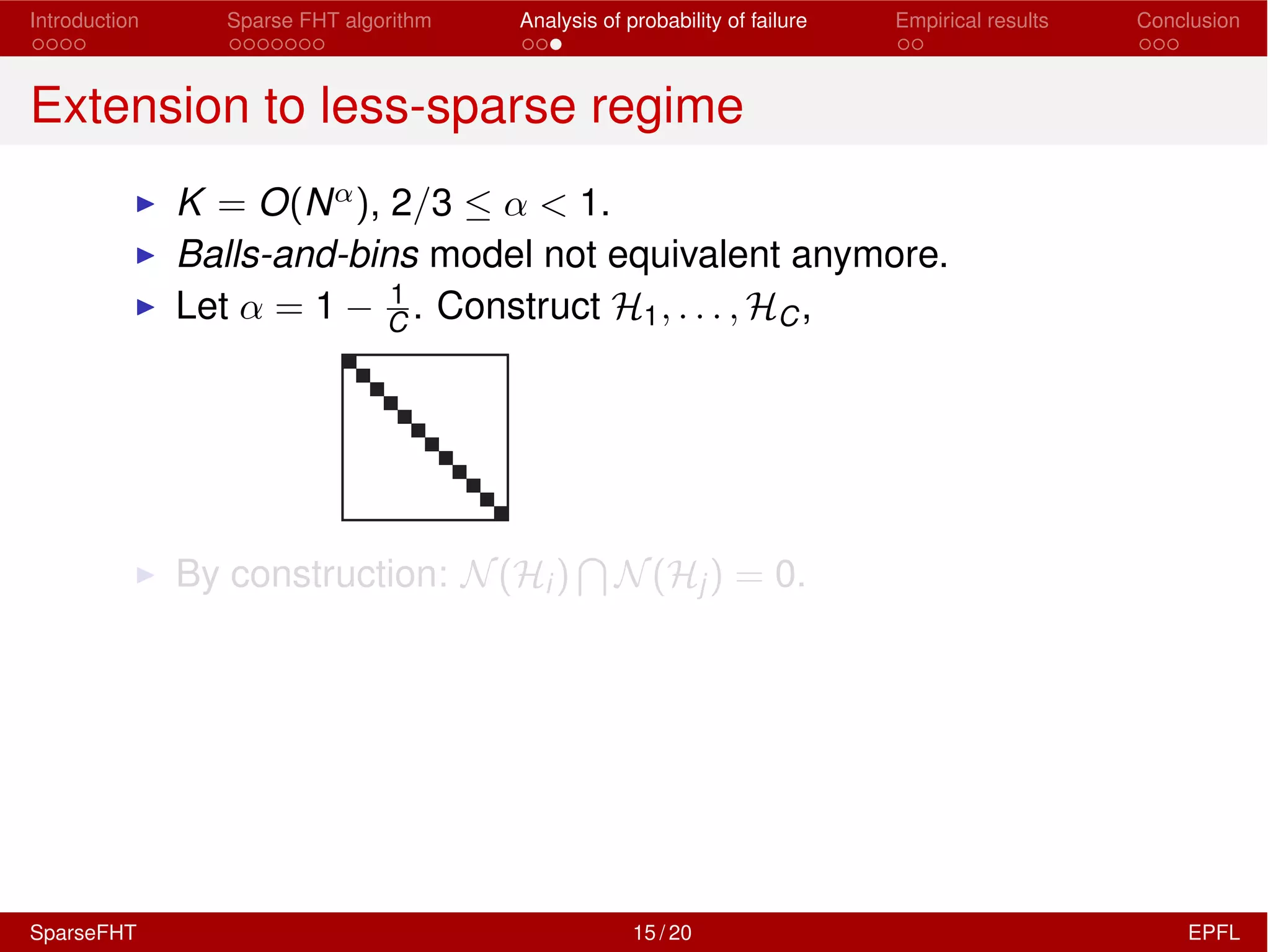
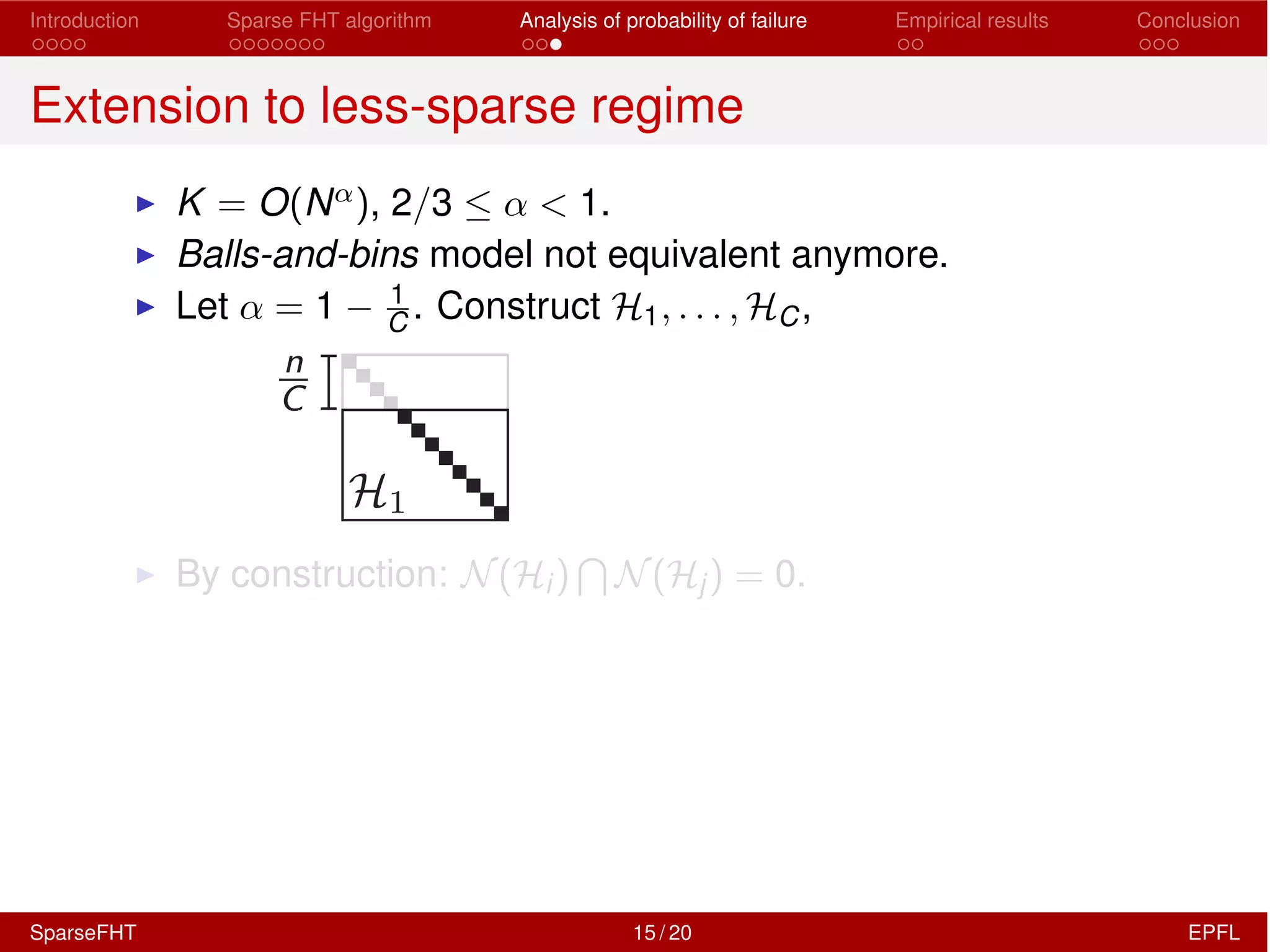
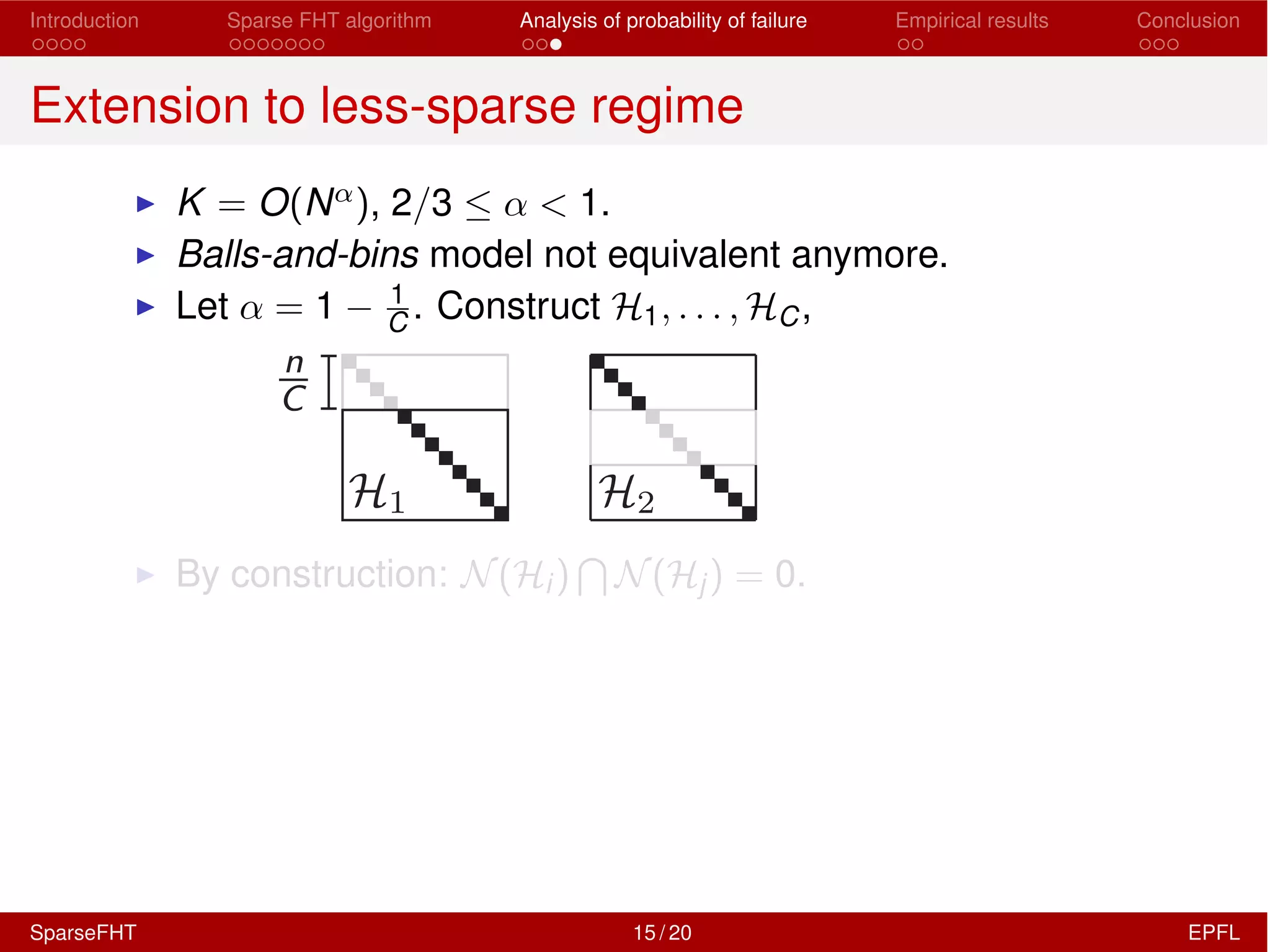
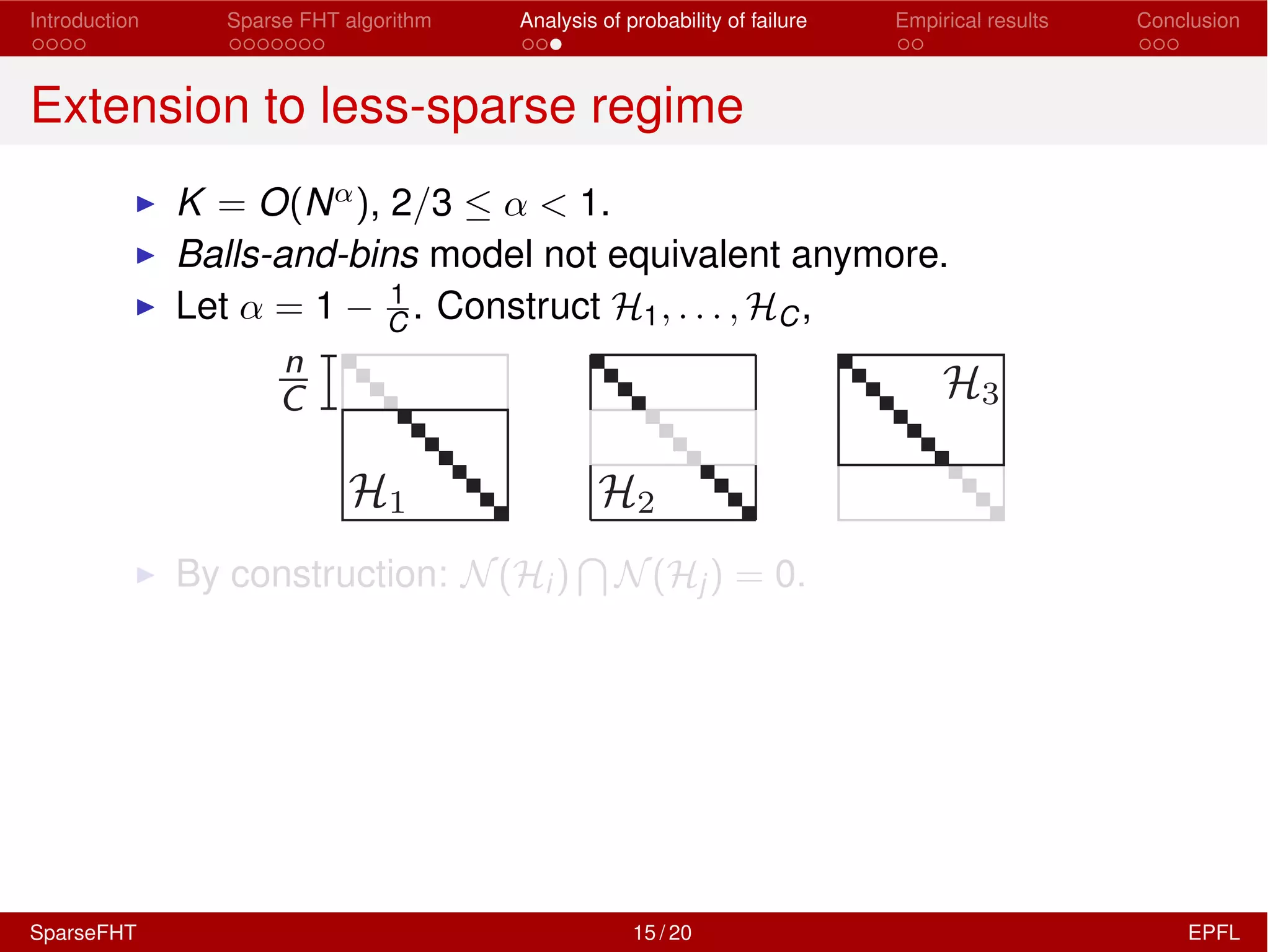
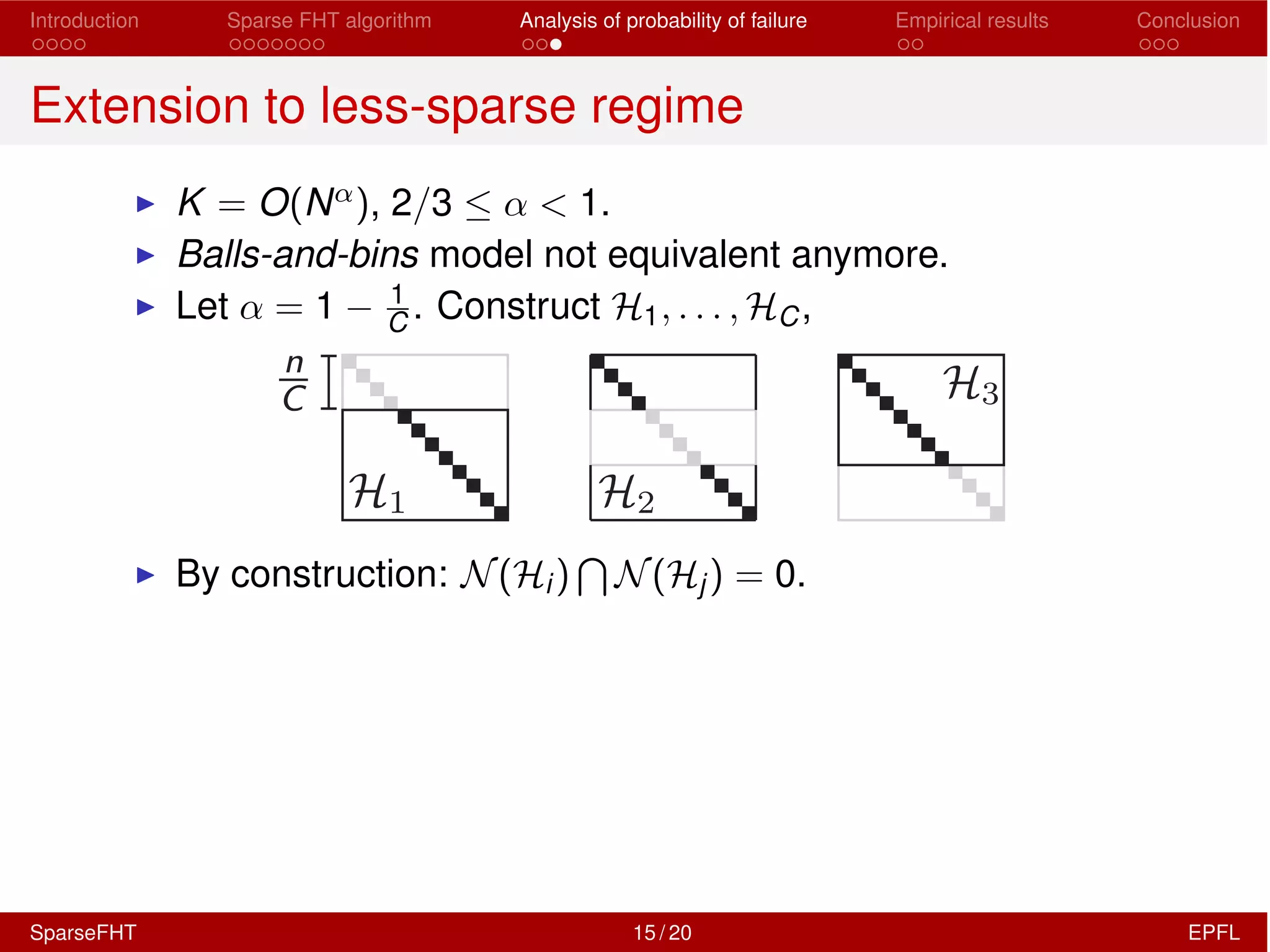
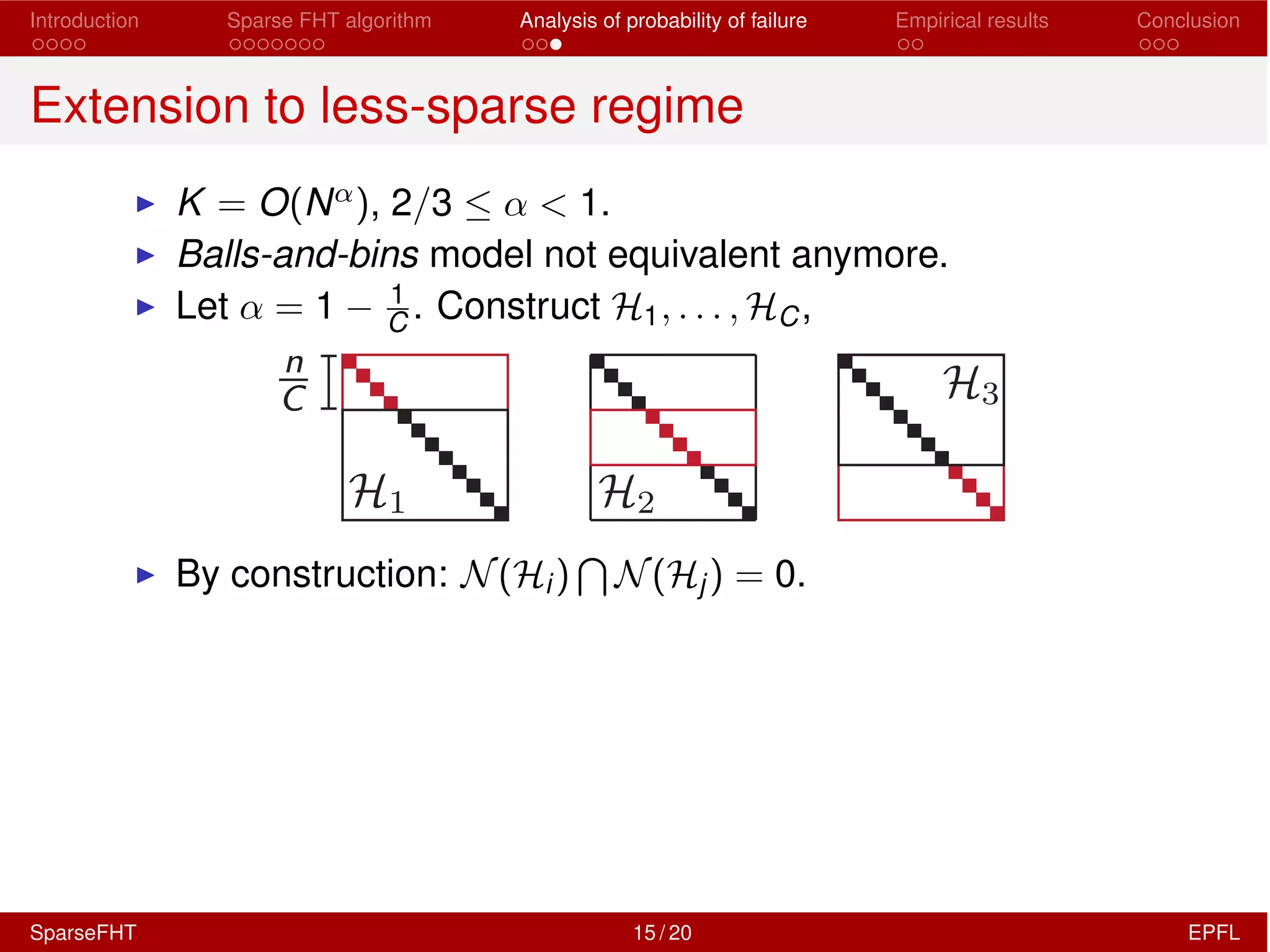
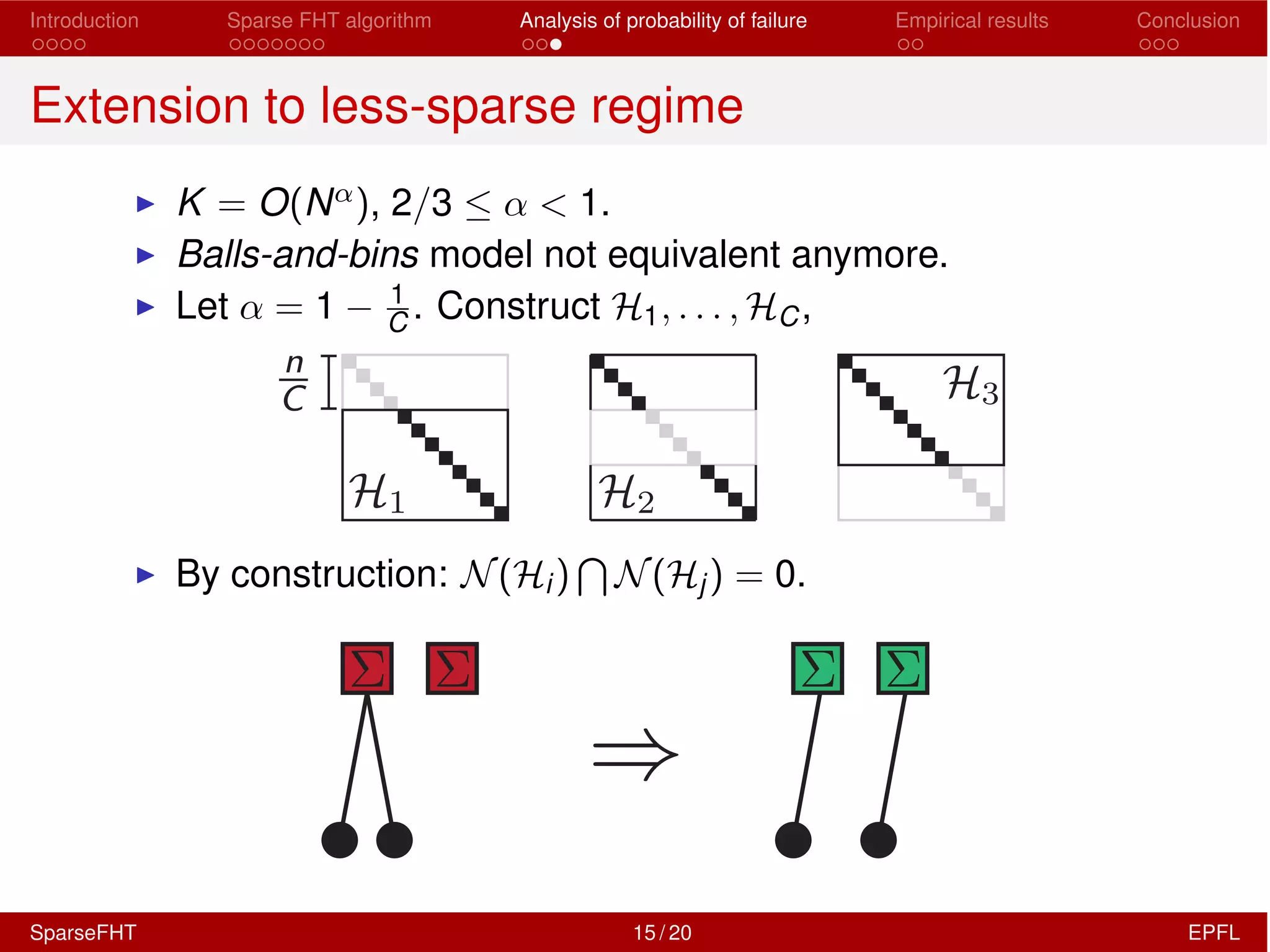
Extension to less-sparse regime
I K = O(N↵), 2/3  ↵ < 1.
I Balls-and-bins model not equivalent anymore.
I Let ↵ = 1 1
C . Construct H1, . . . , HC,
I By construction: N(Hi)
T
N(Hj) = 0.
SparseFHT 15 / 20 EPFL
Introduction Sparse FHT algorithm Analysis of probability of failure Empirical results Conclusion
Extension to less-sparse regime
I K = O(N↵), 2/3  ↵ < 1.
I Balls-and-bins model not equivalent anymore.
I Let ↵ = 1 1
C . Construct H1, . . . , HC,
I By construction: N(Hi)
T
N(Hj) = 0.
SparseFHT 15 / 20 EPFL
Introduction Sparse FHT algorithm Analysis of probability of failure Empirical results Conclusion
Extension to less-sparse regime
I K = O(N↵), 2/3  ↵ < 1.
I Balls-and-bins model not equivalent anymore.
I Let ↵ = 1 1
C . Construct H1, . . . , HC,
I By construction: N(Hi)
T
N(Hj) = 0.
SparseFHT 15 / 20 EPFL
Introduction Sparse FHT algorithm Analysis of probability of failure Empirical results Conclusion
Extension to less-sparse regime
I K = O(N↵), 2/3  ↵ < 1.
I Balls-and-bins model not equivalent anymore.
I Let ↵ = 1 1
C . Construct H1, . . . , HC,
I By construction: N(Hi)
T
N(Hj) = 0.
SparseFHT 15 / 20 EPFL
Introduction Sparse FHT algorithm Analysis of probability of failure Empirical results Conclusion
Extension to less-sparse regime
I K = O(N↵), 2/3  ↵ < 1.
I Balls-and-bins model not equivalent anymore.
I Let ↵ = 1 1
C . Construct H1, . . . , HC,
I By construction: N(Hi)
T
N(Hj) = 0.
SparseFHT 15 / 20 EPFL
Introduction Sparse FHT algorithm Analysis of probability of failure Empirical results Conclusion
Extension to less-sparse regime
I K = O(N↵), 2/3  ↵ < 1.
I Balls-and-bins model not equivalent anymore.
I Let ↵ = 1 1
C . Construct H1, . . . , HC,
I By construction: N(Hi)
T
N(Hj) = 0.
SparseFHT 15 / 20 EPFL
Introduction Sparse FHT algorithm Analysis of probability of failure Empirical results Conclusion
Extension to less-sparse regime
I K = O(N↵), 2/3  ↵ < 1.
I Balls-and-bins model not equivalent anymore.
I Let ↵ = 1 1
C . Construct H1, . . . , HC,
I By construction: N(Hi)
T
N(Hj) = 0.
SparseFHT 15 / 20 EPFL
Introduction Sparse FHT algorithm Analysis of probability of failure Empirical results Conclusion
Extension to less-sparse regime
I K = O(N↵), 2/3  ↵ < 1.
I Balls-and-bins model not equivalent anymore.
I Let ↵ = 1 1
C . Construct H1, . . . , HC,
I By construction: N(Hi)
T
N(Hj) = 0.
SparseFHT 15 / 20 EPFL
Introduction Sparse FHT algorithm Analysis of probability of failure Empirical results Conclusion
Extension to less-sparse regime
I K = O(N↵), 2/3  ↵ < 1.
I Balls-and-bins model not equivalent anymore.
I Let ↵ = 1 1
C . Construct H1, . . . , HC,
I By construction: N(Hi)
T
N(Hj) = 0.
SparseFHT 15 / 20 EPFL
Introduction Sparse FHT algorithm Analysis of probability of failure Empirical results Conclusion
Extension to less-sparse regime
I K = O(N↵), 2/3  ↵ < 1.
I Balls-and-bins model not equivalent anymore.
I Let ↵ = 1 1
C . Construct H1, . . . , HC,
I By construction: N(Hi)
T
N(Hj) = 0.
SparseFHT 15 / 20 EPFL
Introduction Sparse FHT algorithm Analysis of probability of failure Empirical results Conclusion
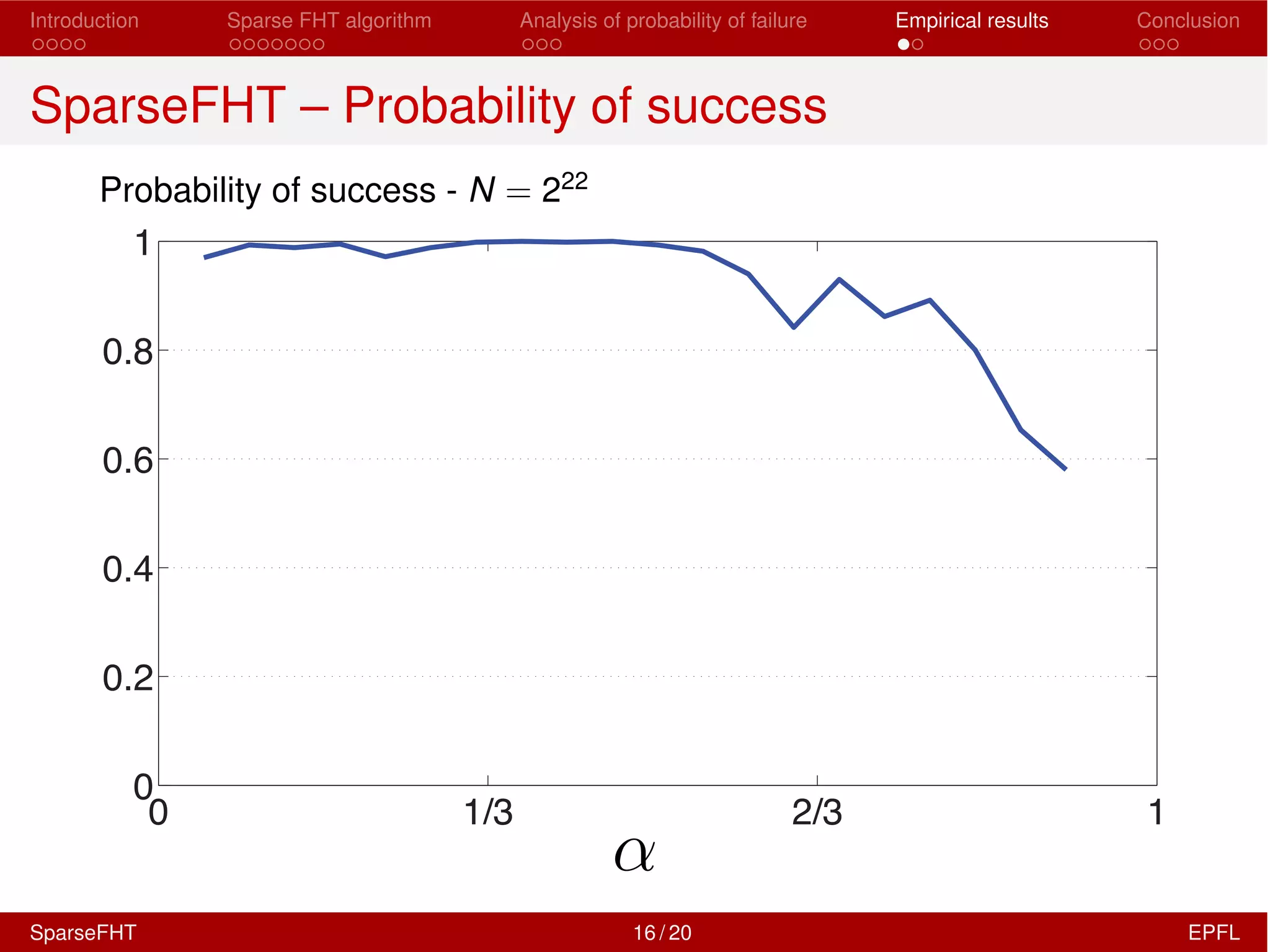
SparseFHT – Probability of success
Probability of success - N = 222
0 1/3 2/3 1
0
0.2
0.4
0.6
0.8
1
↵
SparseFHT 16 / 20 EPFL
Introduction Sparse FHT algorithm Analysis of probability of failure Empirical results Conclusion
SparseFHT vs. FHT
Runtime [µs] – N = 215
0 1/3 2/3 1
0
200
400
600
800
1000
Sparse FHT
FHT
↵
SparseFHT 17 / 20 EPFL
Introduction Sparse FHT algorithm Analysis of probability of failure Empirical results Conclusion
Conclusion
Contribution
I Sparse fast Hadamard algorithm.
I Time complexity O(K log2 K log2
N
K ).
I Sample complexity O(K log2
N
K ).
I Probability of success asymptotically equal to 1.
What’s next ?
I Investigate noisy case.
SparseFHT 18 / 20 EPFL
Introduction Sparse FHT algorithm Analysis of probability of failure Empirical results Conclusion
Conclusion
Contribution
I Sparse fast Hadamard algorithm.
I Time complexity O(K log2 K log2
N
K ).
I Sample complexity O(K log2
N
K ).
I Probability of success asymptotically equal to 1.
What’s next ?
I Investigate noisy case.
SparseFHT 18 / 20 EPFL
Introduction Sparse FHT algorithm Analysis of probability of failure Empirical results Conclusion
Thanks for your attention!
Code and figures available at
http://lcav.epfl.ch/page-99903.html
SparseFHT 19 / 20 EPFL
Introduction Sparse FHT algorithm Analysis of probability of failure Empirical results Conclusion
Reference
[1] M.G. Luby, M. Mitzenmacher, M.A. Shokrollahi, and
D.A. Spielman,
Efficient erasure correcting codes,
IEEE Trans. Inform. Theory, vol. 47, no. 2,
pp. 569–584, 2001.
[2] S. Pawar and K. Ramchandran,
Computing a k-sparse n-length discrete Fourier transform
using at most 4k samples and O(k log k) complexity,
arXiv.org, vol. cs.DS. 04-May-2013.
SparseFHT 20 / 20 EPFL

A Fast Hadamard Transform for Signals with Sub-linear Sparsity

  • 1.
    Introduction Sparse FHTalgorithm Analysis of probability of failure Empirical results Conclusion A Fast Hadamard Transform for Signals with Sub-linear Sparsity Robin Scheibler Saeid Haghighatshoar Martin Vetterli School of Computer and Communication Sciences École Polytechnique Fédérale de Lausanne, Switzerland October 28, 2013 SparseFHT 1 / 20 EPFL
  • 2.
    Introduction Sparse FHTalgorithm Analysis of probability of failure Empirical results Conclusion Why the Hadamard transform ? I Historically, low computation approximation to DFT. I Coding, 1969 Mariner Mars probe. I Communication, orthogonal codes in WCDMA. I Compressed sensing, maximally incoherent with Dirac basis. I Spectroscopy, design of instruments with lower noise. I Recent advances in sparse FFT. 16 ⇥ 16 Hadamard matrix Mariner probe SparseFHT 2 / 20 EPFL
  • 3.
    Introduction Sparse FHTalgorithm Analysis of probability of failure Empirical results Conclusion Fast Hadamard transform I Butterfly structure similar to FFT. I Time complexity O(N log2 N). I Sample complexity N. + Universal, i.e. works for all signals. Does not exploit signal structure (e.g. sparsity). Can we do better ? SparseFHT 3 / 20 EPFL
  • 4.
    Introduction Sparse FHTalgorithm Analysis of probability of failure Empirical results Conclusion Fast Hadamard transform I Butterfly structure similar to FFT. I Time complexity O(N log2 N). I Sample complexity N. + Universal, i.e. works for all signals. Does not exploit signal structure (e.g. sparsity). Can we do better ? SparseFHT 3 / 20 EPFL
  • 5.
    Introduction Sparse FHTalgorithm Analysis of probability of failure Empirical results Conclusion Fast Hadamard transform I Butterfly structure similar to FFT. I Time complexity O(N log2 N). I Sample complexity N. + Universal, i.e. works for all signals. Does not exploit signal structure (e.g. sparsity). Can we do better ? SparseFHT 3 / 20 EPFL
  • 6.
    Introduction Sparse FHTalgorithm Analysis of probability of failure Empirical results Conclusion Fast Hadamard transform I Butterfly structure similar to FFT. I Time complexity O(N log2 N). I Sample complexity N. + Universal, i.e. works for all signals. Does not exploit signal structure (e.g. sparsity). Can we do better ? SparseFHT 3 / 20 EPFL
  • 7.
    Introduction Sparse FHTalgorithm Analysis of probability of failure Empirical results Conclusion Contribution: Sparse fast Hadamard transform Assumptions I The signal is exaclty K-sparse in the transform domain. I Sub-linear sparsity regime K = O(N↵), 0 < ↵ < 1. I Support of the signal is uniformly random. Contribution An algorithm computing the K non-zero coefficients with: I Time complexity O(K log2 K log2 N K ). I Sample complexity O(K log2 N K ). I Probability of failure asymptotically vanishes. SparseFHT 4 / 20 EPFL
  • 8.
    Introduction Sparse FHTalgorithm Analysis of probability of failure Empirical results Conclusion Contribution: Sparse fast Hadamard transform Assumptions I The signal is exaclty K-sparse in the transform domain. I Sub-linear sparsity regime K = O(N↵), 0 < ↵ < 1. I Support of the signal is uniformly random. Contribution An algorithm computing the K non-zero coefficients with: I Time complexity O(K log2 K log2 N K ). I Sample complexity O(K log2 N K ). I Probability of failure asymptotically vanishes. SparseFHT 4 / 20 EPFL
  • 9.
    Introduction Sparse FHTalgorithm Analysis of probability of failure Empirical results Conclusion Outline 1. Sparse FHT algorithm 2. Analysis of probability of failure 3. Empirical results SparseFHT 5 / 20 EPFL
  • 10.
    Introduction Sparse FHTalgorithm Analysis of probability of failure Empirical results Conclusion Another look at the Hadamard transform I Consider indices of x 2 RN, N = 2n. I Take the binary expansion of indices. I Represent signal on hypercube. I Take DFT in every direction. I = {0, . . . , 23 1} SparseFHT 6 / 20 EPFL
  • 11.
    Introduction Sparse FHTalgorithm Analysis of probability of failure Empirical results Conclusion Another look at the Hadamard transform I Consider indices of x 2 RN, N = 2n. I Take the binary expansion of indices. I Represent signal on hypercube. I Take DFT in every direction. I = {(0, 0, 0), . . . , (1, 1, 1)} SparseFHT 6 / 20 EPFL
  • 12.
    Introduction Sparse FHTalgorithm Analysis of probability of failure Empirical results Conclusion Another look at the Hadamard transform I Consider indices of x 2 RN, N = 2n. I Take the binary expansion of indices. I Represent signal on hypercube. I Take DFT in every direction. (0,0,0) (0,1,0) (1,0,1) (1,1,1) (1,1,0)(1,0,0) (0,0,1) (0,1,1) SparseFHT 6 / 20 EPFL
  • 13.
    Introduction Sparse FHTalgorithm Analysis of probability of failure Empirical results Conclusion Another look at the Hadamard transform I Consider indices of x 2 RN, N = 2n. I Take the binary expansion of indices. I Represent signal on hypercube. I Take DFT in every direction. (0,0,0) (0,1,0) (1,0,1) (1,1,1) (1,1,0)(1,0,0) (0,0,1) (0,1,1) SparseFHT 6 / 20 EPFL
  • 14.
    Introduction Sparse FHTalgorithm Analysis of probability of failure Empirical results Conclusion Another look at the Hadamard transform I Consider indices of x 2 RN, N = 2n. I Take the binary expansion of indices. I Represent signal on hypercube. I Take DFT in every direction. (0,0,0) (0,1,0) (1,0,1) (1,1,1) (1,1,0)(1,0,0) (0,0,1) (0,1,1) SparseFHT 6 / 20 EPFL
  • 15.
    Introduction Sparse FHTalgorithm Analysis of probability of failure Empirical results Conclusion Another look at the Hadamard transform I Consider indices of x 2 RN, N = 2n. I Take the binary expansion of indices. I Represent signal on hypercube. I Take DFT in every direction. (0,0,0) (0,1,0) (1,0,1) (1,1,1) (1,1,0)(1,0,0) (0,0,1) (0,1,1) SparseFHT 6 / 20 EPFL
  • 16.
    Introduction Sparse FHTalgorithm Analysis of probability of failure Empirical results Conclusion Another look at the Hadamard transform I Consider indices of x 2 RN, N = 2n. I Take the binary expansion of indices. I Represent signal on hypercube. I Take DFT in every direction. (0,0,0) (0,1,0) (1,0,1) (1,1,1) (1,1,0)(1,0,0) (0,0,1) (0,1,1) Xk0,...,kn 1 = 1X m0=0 · · · 1X mn 1=0 ( 1)k0m0+···+kn 1mn 1 xm0,...,mn 1 , SparseFHT 6 / 20 EPFL
  • 17.
    Introduction Sparse FHTalgorithm Analysis of probability of failure Empirical results Conclusion Another look at the Hadamard transform I Consider indices of x 2 RN, N = 2n. I Take the binary expansion of indices. I Represent signal on hypercube. I Take DFT in every direction. (0,0,0) (0,1,0) (1,0,1) (1,1,1) (1,1,0)(1,0,0) (0,0,1) (0,1,1) Xk = X m2Fn 2 ( 1)hk , mi xm, k, m 2 Fn 2, hk , mi = n 1X i=0 ki mi. Treat indices as binary vectors. SparseFHT 6 / 20 EPFL
  • 18.
    Introduction Sparse FHTalgorithm Analysis of probability of failure Empirical results Conclusion Another look at the Hadamard transform I Consider indices of x 2 RN, N = 2n. I Take the binary expansion of indices. I Represent signal on hypercube. I Take DFT in every direction. (0,0,0) (0,1,0) (1,0,1) (1,1,1) (1,1,0)(1,0,0) (0,0,1) (0,1,1) Xk = X m2Fn 2 ( 1)hk , mi xm, k, m 2 Fn 2, hk , mi = n 1X i=0 ki mi. Treat indices as binary vectors. SparseFHT 6 / 20 EPFL
  • 19.
    Introduction Sparse FHTalgorithm Analysis of probability of failure Empirical results Conclusion Hadamard property I: downsampling/aliasing Given B = 2b, a divider of N = 2n, and H 2 Fb⇥n 2 , where rows of H are a subset of rows of identity matrix, xHT m WHT ! X i2N(H) XHT k+i, m, k 2 Fb 2. e.g. H = ⇥ 0b⇥(n b) Ib ⇤ selects the b high order bits. SparseFHT 7 / 20 EPFL
  • 20.
    Introduction Sparse FHTalgorithm Analysis of probability of failure Empirical results Conclusion Hadamard property I: downsampling/aliasing Given B = 2b, a divider of N = 2n, and H 2 Fb⇥n 2 , where rows of H are a subset of rows of identity matrix, xHT m WHT ! X i2N(H) XHT k+i, m, k 2 Fb 2. e.g. H = ⇥ 0b⇥(n b) Ib ⇤ selects the b high order bits. SparseFHT 7 / 20 EPFL
  • 21.
    Introduction Sparse FHTalgorithm Analysis of probability of failure Empirical results Conclusion Hadamard property I: downsampling/aliasing Given B = 2b, a divider of N = 2n, and H 2 Fb⇥n 2 , where rows of H are a subset of rows of identity matrix, xHT m WHT ! X i2N(H) XHT k+i, m, k 2 Fb 2. e.g. H = ⇥ 0b⇥(n b) Ib ⇤ selects the b high order bits. (0,0,0) (0,1,0) (1,0,1) (1,1,1)(0,1,1)(0,0,1) (1,0,0) (1,1,0) (0,0,0) (0,1,0) (1,0,1) (1,1,1) (0,1,1) (0,0,1) (1,0,0) (1,1,0) WHT SparseFHT 7 / 20 EPFL
  • 22.
    Introduction Sparse FHTalgorithm Analysis of probability of failure Empirical results Conclusion Hadamard property I: downsampling/aliasing Given B = 2b, a divider of N = 2n, and H 2 Fb⇥n 2 , where rows of H are a subset of rows of identity matrix, xHT m WHT ! X i2N(H) XHT k+i, m, k 2 Fb 2. e.g. H = ⇥ 0b⇥(n b) Ib ⇤ selects the b high order bits. (0,0,0) (0,1,0) (0,1,1)(0,0,1) (0,0,0) (0,1,0) (1,0,1) (1,1,1) (0,1,1) (0,0,1) (1,0,0) (1,1,0) (1,0,1) (1,1,1) (1,0,0) (1,1,0) WHT SparseFHT 7 / 20 EPFL
  • 23.
    Introduction Sparse FHTalgorithm Analysis of probability of failure Empirical results Conclusion Aliasing induced bipartite graph time-domain Hadamard-domain I Downsampling induces an aliasing pattern. I Different downsamplings produce different patterns. SparseFHT 8 / 20 EPFL
  • 24.
    Introduction Sparse FHTalgorithm Analysis of probability of failure Empirical results Conclusion Aliasing induced bipartite graph time-domain Hadamard-domain 4-WHT I Downsampling induces an aliasing pattern. I Different downsamplings produce different patterns. SparseFHT 8 / 20 EPFL
  • 25.
    Introduction Sparse FHTalgorithm Analysis of probability of failure Empirical results Conclusion Aliasing induced bipartite graph time-domain Hadamard-domain 4-WHT I Downsampling induces an aliasing pattern. I Different downsamplings produce different patterns. SparseFHT 8 / 20 EPFL
  • 26.
    Introduction Sparse FHTalgorithm Analysis of probability of failure Empirical results Conclusion Aliasing induced bipartite graph time-domain Hadamard-domain 4-WHT 4-WHT I Downsampling induces an aliasing pattern. I Different downsamplings produce different patterns. SparseFHT 8 / 20 EPFL
  • 27.
    Introduction Sparse FHTalgorithm Analysis of probability of failure Empirical results Conclusion Aliasing induced bipartite graph time-domain Hadamard-domain 4-WHT 4-WHT I Downsampling induces an aliasing pattern. I Different downsamplings produce different patterns. SparseFHT 8 / 20 EPFL
  • 28.
    Introduction Sparse FHTalgorithm Analysis of probability of failure Empirical results Conclusion Aliasing induced bipartite graph time-domain Hadamard-domain 4-WHT 4-WHT Checks Variables I Downsampling induces an aliasing pattern. I Different downsamplings produce different patterns. SparseFHT 8 / 20 EPFL
  • 29.
    Introduction Sparse FHTalgorithm Analysis of probability of failure Empirical results Conclusion Genie-aided peeling decoder A genie indicates us I if a check is connected to only one variable (singleton), I in that case, the genie also gives the index of that variable. Peeling decoder algorithm: 1. Find a singleton check: {X1, X8, X11} 2. Peel it off. 3. Repeat until nothing left. SparseFHT 9 / 20 EPFL
  • 30.
    Introduction Sparse FHTalgorithm Analysis of probability of failure Empirical results Conclusion Genie-aided peeling decoder A genie indicates us I if a check is connected to only one variable (singleton), I in that case, the genie also gives the index of that variable. Peeling decoder algorithm: 1. Find a singleton check: {X1, X8, X11} 2. Peel it off. 3. Repeat until nothing left. SparseFHT 9 / 20 EPFL
  • 31.
    Introduction Sparse FHTalgorithm Analysis of probability of failure Empirical results Conclusion Genie-aided peeling decoder A genie indicates us I if a check is connected to only one variable (singleton), I in that case, the genie also gives the index of that variable. Peeling decoder algorithm: 1. Find a singleton check: {X1, X8, X11} 2. Peel it off. 3. Repeat until nothing left. SparseFHT 9 / 20 EPFL
  • 32.
    Introduction Sparse FHTalgorithm Analysis of probability of failure Empirical results Conclusion Genie-aided peeling decoder A genie indicates us I if a check is connected to only one variable (singleton), I in that case, the genie also gives the index of that variable. Peeling decoder algorithm: 1. Find a singleton check: {X1, X8, X11} 2. Peel it off. 3. Repeat until nothing left. SparseFHT 9 / 20 EPFL
  • 33.
    Introduction Sparse FHTalgorithm Analysis of probability of failure Empirical results Conclusion Genie-aided peeling decoder A genie indicates us I if a check is connected to only one variable (singleton), I in that case, the genie also gives the index of that variable. Peeling decoder algorithm: 1. Find a singleton check: {X1, X8, X11} 2. Peel it off. 3. Repeat until nothing left. SparseFHT 9 / 20 EPFL
  • 34.
    Introduction Sparse FHTalgorithm Analysis of probability of failure Empirical results Conclusion Genie-aided peeling decoder A genie indicates us I if a check is connected to only one variable (singleton), I in that case, the genie also gives the index of that variable. Peeling decoder algorithm: 1. Find a singleton check: {X1, X8, X11} 2. Peel it off. 3. Repeat until nothing left. SparseFHT 9 / 20 EPFL
  • 35.
    Introduction Sparse FHTalgorithm Analysis of probability of failure Empirical results Conclusion Genie-aided peeling decoder A genie indicates us I if a check is connected to only one variable (singleton), I in that case, the genie also gives the index of that variable. Success Peeling decoder algorithm: 1. Find a singleton check: {X1, X8, X11} 2. Peel it off. 3. Repeat until nothing left. SparseFHT 9 / 20 EPFL
  • 36.
    Introduction Sparse FHTalgorithm Analysis of probability of failure Empirical results Conclusion Hadamard property II: shift/modulation Theorem (shift/modulation) Given p 2 Fn 2, xm+p WHT ! Xk ( 1)hp , ki . Consequence The signal can be modulated in frequency by manipulating the time-domain samples. SparseFHT 10 / 20 EPFL
  • 37.
    Introduction Sparse FHTalgorithm Analysis of probability of failure Empirical results Conclusion Hadamard property II: shift/modulation Theorem (shift/modulation) Given p 2 Fn 2, xm+p WHT ! Xk ( 1)hp , ki . Consequence The signal can be modulated in frequency by manipulating the time-domain samples. SparseFHT 10 / 20 EPFL
  • 38.
    Introduction Sparse FHTalgorithm Analysis of probability of failure Empirical results Conclusion How to construct the Genie Non-modulated Modulated I Collision: if 2 variables connected to same check. I Xi ( 1)hp , ii+Xj ( 1)hp , ji Xi +Xj 6= ±1, (mild assumption on distribution of X). SparseFHT 11 / 20 EPFL
  • 39.
    Introduction Sparse FHTalgorithm Analysis of probability of failure Empirical results Conclusion How to construct the Genie Non-modulated Modulated I Collision: if 2 variables connected to same check. I Xi ( 1)hp , ii+Xj ( 1)hp , ji Xi +Xj 6= ±1, (mild assumption on distribution of X). SparseFHT 11 / 20 EPFL
  • 40.
    Introduction Sparse FHTalgorithm Analysis of probability of failure Empirical results Conclusion How to construct the Genie Non-modulated Modulated I Collision: if 2 variables connected to same check. I Xi ( 1)hp , ii+Xj ( 1)hp , ji Xi +Xj 6= ±1, (mild assumption on distribution of X). SparseFHT 11 / 20 EPFL
  • 41.
    Introduction Sparse FHTalgorithm Analysis of probability of failure Empirical results Conclusion How to construct the Genie Non-modulated Modulated I Singleton: only one variable connected to check. I Xi ( 1)hp , ii Xi = ( 1)hp , ii = ±1. We can know hp , ii! I O(log2 N K ) measurements sufficient to recover index i, (dimension of null-space of downsampling matrix H). SparseFHT 11 / 20 EPFL
  • 42.
    Introduction Sparse FHTalgorithm Analysis of probability of failure Empirical results Conclusion How to construct the Genie Non-modulated Modulated I Singleton: only one variable connected to check. I Xi ( 1)hp , ii Xi = ( 1)hp , ii = ±1. We can know hp , ii! I O(log2 N K ) measurements sufficient to recover index i, (dimension of null-space of downsampling matrix H). SparseFHT 11 / 20 EPFL
  • 43.
    Introduction Sparse FHTalgorithm Analysis of probability of failure Empirical results Conclusion How to construct the Genie Non-modulated Modulated I Singleton: only one variable connected to check. I Xi ( 1)hp , ii Xi = ( 1)hp , ii = ±1. We can know hp , ii! I O(log2 N K ) measurements sufficient to recover index i, (dimension of null-space of downsampling matrix H). SparseFHT 11 / 20 EPFL
  • 44.
    Introduction Sparse FHTalgorithm Analysis of probability of failure Empirical results Conclusion How to construct the Genie Non-modulated Modulated I Singleton: only one variable connected to check. I Xi ( 1)hp , ii Xi = ( 1)hp , ii = ±1. We can know hp , ii! I O(log2 N K ) measurements sufficient to recover index i, (dimension of null-space of downsampling matrix H). SparseFHT 11 / 20 EPFL
  • 45.
    Introduction Sparse FHTalgorithm Analysis of probability of failure Empirical results Conclusion Sparse fast Hadamard transform Algorithm 1. Set number of checks per downsampling B = O(K). 2. Choose C downsampling matrices H1, . . . , HC. 3. Compute C(log2 N/K + 1) size-K fast Hadamard transform, each takes O(K log2 K). 4. Decode non-zero coefficients using peeling decoder. Performance I Time complexity – O(K log2 K log2 N/K). I Sample complexity – O(K log2 N K ). I How to construct H1, . . . , HC ? Probability of success ? SparseFHT 12 / 20 EPFL
  • 46.
    Introduction Sparse FHTalgorithm Analysis of probability of failure Empirical results Conclusion Sparse fast Hadamard transform Algorithm 1. Set number of checks per downsampling B = O(K). 2. Choose C downsampling matrices H1, . . . , HC. 3. Compute C(log2 N/K + 1) size-K fast Hadamard transform, each takes O(K log2 K). 4. Decode non-zero coefficients using peeling decoder. Performance I Time complexity – O(K log2 K log2 N/K). I Sample complexity – O(K log2 N K ). I How to construct H1, . . . , HC ? Probability of success ? SparseFHT 12 / 20 EPFL
  • 47.
    Introduction Sparse FHTalgorithm Analysis of probability of failure Empirical results Conclusion Sparse fast Hadamard transform Algorithm 1. Set number of checks per downsampling B = O(K). 2. Choose C downsampling matrices H1, . . . , HC. 3. Compute C(log2 N/K + 1) size-K fast Hadamard transform, each takes O(K log2 K). 4. Decode non-zero coefficients using peeling decoder. Performance I Time complexity – O(K log2 K log2 N/K). I Sample complexity – O(K log2 N K ). I How to construct H1, . . . , HC ? Probability of success ? SparseFHT 12 / 20 EPFL
  • 48.
    Introduction Sparse FHTalgorithm Analysis of probability of failure Empirical results Conclusion Very sparse regime Setting I K = O(N↵), 0 < ↵ < 1/3. I Uniformly random support. I Study asymptotic probability of failure as n ! 1. Downsampling matrices construction I Achieves values ↵ = 1 C , i.e. b = n C . I Deterministic downsampling matrices H1, . . . , HC, SparseFHT 13 / 20 EPFL
  • 49.
    Introduction Sparse FHTalgorithm Analysis of probability of failure Empirical results Conclusion Very sparse regime Setting I K = O(N↵), 0 < ↵ < 1/3. I Uniformly random support. I Study asymptotic probability of failure as n ! 1. Downsampling matrices construction I Achieves values ↵ = 1 C , i.e. b = n C . I Deterministic downsampling matrices H1, . . . , HC, SparseFHT 13 / 20 EPFL
  • 50.
    Introduction Sparse FHTalgorithm Analysis of probability of failure Empirical results Conclusion Very sparse regime Setting I K = O(N↵), 0 < ↵ < 1/3. I Uniformly random support. I Study asymptotic probability of failure as n ! 1. Downsampling matrices construction I Achieves values ↵ = 1 C , i.e. b = n C . I Deterministic downsampling matrices H1, . . . , HC, SparseFHT 13 / 20 EPFL
  • 51.
    Introduction Sparse FHTalgorithm Analysis of probability of failure Empirical results Conclusion Very sparse regime Setting I K = O(N↵), 0 < ↵ < 1/3. I Uniformly random support. I Study asymptotic probability of failure as n ! 1. Downsampling matrices construction I Achieves values ↵ = 1 C , i.e. b = n C . I Deterministic downsampling matrices H1, . . . , HC, SparseFHT 13 / 20 EPFL
  • 52.
    Introduction Sparse FHTalgorithm Analysis of probability of failure Empirical results Conclusion Very sparse regime Setting I K = O(N↵), 0 < ↵ < 1/3. I Uniformly random support. I Study asymptotic probability of failure as n ! 1. Downsampling matrices construction I Achieves values ↵ = 1 C , i.e. b = n C . I Deterministic downsampling matrices H1, . . . , HC, SparseFHT 13 / 20 EPFL
  • 53.
    Introduction Sparse FHTalgorithm Analysis of probability of failure Empirical results Conclusion Very sparse regime Setting I K = O(N↵), 0 < ↵ < 1/3. I Uniformly random support. I Study asymptotic probability of failure as n ! 1. Downsampling matrices construction I Achieves values ↵ = 1 C , i.e. b = n C . I Deterministic downsampling matrices H1, . . . , HC, SparseFHT 13 / 20 EPFL
  • 54.
    Introduction Sparse FHTalgorithm Analysis of probability of failure Empirical results Conclusion Balls-and-bins model Uniformly random support model I Theorem: Both constructions are equivalent. Proof: By construction, all rows of Hi are linearly independent. I Reduces to LDPC decoding analysis. I Error correcting code design (Luby et al. 2001). I FFAST (Sparse FFT algorithm) (Pawar & Ramchandran 2013). SparseFHT 14 / 20 EPFL
  • 55.
    Introduction Sparse FHTalgorithm Analysis of probability of failure Empirical results Conclusion Balls-and-bins model Uniformly random support model I Theorem: Both constructions are equivalent. Proof: By construction, all rows of Hi are linearly independent. I Reduces to LDPC decoding analysis. I Error correcting code design (Luby et al. 2001). I FFAST (Sparse FFT algorithm) (Pawar & Ramchandran 2013). SparseFHT 14 / 20 EPFL
  • 56.
    Introduction Sparse FHTalgorithm Analysis of probability of failure Empirical results Conclusion Balls-and-bins model Uniformly random support model I Theorem: Both constructions are equivalent. Proof: By construction, all rows of Hi are linearly independent. I Reduces to LDPC decoding analysis. I Error correcting code design (Luby et al. 2001). I FFAST (Sparse FFT algorithm) (Pawar & Ramchandran 2013). SparseFHT 14 / 20 EPFL
  • 57.
    Introduction Sparse FHTalgorithm Analysis of probability of failure Empirical results Conclusion Balls-and-bins model Uniformly random support model I Theorem: Both constructions are equivalent. Proof: By construction, all rows of Hi are linearly independent. I Reduces to LDPC decoding analysis. I Error correcting code design (Luby et al. 2001). I FFAST (Sparse FFT algorithm) (Pawar & Ramchandran 2013). SparseFHT 14 / 20 EPFL
  • 58.
    Introduction Sparse FHTalgorithm Analysis of probability of failure Empirical results Conclusion Balls-and-bins model Uniformly random support model I Theorem: Both constructions are equivalent. Proof: By construction, all rows of Hi are linearly independent. I Reduces to LDPC decoding analysis. I Error correcting code design (Luby et al. 2001). I FFAST (Sparse FFT algorithm) (Pawar & Ramchandran 2013). SparseFHT 14 / 20 EPFL
  • 59.
    Introduction Sparse FHTalgorithm Analysis of probability of failure Empirical results Conclusion Balls-and-bins model Balls-and-bins model I Theorem: Both constructions are equivalent. Proof: By construction, all rows of Hi are linearly independent. I Reduces to LDPC decoding analysis. I Error correcting code design (Luby et al. 2001). I FFAST (Sparse FFT algorithm) (Pawar & Ramchandran 2013). SparseFHT 14 / 20 EPFL
  • 60.
    Introduction Sparse FHTalgorithm Analysis of probability of failure Empirical results Conclusion Balls-and-bins model Balls-and-bins model I Theorem: Both constructions are equivalent. Proof: By construction, all rows of Hi are linearly independent. I Reduces to LDPC decoding analysis. I Error correcting code design (Luby et al. 2001). I FFAST (Sparse FFT algorithm) (Pawar & Ramchandran 2013). SparseFHT 14 / 20 EPFL
  • 61.
    Introduction Sparse FHTalgorithm Analysis of probability of failure Empirical results Conclusion Balls-and-bins model Balls-and-bins model I Theorem: Both constructions are equivalent. Proof: By construction, all rows of Hi are linearly independent. I Reduces to LDPC decoding analysis. I Error correcting code design (Luby et al. 2001). I FFAST (Sparse FFT algorithm) (Pawar & Ramchandran 2013). SparseFHT 14 / 20 EPFL
  • 62.
    Introduction Sparse FHTalgorithm Analysis of probability of failure Empirical results Conclusion Balls-and-bins model Balls-and-bins model I Theorem: Both constructions are equivalent. Proof: By construction, all rows of Hi are linearly independent. I Reduces to LDPC decoding analysis. I Error correcting code design (Luby et al. 2001). I FFAST (Sparse FFT algorithm) (Pawar & Ramchandran 2013). SparseFHT 14 / 20 EPFL
  • 63.
    Introduction Sparse FHTalgorithm Analysis of probability of failure Empirical results Conclusion Balls-and-bins model Balls-and-bins model I Theorem: Both constructions are equivalent. Proof: By construction, all rows of Hi are linearly independent. I Reduces to LDPC decoding analysis. I Error correcting code design (Luby et al. 2001). I FFAST (Sparse FFT algorithm) (Pawar & Ramchandran 2013). SparseFHT 14 / 20 EPFL
  • 64.
    Introduction Sparse FHTalgorithm Analysis of probability of failure Empirical results Conclusion Balls-and-bins model Balls-and-bins model I Theorem: Both constructions are equivalent. Proof: By construction, all rows of Hi are linearly independent. I Reduces to LDPC decoding analysis. I Error correcting code design (Luby et al. 2001). I FFAST (Sparse FFT algorithm) (Pawar & Ramchandran 2013). SparseFHT 14 / 20 EPFL
  • 65.
    Introduction Sparse FHTalgorithm Analysis of probability of failure Empirical results Conclusion Balls-and-bins model Balls-and-bins model I Theorem: Both constructions are equivalent. Proof: By construction, all rows of Hi are linearly independent. I Reduces to LDPC decoding analysis. I Error correcting code design (Luby et al. 2001). I FFAST (Sparse FFT algorithm) (Pawar & Ramchandran 2013). SparseFHT 14 / 20 EPFL
  • 66.
    Introduction Sparse FHTalgorithm Analysis of probability of failure Empirical results Conclusion Balls-and-bins model Balls-and-bins model I Theorem: Both constructions are equivalent. Proof: By construction, all rows of Hi are linearly independent. I Reduces to LDPC decoding analysis. I Error correcting code design (Luby et al. 2001). I FFAST (Sparse FFT algorithm) (Pawar & Ramchandran 2013). SparseFHT 14 / 20 EPFL
  • 67.
    Introduction Sparse FHTalgorithm Analysis of probability of failure Empirical results Conclusion Balls-and-bins model Balls-and-bins model I Theorem: Both constructions are equivalent. Proof: By construction, all rows of Hi are linearly independent. I Reduces to LDPC decoding analysis. I Error correcting code design (Luby et al. 2001). I FFAST (Sparse FFT algorithm) (Pawar & Ramchandran 2013). SparseFHT 14 / 20 EPFL
  • 68.
    Introduction Sparse FHTalgorithm Analysis of probability of failure Empirical results Conclusion Extension to less-sparse regime I K = O(N↵), 2/3  ↵ < 1. I Balls-and-bins model not equivalent anymore. I Let ↵ = 1 1 C . Construct H1, . . . , HC, I By construction: N(Hi) T N(Hj) = 0. SparseFHT 15 / 20 EPFL
  • 69.
    Introduction Sparse FHTalgorithm Analysis of probability of failure Empirical results Conclusion Extension to less-sparse regime I K = O(N↵), 2/3  ↵ < 1. I Balls-and-bins model not equivalent anymore. I Let ↵ = 1 1 C . Construct H1, . . . , HC, I By construction: N(Hi) T N(Hj) = 0. SparseFHT 15 / 20 EPFL
  • 70.
    Introduction Sparse FHTalgorithm Analysis of probability of failure Empirical results Conclusion Extension to less-sparse regime I K = O(N↵), 2/3  ↵ < 1. I Balls-and-bins model not equivalent anymore. I Let ↵ = 1 1 C . Construct H1, . . . , HC, I By construction: N(Hi) T N(Hj) = 0. SparseFHT 15 / 20 EPFL
  • 71.
    Introduction Sparse FHTalgorithm Analysis of probability of failure Empirical results Conclusion Extension to less-sparse regime I K = O(N↵), 2/3  ↵ < 1. I Balls-and-bins model not equivalent anymore. I Let ↵ = 1 1 C . Construct H1, . . . , HC, I By construction: N(Hi) T N(Hj) = 0. SparseFHT 15 / 20 EPFL
  • 72.
    Introduction Sparse FHTalgorithm Analysis of probability of failure Empirical results Conclusion Extension to less-sparse regime I K = O(N↵), 2/3  ↵ < 1. I Balls-and-bins model not equivalent anymore. I Let ↵ = 1 1 C . Construct H1, . . . , HC, I By construction: N(Hi) T N(Hj) = 0. SparseFHT 15 / 20 EPFL
  • 73.
    Introduction Sparse FHTalgorithm Analysis of probability of failure Empirical results Conclusion Extension to less-sparse regime I K = O(N↵), 2/3  ↵ < 1. I Balls-and-bins model not equivalent anymore. I Let ↵ = 1 1 C . Construct H1, . . . , HC, I By construction: N(Hi) T N(Hj) = 0. SparseFHT 15 / 20 EPFL
  • 74.
    Introduction Sparse FHTalgorithm Analysis of probability of failure Empirical results Conclusion Extension to less-sparse regime I K = O(N↵), 2/3  ↵ < 1. I Balls-and-bins model not equivalent anymore. I Let ↵ = 1 1 C . Construct H1, . . . , HC, I By construction: N(Hi) T N(Hj) = 0. SparseFHT 15 / 20 EPFL
  • 75.
    Introduction Sparse FHTalgorithm Analysis of probability of failure Empirical results Conclusion Extension to less-sparse regime I K = O(N↵), 2/3  ↵ < 1. I Balls-and-bins model not equivalent anymore. I Let ↵ = 1 1 C . Construct H1, . . . , HC, I By construction: N(Hi) T N(Hj) = 0. SparseFHT 15 / 20 EPFL
  • 76.
    Introduction Sparse FHTalgorithm Analysis of probability of failure Empirical results Conclusion Extension to less-sparse regime I K = O(N↵), 2/3  ↵ < 1. I Balls-and-bins model not equivalent anymore. I Let ↵ = 1 1 C . Construct H1, . . . , HC, I By construction: N(Hi) T N(Hj) = 0. SparseFHT 15 / 20 EPFL
  • 77.
    Introduction Sparse FHTalgorithm Analysis of probability of failure Empirical results Conclusion Extension to less-sparse regime I K = O(N↵), 2/3  ↵ < 1. I Balls-and-bins model not equivalent anymore. I Let ↵ = 1 1 C . Construct H1, . . . , HC, I By construction: N(Hi) T N(Hj) = 0. SparseFHT 15 / 20 EPFL
  • 78.
    Introduction Sparse FHTalgorithm Analysis of probability of failure Empirical results Conclusion SparseFHT – Probability of success Probability of success - N = 222 0 1/3 2/3 1 0 0.2 0.4 0.6 0.8 1 ↵ SparseFHT 16 / 20 EPFL
  • 79.
    Introduction Sparse FHTalgorithm Analysis of probability of failure Empirical results Conclusion SparseFHT vs. FHT Runtime [µs] – N = 215 0 1/3 2/3 1 0 200 400 600 800 1000 Sparse FHT FHT ↵ SparseFHT 17 / 20 EPFL
  • 80.
    Introduction Sparse FHTalgorithm Analysis of probability of failure Empirical results Conclusion Conclusion Contribution I Sparse fast Hadamard algorithm. I Time complexity O(K log2 K log2 N K ). I Sample complexity O(K log2 N K ). I Probability of success asymptotically equal to 1. What’s next ? I Investigate noisy case. SparseFHT 18 / 20 EPFL
  • 81.
    Introduction Sparse FHTalgorithm Analysis of probability of failure Empirical results Conclusion Conclusion Contribution I Sparse fast Hadamard algorithm. I Time complexity O(K log2 K log2 N K ). I Sample complexity O(K log2 N K ). I Probability of success asymptotically equal to 1. What’s next ? I Investigate noisy case. SparseFHT 18 / 20 EPFL
  • 82.
    Introduction Sparse FHTalgorithm Analysis of probability of failure Empirical results Conclusion Thanks for your attention! Code and figures available at http://lcav.epfl.ch/page-99903.html SparseFHT 19 / 20 EPFL
  • 83.
    Introduction Sparse FHTalgorithm Analysis of probability of failure Empirical results Conclusion Reference [1] M.G. Luby, M. Mitzenmacher, M.A. Shokrollahi, and D.A. Spielman, Efficient erasure correcting codes, IEEE Trans. Inform. Theory, vol. 47, no. 2, pp. 569–584, 2001. [2] S. Pawar and K. Ramchandran, Computing a k-sparse n-length discrete Fourier transform using at most 4k samples and O(k log k) complexity, arXiv.org, vol. cs.DS. 04-May-2013. SparseFHT 20 / 20 EPFL