A TECHNICAL SEMINAR ON
SPACE ROBOTICS
SPACE ROBOTICS
TITLE PAGE
o INTRODUCTION
o WHAT ARE SPACE ROBOTS?
o EVOLUTION OF SPACE ROBOTS
o TYPES OF ROBOTS
o SPACE ROBOTS CHALLENGES IN DESIGN AND TESTING
o STRUCTURE AND OPERATION OF ROBOTS
o CASE STUDY ON MEMS ON MARS ROVERS AND ROBONUT
o APPLICATIONS AND ADVANTAGES
o FUTURE DIRECTIONS
o CONCLUSION
o REFERENCES
INTRODUCTION
• SPACE ROBOTICS is the development of machines for the space environment that
perform exploration, or to assemble/construct , maintain or service other hardware in
space
• Humans generally control space robots locally(e . g. space shuttle robotic arm) or from
a great distance(e.g. mars Exploration rovers)
• Robotics is a field hat has been magnified by its association to space research.
• The most important thing to note is that the scale of success in space system is same
as that for biological systems i.e. “SURVIAVAL OF THE FITTEST”
WHAT ARE SPACE ROBOTS ?
• SPACE the word itself signifies something infinite.
• Space travel has always been dangerous and any unexpected
event can cause death
• It is here that the robots play a huge role and help mankind in
his research process.
• Development of machines for the space environment.
Usually controlled by humans.
EVOLUTION OF SPACE ROBOTS
SHAKEY (1966-1972):
 It is based on the SPA (sense, plan and action) algorithm.
 It is used in built world modules to match and worked
accordingly.
 FLOW CHART:
HYBRID SYSTEMS(2000-?)
FLOW CHART:
• The next generation of system is
called as probabilistic robots ,
which are under development and
research.
TYPES OF ROBOTS
1 Planetary robots 2 Orbit operators 3 Mineralogy robots
 ZERO “g” EFFECT ON DESIGN
 VACUUM THERMAL EFFECT
 OTHERFACTORS
 SPACE MODULAR MANIPULATORS
CHALLENGES IN SPACE DESIGN
ZERO “g” EFFECT
• Arm will be light in mass
• Manipulator arm -stiffness
based
• Joint actuators -selected based
on dynamic torque (based on the
acceleration of the arm).
• Lack of inertial frame.
VACUUM & THERMAL EFFECT
• Total mass loss (TML) <1%
• Collected volatile condensable matter (CVCM) <0.1%.
• Low temperature -embrittlement of the material, weaken adhesive bonding and
increase friction in bearings.
• Large thermal gradients -distortion in structural elements and jamming of the
mechanism
OTHER FACTORS
• Prime requirements of space systems is lightweight and compactness.
• Dynamic loads during launch-sinusoidal vibrations, random vibrations,
acoustic noise and separation shock spectra.
SPACE MODULAR MANIPULATORS
The unique thermal, vacuum and gravitational conditions of space drive different from the
typical laboratory robot
Four main design drivers were
• Extreme Thermal Conditions
• High Reliability Requirements
• Dynamic Performance
• Modular Design.
ROBOT PERFORMANCE
ASSESSMENT
 To identify the main source of error which perturb the
accuracy of the arm.
 To decide if the arm or the work cell must be
calibrated.
 To compare the expected improvement in accuracy in
calibration.
ROBOT CALIBRATION
Error sources are identified by a bottom up analysis
• Error sources are identified and are sorted into three
categories
• Systematic error
• Pseudo systematic error
• Random errors
STRUCTURE OF SPACE ROBOTS
A.JOINTS
B. ARM
C. WRIST
D.GRIPPER
JOINTS
 Two types of joints are
• Roll joint
• Pitch joint
 Each joint consists of
• Electro optical angular encoders
• Pancake type DC torque motors
• Harmonic gear
• Electromagnetically actuated
ARMS
A. Pick and place type
B. Fit tem to clamp or fixture
C. High accuracy attainable
OPERATION
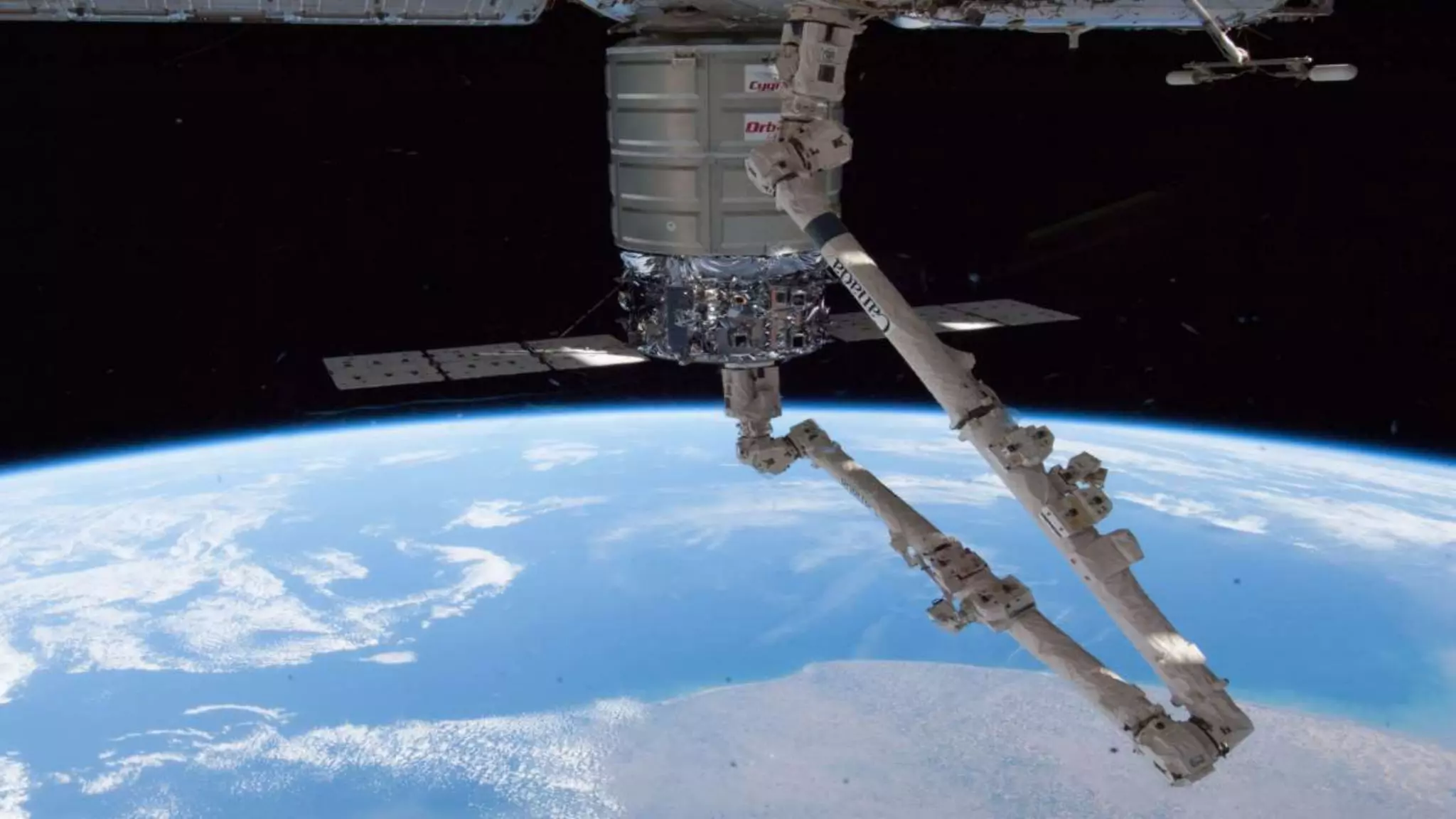
SPACE SHUTTLE ROBOT ARM USES
Survey the outside of the Space Shuttle
 Transport an EVA crew member at the
end of the arm
Satellite deployment and retrieval
 Construction of International Space
Station
FREE FLYING SPACE ROBOTS
 In a free flying space robot a robot arm is attached to the
satellite base
 The satellite may start rotating in an uncontrollable way.
 The antenna communication link may be interrupted
SPACE STATION MOUNTED ROBOTS
JEMRMS SPDM
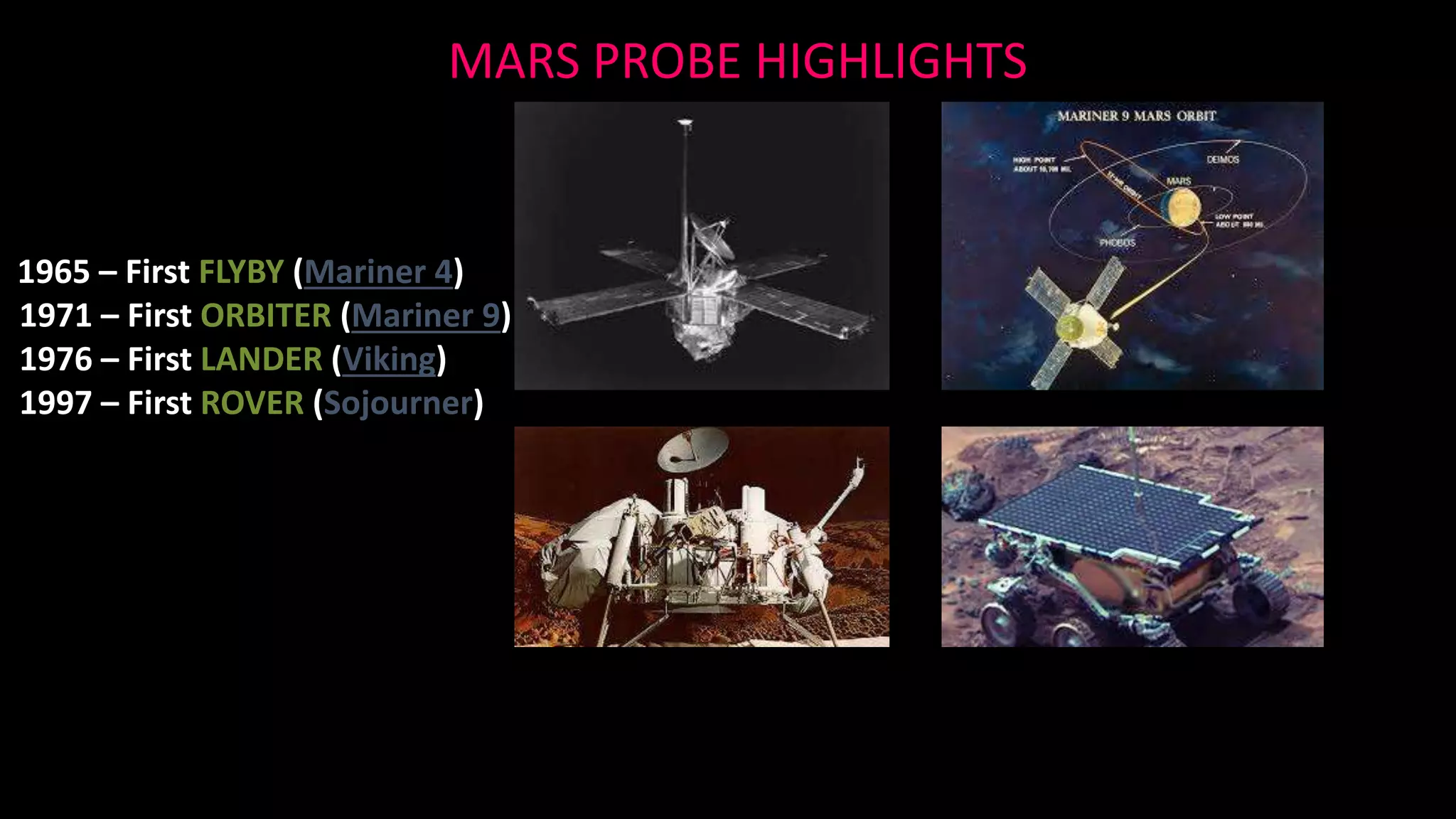
1965 – First FLYBY (Mariner 4)
1971 – First ORBITER (Mariner 9)
1976 – First LANDER (Viking)
1997 – First ROVER (Sojourner)
MARS PROBE HIGHLIGHTS
Implementation of MEMS
The larger Mars Exploration Rovers (Spirit
and Opportunity) landed in 2004. Spirit
lasted until 2010, Opportunity still going!
Curiosity was launched from Cape Canaveral on November 26, 2011, at 10:02. It landed on in Gale Crater on Mars August 5, 2012
 FIRST Humanoid robot in space
 It was launched in FEBRUARY (2011).
 It was developed by the NASA and GENERAL
MOTORS
 The ROBONUT will be official resident on the
International Space Station (ISS).
 Designed to help fix any problems occur on
ISS.
AREAS OF APPLICATION
• In orbit positioning and assembly
• Operation
• Maintenance
• Resupply Scientific
Applications under above categories are
• Scientific Experimentation
• Assist crew in space station assembly
• Space servicing function
• Space craft enhancements
• Space Tug
PROS
•humans are still involved and controlling the
missions but without risking precious lives
•in the long, maintaining robots, inanimate beings,
in space is much easier and cheaper than living
beings
•robots have the capacity to be built to explore
environments humans can’t
•robots are faster and more efficient in observations
and conclusions, they don’t need computers to
certify information, they have it programmed…
they’re brain and bulk in one lighter specimen
•robots now have greater dexterity with new
technologies that allow them to have greater
dexterity than humans. This comes in handy when
dealing with precious, rare space debris
CONS
•sending robots into space doesn’t catch the public
attention in the same way human exploration does
•if something goes wrong in space and the robot’s
system depletes, without a human it’ll take a lot to get
the robot’s system rebooted again from Earth
•don’t have human reasoning… they might do things
and go places that are unknown and are a danger to
them
CONCLUSION
In the future, robotics will make it possible for billions of people to have lives of
leisure instead of the current preoccupation with material needs. There are hundreds of
millions who are now fascinated by space but do not have the means to explore it. For them
space robotics will throw open the door to explore and experience the universe.
REFERENCES
1. www.andrew.cmu.edu/~ycia/robot.html
2. www.space.mech.tohoku.ac.jp/research/overview/overvie
w.html
3. www.nanier.hq.nasa.gov/telerobotics-
page/technologies/0524.html
4. www.jem.tksc.nasda.go.jp/iss/3a/orb_rms_e.html
5. PRODUCTION TECHNOLOGY by R. K. JAIN
6. INTRODUCTION TO SPACE ROBOTICS by ALEX
ELLERY
Space robots
Space robots

Space robots

  • 1.
    A TECHNICAL SEMINARON SPACE ROBOTICS
  • 2.
    SPACE ROBOTICS TITLE PAGE oINTRODUCTION o WHAT ARE SPACE ROBOTS? o EVOLUTION OF SPACE ROBOTS o TYPES OF ROBOTS o SPACE ROBOTS CHALLENGES IN DESIGN AND TESTING o STRUCTURE AND OPERATION OF ROBOTS o CASE STUDY ON MEMS ON MARS ROVERS AND ROBONUT o APPLICATIONS AND ADVANTAGES o FUTURE DIRECTIONS o CONCLUSION o REFERENCES
  • 3.
    INTRODUCTION • SPACE ROBOTICSis the development of machines for the space environment that perform exploration, or to assemble/construct , maintain or service other hardware in space • Humans generally control space robots locally(e . g. space shuttle robotic arm) or from a great distance(e.g. mars Exploration rovers) • Robotics is a field hat has been magnified by its association to space research. • The most important thing to note is that the scale of success in space system is same as that for biological systems i.e. “SURVIAVAL OF THE FITTEST”
  • 4.
    WHAT ARE SPACEROBOTS ? • SPACE the word itself signifies something infinite. • Space travel has always been dangerous and any unexpected event can cause death • It is here that the robots play a huge role and help mankind in his research process. • Development of machines for the space environment. Usually controlled by humans.
  • 5.
    EVOLUTION OF SPACEROBOTS SHAKEY (1966-1972):  It is based on the SPA (sense, plan and action) algorithm.  It is used in built world modules to match and worked accordingly.  FLOW CHART:
  • 6.
    HYBRID SYSTEMS(2000-?) FLOW CHART: •The next generation of system is called as probabilistic robots , which are under development and research.
  • 7.
    TYPES OF ROBOTS 1Planetary robots 2 Orbit operators 3 Mineralogy robots
  • 8.
     ZERO “g”EFFECT ON DESIGN  VACUUM THERMAL EFFECT  OTHERFACTORS  SPACE MODULAR MANIPULATORS CHALLENGES IN SPACE DESIGN
  • 9.
    ZERO “g” EFFECT •Arm will be light in mass • Manipulator arm -stiffness based • Joint actuators -selected based on dynamic torque (based on the acceleration of the arm). • Lack of inertial frame.
  • 10.
    VACUUM & THERMALEFFECT • Total mass loss (TML) <1% • Collected volatile condensable matter (CVCM) <0.1%. • Low temperature -embrittlement of the material, weaken adhesive bonding and increase friction in bearings. • Large thermal gradients -distortion in structural elements and jamming of the mechanism
  • 11.
    OTHER FACTORS • Primerequirements of space systems is lightweight and compactness. • Dynamic loads during launch-sinusoidal vibrations, random vibrations, acoustic noise and separation shock spectra.
  • 12.
    SPACE MODULAR MANIPULATORS Theunique thermal, vacuum and gravitational conditions of space drive different from the typical laboratory robot Four main design drivers were • Extreme Thermal Conditions • High Reliability Requirements • Dynamic Performance • Modular Design.
  • 13.
    ROBOT PERFORMANCE ASSESSMENT  Toidentify the main source of error which perturb the accuracy of the arm.  To decide if the arm or the work cell must be calibrated.  To compare the expected improvement in accuracy in calibration. ROBOT CALIBRATION Error sources are identified by a bottom up analysis • Error sources are identified and are sorted into three categories • Systematic error • Pseudo systematic error • Random errors
  • 14.
    STRUCTURE OF SPACEROBOTS A.JOINTS B. ARM C. WRIST D.GRIPPER
  • 15.
    JOINTS  Two typesof joints are • Roll joint • Pitch joint  Each joint consists of • Electro optical angular encoders • Pancake type DC torque motors • Harmonic gear • Electromagnetically actuated ARMS A. Pick and place type B. Fit tem to clamp or fixture C. High accuracy attainable
  • 16.
    OPERATION SPACE SHUTTLE ROBOTARM USES Survey the outside of the Space Shuttle  Transport an EVA crew member at the end of the arm Satellite deployment and retrieval  Construction of International Space Station
  • 17.
    FREE FLYING SPACEROBOTS  In a free flying space robot a robot arm is attached to the satellite base  The satellite may start rotating in an uncontrollable way.  The antenna communication link may be interrupted
  • 19.
    SPACE STATION MOUNTEDROBOTS JEMRMS SPDM
  • 20.
    1965 – FirstFLYBY (Mariner 4) 1971 – First ORBITER (Mariner 9) 1976 – First LANDER (Viking) 1997 – First ROVER (Sojourner) MARS PROBE HIGHLIGHTS
  • 21.
    Implementation of MEMS Thelarger Mars Exploration Rovers (Spirit and Opportunity) landed in 2004. Spirit lasted until 2010, Opportunity still going! Curiosity was launched from Cape Canaveral on November 26, 2011, at 10:02. It landed on in Gale Crater on Mars August 5, 2012
  • 22.
     FIRST Humanoidrobot in space  It was launched in FEBRUARY (2011).  It was developed by the NASA and GENERAL MOTORS  The ROBONUT will be official resident on the International Space Station (ISS).  Designed to help fix any problems occur on ISS.
  • 24.
    AREAS OF APPLICATION •In orbit positioning and assembly • Operation • Maintenance • Resupply Scientific Applications under above categories are • Scientific Experimentation • Assist crew in space station assembly • Space servicing function • Space craft enhancements • Space Tug
  • 25.
    PROS •humans are stillinvolved and controlling the missions but without risking precious lives •in the long, maintaining robots, inanimate beings, in space is much easier and cheaper than living beings •robots have the capacity to be built to explore environments humans can’t •robots are faster and more efficient in observations and conclusions, they don’t need computers to certify information, they have it programmed… they’re brain and bulk in one lighter specimen •robots now have greater dexterity with new technologies that allow them to have greater dexterity than humans. This comes in handy when dealing with precious, rare space debris CONS •sending robots into space doesn’t catch the public attention in the same way human exploration does •if something goes wrong in space and the robot’s system depletes, without a human it’ll take a lot to get the robot’s system rebooted again from Earth •don’t have human reasoning… they might do things and go places that are unknown and are a danger to them
  • 26.
    CONCLUSION In the future,robotics will make it possible for billions of people to have lives of leisure instead of the current preoccupation with material needs. There are hundreds of millions who are now fascinated by space but do not have the means to explore it. For them space robotics will throw open the door to explore and experience the universe.
  • 27.
    REFERENCES 1. www.andrew.cmu.edu/~ycia/robot.html 2. www.space.mech.tohoku.ac.jp/research/overview/overvie w.html 3.www.nanier.hq.nasa.gov/telerobotics- page/technologies/0524.html 4. www.jem.tksc.nasda.go.jp/iss/3a/orb_rms_e.html 5. PRODUCTION TECHNOLOGY by R. K. JAIN 6. INTRODUCTION TO SPACE ROBOTICS by ALEX ELLERY