Geography of
Southeast Asia
by
Dr. S. Davgun
Fall, ‘02
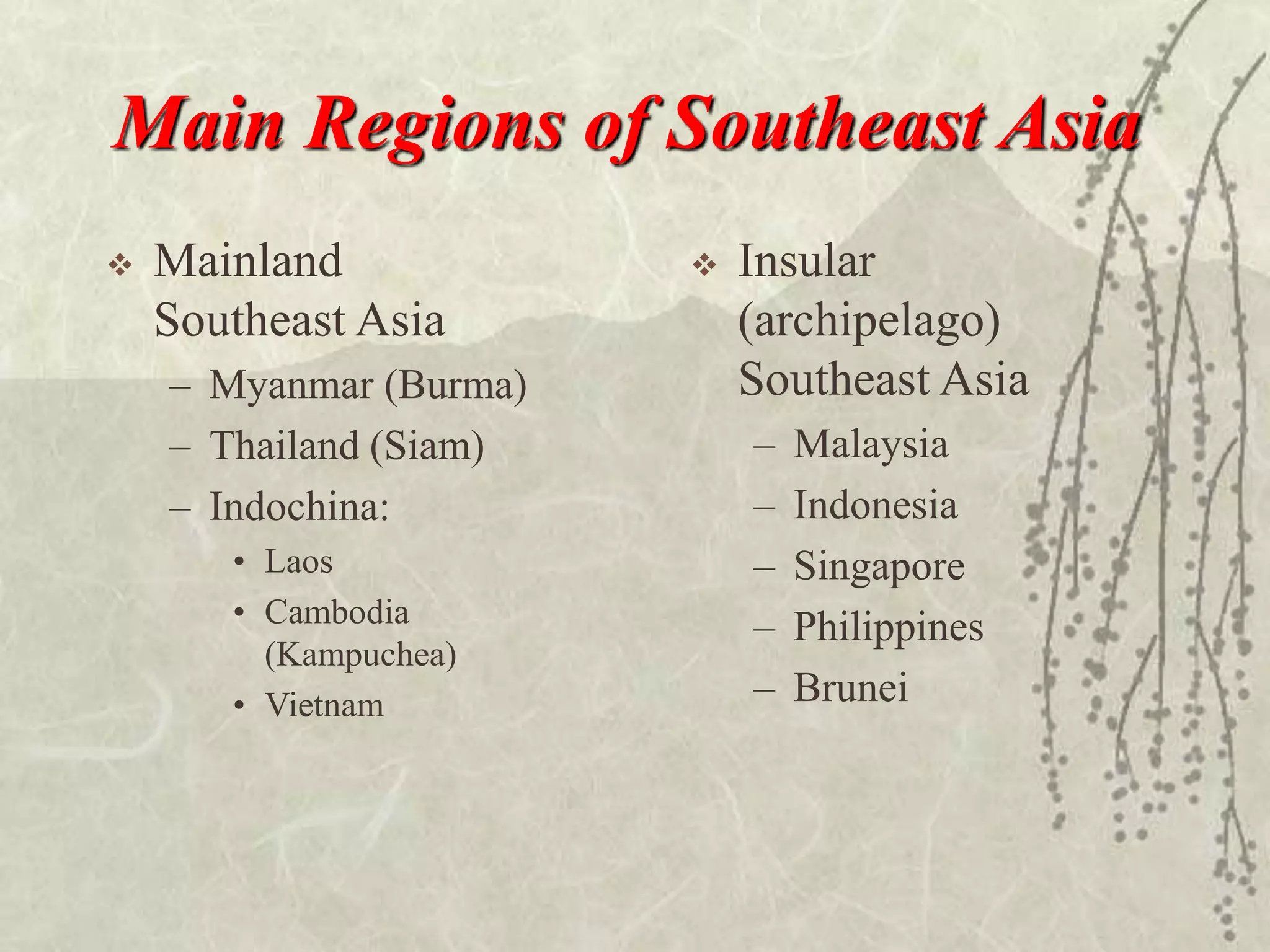
Main Regions of Southeast Asia
 Mainland
Southeast Asia
– Myanmar (Burma)
– Thailand (Siam)
– Indochina:
• Laos
• Cambodia
(Kampuchea)
• Vietnam
 Insular
(archipelago)
Southeast Asia
– Malaysia
– Indonesia
– Singapore
– Philippines
– Brunei
 Indonesia (212 million) 4th most populous
country
 SE Asia has been a shatter belt
 layers of different cultures
 has about half billion (550 million) people,
about half of the population in Indonesia
and the Philippines
 not much industrialized; however
Singapore, and lately Malaysia, Thailand,
and Indonesia are making headway
 relative sparseness of population
Colonial Past
 Country Capital Colonizer year of Ind
 Myanmar Yangon British 1948*
 Thailand Bangkok (was a Buffer zone)
 Laos Vientiane French 1953
 Vietnam Hanoi French 1954
 Cambodia Phnom Penh French 1953
 Malaysia Kuala Lumpur British 1957
 Indonesia Jakarta Netherlands 1949
 Singapore Singapore British 1965**
 Philippines Manila Spain/USA 1946
 Brunei Bandar Sri Begawan British 1984
 East Timor Dili Portuguese 1999/2002
 * was once part of British India
 ** joined Malay in 1963, but opted to become a separate country in 1965
Physical Setting - Landforms
 Dominated by mountains and hills
 Mainland
– series of Mountains, running N-S, slay out of Himalayas,
arc to the south
• run parallel to each other, peaks about 10,000’
• Annamite Chain of Vietnam
• Shan Highlands of western Thailand, eastern Myanmar
• Arakan Yoma of western Myanmar
– flood plains and deltas of major rivers:
• Irrawaddy in Myanmar
• Chao Phraya in Thailand
• Mekong in Indochina (Laos, Cambodia, and Vietnam)
• Red River in northern Vietnam
Physical Setting - Landforms
Insular
Hilly islands, volcanic; some peaks are quite high; example
Mt. Pinatuba in the Philippines is about 4,875 feet high
volcanic material influence the local soils’ fertility level and
cropping patterns
Physical Setting - Climate
 Insular
– equatorial climate: high temperatures (80 - 90 degree F),
precipitation
• lack of seasonality
• soothing effect of water bodies
• temperatures are high all over the year
• rainfall is uniformly distributed over the year
 Mainland
– seasonality; temp. 60 - 85 degrees F
• hilly and moutains
• dry areas - leeward side of the hills; monsoons; dry winters
Problems of a Tropical Environment:
 By land the region is isolated - high, rugged
and malaria-infested mountains
 true tropical:
• continuous heat in lowlands,
• torrential rains
• a prolific vegetation difficult to clear and keep cleared
• soils - leached and poor affects the agriculture
• a high incidence of disease
• 4 - 6 months dry season in Indochinese Peninsula
• infertility of soils in insular
• erosion is so rapid that rivers carry lots mud and silt
Areal Organization:
 Mainland
– formation of national corelands around the major
river basins
• rivers provide: soil enriching flood waters, water supplies
for irrigation, primary corridors of transportation
• river basins contain the most productive agricultural
environments, and the most dense concentration of
population
 Archipelagic
– no single, clear pattern
– role of European colonial powers
Marine Location and Accessibility
 Only Laos is a landlocked country
 Sea is more a tie than a barrier
 Strait of Malacca (Sumatra-Malaya Peninsula)
is one of the busiest maritime traffic
– Singapore the busiest seaport.
Physical Setting - Minerals
 Petroleum is the most important mineral resource:
– about 5% of global production
– Indonesia (oilfields in Sumatra, Kalimantan), Malaysia (in
Sarawak), Brunei, and Myanmar
– offshore oilfields between Sumatra and Java, off northern
Borneo, and out in South China Sea
– Brunei - petro-dollars turned it world’s one of the richest
countries; “Kuwait of SE Asia”
– Japan - the major customer
 The most important single metallic ore - Tin
– 2/5 (40%) of world’s production
• 1/5 (20%) from Malaysia, another 1/5 from Indonesia+ Thailand
 Philippines - copper, silver, and gold
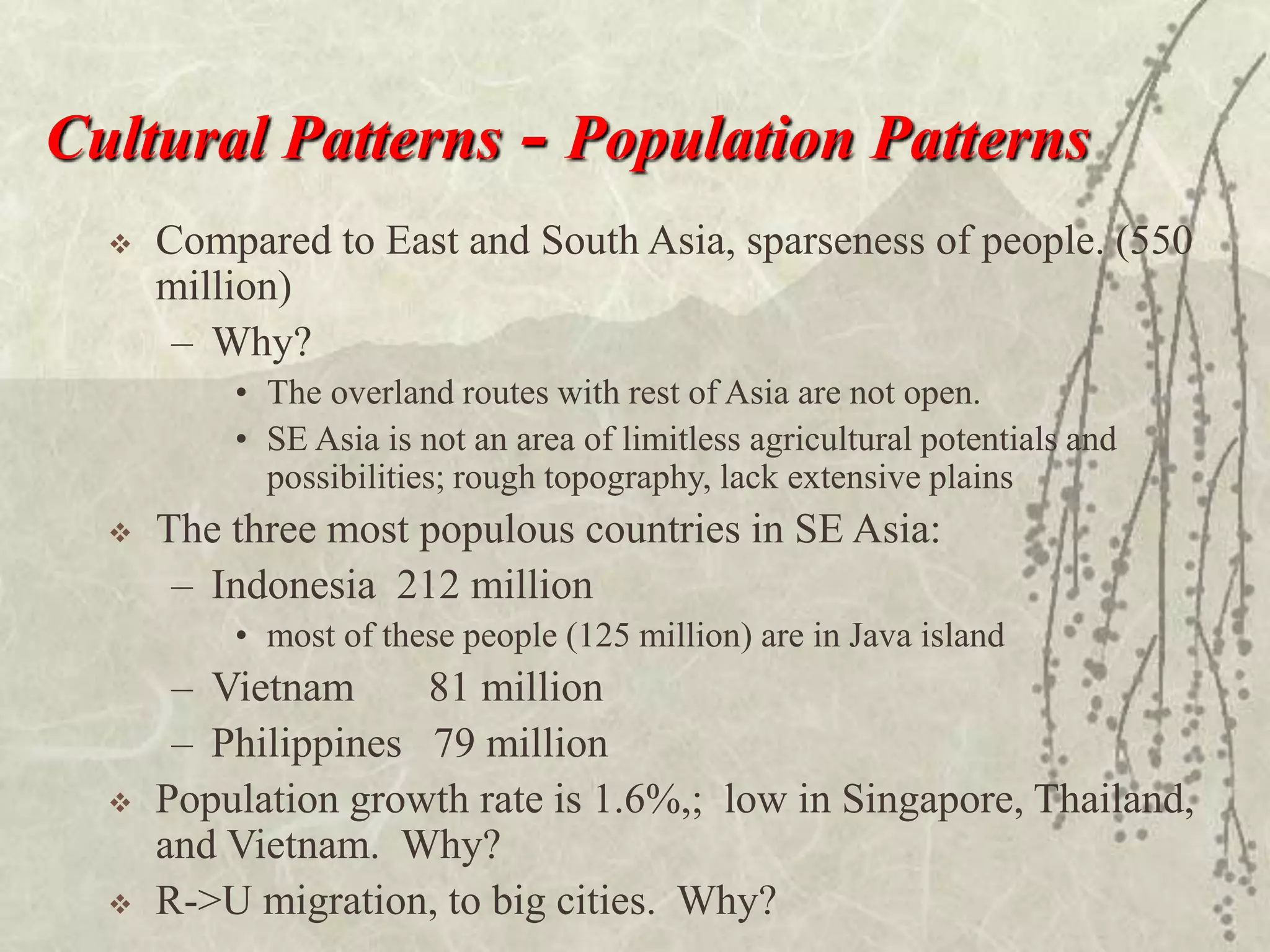
Cultural Patterns - Population Patterns
 Compared to East and South Asia, sparseness of people. (550
million)
– Why?
• The overland routes with rest of Asia are not open.
• SE Asia is not an area of limitless agricultural potentials and
possibilities; rough topography, lack extensive plains
 The three most populous countries in SE Asia:
– Indonesia 212 million
• most of these people (125 million) are in Java island
– Vietnam 81 million
– Philippines 79 million
 Population growth rate is 1.6%,; low in Singapore, Thailand,
and Vietnam. Why?
 R->U migration, to big cities. Why?
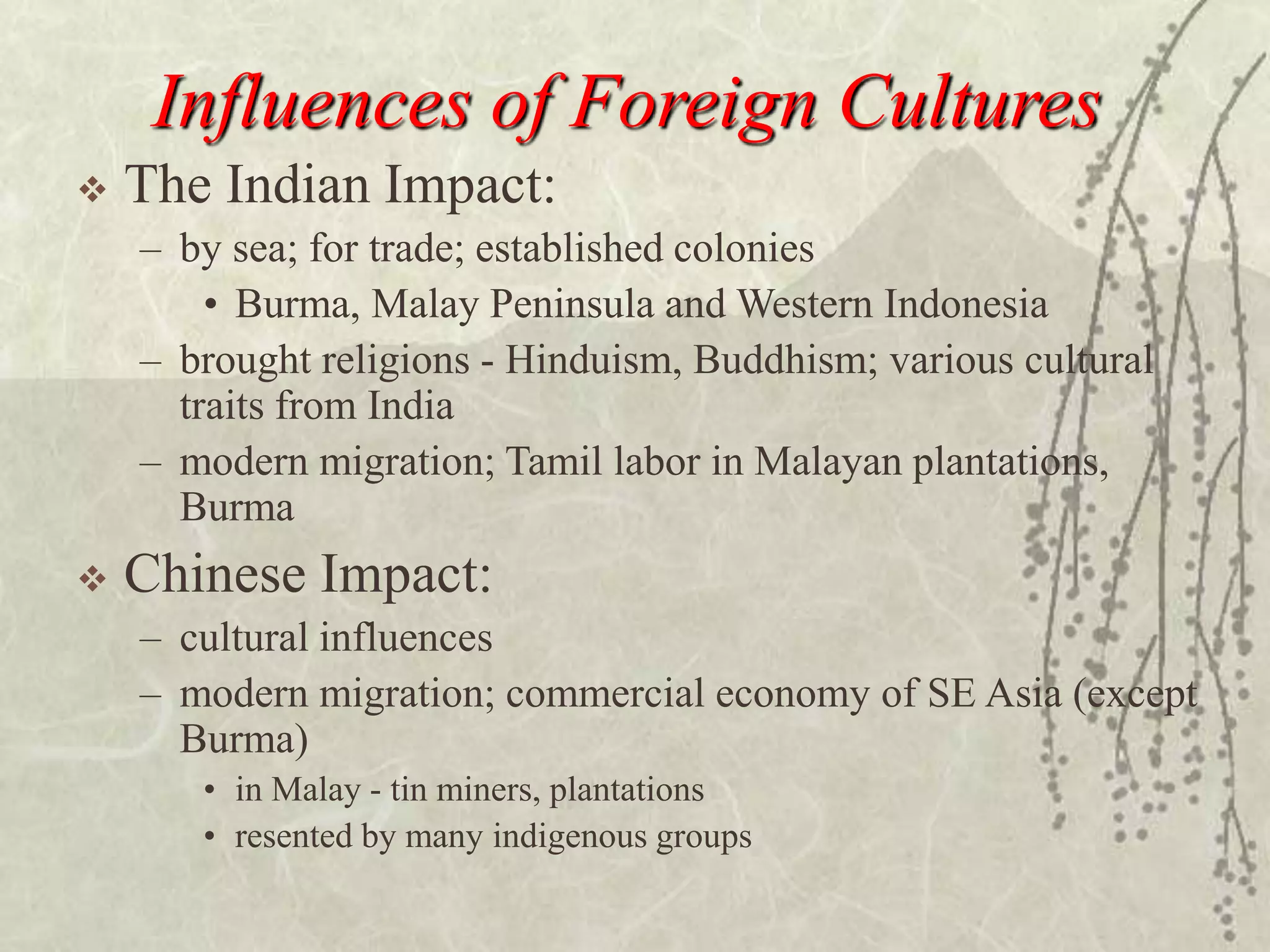
Influences of Foreign Cultures
 The Indian Impact:
– by sea; for trade; established colonies
• Burma, Malay Peninsula and Western Indonesia
– brought religions - Hinduism, Buddhism; various cultural
traits from India
– modern migration; Tamil labor in Malayan plantations,
Burma
 Chinese Impact:
– cultural influences
– modern migration; commercial economy of SE Asia (except
Burma)
• in Malay - tin miners, plantations
• resented by many indigenous groups
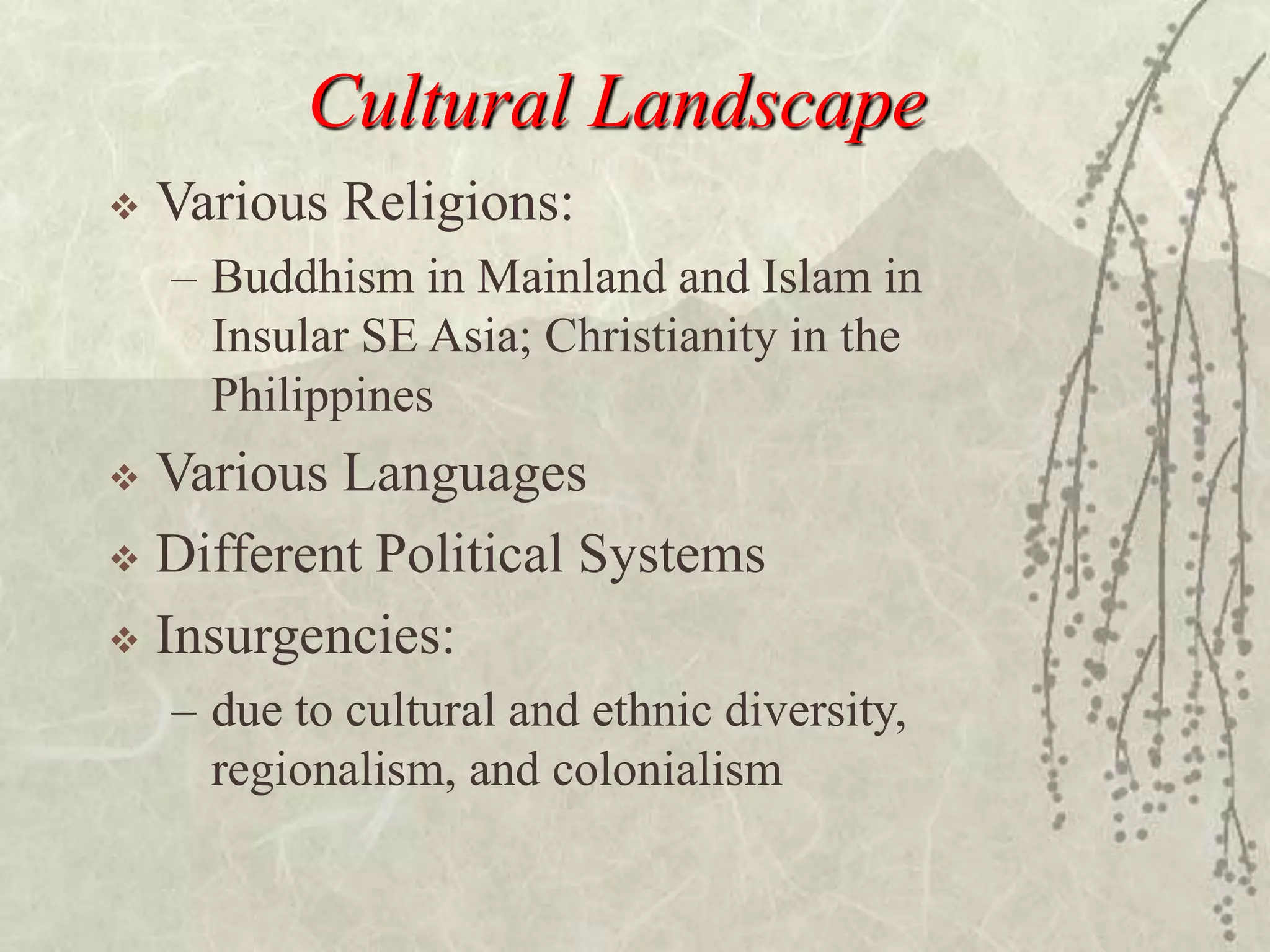
Cultural Landscape
 Various Religions:
– Buddhism in Mainland and Islam in
Insular SE Asia; Christianity in the
Philippines
 Various Languages
 Different Political Systems
 Insurgencies:
– due to cultural and ethnic diversity,
regionalism, and colonialism
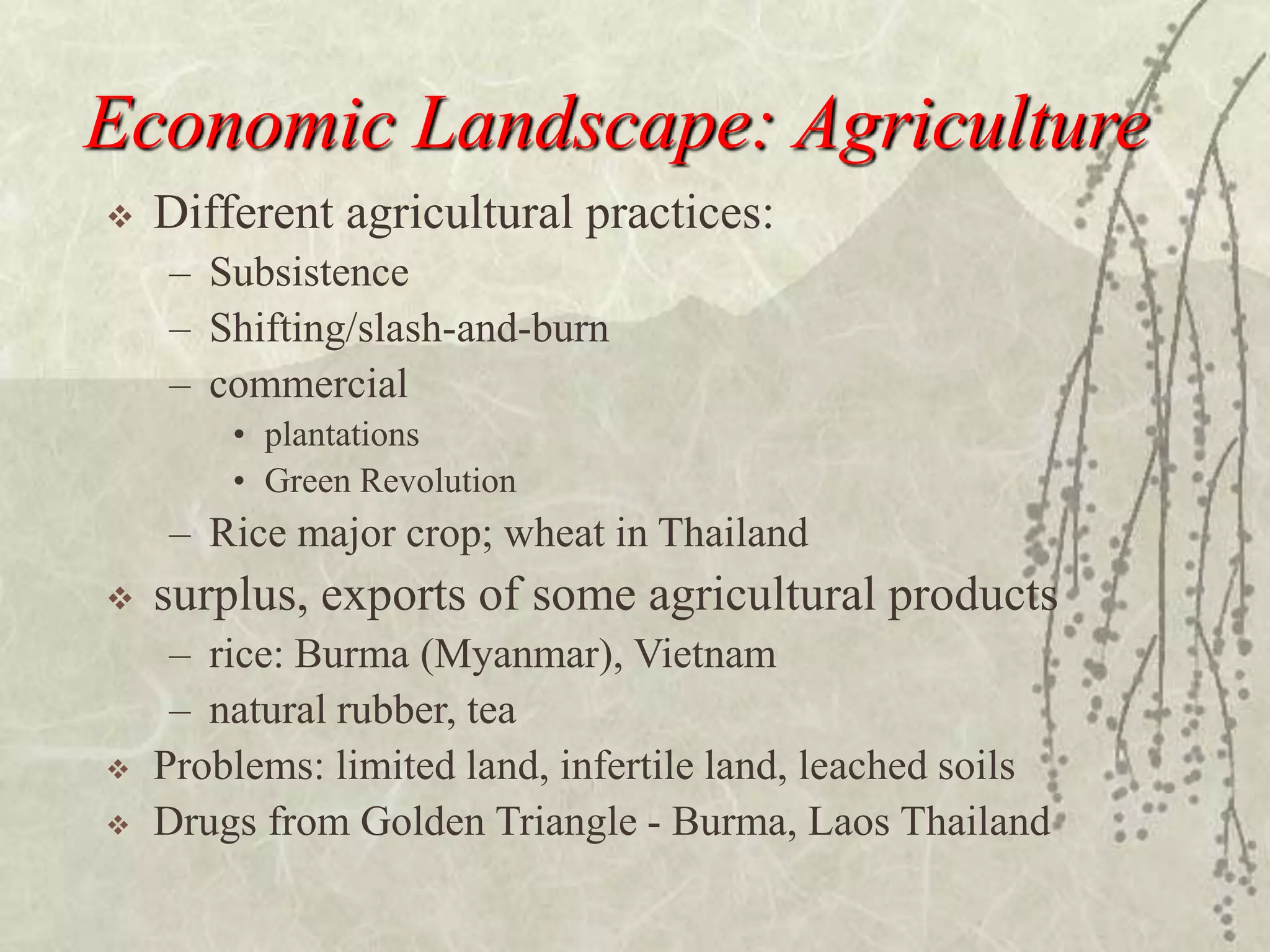
Economic Landscape: Agriculture
 Different agricultural practices:
– Subsistence
– Shifting/slash-and-burn
– commercial
• plantations
• Green Revolution
– Rice major crop; wheat in Thailand
 surplus, exports of some agricultural products
– rice: Burma (Myanmar), Vietnam
– natural rubber, tea
 Problems: limited land, infertile land, leached soils
 Drugs from Golden Triangle - Burma, Laos Thailand
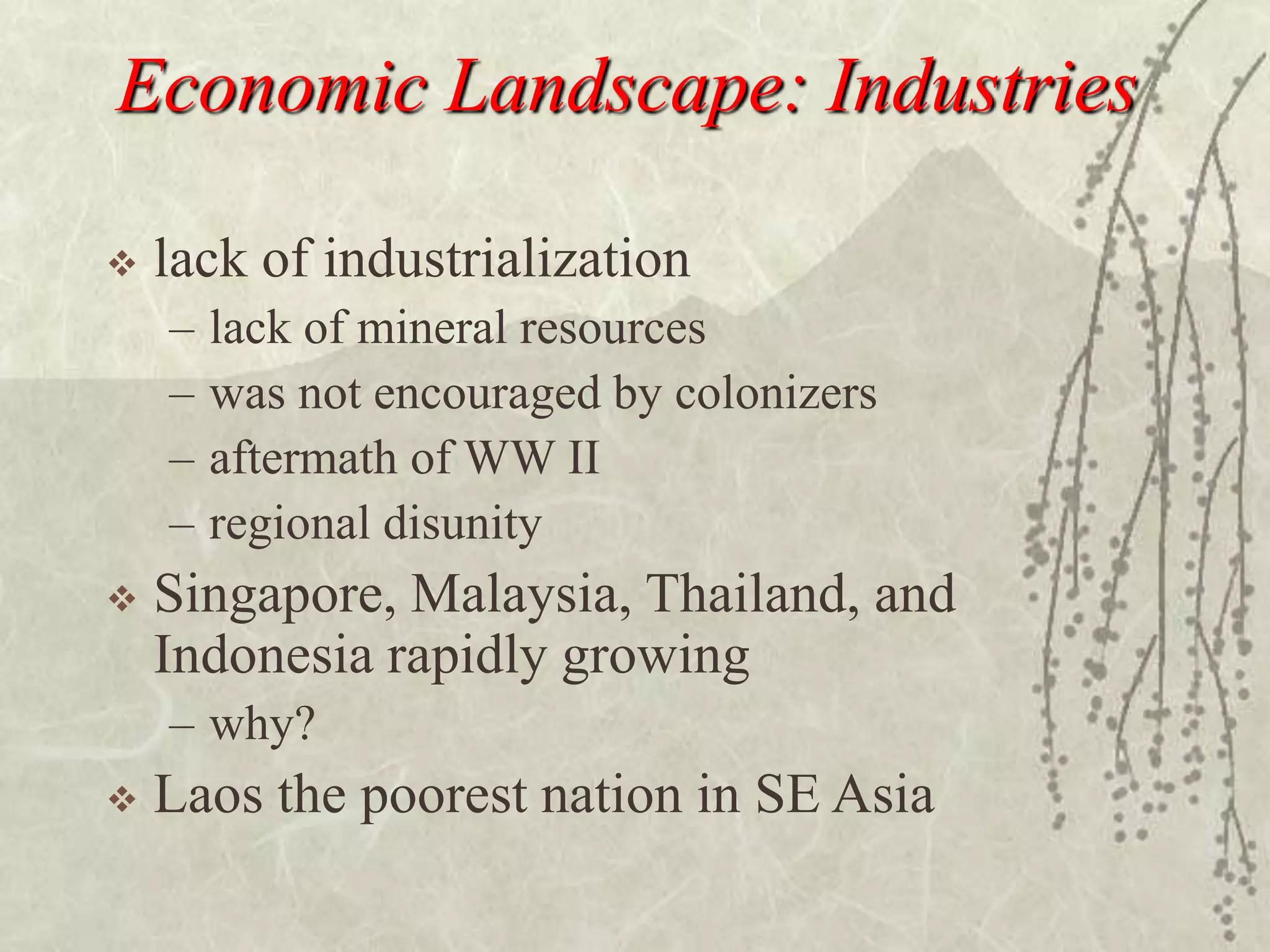
Economic Landscape: Industries
 lack of industrialization
– lack of mineral resources
– was not encouraged by colonizers
– aftermath of WW II
– regional disunity
 Singapore, Malaysia, Thailand, and
Indonesia rapidly growing
– why?
 Laos the poorest nation in SE Asia
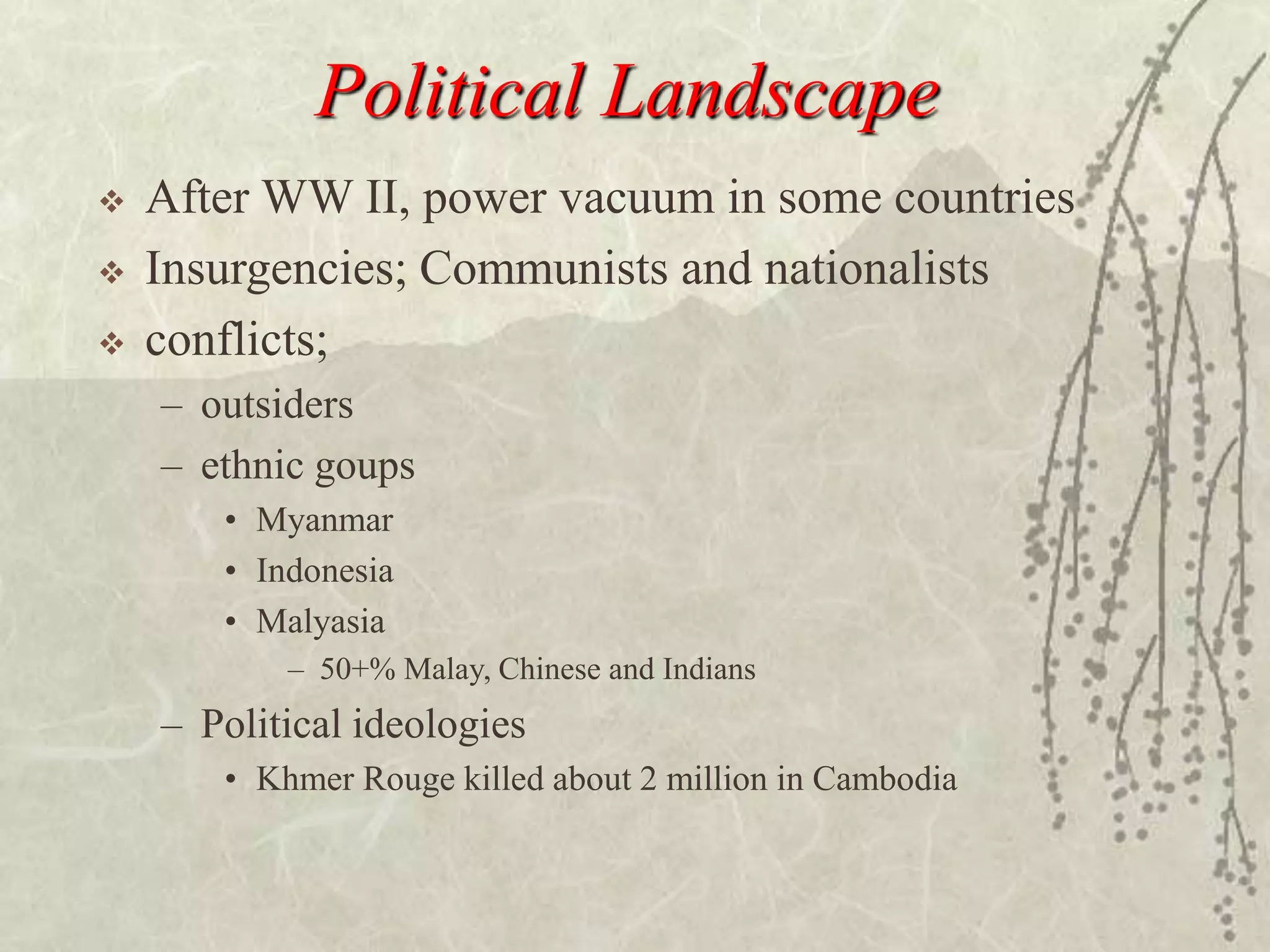
Political Landscape
 After WW II, power vacuum in some countries
 Insurgencies; Communists and nationalists
 conflicts;
– outsiders
– ethnic goups
• Myanmar
• Indonesia
• Malyasia
– 50+% Malay, Chinese and Indians
– Political ideologies
• Khmer Rouge killed about 2 million in Cambodia

Southeast Asia.ppt

  • 1.
  • 2.
    Main Regions ofSoutheast Asia  Mainland Southeast Asia – Myanmar (Burma) – Thailand (Siam) – Indochina: • Laos • Cambodia (Kampuchea) • Vietnam  Insular (archipelago) Southeast Asia – Malaysia – Indonesia – Singapore – Philippines – Brunei
  • 3.
     Indonesia (212million) 4th most populous country  SE Asia has been a shatter belt  layers of different cultures  has about half billion (550 million) people, about half of the population in Indonesia and the Philippines  not much industrialized; however Singapore, and lately Malaysia, Thailand, and Indonesia are making headway  relative sparseness of population
  • 4.
    Colonial Past  CountryCapital Colonizer year of Ind  Myanmar Yangon British 1948*  Thailand Bangkok (was a Buffer zone)  Laos Vientiane French 1953  Vietnam Hanoi French 1954  Cambodia Phnom Penh French 1953  Malaysia Kuala Lumpur British 1957  Indonesia Jakarta Netherlands 1949  Singapore Singapore British 1965**  Philippines Manila Spain/USA 1946  Brunei Bandar Sri Begawan British 1984  East Timor Dili Portuguese 1999/2002  * was once part of British India  ** joined Malay in 1963, but opted to become a separate country in 1965
  • 5.
    Physical Setting -Landforms  Dominated by mountains and hills  Mainland – series of Mountains, running N-S, slay out of Himalayas, arc to the south • run parallel to each other, peaks about 10,000’ • Annamite Chain of Vietnam • Shan Highlands of western Thailand, eastern Myanmar • Arakan Yoma of western Myanmar – flood plains and deltas of major rivers: • Irrawaddy in Myanmar • Chao Phraya in Thailand • Mekong in Indochina (Laos, Cambodia, and Vietnam) • Red River in northern Vietnam
  • 6.
    Physical Setting -Landforms Insular Hilly islands, volcanic; some peaks are quite high; example Mt. Pinatuba in the Philippines is about 4,875 feet high volcanic material influence the local soils’ fertility level and cropping patterns
  • 7.
    Physical Setting -Climate  Insular – equatorial climate: high temperatures (80 - 90 degree F), precipitation • lack of seasonality • soothing effect of water bodies • temperatures are high all over the year • rainfall is uniformly distributed over the year  Mainland – seasonality; temp. 60 - 85 degrees F • hilly and moutains • dry areas - leeward side of the hills; monsoons; dry winters
  • 8.
    Problems of aTropical Environment:  By land the region is isolated - high, rugged and malaria-infested mountains  true tropical: • continuous heat in lowlands, • torrential rains • a prolific vegetation difficult to clear and keep cleared • soils - leached and poor affects the agriculture • a high incidence of disease • 4 - 6 months dry season in Indochinese Peninsula • infertility of soils in insular • erosion is so rapid that rivers carry lots mud and silt
  • 9.
    Areal Organization:  Mainland –formation of national corelands around the major river basins • rivers provide: soil enriching flood waters, water supplies for irrigation, primary corridors of transportation • river basins contain the most productive agricultural environments, and the most dense concentration of population  Archipelagic – no single, clear pattern – role of European colonial powers
  • 10.
    Marine Location andAccessibility  Only Laos is a landlocked country  Sea is more a tie than a barrier  Strait of Malacca (Sumatra-Malaya Peninsula) is one of the busiest maritime traffic – Singapore the busiest seaport.
  • 11.
    Physical Setting -Minerals  Petroleum is the most important mineral resource: – about 5% of global production – Indonesia (oilfields in Sumatra, Kalimantan), Malaysia (in Sarawak), Brunei, and Myanmar – offshore oilfields between Sumatra and Java, off northern Borneo, and out in South China Sea – Brunei - petro-dollars turned it world’s one of the richest countries; “Kuwait of SE Asia” – Japan - the major customer  The most important single metallic ore - Tin – 2/5 (40%) of world’s production • 1/5 (20%) from Malaysia, another 1/5 from Indonesia+ Thailand  Philippines - copper, silver, and gold
  • 12.
    Cultural Patterns -Population Patterns  Compared to East and South Asia, sparseness of people. (550 million) – Why? • The overland routes with rest of Asia are not open. • SE Asia is not an area of limitless agricultural potentials and possibilities; rough topography, lack extensive plains  The three most populous countries in SE Asia: – Indonesia 212 million • most of these people (125 million) are in Java island – Vietnam 81 million – Philippines 79 million  Population growth rate is 1.6%,; low in Singapore, Thailand, and Vietnam. Why?  R->U migration, to big cities. Why?
  • 13.
    Influences of ForeignCultures  The Indian Impact: – by sea; for trade; established colonies • Burma, Malay Peninsula and Western Indonesia – brought religions - Hinduism, Buddhism; various cultural traits from India – modern migration; Tamil labor in Malayan plantations, Burma  Chinese Impact: – cultural influences – modern migration; commercial economy of SE Asia (except Burma) • in Malay - tin miners, plantations • resented by many indigenous groups
  • 14.
    Cultural Landscape  VariousReligions: – Buddhism in Mainland and Islam in Insular SE Asia; Christianity in the Philippines  Various Languages  Different Political Systems  Insurgencies: – due to cultural and ethnic diversity, regionalism, and colonialism
  • 15.
    Economic Landscape: Agriculture Different agricultural practices: – Subsistence – Shifting/slash-and-burn – commercial • plantations • Green Revolution – Rice major crop; wheat in Thailand  surplus, exports of some agricultural products – rice: Burma (Myanmar), Vietnam – natural rubber, tea  Problems: limited land, infertile land, leached soils  Drugs from Golden Triangle - Burma, Laos Thailand
  • 16.
    Economic Landscape: Industries lack of industrialization – lack of mineral resources – was not encouraged by colonizers – aftermath of WW II – regional disunity  Singapore, Malaysia, Thailand, and Indonesia rapidly growing – why?  Laos the poorest nation in SE Asia
  • 17.
    Political Landscape  AfterWW II, power vacuum in some countries  Insurgencies; Communists and nationalists  conflicts; – outsiders – ethnic goups • Myanmar • Indonesia • Malyasia – 50+% Malay, Chinese and Indians – Political ideologies • Khmer Rouge killed about 2 million in Cambodia