34 SEPTEMBER�NOVEMBER2010
ERIC SOUL INTERVIEW
SEPTEMBER�NOVEMBER2010 35
rouble, chaos, con-fyoo-shon,”
says Eric Soul in a thick French
accent leaning back with his
beanpole limbs draped over the
banquette of a non-descript
London restaurant, “Wahala! Wahala!”
All around us suited and booted office
managers murmur over bland lunches.
Eric sticks out like the roller coaster in an
otherwise boring amusement park. “I’m
all about Wahala!” he says referring to the Yoruba word
for ‘problems,’ “You know why? ‘cause I’m here to flip
the script. Africa is used to problems. I want to turn the
word in to something positive through music.”
Born Kirengara Karenga in Rwanda, the son of
well-known folk singer Cecile Kayirebwa, Eric is one of
a new-breed of second-generation European Africans
showing an interest in and promoting the musical and
pop cultural influences of ‘home.’ His show ‘Wahala’
broadcast every Saturday afternoon on VoxAfrica,
throughout Sub-Saharan Africa is “a crash-course in
contemporary African music created by Africans in
Africa and in the Diaspora. Wahala bridges nations and
generations with a Pan-African perspective.”
In the last few years we’ve seen African musicians
burst out of the ‘world music’ category and onto the
mainstream conscience. The first ever MTV African
Music Awards were launched, Fela! The musical is a
major success on Broadway. 2010’s summer anthem was
Shakira’s ‘It’s time for Africa.’
Time will tell if it’s just a fad but Eric is determined
for it not to be.
Raised in Belgium on a diet of Fab Five Freddy, Yo!
MTV Raps and Michael Jackson, Eric
trained as a DJ and street dancer moving
to the UK in the 1990s with a dance
troupe. “There was a huge music
movement going on at that time,” he
says, “It was the start of hard house,
garage, and drum n’ bass. We toured all
the big warehouse clubs in the UK like
The Hacienda and Cargo. I was blown
away by the UK club scene.”
For Eric the 90s were a first-hand lesson in the
power of music in influencing mainstream
perspectives. The realisation coincided with an
invitation to DJ at a club in Kigali just two years after
the war. “I had been away from Rwanda for twenty five
years,” he says, “it was emotional meeting people who
stayed in Rwanda during the war and who knew me
when I was a kid. I connected with myself.” The Kigali
club night was an enormous success. “The first thing
people want to do when peace replaces war time,” he
says, “is celebrate. The club was packed and atmosphere
intense. People were still at the early stages of the
healing process and projecting all this hope on to me,
asking me to start a radio station or open a club. I felt
overwhelmed and decided to come back to London.”
Back in London Eric studied musical engineering
and production and built a name as a DJ going on to
share a stage with the likes of The Prodigy and Akon but
the experience of re-visiting Rwanda didn’t leave him.
“Young black people used to ask me why I spoke
French or where Rwanda was,” he says, “All these
questions became a trigger for my crusade. I was
shocked to realise second or third generation Africans
Eric Soul, London-based DJ, cultural activist and founder
of Wahala TV on why his company 'Afrogroov,' isn't just a
concept but a global music revolution.
WORDS EmmaWoodhouse PHOTOGRAPHY JonathanPerugia
INTERVIEW ERIC SOUL
36 SEPTEMBER�NOVEMBER2010
didn’t know much about their heritage. The black
community was really divided. In other parts of Europe
my peers were proud to say they were from Nigeria,
Senegal or the Ivory Coast. In London they would say
they were from Harlseden or Stratford. They would say
‘I’m British but my parents are from Africa.’ Traditional
African music was for their parents. The kids were in to
cars, bling and American hip hop.”
Afrogroov was born as a club night that bridged the
gap between traditional music and contemporary
urban sounds. Now it’s a collective and the production
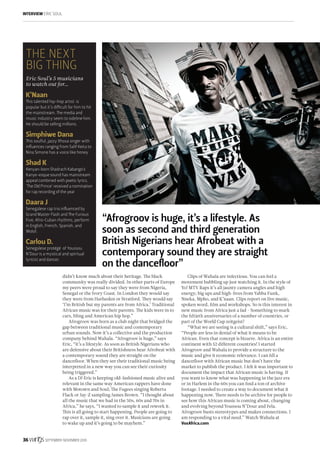
company behind Wahala. “Afrogroov is huge,” says
Eric, “it’s a lifestyle. As soon as British Nigerians who
are defensive about their Britishness hear Afrobeat with
a contemporary sound they are straight on the
dancefloor. When they see their traditional music being
interpreted in a new way you can see their curiosity
being triggered.”
As a DJ Eric is keeping old-fashioned music alive and
relevant in the same way American rappers have done
with Motown and Soul; The Fugees singing Roberta
Flack or Jay-Z sampling James Brown. “I thought about
all the music that we had in the 50s, 60s and 70s in
Africa,” he says, “I wanted to sample it and rework it.
This is all going to start happening. People are going to
rap over it, sample it, sing over it. Musicians are going
to wake up and it’s going to be mayhem.”
Clips of Wahala are infectious. You can feel a
movement bubbling up just watching it. In the style of
Yo! MTV Raps it’s all jaunty camera angles and high
energy; big ups and high-fives from Yabba Funk,
Nneka, Mpho, and K’naan. Clips report on live music,
spoken word, film and workshops. So is this interest in
new music from Africa just a fad - Something to mark
the fiftieth anniversaries of a number of countries, or
part of the World Cup zeitgeist?
“What we are seeing is a cultural shift,” says Eric,
“People are less in denial of what it means to be
African. Even that concept is bizarre. Africa is an entire
continent with 52 different countries! I started
Afrogroov and Wahala to provide a structure to the
music and give it economic relevance. I can fill a
dancefloor with African music but don’t have the
market to publish the product. I felt it was important to
document the impact that African music is having. If
you want to know what was happening in the jazz era
or in Harlem in the 60s you can find a ton of archive
footage. I needed to create a way to document what it
happening now. There needs to be archive for people to
see how this African music is coming about, changing
and evolving beyond Youssou N’Dour and Fela.
Afrogroov busts stereotypes and makes connections. I
am responding to a vital need.” Watch Wahala at
VoxAfrica.com
THE NEXT
BIG THING
Eric Soul’s 5 musicians
to watch out for…
K’Naan
This talented hip-hop artist is
popular but it’s difficult for him to hit
the mainstream. The media and
music industry seem to sideline him.
He should be selling millions.
Simphiwe Dana
This soulful, jazzy Xhosa singer with
influences ranging from Salif Keita to
Nina Simone has a voice like honey
Shad K
Kenyan-born Shadrach Kabango's
Kanye-esque sound has mainstream
appeal combined with poetic lyrics.
'The Old Prince' received a nomination
for rap recording of the year
Daara J
Senegalese rap trio influenced by
Grand Master Flash and The Furious
Five, Afro-Cuban rhythms, perform
in English, French, Spanish, and
Wolof.
Carlou D.
Senegalese protégé of Youssou
N’Dour is a mystical and spiritual
lyricist and dancer.
“Afrogroov is huge, it’s a lifestyle. As
soon as second and third generation
British Nigerians hear Afrobeat with a
contemporary sound they are straight
on the dancefloor”
Soul Trader

Soul Trader

  • 1.
  • 2.
    ERIC SOUL INTERVIEW SEPTEMBER�NOVEMBER201035 rouble, chaos, con-fyoo-shon,” says Eric Soul in a thick French accent leaning back with his beanpole limbs draped over the banquette of a non-descript London restaurant, “Wahala! Wahala!” All around us suited and booted office managers murmur over bland lunches. Eric sticks out like the roller coaster in an otherwise boring amusement park. “I’m all about Wahala!” he says referring to the Yoruba word for ‘problems,’ “You know why? ‘cause I’m here to flip the script. Africa is used to problems. I want to turn the word in to something positive through music.” Born Kirengara Karenga in Rwanda, the son of well-known folk singer Cecile Kayirebwa, Eric is one of a new-breed of second-generation European Africans showing an interest in and promoting the musical and pop cultural influences of ‘home.’ His show ‘Wahala’ broadcast every Saturday afternoon on VoxAfrica, throughout Sub-Saharan Africa is “a crash-course in contemporary African music created by Africans in Africa and in the Diaspora. Wahala bridges nations and generations with a Pan-African perspective.” In the last few years we’ve seen African musicians burst out of the ‘world music’ category and onto the mainstream conscience. The first ever MTV African Music Awards were launched, Fela! The musical is a major success on Broadway. 2010’s summer anthem was Shakira’s ‘It’s time for Africa.’ Time will tell if it’s just a fad but Eric is determined for it not to be. Raised in Belgium on a diet of Fab Five Freddy, Yo! MTV Raps and Michael Jackson, Eric trained as a DJ and street dancer moving to the UK in the 1990s with a dance troupe. “There was a huge music movement going on at that time,” he says, “It was the start of hard house, garage, and drum n’ bass. We toured all the big warehouse clubs in the UK like The Hacienda and Cargo. I was blown away by the UK club scene.” For Eric the 90s were a first-hand lesson in the power of music in influencing mainstream perspectives. The realisation coincided with an invitation to DJ at a club in Kigali just two years after the war. “I had been away from Rwanda for twenty five years,” he says, “it was emotional meeting people who stayed in Rwanda during the war and who knew me when I was a kid. I connected with myself.” The Kigali club night was an enormous success. “The first thing people want to do when peace replaces war time,” he says, “is celebrate. The club was packed and atmosphere intense. People were still at the early stages of the healing process and projecting all this hope on to me, asking me to start a radio station or open a club. I felt overwhelmed and decided to come back to London.” Back in London Eric studied musical engineering and production and built a name as a DJ going on to share a stage with the likes of The Prodigy and Akon but the experience of re-visiting Rwanda didn’t leave him. “Young black people used to ask me why I spoke French or where Rwanda was,” he says, “All these questions became a trigger for my crusade. I was shocked to realise second or third generation Africans Eric Soul, London-based DJ, cultural activist and founder of Wahala TV on why his company 'Afrogroov,' isn't just a concept but a global music revolution. WORDS EmmaWoodhouse PHOTOGRAPHY JonathanPerugia
  • 3.
    INTERVIEW ERIC SOUL 36SEPTEMBER�NOVEMBER2010 didn’t know much about their heritage. The black community was really divided. In other parts of Europe my peers were proud to say they were from Nigeria, Senegal or the Ivory Coast. In London they would say they were from Harlseden or Stratford. They would say ‘I’m British but my parents are from Africa.’ Traditional African music was for their parents. The kids were in to cars, bling and American hip hop.” Afrogroov was born as a club night that bridged the gap between traditional music and contemporary urban sounds. Now it’s a collective and the production company behind Wahala. “Afrogroov is huge,” says Eric, “it’s a lifestyle. As soon as British Nigerians who are defensive about their Britishness hear Afrobeat with a contemporary sound they are straight on the dancefloor. When they see their traditional music being interpreted in a new way you can see their curiosity being triggered.” As a DJ Eric is keeping old-fashioned music alive and relevant in the same way American rappers have done with Motown and Soul; The Fugees singing Roberta Flack or Jay-Z sampling James Brown. “I thought about all the music that we had in the 50s, 60s and 70s in Africa,” he says, “I wanted to sample it and rework it. This is all going to start happening. People are going to rap over it, sample it, sing over it. Musicians are going to wake up and it’s going to be mayhem.” Clips of Wahala are infectious. You can feel a movement bubbling up just watching it. In the style of Yo! MTV Raps it’s all jaunty camera angles and high energy; big ups and high-fives from Yabba Funk, Nneka, Mpho, and K’naan. Clips report on live music, spoken word, film and workshops. So is this interest in new music from Africa just a fad - Something to mark the fiftieth anniversaries of a number of countries, or part of the World Cup zeitgeist? “What we are seeing is a cultural shift,” says Eric, “People are less in denial of what it means to be African. Even that concept is bizarre. Africa is an entire continent with 52 different countries! I started Afrogroov and Wahala to provide a structure to the music and give it economic relevance. I can fill a dancefloor with African music but don’t have the market to publish the product. I felt it was important to document the impact that African music is having. If you want to know what was happening in the jazz era or in Harlem in the 60s you can find a ton of archive footage. I needed to create a way to document what it happening now. There needs to be archive for people to see how this African music is coming about, changing and evolving beyond Youssou N’Dour and Fela. Afrogroov busts stereotypes and makes connections. I am responding to a vital need.” Watch Wahala at VoxAfrica.com THE NEXT BIG THING Eric Soul’s 5 musicians to watch out for… K’Naan This talented hip-hop artist is popular but it’s difficult for him to hit the mainstream. The media and music industry seem to sideline him. He should be selling millions. Simphiwe Dana This soulful, jazzy Xhosa singer with influences ranging from Salif Keita to Nina Simone has a voice like honey Shad K Kenyan-born Shadrach Kabango's Kanye-esque sound has mainstream appeal combined with poetic lyrics. 'The Old Prince' received a nomination for rap recording of the year Daara J Senegalese rap trio influenced by Grand Master Flash and The Furious Five, Afro-Cuban rhythms, perform in English, French, Spanish, and Wolof. Carlou D. Senegalese protégé of Youssou N’Dour is a mystical and spiritual lyricist and dancer. “Afrogroov is huge, it’s a lifestyle. As soon as second and third generation British Nigerians hear Afrobeat with a contemporary sound they are straight on the dancefloor”