1/7
Dr.-Ing. Sung Joon Ahn
CurvSurf, Inc.
Some Thoughts on
2-D/3-D Information Processing
2/7
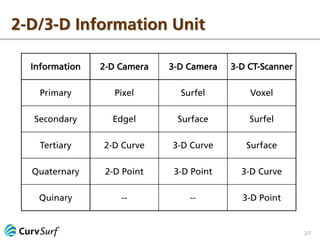
Information 2-D Camera 3-D Camera 3-D CT-Scanner
Primary Pixel Surfel Voxel
Secondary Edgel Surface Surfel
Tertiary 2-D Curve 3-D Curve Surface
Quaternary 2-D Point 3-D Point 3-D Curve
Quinary -- -- 3-D Point
2-D/3-D Information Unit
3/7
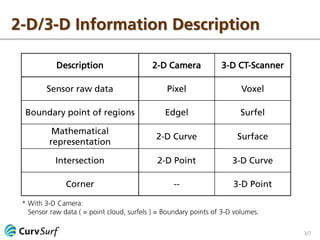
Description 2-D Camera 3-D CT-Scanner
Sensor raw data Pixel Voxel
Boundary point of regions Edgel Surfel
Mathematical
representation
2-D Curve Surface
Intersection 2-D Point 3-D Curve
Corner -- 3-D Point
2-D/3-D Information Description
* With 3-D Camera:
Sensor raw data ( = point cloud, surfels ) = Boundary points of 3-D volumes.
4/7
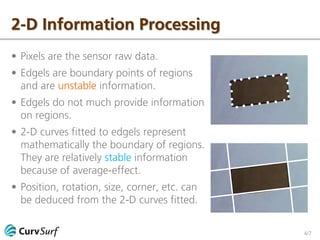
• Pixels are the sensor raw data.
• Edgels are boundary points of regions
and are unstable information.
• Edgels do not much provide information
on regions.
• 2-D curves fitted to edgels represent
mathematically the boundary of regions.
They are relatively stable information
because of average-effect.
• Position, rotation, size, corner, etc. can
be deduced from the 2-D curves fitted.
2-D Information Processing
5/7
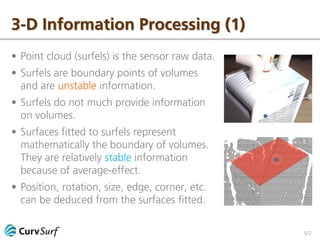
• Point cloud (surfels) is the sensor raw data.
• Surfels are boundary points of volumes
and are unstable information.
• Surfels do not much provide information
on volumes.
• Surfaces fitted to surfels represent
mathematically the boundary of volumes.
They are relatively stable information
because of average-effect.
• Position, rotation, size, edge, corner, etc.
can be deduced from the surfaces fitted.
3-D Information Processing (1)
6/7
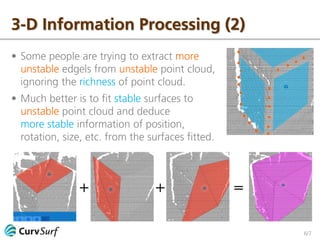
• Some people are trying to extract more
unstable edgels from unstable point cloud,
ignoring the richness of point cloud.
• Much better is to fit stable surfaces to
unstable point cloud and deduce
more stable information of position,
rotation, size, etc. from the surfaces fitted.
3-D Information Processing (2)
+ + =
7/7
• Further discussions are welcomed
• https://plus.google.com/+CurvSurf
Closing
Thank you!

Some thoughts on 2 d 3-d information processing

  • 1.
    1/7 Dr.-Ing. Sung JoonAhn CurvSurf, Inc. Some Thoughts on 2-D/3-D Information Processing
  • 2.
    2/7 Information 2-D Camera3-D Camera 3-D CT-Scanner Primary Pixel Surfel Voxel Secondary Edgel Surface Surfel Tertiary 2-D Curve 3-D Curve Surface Quaternary 2-D Point 3-D Point 3-D Curve Quinary -- -- 3-D Point 2-D/3-D Information Unit
  • 3.
    3/7 Description 2-D Camera3-D CT-Scanner Sensor raw data Pixel Voxel Boundary point of regions Edgel Surfel Mathematical representation 2-D Curve Surface Intersection 2-D Point 3-D Curve Corner -- 3-D Point 2-D/3-D Information Description * With 3-D Camera: Sensor raw data ( = point cloud, surfels ) = Boundary points of 3-D volumes.
  • 4.
    4/7 • Pixels arethe sensor raw data. • Edgels are boundary points of regions and are unstable information. • Edgels do not much provide information on regions. • 2-D curves fitted to edgels represent mathematically the boundary of regions. They are relatively stable information because of average-effect. • Position, rotation, size, corner, etc. can be deduced from the 2-D curves fitted. 2-D Information Processing
  • 5.
    5/7 • Point cloud(surfels) is the sensor raw data. • Surfels are boundary points of volumes and are unstable information. • Surfels do not much provide information on volumes. • Surfaces fitted to surfels represent mathematically the boundary of volumes. They are relatively stable information because of average-effect. • Position, rotation, size, edge, corner, etc. can be deduced from the surfaces fitted. 3-D Information Processing (1)
  • 6.
    6/7 • Some peopleare trying to extract more unstable edgels from unstable point cloud, ignoring the richness of point cloud. • Much better is to fit stable surfaces to unstable point cloud and deduce more stable information of position, rotation, size, etc. from the surfaces fitted. 3-D Information Processing (2) + + =
  • 7.
    7/7 • Further discussionsare welcomed • https://plus.google.com/+CurvSurf Closing Thank you!