Some / Any / Much / Many/
A lot of/ A few/ Few/ A little/ Little


               Jelgavas Valsts ģimnāzija
                        7.Klase
                     Agita Ozoliņa
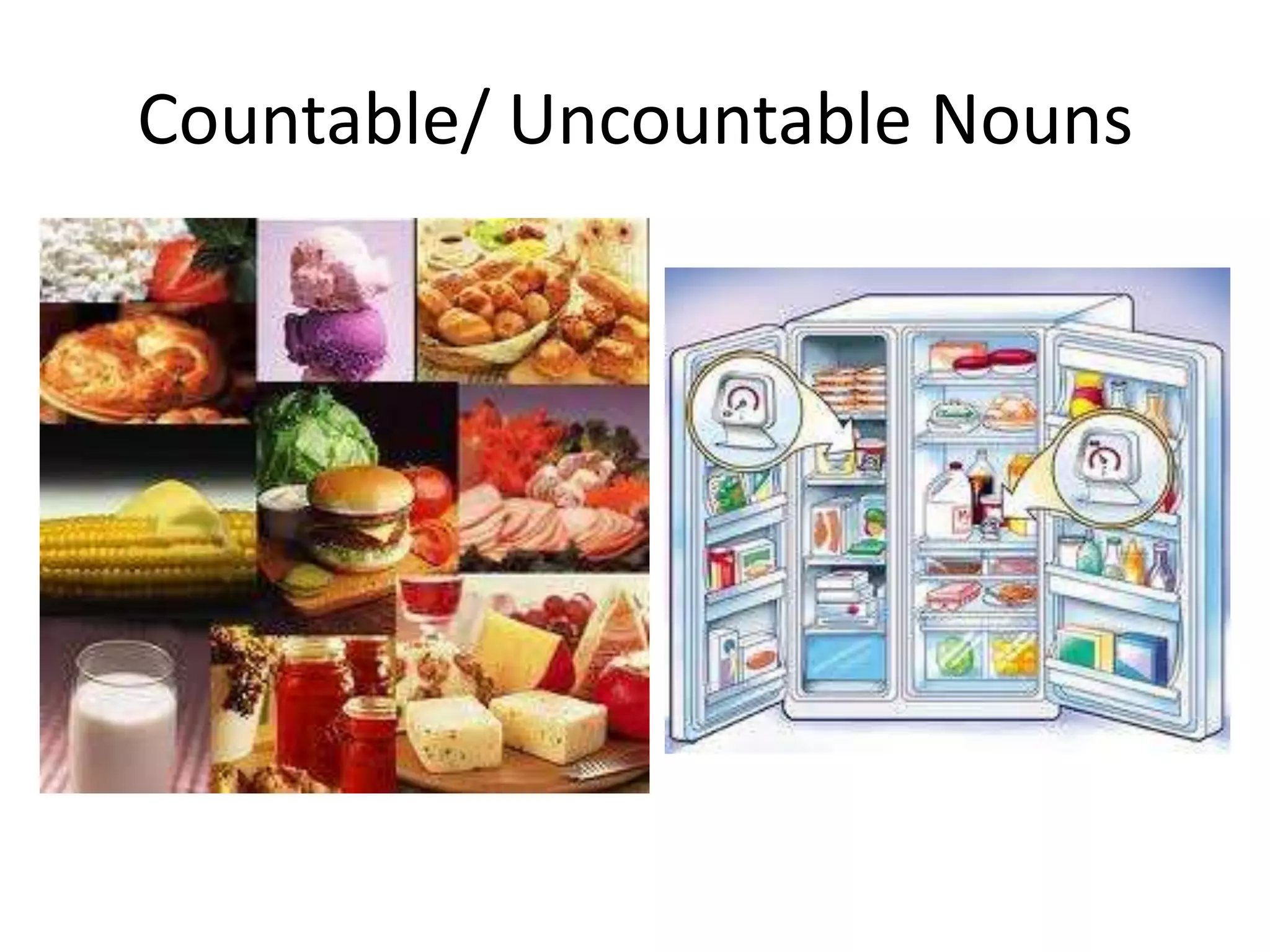
Countable/ Uncountable Nouns
Some
   A little, a few or small number or amount.
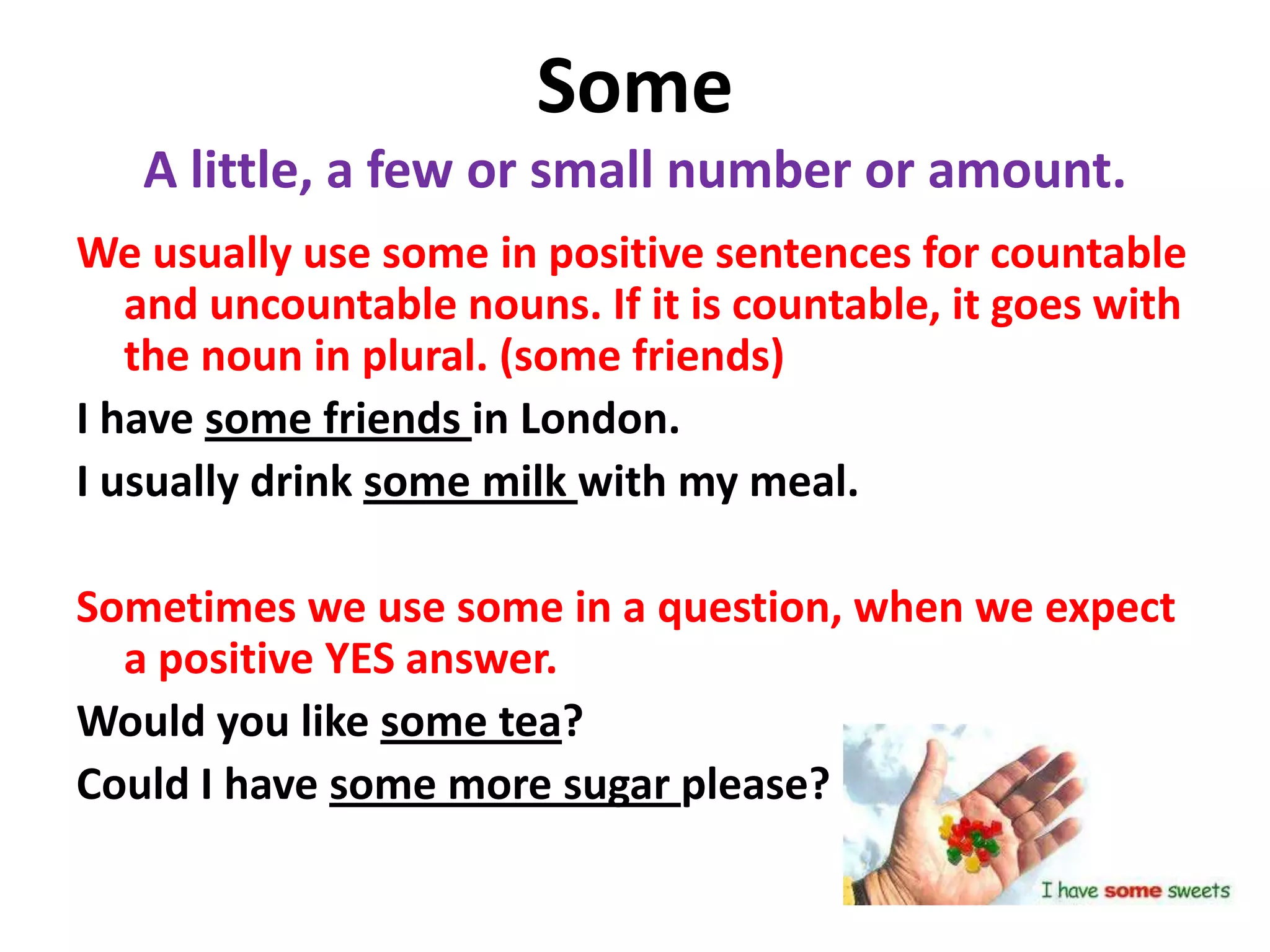
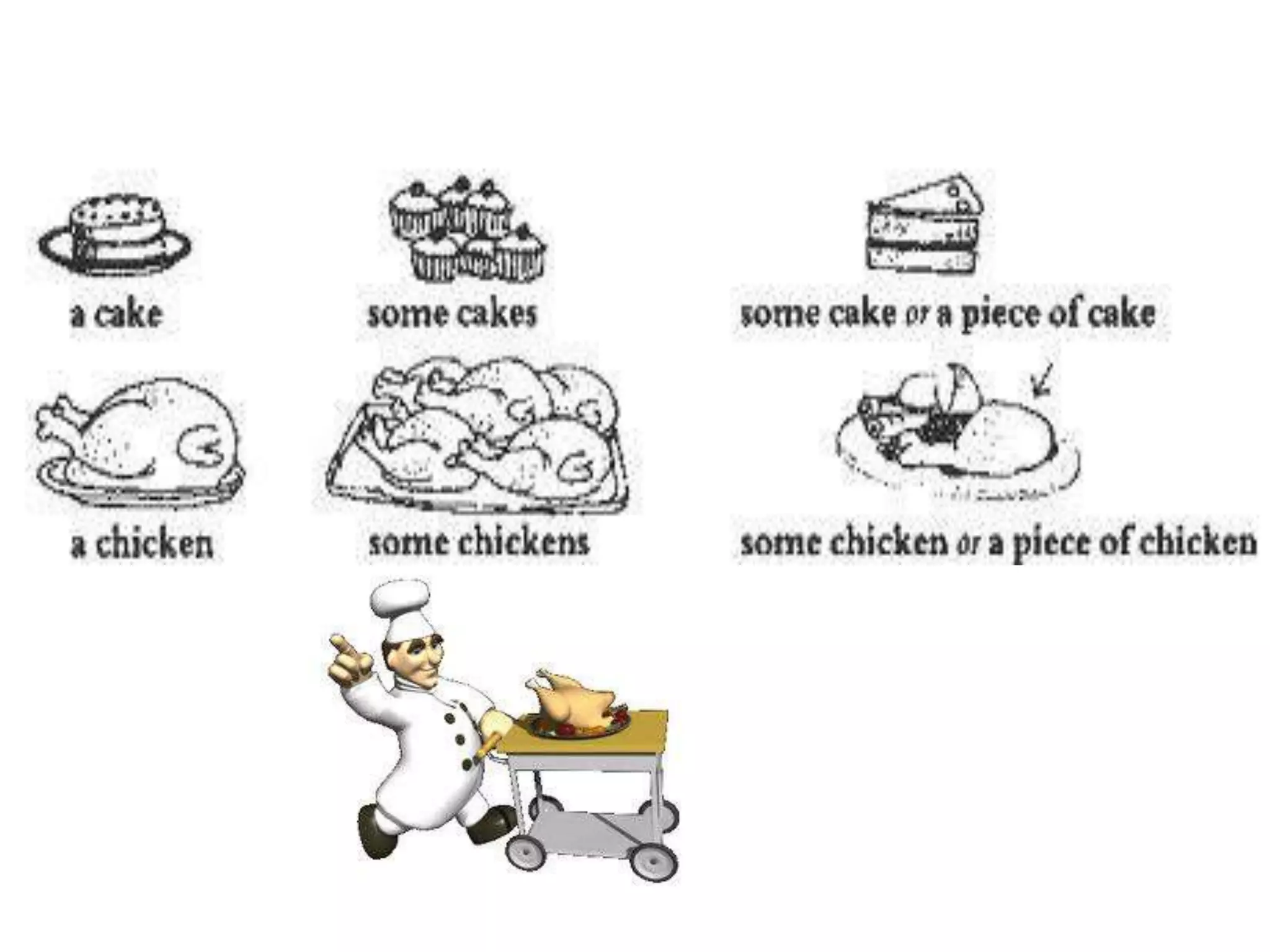
We usually use some in positive sentences for countable
   and uncountable nouns. If it is countable, it goes with
   the noun in plural. (some friends)
I have some friends in London.
I usually drink some milk with my meal.

Sometimes we use some in a question, when we expect
  a positive YES answer.
Would you like some tea?
Could I have some more sugar please?
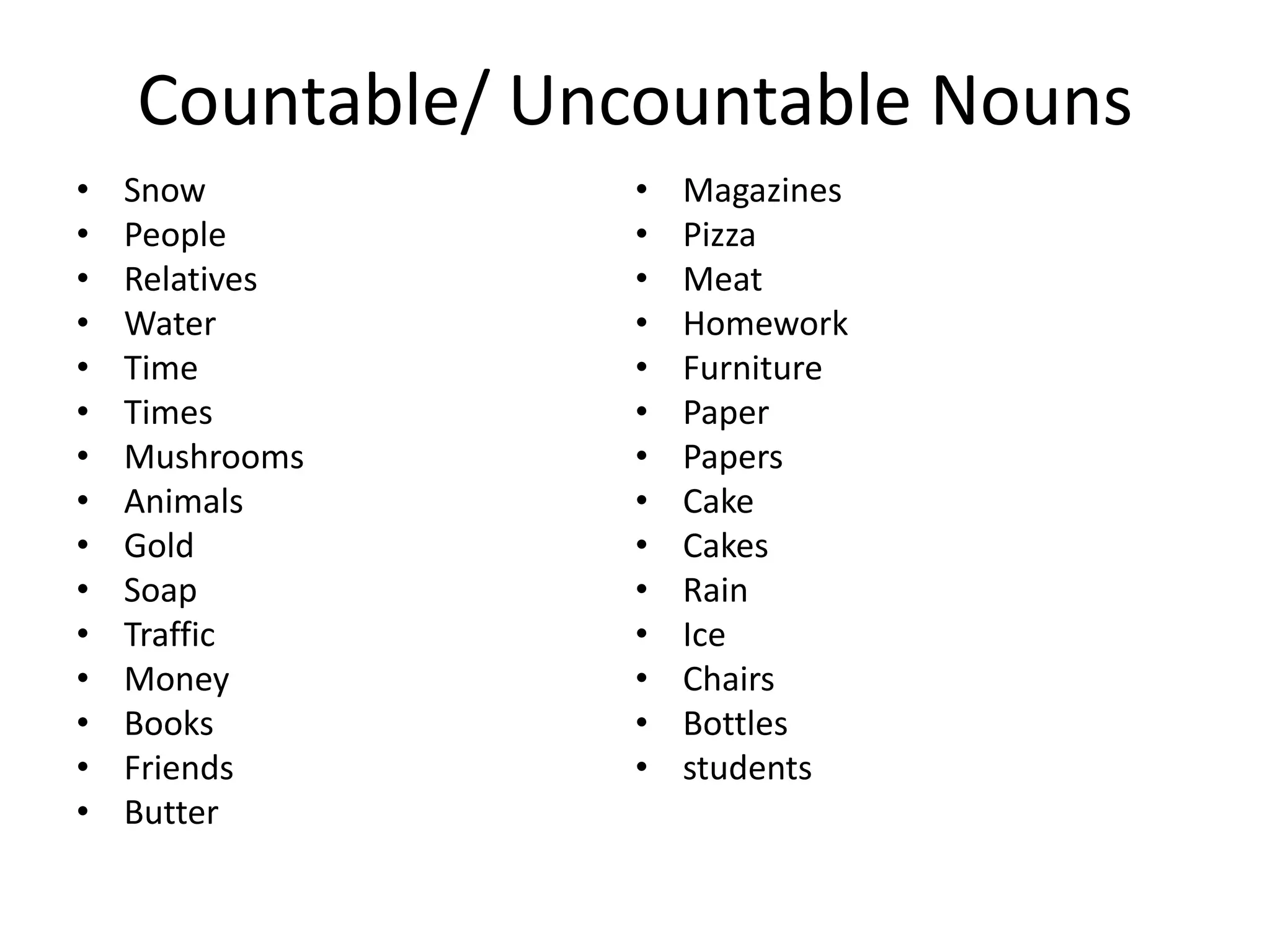
Countable/ Uncountable Nouns
•   Snow          •   Magazines
•   People        •   Pizza
•   Relatives     •   Meat
•   Water         •   Homework
•   Time          •   Furniture
•   Times         •   Paper
•   Mushrooms     •   Papers
•   Animals       •   Cake
•   Gold          •   Cakes
•   Soap          •   Rain
•   Traffic       •   Ice
•   Money         •   Chairs
•   Books         •   Bottles
•   Friends       •   students
•   Butter
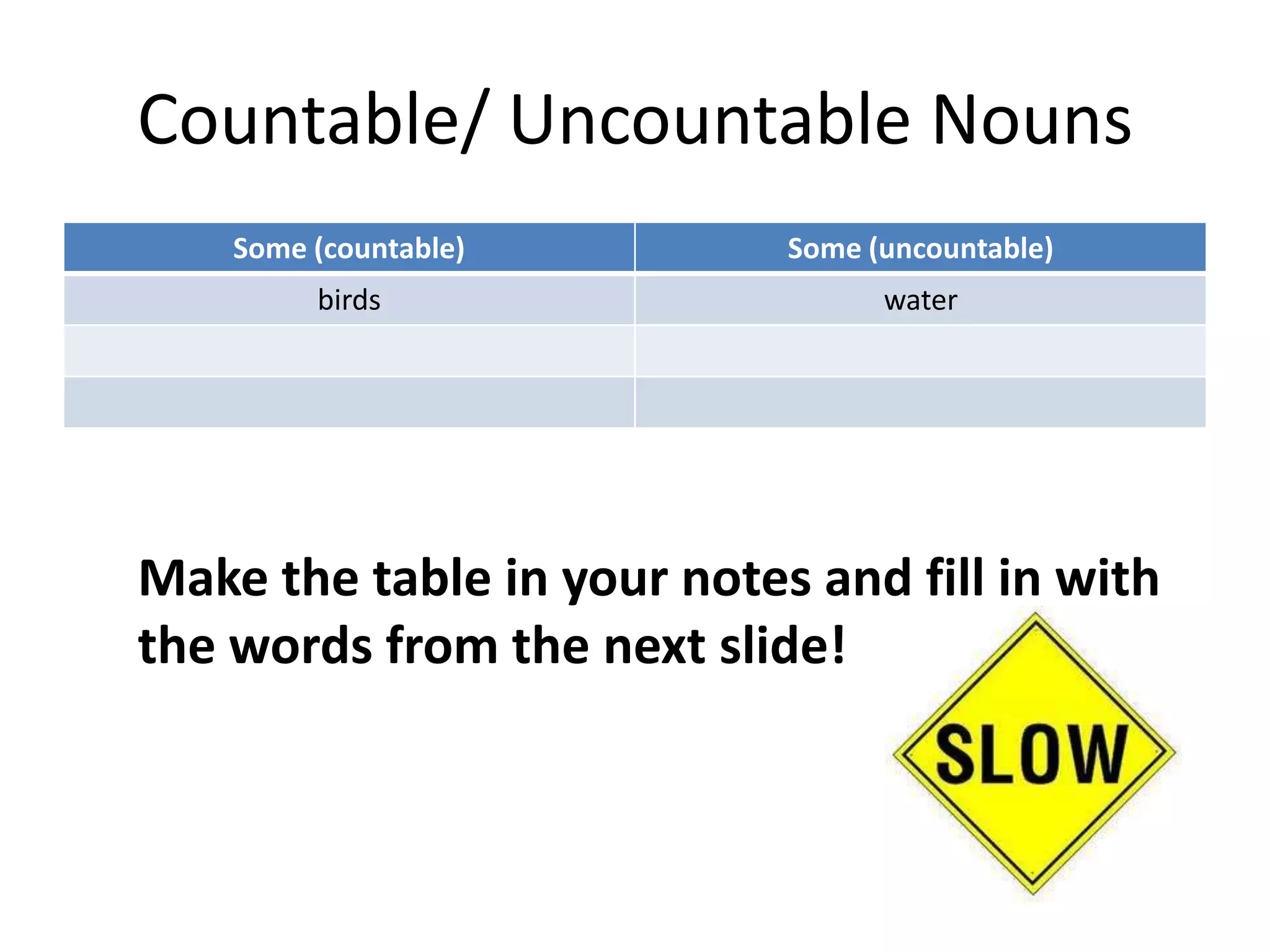
Countable/ Uncountable Nouns
    Some (countable)        Some (uncountable)
         birds                    water


Make the table in your notes and fill in with
the words from the next slide!
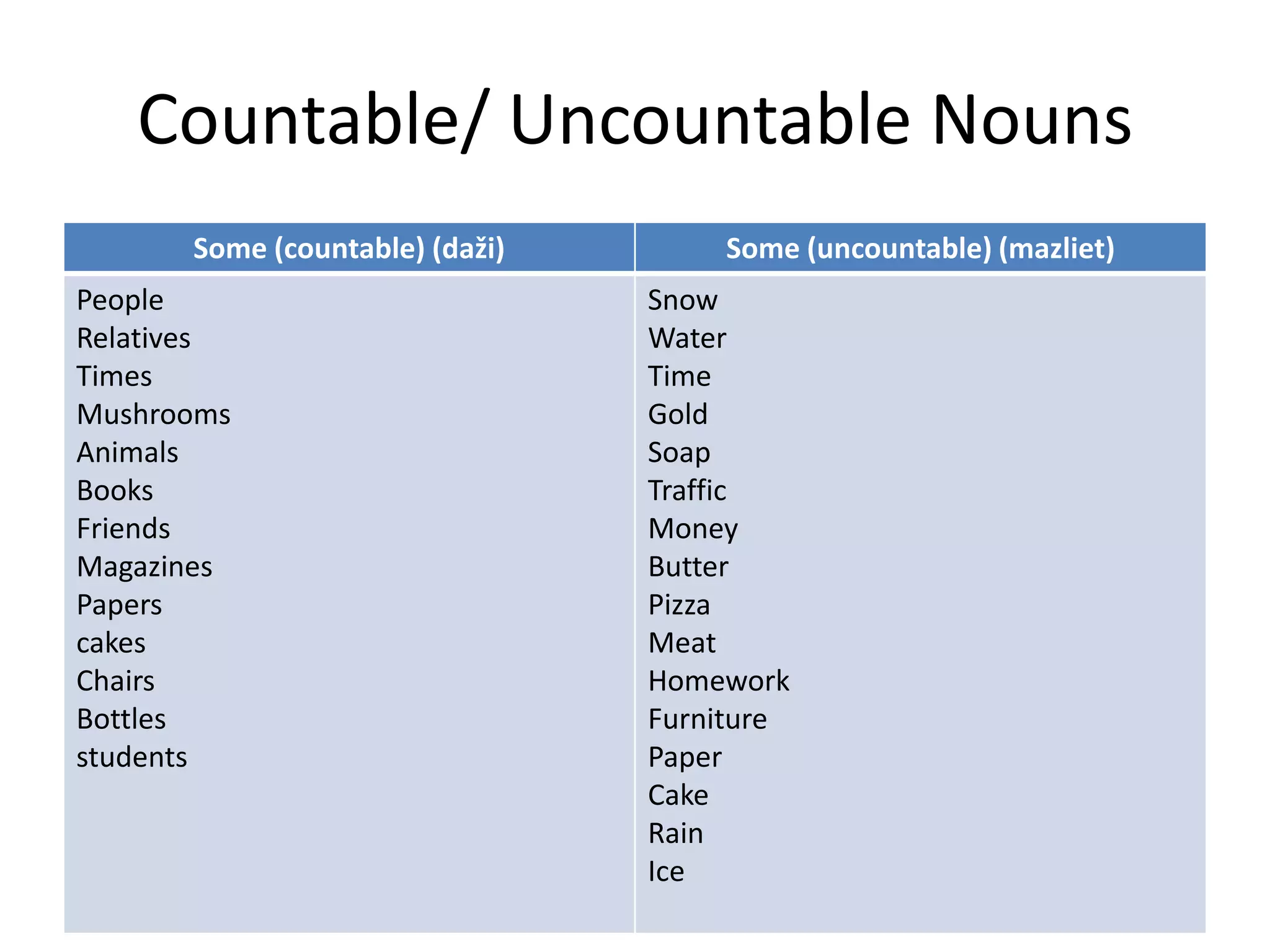
Countable/ Uncountable Nouns
      Some (countable) (daži)       Some (uncountable) (mazliet)
People                          Snow
Relatives                       Water
Times                           Time
Mushrooms                       Gold
Animals                         Soap
Books                           Traffic
Friends                         Money
Magazines                       Butter
Papers                          Pizza
cakes                           Meat
Chairs                          Homework
Bottles                         Furniture
students                        Paper
                                Cake
                                Rain
                                Ice
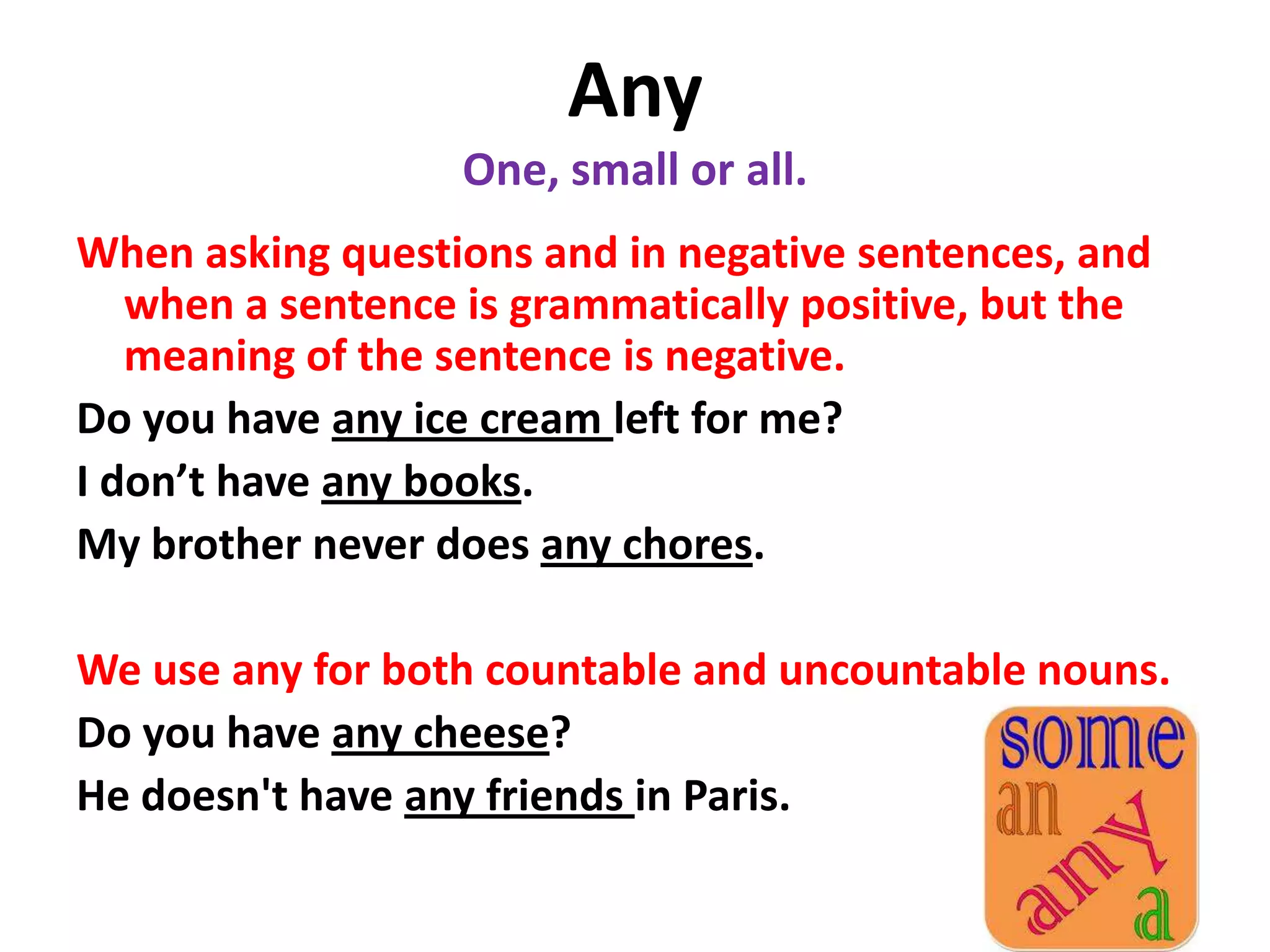
Any
                   One, small or all.
When asking questions and in negative sentences, and
   when a sentence is grammatically positive, but the
   meaning of the sentence is negative.
Do you have any ice cream left for me?
I don’t have any books.
My brother never does any chores.

We use any for both countable and uncountable nouns.
Do you have any cheese?
He doesn't have any friends in Paris.
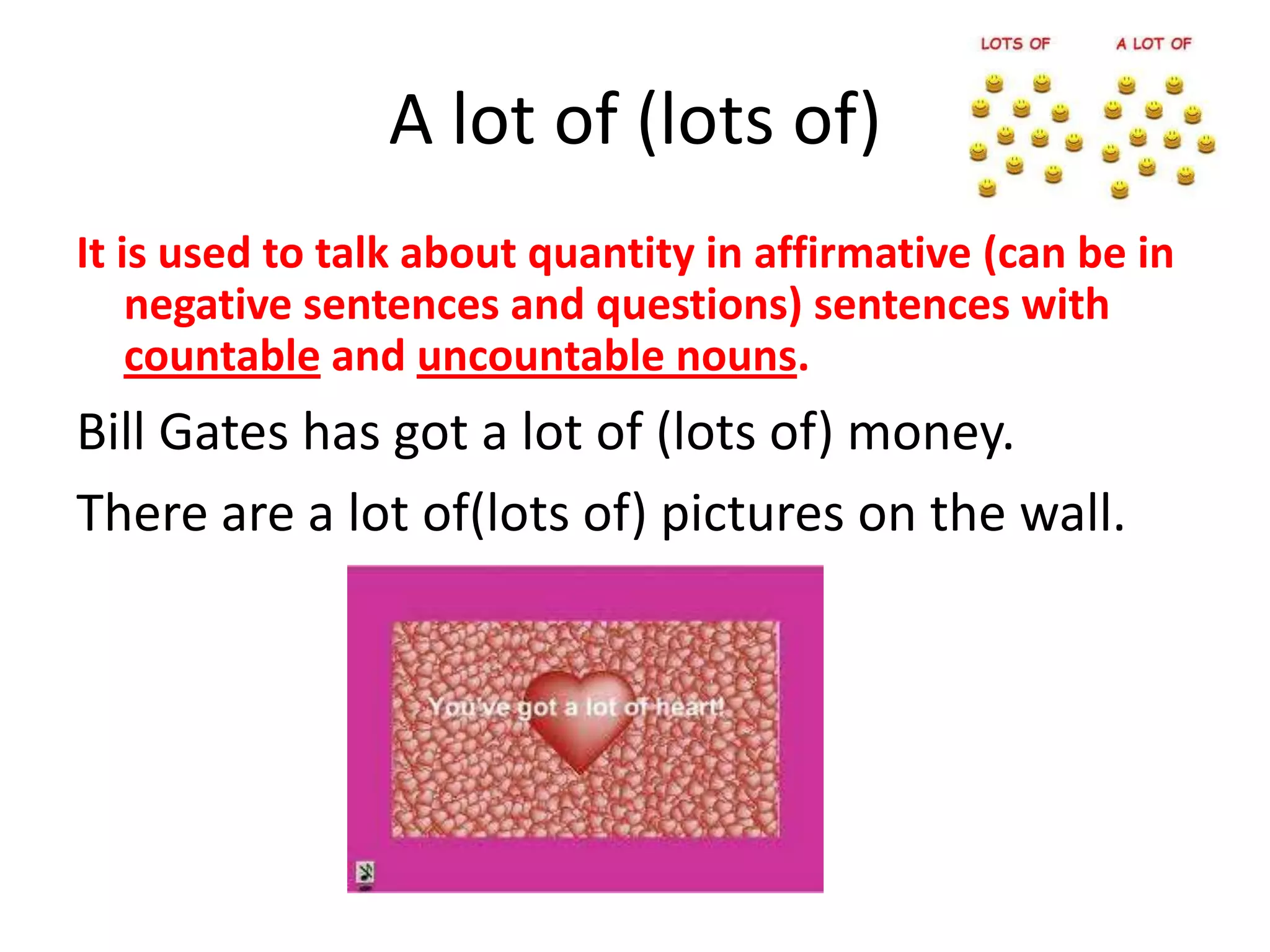
A lot of (lots of)
It is used to talk about quantity in affirmative (can be in
    negative sentences and questions) sentences with
    countable and uncountable nouns.
Bill Gates has got a lot of (lots of) money.
There are a lot of(lots of) pictures on the wall.
Many
It is used to talk about quantity with countable
   nouns and usually in the questions and
   negative sentences.
I don't have many English stamps in my
   collection.
Do you have many English stamps in your
   collection?
Do you have any English stamp in your
   collection?
Much
It is used to talk about quantity with
   uncountable nouns and usually in the
   questions and negative sentences.

They don't have much money to buy a present.
Have you got much homework to do today?
Charlotte’s got a lot of money. 
Charlotte’s got much money. 
A few(few)/ A little(little)
The expressions a little and a few mean some (daži, mazliet).
If a noun is uncountable, we use a little.
     Example: a little money (mazliet naudas)
If a noun is countable, we use a few.
    Example: a few friends (daži draugi)
• It's a difference if you use a little / a few or little / few.
    Without the article, the words have a limiting or negative
    meaning (maz).
• a little = some
    little = hardly any
• Example: I have a little money. - I have some money.
• I have little money. - I have hardly any money.
• a few = some
    few = hardly any
• Example: A few friends visited me. - Some friends visited me.
    Few friends visited me. - Hardly any friends visited me.
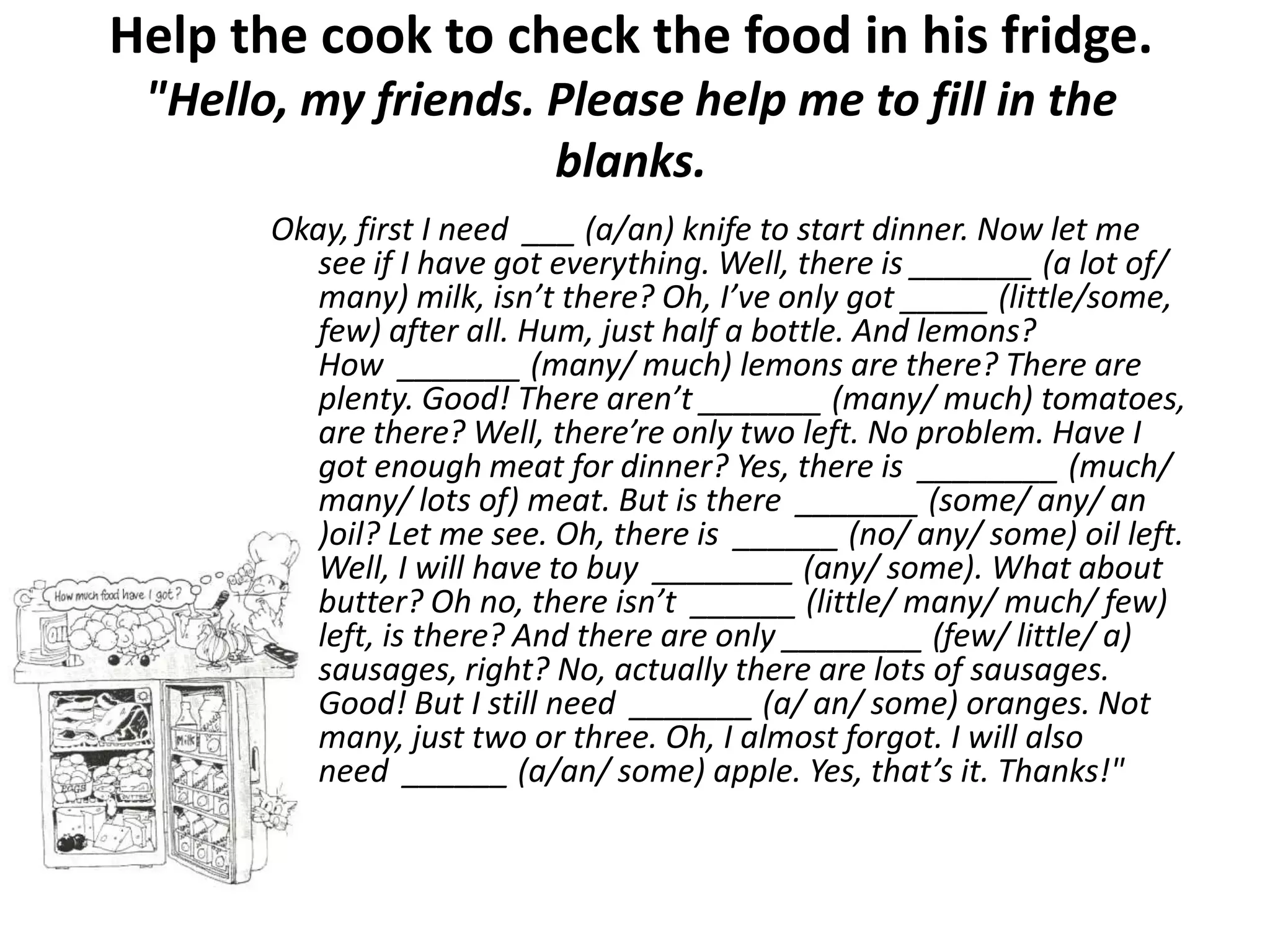
Help the cook to check the food in his fridge.
 "Hello, my friends. Please help me to fill in the
                     blanks.
       Okay, first I need ___ (a/an) knife to start dinner. Now let me
          see if I have got everything. Well, there is _______ (a lot of/
          many) milk, isn’t there? Oh, I’ve only got _____ (little/some,
          few) after all. Hum, just half a bottle. And lemons?
          How _______ (many/ much) lemons are there? There are
          plenty. Good! There aren’t _______ (many/ much) tomatoes,
          are there? Well, there’re only two left. No problem. Have I
          got enough meat for dinner? Yes, there is ________ (much/
          many/ lots of) meat. But is there _______ (some/ any/ an
          )oil? Let me see. Oh, there is ______ (no/ any/ some) oil left.
          Well, I will have to buy ________ (any/ some). What about
          butter? Oh no, there isn’t ______ (little/ many/ much/ few)
          left, is there? And there are only ________ (few/ little/ a)
          sausages, right? No, actually there are lots of sausages.
          Good! But I still need _______ (a/ an/ some) oranges. Not
          many, just two or three. Oh, I almost forgot. I will also
          need ______ (a/an/ some) apple. Yes, that’s it. Thanks!"
Thank you for attention and
        patience!

             Agita Ozoliņa

    Jelgava State Grammar School


          Agita Ozoliņa, Jelgava State Grammar
                          School

Some, any, a lot 7.kl.

  • 1.
    Some / Any/ Much / Many/ A lot of/ A few/ Few/ A little/ Little Jelgavas Valsts ģimnāzija 7.Klase Agita Ozoliņa
  • 2.
  • 3.
    Some A little, a few or small number or amount. We usually use some in positive sentences for countable and uncountable nouns. If it is countable, it goes with the noun in plural. (some friends) I have some friends in London. I usually drink some milk with my meal. Sometimes we use some in a question, when we expect a positive YES answer. Would you like some tea? Could I have some more sugar please?
  • 5.
    Countable/ Uncountable Nouns • Snow • Magazines • People • Pizza • Relatives • Meat • Water • Homework • Time • Furniture • Times • Paper • Mushrooms • Papers • Animals • Cake • Gold • Cakes • Soap • Rain • Traffic • Ice • Money • Chairs • Books • Bottles • Friends • students • Butter
  • 6.
    Countable/ Uncountable Nouns Some (countable) Some (uncountable) birds water Make the table in your notes and fill in with the words from the next slide!
  • 7.
    Countable/ Uncountable Nouns Some (countable) (daži) Some (uncountable) (mazliet) People Snow Relatives Water Times Time Mushrooms Gold Animals Soap Books Traffic Friends Money Magazines Butter Papers Pizza cakes Meat Chairs Homework Bottles Furniture students Paper Cake Rain Ice
  • 8.
    Any One, small or all. When asking questions and in negative sentences, and when a sentence is grammatically positive, but the meaning of the sentence is negative. Do you have any ice cream left for me? I don’t have any books. My brother never does any chores. We use any for both countable and uncountable nouns. Do you have any cheese? He doesn't have any friends in Paris.
  • 9.
    A lot of(lots of) It is used to talk about quantity in affirmative (can be in negative sentences and questions) sentences with countable and uncountable nouns. Bill Gates has got a lot of (lots of) money. There are a lot of(lots of) pictures on the wall.
  • 10.
    Many It is usedto talk about quantity with countable nouns and usually in the questions and negative sentences. I don't have many English stamps in my collection. Do you have many English stamps in your collection? Do you have any English stamp in your collection?
  • 11.
    Much It is usedto talk about quantity with uncountable nouns and usually in the questions and negative sentences. They don't have much money to buy a present. Have you got much homework to do today? Charlotte’s got a lot of money.  Charlotte’s got much money. 
  • 12.
    A few(few)/ Alittle(little) The expressions a little and a few mean some (daži, mazliet). If a noun is uncountable, we use a little. Example: a little money (mazliet naudas) If a noun is countable, we use a few. Example: a few friends (daži draugi) • It's a difference if you use a little / a few or little / few. Without the article, the words have a limiting or negative meaning (maz). • a little = some little = hardly any • Example: I have a little money. - I have some money. • I have little money. - I have hardly any money. • a few = some few = hardly any • Example: A few friends visited me. - Some friends visited me. Few friends visited me. - Hardly any friends visited me.
  • 13.
    Help the cookto check the food in his fridge. "Hello, my friends. Please help me to fill in the blanks. Okay, first I need ___ (a/an) knife to start dinner. Now let me see if I have got everything. Well, there is _______ (a lot of/ many) milk, isn’t there? Oh, I’ve only got _____ (little/some, few) after all. Hum, just half a bottle. And lemons? How _______ (many/ much) lemons are there? There are plenty. Good! There aren’t _______ (many/ much) tomatoes, are there? Well, there’re only two left. No problem. Have I got enough meat for dinner? Yes, there is ________ (much/ many/ lots of) meat. But is there _______ (some/ any/ an )oil? Let me see. Oh, there is ______ (no/ any/ some) oil left. Well, I will have to buy ________ (any/ some). What about butter? Oh no, there isn’t ______ (little/ many/ much/ few) left, is there? And there are only ________ (few/ little/ a) sausages, right? No, actually there are lots of sausages. Good! But I still need _______ (a/ an/ some) oranges. Not many, just two or three. Oh, I almost forgot. I will also need ______ (a/an/ some) apple. Yes, that’s it. Thanks!"
  • 14.
    Thank you forattention and patience! Agita Ozoliņa Jelgava State Grammar School Agita Ozoliņa, Jelgava State Grammar School