Data Structure and Algorithms
Solving recurrences
meghav@kannuruniv.ac.in
Presented by
Megha V
Research scholar
Dept. of IT
Kannur University
Algorithm
Algorithms are of two types:
1. Recursive
2. Non recursive
meghav@kannuruniv.ac.in
Solving Recurrences
Iteration method
Substitution method
Recursion Tree method
Master’s Theorem
meghav@kannuruniv.ac.in
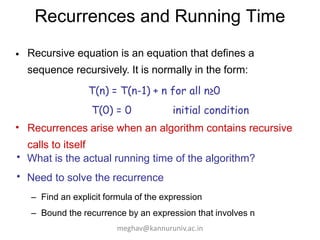
Recurrences and Running Time
• Recursive equation is an equation that defines a
sequence recursively. It is normally in the form:
T(n) = T(n-1) + n for all n≥0
T(0) = 0 initial condition
Recurrences arise when an algorithm contains recursive
calls to itself
•
•
•
What is the actual running time of the algorithm?
Need to solve the recurrence
– Find an explicit formula of the expression
– Bound the recurrence by an expression that involves n
meghav@kannuruniv.ac.in
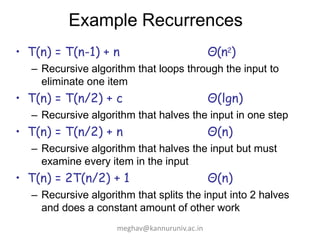
Example Recurrences
• T(n) = T(n-1) + n Θ(n2)
– Recursive algorithm that loops through the input to
eliminate one item
• T(n) = T(n/2) + c Θ(lgn)
– Recursive algorithm that halves the input in one step
• T(n) = T(n/2) + n Θ(n)
– Recursive algorithm that halves the input but must
examine every item in the input
• T(n) = 2T(n/2) + 1 Θ(n)
– Recursive algorithm that splits the input into 2 halves
and does a constant amount of other work
meghav@kannuruniv.ac.in
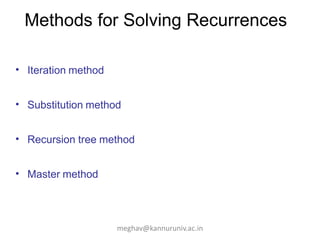
Methods for Solving Recurrences
• Iteration method
• Substitution method
• Recursion tree method
• Master method
meghav@kannuruniv.ac.in
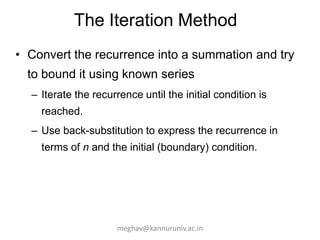
The Iteration Method
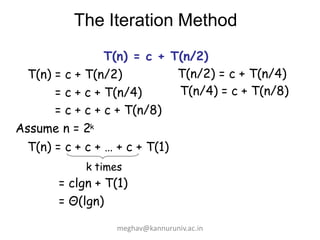
• Convert the recurrence into a summation and try
to bound it using known series
– Iterate the recurrence until the initial condition is
reached.
– Use back-substitution to express the recurrence in
terms of n and the initial (boundary) condition.
meghav@kannuruniv.ac.in
The Iteration Method
T(n) = c + T(n/2)
T(n) = c + T(n/2)
= c + c + T(n/4)
= c + c + c + T(n/8)
Assume n = 2k
T(n) = c + c + … + c + T(1)
k times
= clgn + T(1)
= Θ(lgn)
T(n/2) = c + T(n/4)
T(n/4) = c + T(n/8)
meghav@kannuruniv.ac.in
Iteration Method – Example
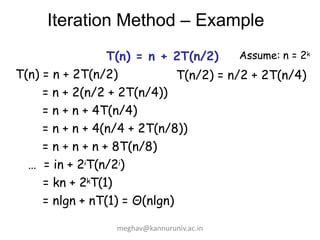
T(n) = n + 2T(n/2)
T(n) = n + 2T(n/2)
= n + 2(n/2 + 2T(n/4))
= n + n + 4T(n/4)
= n + n + 4(n/4 + 2T(n/8))
= n + n + n + 8T(n/8)
… = in + 2iT(n/2i)
= kn + 2kT(1)
= nlgn + nT(1) = Θ(nlgn)
Assume: n = 2k
T(n/2) = n/2 + 2T(n/4)
meghav@kannuruniv.ac.in
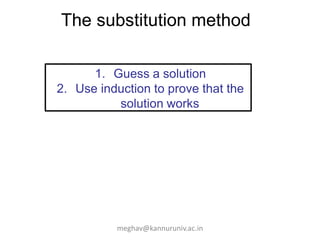
The substitution method
1. Guess a solution
2. Use induction to prove that the
solution works
meghav@kannuruniv.ac.in
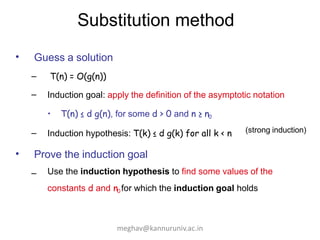
Substitution method
• Guess a solution
–
–
T(n) = O(g(n))
Induction goal: apply the definition of the asymptotic notation
• T(n) ≤ d g(n), for some d > 0 and n ≥ n0
– Induction hypothesis: T(k) ≤ d g(k) for all k < n
• Prove the induction goal
– Use the induction hypothesis to find some values of the
constants d and n0 for which the induction goal holds
(strong induction)
meghav@kannuruniv.ac.in
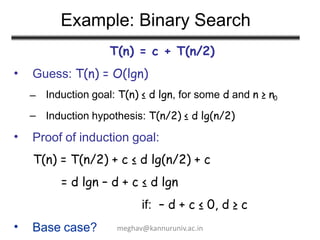
Example: Binary Search
T(n) = c + T(n/2)
Guess: T(n) = O(lgn)
•
–
–
Induction goal: T(n) ≤ d lgn, for some d and n ≥ n0
Induction hypothesis: T(n/2) ≤ d lg(n/2)
• Proof of induction goal:
T(n) = T(n/2) + c ≤ d lg(n/2) + c
= d lgn – d + c ≤ d lgn
if: – d + c ≤ 0, d ≥ c
• Base case? meghav@kannuruniv.ac.in
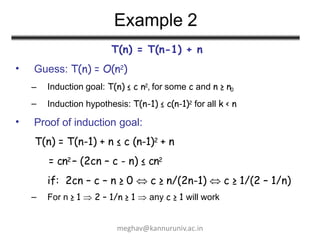
Example 2
T(n) = T(n-1) + n
Guess: T(n) = O(n2)
– Induction goal: T(n) ≤ c n2, for some c and n ≥ n0
•
– Induction hypothesis: T(n-1) ≤ c(n-1)2 for all k < n
• Proof of induction goal:
T(n) = T(n-1) + n ≤ c (n-1)2 + n
= cn2 – (2cn – c - n) ≤ cn2
if: 2cn – c – n ≥ 0  c ≥ n/(2n-1)  c ≥ 1/(2 – 1/n)
– For n ≥ 1  2 – 1/n ≥ 1  any c ≥ 1 will work
meghav@kannuruniv.ac.in
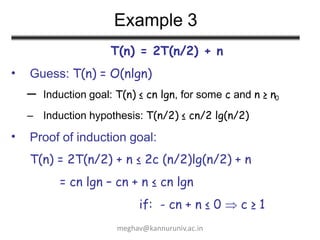
Example 3
T(n) = 2T(n/2) + n
Guess: T(n) = O(nlgn)
•
– Induction goal: T(n) ≤ cn lgn, for some c and n ≥ n0
– Induction hypothesis: T(n/2) ≤ cn/2 lg(n/2)
• Proof of induction goal:
T(n) = 2T(n/2) + n ≤ 2c (n/2)lg(n/2) + n
= cn lgn – cn + n ≤ cn lgn
if: - cn + n ≤ 0  c ≥ 1
meghav@kannuruniv.ac.in
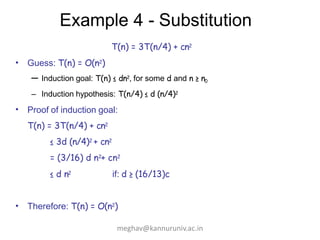
Example 4 - Substitution
T(n) = 3T(n/4) + cn2
• Guess: T(n) = O(n2)
– Induction goal: T(n) ≤ dn2, for some d and n ≥ n0
– Induction hypothesis: T(n/4) ≤ d (n/4)2
• Proof of induction goal:
T(n) = 3T(n/4) + cn2
≤ 3d (n/4)2 + cn2
= (3/16) d n2+ cn2
≤ d n2 if: d ≥ (16/13)c
• Therefore: T(n) = O(n2)
meghav@kannuruniv.ac.in
The recursion-tree method
Convert the recurrence into a tree:
– Each node represents the cost incurred at various
levels of recursion
– Sum up the costs of all levels
Used to “guess” a solution for the recurrence
meghav@kannuruniv.ac.in
Example 1
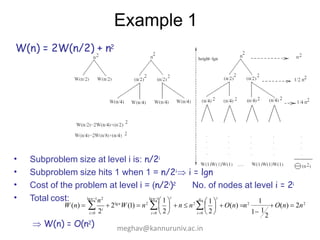
W(n) = 2W(n/2) + n2
•
•
•
•
Subproblem size at level i is: n/2i
Subproblem size hits 1 when 1 = n/2i i = lgn
Cost of the problem at level i = (n/2i)2 No. of nodes at level i = 2i
Total cost:
2
1
1 1
 1 
i
W (n)    2lgn
W(1)  n2
   n  n2
   O(n) n2
 O(n)  2n2

i0  2 
i0  2 
lgn1
n2 lgn1
 1 
i
i0 2i
 W(n) = O(n2) meghav@kannuruniv.ac.in
Example 2
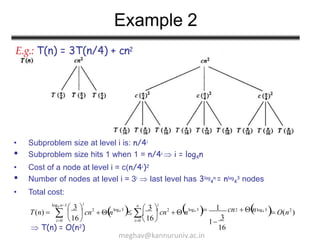
E.g.: T(n) = 3T(n/4) + cn2
• Subproblem size at level i is: n/4i
• Subproblem size hits 1 when 1 = n/4i  i = log4n
• Cost of a node at level i = c(n/4i)2
• Number of nodes at level i = 3i  last level has 3log
4
n = nlog
4
3 nodes
• Total cost:
 T(n) = O(n2) 16
1
16
16
2
 O(n )
2
2
2 log4 3

log4 3
 log4 3

1
  cn  n
3
cn   n

 
 3 
i
cn  n 
 
 
T(n)  


i0 
log4 n1
 3 
i
i0
Master’s method
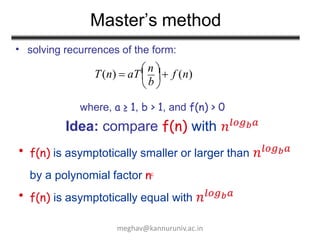
• solving recurrences of the form:
Idea: compare f(n) with 𝑛𝑙𝑜𝑔𝑏𝑎
• f(n) is asymptotically smaller or larger than 𝑛𝑙𝑜𝑔𝑏𝑎
by a polynomial factor n
• f(n) is asymptotically equal with 𝑛𝑙𝑜𝑔𝑏𝑎

b

 
where, a ≥ 1, b > 1, and f(n) > 0
T(n)  aT n   f (n)
meghav@kannuruniv.ac.in
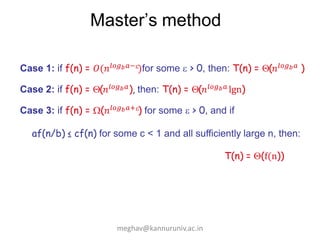
Master’s method
Case 1: if f(n) = 𝑂(𝑛𝑙𝑜𝑔𝑏𝑎−)for some  > 0, then: T(n) = (𝑛𝑙𝑜𝑔𝑏𝑎 )
Case 2: if f(n) = (𝑛𝑙𝑜𝑔𝑏𝑎), then: T(n) = (𝑛𝑙𝑜𝑔𝑏𝑎 lgn)
Case 3: if f(n) = (𝑛𝑙𝑜𝑔𝑏𝑎+) for some  > 0, and if
af(n/b) ≤ cf(n) for some c < 1 and all sufficiently large n, then:
T(n) = (f(n))
meghav@kannuruniv.ac.in
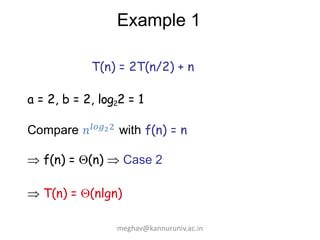
Example 1
T(n) = 2T(n/2) + n
a = 2, b = 2, log22 = 1
Compare 𝑛𝑙𝑜𝑔22 with f(n) = n
 f(n) = (n)  Case 2
 T(n) = (nlgn)
meghav@kannuruniv.ac.in
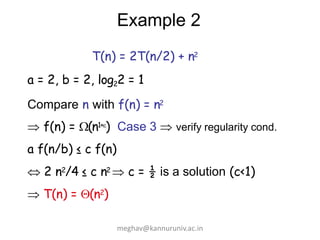
Example 2
T(n) = 2T(n/2) + n2
a = 2, b = 2, log22 = 1
Compare n with f(n) = n2
 f(n) = (n1+) Case 3  verify regularity cond.
a f(n/b) ≤ c f(n)
 2 n2/4 ≤ c n2  c = ½ is a solution (c<1)
 T(n) = (n2)
meghav@kannuruniv.ac.in
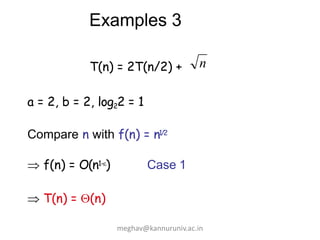
Examples 3
T(n) = 2T(n/2) +
a = 2, b = 2, log22 = 1
Compare n with f(n) = n1/2
 f(n) = O(n1-) Case 1
 T(n) = (n)
n
meghav@kannuruniv.ac.in
Examples
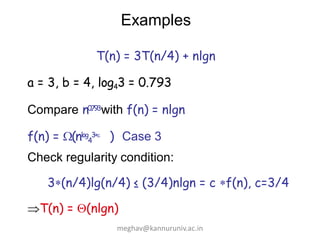
T(n) = 3T(n/4) + nlgn
a = 3, b = 4, log43 = 0.793
Compare n0.793with f(n) = nlgn
f(n) = (nlog
4
3+ ) Case 3
Check regularity condition:
3(n/4)lg(n/4) ≤ (3/4)nlgn = c f(n), c=3/4
T(n) = (nlgn)
meghav@kannuruniv.ac.in
Assignment
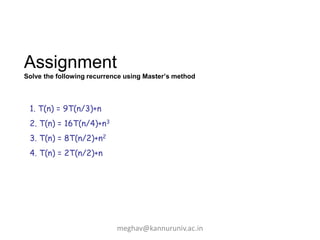
Solve the following recurrence using Master’s method
1. T(n) = 9T(n/3)+n
2. T(n) = 16T(n/4)+n3
3. T(n) = 8T(n/2)+n2
4. T(n) = 2T(n/2)+n
meghav@kannuruniv.ac.in

Solving recurrences

  • 1.
    Data Structure andAlgorithms Solving recurrences meghav@kannuruniv.ac.in Presented by Megha V Research scholar Dept. of IT Kannur University
  • 2.
    Algorithm Algorithms are oftwo types: 1. Recursive 2. Non recursive meghav@kannuruniv.ac.in
  • 3.
    Solving Recurrences Iteration method Substitutionmethod Recursion Tree method Master’s Theorem meghav@kannuruniv.ac.in
  • 4.
    Recurrences and RunningTime • Recursive equation is an equation that defines a sequence recursively. It is normally in the form: T(n) = T(n-1) + n for all n≥0 T(0) = 0 initial condition Recurrences arise when an algorithm contains recursive calls to itself • • • What is the actual running time of the algorithm? Need to solve the recurrence – Find an explicit formula of the expression – Bound the recurrence by an expression that involves n meghav@kannuruniv.ac.in
  • 5.
    Example Recurrences • T(n)= T(n-1) + n Θ(n2) – Recursive algorithm that loops through the input to eliminate one item • T(n) = T(n/2) + c Θ(lgn) – Recursive algorithm that halves the input in one step • T(n) = T(n/2) + n Θ(n) – Recursive algorithm that halves the input but must examine every item in the input • T(n) = 2T(n/2) + 1 Θ(n) – Recursive algorithm that splits the input into 2 halves and does a constant amount of other work meghav@kannuruniv.ac.in
  • 6.
    Methods for SolvingRecurrences • Iteration method • Substitution method • Recursion tree method • Master method meghav@kannuruniv.ac.in
  • 7.
    The Iteration Method •Convert the recurrence into a summation and try to bound it using known series – Iterate the recurrence until the initial condition is reached. – Use back-substitution to express the recurrence in terms of n and the initial (boundary) condition. meghav@kannuruniv.ac.in
  • 8.
    The Iteration Method T(n)= c + T(n/2) T(n) = c + T(n/2) = c + c + T(n/4) = c + c + c + T(n/8) Assume n = 2k T(n) = c + c + … + c + T(1) k times = clgn + T(1) = Θ(lgn) T(n/2) = c + T(n/4) T(n/4) = c + T(n/8) meghav@kannuruniv.ac.in
  • 9.
    Iteration Method –Example T(n) = n + 2T(n/2) T(n) = n + 2T(n/2) = n + 2(n/2 + 2T(n/4)) = n + n + 4T(n/4) = n + n + 4(n/4 + 2T(n/8)) = n + n + n + 8T(n/8) … = in + 2iT(n/2i) = kn + 2kT(1) = nlgn + nT(1) = Θ(nlgn) Assume: n = 2k T(n/2) = n/2 + 2T(n/4) meghav@kannuruniv.ac.in
  • 10.
    The substitution method 1.Guess a solution 2. Use induction to prove that the solution works meghav@kannuruniv.ac.in
  • 11.
    Substitution method • Guessa solution – – T(n) = O(g(n)) Induction goal: apply the definition of the asymptotic notation • T(n) ≤ d g(n), for some d > 0 and n ≥ n0 – Induction hypothesis: T(k) ≤ d g(k) for all k < n • Prove the induction goal – Use the induction hypothesis to find some values of the constants d and n0 for which the induction goal holds (strong induction) meghav@kannuruniv.ac.in
  • 12.
    Example: Binary Search T(n)= c + T(n/2) Guess: T(n) = O(lgn) • – – Induction goal: T(n) ≤ d lgn, for some d and n ≥ n0 Induction hypothesis: T(n/2) ≤ d lg(n/2) • Proof of induction goal: T(n) = T(n/2) + c ≤ d lg(n/2) + c = d lgn – d + c ≤ d lgn if: – d + c ≤ 0, d ≥ c • Base case? meghav@kannuruniv.ac.in
  • 13.
    Example 2 T(n) =T(n-1) + n Guess: T(n) = O(n2) – Induction goal: T(n) ≤ c n2, for some c and n ≥ n0 • – Induction hypothesis: T(n-1) ≤ c(n-1)2 for all k < n • Proof of induction goal: T(n) = T(n-1) + n ≤ c (n-1)2 + n = cn2 – (2cn – c - n) ≤ cn2 if: 2cn – c – n ≥ 0  c ≥ n/(2n-1)  c ≥ 1/(2 – 1/n) – For n ≥ 1  2 – 1/n ≥ 1  any c ≥ 1 will work meghav@kannuruniv.ac.in
  • 14.
    Example 3 T(n) =2T(n/2) + n Guess: T(n) = O(nlgn) • – Induction goal: T(n) ≤ cn lgn, for some c and n ≥ n0 – Induction hypothesis: T(n/2) ≤ cn/2 lg(n/2) • Proof of induction goal: T(n) = 2T(n/2) + n ≤ 2c (n/2)lg(n/2) + n = cn lgn – cn + n ≤ cn lgn if: - cn + n ≤ 0  c ≥ 1 meghav@kannuruniv.ac.in
  • 15.
    Example 4 -Substitution T(n) = 3T(n/4) + cn2 • Guess: T(n) = O(n2) – Induction goal: T(n) ≤ dn2, for some d and n ≥ n0 – Induction hypothesis: T(n/4) ≤ d (n/4)2 • Proof of induction goal: T(n) = 3T(n/4) + cn2 ≤ 3d (n/4)2 + cn2 = (3/16) d n2+ cn2 ≤ d n2 if: d ≥ (16/13)c • Therefore: T(n) = O(n2) meghav@kannuruniv.ac.in
  • 16.
    The recursion-tree method Convertthe recurrence into a tree: – Each node represents the cost incurred at various levels of recursion – Sum up the costs of all levels Used to “guess” a solution for the recurrence meghav@kannuruniv.ac.in
  • 17.
    Example 1 W(n) =2W(n/2) + n2 • • • • Subproblem size at level i is: n/2i Subproblem size hits 1 when 1 = n/2i i = lgn Cost of the problem at level i = (n/2i)2 No. of nodes at level i = 2i Total cost: 2 1 1 1  1  i W (n)    2lgn W(1)  n2    n  n2    O(n) n2  O(n)  2n2  i0  2  i0  2  lgn1 n2 lgn1  1  i i0 2i  W(n) = O(n2) meghav@kannuruniv.ac.in
  • 18.
    Example 2 E.g.: T(n)= 3T(n/4) + cn2 • Subproblem size at level i is: n/4i • Subproblem size hits 1 when 1 = n/4i  i = log4n • Cost of a node at level i = c(n/4i)2 • Number of nodes at level i = 3i  last level has 3log 4 n = nlog 4 3 nodes • Total cost:  T(n) = O(n2) 16 1 16 16 2  O(n ) 2 2 2 log4 3  log4 3  log4 3  1   cn  n 3 cn   n     3  i cn  n      T(n)     i0  log4 n1  3  i i0
  • 19.
    Master’s method • solvingrecurrences of the form: Idea: compare f(n) with 𝑛𝑙𝑜𝑔𝑏𝑎 • f(n) is asymptotically smaller or larger than 𝑛𝑙𝑜𝑔𝑏𝑎 by a polynomial factor n • f(n) is asymptotically equal with 𝑛𝑙𝑜𝑔𝑏𝑎  b    where, a ≥ 1, b > 1, and f(n) > 0 T(n)  aT n   f (n) meghav@kannuruniv.ac.in
  • 20.
    Master’s method Case 1:if f(n) = 𝑂(𝑛𝑙𝑜𝑔𝑏𝑎−)for some  > 0, then: T(n) = (𝑛𝑙𝑜𝑔𝑏𝑎 ) Case 2: if f(n) = (𝑛𝑙𝑜𝑔𝑏𝑎), then: T(n) = (𝑛𝑙𝑜𝑔𝑏𝑎 lgn) Case 3: if f(n) = (𝑛𝑙𝑜𝑔𝑏𝑎+) for some  > 0, and if af(n/b) ≤ cf(n) for some c < 1 and all sufficiently large n, then: T(n) = (f(n)) meghav@kannuruniv.ac.in
  • 21.
    Example 1 T(n) =2T(n/2) + n a = 2, b = 2, log22 = 1 Compare 𝑛𝑙𝑜𝑔22 with f(n) = n  f(n) = (n)  Case 2  T(n) = (nlgn) meghav@kannuruniv.ac.in
  • 22.
    Example 2 T(n) =2T(n/2) + n2 a = 2, b = 2, log22 = 1 Compare n with f(n) = n2  f(n) = (n1+) Case 3  verify regularity cond. a f(n/b) ≤ c f(n)  2 n2/4 ≤ c n2  c = ½ is a solution (c<1)  T(n) = (n2) meghav@kannuruniv.ac.in
  • 23.
    Examples 3 T(n) =2T(n/2) + a = 2, b = 2, log22 = 1 Compare n with f(n) = n1/2  f(n) = O(n1-) Case 1  T(n) = (n) n meghav@kannuruniv.ac.in
  • 24.
    Examples T(n) = 3T(n/4)+ nlgn a = 3, b = 4, log43 = 0.793 Compare n0.793with f(n) = nlgn f(n) = (nlog 4 3+ ) Case 3 Check regularity condition: 3(n/4)lg(n/4) ≤ (3/4)nlgn = c f(n), c=3/4 T(n) = (nlgn) meghav@kannuruniv.ac.in
  • 25.
    Assignment Solve the followingrecurrence using Master’s method 1. T(n) = 9T(n/3)+n 2. T(n) = 16T(n/4)+n3 3. T(n) = 8T(n/2)+n2 4. T(n) = 2T(n/2)+n meghav@kannuruniv.ac.in