Solution
s:
Please see answer in bold letters.
Note pi = 3.1415….
1. The voltage across a 15Ω is as indicated. Find the sinusoidal
expression for the current. In addition, sketch the v and i
waveform on the same axis.
Note: For the graph of a and b please see attached jpg photo
with filename 1ab.jpg and for c and d please see attached photo
with filename 1cd.jpg.
a. 15sin20t
v= 15sin20t
By ohms law,
i = v/r
i = 15sin20t / 15
i = sin20t A
Computation of period for graphing:
v= 15sin20t
i = sin20t
w = 20 = 2pi*f
f = 3.183 Hz
Period =1/f = 0.314 seconds
b. 300sin (377t+20)
v = 300sin (377t+20)
i = 300sin (377t+20) /15
i = 20 sin (377t+20) A
Computation of period for graphing:
v = 300sin (377t+20)
i = 20 sin (377t+20)
w = 377 = 2pi*f
f = 60 Hz
Period = 1/60 = 0.017 seconds
shift to the left by:
2pi/0.017 = (20/180*pi)/x
x = 9.44x10⁻⁴ seconds
c. 60cos (wt+10)
v = 60cos (wt+10)
i = 60cos (wt+10)/15
i = 4cos (wt+10) A
Computation of period for graphing:
let’s denote the period as w sifted to the left by:
10/180*pi = pi/18
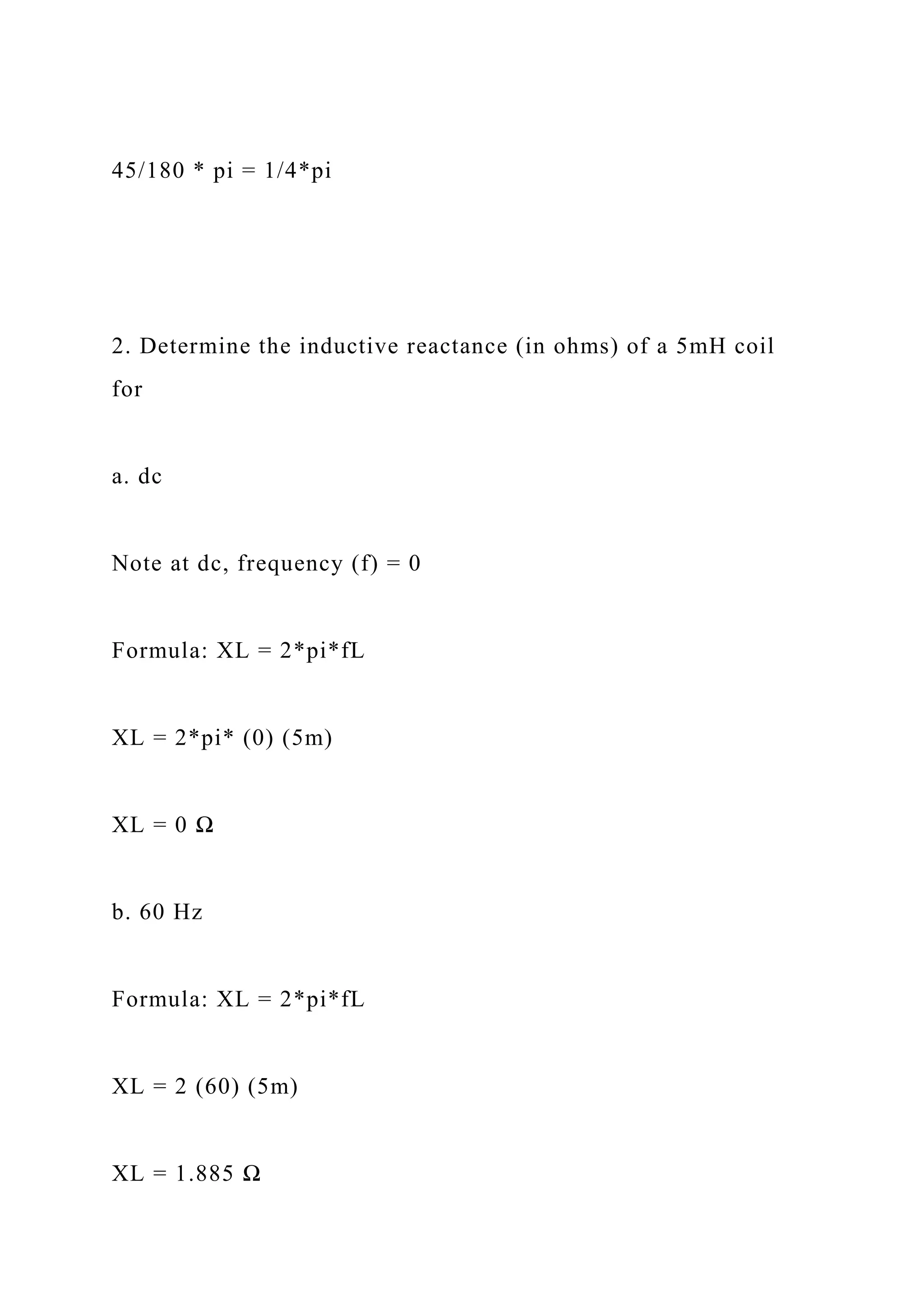
d. -45sin (wt+45)
v = -45sin (wt+45)
i = -45sin (wt+45) / 15
i = -3 sin (wt+45) A
Computation of period for graphing:
let’s denote the period as w sifted to the left by:
45/180 * pi = 1/4*pi
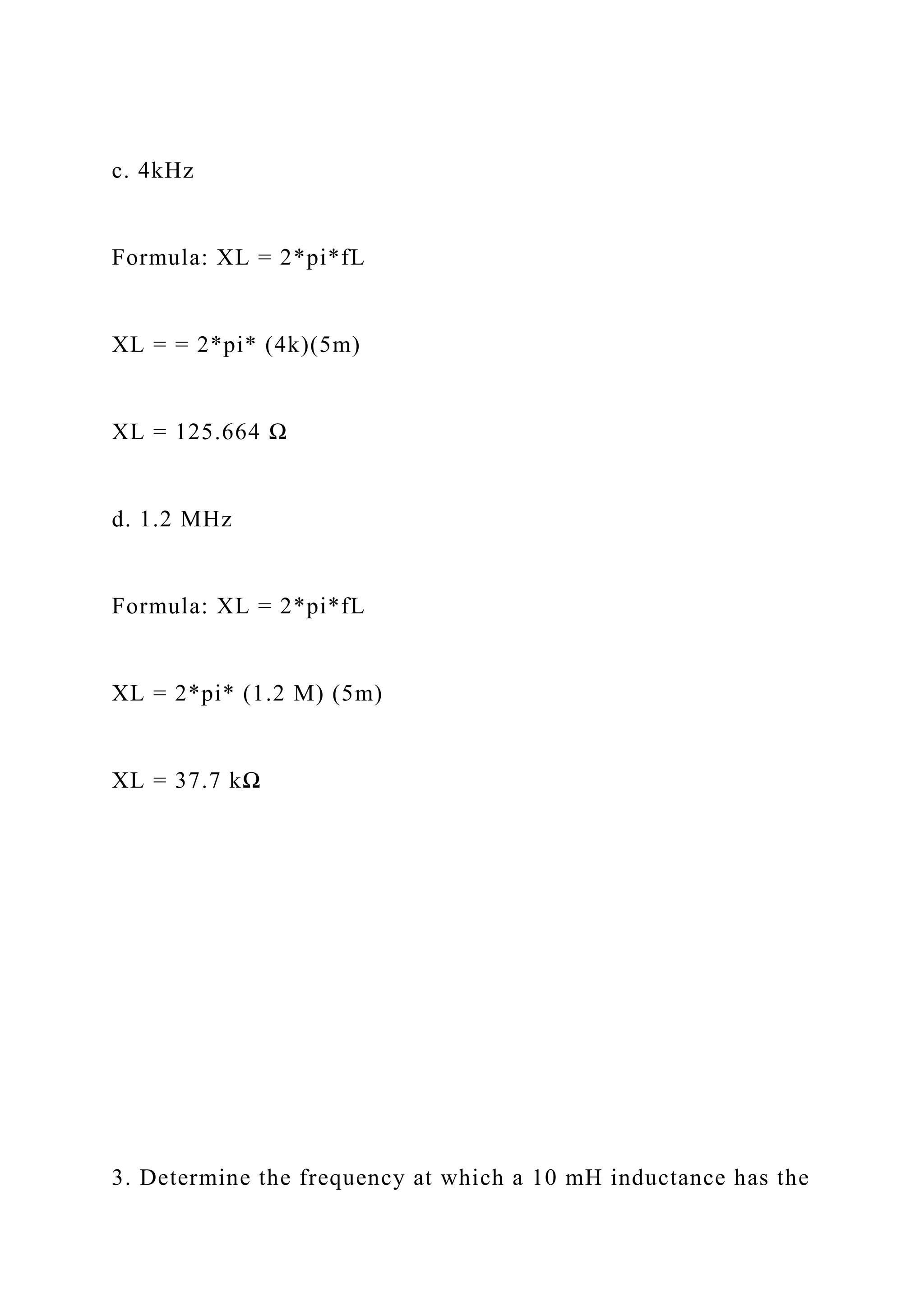
2. Determine the inductive reactance (in ohms) of a 5mH coil
for
a. dc
Note at dc, frequency (f) = 0
Formula: XL = 2*pi*fL
XL = 2*pi* (0) (5m)
XL = 0 Ω
b. 60 Hz
Formula: XL = 2*pi*fL
XL = 2 (60) (5m)
XL = 1.885 Ω
c. 4kHz
Formula: XL = 2*pi*fL
XL = = 2*pi* (4k)(5m)
XL = 125.664 Ω
d. 1.2 MHz
Formula: XL = 2*pi*fL
XL = 2*pi* (1.2 M) (5m)
XL = 37.7 kΩ
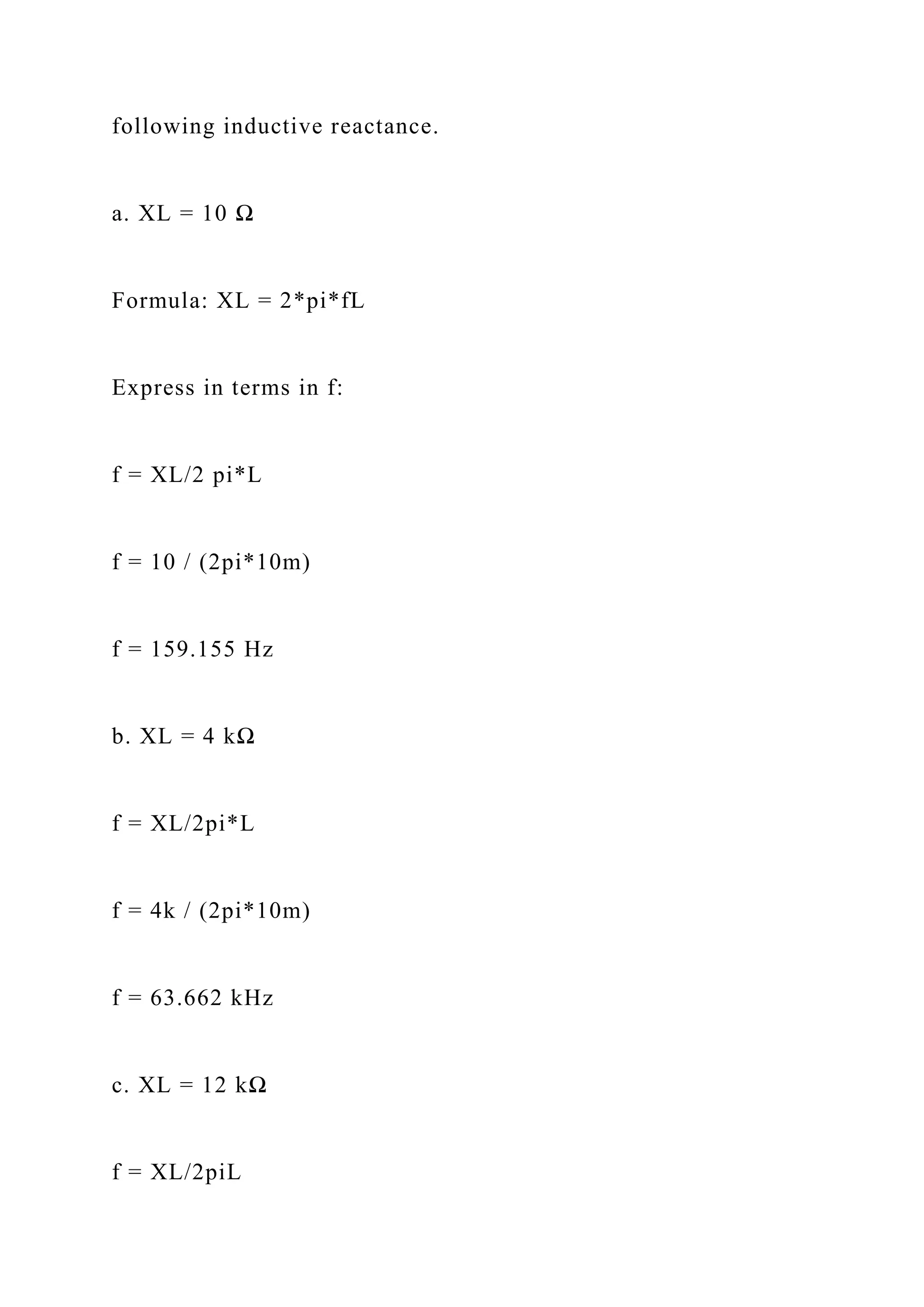
3. Determine the frequency at which a 10 mH inductance has the
following inductive reactance.
a. XL = 10 Ω
Formula: XL = 2*pi*fL
Express in terms in f:
f = XL/2 pi*L
f = 10 / (2pi*10m)
f = 159.155 Hz
b. XL = 4 kΩ
f = XL/2pi*L
f = 4k / (2pi*10m)
f = 63.662 kHz
c. XL = 12 kΩ
f = XL/2piL
f = 12k / (2pi*10m)
f = 190.99 kHz
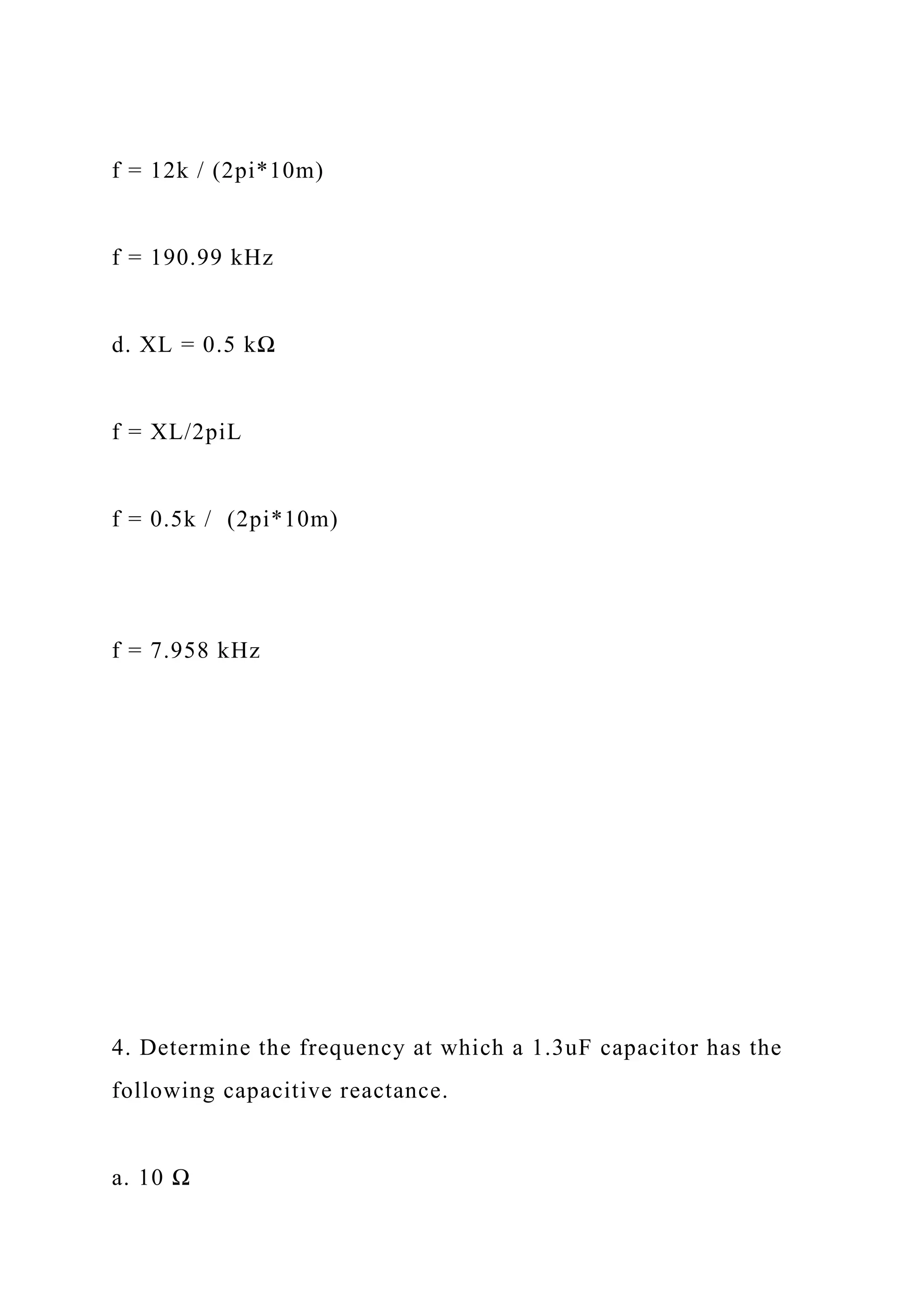
d. XL = 0.5 kΩ
f = XL/2piL
f = 0.5k / (2pi*10m)
f = 7.958 kHz
4. Determine the frequency at which a 1.3uF capacitor has the
following capacitive reactance.
a. 10 Ω
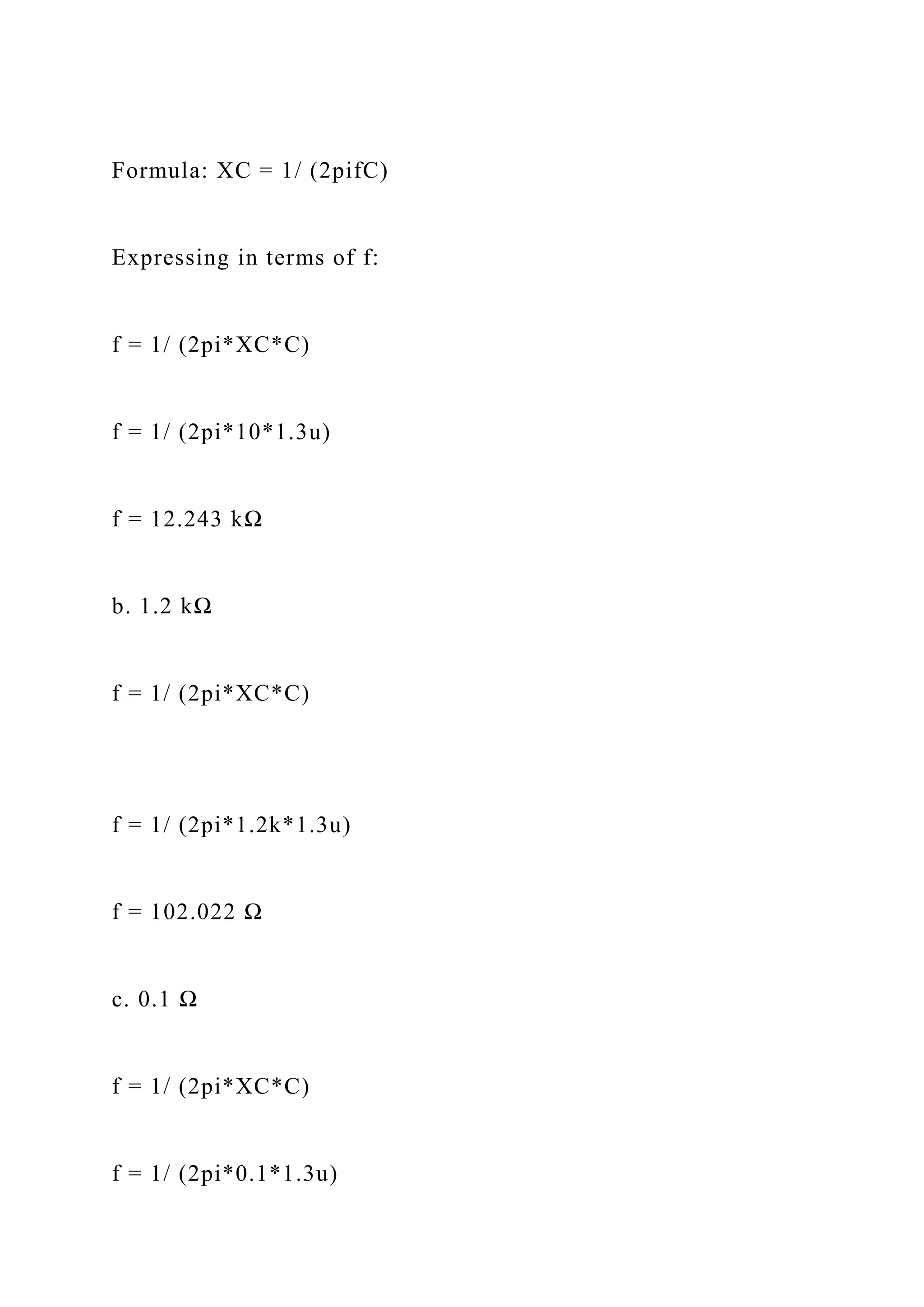
Formula: XC = 1/ (2pifC)
Expressing in terms of f:
f = 1/ (2pi*XC*C)
f = 1/ (2pi*10*1.3u)
f = 12.243 kΩ
b. 1.2 kΩ
f = 1/ (2pi*XC*C)
f = 1/ (2pi*1.2k*1.3u)
f = 102.022 Ω
c. 0.1 Ω
f = 1/ (2pi*XC*C)
f = 1/ (2pi*0.1*1.3u)
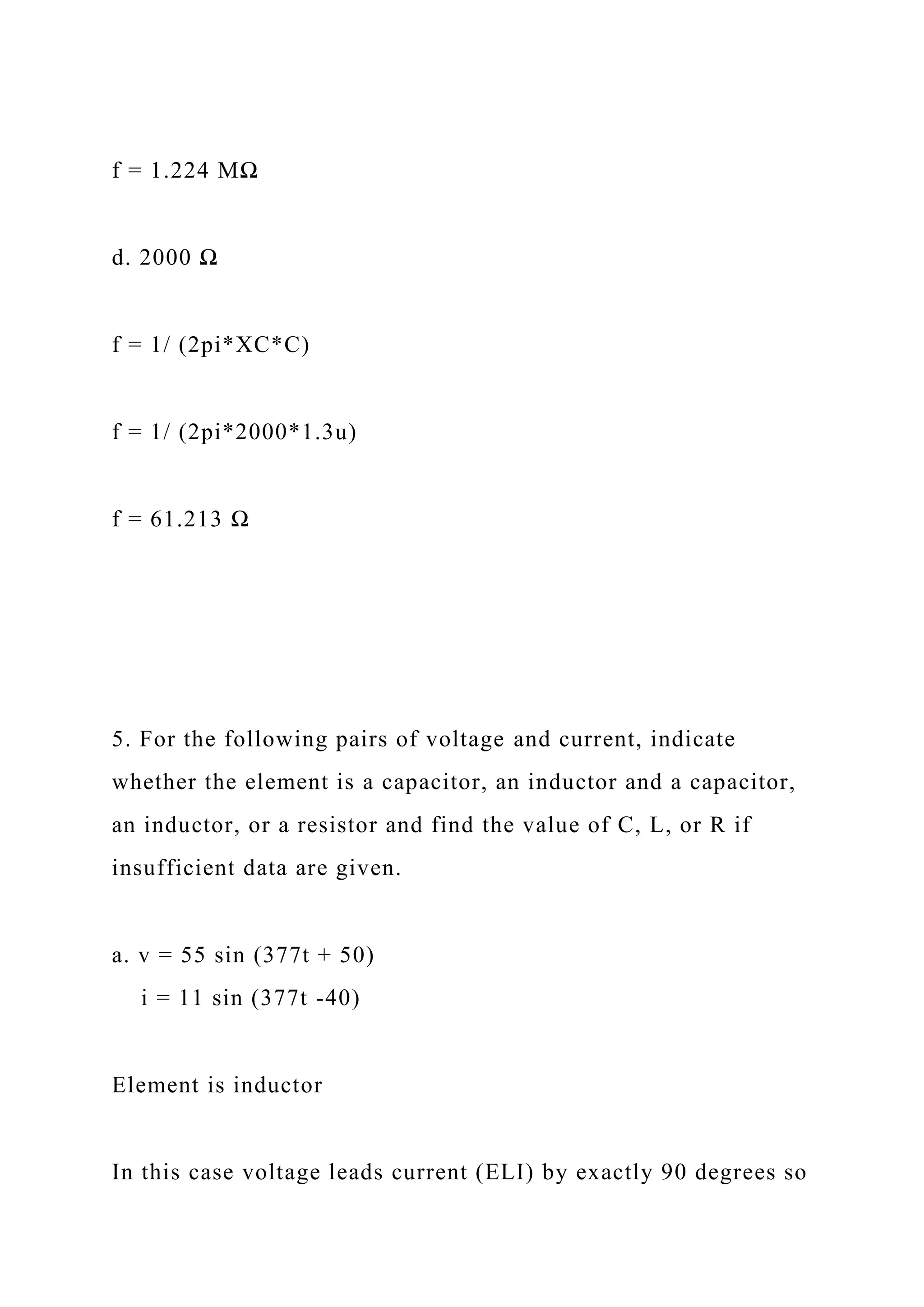
f = 1.224 MΩ
d. 2000 Ω
f = 1/ (2pi*XC*C)
f = 1/ (2pi*2000*1.3u)
f = 61.213 Ω
5. For the following pairs of voltage and current, indicate
whether the element is a capacitor, an inductor and a capacitor,
an inductor, or a resistor and find the value of C, L, or R if
insufficient data are given.
a. v = 55 sin (377t + 50)
i = 11 sin (377t -40)
Element is inductor
In this case voltage leads current (ELI) by exactly 90 degrees so
that means the circuit is inductive and the element is inductor.
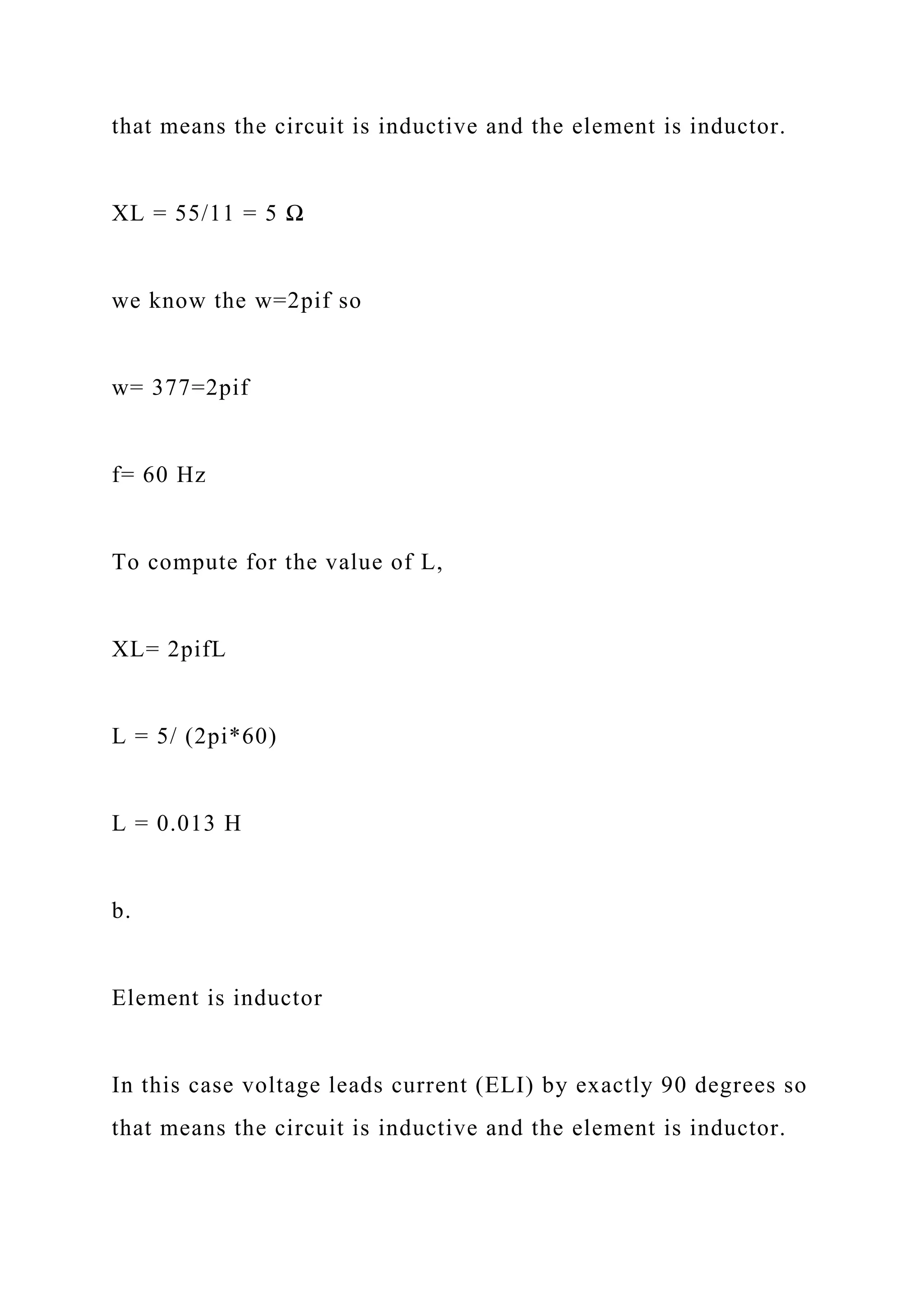
XL = 55/11 = 5 Ω
we know the w=2pif so
w= 377=2pif
f= 60 Hz
To compute for the value of L,
XL= 2pifL
L = 5/ (2pi*60)
L = 0.013 H
b.
Element is inductor
In this case voltage leads current (ELI) by exactly 90 degrees so
that means the circuit is inductive and the element is inductor.
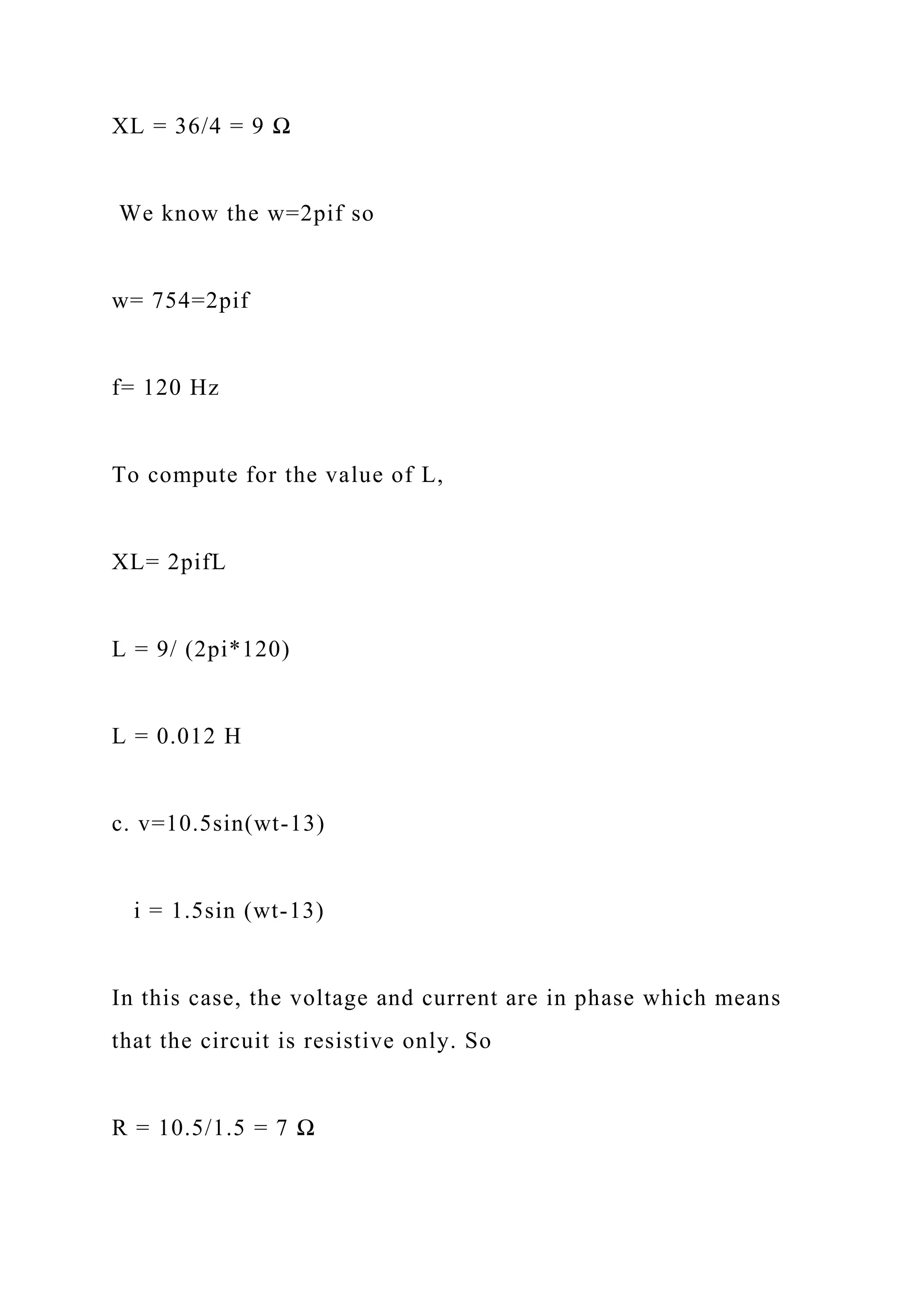
XL = 36/4 = 9 Ω
We know the w=2pif so
w= 754=2pif
f= 120 Hz
To compute for the value of L,
XL= 2pifL
L = 9/ (2pi*120)
L = 0.012 H
c. v=10.5sin(wt-13)
i = 1.5sin (wt-13)
In this case, the voltage and current are in phase which means
that the circuit is resistive only. So
R = 10.5/1.5 = 7 Ω
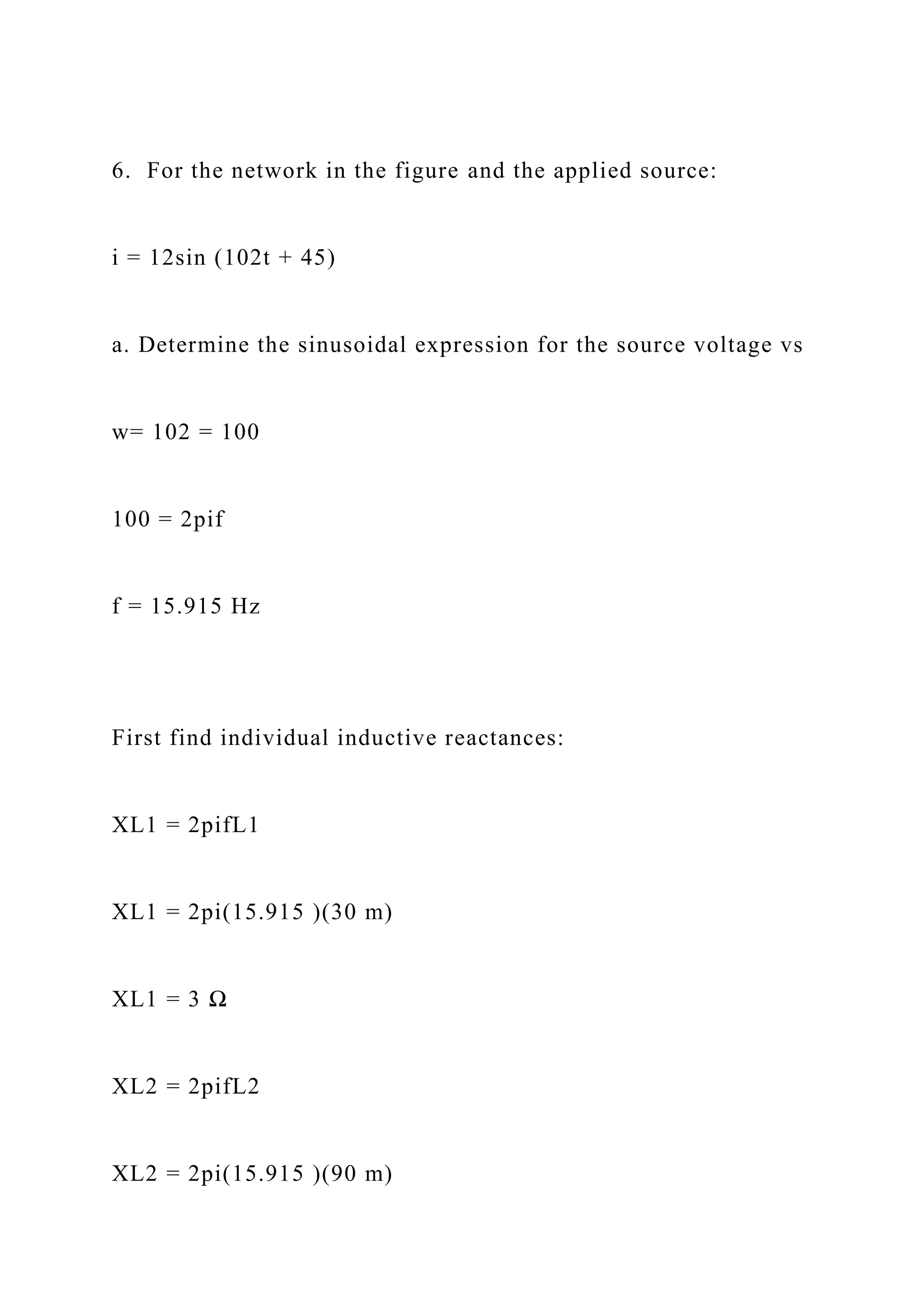
6. For the network in the figure and the applied source:
i = 12sin (102t + 45)
a. Determine the sinusoidal expression for the source voltage vs
w= 102 = 100
100 = 2pif
f = 15.915 Hz
First find individual inductive reactances:
XL1 = 2pifL1
XL1 = 2pi(15.915 )(30 m)
XL1 = 3 Ω
XL2 = 2pifL2
XL2 = 2pi(15.915 )(90 m)
XL1 = 9 Ω
Total reactance = XL = 9(3)/ (9+3)
XL = 2.25 Ω
so vs = 2.25*12sin(102t + 45) and knowing that voltage leads
the current by 90 degrees in an inductor, the equation is
vs = 27sin(100t +135o) volts
b. Find the sinusoidal expression for i1 and i2
By Current Division Theorem:
i1 = is [XL2/ (XL1+XL2)]
i1 = 12sin (102t + 45) (9/ (9+3))
i1 = 9 sin (102t + 45) A
i2 = is [XL1 /(XL1+XL2)]
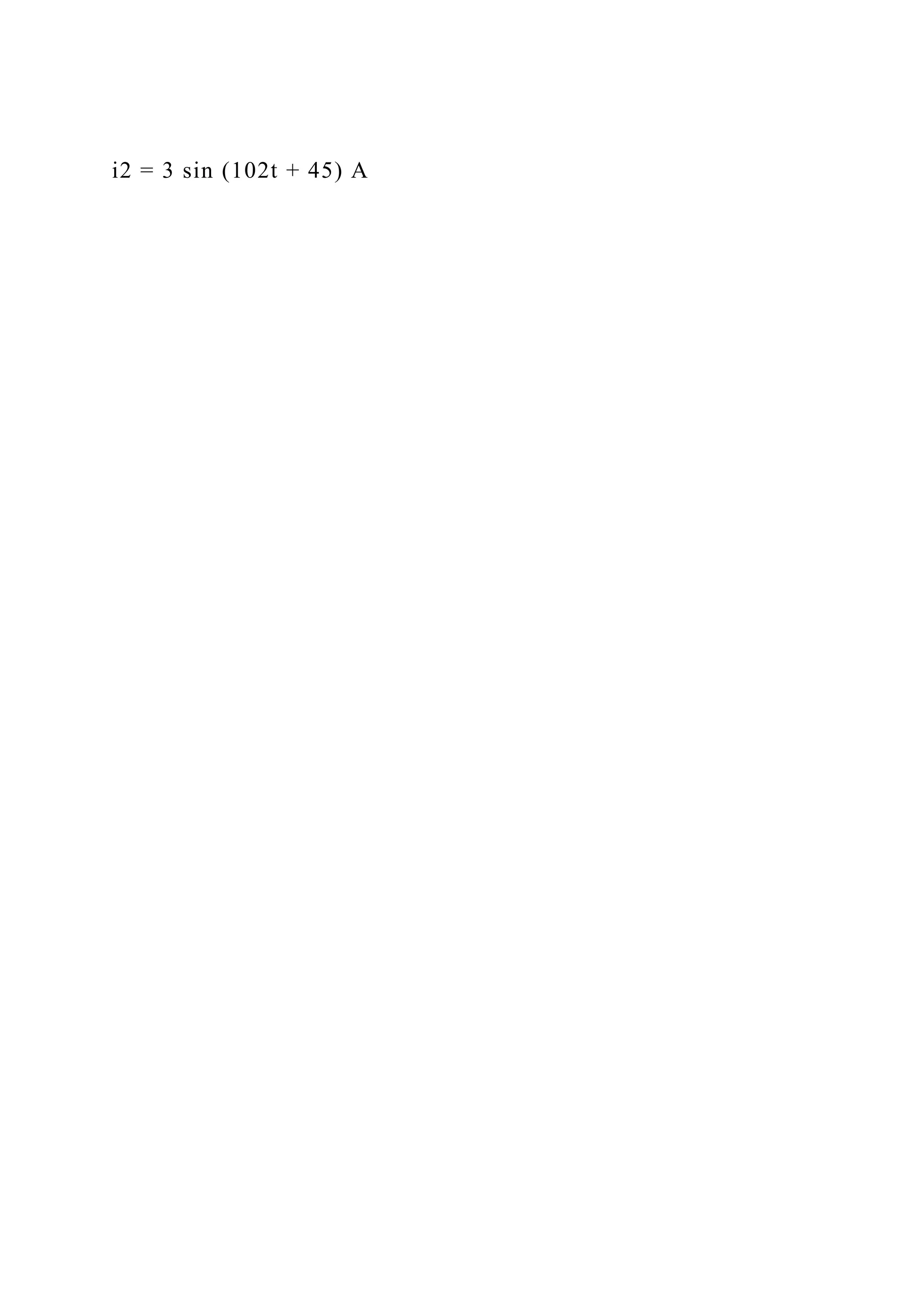
i2 = 12sin (102t + 45) (12/ (9+3))
i2 = 3 sin (102t + 45) A
7. Convert the following from rectangular to polar
a. Z = -8-j16
let rectangular form Z= a + jb and polar form Z = |Z| ∠ θ
where |Z| = sqrt ( a2 + b2 ) and θ = tan-1 (b/a)
Z = sqrt [(-8)2 + (-16)2 ]
Z = 17.89
θ = tan-1 (b/a)
θ = tan-1 (-16/-8)
θ = 64.43 degrees
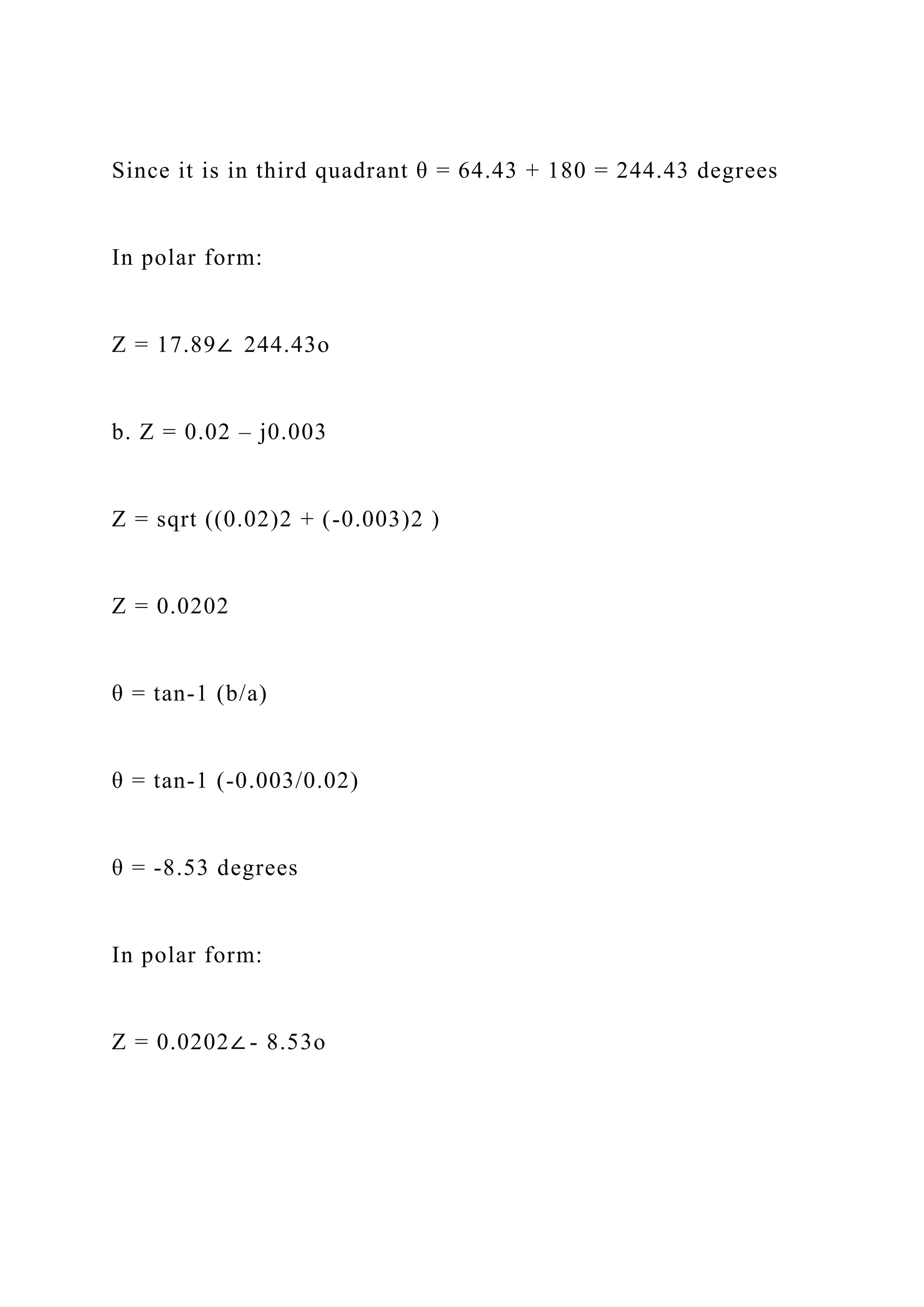
Since it is in third quadrant θ = 64.43 + 180 = 244.43 degrees
In polar form:
Z = 17.89∠ 244.43o
b. Z = 0.02 – j0.003
Z = sqrt ((0.02)2 + (-0.003)2 )
Z = 0.0202
θ = tan-1 (b/a)
θ = tan-1 (-0.003/0.02)
θ = -8.53 degrees
In polar form:
Z = 0.0202∠ - 8.53o
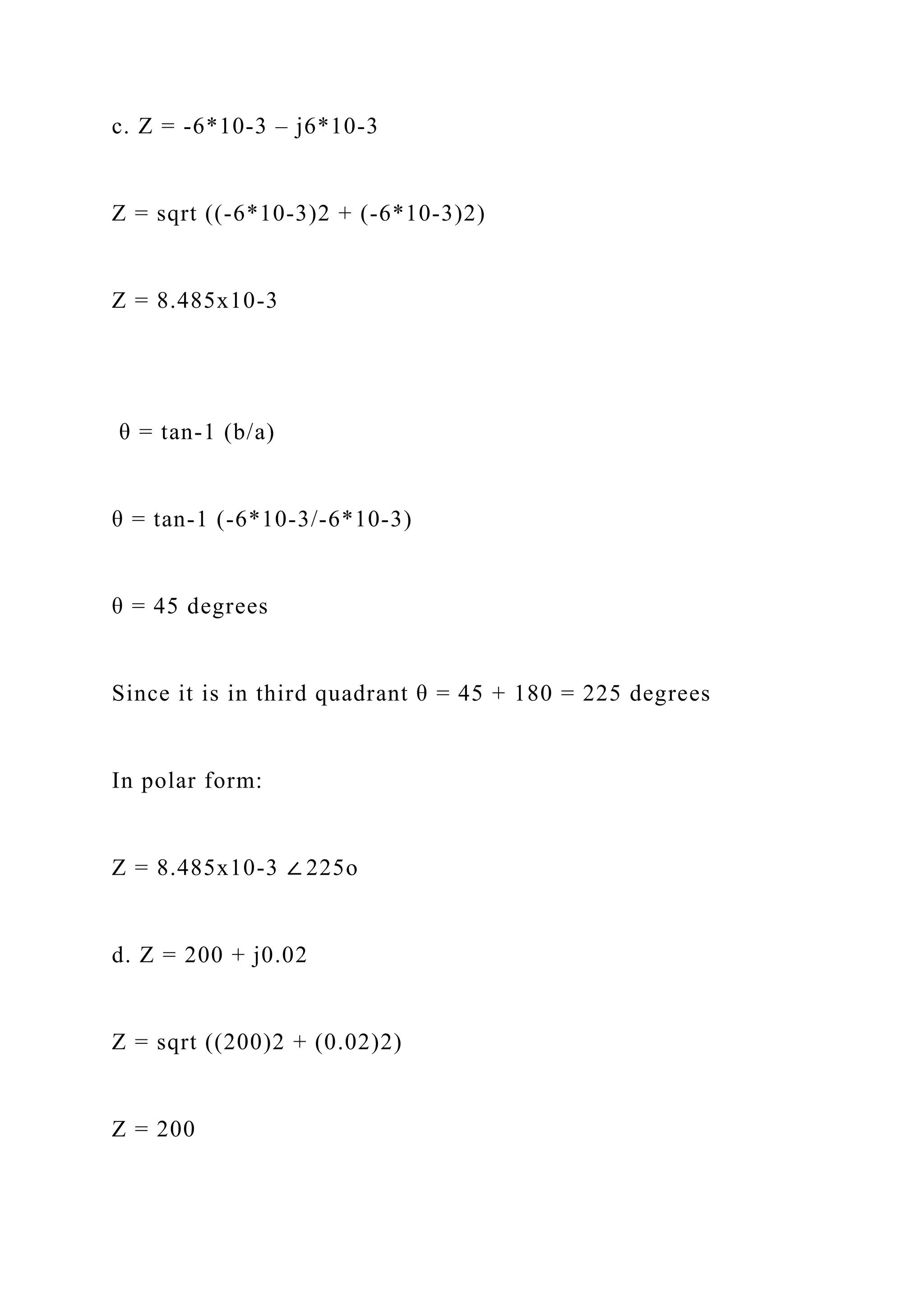
c. Z = -6*10-3 – j6*10-3
Z = sqrt ((-6*10-3)2 + (-6*10-3)2)
Z = 8.485x10⁻³
θ = tan-1 (b/a)
θ = tan-1 (-6*10-3/-6*10-3)
θ = 45 degrees
Since it is in third quadrant θ = 45 + 180 = 225 degrees
In polar form:
Z = 8.485x10⁻³ ∠ 225o
d. Z = 200 + j0.02
Z = sqrt ((200)2 + (0.02)2)
Z = 200
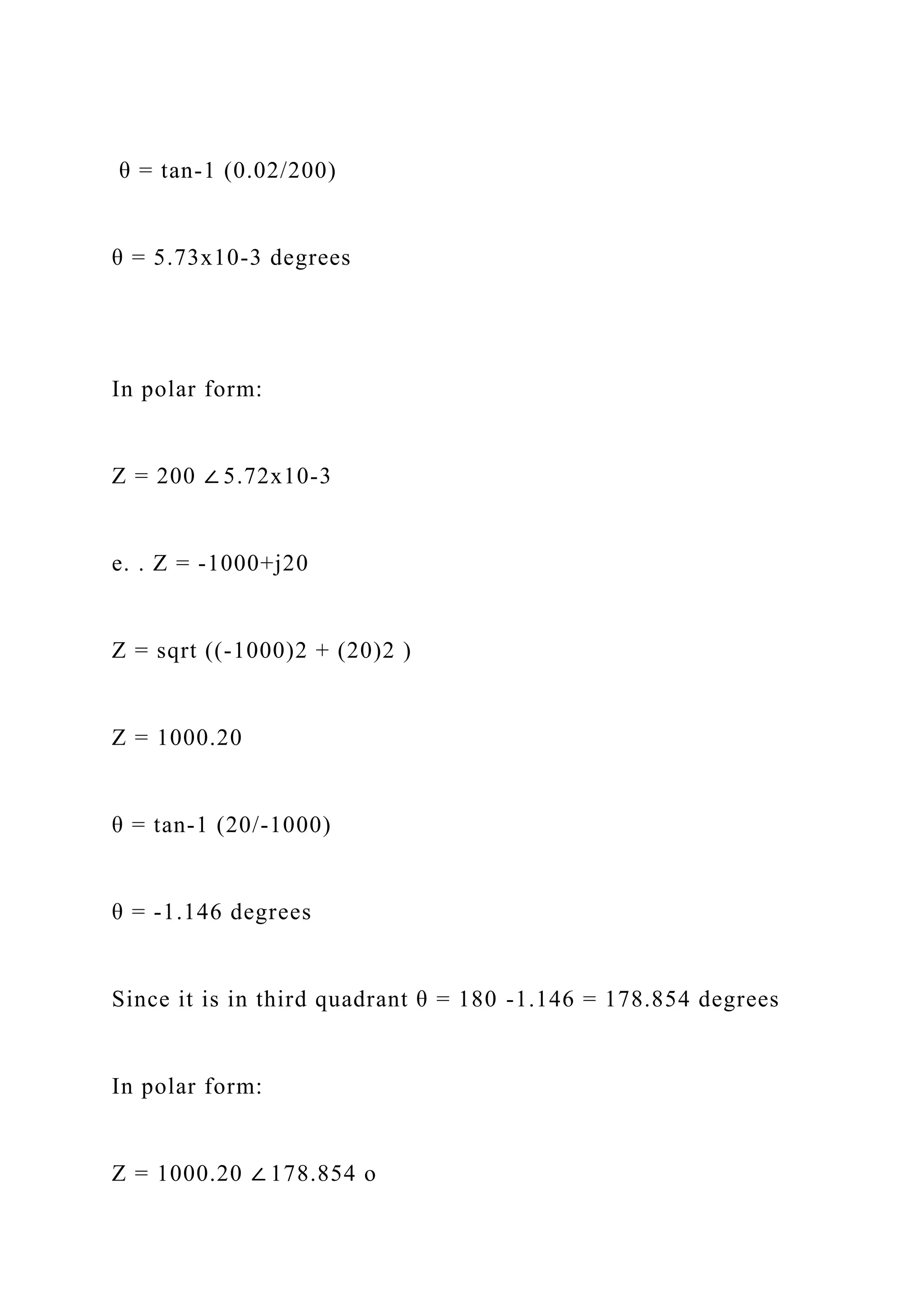
θ = tan-1 (0.02/200)
θ = 5.73x10⁻³ degrees
In polar form:
Z = 200 ∠ 5.72x10⁻³
e. . Z = -1000+j20
Z = sqrt ((-1000)2 + (20)2 )
Z = 1000.20
θ = tan-1 (20/-1000)
θ = -1.146 degrees
Since it is in third quadrant θ = 180 -1.146 = 178.854 degrees
In polar form:
Z = 1000.20 ∠ 178.854 o
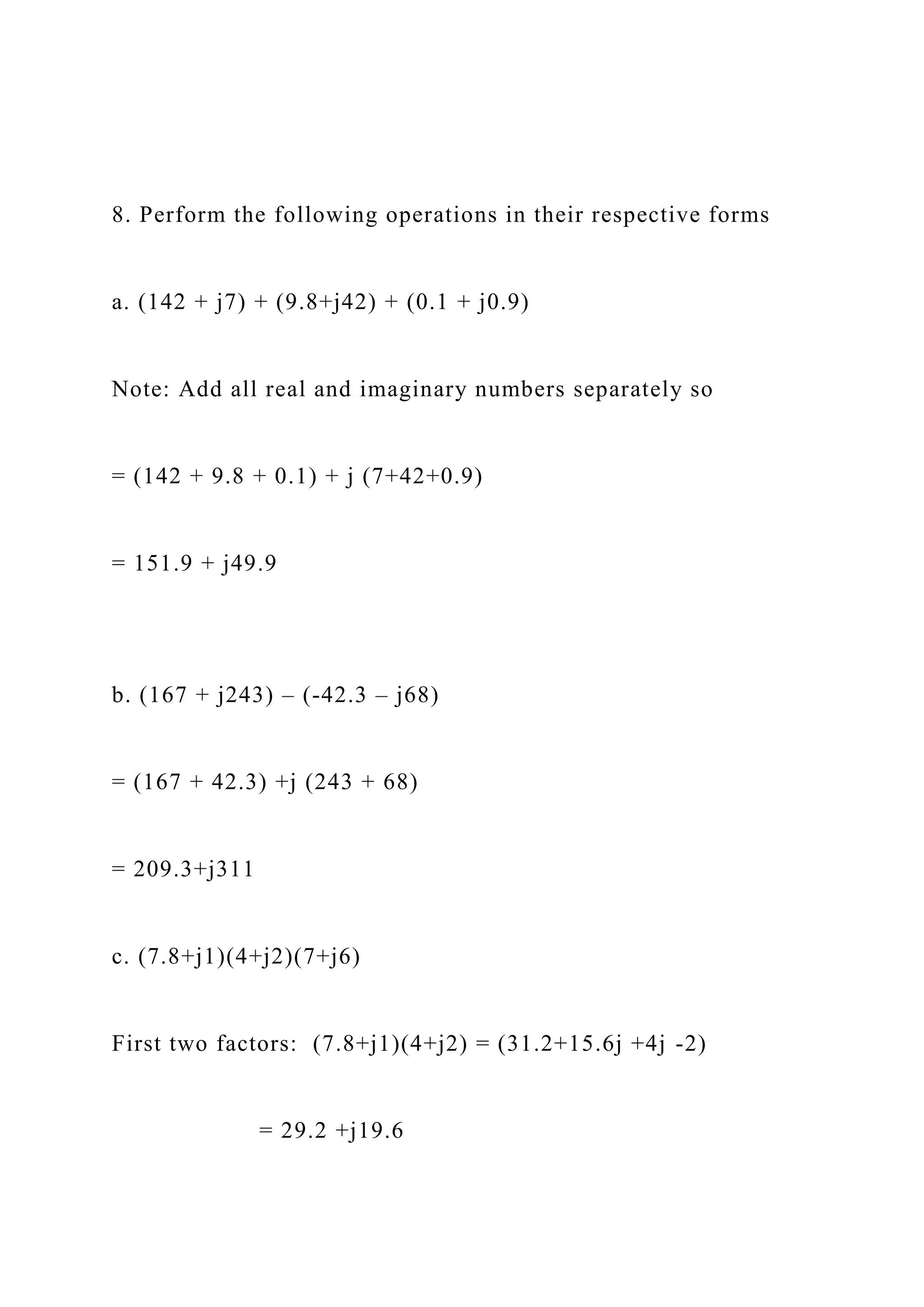
8. Perform the following operations in their respective forms
a. (142 + j7) + (9.8+j42) + (0.1 + j0.9)
Note: Add all real and imaginary numbers separately so
= (142 + 9.8 + 0.1) + j (7+42+0.9)
= 151.9 + j49.9
b. (167 + j243) – (-42.3 – j68)
= (167 + 42.3) +j (243 + 68)
= 209.3+j311
c. (7.8+j1)(4+j2)(7+j6)
First two factors: (7.8+j1)(4+j2) = (31.2+15.6j +4j -2)
= 29.2 +j19.6
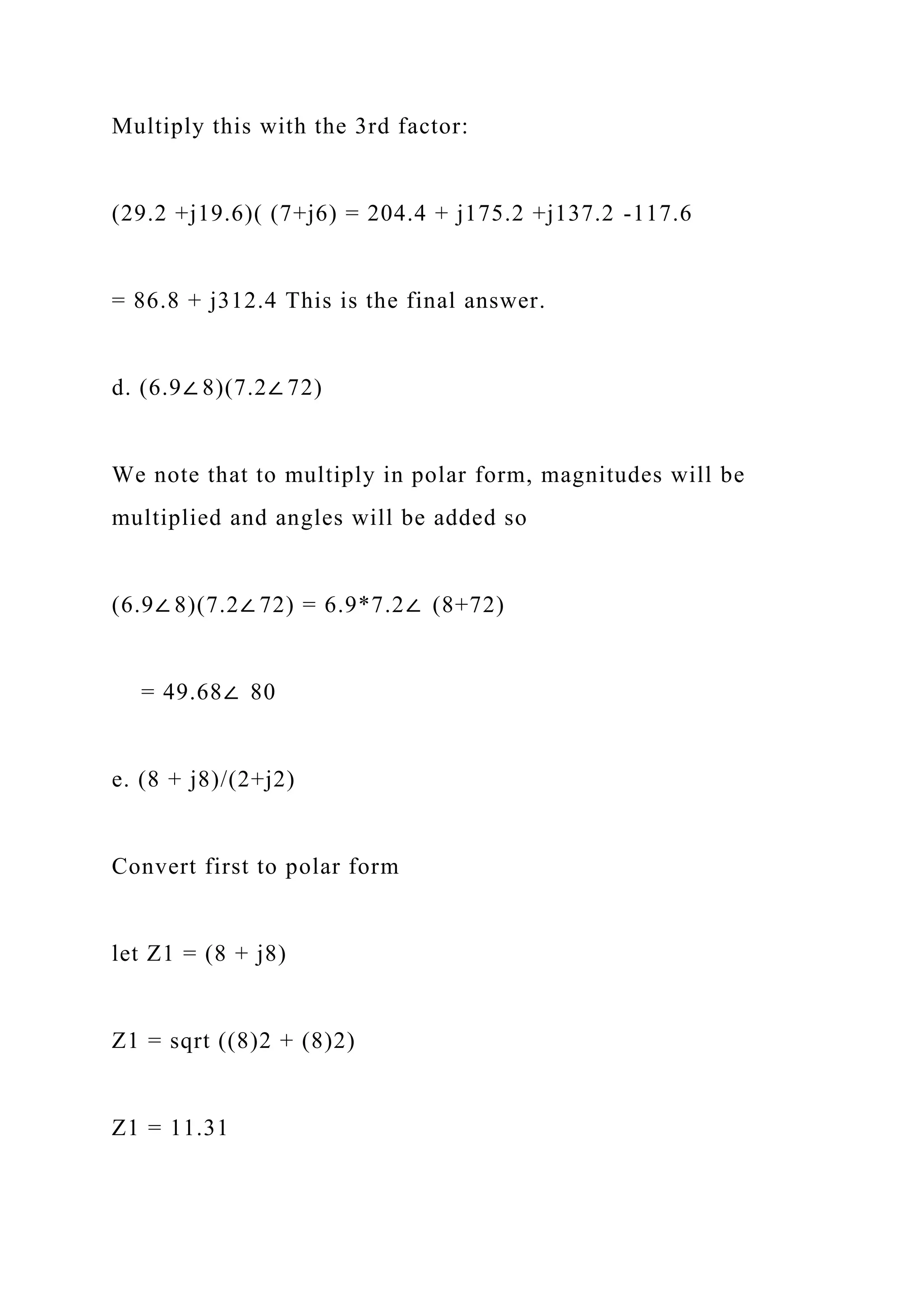
Multiply this with the 3rd factor:
(29.2 +j19.6)( (7+j6) = 204.4 + j175.2 +j137.2 -117.6
= 86.8 + j312.4 This is the final answer.
d. (6.9∠ 8)(7.2∠ 72)
We note that to multiply in polar form, magnitudes will be
multiplied and angles will be added so
(6.9∠ 8)(7.2∠ 72) = 6.9*7.2∠ (8+72)
= 49.68∠ 80
e. (8 + j8)/(2+j2)
Convert first to polar form
let Z1 = (8 + j8)
Z1 = sqrt ((8)2 + (8)2)
Z1 = 11.31
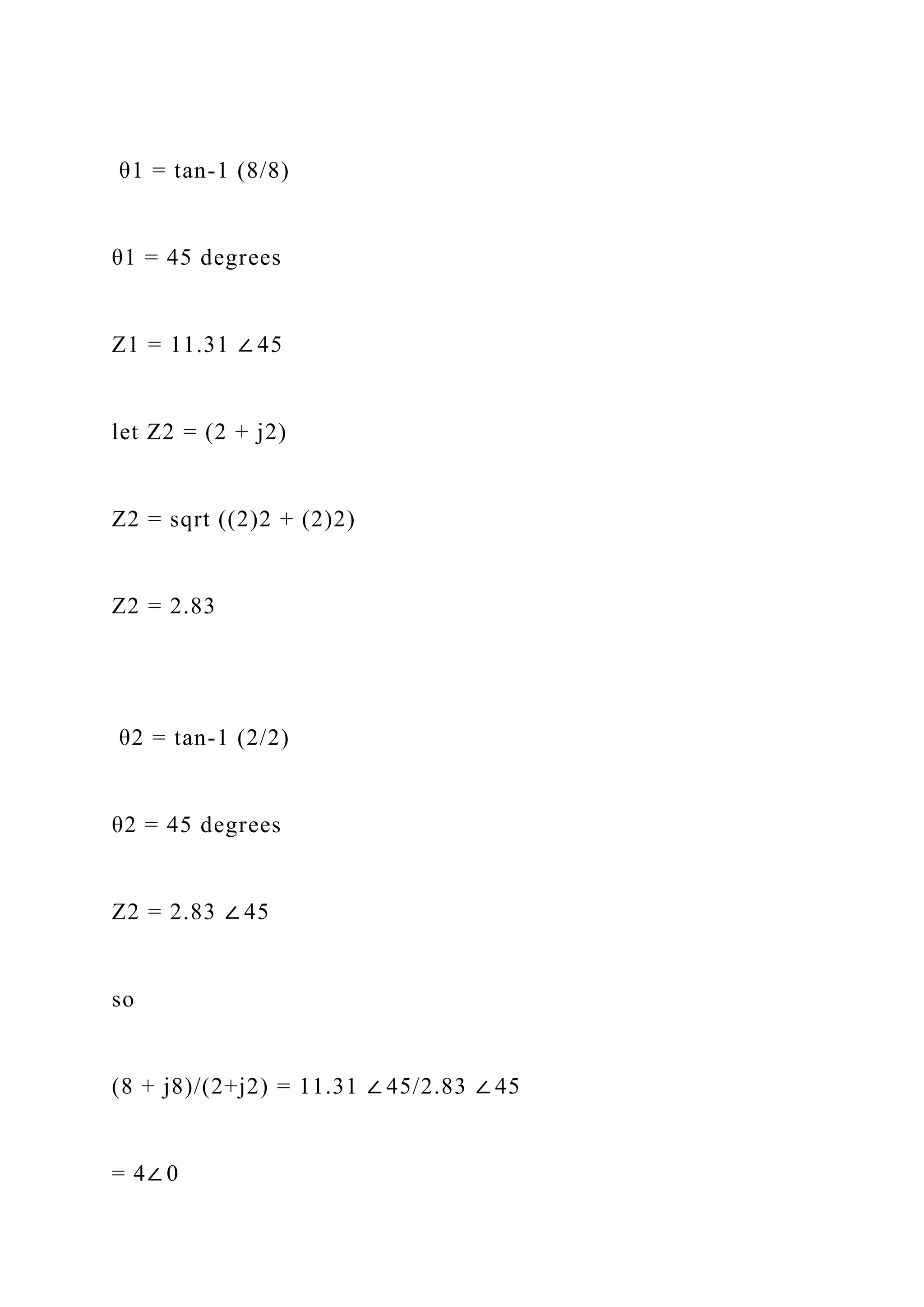
θ1 = tan-1 (8/8)
θ1 = 45 degrees
Z1 = 11.31 ∠ 45
let Z2 = (2 + j2)
Z2 = sqrt ((2)2 + (2)2)
Z2 = 2.83
θ2 = tan-1 (2/2)
θ2 = 45 degrees
Z2 = 2.83 ∠ 45
so
(8 + j8)/(2+j2) = 11.31 ∠ 45/2.83 ∠ 45
= 4∠ 0
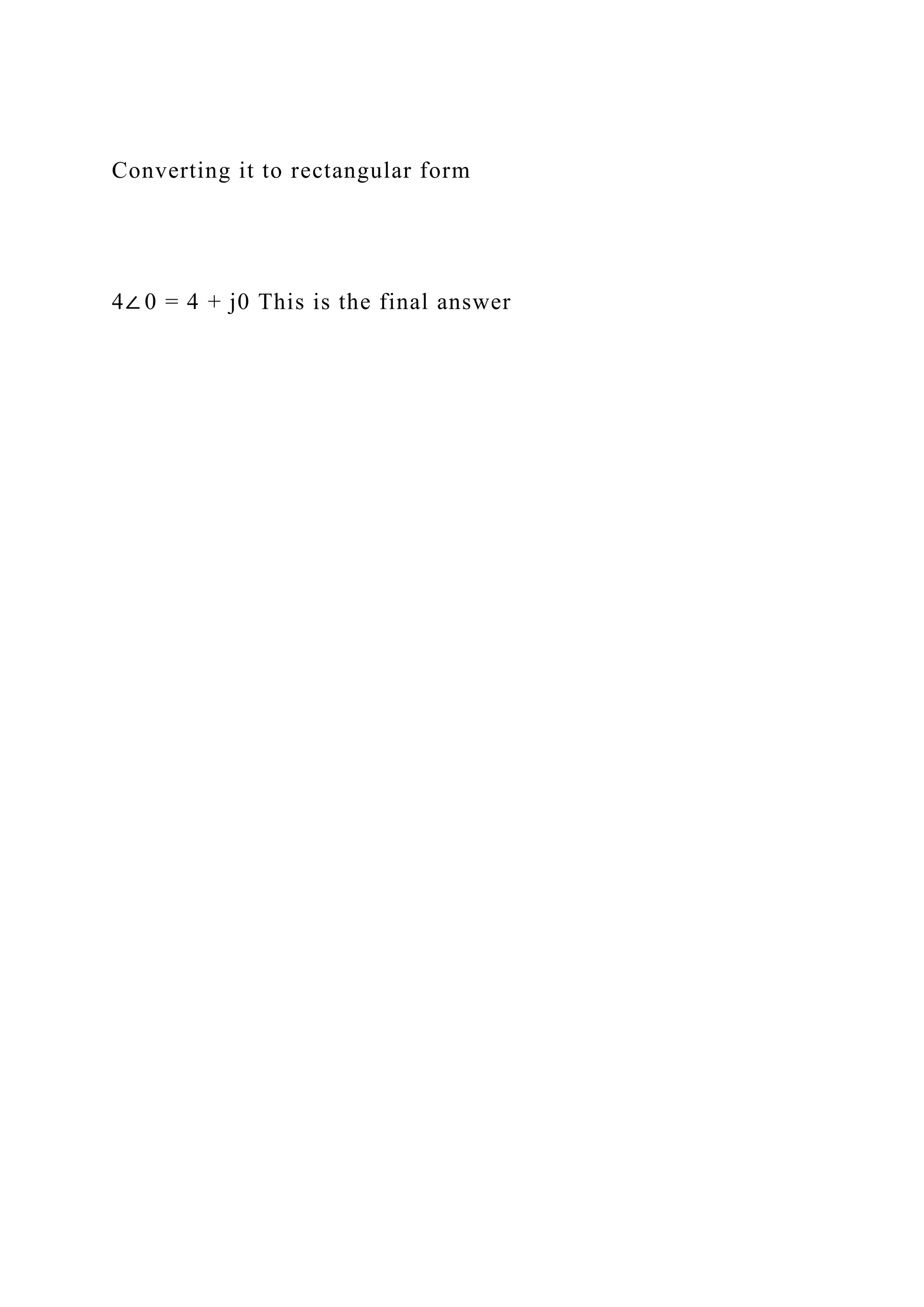
Converting it to rectangular form
4∠ 0 = 4 + j0 This is the final answer
SolutionsPlease see answer in bold letters.Note pi = 3.14.docx

SolutionsPlease see answer in bold letters.Note pi = 3.14.docx

  • 1.
    Solution s: Please see answerin bold letters. Note pi = 3.1415…. 1. The voltage across a 15Ω is as indicated. Find the sinusoidal expression for the current. In addition, sketch the v and i waveform on the same axis. Note: For the graph of a and b please see attached jpg photo with filename 1ab.jpg and for c and d please see attached photo with filename 1cd.jpg. a. 15sin20t v= 15sin20t
  • 2.
    By ohms law, i= v/r i = 15sin20t / 15 i = sin20t A Computation of period for graphing: v= 15sin20t i = sin20t w = 20 = 2pi*f f = 3.183 Hz Period =1/f = 0.314 seconds b. 300sin (377t+20) v = 300sin (377t+20)
  • 3.
    i = 300sin(377t+20) /15 i = 20 sin (377t+20) A Computation of period for graphing: v = 300sin (377t+20) i = 20 sin (377t+20) w = 377 = 2pi*f f = 60 Hz Period = 1/60 = 0.017 seconds shift to the left by: 2pi/0.017 = (20/180*pi)/x x = 9.44x10⁻⁴ seconds c. 60cos (wt+10)
  • 4.
    v = 60cos(wt+10) i = 60cos (wt+10)/15 i = 4cos (wt+10) A Computation of period for graphing: let’s denote the period as w sifted to the left by: 10/180*pi = pi/18 d. -45sin (wt+45) v = -45sin (wt+45) i = -45sin (wt+45) / 15 i = -3 sin (wt+45) A Computation of period for graphing: let’s denote the period as w sifted to the left by:
  • 5.
    45/180 * pi= 1/4*pi 2. Determine the inductive reactance (in ohms) of a 5mH coil for a. dc Note at dc, frequency (f) = 0 Formula: XL = 2*pi*fL XL = 2*pi* (0) (5m) XL = 0 Ω b. 60 Hz Formula: XL = 2*pi*fL XL = 2 (60) (5m) XL = 1.885 Ω
  • 6.
    c. 4kHz Formula: XL= 2*pi*fL XL = = 2*pi* (4k)(5m) XL = 125.664 Ω d. 1.2 MHz Formula: XL = 2*pi*fL XL = 2*pi* (1.2 M) (5m) XL = 37.7 kΩ 3. Determine the frequency at which a 10 mH inductance has the
  • 7.
    following inductive reactance. a.XL = 10 Ω Formula: XL = 2*pi*fL Express in terms in f: f = XL/2 pi*L f = 10 / (2pi*10m) f = 159.155 Hz b. XL = 4 kΩ f = XL/2pi*L f = 4k / (2pi*10m) f = 63.662 kHz c. XL = 12 kΩ f = XL/2piL
  • 8.
    f = 12k/ (2pi*10m) f = 190.99 kHz d. XL = 0.5 kΩ f = XL/2piL f = 0.5k / (2pi*10m) f = 7.958 kHz 4. Determine the frequency at which a 1.3uF capacitor has the following capacitive reactance. a. 10 Ω
  • 9.
    Formula: XC =1/ (2pifC) Expressing in terms of f: f = 1/ (2pi*XC*C) f = 1/ (2pi*10*1.3u) f = 12.243 kΩ b. 1.2 kΩ f = 1/ (2pi*XC*C) f = 1/ (2pi*1.2k*1.3u) f = 102.022 Ω c. 0.1 Ω f = 1/ (2pi*XC*C) f = 1/ (2pi*0.1*1.3u)
  • 10.
    f = 1.224MΩ d. 2000 Ω f = 1/ (2pi*XC*C) f = 1/ (2pi*2000*1.3u) f = 61.213 Ω 5. For the following pairs of voltage and current, indicate whether the element is a capacitor, an inductor and a capacitor, an inductor, or a resistor and find the value of C, L, or R if insufficient data are given. a. v = 55 sin (377t + 50) i = 11 sin (377t -40) Element is inductor In this case voltage leads current (ELI) by exactly 90 degrees so
  • 11.
    that means thecircuit is inductive and the element is inductor. XL = 55/11 = 5 Ω we know the w=2pif so w= 377=2pif f= 60 Hz To compute for the value of L, XL= 2pifL L = 5/ (2pi*60) L = 0.013 H b. Element is inductor In this case voltage leads current (ELI) by exactly 90 degrees so that means the circuit is inductive and the element is inductor.
  • 12.
    XL = 36/4= 9 Ω We know the w=2pif so w= 754=2pif f= 120 Hz To compute for the value of L, XL= 2pifL L = 9/ (2pi*120) L = 0.012 H c. v=10.5sin(wt-13) i = 1.5sin (wt-13) In this case, the voltage and current are in phase which means that the circuit is resistive only. So R = 10.5/1.5 = 7 Ω
  • 13.
    6. For thenetwork in the figure and the applied source: i = 12sin (102t + 45) a. Determine the sinusoidal expression for the source voltage vs w= 102 = 100 100 = 2pif f = 15.915 Hz First find individual inductive reactances: XL1 = 2pifL1 XL1 = 2pi(15.915 )(30 m) XL1 = 3 Ω XL2 = 2pifL2 XL2 = 2pi(15.915 )(90 m)
  • 14.
    XL1 = 9Ω Total reactance = XL = 9(3)/ (9+3) XL = 2.25 Ω so vs = 2.25*12sin(102t + 45) and knowing that voltage leads the current by 90 degrees in an inductor, the equation is vs = 27sin(100t +135o) volts b. Find the sinusoidal expression for i1 and i2 By Current Division Theorem: i1 = is [XL2/ (XL1+XL2)] i1 = 12sin (102t + 45) (9/ (9+3)) i1 = 9 sin (102t + 45) A i2 = is [XL1 /(XL1+XL2)] i2 = 12sin (102t + 45) (12/ (9+3))
  • 15.
    i2 = 3sin (102t + 45) A
  • 16.
    7. Convert thefollowing from rectangular to polar a. Z = -8-j16 let rectangular form Z= a + jb and polar form Z = |Z| ∠ θ where |Z| = sqrt ( a2 + b2 ) and θ = tan-1 (b/a) Z = sqrt [(-8)2 + (-16)2 ] Z = 17.89 θ = tan-1 (b/a) θ = tan-1 (-16/-8) θ = 64.43 degrees
  • 17.
    Since it isin third quadrant θ = 64.43 + 180 = 244.43 degrees In polar form: Z = 17.89∠ 244.43o b. Z = 0.02 – j0.003 Z = sqrt ((0.02)2 + (-0.003)2 ) Z = 0.0202 θ = tan-1 (b/a) θ = tan-1 (-0.003/0.02) θ = -8.53 degrees In polar form: Z = 0.0202∠ - 8.53o
  • 18.
    c. Z =-6*10-3 – j6*10-3 Z = sqrt ((-6*10-3)2 + (-6*10-3)2) Z = 8.485x10⁻³ θ = tan-1 (b/a) θ = tan-1 (-6*10-3/-6*10-3) θ = 45 degrees Since it is in third quadrant θ = 45 + 180 = 225 degrees In polar form: Z = 8.485x10⁻³ ∠ 225o d. Z = 200 + j0.02 Z = sqrt ((200)2 + (0.02)2) Z = 200
  • 19.
    θ = tan-1(0.02/200) θ = 5.73x10⁻³ degrees In polar form: Z = 200 ∠ 5.72x10⁻³ e. . Z = -1000+j20 Z = sqrt ((-1000)2 + (20)2 ) Z = 1000.20 θ = tan-1 (20/-1000) θ = -1.146 degrees Since it is in third quadrant θ = 180 -1.146 = 178.854 degrees In polar form: Z = 1000.20 ∠ 178.854 o
  • 20.
    8. Perform thefollowing operations in their respective forms a. (142 + j7) + (9.8+j42) + (0.1 + j0.9) Note: Add all real and imaginary numbers separately so = (142 + 9.8 + 0.1) + j (7+42+0.9) = 151.9 + j49.9 b. (167 + j243) – (-42.3 – j68) = (167 + 42.3) +j (243 + 68) = 209.3+j311 c. (7.8+j1)(4+j2)(7+j6) First two factors: (7.8+j1)(4+j2) = (31.2+15.6j +4j -2) = 29.2 +j19.6
  • 21.
    Multiply this withthe 3rd factor: (29.2 +j19.6)( (7+j6) = 204.4 + j175.2 +j137.2 -117.6 = 86.8 + j312.4 This is the final answer. d. (6.9∠ 8)(7.2∠ 72) We note that to multiply in polar form, magnitudes will be multiplied and angles will be added so (6.9∠ 8)(7.2∠ 72) = 6.9*7.2∠ (8+72) = 49.68∠ 80 e. (8 + j8)/(2+j2) Convert first to polar form let Z1 = (8 + j8) Z1 = sqrt ((8)2 + (8)2) Z1 = 11.31
  • 22.
    θ1 = tan-1(8/8) θ1 = 45 degrees Z1 = 11.31 ∠ 45 let Z2 = (2 + j2) Z2 = sqrt ((2)2 + (2)2) Z2 = 2.83 θ2 = tan-1 (2/2) θ2 = 45 degrees Z2 = 2.83 ∠ 45 so (8 + j8)/(2+j2) = 11.31 ∠ 45/2.83 ∠ 45 = 4∠ 0
  • 23.
    Converting it torectangular form 4∠ 0 = 4 + j0 This is the final answer