Solution Manual for Software Engineering, 9/E
9th Edition Ian Sommerville install download
https://testbankmall.com/product/solution-manual-for-software-
engineering-9-e-9th-edition-ian-sommerville/
Download more testbank from https://testbankmall.com
Instant digital products (PDF, ePub, MOBI) available
Download now and explore formats that suit you...
Quizzes for Software Engineering, 10/E 10th Edition Ian
Sommerville
https://testbankmall.com/product/quizzes-for-software-
engineering-10-e-10th-edition-ian-sommerville/
testbankmall.com
Software Engineering 10th Edition Sommerville Solutions
Manual
https://testbankmall.com/product/software-engineering-10th-edition-
sommerville-solutions-manual/
testbankmall.com
Solution Manual for Software Engineering: A Practitioner’s
Approach, 9th Edition, Roger Pressman Bruce Maxim
https://testbankmall.com/product/solution-manual-for-software-
engineering-a-practitioners-approach-9th-edition-roger-pressman-bruce-
maxim/
testbankmall.com
Law Business and Society 11th Edition McAdams Solutions
Manual
https://testbankmall.com/product/law-business-and-society-11th-
edition-mcadams-solutions-manual/
testbankmall.com
Solution Manual for PFIN, 7th Edition, Randall
Billingsley, Lawrence Gitman, Michael Joehnk
https://testbankmall.com/product/solution-manual-for-pfin-7th-edition-
randall-billingsley-lawrence-gitman-michael-joehnk/
testbankmall.com
Test Bank for Development Through the Lifespan 7th Edition
Laura E. Berk
https://testbankmall.com/product/test-bank-for-development-through-
the-lifespan-7th-edition-laura-e-berk/
testbankmall.com
Bank Management Koch 8th Edition Solutions Manual
https://testbankmall.com/product/bank-management-koch-8th-edition-
solutions-manual/
testbankmall.com
Fundamental Accounting Principles Wild Shaw 20th Edition
Test Bank
https://testbankmall.com/product/fundamental-accounting-principles-
wild-shaw-20th-edition-test-bank/
testbankmall.com
Financial Markets and Institutions Madura 10th Edition
Test Bank
https://testbankmall.com/product/financial-markets-and-institutions-
madura-10th-edition-test-bank/
testbankmall.com
Software Engineering 9 – Solutions Manual 8
8 Software Engineering 9 – Solutions Manual
©Ian Sommerville 2010
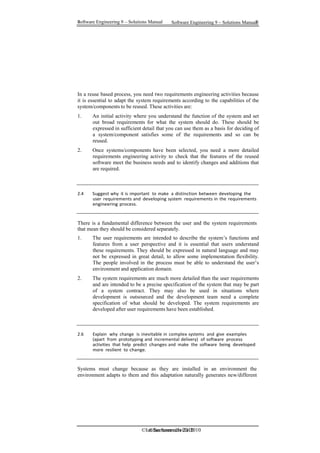
In a reuse based process, you need two requirements engineering activities because
it is essential to adapt the system requirements according to the capabilities of the
system/components to be reused. These activities are:
1. An initial activity where you understand the function of the system and set
out broad requirements for what the system should do. These should be
expressed in sufficient detail that you can use them as a basis for deciding of
a system/component satisfies some of the requirements and so can be
reused.
2. Once systems/components have been selected, you need a more detailed
requirements engineering activity to check that the features of the reused
software meet the business needs and to identify changes and additions that
are required.
2.4 Suggest why it is important to make a distinction between developing the
user requirements and developing system requirements in the requirements
engineering process.
There is a fundamental difference between the user and the system requirements
that mean they should be considered separately.
1. The user requirements are intended to describe the system’s functions and
features from a user perspective and it is essential that users understand
these requirements. They should be expressed in natural language and may
not be expressed in great detail, to allow some implementation flexibility.
The people involved in the process must be able to understand the user’s
environment and application domain.
2. The system requirements are much more detailed than the user requirements
and are intended to be a precise specification of the system that may be part
of a system contract. They may also be used in situations where
development is outsourced and the development team need a complete
specification of what should be developed. The system requirements are
developed after user requirements have been established.
2.6 Explain why change is inevitable in complex systems and give examples
(apart from prototyping and incremental delivery) of software process
activities that help predict changes and make the software being developed
more resilient to change.
Systems must change because as they are installed in an environment the
environment adapts to them and this adaptation naturally generates new/different
Software Engineering 9 – Solutions Manual 9
9 Software Engineering 9 – Solutions Manual
©Ian Sommerville 2010
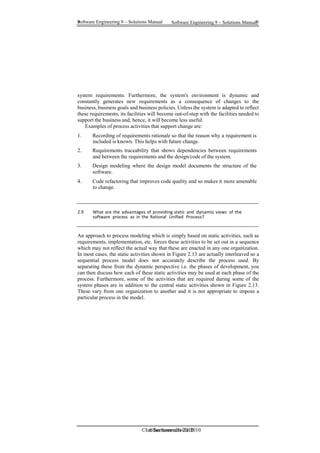
system requirements. Furthermore, the system's environment is dynamic and
constantly generates new requirements as a consequence of changes to the
business, business goals and business policies. Unless the system is adapted to reflect
these requirements, its facilities will become out-of-step with the facilities needed to
support the business and, hence, it will become less useful.
Examples of process activities that support change are:
1. Recording of requirements rationale so that the reason why a requirement is
included is known. This helps with future change.
2. Requirements traceability that shows dependencies between requirements
and between the requirements and the design/code of the system.
3. Design modeling where the design model documents the structure of the
software.
4. Code refactoring that improves code quality and so makes it more amenable
to change.
2.9 What are the advantages of providing static and dynamic views of the
software process as in the Rational Unified Process?
An approach to process modeling which is simply based on static activities, such as
requirements, implementation, etc. forces these activities to be set out in a sequence
which may not reflect the actual way that these are enacted in any one organization.
In most cases, the static activities shown in Figure 2.13 are actually interleaved so a
sequential process model does not accurately describe the process used. By
separating these from the dynamic perspective i.e. the phases of development, you
can then discuss how each of these static activities may be used at each phase of the
process. Furthermore, some of the activities that are required during some of the
system phases are in addition to the central static activities shown in Figure 2.13.
These vary from one organization to another and it is not appropriate to impose a
particular process in the model.
Software Engineering 9 – Solutions Manual
10
10 Software Engineering 9 – Solutions Manual
©Ian Sommerville 2010
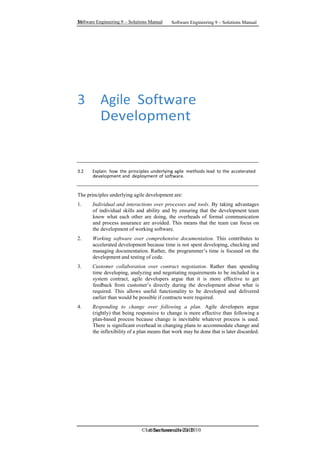
3 Agile Software
Development
3.2 Explain how the principles underlying agile methods lead to the accelerated
development and deployment of software.
The principles underlying agile development are:
1. Individual and interactions over processes and tools. By taking advantages
of individual skills and ability and by ensuring that the development team
know what each other are doing, the overheads of formal communication
and process assurance are avoided. This means that the team can focus on
the development of working software.
2. Working software over comprehensive documentation. This contributes to
accelerated development because time is not spent developing, checking and
managing documentation. Rather, the programmer’s time is focused on the
development and testing of code.
3. Customer collaboration over contract negotiation. Rather than spending
time developing, analyzing and negotiating requirements to be included in a
system contract, agile developers argue that it is more effective to get
feedback from customer’s directly during the development about what is
required. This allows useful functionality to be developed and delivered
earlier than would be possible if contracts were required.
4. Responding to change over following a plan. Agile developers argue
(rightly) that being responsive to change is more effective than following a
plan-based process because change is inevitable whatever process is used.
There is significant overhead in changing plans to accommodate change and
the inflexibility of a plan means that work may be done that is later discarded.
Other documents randomly have
different content
back
back
back
back
back
back
back
back
back
back
back
back
back
back
back
back

Solution Manual for Software Engineering, 9/E 9th Edition Ian Sommerville

  • 1.
    Solution Manual forSoftware Engineering, 9/E 9th Edition Ian Sommerville install download https://testbankmall.com/product/solution-manual-for-software- engineering-9-e-9th-edition-ian-sommerville/ Download more testbank from https://testbankmall.com
  • 2.
    Instant digital products(PDF, ePub, MOBI) available Download now and explore formats that suit you... Quizzes for Software Engineering, 10/E 10th Edition Ian Sommerville https://testbankmall.com/product/quizzes-for-software- engineering-10-e-10th-edition-ian-sommerville/ testbankmall.com Software Engineering 10th Edition Sommerville Solutions Manual https://testbankmall.com/product/software-engineering-10th-edition- sommerville-solutions-manual/ testbankmall.com Solution Manual for Software Engineering: A Practitioner’s Approach, 9th Edition, Roger Pressman Bruce Maxim https://testbankmall.com/product/solution-manual-for-software- engineering-a-practitioners-approach-9th-edition-roger-pressman-bruce- maxim/ testbankmall.com Law Business and Society 11th Edition McAdams Solutions Manual https://testbankmall.com/product/law-business-and-society-11th- edition-mcadams-solutions-manual/ testbankmall.com
  • 3.
    Solution Manual forPFIN, 7th Edition, Randall Billingsley, Lawrence Gitman, Michael Joehnk https://testbankmall.com/product/solution-manual-for-pfin-7th-edition- randall-billingsley-lawrence-gitman-michael-joehnk/ testbankmall.com Test Bank for Development Through the Lifespan 7th Edition Laura E. Berk https://testbankmall.com/product/test-bank-for-development-through- the-lifespan-7th-edition-laura-e-berk/ testbankmall.com Bank Management Koch 8th Edition Solutions Manual https://testbankmall.com/product/bank-management-koch-8th-edition- solutions-manual/ testbankmall.com Fundamental Accounting Principles Wild Shaw 20th Edition Test Bank https://testbankmall.com/product/fundamental-accounting-principles- wild-shaw-20th-edition-test-bank/ testbankmall.com Financial Markets and Institutions Madura 10th Edition Test Bank https://testbankmall.com/product/financial-markets-and-institutions- madura-10th-edition-test-bank/ testbankmall.com
  • 5.
    Software Engineering 9– Solutions Manual 8 8 Software Engineering 9 – Solutions Manual ©Ian Sommerville 2010 ©Ian Sommerville 2010 In a reuse based process, you need two requirements engineering activities because it is essential to adapt the system requirements according to the capabilities of the system/components to be reused. These activities are: 1. An initial activity where you understand the function of the system and set out broad requirements for what the system should do. These should be expressed in sufficient detail that you can use them as a basis for deciding of a system/component satisfies some of the requirements and so can be reused. 2. Once systems/components have been selected, you need a more detailed requirements engineering activity to check that the features of the reused software meet the business needs and to identify changes and additions that are required. 2.4 Suggest why it is important to make a distinction between developing the user requirements and developing system requirements in the requirements engineering process. There is a fundamental difference between the user and the system requirements that mean they should be considered separately. 1. The user requirements are intended to describe the system’s functions and features from a user perspective and it is essential that users understand these requirements. They should be expressed in natural language and may not be expressed in great detail, to allow some implementation flexibility. The people involved in the process must be able to understand the user’s environment and application domain. 2. The system requirements are much more detailed than the user requirements and are intended to be a precise specification of the system that may be part of a system contract. They may also be used in situations where development is outsourced and the development team need a complete specification of what should be developed. The system requirements are developed after user requirements have been established. 2.6 Explain why change is inevitable in complex systems and give examples (apart from prototyping and incremental delivery) of software process activities that help predict changes and make the software being developed more resilient to change. Systems must change because as they are installed in an environment the environment adapts to them and this adaptation naturally generates new/different
  • 6.
    Software Engineering 9– Solutions Manual 9 9 Software Engineering 9 – Solutions Manual ©Ian Sommerville 2010 ©Ian Sommerville 2010 system requirements. Furthermore, the system's environment is dynamic and constantly generates new requirements as a consequence of changes to the business, business goals and business policies. Unless the system is adapted to reflect these requirements, its facilities will become out-of-step with the facilities needed to support the business and, hence, it will become less useful. Examples of process activities that support change are: 1. Recording of requirements rationale so that the reason why a requirement is included is known. This helps with future change. 2. Requirements traceability that shows dependencies between requirements and between the requirements and the design/code of the system. 3. Design modeling where the design model documents the structure of the software. 4. Code refactoring that improves code quality and so makes it more amenable to change. 2.9 What are the advantages of providing static and dynamic views of the software process as in the Rational Unified Process? An approach to process modeling which is simply based on static activities, such as requirements, implementation, etc. forces these activities to be set out in a sequence which may not reflect the actual way that these are enacted in any one organization. In most cases, the static activities shown in Figure 2.13 are actually interleaved so a sequential process model does not accurately describe the process used. By separating these from the dynamic perspective i.e. the phases of development, you can then discuss how each of these static activities may be used at each phase of the process. Furthermore, some of the activities that are required during some of the system phases are in addition to the central static activities shown in Figure 2.13. These vary from one organization to another and it is not appropriate to impose a particular process in the model.
  • 7.
    Software Engineering 9– Solutions Manual 10 10 Software Engineering 9 – Solutions Manual ©Ian Sommerville 2010 ©Ian Sommerville 2010 3 Agile Software Development 3.2 Explain how the principles underlying agile methods lead to the accelerated development and deployment of software. The principles underlying agile development are: 1. Individual and interactions over processes and tools. By taking advantages of individual skills and ability and by ensuring that the development team know what each other are doing, the overheads of formal communication and process assurance are avoided. This means that the team can focus on the development of working software. 2. Working software over comprehensive documentation. This contributes to accelerated development because time is not spent developing, checking and managing documentation. Rather, the programmer’s time is focused on the development and testing of code. 3. Customer collaboration over contract negotiation. Rather than spending time developing, analyzing and negotiating requirements to be included in a system contract, agile developers argue that it is more effective to get feedback from customer’s directly during the development about what is required. This allows useful functionality to be developed and delivered earlier than would be possible if contracts were required. 4. Responding to change over following a plan. Agile developers argue (rightly) that being responsive to change is more effective than following a plan-based process because change is inevitable whatever process is used. There is significant overhead in changing plans to accommodate change and the inflexibility of a plan means that work may be done that is later discarded.
  • 8.
    Other documents randomlyhave different content
  • 9.
  • 10.
  • 11.
  • 12.
  • 13.
  • 15.
  • 16.
  • 17.
  • 18.
  • 20.
  • 21.
  • 22.
  • 23.
  • 25.
  • 27.
  • 29.