Solution Manual for Managerial Accounting 9th
Edition by Crosson download pdf
http://testbankbell.com/product/solution-manual-for-managerial-
accounting-9th-edition-by-crosson/
Visit testbankbell.com to explore and download the complete
collection of test banks or solution manuals!
We have selected some products that you may be interested in
Click the link to download now or visit testbankbell.com
for more options!.
Test Bank for Managerial Accounting, 9th Edition: Crosson
http://testbankbell.com/product/test-bank-for-managerial-
accounting-9th-edition-crosson/
Solution Manual for Managerial Accounting 6th Edition by
Hartgraves
http://testbankbell.com/product/solution-manual-for-managerial-
accounting-6th-edition-by-hartgraves/
Solution Manual for Managerial Accounting 7th Edition by
Mowen
http://testbankbell.com/product/solution-manual-for-managerial-
accounting-7th-edition-by-mowen/
Solution Manual for Juvenile Delinquency The Core, 6th
Edition
http://testbankbell.com/product/solution-manual-for-juvenile-
delinquency-the-core-6th-edition/
ATI RN Proctored Comprehensive Predictor 2019 Form C
http://testbankbell.com/product/ati-rn-proctored-comprehensive-
predictor-2019-form-c/
Solution Manual for Quantitative Analysis for Management
13th Edition by Render
http://testbankbell.com/product/solution-manual-for-quantitative-
analysis-for-management-13th-edition-by-render/
Test Bank for Psychology in Action 12th Edition Huffman
http://testbankbell.com/product/test-bank-for-psychology-in-
action-12th-edition-huffman/
Test Bank for Marketing 20th 2020 by Pride
http://testbankbell.com/product/test-bank-for-marketing-20th-2020-by-
pride/
Test Bank for Brock Biology of Microorganisms 12th Edition
by Madigan
http://testbankbell.com/product/test-bank-for-brock-biology-of-
microorganisms-12th-edition-by-madigan/
Entrepreneurship 2008 1st Edition Bygrave Test Bank
http://testbankbell.com/product/entrepreneurship-2008-1st-edition-
bygrave-test-bank/
© 2011 Cengage Learning. All Rights Reserved. May not be scanned, copied or duplicated, or posted to a publicly accessible website, in whole or in part.
SOLUTION MANUAL FOR MANAGERIAL
ACCOUNTING 9TH EDITION BY CROSSON
FULL DOWNLOAD LINK AT:
HTTPS://TESTBANKBELL.COM/PRODUCT/SOLUTION-MANUAL-FOR-
MANAGERIAL-ACCOUNTING-9TH-EDITION-BY-CROSSON/
CHAPTER 1
Uses of Accounting Information and the Financial Statements
PLANNING MATRIX
Learning Objective
Building Your
Basic Knowledge and Skills
Enhancing Your
Knowledge, Skills,
and Critical Thinking
1. Define accounting and describe its
role in making informed decisions,
identify business goals and activities,
and explain the importance of ethics
in accounting.
SE 1 E 1, 3 P 4, 5, 7,
9
C 1
C 6
2. Identify the users of accounting
information.
E 1, 3, 4 C 1
C 8
3. Explain the importance of business
transactions, money measure, and
separate entity.
SE 2 E 1, 5, 6,
7
C 2
4. Describe the characteristics of a
corporation.
SE 2, 3 E 1, 4, 6,
14
P 8
5. Define financial position, and state
the accounting equation.
SE 4, 5, 6,
7
E 2, 8, 9,
12, 14
C 6
6. Identify the four basic financial
statements.
SE 8, 9 E 2, 9, 10,
11, 13, 14
P 1, 2, 3,
4, 5, 6, 7,
8, 9
C 4
C 5
7. Explain how generally accepted
accounting principles (GAAP) and
international financial reporting
standards (IFRS) relate to financial
statements and the independent
CPA’s report, and identify the
organizations that influence GAAP.
E 2, 3, 15 P 5 C 3
C 6
C 7
C 8
2 Chapter 1: Uses of Accounting Information and the Financial Statements
© 2011 Cengage Learning. All Rights Reserved. May not be scanned, copied or duplicated, or posted to a publicly accessible website, in whole or in part.
MEMORANDA:
SE: Short Exercises
E: Exercises
P: Problems (Each problem has a User Insight question.)
C: Cases
All questions are in the text with related Learning Objectives (Stop, Think, and Apply).
SUGGESTED INSTRUCTIONAL STRATEGY
Output Skills Developed:
Technical, Interpersonal
Related Learning Objective:
6
Instructional Strategy
Learning activity: Group work, game
Learning environment: Interactive groups within classroom
Learning tool: Textbook assignment: Problem 4 or 7 or Case 5
Steps to Implement
1. Divide the class into small groups. One quick way to form groups is to divide the number of
students in class by three or four (the most effective group size for this activity). Ask students to
count off from 1 to the maximum number of groups. Remind them not to forget their number.
Have students get together after you give complete instructions. It will encourage a speedy
transition, as this activity has a time limit.
2. Assign one of the learning tools. (If one of the problems was done for homework, use another one
in this activity; it will reinforce learning.)
3. The first group to correctly complete the task wins. As the groups complete the task, they ask you
to mark their completion time. (You may want to keep their responses until the time limit has
expired. See Step 4.) The time limit is 25 minutes. If, for some reason, no group has the correct
response in 25 minutes, give them additional time as deemed appropriate.
4. The winning group could present the correct responses to the entire class using the solution
transparency and answer student questions. You may prefer to debrief this activity if time is
limited. If you have group responses, a quick check will identify where the problems are.
5. Reward each of the winning group members with one or two extra quiz points, “$100 Grand”
chocolate bars, novelty erasers, etc.
Assessment
Technical skills: Grade group written responses. Ask a related question on the next examination and/or
quiz.
Interpersonal skills: Ask students to answer one or more of the following: How well did your group
interact? How many were fully involved? What could your group do to improve next time?
Chapter 1: Uses of Accounting Information and the Financial Statements 3
© 2011 Cengage Learning. All Rights Reserved. May not be scanned, copied or duplicated, or posted to a publicly accessible website, in whole or in part.
RESOURCE MATERIALS AND OUTLINES
OBJECTIVE 1: Define accounting and describe its role in making informed decisions,
identify business goals and activities, and explain the importance of ethics in accounting.
Summary Statement
Accounting is an information system that measures, processes, and communicates financial information
about an economic entity. Accounting is a link between business activities and decision makers.
A business is an economic unit that aims to sell goods and services to customers at prices that will
provide an adequate return to its owners. The two major goals of all businesses are profitability and
liquidity. Profitability is the ability to earn enough income to attract and hold investment capital.
Liquidity is the ability to have sufficient cash to pay debts as they fall due. Businesses pursue their goals
by engaging in (1) operating activities, which include selling goods and services to customers,
employing managers and workers, and buying and producing goods and services; (2) investing
activities, which involve spending the capital a company receives in productive ways to help it achieve
its objectives; and (3) financing activities, which include obtaining funds to sustain operations. An
important function of accounting is to provide performance measures, which indicate whether
managers are achieving their business goals and whether the business activities are well managed.
The goal of accounting is to assist decision makers. Management accounting provides information to
internal decision makers, such as managers, whereas financial accounting communicates financial
information via financial statements to external decision makers. Most businesses publish financial
statements that report their profitability and financial position.
Accounting includes the design of an information system that meets the user’s needs.
Bookkeeping, a small but important aspect of accounting, deals with the mechanical, repetitive
recordkeeping process. A computer is an electronic device that rapidly collects, organizes, and
communicates vast amounts of information. A computer does not take the place of the accountant but
rather is a tool used by the accountant to perform both routine bookkeeping chores and complex
accounting calculations. A management information system (MIS) consists of the interconnected
subsystems that provide the information needed to run a business. The accounting information system is
an integral part of the management information system.
Ethics is the code of conduct that helps individuals in their everyday life distinguish right from wrong.
Ethics is especially important in preparing financial reports because users of these reports must depend
on the good faith of the people involved in their preparation. The intentional preparation of misleading
financial statements is called fraudulent financial reporting. It can result from the distortion of records,
falsified transactions, or the misapplication of various accounting principles.
In 2002, Congress passed the Sarbanes-Oxley Act to regulate financial reporting in public corporations.
This legislation requires the chief executives and chief financial officers of all publicly traded U.S.
companies to attest to the accuracy and completeness of the quarterly statements and annual reports that
their companies file with the SEC.
New Concepts and Terminology
accounting; business; profitability; liquidity; operating activities; investing activities; financing
activities; performance measures; management accounting; financial accounting; financial statements;
bookkeeping; management information system (MIS); ethics; fraudulent financial reporting; Sarbanes-
Oxley Act
4 Chapter 1: Uses of Accounting Information and the Financial Statements
© 2011 Cengage Learning. All Rights Reserved. May not be scanned, copied or duplicated, or posted to a publicly accessible website, in whole or in part.
Related Text Illustrations
Figure 1: Accounting as an Information System
Figure 2: Business Goals and Activities
Focus on Business Practice: What Does CVS Have to Say About Itself?
Focus on Business Practice: Cash Bonuses Depend on Accounting Numbers!
Focus on Business Practice: How Did Accounting Develop?
Lecture Outline
I. Accounting is an information system that measures, processes, and communicates financial
information.
A. Accounting is a link between business activities and decision makers.
B. Management must have a good understanding of accounting to set financial goals and make
financial decisions.
C. Management must not only understand how accounting information is compiled and
processed but also realize that accounting information is imperfect and should be interpreted
with caution.
II. A business is an economic unit that aims to sell goods and services to customers at prices that will
provide an adequate return to its owners.
A. Goals
1. Profitability—earning a sufficient return to maintain owner interest
2. Liquidity—having enough cash to pay debts as they come due
B. Activities
1. Operating—selling goods and services to customers; employing managers and
workers; buying and producing goods and services; and paying taxes
2. Investing—spending the capital a company receives in productive ways that help it
achieve its objectives
3. Financing—obtaining funds to begin operations and to continue operating
C. Performance measures
1. Performance measures relate to achieving goals and assessing the management of
business activities.
2. Financial analysis is the evaluation and interpretation of the financial statements and
related performance measures.
3. Performance measures must be crafted to motivate managers to make decisions that are
in the best interest of the business.
III. Categories of accounting
A. Management accounting—accounting information for internal decision makers
B. Financial accounting—accounting information for external decision makers; reports are
called financial statements.
IV. Ways in which accounting information is processed
A. Bookkeeping is the mechanical and repetitive recordkeeping aspect of accounting.
B. Computerized accounting
1. Computerized accounting is useful for routine bookkeeping chores and complex
accounting calculations.
2. Computerized information is only as useful as the data input into the system.
C. A management information system (MIS) consists of the interconnected subsystems that
provide the information needed to run a business.
V. Ethical financial reporting
A. Ethics is a code of conduct that addresses whether actions are right or wrong.
Chapter 1: Uses of Accounting Information and the Financial Statements 5
© 2011 Cengage Learning. All Rights Reserved. May not be scanned, copied or duplicated, or posted to a publicly accessible website, in whole or in part.
1. Ethics in the preparation of financial reports is important because users of these reports
must depend on the good faith of the people involved in their preparation.
2. The intentional preparation of misleading financial statements is called fraudulent
financial reporting.
3. Fraudulent financial reporting can result from the distortion of records, falsified
transactions, or the misapplication of various accounting principles.
4. The motivation for fraudulent financial reporting could be to inflate the perceived
value of a business, meet stockholders’ and financial analysts’ expectations, obtain
financing, or receive personal gain.
B. Congress passed the Sarbanes-Oxley Act in 2002 to regulate financial reporting in public
corporations.
Teaching Strategy
A good place to begin is by discussing business goals and activities. Case 1 provides a good foundation
for such discussion. This sets the stage for a discussion of accounting and how it helps businesses
achieve goals and perform activities. Figure 2 in the text illustrates business goals and activities.
Distinguish between profitability and liquidity and explain why a business must maintain both if it is to
survive. The key components of the AICPA’s definition of accounting are “useful,” “financial
information,” and “decisions.” This leads into the next learning objective, which focuses on those who
rely on accounting information for decision making.
Figure 1 in the text not only illustrates accounting as an information system but also indicates the
measurement, processing, and communication functions of accounting.
Students may have difficulty distinguishing between accounting and bookkeeping. Perhaps the use of a
Venn diagram, with bookkeeping as a small circle within a much larger circle identified as accounting,
will help them make the distinction. As they learn accounting, students will also tend to focus on the
bookkeeping aspects only. Remind them that theory, terminology, financial statement disclosure, and
other such topics also need to be learned.
Students often ask if computers have displaced accountants. Explain that although computers are a
useful tool, particularly for routine, repetitive processing, higher-level analytical skills are required to
interpret information, and professional judgment is required to make good decisions.
Distinguish between financial and managerial accounting. The discussion of internal versus external
users can be integrated with the next learning objective on the users of accounting information.
Be sure to mention management’s responsibility for ethical financial reporting, including the definition
of fraudulent financial reporting and the significance of the Sarbanes-Oxley Act.
Short Exercise 1 can be used in class to test students’ knowledge of terminology. Case 6 emphasizes the
importance of cash flows and the goal of liquidity.
OBJECTIVE 2: Identify the users of accounting information.
Summary Statement
Basically, three groups use accounting information: management, outsiders with a direct financial
interest, and outsiders with an indirect financial interest.
1. If a business is to survive, management must achieve profitability and liquidity. The company also
has other goals, such as improving its products and expanding operations. Management directs the
company toward these goals by making the right decisions.
6 Chapter 1: Uses of Accounting Information and the Financial Statements
© 2011 Cengage Learning. All Rights Reserved. May not be scanned, copied or duplicated, or posted to a publicly accessible website, in whole or in part.
2. Present or potential investors and present or potential creditors are considered outside users with a
direct financial interest in a business. Investors use financial statements to assess the strength or
weakness of the company, whereas creditors examine the financial statements to determine the
company’s ability to repay loans at the appropriate time.
3. Society as a whole, through its government officials and public groups, may be viewed as a
financial statement user with an indirect financial interest in a business. Specifically, society
includes (a) tax authorities, (b) regulatory agencies, and (c) other groups (such as labor unions and
financial analysts). The Securities and Exchange Commission (SEC), a regulatory agency, has
extensive reporting requirements for public companies.
Managers in government and not-for-profit organizations such as hospitals, universities, professional
organizations, and charities also make extensive use of financial information. In addition to financing,
investing, and operating activities, these organizations have reporting responsibilities to authoritative
bodies that hold them accountable for their financial performance.
New Concepts and Terminology
management; Securities and Exchange Commission (SEC)
Related Text Illustrations
Figure 3: The Users of Accounting Information
Focus on Business Practice: What Do CFOs Do?
Lecture Outline
I. Three major groups use accounting information.
A. Management (internal users)
B. Outsiders with a direct financial interest
1. Present or potential investor
2. Present or potential creditors
C. People, organizations, and agencies with an indirect financial interest
1. Tax authorities
2. Regulatory agencies
a. Securities and Exchange Commission (SEC)
3. Other groups (labor unions, financial advisers, economic planners, etc.)
II. Government and not-for-profit organizations also use financial information.
Teaching Strategy
An interesting way to present this learning objective is to ask students to name the many users of
financial information while you keep a list on the board (or overhead transparency, etc.). Students
should know that the list in Figure 3 of the text, although ambitious, is not exhaustive. At the same
time, you may want to ask them why each user would seek a company’s financial information and
whether each user is more interested in assessing profitability or liquidity.
Making the distinction between direct and indirect users, and between internal and external users, is
helpful. Ask students how they have used accounting information.
Case 1 applies Learning Objectives 1 and 2 to a real-world company, Costco.
Chapter 1: Uses of Accounting Information and the Financial Statements 7
© 2011 Cengage Learning. All Rights Reserved. May not be scanned, copied or duplicated, or posted to a publicly accessible website, in whole or in part.
OBJECTIVE 3: Explain the importance of business transactions, money measure, and
separate entity.
Summary Statement
To make an accounting measurement, the accountant must answer the following questions:
1. What is measured?
2. When should the measurement be made?
3. What value should be placed on what is measured?
4. How should what is measured be classified?
Accounting is concerned with measuring specific transactions of specific business entities in terms of
money. Business transactions are economic events that affect the financial position of the business.
Business transactions may involve exchanges of value (e.g., sales, borrowings, and purchases) or
nonexchanges (the physical wear and tear on machinery and losses resulting from fire or theft).
The money measure concept states that business transactions should be recorded in terms of money.
Financial statements are normally prepared in terms of the monetary unit of the business’s country
(dollars, pesos, etc.). When transactions occur between countries using different monetary units, the
amounts must be translated from one currency to another using the appropriate exchange rate.
For accounting purposes, a business is treated as a separate entity, distinct from its owners, creditors,
and customers.
New Concepts and Terminology
business transactions; money measure; exchange rate; separate entity
Related Text Illustration
Table 1: Examples of Foreign Exchange Rates
Lecture Outline
I. Four questions must be answered to make an accounting measurement.
A. What is measured?
B. When should the measurement be made?
C. What value should be placed on what is measured?
D. How should what is measured be classified?
II. A business transaction is an economic event that affects a business’s financial position.
A. It may involve an exchange of value (a purchase, sale, payment, collection, or loan).
B. Alternatively, it may involve a “nonexchange” of value (physical wear and tear or losses
from fire, flood, explosion, and theft).
III. The money measure concept states that a business transaction should be recorded in terms of
money.
A. Transactions between countries must involve the translation of amounts of money using the
appropriate exchange rate.
IV. In accounting, a business is treated as a separate entity from its owners, creditors, and customers.
Teaching Strategy
List the four questions that must be answered before an accounting measurement can be made. Perhaps
you can provide a sample transaction and have your students answer these questions. Students will
already have a feel for what a business transaction is, but they probably will not know the difference
8 Chapter 1: Uses of Accounting Information and the Financial Statements
© 2011 Cengage Learning. All Rights Reserved. May not be scanned, copied or duplicated, or posted to a publicly accessible website, in whole or in part.
between an exchange and a nonexchange transaction, so providing several examples may help. Refer to
Table 1 on exchange rates, explain how they are used, and point out that they change daily. Explain
how euros are replacing many European currencies. Obtain copies of annual reports prepared in other
currencies to show students. Asking students to supplement the list of countries and their respective
currencies in Table 1 may invite input from students of diverse backgrounds and is an opportunity to
stress the global nature of business today.
Finally, explain that for accounting purposes, a business and its owner(s) are always considered
separate entities. This concept can be reinforced by telling students that maintaining the separation
between business and owner is often a challenge in a small family business when its owners write a
check on the business’s account for groceries or take a computer home or give their children a company
automobile to drive. In the next learning objective, students learn that for legal purposes, a sole
proprietorship or a partnership and its owners are not considered separate.
Exercise 5 is a good one to reinforce the nature of a business transaction. Case 2 on the concept of an
asset, using Southwest Airlines as an example, is excellent for class discussion.
OBJECTIVE 4: Describe the characteristics of a corporation.
Summary Statement
The three basic forms of business organization are sole proprietorships, partnerships, and corporations.
Accountants recognize each form as an economic unit separate from its owners. A sole proprietorship
is an unincorporated business owned by one person. A partnership is much like a sole proprietorship,
except that it has two or more owners. A corporation, unlike a sole proprietorship or partnership, is a
business unit chartered by the state and legally separate from its owners (the stockholders).
In this book, we begin with accounting for the sole proprietorship because it is the simplest form of
accounting. At critical points, however, we call attention to its essential differences from accounting for
partnerships and corporations.
New Concepts and Terminology
sole proprietorship; partnership; corporation;
Related Text Illustrations
Figure 4: Number and Receipts of U.S. Proprietorships, Partnerships, and Corporations
Focus on Business Practice: Are Most Corporations Big or Small Businesses?
Lecture Outline
I. There are three basic forms of business organization.
A. Sole proprietorship—one owner
1. The owner takes all of the profits or losses of the business
2. The owner also has unlimited liability
B. Partnership—two or more owners
1. In a partnership two or more owners share profits or losses based on a predetermined
arrangement
2. Unlimited liability can be avoided by forming a limited liability partnership
C. Corporation—owned by many owners (the stockholders) but managed by a board of
directors
1. A corporation is a business unit chartered by the state (when articles of incorporation
are filed) and considered a separate legal entity from its owners.
2. The liability of corporate stockholders is limited to their investment.
Chapter 1: Uses of Accounting Information and the Financial Statements 9
© 2011 Cengage Learning. All Rights Reserved. May not be scanned, copied or duplicated, or posted to a publicly accessible website, in whole or in part.
a) A share of stock is a unit of ownership in a corporation.
b) Common stock is the most universal form of stock.
3. The board of directors sets corporate policy and declares dividends.
4. The authority to manage a corporation is given by the owners and board of directors to
the corporate management. Corporate governance is the oversight of a corporation’s
management; ethics is the oversight of the board of directors.
5. A provision of the Sarbanes-Oxley Act requires boards of directors to establish an
audit committee to ensure that the board is objective in evaluating management
performance.
Teaching Strategy
Point out that the sole proprietorship and the partnership are similar in many respects, but that the
corporation is significantly different from the other two forms of business organization (in terms of
formation, owners’ liability, duration, transfer of ownership, and legal entity). Students have difficulty
understanding the difference between the concepts of separate legal entities and separate accounting
entities. Students often think that corporations always have multiple owners.
Relate material to the traditional form of organization of CPA firms. Tell students that pending
legislation would permit CPA firms to incorporate. Ask students why firms might prefer incorporation.
Exercise 6 reviews the concepts from Learning Objectives 3 and 4.
OBJECTIVE 5: Define financial position, and state the accounting equation.
Summary Statement
Financial position refers to the relationship between economic resources and equities at a given time,
which is shown on the balance sheet. The accounting equation shows this relationship in mathematical
form. The basic accounting equation is as follows:
Assets = Liabilities + Stockholders’ Equity
Other forms of the equation are:
Assets – Liabilities = Stockholders’ Equity
Assets – Stockholders’ Equity = Liabilities
The left side of the basic accounting equation shows the resources (assets) of the business; the right side
shows who provided these resources. The resource provider consists of owner (listed under
“stockholders’ equity”) and creditors (evidenced by the existence of “liabilities”). Therefore, it is
logical that the total dollar amount of assets must equal the total dollar amount of liabilities plus
stockholders’ equity.
Assets are the economic resources of a business. Examples of assets are cash, accounts receivable,
inventory, buildings, equipment, patents, and copyrights.
Liabilities are the present obligations of a business. Examples of liabilities are money borrowed from
banks, amounts owed to creditors for goods or services bought on credit, and taxes owed to the
government.
Stockholders’ equity represents the claims of the owner of a sole proprietorship to the assets of the
business. It is equal to the net assets, or the assets that would be left after all liabilities are paid.
Stockholders’ equity consists of the initial investment made by the owner, any subsequent contributions
or investments made into the business, and earnings not distributed back to the owner in the form of
dividends since the business’ inception.
10 Chapter 1: Uses of Accounting Information and the Financial Statements
© 2011 Cengage Learning. All Rights Reserved. May not be scanned, copied or duplicated, or posted to a publicly accessible website, in whole or in part.
After the stockholders’ investment, earnings that have been generated by the business’s income-
producing activities and kept for use in the business are added to stockholders’ equity. Stockholders’
equity is affected by three kinds of operating transactions: revenues, expenses, and dividends. Revenues
are the increases in stockholders’ equity resulting from the operation of the business. Expenses are the
decreases in stockholders’ equity that result from operating a business. When revenues exceed
expenses, the difference is called net income; when expenses exceed revenues, the difference is called
net loss.
New Concepts and Terminology
financial position; accounting equation; assets; liabilities; stockholders’ equity; net assets; revenues;
expenses; net income; net loss
Related Text Illustrations
Figure 5: The Accounting Equation
Lecture Outline
I. A balance sheet discloses a business’s financial position by showing the relationship among
assets, liabilities, and stockholders’ equity.
II. The accounting equation is Assets = Liabilities + Stockholders’ Equity.
III. Assets are a company’s economic resources, such as cash, receivables, inventory, and
equipment.
IV. Liabilities are the present obligations of a business, such as amounts owed to banks, suppliers,
employees, and others.
V. Stockholders’ equity represents the claims of the owner of a business to the net assets of the
business. It is made up of the stockholders’ investment and all earnings not paid back to the
stockholders in the form of dividends.
VI. Net income is the excess of revenues over expenses; net loss is the excess of expenses over
revenues.
Teaching Strategy
To explain the concepts of financial position, the accounting equation, and the balance sheet, you can
point out that all three represent two ways of looking at the same company: the assets are the resources
of the company (the essence of which is “expected future benefit”), and the liabilities and stockholders’
equity represent those who provided the resources (creditors and the owner).
To reinforce the elements of the accounting equation, use a local business and ask students what assets
and liabilities it is likely to have. Students have difficulty grasping the concept of equity. Explain that it
is a number that represents something and tell what it represents.
To illustrate the effects of transactions on the balance sheet equation, you may wish to discuss an end-
of-chapter problem (such as Problem 2s) in which the balance sheet equation is updated for each
transaction. Be sure to total columns after each transaction to illustrate that the accounting equation
must always be in balance. A common misconception is that each transaction must have an increase and
a decrease.
Students should be reminded that, although revenues and expenses have an effect on stockholders’
equity, they do not appear on the balance sheet.
Short Exercises 6 and 7 and Exercise 8 are very good for in-class work.
Chapter 1: Uses of Accounting Information and the Financial Statements 11
© 2011 Cengage Learning. All Rights Reserved. May not be scanned, copied or duplicated, or posted to a publicly accessible website, in whole or in part.
OBJECTIVE 6: Identify the four basic financial statements.
Summary Statement
Accountants communicate their information through financial statements. The four basic statements are
the income statement, the statement of stockholders’ equity, the balance sheet, and the statement of
cash flows.
The income statement, whose components are revenues and expenses, is perhaps the most important
financial statement. Its purpose is to measure a business’s profitability during a given period of time.
The net income or net loss is used to update retained earnings on the statement of retained earnings. Net
income (loss) also appears on the statement of cash flows.
The statement of stockholders’ equity is a calculation of the changes in stockholders’ capital during the
accounting period. Stockholders’ capital at the beginning of the period is the first item on the statement,
followed by an addition for net income and a deduction for dividends. The ending figure is transferred
to the stockholders’ equity section of the balance sheet.
The balance sheet shows the financial position of a business on a specific date. The resources used in
the business are called assets, debts of the business are called liabilities, and the stockholders’ financial
interest in the business is called stockholders’ equity. Changes that occur in these accounts are reflected
in the statement of cash flows.
The statement of cash flows provides users with information about the business’s liquidity by disclosing
all important financing, investing, and operating activities that affect its cash balance during the
accounting period. Cash flows are the inflows and outflows of cash into and out of a business.
Financing activities may include issuing or repaying debt. Investing activities may include selling a
building or investing in stock. Operating activities include receipts from customers and payments to
suppliers and others in the ordinary course of business.
Every financial statement has a three-line heading. The first line gives the name of the company, the
second line gives the name of the statement, and the third line gives the relevant dates (the date of the
balance sheet or the period of time covered by the other three statements).
Short Exercise 9 shows the interrelationship of the financial statements. Cases 5 and 6 are good
summary cases for this chapter.
New Concepts and Terminology
income statement; statement of stockholders’ equity; balance sheet; statement of cash flows; cash flows
Related Text Illustrations
Exhibit 1: Income Statement for Weiss Consultancy
Exhibit 2: Statement of Retained Earnings for Weiss Consultancy
Exhibit 3: Balance Sheet for Weiss Consultancy
Exhibit 4: Statement of Cash Flows for Weiss Consultancy
Exhibit 5: Income Statement, Statement of Retained Earnings, Balance Sheet, and Statement of Cash
Flows for Weiss Consultancy
Lecture Outline
I. There are four basic financial statements that are interrelated.
A. Income statement (also known as the statement of earnings or the profit and loss statement)
1. Shows revenues earned and expenses incurred for a period of time
12 Chapter 1: Uses of Accounting Information and the Financial Statements
© 2011 Cengage Learning. All Rights Reserved. May not be scanned, copied or duplicated, or posted to a publicly accessible website, in whole or in part.
2. Indicates profit or loss for an accounting period
B. Statement of retained earnings (also known as the capital statement)
1. Shows changes in the retained earnings over a period of time
C. Balance sheet (also known as the statement of financial position)
1. Usually prepared as of the last day of the accounting period to show the organization’s
financial position (or status) as of that specific date
2. Reflects the accounting equation in its structure
D. Statement of cash flows
1. Presents significant financing, investing, and operating activities (cash-generating and
cash-using activities) during a given period
2. Explains the reasons for changes in the organization’s cash during an accounting
period
Teaching Strategy
Explain the purpose of each financial statement and discuss how each is used by various user groups
vis-à-vis evaluating profitability and liquidity. Then refer to Exhibit 5 in the text to show the
relationship among the income statement, the statement of stockholders’ equity, the balance sheet, and
the statement of cash flows. For example, students need to know why the income statement must be
prepared first. Point out the common elements that appear on more than one statement. Stress that it is
the ending stockholders’ equity that appears on the balance sheet. Distinguish between a specific date
and a period of time. Since the assets and liabilities of a business are changing from moment to
moment, it is necessary to choose a cutoff date on which to measure them.
Distinguish between net income on the income statement and net cash flows from operating activities
on the statement of cash flows.
An end-of-chapter case (such as Case 5) can be used for reinforcement purposes.
OBJECTIVE 7: Explain how generally accepted accounting principles (GAAP) and
international financial reporting standards (IFRS) relate to financial statements and the
independent CPA’s report, and identify the organizations that influence GAAP.
Summary Statement
Generally accepted accounting principles (GAAP) are the conventions, rules, and procedures that
define acceptable accounting practice at a particular time. They arise from wide agreement on the
theory and practice of accounting at a given time. These principles change continually as business
conditions change and practices improve.
The financial statements of publicly held corporations are prepared by management but audited by a
licensed professional, called a certified public accountant (CPA), so that the statements can be made
more believable to the users. Before the audit (examination) can take place, however, the CPA must be
independent of (without financial or other ties to) the client. On completion of the audit, the CPA
reports whether the audited statements are “presented fairly in all material respects” and are “in
conformity with generally accepted accounting principles.” Because estimates and interpretations are
made in the application of GAAP, auditors must employ their professional judgment in rendering an
opinion.
The Public Company Accounting Oversight Board (PCAOB) is a governmental body created by the
Sarbanes-Oxley Act to regulate the accounting profession.
The Financial Accounting Standards Board (FASB), an independent body, is the authoritative body in
the development of GAAP. The FASB issues Statements of Financial Accounting Standards.
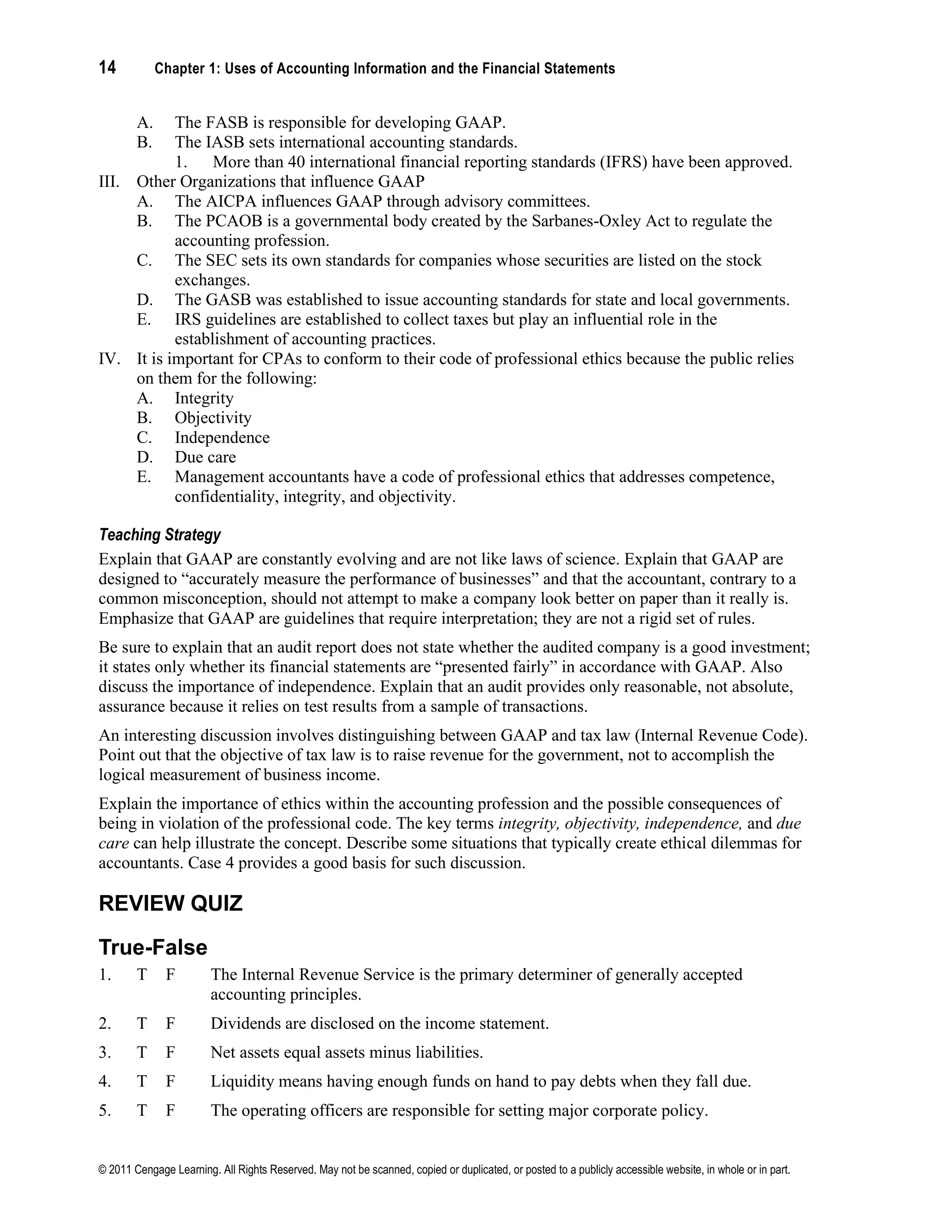
Chapter 1: Uses of Accounting Information and the Financial Statements 13
© 2011 Cengage Learning. All Rights Reserved. May not be scanned, copied or duplicated, or posted to a publicly accessible website, in whole or in part.
The American Institute of Certified Public Accountants (AICPA), the professional association of CPAs,
influences accounting practice through the activities of its senior technical committees.
The Securities and Exchange Commission (SEC) is an agency of the federal government that has the
legal power to set and enforce accounting practices for companies whose securities are traded by the
general public.
The Governmental Accounting Standards Board (GASB) was established in 1984 and is responsible for
issuing accounting standards for state and local governments.
Spurred by the growth of financial markets worldwide, the International Accounting Standards Board
(IASB) develops international accounting standards.
The Internal Revenue Service (IRS) has its own set of rules that govern the assessment and collection of
taxes. These rules, while sometimes contrary to GAAP, are an important influence on accounting
practice.
Professional ethics is the application of a code of conduct to the practice of a profession. The
accounting profession has developed a code that is intended to guide the accountant in carrying out his
or her responsibilities to the public. In conformity with the AICPA’s code for CPAs, the accountant
must act with integrity, objectivity, independence, and due care.
1. Integrity means the accountant is honest, regardless of consequences.
2. Objectivity means the accountant is impartial and intellectually honest in performing his or her
job.
3. Independence means the accountant avoids all relationships that could impair, or even appear to
impair, his or her objectivity, such as owning stock in a company being audited.
4. Due care means carrying out professional responsibilities with competence and diligence.
The Institute of Management Accountants (IMA) has a code of professional ethics, which stipulates that
management accountants are to be competent in their jobs, to keep information confidential, to maintain
integrity and avoid conflicts of interest, and to communicate information objectively and without bias.
New Concepts and Terminology
generally accepted accounting principles (GAAP); certified public accountant (CPA); audit; Financial
Accounting Standards Board (FASB); International Accounting Standards Board (IASB); international
financial reporting standards (IFRS); American Institute of Certified Public Accountants (AICPA);
Public Company Accounting Oversight Board (PCAOB); Securities and Exchange Commission (SEC);
Governmental Accounting Standards Board (GASB); Internal Revenue Service (IRS); professional
ethics; integrity; objectivity; independence; due care; Institute of Management Accountants (IMA);
corporate governance, audit committee
Related Text Illustration
Table 2: Large International Certified Public Accounting Firms
Lecture Outline
I. GAAP are the conventions, rules, and procedures that define acceptable accounting practice at a
particular time.
A. CPAs perform independent audits of businesses’ financial statements.
B. An audit results in a professional opinion as to whether the financial statements are in
accordance with GAAP.
II. Organizations that issue accounting standards
14 Chapter 1: Uses of Accounting Information and the Financial Statements
© 2011 Cengage Learning. All Rights Reserved. May not be scanned, copied or duplicated, or posted to a publicly accessible website, in whole or in part.
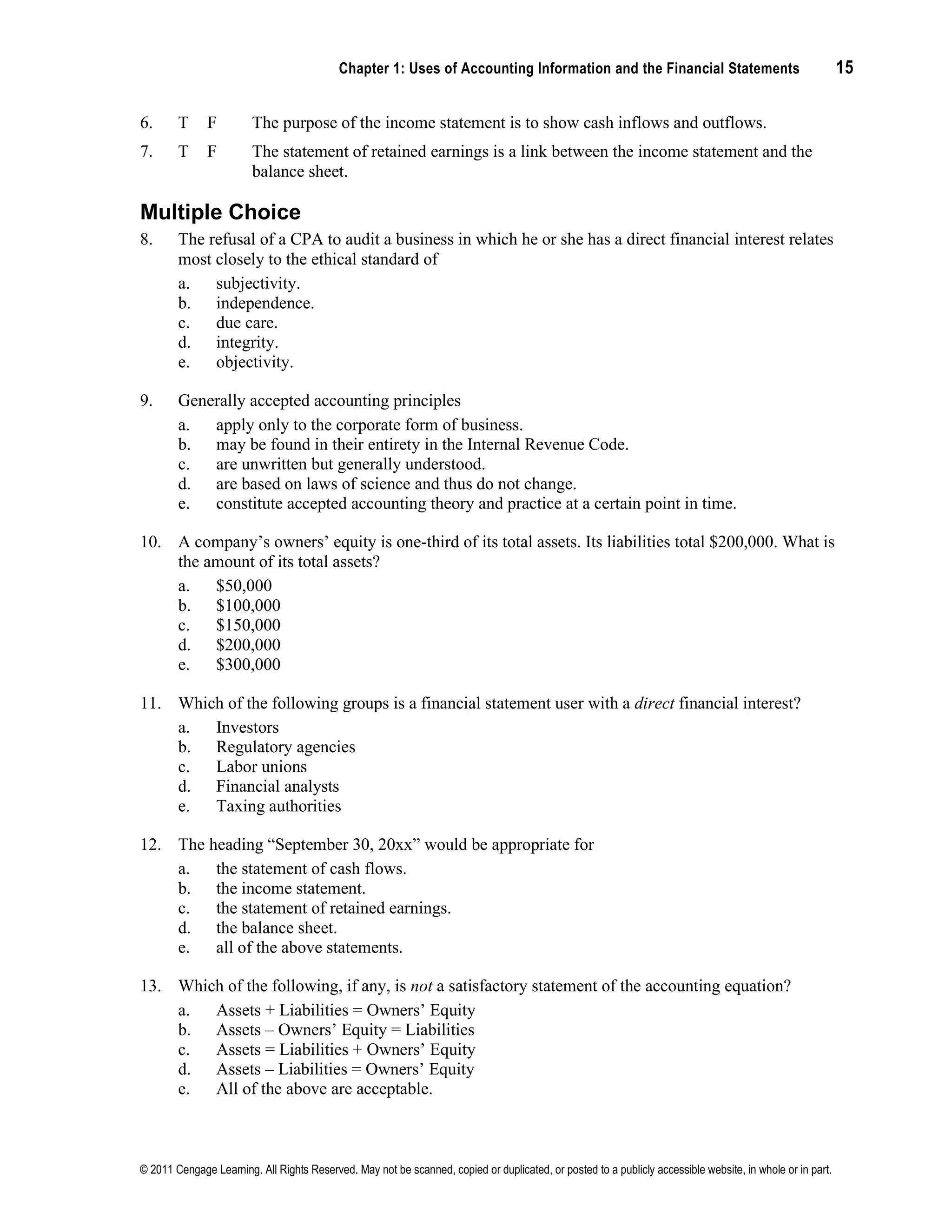
A. The FASB is responsible for developing GAAP.
B. The IASB sets international accounting standards.
1. More than 40 international financial reporting standards (IFRS) have been approved.
III. Other Organizations that influence GAAP
A. The AICPA influences GAAP through advisory committees.
B. The PCAOB is a governmental body created by the Sarbanes-Oxley Act to regulate the
accounting profession.
C. The SEC sets its own standards for companies whose securities are listed on the stock
exchanges.
D. The GASB was established to issue accounting standards for state and local governments.
E. IRS guidelines are established to collect taxes but play an influential role in the
establishment of accounting practices.
IV. It is important for CPAs to conform to their code of professional ethics because the public relies
on them for the following:
A. Integrity
B. Objectivity
C. Independence
D. Due care
E. Management accountants have a code of professional ethics that addresses competence,
confidentiality, integrity, and objectivity.
Teaching Strategy
Explain that GAAP are constantly evolving and are not like laws of science. Explain that GAAP are
designed to “accurately measure the performance of businesses” and that the accountant, contrary to a
common misconception, should not attempt to make a company look better on paper than it really is.
Emphasize that GAAP are guidelines that require interpretation; they are not a rigid set of rules.
Be sure to explain that an audit report does not state whether the audited company is a good investment;
it states only whether its financial statements are “presented fairly” in accordance with GAAP. Also
discuss the importance of independence. Explain that an audit provides only reasonable, not absolute,
assurance because it relies on test results from a sample of transactions.
An interesting discussion involves distinguishing between GAAP and tax law (Internal Revenue Code).
Point out that the objective of tax law is to raise revenue for the government, not to accomplish the
logical measurement of business income.
Explain the importance of ethics within the accounting profession and the possible consequences of
being in violation of the professional code. The key terms integrity, objectivity, independence, and due
care can help illustrate the concept. Describe some situations that typically create ethical dilemmas for
accountants. Case 4 provides a good basis for such discussion.
REVIEW QUIZ
True-False
1. T F The Internal Revenue Service is the primary determiner of generally accepted
accounting principles.
2. T F Dividends are disclosed on the income statement.
3. T F Net assets equal assets minus liabilities.
4. T F Liquidity means having enough funds on hand to pay debts when they fall due.
5. T F The operating officers are responsible for setting major corporate policy.
Chapter 1: Uses of Accounting Information and the Financial Statements 15
© 2011 Cengage Learning. All Rights Reserved. May not be scanned, copied or duplicated, or posted to a publicly accessible website, in whole or in part.
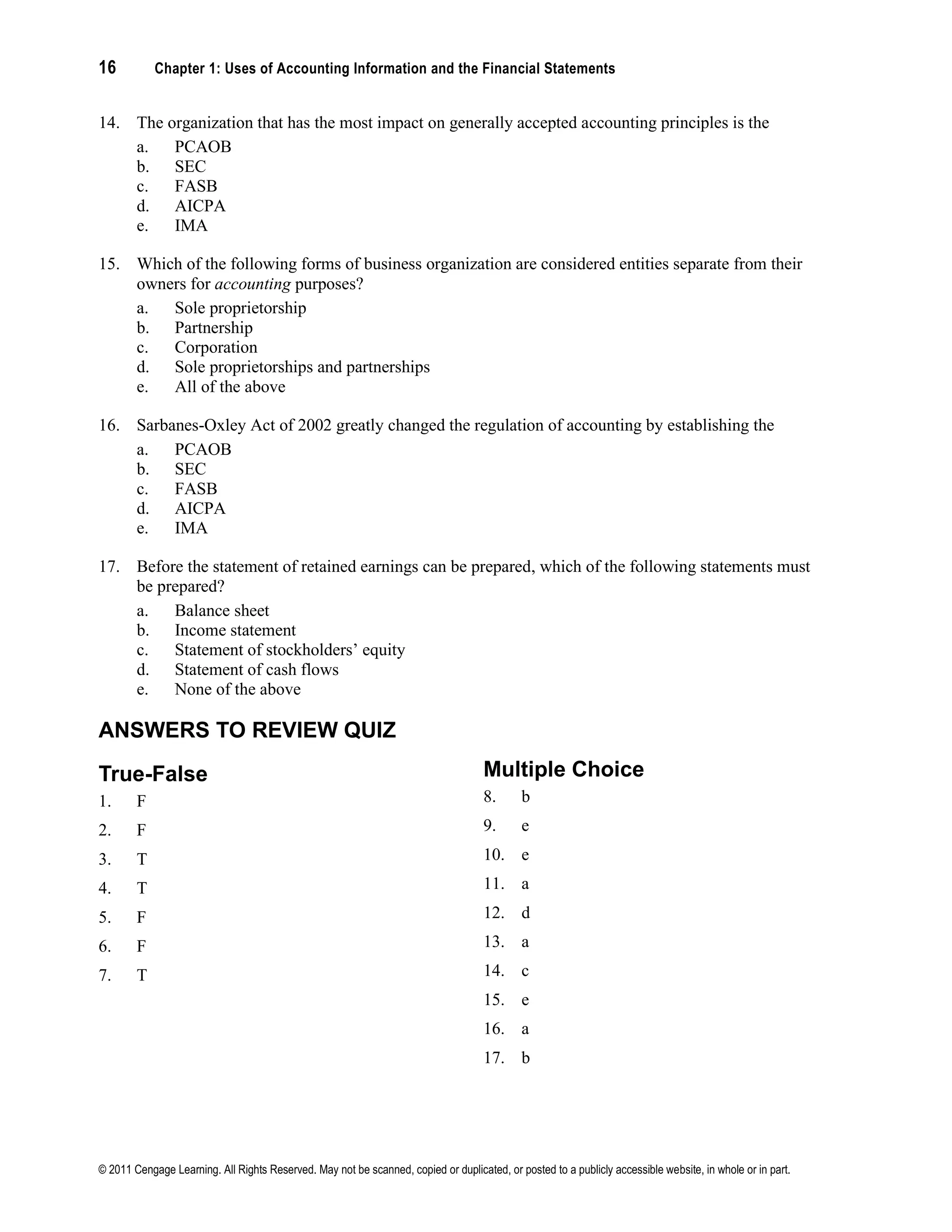
6. T F The purpose of the income statement is to show cash inflows and outflows.
7. T F The statement of retained earnings is a link between the income statement and the
balance sheet.
Multiple Choice
8. The refusal of a CPA to audit a business in which he or she has a direct financial interest relates
most closely to the ethical standard of
a. subjectivity.
b. independence.
c. due care.
d. integrity.
e. objectivity.
9. Generally accepted accounting principles
a. apply only to the corporate form of business.
b. may be found in their entirety in the Internal Revenue Code.
c. are unwritten but generally understood.
d. are based on laws of science and thus do not change.
e. constitute accepted accounting theory and practice at a certain point in time.
10. A company’s owners’ equity is one-third of its total assets. Its liabilities total $200,000. What is
the amount of its total assets?
a. $50,000
b. $100,000
c. $150,000
d. $200,000
e. $300,000
11. Which of the following groups is a financial statement user with a direct financial interest?
a. Investors
b. Regulatory agencies
c. Labor unions
d. Financial analysts
e. Taxing authorities
12. The heading “September 30, 20xx” would be appropriate for
a. the statement of cash flows.
b. the income statement.
c. the statement of retained earnings.
d. the balance sheet.
e. all of the above statements.
13. Which of the following, if any, is not a satisfactory statement of the accounting equation?
a. Assets + Liabilities = Owners’ Equity
b. Assets – Owners’ Equity = Liabilities
c. Assets = Liabilities + Owners’ Equity
d. Assets – Liabilities = Owners’ Equity
e. All of the above are acceptable.
16 Chapter 1: Uses of Accounting Information and the Financial Statements
© 2011 Cengage Learning. All Rights Reserved. May not be scanned, copied or duplicated, or posted to a publicly accessible website, in whole or in part.
14. The organization that has the most impact on generally accepted accounting principles is the
a. PCAOB
b. SEC
c. FASB
d. AICPA
e. IMA
15. Which of the following forms of business organization are considered entities separate from their
owners for accounting purposes?
a. Sole proprietorship
b. Partnership
c. Corporation
d. Sole proprietorships and partnerships
e. All of the above
16. Sarbanes-Oxley Act of 2002 greatly changed the regulation of accounting by establishing the
a. PCAOB
b. SEC
c. FASB
d. AICPA
e. IMA
17. Before the statement of retained earnings can be prepared, which of the following statements must
be prepared?
a. Balance sheet
b. Income statement
c. Statement of stockholders’ equity
d. Statement of cash flows
e. None of the above
ANSWERS TO REVIEW QUIZ
True-False
1. F
2. F
3. T
4. T
5. F
6. F
7. T
Multiple Choice
8. b
9. e
10. e
11. a
12. d
13. a
14. c
15. e
16. a
17. b
Exploring the Variety of Random
Documents with Different Content
Mesopotamia! Toward the end of August he despatched an
aëroplane to Arabia with a welcome message for Lawrence, the
announcement that he would be ready for a joint attack early in
September instead of October or November.
Allenby, fully aware of the inexperience of most of his new troops,
realized that the Turks would have to be defeated by strategy rather
than by force. So he decided to dupe the Turks with a colossal hoax,
a sort of moving picture of the British Army pushing straight up
along the Jordan River from the Dead Sea toward Galilee. But it was
to be a bogus army! In preparing this hoax Allenby’s first move was
to shift all his camel-hospitals from southern Palestine to the Jordan
Valley within fifteen miles of the Turkish lines. Next, he had
hundreds of condemned and worn-out tents shipped up over the
Milk and Honey Railway from Egypt, and pitched them on the banks
of the Jordan. Then he hauled all his captured Turkish cannons down
into the Jordan Valley and started them blazing away in the direction
of the Turks encamped in the hills of Moab. Ten thousand horse-
blankets were thrown over bushes in the valley and tied up to look
like horse-lines. Five new pontoon-bridges were flung over the river.
The sacred valley of the Jordan was filled with all the properties
for a sham battle of the ages. Never since the Greeks captured Troy
with their famous wooden horse has such a remarkable bit of
camouflage been put over on a credulous enemy.
When the German reconnaissance aëroplanes flew over the
Jordan they buzzed back to Turkish headquarters with the important
news that Allenby had placed two new divisions in this sector! This
camouflage army, arranged largely by General Bartholomew of
Allenby’s staff, was so realistic that the Germans and Turks never
dreamed that it might all be a fake; and fortunately the lines were so
carefully guarded that not a single German or Turkish spy got
through. Lawrence, also, lent a helping hand in duping the Turks.
Shortly before the date arranged for the big push three hundred
members of the Imperial Camel Corps came down from Palestine to
help him. They were under the command of Colonel “Robin” Buxton,
a born soldier, who before the war was a prominent Lombard Street
banker. Under the guidance of his tent-mate, Major W. E. Marshall,
R.A.M.C., “the fighting bacteriologist,” Lawrence sent the camel
corps to attack an important Turkish garrison at Mudawara, where a
spectacular twenty-minute battle was fought on August 8.
After the battle of Mudawara, Lawrence led a combined force of
camel corps and Arabs against Amman, just east of the Jordan. This
was merely a feint, but it confirmed the Turks in the belief that the
valley of the historic Jordan River was swarming with the bulk of
Allenby’s forces. Lawrence sent one of the most prominent chiefs of
the Beni Sakr toward Damascus with £7000 in gold to buy barley.
The sheik bought recklessly in every town and village on the eastern
border of Syria. The Turks, knowing well that Emir Feisal’s Bedouin
cavalry could not use such vast quantities of grain, immediately
decided that the barley must be intended for Allenby’s forces in the
Jordan Valley. Lawrence also started the rumor through the Arab
army that Emir Feisal’s host intended to launch its main attack
against Deraa railway junction between Amman and Damascus.
“As a matter of fact,” Lawrence remarked, “we had every intention
of attacking Deraa, but we spread the news so far and wide that the
Turks refused to believe it. Then in deadly secrecy we confided to a
chosen few in the inner circle that we really were going to
concentrate all of our forces against Amman. But we were not.”
This “secret,” of course, leaked out and was betrayed to the Turks,
who immediately shifted the greater part of their forces to the
vicinity of Amman, exactly as Allenby and Lawrence had planned.
When the advance of the Arab army actually started, none but
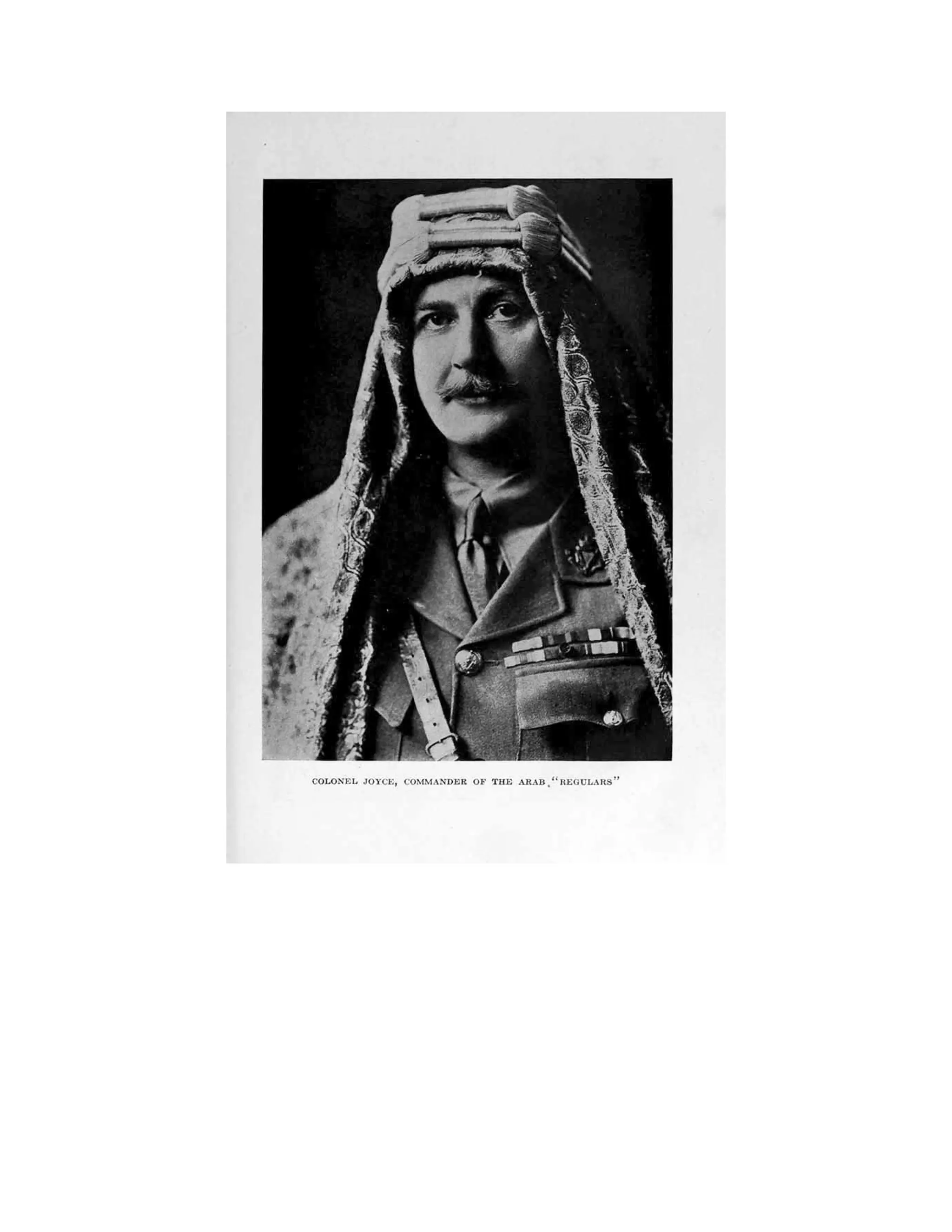
Emir Feisal, Colonel Joyce, and Colonel Lawrence knew that the
attack was to center on Deraa. Early in September Lawrence started
north from the head of the Gulf of Akaba to help Allenby in his
historic final drive. But instead of taking his Bedouin followers from
the Hedjaz, with the exception of his personal body-guard Lawrence
recruited a new army from the tribes of the North Arabian Desert,
and Joyce kept adding to his rapidly increasing mob of deserters
from the Turkish ranks. When it started up the Wadi Araba from the
head of the Gulf of Akaba, Lawrence’s caravan consisted of two
thousand baggage-camels, four hundred and fifty Arab regulars
mounted on racing-camels, four Arab machine-gun units, two
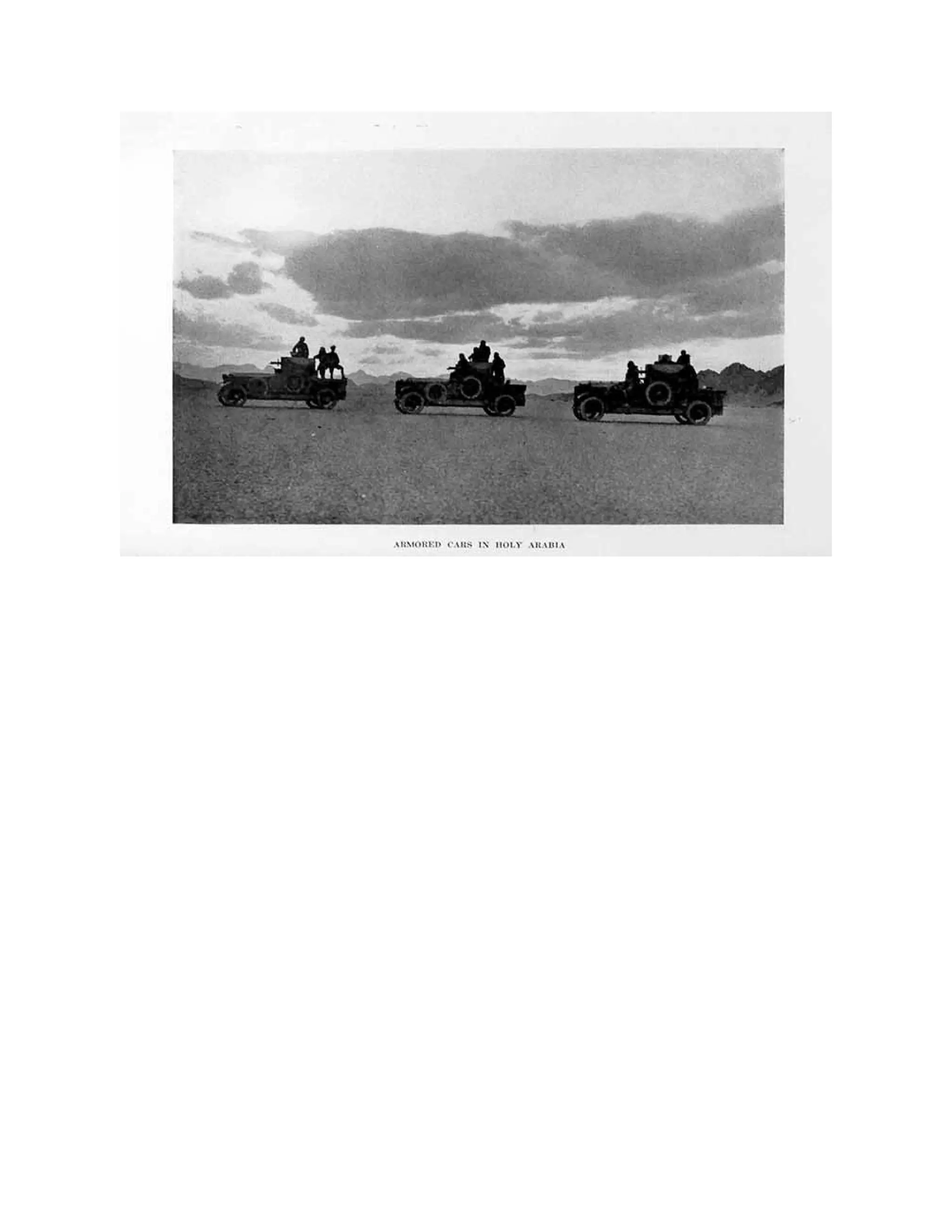
aëroplanes, three Rolls-Royce armored cars, a demolition company
of picked men from the Egyptian camel corps, a battalion of Gurkhas
from India mounted on tall camels from the Sind Desert, and four
mountain-guns manned by French Algerians. In addition he had his
resplendent private body-guard of one hundred picked Bedouins. His
total force amounted to one thousand men mounted on camels.
Lawrence’s motto on this expedition, as on all others, was, “No
margin!” He faced a march of five hundred miles across unmapped
desert under stupendous transport difficulties. During one stage they
marched four days from one water-hole to another, carrying their
entire water-supply with them and suffering from thirst. When they
reached the new water-hole they drank copiously, only to discover
that the water was filled with leeches. These leeches fastened
themselves on the inside of their nasal membranes and proved most
painful. But the column made the trek in a fortnight. They were
hurrying north to cut three Turkish railway lines and all the
telegraph-wires around Deraa, Lawrence’s primary mission being to
prevent the Turks from communicating with Damascus, Aleppo, and
Constantinople when Allenby started his advance.
The camouflage army of the Jordan was a complete success. As a
matter of fact, there were only three battalions of able-bodied troops
in that part of the Holy Land, two of which were made up of newly
arrived Jewish troops from the British Isles and the United States.
If the Turks had known the truth they might have sent down one
brigade, pushed up behind Allenby’s lines, and recaptured
Jerusalem!
Allenby was taking enormous chances, but great men usually do.
The commander-in-chief supplied his troops in the Jordan Valley
with but three weeks’ rations in order that they might use all of the
transport for his main army. His supply people were frantic; they said
the troops along the Jordan must be given eight weeks’ food; but
Allenby knew he was perfectly safe so long as his plan for one
smash went through without a hitch.
Allenby felt that it would not be safe to engage the Turks in a
pitched battle with his small and inadequately trained army, and so
his sole object was to lure all the Turkish reserves to the wrong
place, the Jordan Valley.
Allenby’s sham attack down near Jericho had been scheduled for
September 18. The British Intelligence Corps carefully allowed this
“secret” to get out, and of course the Turks were ready to meet it.
Allenby’s real attack was made not on the eighteenth but on the
nineteenth, and when they woke up and discovered how they had
been fooled, the war in the Near East was over, and most of them
were British or Arab prisoners. Furthermore, it was not made in the
Jordan Valley but away on the other side of Palestine to the north of
Jaffa on the Mediterranean coast! He had transferred nearly all his
infantry and cavalry there by night, and they remained concealed in
the orange-groves until the day of the real battle, the battle that
broke the backbone of the Ottoman Empire.
CHAPTER XXIII
A CAVALRY NAVAL ENGAGEMENT AND LAWRENCE’S LAST GREAT
RAID
All the Turkish ammunition and food had to be brought down from
northern Syria over the Damascus-Palestine-Amman-Medina Railway.
Lawrence’s plan was to swing way out across the unmapped sea of
sand, get clear around the eastern end of the Turkish lines,
unexpectedly appear out of the desert, dash up behind the Turks,
and cut all their communication round Deraa. One of Lawrence’s
most difficult problems during this manœuver was to keep his
column supplied. Even his armored cars and aëroplanes could not
carry enough petrol to pull through. From Akaba to the oasis of
Azarak is 290 miles across burning desert. There were wells at only
three places where the camels could be watered, and the little band
had to live from hand to mouth.
On its way the column rested at Tafileh, a village of six thousand
inhabitants, near which the most unusual episode of the whole
campaign had taken place. A body of Bedouin horse under Abu
Irgeig of Beersheba, under cover of darkness, rode up to a small
enemy naval base near the southern end of the Dead Sea, not far
from the ancient cities of Sodom and Gomorrah. The so-called
Turkish Dead Sea Fleet, consisting of a few ancient arks and motor-
driven craft armed with light guns, was moored alongshore. The
officers were having breakfast in a Turkish Army mess near-by,
utterly unaware of the approach of a hostile force. Abu Irgeig saw at
a glance that the decks were deserted except for a few sentries. So
he ordered his followers to dismount. With a rush they clambered on
board like Barbary corsairs, scuppered the crews, scuttled the boats,
remounted their snorting thoroughbreds, and vanished into the
desert haze before the dazed Turks had time to realize what had
happened. This is perhaps the only occasion in history in which a
naval engagement has been won by cavalry.
Lawrence’s original plan was to gather under his standard the
enormous Rualla tribe, which fills a large part of the North Arabian
Desert, and then descend in force upon the Hauran hill country to
make a direct assault on Deraa. This came to naught because of a
little difference which unexpectedly arose between King Hussein and
General Jaffer Pasha and the senior officers of the northern army,
which ruffled the temper of an important part of Lawrence’s forces.
By the time harmony had been restored it was too late, and, as a
result, the Rualla never came together, making it necessary for
Lawrence to modify his scheme. In the end he decided to carry out a
flying attack on the railways north, west, and south of Deraa with his
regular troops, assisted only by the wild Druses of the Hauran and a
handful of the Rualla horse under Sheiks Khalid and Trad Shaalan.
Before starting this attack, Lawrence arranged for another feint to be
made on the eighteenth against Amman and Es Salt, and for this
purpose he sent word to the members of the Beni Sakr tribe to mass
in the desert near Amman. The rumor of this, confirmed by Allenby’s
mobilization of his great camouflage army in the Jordan Valley, kept
the eyes of the Turks fixed constantly on the Jordan instead of on
the Mediterranean coastal region to the north of Jaffa.
On the oasis of Azarak is a magnificent old castle that dates from
somewhere between the sixth and fourteenth centuries, and is
turreted and loop-holed like the fortress of a Scottish baron.
Evidently it was an outpost of the far-flung Roman Empire, for
Colonel R. V. Buxton, of the Imperial Camel Corps, found a carved
stone in the ruins on which there was an inscription stating that two
legions of Antoninus Pius had been stationed here. So far as is
known no other force visited it until Lawrence and his men came.
The Arabs refuse to go near it because they say it is haunted by the
mad hunting-dogs of the Shepherd Kings that prowl round it o’
nights. Lawrence at one time thought he would like to retire here
and make Azarak Castle his home after the war.
On the thirteenth, Lawrence, accompanied by the small but mobile
force which he had organized for his big attack on Deraa, left the
oasis of Azark and marched into the Es Salt foot-hills. Two days later
they arrived at Umtaiye, thirteen miles southeast of Deraa, where
the male population of nearly all the villages of the Hauran joined
the Shereefian army in a body. Among them was Sheik Tallal el
Hareidhin of Tafas, the finest fighter in the Hauran, who had
accompanied Lawrence on some of his spying expeditions behind
the Turkish lines. He acted as guide for the expedition from this
point and sponsored Lawrence’s cause in every village. Lawrence
declared that if it had not been for this man’s courage, energy, and
honesty some of the tribes of the country through which they
passed, who were blood-enemies of King Hussein and Emir Feisal,
might easily have wrecked all their plans. Probably twenty or thirty
thousand Arab villagers and nomads joined Lawrence at different
points in this grand finale of the Near Eastern campaign.
In addition to severing the lines of communication it was
Lawrence’s intention to place himself and his troops between the
vital railway junction at Deraa and the Turkish armies in Palestine so
as to lure the enemy into reinforcing the thus isolated garrison at
Deraa with troops from the Palestine front who otherwise would be
free to help stem Allenby’s advance. At the same moment it was also
necessary for Lawrence to cut the railway to the south and west of
Deraa in order to add color to the belief of the enemy that the entire
Allied attack was coming against the Turkish Fourth Army in the
upper Jordan Valley. The only unit available for putting the railway
out of business consisted of the armored cars. The cars, plus
Lawrence, whizzed gloriously down the railway line and captured
one post before the open-mouthed Turks were aware of their
danger. This post commanded an attractive railway bridge, 149 kilos
south of Damascus, on which was inscribed a flattering dedication of
the bridge to old Abdul Hamid, the Red Sultan. Lawrence planted
tulips containing 150 pounds of guncotton at both ends and in the
center, and when he touched them off the bridge faded away on the
autumn breeze. This job completed, the cars started on again at top
speed but became stranded in the sand, where they were delayed
for several hours. On their way back to rejoin the army in the
Hauran they crossed the railway five miles north of Deraa, where
Lawrence suppressed another post, wiped out a Kurdish cavalry
detachment, blew up another bridge, and ripped up six hundred
pairs of rails.
After blowing up enough of the railway in the vicinity of Deraa to
throw the whole Turkish service of supply into complete chaos,
Lawrence and his men ascended a high promontory called Mount
Tell Ara, which commanded a panoramic view of Deraa four miles
away. Through his field-glasses he made out nine planes on the
enemy’s aërodrome. During that morning the German aviators had
had it all their own way in the air. They had been playing mischief
with Lawrence’s troops by dropping their eggs and raking the Arabs
with their machine-guns. The Shereefian forces tried to defend
themselves from the ground with their light artillery, but they were
getting the worst of it until Lawrence’s one surviving machine, an
antiquated old bus piloted by Captain Junor, came trundling up from
Azark and sailed square into the middle of the whole German
squadron, Lawrence and his followers watched this fracas with
mixed feelings, for each of the four enemy two-seaters and four
scout-planes was more than the equal of the one prehistoric British
machine. With both skill and good luck Captain Junor cruised right
through the German birdmen and led the whole circus off to the
westward. Twenty minutes later the plucky Junor came tearing back
through the air with his attendant swarm of enemy planes and
signaled down to Lawrence that he had run out of petrol. He landed
within fifty yards of the Arab column, and his B.E. flopped over on its
back. A German Halberstadt dived on it at once and scored a direct
hit with a bomb that blew the little British machine into bits.
Fortunately, Junor had jumped out of his seat a moment before. The
only part of his B.E. that was not destroyed was the Lewis machine-
gun. Within half an hour the plucky pilot had transferred it to a Ford
truck and was tearing around outside Deraa, raking the Turks with
his tracer bullets.
Meanwhile, Lawrence dashed off to join the detachment of troops
he had sent on in the direction of Mezerib. An hour after reaching it
he helped them cut the main Turkish telegraph-lines between
Palestine and Syria. It would be difficult to overestimate the
importance of this, because it completely cut the Turkish armies off
from all hope of relief from Northern Syria and Turkey proper.
At Mezerib several thousand more natives of the Hauran joined
the Arab forces, and the following day Lawrence and his column
marched on along the railway toward Palestine, right into the heart
of the Turkish back area. They spent most of that day planting
tulips, and near Nasib Lawrence blew up his seventy-ninth bridge, a
rather large one with three fine arches, thus bringing to a close his
long and successful career of demolition. Knowing it might be his
last, he planted twice as many tulips under it as necessary.
The column slept soundly at Nasib on the night of the eighteenth
after a good day’s work. The next morning, bright and early,
Lawrence marched his camels, horses, and Arabs off to Umtaiye,
where he was joined by the armored cars. During the morning
another enemy aërodrome was sighted near the railway, and
Lawrence, with two of the armored cars, sped across open country
for a near view. They found three German two-seaters in front of the
hangars. Had it not been for a deep gully intervening, the two
armored cars would have rushed them. As it was, two of the
Germans took off and circled around like great birds, pouring
streams of lead down on the Rolls-Royce machines, while at the
same time Lawrence and the crews inside the turrets finished the
third aeroplane with fifteen hundred bullets. As the armored cars
started back to Umtaiye, the Germans swooped down on them four
times; but all their bombs were badly placed, and the cars escaped
unhurt, except for a bit of shrapnel that wounded the colonel in the
hand. Speaking of his impression of armored car work, Lawrence
remarked that he considered it fighting de luxe.
This same day the Arab regulars, under Jaffer Pasha, and the
armored cars and French detachment and the Rualla horse under
Nuri Shallan, gave a fine account of themselves.
Jaffer Pasha, who also slashed his way brilliantly through this
engagement, comes of a rich and noble Bagdad family. His history is
full of romantic vicissitudes. At the outbreak of the war, Jaff ar el
Askari, as a general on the Turkish staff, was sent across in a
submarine from Constantinople to North Africa to organize an
uprising in the Sahara among the Senussi Arabs. He led the Senussi
in their short but spectacular campaign against the British. In the
first battle he defeated the British; the second battle was a draw;
and in the third he was badly wounded, defeated, and captured by
the Dorset Yeomanry at Agagia, near Solium, and imprisoned in the
great citadel at Cairo. In trying to escape at the end of three months
he broke his ankle and was recaptured in the moat under the
citadel. He was as fat as a barrel, full of the joy of life, and such a
gentlemanly, likable fellow that a little later the British put him on
parole and allowed him to wander about Cairo. Being an Arab
himself, he sympathized with the Arab Nationalist cause and one day
asked his British captors to permit him to volunteer as a private with
Feisal. His request was granted, and he did such remarkable work
that before many months had passed he had risen to the post of
commander-in-chief of Feisal’s regular army, which was composed
mainly of deserters from the Turkish ranks who had known Jaffer as
a general in Turkey. Jaffer Pasha had received the kaiser’s Iron Cross
at the Dardanelles and the Turkish Crescent for his work in the
Senussi campaign, and after he had been with the Arabs for a while
he was made a commander of the Order of St. Michael and St.
George by the British! Allenby accorded him this last honor at his
Ramleh headquarters in Palestine. The guard of honor on this
occasion was the same Dorset Yeomanry that had captured the
pasha just a year before. Jaffer was tremendously pleased and
amused at this subtle touch of humor on Allenby’s part.
Nuri Said, Jaffer Pasha’s brother-in-law, played an equally brilliant
part in the war. He was Emir Feisal’s chief of staff and remained in
this position when Feisal became king in Damascus and later in
Bagdad. Like Jaffer he had attended the Turkish Staff College. In the
Balkan War he was an aviator. Afterward he acted as secretary of
the Arab officers’ secret society which plotted to overthrow the
Turks. He is reckless and loves a hot fight. In fact, the hotter the
action the cooler was Nuri Said. He was one of the few Arab
townsmen whom the Bedouins admired and respected.
All had gone well with the preliminary plans for Allenby’s drive in
Palestine. But until twenty-four hours before the attack was
launched, on the nineteenth, the commander-in-chief himself was
not certain whether he was going to succeed or not. If the Turks and
Germans had discovered his real plan and had not been deceived
into thinking that both the British and Arabian forces were
concentrating on Amman with the intention of attempting to push
north up the Jordan Valley and if the enemy had withdrawn its right
wing only about half-way across Palestine from the Mediterranean
coast and the River Auja to the hills of Samaria, which would merely
have been a retirement of ten miles along the entire front, the Turks
could have played safe, Allenby’s whole blow would have been
wasted, and Lawrence’s brilliant operations around Deraa would
have been all in vain. Lawrence did not even have sufficient supplies
to last his column for two extra days, so that failure would have
been nothing short of a catastrophe for him. Of course, neither
Allenby nor Lawrence would have suffered heavy losses, but on the
other hand they would not have rung the curtain down in Arabia and
Palestine so soon. The entire World War might have dragged on for
several months longer, and an additional hundred thousand lives or
more might have been sacrificed on the Western Front. But there
were no ifs; the enemy walked into the prepared trap like lambs to
the slaughter.
CHAPTER XXIV
THE DOWNFALL OF THE OTTOMAN EMPIRE
On the whole, this last joint operation of the British and Arabian
forces was one of the most marvelous pieces of staff planning in all
military annals. It was a game of chess played by experts on an
international board. Never before was there a similar campaign. It
was a complete reversal of all Marshal Foch’s principles. Allenby and
Lawrence went back to the Napoleonic wars, to the battles of the
eighteenth century, when generals won by manœuver and strategy
instead of by tactics (the term “tactics” referring to the science of
handling men under fire). In this, the most brilliant and spectacular
military operation in the world’s history, Allenby and Lawrence lost
only four hundred and fifty men, although they completely
annihilated the Turkish army, captured over one hundred thousand
Turks, advanced more than three hundred miles in less than a
month, and broke the backbone of the Turkish Empire. Part of the
credit should go to Brigadier-General Bartholomew. Allenby is
colossal; he needs a needle-sharp man to complete him. He had
such an officer and strategist in General Bartholomew.
Allenby’s complete plan, which involved the destruction of all the
Turkish effectives with one sweeping blow, was known only to four
people; the commander-in-chief himself, his chief of Staff, (Major-
General Boles), General Bartholomew, and Colonel Lawrence. Not
even Emir Feisal or King Hussein knew what was going to happen.
At five o’clock on the morning of September 18, 1917, General
Bartholomew came to his office at headquarters in Ramleh and
anxiously said to the staff officer on duty: “Has there been any
change?”
“No, the Turks are still there,” replied the latter.
“Good!” said Bartholomew. “We will take at least thirty thousand
prisoners before this show is over.” He did not dream that the Allied
forces would capture three times thirty thousand Turks.
The deception of the enemy had been perfect in every detail.
When Allenby’s forces entered Nazareth, which had been the
German and Turkish Palestine headquarters, they found papers
indicating that the German High Command had been certain the
attack would take place in the Jordan Valley. Field-Marshal von
Sanders had been taken in down to the last point.
Meanwhile Lawrence, Joyce, General Nuri, and their associates
had received no news of what was going on in Palestine, but they
were busy day and night demolishing sections of the railway. One
night Lord Winterton, who played an active part in this final stage of
the desert campaign, went out on a demolition expedition and
placed some thirty parties at work along the line. The earl himself
dashed about in the dark from point to point in an armored car.
While walking along the railway he met a soldier who said, “How are
things?”
“Fine!” replied Winterton; “we have twenty-eight charges planted
and will be ready to touch them off in a few minutes.” The soldier
remarked that this was splendid, and then disappeared. A moment
later machine-guns blazed forth on all sides, and the earl had to run
for it. His questioner had either been a German or a Turk, and had
the incident occurred an hour earlier it might have spoiled Lord
Winterton’s work for that night. But the tulips were duly touched off,
and the show was a success.
The following day Lawrence dashed back to Azarak in an armored
car, then flew across the desert and northern Palestine to Allenby’s
headquarters at Ramleh. A hurried conference with the commander-
in-chief secured for him three more Bristol fighters, the best battle-
planes that the British were using in the Holy Land. He also brought
back the astounding news that more than twenty thousand prisoners
had already been taken by Allenby’s forces, that Nazareth, Nablus,
and many other important centers had fallen, and that they were
advancing toward Deraa and Damascus. That meant that the
Arabian army would be called upon by Allenby to play a still greater
part from now on, because it was the only force between the
crumbling Turkish divisions and Anatolia, toward which they must
retreat.
Lawrence had flown to Palestine for aëroplanes because the
Germans had nine of them near Deraa with which they were
bombing Feisal’s followers out of the ground. One of the pilots was a
Captain Peters, and another was a Captain Ross Smith, who later
became world famous and was knighted for flying from England to
Australia. Lord Winterton gives us a graphic picture of the events of
that morning in a scintillating article in “Blackwood’s”:
While L. and the airmen were having breakfast with us, a
Turkish ’plane was observed, making straight for us. One of the
airmen . . . hurried off to down the intruder. This he successfully
did, and the Turkish ’plane fell in flames near the railway. He
then returned and finished his porridge, which had been kept
hot for him meanwhile! But not for him a peaceful breakfast
that morning. He had barely reached the marmalade stage
when another Turkish ’plane appeared. Up hurried the
Australian again; but this Turk was too wily and scuttled back to
Deraa, only to be chased by P. on another machine, which sent
him down in flames.
That night the Germans burnt all of their remaining machines, and
from that moment the British airmen had the air above North Arabia,
Palestine, and Syria to themselves.
That afternoon a giant Handley-Page arrived from Palestine with
General Borton, commander of Allenby’s air squadrons, as the
passenger and Ross Smith as the pilot. They brought forty-seven tins
of petrol and also a supply of tea for Lawrence, Winterton, and
companions. This was the first time that a great night-bombing
plane ever flew over the enemy lines by day. The purpose was for
propaganda, and so profoundly were the tribesmen impressed by
this vast bird, which was several times larger than any they had thus
far seen, that all of the peoples of the Hauran, who had been
reluctant to coöperate with Emir Feisal, immediately swore allegiance
to the Arab cause and galloped in on their horses, with their rifles
popping off into the air, eager to charge the Turks, or at least make
a noisy display of valor.
The next day the infantry under General Jaffer Pasha, the jovial
commander-in-chief of Colonel Joyce’s regulars, went down to have
a look at the first large bridge which Lawrence had dynamited in the
vicinity of Deraa. They found it nearly repaired, but after a sharp
fight they drove off its guards, who were persistent and game
German machine-gunners, destroyed more of the line, and then
proceeded to burn the great timber framework which had been
erected by the Turks and Germans during the intervening seven
days. In this rather sharp encounter the armored cars, the French
detachment under Captain Pisani, and the Rualla Horse under Nuri
Shaalan plunged into the heart of things. Nuri is a quiet retiring man
of few words and plenty of deeds. He turned out to be unusually
intelligent, well informed, decisive, and full of quiet humor. Lawrence
once remarked to me that he not only was the chief of the largest
tribe in all the desert but one of the finest Arab sheiks he had ever
met, and that the members of his tribe were like wax in his hands
because “he knows what should be done and does it.”
When Lawrence started his operations around Deraa, von Sanders
did exactly what his opponents wanted him to do. He sent his last
reserves up to Deraa, so that when Allenby’s troops once smashed
through the Turkish front lines they had fairly clear going ahead of
them. At the important railway junction of Afuleh, on the evening of
the nineteenth, the Turkish motor-lorries came streaming in for
supplies, not knowing that all their great depots were in the hands
of Allenby’s men. As they rumbled into the supply-station, a British
officer remarked politely to one and all, “Would you mind going this
way, please?” That lasted for four hours, until the news spread
through the Turkish back area that Allenby’s troops had taken
Afuleh, the railway junction in the center of the plain of Esdraelon,
where the Turkish railway which connects Constantinople,
Damascus, and the Holy Land branches out, one line extending
down into Samaria and the other east to Haifa on the
Mediterranean. Afuleh was the main supply-base of the whole
Turkish army. After Allenby had occupied Afuleh for fully six hours, a
German plane came down with orders to von Sanders from
Hindenburg. The occupants of the plane did not discover their
predicament until they left their machine and walked over to local
headquarters to report. To their chagrin they found themselves
turning over their orders to Allenby’s staff.
By September 24 Allenby’s forces had advanced so far that the
entire Turkish Fourth Army, concentrated around Amman and the
Jordan on the mission of attacking empty tents and horse-blankets,
had been ordered back to defend Deraa and Damascus. The Turkish
Fourth Army generals were infuriated when they discovered that the
railway line had been cut behind them, and attempted to retreat
north along their motor-roads with all their guns and transport.
Lawrence and his cavalry did not intend to pave their retreat with
roses. Stationed on the hills they poured down such an incessant
stream of bullets that the Turks were forced to abandon all their
guns and carts between Mafrak and Nasib. Hundreds were
slaughtered. The formal column of retreat broke up into a confused
mass of fugitives, who never had a minute’s peace to reform their
lines. British aëroplanes added the finishing touch by dropping
bombs, and the Turkish Fourth Army scattered panic-stricken in all
directions.
Lawrence now decided to put himself between Deraa and
Damascus, hoping to force the immediate evacuation of Deraa and
thus pick up the sorry fragments of the crack Turkish Fourth Army as
it emerged from Deraa, and also harass other remnants of the
Turkish armies in Palestine that might attempt to escape north.
Accordingly, at the head of his camel corps, he made a hurried
forced march northward on the twenty-fifth, and by the afternoon of
the twenty-sixth swept down on the Turkish railway near Ghazale
and Ezra on the road to Damascus. With him were Nasir, Nuri, Auda,
and the Druses—“names with which to hush children even in the
daytime,” to quote Lawrence himself. His rapid manœuvers took the
panic-stricken Turks completely by surprise. Just the previous day
they had worked feverishly on the railway line and had reopened it
for traffic at the points where Lawrence had damaged it a week
earlier. He planted a few hundred tulips, putting the line out of
commission permanently and penning six complete trains in Deraa.
Fantastic reports of disaster spread like wildfire throughout Syria,
and the Turks at once began the evacuation of Deraa by road.
By dawn of the twenty-seventh, Lawrence and his cavalry were
already out scouting the surrounding country and had captured two
Austro-Turk machine-gun companies placed across a road to oppose
Allenby’s approaching columns. Then Lawrence climbed to the
summit of a high hill in the vicinity called Sheik Saad, whence he
could sweep the country-side with his glasses. Whenever he saw a
small enemy column appearing on the horizon, he jumped on his
horse and, accompanied by some nine hundred picked men only too
eager for that kind of diversion, charged into the midst of them as if
they had been tin soldiers and serenely took them all prisoners. If
from his observation station on the hill he saw a column that was
too large to tackle, he lay low and let it pass.
About noon an aëroplane dropped Lawrence a message stating
that two columns of Turks were advancing on him. One, six
thousand strong, was coming from Deraa; the other, two thousand
strong, from Mazerib. Lawrence decided that the second was about
his size. Sending for some of his regulars, who were gathering stray
Turks like daisies a few miles away, he dashed off to intercept the
enemy near Tafas. At the same time he sent the Hauran horsemen
in the other direction to get around behind them and hang on the
skirts of the column in order to annoy them. The Turks reached
Tafas a short time before Lawrence and brutally mistreated all the
women and children of the village. Shereef Bey, commander of the
Turkish Lancers, at the rear-guard of the column, ordered all the
people massacred, including the women and children. Tallal, head
sheik of this village of Tafas, who had been a great tower of strength
with Lawrence from the beginning and one of the boldest horsemen
in North Arabia, was riding at the front of the Arab column with
Lawrence and Auda Abu Tayi when he came upon the wives and
children of his kinsmen lying in pools of blood in the road. Several
years after the war one of Lawrence’s poet friends in England got
married, and when Lawrence expressed regret at not having enough
money to buy an appropriate wedding present the poet suggested
that he might let him have a few pages of his diary instead. The
wish was granted, and the poet disposed of the pages to “The
World’s Work” for publication in America. The portion sold happened
to include Lawrence’s story of the death of the gallant Sheik Tallal el
Hareidhin:
We left Abd el Main there and rode on past the other bodies,
now seen clearly in the sunlight to be men, women and four
babies, toward the village whose loneliness we knew meant that
it was full of death and horror. On the outskirts were the low
mud walls of some sheep-folds, and on one lay something red
and white. I looked nearer, and saw the body of a woman
folded across it, face downward, nailed there by a saw-bayonet
whose haft stuck hideously into the air from between her naked
legs. She had been pregnant, and about her were others,
perhaps twenty in all, variously killed, but laid out to accord with
an obscene taste. The Zaagi burst out in wild peals of laughter,
in which some of those who were not sick joined hysterically. It
was a sight near madness, the more desolate for the warm
sunshine and the clean air of this upland afternoon. I said: “The
best of you brings me the most Turkish dead”; and we turned
and rode as fast as we might in the direction of the fading
enemy. On our way we shot down those of them fallen out by
the roadside who came imploring our pity.
Tallal had seen something of what we had seen. He gave one
moan like a hurt animal, and then slowly rode to the higher
ground, and sat there a long while on his mare, shivering and
looking fixedly after the Turks. I moved toward him to speak to
him, but Auda caught my rein and stayed me. After some
minutes Tallal very slowly drew his headcloth about his face,
and then seemed to take hold of himself, for he dashed his
stirrups into his horse’s flanks and galloped headlong, bending
low in the saddle and swaying as though he would fall, straight
at the main body of the enemy. It was a long ride, down the
gentle slope and across the hollow, and we all sat there like
stone while he rushed forward, the drumming of his horse’s
hoofs sounding unnaturally loud in our ears. We had stopped
shooting and the Turks had stopped shooting; both armies
waited for him. He flew on in this hushed evening, till he was
only a few lengths from the enemy. Then he sat up in the
saddle and cried his war-cry “Tallal, Tallal” twice in a
tremendous voice. Instantly, all their rifles and machine-guns
crashed out together, and he and his mare, riddled through and
through with bullets, fell dead among their lance points.
Auda looked very cold and grim. “God give him mercy! We
will take his price.” He shook his rein and moved slowly forward
after the enemy. We called up the peasantry, now all drunk with
fear and blood, and sent them from this side and from that
against the retreating column. Auda led them like the old lion of
battle that he is. By a skilful turn he drove the enemy into bad
ground and split their column into three parts. The third part,
the smallest, was mostly made up of German and Austrian
gunners, grouped round three motor-cars which presumably
carried high officers. They fought magnificently and drove off
our attacks time and again, despite our desperation. The Arabs
were fighting like devils, the sweat blinding our eyes, our
throats parched with dust, and the agony of cruelty and revenge
which was burning in our bodies and twisting our hands about
so that we could hardly shoot. By my orders they were to take
no prisoners—for the first time in the war.
This account of the death of Tallal el Hareidhin of Tafas, in
Lawrence’s own words, shows us what marvelous descriptive powers
this young soldier-scholar has at his command, and gives us a hint
of the masterpiece that the world should one day receive from his
pen.
Two German machine-gun companies had resisted magnificently
and escaped, with the Turkish commander-in-chief, Djemal Pasha, in
his car in their midst. The Arabs wiped out the second section
completely after a bitter hand-to-hand struggle. No prisoners were
taken, because the Arabs were wild with rage over the Tafas
massacre. Two hundred and fifty German prisoners had been
captured during the day, but when the Arabs discovered one of
Lawrence’s men with a fractured thigh pinned to the ground with
two German bayonets, they acted like enraged bulls. Turning their
machine-guns on the remaining prisoners they wiped them out.
After the encounter, Nuri Shaalan, at the head of the Rualla horse,
rode straight into the main street of Deraa. There were two or three
fights on the way, but they took the town in a whirlwind gallop. The
next morning Nuri returned to Lawrence at Tafas with five hundred
infantry prisoners and the freedom of the town of Deraa. Some of
Allenby’s troops arrived in Deraa that day also.
Lawrence and his army spent that night—and a very uneasy night
it was—on Sheik Saad hill. He did not feel certain of victory since
there was always a risk of his small force being washed away by a
great wave of the enemy in retreat. All that night the Hauran
horsemen clung tenaciously to the great Turkish column from Deraa,
made up of six thousand men, which Lawrence had not dared
engage in pitched battle. Instead of sleeping with the regular troops
at Sheik Saad, Lawrence spent part of the night helping the Hauran
cavalry, and at dawn he rode off to the westward with a handful of
men until he met the outposts of the fourth cavalry division of the
British army. After guiding them into Deraa and starting them off on
their northward march toward Damascus, Lawrence galloped back
full speed to the Hauran cavalry. Although the Turkish column when
it left Deraa was six thousand strong, at the end of twenty-four
hours only five thousand remained. One thousand had been picked
off by the Bedouins. Eighteen hours more and there were three
thousand; and after a point called Kiswe, where Lawrence headed
off the remnant of the Turkish Fourth Army and flung them into one
of Allenby’s cavalry brigades coming from the southwest, only two
thousand remained.
In all, Lawrence, Joyce, Jaffer, and Nuri, and their scattered force
of wild Bedouins and regular camel corps had killed about five
thousand of the Turks in this last phase of the campaign and
captured more than eight thousand of them, as well as one hundred
and fifty machine-guns and thirty cannons. In addition to the column
of less than one thousand men who had started north from Akaba
with Lawrence, Auda Abu Tayi and two hundred of the best fighting
men of the Howeitat tribe took part in Lawrence’s war-dance around
Deraa, also two thousand Beni Sakhr, “the Sons of Hawks,” from east
of the Dead Sea, four thousand Rualla under Nuri Shaalan from the
North Arabian Desert, one thousand Druses from the Hauran, and
eight thousand Arab villagers from the Hauran.
In a letter which he wrote to me more than a year after the war,
Colonel Stirling, who had played a prominent rôle in this final raid,
summed up the effects of what the Arabs had done to help Allenby
overwhelm the Turks:
“This, after all,” wrote Colonel Stirling, “was the main justification
of our existence and of the money and time we had spent on the
Arab Revolt. The raid itself was really very dramatic in that we
started out, a small regular force of Arabs 400 strong and marched
600 miles in 23 days through unmapped Arabia and came in out of
the blue—miles behind the Turkish main armies, and as an absolute
surprise. Two days before the British advance in Palestine began we
had cut three lines of railways and for five days allowed no trains to
get through to the Turkish armies. The result was that when their
retreat commenced they found all their advance food depots and
ammunition dumps were exhausted. During these days we of course
led a somewhat precarious existence, generally shifting camp twice
in a night to avoid being surprised. We were only a very weak force
then, you see, though by the time we got on and rushed Damascus,
something like 11,000 mounted Arabs had joined us.”
Some of the Arab horsemen rode right on that evening into
Damascus, where the burning ammunition-dumps turned night into
day. Back at Kiswe, just a few miles south of Damascus, and not far
from where Saul of Tarsus was dazzled by the light that transformed
him into Paul the interpreter of Christianity, the glare of the fires
from Damascus and the roar and reverberation of explosions kept
Lawrence awake most of the night. He was completely worn out.
From September 13 to 30, he had caught only occasional snatches
of sleep. Mounted on a racing-camel or dashing about the country
on an Arab steed, riding inside the turret of an armored car or flying
about in one of the fighting planes, he had led the relentless
existence demanded of him in this great emergency of the war. Now
the end of the war was in sight in the Land of the Arabian Nights.
But sleep was difficult because all night long the Turks and Germans
were blowing up their ammunition-dumps eight miles north in
Damascus. With each explosion the earth shook, the sky went white,
and splashes of red tore great gaps in the night as shells went off in
the air. “They are burning Damascus,” Lawrence remarked to Stirling.
Then he rolled over in the sand and fell asleep.
CHAPTER XXV
LAWRENCE RULES IN DAMASCUS, AND THE TREACHERY OF THE
ALGERIAN EMIR
The next morning they saw Damascus in the center of its gardens
as green and beautiful as any city in the world. The enchantment of
the scene, “like a dream that visits the light slumbers of the morning
—a dream dreamed but to vanish,” reminded Lawrence of the Arab
story that when Mohammed first came here as a camel-driver, upon
seeing Damascus from a distance, he refused to enter, saying that
man could only hope to enter paradise once. Coming out of the
desert and beholding this view, than which there is none more
enchanting and alluring in the world, it is no wonder Mohammed
was sorely tempted and even trembled for his soul. Seen from afar,
this oasis of verdure, rimmed round by yellow desert against a
background of snow-capped mountains, is indeed a pearl in an
emerald setting. So it is only natural that the desert-dweller should
look upon it as an earthly paradise.
As the sun-rays fell aslant, weaving a fairy gossamer veil over the
minarets and cupolas of this dream city, Lawrence and Stirling drove
into Damascus in their famous Rolls-Royce, the Blue Mist. They went
straight to the town-hall and there called a meeting of all the leading
sheiks. Lawrence selected Shukri Ibn Ayubi, a descendant of Saladin,
to act as the first military governor under the new régime. Then he
appointed a chief of police, a director of local transportation, and
numerous other officials. These details arranged, Shukri, Nuri Said,
Auda Abu Tayi, Nuri Shalaan, and Lawrence, at the head of their
Bedouin irregulars, proceeded through the streets of Damascus.
The twenty-nine-year-old commander-in-chief of the greatest
army that had been raised in Arabia for five centuries, who in less
than a year had made himself the most important man in Arabia
since the days of the great Calif Harun al Rashid, made his official
entry into this ancient capital of the old Arabian Empire at seven
o’clock on the morning of October 31. The entire population,
together with tens of thousands of Bedouins from the fringes of the
desert, packed the “street that is called straight” as Lawrence
entered the gate, dressed in the garb of a prince of Mecca. All
realized that at last their glorious city had been freed from the
Turkish yoke. Howling dervishes ran in front of him, dancing and
sticking knives into their flesh, while behind him came his flying
column of picturesque Arabian knights. For months they had heard
of the exploits of Shereef Lawrence, but now for the first time they
saw the mysterious Englishman who had united the desert tribes
and driven the Turks from Arabia. As they saw him come swinging
along through the bazaars on the back of his camel, it seemed as
though all the people of Damascus shouted his name and Feisal’s in
one joyful chorus. For ten miles and more along the streets of this,
the oldest city in the world that still remains standing, the crowds
gave the young Englishman one of the greatest ovations ever given
to any man. Dr. John Finley, of the American Red Cross, who came
north with Allenby, said, in describing it, that “there were scenes of
joy and ecstasy such as may never be witnessed on this earth again.
The bazaars were lined with hundreds of thousands of people. The
‘street that is called straight’ was so packed that the horses and
camels could hardly squirm through. The housetops were crowded.
The people hung priceless Oriental carpets from their balconies and
showered Lawrence and his companions with silken head-cloths,
flowers and attar of roses.”
Fortunately for the Arabs, Allenby had ordered Light Horse Harry
Chauvel to hold his Australians back and let Feisal’s advance-guard
Welcome to our website – the perfect destination for book lovers and
knowledge seekers. We believe that every book holds a new world,
offering opportunities for learning, discovery, and personal growth.
That’s why we are dedicated to bringing you a diverse collection of
books, ranging from classic literature and specialized publications to
self-development guides and children's books.
More than just a book-buying platform, we strive to be a bridge
connecting you with timeless cultural and intellectual values. With an
elegant, user-friendly interface and a smart search system, you can
quickly find the books that best suit your interests. Additionally,
our special promotions and home delivery services help you save time
and fully enjoy the joy of reading.
Join us on a journey of knowledge exploration, passion nurturing, and
personal growth every day!
testbankbell.com


Solution Manual for Managerial Accounting 9th Edition by Crosson

  • 1.
    Solution Manual forManagerial Accounting 9th Edition by Crosson download pdf http://testbankbell.com/product/solution-manual-for-managerial- accounting-9th-edition-by-crosson/ Visit testbankbell.com to explore and download the complete collection of test banks or solution manuals!
  • 2.
    We have selectedsome products that you may be interested in Click the link to download now or visit testbankbell.com for more options!. Test Bank for Managerial Accounting, 9th Edition: Crosson http://testbankbell.com/product/test-bank-for-managerial- accounting-9th-edition-crosson/ Solution Manual for Managerial Accounting 6th Edition by Hartgraves http://testbankbell.com/product/solution-manual-for-managerial- accounting-6th-edition-by-hartgraves/ Solution Manual for Managerial Accounting 7th Edition by Mowen http://testbankbell.com/product/solution-manual-for-managerial- accounting-7th-edition-by-mowen/ Solution Manual for Juvenile Delinquency The Core, 6th Edition http://testbankbell.com/product/solution-manual-for-juvenile- delinquency-the-core-6th-edition/
  • 3.
    ATI RN ProctoredComprehensive Predictor 2019 Form C http://testbankbell.com/product/ati-rn-proctored-comprehensive- predictor-2019-form-c/ Solution Manual for Quantitative Analysis for Management 13th Edition by Render http://testbankbell.com/product/solution-manual-for-quantitative- analysis-for-management-13th-edition-by-render/ Test Bank for Psychology in Action 12th Edition Huffman http://testbankbell.com/product/test-bank-for-psychology-in- action-12th-edition-huffman/ Test Bank for Marketing 20th 2020 by Pride http://testbankbell.com/product/test-bank-for-marketing-20th-2020-by- pride/ Test Bank for Brock Biology of Microorganisms 12th Edition by Madigan http://testbankbell.com/product/test-bank-for-brock-biology-of- microorganisms-12th-edition-by-madigan/
  • 4.
    Entrepreneurship 2008 1stEdition Bygrave Test Bank http://testbankbell.com/product/entrepreneurship-2008-1st-edition- bygrave-test-bank/
  • 5.
    © 2011 CengageLearning. All Rights Reserved. May not be scanned, copied or duplicated, or posted to a publicly accessible website, in whole or in part. SOLUTION MANUAL FOR MANAGERIAL ACCOUNTING 9TH EDITION BY CROSSON FULL DOWNLOAD LINK AT: HTTPS://TESTBANKBELL.COM/PRODUCT/SOLUTION-MANUAL-FOR- MANAGERIAL-ACCOUNTING-9TH-EDITION-BY-CROSSON/ CHAPTER 1 Uses of Accounting Information and the Financial Statements PLANNING MATRIX Learning Objective Building Your Basic Knowledge and Skills Enhancing Your Knowledge, Skills, and Critical Thinking 1. Define accounting and describe its role in making informed decisions, identify business goals and activities, and explain the importance of ethics in accounting. SE 1 E 1, 3 P 4, 5, 7, 9 C 1 C 6 2. Identify the users of accounting information. E 1, 3, 4 C 1 C 8 3. Explain the importance of business transactions, money measure, and separate entity. SE 2 E 1, 5, 6, 7 C 2 4. Describe the characteristics of a corporation. SE 2, 3 E 1, 4, 6, 14 P 8 5. Define financial position, and state the accounting equation. SE 4, 5, 6, 7 E 2, 8, 9, 12, 14 C 6 6. Identify the four basic financial statements. SE 8, 9 E 2, 9, 10, 11, 13, 14 P 1, 2, 3, 4, 5, 6, 7, 8, 9 C 4 C 5 7. Explain how generally accepted accounting principles (GAAP) and international financial reporting standards (IFRS) relate to financial statements and the independent CPA’s report, and identify the organizations that influence GAAP. E 2, 3, 15 P 5 C 3 C 6 C 7 C 8
  • 6.
    2 Chapter 1:Uses of Accounting Information and the Financial Statements © 2011 Cengage Learning. All Rights Reserved. May not be scanned, copied or duplicated, or posted to a publicly accessible website, in whole or in part. MEMORANDA: SE: Short Exercises E: Exercises P: Problems (Each problem has a User Insight question.) C: Cases All questions are in the text with related Learning Objectives (Stop, Think, and Apply). SUGGESTED INSTRUCTIONAL STRATEGY Output Skills Developed: Technical, Interpersonal Related Learning Objective: 6 Instructional Strategy Learning activity: Group work, game Learning environment: Interactive groups within classroom Learning tool: Textbook assignment: Problem 4 or 7 or Case 5 Steps to Implement 1. Divide the class into small groups. One quick way to form groups is to divide the number of students in class by three or four (the most effective group size for this activity). Ask students to count off from 1 to the maximum number of groups. Remind them not to forget their number. Have students get together after you give complete instructions. It will encourage a speedy transition, as this activity has a time limit. 2. Assign one of the learning tools. (If one of the problems was done for homework, use another one in this activity; it will reinforce learning.) 3. The first group to correctly complete the task wins. As the groups complete the task, they ask you to mark their completion time. (You may want to keep their responses until the time limit has expired. See Step 4.) The time limit is 25 minutes. If, for some reason, no group has the correct response in 25 minutes, give them additional time as deemed appropriate. 4. The winning group could present the correct responses to the entire class using the solution transparency and answer student questions. You may prefer to debrief this activity if time is limited. If you have group responses, a quick check will identify where the problems are. 5. Reward each of the winning group members with one or two extra quiz points, “$100 Grand” chocolate bars, novelty erasers, etc. Assessment Technical skills: Grade group written responses. Ask a related question on the next examination and/or quiz. Interpersonal skills: Ask students to answer one or more of the following: How well did your group interact? How many were fully involved? What could your group do to improve next time?
  • 7.
    Chapter 1: Usesof Accounting Information and the Financial Statements 3 © 2011 Cengage Learning. All Rights Reserved. May not be scanned, copied or duplicated, or posted to a publicly accessible website, in whole or in part. RESOURCE MATERIALS AND OUTLINES OBJECTIVE 1: Define accounting and describe its role in making informed decisions, identify business goals and activities, and explain the importance of ethics in accounting. Summary Statement Accounting is an information system that measures, processes, and communicates financial information about an economic entity. Accounting is a link between business activities and decision makers. A business is an economic unit that aims to sell goods and services to customers at prices that will provide an adequate return to its owners. The two major goals of all businesses are profitability and liquidity. Profitability is the ability to earn enough income to attract and hold investment capital. Liquidity is the ability to have sufficient cash to pay debts as they fall due. Businesses pursue their goals by engaging in (1) operating activities, which include selling goods and services to customers, employing managers and workers, and buying and producing goods and services; (2) investing activities, which involve spending the capital a company receives in productive ways to help it achieve its objectives; and (3) financing activities, which include obtaining funds to sustain operations. An important function of accounting is to provide performance measures, which indicate whether managers are achieving their business goals and whether the business activities are well managed. The goal of accounting is to assist decision makers. Management accounting provides information to internal decision makers, such as managers, whereas financial accounting communicates financial information via financial statements to external decision makers. Most businesses publish financial statements that report their profitability and financial position. Accounting includes the design of an information system that meets the user’s needs. Bookkeeping, a small but important aspect of accounting, deals with the mechanical, repetitive recordkeeping process. A computer is an electronic device that rapidly collects, organizes, and communicates vast amounts of information. A computer does not take the place of the accountant but rather is a tool used by the accountant to perform both routine bookkeeping chores and complex accounting calculations. A management information system (MIS) consists of the interconnected subsystems that provide the information needed to run a business. The accounting information system is an integral part of the management information system. Ethics is the code of conduct that helps individuals in their everyday life distinguish right from wrong. Ethics is especially important in preparing financial reports because users of these reports must depend on the good faith of the people involved in their preparation. The intentional preparation of misleading financial statements is called fraudulent financial reporting. It can result from the distortion of records, falsified transactions, or the misapplication of various accounting principles. In 2002, Congress passed the Sarbanes-Oxley Act to regulate financial reporting in public corporations. This legislation requires the chief executives and chief financial officers of all publicly traded U.S. companies to attest to the accuracy and completeness of the quarterly statements and annual reports that their companies file with the SEC. New Concepts and Terminology accounting; business; profitability; liquidity; operating activities; investing activities; financing activities; performance measures; management accounting; financial accounting; financial statements; bookkeeping; management information system (MIS); ethics; fraudulent financial reporting; Sarbanes- Oxley Act
  • 8.
    4 Chapter 1:Uses of Accounting Information and the Financial Statements © 2011 Cengage Learning. All Rights Reserved. May not be scanned, copied or duplicated, or posted to a publicly accessible website, in whole or in part. Related Text Illustrations Figure 1: Accounting as an Information System Figure 2: Business Goals and Activities Focus on Business Practice: What Does CVS Have to Say About Itself? Focus on Business Practice: Cash Bonuses Depend on Accounting Numbers! Focus on Business Practice: How Did Accounting Develop? Lecture Outline I. Accounting is an information system that measures, processes, and communicates financial information. A. Accounting is a link between business activities and decision makers. B. Management must have a good understanding of accounting to set financial goals and make financial decisions. C. Management must not only understand how accounting information is compiled and processed but also realize that accounting information is imperfect and should be interpreted with caution. II. A business is an economic unit that aims to sell goods and services to customers at prices that will provide an adequate return to its owners. A. Goals 1. Profitability—earning a sufficient return to maintain owner interest 2. Liquidity—having enough cash to pay debts as they come due B. Activities 1. Operating—selling goods and services to customers; employing managers and workers; buying and producing goods and services; and paying taxes 2. Investing—spending the capital a company receives in productive ways that help it achieve its objectives 3. Financing—obtaining funds to begin operations and to continue operating C. Performance measures 1. Performance measures relate to achieving goals and assessing the management of business activities. 2. Financial analysis is the evaluation and interpretation of the financial statements and related performance measures. 3. Performance measures must be crafted to motivate managers to make decisions that are in the best interest of the business. III. Categories of accounting A. Management accounting—accounting information for internal decision makers B. Financial accounting—accounting information for external decision makers; reports are called financial statements. IV. Ways in which accounting information is processed A. Bookkeeping is the mechanical and repetitive recordkeeping aspect of accounting. B. Computerized accounting 1. Computerized accounting is useful for routine bookkeeping chores and complex accounting calculations. 2. Computerized information is only as useful as the data input into the system. C. A management information system (MIS) consists of the interconnected subsystems that provide the information needed to run a business. V. Ethical financial reporting A. Ethics is a code of conduct that addresses whether actions are right or wrong.
  • 9.
    Chapter 1: Usesof Accounting Information and the Financial Statements 5 © 2011 Cengage Learning. All Rights Reserved. May not be scanned, copied or duplicated, or posted to a publicly accessible website, in whole or in part. 1. Ethics in the preparation of financial reports is important because users of these reports must depend on the good faith of the people involved in their preparation. 2. The intentional preparation of misleading financial statements is called fraudulent financial reporting. 3. Fraudulent financial reporting can result from the distortion of records, falsified transactions, or the misapplication of various accounting principles. 4. The motivation for fraudulent financial reporting could be to inflate the perceived value of a business, meet stockholders’ and financial analysts’ expectations, obtain financing, or receive personal gain. B. Congress passed the Sarbanes-Oxley Act in 2002 to regulate financial reporting in public corporations. Teaching Strategy A good place to begin is by discussing business goals and activities. Case 1 provides a good foundation for such discussion. This sets the stage for a discussion of accounting and how it helps businesses achieve goals and perform activities. Figure 2 in the text illustrates business goals and activities. Distinguish between profitability and liquidity and explain why a business must maintain both if it is to survive. The key components of the AICPA’s definition of accounting are “useful,” “financial information,” and “decisions.” This leads into the next learning objective, which focuses on those who rely on accounting information for decision making. Figure 1 in the text not only illustrates accounting as an information system but also indicates the measurement, processing, and communication functions of accounting. Students may have difficulty distinguishing between accounting and bookkeeping. Perhaps the use of a Venn diagram, with bookkeeping as a small circle within a much larger circle identified as accounting, will help them make the distinction. As they learn accounting, students will also tend to focus on the bookkeeping aspects only. Remind them that theory, terminology, financial statement disclosure, and other such topics also need to be learned. Students often ask if computers have displaced accountants. Explain that although computers are a useful tool, particularly for routine, repetitive processing, higher-level analytical skills are required to interpret information, and professional judgment is required to make good decisions. Distinguish between financial and managerial accounting. The discussion of internal versus external users can be integrated with the next learning objective on the users of accounting information. Be sure to mention management’s responsibility for ethical financial reporting, including the definition of fraudulent financial reporting and the significance of the Sarbanes-Oxley Act. Short Exercise 1 can be used in class to test students’ knowledge of terminology. Case 6 emphasizes the importance of cash flows and the goal of liquidity. OBJECTIVE 2: Identify the users of accounting information. Summary Statement Basically, three groups use accounting information: management, outsiders with a direct financial interest, and outsiders with an indirect financial interest. 1. If a business is to survive, management must achieve profitability and liquidity. The company also has other goals, such as improving its products and expanding operations. Management directs the company toward these goals by making the right decisions.
  • 10.
    6 Chapter 1:Uses of Accounting Information and the Financial Statements © 2011 Cengage Learning. All Rights Reserved. May not be scanned, copied or duplicated, or posted to a publicly accessible website, in whole or in part. 2. Present or potential investors and present or potential creditors are considered outside users with a direct financial interest in a business. Investors use financial statements to assess the strength or weakness of the company, whereas creditors examine the financial statements to determine the company’s ability to repay loans at the appropriate time. 3. Society as a whole, through its government officials and public groups, may be viewed as a financial statement user with an indirect financial interest in a business. Specifically, society includes (a) tax authorities, (b) regulatory agencies, and (c) other groups (such as labor unions and financial analysts). The Securities and Exchange Commission (SEC), a regulatory agency, has extensive reporting requirements for public companies. Managers in government and not-for-profit organizations such as hospitals, universities, professional organizations, and charities also make extensive use of financial information. In addition to financing, investing, and operating activities, these organizations have reporting responsibilities to authoritative bodies that hold them accountable for their financial performance. New Concepts and Terminology management; Securities and Exchange Commission (SEC) Related Text Illustrations Figure 3: The Users of Accounting Information Focus on Business Practice: What Do CFOs Do? Lecture Outline I. Three major groups use accounting information. A. Management (internal users) B. Outsiders with a direct financial interest 1. Present or potential investor 2. Present or potential creditors C. People, organizations, and agencies with an indirect financial interest 1. Tax authorities 2. Regulatory agencies a. Securities and Exchange Commission (SEC) 3. Other groups (labor unions, financial advisers, economic planners, etc.) II. Government and not-for-profit organizations also use financial information. Teaching Strategy An interesting way to present this learning objective is to ask students to name the many users of financial information while you keep a list on the board (or overhead transparency, etc.). Students should know that the list in Figure 3 of the text, although ambitious, is not exhaustive. At the same time, you may want to ask them why each user would seek a company’s financial information and whether each user is more interested in assessing profitability or liquidity. Making the distinction between direct and indirect users, and between internal and external users, is helpful. Ask students how they have used accounting information. Case 1 applies Learning Objectives 1 and 2 to a real-world company, Costco.
  • 11.
    Chapter 1: Usesof Accounting Information and the Financial Statements 7 © 2011 Cengage Learning. All Rights Reserved. May not be scanned, copied or duplicated, or posted to a publicly accessible website, in whole or in part. OBJECTIVE 3: Explain the importance of business transactions, money measure, and separate entity. Summary Statement To make an accounting measurement, the accountant must answer the following questions: 1. What is measured? 2. When should the measurement be made? 3. What value should be placed on what is measured? 4. How should what is measured be classified? Accounting is concerned with measuring specific transactions of specific business entities in terms of money. Business transactions are economic events that affect the financial position of the business. Business transactions may involve exchanges of value (e.g., sales, borrowings, and purchases) or nonexchanges (the physical wear and tear on machinery and losses resulting from fire or theft). The money measure concept states that business transactions should be recorded in terms of money. Financial statements are normally prepared in terms of the monetary unit of the business’s country (dollars, pesos, etc.). When transactions occur between countries using different monetary units, the amounts must be translated from one currency to another using the appropriate exchange rate. For accounting purposes, a business is treated as a separate entity, distinct from its owners, creditors, and customers. New Concepts and Terminology business transactions; money measure; exchange rate; separate entity Related Text Illustration Table 1: Examples of Foreign Exchange Rates Lecture Outline I. Four questions must be answered to make an accounting measurement. A. What is measured? B. When should the measurement be made? C. What value should be placed on what is measured? D. How should what is measured be classified? II. A business transaction is an economic event that affects a business’s financial position. A. It may involve an exchange of value (a purchase, sale, payment, collection, or loan). B. Alternatively, it may involve a “nonexchange” of value (physical wear and tear or losses from fire, flood, explosion, and theft). III. The money measure concept states that a business transaction should be recorded in terms of money. A. Transactions between countries must involve the translation of amounts of money using the appropriate exchange rate. IV. In accounting, a business is treated as a separate entity from its owners, creditors, and customers. Teaching Strategy List the four questions that must be answered before an accounting measurement can be made. Perhaps you can provide a sample transaction and have your students answer these questions. Students will already have a feel for what a business transaction is, but they probably will not know the difference
  • 12.
    8 Chapter 1:Uses of Accounting Information and the Financial Statements © 2011 Cengage Learning. All Rights Reserved. May not be scanned, copied or duplicated, or posted to a publicly accessible website, in whole or in part. between an exchange and a nonexchange transaction, so providing several examples may help. Refer to Table 1 on exchange rates, explain how they are used, and point out that they change daily. Explain how euros are replacing many European currencies. Obtain copies of annual reports prepared in other currencies to show students. Asking students to supplement the list of countries and their respective currencies in Table 1 may invite input from students of diverse backgrounds and is an opportunity to stress the global nature of business today. Finally, explain that for accounting purposes, a business and its owner(s) are always considered separate entities. This concept can be reinforced by telling students that maintaining the separation between business and owner is often a challenge in a small family business when its owners write a check on the business’s account for groceries or take a computer home or give their children a company automobile to drive. In the next learning objective, students learn that for legal purposes, a sole proprietorship or a partnership and its owners are not considered separate. Exercise 5 is a good one to reinforce the nature of a business transaction. Case 2 on the concept of an asset, using Southwest Airlines as an example, is excellent for class discussion. OBJECTIVE 4: Describe the characteristics of a corporation. Summary Statement The three basic forms of business organization are sole proprietorships, partnerships, and corporations. Accountants recognize each form as an economic unit separate from its owners. A sole proprietorship is an unincorporated business owned by one person. A partnership is much like a sole proprietorship, except that it has two or more owners. A corporation, unlike a sole proprietorship or partnership, is a business unit chartered by the state and legally separate from its owners (the stockholders). In this book, we begin with accounting for the sole proprietorship because it is the simplest form of accounting. At critical points, however, we call attention to its essential differences from accounting for partnerships and corporations. New Concepts and Terminology sole proprietorship; partnership; corporation; Related Text Illustrations Figure 4: Number and Receipts of U.S. Proprietorships, Partnerships, and Corporations Focus on Business Practice: Are Most Corporations Big or Small Businesses? Lecture Outline I. There are three basic forms of business organization. A. Sole proprietorship—one owner 1. The owner takes all of the profits or losses of the business 2. The owner also has unlimited liability B. Partnership—two or more owners 1. In a partnership two or more owners share profits or losses based on a predetermined arrangement 2. Unlimited liability can be avoided by forming a limited liability partnership C. Corporation—owned by many owners (the stockholders) but managed by a board of directors 1. A corporation is a business unit chartered by the state (when articles of incorporation are filed) and considered a separate legal entity from its owners. 2. The liability of corporate stockholders is limited to their investment.
  • 13.
    Chapter 1: Usesof Accounting Information and the Financial Statements 9 © 2011 Cengage Learning. All Rights Reserved. May not be scanned, copied or duplicated, or posted to a publicly accessible website, in whole or in part. a) A share of stock is a unit of ownership in a corporation. b) Common stock is the most universal form of stock. 3. The board of directors sets corporate policy and declares dividends. 4. The authority to manage a corporation is given by the owners and board of directors to the corporate management. Corporate governance is the oversight of a corporation’s management; ethics is the oversight of the board of directors. 5. A provision of the Sarbanes-Oxley Act requires boards of directors to establish an audit committee to ensure that the board is objective in evaluating management performance. Teaching Strategy Point out that the sole proprietorship and the partnership are similar in many respects, but that the corporation is significantly different from the other two forms of business organization (in terms of formation, owners’ liability, duration, transfer of ownership, and legal entity). Students have difficulty understanding the difference between the concepts of separate legal entities and separate accounting entities. Students often think that corporations always have multiple owners. Relate material to the traditional form of organization of CPA firms. Tell students that pending legislation would permit CPA firms to incorporate. Ask students why firms might prefer incorporation. Exercise 6 reviews the concepts from Learning Objectives 3 and 4. OBJECTIVE 5: Define financial position, and state the accounting equation. Summary Statement Financial position refers to the relationship between economic resources and equities at a given time, which is shown on the balance sheet. The accounting equation shows this relationship in mathematical form. The basic accounting equation is as follows: Assets = Liabilities + Stockholders’ Equity Other forms of the equation are: Assets – Liabilities = Stockholders’ Equity Assets – Stockholders’ Equity = Liabilities The left side of the basic accounting equation shows the resources (assets) of the business; the right side shows who provided these resources. The resource provider consists of owner (listed under “stockholders’ equity”) and creditors (evidenced by the existence of “liabilities”). Therefore, it is logical that the total dollar amount of assets must equal the total dollar amount of liabilities plus stockholders’ equity. Assets are the economic resources of a business. Examples of assets are cash, accounts receivable, inventory, buildings, equipment, patents, and copyrights. Liabilities are the present obligations of a business. Examples of liabilities are money borrowed from banks, amounts owed to creditors for goods or services bought on credit, and taxes owed to the government. Stockholders’ equity represents the claims of the owner of a sole proprietorship to the assets of the business. It is equal to the net assets, or the assets that would be left after all liabilities are paid. Stockholders’ equity consists of the initial investment made by the owner, any subsequent contributions or investments made into the business, and earnings not distributed back to the owner in the form of dividends since the business’ inception.
  • 14.
    10 Chapter 1:Uses of Accounting Information and the Financial Statements © 2011 Cengage Learning. All Rights Reserved. May not be scanned, copied or duplicated, or posted to a publicly accessible website, in whole or in part. After the stockholders’ investment, earnings that have been generated by the business’s income- producing activities and kept for use in the business are added to stockholders’ equity. Stockholders’ equity is affected by three kinds of operating transactions: revenues, expenses, and dividends. Revenues are the increases in stockholders’ equity resulting from the operation of the business. Expenses are the decreases in stockholders’ equity that result from operating a business. When revenues exceed expenses, the difference is called net income; when expenses exceed revenues, the difference is called net loss. New Concepts and Terminology financial position; accounting equation; assets; liabilities; stockholders’ equity; net assets; revenues; expenses; net income; net loss Related Text Illustrations Figure 5: The Accounting Equation Lecture Outline I. A balance sheet discloses a business’s financial position by showing the relationship among assets, liabilities, and stockholders’ equity. II. The accounting equation is Assets = Liabilities + Stockholders’ Equity. III. Assets are a company’s economic resources, such as cash, receivables, inventory, and equipment. IV. Liabilities are the present obligations of a business, such as amounts owed to banks, suppliers, employees, and others. V. Stockholders’ equity represents the claims of the owner of a business to the net assets of the business. It is made up of the stockholders’ investment and all earnings not paid back to the stockholders in the form of dividends. VI. Net income is the excess of revenues over expenses; net loss is the excess of expenses over revenues. Teaching Strategy To explain the concepts of financial position, the accounting equation, and the balance sheet, you can point out that all three represent two ways of looking at the same company: the assets are the resources of the company (the essence of which is “expected future benefit”), and the liabilities and stockholders’ equity represent those who provided the resources (creditors and the owner). To reinforce the elements of the accounting equation, use a local business and ask students what assets and liabilities it is likely to have. Students have difficulty grasping the concept of equity. Explain that it is a number that represents something and tell what it represents. To illustrate the effects of transactions on the balance sheet equation, you may wish to discuss an end- of-chapter problem (such as Problem 2s) in which the balance sheet equation is updated for each transaction. Be sure to total columns after each transaction to illustrate that the accounting equation must always be in balance. A common misconception is that each transaction must have an increase and a decrease. Students should be reminded that, although revenues and expenses have an effect on stockholders’ equity, they do not appear on the balance sheet. Short Exercises 6 and 7 and Exercise 8 are very good for in-class work.
  • 15.
    Chapter 1: Usesof Accounting Information and the Financial Statements 11 © 2011 Cengage Learning. All Rights Reserved. May not be scanned, copied or duplicated, or posted to a publicly accessible website, in whole or in part. OBJECTIVE 6: Identify the four basic financial statements. Summary Statement Accountants communicate their information through financial statements. The four basic statements are the income statement, the statement of stockholders’ equity, the balance sheet, and the statement of cash flows. The income statement, whose components are revenues and expenses, is perhaps the most important financial statement. Its purpose is to measure a business’s profitability during a given period of time. The net income or net loss is used to update retained earnings on the statement of retained earnings. Net income (loss) also appears on the statement of cash flows. The statement of stockholders’ equity is a calculation of the changes in stockholders’ capital during the accounting period. Stockholders’ capital at the beginning of the period is the first item on the statement, followed by an addition for net income and a deduction for dividends. The ending figure is transferred to the stockholders’ equity section of the balance sheet. The balance sheet shows the financial position of a business on a specific date. The resources used in the business are called assets, debts of the business are called liabilities, and the stockholders’ financial interest in the business is called stockholders’ equity. Changes that occur in these accounts are reflected in the statement of cash flows. The statement of cash flows provides users with information about the business’s liquidity by disclosing all important financing, investing, and operating activities that affect its cash balance during the accounting period. Cash flows are the inflows and outflows of cash into and out of a business. Financing activities may include issuing or repaying debt. Investing activities may include selling a building or investing in stock. Operating activities include receipts from customers and payments to suppliers and others in the ordinary course of business. Every financial statement has a three-line heading. The first line gives the name of the company, the second line gives the name of the statement, and the third line gives the relevant dates (the date of the balance sheet or the period of time covered by the other three statements). Short Exercise 9 shows the interrelationship of the financial statements. Cases 5 and 6 are good summary cases for this chapter. New Concepts and Terminology income statement; statement of stockholders’ equity; balance sheet; statement of cash flows; cash flows Related Text Illustrations Exhibit 1: Income Statement for Weiss Consultancy Exhibit 2: Statement of Retained Earnings for Weiss Consultancy Exhibit 3: Balance Sheet for Weiss Consultancy Exhibit 4: Statement of Cash Flows for Weiss Consultancy Exhibit 5: Income Statement, Statement of Retained Earnings, Balance Sheet, and Statement of Cash Flows for Weiss Consultancy Lecture Outline I. There are four basic financial statements that are interrelated. A. Income statement (also known as the statement of earnings or the profit and loss statement) 1. Shows revenues earned and expenses incurred for a period of time
  • 16.
    12 Chapter 1:Uses of Accounting Information and the Financial Statements © 2011 Cengage Learning. All Rights Reserved. May not be scanned, copied or duplicated, or posted to a publicly accessible website, in whole or in part. 2. Indicates profit or loss for an accounting period B. Statement of retained earnings (also known as the capital statement) 1. Shows changes in the retained earnings over a period of time C. Balance sheet (also known as the statement of financial position) 1. Usually prepared as of the last day of the accounting period to show the organization’s financial position (or status) as of that specific date 2. Reflects the accounting equation in its structure D. Statement of cash flows 1. Presents significant financing, investing, and operating activities (cash-generating and cash-using activities) during a given period 2. Explains the reasons for changes in the organization’s cash during an accounting period Teaching Strategy Explain the purpose of each financial statement and discuss how each is used by various user groups vis-à-vis evaluating profitability and liquidity. Then refer to Exhibit 5 in the text to show the relationship among the income statement, the statement of stockholders’ equity, the balance sheet, and the statement of cash flows. For example, students need to know why the income statement must be prepared first. Point out the common elements that appear on more than one statement. Stress that it is the ending stockholders’ equity that appears on the balance sheet. Distinguish between a specific date and a period of time. Since the assets and liabilities of a business are changing from moment to moment, it is necessary to choose a cutoff date on which to measure them. Distinguish between net income on the income statement and net cash flows from operating activities on the statement of cash flows. An end-of-chapter case (such as Case 5) can be used for reinforcement purposes. OBJECTIVE 7: Explain how generally accepted accounting principles (GAAP) and international financial reporting standards (IFRS) relate to financial statements and the independent CPA’s report, and identify the organizations that influence GAAP. Summary Statement Generally accepted accounting principles (GAAP) are the conventions, rules, and procedures that define acceptable accounting practice at a particular time. They arise from wide agreement on the theory and practice of accounting at a given time. These principles change continually as business conditions change and practices improve. The financial statements of publicly held corporations are prepared by management but audited by a licensed professional, called a certified public accountant (CPA), so that the statements can be made more believable to the users. Before the audit (examination) can take place, however, the CPA must be independent of (without financial or other ties to) the client. On completion of the audit, the CPA reports whether the audited statements are “presented fairly in all material respects” and are “in conformity with generally accepted accounting principles.” Because estimates and interpretations are made in the application of GAAP, auditors must employ their professional judgment in rendering an opinion. The Public Company Accounting Oversight Board (PCAOB) is a governmental body created by the Sarbanes-Oxley Act to regulate the accounting profession. The Financial Accounting Standards Board (FASB), an independent body, is the authoritative body in the development of GAAP. The FASB issues Statements of Financial Accounting Standards.
  • 17.
    Chapter 1: Usesof Accounting Information and the Financial Statements 13 © 2011 Cengage Learning. All Rights Reserved. May not be scanned, copied or duplicated, or posted to a publicly accessible website, in whole or in part. The American Institute of Certified Public Accountants (AICPA), the professional association of CPAs, influences accounting practice through the activities of its senior technical committees. The Securities and Exchange Commission (SEC) is an agency of the federal government that has the legal power to set and enforce accounting practices for companies whose securities are traded by the general public. The Governmental Accounting Standards Board (GASB) was established in 1984 and is responsible for issuing accounting standards for state and local governments. Spurred by the growth of financial markets worldwide, the International Accounting Standards Board (IASB) develops international accounting standards. The Internal Revenue Service (IRS) has its own set of rules that govern the assessment and collection of taxes. These rules, while sometimes contrary to GAAP, are an important influence on accounting practice. Professional ethics is the application of a code of conduct to the practice of a profession. The accounting profession has developed a code that is intended to guide the accountant in carrying out his or her responsibilities to the public. In conformity with the AICPA’s code for CPAs, the accountant must act with integrity, objectivity, independence, and due care. 1. Integrity means the accountant is honest, regardless of consequences. 2. Objectivity means the accountant is impartial and intellectually honest in performing his or her job. 3. Independence means the accountant avoids all relationships that could impair, or even appear to impair, his or her objectivity, such as owning stock in a company being audited. 4. Due care means carrying out professional responsibilities with competence and diligence. The Institute of Management Accountants (IMA) has a code of professional ethics, which stipulates that management accountants are to be competent in their jobs, to keep information confidential, to maintain integrity and avoid conflicts of interest, and to communicate information objectively and without bias. New Concepts and Terminology generally accepted accounting principles (GAAP); certified public accountant (CPA); audit; Financial Accounting Standards Board (FASB); International Accounting Standards Board (IASB); international financial reporting standards (IFRS); American Institute of Certified Public Accountants (AICPA); Public Company Accounting Oversight Board (PCAOB); Securities and Exchange Commission (SEC); Governmental Accounting Standards Board (GASB); Internal Revenue Service (IRS); professional ethics; integrity; objectivity; independence; due care; Institute of Management Accountants (IMA); corporate governance, audit committee Related Text Illustration Table 2: Large International Certified Public Accounting Firms Lecture Outline I. GAAP are the conventions, rules, and procedures that define acceptable accounting practice at a particular time. A. CPAs perform independent audits of businesses’ financial statements. B. An audit results in a professional opinion as to whether the financial statements are in accordance with GAAP. II. Organizations that issue accounting standards
  • 18.
    14 Chapter 1:Uses of Accounting Information and the Financial Statements © 2011 Cengage Learning. All Rights Reserved. May not be scanned, copied or duplicated, or posted to a publicly accessible website, in whole or in part. A. The FASB is responsible for developing GAAP. B. The IASB sets international accounting standards. 1. More than 40 international financial reporting standards (IFRS) have been approved. III. Other Organizations that influence GAAP A. The AICPA influences GAAP through advisory committees. B. The PCAOB is a governmental body created by the Sarbanes-Oxley Act to regulate the accounting profession. C. The SEC sets its own standards for companies whose securities are listed on the stock exchanges. D. The GASB was established to issue accounting standards for state and local governments. E. IRS guidelines are established to collect taxes but play an influential role in the establishment of accounting practices. IV. It is important for CPAs to conform to their code of professional ethics because the public relies on them for the following: A. Integrity B. Objectivity C. Independence D. Due care E. Management accountants have a code of professional ethics that addresses competence, confidentiality, integrity, and objectivity. Teaching Strategy Explain that GAAP are constantly evolving and are not like laws of science. Explain that GAAP are designed to “accurately measure the performance of businesses” and that the accountant, contrary to a common misconception, should not attempt to make a company look better on paper than it really is. Emphasize that GAAP are guidelines that require interpretation; they are not a rigid set of rules. Be sure to explain that an audit report does not state whether the audited company is a good investment; it states only whether its financial statements are “presented fairly” in accordance with GAAP. Also discuss the importance of independence. Explain that an audit provides only reasonable, not absolute, assurance because it relies on test results from a sample of transactions. An interesting discussion involves distinguishing between GAAP and tax law (Internal Revenue Code). Point out that the objective of tax law is to raise revenue for the government, not to accomplish the logical measurement of business income. Explain the importance of ethics within the accounting profession and the possible consequences of being in violation of the professional code. The key terms integrity, objectivity, independence, and due care can help illustrate the concept. Describe some situations that typically create ethical dilemmas for accountants. Case 4 provides a good basis for such discussion. REVIEW QUIZ True-False 1. T F The Internal Revenue Service is the primary determiner of generally accepted accounting principles. 2. T F Dividends are disclosed on the income statement. 3. T F Net assets equal assets minus liabilities. 4. T F Liquidity means having enough funds on hand to pay debts when they fall due. 5. T F The operating officers are responsible for setting major corporate policy.
  • 19.
    Chapter 1: Usesof Accounting Information and the Financial Statements 15 © 2011 Cengage Learning. All Rights Reserved. May not be scanned, copied or duplicated, or posted to a publicly accessible website, in whole or in part. 6. T F The purpose of the income statement is to show cash inflows and outflows. 7. T F The statement of retained earnings is a link between the income statement and the balance sheet. Multiple Choice 8. The refusal of a CPA to audit a business in which he or she has a direct financial interest relates most closely to the ethical standard of a. subjectivity. b. independence. c. due care. d. integrity. e. objectivity. 9. Generally accepted accounting principles a. apply only to the corporate form of business. b. may be found in their entirety in the Internal Revenue Code. c. are unwritten but generally understood. d. are based on laws of science and thus do not change. e. constitute accepted accounting theory and practice at a certain point in time. 10. A company’s owners’ equity is one-third of its total assets. Its liabilities total $200,000. What is the amount of its total assets? a. $50,000 b. $100,000 c. $150,000 d. $200,000 e. $300,000 11. Which of the following groups is a financial statement user with a direct financial interest? a. Investors b. Regulatory agencies c. Labor unions d. Financial analysts e. Taxing authorities 12. The heading “September 30, 20xx” would be appropriate for a. the statement of cash flows. b. the income statement. c. the statement of retained earnings. d. the balance sheet. e. all of the above statements. 13. Which of the following, if any, is not a satisfactory statement of the accounting equation? a. Assets + Liabilities = Owners’ Equity b. Assets – Owners’ Equity = Liabilities c. Assets = Liabilities + Owners’ Equity d. Assets – Liabilities = Owners’ Equity e. All of the above are acceptable.
  • 20.
    16 Chapter 1:Uses of Accounting Information and the Financial Statements © 2011 Cengage Learning. All Rights Reserved. May not be scanned, copied or duplicated, or posted to a publicly accessible website, in whole or in part. 14. The organization that has the most impact on generally accepted accounting principles is the a. PCAOB b. SEC c. FASB d. AICPA e. IMA 15. Which of the following forms of business organization are considered entities separate from their owners for accounting purposes? a. Sole proprietorship b. Partnership c. Corporation d. Sole proprietorships and partnerships e. All of the above 16. Sarbanes-Oxley Act of 2002 greatly changed the regulation of accounting by establishing the a. PCAOB b. SEC c. FASB d. AICPA e. IMA 17. Before the statement of retained earnings can be prepared, which of the following statements must be prepared? a. Balance sheet b. Income statement c. Statement of stockholders’ equity d. Statement of cash flows e. None of the above ANSWERS TO REVIEW QUIZ True-False 1. F 2. F 3. T 4. T 5. F 6. F 7. T Multiple Choice 8. b 9. e 10. e 11. a 12. d 13. a 14. c 15. e 16. a 17. b
  • 21.
    Exploring the Varietyof Random Documents with Different Content
  • 22.
    Mesopotamia! Toward theend of August he despatched an aëroplane to Arabia with a welcome message for Lawrence, the announcement that he would be ready for a joint attack early in September instead of October or November. Allenby, fully aware of the inexperience of most of his new troops, realized that the Turks would have to be defeated by strategy rather than by force. So he decided to dupe the Turks with a colossal hoax, a sort of moving picture of the British Army pushing straight up along the Jordan River from the Dead Sea toward Galilee. But it was to be a bogus army! In preparing this hoax Allenby’s first move was to shift all his camel-hospitals from southern Palestine to the Jordan Valley within fifteen miles of the Turkish lines. Next, he had hundreds of condemned and worn-out tents shipped up over the Milk and Honey Railway from Egypt, and pitched them on the banks of the Jordan. Then he hauled all his captured Turkish cannons down into the Jordan Valley and started them blazing away in the direction of the Turks encamped in the hills of Moab. Ten thousand horse- blankets were thrown over bushes in the valley and tied up to look like horse-lines. Five new pontoon-bridges were flung over the river. The sacred valley of the Jordan was filled with all the properties for a sham battle of the ages. Never since the Greeks captured Troy with their famous wooden horse has such a remarkable bit of camouflage been put over on a credulous enemy. When the German reconnaissance aëroplanes flew over the Jordan they buzzed back to Turkish headquarters with the important news that Allenby had placed two new divisions in this sector! This camouflage army, arranged largely by General Bartholomew of Allenby’s staff, was so realistic that the Germans and Turks never dreamed that it might all be a fake; and fortunately the lines were so carefully guarded that not a single German or Turkish spy got through. Lawrence, also, lent a helping hand in duping the Turks. Shortly before the date arranged for the big push three hundred members of the Imperial Camel Corps came down from Palestine to
  • 23.
    help him. Theywere under the command of Colonel “Robin” Buxton, a born soldier, who before the war was a prominent Lombard Street banker. Under the guidance of his tent-mate, Major W. E. Marshall, R.A.M.C., “the fighting bacteriologist,” Lawrence sent the camel corps to attack an important Turkish garrison at Mudawara, where a spectacular twenty-minute battle was fought on August 8. After the battle of Mudawara, Lawrence led a combined force of camel corps and Arabs against Amman, just east of the Jordan. This was merely a feint, but it confirmed the Turks in the belief that the valley of the historic Jordan River was swarming with the bulk of Allenby’s forces. Lawrence sent one of the most prominent chiefs of the Beni Sakr toward Damascus with £7000 in gold to buy barley. The sheik bought recklessly in every town and village on the eastern border of Syria. The Turks, knowing well that Emir Feisal’s Bedouin cavalry could not use such vast quantities of grain, immediately decided that the barley must be intended for Allenby’s forces in the Jordan Valley. Lawrence also started the rumor through the Arab army that Emir Feisal’s host intended to launch its main attack against Deraa railway junction between Amman and Damascus. “As a matter of fact,” Lawrence remarked, “we had every intention of attacking Deraa, but we spread the news so far and wide that the Turks refused to believe it. Then in deadly secrecy we confided to a chosen few in the inner circle that we really were going to concentrate all of our forces against Amman. But we were not.” This “secret,” of course, leaked out and was betrayed to the Turks, who immediately shifted the greater part of their forces to the vicinity of Amman, exactly as Allenby and Lawrence had planned. When the advance of the Arab army actually started, none but Emir Feisal, Colonel Joyce, and Colonel Lawrence knew that the attack was to center on Deraa. Early in September Lawrence started north from the head of the Gulf of Akaba to help Allenby in his historic final drive. But instead of taking his Bedouin followers from
  • 24.
    the Hedjaz, withthe exception of his personal body-guard Lawrence recruited a new army from the tribes of the North Arabian Desert, and Joyce kept adding to his rapidly increasing mob of deserters from the Turkish ranks. When it started up the Wadi Araba from the head of the Gulf of Akaba, Lawrence’s caravan consisted of two thousand baggage-camels, four hundred and fifty Arab regulars mounted on racing-camels, four Arab machine-gun units, two aëroplanes, three Rolls-Royce armored cars, a demolition company of picked men from the Egyptian camel corps, a battalion of Gurkhas from India mounted on tall camels from the Sind Desert, and four mountain-guns manned by French Algerians. In addition he had his resplendent private body-guard of one hundred picked Bedouins. His total force amounted to one thousand men mounted on camels. Lawrence’s motto on this expedition, as on all others, was, “No margin!” He faced a march of five hundred miles across unmapped desert under stupendous transport difficulties. During one stage they marched four days from one water-hole to another, carrying their entire water-supply with them and suffering from thirst. When they reached the new water-hole they drank copiously, only to discover that the water was filled with leeches. These leeches fastened themselves on the inside of their nasal membranes and proved most painful. But the column made the trek in a fortnight. They were hurrying north to cut three Turkish railway lines and all the telegraph-wires around Deraa, Lawrence’s primary mission being to prevent the Turks from communicating with Damascus, Aleppo, and Constantinople when Allenby started his advance. The camouflage army of the Jordan was a complete success. As a matter of fact, there were only three battalions of able-bodied troops in that part of the Holy Land, two of which were made up of newly arrived Jewish troops from the British Isles and the United States. If the Turks had known the truth they might have sent down one brigade, pushed up behind Allenby’s lines, and recaptured Jerusalem!
  • 25.
    Allenby was takingenormous chances, but great men usually do. The commander-in-chief supplied his troops in the Jordan Valley with but three weeks’ rations in order that they might use all of the transport for his main army. His supply people were frantic; they said the troops along the Jordan must be given eight weeks’ food; but Allenby knew he was perfectly safe so long as his plan for one smash went through without a hitch. Allenby felt that it would not be safe to engage the Turks in a pitched battle with his small and inadequately trained army, and so his sole object was to lure all the Turkish reserves to the wrong place, the Jordan Valley. Allenby’s sham attack down near Jericho had been scheduled for September 18. The British Intelligence Corps carefully allowed this “secret” to get out, and of course the Turks were ready to meet it. Allenby’s real attack was made not on the eighteenth but on the nineteenth, and when they woke up and discovered how they had been fooled, the war in the Near East was over, and most of them were British or Arab prisoners. Furthermore, it was not made in the Jordan Valley but away on the other side of Palestine to the north of Jaffa on the Mediterranean coast! He had transferred nearly all his infantry and cavalry there by night, and they remained concealed in the orange-groves until the day of the real battle, the battle that broke the backbone of the Ottoman Empire.
  • 28.
    CHAPTER XXIII A CAVALRYNAVAL ENGAGEMENT AND LAWRENCE’S LAST GREAT RAID All the Turkish ammunition and food had to be brought down from northern Syria over the Damascus-Palestine-Amman-Medina Railway. Lawrence’s plan was to swing way out across the unmapped sea of sand, get clear around the eastern end of the Turkish lines, unexpectedly appear out of the desert, dash up behind the Turks, and cut all their communication round Deraa. One of Lawrence’s most difficult problems during this manœuver was to keep his column supplied. Even his armored cars and aëroplanes could not carry enough petrol to pull through. From Akaba to the oasis of Azarak is 290 miles across burning desert. There were wells at only three places where the camels could be watered, and the little band had to live from hand to mouth. On its way the column rested at Tafileh, a village of six thousand inhabitants, near which the most unusual episode of the whole campaign had taken place. A body of Bedouin horse under Abu Irgeig of Beersheba, under cover of darkness, rode up to a small enemy naval base near the southern end of the Dead Sea, not far from the ancient cities of Sodom and Gomorrah. The so-called Turkish Dead Sea Fleet, consisting of a few ancient arks and motor- driven craft armed with light guns, was moored alongshore. The
  • 29.
    officers were havingbreakfast in a Turkish Army mess near-by, utterly unaware of the approach of a hostile force. Abu Irgeig saw at a glance that the decks were deserted except for a few sentries. So he ordered his followers to dismount. With a rush they clambered on board like Barbary corsairs, scuppered the crews, scuttled the boats, remounted their snorting thoroughbreds, and vanished into the desert haze before the dazed Turks had time to realize what had happened. This is perhaps the only occasion in history in which a naval engagement has been won by cavalry. Lawrence’s original plan was to gather under his standard the enormous Rualla tribe, which fills a large part of the North Arabian Desert, and then descend in force upon the Hauran hill country to make a direct assault on Deraa. This came to naught because of a little difference which unexpectedly arose between King Hussein and General Jaffer Pasha and the senior officers of the northern army, which ruffled the temper of an important part of Lawrence’s forces. By the time harmony had been restored it was too late, and, as a result, the Rualla never came together, making it necessary for Lawrence to modify his scheme. In the end he decided to carry out a flying attack on the railways north, west, and south of Deraa with his regular troops, assisted only by the wild Druses of the Hauran and a handful of the Rualla horse under Sheiks Khalid and Trad Shaalan. Before starting this attack, Lawrence arranged for another feint to be made on the eighteenth against Amman and Es Salt, and for this purpose he sent word to the members of the Beni Sakr tribe to mass in the desert near Amman. The rumor of this, confirmed by Allenby’s mobilization of his great camouflage army in the Jordan Valley, kept the eyes of the Turks fixed constantly on the Jordan instead of on the Mediterranean coastal region to the north of Jaffa. On the oasis of Azarak is a magnificent old castle that dates from somewhere between the sixth and fourteenth centuries, and is turreted and loop-holed like the fortress of a Scottish baron. Evidently it was an outpost of the far-flung Roman Empire, for Colonel R. V. Buxton, of the Imperial Camel Corps, found a carved
  • 30.
    stone in theruins on which there was an inscription stating that two legions of Antoninus Pius had been stationed here. So far as is known no other force visited it until Lawrence and his men came. The Arabs refuse to go near it because they say it is haunted by the mad hunting-dogs of the Shepherd Kings that prowl round it o’ nights. Lawrence at one time thought he would like to retire here and make Azarak Castle his home after the war. On the thirteenth, Lawrence, accompanied by the small but mobile force which he had organized for his big attack on Deraa, left the oasis of Azark and marched into the Es Salt foot-hills. Two days later they arrived at Umtaiye, thirteen miles southeast of Deraa, where the male population of nearly all the villages of the Hauran joined the Shereefian army in a body. Among them was Sheik Tallal el Hareidhin of Tafas, the finest fighter in the Hauran, who had accompanied Lawrence on some of his spying expeditions behind the Turkish lines. He acted as guide for the expedition from this point and sponsored Lawrence’s cause in every village. Lawrence declared that if it had not been for this man’s courage, energy, and honesty some of the tribes of the country through which they passed, who were blood-enemies of King Hussein and Emir Feisal, might easily have wrecked all their plans. Probably twenty or thirty thousand Arab villagers and nomads joined Lawrence at different points in this grand finale of the Near Eastern campaign. In addition to severing the lines of communication it was Lawrence’s intention to place himself and his troops between the vital railway junction at Deraa and the Turkish armies in Palestine so as to lure the enemy into reinforcing the thus isolated garrison at Deraa with troops from the Palestine front who otherwise would be free to help stem Allenby’s advance. At the same moment it was also necessary for Lawrence to cut the railway to the south and west of Deraa in order to add color to the belief of the enemy that the entire Allied attack was coming against the Turkish Fourth Army in the upper Jordan Valley. The only unit available for putting the railway out of business consisted of the armored cars. The cars, plus
  • 31.
    Lawrence, whizzed gloriouslydown the railway line and captured one post before the open-mouthed Turks were aware of their danger. This post commanded an attractive railway bridge, 149 kilos south of Damascus, on which was inscribed a flattering dedication of the bridge to old Abdul Hamid, the Red Sultan. Lawrence planted tulips containing 150 pounds of guncotton at both ends and in the center, and when he touched them off the bridge faded away on the autumn breeze. This job completed, the cars started on again at top speed but became stranded in the sand, where they were delayed for several hours. On their way back to rejoin the army in the Hauran they crossed the railway five miles north of Deraa, where Lawrence suppressed another post, wiped out a Kurdish cavalry detachment, blew up another bridge, and ripped up six hundred pairs of rails. After blowing up enough of the railway in the vicinity of Deraa to throw the whole Turkish service of supply into complete chaos, Lawrence and his men ascended a high promontory called Mount Tell Ara, which commanded a panoramic view of Deraa four miles away. Through his field-glasses he made out nine planes on the enemy’s aërodrome. During that morning the German aviators had had it all their own way in the air. They had been playing mischief with Lawrence’s troops by dropping their eggs and raking the Arabs with their machine-guns. The Shereefian forces tried to defend themselves from the ground with their light artillery, but they were getting the worst of it until Lawrence’s one surviving machine, an antiquated old bus piloted by Captain Junor, came trundling up from Azark and sailed square into the middle of the whole German squadron, Lawrence and his followers watched this fracas with mixed feelings, for each of the four enemy two-seaters and four scout-planes was more than the equal of the one prehistoric British machine. With both skill and good luck Captain Junor cruised right through the German birdmen and led the whole circus off to the westward. Twenty minutes later the plucky Junor came tearing back through the air with his attendant swarm of enemy planes and signaled down to Lawrence that he had run out of petrol. He landed
  • 32.
    within fifty yardsof the Arab column, and his B.E. flopped over on its back. A German Halberstadt dived on it at once and scored a direct hit with a bomb that blew the little British machine into bits. Fortunately, Junor had jumped out of his seat a moment before. The only part of his B.E. that was not destroyed was the Lewis machine- gun. Within half an hour the plucky pilot had transferred it to a Ford truck and was tearing around outside Deraa, raking the Turks with his tracer bullets. Meanwhile, Lawrence dashed off to join the detachment of troops he had sent on in the direction of Mezerib. An hour after reaching it he helped them cut the main Turkish telegraph-lines between Palestine and Syria. It would be difficult to overestimate the importance of this, because it completely cut the Turkish armies off from all hope of relief from Northern Syria and Turkey proper. At Mezerib several thousand more natives of the Hauran joined the Arab forces, and the following day Lawrence and his column marched on along the railway toward Palestine, right into the heart of the Turkish back area. They spent most of that day planting tulips, and near Nasib Lawrence blew up his seventy-ninth bridge, a rather large one with three fine arches, thus bringing to a close his long and successful career of demolition. Knowing it might be his last, he planted twice as many tulips under it as necessary. The column slept soundly at Nasib on the night of the eighteenth after a good day’s work. The next morning, bright and early, Lawrence marched his camels, horses, and Arabs off to Umtaiye, where he was joined by the armored cars. During the morning another enemy aërodrome was sighted near the railway, and Lawrence, with two of the armored cars, sped across open country for a near view. They found three German two-seaters in front of the hangars. Had it not been for a deep gully intervening, the two armored cars would have rushed them. As it was, two of the Germans took off and circled around like great birds, pouring streams of lead down on the Rolls-Royce machines, while at the
  • 33.
    same time Lawrenceand the crews inside the turrets finished the third aeroplane with fifteen hundred bullets. As the armored cars started back to Umtaiye, the Germans swooped down on them four times; but all their bombs were badly placed, and the cars escaped unhurt, except for a bit of shrapnel that wounded the colonel in the hand. Speaking of his impression of armored car work, Lawrence remarked that he considered it fighting de luxe. This same day the Arab regulars, under Jaffer Pasha, and the armored cars and French detachment and the Rualla horse under Nuri Shallan, gave a fine account of themselves.
  • 36.
    Jaffer Pasha, whoalso slashed his way brilliantly through this engagement, comes of a rich and noble Bagdad family. His history is full of romantic vicissitudes. At the outbreak of the war, Jaff ar el Askari, as a general on the Turkish staff, was sent across in a submarine from Constantinople to North Africa to organize an uprising in the Sahara among the Senussi Arabs. He led the Senussi in their short but spectacular campaign against the British. In the first battle he defeated the British; the second battle was a draw; and in the third he was badly wounded, defeated, and captured by the Dorset Yeomanry at Agagia, near Solium, and imprisoned in the
  • 37.
    great citadel atCairo. In trying to escape at the end of three months he broke his ankle and was recaptured in the moat under the citadel. He was as fat as a barrel, full of the joy of life, and such a gentlemanly, likable fellow that a little later the British put him on parole and allowed him to wander about Cairo. Being an Arab himself, he sympathized with the Arab Nationalist cause and one day asked his British captors to permit him to volunteer as a private with Feisal. His request was granted, and he did such remarkable work that before many months had passed he had risen to the post of commander-in-chief of Feisal’s regular army, which was composed mainly of deserters from the Turkish ranks who had known Jaffer as a general in Turkey. Jaffer Pasha had received the kaiser’s Iron Cross at the Dardanelles and the Turkish Crescent for his work in the Senussi campaign, and after he had been with the Arabs for a while he was made a commander of the Order of St. Michael and St. George by the British! Allenby accorded him this last honor at his Ramleh headquarters in Palestine. The guard of honor on this occasion was the same Dorset Yeomanry that had captured the pasha just a year before. Jaffer was tremendously pleased and amused at this subtle touch of humor on Allenby’s part. Nuri Said, Jaffer Pasha’s brother-in-law, played an equally brilliant part in the war. He was Emir Feisal’s chief of staff and remained in this position when Feisal became king in Damascus and later in Bagdad. Like Jaffer he had attended the Turkish Staff College. In the Balkan War he was an aviator. Afterward he acted as secretary of the Arab officers’ secret society which plotted to overthrow the Turks. He is reckless and loves a hot fight. In fact, the hotter the action the cooler was Nuri Said. He was one of the few Arab townsmen whom the Bedouins admired and respected. All had gone well with the preliminary plans for Allenby’s drive in Palestine. But until twenty-four hours before the attack was launched, on the nineteenth, the commander-in-chief himself was not certain whether he was going to succeed or not. If the Turks and Germans had discovered his real plan and had not been deceived
  • 38.
    into thinking thatboth the British and Arabian forces were concentrating on Amman with the intention of attempting to push north up the Jordan Valley and if the enemy had withdrawn its right wing only about half-way across Palestine from the Mediterranean coast and the River Auja to the hills of Samaria, which would merely have been a retirement of ten miles along the entire front, the Turks could have played safe, Allenby’s whole blow would have been wasted, and Lawrence’s brilliant operations around Deraa would have been all in vain. Lawrence did not even have sufficient supplies to last his column for two extra days, so that failure would have been nothing short of a catastrophe for him. Of course, neither Allenby nor Lawrence would have suffered heavy losses, but on the other hand they would not have rung the curtain down in Arabia and Palestine so soon. The entire World War might have dragged on for several months longer, and an additional hundred thousand lives or more might have been sacrificed on the Western Front. But there were no ifs; the enemy walked into the prepared trap like lambs to the slaughter.
  • 39.
    CHAPTER XXIV THE DOWNFALLOF THE OTTOMAN EMPIRE On the whole, this last joint operation of the British and Arabian forces was one of the most marvelous pieces of staff planning in all military annals. It was a game of chess played by experts on an international board. Never before was there a similar campaign. It was a complete reversal of all Marshal Foch’s principles. Allenby and Lawrence went back to the Napoleonic wars, to the battles of the eighteenth century, when generals won by manœuver and strategy instead of by tactics (the term “tactics” referring to the science of handling men under fire). In this, the most brilliant and spectacular military operation in the world’s history, Allenby and Lawrence lost only four hundred and fifty men, although they completely annihilated the Turkish army, captured over one hundred thousand Turks, advanced more than three hundred miles in less than a month, and broke the backbone of the Turkish Empire. Part of the credit should go to Brigadier-General Bartholomew. Allenby is colossal; he needs a needle-sharp man to complete him. He had such an officer and strategist in General Bartholomew. Allenby’s complete plan, which involved the destruction of all the Turkish effectives with one sweeping blow, was known only to four people; the commander-in-chief himself, his chief of Staff, (Major-
  • 40.
    General Boles), GeneralBartholomew, and Colonel Lawrence. Not even Emir Feisal or King Hussein knew what was going to happen. At five o’clock on the morning of September 18, 1917, General Bartholomew came to his office at headquarters in Ramleh and anxiously said to the staff officer on duty: “Has there been any change?” “No, the Turks are still there,” replied the latter. “Good!” said Bartholomew. “We will take at least thirty thousand prisoners before this show is over.” He did not dream that the Allied forces would capture three times thirty thousand Turks. The deception of the enemy had been perfect in every detail. When Allenby’s forces entered Nazareth, which had been the German and Turkish Palestine headquarters, they found papers indicating that the German High Command had been certain the attack would take place in the Jordan Valley. Field-Marshal von Sanders had been taken in down to the last point. Meanwhile Lawrence, Joyce, General Nuri, and their associates had received no news of what was going on in Palestine, but they were busy day and night demolishing sections of the railway. One night Lord Winterton, who played an active part in this final stage of the desert campaign, went out on a demolition expedition and placed some thirty parties at work along the line. The earl himself dashed about in the dark from point to point in an armored car. While walking along the railway he met a soldier who said, “How are things?” “Fine!” replied Winterton; “we have twenty-eight charges planted and will be ready to touch them off in a few minutes.” The soldier remarked that this was splendid, and then disappeared. A moment later machine-guns blazed forth on all sides, and the earl had to run for it. His questioner had either been a German or a Turk, and had the incident occurred an hour earlier it might have spoiled Lord
  • 41.
    Winterton’s work forthat night. But the tulips were duly touched off, and the show was a success. The following day Lawrence dashed back to Azarak in an armored car, then flew across the desert and northern Palestine to Allenby’s headquarters at Ramleh. A hurried conference with the commander- in-chief secured for him three more Bristol fighters, the best battle- planes that the British were using in the Holy Land. He also brought back the astounding news that more than twenty thousand prisoners had already been taken by Allenby’s forces, that Nazareth, Nablus, and many other important centers had fallen, and that they were advancing toward Deraa and Damascus. That meant that the Arabian army would be called upon by Allenby to play a still greater part from now on, because it was the only force between the crumbling Turkish divisions and Anatolia, toward which they must retreat. Lawrence had flown to Palestine for aëroplanes because the Germans had nine of them near Deraa with which they were bombing Feisal’s followers out of the ground. One of the pilots was a Captain Peters, and another was a Captain Ross Smith, who later became world famous and was knighted for flying from England to Australia. Lord Winterton gives us a graphic picture of the events of that morning in a scintillating article in “Blackwood’s”: While L. and the airmen were having breakfast with us, a Turkish ’plane was observed, making straight for us. One of the airmen . . . hurried off to down the intruder. This he successfully did, and the Turkish ’plane fell in flames near the railway. He then returned and finished his porridge, which had been kept hot for him meanwhile! But not for him a peaceful breakfast that morning. He had barely reached the marmalade stage when another Turkish ’plane appeared. Up hurried the Australian again; but this Turk was too wily and scuttled back to Deraa, only to be chased by P. on another machine, which sent him down in flames.
  • 42.
    That night theGermans burnt all of their remaining machines, and from that moment the British airmen had the air above North Arabia, Palestine, and Syria to themselves. That afternoon a giant Handley-Page arrived from Palestine with General Borton, commander of Allenby’s air squadrons, as the passenger and Ross Smith as the pilot. They brought forty-seven tins of petrol and also a supply of tea for Lawrence, Winterton, and companions. This was the first time that a great night-bombing plane ever flew over the enemy lines by day. The purpose was for propaganda, and so profoundly were the tribesmen impressed by this vast bird, which was several times larger than any they had thus far seen, that all of the peoples of the Hauran, who had been reluctant to coöperate with Emir Feisal, immediately swore allegiance to the Arab cause and galloped in on their horses, with their rifles popping off into the air, eager to charge the Turks, or at least make a noisy display of valor. The next day the infantry under General Jaffer Pasha, the jovial commander-in-chief of Colonel Joyce’s regulars, went down to have a look at the first large bridge which Lawrence had dynamited in the vicinity of Deraa. They found it nearly repaired, but after a sharp fight they drove off its guards, who were persistent and game German machine-gunners, destroyed more of the line, and then proceeded to burn the great timber framework which had been erected by the Turks and Germans during the intervening seven days. In this rather sharp encounter the armored cars, the French detachment under Captain Pisani, and the Rualla Horse under Nuri Shaalan plunged into the heart of things. Nuri is a quiet retiring man of few words and plenty of deeds. He turned out to be unusually intelligent, well informed, decisive, and full of quiet humor. Lawrence once remarked to me that he not only was the chief of the largest tribe in all the desert but one of the finest Arab sheiks he had ever met, and that the members of his tribe were like wax in his hands because “he knows what should be done and does it.”
  • 43.
    When Lawrence startedhis operations around Deraa, von Sanders did exactly what his opponents wanted him to do. He sent his last reserves up to Deraa, so that when Allenby’s troops once smashed through the Turkish front lines they had fairly clear going ahead of them. At the important railway junction of Afuleh, on the evening of the nineteenth, the Turkish motor-lorries came streaming in for supplies, not knowing that all their great depots were in the hands of Allenby’s men. As they rumbled into the supply-station, a British officer remarked politely to one and all, “Would you mind going this way, please?” That lasted for four hours, until the news spread through the Turkish back area that Allenby’s troops had taken Afuleh, the railway junction in the center of the plain of Esdraelon, where the Turkish railway which connects Constantinople, Damascus, and the Holy Land branches out, one line extending down into Samaria and the other east to Haifa on the Mediterranean. Afuleh was the main supply-base of the whole Turkish army. After Allenby had occupied Afuleh for fully six hours, a German plane came down with orders to von Sanders from Hindenburg. The occupants of the plane did not discover their predicament until they left their machine and walked over to local headquarters to report. To their chagrin they found themselves turning over their orders to Allenby’s staff. By September 24 Allenby’s forces had advanced so far that the entire Turkish Fourth Army, concentrated around Amman and the Jordan on the mission of attacking empty tents and horse-blankets, had been ordered back to defend Deraa and Damascus. The Turkish Fourth Army generals were infuriated when they discovered that the railway line had been cut behind them, and attempted to retreat north along their motor-roads with all their guns and transport. Lawrence and his cavalry did not intend to pave their retreat with roses. Stationed on the hills they poured down such an incessant stream of bullets that the Turks were forced to abandon all their guns and carts between Mafrak and Nasib. Hundreds were slaughtered. The formal column of retreat broke up into a confused mass of fugitives, who never had a minute’s peace to reform their
  • 44.
    lines. British aëroplanesadded the finishing touch by dropping bombs, and the Turkish Fourth Army scattered panic-stricken in all directions. Lawrence now decided to put himself between Deraa and Damascus, hoping to force the immediate evacuation of Deraa and thus pick up the sorry fragments of the crack Turkish Fourth Army as it emerged from Deraa, and also harass other remnants of the Turkish armies in Palestine that might attempt to escape north. Accordingly, at the head of his camel corps, he made a hurried forced march northward on the twenty-fifth, and by the afternoon of the twenty-sixth swept down on the Turkish railway near Ghazale and Ezra on the road to Damascus. With him were Nasir, Nuri, Auda, and the Druses—“names with which to hush children even in the daytime,” to quote Lawrence himself. His rapid manœuvers took the panic-stricken Turks completely by surprise. Just the previous day they had worked feverishly on the railway line and had reopened it for traffic at the points where Lawrence had damaged it a week earlier. He planted a few hundred tulips, putting the line out of commission permanently and penning six complete trains in Deraa. Fantastic reports of disaster spread like wildfire throughout Syria, and the Turks at once began the evacuation of Deraa by road. By dawn of the twenty-seventh, Lawrence and his cavalry were already out scouting the surrounding country and had captured two Austro-Turk machine-gun companies placed across a road to oppose Allenby’s approaching columns. Then Lawrence climbed to the summit of a high hill in the vicinity called Sheik Saad, whence he could sweep the country-side with his glasses. Whenever he saw a small enemy column appearing on the horizon, he jumped on his horse and, accompanied by some nine hundred picked men only too eager for that kind of diversion, charged into the midst of them as if they had been tin soldiers and serenely took them all prisoners. If from his observation station on the hill he saw a column that was too large to tackle, he lay low and let it pass.
  • 45.
    About noon anaëroplane dropped Lawrence a message stating that two columns of Turks were advancing on him. One, six thousand strong, was coming from Deraa; the other, two thousand strong, from Mazerib. Lawrence decided that the second was about his size. Sending for some of his regulars, who were gathering stray Turks like daisies a few miles away, he dashed off to intercept the enemy near Tafas. At the same time he sent the Hauran horsemen in the other direction to get around behind them and hang on the skirts of the column in order to annoy them. The Turks reached Tafas a short time before Lawrence and brutally mistreated all the women and children of the village. Shereef Bey, commander of the Turkish Lancers, at the rear-guard of the column, ordered all the people massacred, including the women and children. Tallal, head sheik of this village of Tafas, who had been a great tower of strength with Lawrence from the beginning and one of the boldest horsemen in North Arabia, was riding at the front of the Arab column with Lawrence and Auda Abu Tayi when he came upon the wives and children of his kinsmen lying in pools of blood in the road. Several years after the war one of Lawrence’s poet friends in England got married, and when Lawrence expressed regret at not having enough money to buy an appropriate wedding present the poet suggested that he might let him have a few pages of his diary instead. The wish was granted, and the poet disposed of the pages to “The World’s Work” for publication in America. The portion sold happened to include Lawrence’s story of the death of the gallant Sheik Tallal el Hareidhin: We left Abd el Main there and rode on past the other bodies, now seen clearly in the sunlight to be men, women and four babies, toward the village whose loneliness we knew meant that it was full of death and horror. On the outskirts were the low mud walls of some sheep-folds, and on one lay something red and white. I looked nearer, and saw the body of a woman folded across it, face downward, nailed there by a saw-bayonet whose haft stuck hideously into the air from between her naked legs. She had been pregnant, and about her were others,
  • 46.
    perhaps twenty inall, variously killed, but laid out to accord with an obscene taste. The Zaagi burst out in wild peals of laughter, in which some of those who were not sick joined hysterically. It was a sight near madness, the more desolate for the warm sunshine and the clean air of this upland afternoon. I said: “The best of you brings me the most Turkish dead”; and we turned and rode as fast as we might in the direction of the fading enemy. On our way we shot down those of them fallen out by the roadside who came imploring our pity. Tallal had seen something of what we had seen. He gave one moan like a hurt animal, and then slowly rode to the higher ground, and sat there a long while on his mare, shivering and looking fixedly after the Turks. I moved toward him to speak to him, but Auda caught my rein and stayed me. After some minutes Tallal very slowly drew his headcloth about his face, and then seemed to take hold of himself, for he dashed his stirrups into his horse’s flanks and galloped headlong, bending low in the saddle and swaying as though he would fall, straight at the main body of the enemy. It was a long ride, down the gentle slope and across the hollow, and we all sat there like stone while he rushed forward, the drumming of his horse’s hoofs sounding unnaturally loud in our ears. We had stopped shooting and the Turks had stopped shooting; both armies waited for him. He flew on in this hushed evening, till he was only a few lengths from the enemy. Then he sat up in the saddle and cried his war-cry “Tallal, Tallal” twice in a tremendous voice. Instantly, all their rifles and machine-guns crashed out together, and he and his mare, riddled through and through with bullets, fell dead among their lance points. Auda looked very cold and grim. “God give him mercy! We will take his price.” He shook his rein and moved slowly forward after the enemy. We called up the peasantry, now all drunk with fear and blood, and sent them from this side and from that against the retreating column. Auda led them like the old lion of
  • 47.
    battle that heis. By a skilful turn he drove the enemy into bad ground and split their column into three parts. The third part, the smallest, was mostly made up of German and Austrian gunners, grouped round three motor-cars which presumably carried high officers. They fought magnificently and drove off our attacks time and again, despite our desperation. The Arabs were fighting like devils, the sweat blinding our eyes, our throats parched with dust, and the agony of cruelty and revenge which was burning in our bodies and twisting our hands about so that we could hardly shoot. By my orders they were to take no prisoners—for the first time in the war. This account of the death of Tallal el Hareidhin of Tafas, in Lawrence’s own words, shows us what marvelous descriptive powers this young soldier-scholar has at his command, and gives us a hint of the masterpiece that the world should one day receive from his pen. Two German machine-gun companies had resisted magnificently and escaped, with the Turkish commander-in-chief, Djemal Pasha, in his car in their midst. The Arabs wiped out the second section completely after a bitter hand-to-hand struggle. No prisoners were taken, because the Arabs were wild with rage over the Tafas massacre. Two hundred and fifty German prisoners had been captured during the day, but when the Arabs discovered one of Lawrence’s men with a fractured thigh pinned to the ground with two German bayonets, they acted like enraged bulls. Turning their machine-guns on the remaining prisoners they wiped them out. After the encounter, Nuri Shaalan, at the head of the Rualla horse, rode straight into the main street of Deraa. There were two or three fights on the way, but they took the town in a whirlwind gallop. The next morning Nuri returned to Lawrence at Tafas with five hundred infantry prisoners and the freedom of the town of Deraa. Some of Allenby’s troops arrived in Deraa that day also.
  • 48.
    Lawrence and hisarmy spent that night—and a very uneasy night it was—on Sheik Saad hill. He did not feel certain of victory since there was always a risk of his small force being washed away by a great wave of the enemy in retreat. All that night the Hauran horsemen clung tenaciously to the great Turkish column from Deraa, made up of six thousand men, which Lawrence had not dared engage in pitched battle. Instead of sleeping with the regular troops at Sheik Saad, Lawrence spent part of the night helping the Hauran cavalry, and at dawn he rode off to the westward with a handful of men until he met the outposts of the fourth cavalry division of the British army. After guiding them into Deraa and starting them off on their northward march toward Damascus, Lawrence galloped back full speed to the Hauran cavalry. Although the Turkish column when it left Deraa was six thousand strong, at the end of twenty-four hours only five thousand remained. One thousand had been picked off by the Bedouins. Eighteen hours more and there were three thousand; and after a point called Kiswe, where Lawrence headed off the remnant of the Turkish Fourth Army and flung them into one of Allenby’s cavalry brigades coming from the southwest, only two thousand remained. In all, Lawrence, Joyce, Jaffer, and Nuri, and their scattered force of wild Bedouins and regular camel corps had killed about five thousand of the Turks in this last phase of the campaign and captured more than eight thousand of them, as well as one hundred and fifty machine-guns and thirty cannons. In addition to the column of less than one thousand men who had started north from Akaba with Lawrence, Auda Abu Tayi and two hundred of the best fighting men of the Howeitat tribe took part in Lawrence’s war-dance around Deraa, also two thousand Beni Sakhr, “the Sons of Hawks,” from east of the Dead Sea, four thousand Rualla under Nuri Shaalan from the North Arabian Desert, one thousand Druses from the Hauran, and eight thousand Arab villagers from the Hauran. In a letter which he wrote to me more than a year after the war, Colonel Stirling, who had played a prominent rôle in this final raid,
  • 49.
    summed up theeffects of what the Arabs had done to help Allenby overwhelm the Turks: “This, after all,” wrote Colonel Stirling, “was the main justification of our existence and of the money and time we had spent on the Arab Revolt. The raid itself was really very dramatic in that we started out, a small regular force of Arabs 400 strong and marched 600 miles in 23 days through unmapped Arabia and came in out of the blue—miles behind the Turkish main armies, and as an absolute surprise. Two days before the British advance in Palestine began we had cut three lines of railways and for five days allowed no trains to get through to the Turkish armies. The result was that when their retreat commenced they found all their advance food depots and ammunition dumps were exhausted. During these days we of course led a somewhat precarious existence, generally shifting camp twice in a night to avoid being surprised. We were only a very weak force then, you see, though by the time we got on and rushed Damascus, something like 11,000 mounted Arabs had joined us.” Some of the Arab horsemen rode right on that evening into Damascus, where the burning ammunition-dumps turned night into day. Back at Kiswe, just a few miles south of Damascus, and not far from where Saul of Tarsus was dazzled by the light that transformed him into Paul the interpreter of Christianity, the glare of the fires from Damascus and the roar and reverberation of explosions kept Lawrence awake most of the night. He was completely worn out. From September 13 to 30, he had caught only occasional snatches of sleep. Mounted on a racing-camel or dashing about the country on an Arab steed, riding inside the turret of an armored car or flying about in one of the fighting planes, he had led the relentless existence demanded of him in this great emergency of the war. Now the end of the war was in sight in the Land of the Arabian Nights. But sleep was difficult because all night long the Turks and Germans were blowing up their ammunition-dumps eight miles north in Damascus. With each explosion the earth shook, the sky went white, and splashes of red tore great gaps in the night as shells went off in
  • 50.
    the air. “Theyare burning Damascus,” Lawrence remarked to Stirling. Then he rolled over in the sand and fell asleep.
  • 51.
    CHAPTER XXV LAWRENCE RULESIN DAMASCUS, AND THE TREACHERY OF THE ALGERIAN EMIR The next morning they saw Damascus in the center of its gardens as green and beautiful as any city in the world. The enchantment of the scene, “like a dream that visits the light slumbers of the morning —a dream dreamed but to vanish,” reminded Lawrence of the Arab story that when Mohammed first came here as a camel-driver, upon seeing Damascus from a distance, he refused to enter, saying that man could only hope to enter paradise once. Coming out of the desert and beholding this view, than which there is none more enchanting and alluring in the world, it is no wonder Mohammed was sorely tempted and even trembled for his soul. Seen from afar, this oasis of verdure, rimmed round by yellow desert against a background of snow-capped mountains, is indeed a pearl in an emerald setting. So it is only natural that the desert-dweller should look upon it as an earthly paradise.
  • 53.
    As the sun-raysfell aslant, weaving a fairy gossamer veil over the minarets and cupolas of this dream city, Lawrence and Stirling drove into Damascus in their famous Rolls-Royce, the Blue Mist. They went straight to the town-hall and there called a meeting of all the leading sheiks. Lawrence selected Shukri Ibn Ayubi, a descendant of Saladin, to act as the first military governor under the new régime. Then he appointed a chief of police, a director of local transportation, and numerous other officials. These details arranged, Shukri, Nuri Said,
  • 54.
    Auda Abu Tayi,Nuri Shalaan, and Lawrence, at the head of their Bedouin irregulars, proceeded through the streets of Damascus. The twenty-nine-year-old commander-in-chief of the greatest army that had been raised in Arabia for five centuries, who in less than a year had made himself the most important man in Arabia since the days of the great Calif Harun al Rashid, made his official entry into this ancient capital of the old Arabian Empire at seven o’clock on the morning of October 31. The entire population, together with tens of thousands of Bedouins from the fringes of the desert, packed the “street that is called straight” as Lawrence entered the gate, dressed in the garb of a prince of Mecca. All realized that at last their glorious city had been freed from the Turkish yoke. Howling dervishes ran in front of him, dancing and sticking knives into their flesh, while behind him came his flying column of picturesque Arabian knights. For months they had heard of the exploits of Shereef Lawrence, but now for the first time they saw the mysterious Englishman who had united the desert tribes and driven the Turks from Arabia. As they saw him come swinging along through the bazaars on the back of his camel, it seemed as though all the people of Damascus shouted his name and Feisal’s in one joyful chorus. For ten miles and more along the streets of this, the oldest city in the world that still remains standing, the crowds gave the young Englishman one of the greatest ovations ever given to any man. Dr. John Finley, of the American Red Cross, who came north with Allenby, said, in describing it, that “there were scenes of joy and ecstasy such as may never be witnessed on this earth again. The bazaars were lined with hundreds of thousands of people. The ‘street that is called straight’ was so packed that the horses and camels could hardly squirm through. The housetops were crowded. The people hung priceless Oriental carpets from their balconies and showered Lawrence and his companions with silken head-cloths, flowers and attar of roses.” Fortunately for the Arabs, Allenby had ordered Light Horse Harry Chauvel to hold his Australians back and let Feisal’s advance-guard
  • 55.
    Welcome to ourwebsite – the perfect destination for book lovers and knowledge seekers. We believe that every book holds a new world, offering opportunities for learning, discovery, and personal growth. That’s why we are dedicated to bringing you a diverse collection of books, ranging from classic literature and specialized publications to self-development guides and children's books. More than just a book-buying platform, we strive to be a bridge connecting you with timeless cultural and intellectual values. With an elegant, user-friendly interface and a smart search system, you can quickly find the books that best suit your interests. Additionally, our special promotions and home delivery services help you save time and fully enjoy the joy of reading. Join us on a journey of knowledge exploration, passion nurturing, and personal growth every day! testbankbell.com