Solid Waste
Management
Learning objectives
– Definition and concept of solid waste
– Source and types of solid waste
– Solid Waste Issues In Developing Countries
– Impacts of solid wastes
– Functional elements of solid waste
– Sustainable waste management and waste
management hierarchy
– Importance, Challenges and
Opportunities
2
Definition
 Waste is "useless or worthless material; stuff to
be
thrown away." (World Book Dictionary)
 Waste is "a resource that is not safely recycled back
into the environment or the marketplace." (Zero
Waste America )
3
What is Solid Waste
4
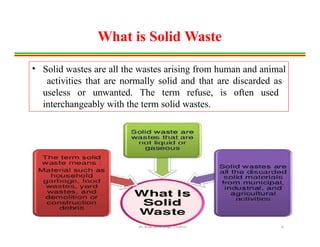
• Solid wastes are all the wastes arising from human and animal
activities that are normally solid and that are discarded as
useless or unwanted. The term refuse, is often used
interchangeably with the term solid wastes.
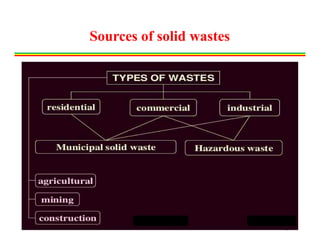
Sources of solid wastes
5
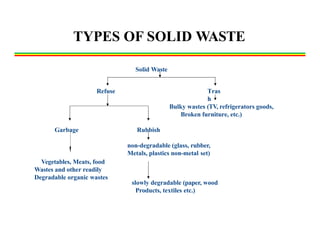
TYPES OF SOLID WASTE
Solid Waste
Refuse Tras
h
Bulky wastes (TV, refrigerators goods,
Broken furniture, etc.)
Garbage Rubbish
non-degradable (glass, rubber,
Metals, plastics non-metal set)
Vegetables, Meats, food
Wastes and other readily
Degradable organic wastes
slowly degradable (paper, wood
Products, textiles etc.)
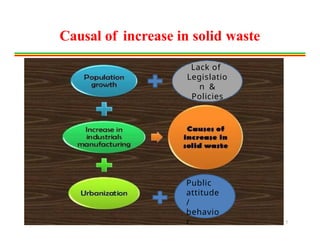
Causal of increase in solid waste
7
Lack of
Legislatio
n &
Policies
Public
attitude
/
behavio
r
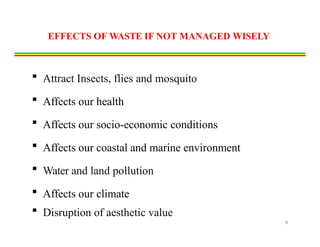
EFFECTS OF WASTE IF NOT MANAGED WISELY
 Attract Insects, flies and mosquito
 Affects our health
 Affects our socio-economic conditions
 Affects our coastal and marine environment
 Water and land pollution
 Affects our climate
 Disruption of aesthetic value
8
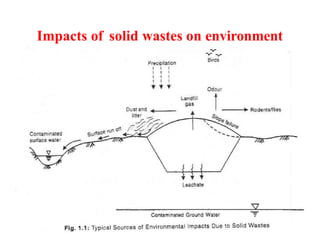
Impacts of solid wastes on environment
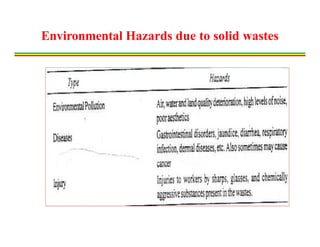
Environmental Hazards due to solid wastes
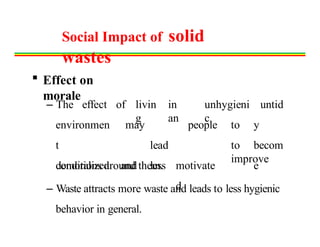
Social Impact of solid
wastes
 Effect on
morale
– The effect of livin
g
in
an
unhygieni
c
untid
y
becom
e
environmen
t
demoralized
may
lead
and less
people
motivate
d
to
to
improve
conditions around them.
– Waste attracts more waste and leads to less hygienic
behavior in general.
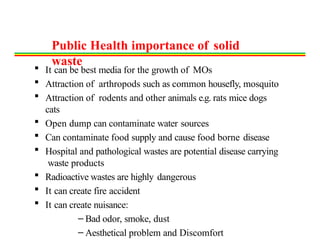
Public Health importance of solid
waste
 It can be best media for the growth of MOs
 Attraction of arthropods such as common housefly, mosquito
 Attraction of rodents and other animals e.g. rats mice dogs
cats
 Open dump can contaminate water sources
 Can contaminate food supply and cause food borne disease
 Hospital and pathological wastes are potential disease carrying
waste products
 Radioactive wastes are highly dangerous
 It can create fire accident
 It can create nuisance:
– Bad odor, smoke, dust
– Aesthetical problem and Discomfort
 Solid waste management: is a discipline associated with
the control of generation, storage, collection, transfer and
transport, processing and finally disposing of wastes with the
objective of protecting the health of the population, promoting
of environmental quality and sustainability, support of
economic productivity and employment generation.
13
What Can We Do?
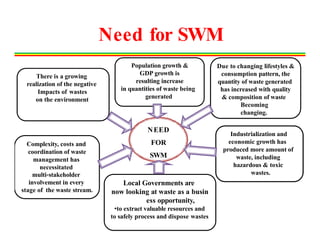
There is a growing
realization of the negative
Impacts of wastes
on the environment
Local Governments are
now looking at waste as a busin
ess opportunity,
•to extract valuable resources and
to safely process and dispose wastes
Industrialization and
economic growth has
produced more amount of
waste, including
hazardous & toxic
wastes.
Complexity, costs and
coordination of waste
management has
necessitated
multi‐stakeholder
involvement in every
stage of the waste stream.
Population growth &
GDP growth is
resulting increase
in quantities of waste being
generated
Due to changing lifestyles &
consumption pattern, the
quantity of waste generated
has increased with quality
& composition of waste
Becoming
changing.
NEED
FOR
SWM
Need for SWM
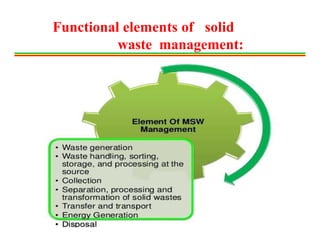
Functional elements of solid
waste management:
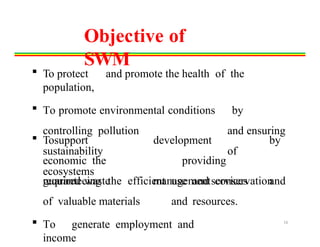
Objective of
SWM
 To protect and promote the health of the
population,
 To promote environmental conditions by
controlling pollution and ensuring
sustainability of
ecosystems
 Tosupport
economic the
required waste
development by
providing
managementservices and
guaranteeing the efficient use and conservation
of valuable materials and resources.
 To generate employment and
income
16
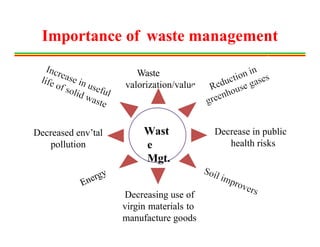
Importance of waste management
Wast
e
Mgt.
Decrease in public
health risks
Decreasing use of
virgin materials to
manufacture goods
Waste
valorization/value
Decreased env’tal
pollution
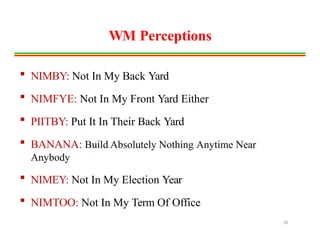
WM Perceptions
 NIMBY: Not In My Back Yard
 NIMFYE: Not In My Front Yard Either
 PIITBY: Put It In Their Back Yard
 BANANA: Build Absolutely Nothing Anytime Near
Anybody
 NIMEY: Not In My Election Year
 NIMTOO: Not In My Term Of Office
18
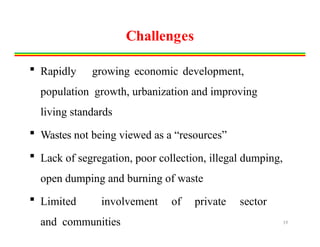
Challenges
 Rapidly growing economic development,
population growth, urbanization and improving
living standards
 Wastes not being viewed as a “resources”
 Lack of segregation, poor collection, illegal dumping,
open dumping and burning of waste
 Limited involvement of private sector
and communities 19
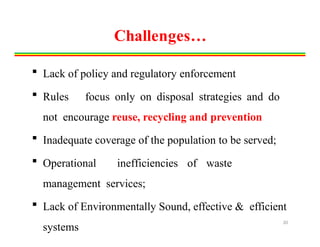
Challenges…
 Lack of policy and regulatory enforcement
 Rules focus only on disposal strategies and do
not encourage reuse, recycling and prevention
 Inadequate coverage of the population to be served;
 Operational inefficiencies of waste
management services;
 Lack of Environmentally Sound, effective & efficient
systems
20
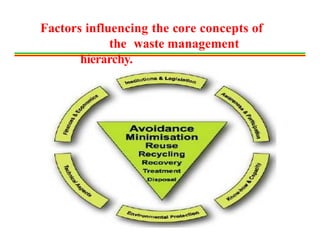
Factors influencing the core concepts of
the waste management
hierarchy.
Sustainable waste management
What shall we
do?
23
Apply Sustainable Waste Management
System
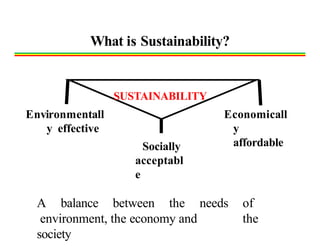
What is Sustainability?
Environmentall
y effective
Economicall
y
affordable
Socially
acceptabl
e
SUSTAINABILITY
of
the
A balance between the needs
environment, the economy and
society
Sustainable Waste Management
 Is a comprehensive waste prevention, recycling, and
waste management in a ways that most effectively
protect human health and the environment
 Involves the selection and application of appropriate
techniques, technologies, and management programs
to achieve sustainability
 Maximizes the opportunities for resource recovery at
all stages
ownership &
through
 It develops
local
responsibilities/participation
approach
a consultative
25
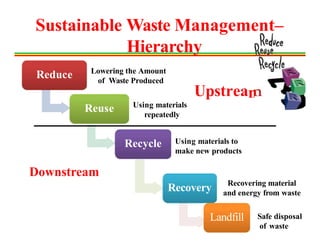
Sustainable Waste Management–
Hierarchy
Reduce
Reduce
Reuse
Reuse
Recycle
Recycle
Recovery
Recovery
Landfill
Landfill
Upstream
Downstream
Lowering the Amount
of Waste Produced
Using materials
repeatedly
Using materials to
make new products
Recovering material
and energy from waste
Safe disposal
of waste
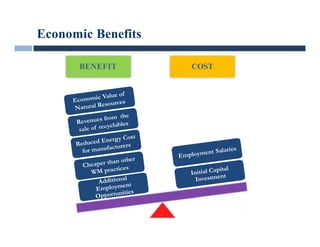
BENEFIT
Economic Benefits
COST
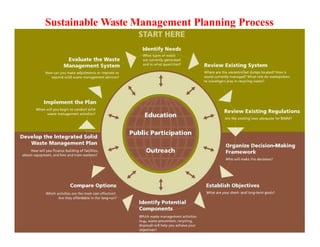
Sustainable Waste Management Planning Process
28
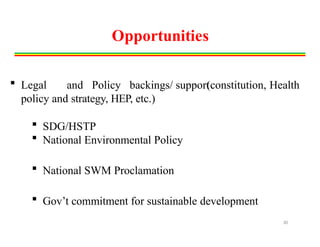
Opportunities
(constitution, Health
 Legal and Policy backings/ support
policy and strategy, HEP, etc.)
 SDG/HSTP
 National Environmental Policy
 National SWM Proclamation
 Gov’t commitment for sustainable development
30
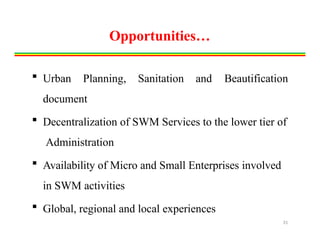
Opportunities…
 Urban Planning, Sanitation and Beautification
document
 Decentralization of SWM Services to the lower tier of
Administration
 Availability of Micro and Small Enterprises involved
in SWM activities
 Global, regional and local experiences
31
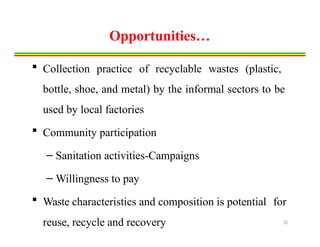
Opportunities…
 Collection practice of recyclable wastes (plastic,
bottle, shoe, and metal) by the informal sectors to be
used by local factories
 Community participation
– Sanitation activities-Campaigns
– Willingness to pay
 Waste characteristics and composition is potential for
reuse, recycle and recovery 32
33
Share the Responsibility
Thank 34

Solid Waste management and segregation u

  • 1.
  • 2.
    Learning objectives – Definitionand concept of solid waste – Source and types of solid waste – Solid Waste Issues In Developing Countries – Impacts of solid wastes – Functional elements of solid waste – Sustainable waste management and waste management hierarchy – Importance, Challenges and Opportunities 2
  • 3.
    Definition  Waste is"useless or worthless material; stuff to be thrown away." (World Book Dictionary)  Waste is "a resource that is not safely recycled back into the environment or the marketplace." (Zero Waste America ) 3
  • 4.
    What is SolidWaste 4 • Solid wastes are all the wastes arising from human and animal activities that are normally solid and that are discarded as useless or unwanted. The term refuse, is often used interchangeably with the term solid wastes.
  • 5.
  • 6.
    TYPES OF SOLIDWASTE Solid Waste Refuse Tras h Bulky wastes (TV, refrigerators goods, Broken furniture, etc.) Garbage Rubbish non-degradable (glass, rubber, Metals, plastics non-metal set) Vegetables, Meats, food Wastes and other readily Degradable organic wastes slowly degradable (paper, wood Products, textiles etc.)
  • 7.
    Causal of increasein solid waste 7 Lack of Legislatio n & Policies Public attitude / behavio r
  • 8.
    EFFECTS OF WASTEIF NOT MANAGED WISELY  Attract Insects, flies and mosquito  Affects our health  Affects our socio-economic conditions  Affects our coastal and marine environment  Water and land pollution  Affects our climate  Disruption of aesthetic value 8
  • 9.
    Impacts of solidwastes on environment
  • 10.
  • 11.
    Social Impact ofsolid wastes  Effect on morale – The effect of livin g in an unhygieni c untid y becom e environmen t demoralized may lead and less people motivate d to to improve conditions around them. – Waste attracts more waste and leads to less hygienic behavior in general.
  • 12.
    Public Health importanceof solid waste  It can be best media for the growth of MOs  Attraction of arthropods such as common housefly, mosquito  Attraction of rodents and other animals e.g. rats mice dogs cats  Open dump can contaminate water sources  Can contaminate food supply and cause food borne disease  Hospital and pathological wastes are potential disease carrying waste products  Radioactive wastes are highly dangerous  It can create fire accident  It can create nuisance: – Bad odor, smoke, dust – Aesthetical problem and Discomfort
  • 13.
     Solid wastemanagement: is a discipline associated with the control of generation, storage, collection, transfer and transport, processing and finally disposing of wastes with the objective of protecting the health of the population, promoting of environmental quality and sustainability, support of economic productivity and employment generation. 13 What Can We Do?
  • 14.
    There is agrowing realization of the negative Impacts of wastes on the environment Local Governments are now looking at waste as a busin ess opportunity, •to extract valuable resources and to safely process and dispose wastes Industrialization and economic growth has produced more amount of waste, including hazardous & toxic wastes. Complexity, costs and coordination of waste management has necessitated multi‐stakeholder involvement in every stage of the waste stream. Population growth & GDP growth is resulting increase in quantities of waste being generated Due to changing lifestyles & consumption pattern, the quantity of waste generated has increased with quality & composition of waste Becoming changing. NEED FOR SWM Need for SWM
  • 15.
    Functional elements ofsolid waste management:
  • 16.
    Objective of SWM  Toprotect and promote the health of the population,  To promote environmental conditions by controlling pollution and ensuring sustainability of ecosystems  Tosupport economic the required waste development by providing managementservices and guaranteeing the efficient use and conservation of valuable materials and resources.  To generate employment and income 16
  • 17.
    Importance of wastemanagement Wast e Mgt. Decrease in public health risks Decreasing use of virgin materials to manufacture goods Waste valorization/value Decreased env’tal pollution
  • 18.
    WM Perceptions  NIMBY:Not In My Back Yard  NIMFYE: Not In My Front Yard Either  PIITBY: Put It In Their Back Yard  BANANA: Build Absolutely Nothing Anytime Near Anybody  NIMEY: Not In My Election Year  NIMTOO: Not In My Term Of Office 18
  • 19.
    Challenges  Rapidly growingeconomic development, population growth, urbanization and improving living standards  Wastes not being viewed as a “resources”  Lack of segregation, poor collection, illegal dumping, open dumping and burning of waste  Limited involvement of private sector and communities 19
  • 20.
    Challenges…  Lack ofpolicy and regulatory enforcement  Rules focus only on disposal strategies and do not encourage reuse, recycling and prevention  Inadequate coverage of the population to be served;  Operational inefficiencies of waste management services;  Lack of Environmentally Sound, effective & efficient systems 20
  • 21.
    Factors influencing thecore concepts of the waste management hierarchy.
  • 22.
  • 23.
    What shall we do? 23 ApplySustainable Waste Management System
  • 24.
    What is Sustainability? Environmentall yeffective Economicall y affordable Socially acceptabl e SUSTAINABILITY of the A balance between the needs environment, the economy and society
  • 25.
    Sustainable Waste Management Is a comprehensive waste prevention, recycling, and waste management in a ways that most effectively protect human health and the environment  Involves the selection and application of appropriate techniques, technologies, and management programs to achieve sustainability  Maximizes the opportunities for resource recovery at all stages ownership & through  It develops local responsibilities/participation approach a consultative 25
  • 26.
    Sustainable Waste Management– Hierarchy Reduce Reduce Reuse Reuse Recycle Recycle Recovery Recovery Landfill Landfill Upstream Downstream Loweringthe Amount of Waste Produced Using materials repeatedly Using materials to make new products Recovering material and energy from waste Safe disposal of waste
  • 27.
  • 28.
    Sustainable Waste ManagementPlanning Process 28
  • 30.
    Opportunities (constitution, Health  Legaland Policy backings/ support policy and strategy, HEP, etc.)  SDG/HSTP  National Environmental Policy  National SWM Proclamation  Gov’t commitment for sustainable development 30
  • 31.
    Opportunities…  Urban Planning,Sanitation and Beautification document  Decentralization of SWM Services to the lower tier of Administration  Availability of Micro and Small Enterprises involved in SWM activities  Global, regional and local experiences 31
  • 32.
    Opportunities…  Collection practiceof recyclable wastes (plastic, bottle, shoe, and metal) by the informal sectors to be used by local factories  Community participation – Sanitation activities-Campaigns – Willingness to pay  Waste characteristics and composition is potential for reuse, recycle and recovery 32
  • 33.
  • 34.