IMPACT ON FRICTION,
DAMAGE AND WEAR
RESISTANCE BY SOL GEL
COATING ON STAINLESS
STEEL
ANANTHU GOPAL S.P
Roll No: 463
MP
SCTCE
Contents
• Introduction
• Introduction to sol gel coating
• Experimental details
• Sample characterisation
• Wear tests
• Results
• Phase composition and structure
• Mechanical properties
• Tribological behaviour
• Conclusion
• Reference
INTRODUCTION
Degradation by wear surfaces is one of the most current industrial phenomena, which cause
replacement of parts in the engineering industry. The choice of material for the production of parts is
often a complex issue .
so it is necessary to use special surface treatment. To meet the reliability requirements in the areas
that have been developed treatments or coatings that increase the longevity of parts.
In this study we will focus on the surface treatment process developed by the sol–gel (SG)
technology in a stainless steel to improve their behaviour as wear.
Sol gel is one of the simplest techniques to manufacture thin films. It is easy to adopt , requires low
processing temperature and leads to high degree of purity oxide coatings.
Introduction to Sol-gel coating
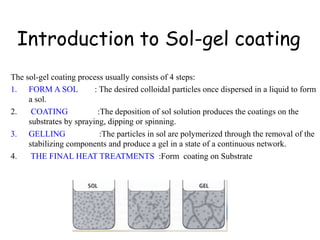
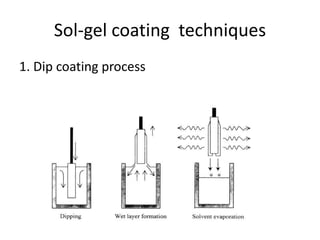
The sol-gel coating process usually consists of 4 steps:
1. FORM A SOL : The desired colloidal particles once dispersed in a liquid to form
a sol.
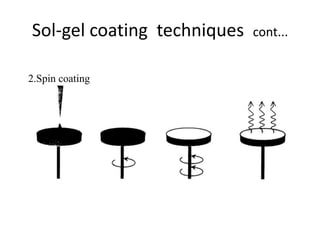
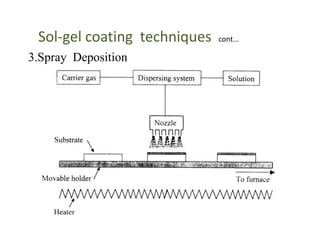
2. COATING :The deposition of sol solution produces the coatings on the
substrates by spraying, dipping or spinning.
3. GELLING :The particles in sol are polymerized through the removal of the
stabilizing components and produce a gel in a state of a continuous network.
4. THE FINAL HEAT TREATMENTS :Form coating on Substrate
Sol-gel coating techniques
1. Dip coating process
Sol-gel coating techniques cont...
2.Spin coating
3.Spray Deposition
Sol-gel coating techniques cont...
Experimental Details
Specimen
AISI304 stainless steel is used as substrate. Before the sol–gel process, all substrate surfaces
are prepared by soft polishing, then it is cleaned by ethanol and acetone.
AISI H11 nitrated steel (classic steel used for formatting) is also tested for a
comparative study with coated and uncoated stainless steel AISI304. Thereby, to test this steel
in wear, a circular samples steel is cut into pieces of 30 mm of diameter, and 5 mm of
thickness. Al2O3 used as material to be coated.
Coating
A sol– gel coating alumina is developed by gelling.
The alumina isopropoxide precursor Al(O-i-Pr)3, is dissolved in water in the presence of the acid
HNO3.
Solution is maintained under agitation during 24h at room temperature (25 °C).
To make sure of the good dispersion of the powder with in the water.Then the
mixture is treated by ultrasounds during 120 seconds.
The gels are deposited on the substrate by using a dip-coater at a constant speed of 60mm/min, and
then withdrawn at approximately the same speed.
The coated substrates are then annealed at 500 °C or 700°C for 1 h
Samples characterization
In this analysis, a micro structural scanning electron
microscope (SEM) equipped with an energy
spectroscopy X(EDX) light dispersion is
employed.
The identification of the film phase formed by the
sol–gel on the stainless steel was studied using
XRD technique (simens D-500 system)
Wear tests
The study of the wear and tribology behaviour is developed by a pin-on-disc
tribometer) without lubrication in room temperature.
The tests were elaborated out with 1N load and a rotating speed of 0.01m/s for a
total wear distance of 40m.
Mass loss was measured with a 10^-5-5g analytical balance before and after the
tests.
Volume loss after the wear test was determined for each specimen from the mass
loss measurements taking the real density of the material into account or of the
coating.
From these data, the specific wear rate(mm3^3N-1m-1), was calculated by dividing
the volume loss by the normal applied load and the total sliding length as the
following equation indicates:
V = K. W. L
In this equation, V is the wear volume(mm3), L is the sliding distance (m), W is
the applied load(N) and K is the specific wear rate(mm3 N-1m-1).
Results- Morphology
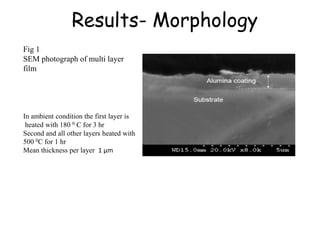
Fig 1
SEM photograph of multi layer
film
In ambient condition the first layer is
heated with 180 0 C for 3 hr
Second and all other layers heated with
500 0C for 1 hr
Mean thickness per layer 1 μm
Phase composition and
structure
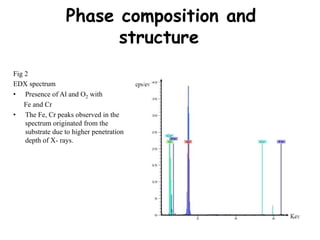
Fig 2
EDX spectrum
• Presence of Al and O2 with
Fe and Cr
• The Fe, Cr peaks observed in the
spectrum originated from the
substrate due to higher penetration
depth of X- rays.
Mechanical properties
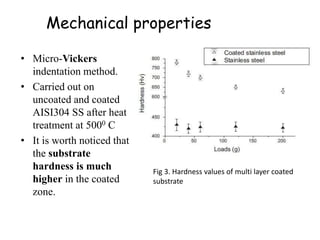
• Micro-Vickers
indentation method.
• Carried out on
uncoated and coated
AISI304 SS after heat
treatment at 5000 C
• It is worth noticed that
the substrate
hardness is much
higher in the coated
zone.
Fig 3. Hardness values of multi layer coated
substrate
Tribological behaviour
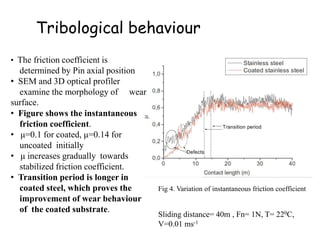
Fig 4. Variation of instantaneous friction coefficient
• The friction coefficient is
determined by Pin axial position
• SEM and 3D optical profiler
examine the morphology of wear
surface.
• Figure shows the instantaneous
friction coefficient.
• μ=0.1 for coated, μ=0.14 for
uncoated initially
• μ increases gradually towards
stabilized friction coefficient.
• Transition period is longer in
coated steel, which proves the
improvement of wear behaviour
of the coated substrate.
Sliding distance= 40m , Fn= 1N, T= 220C,
V=0.01 ms-1
Tribological behaviour cont..
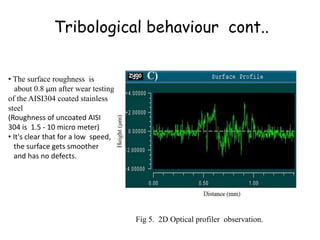
• The surface roughness is
about 0.8 μm after wear testing
of the AISI304 coated stainless
steel
(Roughness of uncoated AISI
304 is 1.5 - 10 micro meter)
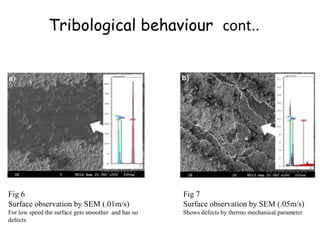
• It's clear that for a low speed,
the surface gets smoother
and has no defects.
Fig 5. 2D Optical profiler observation.
Tribological behaviour cont..
Fig 6
Surface observation by SEM (.01m/s)
For low speed the surface gets smoother and has no
defects
Fig 7
Surface observation by SEM (.05m/s)
Shows defects by thermo mechanical parameter
Tribological behaviour ........
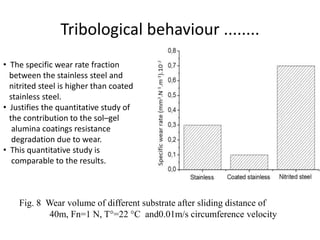
Fig. 8 Wear volume of different substrate after sliding distance of
40m, Fn=1 N, T°=22 °C and0.01m/s circumference velocity
• The specific wear rate fraction
between the stainless steel and
nitrited steel is higher than coated
stainless steel.
• Justifies the quantitative study of
the contribution to the sol–gel
alumina coatings resistance
degradation due to wear.
• This quantitative study is
comparable to the results.
Conclusion
 The alumina coated stainless steel by sol-gel method
reduces the instantaneous and stabilized friction
coefficients.
 The micro structural analysis has shown that the sol-gel
coating is smooth homogeneous and compact.
 Based on the defined mechanical properties, the
hardness of the sol-gel coating is higher than those of
uncoated stainless steel and nitride steel.
 Through pin-disc test, it has been established that
alumina layers improve the tribological behaviour of
stainless steel, and reduce wear and damage.
Reference
[1] B. Tlili, A.Barkaoui, M.Walock, Tribology and wear resistance of the stainless steel.
The sol–gel coating impact on the friction and damage; 102(2016)348–354
[2] S.M. Attia, Jue Wang, Guangming, Jun Shen, and Jianhua M A; Review on sol- gel
derived coatings: process, techniques and optical applications; vol 18 (2012) ,211-218
[3] M. Aparicio A. Jitanu G. Rodriguez A. Degnah K.Al-Marzoki J. Mosa L.C. klein;
Corrosion Protection of AISI 304 Stainless Steel with Melting Gel Coatings;
S0013-4686(2015)31068-9
[4] Ana F. Suzana, Elivelton A. Ferreira, Assis V. Benedetti, Hudson W.P. Carvalho, Celso V.
Santilli, Sandra H. Pulcinelli; Corrosion protection of chromium-coated steel by hybrid
sol-gel coatings; S0257-8972(2016)30358-9
Thank You

Sol-Gel coating

  • 1.
    IMPACT ON FRICTION, DAMAGEAND WEAR RESISTANCE BY SOL GEL COATING ON STAINLESS STEEL ANANTHU GOPAL S.P Roll No: 463 MP SCTCE
  • 2.
    Contents • Introduction • Introductionto sol gel coating • Experimental details • Sample characterisation • Wear tests • Results • Phase composition and structure • Mechanical properties • Tribological behaviour • Conclusion • Reference
  • 3.
    INTRODUCTION Degradation by wearsurfaces is one of the most current industrial phenomena, which cause replacement of parts in the engineering industry. The choice of material for the production of parts is often a complex issue . so it is necessary to use special surface treatment. To meet the reliability requirements in the areas that have been developed treatments or coatings that increase the longevity of parts. In this study we will focus on the surface treatment process developed by the sol–gel (SG) technology in a stainless steel to improve their behaviour as wear. Sol gel is one of the simplest techniques to manufacture thin films. It is easy to adopt , requires low processing temperature and leads to high degree of purity oxide coatings.
  • 4.
    Introduction to Sol-gelcoating The sol-gel coating process usually consists of 4 steps: 1. FORM A SOL : The desired colloidal particles once dispersed in a liquid to form a sol. 2. COATING :The deposition of sol solution produces the coatings on the substrates by spraying, dipping or spinning. 3. GELLING :The particles in sol are polymerized through the removal of the stabilizing components and produce a gel in a state of a continuous network. 4. THE FINAL HEAT TREATMENTS :Form coating on Substrate
  • 5.
    Sol-gel coating techniques 1.Dip coating process
  • 6.
    Sol-gel coating techniquescont... 2.Spin coating
  • 7.
  • 8.
    Experimental Details Specimen AISI304 stainlesssteel is used as substrate. Before the sol–gel process, all substrate surfaces are prepared by soft polishing, then it is cleaned by ethanol and acetone. AISI H11 nitrated steel (classic steel used for formatting) is also tested for a comparative study with coated and uncoated stainless steel AISI304. Thereby, to test this steel in wear, a circular samples steel is cut into pieces of 30 mm of diameter, and 5 mm of thickness. Al2O3 used as material to be coated.
  • 9.
    Coating A sol– gelcoating alumina is developed by gelling. The alumina isopropoxide precursor Al(O-i-Pr)3, is dissolved in water in the presence of the acid HNO3. Solution is maintained under agitation during 24h at room temperature (25 °C). To make sure of the good dispersion of the powder with in the water.Then the mixture is treated by ultrasounds during 120 seconds. The gels are deposited on the substrate by using a dip-coater at a constant speed of 60mm/min, and then withdrawn at approximately the same speed. The coated substrates are then annealed at 500 °C or 700°C for 1 h
  • 10.
    Samples characterization In thisanalysis, a micro structural scanning electron microscope (SEM) equipped with an energy spectroscopy X(EDX) light dispersion is employed. The identification of the film phase formed by the sol–gel on the stainless steel was studied using XRD technique (simens D-500 system)
  • 11.
    Wear tests The studyof the wear and tribology behaviour is developed by a pin-on-disc tribometer) without lubrication in room temperature. The tests were elaborated out with 1N load and a rotating speed of 0.01m/s for a total wear distance of 40m. Mass loss was measured with a 10^-5-5g analytical balance before and after the tests. Volume loss after the wear test was determined for each specimen from the mass loss measurements taking the real density of the material into account or of the coating. From these data, the specific wear rate(mm3^3N-1m-1), was calculated by dividing the volume loss by the normal applied load and the total sliding length as the following equation indicates: V = K. W. L In this equation, V is the wear volume(mm3), L is the sliding distance (m), W is the applied load(N) and K is the specific wear rate(mm3 N-1m-1).
  • 12.
    Results- Morphology Fig 1 SEMphotograph of multi layer film In ambient condition the first layer is heated with 180 0 C for 3 hr Second and all other layers heated with 500 0C for 1 hr Mean thickness per layer 1 μm
  • 13.
    Phase composition and structure Fig2 EDX spectrum • Presence of Al and O2 with Fe and Cr • The Fe, Cr peaks observed in the spectrum originated from the substrate due to higher penetration depth of X- rays.
  • 14.
    Mechanical properties • Micro-Vickers indentationmethod. • Carried out on uncoated and coated AISI304 SS after heat treatment at 5000 C • It is worth noticed that the substrate hardness is much higher in the coated zone. Fig 3. Hardness values of multi layer coated substrate
  • 15.
    Tribological behaviour Fig 4.Variation of instantaneous friction coefficient • The friction coefficient is determined by Pin axial position • SEM and 3D optical profiler examine the morphology of wear surface. • Figure shows the instantaneous friction coefficient. • μ=0.1 for coated, μ=0.14 for uncoated initially • μ increases gradually towards stabilized friction coefficient. • Transition period is longer in coated steel, which proves the improvement of wear behaviour of the coated substrate. Sliding distance= 40m , Fn= 1N, T= 220C, V=0.01 ms-1
  • 16.
    Tribological behaviour cont.. •The surface roughness is about 0.8 μm after wear testing of the AISI304 coated stainless steel (Roughness of uncoated AISI 304 is 1.5 - 10 micro meter) • It's clear that for a low speed, the surface gets smoother and has no defects. Fig 5. 2D Optical profiler observation.
  • 17.
    Tribological behaviour cont.. Fig6 Surface observation by SEM (.01m/s) For low speed the surface gets smoother and has no defects Fig 7 Surface observation by SEM (.05m/s) Shows defects by thermo mechanical parameter
  • 18.
    Tribological behaviour ........ Fig.8 Wear volume of different substrate after sliding distance of 40m, Fn=1 N, T°=22 °C and0.01m/s circumference velocity • The specific wear rate fraction between the stainless steel and nitrited steel is higher than coated stainless steel. • Justifies the quantitative study of the contribution to the sol–gel alumina coatings resistance degradation due to wear. • This quantitative study is comparable to the results.
  • 19.
    Conclusion  The aluminacoated stainless steel by sol-gel method reduces the instantaneous and stabilized friction coefficients.  The micro structural analysis has shown that the sol-gel coating is smooth homogeneous and compact.  Based on the defined mechanical properties, the hardness of the sol-gel coating is higher than those of uncoated stainless steel and nitride steel.  Through pin-disc test, it has been established that alumina layers improve the tribological behaviour of stainless steel, and reduce wear and damage.
  • 20.
    Reference [1] B. Tlili,A.Barkaoui, M.Walock, Tribology and wear resistance of the stainless steel. The sol–gel coating impact on the friction and damage; 102(2016)348–354 [2] S.M. Attia, Jue Wang, Guangming, Jun Shen, and Jianhua M A; Review on sol- gel derived coatings: process, techniques and optical applications; vol 18 (2012) ,211-218 [3] M. Aparicio A. Jitanu G. Rodriguez A. Degnah K.Al-Marzoki J. Mosa L.C. klein; Corrosion Protection of AISI 304 Stainless Steel with Melting Gel Coatings; S0013-4686(2015)31068-9 [4] Ana F. Suzana, Elivelton A. Ferreira, Assis V. Benedetti, Hudson W.P. Carvalho, Celso V. Santilli, Sandra H. Pulcinelli; Corrosion protection of chromium-coated steel by hybrid sol-gel coatings; S0257-8972(2016)30358-9
  • 21.