www.readinga-z.com
Written by Bruce D. Cooper
LEVELED BOOK • S
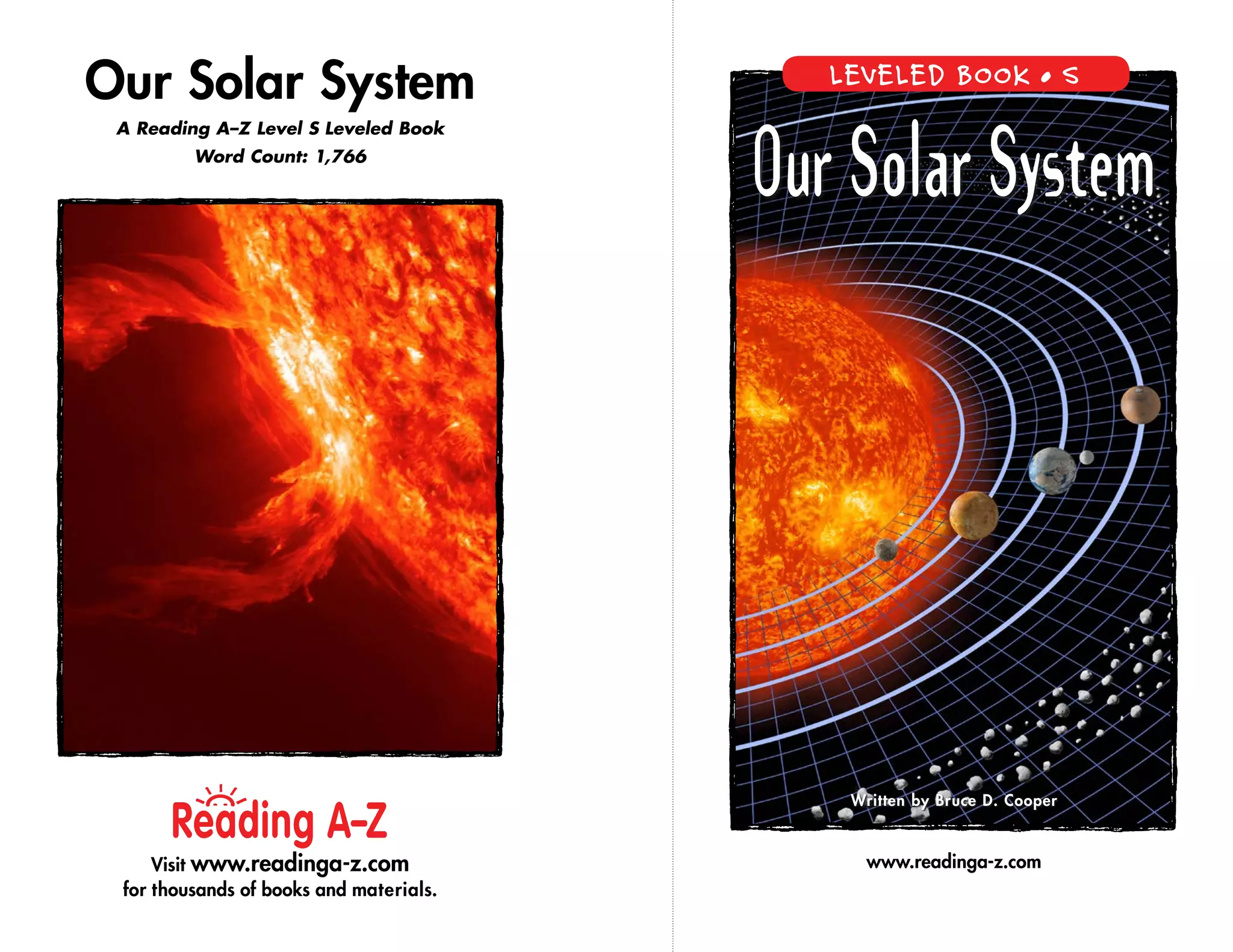
Our Solar System
Our Solar System
A Reading A–Z Level S Leveled Book
Word Count: 1,766
Visit www.readinga-z.com
for thousands of books and materials.
Our Solar System
Level S Leveled Book
© Learning A–Z
Written by Bruce D. Cooper
Digital image manipulation
by Randy Gates
All rights reserved.
www.readinga-z.com
Correlation
LEVEL S
O
34
34
Fountas & Pinnell
Reading Recovery
DRA
Written by Bruce D. Cooper
www.readinga-z.com
Our Solar System
Photo Credits:
Front cover, title page, pages 4, 7, 10: courtesy of NASA/JPL; back cover:
courtesy of SDO/AIA; page 3: courtesy of NASA/ESA/The Hubble Heritage
Team (STScI/AURA); page 5: courtesy of Solar & Heliospheric Observatory/
Extreme Ultraviolet Imaging Telescope/NASA/Goddard Space Flight Center;
page 6: courtesy of SOHO (ESA & NASA)/EIT Consortium; page 8: courtesy
of NASA/Johns Hopkins University Applied Physics Laboratory/Arizona State
University/Carnegie Institution of Washington. Image reproduced courtesy of
Science/AAAS; pages 9, 13: courtesy of NASA/JPL/USGS; page 11: courtesy
of NASA/GSFC/GOES/NOAA; pages 12, 17, 21: courtesy of NASA; page
14: courtesy of NASA and The Hubble Heritage Team (STScI/AURA); page
15: courtesy of NASA/JPL-Caltech/University of Arizona; page 16: courtesy of
NASA, ESA, and E. Karkoschka (University of Arizona); page 18: courtesy of
NASA/JPL/Space Science Institute; page 19: courtesy of NASA, ESA, and the
Hubble Heritage Team (STScI/AURA); page 20: courtesy of Erich Karkoschka
(University of Arizona) and NASA; page 22: courtesy of NASA, ESA, and M.
Buie (Southwest Research Institute); page 23: courtesy of ESA - AOES Medialab;
page 24: © WIYN/NOAO/AURA/NSF/epa/Corbis; page 25 (center): courtesy
of ESA/ LFI & HFI Consortia; page 25 (right): courtesy of ESA – D. Ducros
Our Solar System • Level S 3 4
Table of Contents
Introduction .  .  .  .  .  .  .  .  .  .  .  .  .  .  .  .  .  .  .  .  .  .  .  .  .  . 4
The Sun .  .  .  .  .  .  .  .  .  .  .  .  .  .  .  .  .  .  .  .  .  .  .  .  .  .  .  .  . 6
Mercury .  .  .  .  .  .  .  .  .  .  .  .  .  .  .  .  .  .  .  .  .  .  .  .  .  .  .  .  . 8
Venus .  .  .  .  .  .  .  .  .  .  .  .  .  .  .  .  .  .  .  .  .  .  .  .  .  .  .  .  .  .  . 9
Earth  .  .  .  .  .  .  .  .  .  .  .  .  .  .  .  .  .  .  .  .  .  .  .  .  .  .  .  .  .  . 11
The Moon .  .  .  .  .  .  .  .  .  .  .  .  .  .  .  .  .  .  .  .  .  .  .  .  .  .  . 13
Mars .  .  .  .  .  .  .  .  .  .  .  .  .  .  .  .  .  .  .  .  .  .  .  .  .  .  .  .  .  .  . 14
Jupiter  .  .  .  .  .  .  .  .  .  .  .  .  .  .  .  .  .  .  .  .  .  .  .  .  .  .  .  .  . 16
Saturn  .  .  .  .  .  .  .  .  .  .  .  .  .  .  .  .  .  .  .  .  .  .  .  .  .  .  .  .  . 18
Uranus .  .  .  .  .  .  .  .  .  .  .  .  .  .  .  .  .  .  .  .  .  .  .  .  .  .  .  .  . 20
Neptune .  .  .  .  .  .  .  .  .  .  .  .  .  .  .  .  .  .  .  .  .  .  .  .  .  .  .  . 21
Pluto and Other Dwarf Planets .  .  .  .  .  .  .  .  .  .  . 22
Asteroids  .  .  .  .  .  .  .  .  .  .  .  .  .  .  .  .  .  .  .  .  .  .  .  .  .  .  . 23
Comets .  .  .  .  .  .  .  .  .  .  .  .  .  .  .  .  .  .  .  .  .  .  .  .  .  .  .  .  . 24
Conclusion .  .  .  .  .  .  .  .  .  .  .  .  .  .  .  .  .  .  .  .  .  .  .  .  .  . 25
Glossary .  .  .  .  .  .  .  .  .  .  .  .  .  .  .  .  .  .  .  .  .  .  .  .  .  .  .  . 26
Introduction
Our Solar System is made up of the Sun,
eight official planets, several dwarf planets,
and hundreds of planetary satellites, or moons.
It also contains comets, asteroids, and clouds
of gas. The Sun is the center of the Solar
System. Everything else in the Solar System
goes around, or orbits, the Sun. Mercury,
Venus, Earth, and Mars are the inner, rocky
planets. They are made of hard materials. The
outer planets are Jupiter, Saturn, Uranus, and
Neptune. They are known as the gas giants and
are made mostly of gases. The outer planets
are hundreds of times larger than Earth.
Sun
Jupiter
Saturn
Uranus
Neptune
Pluto
Earth
Moon
Venus
Mars
Mercury
Our Solar System • Level S 5 6
To get an idea of the size of things in our
Solar System, imagine that Earth is a grape.
If the Earth were the size of a grape, the Moon
would be the size of a green pea. The Sun
would be as big as a ball that an adult man
could stand in. Jupiter, the largest planet,
would be the size of a grapefruit, while Saturn,
the second largest planet, would be the size of
an orange. Uranus and Neptune would be the
size of lemons.
Approximate
size of
Earth for
comparison
The Sun is approximately110 times larger than Earth. The
diameter of Earth is approximately13,000 kilometers (8,100
miles). The Sun’s diameter is approximately1.4 million kilometers
(870,000 miles).
The Sun
The Sun is a huge ball of burning gas that
sends energy far out into the Solar System.
The Sun plays a very important part in our
daily lives, providing energy that supports all
life on Earth. The Sun causes seasons, climate,
ocean currents, air circulation, and weather.
Without the Sun’s energy, plants could not
grow and make food. Also, there would be no
gas, oil, or coal, which are Earth’s fossil fuels.
Fossil fuels are formed over millions of years
from dead plant and animal life.
The temperature of the Sun’s surface is approximately 6,000
degrees Celsius (10,832 degrees Fahrenheit). The Sun’s core is
approximately 15,000,000 degrees Celsius (27,000,032
degrees Fahrenheit).
Our Solar System • Level S 7 8
The Sun is just one of billions of stars. It
has been around for about 4.6 billion years.
It will keep producing energy for another
5 billion years. Before it dies, it will swell up
and swallow many of the inner planets. Then
it will shrink into a much smaller ball.
Relative sizes of
the objects in our
Solar SystemSun
Jupiter
Saturn
Uranus
Neptune
Pluto
Mercury
Earth
Venus
Mars
Mercury
Mercury is the closest planet to the Sun.
It is the smallest planet in our Solar System.
It takes only 88 Earth days for Mercury to
make a complete orbit around the Sun. (For
comparison, it takes Earth 365 days, or one
year, to orbit the Sun.) Like all other planets,
Mercury spins like a top as it goes around the
Sun. It spins very slowly. Each spin of a planet
is a day on that planet. A day on Mercury is
59 times longer than an Earth day. Because
Mercury spins, or rotates, so slowly, it gets
very hot during the day and very cold at night.
A close-up image
from the NASA
Discovery flight
in 2008, shows
the huge Caloris
Impact Basin
on Mercury.
Our Solar System • Level S 9 10
As well as trapping in heat, the clouds of
Venus reflect sunlight. This makes Venus one of
the brightest objects in the sky. The air pressure
on Venus is ninety times greater than that on
Earth. For this reason, space probes that land
on Venus stop working within a few hours.
Venus rotates even more slowly than Mercury.
One day on Venus is equal to 243 Earth days.
Maat Mons, a volcano on Venus, is 8 km (5 mi.) high.
It is very similar to the types of volcanoes found in Hawaii.
Venus
Venus and Earth are similar in size. But
Earth and Venus are very different. Venus is
covered by layers of clouds that are much
thicker than clouds on Earth. These clouds
trap most of the Sun’s heat. The temperature
on Venus gets very, very hot—more than four
times hotter than boiling water.
In addition to having air too heavy to breathe, scientists found
that Venus rotates backward. This means that on Venus the
Sun rises in the west and sets in the east. The colors used on
this Magellan-mission image represent different elevations on the
surface of Venus.
Our Solar System • Level S 11 12
Earth
Earth is a very special planet because it
is our home and also because it is the only
planet in our Solar System that can support
life. The most important difference between
Earth and other planets is the abundance of
liquid water. Water covers nearly 70 percent
of the Earth. Earth rotates about once every
24 hours (one day). It completes one orbit of
the Sun about once every 365 days (one year).
Earth’s atmosphere is made up of gases
that living things need to stay alive. The
atmosphere protects us from most of the
Sun’s harmful rays. It also helps to protect
us from meteors by causing them to burn up
before reaching Earth’s surface. Earth has one
natural satellite, the Moon.
Do You Know?
Earth’s atmosphere is very thin.
If Earth were an apple, the
atmosphere would only be as
thick as the apple’s skin.
Our Solar System • Level S 13 14
The Moon
The Moon is about one-fourth the size
of Earth. It reflects light from the Sun onto
us. Many scientists believe the Moon was
originally a part of Earth and was broken off
in an enormous space collision. Tests have
shown that there is water ice on the Moon’s
surface. Earth’s ocean tides are caused by the
gravitational pull of the Moon.
Mars
Mars is the fourth planet from the Sun. It
is known as the red planet because of large
amounts of rust-colored dust on its surface.
Mars is the most Earth-like of all the planets
of our Solar System. Mars has seasons similar
to our own, and the soil there is similar to the
soil on Earth. But there is very little oxygen or
water vapor in Mars’s atmosphere. The climate
on Mars changes widely between seasons.
Temperatures on its surface can range from
30° Celsius (86°F) in the summer, to –130°
Celsius (–202°F) in the winter.
Our Solar System • Level S 15 16
Mars often has
winds that blow up
to 200 kilometers per
hour (120 mph). These
winds cause great dust
storms that color the
planet’s atmosphere
pink. There are ice
caps on both poles of
Mars. The northern one
is made up mostly of
water that never melts,
while the southern
pole is made up of
carbon dioxide, which
changes from solid to
gas during the Martian
summer. Mars has two
small moons, Phobos
and Deimos. A year on
Mars is almost as long
as two Earth years. A
day on Mars lasts only
one-half hour longer
than a day on Earth.
Jupiter
Jupiter is the largest planet in our Solar
System. It is like a star in many ways because
it is made up mostly of gas clouds. The
clouds of Jupiter form bands that have very
high winds and are always very stormy. One
gigantic storm rotates counterclockwise at a
constant speed of 360 kilometers per hour
(225 mph), and acts much like a hurricane. It’s
called the Great Red Spot. Easily visible, it can
be as wide as three times the size of Earth.
Jupiter’s temperature is very cold at the tops
of the clouds. At its core, it is hotter than the
surface of the Sun.
Scientists are studying the
gullies at Mars Hale Crater
to discover if their changing
surface shapes are created by
the movement of liquid water.
Jupiter and its moon, Ganymede, photographed April 9, 2007,
by the Hubble Space Telescope
Our Solar System • Level S 17 18
In some ways, Jupiter is like a mini-solar
system because it is so big and has four large
moons and dozens of smaller moons orbiting
around it. It also has several thin rings at its
equator. Scientists believe that if Jupiter had
become larger during its development, it could
have become a star instead of a planet. Jupiter
spins quite fast for such a large planet. One
day on Jupiter is roughly ten hours. It takes
Jupiter almost twelve Earth years to complete
its orbit around the Sun.
Saturn
Saturn is the sixth planet of the Solar
System. It is easy to recognize because of its
large, visible system of rings. The rings are
made up of millions of pieces of ice and frozen
gases. Saturn also has dozens of small moons
that orbit it.
Jupiter’s constant dust storm, the Big Red Spot, is highly visible.
Shown in their approximate size relationship, Jupiter’s four moons
are named, top to bottom: Io, Europa, Ganymede and Callisto.
Saturn’s spectacular rings are mostly made of water ice. Each
ring averages about 30 feet in depth but some bumps and points
are more than two miles high.
Our Solar System • Level S 19 20
Saturn is also unique for another reason.
It weighs little compared to how large it is.
Saturn would float if a swimming pool could
be made big enough to hold it. Saturn spins
very fast, making one day on Saturn ten and
one-half hours long.
Uranus
Uranus is the seventh planet of the Solar
System and the third largest. It looks blue-
green in color because of methane gas in its
atmosphere. Uranus seems to roll around the
Sun because it is very tilted. Scientists think
this might be because it bumped into another
planet-sized object long ago. Uranus has at
least twenty-seven moons, five of which are
large. Scientists have also counted at least
thirteen rings. It takes Uranus eighty-one Earth
years to go around the Sun.
Some of Uranus’s
moons and rings
can be seen very
clearly in this
Hubble Telescope
image. The bright
spots on the far
right of the planet
are high clouds.
Four moons of Saturn pass in front of the planet. Enceladus and
Dione on the far left cast shadows while the larger Titan and the
small Mimas at the far right do not.
moon
shadow moon
moon
moon
shadow
Our Solar System • Level S 21 22
What Would You Weigh?
Gravity is different on each
planet, and gravity determines
how much you weigh.
If you weigh 70 lbs. on Earth,
then you would weigh:
On Mercury	 27 lbs.
On Venus	 63 lbs.
On the Moon	 12 lbs.
On Mars	 27 lbs.
On Jupiter	 165 lbs.
On Saturn	 65 lbs.
On Uranus	 62 lbs.
On Neptune	 79 lbs.
On Pluto	 5 lbs.
In outer space, you’d weigh
nothing!
Neptune
Neptune is the eighth planet from the Sun.
Neptune and Uranus are sometimes called
the twin giants because they are so much
alike. They are about the same size and color
and both are covered with thick clouds. But
Neptune’s winds are the fastest in the Solar
System—reaching 2,000 kilometers per hour
(over 1,242 mph). Neptune has one large
moon and many smaller moons, plus several
visible dust rings. It takes Neptune about 165
Earth years to go around the Sun.
Pluto and Other Dwarf Planets
Before 2006, the space object
called Pluto was the ninth planet
of our Solar System. But scientists
debated and voted to create a new
category called dwarf planets for space objects
like Pluto. Dwarf planets orbit the Sun, have
nearly round shapes, produce a minimum
level of brightness, and are not moons. They
also do not have enough gravitational pull to
sweep other space objects from their orbit.
Scientists began by identifying six official
dwarf planets, but
some scientists
wanted to classify
dozens of similar
space objects as
dwarf planets.
Many more space
objects could be
counted among
the dwarf planets
as technology
makes it easier
to identify them.
Toward the
top is the
“backward”
storm that
scientists have
named Dark
Spot One
and lower is,
Dark Spot
Two. Their
cyclonelike
winds spin
counter to
the direction
of Neptune’s
orbit.
Our Solar System • Level S 23 24
Asteroids
Asteroids are rocky, metallic objects orbiting
the Sun. They range in size from a few feet
in diameter to hundreds of miles in diameter.
Most asteroids are found between Mars and
Jupiter. Some have orbits that cross the Earth’s
path, and in the past, some have even crashed
into Earth. Asteroids and other smaller objects
that enter Earth’s atmosphere are called
meteoroids. If they survive the trip and land
on the ground, they are called meteorites. If
they burn up before landing, they are called
meteors. Among the best evidence of an
asteroid hitting Earth is the Barringer Crater
near Winslow, Arizona.
Comets
Comets are composed of ice and dust and
are like large dirty snowballs in space. They
have very oval-shaped orbits. For part of that
orbit, they come close to the Sun, and then they
swing far out into space. Some comets orbit the
Sun in less than 200 years. The most famous
of these is Halley’s Comet. It returns every
seventy-six years. Other comets take thousands
of years to complete an orbit. Comet Hyakutake,
which passed close to the Earth in 1996, will
return in about 9,000 years.
The comet NEAT, photographed by the WIYN telescope at Kitt
Peak National Observatory in Arizona, was discovered in 2001
by the Near Earth Asteroid Tracking system.
Satellites monitor impact tests during research into ways to
prevent asteroids from colliding with Earth.
Our Solar System • Level S 25 26
Conclusion
Humans have always wondered, “what’s
happening out there in space?” For centuries,
we could only guess. New rockets, space
probes, satellites, and telescopes show us
what’s happening in our Solar System every
day. These tools have helped scientists to
discover new planets, re-count moons, and see
stars being born and being swallowed. They
have also given us the first full-sky survey map
of our universe and a direct view at the Sun.
What will they show us next about our Solar
System and beyond?
Glossary
atmosphere (n.)	a layer of gases
surrounding a planet, star,
or moon (p. 12)
diameter (n.)	the length of a straight line
through the center of an
object (p. 23)
fossil fuels (n.)	sources of energy such as
coal, oil, and natural gas
that were made by the
decomposition of plants
and animals over millions
of years (p. 6)
gravitational pull (n.)	the force of attraction
that tends to draw objects
together (p. 13)
meteor (n.)	a meteoroid that enters
Earth’s atmosphere (p. 23)
meteorite (n.)	a meteoroid that actually
lands on Earth (p. 23)
meteoroid (n.)	a comet, asteroid, or dust
particle floating in space
(p. 23)
orbit (n.)	 the path of an object
revolving around another
object (p. 8)
orbits (v.)	to revolve around another
object (p. 4)
In July 2010, after a year-long mapping mission, the orbiting
Planck Telescope of the European Space Agency (ESA) delivered
its first full-sky survey of our universe. Planck’s mission is to
measure radiation left over from the ancient beginnings of our
universe so that scientists can study how it was formed. As Planck
sweeps the sky, it also measures the temperatures, density of
matter, speed, and movement of galaxies.

Solar system a z

  • 1.
    www.readinga-z.com Written by BruceD. Cooper LEVELED BOOK • S Our Solar System Our Solar System A Reading A–Z Level S Leveled Book Word Count: 1,766 Visit www.readinga-z.com for thousands of books and materials.
  • 2.
    Our Solar System LevelS Leveled Book © Learning A–Z Written by Bruce D. Cooper Digital image manipulation by Randy Gates All rights reserved. www.readinga-z.com Correlation LEVEL S O 34 34 Fountas & Pinnell Reading Recovery DRA Written by Bruce D. Cooper www.readinga-z.com Our Solar System Photo Credits: Front cover, title page, pages 4, 7, 10: courtesy of NASA/JPL; back cover: courtesy of SDO/AIA; page 3: courtesy of NASA/ESA/The Hubble Heritage Team (STScI/AURA); page 5: courtesy of Solar & Heliospheric Observatory/ Extreme Ultraviolet Imaging Telescope/NASA/Goddard Space Flight Center; page 6: courtesy of SOHO (ESA & NASA)/EIT Consortium; page 8: courtesy of NASA/Johns Hopkins University Applied Physics Laboratory/Arizona State University/Carnegie Institution of Washington. Image reproduced courtesy of Science/AAAS; pages 9, 13: courtesy of NASA/JPL/USGS; page 11: courtesy of NASA/GSFC/GOES/NOAA; pages 12, 17, 21: courtesy of NASA; page 14: courtesy of NASA and The Hubble Heritage Team (STScI/AURA); page 15: courtesy of NASA/JPL-Caltech/University of Arizona; page 16: courtesy of NASA, ESA, and E. Karkoschka (University of Arizona); page 18: courtesy of NASA/JPL/Space Science Institute; page 19: courtesy of NASA, ESA, and the Hubble Heritage Team (STScI/AURA); page 20: courtesy of Erich Karkoschka (University of Arizona) and NASA; page 22: courtesy of NASA, ESA, and M. Buie (Southwest Research Institute); page 23: courtesy of ESA - AOES Medialab; page 24: © WIYN/NOAO/AURA/NSF/epa/Corbis; page 25 (center): courtesy of ESA/ LFI & HFI Consortia; page 25 (right): courtesy of ESA – D. Ducros
  • 3.
    Our Solar System• Level S 3 4 Table of Contents Introduction . . . . . . . . . . . . . . . . . . . . . . . . . . 4 The Sun . . . . . . . . . . . . . . . . . . . . . . . . . . . . . 6 Mercury . . . . . . . . . . . . . . . . . . . . . . . . . . . . . 8 Venus . . . . . . . . . . . . . . . . . . . . . . . . . . . . . . . 9 Earth . . . . . . . . . . . . . . . . . . . . . . . . . . . . . . 11 The Moon . . . . . . . . . . . . . . . . . . . . . . . . . . . 13 Mars . . . . . . . . . . . . . . . . . . . . . . . . . . . . . . . 14 Jupiter . . . . . . . . . . . . . . . . . . . . . . . . . . . . . 16 Saturn . . . . . . . . . . . . . . . . . . . . . . . . . . . . . 18 Uranus . . . . . . . . . . . . . . . . . . . . . . . . . . . . . 20 Neptune . . . . . . . . . . . . . . . . . . . . . . . . . . . . 21 Pluto and Other Dwarf Planets . . . . . . . . . . . 22 Asteroids . . . . . . . . . . . . . . . . . . . . . . . . . . . 23 Comets . . . . . . . . . . . . . . . . . . . . . . . . . . . . . 24 Conclusion . . . . . . . . . . . . . . . . . . . . . . . . . . 25 Glossary . . . . . . . . . . . . . . . . . . . . . . . . . . . . 26 Introduction Our Solar System is made up of the Sun, eight official planets, several dwarf planets, and hundreds of planetary satellites, or moons. It also contains comets, asteroids, and clouds of gas. The Sun is the center of the Solar System. Everything else in the Solar System goes around, or orbits, the Sun. Mercury, Venus, Earth, and Mars are the inner, rocky planets. They are made of hard materials. The outer planets are Jupiter, Saturn, Uranus, and Neptune. They are known as the gas giants and are made mostly of gases. The outer planets are hundreds of times larger than Earth. Sun Jupiter Saturn Uranus Neptune Pluto Earth Moon Venus Mars Mercury
  • 4.
    Our Solar System• Level S 5 6 To get an idea of the size of things in our Solar System, imagine that Earth is a grape. If the Earth were the size of a grape, the Moon would be the size of a green pea. The Sun would be as big as a ball that an adult man could stand in. Jupiter, the largest planet, would be the size of a grapefruit, while Saturn, the second largest planet, would be the size of an orange. Uranus and Neptune would be the size of lemons. Approximate size of Earth for comparison The Sun is approximately110 times larger than Earth. The diameter of Earth is approximately13,000 kilometers (8,100 miles). The Sun’s diameter is approximately1.4 million kilometers (870,000 miles). The Sun The Sun is a huge ball of burning gas that sends energy far out into the Solar System. The Sun plays a very important part in our daily lives, providing energy that supports all life on Earth. The Sun causes seasons, climate, ocean currents, air circulation, and weather. Without the Sun’s energy, plants could not grow and make food. Also, there would be no gas, oil, or coal, which are Earth’s fossil fuels. Fossil fuels are formed over millions of years from dead plant and animal life. The temperature of the Sun’s surface is approximately 6,000 degrees Celsius (10,832 degrees Fahrenheit). The Sun’s core is approximately 15,000,000 degrees Celsius (27,000,032 degrees Fahrenheit).
  • 5.
    Our Solar System• Level S 7 8 The Sun is just one of billions of stars. It has been around for about 4.6 billion years. It will keep producing energy for another 5 billion years. Before it dies, it will swell up and swallow many of the inner planets. Then it will shrink into a much smaller ball. Relative sizes of the objects in our Solar SystemSun Jupiter Saturn Uranus Neptune Pluto Mercury Earth Venus Mars Mercury Mercury is the closest planet to the Sun. It is the smallest planet in our Solar System. It takes only 88 Earth days for Mercury to make a complete orbit around the Sun. (For comparison, it takes Earth 365 days, or one year, to orbit the Sun.) Like all other planets, Mercury spins like a top as it goes around the Sun. It spins very slowly. Each spin of a planet is a day on that planet. A day on Mercury is 59 times longer than an Earth day. Because Mercury spins, or rotates, so slowly, it gets very hot during the day and very cold at night. A close-up image from the NASA Discovery flight in 2008, shows the huge Caloris Impact Basin on Mercury.
  • 6.
    Our Solar System• Level S 9 10 As well as trapping in heat, the clouds of Venus reflect sunlight. This makes Venus one of the brightest objects in the sky. The air pressure on Venus is ninety times greater than that on Earth. For this reason, space probes that land on Venus stop working within a few hours. Venus rotates even more slowly than Mercury. One day on Venus is equal to 243 Earth days. Maat Mons, a volcano on Venus, is 8 km (5 mi.) high. It is very similar to the types of volcanoes found in Hawaii. Venus Venus and Earth are similar in size. But Earth and Venus are very different. Venus is covered by layers of clouds that are much thicker than clouds on Earth. These clouds trap most of the Sun’s heat. The temperature on Venus gets very, very hot—more than four times hotter than boiling water. In addition to having air too heavy to breathe, scientists found that Venus rotates backward. This means that on Venus the Sun rises in the west and sets in the east. The colors used on this Magellan-mission image represent different elevations on the surface of Venus.
  • 7.
    Our Solar System• Level S 11 12 Earth Earth is a very special planet because it is our home and also because it is the only planet in our Solar System that can support life. The most important difference between Earth and other planets is the abundance of liquid water. Water covers nearly 70 percent of the Earth. Earth rotates about once every 24 hours (one day). It completes one orbit of the Sun about once every 365 days (one year). Earth’s atmosphere is made up of gases that living things need to stay alive. The atmosphere protects us from most of the Sun’s harmful rays. It also helps to protect us from meteors by causing them to burn up before reaching Earth’s surface. Earth has one natural satellite, the Moon. Do You Know? Earth’s atmosphere is very thin. If Earth were an apple, the atmosphere would only be as thick as the apple’s skin.
  • 8.
    Our Solar System• Level S 13 14 The Moon The Moon is about one-fourth the size of Earth. It reflects light from the Sun onto us. Many scientists believe the Moon was originally a part of Earth and was broken off in an enormous space collision. Tests have shown that there is water ice on the Moon’s surface. Earth’s ocean tides are caused by the gravitational pull of the Moon. Mars Mars is the fourth planet from the Sun. It is known as the red planet because of large amounts of rust-colored dust on its surface. Mars is the most Earth-like of all the planets of our Solar System. Mars has seasons similar to our own, and the soil there is similar to the soil on Earth. But there is very little oxygen or water vapor in Mars’s atmosphere. The climate on Mars changes widely between seasons. Temperatures on its surface can range from 30° Celsius (86°F) in the summer, to –130° Celsius (–202°F) in the winter.
  • 9.
    Our Solar System• Level S 15 16 Mars often has winds that blow up to 200 kilometers per hour (120 mph). These winds cause great dust storms that color the planet’s atmosphere pink. There are ice caps on both poles of Mars. The northern one is made up mostly of water that never melts, while the southern pole is made up of carbon dioxide, which changes from solid to gas during the Martian summer. Mars has two small moons, Phobos and Deimos. A year on Mars is almost as long as two Earth years. A day on Mars lasts only one-half hour longer than a day on Earth. Jupiter Jupiter is the largest planet in our Solar System. It is like a star in many ways because it is made up mostly of gas clouds. The clouds of Jupiter form bands that have very high winds and are always very stormy. One gigantic storm rotates counterclockwise at a constant speed of 360 kilometers per hour (225 mph), and acts much like a hurricane. It’s called the Great Red Spot. Easily visible, it can be as wide as three times the size of Earth. Jupiter’s temperature is very cold at the tops of the clouds. At its core, it is hotter than the surface of the Sun. Scientists are studying the gullies at Mars Hale Crater to discover if their changing surface shapes are created by the movement of liquid water. Jupiter and its moon, Ganymede, photographed April 9, 2007, by the Hubble Space Telescope
  • 10.
    Our Solar System• Level S 17 18 In some ways, Jupiter is like a mini-solar system because it is so big and has four large moons and dozens of smaller moons orbiting around it. It also has several thin rings at its equator. Scientists believe that if Jupiter had become larger during its development, it could have become a star instead of a planet. Jupiter spins quite fast for such a large planet. One day on Jupiter is roughly ten hours. It takes Jupiter almost twelve Earth years to complete its orbit around the Sun. Saturn Saturn is the sixth planet of the Solar System. It is easy to recognize because of its large, visible system of rings. The rings are made up of millions of pieces of ice and frozen gases. Saturn also has dozens of small moons that orbit it. Jupiter’s constant dust storm, the Big Red Spot, is highly visible. Shown in their approximate size relationship, Jupiter’s four moons are named, top to bottom: Io, Europa, Ganymede and Callisto. Saturn’s spectacular rings are mostly made of water ice. Each ring averages about 30 feet in depth but some bumps and points are more than two miles high.
  • 11.
    Our Solar System• Level S 19 20 Saturn is also unique for another reason. It weighs little compared to how large it is. Saturn would float if a swimming pool could be made big enough to hold it. Saturn spins very fast, making one day on Saturn ten and one-half hours long. Uranus Uranus is the seventh planet of the Solar System and the third largest. It looks blue- green in color because of methane gas in its atmosphere. Uranus seems to roll around the Sun because it is very tilted. Scientists think this might be because it bumped into another planet-sized object long ago. Uranus has at least twenty-seven moons, five of which are large. Scientists have also counted at least thirteen rings. It takes Uranus eighty-one Earth years to go around the Sun. Some of Uranus’s moons and rings can be seen very clearly in this Hubble Telescope image. The bright spots on the far right of the planet are high clouds. Four moons of Saturn pass in front of the planet. Enceladus and Dione on the far left cast shadows while the larger Titan and the small Mimas at the far right do not. moon shadow moon moon moon shadow
  • 12.
    Our Solar System• Level S 21 22 What Would You Weigh? Gravity is different on each planet, and gravity determines how much you weigh. If you weigh 70 lbs. on Earth, then you would weigh: On Mercury 27 lbs. On Venus 63 lbs. On the Moon 12 lbs. On Mars 27 lbs. On Jupiter 165 lbs. On Saturn 65 lbs. On Uranus 62 lbs. On Neptune 79 lbs. On Pluto 5 lbs. In outer space, you’d weigh nothing! Neptune Neptune is the eighth planet from the Sun. Neptune and Uranus are sometimes called the twin giants because they are so much alike. They are about the same size and color and both are covered with thick clouds. But Neptune’s winds are the fastest in the Solar System—reaching 2,000 kilometers per hour (over 1,242 mph). Neptune has one large moon and many smaller moons, plus several visible dust rings. It takes Neptune about 165 Earth years to go around the Sun. Pluto and Other Dwarf Planets Before 2006, the space object called Pluto was the ninth planet of our Solar System. But scientists debated and voted to create a new category called dwarf planets for space objects like Pluto. Dwarf planets orbit the Sun, have nearly round shapes, produce a minimum level of brightness, and are not moons. They also do not have enough gravitational pull to sweep other space objects from their orbit. Scientists began by identifying six official dwarf planets, but some scientists wanted to classify dozens of similar space objects as dwarf planets. Many more space objects could be counted among the dwarf planets as technology makes it easier to identify them. Toward the top is the “backward” storm that scientists have named Dark Spot One and lower is, Dark Spot Two. Their cyclonelike winds spin counter to the direction of Neptune’s orbit.
  • 13.
    Our Solar System• Level S 23 24 Asteroids Asteroids are rocky, metallic objects orbiting the Sun. They range in size from a few feet in diameter to hundreds of miles in diameter. Most asteroids are found between Mars and Jupiter. Some have orbits that cross the Earth’s path, and in the past, some have even crashed into Earth. Asteroids and other smaller objects that enter Earth’s atmosphere are called meteoroids. If they survive the trip and land on the ground, they are called meteorites. If they burn up before landing, they are called meteors. Among the best evidence of an asteroid hitting Earth is the Barringer Crater near Winslow, Arizona. Comets Comets are composed of ice and dust and are like large dirty snowballs in space. They have very oval-shaped orbits. For part of that orbit, they come close to the Sun, and then they swing far out into space. Some comets orbit the Sun in less than 200 years. The most famous of these is Halley’s Comet. It returns every seventy-six years. Other comets take thousands of years to complete an orbit. Comet Hyakutake, which passed close to the Earth in 1996, will return in about 9,000 years. The comet NEAT, photographed by the WIYN telescope at Kitt Peak National Observatory in Arizona, was discovered in 2001 by the Near Earth Asteroid Tracking system. Satellites monitor impact tests during research into ways to prevent asteroids from colliding with Earth.
  • 14.
    Our Solar System• Level S 25 26 Conclusion Humans have always wondered, “what’s happening out there in space?” For centuries, we could only guess. New rockets, space probes, satellites, and telescopes show us what’s happening in our Solar System every day. These tools have helped scientists to discover new planets, re-count moons, and see stars being born and being swallowed. They have also given us the first full-sky survey map of our universe and a direct view at the Sun. What will they show us next about our Solar System and beyond? Glossary atmosphere (n.) a layer of gases surrounding a planet, star, or moon (p. 12) diameter (n.) the length of a straight line through the center of an object (p. 23) fossil fuels (n.) sources of energy such as coal, oil, and natural gas that were made by the decomposition of plants and animals over millions of years (p. 6) gravitational pull (n.) the force of attraction that tends to draw objects together (p. 13) meteor (n.) a meteoroid that enters Earth’s atmosphere (p. 23) meteorite (n.) a meteoroid that actually lands on Earth (p. 23) meteoroid (n.) a comet, asteroid, or dust particle floating in space (p. 23) orbit (n.) the path of an object revolving around another object (p. 8) orbits (v.) to revolve around another object (p. 4) In July 2010, after a year-long mapping mission, the orbiting Planck Telescope of the European Space Agency (ESA) delivered its first full-sky survey of our universe. Planck’s mission is to measure radiation left over from the ancient beginnings of our universe so that scientists can study how it was formed. As Planck sweeps the sky, it also measures the temperatures, density of matter, speed, and movement of galaxies.