Solar SIDs – Solar Improvement Financing and Federal ProgramsColumbus Green Building ForumApril 14, 2010Columbus, OHDavid RogersBricker & Eckler LLPdrogers@bricker.com
Ohio House Bill 1Effective 10/15/09; allows municipalities and/or townships and property owners to work together to provide up-front, assessment-based financing for property owners that want to install their own solar improvements but lack the funds to make the investment
Ohio’s law is modeled after the success of Berkeley, California’s FIRST (“Financing Initiative for Renewable and Solar Technology”) programPACE FinancingPACE means “Property Assessed Clean Energy”Ohio’s PACE Authority is HB1PACE Policy Framework: In October 2009, a Policy Framework was released by the Obama Administration to encourage states and local governments to adopt pilot PACE programs.The Policy Framework is designed to provide important safeguards in the creation of PACE programs, including homeowner and mortgage lender protections.  Current Policy Framework limited to residential programs, but its principles can and have been applied to commercial and industrial projects.
PACE FinancingPACE Policy Framework outlines bestpractices for PACE programs:property owners "opt-in" to attach up to 100% of the cost of energy improvements to their real property tax bill;assessing local government has the ability to foreclose on delinquent real propertyimprovements should "pay for themselves“projects should have high return in terms of energy efficiency or renewable energy gainsenergy auditsmortgage holder protections (clear title, no defaults, no negative equity financings)
Solar SIDsSolar SID: special type of financing district created under ORC Chapter 1710 for the purpose of financing:
 	solar photovoltaic (i.e., roof-top and 	ground-mounted solar arrays), and
 	solar thermal systems (i.e., solar water 	heating systems)
Solar SID and City/Township will:
 	administer program
 	determine general criteria for eligible solar  	improvements (including parameters such	as cost and size and zoning-related 	considerations)
   can pre-qualify installers/PPA providersSummary of Solar SID ProcessIdentify property owners with solar improvementsDraft petition (really and application) for SID creation and SID planProperty owners sign PetitionCity/Solar Developer develops plan for specific solar improvements (SID Plan)City/Solar Developer submits Petition proposing creation of SID and SID Plan to property ownersCity Council reviews SID Petition and SID PlanCity Council approves creation of SID, SID Petition, SID Plan and SID Board Articles
Summary of Solar SID ProcessCity Council approves Resolution of Necessity specifying details of special assessmentNotice of Resolution of Necessity sent by certified mail to SID property ownersSID property owners may file objection to estimated assessmentCity Council adopts Assessment Ordinance finalizing assessments.  City Council certifies special assessments to the County AuditorNotice of first meeting of SID property ownersMeeting of SID property owners and election of SID BoardSID receives assessments through County Auditor settlement process
Solar SID Financing
Solar SID Financing Cities and townships have options.
Financing from Special Assessment Payments from property owners in installments for up to 25 years.
Department of Energy Loan Guarantee Program
ITCs and Grants.
Revolving Loan Funds.  Cities have new authority in HB 1 (ORC Section 717.25) to create solar revolving loan funds.Solar SID Financing:Debt OptionsAssessment revenue can pay debt service on “general obligation” bonds.
Assessment revenue can pay debt service on “special obligation” revenue bonds. Solar SID Financing:Debt Options“Special obligation” revenue bonds would be issued by another entity, like an Ohio Port Authority, OAQDA or ODOD.Port Authority “Bond Fund” programs may be available.It is anticipated that one or more of these entities will apply and become U.S. Department of Energy approved “development finance organizations” and as such special obligation revenue bonds issued by these issuers would be eligible for U.S. Department of Energy loan guarantees.
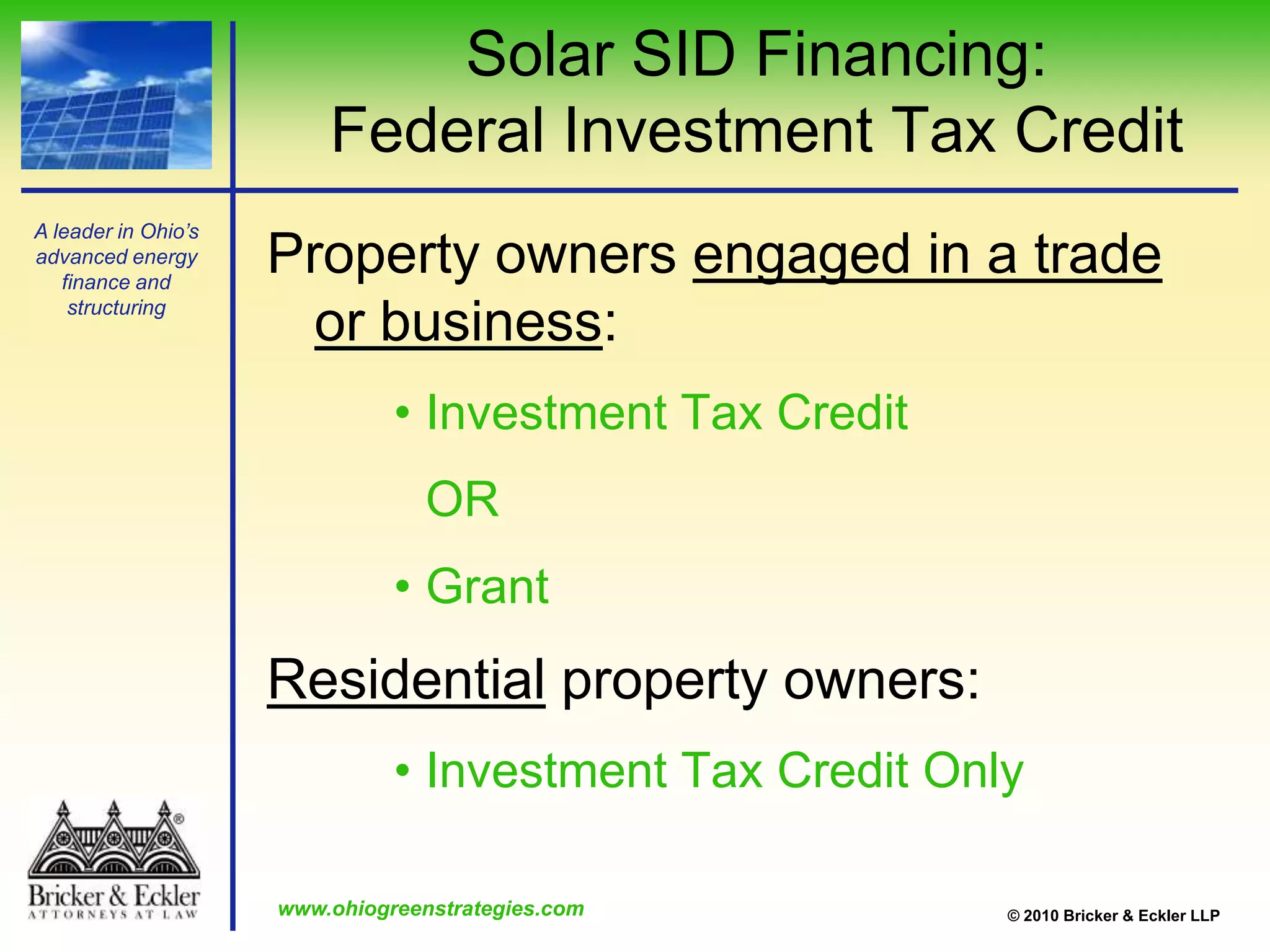
Solar SID Financing:Federal Investment Tax CreditSolar improvement owners may be eligible for a federal Investment Tax Credit equal to 30% of the eligible cost of their project.
Solar improvement owners may be eligible for a 30% federal grant in lieu of the Investment Tax Credit for projects placed in service in 2009 or 2010 (or started by then and placed in service before Jan. 1, 2017).
The initial owner will be the municipality or township.
The owner receiving the tax credit or grant could be the property owner or the solar installer/PPA provider.Solar SID Financing:Federal Investment Tax CreditProperty owners engaged in a trade or business:Investment Tax Credit 	ORGrantResidential property owners:Investment Tax Credit Only
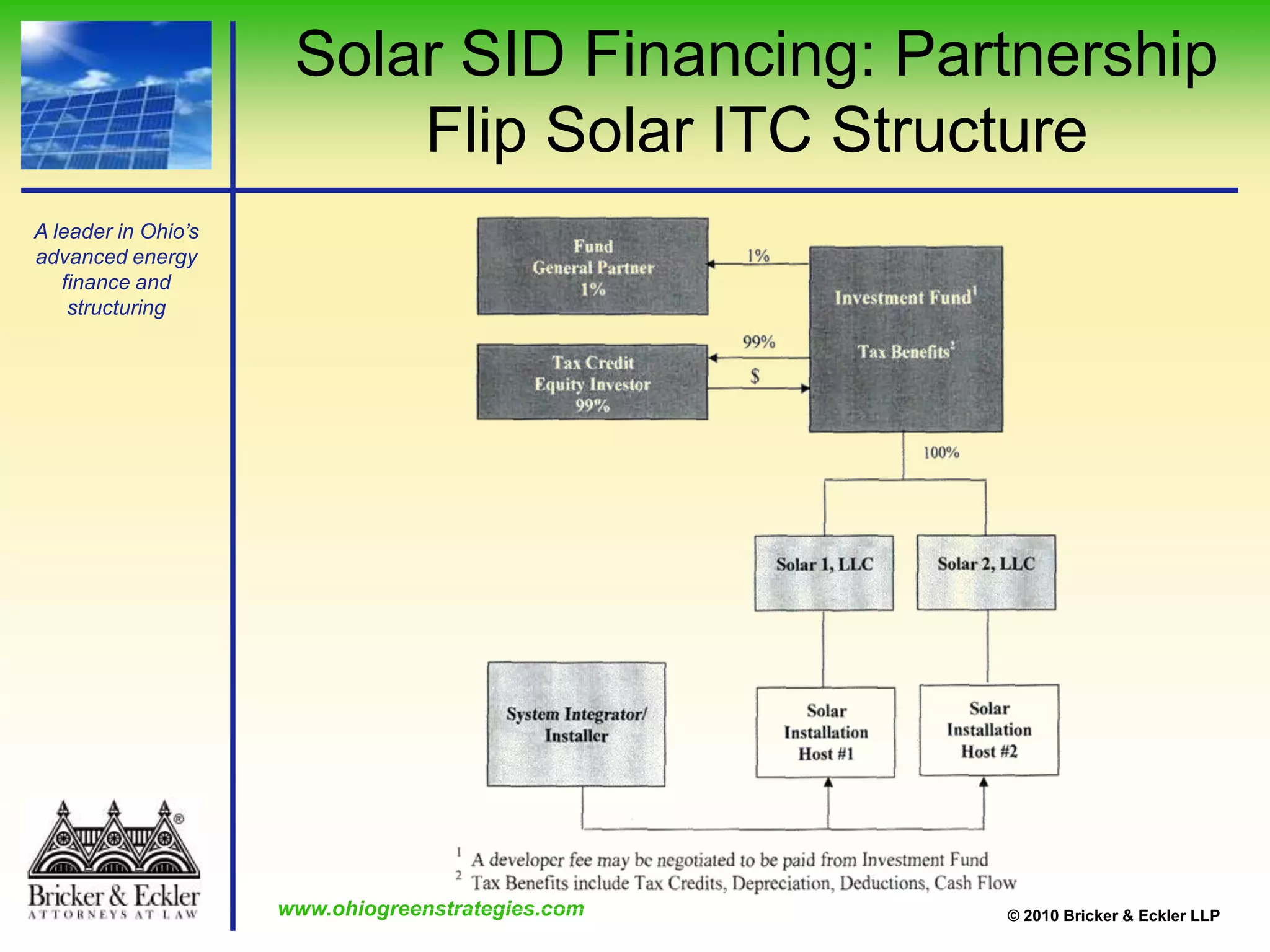
Solar SID Financing: Partnership Flip Solar ITC Structure
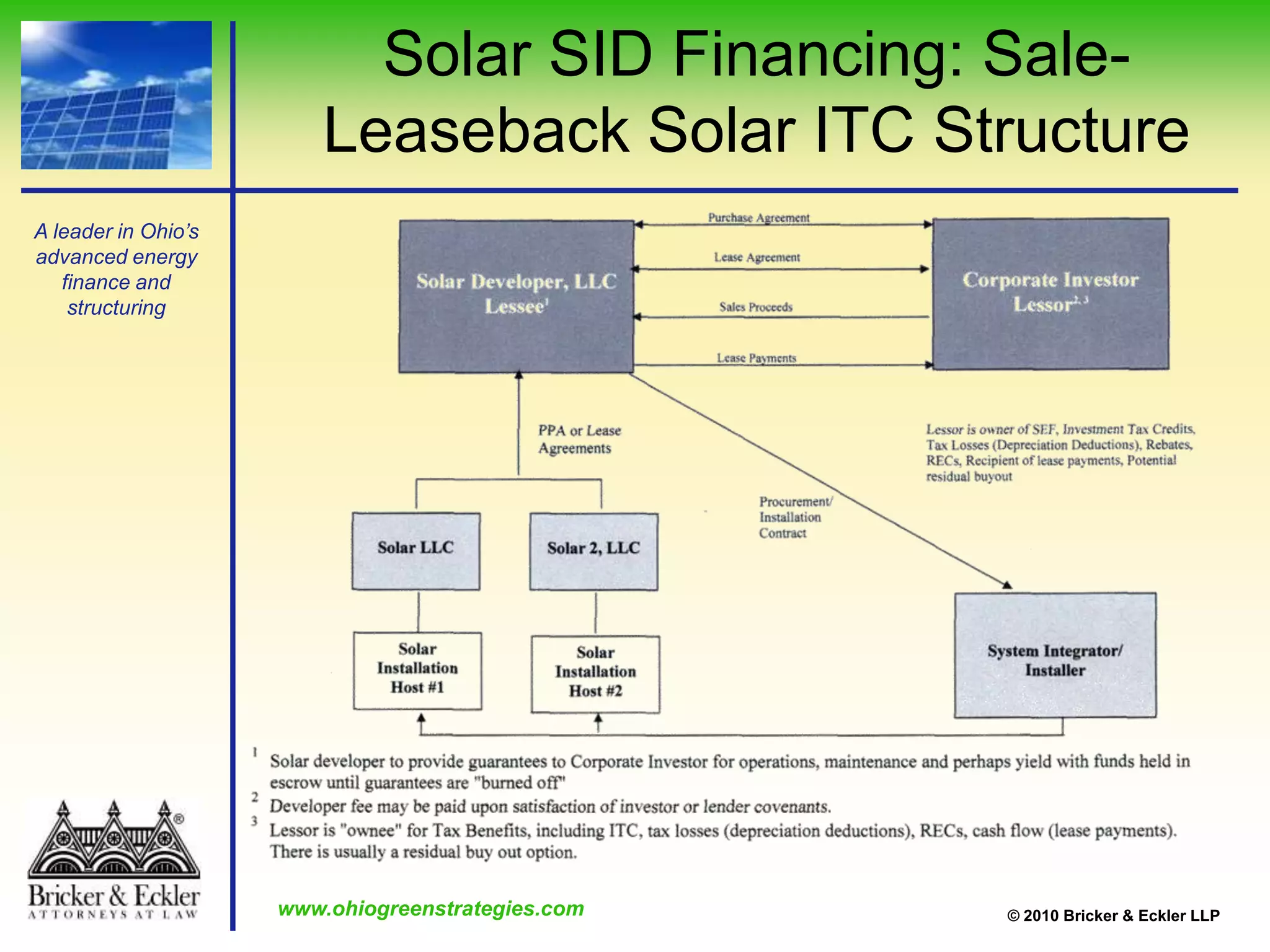
Solar SID Financing: Sale-Leaseback Solar ITC Structure
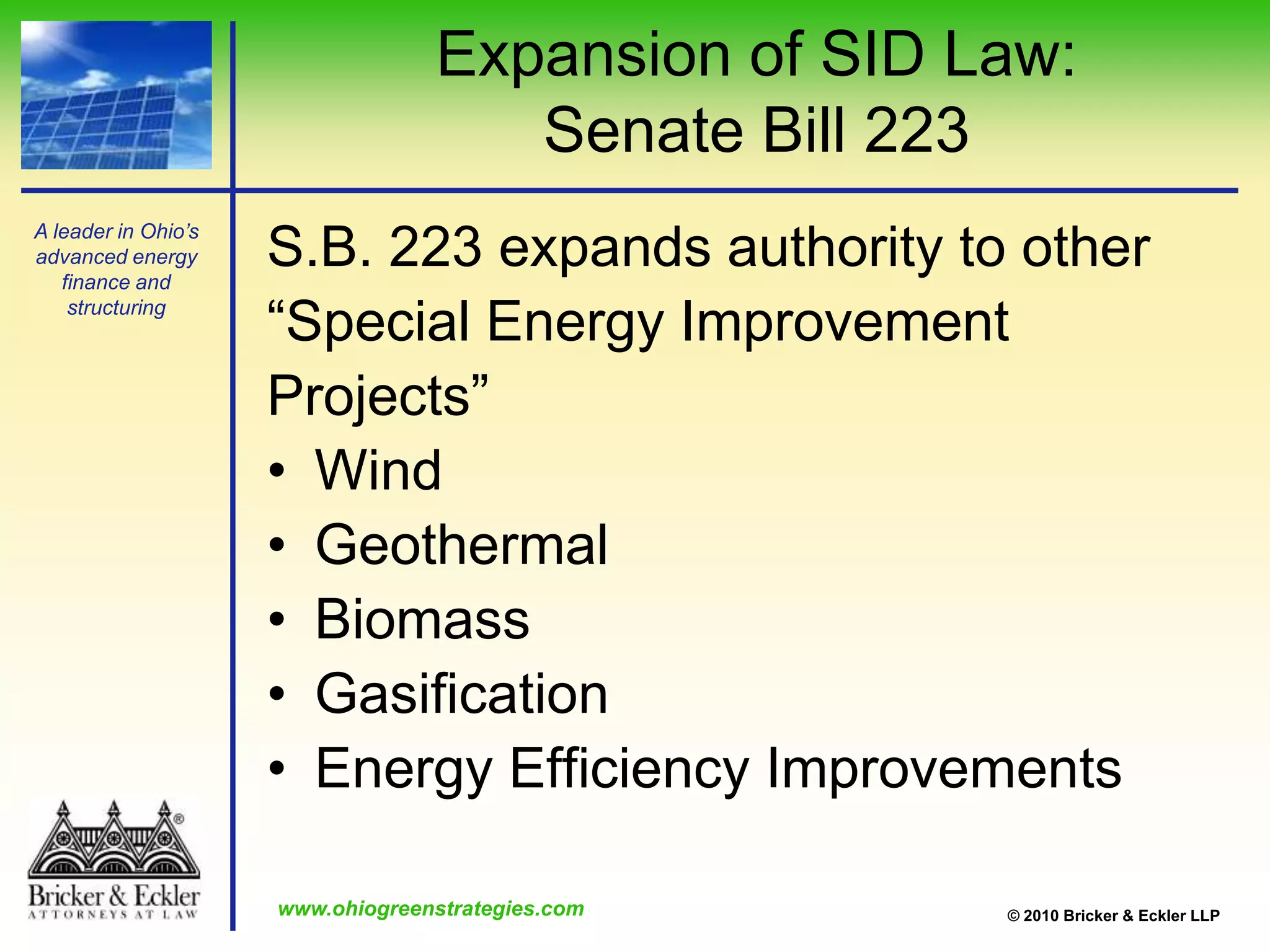
Expansion of SID Law: Senate Bill 223S.B. 223 expands authority to other“Special Energy Improvement Projects”WindGeothermalBiomassGasificationEnergy Efficiency Improvements
Expansion of SID Law: Senate Bill 223Current status of S.B. 223:Discussions with Utilities ongoing“Behind the Meter” projects primarily, or250 kw or smallerRECs still availableHelps Utilities meet their RPS targetsHearings continue
New Clean Renewable Energy Bonds (“New CREBs”)New CREBs are tax credit bonds similar in form to CREBs whose termination date was extended to December 31, 2009 (only New CREBs are now available to issuers without a preexisting CREBs volume cap award)100% of the available project proceeds of New CREBs are to be used for capital expenditures incurred by governmental bodies, public power companies or cooperative electric companies for one or more types of renewable electric generation facilities (e.g. wind, solar, biomass, municipal solid waste, hydropower, etc.) for which a production tax credit (IRC Section 45) can be claimed, without regard to placed in service dateQualified issuers of New CREBs include utilities, cooperative electric companies, a state or any political subdivision thereof
New Clean Renewable Energy Bonds (“New CREBs”)New CREBs are not interest-bearing obligationsThe holder of a New CREB on a credit allowance date is entitled to a tax creditThe amount of the credit is determined by multiplying the bond’s credit rate by the face amount of the bondThe credit rate on the bonds is determined by the Secretary of the Treasury and is set at a rate that permits the issuance of New CREBs without discount or interest The amount of the annual credit will be 70 percent of the amount of the credit as determined above In practice, New CREBs will likely require the issuer to pay supplemental interest or sell the New CREBs at a discount in order to adjust the credit rate set by the Treasury to the market risk of an investor purchasing a New CREB

Solar sid-powerpoint

  • 1.
    Solar SIDs –Solar Improvement Financing and Federal ProgramsColumbus Green Building ForumApril 14, 2010Columbus, OHDavid RogersBricker & Eckler LLPdrogers@bricker.com
  • 2.
    Ohio House Bill1Effective 10/15/09; allows municipalities and/or townships and property owners to work together to provide up-front, assessment-based financing for property owners that want to install their own solar improvements but lack the funds to make the investment
  • 3.
    Ohio’s law ismodeled after the success of Berkeley, California’s FIRST (“Financing Initiative for Renewable and Solar Technology”) programPACE FinancingPACE means “Property Assessed Clean Energy”Ohio’s PACE Authority is HB1PACE Policy Framework: In October 2009, a Policy Framework was released by the Obama Administration to encourage states and local governments to adopt pilot PACE programs.The Policy Framework is designed to provide important safeguards in the creation of PACE programs, including homeowner and mortgage lender protections. Current Policy Framework limited to residential programs, but its principles can and have been applied to commercial and industrial projects.
  • 4.
    PACE FinancingPACE PolicyFramework outlines bestpractices for PACE programs:property owners "opt-in" to attach up to 100% of the cost of energy improvements to their real property tax bill;assessing local government has the ability to foreclose on delinquent real propertyimprovements should "pay for themselves“projects should have high return in terms of energy efficiency or renewable energy gainsenergy auditsmortgage holder protections (clear title, no defaults, no negative equity financings)
  • 5.
    Solar SIDsSolar SID:special type of financing district created under ORC Chapter 1710 for the purpose of financing:
  • 6.
    solar photovoltaic(i.e., roof-top and ground-mounted solar arrays), and
  • 7.
    solar thermalsystems (i.e., solar water heating systems)
  • 8.
    Solar SID andCity/Township will:
  • 9.
  • 10.
    determine generalcriteria for eligible solar improvements (including parameters such as cost and size and zoning-related considerations)
  • 11.
    can pre-qualify installers/PPA providersSummary of Solar SID ProcessIdentify property owners with solar improvementsDraft petition (really and application) for SID creation and SID planProperty owners sign PetitionCity/Solar Developer develops plan for specific solar improvements (SID Plan)City/Solar Developer submits Petition proposing creation of SID and SID Plan to property ownersCity Council reviews SID Petition and SID PlanCity Council approves creation of SID, SID Petition, SID Plan and SID Board Articles
  • 12.
    Summary of SolarSID ProcessCity Council approves Resolution of Necessity specifying details of special assessmentNotice of Resolution of Necessity sent by certified mail to SID property ownersSID property owners may file objection to estimated assessmentCity Council adopts Assessment Ordinance finalizing assessments. City Council certifies special assessments to the County AuditorNotice of first meeting of SID property ownersMeeting of SID property owners and election of SID BoardSID receives assessments through County Auditor settlement process
  • 13.
  • 14.
    Solar SID FinancingCities and townships have options.
  • 15.
    Financing from SpecialAssessment Payments from property owners in installments for up to 25 years.
  • 16.
    Department of EnergyLoan Guarantee Program
  • 17.
  • 18.
    Revolving Loan Funds. Cities have new authority in HB 1 (ORC Section 717.25) to create solar revolving loan funds.Solar SID Financing:Debt OptionsAssessment revenue can pay debt service on “general obligation” bonds.
  • 19.
    Assessment revenue canpay debt service on “special obligation” revenue bonds. Solar SID Financing:Debt Options“Special obligation” revenue bonds would be issued by another entity, like an Ohio Port Authority, OAQDA or ODOD.Port Authority “Bond Fund” programs may be available.It is anticipated that one or more of these entities will apply and become U.S. Department of Energy approved “development finance organizations” and as such special obligation revenue bonds issued by these issuers would be eligible for U.S. Department of Energy loan guarantees.
  • 20.
    Solar SID Financing:FederalInvestment Tax CreditSolar improvement owners may be eligible for a federal Investment Tax Credit equal to 30% of the eligible cost of their project.
  • 21.
    Solar improvement ownersmay be eligible for a 30% federal grant in lieu of the Investment Tax Credit for projects placed in service in 2009 or 2010 (or started by then and placed in service before Jan. 1, 2017).
  • 22.
    The initial ownerwill be the municipality or township.
  • 23.
    The owner receivingthe tax credit or grant could be the property owner or the solar installer/PPA provider.Solar SID Financing:Federal Investment Tax CreditProperty owners engaged in a trade or business:Investment Tax Credit ORGrantResidential property owners:Investment Tax Credit Only
  • 24.
    Solar SID Financing:Partnership Flip Solar ITC Structure
  • 25.
    Solar SID Financing:Sale-Leaseback Solar ITC Structure
  • 26.
    Expansion of SIDLaw: Senate Bill 223S.B. 223 expands authority to other“Special Energy Improvement Projects”WindGeothermalBiomassGasificationEnergy Efficiency Improvements
  • 27.
    Expansion of SIDLaw: Senate Bill 223Current status of S.B. 223:Discussions with Utilities ongoing“Behind the Meter” projects primarily, or250 kw or smallerRECs still availableHelps Utilities meet their RPS targetsHearings continue
  • 28.
    New Clean RenewableEnergy Bonds (“New CREBs”)New CREBs are tax credit bonds similar in form to CREBs whose termination date was extended to December 31, 2009 (only New CREBs are now available to issuers without a preexisting CREBs volume cap award)100% of the available project proceeds of New CREBs are to be used for capital expenditures incurred by governmental bodies, public power companies or cooperative electric companies for one or more types of renewable electric generation facilities (e.g. wind, solar, biomass, municipal solid waste, hydropower, etc.) for which a production tax credit (IRC Section 45) can be claimed, without regard to placed in service dateQualified issuers of New CREBs include utilities, cooperative electric companies, a state or any political subdivision thereof
  • 29.
    New Clean RenewableEnergy Bonds (“New CREBs”)New CREBs are not interest-bearing obligationsThe holder of a New CREB on a credit allowance date is entitled to a tax creditThe amount of the credit is determined by multiplying the bond’s credit rate by the face amount of the bondThe credit rate on the bonds is determined by the Secretary of the Treasury and is set at a rate that permits the issuance of New CREBs without discount or interest The amount of the annual credit will be 70 percent of the amount of the credit as determined above In practice, New CREBs will likely require the issuer to pay supplemental interest or sell the New CREBs at a discount in order to adjust the credit rate set by the Treasury to the market risk of an investor purchasing a New CREB
  • 30.
    New Clean RenewableEnergy Bonds (“New CREBs”)“Available project proceeds” definition limits costs of issuance financed by the issue to 2 percentRequirement for capital expenditures (no refunding)National volume cap now $2.4 billion per 2009 Stimulus law1/3 awarded to qualified projects of public power providers (state utilities)
  • 31.
    1/3 awardedto qualified projects of governmental bodies
  • 32.
    1/3 awarded toqualified projects of cooperative electric companies like AMP-OhioNew Clean Renewable Energy Bonds (“New CREBs”)Applications for New CREBs volume cap allocations for 2009 were due on August 4, 2009Allocations of volume cap for both governmental and cooperative owned projects will be awarded based upon the “smallest to largest” request methodology as used for CREBs.2010 and future allocations of New CREBs will be based upon further Congressional allocations of authority to issue New CREBs
  • 33.
    Qualified Energy ConservationBonds (“QECBs”)QECBs are tax credit bonds similar to New CREBsQECBs however are issued only by a state and local government100% of the available project proceeds of QECBs are to be used for “qualified conservation purposes”
  • 34.
    Qualified Energy ConservationBonds (“QECBs”)“Qualified Conservation Purposes” includes capital expenditures incurred for:Reducing energy consumption in publicly owned buildings by at least 20%Implementing green community programsRural developmentElectric generation facilities that qualify for the PTC
  • 35.
    Qualified Energy ConservationBonds (“QECBs”)The State of Ohio has received an allocation of $119,160,000 in QECB volume cap to be divided among the state and “large local governments” with populations of 100,000 or more.QECB volume cap was allocated among the Ohio Air Quality Development Authority and large counties and cities pursuant to H.B.1 and a resolution of the OAQDA. Most of the allocation has been returned to OAQDA; for reallocation.
  • 36.
    Other TechniquesDOE LoanGuarantee ProgramDepartment of Energy Loan Guarantee ProgramFor all major renewables (wind, solar, biomass, geothermal, hydro)For all types of borrowers; but initial solicitations for commercialUp to $100 billion in loans will be guaranteed
  • 37.
    DOE Loan GuaranteesPrimarilyfor DevelopersBank loans qualifyLoans from development finance governmental agencies qualifyUp to 80-90% guaranteedOhio banks will qualify as lendersOhio port authorities will qualify as lenders
  • 38.
    DOE Loan GuaranteesMinimumfee $50,000 NEPA (Federal environmental review) or waiver requiredPACE programs, including solar SIDs will qualify
  • 39.
    DOE Loan GuaranteesAvailablefor project loans right nowDevelopment finance organizations (DFO’s) can review and underwrite loans Five port authorities designated as DFO’sOAQDA and Ohio DOD also designated
  • 40.
    Questions?Contact:Bricker & EcklerLLP100 South Third Street  Columbus, OhioDavid Rogers  614.227.2367drogers@bricker.comPrice Finley  614.227.8897pfinley@bricker.comEmmett Kelley  614.227.2308ekelly@bricker.comJ. Caleb Bell  614.227.2384jbell@bricker.com