Simulation for Optimal Battery Charging in
Solar-Powered Vehicle
Team Members:
R.Balaji
V.Praveen Kumar
C.Purushothaman
A.Stephen Raj

100107144003
100107144031
110407144019
110407144027

Guided by,
Prof .A.Vidhyasekar M.E., AP/ECE

1
Outline
•
•
•
•
•
•
•
•
•
•

Objective
Introduction
Literature survey
Existing method
Our new proposal
Simulation results
Flowchart
Coding
Applications
Schedule
2
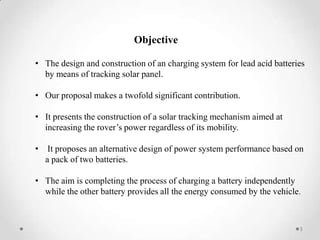
Objective
• The design and construction of an charging system for lead acid batteries
by means of tracking solar panel.
• Our proposal makes a twofold significant contribution.
• It presents the construction of a solar tracking mechanism aimed at
increasing the rover’s power regardless of its mobility.
•

It proposes an alternative design of power system performance based on
a pack of two batteries.

• The aim is completing the process of charging a battery independently
while the other battery provides all the energy consumed by the vehicle.

3
Introduction

• What is Solar Panel?
• How does solar panel works?
• What is the purpose of battery?
• How did it works effectively here?

4
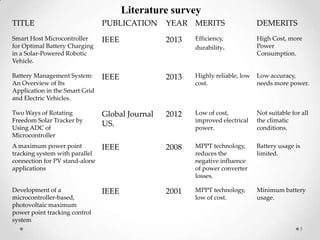
Literature survey
TITLE

PUBLICATION

YEAR MERITS

DEMERITS

Smart Host Microcontroller
for Optimal Battery Charging
in a Solar-Powered Robotic
Vehicle.

IEEE

2013

Efficiency,
durability.

High Cost, more
Power
Consumption.

Battery Management System:
An Overview of Its
Application in the Smart Grid
and Electric Vehicles.

IEEE

2013

Highly reliable, low
cost.

Low accuracy,
needs more power.

Two Ways of Rotating
Freedom Solar Tracker by
Using ADC of
Microcontroller

Global Journal
US.

2012

Low of cost,
improved electrical
power.

Not suitable for all
the climatic
conditions.

A maximum power point
tracking system with parallel
connection for PV stand-alone
applications

IEEE

2008

MPPT technology,
reduces the
negative influence
of power converter
losses.

Battery usage is
limited.

Development of a
microcontroller-based,
photovoltaic maximum
power point tracking control
system

IEEE

2001

MPPT technology,
low of cost.

Minimum battery
usage.

5
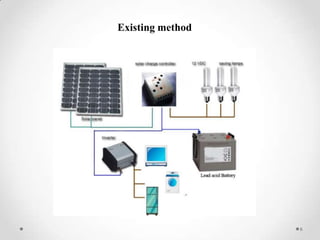
Existing method

6
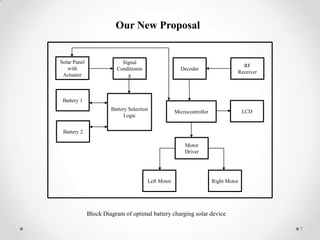
Our New Proposal

Solar Panel
with
Actuator

Signal
Conditionin
g

RF
Receiver

Decoder

Battery 1
Battery Selection
Logic

LCD

Microcontroller

Battery 2
Motor
Driver

Left Motor

Right Motor

Block Diagram of optimal battery charging solar device
7
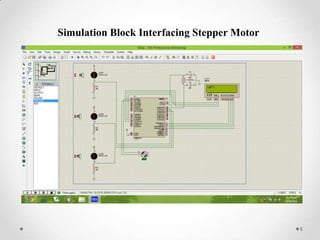
Simulation Block Interfacing Stepper Motor

8
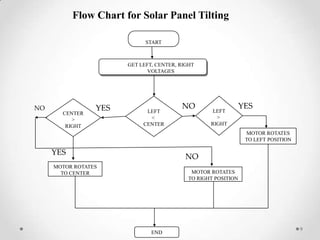
Flow Chart for Solar Panel Tilting
START

GET LEFT, CENTER, RIGHT
VOLTAGES

CENTER
>
RIGHT

LEFT
<
CENTER

NO

LEFT
>
RIGHT

YES

MOTOR ROTATES
TO LEFT POSITION

YES

NO

MOTOR ROTATES
TO CENTER

MOTOR ROTATES
TO RIGHT POSITION

END

9
Working Methodology
• Each module is rated by its DC output power under standard test
conditions (STC), and typically ranges from 100 to 320 watts.

• The efficiency of a module determines the area of a module given the
same rated output an 8% efficient 230 watt module will have twice the
area of a 16% efficient 230 watt module.

• This robot is equipped with 2 batteries. The robot switches to the battery
which has more charge. In this time the other battery starts charging via
solar panel. This intelligence can be achieved by the use of a
microcontroller.

10
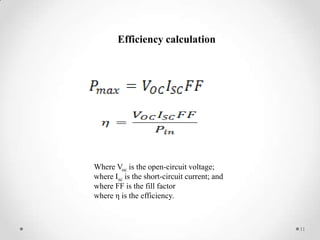
Efficiency calculation

Where Voc is the open-circuit voltage;
where Isc is the short-circuit current; and
where FF is the fill factor
where η is the efficiency.

11
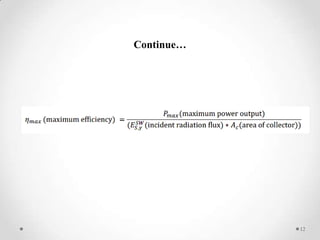
Continue…

12
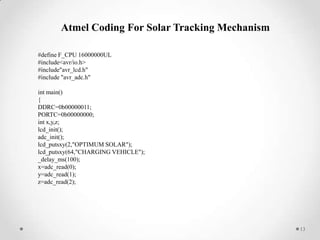
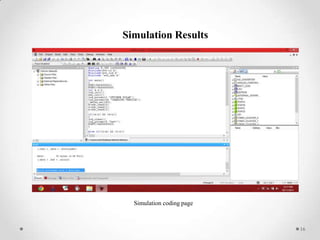
Atmel Coding For Solar Tracking Mechanism
#define F_CPU 16000000UL
#include<avr/io.h>
#include"avr_lcd.h"
#include "avr_adc.h"
int main()
{
DDRC=0b00000011;
PORTC=0b00000000;
int x,y,z;
lcd_init();
adc_init();
lcd_putsxy(2,"OPTIMUM SOLAR");
lcd_putsxy(64,"CHARGING VEHICLE");
_delay_ms(100);
x=adc_read(0);
y=adc_read(1);
z=adc_read(2);

13
Continue…
if((x>y) && (x>z))
{
lcd_clear();
lcd_putsxy(0,"Left");
PORTC=0b00000010;
}
else if((y>x) && (y>z))
{
lcd_clear();
lcd_putsxy(0,"Center");
}
else
{
lcd_clear();
lcd_putsxy(0,"Right");
PORTC=0b00000001;
}
}

14
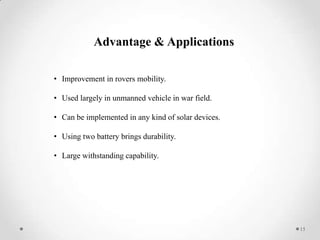
Advantage & Applications
• Improvement in rovers mobility.
• Used largely in unmanned vehicle in war field.
• Can be implemented in any kind of solar devices.

• Using two battery brings durability.
• Large withstanding capability.

15
Simulation Results

Simulation coding page

16
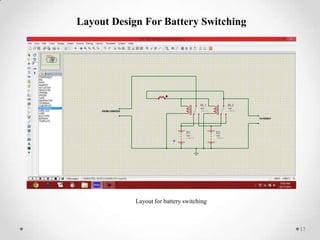
Layout Design For Battery Switching

Layout for battery switching

17
Conclusions And Future Work

•

The interest of this robotic system lies in the design concept of solar tracking and
battery switching mechanism.

•

On this basis, our proposal presents the construction of a solar tracking mechanism
aimed at increasing the rover’s power regardless of its mobility.

•

The aim is completing the process of controlling the robot in the availability of solar
power.

•

The future work concentrates in hardware design built with compact weight and with
more efficient power consumption for the rover’s continuous motion.

18
Schedule

• September 

Preparation of module’s coding.

• October

Simulation for solar tracking mechanism



• November 

Layout design for battery switching

• December 

Completion for phase 1

19
20
21

Solar powered rover

  • 1.
    Simulation for OptimalBattery Charging in Solar-Powered Vehicle Team Members: R.Balaji V.Praveen Kumar C.Purushothaman A.Stephen Raj 100107144003 100107144031 110407144019 110407144027 Guided by, Prof .A.Vidhyasekar M.E., AP/ECE 1
  • 2.
    Outline • • • • • • • • • • Objective Introduction Literature survey Existing method Ournew proposal Simulation results Flowchart Coding Applications Schedule 2
  • 3.
    Objective • The designand construction of an charging system for lead acid batteries by means of tracking solar panel. • Our proposal makes a twofold significant contribution. • It presents the construction of a solar tracking mechanism aimed at increasing the rover’s power regardless of its mobility. • It proposes an alternative design of power system performance based on a pack of two batteries. • The aim is completing the process of charging a battery independently while the other battery provides all the energy consumed by the vehicle. 3
  • 4.
    Introduction • What isSolar Panel? • How does solar panel works? • What is the purpose of battery? • How did it works effectively here? 4
  • 5.
    Literature survey TITLE PUBLICATION YEAR MERITS DEMERITS SmartHost Microcontroller for Optimal Battery Charging in a Solar-Powered Robotic Vehicle. IEEE 2013 Efficiency, durability. High Cost, more Power Consumption. Battery Management System: An Overview of Its Application in the Smart Grid and Electric Vehicles. IEEE 2013 Highly reliable, low cost. Low accuracy, needs more power. Two Ways of Rotating Freedom Solar Tracker by Using ADC of Microcontroller Global Journal US. 2012 Low of cost, improved electrical power. Not suitable for all the climatic conditions. A maximum power point tracking system with parallel connection for PV stand-alone applications IEEE 2008 MPPT technology, reduces the negative influence of power converter losses. Battery usage is limited. Development of a microcontroller-based, photovoltaic maximum power point tracking control system IEEE 2001 MPPT technology, low of cost. Minimum battery usage. 5
  • 6.
  • 7.
    Our New Proposal SolarPanel with Actuator Signal Conditionin g RF Receiver Decoder Battery 1 Battery Selection Logic LCD Microcontroller Battery 2 Motor Driver Left Motor Right Motor Block Diagram of optimal battery charging solar device 7
  • 8.
  • 9.
    Flow Chart forSolar Panel Tilting START GET LEFT, CENTER, RIGHT VOLTAGES CENTER > RIGHT LEFT < CENTER NO LEFT > RIGHT YES MOTOR ROTATES TO LEFT POSITION YES NO MOTOR ROTATES TO CENTER MOTOR ROTATES TO RIGHT POSITION END 9
  • 10.
    Working Methodology • Eachmodule is rated by its DC output power under standard test conditions (STC), and typically ranges from 100 to 320 watts. • The efficiency of a module determines the area of a module given the same rated output an 8% efficient 230 watt module will have twice the area of a 16% efficient 230 watt module. • This robot is equipped with 2 batteries. The robot switches to the battery which has more charge. In this time the other battery starts charging via solar panel. This intelligence can be achieved by the use of a microcontroller. 10
  • 11.
    Efficiency calculation Where Vocis the open-circuit voltage; where Isc is the short-circuit current; and where FF is the fill factor where η is the efficiency. 11
  • 12.
  • 13.
    Atmel Coding ForSolar Tracking Mechanism #define F_CPU 16000000UL #include<avr/io.h> #include"avr_lcd.h" #include "avr_adc.h" int main() { DDRC=0b00000011; PORTC=0b00000000; int x,y,z; lcd_init(); adc_init(); lcd_putsxy(2,"OPTIMUM SOLAR"); lcd_putsxy(64,"CHARGING VEHICLE"); _delay_ms(100); x=adc_read(0); y=adc_read(1); z=adc_read(2); 13
  • 14.
    Continue… if((x>y) && (x>z)) { lcd_clear(); lcd_putsxy(0,"Left"); PORTC=0b00000010; } elseif((y>x) && (y>z)) { lcd_clear(); lcd_putsxy(0,"Center"); } else { lcd_clear(); lcd_putsxy(0,"Right"); PORTC=0b00000001; } } 14
  • 15.
    Advantage & Applications •Improvement in rovers mobility. • Used largely in unmanned vehicle in war field. • Can be implemented in any kind of solar devices. • Using two battery brings durability. • Large withstanding capability. 15
  • 16.
  • 17.
    Layout Design ForBattery Switching Layout for battery switching 17
  • 18.
    Conclusions And FutureWork • The interest of this robotic system lies in the design concept of solar tracking and battery switching mechanism. • On this basis, our proposal presents the construction of a solar tracking mechanism aimed at increasing the rover’s power regardless of its mobility. • The aim is completing the process of controlling the robot in the availability of solar power. • The future work concentrates in hardware design built with compact weight and with more efficient power consumption for the rover’s continuous motion. 18
  • 19.
    Schedule • September  Preparationof module’s coding. • October Simulation for solar tracking mechanism  • November  Layout design for battery switching • December  Completion for phase 1 19
  • 20.
  • 21.