SOL-MAN-CFAS ANSWERSHEET, ANSWERKEY,
CORRECTANSWER
Bachelor of Secondary Education (St. Luke's College of Medicine - WHQM)
Scan to open on Studocu
Studocu is not sponsored or endorsed by any college or university
SOL-MAN-CFAS ANSWERSHEET, ANSWERKEY,
CORRECT ANSWER
Bachelor of Secondary Education (St. Luke's College of Medicine - WHQM)
Scan to open on Studocu
Studocu is not sponsored or endorsed by any college or university
Downloaded by Zmm Dk (dmj2237@gmail.com)
lOMoARcPSD|46138815
2.
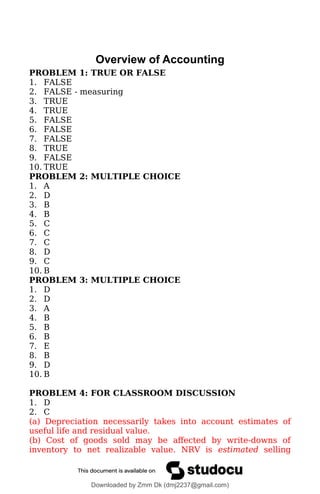
Overview of Accounting
PROBLEM1: TRUE OR FALSE
1. FALSE
2. FALSE - measuring
3. TRUE
4. TRUE
5. FALSE
6. FALSE
7. FALSE
8. TRUE
9. FALSE
10. TRUE
PROBLEM 2: MULTIPLE CHOICE
1. A
2. D
3. B
4. B
5. C
6. C
7. C
8. D
9. C
10. B
PROBLEM 3: MULTIPLE CHOICE
1. D
2. D
3. A
4. B
5. B
6. B
7. E
8. B
9. D
10. B
PROBLEM 4: FOR CLASSROOM DISCUSSION
1. D
2. C
(a) Depreciation necessarily takes into account estimates of
useful life and residual value.
(b) Cost of goods sold may be affected by write-downs of
inventory to net realizable value. NRV is estimated selling
Downloaded by Zmm Dk (dmj2237@gmail.com)
lOMoARcPSD|46138815
3.
price less estimatedcosts of completion and costs to make the
sale. Thus, COGS may be valued by opinion.
(c) Discount on share capital represents the excess of par value
of shares issued over the fair value of the consideration
received. This is valued by fact because it is not affected by
estimates.
(d) Various estimated expenses and income are closed to
retained earnings. Thus, retained earnings is affected by
estimates.
3. D
4. C
5. D
6. D
7. A
8. D
9. A
10. C - equal authority
Conceptual Framework for Financial Reporting
PROBLEM 1: TRUE OR FALSE
1. FALSE – e.g., contributions from, and distributions to, the
entity’s owners result to changes in equity but these do not
result from the entity’s financial performance.
2. FALSE – The qualitative characteristics apply to
information in the financial statements as well as to
financial information provided in other ways.
3. FALSE
4. TRUE
5. FALSE
6. TRUE
7. FALSE
8. FALSE
9. TRUE
10. FALSE – mainly to primary users only and not necessarily
to all external users.
PROBLEM 2: TRUE OR FALSE
1. FALSE
2. TRUE
3. FALSE
4. TRUE
5. TRUE
6. TRUE
7. TRUE
Downloaded by Zmm Dk (dmj2237@gmail.com)
lOMoARcPSD|46138815
4.
8. FALSE –Historical cost may need to be updated for the
asset’s depreciation, impairment, or unwinding of discount
or premium.
9. TRUE
10. TRUE
PROBLEM 3: MULTIPLE CHOICE
1. A
2. A
3. A
4. D
5. D
6. C
7. D
8. A
9. C
10. A
11. D
12. A
13. B
14. C
Explanation: Choices (a) and (b) can affect recognition
decisions about an asset or liability but not necessarily the
existence of the asset or liability.
15. B
PROBLEM 4: MULTIPLE CHOICE
1. A
2. C
3. A
4. D
5. C
6. D
7. D
8. B
9. A
Explanation: Choice (a) is the least accurate statement.
General purpose financial reports are mainly intended for
primary users, and not equally to all types of external
users. For example, a government regulatory agency is
considered an external user but not a primary user.
10. A
PROBLEM 5: FOR CLASSROOM DISCUSSION
1. D
2. D
Downloaded by Zmm Dk (dmj2237@gmail.com)
lOMoARcPSD|46138815
5.
3. C
4. D
5.C
6. A
7. B
8. D
9. A
10. B
11. D
12. A
13. C
14. A
15. D
16. D
Explanations:
Choice (c) is correct. For example, if Entity B delivers the
goods before Entity A pays the purchase price, Entity A will
record the receipt of delivery as debit to ‘Inventory’ or
‘Purchases’ and credit to ‘Accounts payable’ (i.e., a
liability).
Choice (d) is incorrect. If Entity A performs its obligation
first, Entity A’s combined right and obligation changes to
an asset, not a liability. For example, if Entity A pays the
purchase price before Entity B delivers the goods, Entity A
will record the payment as debit to ‘Advances to
suppliers’ (i.e., an asset) and credit to ‘Cash’.
17. D
18. C
19. D
20. D
21. C
22. C
23. D
24. A
25. A
PAS 1 Presentation of Financial Statements
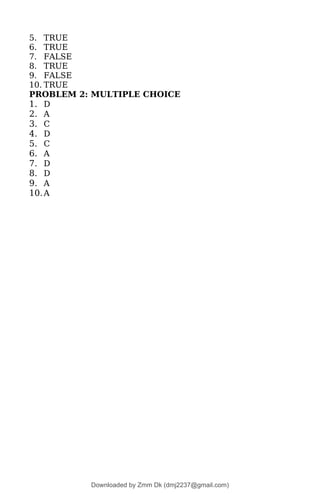
PROBLEM 1: TRUE OR FALSE
1. TRUE
2. TRUE
3. FALSE
4. FALSE
5. FALSE
6. FALSE
7. FALSE
Downloaded by Zmm Dk (dmj2237@gmail.com)
lOMoARcPSD|46138815
6.
8. FALSE
9. FALSE
10.FALSE
PROBLEM 2: MULTIPLE CHOICE
1. A
2. B
3. A
4. A
5. A
6. D
7. D
8. D
9. A
10. B
PROBLEM 3: MULTIPLE CHOICE
1. B
2. A
3. D
4. C
5. A
6. C
7. B
8. C
9. C
10. D
PROBLEM 4: FOR CLASSROOM DISCUSSION
1. A
2. B
3. D
4. A
5. C
6. D
7. A
8. C
9. C
10. B
11. D
PAS 2 Inventories
PROBLEM 1: TRUE OR FALSE
1. FALSE
2. FALSE
3. TRUE
4. FALSE
Downloaded by Zmm Dk (dmj2237@gmail.com)
lOMoARcPSD|46138815
7.
5. TRUE
6. TRUE
7.FALSE
8. TRUE
9. FALSE
10. TRUE
PROBLEM 2: MULTIPLE CHOICE
1. D
2. A
3. C
4. D
5. C
6. A
7. D
8. D
9. A
10.A
Downloaded by Zmm Dk (dmj2237@gmail.com)
lOMoARcPSD|46138815
8.
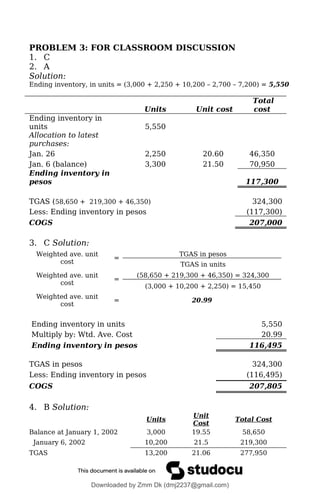
PROBLEM 3: FORCLASSROOM DISCUSSION
1. C
2. A
Solution:
Ending inventory, in units = (3,000 + 2,250 + 10,200 – 2,700 – 7,200) = 5,550
Units Unit cost
Total
cost
Ending inventory in
units 5,550
Allocation to latest
purchases:
Jan. 26 2,250 20.60 46,350
Jan. 6 (balance) 3,300 21.50 70,950
Ending inventory in
pesos 117,300
TGAS (58,650 + 219,300 + 46,350) 324,300
Less: Ending inventory in pesos (117,300)
COGS 207,000
3. C Solution:
Weighted ave. unit
cost
=
TGAS in pesos
TGAS in units
Weighted ave. unit
cost
=
(58,650 + 219,300 + 46,350) = 324,300
(3,000 + 10,200 + 2,250) = 15,450
Weighted ave. unit
cost
= 20.99
Ending inventory in units 5,550
Multiply by: Wtd. Ave. Cost 20.99
Ending inventory in pesos 116,495
TGAS in pesos 324,300
Less: Ending inventory in pesos (116,495)
COGS 207,805
4. B Solution:
Units
Unit
Cost
Total Cost
Balance at January 1, 2002 3,000 19.55 58,650
January 6, 2002 10,200 21.5 219,300
TGAS 13,200 21.06 277,950
Downloaded by Zmm Dk (dmj2237@gmail.com)
lOMoARcPSD|46138815
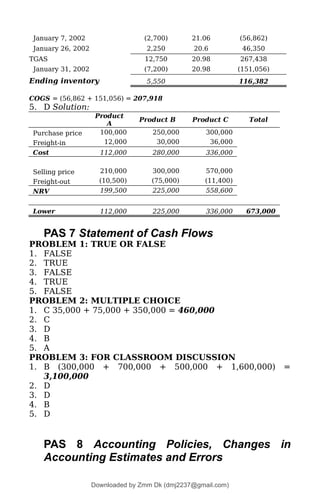
9.
January 7, 2002(2,700) 21.06 (56,862)
January 26, 2002 2,250 20.6 46,350
TGAS 12,750 20.98 267,438
January 31, 2002 (7,200) 20.98 (151,056)
Ending inventory 5,550 116,382
COGS = (56,862 + 151,056) = 207,918
5. D Solution:
Product
A
Product B Product C Total
Purchase price 100,000 250,000 300,000
Freight-in 12,000 30,000 36,000
Cost 112,000 280,000 336,000
Selling price 210,000 300,000 570,000
Freight-out (10,500) (75,000) (11,400)
NRV 199,500 225,000 558,600
Lower 112,000 225,000 336,000 673,000
PAS 7 Statement of Cash Flows
PROBLEM 1: TRUE OR FALSE
1. FALSE
2. TRUE
3. FALSE
4. TRUE
5. FALSE
PROBLEM 2: MULTIPLE CHOICE
1. C 35,000 + 75,000 + 350,000 = 460,000
2. C
3. D
4. B
5. A
PROBLEM 3: FOR CLASSROOM DISCUSSION
1. B (300,000 + 700,000 + 500,000 + 1,600,000) =
3,100,000
2. D
3. D
4. B
5. D
PAS 8 Accounting Policies, Changes in
Accounting Estimates and Errors
Downloaded by Zmm Dk (dmj2237@gmail.com)
lOMoARcPSD|46138815
10.
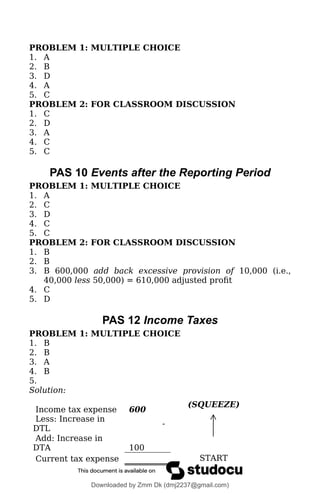
PROBLEM 1: MULTIPLECHOICE
1. A
2. B
3. D
4. A
5. C
PROBLEM 2: FOR CLASSROOM DISCUSSION
1. C
2. D
3. A
4. C
5. C
PAS 10 Events after the Reporting Period
PROBLEM 1: MULTIPLE CHOICE
1. A
2. C
3. D
4. C
5. C
PROBLEM 2: FOR CLASSROOM DISCUSSION
1. B
2. B
3. B 600,000 add back excessive provision of 10,000 (i.e.,
40,000 less 50,000) = 610,000 adjusted profit
4. C
5. D
PAS 12 Income Taxes
PROBLEM 1: MULTIPLE CHOICE
1. B
2. B
3. A
4. B
5.
Solution:
Income tax expense 600
(SQUEEZE)
Less: Increase in
DTL
-
Add: Increase in
DTA 100
Current tax expense START
Downloaded by Zmm Dk (dmj2237@gmail.com)
lOMoARcPSD|46138815
11.
700
6. D
7. A
8.A
9. B
10. C
11. D
PROBLEM 2: FOR CLASSROOM DISCUSSION
1. B
2. A
3. B
4. A
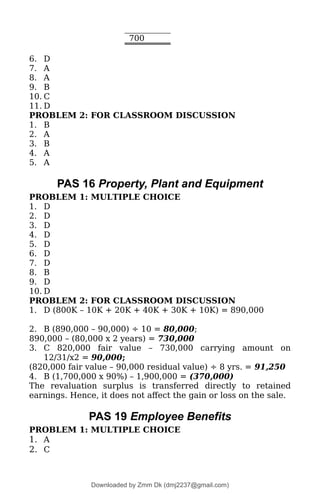
5. A
PAS 16 Property, Plant and Equipment
PROBLEM 1: MULTIPLE CHOICE
1. D
2. D
3. D
4. D
5. D
6. D
7. D
8. B
9. D
10. D
PROBLEM 2: FOR CLASSROOM DISCUSSION
1. D (800K – 10K + 20K + 40K + 30K + 10K) = 890,000
2. B (890,000 – 90,000) ÷ 10 = 80,000;
890,000 – (80,000 x 2 years) = 730,000
3. C 820,000 fair value – 730,000 carrying amount on
12/31/x2 = 90,000;
(820,000 fair value – 90,000 residual value) ÷ 8 yrs. = 91,250
4. B (1,700,000 x 90%) – 1,900,000 = (370,000)
The revaluation surplus is transferred directly to retained
earnings. Hence, it does not affect the gain or loss on the sale.
PAS 19 Employee Benefits
PROBLEM 1: MULTIPLE CHOICE
1. A
2. C
Downloaded by Zmm Dk (dmj2237@gmail.com)
lOMoARcPSD|46138815
12.
3. A (8Mx 5%) ÷ 6 employees currently employed as at year-
end = 66,667
4. A
5. B
6. C
7. D
8. C
9. C
10.D
PROBLEM 2: FOR CLASSROOM DISCUSSION
1. D [(20 employees x 1 day x 12 months) – 150 days] x ₱1,000
x 105% = 94,500.
The 20% employee turnover rate is irrelevant because
the employee benefits are monetized.
2. D
3. B Solution: 2,900,000 PV of DBO – 2,600,000 FVPA =
300,000 deficit
4. B Solution: 400,000 service cost + 20,000 net interest (see
computations below) = 420,000
5. C
Solution:
Service cost:
(a) Current service cost 400,000
(b) Past service cost -
(c) Any (gain) or loss on settlement -
400,000
Net interest on the net defined benefit liability (asset):
(a) Interest cost on the DBO (2M, beg. x 10%) 200,000
(b) Interest income on plan assets (1.8M, beg. x 10%) (180,000)
(c) Interest on the effect of the asset ceiling -
20,000
Remeasurements of the net defined benefit liability (asset):
(a) Actuarial (gains) and losses 200,000
(b) Difference between interest income on plan assets
and
60,000
return on plan assets (180,000 – 120,000)
(c) Difference between the interest on the effect of
the asset -
ceiling and change in the effect of the asset ceiling
260,000
Total Defined Benefit Cost 680,000
Downloaded by Zmm Dk (dmj2237@gmail.com)
lOMoARcPSD|46138815
13.
PAS 20 Accountingfor Government Grants and
Disclosure of Government Assistance
PROBLEM 1: MULTIPLE CHOICE
1. B
2. A
3. C
4. D
5. C
PROBLEM 2: FOR CLASSROOM DISCUSSION
1. D
2. C
20x1 = 0, no depreciation yet is recognized from the
building; therefore, no income yet is recognized from
the government grant (i.e., ‘matching’). The building
starts to be depreciated in 20x2.
20x2 = 20,000 (200,000 ÷ 10 years)
3. B Gross presentation: (1M x 9/10) = 900,000;
Net presentation: (1M – 200K) x 9/10 = 720,000
4. A Gross presentation: (1M ÷ 10) = 100,000;
Net presentation: (1M – 200K) ÷ 10 = 80,000
5. A
Foreign Exchange Rates
PROBLEM 1: MULTIPLE CHOICE
1. D
2. A
3. D
4. A
5. B
PROBLEM 2: FOR CLASSROOM DISCUSSION
1. A [$1,000 x (52 – 50)] = 2,000 gain
2. D [$1,000 x (47 – 52)] = 5,000 loss
3. D
Solution:
(₱10M total assets - ₱5M total liabilities) ÷ ₱10 closing rate =
¥500,000 translated equity
4. A
Solution:
₱3M profit ÷ ₱8 average rate = ¥375,000 translated profit
5. A
Solution:
Translated share capital = (₱2M ÷ ₱5 historical) = ¥400,000
Translated retained earnings (see table below)
Downloaded by Zmm Dk (dmj2237@gmail.com)
lOMoARcPSD|46138815
14.
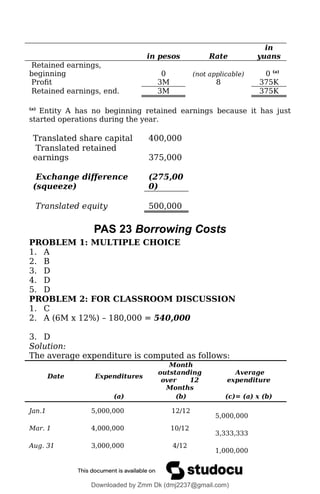
in pesos Rate
in
yuans
Retainedearnings,
beginning 0 (not applicable) 0 (a)
Profit 3M 8 375K
Retained earnings, end. 3M 375K
(a)
Entity A has no beginning retained earnings because it has just
started operations during the year.
Translated share capital 400,000
Translated retained
earnings 375,000
Exchange difference
(squeeze)
(275,00
0)
Translated equity 500,000
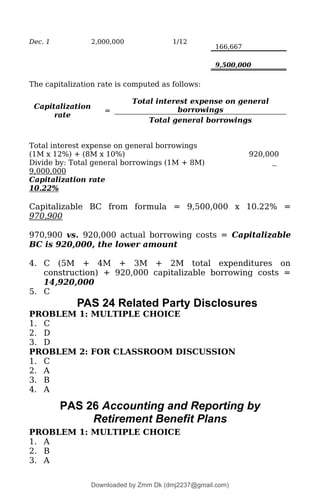
PAS 23 Borrowing Costs
PROBLEM 1: MULTIPLE CHOICE
1. A
2. B
3. D
4. D
5. D
PROBLEM 2: FOR CLASSROOM DISCUSSION
1. C
2. A (6M x 12%) – 180,000 = 540,000
3. D
Solution:
The average expenditure is computed as follows:
Date Expenditures
Month
outstanding
over 12
Months
Average
expenditure
(a) (b) (c)= (a) x (b)
Jan.1 5,000,000 12/12
5,000,000
Mar. 1 4,000,000 10/12
3,333,333
Aug. 31 3,000,000 4/12
1,000,000
Downloaded by Zmm Dk (dmj2237@gmail.com)
lOMoARcPSD|46138815
15.
Dec. 1 2,000,0001/12
166,667
9,500,000
The capitalization rate is computed as follows:
Capitalization
rate
=
Total interest expense on general
borrowings
Total general borrowings
Total interest expense on general borrowings
(1M x 12%) + (8M x 10%) 920,000
Divide by: Total general borrowings (1M + 8M)
9,000,000
Capitalization rate
10.22%
Capitalizable BC from formula = 9,500,000 x 10.22% =
970,900
970,900 vs. 920,000 actual borrowing costs = Capitalizable
BC is 920,000, the lower amount
4. C (5M + 4M + 3M + 2M total expenditures on
construction) + 920,000 capitalizable borrowing costs =
14,920,000
5. C
PAS 24 Related Party Disclosures
PROBLEM 1: MULTIPLE CHOICE
1. C
2. D
3. D
PROBLEM 2: FOR CLASSROOM DISCUSSION
1. C
2. A
3. B
4. A
PAS 26 Accounting and Reporting by
Retirement Benefit Plans
PROBLEM 1: MULTIPLE CHOICE
1. A
2. B
3. A
Downloaded by Zmm Dk (dmj2237@gmail.com)
lOMoARcPSD|46138815
16.
4. A
PROBLEM 2:FOR CLASSROOM DISCUSSION
1. D
2. D
PAS 27 Separate Financial Statements
PROBLEM 1: MULTIPLE CHOICE
1. D
PROBLEM 2: FOR CLASSROOM DISCUSSION
1. D
PAS 28 Investments in Associates and Joint
Ventures
PROBLEM 1: MULTIPLE CHOICE
1. B
2. B
3. C
4. A
Solution:
Investment in associate
3/31/x1
500,00
0
Sh. in P (1M x 20% x
9/12)
150,00
0 60,000
Dividends (300K x
20%)
40,000 Sh. in L (200K x 20%
- Dividends
550,00
0 12/31/x2
PROBLEM 2: FOR CLASSROOM DISCUSSION
1. C
Solution:
Investment in associate
1/1/x1
600,00
0
Sh. in profit (200K x
30%) 60,000 15,000
Dividends (50K x
30%)
645,00
0 12/31/x1
2. B [4M profit – (10M x 5%)] x 20% = 700,000
3. B
Downloaded by Zmm Dk (dmj2237@gmail.com)
lOMoARcPSD|46138815
17.
PAS 29 FinancialReporting in Hyperinflationary
Economies
PROBLEM 1: MULTIPLE CHOICE
1. C
2. B
3. A
PROBLEM 2: FOR CLASSROOM DISCUSSION
1. C Building: 900,000 x 150/100 = 1,350,000; The accounts
receivable is not restated because it is a monetary item.
2. A 1,200,000 x 200/180 = 1,333,333
PAS 32 Financial Instruments: Presentation
PROBLEM 1: MULTIPLE CHOICE
1. B
2. B
3. B
4. A
5. D
PROBLEM 2: FOR CLASSROOM DISCUSSION
1. B
2. D
3. B
Solution:
Issue price 2,600,000
Fair value of debt instrument without equity feature (2M x
102%)
(2,040,0
00)
Equity component
560,00
0
4. D
5. A - Offsetting is not permitted because Entity A does not
intend to settle the financial instruments on a net basis.
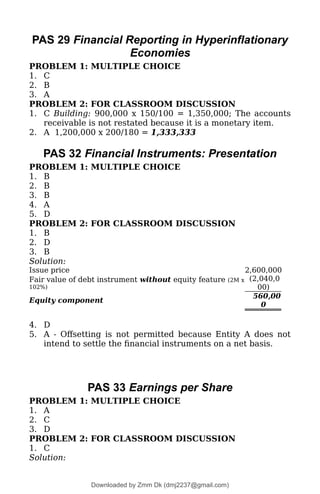
PAS 33 Earnings per Share
PROBLEM 1: MULTIPLE CHOICE
1. A
2. C
3. D
PROBLEM 2: FOR CLASSROOM DISCUSSION
1. C
Solution:
Downloaded by Zmm Dk (dmj2237@gmail.com)
lOMoARcPSD|46138815
18.
Date No. ofsh.
Months
outstanding
Weighted
average
(a) (b) (c) = (a) x (b)
1/1/20x1 120,000 12/12 120,000
3/1/20x1 42,000 10/12 35,000
9/30/20x1 20,000 3/12 5,000
11/1/20x1 (12,000) 2/12 (2,000)
158,000
Basi
c
EPS
=
Profit (Loss) less Preferred dividends
Weighted average number of outstanding ordinary
shares
Basi
c
EPS
=
2,800,000 – (100,000 x ₱10 x 10%)
158,000
Basic EPS = ₱17.09
2. A [(-1M) – 50K] ÷ 100,000 = -1,050,000 ÷ 100,000 = -10.5
3. C
Solution:
The weighted average number of ordinary shares
outstanding are adjusted retrospectively as follows:
20x1 20x2
1/1 (200,000 x 110% x
2)
440,00
0
(200,000 x 110% x 2 x
12/12)
440,00
0
4/1 (20,000 x 110% x 2 x 9/12) 33,00
0
9/3
0
-
11/
1
-
Weighted average 440,0
00
473,0
00
20x2 20x1
Profit after tax
2,200,00
0
1,800,00
0
Adjusted weighted ave. no. of outstanding
sh. 473,000 440,000
Basic EPS 4.65 4.09
Downloaded by Zmm Dk (dmj2237@gmail.com)
lOMoARcPSD|46138815
19.
4. A
Solution:
Aggregate mkt.value of shares before exercise of rts.
(200,000 sh. x ₱180)
36,000,00
0
Add: Proceeds from exercise of rts. [(200,000 rts. ÷ 5) x
₱120] 4,800,000
Total
40,800,00
0
Divide by: Outstanding shares after exercise of rts.
[200,000 sh. before exercise + (200,000 rts. ÷ 5 rts. per
sh.)] 240,000
Theoretical ex-rights fair value per share 170
Adjustme
nt factor
=
Fair value of stocks immediately before the
exercise of rights
Theoretical ex-rights fair value per share
The adjustment factor is 180/170.
Jan. 1: (200,000 x 180/170 x 4/12)
70,58
8
May. 1: (240,000 x 8/12)
160,0
00
Weighted average no. of outstanding ordinary
shares
230,58
8
Profit for the year
2,900,00
0
Divide by: Weighted average no. of outstanding sh. 230,588
Basic earnings per share
12.5
8
5. C
Solution:
Diluted
EPS
=
Profit (Loss) plus After tax interest expense on
convertible bonds
Weighted average number of outstanding ordinary
shares plus Incremental shares arising from the
assumed conversion or exercise of dilutive potential
ordinary shares
Diluted
EPS
=
800,000 + (2,000,000 x 12% x 70%*)
100,000 + [(2,000,000 ÷ 1,000) x 30]
*70% = 1 – 30% tax rate
Downloaded by Zmm Dk (dmj2237@gmail.com)
lOMoARcPSD|46138815
20.
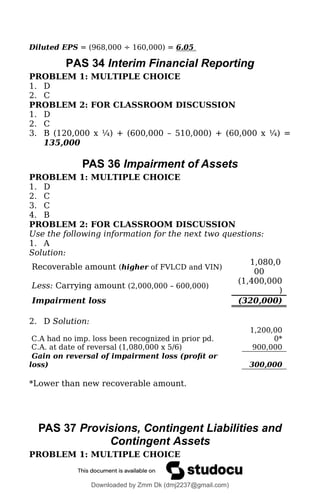
Diluted EPS =(968,000 ÷ 160,000) = 6.05
PAS 34 Interim Financial Reporting
PROBLEM 1: MULTIPLE CHOICE
1. D
2. C
PROBLEM 2: FOR CLASSROOM DISCUSSION
1. D
2. C
3. B (120,000 x ¼) + (600,000 – 510,000) + (60,000 x ¼) =
135,000
PAS 36 Impairment of Assets
PROBLEM 1: MULTIPLE CHOICE
1. D
2. C
3. C
4. B
PROBLEM 2: FOR CLASSROOM DISCUSSION
Use the following information for the next two questions:
1. A
Solution:
Recoverable amount (higher of FVLCD and VIN)
1,080,0
00
Less: Carrying amount (2,000,000 – 600,000)
(1,400,000
)
Impairment loss (320,000)
2. D Solution:
C.A had no imp. loss been recognized in prior pd.
1,200,00
0*
C.A. at date of reversal (1,080,000 x 5/6) 900,000
Gain on reversal of impairment loss (profit or
loss) 300,000
*Lower than new recoverable amount.
PAS 37 Provisions, Contingent Liabilities and
Contingent Assets
PROBLEM 1: MULTIPLE CHOICE
Downloaded by Zmm Dk (dmj2237@gmail.com)
lOMoARcPSD|46138815
21.
1. D
2. D
3.B
PROBLEM 2: FOR CLASSROOM DISCUSSION
1. C
2. D
3. C
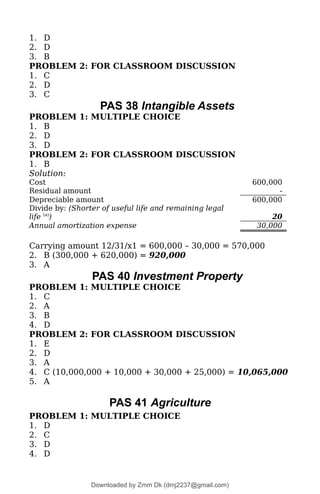
PAS 38 Intangible Assets
PROBLEM 1: MULTIPLE CHOICE
1. B
2. D
3. D
PROBLEM 2: FOR CLASSROOM DISCUSSION
1. B
Solution:
Cost 600,000
Residual amount -
Depreciable amount 600,000
Divide by: (Shorter of useful life and remaining legal
life (a)
) 20
Annual amortization expense 30,000
Carrying amount 12/31/x1 = 600,000 – 30,000 = 570,000
2. B (300,000 + 620,000) = 920,000
3. A
PAS 40 Investment Property
PROBLEM 1: MULTIPLE CHOICE
1. C
2. A
3. B
4. D
PROBLEM 2: FOR CLASSROOM DISCUSSION
1. E
2. D
3. A
4. C (10,000,000 + 10,000 + 30,000 + 25,000) = 10,065,000
5. A
PAS 41 Agriculture
PROBLEM 1: MULTIPLE CHOICE
1. D
2. C
3. D
4. D
Downloaded by Zmm Dk (dmj2237@gmail.com)
lOMoARcPSD|46138815
22.
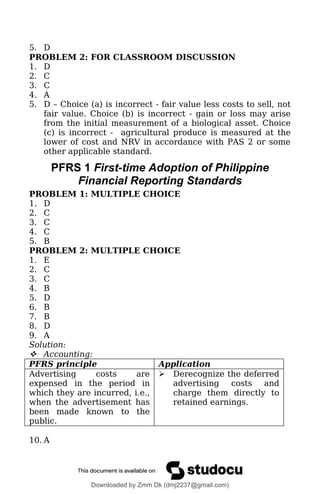
5. D
PROBLEM 2:FOR CLASSROOM DISCUSSION
1. D
2. C
3. C
4. A
5. D – Choice (a) is incorrect - fair value less costs to sell, not
fair value. Choice (b) is incorrect - gain or loss may arise
from the initial measurement of a biological asset. Choice
(c) is incorrect - agricultural produce is measured at the
lower of cost and NRV in accordance with PAS 2 or some
other applicable standard.
PFRS 1 First-time Adoption of Philippine
Financial Reporting Standards
PROBLEM 1: MULTIPLE CHOICE
1. D
2. C
3. C
4. C
5. B
PROBLEM 2: MULTIPLE CHOICE
1. E
2. C
3. C
4. B
5. D
6. B
7. B
8. D
9. A
Solution:
Accounting:
PFRS principle Application
Advertising costs are
expensed in the period in
which they are incurred, i.e.,
when the advertisement has
been made known to the
public.
Derecognize the deferred
advertising costs and
charge them directly to
retained earnings.
10. A
Downloaded by Zmm Dk (dmj2237@gmail.com)
lOMoARcPSD|46138815
23.
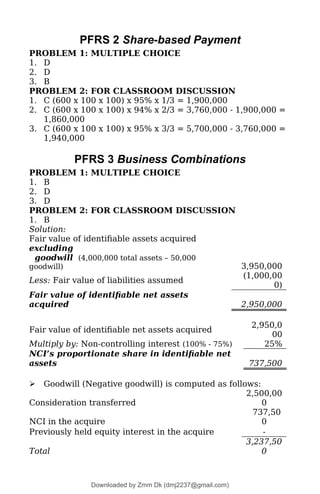
PFRS 2 Share-basedPayment
PROBLEM 1: MULTIPLE CHOICE
1. D
2. D
3. B
PROBLEM 2: FOR CLASSROOM DISCUSSION
1. C (600 x 100 x 100) x 95% x 1/3 = 1,900,000
2. C (600 x 100 x 100) x 94% x 2/3 = 3,760,000 - 1,900,000 =
1,860,000
3. C (600 x 100 x 100) x 95% x 3/3 = 5,700,000 - 3,760,000 =
1,940,000
PFRS 3 Business Combinations
PROBLEM 1: MULTIPLE CHOICE
1. B
2. D
3. D
PROBLEM 2: FOR CLASSROOM DISCUSSION
1. B
Solution:
Fair value of identifiable assets acquired
excluding
goodwill (4,000,000 total assets – 50,000
goodwill) 3,950,000
Less: Fair value of liabilities assumed
(1,000,00
0)
Fair value of identifiable net assets
acquired 2,950,000
Fair value of identifiable net assets acquired
2,950,0
00
Multiply by: Non-controlling interest (100% - 75%) 25%
NCI’s proportionate share in identifiable net
assets 737,500
Goodwill (Negative goodwill) is computed as follows:
Consideration transferred
2,500,00
0
NCI in the acquire
737,50
0
Previously held equity interest in the acquire -
Total
3,237,50
0
Downloaded by Zmm Dk (dmj2237@gmail.com)
lOMoARcPSD|46138815
24.
Less: Fair valueof identifiable net assets
acquired
(2,950,0
00)
Goodwill
287,5
00
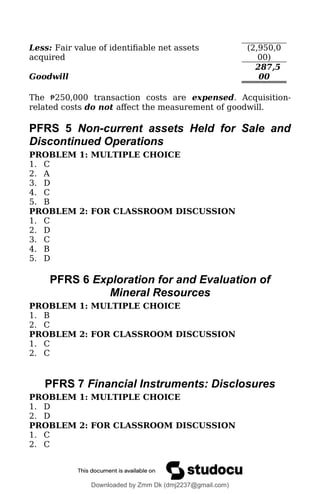
The ₱250,000 transaction costs are expensed. Acquisition-
related costs do not affect the measurement of goodwill.
PFRS 5 Non-current assets Held for Sale and
Discontinued Operations
PROBLEM 1: MULTIPLE CHOICE
1. C
2. A
3. D
4. C
5. B
PROBLEM 2: FOR CLASSROOM DISCUSSION
1. C
2. D
3. C
4. B
5. D
PFRS 6 Exploration for and Evaluation of
Mineral Resources
PROBLEM 1: MULTIPLE CHOICE
1. B
2. C
PROBLEM 2: FOR CLASSROOM DISCUSSION
1. C
2. C
PFRS 7 Financial Instruments: Disclosures
PROBLEM 1: MULTIPLE CHOICE
1. D
2. D
PROBLEM 2: FOR CLASSROOM DISCUSSION
1. C
2. C
Downloaded by Zmm Dk (dmj2237@gmail.com)
lOMoARcPSD|46138815
25.
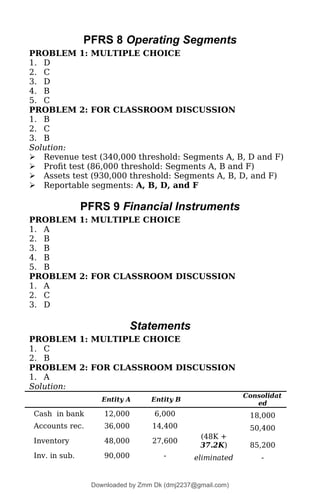
PFRS 8 OperatingSegments
PROBLEM 1: MULTIPLE CHOICE
1. D
2. C
3. D
4. B
5. C
PROBLEM 2: FOR CLASSROOM DISCUSSION
1. B
2. C
3. B
Solution:
Revenue test (340,000 threshold: Segments A, B, D and F)
Profit test (86,000 threshold: Segments A, B and F)
Assets test (930,000 threshold: Segments A, B, D, and F)
Reportable segments: A, B, D, and F
PFRS 9 Financial Instruments
PROBLEM 1: MULTIPLE CHOICE
1. A
2. B
3. B
4. B
5. B
PROBLEM 2: FOR CLASSROOM DISCUSSION
1. A
2. C
3. D
Statements
PROBLEM 1: MULTIPLE CHOICE
1. C
2. B
PROBLEM 2: FOR CLASSROOM DISCUSSION
1. A
Solution:
Entity A Entity B
Consolidat
ed
Cash in bank 12,000 6,000 18,000
Accounts rec. 36,000 14,400 50,400
Inventory 48,000 27,600
(48K +
37.2K) 85,200
Inv. in sub. 90,000 - eliminated -
Downloaded by Zmm Dk (dmj2237@gmail.com)
lOMoARcPSD|46138815
26.
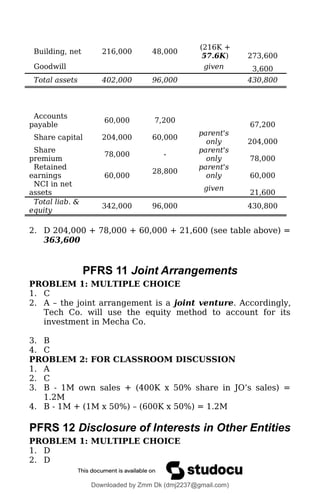
Building, net 216,00048,000
(216K +
57.6K) 273,600
Goodwill given 3,600
Total assets 402,000 96,000 430,800
Accounts
payable
60,000 7,200
67,200
Share capital 204,000 60,000
parent's
only 204,000
Share
premium
78,000 -
parent's
only 78,000
Retained
earnings 60,000
28,800
parent's
only 60,000
NCI in net
assets
given
21,600
Total liab. &
equity
342,000 96,000 430,800
2. D 204,000 + 78,000 + 60,000 + 21,600 (see table above) =
363,600
PFRS 11 Joint Arrangements
PROBLEM 1: MULTIPLE CHOICE
1. C
2. A – the joint arrangement is a joint venture. Accordingly,
Tech Co. will use the equity method to account for its
investment in Mecha Co.
3. B
4. C
PROBLEM 2: FOR CLASSROOM DISCUSSION
1. A
2. C
3. B - 1M own sales + (400K x 50% share in JO’s sales) =
1.2M
4. B - 1M + (1M x 50%) – (600K x 50%) = 1.2M
PFRS 12 Disclosure of Interests in Other Entities
PROBLEM 1: MULTIPLE CHOICE
1. D
2. D
Downloaded by Zmm Dk (dmj2237@gmail.com)
lOMoARcPSD|46138815
27.
PROBLEM 2: FORCLASSROOM DISCUSSION
1. D
2. A
PFRS 13 Fair Value Measurement
PROBLEM 1: MULTIPLE CHOICE
1. D
2. D
3. B
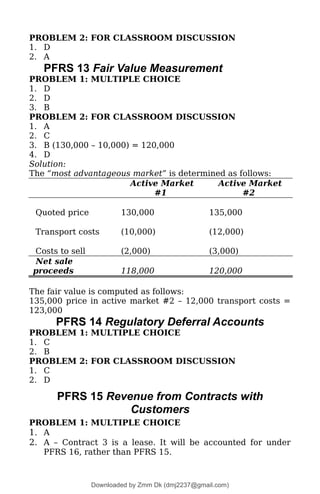
PROBLEM 2: FOR CLASSROOM DISCUSSION
1. A
2. C
3. B (130,000 – 10,000) = 120,000
4. D
Solution:
The “most advantageous market” is determined as follows:
Active Market
#1
Active Market
#2
Quoted price 130,000 135,000
Transport costs (10,000) (12,000)
Costs to sell (2,000) (3,000)
Net sale
proceeds 118,000 120,000
The fair value is computed as follows:
135,000 price in active market #2 – 12,000 transport costs =
123,000
PFRS 14 Regulatory Deferral Accounts
PROBLEM 1: MULTIPLE CHOICE
1. C
2. B
PROBLEM 2: FOR CLASSROOM DISCUSSION
1. C
2. D
PFRS 15 Revenue from Contracts with
Customers
PROBLEM 1: MULTIPLE CHOICE
1. A
2. A – Contract 3 is a lease. It will be accounted for under
PFRS 16, rather than PFRS 15.
Downloaded by Zmm Dk (dmj2237@gmail.com)
lOMoARcPSD|46138815
28.
3. A
4. D
5.B
PROBLEM 2: FOR CLASSROOM DISCUSSION
1. C
2. D
3. D
4. C
5. D
6. A
7. A
8. D
PROBLEM 1: MULTIPLE CHOICE
1. C
2. B
3. C - Choice (d) is incorrect. Under a sublease, the lessee is
also the lessor of the same leased asset.
4. C
5. C
PROBLEM 2: FOR CLASSROOM DISCUSSION
1. B
Solution:
Fixed payments 220,000
Multiply by: PV of an ordinary annuity of ₱1
@10%, n=4 3.16987
Lease liability 697,371
2. A
Solution:
Cost of right-of-use asset 697,371
Divide by: Lease term (shorter) 4
Annual depreciation 174,343
Since the lease contract neither provides for the transfer of
ownership to the lessee nor a ‘reasonably certain’ purchase
option, the asset is depreciated over the shorter of its useful
life (10 yrs.) and the lease term (4 yrs.).
3. D
4. A
5. B
Solution:
Fixed payments 220,000
Multiply by: PV of an ordinary annuity of ₱1 3.16987
Downloaded by Zmm Dk (dmj2237@gmail.com)
lOMoARcPSD|46138815
29.
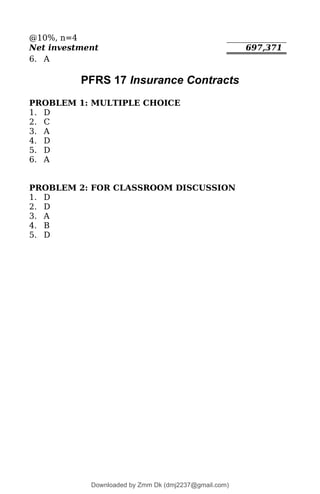
@10%, n=4
Net investment697,371
6. A
PFRS 17 Insurance Contracts
PROBLEM 1: MULTIPLE CHOICE
1. D
2. C
3. A
4. D
5. D
6. A
PROBLEM 2: FOR CLASSROOM DISCUSSION
1. D
2. D
3. A
4. B
5. D
Downloaded by Zmm Dk (dmj2237@gmail.com)
lOMoARcPSD|46138815

![3. A (8M x 5%) ÷ 6 employees currently employed as at year-
end = 66,667
4. A
5. B
6. C
7. D
8. C
9. C
10.D
PROBLEM 2: FOR CLASSROOM DISCUSSION
1. D [(20 employees x 1 day x 12 months) – 150 days] x ₱1,000
x 105% = 94,500.
The 20% employee turnover rate is irrelevant because
the employee benefits are monetized.
2. D
3. B Solution: 2,900,000 PV of DBO – 2,600,000 FVPA =
300,000 deficit
4. B Solution: 400,000 service cost + 20,000 net interest (see
computations below) = 420,000
5. C
Solution:
Service cost:
(a) Current service cost 400,000
(b) Past service cost -
(c) Any (gain) or loss on settlement -
400,000
Net interest on the net defined benefit liability (asset):
(a) Interest cost on the DBO (2M, beg. x 10%) 200,000
(b) Interest income on plan assets (1.8M, beg. x 10%) (180,000)
(c) Interest on the effect of the asset ceiling -
20,000
Remeasurements of the net defined benefit liability (asset):
(a) Actuarial (gains) and losses 200,000
(b) Difference between interest income on plan assets
and
60,000
return on plan assets (180,000 – 120,000)
(c) Difference between the interest on the effect of
the asset -
ceiling and change in the effect of the asset ceiling
260,000
Total Defined Benefit Cost 680,000
Downloaded by Zmm Dk (dmj2237@gmail.com)
lOMoARcPSD|46138815](https://image.slidesharecdn.com/sol-man-cfas-answersheet-answerkey-correct-answer-250608121017-7e87240b/85/sol-man-cfas-answersheet-answerkey-correct-answer-pdf-12-320.jpg)
![PAS 20 Accounting for Government Grants and
Disclosure of Government Assistance
PROBLEM 1: MULTIPLE CHOICE
1. B
2. A
3. C
4. D
5. C
PROBLEM 2: FOR CLASSROOM DISCUSSION
1. D
2. C
20x1 = 0, no depreciation yet is recognized from the
building; therefore, no income yet is recognized from
the government grant (i.e., ‘matching’). The building
starts to be depreciated in 20x2.
20x2 = 20,000 (200,000 ÷ 10 years)
3. B Gross presentation: (1M x 9/10) = 900,000;
Net presentation: (1M – 200K) x 9/10 = 720,000
4. A Gross presentation: (1M ÷ 10) = 100,000;
Net presentation: (1M – 200K) ÷ 10 = 80,000
5. A
Foreign Exchange Rates
PROBLEM 1: MULTIPLE CHOICE
1. D
2. A
3. D
4. A
5. B
PROBLEM 2: FOR CLASSROOM DISCUSSION
1. A [$1,000 x (52 – 50)] = 2,000 gain
2. D [$1,000 x (47 – 52)] = 5,000 loss
3. D
Solution:
(₱10M total assets - ₱5M total liabilities) ÷ ₱10 closing rate =
¥500,000 translated equity
4. A
Solution:
₱3M profit ÷ ₱8 average rate = ¥375,000 translated profit
5. A
Solution:
Translated share capital = (₱2M ÷ ₱5 historical) = ¥400,000
Translated retained earnings (see table below)
Downloaded by Zmm Dk (dmj2237@gmail.com)
lOMoARcPSD|46138815](https://image.slidesharecdn.com/sol-man-cfas-answersheet-answerkey-correct-answer-250608121017-7e87240b/85/sol-man-cfas-answersheet-answerkey-correct-answer-pdf-13-320.jpg)
![4. A
PROBLEM 2: FOR CLASSROOM DISCUSSION
1. D
2. D
PAS 27 Separate Financial Statements
PROBLEM 1: MULTIPLE CHOICE
1. D
PROBLEM 2: FOR CLASSROOM DISCUSSION
1. D
PAS 28 Investments in Associates and Joint
Ventures
PROBLEM 1: MULTIPLE CHOICE
1. B
2. B
3. C
4. A
Solution:
Investment in associate
3/31/x1
500,00
0
Sh. in P (1M x 20% x
9/12)
150,00
0 60,000
Dividends (300K x
20%)
40,000 Sh. in L (200K x 20%
- Dividends
550,00
0 12/31/x2
PROBLEM 2: FOR CLASSROOM DISCUSSION
1. C
Solution:
Investment in associate
1/1/x1
600,00
0
Sh. in profit (200K x
30%) 60,000 15,000
Dividends (50K x
30%)
645,00
0 12/31/x1
2. B [4M profit – (10M x 5%)] x 20% = 700,000
3. B
Downloaded by Zmm Dk (dmj2237@gmail.com)
lOMoARcPSD|46138815](https://image.slidesharecdn.com/sol-man-cfas-answersheet-answerkey-correct-answer-250608121017-7e87240b/85/sol-man-cfas-answersheet-answerkey-correct-answer-pdf-16-320.jpg)
![Date No. of sh.
Months
outstanding
Weighted
average
(a) (b) (c) = (a) x (b)
1/1/20x1 120,000 12/12 120,000
3/1/20x1 42,000 10/12 35,000
9/30/20x1 20,000 3/12 5,000
11/1/20x1 (12,000) 2/12 (2,000)
158,000
Basi
c
EPS
=
Profit (Loss) less Preferred dividends
Weighted average number of outstanding ordinary
shares
Basi
c
EPS
=
2,800,000 – (100,000 x ₱10 x 10%)
158,000
Basic EPS = ₱17.09
2. A [(-1M) – 50K] ÷ 100,000 = -1,050,000 ÷ 100,000 = -10.5
3. C
Solution:
The weighted average number of ordinary shares
outstanding are adjusted retrospectively as follows:
20x1 20x2
1/1 (200,000 x 110% x
2)
440,00
0
(200,000 x 110% x 2 x
12/12)
440,00
0
4/1 (20,000 x 110% x 2 x 9/12) 33,00
0
9/3
0
-
11/
1
-
Weighted average 440,0
00
473,0
00
20x2 20x1
Profit after tax
2,200,00
0
1,800,00
0
Adjusted weighted ave. no. of outstanding
sh. 473,000 440,000
Basic EPS 4.65 4.09
Downloaded by Zmm Dk (dmj2237@gmail.com)
lOMoARcPSD|46138815](https://image.slidesharecdn.com/sol-man-cfas-answersheet-answerkey-correct-answer-250608121017-7e87240b/85/sol-man-cfas-answersheet-answerkey-correct-answer-pdf-18-320.jpg)
![4. A
Solution:
Aggregate mkt. value of shares before exercise of rts.
(200,000 sh. x ₱180)
36,000,00
0
Add: Proceeds from exercise of rts. [(200,000 rts. ÷ 5) x
₱120] 4,800,000
Total
40,800,00
0
Divide by: Outstanding shares after exercise of rts.
[200,000 sh. before exercise + (200,000 rts. ÷ 5 rts. per
sh.)] 240,000
Theoretical ex-rights fair value per share 170
Adjustme
nt factor
=
Fair value of stocks immediately before the
exercise of rights
Theoretical ex-rights fair value per share
The adjustment factor is 180/170.
Jan. 1: (200,000 x 180/170 x 4/12)
70,58
8
May. 1: (240,000 x 8/12)
160,0
00
Weighted average no. of outstanding ordinary
shares
230,58
8
Profit for the year
2,900,00
0
Divide by: Weighted average no. of outstanding sh. 230,588
Basic earnings per share
12.5
8
5. C
Solution:
Diluted
EPS
=
Profit (Loss) plus After tax interest expense on
convertible bonds
Weighted average number of outstanding ordinary
shares plus Incremental shares arising from the
assumed conversion or exercise of dilutive potential
ordinary shares
Diluted
EPS
=
800,000 + (2,000,000 x 12% x 70%*)
100,000 + [(2,000,000 ÷ 1,000) x 30]
*70% = 1 – 30% tax rate
Downloaded by Zmm Dk (dmj2237@gmail.com)
lOMoARcPSD|46138815](https://image.slidesharecdn.com/sol-man-cfas-answersheet-answerkey-correct-answer-250608121017-7e87240b/85/sol-man-cfas-answersheet-answerkey-correct-answer-pdf-19-320.jpg)