Chapter: Requirement Engineering
Requirements Engineering
 Requirement: A function, constraint or
other property that the system must
provide to fill the needs of the system’s
intended user(s)
 Engineering: implies that systematic and
repeatable techniques should be used
 Requirement Engineering means that
requirements for a product are defined,
managed and tested systematically
 It is essential that the software engineering team
understand the requirements of a problem before
the team tries to solve the problem.
 In some cases requirements engineering may be
abbreviated, but it is never abandoned.
 RE is software engineering actions that start with
communication activity and continues into the
modeling activity.
 RE establishes a solid base for design and
construction. Without it, resulting software has a
high probability of not meeting customer needs.
Requirements Engineering
Characteristics of a Good Requirement
 Clear and Unambiguous
 standard structure
 has only one possible interpretation
 Not more than one requirement in one sentence
 Correct
 A requirement contributes to a real need
 Understandable
 A reader can easily understand the meaning of the
requirement
 Verifiable
 A requirement can be tested
 Complete
 Consistent
 Traceable
Why is Getting Good Requirements
Hard?
 Stakeholders don’t know what they really
want.
 Stakeholders express requirements in their
own terms.
 Different stakeholders may have conflicting
requirements.
 Organisational and political factors may
influence the system requirements.
 The requirements change during the RE
process. New stakeholders may emerge
and the business environment change.
Requirements Engineering Tasks
 Inception —Establish a basic understanding of the problem
and the nature of the solution.
 Elicitation —Draw out the requirements from stakeholders.
 Elaboration (Highly structured)—Create an analysis model
that represents information, functional, and behavioral
aspects of the requirements.
 Negotiation—Agree on a deliverable system that is realistic
for developers and customers.
 Specification—Describe the requirements formally or
informally.
 Validation —Review the requirement specification for errors,
ambiguities, omissions, and conflicts.
 Requirements management —Manage changing
requirements.
Inception
 Inception— Ask “context-free”
questions that establish …
 Basic understanding of the problem
 The people who want a solution
 The nature of the solution that is
desired, and
 The effectiveness of preliminary
communication and collaboration
between the customer and the developer
Elicitation
 Elicitation - elicit requirements from customers,
users and others.
 Find out from customers, users and others
what the product objectives are
 what is to be done
 how the product fits into business needs,
and
 how the product is used on a day to day
basis
Why Requirement elicitation is
difficult?
 Problems of scope:
 The boundary of the system is ill-defined.
 Customers/users specify unnecessary technical detail that may confuse
rather than clarify objectives.
 Problem of understanding:
 Customers are not completely sure of what is needed.
 Customers have a poor understanding of the capabilities and limitations
of the computing environment.
 Customers don’t have a full understanding of their problem domain.
 Customers have trouble communicating needs to the system engineer.
 Customers omit detail that is believed to be obvious.
 Customers specify requirements that conflict with other requirements.
 Customers specify requirements that are ambiguous or not able to test.
 Problems of volatility:
 Requirement change over time.
Elaboration
 Focuses on developing a refined technical model of
software functions, features, and constraints using the
information obtained during inception and elicitation
 Create an analysis model that identifies data, function
and behavioral requirements.
 It is driven by the creation and refinement of user
scenarios that describe how the end-user will interact
with the system.
 Each event parsed into extracted.
 End result defines informational, functional and
behavioral domain of the problem
Negotiation
 Negotiation - agree on a deliverable system
that is realistic for developers and customers
 Requirements are categorized and organized
into subsets
 Relations among requirements identified
 Requirements reviewed for correctness
 Requirements prioritized based on customer
needs
 Negotiation about requirements, project cost
and project timeline.
 There should be no winner and no loser in
effective negotiation.
Specification
 Specification – Different things to different people.
 It can be –
 Written Document
 A set of graphical models,
 A formal mathematical models
 Collection of usage scenario.
 A prototype
 Combination of above.
 The Formality and format of a specification varies with
the size and the complexity of the software to be built.
 For large systems, written document, language
descriptions, and graphical models may be the best
approach.
 For small systems or products, usage scenarios
Validation
 Requirements Validation - formal technical
review mechanism that looks for
 Errors in content or interpretation
 Areas where clarification may be required
 Missing information
 Inconsistencies (a major problem when
large products or systems are engineered)
 Conflicting or unrealistic (unachievable)
requirements.
Requirement Management
 Set of activities that help project team to identify, control, and
track requirements and changes as project proceeds
Requirements begin with identification. Each requirement is
assigned a unique identifier. Once requirement have been identified,
traceability table are developed.
Traceability Table:
 Features traceability table - shows how requirements relate to
customer observable features
Source traceability table - identifies source of each requirement
Dependency traceability table - indicate relations among
requirements
Subsystem traceability table - requirements categorized by
subsystem
Interface traceability table - shows requirement relations to
internal and external interfaces
It will help to track, if change in one requirement will affect different
aspects of the system.
Initiating Requirements Engineering Process
 Identify stakeholders
 Stakeholder can be “anyone who benefits in a direct or indirect
way from the system which is being developed”
Ex. Business manager, project manager, marketing people,
software engineer, support engineer, end-users, internal-
external customers, consultants, maintenance engineer.
 Each one of them has different view of the system.
 Recognize multiple points of view
 Marketing group concern about feature and function to excite potential
market. To sell easily in the market.
 Business manager concern about feature built within budget and will be
ready to meet market.
 End user – Easy to learn and use.
 SE – product functioning at various infrastructure support.
 Support engineer – Maintainability of software.
Role of RE is to categorize all stakeholder information in a way that
there could be no inconsistent or conflict requirement with one
another
 Work toward collaboration
 RE identify areas of commonality (i.e. Agreed requirement)
and areas of conflict or inconsistency.
 It does not mean requirement defined by committee. It may
happened they providing just view of their requirement.
 Business manager or senior technologist may make final
decision.
 Asking the first questions
 Who is behind the request for this work?
 Who will use the solution?
 What will be the economic benefit of a successful
solution
 Is there another source for the solution that you need?
These questions will help – stakeholder interest in the software
& measurable benefit of successful implementation.
Asking the question
Next set of questions – better understanding of the
problem.
 What business problem (s) will this solution address?
 Describe business environment in which the solution will
be used?
 will performance or productivity issues affect the solution
is approached?
Final set of questions – Effectiveness of communication
 Are my questions relevant to the problem?
 Am I asking too many questions?
 Can anyone else provide additional information?
 should I be asking you anything else?
Eliciting Requirement
Approach for eliciting requirement:
 Collaborative Requirement Gathering
 Quality Function Deployment
 User Scenarios
 Elicitation Work Products
Collaborative Requirement
Gathering
 Meetings are attended by all interested stakeholders.
 Rules established for preparation and participation.
 Agenda should be formal enough to cover all important points, but
informal enough to encourage the free flow of ideas.
 A facilitator controls the meeting.
 A definition mechanism (blackboard, flip charts, etc.) is used.
 During the meeting:
 The problem is identified.
 Elements of the solution are proposed.
 Different approaches are negotiated.
 A preliminary set of solution requirements are obtained.
 The atmosphere is collaborative and non-threatening.
 Flow of event – Outline the sequence of events occurs
 Requirement gathering meeting ( initial meeting)
 During meeting
 Follow the meeting.
Collaborative requirement
gathering (contd.)
 In initial meeting, distribute “Product request” (defined by
stakeholder) to all attendee.
 Based on product request, each attendee is asked to make
 List of objects (Internal or external system objects)
 List of services( Processes or functions)
 List of constraints ( cost, size, business rules) and
performance criteria( speed, accuracy) are developed.
 Collect lists from everyone and combined.
 Combined list eliminates redundant entries, add new ideas
, but does not delete anything.
 Objective is to develop a consensus list in each topic area
(objects, services, constraints and performance).
 Based on lists, team is divided into smaller sub-teams :
each works to develop mini-specification for one or more
entries on each of the lists.
 Each sub-team the presents its mini-specification to
all attendees for discussion. Addition, deletion and
further elaboration are made.
 Now each team makes a list of validation criteria for
the product and present to team.
 Finally, one or more participants is assigned the
task of writing a complete draft specification.
Collaborative requirement
gathering (Contd.)
Quality Function Deployment
 It is a technique that translate the needs of the customer into technical
requirement for software.
 Concentrates on maximizing customer satisfaction.
 QFD emphasizes – what is valuable to the customer and then deploys these
values throughout the engineering process.
Three types of requirement:
1. Normal Requirements – reflect objectives and goals stated for product. If
requirement are present in final products, customer is satisfied.
2. Expected Requirements – customer does not explicitly state them.
Customer assumes it is implicitly available with the system.
3. Exciting Requirements- Features that go beyond the customer’s
expectation.
During meeting with customer –
Function deployment determines the “value” of each function required of the
system.
Information deployment identifies data objects and events and also tied with
functions.
Task deployment examines the behavior of the system.
Value analysis determines the priority of requirements during these 3
deployments.
User Scenario
 It is difficult to move into more software engineering
activities until s/w team understands how these
functions and features will be used by diff. end-users.
 Developers and users create a set of usage threads for
the system to be constructed
 A use-case scenario is a story about how someone or
something external to the software (known as an actor)
interacts with the system.
 Describe how the system will be used
 Each scenario is described from the point-of-view of an “actor”—a
person or device that interacts with the software in some way
Elicitation Work Products
Elicitation work product will vary depending upon the size of
the system or product to be built.
 Statement of need and feasibility.
 Statement of scope.
 List of participants in requirements elicitation.
 Description of the system’s technical environment.
 List of requirements and associated domain constraints.
 List of usage scenarios.
 Any prototypes developed to refine requirements.
Software Prototype
 Prototype constructed for customer and developer
assessment.
 In some circumstances construction of prototype is
require in beginning of analysis. (To derive requirement
effectively)
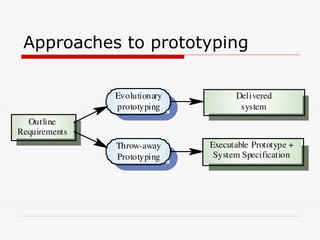
Selecting Prototype Approach
1. Close ended (Throwaway Approach)
2. Open ended (Evolutionary Approach)
Close Ended – It serves as a rough demonstration of
requirement. It is then discarded, and the software
engineered using a different paradigm.
Open Ended - uses the prototype as the first part of an
analysis activity that will be continued into design and
construction. The prototype of the software is the first
evolution of the finished system.
Approaches to prototyping
Evolutionary
prototyping
Throw-away
Prototyping
Delivered
system
Executable Prototype +
System Specification
Outline
Requirements
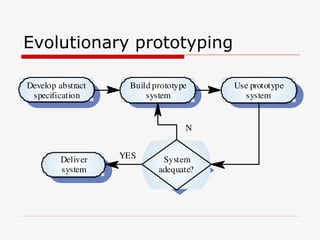
Evolutionary prototyping
Build prototype
system
Develop abstract
specification
Use prototype
system
Deliver
system
System
adequate?
YES
N
Evolutionary prototyping
advantages
 Accelerated delivery of the system
 Rapid delivery and deployment are
sometimes more important than
functionality or long-term software
maintainability
 User engagement with the system
 Not only is the system more likely to
meet user requirements, they are more
likely to commit to the use of the system
Evolutionary prototyping problems
 Management problems
 Existing management processes assume a
waterfall model of development
 Specialist skills are required which may not be
available in all development teams
 Maintenance problems
 Continual change tends to corrupt system
structure so long-term maintenance is expensive
 Contractual problems
 Due to cost or time line agreed
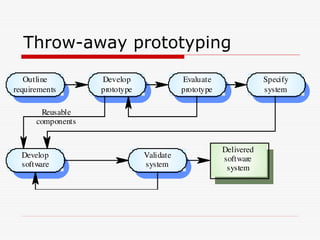
Throw-away prototyping
Outline
requirements
Develop
prototype
Evaluate
prototype
Specify
system
Develop
software
Validate
system
Delivered
software
system
Reusable
components
Throw-away prototyping
 Used to reduce requirements risk
 The prototype is developed from an initial
specification, delivered for experiment then
discarded
 The throw-away prototype should NOT be
considered as a final system
 Some system characteristics may have been
left out
 There is no specification for long-term
maintenance
 The system will be poorly structured and
difficult to maintain
Prototyping Methods and Tools
 A prototype must be developed rapidly so that the customer may assess results and
recommend changes.
3 methods are available:
1. Fourth Generation Techniques (4GT)
 4GT enable the software engineer to generate executable code quickly, they are ideal for
rapid prototyping.
 Ex. Tool for Database query language or reporting language.
2. Reusable software components
 To rapid prototyping is to assemble, rather than build, the prototype by using a set of
existing software components.
 Should maintain library for existing software components
 An existing software product can be used as a prototype for a "new, improved" competitive
product
3. Formal specification and prototyping environments
 Enable an analyst to interactively create language-based specifications of a system or
software,
 Invoke automated tools that translate the language-based specifications into executable
code,
 Enable the customer to use the prototype executable code to refine formal requirements.
Specification
 Mode of specification has much to do with the quality of
solution.
 If specification incomplete, inconsistent, or misleading
specifications have experienced the frustration and confusion
that invariably results.
Specification Principles: May be viewed as
representation process.
1. Separate functionality from implementation.
2. Develop a model of the desired behavior of a system.
3. Establish the context in which software operates by
specifying the manner.
4. Define the environment in which the system operates and
indicate how.
Specification Principles (cont.)
5. Create a cognitive model rather than a design or
implementation model. The cognitive model describes a
system as perceived by its user community.
6. The specifications must be tolerant of incompleteness
and augmentable.
7. Establish the content and structure of a specification in
a way that will enable it to be amenable to change.
Specification Representation
Representation format and content should be relevant to
the problem.
 For example, a specification for a manufacturing automation system might
use different symbology, diagrams and language than the specification for a
programming language compiler.
Information contained within the specification should be
nested (layered).
 Paragraph and diagram numbering schemes should indicate the level of detail
that is being presented.
 It is sometimes worthwhile to present the same information at different
levels of abstraction to aid in understanding.
Diagrams and other notational forms should be restricted in
number and consistent in use.
 Confusing or inconsistent notation, whether graphical or symbolic, degrades
understanding and fosters errors.
Representations should be revisable.
Software Requirements Specification
 It contains a complete information description, a detailed functional
description, a representation of system behavior, an indication of
performance requirements and design constraints, appropriate
validation criteria, and other information pertinent to requirements.
Format of SRS:
Introduction of the software requirements specification states the goals
and objectives of the software, describing it in the context of the
computer-based system.
Information content, flow, and structure are documented. Hardware,
software, and human interfaces are described for external system
elements and internal software functions.
Functional Description A processing narrative is provided for each
function, design constraints are stated and justified & performance
characteristics are stated
Behavioral Description operation of the software as a consequence of
external events and internally generated control characteristics.
Software Requirements Specification (Cont.)
Validation Criteria is probably the most important and, ironically,
the most often neglected section of the Software Requirements
Specification (SRS). Testing or validating each user-scenario.
Finally, the specification includes a Bibliography and Appendix.
The bibliography contains references to all documents that
relate to the software. The appendix contains information that
supplements the specifications
Specification Review
 A review of the SRS (and/or prototype) is conducted by
both the software developer and the customer.
 Conducted at a macroscopic level
 Ensure that specification is complete
 Consistent
 Accurate (Information, functional and behavioral
domain considered).
 Review becomes more detailed while examining
Information, functional and behavioral domain.
 Examining not only broad descriptions but the way in
which requirement worded.
E.g. Terms like “Vague ” (some, sometimes, often, usually)
should be flag by reviewer for further clarification.
Review (cont.)
 Once review is complete – SRS “signed off” by both
customer and developer. ( “contract” for software
development)
 Requests for changes in requirements after the
specification is finalized will not be eliminated.
 Change is an extension of software scope and
therefore can increase cost and/or delivery of product.
 During the review, changes to the specification may
be recommended.
 It can be extremely difficult to assess the global
impact of a change; that is, how a change in one
function affects requirements for other functions

software engineering_ Requirement Engineering.ppt

  • 1.
  • 2.
    Requirements Engineering  Requirement:A function, constraint or other property that the system must provide to fill the needs of the system’s intended user(s)  Engineering: implies that systematic and repeatable techniques should be used  Requirement Engineering means that requirements for a product are defined, managed and tested systematically
  • 3.
     It isessential that the software engineering team understand the requirements of a problem before the team tries to solve the problem.  In some cases requirements engineering may be abbreviated, but it is never abandoned.  RE is software engineering actions that start with communication activity and continues into the modeling activity.  RE establishes a solid base for design and construction. Without it, resulting software has a high probability of not meeting customer needs. Requirements Engineering
  • 4.
    Characteristics of aGood Requirement  Clear and Unambiguous  standard structure  has only one possible interpretation  Not more than one requirement in one sentence  Correct  A requirement contributes to a real need  Understandable  A reader can easily understand the meaning of the requirement  Verifiable  A requirement can be tested  Complete  Consistent  Traceable
  • 5.
    Why is GettingGood Requirements Hard?  Stakeholders don’t know what they really want.  Stakeholders express requirements in their own terms.  Different stakeholders may have conflicting requirements.  Organisational and political factors may influence the system requirements.  The requirements change during the RE process. New stakeholders may emerge and the business environment change.
  • 6.
    Requirements Engineering Tasks Inception —Establish a basic understanding of the problem and the nature of the solution.  Elicitation —Draw out the requirements from stakeholders.  Elaboration (Highly structured)—Create an analysis model that represents information, functional, and behavioral aspects of the requirements.  Negotiation—Agree on a deliverable system that is realistic for developers and customers.  Specification—Describe the requirements formally or informally.  Validation —Review the requirement specification for errors, ambiguities, omissions, and conflicts.  Requirements management —Manage changing requirements.
  • 7.
    Inception  Inception— Ask“context-free” questions that establish …  Basic understanding of the problem  The people who want a solution  The nature of the solution that is desired, and  The effectiveness of preliminary communication and collaboration between the customer and the developer
  • 8.
    Elicitation  Elicitation -elicit requirements from customers, users and others.  Find out from customers, users and others what the product objectives are  what is to be done  how the product fits into business needs, and  how the product is used on a day to day basis
  • 9.
    Why Requirement elicitationis difficult?  Problems of scope:  The boundary of the system is ill-defined.  Customers/users specify unnecessary technical detail that may confuse rather than clarify objectives.  Problem of understanding:  Customers are not completely sure of what is needed.  Customers have a poor understanding of the capabilities and limitations of the computing environment.  Customers don’t have a full understanding of their problem domain.  Customers have trouble communicating needs to the system engineer.  Customers omit detail that is believed to be obvious.  Customers specify requirements that conflict with other requirements.  Customers specify requirements that are ambiguous or not able to test.  Problems of volatility:  Requirement change over time.
  • 10.
    Elaboration  Focuses ondeveloping a refined technical model of software functions, features, and constraints using the information obtained during inception and elicitation  Create an analysis model that identifies data, function and behavioral requirements.  It is driven by the creation and refinement of user scenarios that describe how the end-user will interact with the system.  Each event parsed into extracted.  End result defines informational, functional and behavioral domain of the problem
  • 11.
    Negotiation  Negotiation -agree on a deliverable system that is realistic for developers and customers  Requirements are categorized and organized into subsets  Relations among requirements identified  Requirements reviewed for correctness  Requirements prioritized based on customer needs  Negotiation about requirements, project cost and project timeline.  There should be no winner and no loser in effective negotiation.
  • 12.
    Specification  Specification –Different things to different people.  It can be –  Written Document  A set of graphical models,  A formal mathematical models  Collection of usage scenario.  A prototype  Combination of above.  The Formality and format of a specification varies with the size and the complexity of the software to be built.  For large systems, written document, language descriptions, and graphical models may be the best approach.  For small systems or products, usage scenarios
  • 13.
    Validation  Requirements Validation- formal technical review mechanism that looks for  Errors in content or interpretation  Areas where clarification may be required  Missing information  Inconsistencies (a major problem when large products or systems are engineered)  Conflicting or unrealistic (unachievable) requirements.
  • 14.
    Requirement Management  Setof activities that help project team to identify, control, and track requirements and changes as project proceeds Requirements begin with identification. Each requirement is assigned a unique identifier. Once requirement have been identified, traceability table are developed. Traceability Table:  Features traceability table - shows how requirements relate to customer observable features Source traceability table - identifies source of each requirement Dependency traceability table - indicate relations among requirements Subsystem traceability table - requirements categorized by subsystem Interface traceability table - shows requirement relations to internal and external interfaces It will help to track, if change in one requirement will affect different aspects of the system.
  • 15.
    Initiating Requirements EngineeringProcess  Identify stakeholders  Stakeholder can be “anyone who benefits in a direct or indirect way from the system which is being developed” Ex. Business manager, project manager, marketing people, software engineer, support engineer, end-users, internal- external customers, consultants, maintenance engineer.  Each one of them has different view of the system.  Recognize multiple points of view  Marketing group concern about feature and function to excite potential market. To sell easily in the market.  Business manager concern about feature built within budget and will be ready to meet market.  End user – Easy to learn and use.  SE – product functioning at various infrastructure support.  Support engineer – Maintainability of software. Role of RE is to categorize all stakeholder information in a way that there could be no inconsistent or conflict requirement with one another
  • 16.
     Work towardcollaboration  RE identify areas of commonality (i.e. Agreed requirement) and areas of conflict or inconsistency.  It does not mean requirement defined by committee. It may happened they providing just view of their requirement.  Business manager or senior technologist may make final decision.  Asking the first questions  Who is behind the request for this work?  Who will use the solution?  What will be the economic benefit of a successful solution  Is there another source for the solution that you need? These questions will help – stakeholder interest in the software & measurable benefit of successful implementation.
  • 17.
    Asking the question Nextset of questions – better understanding of the problem.  What business problem (s) will this solution address?  Describe business environment in which the solution will be used?  will performance or productivity issues affect the solution is approached? Final set of questions – Effectiveness of communication  Are my questions relevant to the problem?  Am I asking too many questions?  Can anyone else provide additional information?  should I be asking you anything else?
  • 18.
    Eliciting Requirement Approach foreliciting requirement:  Collaborative Requirement Gathering  Quality Function Deployment  User Scenarios  Elicitation Work Products
  • 19.
    Collaborative Requirement Gathering  Meetingsare attended by all interested stakeholders.  Rules established for preparation and participation.  Agenda should be formal enough to cover all important points, but informal enough to encourage the free flow of ideas.  A facilitator controls the meeting.  A definition mechanism (blackboard, flip charts, etc.) is used.  During the meeting:  The problem is identified.  Elements of the solution are proposed.  Different approaches are negotiated.  A preliminary set of solution requirements are obtained.  The atmosphere is collaborative and non-threatening.  Flow of event – Outline the sequence of events occurs  Requirement gathering meeting ( initial meeting)  During meeting  Follow the meeting.
  • 20.
    Collaborative requirement gathering (contd.) In initial meeting, distribute “Product request” (defined by stakeholder) to all attendee.  Based on product request, each attendee is asked to make  List of objects (Internal or external system objects)  List of services( Processes or functions)  List of constraints ( cost, size, business rules) and performance criteria( speed, accuracy) are developed.  Collect lists from everyone and combined.  Combined list eliminates redundant entries, add new ideas , but does not delete anything.  Objective is to develop a consensus list in each topic area (objects, services, constraints and performance).  Based on lists, team is divided into smaller sub-teams : each works to develop mini-specification for one or more entries on each of the lists.
  • 21.
     Each sub-teamthe presents its mini-specification to all attendees for discussion. Addition, deletion and further elaboration are made.  Now each team makes a list of validation criteria for the product and present to team.  Finally, one or more participants is assigned the task of writing a complete draft specification. Collaborative requirement gathering (Contd.)
  • 22.
    Quality Function Deployment It is a technique that translate the needs of the customer into technical requirement for software.  Concentrates on maximizing customer satisfaction.  QFD emphasizes – what is valuable to the customer and then deploys these values throughout the engineering process. Three types of requirement: 1. Normal Requirements – reflect objectives and goals stated for product. If requirement are present in final products, customer is satisfied. 2. Expected Requirements – customer does not explicitly state them. Customer assumes it is implicitly available with the system. 3. Exciting Requirements- Features that go beyond the customer’s expectation. During meeting with customer – Function deployment determines the “value” of each function required of the system. Information deployment identifies data objects and events and also tied with functions. Task deployment examines the behavior of the system. Value analysis determines the priority of requirements during these 3 deployments.
  • 23.
    User Scenario  Itis difficult to move into more software engineering activities until s/w team understands how these functions and features will be used by diff. end-users.  Developers and users create a set of usage threads for the system to be constructed  A use-case scenario is a story about how someone or something external to the software (known as an actor) interacts with the system.  Describe how the system will be used  Each scenario is described from the point-of-view of an “actor”—a person or device that interacts with the software in some way
  • 24.
    Elicitation Work Products Elicitationwork product will vary depending upon the size of the system or product to be built.  Statement of need and feasibility.  Statement of scope.  List of participants in requirements elicitation.  Description of the system’s technical environment.  List of requirements and associated domain constraints.  List of usage scenarios.  Any prototypes developed to refine requirements.
  • 25.
    Software Prototype  Prototypeconstructed for customer and developer assessment.  In some circumstances construction of prototype is require in beginning of analysis. (To derive requirement effectively) Selecting Prototype Approach 1. Close ended (Throwaway Approach) 2. Open ended (Evolutionary Approach) Close Ended – It serves as a rough demonstration of requirement. It is then discarded, and the software engineered using a different paradigm. Open Ended - uses the prototype as the first part of an analysis activity that will be continued into design and construction. The prototype of the software is the first evolution of the finished system.
  • 26.
  • 27.
    Evolutionary prototyping Build prototype system Developabstract specification Use prototype system Deliver system System adequate? YES N
  • 28.
    Evolutionary prototyping advantages  Accelerateddelivery of the system  Rapid delivery and deployment are sometimes more important than functionality or long-term software maintainability  User engagement with the system  Not only is the system more likely to meet user requirements, they are more likely to commit to the use of the system
  • 29.
    Evolutionary prototyping problems Management problems  Existing management processes assume a waterfall model of development  Specialist skills are required which may not be available in all development teams  Maintenance problems  Continual change tends to corrupt system structure so long-term maintenance is expensive  Contractual problems  Due to cost or time line agreed
  • 30.
  • 31.
    Throw-away prototyping  Usedto reduce requirements risk  The prototype is developed from an initial specification, delivered for experiment then discarded  The throw-away prototype should NOT be considered as a final system  Some system characteristics may have been left out  There is no specification for long-term maintenance  The system will be poorly structured and difficult to maintain
  • 32.
    Prototyping Methods andTools  A prototype must be developed rapidly so that the customer may assess results and recommend changes. 3 methods are available: 1. Fourth Generation Techniques (4GT)  4GT enable the software engineer to generate executable code quickly, they are ideal for rapid prototyping.  Ex. Tool for Database query language or reporting language. 2. Reusable software components  To rapid prototyping is to assemble, rather than build, the prototype by using a set of existing software components.  Should maintain library for existing software components  An existing software product can be used as a prototype for a "new, improved" competitive product 3. Formal specification and prototyping environments  Enable an analyst to interactively create language-based specifications of a system or software,  Invoke automated tools that translate the language-based specifications into executable code,  Enable the customer to use the prototype executable code to refine formal requirements.
  • 33.
    Specification  Mode ofspecification has much to do with the quality of solution.  If specification incomplete, inconsistent, or misleading specifications have experienced the frustration and confusion that invariably results. Specification Principles: May be viewed as representation process. 1. Separate functionality from implementation. 2. Develop a model of the desired behavior of a system. 3. Establish the context in which software operates by specifying the manner. 4. Define the environment in which the system operates and indicate how.
  • 34.
    Specification Principles (cont.) 5.Create a cognitive model rather than a design or implementation model. The cognitive model describes a system as perceived by its user community. 6. The specifications must be tolerant of incompleteness and augmentable. 7. Establish the content and structure of a specification in a way that will enable it to be amenable to change.
  • 35.
    Specification Representation Representation formatand content should be relevant to the problem.  For example, a specification for a manufacturing automation system might use different symbology, diagrams and language than the specification for a programming language compiler. Information contained within the specification should be nested (layered).  Paragraph and diagram numbering schemes should indicate the level of detail that is being presented.  It is sometimes worthwhile to present the same information at different levels of abstraction to aid in understanding. Diagrams and other notational forms should be restricted in number and consistent in use.  Confusing or inconsistent notation, whether graphical or symbolic, degrades understanding and fosters errors. Representations should be revisable.
  • 36.
    Software Requirements Specification It contains a complete information description, a detailed functional description, a representation of system behavior, an indication of performance requirements and design constraints, appropriate validation criteria, and other information pertinent to requirements. Format of SRS: Introduction of the software requirements specification states the goals and objectives of the software, describing it in the context of the computer-based system. Information content, flow, and structure are documented. Hardware, software, and human interfaces are described for external system elements and internal software functions. Functional Description A processing narrative is provided for each function, design constraints are stated and justified & performance characteristics are stated Behavioral Description operation of the software as a consequence of external events and internally generated control characteristics.
  • 37.
    Software Requirements Specification(Cont.) Validation Criteria is probably the most important and, ironically, the most often neglected section of the Software Requirements Specification (SRS). Testing or validating each user-scenario. Finally, the specification includes a Bibliography and Appendix. The bibliography contains references to all documents that relate to the software. The appendix contains information that supplements the specifications
  • 38.
    Specification Review  Areview of the SRS (and/or prototype) is conducted by both the software developer and the customer.  Conducted at a macroscopic level  Ensure that specification is complete  Consistent  Accurate (Information, functional and behavioral domain considered).  Review becomes more detailed while examining Information, functional and behavioral domain.  Examining not only broad descriptions but the way in which requirement worded. E.g. Terms like “Vague ” (some, sometimes, often, usually) should be flag by reviewer for further clarification.
  • 39.
    Review (cont.)  Oncereview is complete – SRS “signed off” by both customer and developer. ( “contract” for software development)  Requests for changes in requirements after the specification is finalized will not be eliminated.  Change is an extension of software scope and therefore can increase cost and/or delivery of product.  During the review, changes to the specification may be recommended.  It can be extremely difficult to assess the global impact of a change; that is, how a change in one function affects requirements for other functions