UNIT – I (Cont…)
OUTLINE
• EvolutionaryProcessModel
-TheSpiralModel
• ConcurrentModel
• SpecializedProcessModel
-Component-BasedDevelopment
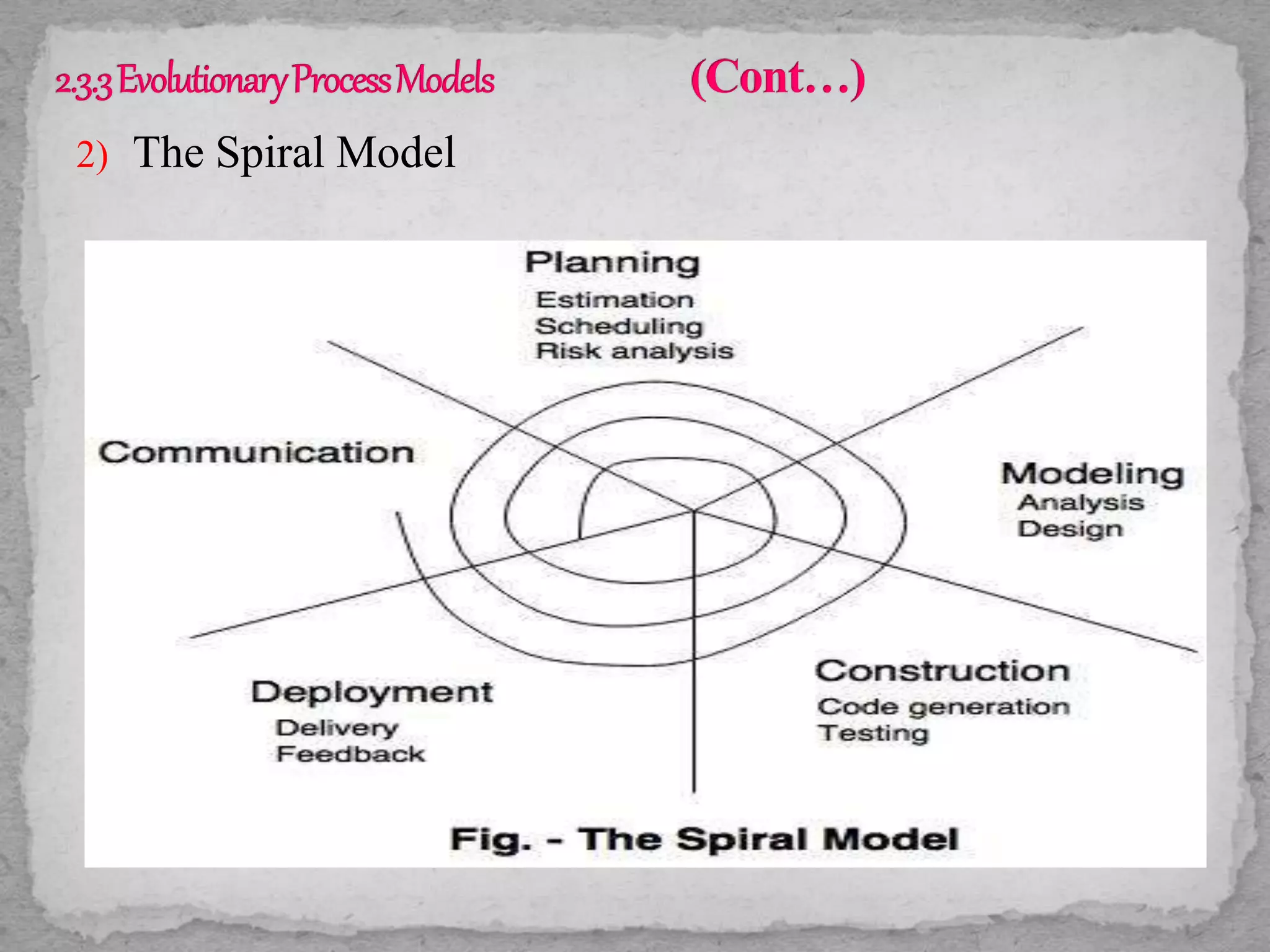
2) The Spiral Model
2) The Spiral Model
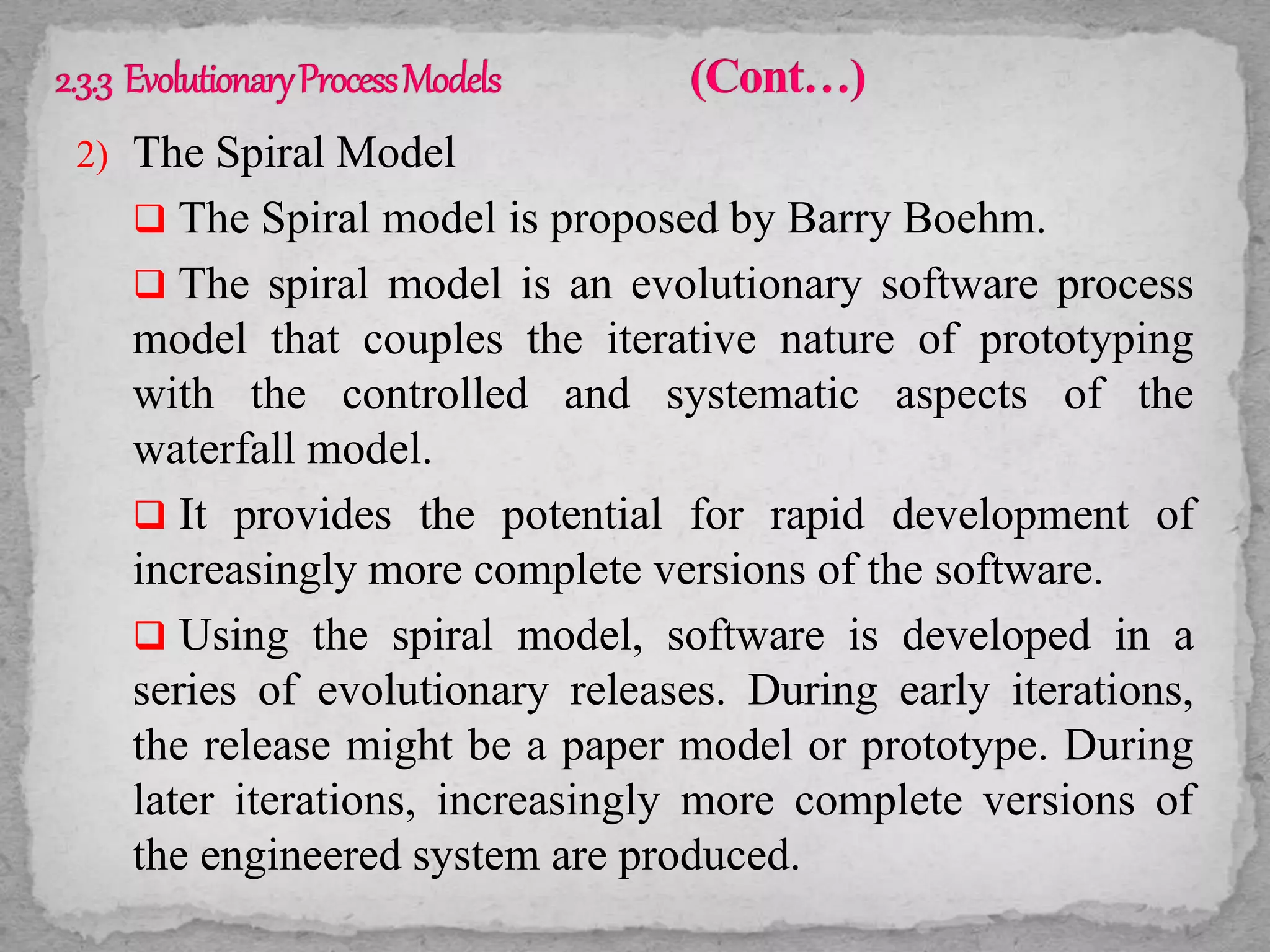
 The Spiral model is proposed by Barry Boehm.
 The spiral model is an evolutionary software process
model that couples the iterative nature of prototyping
with the controlled and systematic aspects of the
waterfall model.
 It provides the potential for rapid development of
increasingly more complete versions of the software.
 Using the spiral model, software is developed in a
series of evolutionary releases. During early iterations,
the release might be a paper model or prototype. During
later iterations, increasingly more complete versions of
the engineered system are produced.
 Anchor point milestones- a combination of work
products and conditions that are attained along the path
of the spiral- are noted for each evolutionary pass.
 The first circuit around the spiral might result in the
development of product specification; subsequent passes
around the spiral might be used to develop a prototype
and then progressively more sophisticated versions of the
software.
 Each pass through the planning region results in
adjustments to the project plan. Cost and schedule are
adjusted based on feedback derived from the customer
after delivery. In addition, the project manager adjusts the
planned number of iterations required to complete the
software.
 It maintains the systematic stepwise approach
suggested by the classic life cycle but incorporates it into
an iterative framework that more realistically reflects the
real world.
 The first circuit around the spiral might represent a
“concept development project” which starts at the core of
the spiral and continues for multiple iterations until
concept development is complete.
 If the concept is to be developed into an actual
product, the process proceeds outward on the spiral and a
“new product development project” commences.
 Later, a circuit around the spiral might be used to
represent a “product enhancement project.” In essence,
the spiral, when characterized in this way, remains
 The concurrent development model, sometimes called
concurrent engineering, allows a software team to
represent iterative and concurrent elements of any of the
process models.
 For example, the modeling activity defined for the spiral
model is accomplished by invoking one or more of the
following software engineering actions: prototyping,
analysis, and design.
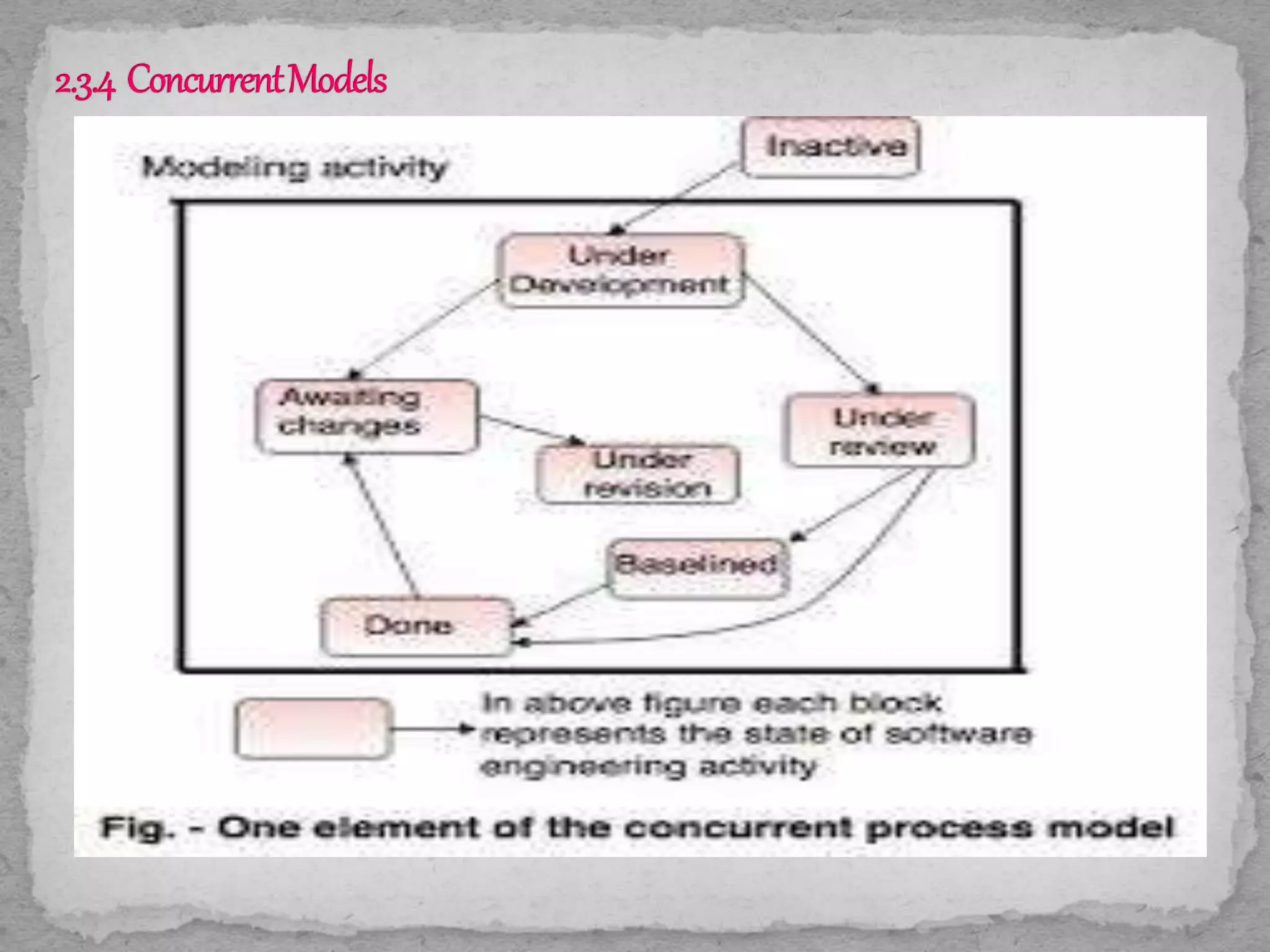
The above Figure provides a schematic representation of
one software engineering activity within the modeling
activity using a concurrent modeling approach.
The activity—modeling—m ay be in any one of the states
- noted at any given time.
 Similarly, other activities, actions, or tasks (e.g.,
communication or construction) can be represented in an
analogous manner.
 All software engineering activities exist concurrently but
reside indifferent states.
 For example, early in a project the communication
activity (not shown in the figure)has completed its first
iteration and exists in the awaiting changes state.
 The modeling activity (which existed in the inactive state
while initial communication was completed, now makes a
transition into the under development state.
 If, however, the customer indicates that changes in
requirements must be made, the modeling activity moves
from the under development state into the awaiting change
state.
 Concurrent modeling defines a series of events that will
trigger transitions from state to state for each of the
software engineering activities, actions, or tasks.
For example, during early stages of design an
inconsistency in the requirements model is uncovered.
This generates the event analysis model correction, which
will trigger the requirements analysis action from the done
state into the awaiting changes state.
Concurrent modeling is applicable to all types of software
development and provides an accurate picture of the
current state of a project.
Each activity, action, or task on the network exists
simultaneously with other activities, actions, or tasks.
Events generated at one point in the process network
trigger transitions among the states.
 Specialized process models take on many of the characteristics
of one or more of the traditional models
2.4.1 Component-Based Development
 Commercial off-the-shelf (COTS)software components,
developed by vendors who offer them as products, provide
targeted functionality with well-defined interfaces that enable
the component to be integrated into the software that is to be
built.
 The component-based development model incorporates many
of the characteristics of the spiral model.
 It is evolutionary in nature, demanding an iterative approach to
the creation of software.
 However, the component-based development model constructs
applications from prepackaged software components.
 However, the component-based development model
constructs applications from prepackaged software
components.
 Modeling and construction activities begin with the
identification of candidate components.
 These candidate components can be designed as either
conventional software modules or object-oriented classes
or packages of classes.
 Regardless of the technology that is used to create the
components, the component-based development model
incorporates the following steps:
1. Available component-based products are researched
and evaluated for the application domain in question.
2. Component integration issues are considered.
3. A software architecture is designed to
accommodate the components.
4. Components are integrated into the architecture.
5. Comprehensive testing is conducted to ensure
proper functionality.
The component-based development model leads to
software reuse, and reusability provides software
engineers with a number of measurable benefits.
Software Engineering

Software Engineering

  • 2.
    UNIT – I(Cont…) OUTLINE • EvolutionaryProcessModel -TheSpiralModel • ConcurrentModel • SpecializedProcessModel -Component-BasedDevelopment
  • 3.
  • 4.
    2) The SpiralModel  The Spiral model is proposed by Barry Boehm.  The spiral model is an evolutionary software process model that couples the iterative nature of prototyping with the controlled and systematic aspects of the waterfall model.  It provides the potential for rapid development of increasingly more complete versions of the software.  Using the spiral model, software is developed in a series of evolutionary releases. During early iterations, the release might be a paper model or prototype. During later iterations, increasingly more complete versions of the engineered system are produced.
  • 5.
     Anchor pointmilestones- a combination of work products and conditions that are attained along the path of the spiral- are noted for each evolutionary pass.  The first circuit around the spiral might result in the development of product specification; subsequent passes around the spiral might be used to develop a prototype and then progressively more sophisticated versions of the software.  Each pass through the planning region results in adjustments to the project plan. Cost and schedule are adjusted based on feedback derived from the customer after delivery. In addition, the project manager adjusts the planned number of iterations required to complete the software.
  • 6.
     It maintainsthe systematic stepwise approach suggested by the classic life cycle but incorporates it into an iterative framework that more realistically reflects the real world.  The first circuit around the spiral might represent a “concept development project” which starts at the core of the spiral and continues for multiple iterations until concept development is complete.  If the concept is to be developed into an actual product, the process proceeds outward on the spiral and a “new product development project” commences.  Later, a circuit around the spiral might be used to represent a “product enhancement project.” In essence, the spiral, when characterized in this way, remains
  • 8.
     The concurrentdevelopment model, sometimes called concurrent engineering, allows a software team to represent iterative and concurrent elements of any of the process models.  For example, the modeling activity defined for the spiral model is accomplished by invoking one or more of the following software engineering actions: prototyping, analysis, and design. The above Figure provides a schematic representation of one software engineering activity within the modeling activity using a concurrent modeling approach. The activity—modeling—m ay be in any one of the states - noted at any given time.
  • 9.
     Similarly, otheractivities, actions, or tasks (e.g., communication or construction) can be represented in an analogous manner.  All software engineering activities exist concurrently but reside indifferent states.  For example, early in a project the communication activity (not shown in the figure)has completed its first iteration and exists in the awaiting changes state.  The modeling activity (which existed in the inactive state while initial communication was completed, now makes a transition into the under development state.  If, however, the customer indicates that changes in requirements must be made, the modeling activity moves from the under development state into the awaiting change state.
  • 10.
     Concurrent modelingdefines a series of events that will trigger transitions from state to state for each of the software engineering activities, actions, or tasks. For example, during early stages of design an inconsistency in the requirements model is uncovered. This generates the event analysis model correction, which will trigger the requirements analysis action from the done state into the awaiting changes state. Concurrent modeling is applicable to all types of software development and provides an accurate picture of the current state of a project. Each activity, action, or task on the network exists simultaneously with other activities, actions, or tasks. Events generated at one point in the process network trigger transitions among the states.
  • 11.
     Specialized processmodels take on many of the characteristics of one or more of the traditional models 2.4.1 Component-Based Development  Commercial off-the-shelf (COTS)software components, developed by vendors who offer them as products, provide targeted functionality with well-defined interfaces that enable the component to be integrated into the software that is to be built.  The component-based development model incorporates many of the characteristics of the spiral model.  It is evolutionary in nature, demanding an iterative approach to the creation of software.  However, the component-based development model constructs applications from prepackaged software components.
  • 12.
     However, thecomponent-based development model constructs applications from prepackaged software components.  Modeling and construction activities begin with the identification of candidate components.  These candidate components can be designed as either conventional software modules or object-oriented classes or packages of classes.  Regardless of the technology that is used to create the components, the component-based development model incorporates the following steps: 1. Available component-based products are researched and evaluated for the application domain in question.
  • 13.
    2. Component integrationissues are considered. 3. A software architecture is designed to accommodate the components. 4. Components are integrated into the architecture. 5. Comprehensive testing is conducted to ensure proper functionality. The component-based development model leads to software reuse, and reusability provides software engineers with a number of measurable benefits.