In the past 10 years, Web access, the nature of the Web, and contexts for learning have been transformed, along with the emergence of desired technological competencies for learners, teachers, and administrators.  Internet connectivity in schools, homes, neighborhoods, and communities has become increasingly pervasive.  Since the mid-1990s, the percentage of public schools connected to the Internet exploded from 35% to 100%.(Greenhow et al., 2009)
A Network of LearnersMichelle J. Gibson Herman
The BeginningFace-2-Face EnvironmentFacilitator focusedLimited to brick and mortarFirst generation Web or Web 1.0 was limited in accessInformation only (read only)Not interactive
CurrentlyFace-to-face classroomsFacilitator focusedTechnological advancementsSocial interaction amongst groupsBlended classroomsAllows for collaboration of ideas Ability to have face-to-face contactOnline classroomIncorporation of social networksParticipation in various Web 2.0 environmentsGlobal community of learners
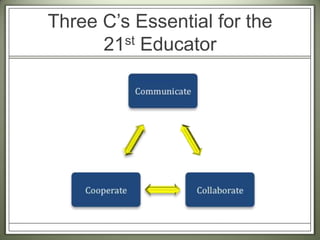
Three C’s Essential for the21st Educator
What is Current Research Finding with Current InstructionLevin et al. (2002) surveying 3,000 public school students, identified a “digital disconnect” (p. v) between students and their schools, with students claiming their teachers had not yet shifted their teaching to respond to the new ways students communicate and use the Web beyond their classrooms.National School Boards Association (2007) reported that students’ online sharing in social network sites involves education and learning.  Sixty percent of students surveyed reported using their social network sites to talk about education topics.
Research QuestionsWhat is the learner participation and identity as it relates to competencies, practices, and policies of learning institutions?  Is the way information that is being delivered virtually, quickly changing and affecting the way learning is being learned?  What value does the facilitator provide in the way learning is being learned?
My Research Interests Technology driven futureInteractions of learners and facilitators using:Cloud ComputingSocial Operating Systems Relevant Delivery SystemLearners Educationally beneficialEase of access and contentFacilitators Effective communicatorsEffectively guide and direct collaboration amongst groups
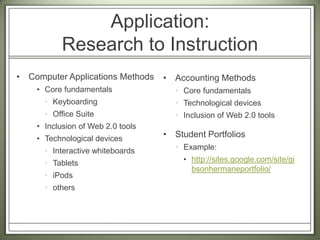
Application:  Research to InstructionComputer Applications MethodsCore fundamentalsKeyboardingOffice SuiteInclusion of Web 2.0 toolsTechnological devicesInteractive whiteboardsTabletsiPodsothersAccounting MethodsCore fundamentalsTechnological devicesInclusion of Web 2.0 toolsStudent PortfoliosExample:http://sites.google.com/site/gibsonhermaneportfolio/
Preparing the Future TeacherNeeds to embrace technologyNeeds to incorporate collaborative toolsRelevant to learner of todayPreparation:  the tools of a successful facilitator of learnersNeeds to continue to incorporate fundamentals into curriculumNeeds to engage learner to higher level of thinking
Key to the learning process are the interactions among students themselves, the interactions between faculty and students, and the collaboration in learning that results from these interactions. ~Palloff and Pratt. Questions?

Social Network Revised

  • 1.
    In the past10 years, Web access, the nature of the Web, and contexts for learning have been transformed, along with the emergence of desired technological competencies for learners, teachers, and administrators. Internet connectivity in schools, homes, neighborhoods, and communities has become increasingly pervasive. Since the mid-1990s, the percentage of public schools connected to the Internet exploded from 35% to 100%.(Greenhow et al., 2009)
  • 2.
    A Network ofLearnersMichelle J. Gibson Herman
  • 3.
    The BeginningFace-2-Face EnvironmentFacilitatorfocusedLimited to brick and mortarFirst generation Web or Web 1.0 was limited in accessInformation only (read only)Not interactive
  • 4.
    CurrentlyFace-to-face classroomsFacilitator focusedTechnologicaladvancementsSocial interaction amongst groupsBlended classroomsAllows for collaboration of ideas Ability to have face-to-face contactOnline classroomIncorporation of social networksParticipation in various Web 2.0 environmentsGlobal community of learners
  • 5.
    Three C’s Essentialfor the21st Educator
  • 6.
    What is CurrentResearch Finding with Current InstructionLevin et al. (2002) surveying 3,000 public school students, identified a “digital disconnect” (p. v) between students and their schools, with students claiming their teachers had not yet shifted their teaching to respond to the new ways students communicate and use the Web beyond their classrooms.National School Boards Association (2007) reported that students’ online sharing in social network sites involves education and learning. Sixty percent of students surveyed reported using their social network sites to talk about education topics.
  • 7.
    Research QuestionsWhat isthe learner participation and identity as it relates to competencies, practices, and policies of learning institutions? Is the way information that is being delivered virtually, quickly changing and affecting the way learning is being learned? What value does the facilitator provide in the way learning is being learned?
  • 8.
    My Research InterestsTechnology driven futureInteractions of learners and facilitators using:Cloud ComputingSocial Operating Systems Relevant Delivery SystemLearners Educationally beneficialEase of access and contentFacilitators Effective communicatorsEffectively guide and direct collaboration amongst groups
  • 9.
    Application: Researchto InstructionComputer Applications MethodsCore fundamentalsKeyboardingOffice SuiteInclusion of Web 2.0 toolsTechnological devicesInteractive whiteboardsTabletsiPodsothersAccounting MethodsCore fundamentalsTechnological devicesInclusion of Web 2.0 toolsStudent PortfoliosExample:http://sites.google.com/site/gibsonhermaneportfolio/
  • 10.
    Preparing the FutureTeacherNeeds to embrace technologyNeeds to incorporate collaborative toolsRelevant to learner of todayPreparation: the tools of a successful facilitator of learnersNeeds to continue to incorporate fundamentals into curriculumNeeds to engage learner to higher level of thinking
  • 11.
    Key to thelearning process are the interactions among students themselves, the interactions between faculty and students, and the collaboration in learning that results from these interactions. ~Palloff and Pratt. Questions?

Editor's Notes

  • #2 How well are we preparing the future teacher for the next ten years? How can facilitators make sure that learning is occurring using various technologies?How important is social networking to understanding methods of teaching?
  • #4 Schools had limited access to the Internet. It was slow, some where dial up, and the primary use was for researching information. There may have only been one computer lab in the school and not many instructors would take their classes to the lab.
  • #5 The way information is being delivered has drastically changed over the last decade. It is no longer just face-2-face. These various environments has caused me to focus more in-depth on the following
  • #6 I believe that as a 21st century educator; needs to incorporate communication, collaboration, and cooperation in all curriculum areas. Achieving the skills and the tools to assist students to be successful communicators and collaborators is my goal as an educator.
  • #7 Are we preparing future teachers for the next wave of learning? Research is showing there is a growing disconnect on what students are learning in the classroom compared to what is currently occurring outside of their learning environment. During 2008-2009, I was involved with University of Wisconsin-Stout’s graduation certification program on E-Learning and Online Education. I began to reflect on what are schools doing to make a connection between school, student, community. Are social networks really helping in the way students learn? Having completed my certification, I realized that I would like to pursue further study on how technology, learner, and facilitator work together.
  • #8 Learner participation
  • #9 Researching Web 2.0 tools and how learning and teaching should be incorporated into the classroom is my research interest. Technology-cloud computing (reduces the need to install applications on individual computers, only uses resources when needed, housed virtually, would this help eliminate problems with personal computers in an online environment?) Social Operating Systems (focuses on
  • #11 I believe training of new teachers to