BY
JOTHILAKSHMI
1
BUSINESS CENTRIC SOA
AND SOAP BASICS
2
SOA business centric -content
 What Is Service?
 Benefits Of Business-centric SOA
 Introduce Agility
 Prepare For Orchestration
 Enable Reuse
3
What is a Service?
 A service is a reusable component that can
be used as a building block to form larger,
more complex business-application
functionality.
 A service may be as simple as “get me
some person data,” or as complex as
“process a disbursement.”
4
Benefits of business-centric SOA
• Web services currently being built is
Business service and Application Service.
• Hybrid services are attractive because , they
fulfill the immediate requirement with clear ROI
benefits with minimal effort .
• Characteristics of SOA can still attain without the
use of business services.
5
Benefits of business-centric SOA
 introduce agility
 prepare for orchestration
 enable reuse
6
AGILITY
• It improve flexibility and agility with the
processes that can be remodeled in response to
change.
• It establishes highly responsive IT environment ,
responsive to that changes in an org business it
can accommodate re-composition of business
process and technology architecture.
• requirement can be met by business service layer.
7
PREPARE FOR ORCHESTRATION
• Modeling current processes to that they can
easily migrate to an orchestration environment.
• Orchestration brings with the concept that ,
when implemented , it lie at the core of SOA
8
ENABLE REUSE
• Reuse in both application and business services
as follows.
• By modeling business logic as distinct services
with explicit boundaries , business process level
reuse can be achieved.
• By taking the time to properly align business
models with business service representation ,
the resulting BSL ends up freeing the ASL.
9
DERIVING BUSINESS SERVICES
 Source from which business services can be
derived.
Business process management (BPM) models.
 Types of derived business services.
• Task centric business services.
• Entity centric business services.
10
Simple Object Access Protocol
(SOAP) basics
11
SOAP basic content
 What is SOAP?
 SOAP Messaging Framework
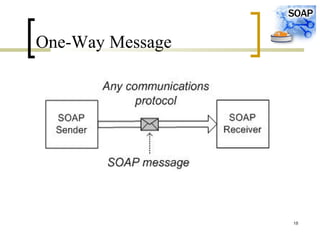
 One-Way Message
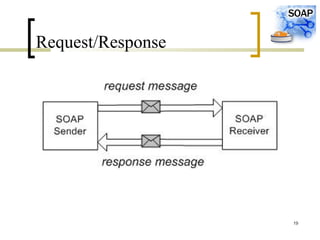
 Request/Response
 SOAP Message Format
 SOAP Security
 Syntax Rules
SOAP
SOAP IS:
 Lightweight communication protocol
 For communication between applications
one-way, request/response, multicast, etc..
 Designed to communicate via HTTP
 Not tied to any component technology
 Not tied to any programming language
 Based on XML
 Simple and extensible
13
SOAP Messaging Framework
 XML-based messaging framework that is
 1) extensible
 2) interoperable
 3) independent
 Next we discuss these three characteristics
in more detail
14
Extensible
 Simplicity remains one of SOAP's primary
design goals
 SOAP defines a communication
framework that allows for features such as
security, routing, and reliability to be
added later as layered extensions
15
Interoperable
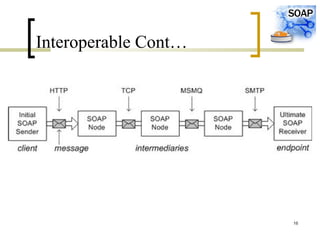
 SOAP can be used over any transport
protocol such as TCP, HTTP, SMTP
 SOAP provides an explicit binding today
for HTTP
16
Interoperable Cont…
17
Independent
 SOAP allows for any programming model
and is not tied to RPC
 SOAP defines a model for processing
individual, one-way messages
 SOAP also allows for any number of
message exchange patterns (MEPs)
18
One-Way Message
19
Request/Response
20
SOAP Message Format
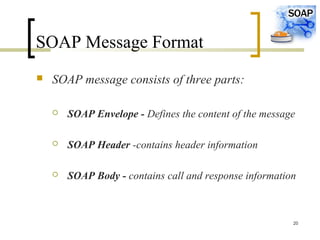
 SOAP message consists of three parts:
 SOAP Envelope - Defines the content of the message
 SOAP Header -contains header information
 SOAP Body - contains call and response information
21
SOAP Envelope
 The SOAP Envelope construct defines an
overall framework for expressing what is
in a message and who should deal with it.
22
SOAP Envelope Cont…
 The Envelope is the top element of the
XML document representing the message.
 The Envelope element is always the root
element of a SOAP message.
 The Envelope element contains an optional
Header element followed by a mandatory
Body element.
23
SOAP Header
 The Header element is a generic container
for control information
 It may contain any number of elements
from any namespace
 Header blocks should contain information
that influences payload processing
 Header is optional
24
SOAP Body
 The Body element represents the message
payload
 It is Special case of header
 Default contract between sender and ultimate
recipient
 Different from HTTP's header/body
separation
SOAP Fault
 The SOAP Fault mechanism is designed to support the
composability model
 A SOAP message can carry one SOAP Fault element
 Must be placed in the Body of the message
 Detail information for faults resulting from headers are
carried in the header
 The SOAP fault code extension mechanism is for SOAP only
 Application faults should use existing SOAP fault codes
 Client code is for request faults
 Server code is for processing faults
SYNTAX RULES
 MUST be encoded using XML
 MUST have a SOAP Envelope
 CAN have a SOAP header
 MUST have a SOAP Body
 MUST use the SOAP Envelope namespace
 MUST use the SOAP Encoding namespace
 Must NOT contain a DTD reference
 Must NOT contain XML Processing
Summary
 SOAP envelope provides
 Composability in the vertical (Shopping basket)
 Composability in the horizontal (Amtrak)
 SOAP can be used with many protocols
 Easy to deploy with existing infrastructure
 SOAP is fundamentally a one-way message
Soa business centric and soap basic

Soa business centric and soap basic

  • 1.
  • 2.
    2 SOA business centric-content  What Is Service?  Benefits Of Business-centric SOA  Introduce Agility  Prepare For Orchestration  Enable Reuse
  • 3.
    3 What is aService?  A service is a reusable component that can be used as a building block to form larger, more complex business-application functionality.  A service may be as simple as “get me some person data,” or as complex as “process a disbursement.”
  • 4.
    4 Benefits of business-centricSOA • Web services currently being built is Business service and Application Service. • Hybrid services are attractive because , they fulfill the immediate requirement with clear ROI benefits with minimal effort . • Characteristics of SOA can still attain without the use of business services.
  • 5.
    5 Benefits of business-centricSOA  introduce agility  prepare for orchestration  enable reuse
  • 6.
    6 AGILITY • It improveflexibility and agility with the processes that can be remodeled in response to change. • It establishes highly responsive IT environment , responsive to that changes in an org business it can accommodate re-composition of business process and technology architecture. • requirement can be met by business service layer.
  • 7.
    7 PREPARE FOR ORCHESTRATION •Modeling current processes to that they can easily migrate to an orchestration environment. • Orchestration brings with the concept that , when implemented , it lie at the core of SOA
  • 8.
    8 ENABLE REUSE • Reusein both application and business services as follows. • By modeling business logic as distinct services with explicit boundaries , business process level reuse can be achieved. • By taking the time to properly align business models with business service representation , the resulting BSL ends up freeing the ASL.
  • 9.
    9 DERIVING BUSINESS SERVICES Source from which business services can be derived. Business process management (BPM) models.  Types of derived business services. • Task centric business services. • Entity centric business services.
  • 10.
    10 Simple Object AccessProtocol (SOAP) basics
  • 11.
    11 SOAP basic content What is SOAP?  SOAP Messaging Framework  One-Way Message  Request/Response  SOAP Message Format  SOAP Security  Syntax Rules
  • 12.
    SOAP SOAP IS:  Lightweightcommunication protocol  For communication between applications one-way, request/response, multicast, etc..  Designed to communicate via HTTP  Not tied to any component technology  Not tied to any programming language  Based on XML  Simple and extensible
  • 13.
    13 SOAP Messaging Framework XML-based messaging framework that is  1) extensible  2) interoperable  3) independent  Next we discuss these three characteristics in more detail
  • 14.
    14 Extensible  Simplicity remainsone of SOAP's primary design goals  SOAP defines a communication framework that allows for features such as security, routing, and reliability to be added later as layered extensions
  • 15.
    15 Interoperable  SOAP canbe used over any transport protocol such as TCP, HTTP, SMTP  SOAP provides an explicit binding today for HTTP
  • 16.
  • 17.
    17 Independent  SOAP allowsfor any programming model and is not tied to RPC  SOAP defines a model for processing individual, one-way messages  SOAP also allows for any number of message exchange patterns (MEPs)
  • 18.
  • 19.
  • 20.
    20 SOAP Message Format SOAP message consists of three parts:  SOAP Envelope - Defines the content of the message  SOAP Header -contains header information  SOAP Body - contains call and response information
  • 21.
    21 SOAP Envelope  TheSOAP Envelope construct defines an overall framework for expressing what is in a message and who should deal with it.
  • 22.
    22 SOAP Envelope Cont… The Envelope is the top element of the XML document representing the message.  The Envelope element is always the root element of a SOAP message.  The Envelope element contains an optional Header element followed by a mandatory Body element.
  • 23.
    23 SOAP Header  TheHeader element is a generic container for control information  It may contain any number of elements from any namespace  Header blocks should contain information that influences payload processing  Header is optional
  • 24.
    24 SOAP Body  TheBody element represents the message payload  It is Special case of header  Default contract between sender and ultimate recipient  Different from HTTP's header/body separation
  • 25.
    SOAP Fault  TheSOAP Fault mechanism is designed to support the composability model  A SOAP message can carry one SOAP Fault element  Must be placed in the Body of the message  Detail information for faults resulting from headers are carried in the header  The SOAP fault code extension mechanism is for SOAP only  Application faults should use existing SOAP fault codes  Client code is for request faults  Server code is for processing faults
  • 26.
    SYNTAX RULES  MUSTbe encoded using XML  MUST have a SOAP Envelope  CAN have a SOAP header  MUST have a SOAP Body  MUST use the SOAP Envelope namespace  MUST use the SOAP Encoding namespace  Must NOT contain a DTD reference  Must NOT contain XML Processing
  • 27.
    Summary  SOAP envelopeprovides  Composability in the vertical (Shopping basket)  Composability in the horizontal (Amtrak)  SOAP can be used with many protocols  Easy to deploy with existing infrastructure  SOAP is fundamentally a one-way message