Basic Snowmobile Training & Safety Training & Safety
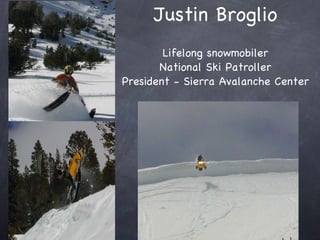
Justin Broglio Lifelong snowmobiler National Ski Patroller President - Sierra Avalanche Center
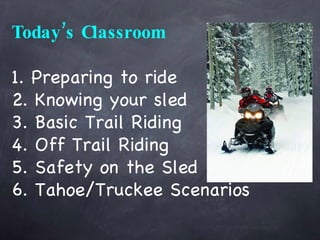
Today’s Classroom 1. Preparing to ride 2. Knowing your sled 3. Basic Trail Riding 4. Off Trail Riding 5. Safety on the Sled 6. Tahoe/Truckee Scenarios
What not to do...
 
Suddenlink Snowmobile Training & Safety Training & Safety Classroom  Section 1-2  Preparing to Ride Knowing your Sled
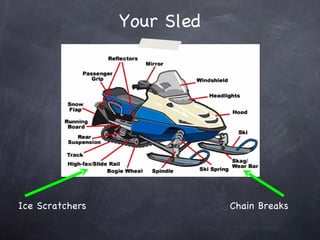
Your Sled Ice Scratchers Chain Breaks
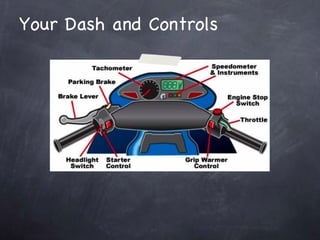
Your Dash and Controls
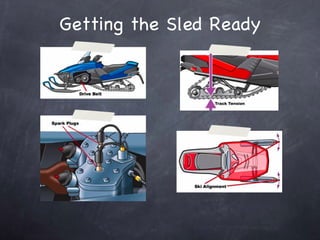
Getting the Sled Ready
 
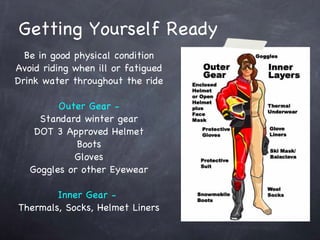
Getting Yourself Ready Be in good physical condition Avoid riding when ill or fatigued Drink water throughout the ride Outer Gear - Standard winter gear DOT 3 Approved Helmet Boots Gloves Goggles or other Eyewear Inner Gear -   Thermals, Socks, Helmet Liners
 
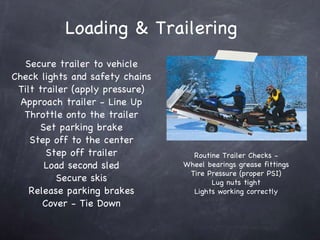
Loading & Trailering Secure trailer to vehicle Check lights and safety chains Tilt trailer (apply pressure) Approach trailer - Line Up Throttle onto the trailer Set parking brake Step off to the center Step off trailer Load second sled Secure skis Release parking brakes Cover - Tie Down Routine Trailer Checks - Wheel bearings grease fittings Tire Pressure (proper PSI) Lug nuts tight Lights working correctly
 
 
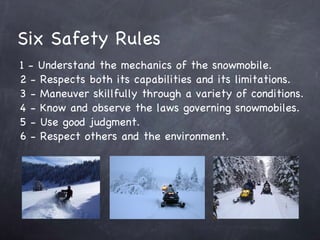
Six Safety Rules 1 - Understand the mechanics of the snowmobile. 2 - Respects both its capabilities and its limitations. 3 - Maneuver skillfully through a variety of conditions. 4 - Know and observe the laws governing snowmobiles. 5 - Use good judgment. 6 - Respect others and the environment.
Suddenlink Snowmobile Training & Safety Training & Safety Classroom  Section 1  Basic Trail Riding
 
Starting the sled 1. Check the throttle is loose, not frozen or stuck. 2. Check all switches to proper positions and key is on. 3. Choke or prime as needed. 4. Pull the recoil starter with both hands.    - Only pull until you feel resistance and pull back,   then release without letting the handle snap. 5. If after 6-10 pulls the machine does not start,    pump the throttle a few times and try again. 6. If after 12-15 pulls the machine does not start,   stop and perform engine checks.  stop and perform engine checks.  stop and perform engine checks.  stop and perform engine checks.  stop and perform engine checks.  stop and perform engine checks.  stop and perform engine checks.  stop and perform engine checks.  stop and perform engine checks.  stop and perform engine checks.  stop and perform engine checks.  stop and perform engine checks.
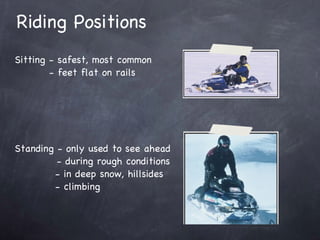
Riding Positions Sitting - safest, most common - feet flat on rails Standing - only used to see ahead - during rough conditions - in deep snow, hillsides - climbing
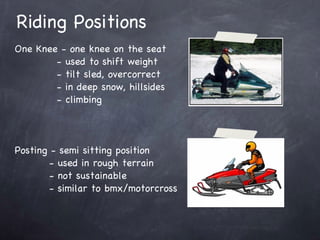
Riding Positions One Knee - one knee on the seat - used to shift weight - tilt sled, overcorrect - in deep snow, hillsides - climbing Posting - semi sitting position - used in rough terrain - not sustainable - similar to bmx/motorcross
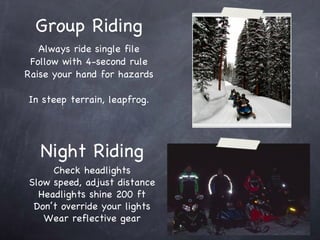
Group Riding Always ride single file Follow with 4-second rule Raise your hand for hazards In steep terrain, leapfrog. Night Riding Check headlights Slow speed, adjust distance Headlights shine 200 ft Don’t override your lights Wear reflective gear
 
Suddenlink Snowmobile Training & Safety Training & Safety Classroom  Section 1  Off Trail Riding
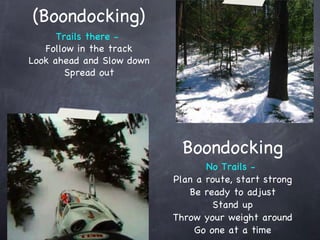
Trees (Boondocking) No Trails -  Plan a route, start strong Be ready to adjust Stand up Throw your weight around Go one at a time Trails there -  Follow in the track Look ahead and Slow down Spread out Boondocking
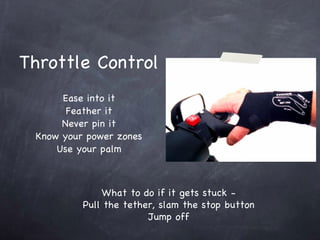
Throttle Control Ease into it Feather it Never pin it Know your power zones Use your palm What to do if it gets stuck - Pull the tether, slam the stop button Jump off
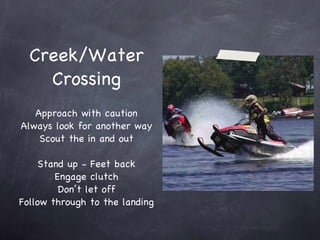
Creek/Water Crossing Approach with caution Always look for another way Scout the in and out Stand up - Feet back Engage clutch Don’t let off Follow through to the landing
 
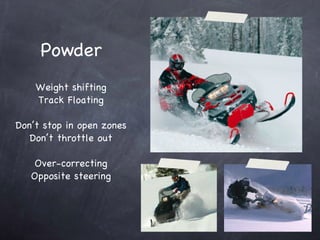
Powder Weight shifting Track Floating Don’t stop in open zones Don’t throttle out Over-correcting Opposite steering
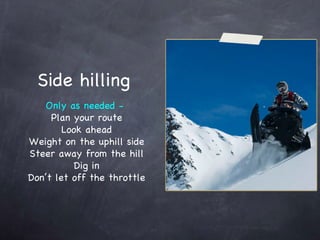
Side hilling Only as needed -  Plan your route Look ahead Weight on the uphill side Steer away from the hill Dig in Don’t let off the throttle
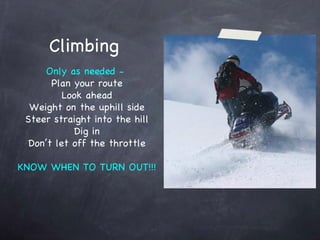
Climbing Only as needed -  Plan your route Look ahead Weight on the uphill side Steer straight into the hill Dig in Don’t let off the throttle KNOW WHEN TO TURN OUT!!!


Suddenlink Snowmobile Training & Safety Training & Safety Classroom  Section 1  Safety on the sled
 
Suddenlink Snowmobile Training & Safety Training & Safety Classroom  Section 6  Truckee/Tahoe Scenarios
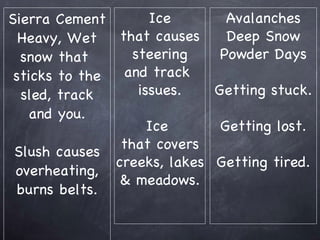
Sierra Cement Heavy, Wet snow that  sticks to the sled, track and you. Slush causes overheating, burns belts.   Ice that causes steering and track  issues. Ice  that covers creeks, lakes & meadows. Avalanches Deep Snow Powder Days Getting stuck. Getting lost. Getting tired.
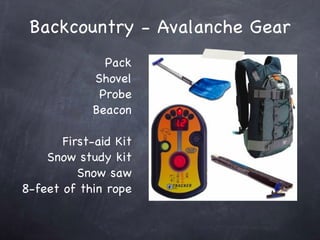
Backcountry - Avalanche Gear Pack Shovel Probe Beacon First-aid Kit Snow study kit Snow saw 8-feet of thin rope
 
 
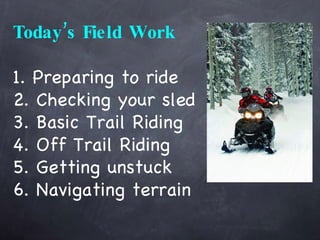
Today’s Field Work 1. Preparing to ride 2. Checking your sled 3. Basic Trail Riding 4. Off Trail Riding 5. Getting unstuck 6. Navigating terrain

Snowmobile training

  • 1.
    Basic Snowmobile Training& Safety Training & Safety
  • 2.
    Justin Broglio Lifelongsnowmobiler National Ski Patroller President - Sierra Avalanche Center
  • 3.
    Today’s Classroom 1.Preparing to ride 2. Knowing your sled 3. Basic Trail Riding 4. Off Trail Riding 5. Safety on the Sled 6. Tahoe/Truckee Scenarios
  • 4.
  • 5.
  • 6.
    Suddenlink Snowmobile Training& Safety Training & Safety Classroom Section 1-2 Preparing to Ride Knowing your Sled
  • 7.
    Your Sled IceScratchers Chain Breaks
  • 8.
    Your Dash andControls
  • 9.
  • 10.
  • 11.
    Getting Yourself ReadyBe in good physical condition Avoid riding when ill or fatigued Drink water throughout the ride Outer Gear - Standard winter gear DOT 3 Approved Helmet Boots Gloves Goggles or other Eyewear Inner Gear - Thermals, Socks, Helmet Liners
  • 12.
  • 13.
    Loading & TraileringSecure trailer to vehicle Check lights and safety chains Tilt trailer (apply pressure) Approach trailer - Line Up Throttle onto the trailer Set parking brake Step off to the center Step off trailer Load second sled Secure skis Release parking brakes Cover - Tie Down Routine Trailer Checks - Wheel bearings grease fittings Tire Pressure (proper PSI) Lug nuts tight Lights working correctly
  • 14.
  • 15.
  • 16.
    Six Safety Rules1 - Understand the mechanics of the snowmobile. 2 - Respects both its capabilities and its limitations. 3 - Maneuver skillfully through a variety of conditions. 4 - Know and observe the laws governing snowmobiles. 5 - Use good judgment. 6 - Respect others and the environment.

  • 17.
    Suddenlink Snowmobile Training& Safety Training & Safety Classroom Section 1 Basic Trail Riding
  • 18.
  • 19.
    Starting the sled1. Check the throttle is loose, not frozen or stuck. 2. Check all switches to proper positions and key is on. 3. Choke or prime as needed. 4. Pull the recoil starter with both hands. - Only pull until you feel resistance and pull back, then release without letting the handle snap. 5. If after 6-10 pulls the machine does not start, pump the throttle a few times and try again. 6. If after 12-15 pulls the machine does not start, stop and perform engine checks. stop and perform engine checks. stop and perform engine checks. stop and perform engine checks. stop and perform engine checks. stop and perform engine checks. stop and perform engine checks. stop and perform engine checks. stop and perform engine checks. stop and perform engine checks. stop and perform engine checks. stop and perform engine checks.
  • 20.
    Riding Positions Sitting- safest, most common - feet flat on rails Standing - only used to see ahead - during rough conditions - in deep snow, hillsides - climbing
  • 21.
    Riding Positions OneKnee - one knee on the seat - used to shift weight - tilt sled, overcorrect - in deep snow, hillsides - climbing Posting - semi sitting position - used in rough terrain - not sustainable - similar to bmx/motorcross
  • 22.
    Group Riding Alwaysride single file Follow with 4-second rule Raise your hand for hazards In steep terrain, leapfrog. Night Riding Check headlights Slow speed, adjust distance Headlights shine 200 ft Don’t override your lights Wear reflective gear
  • 23.
  • 24.
    Suddenlink Snowmobile Training& Safety Training & Safety Classroom Section 1 Off Trail Riding
  • 25.
    Trees (Boondocking) NoTrails - Plan a route, start strong Be ready to adjust Stand up Throw your weight around Go one at a time Trails there - Follow in the track Look ahead and Slow down Spread out Boondocking
  • 26.
    Throttle Control Easeinto it Feather it Never pin it Know your power zones Use your palm What to do if it gets stuck - Pull the tether, slam the stop button Jump off
  • 27.
    Creek/Water Crossing Approachwith caution Always look for another way Scout the in and out Stand up - Feet back Engage clutch Don’t let off Follow through to the landing
  • 28.
  • 29.
    Powder Weight shiftingTrack Floating Don’t stop in open zones Don’t throttle out Over-correcting Opposite steering
  • 30.
    Side hilling Onlyas needed - Plan your route Look ahead Weight on the uphill side Steer away from the hill Dig in Don’t let off the throttle
  • 31.
    Climbing Only asneeded - Plan your route Look ahead Weight on the uphill side Steer straight into the hill Dig in Don’t let off the throttle KNOW WHEN TO TURN OUT!!!
  • 32.
  • 33.
  • 34.
  • 35.
    Suddenlink Snowmobile Training& Safety Training & Safety Classroom Section 1 Safety on the sled
  • 36.
  • 37.
    Suddenlink Snowmobile Training& Safety Training & Safety Classroom Section 6 Truckee/Tahoe Scenarios
  • 38.
    Sierra Cement Heavy,Wet snow that sticks to the sled, track and you. Slush causes overheating, burns belts. Ice that causes steering and track issues. Ice that covers creeks, lakes & meadows. Avalanches Deep Snow Powder Days Getting stuck. Getting lost. Getting tired.
  • 39.
    Backcountry - AvalancheGear Pack Shovel Probe Beacon First-aid Kit Snow study kit Snow saw 8-feet of thin rope
  • 40.
  • 41.
  • 42.
    Today’s Field Work1. Preparing to ride 2. Checking your sled 3. Basic Trail Riding 4. Off Trail Riding 5. Getting unstuck 6. Navigating terrain