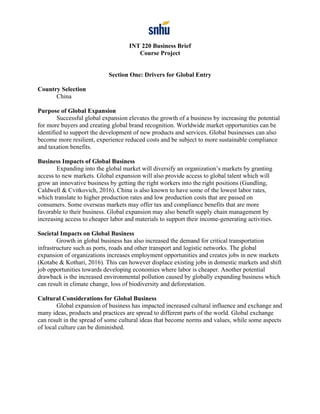
INT 220 Business Brief
Course Project
Section One: Drivers for Global Entry
Country Selection
China
Purpose of Global Expansion
Successful global expansion elevates the growth of a business by increasing the potential
for more buyers and creating global brand recognition. Worldwide market opportunities can be
identified to support the development of new products and services. Global businesses can also
become more resilient, experience reduced costs and be subject to more sustainable compliance
and taxation benefits.
Business Impacts of Global Business
Expanding into the global market will diversify an organization’s markets by granting
access to new markets. Global expansion will also provide access to global talent which will
grow an innovative business by getting the right workers into the right positions (Gundling,
Caldwell & Cvitkovich, 2016). China is also known to have some of the lowest labor rates,
which translate to higher production rates and low production costs that are passed on
consumers. Some overseas markets may offer tax and compliance benefits that are more
favorable to their business. Global expansion may also benefit supply chain management by
increasing access to cheaper labor and materials to support their income-generating activities.
Societal Impacts on Global Business
Growth in global business has also increased the demand for critical transportation
infrastructure such as ports, roads and other transport and logistic networks. The global
expansion of organizations increases employment opportunities and creates jobs in new markets
(Kotabe & Kothari, 2016). This can however displace existing jobs in domestic markets and shift
job opportunities towards developing economies where labor is cheaper. Another potential
drawback is the increased environmental pollution caused by globally expanding business which
can result in climate change, loss of biodiversity and deforestation.
Cultural Considerations for Global Business
Global expansion of business has impacted increased cultural influence and exchange and
many ideas, products and practices are spread to different parts of the world. Global exchange
can result in the spread of some cultural ideas that become norms and values, while some aspects
of local culture can be diminished.
Section Two: Market Profile
Cultural Profile
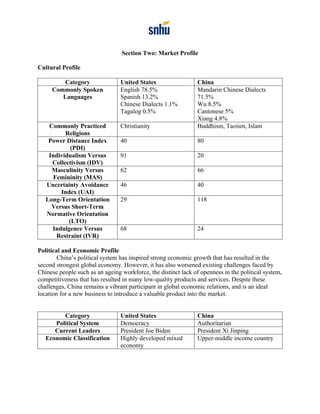
Category United States China
Commonly Spoken
Languages
English 78.5%
Spanish 13.2%
Chinese Dialects 1.1%
Tagalog 0.5%
Mandarin Chinese Dialects
71.5%
Wu 8.5%
Cantonese 5%
Xiang 4.8%
Commonly Practiced
Religions
Christianity Buddhism, Taoism, Islam
Power Distance Index
(PDI)
40 80
Individualism Versus
Collectivism (IDV)
91 20
Masculinity Versus
Femininity (MAS)
62 66
Uncertainty Avoidance
Index (UAI)
46 40
Long-Term Orientation
Versus Short-Term
Normative Orientation
(LTO)
29 118
Indulgence Versus
Restraint (IVR)
68 24
Political and Economic Profile
China’s political system has inspired strong economic growth that has resulted in the
second strongest global economy. However, it has also worsened existing challenges faced by
Chinese people such as an ageing workforce, the distinct lack of openness in the political system,
competitiveness that has resulted in many low-quality products and services. Despite these
challenges, China remains a vibrant participant in global economic relations, and is an ideal
location for a new business to introduce a valuable product into the market.
Category United States China
Political System Democracy Authoritarian
Current Leaders President Joe Biden President Xi Jinping
Economic Classification Highly developed mixed
economy
Upper-middle income country
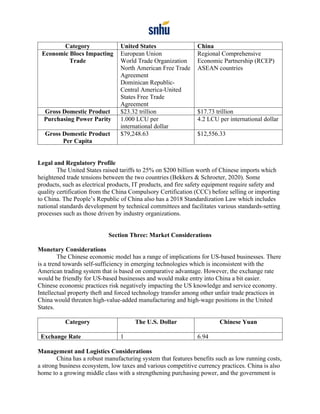
Category United States China
Economic Blocs Impacting
Trade
European Union
World Trade Organization
North American Free Trade
Agreement
Dominican Republic-
Central America-United
States Free Trade
Agreement
Regional Comprehensive
Economic Partnership (RCEP)
ASEAN countries
Gross Domestic Product $23.32 trillion $17.73 trillion
Purchasing Power Parity 1.000 LCU per
international dollar
4.2 LCU per international dollar
Gross Domestic Product
Per Capita
$79,248.63 $12,556.33
Legal and Regulatory Profile
The United States raised tariffs to 25% on $200 billion worth of Chinese imports which
heightened trade tensions between the two countries (Bekkers & Schroeter, 2020). Some
products, such as electrical products, IT products, and fire safety equipment require safety and
quality certification from the China Compulsory Certification (CCC) before selling or importing
to China. The People’s Republic of China also has a 2018 Standardization Law which includes
national standards development by technical committees and facilitates various standards-setting
processes such as those driven by industry organizations.
Section Three: Market Considerations
Monetary Considerations
The Chinese economic model has a range of implications for US-based businesses. There
is a trend towards self-sufficiency in emerging technologies which is inconsistent with the
American trading system that is based on comparative advantage. However, the exchange rate
would be friendly for US-based businesses and would make entry into China a bit easier.
Chinese economic practices risk negatively impacting the US knowledge and service economy.
Intellectual property theft and forced technology transfer among other unfair trade practices in
China would threaten high-value-added manufacturing and high-wage positions in the United
States.
Category The U.S. Dollar Chinese Yuan
Exchange Rate 1 6.94
Management and Logistics Considerations
China has a robust manufacturing system that features benefits such as low running costs,
a strong business ecosystem, low taxes and various competitive currency practices. China is also
home to a growing middle class with a strengthening purchasing power, and the government is
making more reforms to generally ease doing business in the country. China also has significant
current and predicted economic growth as a result of relaxed laws and reduced tariffs that have
welcomed more foreign investment into the Chinese Economy.
Mode of Entry Considerations
Advantages
When entering China, breaking down the region into several geographic segments would
allow for a more grounded means of searching for the right business partners and distributors to
ensure the best performance in these areas. Cities like Shanghai, Beijing and Guangzhou offer
the best possible chances of establishing new business opportunities (Chevalier & Lu, 2010).
These regions contain the most experienced personnel who have worked with foreign companies.
Smaller US companies would benefit from focusing on niche market areas, considering that the
Chinese market is highly divided by geography, income levels and age.
Disadvantages
Vetting different regional partners, distributors and agents is time-consuming and would
be a costly venture. Also, recent legislative changes by the US government may make the cost of
importing and exporting goods and services into China more costly and complex (Morrison,
2010).
References
Bekkers, E., & Schroeter, S. (2020). An economic analysis of the US-China trade conflict (No.
ERSD-2020-04). WTO Staff Working Paper.
Chevalier, M., & Lu, P. X. (2010). Luxury China: Market opportunities and potential. John
Wiley & Sons.
Gundling, E., Caldwell, C., & Cvitkovich, K. (2016). Global talent: Beyond outsourcing.
In Advances in global leadership. Emerald Group Publishing Limited.
Kotabe, M., & Kothari, T. (2016). Emerging market multinational companies’ evolutionary paths
to building a competitive advantage from emerging markets to developed
countries. Journal of World Business, 51(5), 729-743.
Morrison, W. M. (2010, July). China-US trade issues. LIBRARY OF CONGRESS
WASHINGTON DC CONGRESSIONAL RESEARCH SERVICE.

SNHU assignment IT courses. Washington University

  • 1.
    INT 220 BusinessBrief Course Project Section One: Drivers for Global Entry Country Selection China Purpose of Global Expansion Successful global expansion elevates the growth of a business by increasing the potential for more buyers and creating global brand recognition. Worldwide market opportunities can be identified to support the development of new products and services. Global businesses can also become more resilient, experience reduced costs and be subject to more sustainable compliance and taxation benefits. Business Impacts of Global Business Expanding into the global market will diversify an organization’s markets by granting access to new markets. Global expansion will also provide access to global talent which will grow an innovative business by getting the right workers into the right positions (Gundling, Caldwell & Cvitkovich, 2016). China is also known to have some of the lowest labor rates, which translate to higher production rates and low production costs that are passed on consumers. Some overseas markets may offer tax and compliance benefits that are more favorable to their business. Global expansion may also benefit supply chain management by increasing access to cheaper labor and materials to support their income-generating activities. Societal Impacts on Global Business Growth in global business has also increased the demand for critical transportation infrastructure such as ports, roads and other transport and logistic networks. The global expansion of organizations increases employment opportunities and creates jobs in new markets (Kotabe & Kothari, 2016). This can however displace existing jobs in domestic markets and shift job opportunities towards developing economies where labor is cheaper. Another potential drawback is the increased environmental pollution caused by globally expanding business which can result in climate change, loss of biodiversity and deforestation. Cultural Considerations for Global Business Global expansion of business has impacted increased cultural influence and exchange and many ideas, products and practices are spread to different parts of the world. Global exchange can result in the spread of some cultural ideas that become norms and values, while some aspects of local culture can be diminished.
  • 2.
    Section Two: MarketProfile Cultural Profile Category United States China Commonly Spoken Languages English 78.5% Spanish 13.2% Chinese Dialects 1.1% Tagalog 0.5% Mandarin Chinese Dialects 71.5% Wu 8.5% Cantonese 5% Xiang 4.8% Commonly Practiced Religions Christianity Buddhism, Taoism, Islam Power Distance Index (PDI) 40 80 Individualism Versus Collectivism (IDV) 91 20 Masculinity Versus Femininity (MAS) 62 66 Uncertainty Avoidance Index (UAI) 46 40 Long-Term Orientation Versus Short-Term Normative Orientation (LTO) 29 118 Indulgence Versus Restraint (IVR) 68 24 Political and Economic Profile China’s political system has inspired strong economic growth that has resulted in the second strongest global economy. However, it has also worsened existing challenges faced by Chinese people such as an ageing workforce, the distinct lack of openness in the political system, competitiveness that has resulted in many low-quality products and services. Despite these challenges, China remains a vibrant participant in global economic relations, and is an ideal location for a new business to introduce a valuable product into the market. Category United States China Political System Democracy Authoritarian Current Leaders President Joe Biden President Xi Jinping Economic Classification Highly developed mixed economy Upper-middle income country
  • 3.
    Category United StatesChina Economic Blocs Impacting Trade European Union World Trade Organization North American Free Trade Agreement Dominican Republic- Central America-United States Free Trade Agreement Regional Comprehensive Economic Partnership (RCEP) ASEAN countries Gross Domestic Product $23.32 trillion $17.73 trillion Purchasing Power Parity 1.000 LCU per international dollar 4.2 LCU per international dollar Gross Domestic Product Per Capita $79,248.63 $12,556.33 Legal and Regulatory Profile The United States raised tariffs to 25% on $200 billion worth of Chinese imports which heightened trade tensions between the two countries (Bekkers & Schroeter, 2020). Some products, such as electrical products, IT products, and fire safety equipment require safety and quality certification from the China Compulsory Certification (CCC) before selling or importing to China. The People’s Republic of China also has a 2018 Standardization Law which includes national standards development by technical committees and facilitates various standards-setting processes such as those driven by industry organizations. Section Three: Market Considerations Monetary Considerations The Chinese economic model has a range of implications for US-based businesses. There is a trend towards self-sufficiency in emerging technologies which is inconsistent with the American trading system that is based on comparative advantage. However, the exchange rate would be friendly for US-based businesses and would make entry into China a bit easier. Chinese economic practices risk negatively impacting the US knowledge and service economy. Intellectual property theft and forced technology transfer among other unfair trade practices in China would threaten high-value-added manufacturing and high-wage positions in the United States. Category The U.S. Dollar Chinese Yuan Exchange Rate 1 6.94 Management and Logistics Considerations China has a robust manufacturing system that features benefits such as low running costs, a strong business ecosystem, low taxes and various competitive currency practices. China is also home to a growing middle class with a strengthening purchasing power, and the government is
  • 4.
    making more reformsto generally ease doing business in the country. China also has significant current and predicted economic growth as a result of relaxed laws and reduced tariffs that have welcomed more foreign investment into the Chinese Economy. Mode of Entry Considerations Advantages When entering China, breaking down the region into several geographic segments would allow for a more grounded means of searching for the right business partners and distributors to ensure the best performance in these areas. Cities like Shanghai, Beijing and Guangzhou offer the best possible chances of establishing new business opportunities (Chevalier & Lu, 2010). These regions contain the most experienced personnel who have worked with foreign companies. Smaller US companies would benefit from focusing on niche market areas, considering that the Chinese market is highly divided by geography, income levels and age. Disadvantages Vetting different regional partners, distributors and agents is time-consuming and would be a costly venture. Also, recent legislative changes by the US government may make the cost of importing and exporting goods and services into China more costly and complex (Morrison, 2010).
  • 5.
    References Bekkers, E., &Schroeter, S. (2020). An economic analysis of the US-China trade conflict (No. ERSD-2020-04). WTO Staff Working Paper. Chevalier, M., & Lu, P. X. (2010). Luxury China: Market opportunities and potential. John Wiley & Sons. Gundling, E., Caldwell, C., & Cvitkovich, K. (2016). Global talent: Beyond outsourcing. In Advances in global leadership. Emerald Group Publishing Limited. Kotabe, M., & Kothari, T. (2016). Emerging market multinational companies’ evolutionary paths to building a competitive advantage from emerging markets to developed countries. Journal of World Business, 51(5), 729-743. Morrison, W. M. (2010, July). China-US trade issues. LIBRARY OF CONGRESS WASHINGTON DC CONGRESSIONAL RESEARCH SERVICE.