© Waher Data AB, 2018.
Smart City Lecture 4
Harmonizing the Internet of Things
© Waher Data AB, 2018.
1. Recapture
© Waher Data AB, 2018.
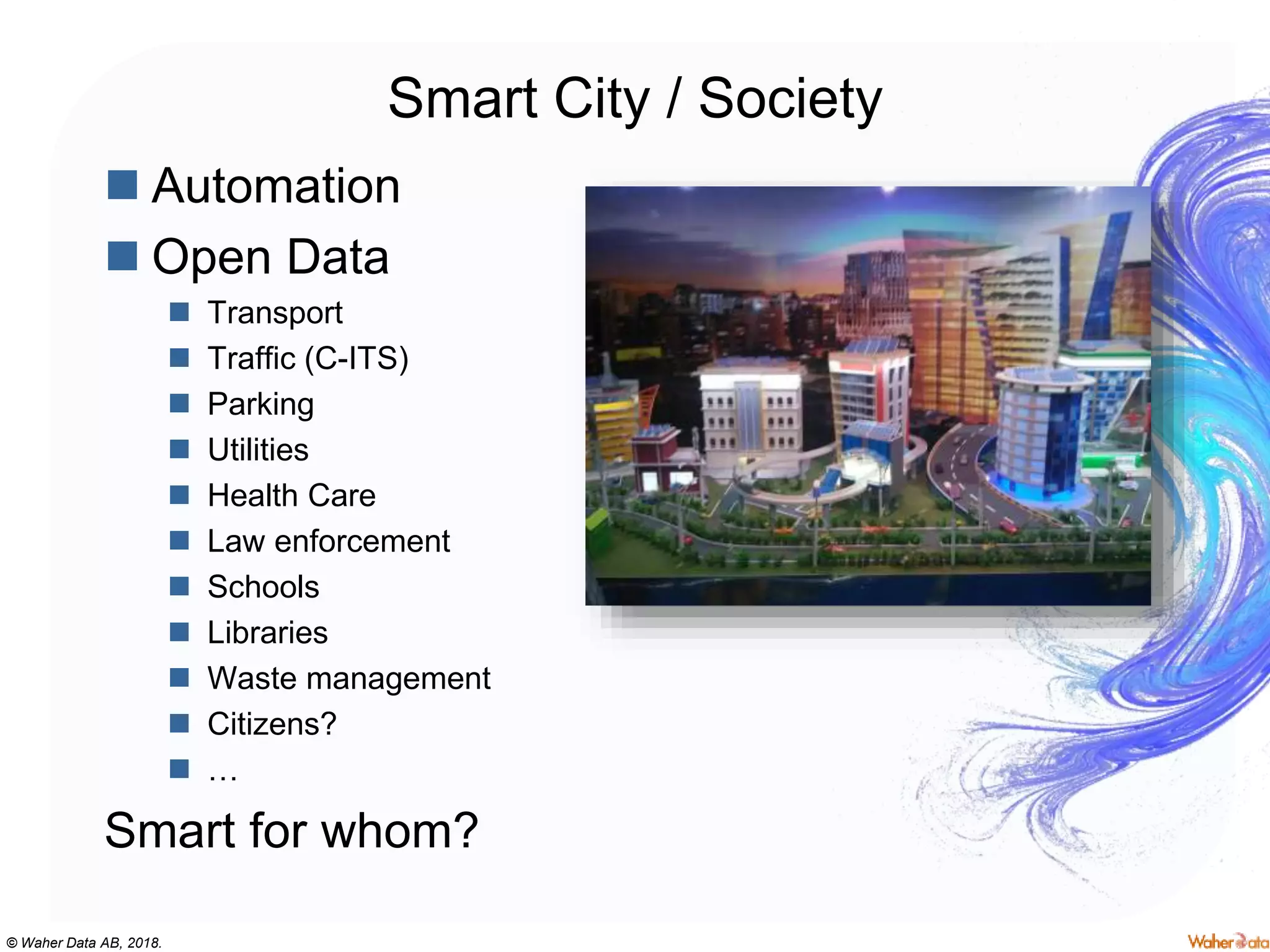
Smart City / Society
 Automation
 Open Data
 Transport
 Traffic (C-ITS)
 Parking
 Utilities
 Health Care
 Law enforcement
 Schools
 Libraries
 Waste management
 Citizens?
 …
Smart for whom?
© Waher Data AB, 2018.
Vision of a Smart City
 Ubiquitous access to interoperable
sensors and things.
 Ubiquitous access to data and
information from society’s authorities.
 Access to smart services in all niches of
society.
 Definition of ownership of information.
 Protection of Privacy, by design and by
default.
 Market for access to things and data.
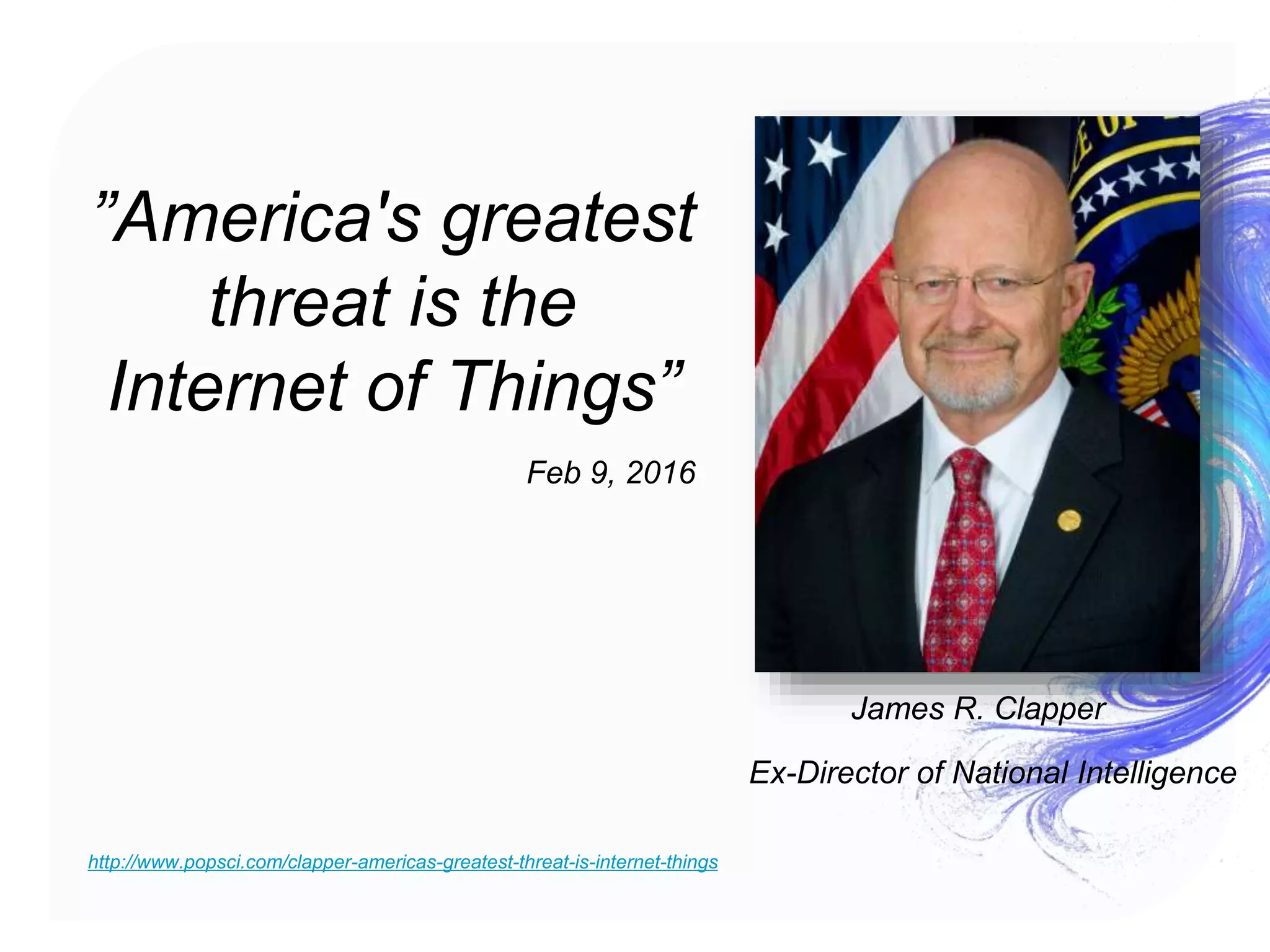
Ex-Director of National Intelligence
James R. Clapper
http://www.popsci.com/clapper-americas-greatest-threat-is-internet-things
”America's greatest
threat is the
Internet of Things”
Feb 9, 2016
© Waher Data AB, 2018.
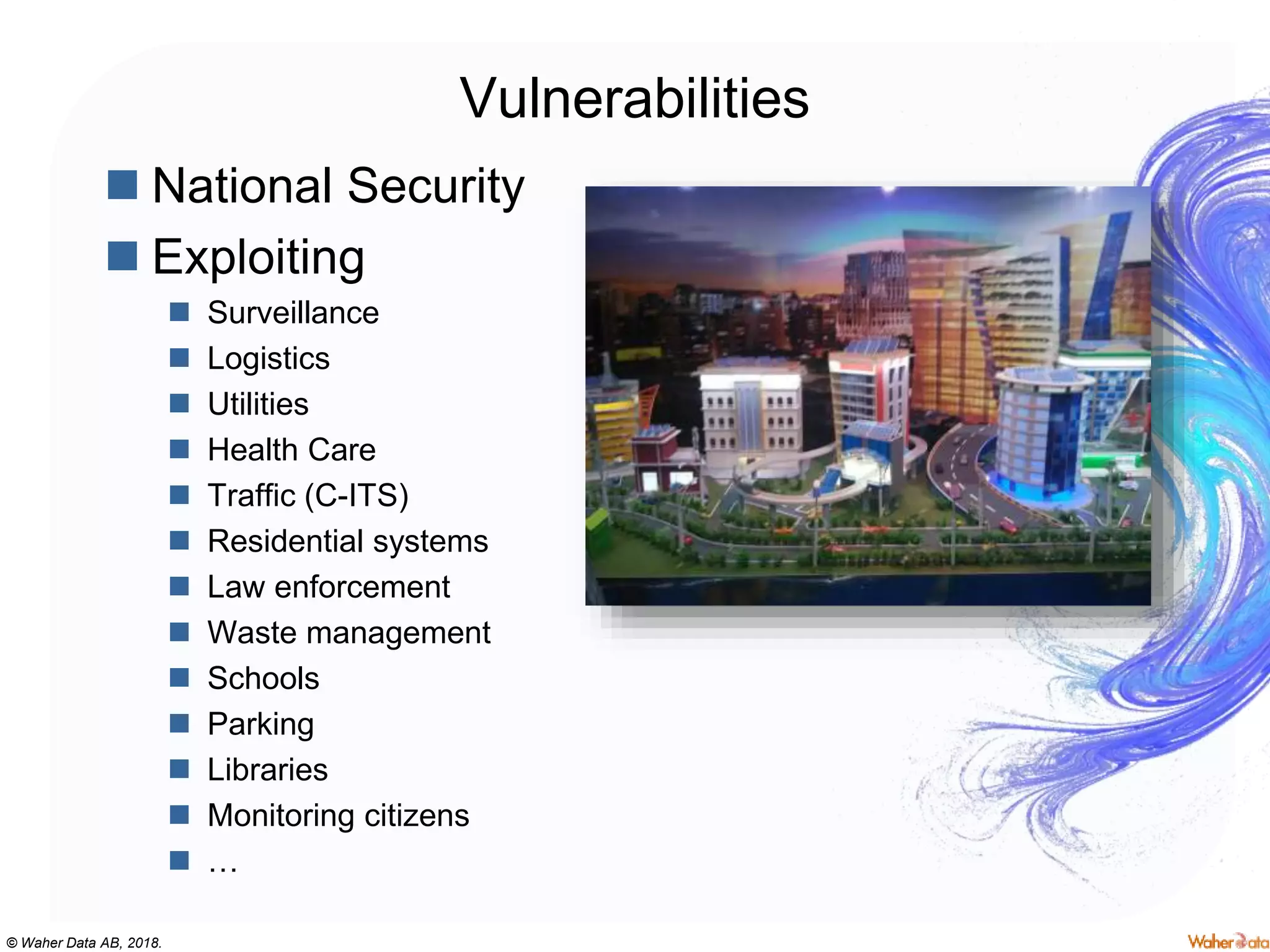
Vulnerabilities
 National Security
 Exploiting
 Surveillance
 Logistics
 Utilities
 Health Care
 Traffic (C-ITS)
 Residential systems
 Law enforcement
 Waste management
 Schools
 Parking
 Libraries
 Monitoring citizens
 …
© Waher Data AB, 2018.
What must Governments do?
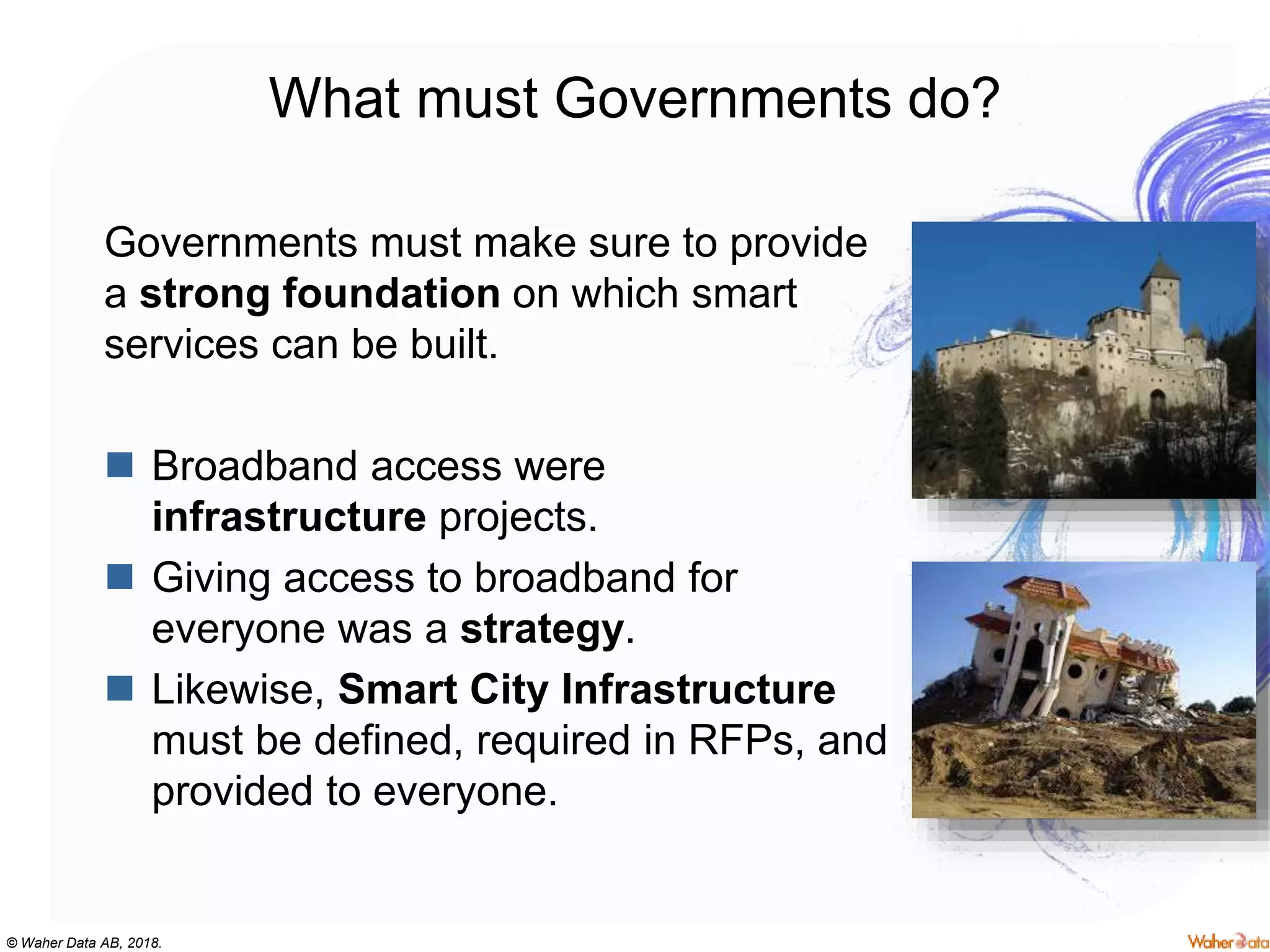
Governments must make sure to provide
a strong foundation on which smart
services can be built.
 Broadband access were
infrastructure projects.
 Giving access to broadband for
everyone was a strategy.
 Likewise, Smart City Infrastructure
must be defined, required in RFPs, and
provided to everyone.
© Waher Data AB, 2018.
Options?
Sealed secure systems?
or
Open, Interoperable, but vulnerable
systems?
or is it possible to have:
Open, Interoperable & secure systems?
© Waher Data AB, 2018.
2. Openness + Security
For Things
© Waher Data AB, 2018.
Strong Foundation
Things are “stupid” and need help with:
 Decision Support
 Ownership
 Owner consent
 Lifecycle
 Transfer of ownership
 Decommissioning
 Discovery
 Interoperability
 Data
 Operationsc
© Waher Data AB, 2018.
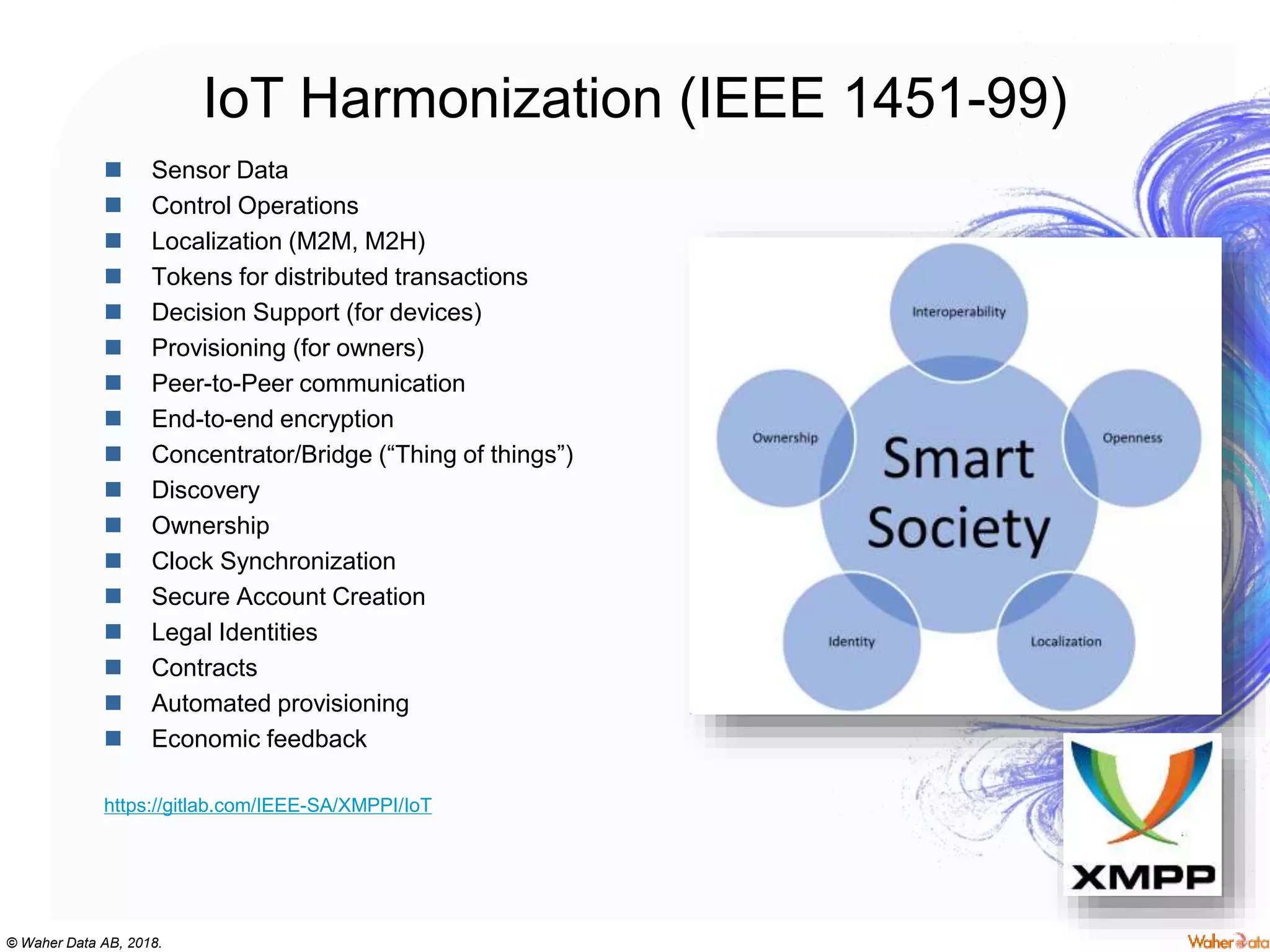
IoT Harmonization (IEEE 1451-99)
 Sensor Data
 Control Operations
 Localization (M2M, M2H)
 Tokens for distributed transactions
 Decision Support (for devices)
 Provisioning (for owners)
 Peer-to-Peer communication
 End-to-end encryption
 Concentrator/Bridge (“Thing of things”)
 Discovery
 Ownership
 Clock Synchronization
 Secure Account Creation
 Legal Identities
 Contracts
 Automated provisioning
 Economic feedback
https://gitlab.com/IEEE-SA/XMPPI/IoT
© Waher Data AB, 2018.
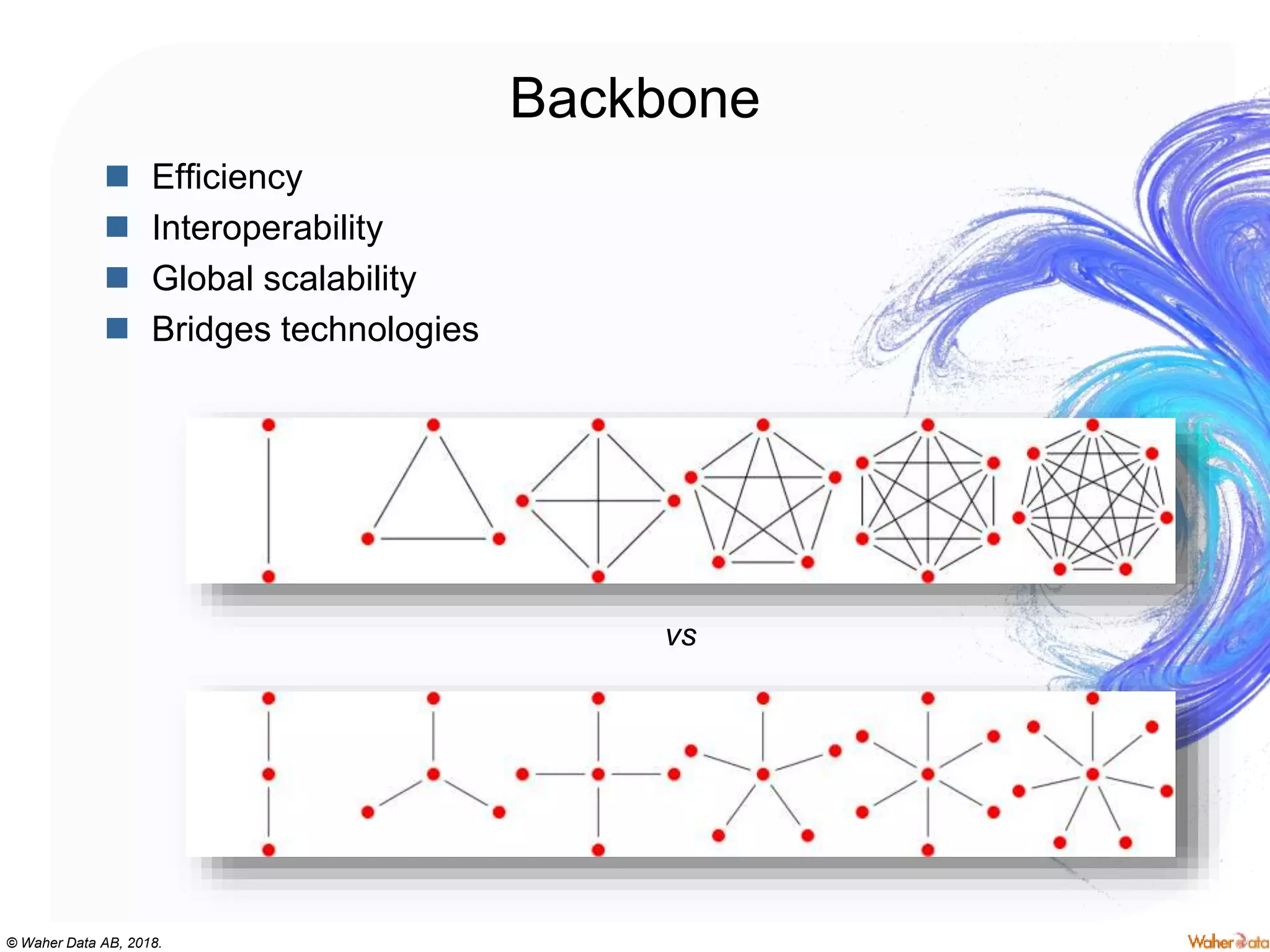
Backbone
 Efficiency
 Interoperability
 Global scalability
 Bridges technologies
vs
© Waher Data AB, 2018.
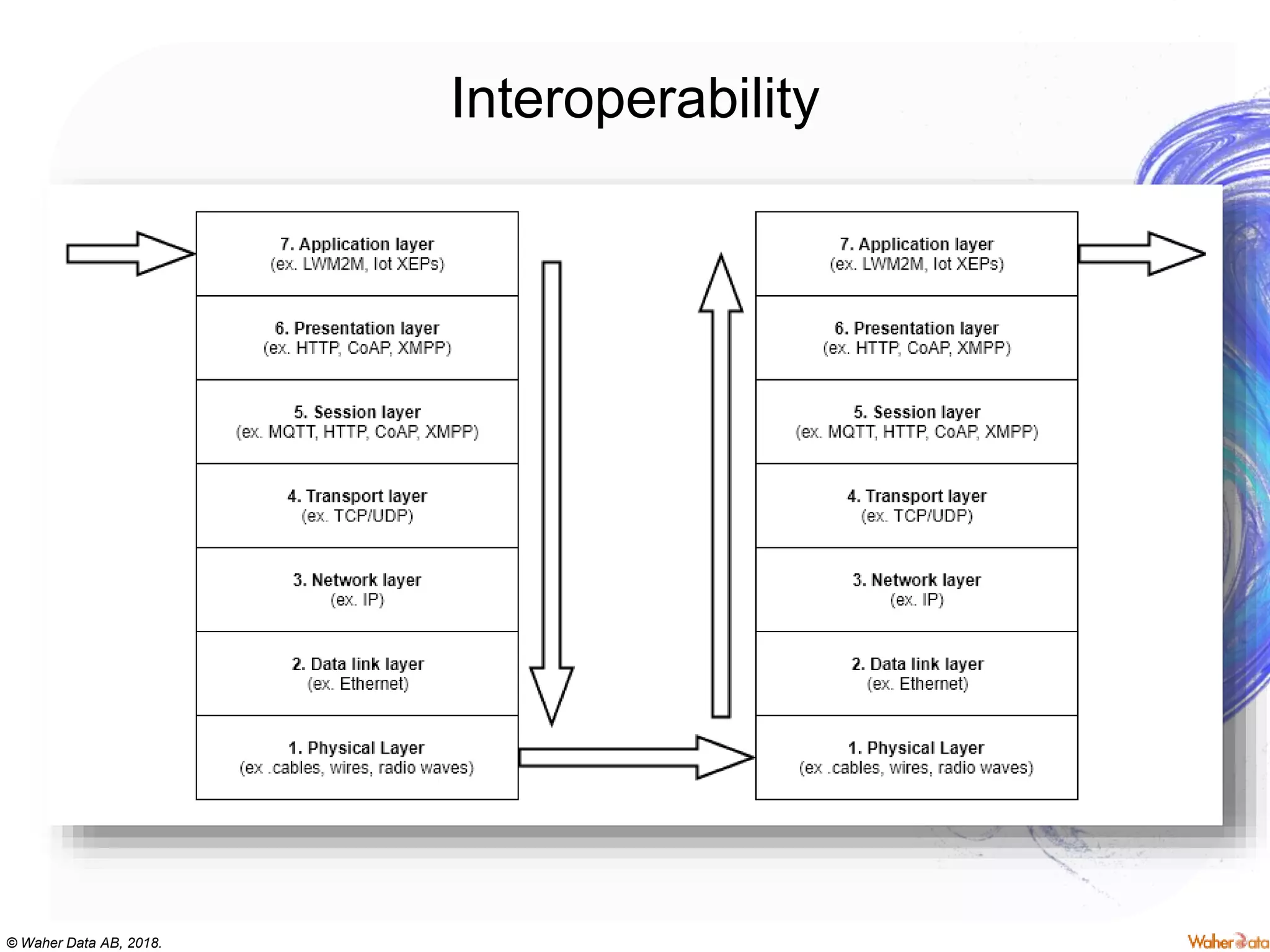
Interoperability
© Waher Data AB, 2018.
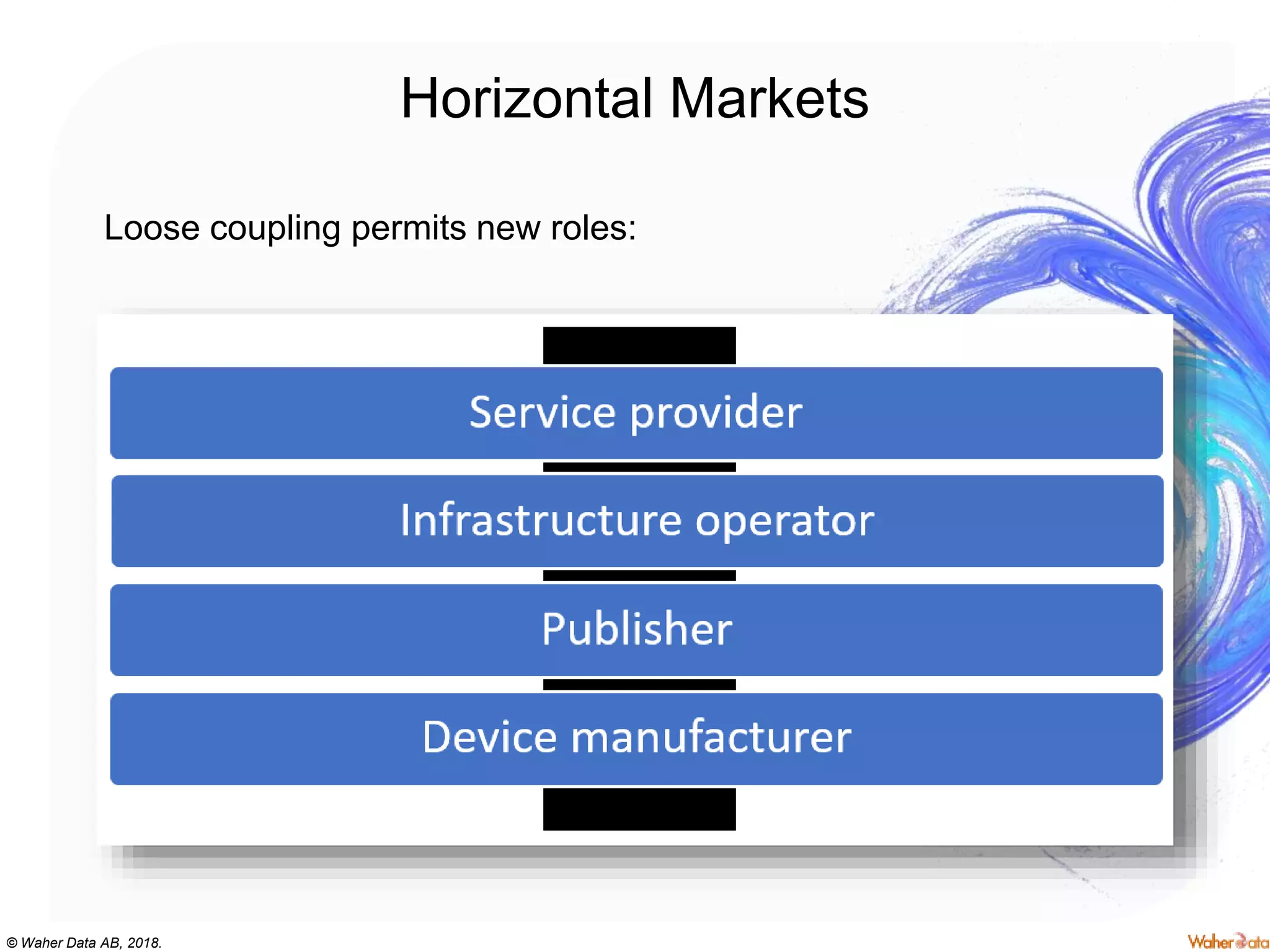
Horizontal Markets
Loose coupling permits new roles:
© Waher Data AB, 2018.
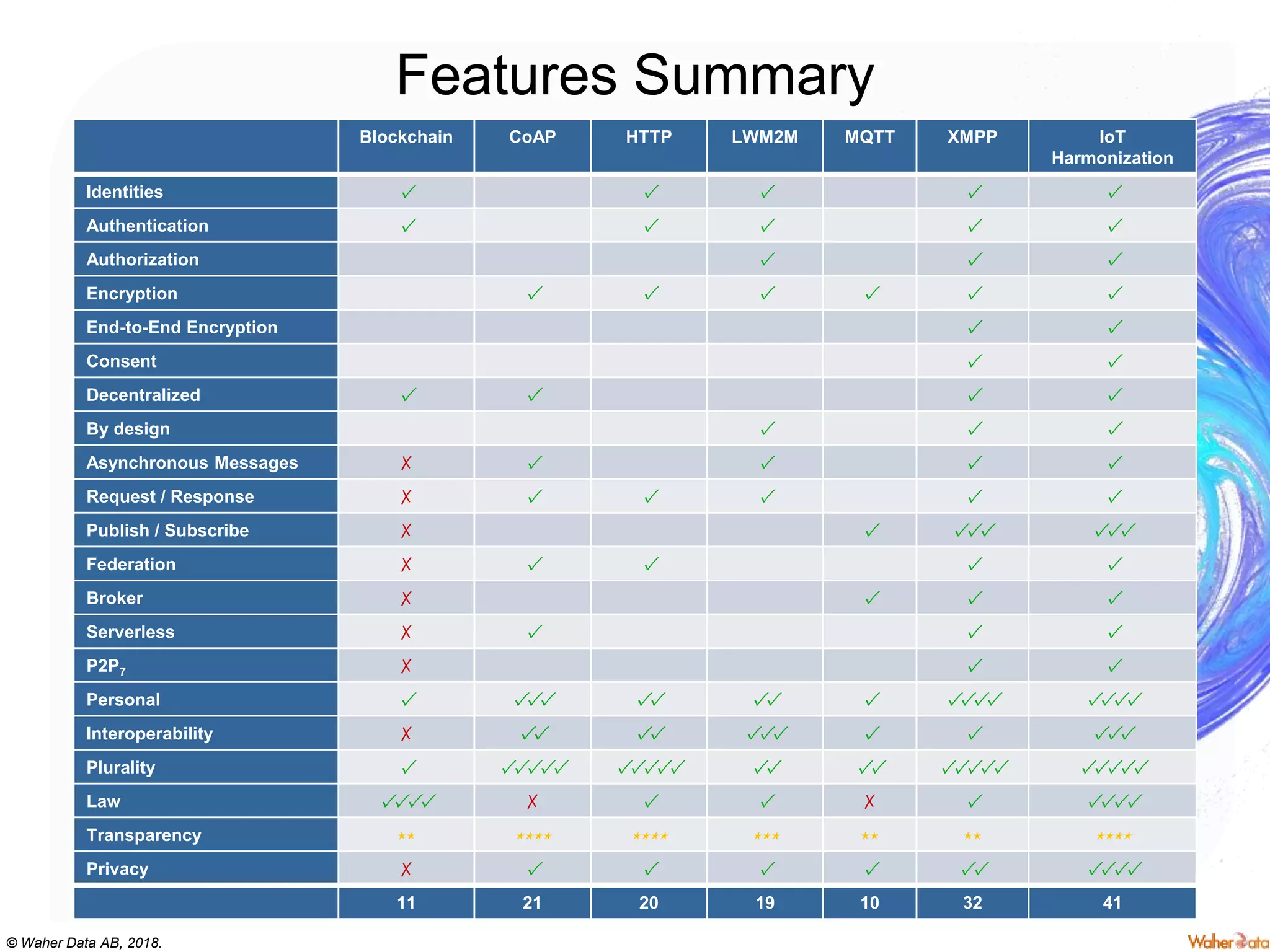
Features Summary
Blockchain CoAP HTTP LWM2M MQTT XMPP IoT
Harmonization
Identities ✓ ✓ ✓ ✓ ✓
Authentication ✓ ✓ ✓ ✓ ✓
Authorization ✓ ✓ ✓
Encryption ✓ ✓ ✓ ✓ ✓ ✓
End-to-End Encryption ✓ ✓
Consent ✓ ✓
Decentralized ✓ ✓ ✓ ✓
By design ✓ ✓ ✓
Asynchronous Messages ✗ ✓ ✓ ✓ ✓
Request / Response ✗ ✓ ✓ ✓ ✓ ✓
Publish / Subscribe ✗ ✓ ✓✓✓ ✓✓✓
Federation ✗ ✓ ✓ ✓ ✓
Broker ✗ ✓ ✓ ✓
Serverless ✗ ✓ ✓ ✓
P2P7 ✗ ✓ ✓
Personal ✓ ✓✓✓ ✓✓ ✓✓ ✓ ✓✓✓✓ ✓✓✓✓
Interoperability ✗ ✓✓ ✓✓ ✓✓✓ ✓ ✓ ✓✓✓
Plurality ✓ ✓✓✓✓✓ ✓✓✓✓✓ ✓✓ ✓✓ ✓✓✓✓✓ ✓✓✓✓✓
Law ✓✓✓✓ ✗ ✓ ✓ ✗ ✓ ✓✓✓✓
Transparency ⋆⋆ ⋆⋆⋆⋆ ⋆⋆⋆⋆ ⋆⋆⋆ ⋆⋆ ⋆⋆ ⋆⋆⋆⋆
Privacy ✗ ✓ ✓ ✓ ✓ ✓✓ ✓✓✓✓
11 21 20 19 10 32 41
© Waher Data AB, 2018.
3. Harmonizing the IoT
for the Smart City / Society
© Waher Data AB, 2018.
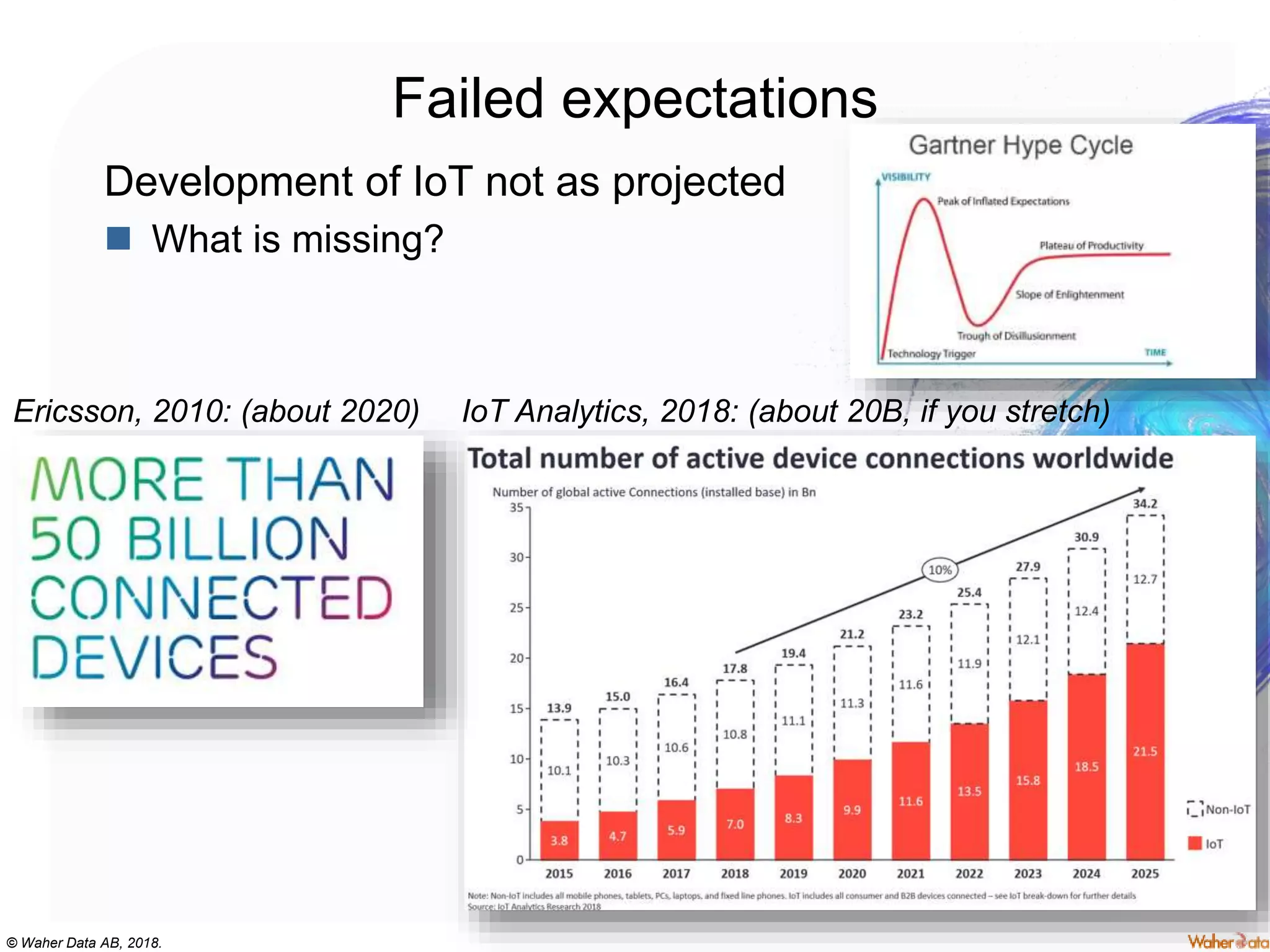
Failed expectations
Development of IoT not as projected
 What is missing?
Ericsson, 2010: (about 2020) IoT Analytics, 2018: (about 20B, if you stretch)
© Waher Data AB, 2018.
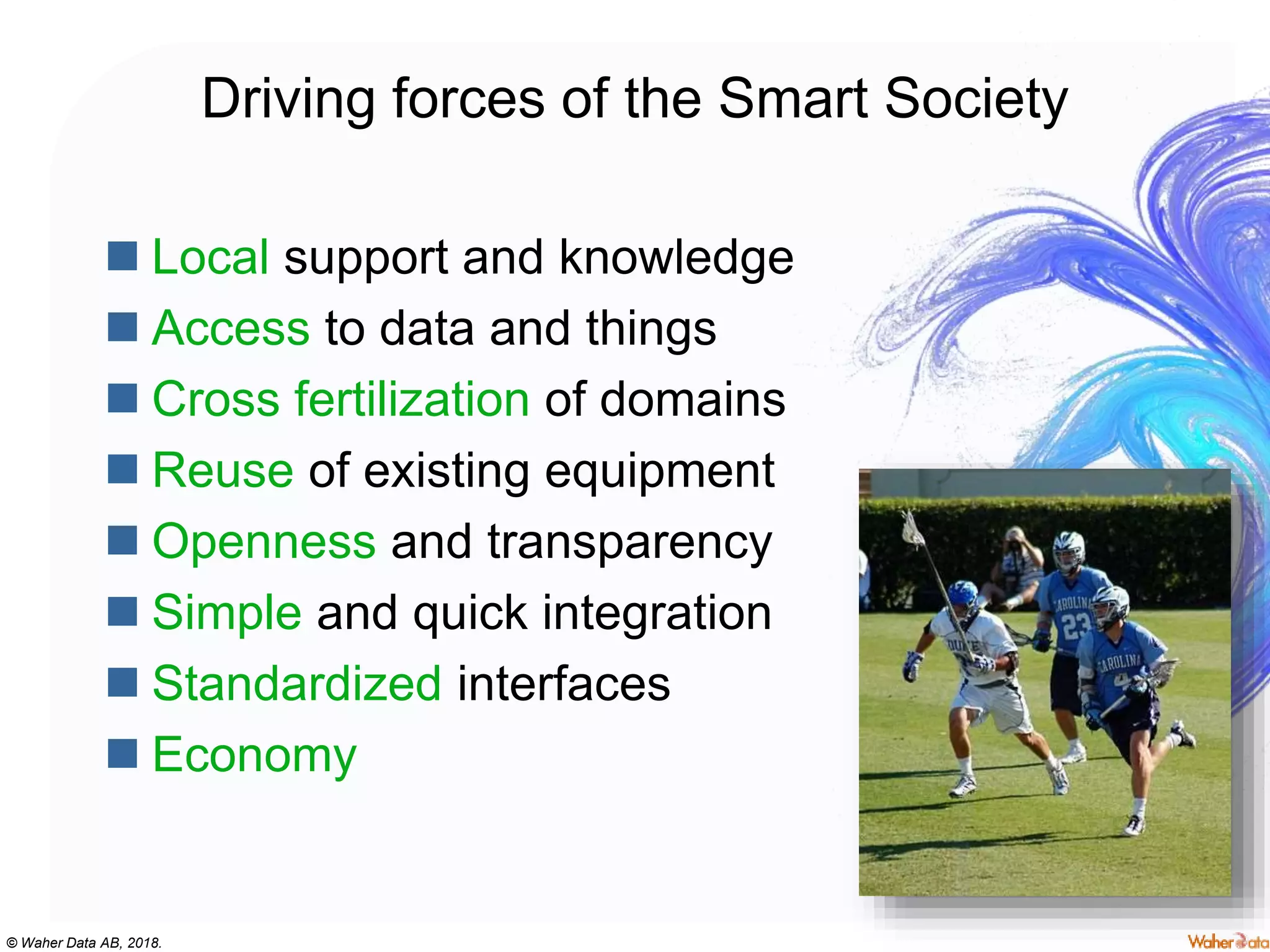
Driving forces of the Smart Society
 Local support and knowledge
 Access to data and things
 Cross fertilization of domains
 Reuse of existing equipment
 Openness and transparency
 Simple and quick integration
 Standardized interfaces
 Economy
© Waher Data AB, 2018.
Dilemma
Would you publish your things on the Internet?
 You would add risk to your solution
 You would degrade the performance
 Competitors could do what you do
 But cheaper
(they don’t have to buy equipment)
A crucial element is missing, for IoT to boom.
© Waher Data AB, 2018.
Standards
Interoperability is based on standards.
Standards are required for:
 Communication
 Representation
 Operation
 Security
 Privacy
 Discovery
 Decision support
 Economic feedback models
© Waher Data AB, 2018.
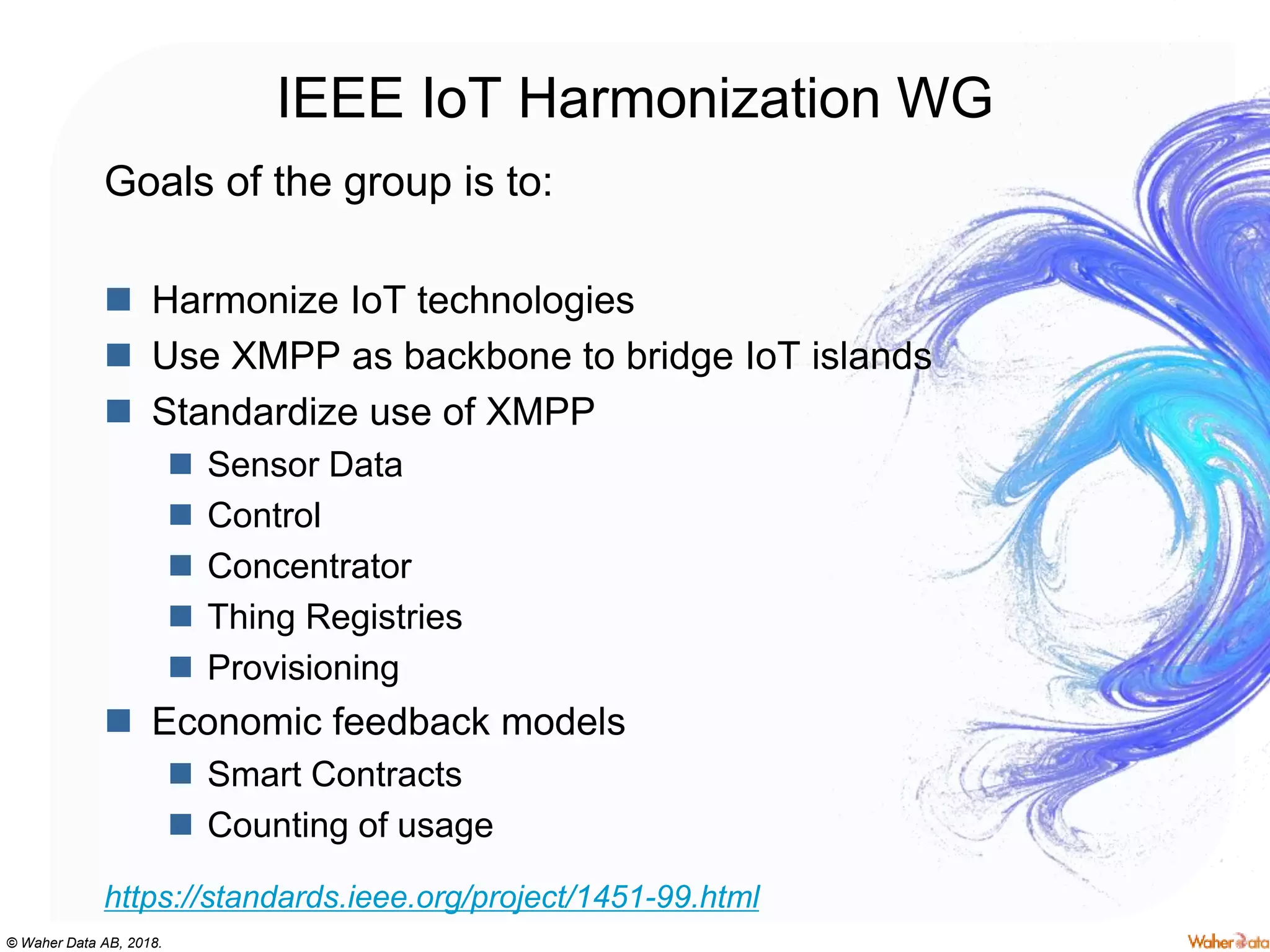
IEEE IoT Harmonization WG
Goals of the group is to:
 Harmonize IoT technologies
 Use XMPP as backbone to bridge IoT islands
 Standardize use of XMPP
 Sensor Data
 Control
 Concentrator
 Thing Registries
 Provisioning
 Economic feedback models
 Smart Contracts
 Counting of usage
https://standards.ieee.org/project/1451-99.html
© Waher Data AB, 2018.
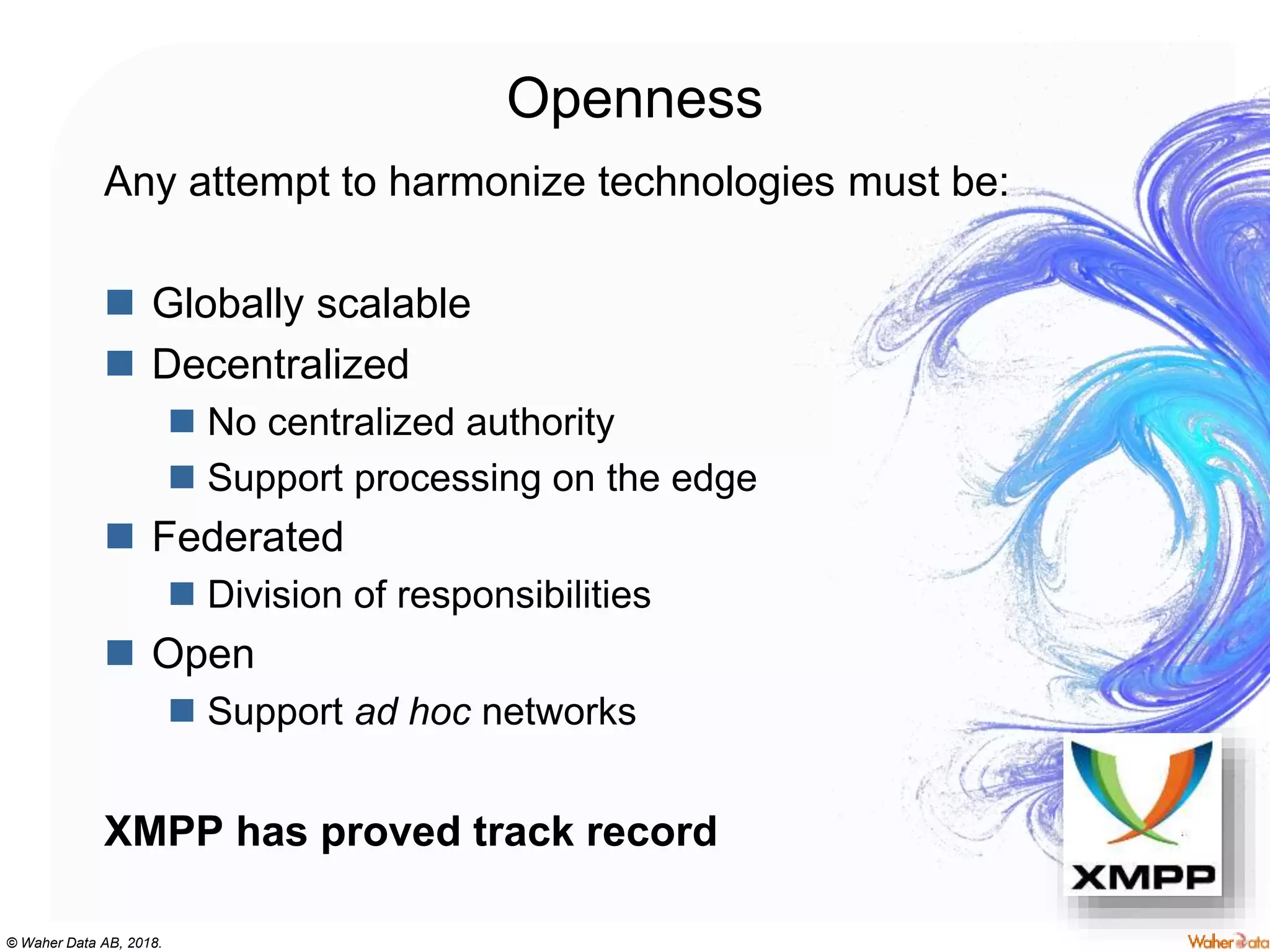
Openness
Any attempt to harmonize technologies must be:
 Globally scalable
 Decentralized
 No centralized authority
 Support processing on the edge
 Federated
 Division of responsibilities
 Open
 Support ad hoc networks
XMPP has proved track record
© Waher Data AB, 2018.
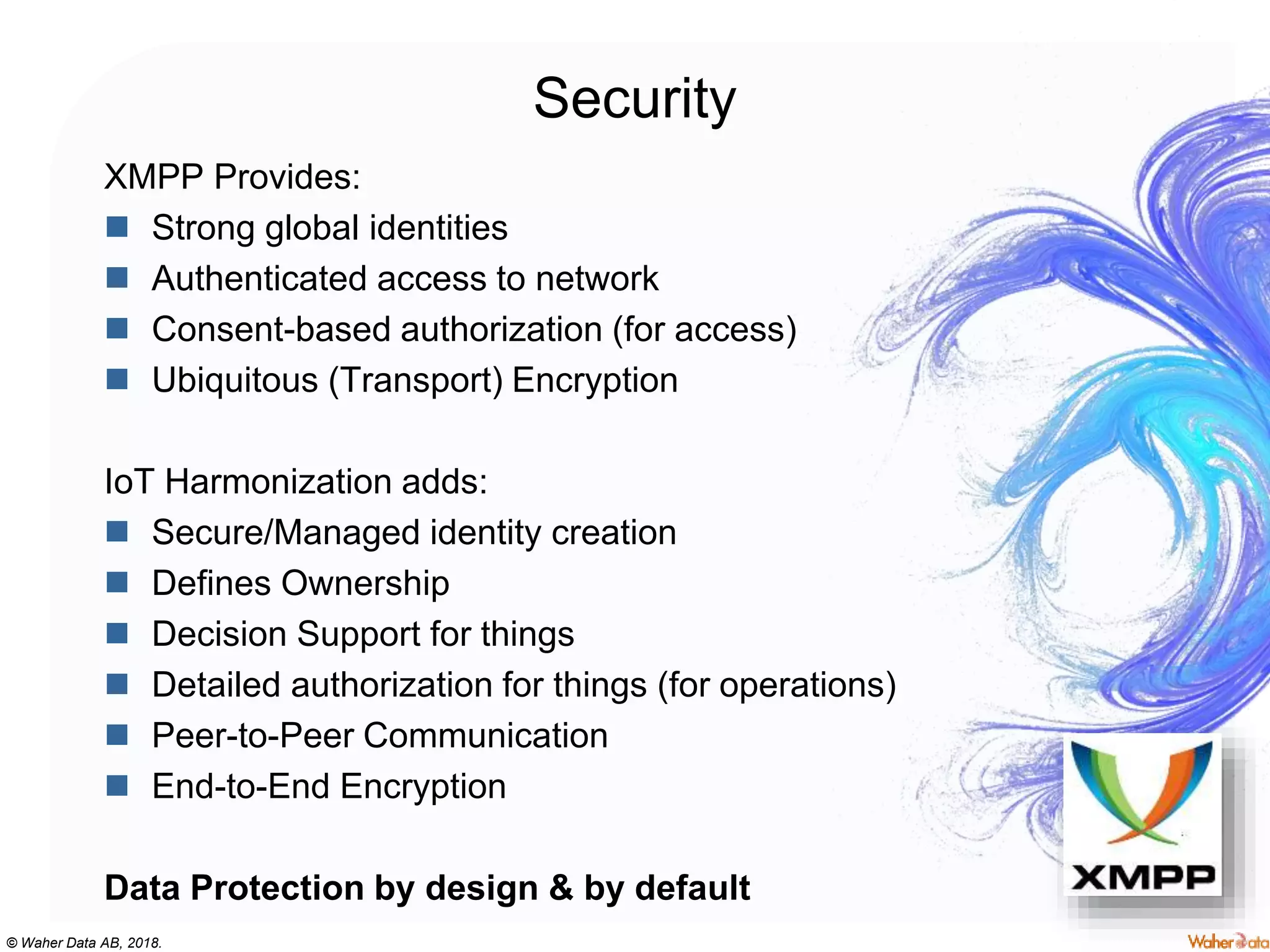
Security
XMPP Provides:
 Strong global identities
 Authenticated access to network
 Consent-based authorization (for access)
 Ubiquitous (Transport) Encryption
IoT Harmonization adds:
 Secure/Managed identity creation
 Defines Ownership
 Decision Support for things
 Detailed authorization for things (for operations)
 Peer-to-Peer Communication
 End-to-End Encryption
Data Protection by design & by default
© Waher Data AB, 2018.
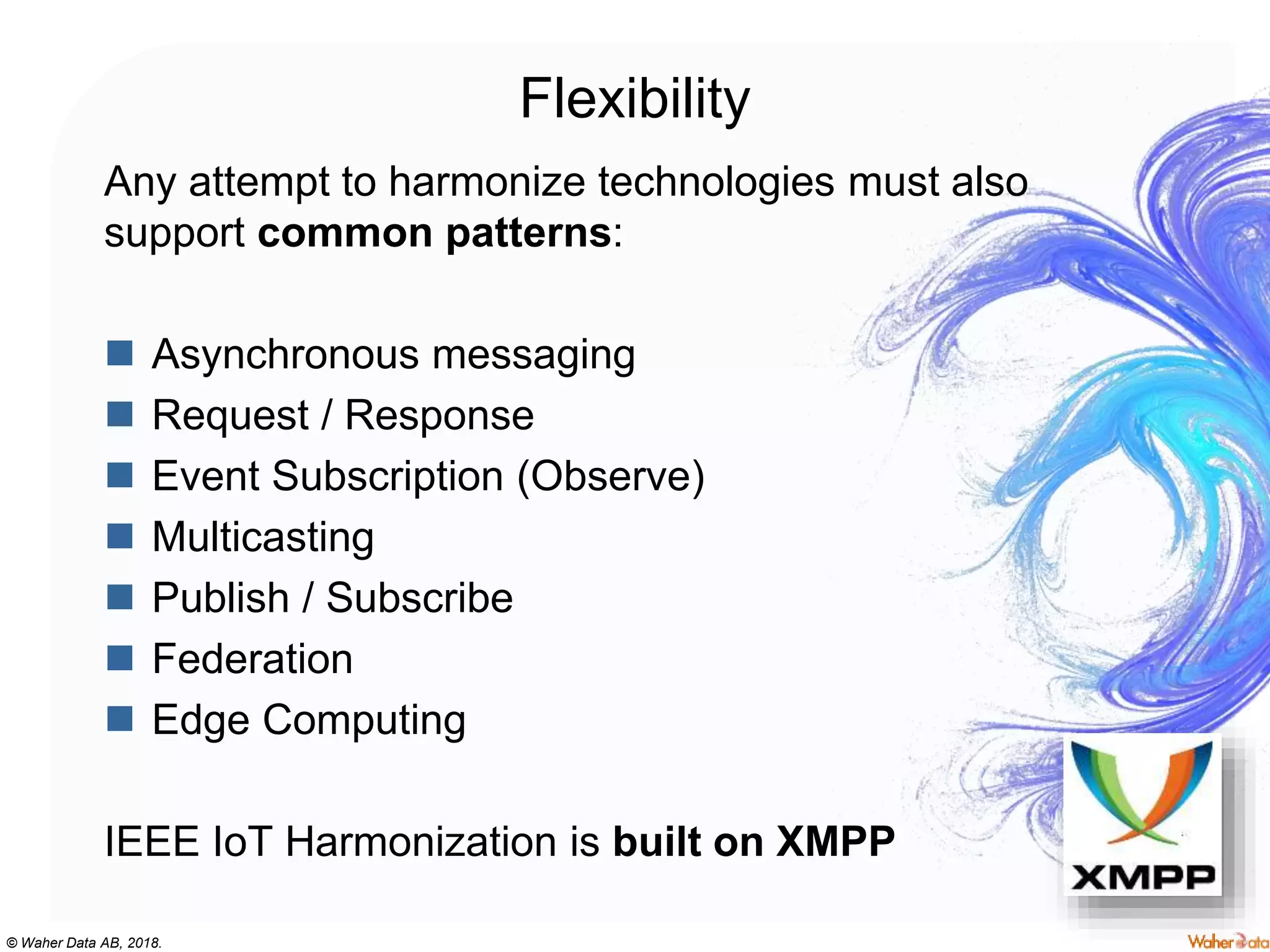
Flexibility
Any attempt to harmonize technologies must also
support common patterns:
 Asynchronous messaging
 Request / Response
 Event Subscription (Observe)
 Multicasting
 Publish / Subscribe
 Federation
 Edge Computing
IEEE IoT Harmonization is built on XMPP
© Waher Data AB, 2018.
4. XMPP
© Waher Data AB, 2018.
What is XMPP?
eXtensible Messaging and
Presence Protocol
 Standardized by the IETF
 RFC 6120
 RFC 6121
 RFC 6122
 Originally developed in the late 1990-ies.
 Instant Messaging
 “Jabber”
 Based on XML
© Waher Data AB, 2018.
Basic features
Some basic features of XMPP include:
 Global scalability (federation)
 Extensibility (namespaces)
 Robustness (20 years of operation)
 Open (public & free)
 Standardized
 Secure
 Interoperable
© Waher Data AB, 2018.
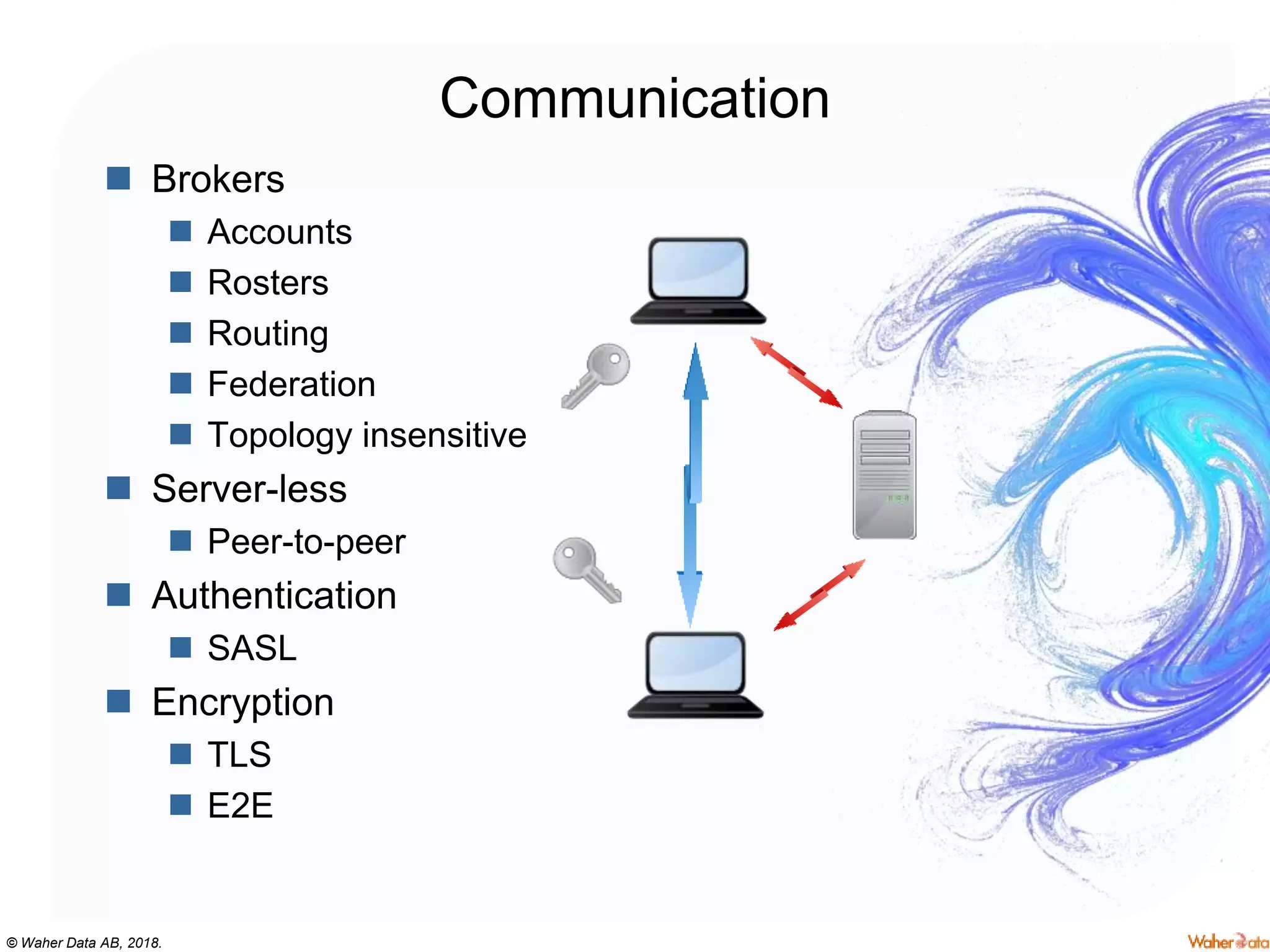
Communication
 Brokers
 Accounts
 Rosters
 Routing
 Federation
 Topology insensitive
 Server-less
 Peer-to-peer
 Authentication
 SASL
 Encryption
 TLS
 E2E
© Waher Data AB, 2018.
Communication Patterns
Intrinsic patterns:
 Asynchronous messages (message)
 Request/Response (iq)
 Publish/Subscribe (presence)
Extended
 Publish/Subscribe
 Personal Eventing (extended by XEP-0163)
 Publish-Subscribe (extended by XEP-0060)
 Multicasting (extended by XEP-0045)
 etc.
© Waher Data AB, 2018.
Security
Standard layers of security:
 Authentication (SASL)
 Encryption (TLS)
 Consent-based Authorization
 Blocking
 Spam reporting
 Provisioning
 End-to-end encryption
© Waher Data AB, 2018.
5. Communication
Patterns
© Waher Data AB, 2018.
Asynchronous Messages
© Waher Data AB, 2018.
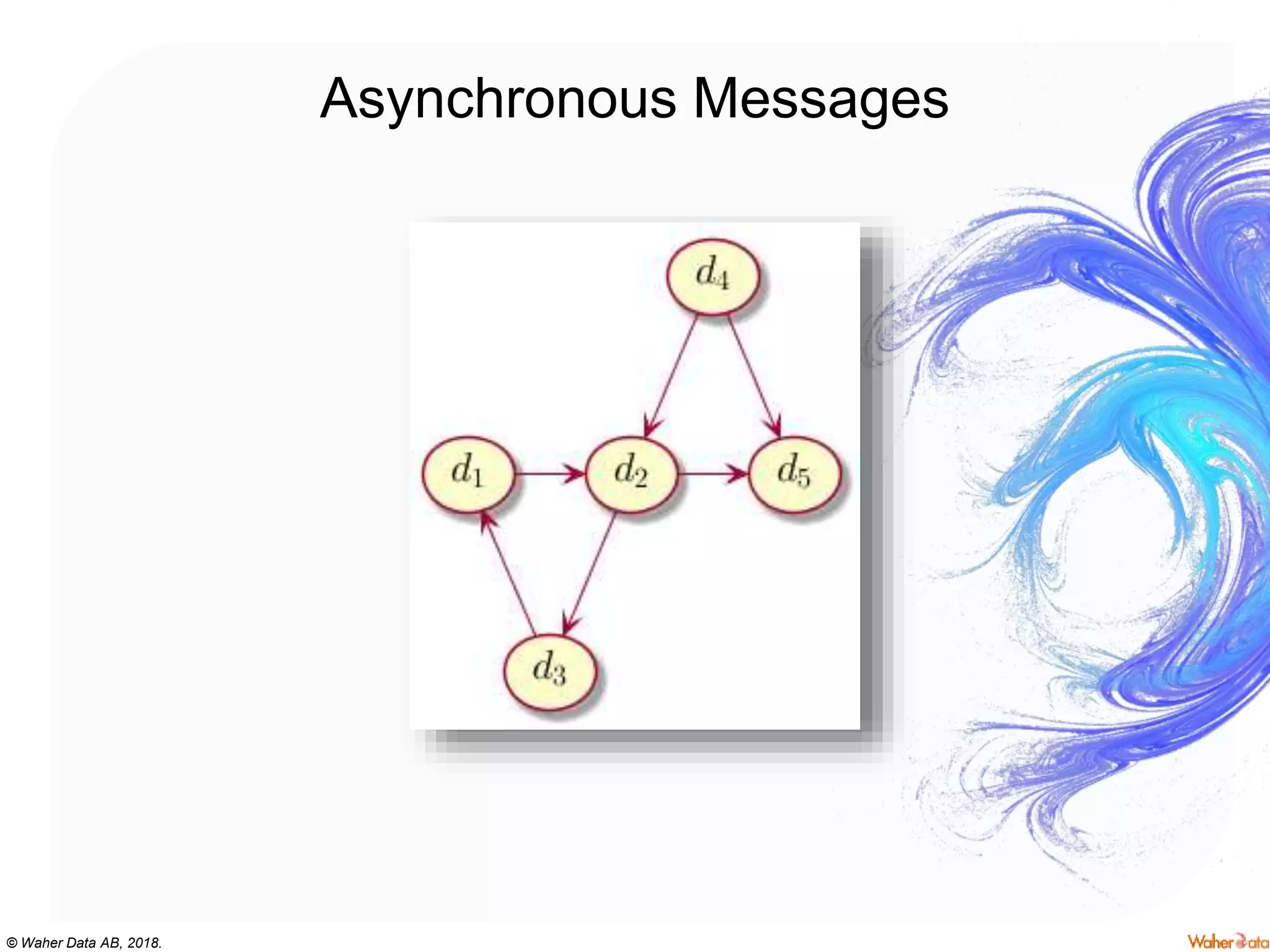
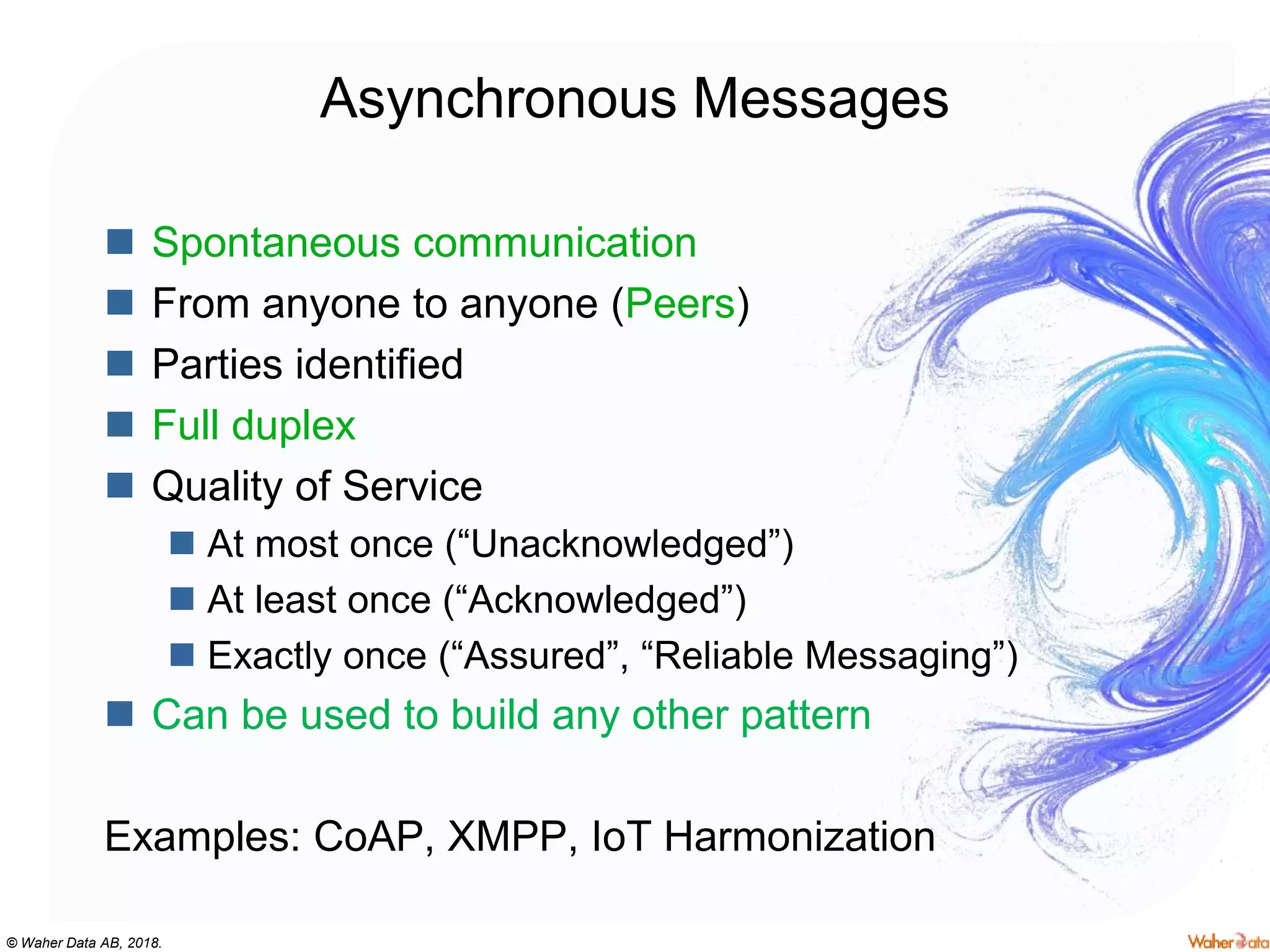
Asynchronous Messages
 Spontaneous communication
 From anyone to anyone (Peers)
 Parties identified
 Full duplex
 Quality of Service
 At most once (“Unacknowledged”)
 At least once (“Acknowledged”)
 Exactly once (“Assured”, “Reliable Messaging”)
 Can be used to build any other pattern
Examples: CoAP, XMPP, IoT Harmonization
© Waher Data AB, 2018.
Request / Response
© Waher Data AB, 2018.
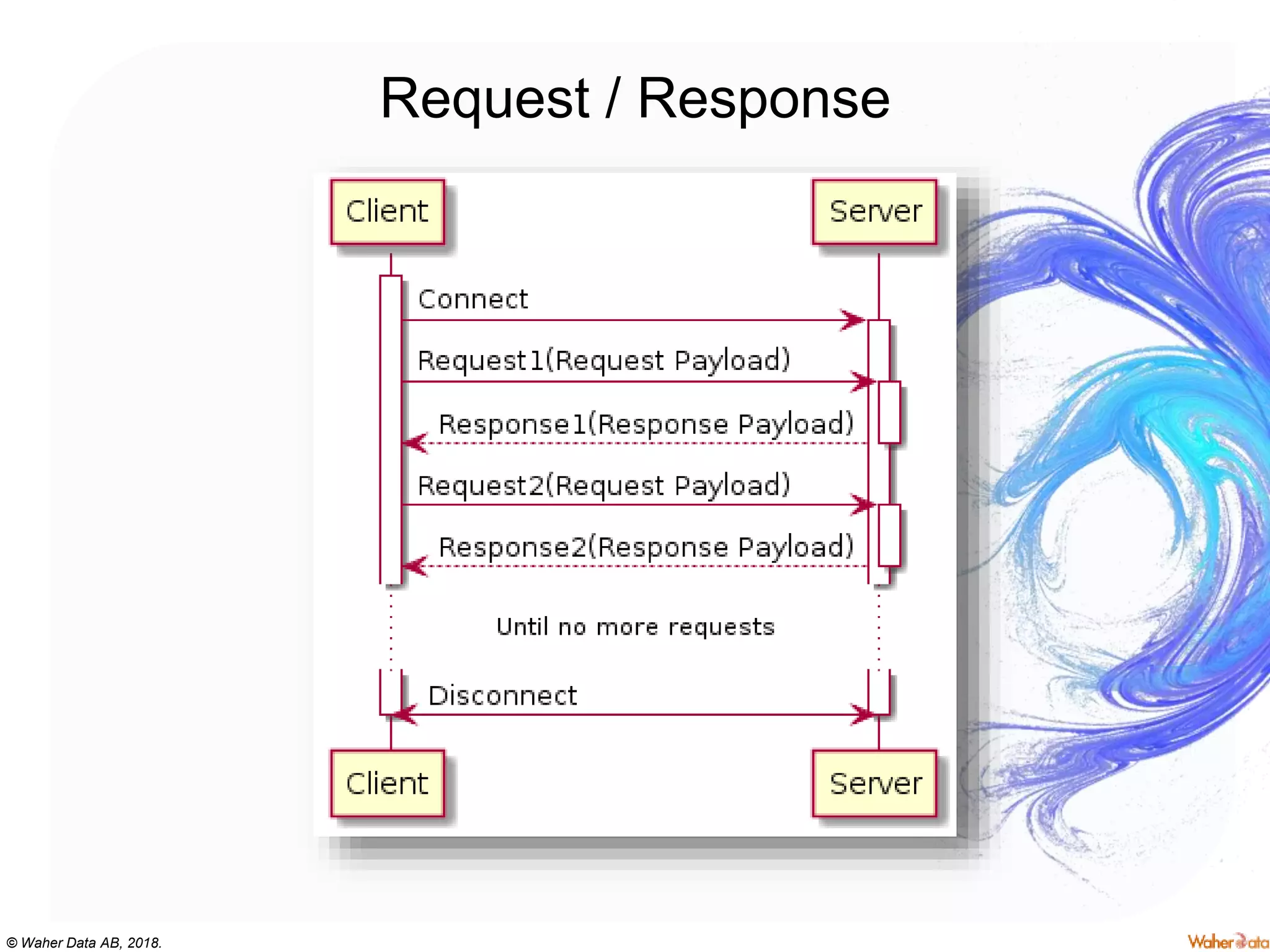
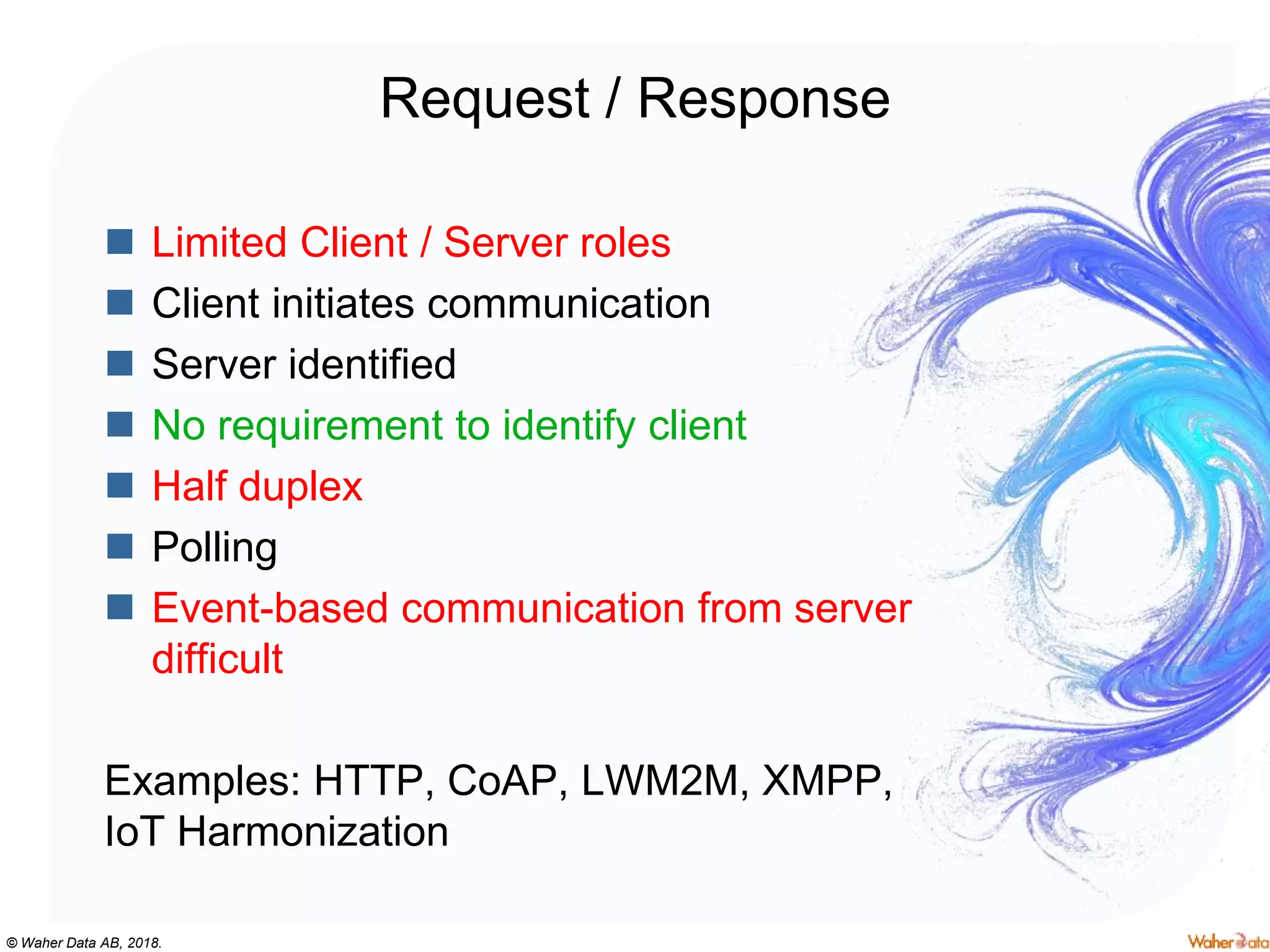
Request / Response
 Limited Client / Server roles
 Client initiates communication
 Server identified
 No requirement to identify client
 Half duplex
 Polling
 Event-based communication from server
difficult
Examples: HTTP, CoAP, LWM2M, XMPP,
IoT Harmonization
© Waher Data AB, 2018.
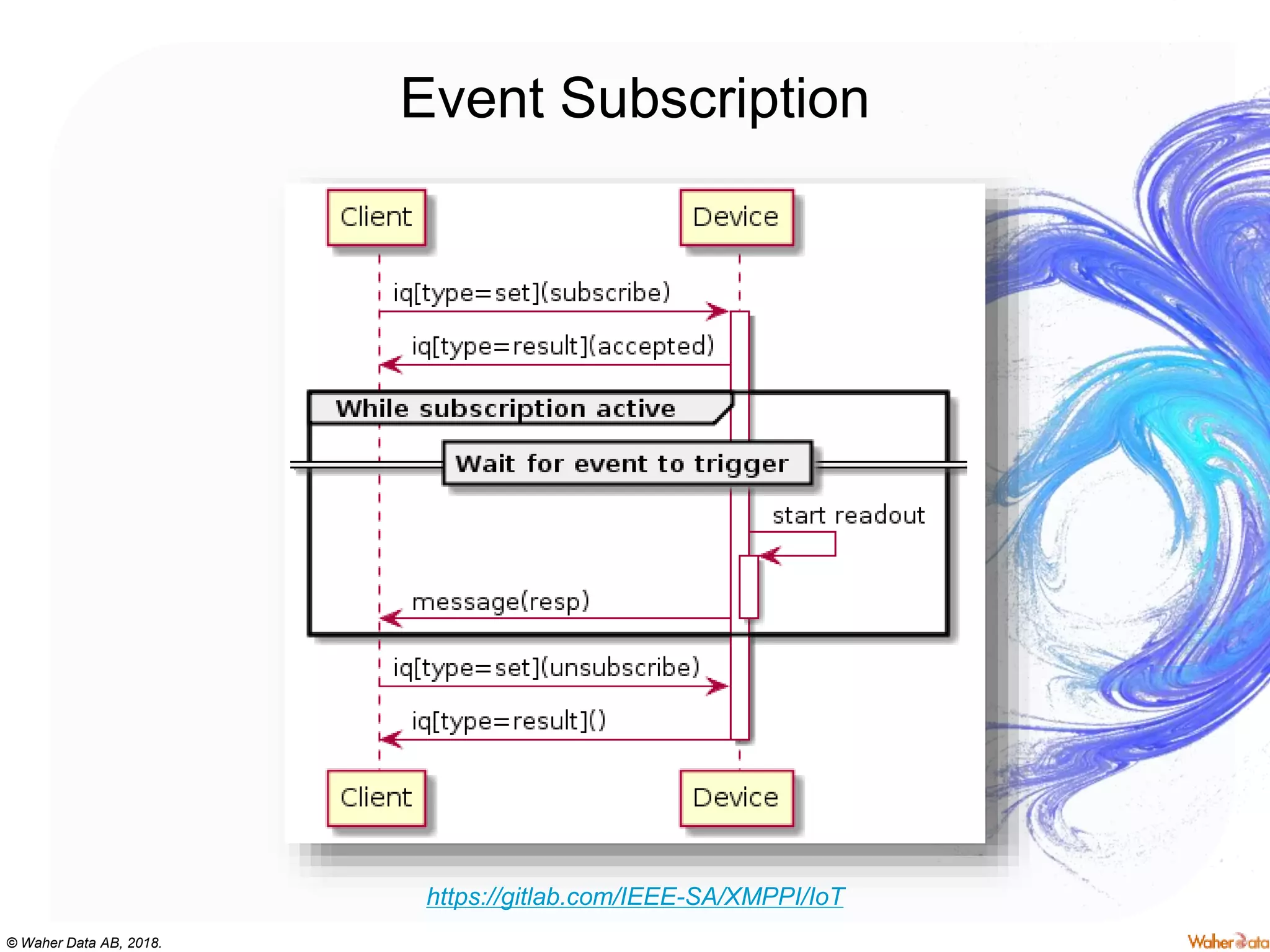
Event Subscription (“Observe”)
© Waher Data AB, 2018.
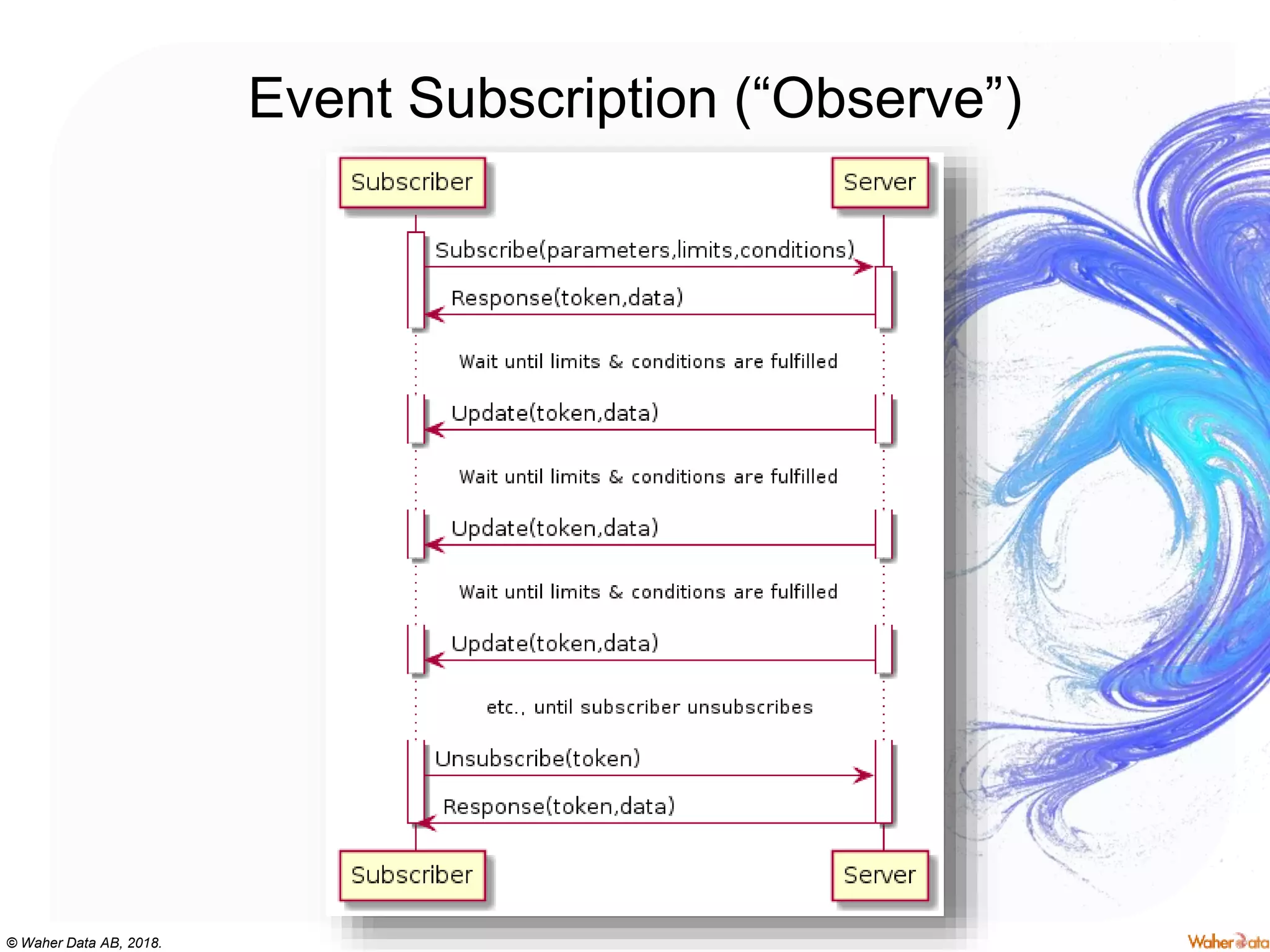
Event Subscription (“Observe”)
 Combines Req./Resp. & Asynch. Msg.
 Client initiates subscription
 Server initiates updates
 Client determines conditions
 Server does not have to know client use case
 More efficient than polling
Examples: CoAP, LWM2M, IoT Harmonization
© Waher Data AB, 2018.
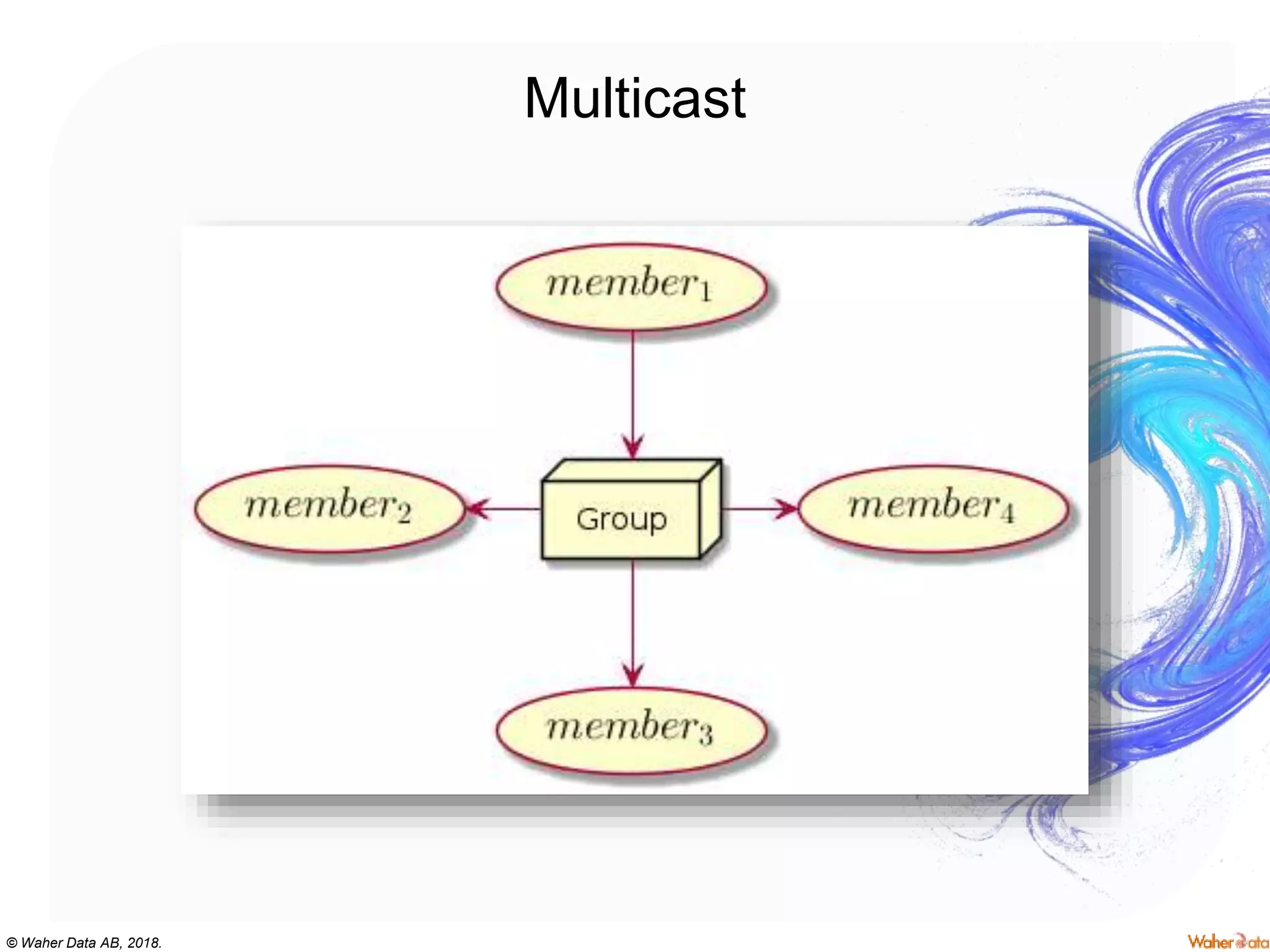
Multicast
© Waher Data AB, 2018.
Multicast
 Group membership
 Often only security mechanism
 Group encryption difficult
 Anyone in group can send a message
 Everyone in a group receives messages
 Detailed authorization difficult
 Synchronizing events
 Clocks
 Updates
 Multicast Streaming (like IP-TV)
 Discovery in ad hoc networks
Examples: CoAP, XMPP, IoT Harmonization
© Waher Data AB, 2018.
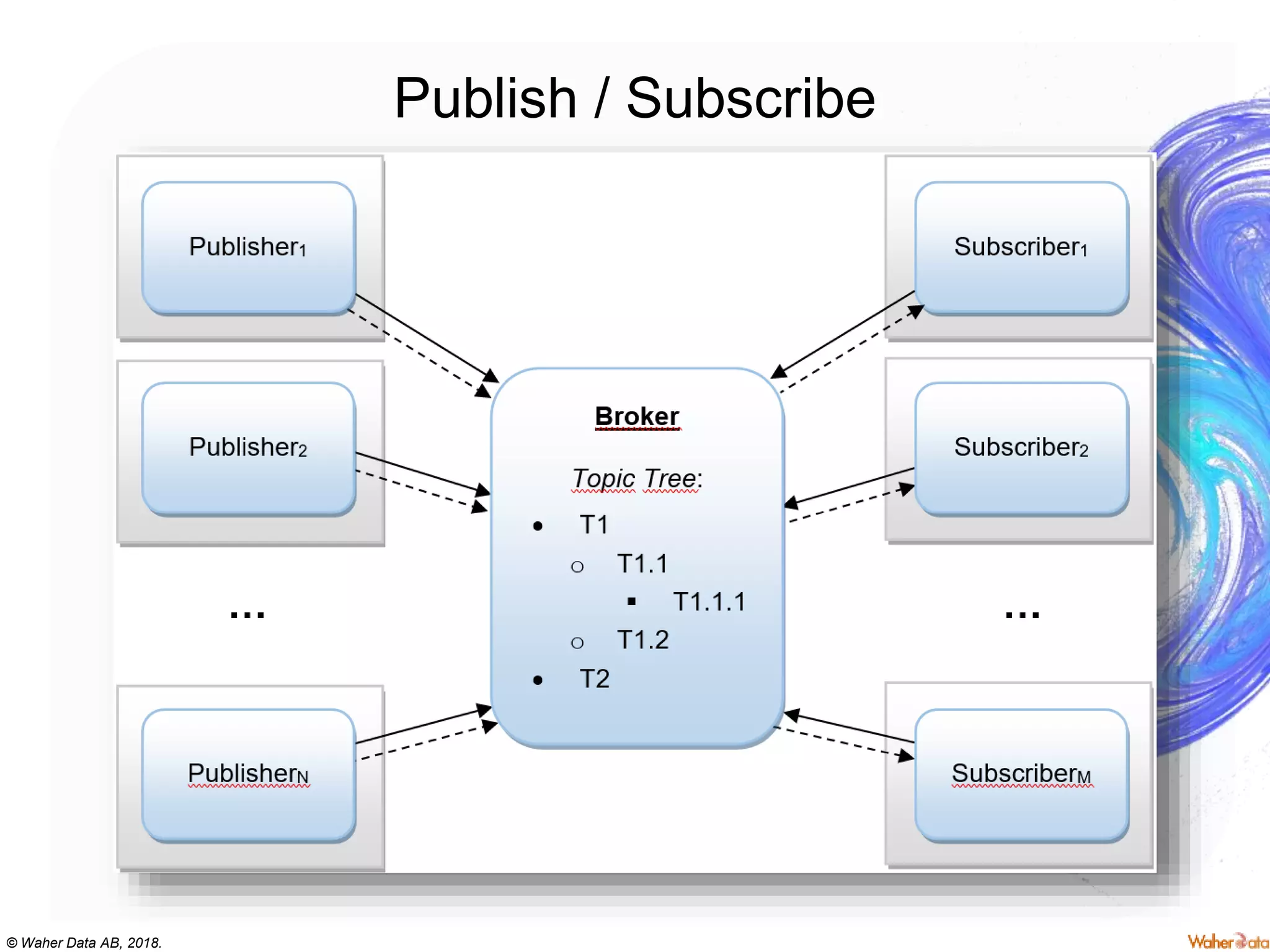
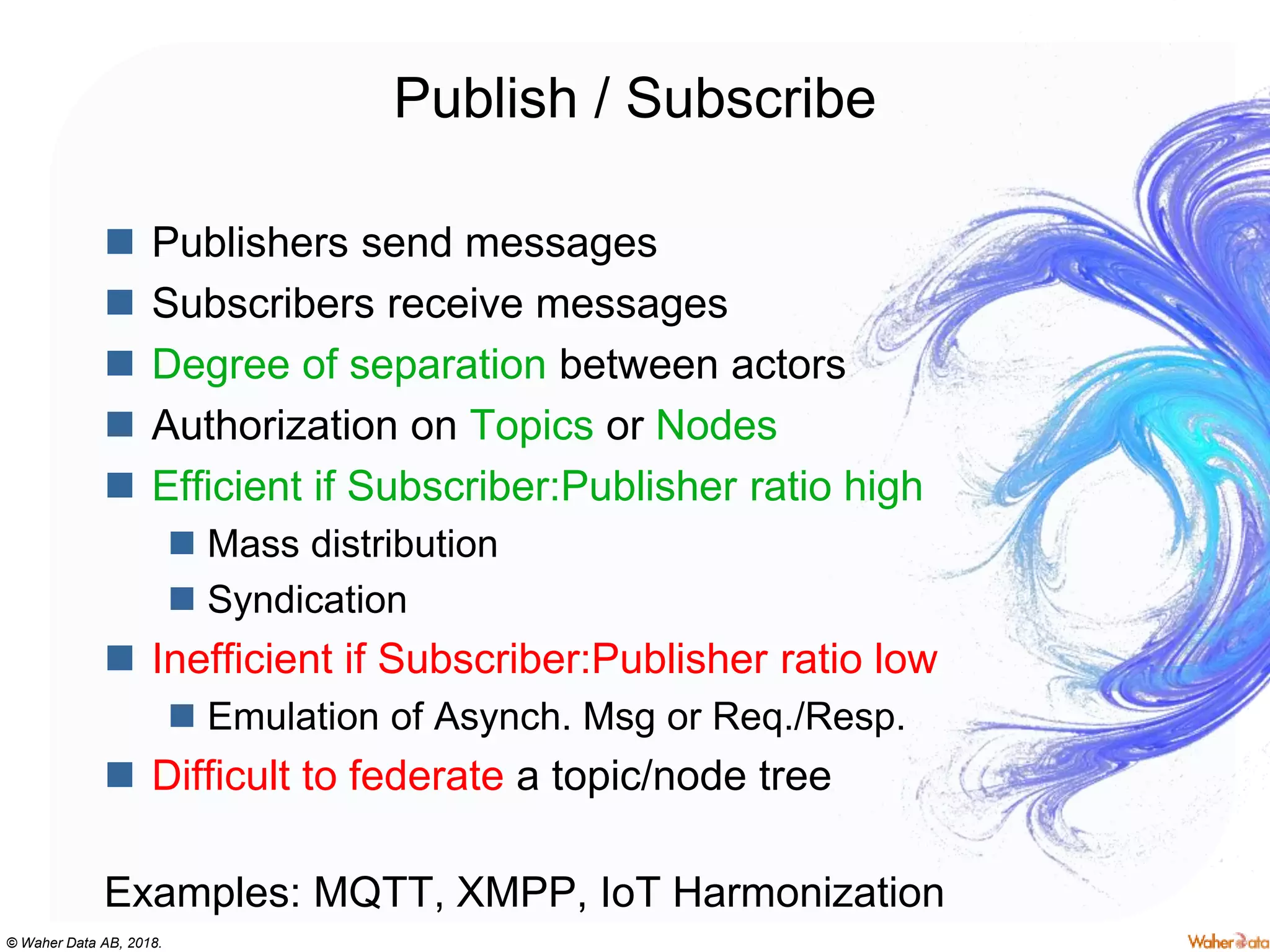
Publish / Subscribe
© Waher Data AB, 2018.
Publish / Subscribe
 Publishers send messages
 Subscribers receive messages
 Degree of separation between actors
 Authorization on Topics or Nodes
 Efficient if Subscriber:Publisher ratio high
 Mass distribution
 Syndication
 Inefficient if Subscriber:Publisher ratio low
 Emulation of Asynch. Msg or Req./Resp.
 Difficult to federate a topic/node tree
Examples: MQTT, XMPP, IoT Harmonization
© Waher Data AB, 2018.
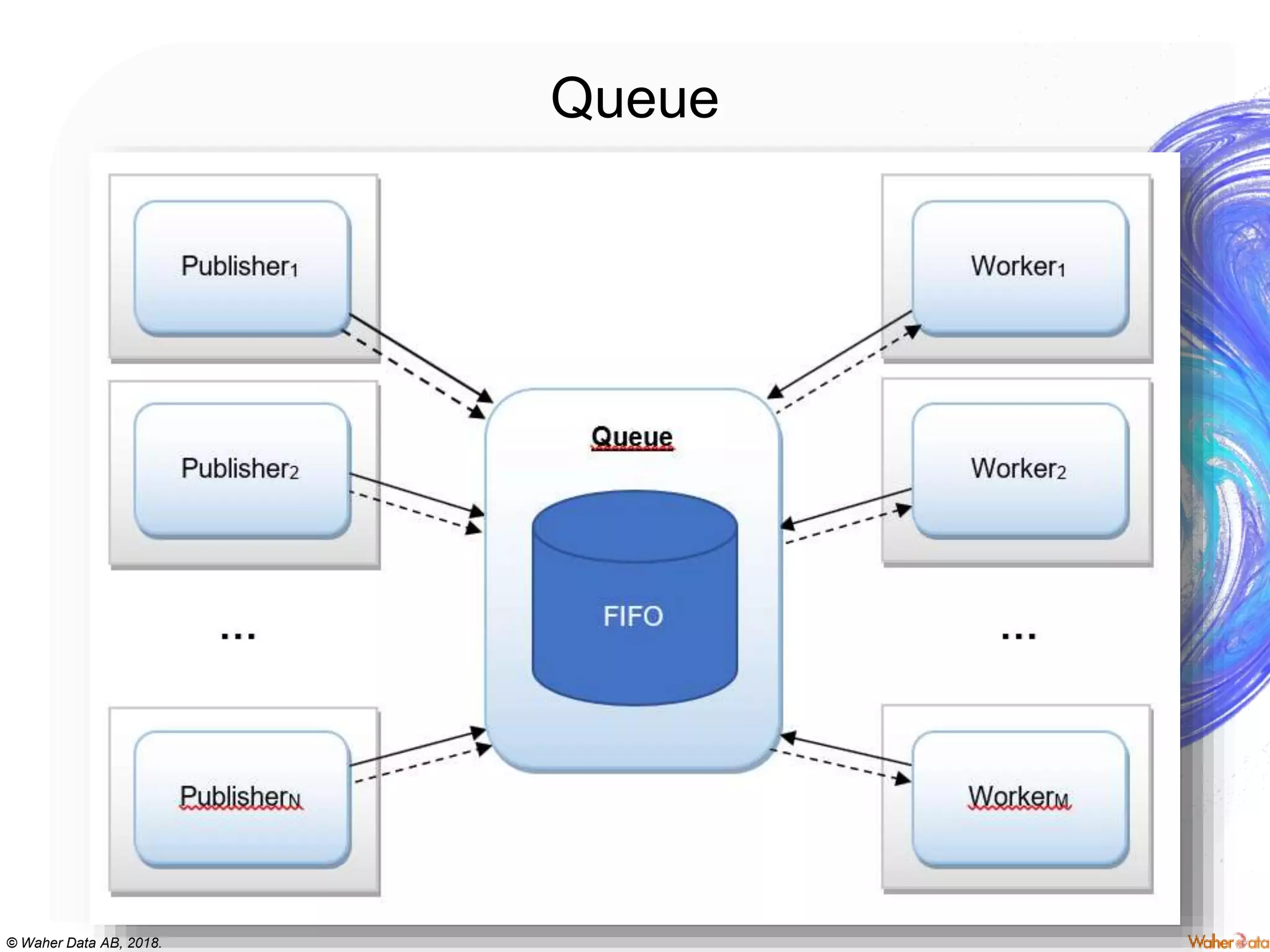
Queue
© Waher Data AB, 2018.
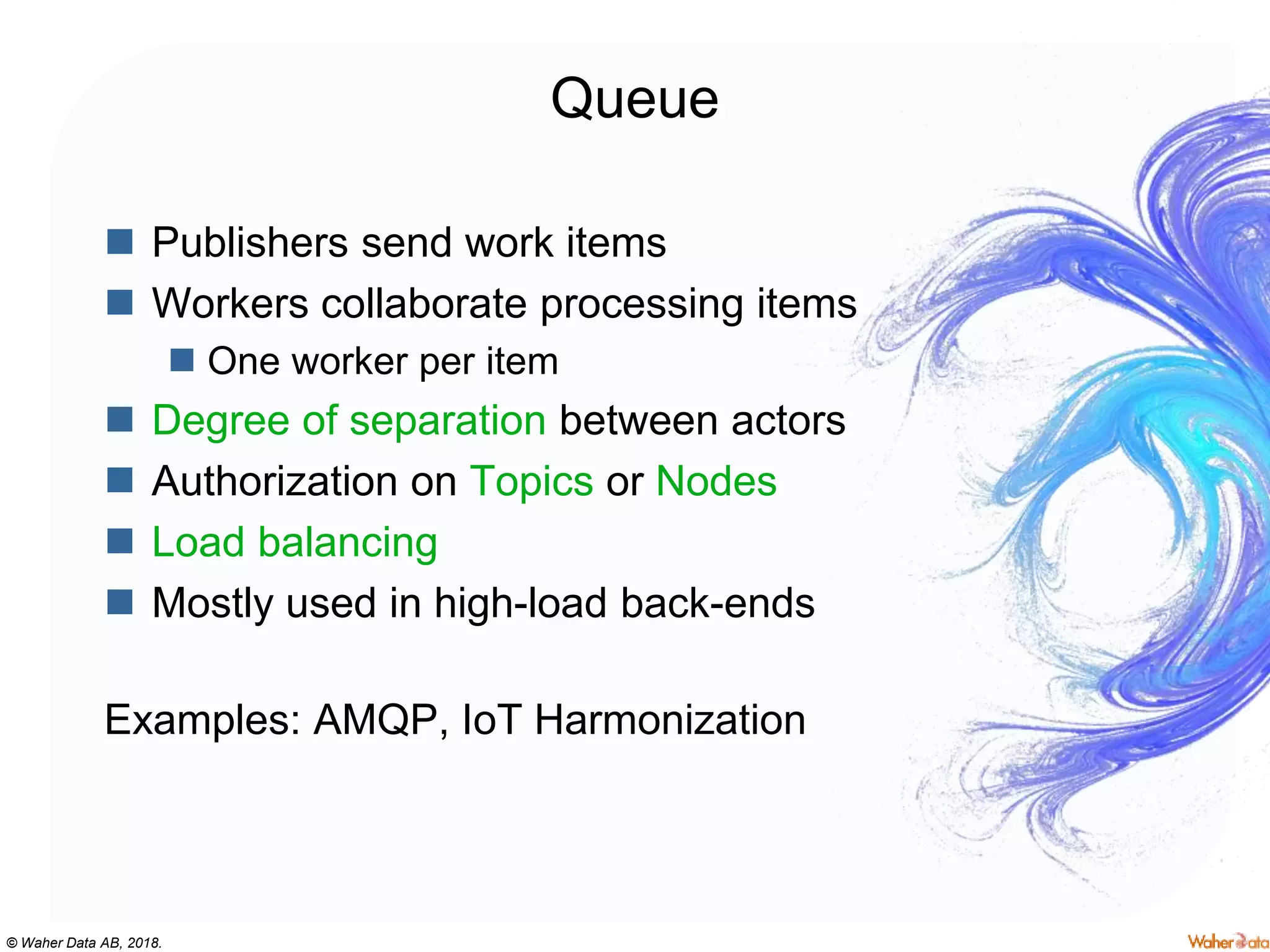
Queue
 Publishers send work items
 Workers collaborate processing items
 One worker per item
 Degree of separation between actors
 Authorization on Topics or Nodes
 Load balancing
 Mostly used in high-load back-ends
Examples: AMQP, IoT Harmonization
© Waher Data AB, 2018.
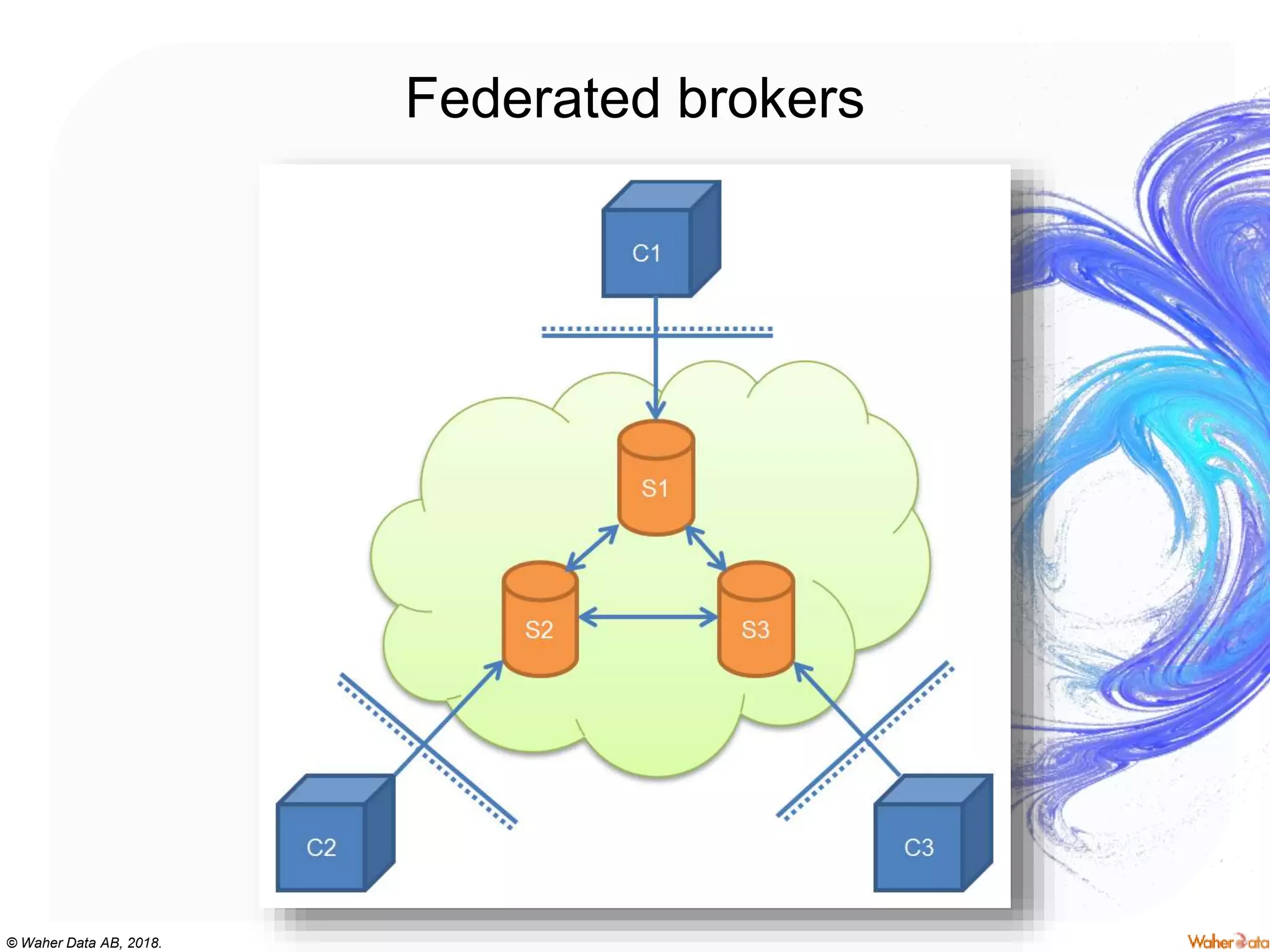
Federated brokers
© Waher Data AB, 2018.
Federated brokers
 Global scalability
 Divide & Conquer (federations/domains)
 Brokers cooperate
 Each domain controls its part of the network
 Cross-domain cooperation easy
 Decentralization
 Resilience
 Global distributed identities
 Solves Topology Problem
Examples: XMPP, IoT Harmonization, (SMTP)
© Waher Data AB, 2018.
Decentralization / Edge Computing
© Waher Data AB, 2018.
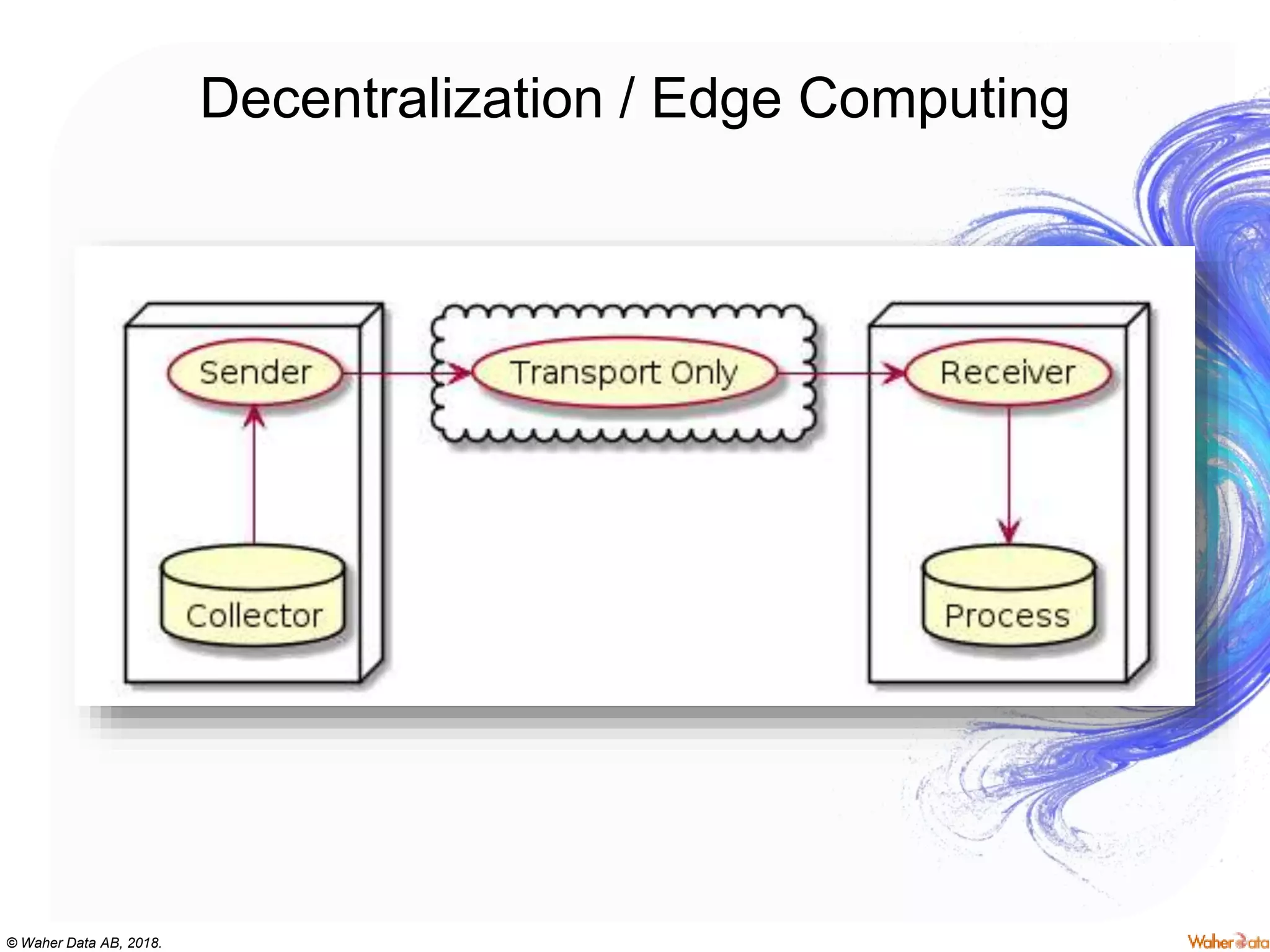
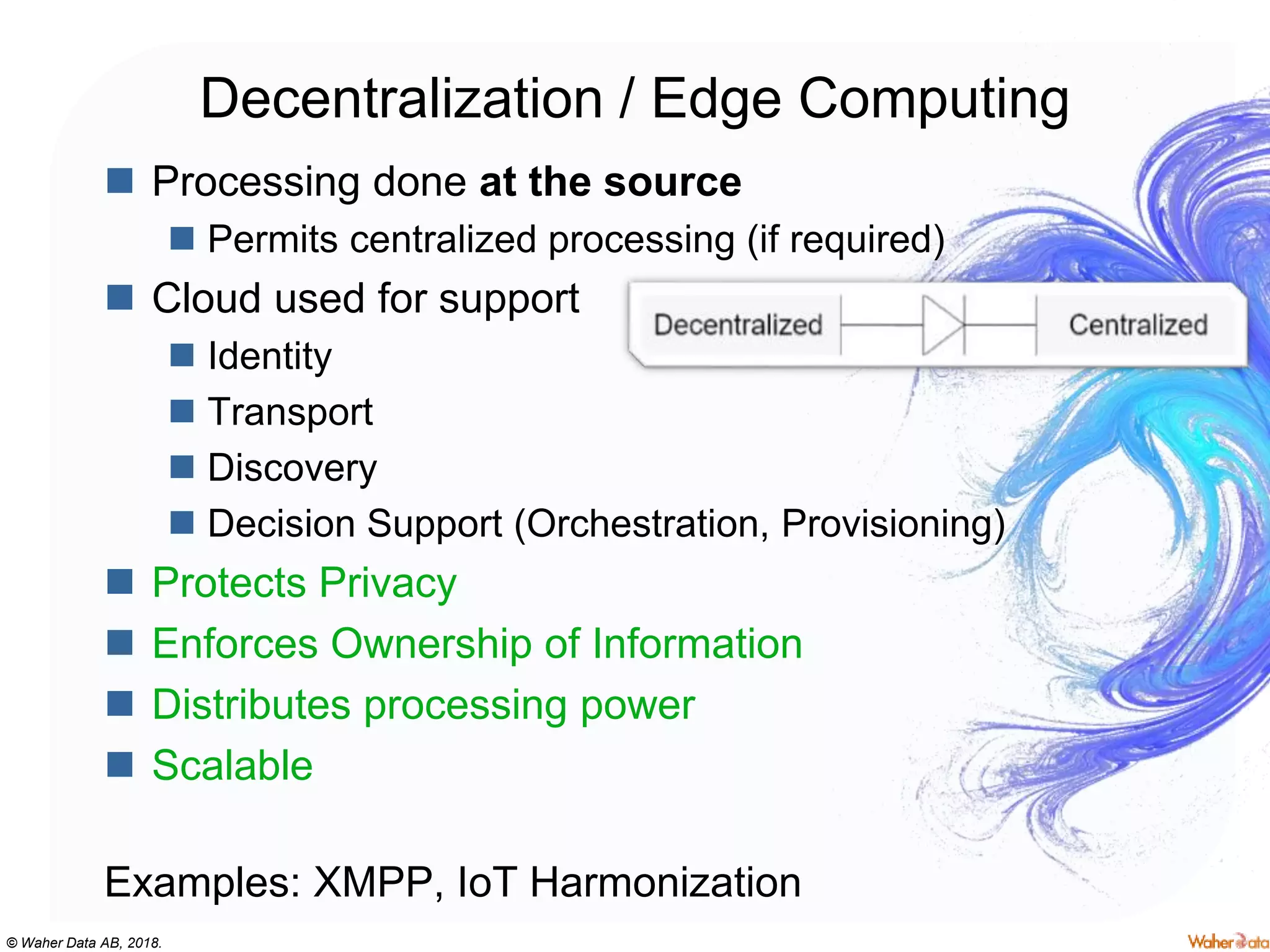
Decentralization / Edge Computing
 Processing done at the source
 Permits centralized processing (if required)
 Cloud used for support
 Identity
 Transport
 Discovery
 Decision Support (Orchestration, Provisioning)
 Protects Privacy
 Enforces Ownership of Information
 Distributes processing power
 Scalable
Examples: XMPP, IoT Harmonization
© Waher Data AB, 2018.
6. Infrastructure Services
© Waher Data AB, 2018.
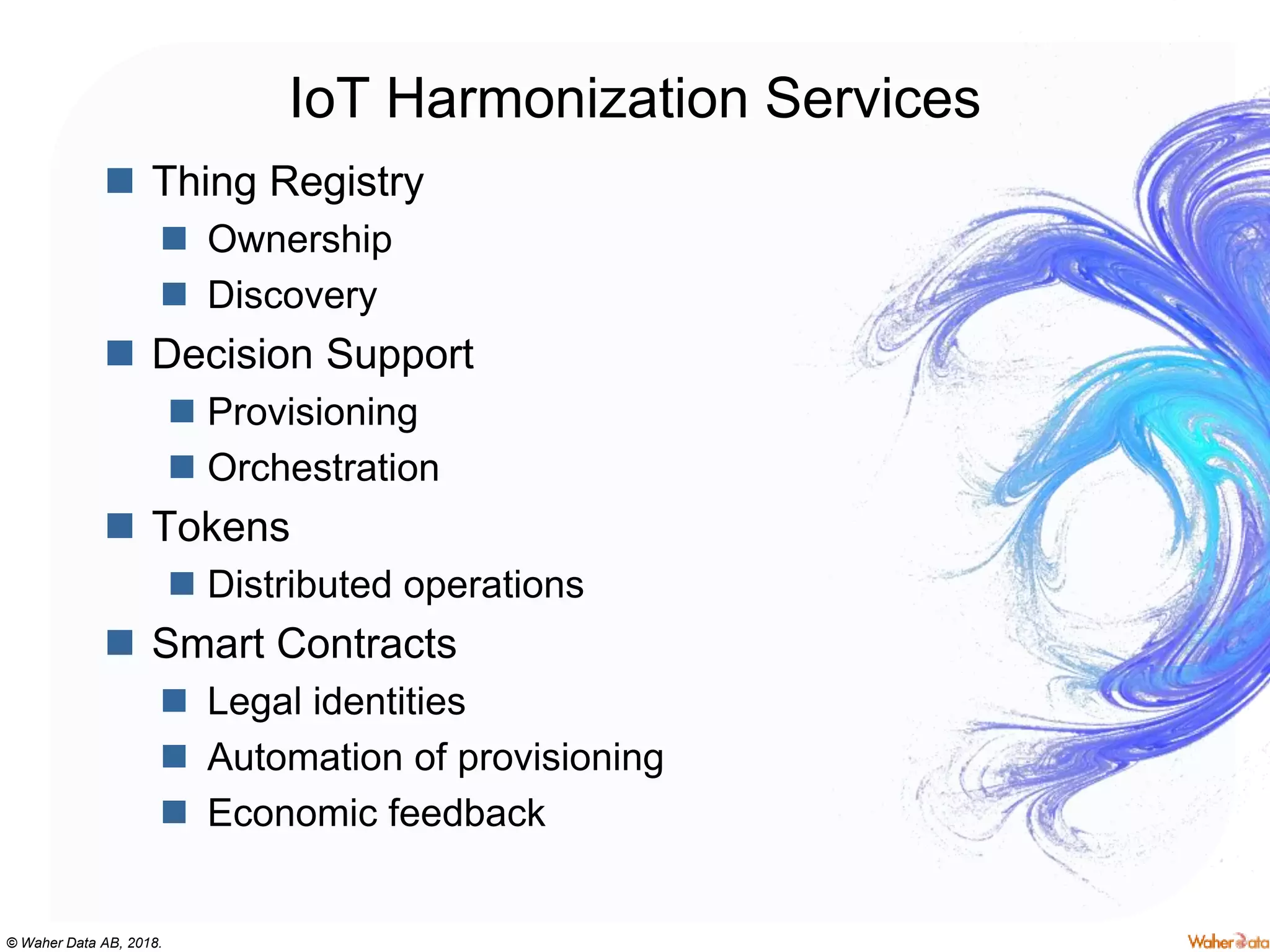
IoT Harmonization Services
 Thing Registry
 Ownership
 Discovery
 Decision Support
 Provisioning
 Orchestration
 Tokens
 Distributed operations
 Smart Contracts
 Legal identities
 Automation of provisioning
 Economic feedback
© Waher Data AB, 2018.
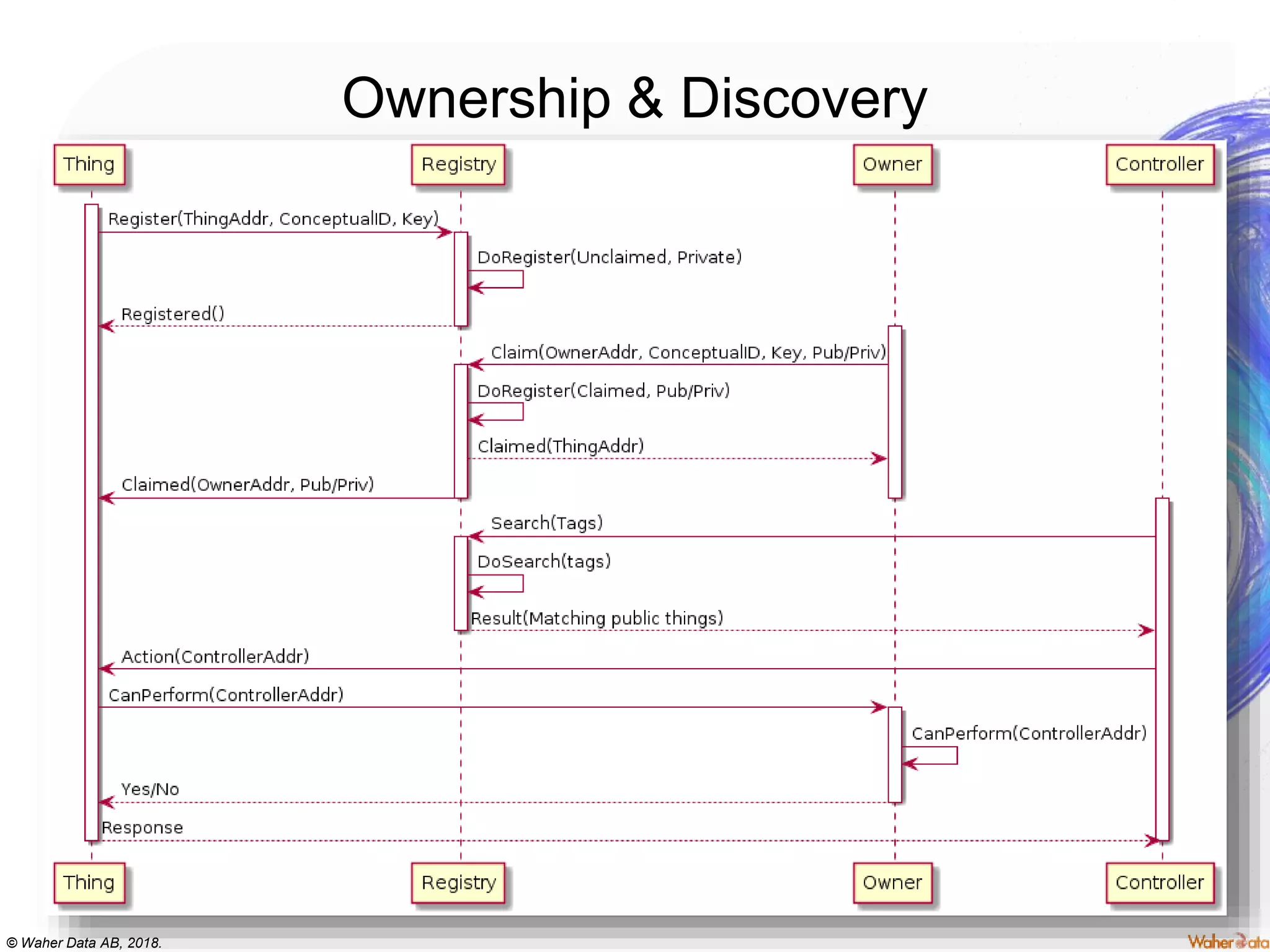
Ownership & Discovery
© Waher Data AB, 2018.
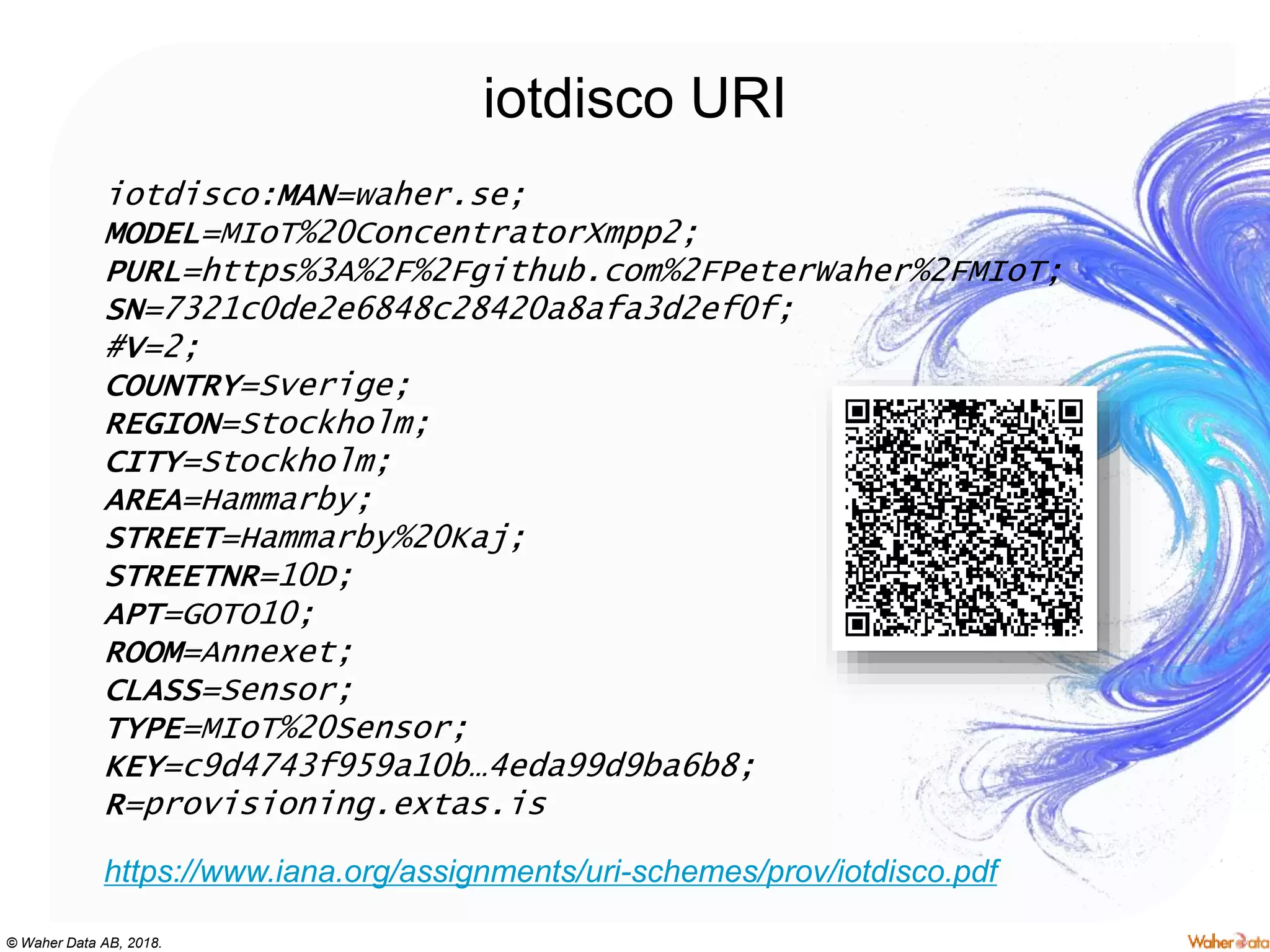
iotdisco URI
iotdisco:MAN=waher.se;
MODEL=MIoT%20ConcentratorXmpp2;
PURL=https%3A%2F%2Fgithub.com%2FPeterWaher%2FMIoT;
SN=7321c0de2e6848c28420a8afa3d2ef0f;
#V=2;
COUNTRY=Sverige;
REGION=Stockholm;
CITY=Stockholm;
AREA=Hammarby;
STREET=Hammarby%20Kaj;
STREETNR=10D;
APT=GOTO10;
ROOM=Annexet;
CLASS=Sensor;
TYPE=MIoT%20Sensor;
KEY=c9d4743f959a10b…4eda99d9ba6b8;
R=provisioning.extas.is
https://www.iana.org/assignments/uri-schemes/prov/iotdisco.pdf
© Waher Data AB, 2018.
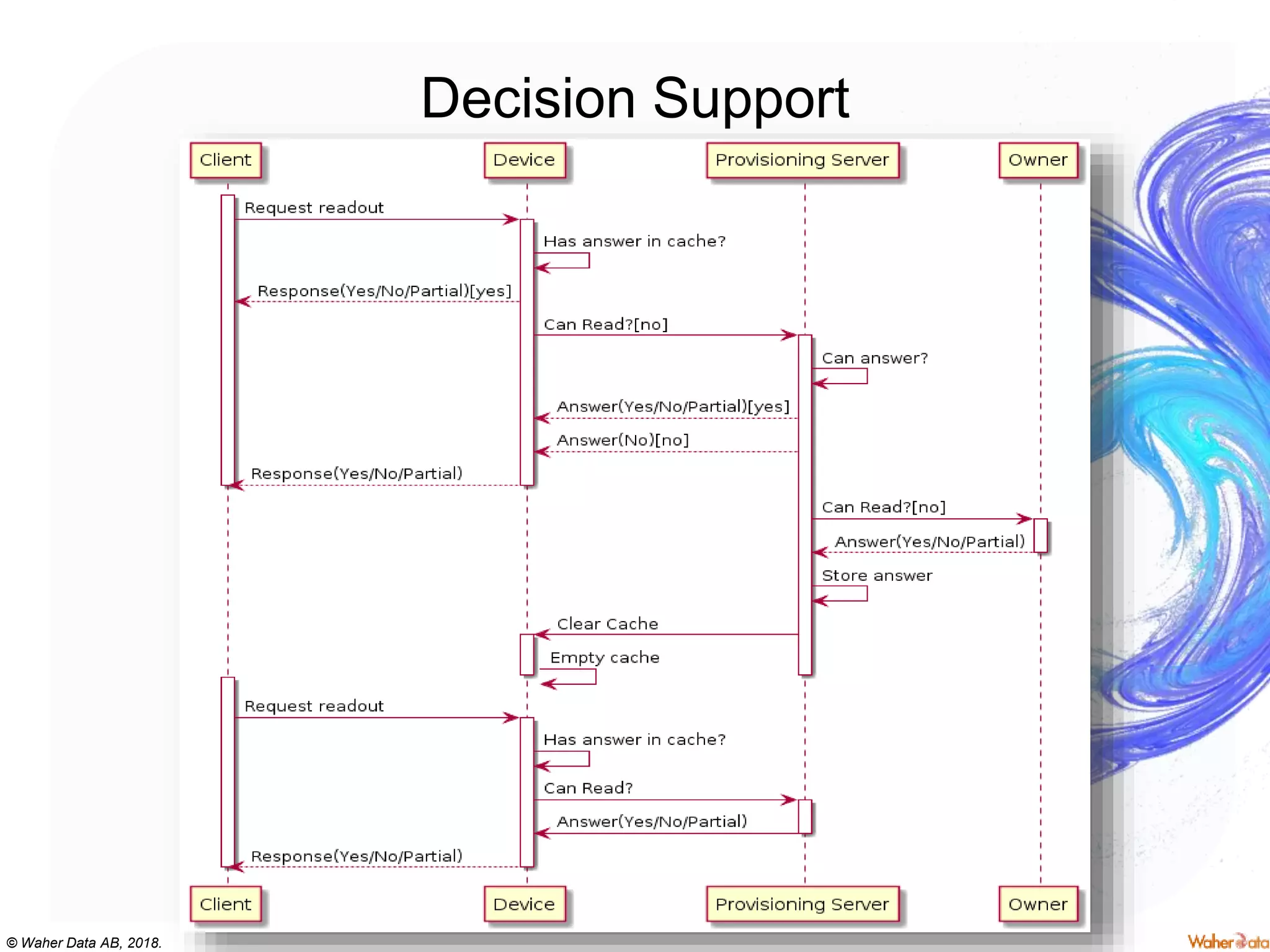
Decision Support
© Waher Data AB, 2018.
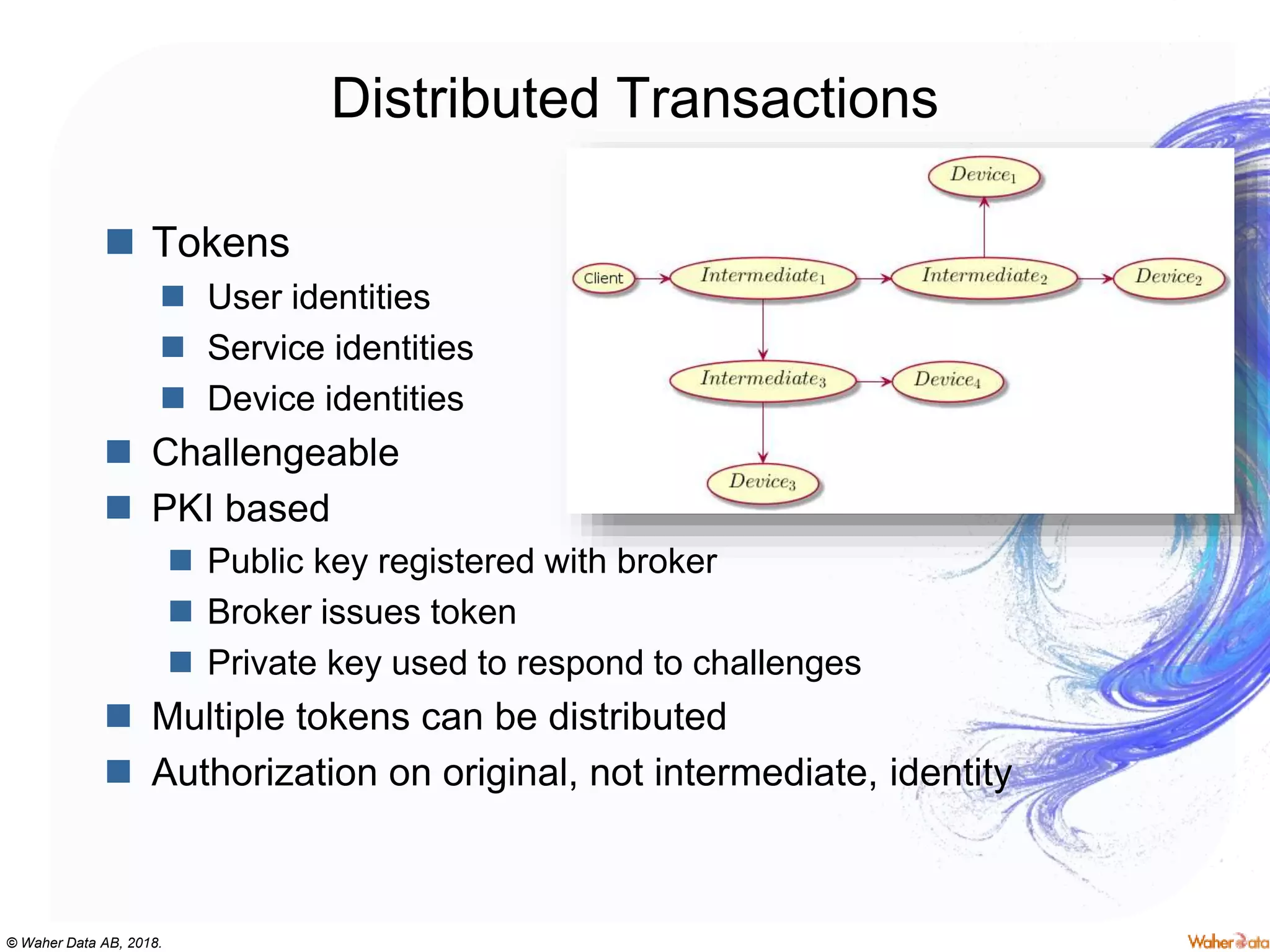
Distributed Transactions
 Tokens
 User identities
 Service identities
 Device identities
 Challengeable
 PKI based
 Public key registered with broker
 Broker issues token
 Private key used to respond to challenges
 Multiple tokens can be distributed
 Authorization on original, not intermediate, identity
© Waher Data AB, 2018.
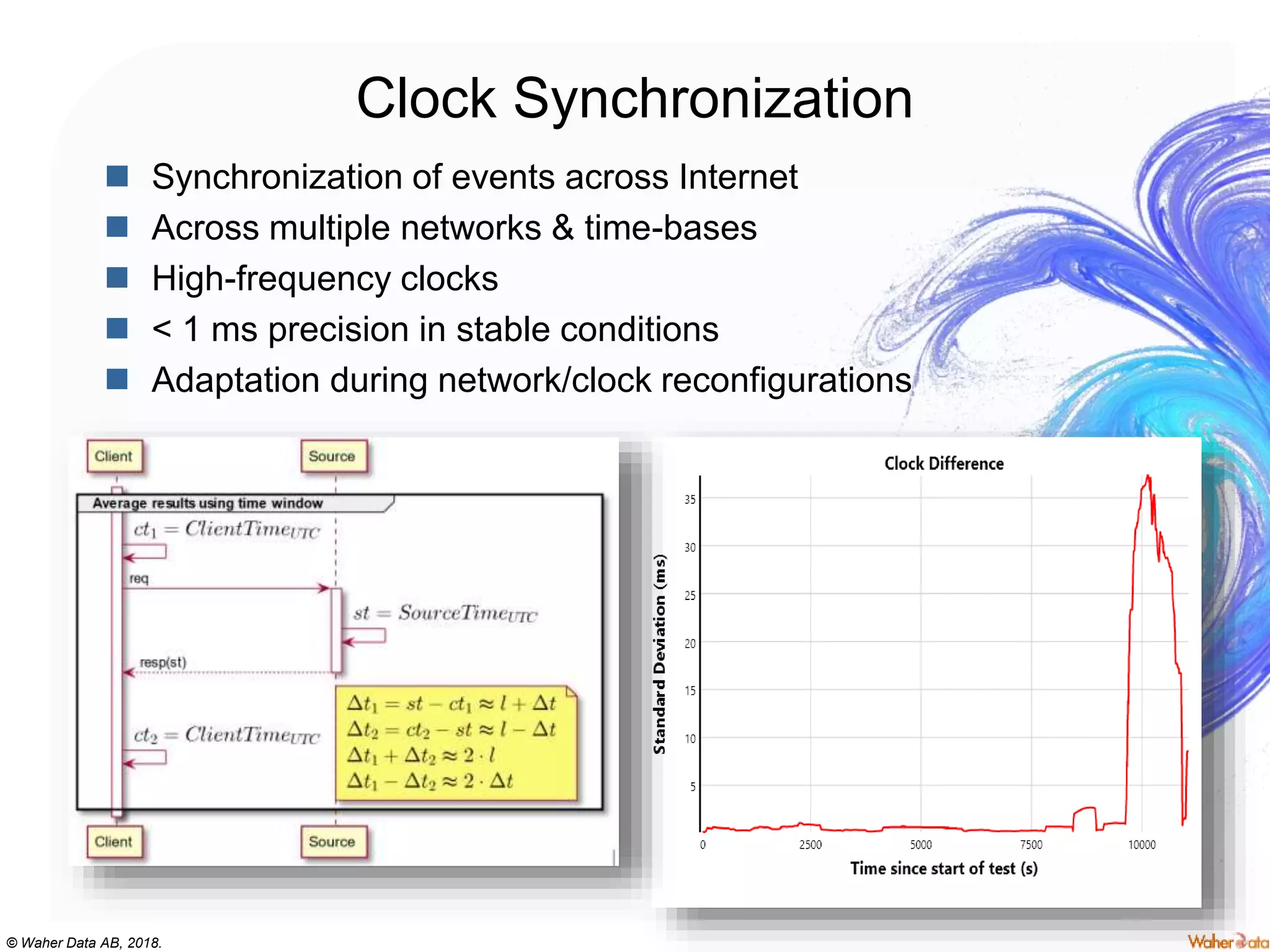
Clock Synchronization
 Synchronization of events across Internet
 Across multiple networks & time-bases
 High-frequency clocks
 < 1 ms precision in stable conditions
 Adaptation during network/clock reconfigurations
© Waher Data AB, 2018.
Smart Contracts
 Legal identities
 Smart Contracts
 Owner defines rules for access
 Automation of Provisioning
 Zero configuration
 Signing smart contract gives access
 Economic Feedback
 Billing based on usage
© Waher Data AB, 2018.
Connectivity
 Direct to XMPP network
 TCP
 HTTP (BOSH)
 Web-socket
 UDP (experimental)
 Via Concentrator (“Thing of Things”)
 Embedded
 Gateway
 Bridge protocols
 Bridge patterns
 System Integration
© Waher Data AB, 2018.
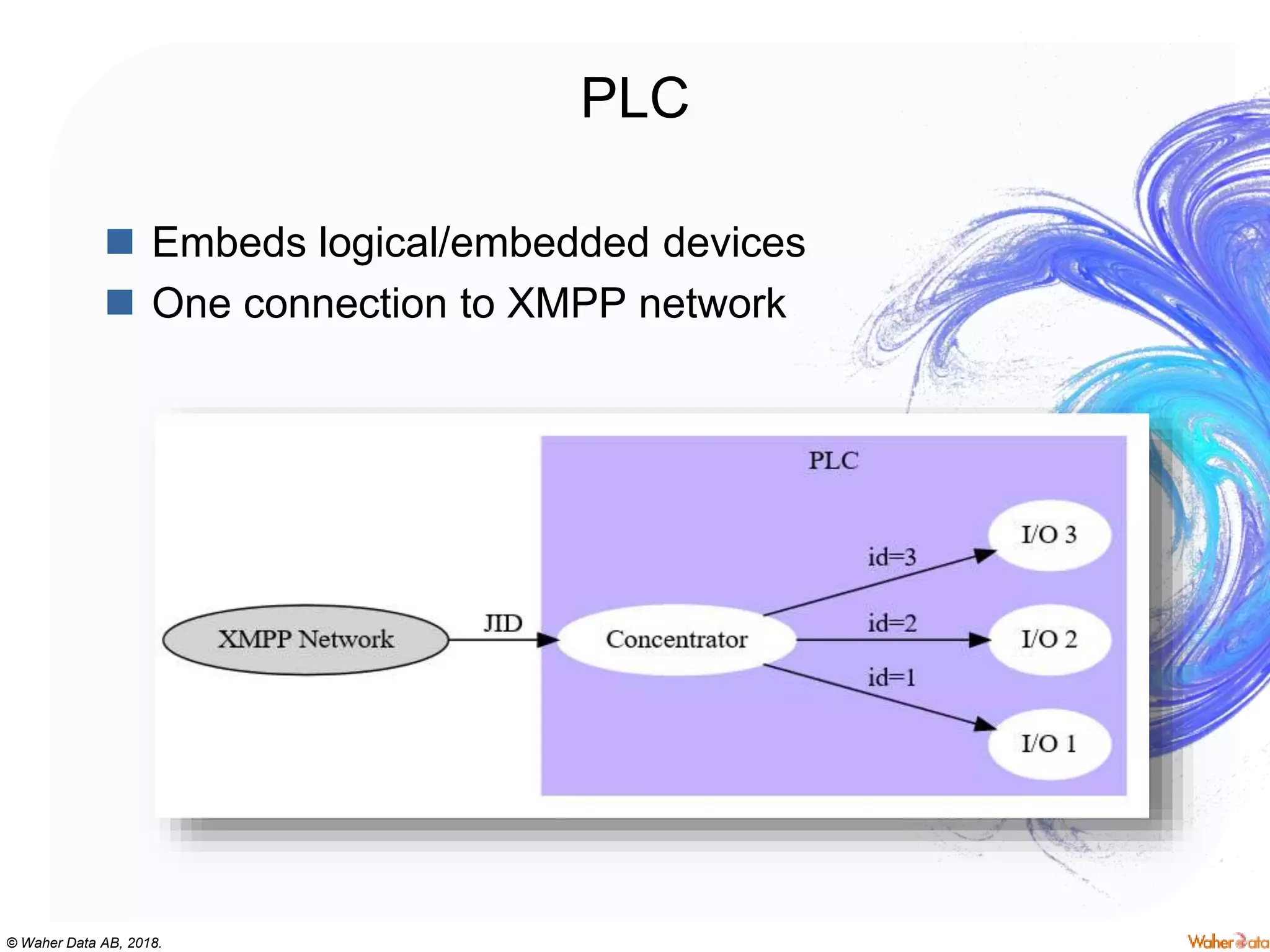
PLC
 Embeds logical/embedded devices
 One connection to XMPP network
© Waher Data AB, 2018.
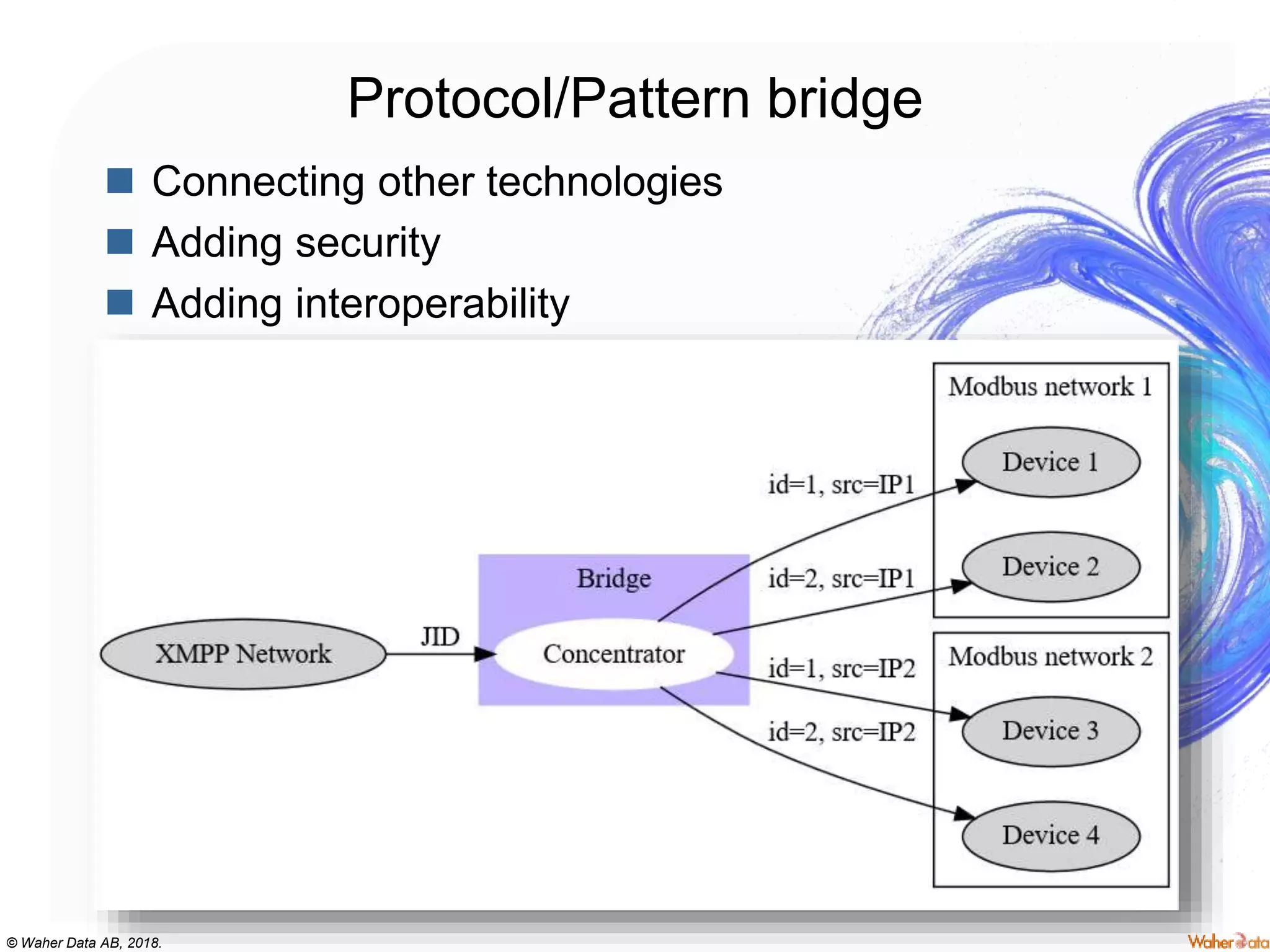
Protocol/Pattern bridge
 Connecting other technologies
 Adding security
 Adding interoperability
© Waher Data AB, 2018.
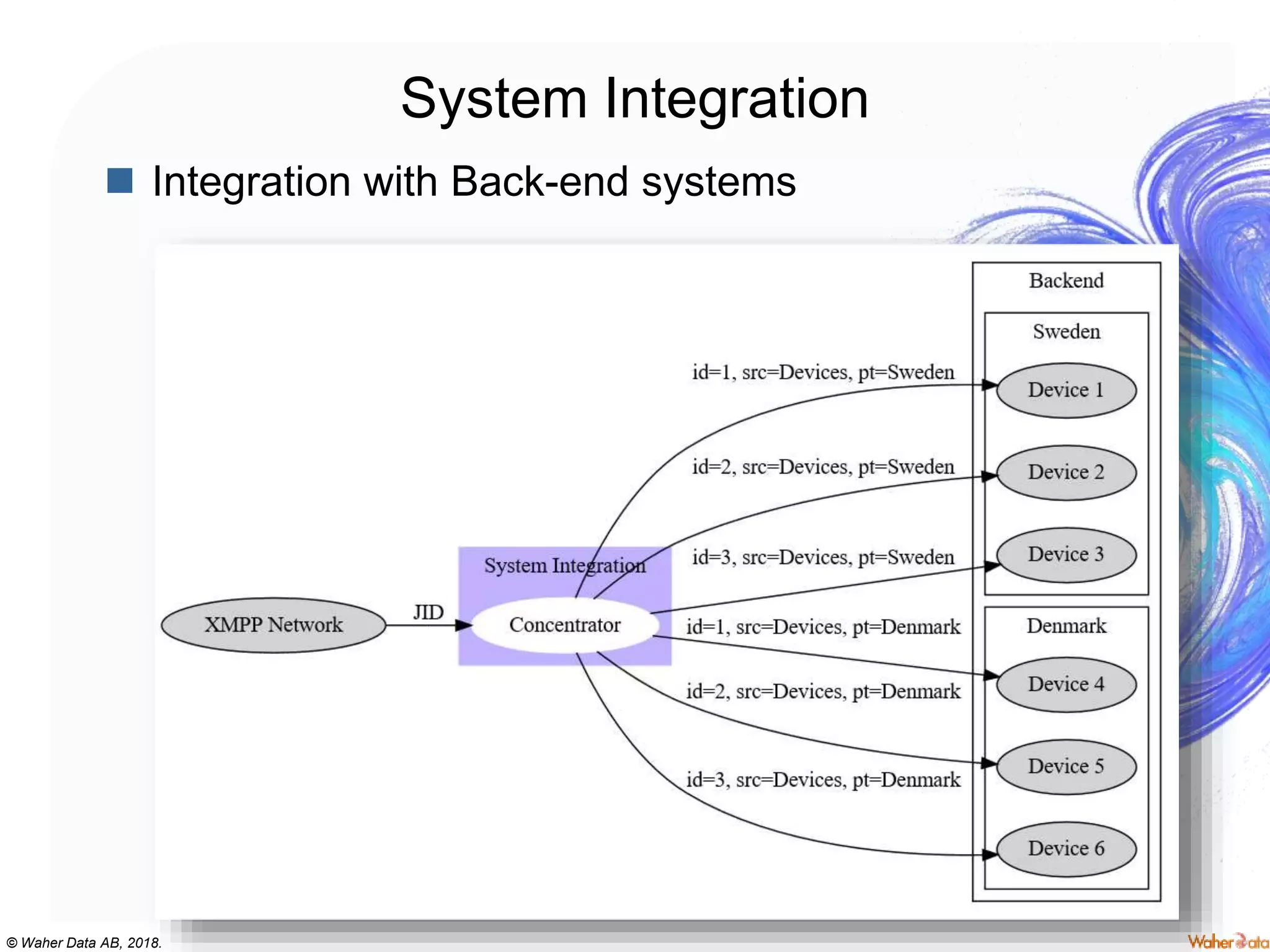
System Integration
 Integration with Back-end systems
© Waher Data AB, 2018.
7. Representation
© Waher Data AB, 2018.
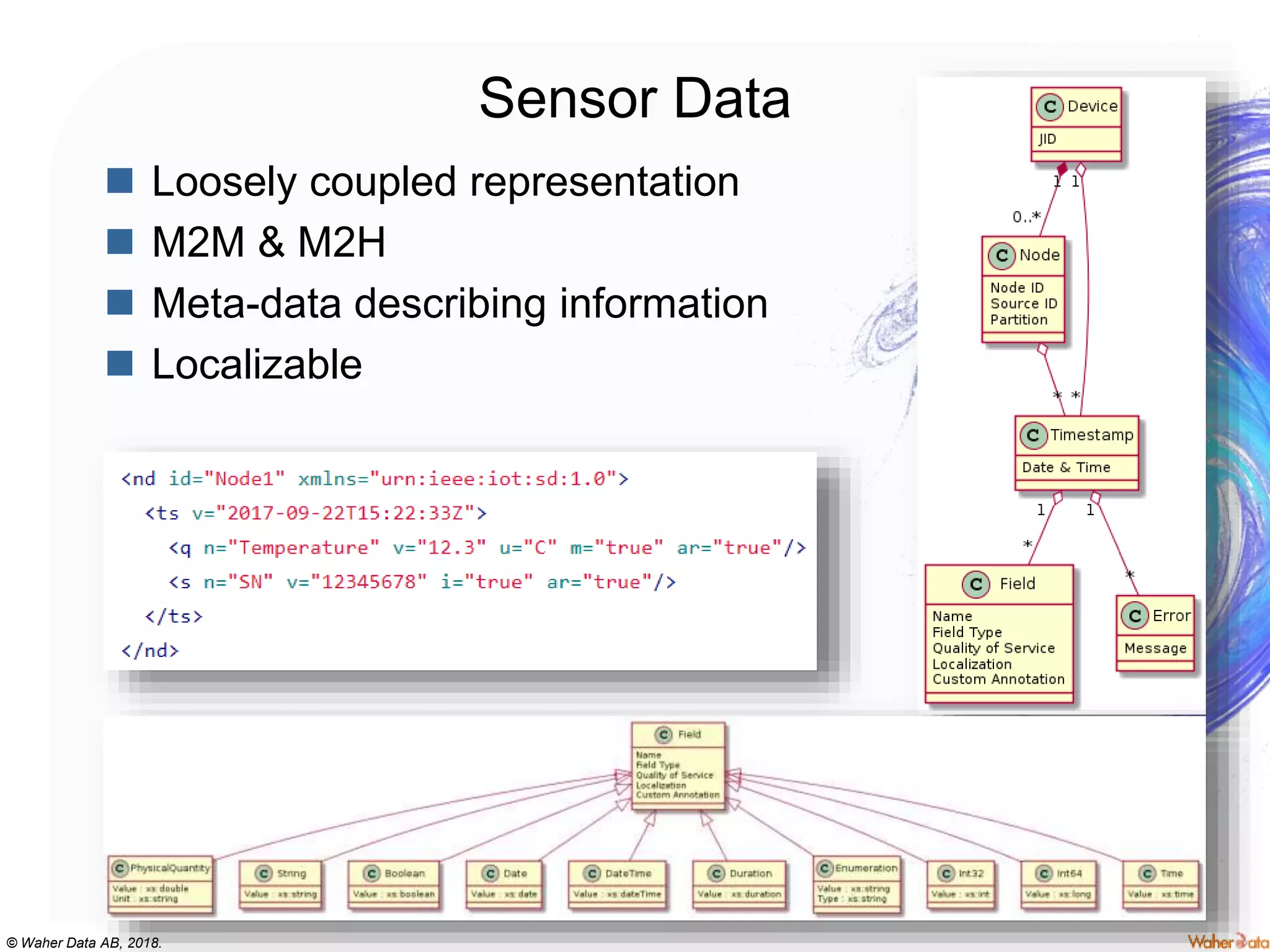
Sensor Data
 Loosely coupled representation
 M2M & M2H
 Meta-data describing information
 Localizable
© Waher Data AB, 2018.
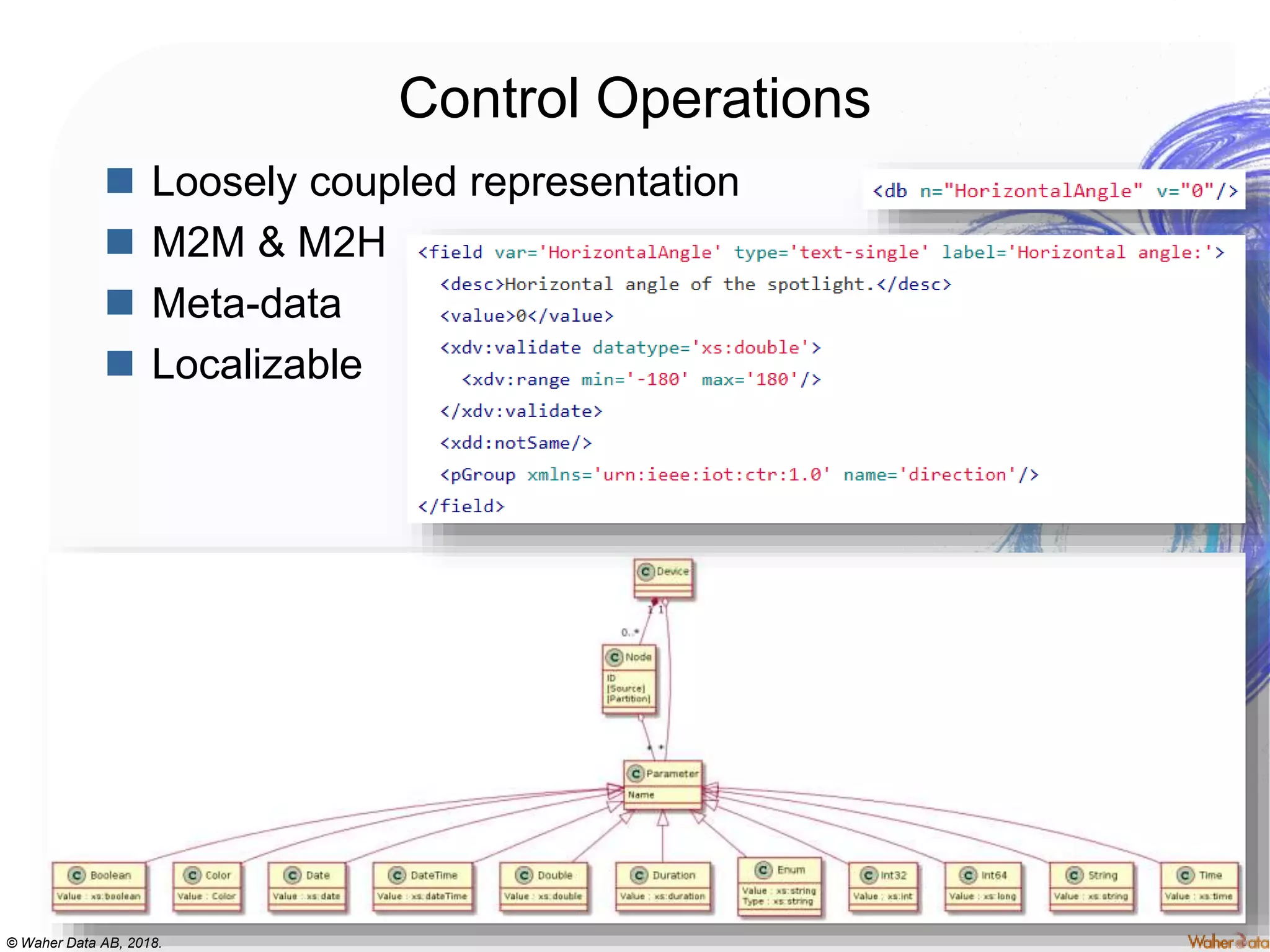
Control Operations
 Loosely coupled representation
 M2M & M2H
 Meta-data
 Localizable
© Waher Data AB, 2018.
8. Operation
© Waher Data AB, 2018.
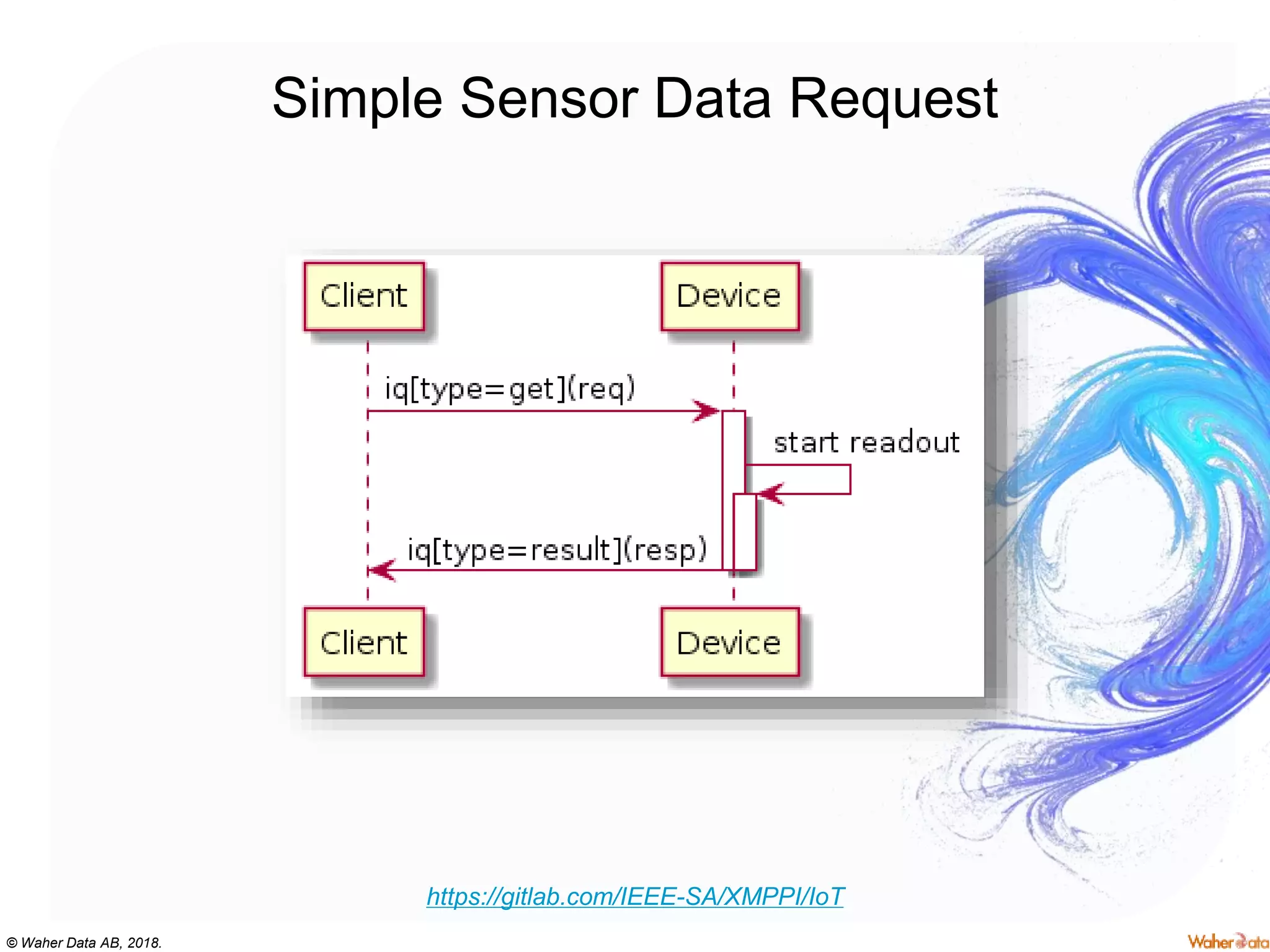
Simple Sensor Data Request
https://gitlab.com/IEEE-SA/XMPPI/IoT
© Waher Data AB, 2018.
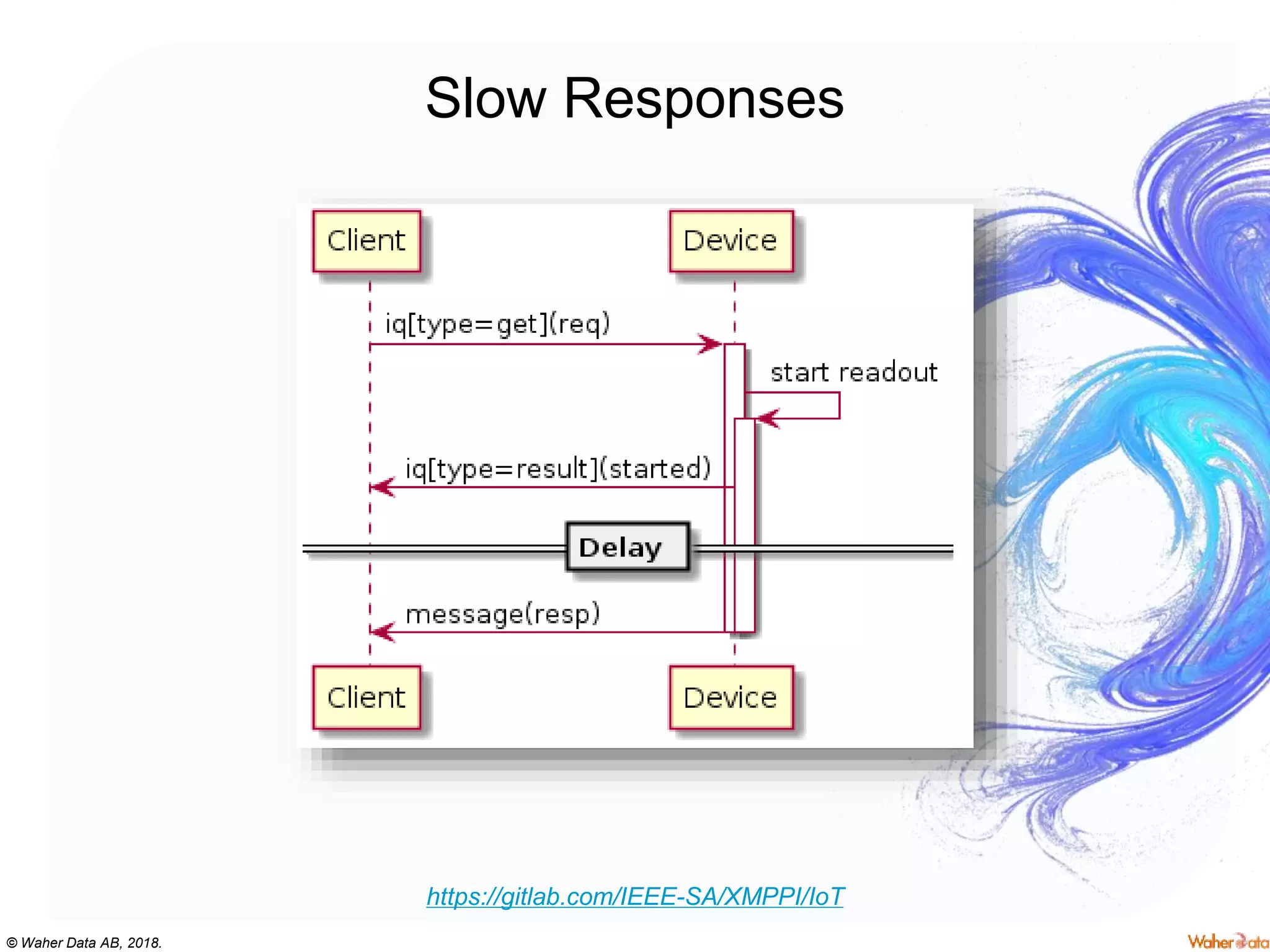
Slow Responses
https://gitlab.com/IEEE-SA/XMPPI/IoT
© Waher Data AB, 2018.
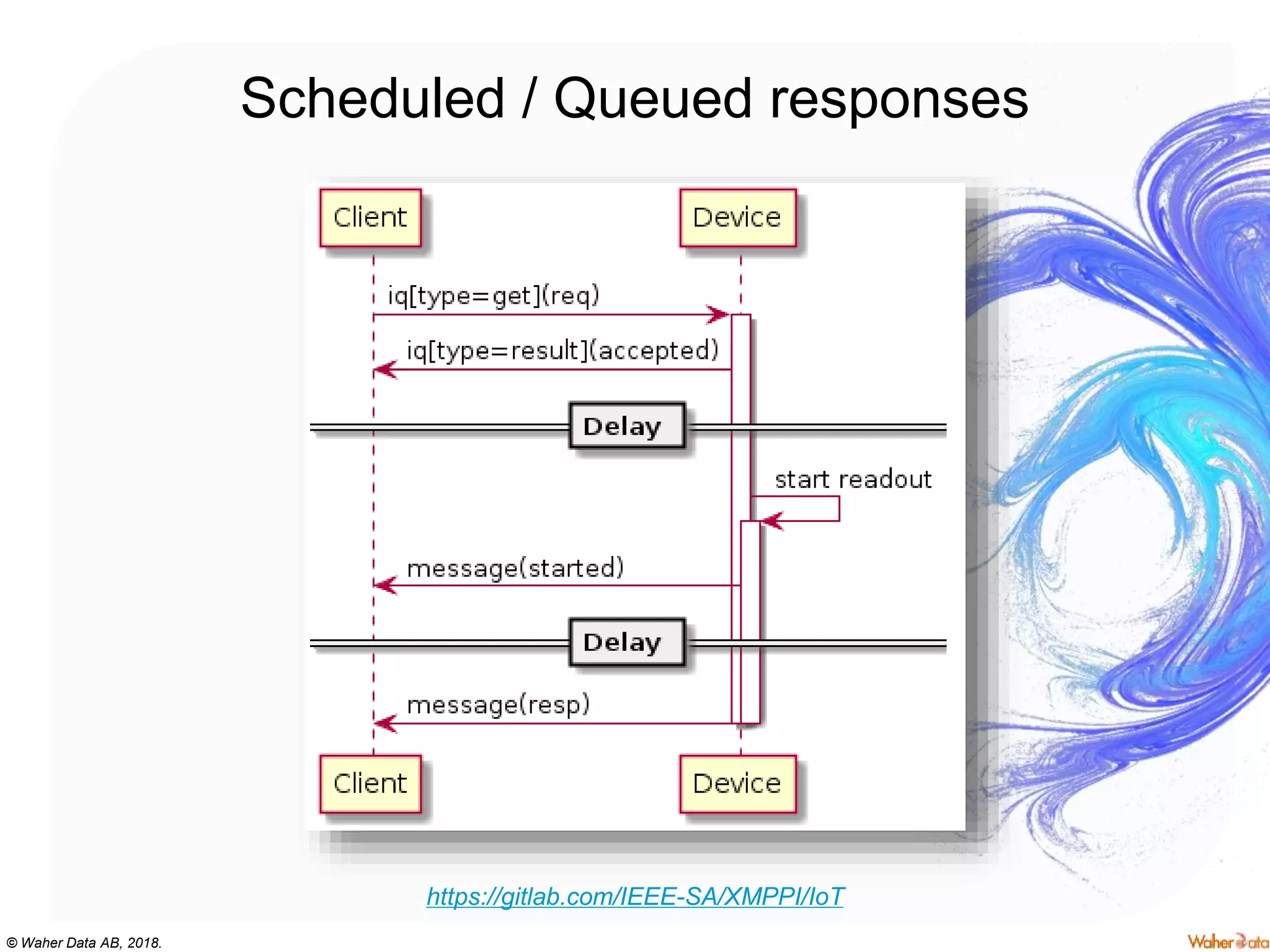
Scheduled / Queued responses
https://gitlab.com/IEEE-SA/XMPPI/IoT
© Waher Data AB, 2018.
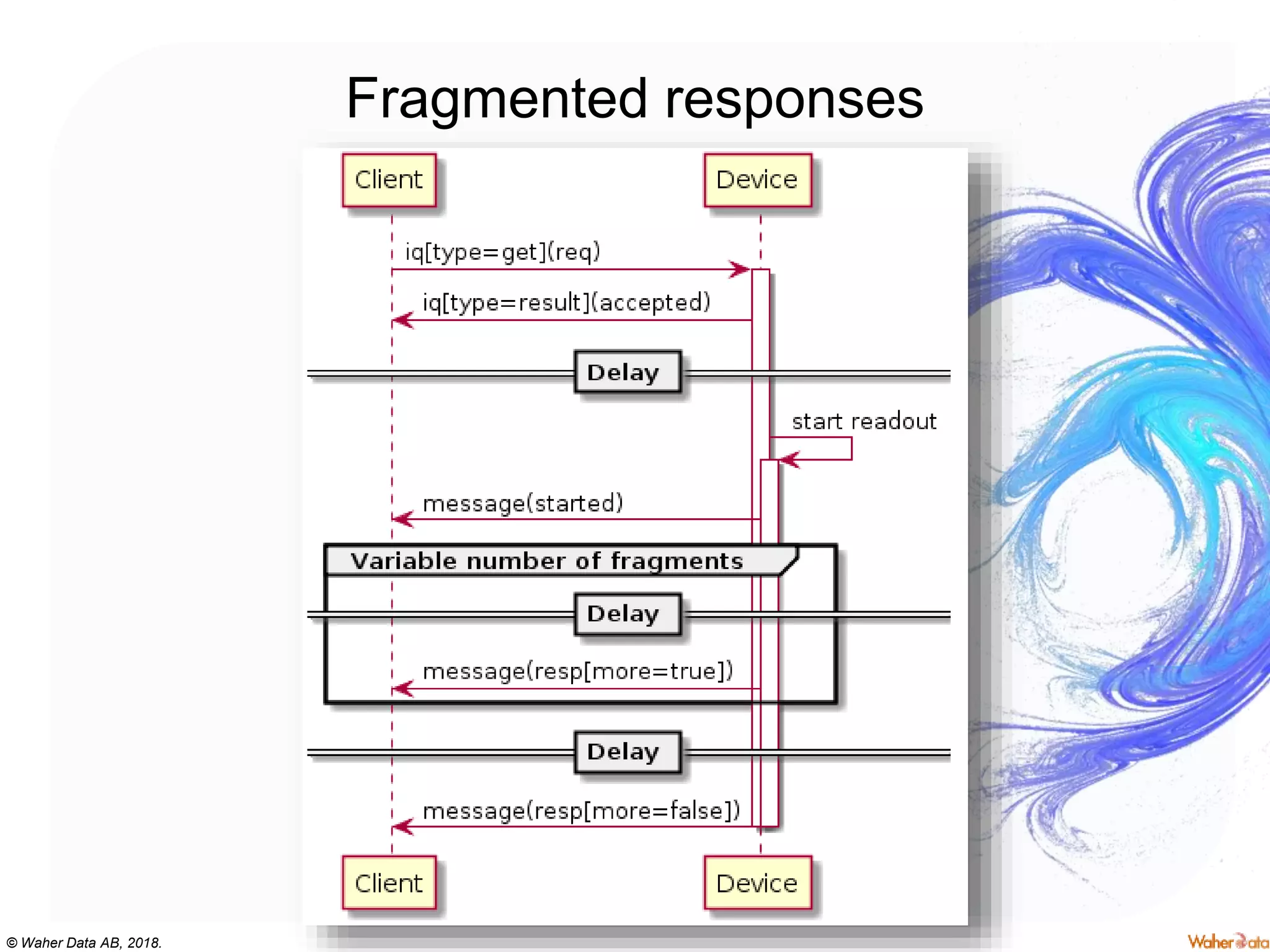
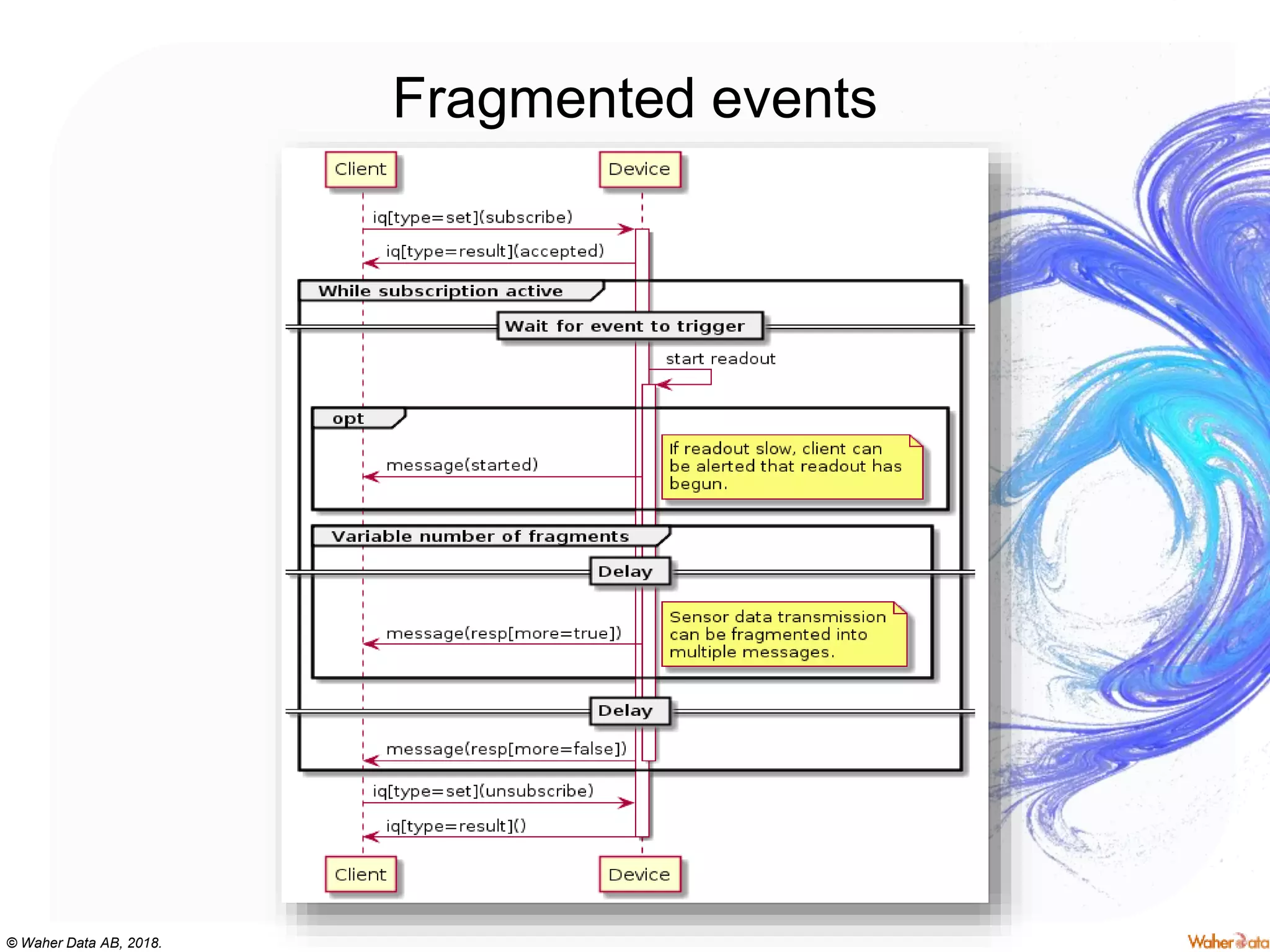
Fragmented responses
© Waher Data AB, 2018.
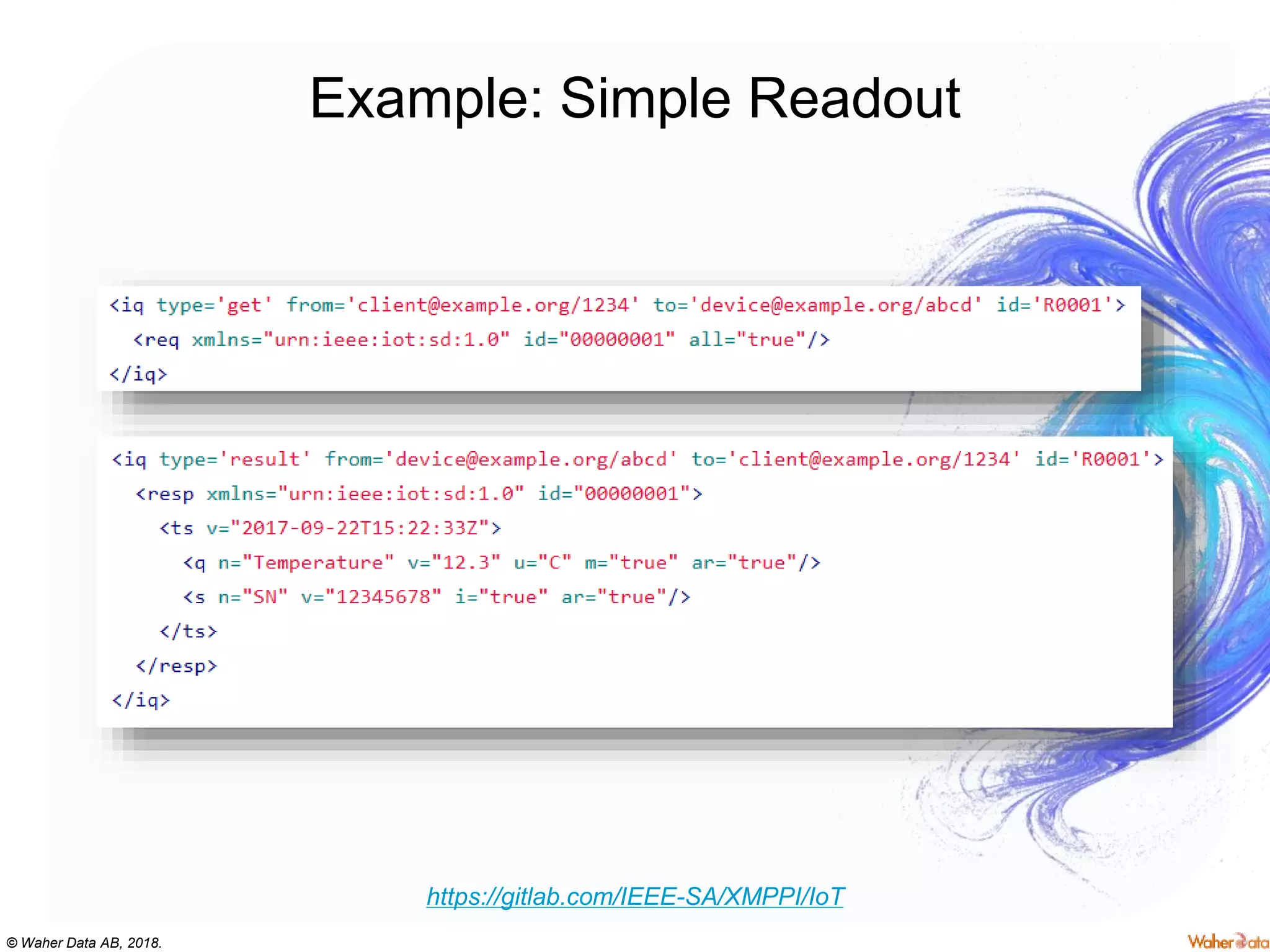
Example: Simple Readout
https://gitlab.com/IEEE-SA/XMPPI/IoT
© Waher Data AB, 2018.
Event Subscription
https://gitlab.com/IEEE-SA/XMPPI/IoT
© Waher Data AB, 2018.
Fragmented events
© Waher Data AB, 2018.
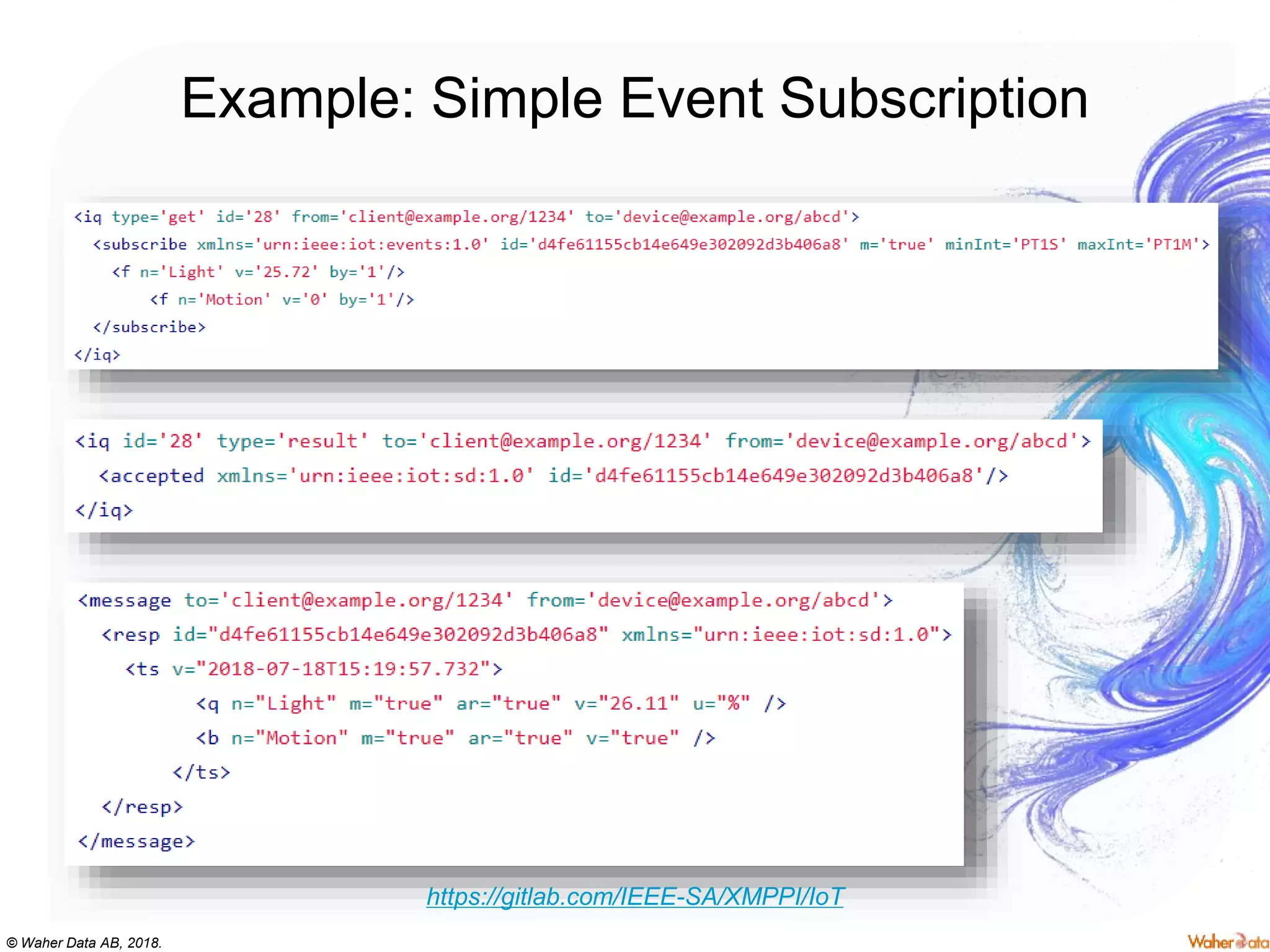
Example: Simple Event Subscription
https://gitlab.com/IEEE-SA/XMPPI/IoT
© Waher Data AB, 2018.
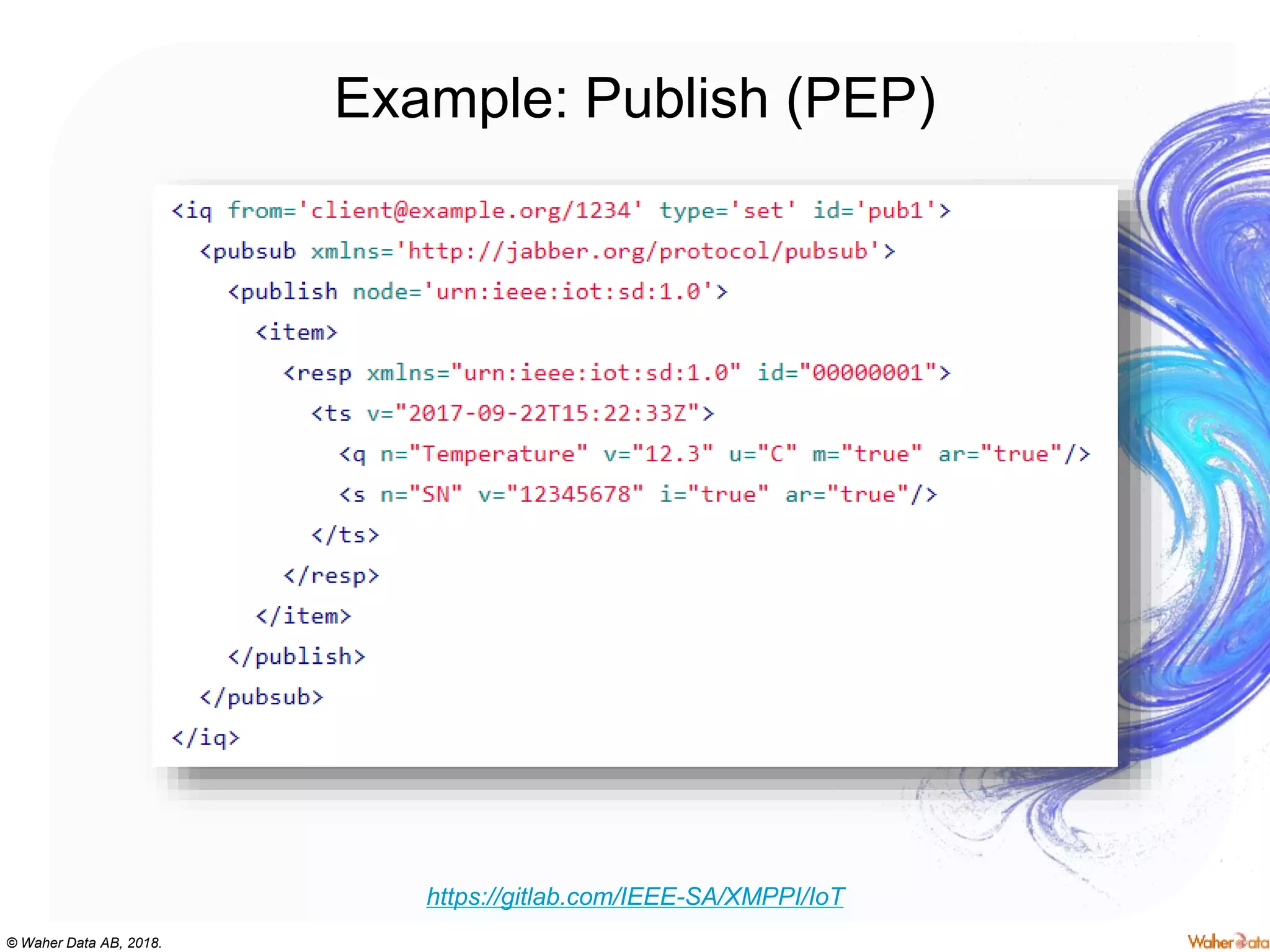
Example: Publish (PEP)
https://gitlab.com/IEEE-SA/XMPPI/IoT
© Waher Data AB, 2018.
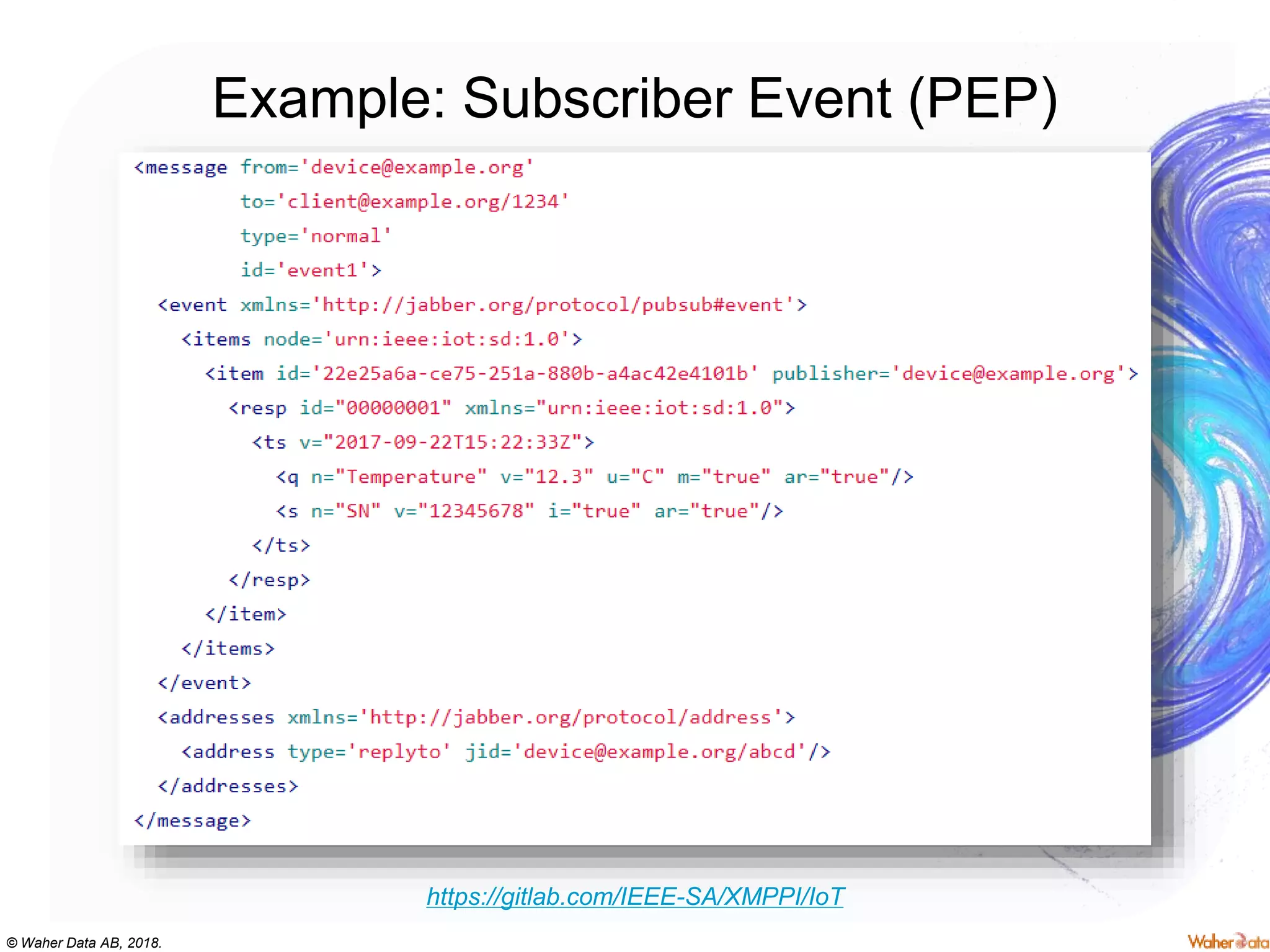
Example: Subscriber Event (PEP)
https://gitlab.com/IEEE-SA/XMPPI/IoT
© Waher Data AB, 2018.
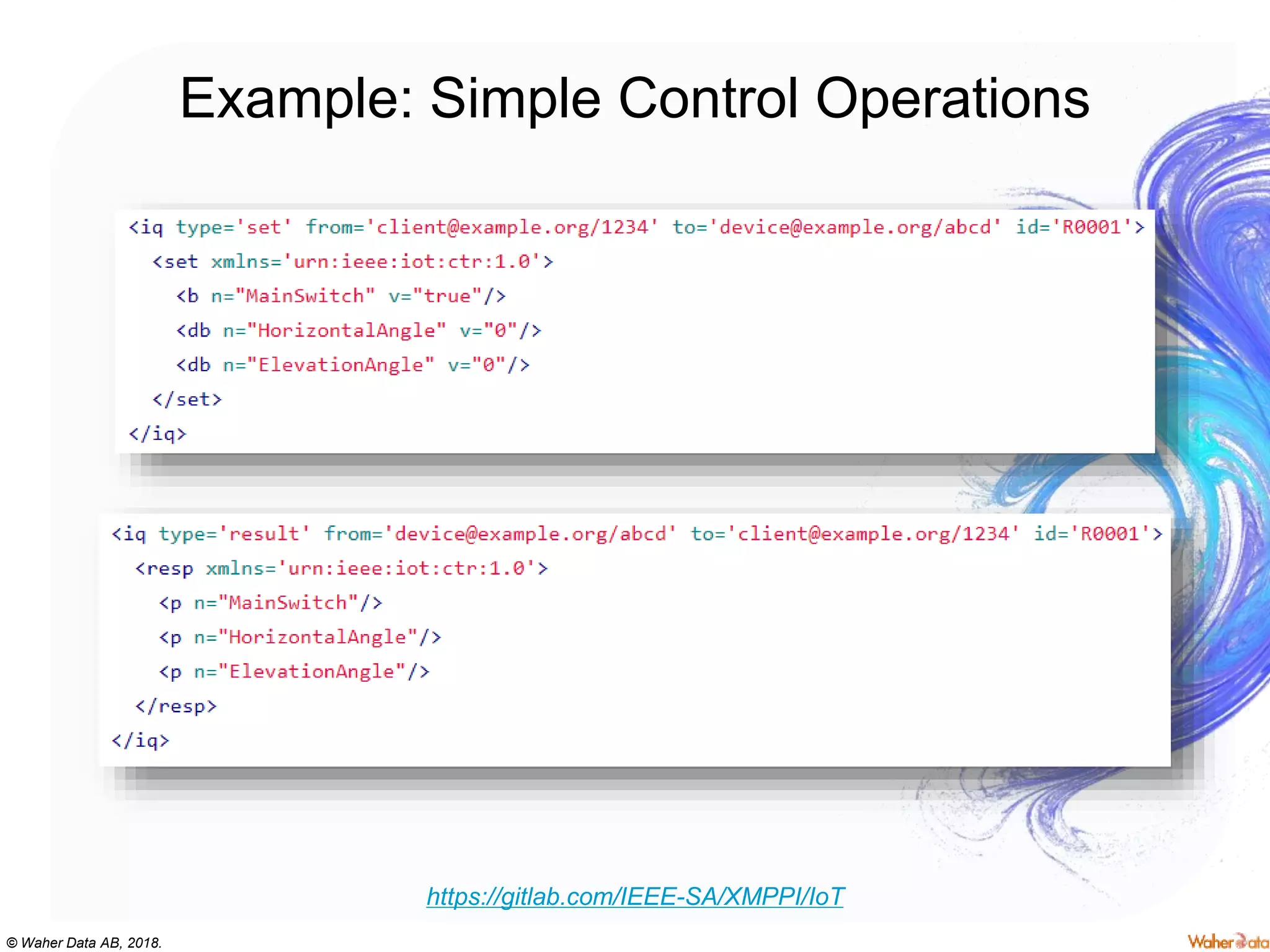
Example: Simple Control Operations
https://gitlab.com/IEEE-SA/XMPPI/IoT
© Waher Data AB, 2018.
9. Events
© Waher Data AB, 2018.
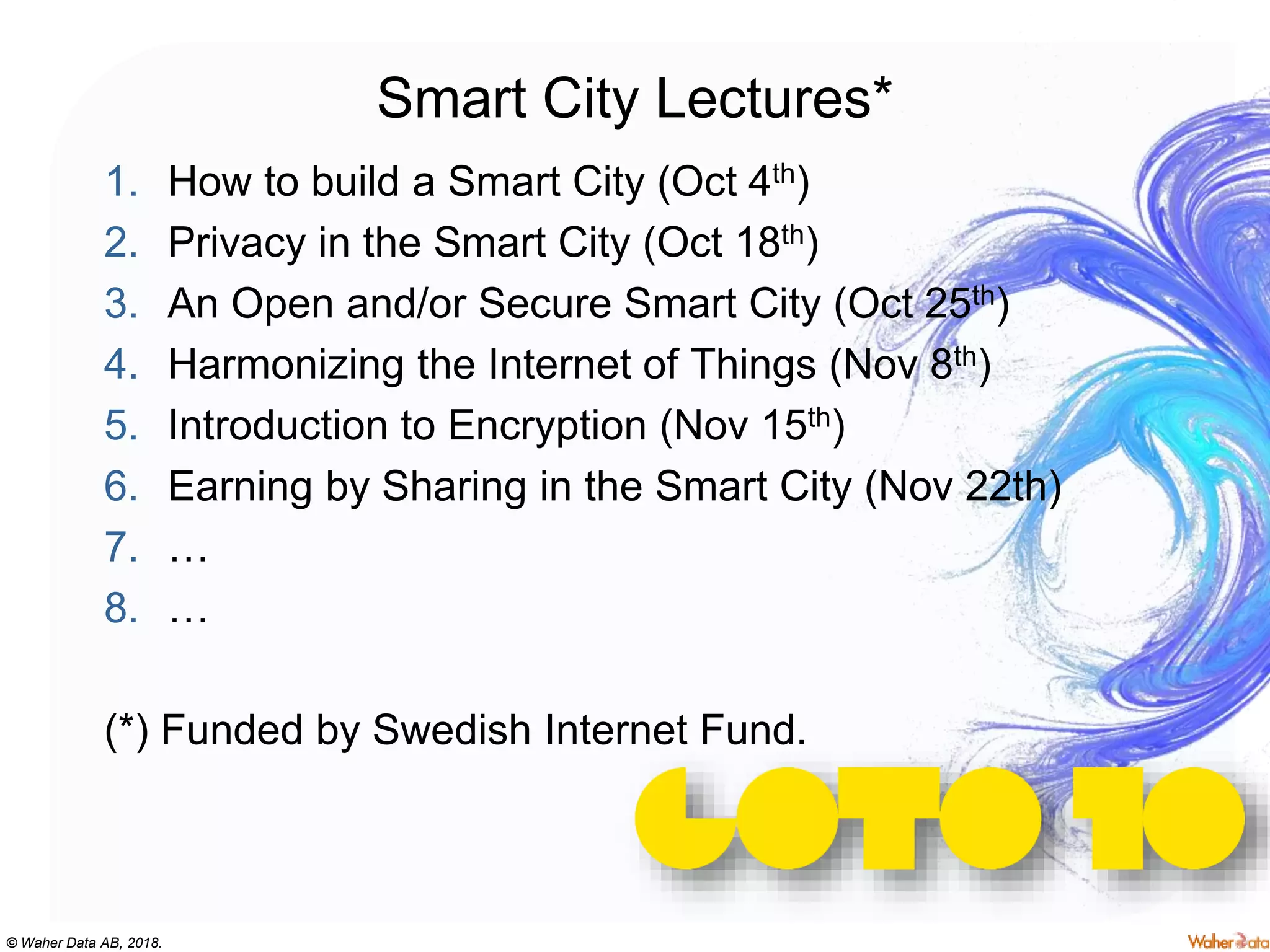
Smart City Lectures*
1. How to build a Smart City (Oct 4th)
2. Privacy in the Smart City (Oct 18th)
3. An Open and/or Secure Smart City (Oct 25th)
4. Harmonizing the Internet of Things (Nov 8th)
5. Introduction to Encryption (Nov 15th)
6. Earning by Sharing in the Smart City (Nov 22th)
7. …
8. …
(*) Funded by Swedish Internet Fund.
© Waher Data AB, 2018.
Smart City Labs*
1. Sensors and actuators (Oct 10th)
2. Connect and chat with your device (Oct 17th)
3. Publishing data from your sensor (Oct 24th)
4. Publishing and discovering devices (Nov 7th)
5. Controlling actuators (Nov 14th)
6. Decision Support for your devices (Nov 21th)
7. …
8. …
(*) Funded by Swedish Internet Fund.
© Waher Data AB, 2018.
 Raspberry Pi & Arduino
 Sensors, Actuators, Controllers,
Concentrators, Bridges
 Protocols:
MQTT, HTTP, CoAP, LWM2M, XMPP
 Interoperability
 Social Interaction
 Decision Support
 Product Lifecycle
 IoT Service Platforms
 IoT Harmonization
 Security
 Privacy
Amazon
Packt
Microsoft Store
Contact: https://waher.se/, https://littlesister.se/
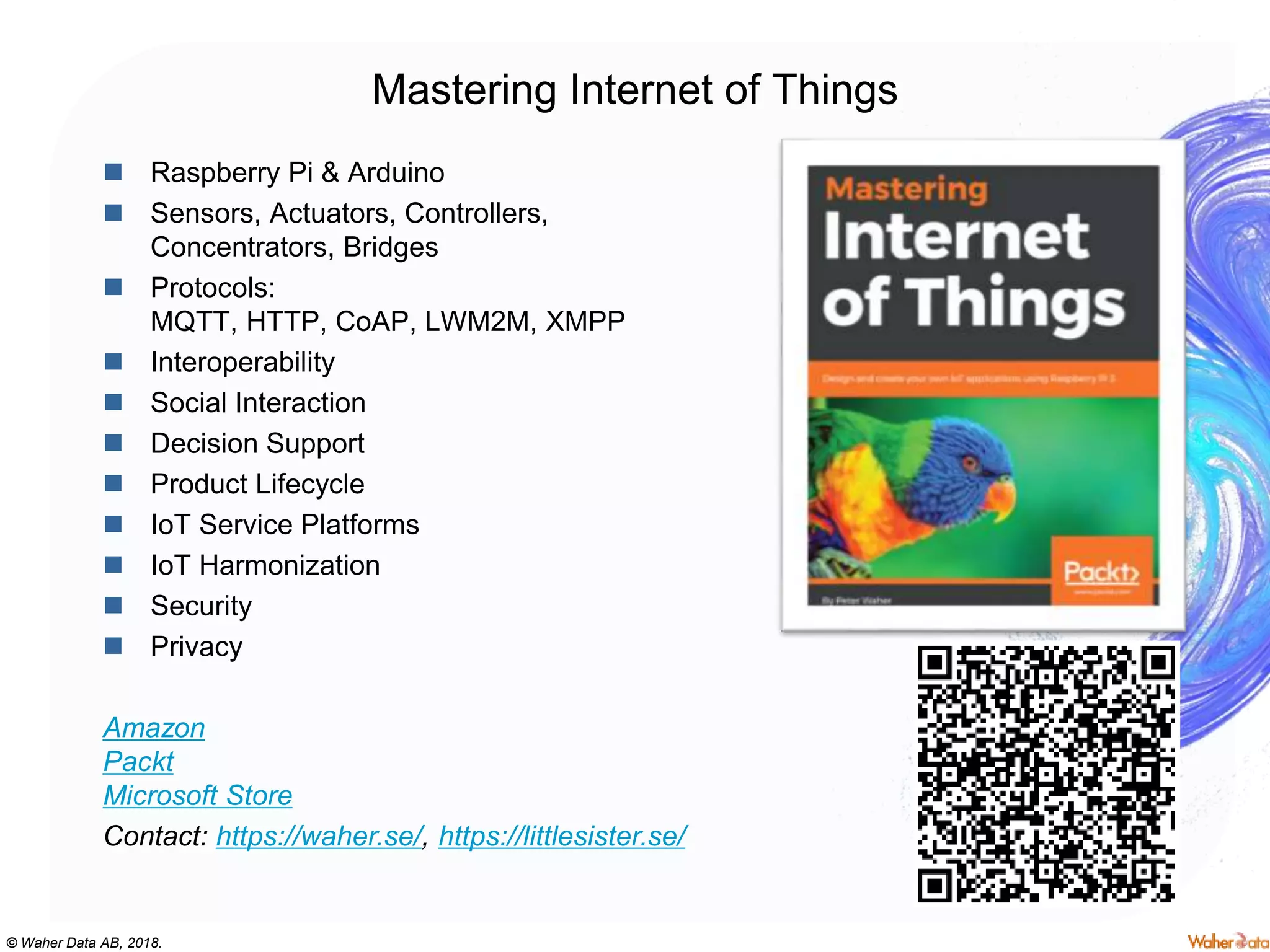
Mastering Internet of Things
© Waher Data AB, 2018.
10. Open Discussion
Ownership?
Privacy?
Security?
Surveillance?
Interoperability?
Cool stuff?
Qué?
Where’s the Money?
Who pays?
What could go wrong?
Little Sister?
Harmonization?

Smart City Lecture 4 - Harmonizing the Internet of Things

  • 1.
    © Waher DataAB, 2018. Smart City Lecture 4 Harmonizing the Internet of Things
  • 2.
    © Waher DataAB, 2018. 1. Recapture
  • 3.
    © Waher DataAB, 2018. Smart City / Society  Automation  Open Data  Transport  Traffic (C-ITS)  Parking  Utilities  Health Care  Law enforcement  Schools  Libraries  Waste management  Citizens?  … Smart for whom?
  • 4.
    © Waher DataAB, 2018. Vision of a Smart City  Ubiquitous access to interoperable sensors and things.  Ubiquitous access to data and information from society’s authorities.  Access to smart services in all niches of society.  Definition of ownership of information.  Protection of Privacy, by design and by default.  Market for access to things and data.
  • 5.
    Ex-Director of NationalIntelligence James R. Clapper http://www.popsci.com/clapper-americas-greatest-threat-is-internet-things ”America's greatest threat is the Internet of Things” Feb 9, 2016
  • 6.
    © Waher DataAB, 2018. Vulnerabilities  National Security  Exploiting  Surveillance  Logistics  Utilities  Health Care  Traffic (C-ITS)  Residential systems  Law enforcement  Waste management  Schools  Parking  Libraries  Monitoring citizens  …
  • 7.
    © Waher DataAB, 2018. What must Governments do? Governments must make sure to provide a strong foundation on which smart services can be built.  Broadband access were infrastructure projects.  Giving access to broadband for everyone was a strategy.  Likewise, Smart City Infrastructure must be defined, required in RFPs, and provided to everyone.
  • 8.
    © Waher DataAB, 2018. Options? Sealed secure systems? or Open, Interoperable, but vulnerable systems? or is it possible to have: Open, Interoperable & secure systems?
  • 9.
    © Waher DataAB, 2018. 2. Openness + Security For Things
  • 10.
    © Waher DataAB, 2018. Strong Foundation Things are “stupid” and need help with:  Decision Support  Ownership  Owner consent  Lifecycle  Transfer of ownership  Decommissioning  Discovery  Interoperability  Data  Operationsc
  • 11.
    © Waher DataAB, 2018. IoT Harmonization (IEEE 1451-99)  Sensor Data  Control Operations  Localization (M2M, M2H)  Tokens for distributed transactions  Decision Support (for devices)  Provisioning (for owners)  Peer-to-Peer communication  End-to-end encryption  Concentrator/Bridge (“Thing of things”)  Discovery  Ownership  Clock Synchronization  Secure Account Creation  Legal Identities  Contracts  Automated provisioning  Economic feedback https://gitlab.com/IEEE-SA/XMPPI/IoT
  • 12.
    © Waher DataAB, 2018. Backbone  Efficiency  Interoperability  Global scalability  Bridges technologies vs
  • 13.
    © Waher DataAB, 2018. Interoperability
  • 14.
    © Waher DataAB, 2018. Horizontal Markets Loose coupling permits new roles:
  • 15.
    © Waher DataAB, 2018. Features Summary Blockchain CoAP HTTP LWM2M MQTT XMPP IoT Harmonization Identities ✓ ✓ ✓ ✓ ✓ Authentication ✓ ✓ ✓ ✓ ✓ Authorization ✓ ✓ ✓ Encryption ✓ ✓ ✓ ✓ ✓ ✓ End-to-End Encryption ✓ ✓ Consent ✓ ✓ Decentralized ✓ ✓ ✓ ✓ By design ✓ ✓ ✓ Asynchronous Messages ✗ ✓ ✓ ✓ ✓ Request / Response ✗ ✓ ✓ ✓ ✓ ✓ Publish / Subscribe ✗ ✓ ✓✓✓ ✓✓✓ Federation ✗ ✓ ✓ ✓ ✓ Broker ✗ ✓ ✓ ✓ Serverless ✗ ✓ ✓ ✓ P2P7 ✗ ✓ ✓ Personal ✓ ✓✓✓ ✓✓ ✓✓ ✓ ✓✓✓✓ ✓✓✓✓ Interoperability ✗ ✓✓ ✓✓ ✓✓✓ ✓ ✓ ✓✓✓ Plurality ✓ ✓✓✓✓✓ ✓✓✓✓✓ ✓✓ ✓✓ ✓✓✓✓✓ ✓✓✓✓✓ Law ✓✓✓✓ ✗ ✓ ✓ ✗ ✓ ✓✓✓✓ Transparency ⋆⋆ ⋆⋆⋆⋆ ⋆⋆⋆⋆ ⋆⋆⋆ ⋆⋆ ⋆⋆ ⋆⋆⋆⋆ Privacy ✗ ✓ ✓ ✓ ✓ ✓✓ ✓✓✓✓ 11 21 20 19 10 32 41
  • 16.
    © Waher DataAB, 2018. 3. Harmonizing the IoT for the Smart City / Society
  • 17.
    © Waher DataAB, 2018. Failed expectations Development of IoT not as projected  What is missing? Ericsson, 2010: (about 2020) IoT Analytics, 2018: (about 20B, if you stretch)
  • 18.
    © Waher DataAB, 2018. Driving forces of the Smart Society  Local support and knowledge  Access to data and things  Cross fertilization of domains  Reuse of existing equipment  Openness and transparency  Simple and quick integration  Standardized interfaces  Economy
  • 19.
    © Waher DataAB, 2018. Dilemma Would you publish your things on the Internet?  You would add risk to your solution  You would degrade the performance  Competitors could do what you do  But cheaper (they don’t have to buy equipment) A crucial element is missing, for IoT to boom.
  • 20.
    © Waher DataAB, 2018. Standards Interoperability is based on standards. Standards are required for:  Communication  Representation  Operation  Security  Privacy  Discovery  Decision support  Economic feedback models
  • 21.
    © Waher DataAB, 2018. IEEE IoT Harmonization WG Goals of the group is to:  Harmonize IoT technologies  Use XMPP as backbone to bridge IoT islands  Standardize use of XMPP  Sensor Data  Control  Concentrator  Thing Registries  Provisioning  Economic feedback models  Smart Contracts  Counting of usage https://standards.ieee.org/project/1451-99.html
  • 22.
    © Waher DataAB, 2018. Openness Any attempt to harmonize technologies must be:  Globally scalable  Decentralized  No centralized authority  Support processing on the edge  Federated  Division of responsibilities  Open  Support ad hoc networks XMPP has proved track record
  • 23.
    © Waher DataAB, 2018. Security XMPP Provides:  Strong global identities  Authenticated access to network  Consent-based authorization (for access)  Ubiquitous (Transport) Encryption IoT Harmonization adds:  Secure/Managed identity creation  Defines Ownership  Decision Support for things  Detailed authorization for things (for operations)  Peer-to-Peer Communication  End-to-End Encryption Data Protection by design & by default
  • 24.
    © Waher DataAB, 2018. Flexibility Any attempt to harmonize technologies must also support common patterns:  Asynchronous messaging  Request / Response  Event Subscription (Observe)  Multicasting  Publish / Subscribe  Federation  Edge Computing IEEE IoT Harmonization is built on XMPP
  • 25.
    © Waher DataAB, 2018. 4. XMPP
  • 26.
    © Waher DataAB, 2018. What is XMPP? eXtensible Messaging and Presence Protocol  Standardized by the IETF  RFC 6120  RFC 6121  RFC 6122  Originally developed in the late 1990-ies.  Instant Messaging  “Jabber”  Based on XML
  • 27.
    © Waher DataAB, 2018. Basic features Some basic features of XMPP include:  Global scalability (federation)  Extensibility (namespaces)  Robustness (20 years of operation)  Open (public & free)  Standardized  Secure  Interoperable
  • 28.
    © Waher DataAB, 2018. Communication  Brokers  Accounts  Rosters  Routing  Federation  Topology insensitive  Server-less  Peer-to-peer  Authentication  SASL  Encryption  TLS  E2E
  • 29.
    © Waher DataAB, 2018. Communication Patterns Intrinsic patterns:  Asynchronous messages (message)  Request/Response (iq)  Publish/Subscribe (presence) Extended  Publish/Subscribe  Personal Eventing (extended by XEP-0163)  Publish-Subscribe (extended by XEP-0060)  Multicasting (extended by XEP-0045)  etc.
  • 30.
    © Waher DataAB, 2018. Security Standard layers of security:  Authentication (SASL)  Encryption (TLS)  Consent-based Authorization  Blocking  Spam reporting  Provisioning  End-to-end encryption
  • 31.
    © Waher DataAB, 2018. 5. Communication Patterns
  • 32.
    © Waher DataAB, 2018. Asynchronous Messages
  • 33.
    © Waher DataAB, 2018. Asynchronous Messages  Spontaneous communication  From anyone to anyone (Peers)  Parties identified  Full duplex  Quality of Service  At most once (“Unacknowledged”)  At least once (“Acknowledged”)  Exactly once (“Assured”, “Reliable Messaging”)  Can be used to build any other pattern Examples: CoAP, XMPP, IoT Harmonization
  • 34.
    © Waher DataAB, 2018. Request / Response
  • 35.
    © Waher DataAB, 2018. Request / Response  Limited Client / Server roles  Client initiates communication  Server identified  No requirement to identify client  Half duplex  Polling  Event-based communication from server difficult Examples: HTTP, CoAP, LWM2M, XMPP, IoT Harmonization
  • 36.
    © Waher DataAB, 2018. Event Subscription (“Observe”)
  • 37.
    © Waher DataAB, 2018. Event Subscription (“Observe”)  Combines Req./Resp. & Asynch. Msg.  Client initiates subscription  Server initiates updates  Client determines conditions  Server does not have to know client use case  More efficient than polling Examples: CoAP, LWM2M, IoT Harmonization
  • 38.
    © Waher DataAB, 2018. Multicast
  • 39.
    © Waher DataAB, 2018. Multicast  Group membership  Often only security mechanism  Group encryption difficult  Anyone in group can send a message  Everyone in a group receives messages  Detailed authorization difficult  Synchronizing events  Clocks  Updates  Multicast Streaming (like IP-TV)  Discovery in ad hoc networks Examples: CoAP, XMPP, IoT Harmonization
  • 40.
    © Waher DataAB, 2018. Publish / Subscribe
  • 41.
    © Waher DataAB, 2018. Publish / Subscribe  Publishers send messages  Subscribers receive messages  Degree of separation between actors  Authorization on Topics or Nodes  Efficient if Subscriber:Publisher ratio high  Mass distribution  Syndication  Inefficient if Subscriber:Publisher ratio low  Emulation of Asynch. Msg or Req./Resp.  Difficult to federate a topic/node tree Examples: MQTT, XMPP, IoT Harmonization
  • 42.
    © Waher DataAB, 2018. Queue
  • 43.
    © Waher DataAB, 2018. Queue  Publishers send work items  Workers collaborate processing items  One worker per item  Degree of separation between actors  Authorization on Topics or Nodes  Load balancing  Mostly used in high-load back-ends Examples: AMQP, IoT Harmonization
  • 44.
    © Waher DataAB, 2018. Federated brokers
  • 45.
    © Waher DataAB, 2018. Federated brokers  Global scalability  Divide & Conquer (federations/domains)  Brokers cooperate  Each domain controls its part of the network  Cross-domain cooperation easy  Decentralization  Resilience  Global distributed identities  Solves Topology Problem Examples: XMPP, IoT Harmonization, (SMTP)
  • 46.
    © Waher DataAB, 2018. Decentralization / Edge Computing
  • 47.
    © Waher DataAB, 2018. Decentralization / Edge Computing  Processing done at the source  Permits centralized processing (if required)  Cloud used for support  Identity  Transport  Discovery  Decision Support (Orchestration, Provisioning)  Protects Privacy  Enforces Ownership of Information  Distributes processing power  Scalable Examples: XMPP, IoT Harmonization
  • 48.
    © Waher DataAB, 2018. 6. Infrastructure Services
  • 49.
    © Waher DataAB, 2018. IoT Harmonization Services  Thing Registry  Ownership  Discovery  Decision Support  Provisioning  Orchestration  Tokens  Distributed operations  Smart Contracts  Legal identities  Automation of provisioning  Economic feedback
  • 50.
    © Waher DataAB, 2018. Ownership & Discovery
  • 51.
    © Waher DataAB, 2018. iotdisco URI iotdisco:MAN=waher.se; MODEL=MIoT%20ConcentratorXmpp2; PURL=https%3A%2F%2Fgithub.com%2FPeterWaher%2FMIoT; SN=7321c0de2e6848c28420a8afa3d2ef0f; #V=2; COUNTRY=Sverige; REGION=Stockholm; CITY=Stockholm; AREA=Hammarby; STREET=Hammarby%20Kaj; STREETNR=10D; APT=GOTO10; ROOM=Annexet; CLASS=Sensor; TYPE=MIoT%20Sensor; KEY=c9d4743f959a10b…4eda99d9ba6b8; R=provisioning.extas.is https://www.iana.org/assignments/uri-schemes/prov/iotdisco.pdf
  • 52.
    © Waher DataAB, 2018. Decision Support
  • 53.
    © Waher DataAB, 2018. Distributed Transactions  Tokens  User identities  Service identities  Device identities  Challengeable  PKI based  Public key registered with broker  Broker issues token  Private key used to respond to challenges  Multiple tokens can be distributed  Authorization on original, not intermediate, identity
  • 54.
    © Waher DataAB, 2018. Clock Synchronization  Synchronization of events across Internet  Across multiple networks & time-bases  High-frequency clocks  < 1 ms precision in stable conditions  Adaptation during network/clock reconfigurations
  • 55.
    © Waher DataAB, 2018. Smart Contracts  Legal identities  Smart Contracts  Owner defines rules for access  Automation of Provisioning  Zero configuration  Signing smart contract gives access  Economic Feedback  Billing based on usage
  • 56.
    © Waher DataAB, 2018. Connectivity  Direct to XMPP network  TCP  HTTP (BOSH)  Web-socket  UDP (experimental)  Via Concentrator (“Thing of Things”)  Embedded  Gateway  Bridge protocols  Bridge patterns  System Integration
  • 57.
    © Waher DataAB, 2018. PLC  Embeds logical/embedded devices  One connection to XMPP network
  • 58.
    © Waher DataAB, 2018. Protocol/Pattern bridge  Connecting other technologies  Adding security  Adding interoperability
  • 59.
    © Waher DataAB, 2018. System Integration  Integration with Back-end systems
  • 60.
    © Waher DataAB, 2018. 7. Representation
  • 61.
    © Waher DataAB, 2018. Sensor Data  Loosely coupled representation  M2M & M2H  Meta-data describing information  Localizable
  • 62.
    © Waher DataAB, 2018. Control Operations  Loosely coupled representation  M2M & M2H  Meta-data  Localizable
  • 63.
    © Waher DataAB, 2018. 8. Operation
  • 64.
    © Waher DataAB, 2018. Simple Sensor Data Request https://gitlab.com/IEEE-SA/XMPPI/IoT
  • 65.
    © Waher DataAB, 2018. Slow Responses https://gitlab.com/IEEE-SA/XMPPI/IoT
  • 66.
    © Waher DataAB, 2018. Scheduled / Queued responses https://gitlab.com/IEEE-SA/XMPPI/IoT
  • 67.
    © Waher DataAB, 2018. Fragmented responses
  • 68.
    © Waher DataAB, 2018. Example: Simple Readout https://gitlab.com/IEEE-SA/XMPPI/IoT
  • 69.
    © Waher DataAB, 2018. Event Subscription https://gitlab.com/IEEE-SA/XMPPI/IoT
  • 70.
    © Waher DataAB, 2018. Fragmented events
  • 71.
    © Waher DataAB, 2018. Example: Simple Event Subscription https://gitlab.com/IEEE-SA/XMPPI/IoT
  • 72.
    © Waher DataAB, 2018. Example: Publish (PEP) https://gitlab.com/IEEE-SA/XMPPI/IoT
  • 73.
    © Waher DataAB, 2018. Example: Subscriber Event (PEP) https://gitlab.com/IEEE-SA/XMPPI/IoT
  • 74.
    © Waher DataAB, 2018. Example: Simple Control Operations https://gitlab.com/IEEE-SA/XMPPI/IoT
  • 75.
    © Waher DataAB, 2018. 9. Events
  • 76.
    © Waher DataAB, 2018. Smart City Lectures* 1. How to build a Smart City (Oct 4th) 2. Privacy in the Smart City (Oct 18th) 3. An Open and/or Secure Smart City (Oct 25th) 4. Harmonizing the Internet of Things (Nov 8th) 5. Introduction to Encryption (Nov 15th) 6. Earning by Sharing in the Smart City (Nov 22th) 7. … 8. … (*) Funded by Swedish Internet Fund.
  • 77.
    © Waher DataAB, 2018. Smart City Labs* 1. Sensors and actuators (Oct 10th) 2. Connect and chat with your device (Oct 17th) 3. Publishing data from your sensor (Oct 24th) 4. Publishing and discovering devices (Nov 7th) 5. Controlling actuators (Nov 14th) 6. Decision Support for your devices (Nov 21th) 7. … 8. … (*) Funded by Swedish Internet Fund.
  • 78.
    © Waher DataAB, 2018.  Raspberry Pi & Arduino  Sensors, Actuators, Controllers, Concentrators, Bridges  Protocols: MQTT, HTTP, CoAP, LWM2M, XMPP  Interoperability  Social Interaction  Decision Support  Product Lifecycle  IoT Service Platforms  IoT Harmonization  Security  Privacy Amazon Packt Microsoft Store Contact: https://waher.se/, https://littlesister.se/ Mastering Internet of Things
  • 79.
    © Waher DataAB, 2018. 10. Open Discussion Ownership? Privacy? Security? Surveillance? Interoperability? Cool stuff? Qué? Where’s the Money? Who pays? What could go wrong? Little Sister? Harmonization?