
MADE AND PRESENTED BY:
SOHAIL AHMAD

Institute of
education and
research

MAIL IDE:
sohail9595@yahoo.com

University of
Peshawar
Smart card:
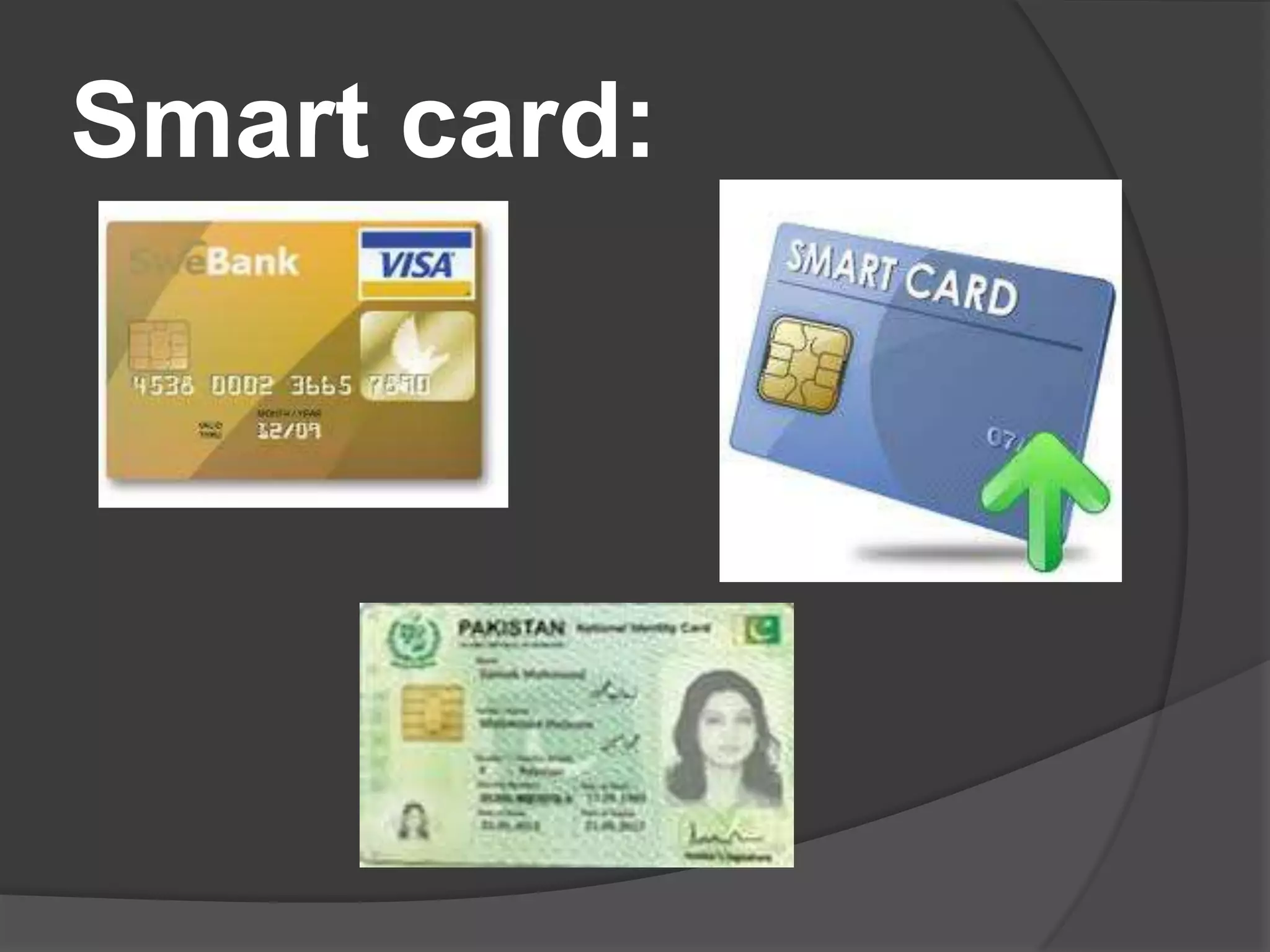
A smart card is a plastic card about the size
of a credit card, with an embedded
microchip that can be loaded with data,
used for telephone calling, electronic cash
payments, and other applications, and
then periodically refreshed for additional
use.
Explanation:
A smart card looks like credit card but
has a micro processer embedded in it.
 Smart card holds more information than
standard credit cards—about 8 to 40
megabytes data.
 Some can be reloaded for reuse.

Invention:
In 1968 and 1969 German electrical
engineers Helmut Grottrup and Jurgen
Dethloff jointly filed patents for the
automated chip card.
 French inventor Roland Moreno patented
the memory card concept in 1974.
 An important patent for smart cards with a
microprocessor and memory as used today
was filed by Jürgen Dethloff in 1976.
 In 1977, Michel Ugon from Honeywell Bull
invented the first microprocessor smart
card.

Purpose of smartcard


Smart cards can provide identification,
authentication, data storage and application
processing. Smart cards may provide strong
security authentication for single sign-on
(SSO) within large organizations.
How Smart Cards Work:


A smart card contains more information
than a magnetic stripe card and it can be
programmed for different applications.
Some cards can contain programming and
data to support multiple applications and
some can be updated to add new
applications after they are issued. Smart
cards can be designed to be inserted into a
slot and read by a special reader or to be
read at a distance, such as at a toll booth.
Cards can be disposable (as at a tradeshow) or reloadable (for most applications).
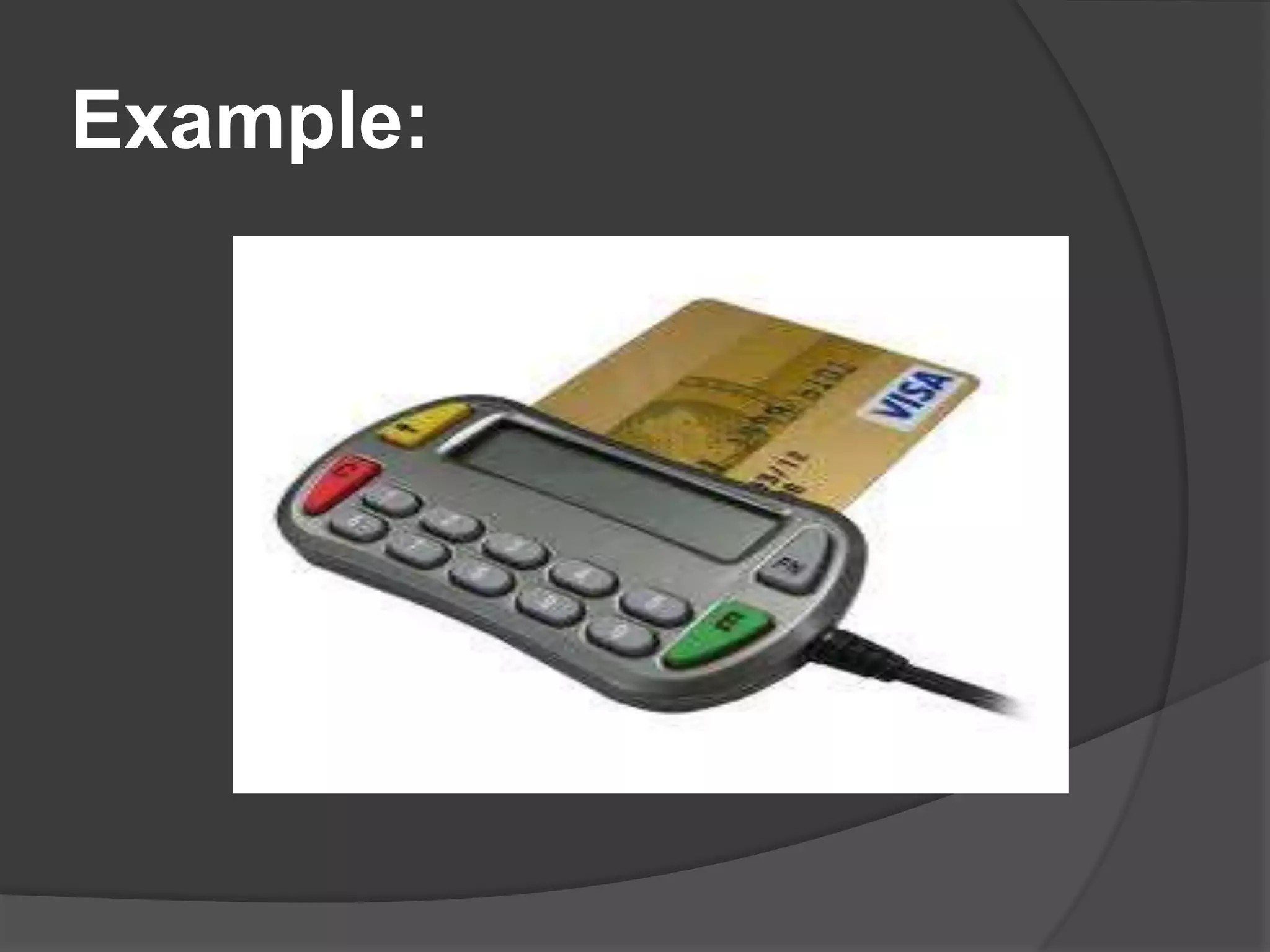
Example:
Example:


When you are using a phone card,
which is programmed to contain a set
number of available minutes, you insert
the card into a slot in the phone, wait for
a tone, and dial the number. The length
of your call is automatically calculated
on the card, and the corresponding
charges deducted from the balance.
Uses of smartcard:


Currently or soon, you may be able to use a smart
card to:

Dial a connection on a mobile telephone and be
charged on a per-call basis
 Establish your identity when logging on to an
Internet access provider or to an online bank
 Pay for parking at parking meters or to get on
subways, trains, or buses
 Give hospitals or doctors personal data without
filling out a form
 Building-entrance cards
 Buy gasoline at a gasoline station

1. Identification


Smart-cards can authenticate identity.
Usually, they employ a public key
infrastructure (PKI). The card stores an
encrypted digital certificate issued from
the PKI provider along with other
relevant information. Examples include
the U.S. Department of Defense (DoD)
Common Access Card (CAC), and other
cards used by other governments for
their citizens NADRA
2. Financial


Smart cards serve as credit or ATM
cards, fuel cards, mobile phone SIMs,
authorization cards for pay television,
household utility pre-payment cards,
high-security identification and accesscontrol cards, and public transport and
public phone payment cards.
3. Schools:
Smart cards are being provided to
students at schools and colleges.
 Uses include:
 Tracking student attendance.
 As an electronic purse, to pay for items
at canteens, vending machines, laundry
facilities, etc...
 Tracking loans from the school library.
 Access to transportation services.

4. Healthcare


Smart health cards can improve the
security and privacy of patient
information, provide a secure carrier for
portable medical records, reduce health
care fraud, support new processes for
portable medical records, provide secure
access to emergency medical
information, enable compliance with
government initiatives (e.g., organ
donation) and mandates, and provide the
platform to implement other applications as
needed by the health care organization
Advantages:
Can be readily reconfigured.
 Reusable.
 Allow for secure transactions off-line,
reducing the cost for inline networks.
 Give more security, thus reducing the
risk of transaction fraud.
 More durable and reliable.
 Allow multiple applications to be stored
in one card.

Disadvantages:
Fees applied with the use of a card.
 It gives liability issues if stolen or lost.
 The accuracy of information is small.
 Lack of technology to support users.
 Potential for too much data on one card
if lost or stolen.
 Potential area for computer hackers and
computer viruses.

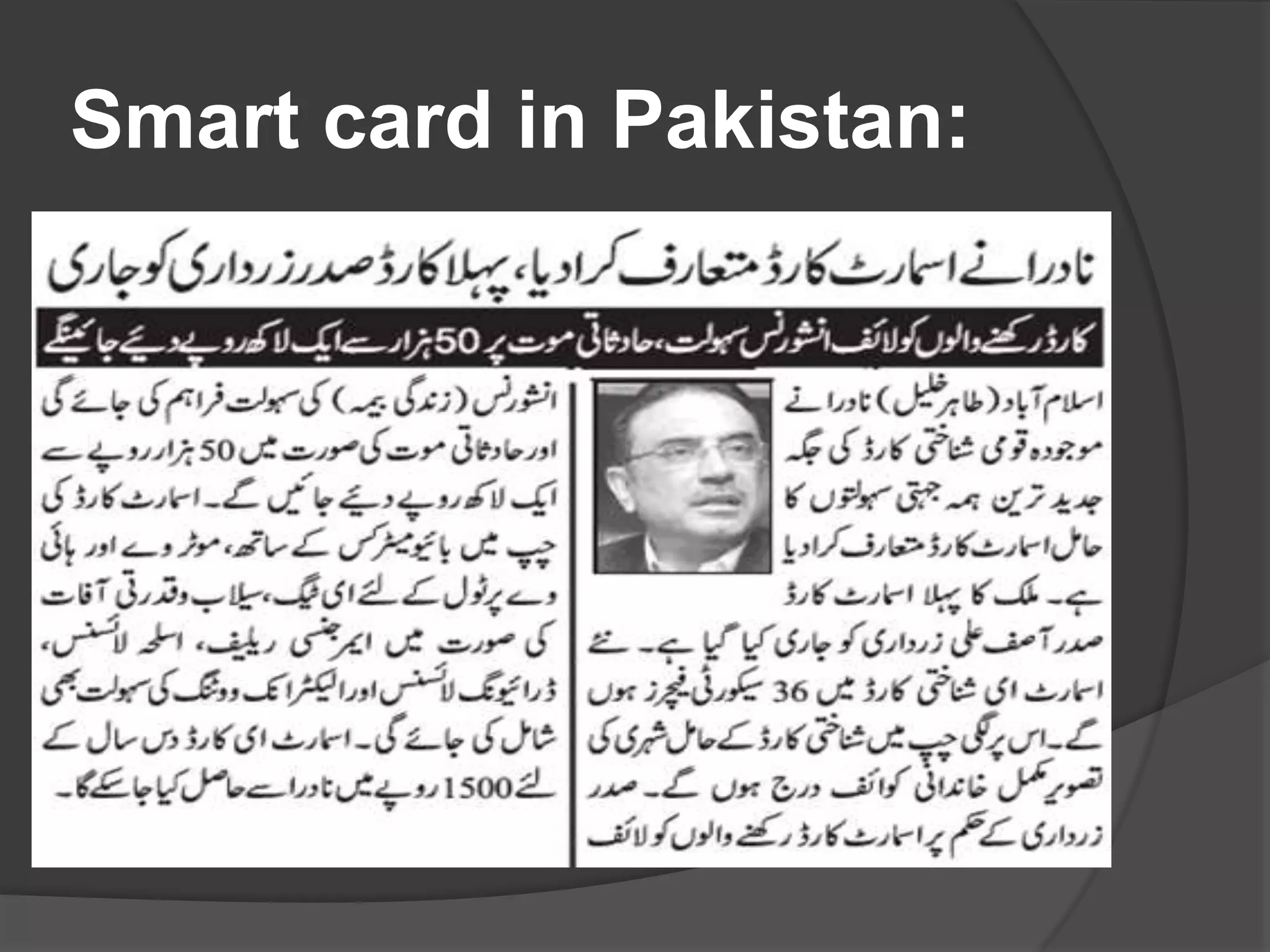
Smart card in Pakistan:
Research:


Over a billion smart cards are already in
use. Currently, Europe is the region
where they are most used. Ovum, a
research firm, predicts that 2.7 billion
smart cards will be shipped annually by
2003. Another study forecasts a $26.5
billion market for recharging smart cards
by 2005.
Smart card

Smart card

  • 1.
    MADE AND PRESENTEDBY: SOHAIL AHMAD Institute of education and research MAIL IDE: sohail9595@yahoo.com University of Peshawar
  • 2.
  • 3.
    A smart cardis a plastic card about the size of a credit card, with an embedded microchip that can be loaded with data, used for telephone calling, electronic cash payments, and other applications, and then periodically refreshed for additional use.
  • 4.
    Explanation: A smart cardlooks like credit card but has a micro processer embedded in it.  Smart card holds more information than standard credit cards—about 8 to 40 megabytes data.  Some can be reloaded for reuse. 
  • 5.
    Invention: In 1968 and1969 German electrical engineers Helmut Grottrup and Jurgen Dethloff jointly filed patents for the automated chip card.  French inventor Roland Moreno patented the memory card concept in 1974.  An important patent for smart cards with a microprocessor and memory as used today was filed by Jürgen Dethloff in 1976.  In 1977, Michel Ugon from Honeywell Bull invented the first microprocessor smart card. 
  • 6.
    Purpose of smartcard  Smartcards can provide identification, authentication, data storage and application processing. Smart cards may provide strong security authentication for single sign-on (SSO) within large organizations.
  • 7.
    How Smart CardsWork:  A smart card contains more information than a magnetic stripe card and it can be programmed for different applications. Some cards can contain programming and data to support multiple applications and some can be updated to add new applications after they are issued. Smart cards can be designed to be inserted into a slot and read by a special reader or to be read at a distance, such as at a toll booth. Cards can be disposable (as at a tradeshow) or reloadable (for most applications).
  • 8.
  • 9.
    Example:  When you areusing a phone card, which is programmed to contain a set number of available minutes, you insert the card into a slot in the phone, wait for a tone, and dial the number. The length of your call is automatically calculated on the card, and the corresponding charges deducted from the balance.
  • 10.
    Uses of smartcard:  Currentlyor soon, you may be able to use a smart card to: Dial a connection on a mobile telephone and be charged on a per-call basis  Establish your identity when logging on to an Internet access provider or to an online bank  Pay for parking at parking meters or to get on subways, trains, or buses  Give hospitals or doctors personal data without filling out a form  Building-entrance cards  Buy gasoline at a gasoline station 
  • 11.
    1. Identification  Smart-cards canauthenticate identity. Usually, they employ a public key infrastructure (PKI). The card stores an encrypted digital certificate issued from the PKI provider along with other relevant information. Examples include the U.S. Department of Defense (DoD) Common Access Card (CAC), and other cards used by other governments for their citizens NADRA
  • 12.
    2. Financial  Smart cardsserve as credit or ATM cards, fuel cards, mobile phone SIMs, authorization cards for pay television, household utility pre-payment cards, high-security identification and accesscontrol cards, and public transport and public phone payment cards.
  • 13.
    3. Schools: Smart cardsare being provided to students at schools and colleges.  Uses include:  Tracking student attendance.  As an electronic purse, to pay for items at canteens, vending machines, laundry facilities, etc...  Tracking loans from the school library.  Access to transportation services. 
  • 14.
    4. Healthcare  Smart healthcards can improve the security and privacy of patient information, provide a secure carrier for portable medical records, reduce health care fraud, support new processes for portable medical records, provide secure access to emergency medical information, enable compliance with government initiatives (e.g., organ donation) and mandates, and provide the platform to implement other applications as needed by the health care organization
  • 15.
    Advantages: Can be readilyreconfigured.  Reusable.  Allow for secure transactions off-line, reducing the cost for inline networks.  Give more security, thus reducing the risk of transaction fraud.  More durable and reliable.  Allow multiple applications to be stored in one card. 
  • 16.
    Disadvantages: Fees applied withthe use of a card.  It gives liability issues if stolen or lost.  The accuracy of information is small.  Lack of technology to support users.  Potential for too much data on one card if lost or stolen.  Potential area for computer hackers and computer viruses. 
  • 17.
    Smart card inPakistan:
  • 18.
    Research:  Over a billionsmart cards are already in use. Currently, Europe is the region where they are most used. Ovum, a research firm, predicts that 2.7 billion smart cards will be shipped annually by 2003. Another study forecasts a $26.5 billion market for recharging smart cards by 2005.