SUBJECTIVE ASSIGNMENT 2
Presented By
N.KAMALEESWARI
Application no: 5b2c04def30211e98c07b32d30b69784
SASTRA Deemed to be University.
ACKNOWLEDGEMENT
I would like to acknowledge ALL MY STAFF FOR
THEIR constant support and help with such a good
presentation videos.
I pay my gratitude to Academic Writing course
which taught me how to write a research article and
how to publish an article without plagiarism and also
about the digital writing.
I thank my parents and almighty for their blessings
and grace.
Small-Scale Fading and Multipath
Small-Scale Multipath Propagation
• The three most important effects
• Rapid changes in signal strength over a small travel distance or time interval
• Random frequency modulation due to varying Doppler shifts on different
multipath signals
• Time dispersion caused by multipath propagation delays
• Factors influencing small-scale fading
• Multipath propagation: reflection objects and scatters
• Speed of the mobile: Doppler shifts
• Speed of surrounding objects
• Transmission bandwidth of the signal
• The received signal will be distorted if the transmission bandwidth is greater than
the bandwidth of the multipath channel.
• Coherent bandwidth: bandwidth of the multipath channel.
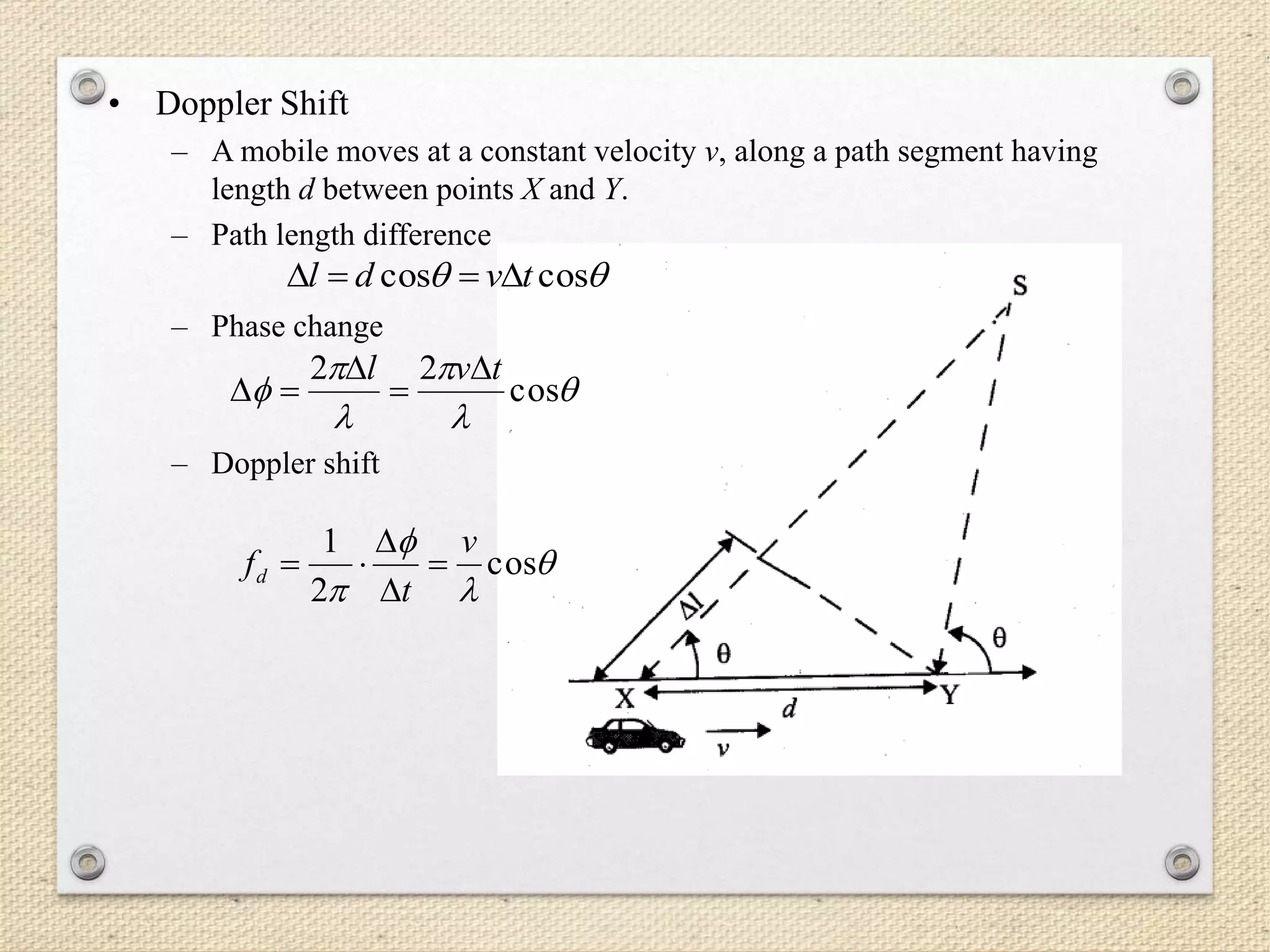
• Doppler Shift
– A mobile moves at a constant velocity v, along a path segment having
length d between points X and Y.
– Path length difference
– Phase change
– Doppler shift
 coscos tvdl 





 cos
22 tvl 







cos
2
1 v
t
fd 



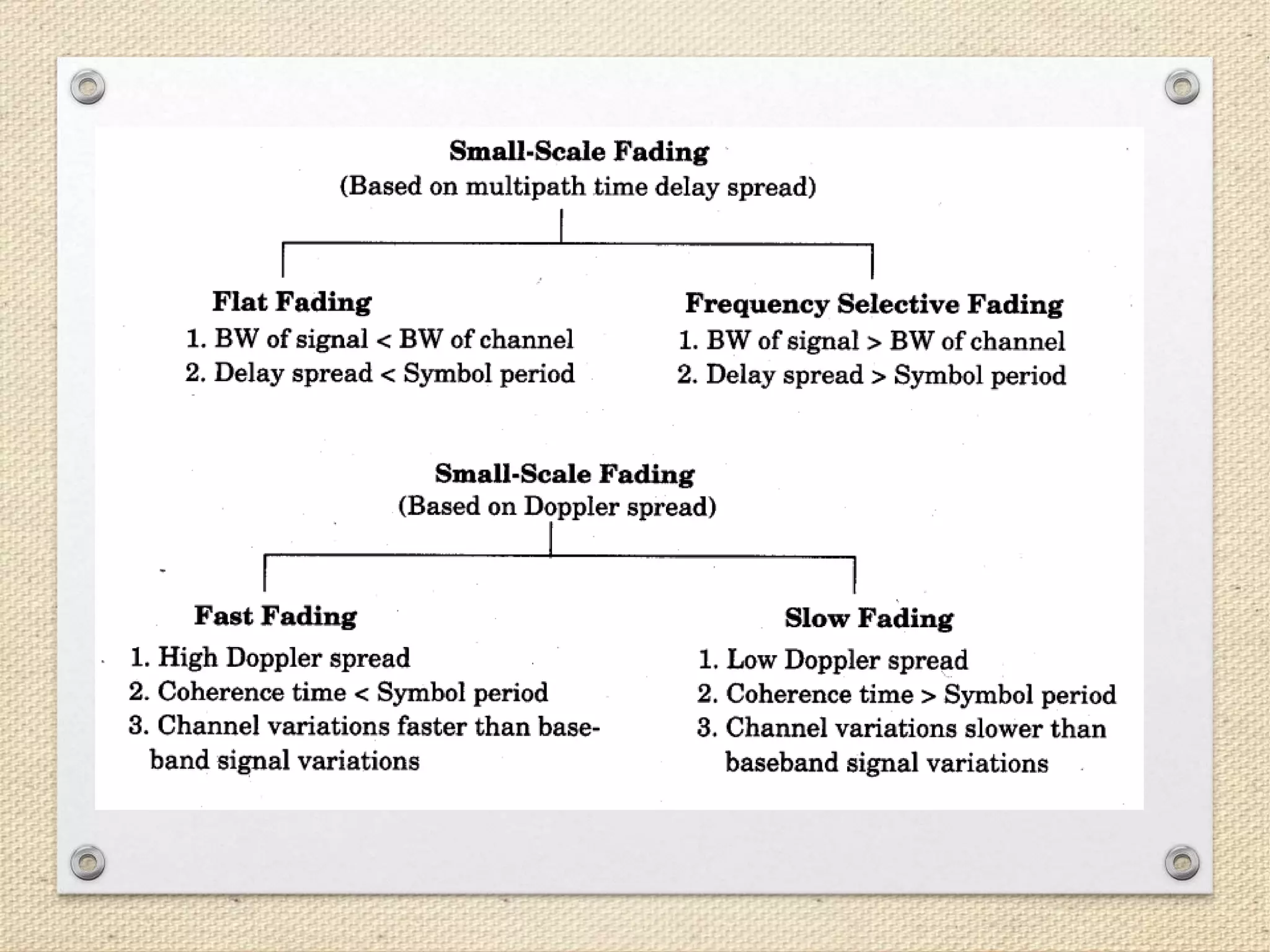
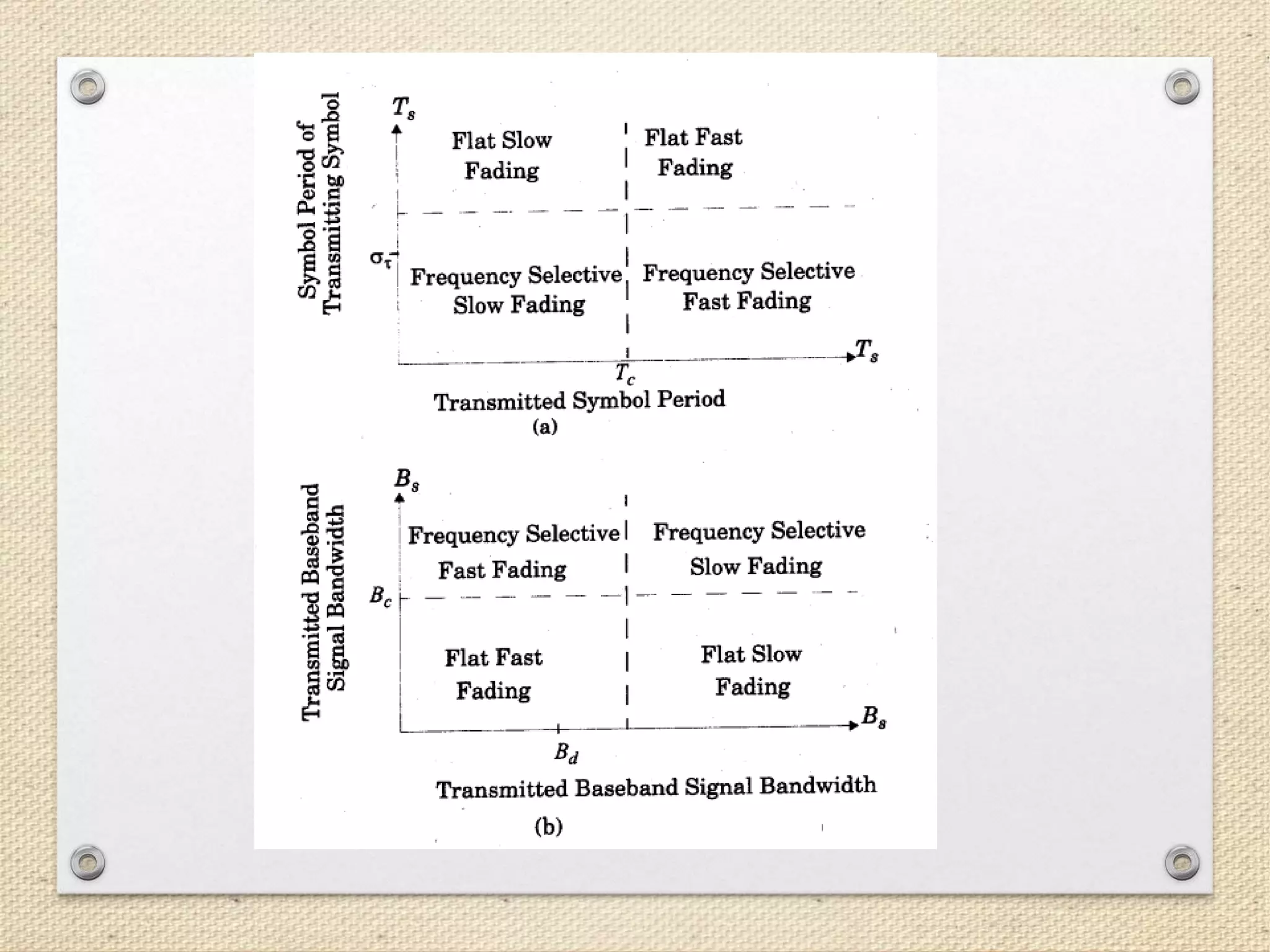
Types of Small-Scale Fading
• Multipath delay spread leads to time dispersion and frequency selective
fading.
• Doppler spread leads to frequency dispersion and time selective fading.
• Multipath delay spread and Doppler spread are independent of one
another.
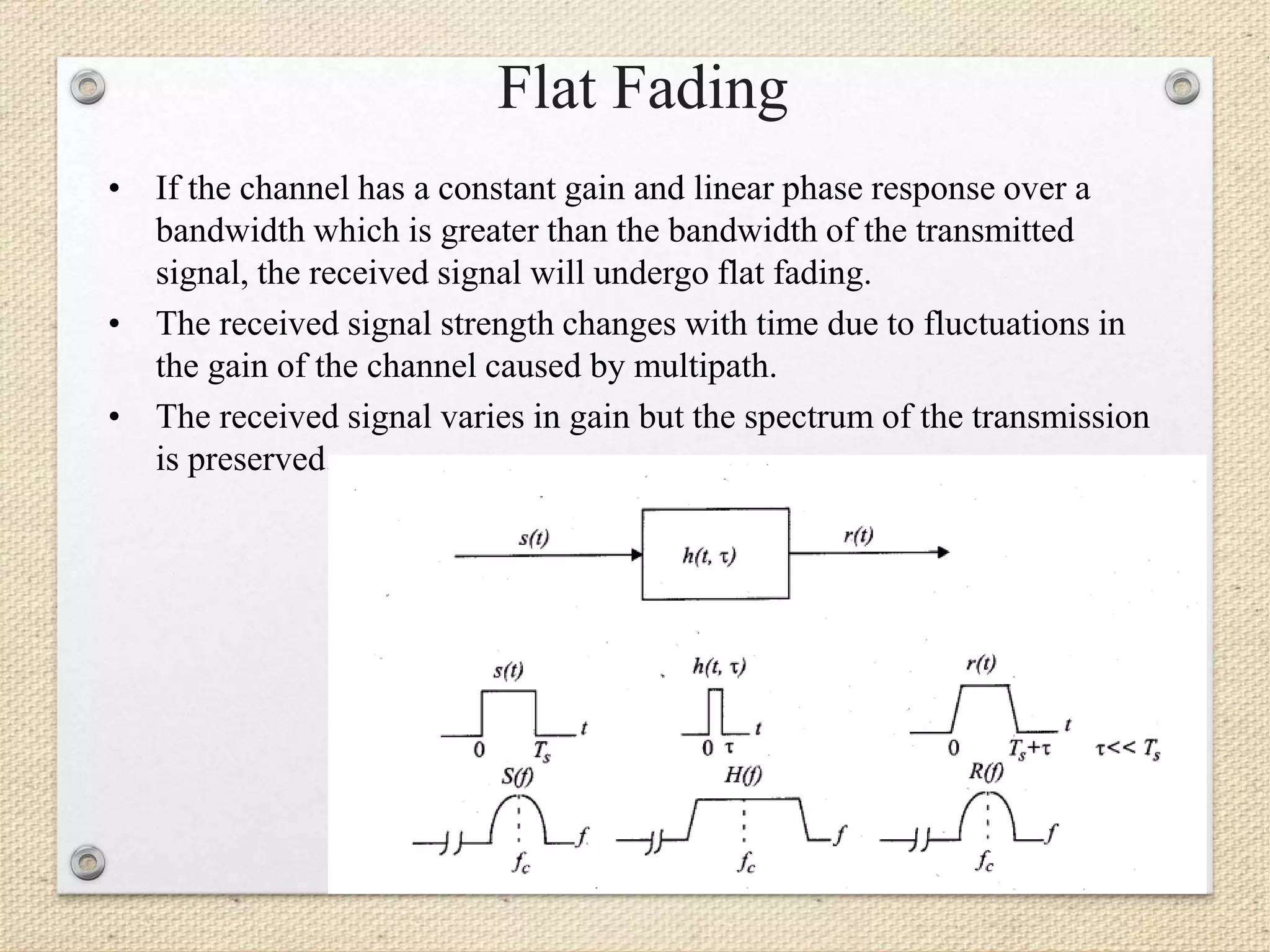
Flat Fading
• If the channel has a constant gain and linear phase response over a
bandwidth which is greater than the bandwidth of the transmitted
signal, the received signal will undergo flat fading.
• The received signal strength changes with time due to fluctuations in
the gain of the channel caused by multipath.
• The received signal varies in gain but the spectrum of the transmission
is preserved.
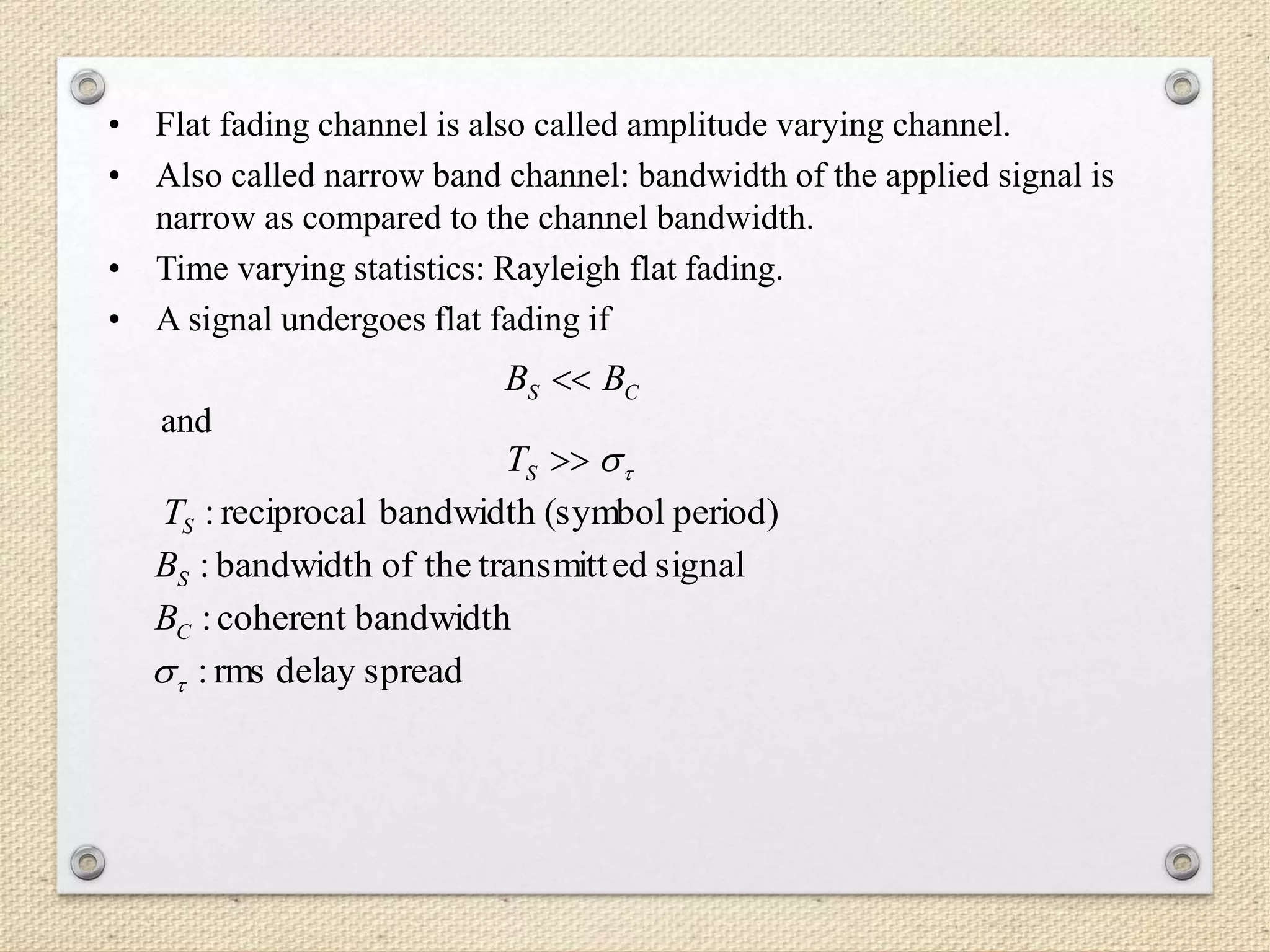
• Flat fading channel is also called amplitude varying channel.
• Also called narrow band channel: bandwidth of the applied signal is
narrow as compared to the channel bandwidth.
• Time varying statistics: Rayleigh flat fading.
• A signal undergoes flat fading if
and
CS BB 
ST
period)(symbolbandwidthreciprocal:ST
signaledtransmitttheofbandwidth:SB
bandwidthcoherent:CB
spreaddelayrms:
Frequency Selective Fading
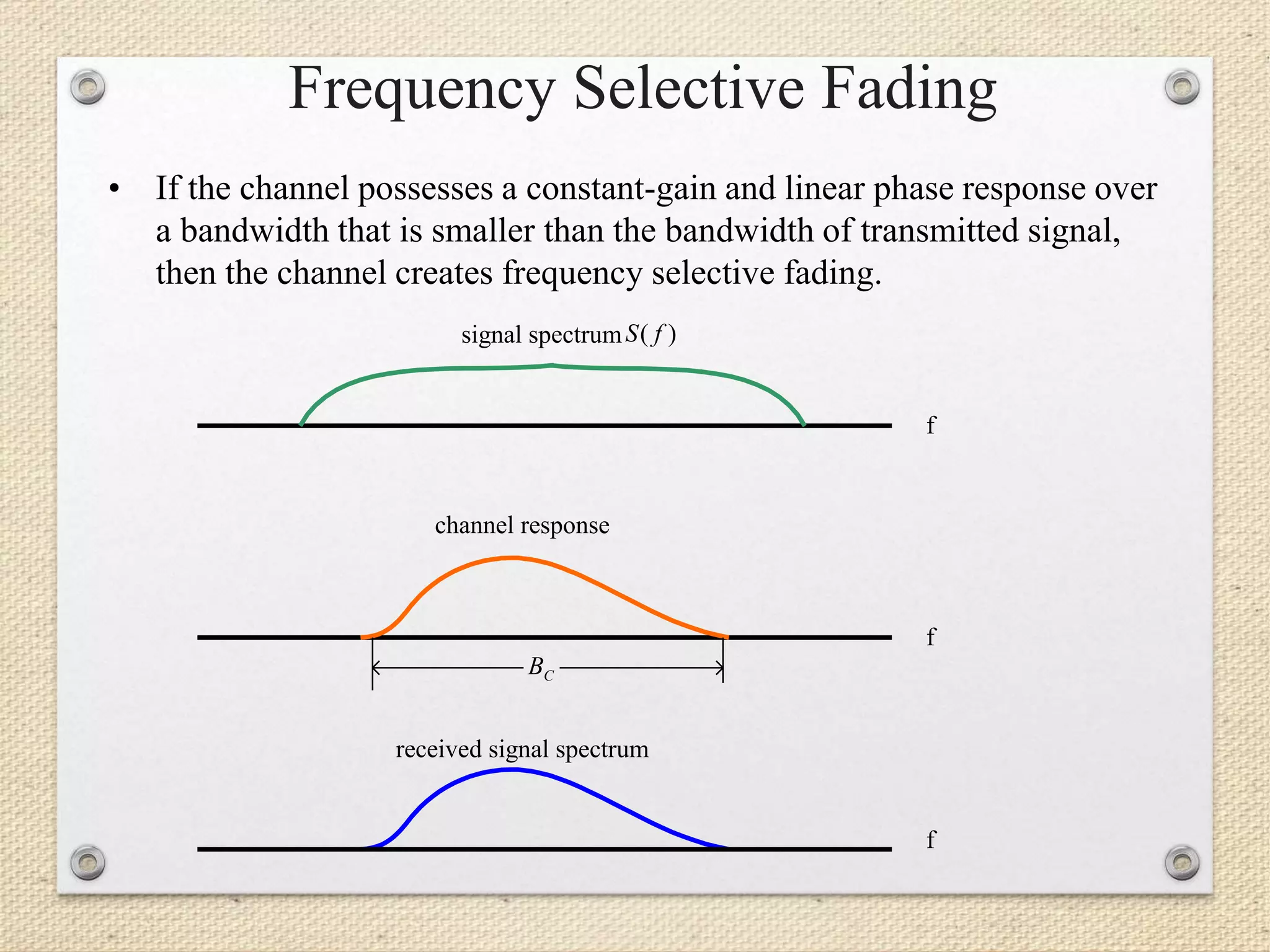
• If the channel possesses a constant-gain and linear phase response over
a bandwidth that is smaller than the bandwidth of transmitted signal,
then the channel creates frequency selective fading.
signal spectrum
channel response
received signal spectrum
f
f
f
)( fS
CB
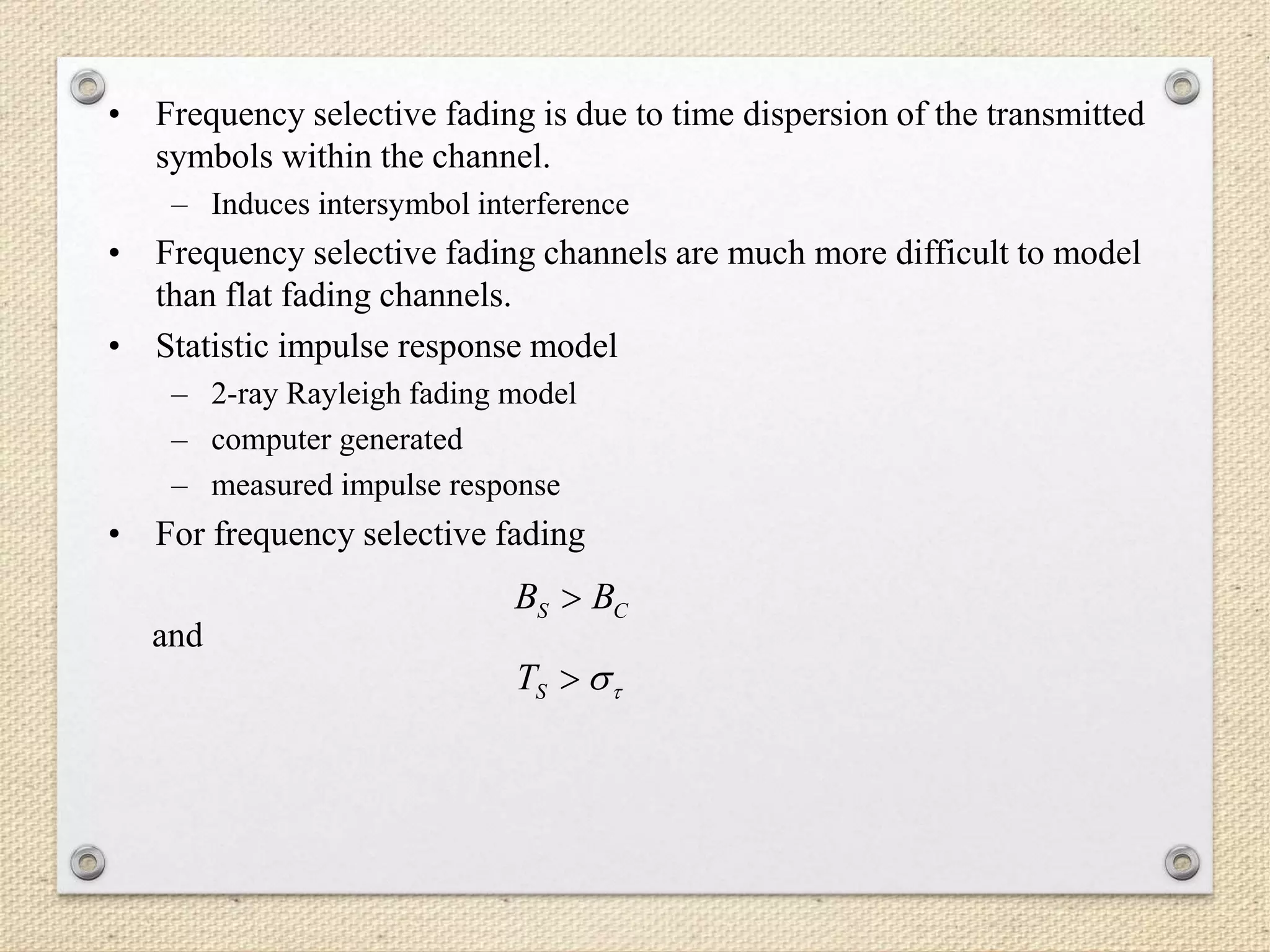
• Frequency selective fading is due to time dispersion of the transmitted
symbols within the channel.
– Induces intersymbol interference
• Frequency selective fading channels are much more difficult to model
than flat fading channels.
• Statistic impulse response model
– 2-ray Rayleigh fading model
– computer generated
– measured impulse response
• For frequency selective fading
and
CS BB 
ST
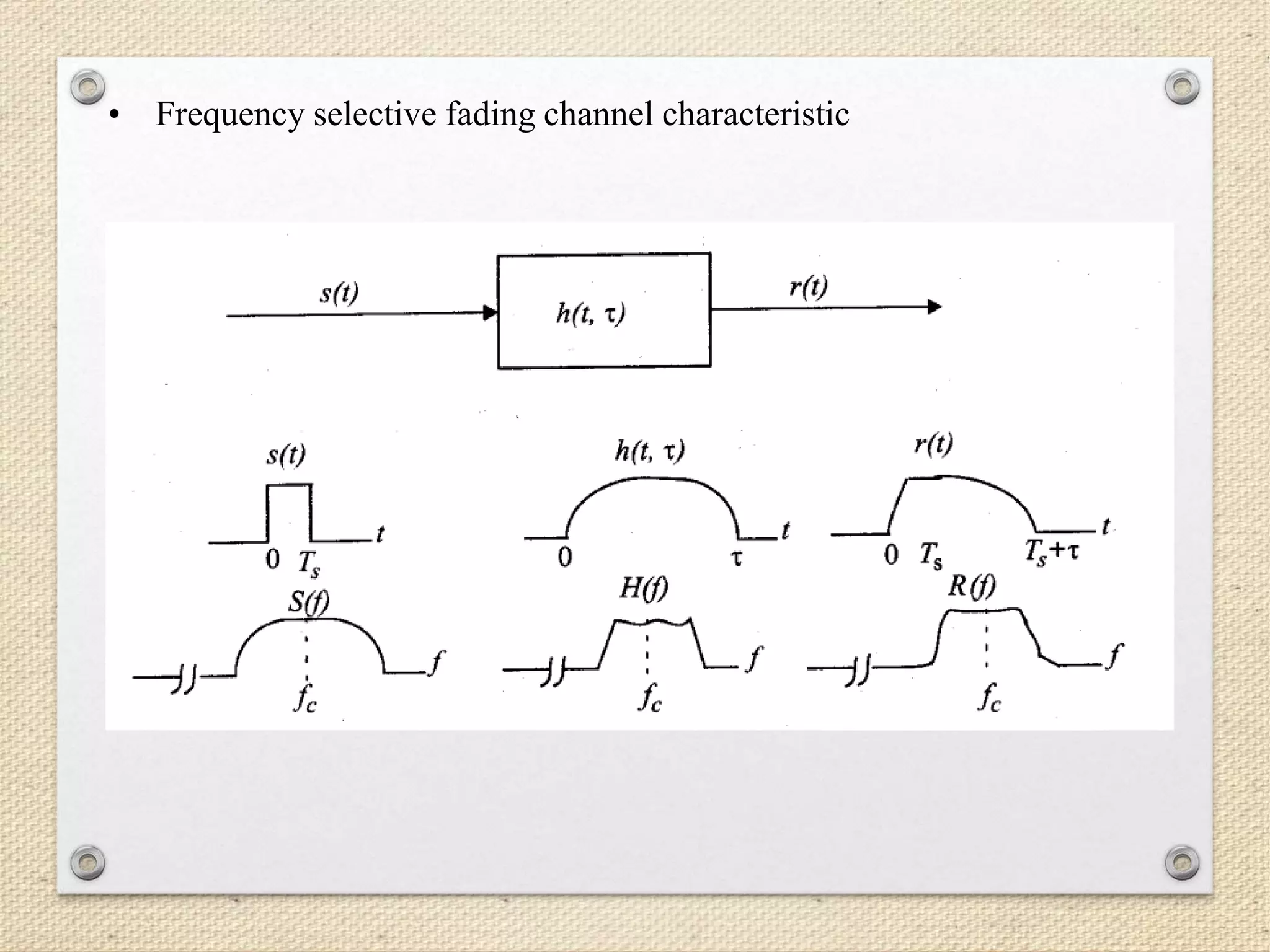
• Frequency selective fading channel characteristic
Fading Effects Due to Doppler Spread
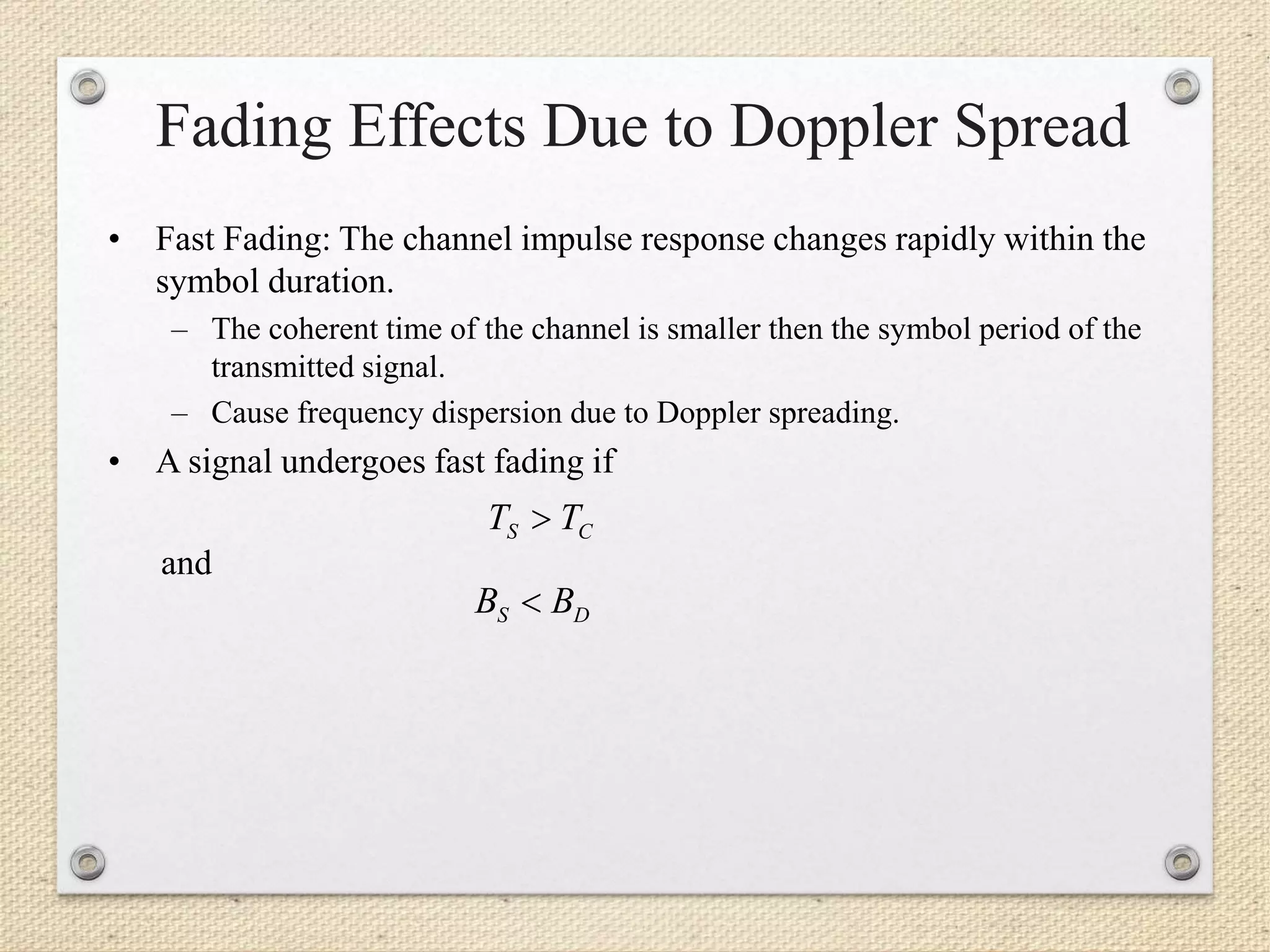
• Fast Fading: The channel impulse response changes rapidly within the
symbol duration.
– The coherent time of the channel is smaller then the symbol period of the
transmitted signal.
– Cause frequency dispersion due to Doppler spreading.
• A signal undergoes fast fading if
and
CS TT 
DS BB 
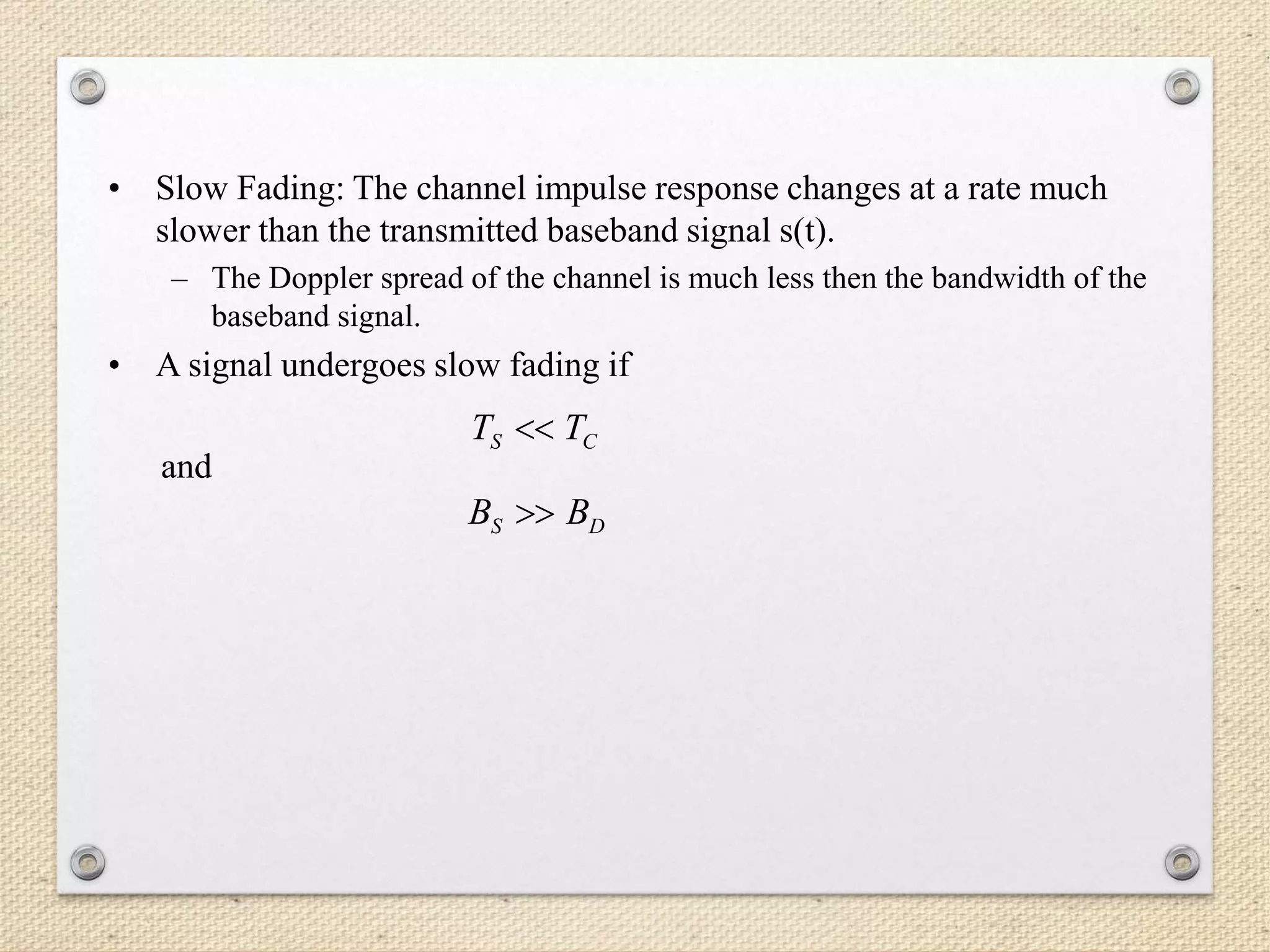
• Slow Fading: The channel impulse response changes at a rate much
slower than the transmitted baseband signal s(t).
– The Doppler spread of the channel is much less then the bandwidth of the
baseband signal.
• A signal undergoes slow fading if
and
CS TT 
DS BB 
Small-Scale Fading and Multipath

Small-Scale Fading and Multipath

  • 1.
    SUBJECTIVE ASSIGNMENT 2 PresentedBy N.KAMALEESWARI Application no: 5b2c04def30211e98c07b32d30b69784 SASTRA Deemed to be University.
  • 2.
    ACKNOWLEDGEMENT I would liketo acknowledge ALL MY STAFF FOR THEIR constant support and help with such a good presentation videos. I pay my gratitude to Academic Writing course which taught me how to write a research article and how to publish an article without plagiarism and also about the digital writing. I thank my parents and almighty for their blessings and grace.
  • 3.
  • 4.
    Small-Scale Multipath Propagation •The three most important effects • Rapid changes in signal strength over a small travel distance or time interval • Random frequency modulation due to varying Doppler shifts on different multipath signals • Time dispersion caused by multipath propagation delays • Factors influencing small-scale fading • Multipath propagation: reflection objects and scatters • Speed of the mobile: Doppler shifts • Speed of surrounding objects • Transmission bandwidth of the signal • The received signal will be distorted if the transmission bandwidth is greater than the bandwidth of the multipath channel. • Coherent bandwidth: bandwidth of the multipath channel.
  • 5.
    • Doppler Shift –A mobile moves at a constant velocity v, along a path segment having length d between points X and Y. – Path length difference – Phase change – Doppler shift  coscos tvdl        cos 22 tvl         cos 2 1 v t fd    
  • 6.
    Types of Small-ScaleFading • Multipath delay spread leads to time dispersion and frequency selective fading. • Doppler spread leads to frequency dispersion and time selective fading. • Multipath delay spread and Doppler spread are independent of one another.
  • 8.
    Flat Fading • Ifthe channel has a constant gain and linear phase response over a bandwidth which is greater than the bandwidth of the transmitted signal, the received signal will undergo flat fading. • The received signal strength changes with time due to fluctuations in the gain of the channel caused by multipath. • The received signal varies in gain but the spectrum of the transmission is preserved.
  • 9.
    • Flat fadingchannel is also called amplitude varying channel. • Also called narrow band channel: bandwidth of the applied signal is narrow as compared to the channel bandwidth. • Time varying statistics: Rayleigh flat fading. • A signal undergoes flat fading if and CS BB  ST period)(symbolbandwidthreciprocal:ST signaledtransmitttheofbandwidth:SB bandwidthcoherent:CB spreaddelayrms:
  • 10.
    Frequency Selective Fading •If the channel possesses a constant-gain and linear phase response over a bandwidth that is smaller than the bandwidth of transmitted signal, then the channel creates frequency selective fading. signal spectrum channel response received signal spectrum f f f )( fS CB
  • 11.
    • Frequency selectivefading is due to time dispersion of the transmitted symbols within the channel. – Induces intersymbol interference • Frequency selective fading channels are much more difficult to model than flat fading channels. • Statistic impulse response model – 2-ray Rayleigh fading model – computer generated – measured impulse response • For frequency selective fading and CS BB  ST
  • 12.
    • Frequency selectivefading channel characteristic
  • 13.
    Fading Effects Dueto Doppler Spread • Fast Fading: The channel impulse response changes rapidly within the symbol duration. – The coherent time of the channel is smaller then the symbol period of the transmitted signal. – Cause frequency dispersion due to Doppler spreading. • A signal undergoes fast fading if and CS TT  DS BB 
  • 14.
    • Slow Fading:The channel impulse response changes at a rate much slower than the transmitted baseband signal s(t). – The Doppler spread of the channel is much less then the bandwidth of the baseband signal. • A signal undergoes slow fading if and CS TT  DS BB 