RELIANCE INSTITUTE OF NURSING
TOPIC
PRESENTED BY :-
MR. ROMAN BAJRANG
BASIC BS.C NURSING 2ND YEAR
RELIANCE INSTITUTE OF NURSING
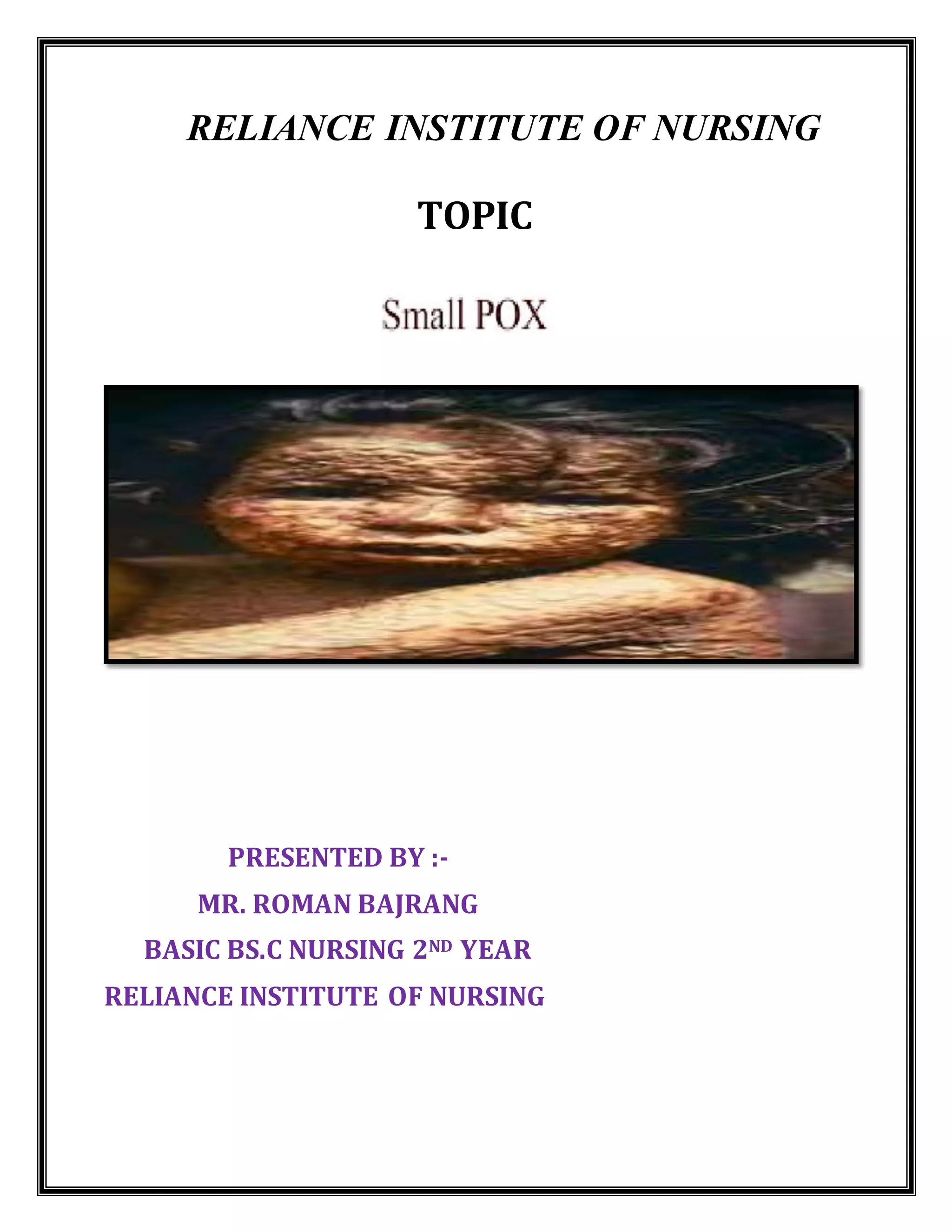
SMALLPOX
INTRODUCTION
 A highly contagious and frequently fatal viral disease.
 The disease is also known by the Latin names Variola or Variola Vera, which is a
derivative of the Latin Varius, meaning "spotted", or Varus, meaning "pimple".
 The term "Smallpox" was first used in Europe in the 15th century to distinguish Variola
from the "great pox" (Syphilis).
 Smallpox was responsible for an estimated 300–500 million deaths during the 20th
century.
 Believed to have begun in Africa and spread to India and china.
HISTORY
 First appeared in northeastern Africa around 10,000 BC
 Skin lesions on mummies 1570-1085 BC Ramses V
 In the elephant war in Mecca 568 AD, smallpox decimated the Ethiopian soldiers
 Introduction of smallpox into the new world (Carribean 1507, Mexico 1520, Peru 1524,
and brazil 1555 ) facilitated Spanish conquest
 Smallpox destroys Hottentots (1713)
 In 1738, smallpox killed half the Cherokee Indian population
 Smallpox disrupted colonial army in 1776
MICROBIOLOGY
 Caused by Variola virus
 Belongs to the genus Orthopoxvirus, the family Poxviridae and subfamily
Chordopoxvirinae
 Single, linear, double-stranded DNA molecules and replicate in cell cytoplasm.
 Shaped like bricks and measure about 300 x 200 nm in size
 Incubation: 12-14 days (range 7-17d)
 2 clinical forms:
 Variola major
 Variola minor
 Variola major
 Classic smallpox
 Predominant form in Asian epidemics
 Highest mortality (~30%)
 Variola minor
 Causes milder disease
 Discovered in 20th century
 Started in S. Africa
 Was most predominant form in N. America
TYPES
 Classic smallpox was considered the most communicable disease; about 30% of
unvaccinated people who came in contact with the virus were infected.
 The Hemorrhagic variety of Variola had a much higher death rate (95%) than classic
smallpox and lead to death more quickly.
 The Malignant or flat forms of smallpox affected 6% of the population and evolved
slower than the classic type of smallpox but with a death rate of almost 100%.
 The Modified variety of Variola essentially affected people who were vaccinated.
PATHOPHYSIOLOGY
Virus lands on respiratory/oral mucosa
Macrophages carry to regional nodes
Invades Reticuloendothelial organs
White blood cells infected
Systemic inflammatory response
SIGN & SYMPTOMS
 The initial symptoms that the person has are fever 1030, body aches, headache, chills and
vomiting.
 After the initial symptoms the virus creates a rash that starts as macules (flat, red lesions)
on the skin. Then vesicles (raised blisters) form and lastly pustules (pus filled blisters)
appear.
 Just after the rash appears, the virus is highly contagious as it moves into the mucous
membrane.
TRANSMISSION
 Airborne route
 Infectious materials:
 Saliva
 Vesicular fluid
 Scabs
 Urine
 Conjunctival fluid
 Possibly blood
 The virus can cross the placenta, but the incidence of congenital smallpox is relatively
low.
 Smallpox transmission does not occur through animals or insects.
PREVENTION
• The smallpox vaccine is the only known way to prevent smallpox in an exposed person.
The smallpox vaccine helps the body develop immunity to smallpox.
• Isolation of patients if they develop fever.
TREATMENT
 No proven treatment.
 Only thing done was to give those intravenous fluids and medicine to control fever and
pain.
 Antibiotics, given to prevent possible bacterial infections.
VACCINATION
 Edward Jenner demonstrated that immunity to smallpox could be produced by
inoculating a human with material from a lesion on the udder of a cow. Jenner called this
infectious material vaccine, and the procedure came to be called vaccination.
 The material Jenner used for his vaccine probably contained cowpox virus, a virus related
to Variola but not as virulent.
Smallpox (vaccinia ) vaccine dryvax®
 Lyophilized vaccinia containing calf lymph.
 Trace amounts of antibiotics:
 Polymyxin B.
 Streptomycin.
 Chlortetracycline.
 Neomycin.
THANKYOU!

Smallpox 1

  • 1.
    RELIANCE INSTITUTE OFNURSING TOPIC PRESENTED BY :- MR. ROMAN BAJRANG BASIC BS.C NURSING 2ND YEAR RELIANCE INSTITUTE OF NURSING
  • 2.
    SMALLPOX INTRODUCTION  A highlycontagious and frequently fatal viral disease.  The disease is also known by the Latin names Variola or Variola Vera, which is a derivative of the Latin Varius, meaning "spotted", or Varus, meaning "pimple".  The term "Smallpox" was first used in Europe in the 15th century to distinguish Variola from the "great pox" (Syphilis).  Smallpox was responsible for an estimated 300–500 million deaths during the 20th century.  Believed to have begun in Africa and spread to India and china. HISTORY  First appeared in northeastern Africa around 10,000 BC  Skin lesions on mummies 1570-1085 BC Ramses V  In the elephant war in Mecca 568 AD, smallpox decimated the Ethiopian soldiers  Introduction of smallpox into the new world (Carribean 1507, Mexico 1520, Peru 1524, and brazil 1555 ) facilitated Spanish conquest  Smallpox destroys Hottentots (1713)  In 1738, smallpox killed half the Cherokee Indian population  Smallpox disrupted colonial army in 1776 MICROBIOLOGY  Caused by Variola virus  Belongs to the genus Orthopoxvirus, the family Poxviridae and subfamily Chordopoxvirinae  Single, linear, double-stranded DNA molecules and replicate in cell cytoplasm.  Shaped like bricks and measure about 300 x 200 nm in size  Incubation: 12-14 days (range 7-17d)
  • 3.
     2 clinicalforms:  Variola major  Variola minor  Variola major  Classic smallpox  Predominant form in Asian epidemics  Highest mortality (~30%)  Variola minor  Causes milder disease  Discovered in 20th century  Started in S. Africa  Was most predominant form in N. America TYPES  Classic smallpox was considered the most communicable disease; about 30% of unvaccinated people who came in contact with the virus were infected.  The Hemorrhagic variety of Variola had a much higher death rate (95%) than classic smallpox and lead to death more quickly.  The Malignant or flat forms of smallpox affected 6% of the population and evolved slower than the classic type of smallpox but with a death rate of almost 100%.  The Modified variety of Variola essentially affected people who were vaccinated. PATHOPHYSIOLOGY Virus lands on respiratory/oral mucosa Macrophages carry to regional nodes Invades Reticuloendothelial organs
  • 4.
    White blood cellsinfected Systemic inflammatory response SIGN & SYMPTOMS  The initial symptoms that the person has are fever 1030, body aches, headache, chills and vomiting.  After the initial symptoms the virus creates a rash that starts as macules (flat, red lesions) on the skin. Then vesicles (raised blisters) form and lastly pustules (pus filled blisters) appear.  Just after the rash appears, the virus is highly contagious as it moves into the mucous membrane. TRANSMISSION  Airborne route  Infectious materials:  Saliva  Vesicular fluid  Scabs  Urine  Conjunctival fluid  Possibly blood  The virus can cross the placenta, but the incidence of congenital smallpox is relatively low.  Smallpox transmission does not occur through animals or insects.
  • 5.
    PREVENTION • The smallpoxvaccine is the only known way to prevent smallpox in an exposed person. The smallpox vaccine helps the body develop immunity to smallpox. • Isolation of patients if they develop fever. TREATMENT  No proven treatment.  Only thing done was to give those intravenous fluids and medicine to control fever and pain.  Antibiotics, given to prevent possible bacterial infections. VACCINATION  Edward Jenner demonstrated that immunity to smallpox could be produced by inoculating a human with material from a lesion on the udder of a cow. Jenner called this infectious material vaccine, and the procedure came to be called vaccination.  The material Jenner used for his vaccine probably contained cowpox virus, a virus related to Variola but not as virulent. Smallpox (vaccinia ) vaccine dryvax®  Lyophilized vaccinia containing calf lymph.  Trace amounts of antibiotics:  Polymyxin B.  Streptomycin.  Chlortetracycline.  Neomycin. THANKYOU!