1
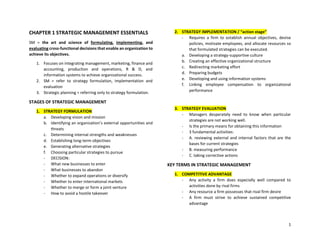
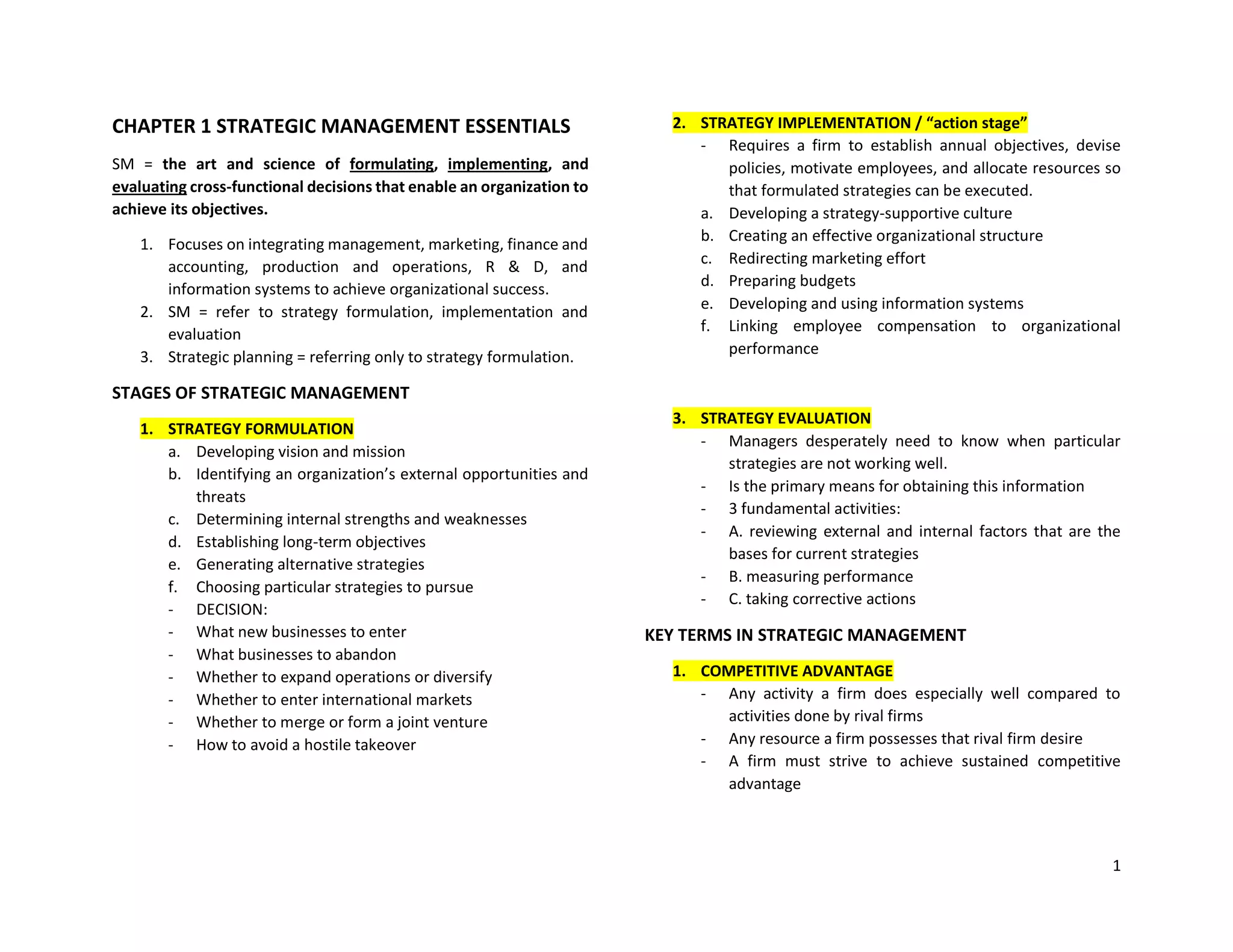
CHAPTER 1 STRATEGIC MANAGEMENT ESSENTIALS
SM = the art and science of formulating, implementing, and
evaluating cross-functional decisions that enable an organization to
achieve its objectives.
1. Focuses on integrating management, marketing, finance and
accounting, production and operations, R & D, and
information systems to achieve organizational success.
2. SM = refer to strategy formulation, implementation and
evaluation
3. Strategic planning = referring only to strategy formulation.
STAGES OF STRATEGIC MANAGEMENT
1. STRATEGY FORMULATION
a. Developing vision and mission
b. Identifying an organization’s external opportunities and
threats
c. Determining internal strengths and weaknesses
d. Establishing long-term objectives
e. Generating alternative strategies
f. Choosing particular strategies to pursue
- DECISION:
- What new businesses to enter
- What businesses to abandon
- Whether to expand operations or diversify
- Whether to enter international markets
- Whether to merge or form a joint venture
- How to avoid a hostile takeover
2. STRATEGY IMPLEMENTATION / “action stage”
- Requires a firm to establish annual objectives, devise
policies, motivate employees, and allocate resources so
that formulated strategies can be executed.
a. Developing a strategy-supportive culture
b. Creating an effective organizational structure
c. Redirecting marketing effort
d. Preparing budgets
e. Developing and using information systems
f. Linking employee compensation to organizational
performance
3. STRATEGY EVALUATION
- Managers desperately need to know when particular
strategies are not working well.
- Is the primary means for obtaining this information
- 3 fundamental activities:
- A. reviewing external and internal factors that are the
bases for current strategies
- B. measuring performance
- C. taking corrective actions
KEY TERMS IN STRATEGIC MANAGEMENT
1. COMPETITIVE ADVANTAGE
- Any activity a firm does especially well compared to
activities done by rival firms
- Any resource a firm possesses that rival firm desire
- A firm must strive to achieve sustained competitive
advantage
2
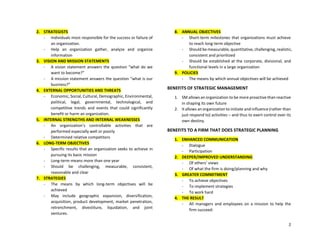
2. STRATEGISTS
- Individuals most responsible for the success or failure of
an organization.
- Help an organization gather, analyze and organize
information
3. VISION AND MISSION STATEMENTS
- A vision statement answers the question “what do we
want to become?”
- A mission statement answers the question “what is our
business?”
4. EXTERNAL OPPORTUNITIES AND THREATS
- Economic, Social, Cultural, Demographic, Environmental,
political, legal, governmental, technological, and
competitive trends and events that could significantly
benefit or harm an organization.
5. INTERNAL STRENGTHS AND INTERNAL WEAKNESSES
- An organization’s controllable activities that are
performed especially well or poorly
- Determined relative competitors
6. LONG-TERM OBJECTIVES
- Specific results that an organization seeks to achieve in
pursuing its basic mission
- Long-term means more than one year
- Should be challenging, measurable, consistent,
reasonable and clear
7. STRATEGIES
- The means by which long-term objectives will be
achieved
- May include geographic expansion, diversification,
acquisition, product development, market penetration,
retrenchment, divestiture, liquidation, and joint
ventures.
8. ANNUAL OBJECTIVES
- Short-term milestones that organizations must achieve
to reach long-term objective
- Should be measurable, quantitative, challenging, realistic,
consistent and prioritized
- Should be established at the corporate, divisional, and
functional levels in a large organization
9. POLICIES
- The means by which annual objectives will be achieved
BENEFITS OF STRATEGIC MANAGEMENT
1. SM allows an organization to be more proactive than reactive
in shaping its own future
2. It allows an organization to initiate and influence (rather than
just respond to) activities – and thus to exert control over its
own destiny.
BENEFITS TO A FIRM THAT DOES STRATEGIC PLANNING
1. ENHANCED COMMUNICATION
- Dialogue
- Participation
2. DEEPER/IMPROVED UNDERSTANDING
- Of others’ views
- Of what the firm is doing/planning and why
3. GREATER COMMITMENT
- To achieve objectives
- To implement strategies
- To work hard
4. THE RESULT
- All managers and employees on a mission to help the
firm succeed.
3
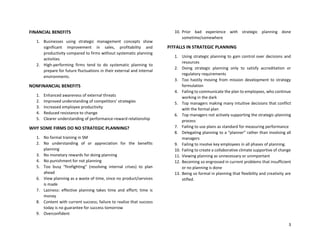
FINANCIAL BENEFITS
1. Businesses using strategic management concepts show
significant improvement in sales, profitability and
productivity compared to firms without systematic planning
activities
2. High-performing firms tend to do systematic planning to
prepare for future fluctuations in their external and internal
environments.
NONFINANCIAL BENEFITS
1. Enhanced awareness of external threats
2. Improved understanding of competitors’ strategies
3. Increased employee productivity
4. Reduced resistance to change
5. Clearer understanding of performance-reward relationship
WHY SOME FIRMS DO NO STRATEGIC PLANNING?
1. No formal training in SM
2. No understanding of or appreciation for the benefits
planning
3. No monetary rewards for doing planning
4. No punishment for not planning
5. Too busy “firefighting” (resolving internal crises) to plan
ahead
6. View planning as a waste of time, since no product/services
is made
7. Laziness: effective planning takes time and effort; time is
money
8. Content with current success; failure to realize that success
today is no guarantee for success tomorrow
9. Overconfident
10. Prior bad experience with strategic planning done
sometime/somewhere
PITFALLS IN STRATEGIC PLANNING
1. Using strategic planning to gain control over decisions and
resources
2. Doing strategic planning only to satisfy accreditation or
regulatory requirements
3. Too hastily moving from mission development to strategy
formulation
4. Failing to communicate the plan to employees, who continue
working in the dark
5. Top managers making many intuitive decisions that conflict
with the formal plan
6. Top managers not actively supporting the strategic-planning
process
7. Failing to use plans as standard for measuring performance
8. Delegating planning to a “planner” rather than involving all
managers
9. Failing to involve key employees in all phases of planning.
10. Failing to create a collaborative climate supportive of change
11. Viewing planning as unnecessary or unimportant
12. Becoming so engrossed in current problems that insufficient
or no planning is done
13. Being so formal in planning that flexibility and creativity are
stifled.
4
CHAPTER 2 VISION AND MISSION ANALYSIS
VISION STATEMENT (WHAT DO WE WANT TO BECOME?)
1. Should be short, preferably one sentence, and as many
managers as possible should have input into developing the
statement.
2. Should reveal the type of business the firm engages.
MISSION STATEMENT (WHAT IS OUR BUSINESS?)
1. A declaration of an organization’s “reason for being.”
2. It is essential for effectively establishing objectives and
formulating strategies.
3. It reveals what an organization wants to be and whom it
wants to serve.
4. Also called as – a creed statement / a statement of purpose
/ a statement of beliefs / a statement of business principles.
IMPORTANCE OF VISON AND MISSION
1. To make sure all employees / managers understand the
firm’s purpose or reason for being.
2. To provide a basis for prioritization of key internal and
external factors utilized to formulate feasible strategies.
3. To provide a basis for the allocation of resources.
4. To provide a basis for organizing work, departments,
activities, and segments around common purpose.
BENEFITS OF HAVING A CLEAR MISSION AND VISION
1. Achieve clarity of purpose among all managers and
employees.
2. Provide a basis for all other strategic planning activities,
including internal and external assessment, establishing
objectives, developing strategies, choosing among
alternative strategies, devising policies, establishing
organizational structure, allocating resources, and evaluating
performance.
3. Provide direction.
4. Provide a focal point for all stakeholders of the firm.
5. Resolve divergent views among managers.
6. Promote a sense of shared expectations among all managers
and employees.
7. Project a sense of worth and intent to all stakeholders.
8. Project an organized, motivated organization worthy of
support.
9. Achieve higher organizational performance.
10. Achieve synergy among all managers and employees.
CHARACTERISTICS OF A MISSION STATEMENT
1. A good mission statement allows for the generation and
consideration of a range of feasible alternative objectives
and strategies without unduly stifling management creativity.
2. Needs to be broad to reconcile differences effectively
among, and appeal to, an organization’s diverse stakeholders.
- Stakeholders = employees, managers, BOD, customers,
suppliers, distributors, creditors, governments, unions,
competitors, environmental groups, general public.
3. Should arose positive feelings and emotions about an
organization.
4. Should be inspiring in the sense that it motivates readers to
action.
5. A business mission reflects judgements about future growth
directions and strategies that are based on forward-looking
external and internal analyses.
5
A CUSTOMER ORIENTATION
1. Define what the organization is and what the organization
aspires to be.
2. Be limited enough to exclude some ventures and broad
enough to allow for creative growth.
3. Distinguish a given organization from all others.
4. Serve as framework for evaluating both current and
prospective activities.
5. Be stated in terms sufficiently clear to be widely understood
throughout the organization.
6. A good mission statement reflects the anticipations of
customers.
7. The operating philosophy of organizations should be to
identify customers’ needs and then provide a product or
service to fulfill those needs.
MISSION STATEMENT COMPONENTS
1. CUSTOMERS - Who are the firm’s customers?
2. PRODUCTS OR SERVICES – what are the firm’s major
products / services?
3. MARKETS – geographically, where does the firm compete?
4. TECHNOLOGY – is the firm technologically current?
5. SURVIVAL, GROWTH, AND PROFITABILITY – is the firm
committed to growth and financial soundness?
6. PHILOSOPHY – what are the basic beliefs, values, aspirations,
and ethical priorities of the firm?
7. SELF-CONCEPT (distinctive competence) – what is the firm’s
major competitive advantage?
8. PUBLIC IMAGE – is the firm responsive to social, community,
and environmental concerns?
9. EMPLOYEES – are employees a valuable asset of the firm?
6
CHAPTER 3 THE EXTERNAL AUDIT
1. Focuses on identifying and evaluating trends and events
beyond the control of a single firm.
2. Reveals key opportunities and threats confronting an
organization so that managers can formulate strategies to
take advantage of the opportunities and avoid or reduce the
impact of threats.
3. EA is aimed at identifying key variables that offer actionable
responses.
4. Firms should be able to respond either offensively or
defensively to the factors by formulating strategies that take
advantage of external opportunities or that minimize the
impact of potential threats.
KEY EXTERNAL FORCES / FACTORS
Can be divided into 5 broad categories:
1. Economic forces
2. Social, cultural, demographic, natural environment forces
3. Political, governmental, and legal forces
4. Technological forces
5. Competitive forces
THE PROCESS OF PERFORMING AN EXTERNAL AUDIT
1. Gather competitive intelligence and information about
economic, social, cultural, demographic, environmental,
political, governmental, legal and technological trends.
2. Information should be assimilated and evaluated.
3. A final list of the most important key external factors should
be communicated.
THE INDUSTRIAL ORGANIZATION (I/O) VIEW = IO approach to
competitive advantage advocates that external (industry) factors are
more important than internal factors in a firm for gaining and
sustaining competitive advantage.
P.E.S.T.E.L.C
1. ECONOMIC FORCES
- Direct impact on the potential attractiveness of various
strategies.
- Forecasting – Asian financial crisis 1997, global recession
- Interest, inflation rates, value of the dollar, price
fluctuations, import/export factor, unemployment
trends.
2. SOCIAL, CULTURAL, DEMOGRAPHIC, NATURAL
ENVIRONMENT FORCES
- Small, large, for-profit, and nonprofit organization in all
industries are being staggered and challenged by the
opportunities and threats arising from changes in social,
cultural, demographic and environmental variables.
- No of marriage, divorces, births, deaths, attitudes
toward product quality / customer service, social
responsibility issues
3. POLITICAL, GOVERNMENTAL, AND LEGAL FORCES
- The increasing global interdependence among
economies, markets, governments, organizations makes
it imperative that firms consider the possible impact of
political variables on the formulation and
implementation of competitive strategies.
- Environmental regulations, no of patents, unionization
trends, political conditions in foreign countries
7
4. TECHNOLOGICAL FORCES
- Many firms now have a chief information officer (CIO)
and a chief technology officer (CTO) who work together
to ensure that information needed to formulate,
implement, and evaluate strategies is available where
and when it is needed.
- New technologies such as – the IoT, 3D printing, biotech,
analytics, robotics, artificial intelligence
RESULTS OF TECHNOLOGICAL ADVANCES
A. Major opportunities and threats that must be
considered in formulating strategies.
B. Can affect organizations’ products, services, markets,
suppliers, distributors, competitors, customers,
manufacturing processes, marketing practices, and
competitive position.
C. Can create new markets, result in new and improved
products, change the relative competitive cost positions,
and render existing products and services obsolete.
D. Can reduce or eliminate cost barriers between
businesses, create shorter production runs, create
shortages in technical skills, and result in changing values
and expectations of employees, managers, and customer.
E. Can create new competitive advantages that are more
powerful than existing advantages.
5. COMPETITIVE FORCES
- An important part of an external audit is identifying rival
firms and determining their strengths, weaknesses,
capabilities, opportunities, threats, objectives and
strategies.
- Collecting and evaluating information on competitors is
essential for successful strategy formulation.
CHARACTERISTICS OF THE MOST COMPETITIVE COMPANIES:
1. Strive to continually increase market share.
2. Use the vision/mission as a guide for all decisions.
3. Whether it’s broke or not, fix it-make it better.
4. Continually adapt, innovate, improve.
5. Acquisition is essential to growth.
6. Hire and retain the best employees and managers
possible.
7. Strive to stay cost-competitive on a global basis.
COMPETITIVE INTELLIGENCE PROGRAMS
CI = a systematic and ethical process for gathering and analyzing
information about the competition’s activities and general business
trends to further a business’s own goals.
The more information and knowledge a firm can obtain about its
competitors, the more likely the firm can formulate and implement
effective strategies.
The 3 basic objective of a CI program are:
1. To provide general understanding of an industry and its
competitors.
2. To identify areas in which competitors are vulnerable and to
assess the impact strategic actions would have on
competitors.
3. To identify potential moves that a competitor might make
that would endanger a firm’s position in the market.
8
THE 5 FORCES MODEL OF COMPETITION
1. RIVALRY AMONG COMPETING FIRM
- The most powerful of the 5 forces
- The intensity of rivalry among competing firms tends to
increase as the no of competitors increase, as
competitors become more equal in size and capability, as
demand for the industry’s product declines, and as price
cutting becomes common.
- Rivalry increase when customers can switch brands
easily, when barriers to leaving the market are high,
when the product is perishable.
- More competitors, more intense the competition
2. POTENTIAL ENTRY OF NEW COMPETITORS / THREATS OF
NEW ENTRANTS
- Include the need to gain economies of scale quickly, the
need to gain technology and specialized know-how, the
lack of experience, large capital requirements and
potential saturation of the market.
- When the threat of new firms entering the market is
strong, incumbent firms generally fortify their position
and take actions to deter new entrants.
3. POTENTIAL DEVELOPMENT OF SUBSTITUTE PRODUCTS /
THREATS OF SUBSTITUTE PRODUCTS
- Competitive pressures arising from substitute products
increase as the relative price of substitute products
declines and as consumers’ costs of switching decrease.
- The competitive strength of substitute product is best
measured by the inroads into the market share those
products obtain, as well as those firms’ plans for
increased capacity and market penetration.
- Compete with other substitute company because they
served the similar purpose/needs.
4. BARGAINING POWER OF SUPPLIERS
- BOS increased when there are few suppliers/substitutes/
costs of switching raw materials is high
- Firms may pursue a backward integration strategy to
gain control or ownership of suppliers.
5. BARGAINING POWER OF CONSUMERS
- Customers being concentrated or buying in volume
affects intensity of competition
- Consumer power is higher where products are standard
or undifferentiated.
CONDITIONS WHERE CONSUMERS GAIN BARGAINING
POWER
1. If buyers can inexpensively switch
2. If buyers are particularly important
3. If sellers are struggling in the face of falling consumer
demand
4. If buyers are informed about sellers’ products, prices and
costs.
5. If buyers have discretion in whether and when they
purchase the product.
9
SOURCES OF EXTERNAL INFORMATION
1. PUBLISHED
- Include periodicals, journal, reports, gov documents,
abstracts, books, directories, newspapers and manuals.
2. UNPUBLISHED
- Include customer survey, market research, speeches at
professional and shareholders’ meetings, tv programs,
interviews, and conversation with stakeholders.
THE EXTERNAL FACTOR EVALUATION MATRIX (EFE)
1. Allows strategies to summarize and evaluate economic,
social, cultural, demographic, environmental, political,
governmental, legal, technological, and competitive
information
The 5 steps:
1. List 20 key external factors, including both opportunities and
threats that affect the firm and its industry.
2. Assign to each factor a weight that ranges from 0.0 (not
important) to 1.0 (very important). The weight indicates the
relative importance of the factor to being successful in the
firm’s industry.
3. Assign a rating between 1 and 4 to each key external factor
to indicate how effectively the firm’s current strategies
respond to the factor where 4 = superior, 3 = above average,
2 = average, 1 = poor.
4. Multiple each factor’s weigh by its rating to determined
weighted score.
5. Sum the weighted scores for each variable to determine the
total weighted score for the organization.
COMPETITIVE PROFILE MATRIX (CPM)
1. Identifies firm’s major competitors and their strengths &
weaknesses in relation to a sample firm’s strategic positions
2. Critical success factors include internal and external issues.
10
CHAPTER 4 INTERNAL AUDIT
KEY INTERNAL FORCES
1. Distinctive competencies – a firm’s strengths that cannot be
easily matched or imitated by competitors.
2. Building competitive advantages involves taking advantage
of distinctive competencies.
3. A complete internal assessment is vital to help a firm
formulate, implement, and evaluate strategies to enable it to
gain and sustain competitive advantages.
4. The process of gaining competitive advantage in a firm –
weaknesses – strengths – distinctive competencies –
competitive advantage
THE PROCESS OF PERFORMING AN INTERNAL AUDIT
1. The internal audit requires gathering, assimilating, and
prioritizing information about the firm’s management,
marketing, finance and accounting, production and
operations, R & D, and MIS operations to reveal the firm’s
most important strengths and most severe weaknesses.
2. Provides more opportunity for participants to understand
how their jobs, departments, and divisions fit into the whole
organization. This is a great benefit because managers and
employees perform better when they understand how their
work affects other areas and activities.
3. Performing an internal audit is an excellent vehicle or forum
for improving the process of communication in an
organization.
THE RESOURCE-BASED VIEW (RBV)
1. RBV approach to competitive advantage contends that
internal resources are more important for a firm than
external factors in achieving and sustaining competitive
advantage.
2. Proponents of RBV contend that organizational performance
will primarily be determined by internal resources that can
be grouped into 3 all-encompassing categories –
physical/human/organizational resources.
3. Empirical Indicators - For a resource to be valuable, it must
be either (1) rare, (2) hard to imitate (3) not easily
substitutable.
4. These enable a firm to implement strategies that improve
efficiency and effectiveness and lead to a sustainable
competitive advantage.
INTEGRATING STRATEGY AND CULTURE
1. Organizational culture significantly affects planning activities.
2. If strategies can capitalize on cultural strengths, such as a
strong work ethic or highly ethical beliefs, then management
often can swiftly and easily implement changes.
3. Organizational culture = a pattern behavior that has been
developed by an organization as it learns to cope with its
problem of external adaptation and internal integration and
that has worked well enough to be considered valid and to
be taught to new members as the correct way to perceive,
think and feel.
11
THE BASIC FUNCTIONS OF MANAGEMENT
1. PLANNING
- Helps a firm achieve max effect from a given effort.
- Allows a firm to gather the resources needed and carry
out tasks in the most efficient way possible.
- Consists of all those managerial activities related to
preparing for the future.
- It allows an organization to identify and take advantage
of external opportunities as well as minimize the impact
of external threats.
- Forecasting, establishing objectives, devising strategies,
and developing policies.
2. ORGANIZING
- To achieve coordinated effort by defining task and
authority relationships.
- Resources are allocated more effectively and used more
efficiently.
- Consists of 3 sequential activities – breaking down tasks
into jobs, combining jobs to form departments and
delegating authority.
3. MOTIVATING
- The process of influencing people to accomplish specific
objectives.
- Includes at least 4 major components – leadership, group
dynamics, communications and organization change
4. STAFFING
- Refers to HR activities such as recruiting, interviewing,
testing, selecting, evaluating, rewarding
- Play a major role in strategy-implementation efforts
- HR managers are becoming more actively involved in the
strategic-management process.
5. CONTROLLING
- Includes all of those activities undertaken to ensure that
actual operations conform to planned operations.
- All managers in an organization have controlling
responsibilities, such as conducting performance
evaluations and taking necessary action to minimize
inefficiencies.
MARKETING – the process of defining, anticipating, creating, and
fulfilling customers’ needs and wants for products and services.
1. CUSTOMER ANALYSIS
- The examination and evaluation of consumer need,
desires and wants
- Involves administering customer surveys, analyzing
consumer information, evaluating market positioning
strategies, developing customer profiles, and
determining optimal market segmentation strategies.
2. SELLING
- Includes many marketing activities, such as advertising,
sales promotion, publicity, personal selling, sales force
management, customer relations and dealer relations.
- Personal selling is most important for industrial good
companies.
- Advertising is most important for consumer goods
companies.
3. PRODUCT AND SERVICE PLANNING
- Important when a company is pursuing product
development or diversification
- Includes activities such as test marketing, product and
brand positioning, devising warranties, packaging,
determining product options
12
4. PRICING
- Sometimes an organization will pursue a forward
integration strategy primarily to gain better control over
prices charged to consumers.
- 5 major stakeholders affect pricing decisions; consumers,
governments, suppliers, distributors and competitors.
5. DISTRIBUTION
- Include warehousing, distribution channels, distribution
coverage, retail site location, sales territories, inventory
levels and location, transportation carriers, wholesaling
and retailing.
- Especially important when a firm is striving to implement
a market development or forward integration strategy.
6. MARKETING RESEARCH
- The systematic gathering, recording, and analyzing of
data about problems relating to the marketing of goods
and services.
- Can uncover critical strengths and weaknesses
7. COST/BENEFIT ANALYSIS
- Involves assessing the costs, benefits and risks associated
with marketing decisions.
- 3 steps are required:
- Compute the total costs associated with a decision
- Estimate the total benefits from the decision
- Compare the total costs with the total benefits.
FINANCE / ACCOUNTING FUNCTIONS
1. THE INVESTMENT DECISIONS (capital budgeting)
- The allocation and reallocation of capital and resources
to projects, products, assets and divisions of an
organization
2. FINANCING DECISIONS
- Determines the best capital structure for the firm and
includes examining various methods by which the firm
can raise capital.
3. DIVIDEND DECISIONS
- Concern issues such as the percentage of earnings paid
to stockholders, the stability of dividends paid over time,
and the repurchase or issuance of stock.
- Determine the amount of funds that are retained in a
firm compared to the amount paid out to stockholders
PRODUCTIONS/OPERATIONS
1. Consists of all those activities that transform inputs into
goods and services.
2. Production/operations management deals with inputs,
transformations, and outputs that vary across industries and
markets.
13
THE BASIC FUNTIONS (DECISIONS) WITHIN
PRODUCTION/OPERATIONS
1. PROCESS
- These decisions include choice of technology, facility
layout, process flow analysis, facility location, line
balancing, process control, and transportation analysis.
- Distances from raw materials to productions sites to
customers are a major consideration.
2. CAPACITY
- These decisions include forecasting, facilitates planning,
aggregate planning, scheduling, capacity planning, and
queuing analysis.
- Capacity utilization is a major consideration.
3. INVENTORY
- These decisions involve managing the level of raw
materials, work-in-process, and finished good, especially
considering what to order, when to order, how much to
order and materials handling.
4. WORKFORCE
- These decisions involve managing the skilled, unskilled,
clerical, and managerial employees by caring for job
design, work measurement, job enrichment, work
standards, and motivation techniques.
5. QUALITY
- These decisions are aimed at ensuring that high-quality
goods and services are produced by caring for quality
control, sampling, testing, quality assurance and cost
control.
IMPLICATIONS OF VARIOUS STRATEGIES ON
PRODUCTION/OPERATIONS
1. Become a low-cost provider
- Creates high barriers to entry
- Create larger market
- Requires longer production runs and fewer product
changes.
2. Become a high-quality provider
- Requires more quality-assurance efforts
- Requires more expensive equipment
- Requires highly skilled workers and higher wages
3. Provide great customer service
- Requires more service people, service parts and
equipment
- Requires rapid response to customer needs or changes
in customer tastes
- Requires a higher inventory investment
4. Be the first to introduce new products
- Has higher research and development costs
- Has high retaining and tooling costs
5. Become highly automated
- Requires high capital investment
- Reduces flexibility
- May affect labor relations
- Make maintenance more crucial
6. Minimize layoffs
- Serves the security needs of employees and may develop
employee loyalty
- Helps attract and retain highly skilled employees.
14
MANAGEMENT INFORMATION SYSTEMS (MIS)
1. Receives raw material from both external and internal
evaluation of an organization
2. Improves the performance of an enterprise by improving the
quality of managerial decision
3. Collects, codes, stores, synthesizes and presents information
in such a manner that it answers important operating and
strategic questions.
VALUE CHAIN ANALYSIS
1. Refers to the process whereby a firm determines the costs
associated with organizational activities from purchasing raw
materials to manufacturing products to marketing those
products.
2. Aims to identify where low-cost advantages or disadvantages
exist anywhere along the value chain from raw material to
customer service activities.
BENCHMARKING
1. An analytical tool used to determine whether a firm’s value
chain activities are competitive compared to rivals and thus
conducive to winning in the marketplace
2. Entails measuring costs of value chain activities across an
industry to determine “best practices”
THE INTERNAL FACTOR EVALUATION (IFE) MATRIX
This strategy-formulation tool summarizes and evaluates the major
strengths and weaknesses in the functional areas of business.
Also provide a basis for identifying and evaluating relationships
among those areas.
5 steps:
1. List key internal factors as identified in the internal-audit
process
2. Assign a weight that ranges from 0.0 (not important) to 1.0
(all important) to each factor.
3. Assign a 1 to 4 rating to each factor to indicate whether that
factor represents a major / minor weaknesses, minor / major
strength.
4. Multiply each factor’s weight by its rating to determine a
weighted score for each variable.
5. Sum the weighted scores for each variable to determine the
total weighted score for the organization.
15
CHAPTER 5 TYPE OF STRATEGIES
8 desired characteristics of objectives:
1. Quantitative
2. Measurable
3. Realistic
4. Understandable
5. Challenging
6. Hierarchical
7. Obtainable
8. Congruent across departments
10 benefits of having clear objectives:
1. Provide direction by revealing expectations
2. Allow synergy
3. Assist in evaluation by serving as standards
4. Establish priorities
5. Reduce uncertainty
6. Minimize conflicts
7. Stimulate exertion
8. Aid in allocation of resources
9. Aid in design of jobs
10. Provide basis for consistent decision making
FINANCIAL VERSUS STRATEGIC OBJECTIVES
1. FINANCIAL – include growth in revenues, growth in earning,
higher dividends, larger profit margins, greater return on
investment, higher earnings per share, a rising stock price,
improved cash flow, and so on.
2. STRATEGIC OBJECTIVES – include a larger market share,
quicker on time delivery than rivals, shorter design to market
times than rivals, lower costs than rivals, achieving
technological leadership, consistently getting new or
improved products to market ahead or rivals and so on.
AVOID NOT MANAGING BY OBJECTIVES
1. MANAGING BY EXTRAPOLATION
- The idea is to keep on doing the same things in the same
ways because things are going well.
2. MANAGING BY CRISIS
- A form of reacting, letting events dictate the what and
when of management decisions.
3. MANAGING BY SUBJECTIVES
- Built on the idea that there is no general plan for which
way to go and what to do; just do the best you can to
accomplish what you think should be done
4. MANAGING BY HOPE
- Decisions are predicted on the hope that they will work
and that good timers are just around the corner,
especially if luck and good fortune are on our side.
INTEGRATION STRATEGIES
1. FORWARD INTEGRATION
- Involves gaining ownership or increased control over
distributions or retailers.
- Increasing no of manufacturers (suppliers) are pursuing
a forward integration strategy by establishing websites
to sell their products directly to consumers.
- A. when organization’s present distributors are
especially expensive.
- B. when the availability of quality distributors is so
limited as to offer a competitive advantage.
16
- C. when an organization competes in an industry that is
growing.
- D. when an organization has both capital and human
resources to manage distributing their own products.
- E. when the advantages of stable production are
particularly high
- F. when present distributors or retailers have high profit
margins.
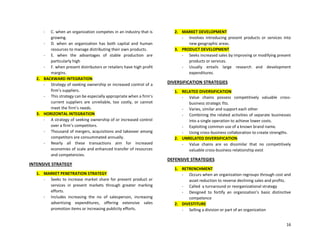
2. BACKWARD INTEGRATION
- Strategy of seeking ownership or increased control of a
firm’s suppliers.
- This strategy can be especially appropriate when a firm’s
current suppliers are unreliable, too costly, or cannot
meet the firm’s needs.
3. HORIZONTAL INTEGRATION
- A strategy of seeking ownership of or increased control
over a firm’s competitors.
- Thousand of mergers, acquisitions and takeover among
competitors are consummated annually.
- Nearly all these transactions aim for increased
economies of scale and enhanced transfer of resources
and competencies.
INTENSIVE STRATEGY
1. MARKET PENETRATION STRATEGY
- Seeks to increase market share for present product or
services in present markets through greater marking
efforts.
- Includes increasing the no of salesperson, increasing
advertising expenditures, offering extensive sales
promotion items or increasing publicity efforts.
2. MARKET DEVELOPMENT
- Involves introducing present products or services into
new geographic areas.
3. PRODUCT DEVELOPMENT
- Seeks increased sales by improving or modifying present
products or services.
- Usually entails large research and development
expenditures.
DIVERSIFICATION STRATEGIES
1. RELATED DIVERSIFICATION
- Value chains possess competitively valuable cross-
business strategic fits.
- Varies, similar and support each other
- Combining the related activities of separate businesses
into a single operation to achieve lower costs.
- Exploiting common use of a known brand name.
- Using cross-business collaboration to create strengths.
2. UNRELATED DIVERSIFICATION
- Value chains are so dissimilar that no competitively
valuable cross-business relationship exist
DEFENSIVE STRATEGIES
1. RETRENCHMENT
- Occurs when an organization regroups through cost and
asset reduction to reverse declining sales and profits.
- Called a turnaround or reorganizational strategy
- Designed to fortify an organization’s basic distinctive
competence
2. DIVESTITURE
- Selling a division or part of an organization
17
- Often used to raise capital for further strategic
acquisitions or investments.
- Can be part of an overall retrenchment strategy to rid an
organization of businesses that are unprofitable, that
require too much capital or that do not fit well with the
firm’s other activities.
3. LIQUIDATION
- Selling all of a company’s assets, in parts for their
tangible worth
- Can be emotionally difficult strategy
- It may be better to cease operating than to continue
losing large sums of money.
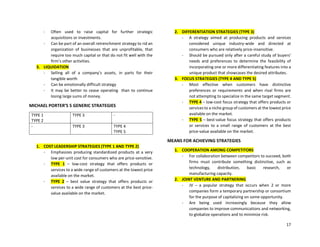
MICHAEL PORTER’S 5 GENERIC STRATEGIES
TYPE 1
TYPE 2
TYPE 3 -
- TYPE 3 TYPE 4
TYPE 5
1. COST LEADERSHIP STRATEGIES (TYPE 1 AND TYPE 2)
- Emphasizes producing standardized products at a very
low per-unit cost for consumers who are price-sensitive.
- TYPE 1 – low-cost strategy that offers products or
services to a wide range of customers at the lowest price
available on the market.
- TYPE 2 – best value strategy that offers products or
services to a wide range of customers at the best price-
value available on the market.
2. DIFFERENTIATION STRATEGIES (TYPE 3)
- A strategy aimed at producing products and services
considered unique industry-wide and directed at
consumers who are relatively price-insensitive.
- Should be pursued only after a careful study of buyers’
needs and preferences to determine the feasibility of
incorporating one or more differentiating features into a
unique product that showcases the desired attributes.
3. FOCUS STRATEGIES (TYPE 4 AND TYPE 5)
- Most effective when customers have distinctive
preferences or requirements and when rival firms are
not attempting to specialize in the same target segment.
- TYPE 4 – low-cost focus strategy that offers products or
services to a niche group of customers at the lowest price
available on the market.
- TYPE 5 – best-value focus strategy that offers products
or services to a small range of customers at the best
price-value available on the market.
MEANS FOR ACHIEVING STRATEGIES
1. COOPERATION AMONG COMPETITORS
- For collaboration between competitors to succeed, both
firms must contribute something distinctive, such as
technology, distribution, basic research, or
manufacturing capacity.
2. JOINT VENTURE AND PARTNERING
- JV – a popular strategy that occurs when 2 or more
companies form a temporary partnership or consortium
for the purpose of capitalizing on some opportunity.
- Are being used increasingly because they allow
companies to improve communications and networking,
to globalize operations and to minimize risk.
18
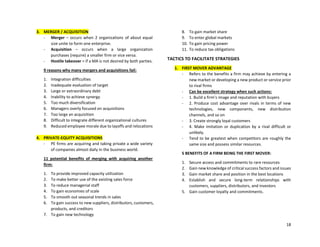
3. MERGER / ACQUISITION
- Merger – occurs when 2 organizations of about equal
size unite to form one enterprise.
- Acquisition – occurs when a large organization
purchases (require) a smaller firm or vice versa.
- Hostile takeover = if a MA is not desired by both parties.
9 reasons why many mergers and acquisitions fail:
1. Integration difficulties
2. Inadequate evaluation of target
3. Large or extraordinary debt
4. Inability to achieve synergy
5. Too much diversification
6. Managers overly focused on acquisitions
7. Too large an acquisition
8. Difficult to integrate different organizational cultures
9. Reduced employee morale due to layoffs and relocations
4. PRIVATE-EQUITY ACQUISITIONS
- PE firms are acquiring and taking private a wide variety
of companies almost daily in the business world.
11 potential benefits of merging with acquiring another
firm:
1. To provide improved capacity utilization
2. To make better use of the existing sales force
3. To reduce managerial staff
4. To gain economies of scale
5. To smooth out seasonal trends in sales
6. To gain success to new suppliers, distributors, customers,
products, and creditors
7. To gain new technology
8. To gain market share
9. To enter global markets
10. To gain pricing power
11. To reduce tax obligations
TACTICS TO FACILITATE STRATEGIES
1. FIRST MOVER ADVANTAGE
- Refers to the benefits a firm may achieve by entering a
new market or developing a new product or service prior
to rival firms
- Can be excellent strategy when such actions:
- 1. Build a firm’s image and reputation with buyers
- 2. Produce cost advantage over rivals in terms of new
technologies, new components, new distribution
channels, and so on
- 3. Create strongly loyal customers
- 4. Make imitation or duplication by a rival difficult or
unlikely.
- Tend to be greatest when competitors are roughly the
same size and possess similar resources.
5 BENEFITS OF A FIRM BEING THE FIRST MOVER:
1. Secure access and commitments to rare resources
2. Gain new knowledge of critical success factors and issues
3. Gain market share and position in the best locations
4. Establish and secure long-term relationships with
customers, suppliers, distributors, and investors
5. Gain customer loyalty and commitments.
19
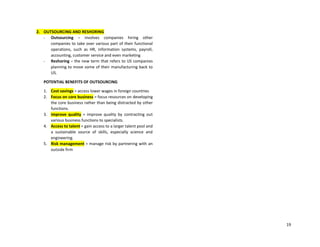
2. OUTSOURCING AND RESHORING
- Outsourcing – involves companies hiring other
companies to take over various part of their functional
operations, such as HR, information systems, payroll,
accounting, customer service and even marketing
- Reshoring – the new term that refers to US companies
planning to move some of their manufacturing back to
US.
POTENTIAL BENEFITS OF OUTSOURCING
1. Cost savings = access lower wages in foreign countries
2. Focus on core business = focus resources on developing
the core business rather than being distracted by other
functions.
3. Improve quality = improve quality by contracting out
various business functions to specialists.
4. Access to talent = gain access to a larger talent pool and
a sustainable source of skills, especially science and
engineering.
5. Risk management = manage risk by partnering with an
outside firm
20
CHAPTER 6 STRATEGY GENERATION AND SELECTION
THE PROCESS OF GENERATING AND SELECTING STRATEGIES
1. A manageable set of the most attractive alternative
strategies must be developed.
2. The advantages, disadvantages, trade-offs, costs, and
benefits of these strategies should be determined.
3. Identifying and evaluating alternative strategies should
involve many of the managers and employees who earlier
assembled the organizational vision and mission statements,
performed the external audit, and conducted the internal
audit.
4. Alternative strategies proposed by participants should be
considered and discussed in a series of meetings.
5. Proposed strategies should be listed in writing.
6. When all feasible strategies identified by participants are
given and understood, the strategies should be ranked in
order of attractiveness.
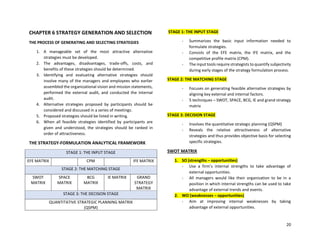
THE STRATEGY-FORMULATION ANALYTICAL FRAMEWORK
STAGE 1: THE INPUT STAGE
EFE MATRIX CPM IFE MATRIX
STAGE 2: THE MATCHING STAGE
SWOT
MATRIX
SPACE
MATRIX
BCG
MATRIX
IE MATRIX GRAND
STRATEGY
MATRIX
STAGE 3: THE DECISION STAGE
QUANTITATIVE STRATEGIC PLANNING MATRIX
(QSPM)
STAGE 1: THE INPUT STAGE
- Summarizes the basic input information needed to
formulate strategies.
- Consists of the EFE matrix, the IFE matrix, and the
competitive profile matrix (CPM).
- The input tools require strategists to quantify subjectivity
during early stages of the strategy formulation process.
STAGE 2: THE MATCHING STAGE
- Focuses on generating feasible alternative strategies by
aligning key external and internal factors.
- 5 techniques – SWOT, SPACE, BCG, IE and grand strategy
matrix
STAGE 3: DECISION STAGE
- Involves the quantitative strategic planning (QSPM)
- Reveals the relative attractiveness of alternative
strategies and thus provides objective basis for selecting
specific strategies.
SWOT MATRIX
1. SO (strengths – opportunities)
- Use a firm’s internal strengths to take advantage of
external opportunities.
- All managers would like their organization to be in a
position in which internal strengths can be used to take
advantage of external trends and events.
2. WO (weaknesses – opportunities)
- Aim at improving internal weaknesses by taking
advantage of external opportunities.
21
- Sometimes key external opportunities exist, but a firm
has internal weaknesses that prevent it from exploiting
those opportunities.
3. ST (strength – threats)
- Use a firm’s strengths to avoid or reduce the impact of
external threats.
4. WT (weaknesses – threats)
- Defensive tactics directed at reducing internal
weaknesses and avoiding external threats.
LIMITATIONS OF SWOT MATRIX
1. SWOT does not show how to achieve a competitive
advantage, so it must not be an end in itself.
2. SWOT is a static assessment (or snapshot) in time. As
circumstances, capabilities, threats and strategies change,
the dynamics of a competitive environment may not be
revealed in a single matrix.
3. SWOT analysis may lead the firm to overemphasize a single
internal or external factor in formulating strategies.
4. There are no weights, ratings or numbers in a SWOT analysis.
5. The relative attractiveness of alternative strategies is not
provided.
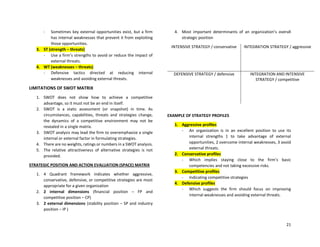
STRATEGIC POSITION AND ACTION EVALUATION (SPACE) MATRIX
1. 4 Quadrant framework indicates whether aggressive,
conservative, defensive, or competitive strategies are most
appropriate for a given organization
2. 2 internal dimensions (financial position – FP and
competitive position – CP)
3. 2 external dimensions (stability position – SP and industry
position – IP )
4. Most important determinants of an organization’s overall
strategic position
INTENSIVE STRATEGY / conservative INTEGRATION STRATEGY / aggressive
DEFENSIVE STRATEGY / defensive INTEGRATION AND INTENSIVE
STRATEGY / competitive
EXAMPLE OF STRATEGY PROFILES
1. Aggressive profiles
- An organization is in an excellent position to use its
internal strengths 1 to take advantage of external
opportunities, 2 overcome internal weaknesses, 3 avoid
external threats.
2. Conservative profiles
- Which implies staying close to the firm’s basic
competencies and not taking excessive risks.
3. Competitive profiles
- Indicating competitive strategies
4. Defensive profiles
- Which suggests the firm should focus on improving
internal weaknesses and avoiding external threats.
22
LIMITATIONS OF SPACE MATRIX
1. It is a snapshot in time.
2. There are more than 4 dimensions that firm could/should be
rated on.
3. The directional vector could fall directly on an axis, or could
even go nowhere if the coordinate is (0,0).
4. Implications of the exact angle of the vector within a
quadrant are unclear.
5. Key underlying internal and external factors are not explicitly
considered.
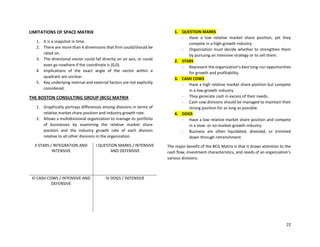
THE BOSTON CONSULTING GROUP (BCG) MATRIX
1. Graphically portrays differences among divisions in terms of
relative market share position and industry growth rate.
2. Allows a multidivisional organization to manage its portfolio
of businesses by examining the relative market share
position and the industry growth rate of each division
relative to all other divisions in the organization.
II STARS / INTEGRATION AND
INTENSIVE
I QUESTION MARKS / INTENSIVE
AND DEFENSIVE
III CASH COWS / INTENSIVE AND
DEFENSIVE
IV DOGS / DEFENSIVE
1. QUESTION MARKS
- Have a low relative market share position, yet they
compete in a high-growth industry.
- Organization must decide whether to strengthen them
by pursuing an intensive strategy or to sell them.
2. STARS
- Represent the organization’s best long-run opportunities
for growth and profitability.
3. CASH COWS
- Have a high relative market share position but compete
in a low-growth industry.
- They generate cash in excess of their needs.
- Cash cow divisions should be managed to maintain their
strong position for as long as possible.
4. DOGS
- Have a low relative market share position and compete
in a slow- or no-market-growth industry.
- Business are often liquidated, divested, or trimmed
down through retrenchment.
The major benefit of the BCG Matrix is that it draws attention to the
cash flow, investment characteristics, and needs of an organization’s
various divisions.
23
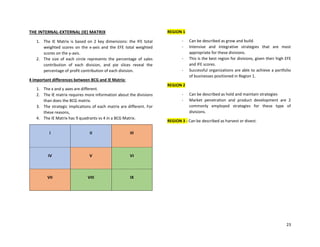
THE INTERNAL-EXTERNAL (IE) MATRIX
1. The IE Matrix is based on 2 key dimensions: the IFE total
weighted scores on the x-axis and the EFE total weighted
scores on the y-axis.
2. The size of each circle represents the percentage of sales
contribution of each division, and pie slices reveal the
percentage of profit contribution of each division.
4 important differences between BCG and IE Matrix:
1. The x and y axes are different.
2. The IE matrix requires more information about the divisions
than does the BCG matrix.
3. The strategic implications of each matrix are different. For
these reasons,
4. The IE Matrix has 9 quadrants vs 4 in a BCG Matrix.
I II III
IV V VI
VII VIII IX
REGION 1
- Can be described as grow and build.
- Intensive and integrative strategies that are most
appropriate for these divisions.
- This is the best region for divisions, given their high EFE
and IFE scores.
- Successful organizations are able to achieve a portfolio
of businesses positioned in Region 1.
REGION 2
- Can be described as hold and maintain strategies
- Market penetration and product development are 2
commonly employed strategies for these type of
divisions.
REGION 3 - Can be described as harvest or divest.
24
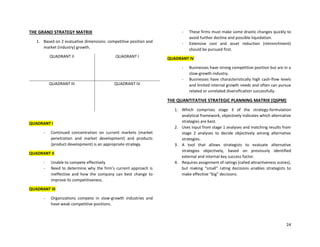
THE GRAND STRATEGY MATRIX
1. Based on 2 evaluative dimensions: competitive position and
market (industry) growth.
QUADRANT II QUADRANT I
QUADRANT III QUADRANT IV
QUADRANT I
- Continued concentration on current markets (market
penetration and market development) and products
(product development) is an appropriate strategy.
QUADRANT II
- Unable to compete effectively
- Need to determine why the firm’s current approach is
ineffective and how the company can best change to
improve its competitiveness.
QUADRANT III
- Organizations compete in slow-growth industries and
have weak competitive positions.
- These firms must make some drastic changes quickly to
avoid further decline and possible liquidation.
- Extensive cost and asset reduction (retrenchment)
should be pursued first.
QUADRANT IV
- Businesses have strong competitive position but are in a
slow-growth industry.
- Businesses have characteristically high cash-flow levels
and limited internal growth needs and often can pursue
related or unrelated diversification successfully.
THE QUANTITATIVE STRATEGIC PLANNING MATRIX (QSPM)
1. Which comprises stage 3 of the strategy-formulation
analytical framework, objectively indicates which alternative
strategies are best.
2. Uses input from stage 1 analyses and matching results from
stage 2 analyses to decide objectively among alternative
strategies.
3. A tool that allows strategists to evaluate alternative
strategies objectively, based on previously identified
external and internal key success factor.
4. Requires assignment of ratings (called attractiveness scores),
but making “small” rating decisions enables strategists to
make effective “big” decisions.
25
STEPS IN A QSPM
1. Make a list of the firm’s key external opportunities and
threats and internal strengths and weaknesses in the left
column.
2. Assign weights to each key external and internal factor.
- These weights are identical to those in the EFE and IFE.
3. Examine the stage 2 (matching) matrices, and identify
alternative strategies that the organization should consider
implementing.
4. Determine the attractiveness score (AS).
- Defined as numerical values that indicate the relative
attractiveness of each strategy considering a single
external or internal factor.
- Determined by examining each key external or internal
factor.
- 1 = not attractive, 2 = somewhat attractive, 3 =
reasonably attractive, 4 = highly attractive
5. Compute the total attractiveness score (TAS)
- Multiplying the weights by the AS in each row.
- Indicate the relative attractiveness of each alternative
strategy, considering only the impact of the adjacent
external or internal critical success factor.
- The higher the TAS, the more attractive the strategic
alternative.
6. Compute the sum total attractiveness score (STAS)
- Reveal which strategy is most attractive in each set of
alternatives.
- Higher scores indicate more attractive strategies,
considering all the relevant external and internal factors
that could affect the strategic decisions.
POSITIVE FEATURES OF THE QSPM
1. Sets of strategies can be examined sequentially or
simultaneously.
2. Requires strategists to integrate pertinent external and
internal factors into decision process.
3. Can be adapted for use by small and large for-profit and
nonprofit organizations.
LIMITATIONS OF THE QSPM
1. It always requires informed judgements.
2. It is only as good as the perquisite information and matching
analyses on which it is based.
TACTICS TO AID STRATEGIES
1. Choose methods that afford employee commitment.
2. Achieve satisfactory results with a popular strategy.
3. Shift from specific to general issues.
4. Focus on long-term issues and concerns.
5. Involve middle level managers in decisions.
GOVERNANCE ISSUES
Board of Directors – a group of individuals who are elected by the
ownership of a corporation to have oversight and guidance over
management and who look out for shareholders’ interests.
26
BOD DUTIES AND RESPONSIBILITES
1. CONTROL AND OVERSIGHT OVER MANAGEMENT
- Select the CEO
- Sanction the CEO’s team
- Provide the CEO with a forum
- Ensure managerial competency
- Evaluate management’s performance
- Set management’s salary level, including fringe benefits
- Guarantee managerial integrity through continuous
auditing.
- Chart the corporate course
- Devise and revise policies to be implemented by
management
2. ADHERENCE TO LEGAL PRESCRIPTIONS
- Keep abreast of new laws
- Ensure the entire organization fulfills legal prescriptions
- Pass bylaws and related resolutions
- Select new directors
- Approve capital budgets
- Authorize borrowing, new stock issues, bonds, and so on.
3. CONSIDERATION OF STAKEHOLDERS’ INTERESTS
- Monitor product quality
- Facilitate upward progression in employee quality of
work life
- Review labor policies and practices
- Improve the customer climate
- Keep community relations at the highest level.
- Use influence to better government, professional
association, and educational contacts.
- Maintain good public image
4. ADVANCEMENT OF STOCKHOLDERS’ RIGHTS
- Preserve stockholders’ equity
- Stimulate corporate growth so that the firm will survive
and flourish
- Guard against equity dilution
- Ensure equitable stockholder representation
- Inform stockholders through letters, reports and
meetings
- Declare proper dividends
- Guarantee corporate survival
PRINCIPLES OF GOOD GOVERNANCE
1. No more than 2 directors are current or former company
executives.
2. The audit, compensation and nominating committees are
made up solely of outside directors.
3. Each director owns a large equity stake in the company,
excluding stock options.
4. Each director attends at least 75% of all meetings
5. The board meets regularly without management present and
evaluates its own performance annually.
6. The CEO is not also the chairperson of the board.
7. There are no interlocking directorships (where a director or
CEO sits on another director’s board).
27
CHAPTER 7 STRATEGY EXECUTION
THE NATURE OF STRATEGY IMPLEMENTATION
STRATEGY FORMULATION:
1. SF is positioning forces before the action.
2. SF focuses on effectiveness.
3. SF is primarily an intellectual process.
4. SF requires good intuitive and analytical skills.
STRATEGY IMPLEMENTATION:
1. SI is managing forces during the action
2. SI focuses on efficiency.
3. SI is primarily an operational process.
4. SI requires special motivation and leadership skills.
ANNUAL OBJECTIVES:
1. Represent the basis for allocating resources
2. Are a primary mechanism for evaluating managers.
3. Are the major instrument for monitoring progress toward
achieving long-term objectives
4. Establish organizational, divisional and departmental
priorities.
5. Are essential for keeping a strategic plan on track.
POLICIES
- Specific guidelines, methods, procedures, rules, forms,
and administrative practices established to support and
encourage work toward stated goals.
- Instruments for strategy implementations
REASONS OF POLICIES:
1. Set boundaries, constraints, and limits on the kinds of
administrative actions that can be taken to reward and
sanction behavior.
2. Let both employees and managers know what is expected of
them, thereby increasing the likelihood that strategies will be
implemented successfully.
3. Provide a basis for management control and allow
coordination across organizational units.
4. Reduce the amount of time managers spend making
decisions. Policies also clarify what work is to be done and by
whom.
5. Promote delegation of decision making to appropriate
managerial levels where various problems usually arise.
6. Clarify what can and cannot be done in pursuit of an
organization’s objectives.
TYPE OF RESOURCES – financial, physical, human, technological
RESOURCE ALLOCATION
- Central management activity that allows for strategy
execution.
- Strategic management enables resources to be allocated
according to priorities established by annual objectives.
MANAGING CONFLICT
1. CONFLICT
- Disagreement between 2 or more parties on 1 or more
issues.
- Establishing annual objectives can lead to conflict
because individuals have different expectations and
28
perceptions, schedules create pressure, personalities are
incompatible and misunderstandings occur between line
managers and staff managers.
2. AVOIDANCE
- Includes such actions as ignoring the problem in hopes
that the conflict will resolve itself or physically separating
the conflicting individuals.
3. DEFUSION
- Includes playing down differences between conflicting
parties while accentuating similarities and common
interests.
4. CONFRONTATION
- Exemplified by exchanging members of conflicting
parties so that each can gain an appreciation of the
other’s point of view or holding a meeting at which
conflicting parties present their views and work through
their differences.
TYPES OF ORGANIZATIONAL STRUCTURE
1. THE FUNCTIONAL STRUCTURE
- Is the simplest and least expensive of the 7 alternatives.
- Group tasks and activities by business function, such as
production / operations, marketing, finance/accounting,
R & D, and management information systems.
Advantages:
1. Simple and inexpensive
2. Capitalizes on specialization of business activities such as
marketing and finance
3. Minimizes need for elaborate control system
4. Allows for rapid decision making
Disadvantages:
1. Accountability forced to the top
2. Delegation of authority and responsibility not encouraged
3. Minimizes career development
4. Low employee and manager morale
5. Inadequate planning for products and markets
6. Leads to short-term, narrow thinking
7. Leads to communication problems
2. THE DIVISIONAL STRUCTURE
- Sometimes referred to as segments, profit centers or
business units
- Functional activities are performed both centrally and in
each separate division
- Organized by geographic area, product or service,
customer or process.
Advantages:
1. Clear accountability
2. Allows local control of local situations
3. Creates career development chances
4. Promotes delegation of authority
5. Leads to competitive climate internally
6. Allows easy adding of new products or regions
7. Allows strict control and attention to products, customers or
regions.
Disadvantages:
1. Can be costly
2. Duplication of functional activities
3. Requires a skilled management force
29
4. Requires an elaborate control system
5. Competition among divisions can become so intense as to be
dysfunctional.
6. Can lead limited sharing of ideas and resources
7. Some regions, products or customers may receive special
treatment.
3. THE STRATEGIC BUSINESS UNIT (SBU) STRUCTURE
- Groups similar divisions into strategic business units and
delegates authority and responsibility for each unit to a
senior executive who reports directly to the chief
executive officer.
- Can facilitate strategy implementation by improving
coordination between similar divisions and channeling
accountability to distinct business units.
4. THE MATRIX STRUCTURE
- Most complex of all designs because it depends upon
both vertical and horizontal flows of authority and
communication.
- For a matrix structure to be effective, organizations need
participative planning, training, clear mutual
understanding of roles and responsibilities, excellent
internal communication, and mutual trust and
confidence.
Advantages:
1. Clear project objectives
2. Results of their work clearly seen by employees
3. Easy to shut down a project
4. Facilitates uses of special equipment, personnel and facilities.
5. Shared functional resources instead of duplicated resources,
as in a divisional structure.
Disadvantages:
1. Requires excellent vertical and horizontal flows of
communication.
2. Costly because creates more manager positions
3. Violates unity of command principle
4. Create dual lines of budget authority
5. Creates dual sources of reward and punishments
6. Creates shared authority and reporting
7. Requires mutual trust and understanding
STRATEGIC PRODUCTION/OPERATIONS ISSUES
1. RESTRUCTURING
- Involves reducing the size of the firm in terms of no of
employees, no of divisions or units, and no of hierarchical
levels in the firm’s organizational structure.
- This reduction in size is intended to improve both
efficiency and effectiveness.
- Concerned primarily with shareholder well-being rather
than employee well-being.
2. REENGINEERING
- Involves reconfiguring or redesigning work, jobs and
processes for the purpose of improving cost, quality,
service, and speed.
- Does not usually affect the organizational structure or
chart, nor does it imply job loss or employee layoffs.
3. MANAGE RESISTANCE TO CHANGE
- May be the single-greatest threat to successful strategy
implementation.
- Regularly occurs in organizations in the form of
sabotaging production machines, absenteeism, filing
30
unfounded grievances, and an unwillingness to
cooperate.
- A. force change strategy = involves giving order and
enforcing those orders; has the advantage of being fast,
but it is plagued by low commitment and high resistance.
- B. the educative change strategy = one that presents
information to convince people of the need for change;
disadvantage – slow and difficult
- C. rational change strategy or self-interest change =
attempts to convince individuals that the change is to
their personal advantage.
STRATEGIC HUMAN RESOURCES ISSUES
1. LINKING PERFORMANCE AND PAY TO STRATEGIES
- Decisions on salary increases, promotions, merit pay,
and bonuses need to support the long-term and annual
objectives of the firm.
- Gain sharing = requires employees or departments to
establish performance targets; if actual results exceed
objectives; all members get bonuses.
- Bonus system = criteria such as sales, profit, production
efficiency, quality and safety could also serve as bases for
an effective bonus system.
2. BALANCE WORK AND HOME LIFE
- Work and family strategies now represent a competitive
advantage for those firms that offer such benefits as:
- Elder care assistance; flexible scheduling; job sharing;
adoption benefits; onsite summer camp; employee help
line; pet care; lawn service referrals
3. DEVELOP A DIVERSE WORKFORCE
6 benefits of having diverse workforce:
1. Women and minorities have different insights, opinions
and perspectives that should be considered.
2. A diverse workforce portrays a firm committed to
nondiscrimination.
3. A workforce that mirrors a customers base can help
attract customers, build customer loyalty, and
design/offer products/services that meet customer
needs/wants.
4. A diverse workforce helps protect the firm against
discrimination lawsuits
5. Women and minorities represent a huge additional pool
of qualified applicants.
6. A diverse workforce strengthens a firm’s social
responsibility and ethical position.
4. CREATING A STRATEGY-SUPPORTIVE CULTURE
1. Formal statements of organizational philosophy,
charters, creeds, materials used for recruitment and
selection, and socialization.
2. Designing of physical spaces, facades, buildings
3. Deliberate role modeling, teaching and coaching by
leaders.
4. Explicit reward and status system, promotion criteria.
5. Stories, legends, myths and parables about key people
and events
6. What leaders pay attention to, measure and control
7. Leader reactions to critical incidents and organizational
crises.
8. How the organization is designed and structured
9. Organizational systems and procedures
31
10. Criteria used for recruitment, selection, promotion,
leveling off, retirement and “excommunication” of
people.
5. MONITORING SOCIAL MEDIA
- Proponents of companies monitoring employees’ social
media activities emphasize that:
- 1. A company’s reputation in the marketplace can easily
be damaged by disgruntled employees venting on social
media sites.
- 2. Social media records can be subpoenaed, like email,
and used as evidence against the company.
6. CORPORATE WELLNESS PROGRAM
- The affordable care act increased the maximum
incentives and penalties employers may use to
encourage employee well-being.
- Most companies have both:
- 1. “carrots” such as giving employee discounts on
insurance premiums or even extra cash
- 2. “sticks” such as imposing surcharges on premiums for
those who do not make progress toward getting healthy.
32
CHAPTER 8 STRATEGY IMPLEMENTATION
STRATEGIC MARKETING ISSUES
1. How to make ads more interactive to be more effective
2. How to best take advantage of FB and Twitter conservations
about the company and industry
3. To use exclusive dealerships or multiple channels of
distribution.
4. To use heavy, light or no TV ads vs online ads.
5. To limit (or not) the share of business done with a single
customer
6. To be a price leader or a price follower
7. To offer a complete or limited warranty
8. To reward salespeople based on straight salary, straight
commission or a combination salary/commission.
SOCIAL MEDIA MARKETING
- Marketers must get customers involved in the company
website and solicit suggestions in terms of product
development, customer service and ideas.
- The company should enable customers to interact with
the firm on the following social media networks: FB,
TWITTER, LINKEDIN, INSTAGRAM
MARKET SEGMENTATION
1. Strategies such as market development, product
development, market penetration, and diversification
require increased sales through new markets and products.
2. Market segmentation allows a firm to operate with limited
resources because mass production, mass distribution and
mass advertising are not required.
3. Market segmentation decisions directly affect the marketing
mix variables: product; place; promotion; price
Alternative bases for market segmentation:
1. Geographic – region, country size, city size, density, climate
2. Demographic – age, gender, family size, family life cycle,
income, occupation, education, religion, race, nationality
3. Psychographic – social class, personality
4. Behavioral – use occasion, benefits sought, user status,
usage rate, loyalty status, readiness stage, attitude toward
product.
PRODUCT POSITIONING
- Entails developing schematic representations that reflect
how your products or services compare to competitors
on dimensions most important to success in the industry.
- Also called perceptual mapping
- An effective product positioning strategy meets 2
criteria:
- 1. It uniquely distinguishes a company from the
competition
- 2. It leads customers to expect slightly less service than a
company can deliver.
PRODUCT POSITIONING STEPS
1. Select key criteria that effectively differentiate products or
services in the industry.
2. Diagram a 2-dimensional product-positioning map with
specified criteria on each axis.
3. Plot major competitors’ products or services in the resultant
4 quadrant matrix.
33
4. Identify areas in the positioning map where the company’s
products or service could be most competitive in the given
target market. Look for vacant areas (niches).
5. Develop a marketing plan to position the company’s
products or services appropriately.
RULES FOR USING PRODUCT POSITIONING AS A STRATEGY-
IMPLEMENTATION TOOL
1. Look for the hole or vacant niche.
2. Don’t serve 2 segments with the same strategy.
3. Don’t position yourself in the middle of the map.
FINANCE / ACCOUNTING ISSUES
Some examples of decisions that may require finance and
accounting policies are:
1. To raise capital with short term debt, long term debt,
preferred stock, or common stock
2. To lease or buy fixed assets
3. To determine an appropriate dividend payout ratio
4. To use LIFO, FIFO or a market-value accounting approach.
5. To extend the time of accounts receivable
6. To establish a certain percentage discounts on accounts
within a specified period of time
7. To determine the amount of cash that should be kept on
hand.
5 important finance/accounting activities:
1. Acquire needed capital to implement strategies
2. Develop projected financial statements to show expected
impact of strategies implemented
3. Determine the firm’s value (corporate valuation) in the event
an offer is received.
4. Decide whether to go public with an initial public offering
(IPO)
5. Decide whether to keep cash offshore that was earned
offshore.
ACQUIRING CAPITAL TO IMPLEMENT STRATEGIES
1. Successful strategy implementation often requires additional
capital
2. Besides net profit from operations and the sale of assets, 2
basic sources of capital for an organization are debt and
equity.
3. EPS = earnings per share
4. EBIT = earning before interest and taxes
5. EBT = earnings before tax
6. EAT = earnings after tax
PROJECTED FINANCIAL STATEMENT
1. Allows an organizational to examine the expected results of
various actions and approaches
2. Allows an organization to compute projected financial ratios
under various strategy-implementation decisions.
34
STEPS OF PERFORMING PROJECTED FINANCIAL ANALYSIS
1. Prepare the projected income statement before the balance
sheet.
2. Use the percentage-of-sales method to project cost of goods
sold (CGS) and the expense items in the income statement.
3. Calculate the projected net income
4. Subtract from the net income any dividends to be paid for
that year.
5. Project the balance sheet items, beginning with retained
earnings and then forecasting stockholders’ equity, long-
term liabilities, current liabilities, total liabilities, total assets,
fixed assets, and current assets (in that order).
6. Use the cash account as the plug figure
7. List commentary (remarks) on the projected statements.
RESEARCH AND DEVELOPMENT ISSUES
Strategies:
1. Emphasize product or process improvements
2. Stress basic or applied research
3. Be leaders or followers in R&D
4. Develop robotics or manual-type processes.
5. Spend a high, average, or low amount of money on R & D.
6. Perform R & D within the firm or contract R & D to outside
firms.
7. Use university researchers or private-sector researchers.
R & D approaches for implementing strategies:
1. Be the first firm to market new technological products
2. Be an innovative imitator of successful products, thus
minimizing the risks and costs of start-up.
3. Be a low-cost producer by mass-producing products similar
to but less expensive than products recently introduced.
MANAGEMENT INFORMATION SYSTEM (MIS) ISSUES
1. Having an effective MIS may be the most important factor in
differentiating successful from unsuccessful firms.
2. The process of strategic management is facilitated
immensely in firms that have an effective information system.
MOBILE COMPUTING
1. Mobile tracking of employees.
2. Mobile apps for customers.
35
CHAPTER 9 STRATEGY MONITORING
STRATEGY EVALUATION (3 basic activities)
1. Examine the underlying bases of a firm’s strategy
2. Compare expected results with actual results
3. Take corrective actions to ensure that performance conforms
to plans.
RUMELT’S STRATEGY EVALUATION CRITERIA
1. CONSONANCE
- The need of strategists to examine set of trends, as well
as individual trends, in evaluating strategies.
- A strategy must represent an adaptive response to the
external environment and to the critical changes
occurring within it.
2. CONSISTENCY
- It is important to strive for consistency when setting
goals and policies.
- Organizational conflicts and interdepartmental bickering
are often symptoms of managerial disorder, but these
problems may also be a sign of strategic inconsistency.
3. FEASIBILITY
- Can the strategy be attempted within the physical,
human, and financial resources of the enterprise?
- It is important to examine whether an organization has
demonstrated in the past that it possesses the abilities,
competencies, skills and talents needed to carry out a
given strategy.
4. ADVANTAGE
- A strategy must provide for the creation or maintenance
of a competitive advantage in a selected area of activity.
- Competitive advantages normally are the result of
superiority in one of 3 areas: 1 resources, 2 skills, 3
position.
THE PROCESS OF EVALUATING STRATEGIES
1. Strategy evaluation should initiate managerial questioning of
expectations and assumptions, should trigger a review of
objectives and values, and should stimulate creativity in
generating alternatives and formulating criteria of evaluation.
2. Evaluating strategies on a continuous rather than on a
periodic basic allows benchmarks of progress to be
established and more effectively monitored.
3. Successful strategies combine patience with a willingness to
promptly take corrective actions when necessary.
A STRATEGY-EVALUATION FRAMEWORK
36
MEASURING ORGANIZATIONAL PERFORMANCE
Strategists use common quantitative criteria to make 3 critical
comparisons:
1. Comparing the firm’s performance over different time
periods
2. Comparing the firm’s performance to competitors’
3. Comparing the firm’s performance to industry averages.
THE BALANCE SCORECARD
1. A strategy evaluation and control technique
2. Aim is to “balance” shareholder objectives with customer
and operational objectives
3. The balance scorecard concept is consistent with the notions
of continuous improvement in management and total quality
management.
4. Is an important strategy-evaluation tool that allows firm to
evaluate strategies from 4 perspectives; financial
performance, customer knowledge, internal business
processes and learning and growth
CHARACTERISTICS OF AN EFFECTIVE EVALUATION SYSTEM
1. Strategy-evaluation activities must be economical; too
much information can be just as bad as too little information,
and too many controls can do more harm than good.
2. Strategy-evaluation activities also should be meaningful;
they should specifically relate to a firm’s objectives.
3. Strategy-evaluation activities should provide timely
information; on occasion and in some areas, managers may
need information on a daily or even continuous basis.
4. Strategy-evaluation processes should be designed to
provide a true picture of what is happening.
5. The strategy-evaluation process should not dominate
decisions; it should foster mutual understanding, trust and
common sense.
CONTINGENCY PLANNING
1. Can be defined as alternative plans that can be put into effect
if certain key events do not occur as expected.
2. Can promote a strategist’s ability to respond quickly to key
changes in the internal and external bases of an
organization’s current strategy.
5 steps effective contingency planning:
1. Identify both good and bad events that could jeopardize
strategies.
2. Determine when the good and bad events are likely to occur.
3. Determine the expected pros and cons of each contingency
event.
4. Develop contingency plans for key contingency events.
5. Determine early warning trigger points for key contingency
events.
AUDITING = a systematic process of objectively obtaining and
evaluating evidence regarding assertions about economic actions
and events to ascertain the degree of correspondence between these
assertions and established criteria, and communicating the results to
interested users.
37
GUIDELINE FOR EFFECTIVE MANAGEMENT
1. Keep the process simple and easily understandable.
2. Eliminate vague planning jargon.
3. Keep the process nonroutine; vary assignments, team
membership, meeting formats, settings, and even the
planning calendar.
4. Welcome bad news and encourage devil’s advocate thinking
5. Do not allow technicians to monopolize the planning process.
6. To the extent possible, involve managers from all areas of the
firm.
38
CHAPTER 10 ETHICS / SOCIAL RESPONSIBILITY /
SUSTAINABILITY
BUSINESS ETHICS = principles of conduct within organizations that
guide decision making and behavior.
SOCIAL RESPONSIBILITY = actions an organization takes beyond
what is legally required to protect or enhance the well-being of living
things.
SUSTAINABILITY = the extent than an organization’s operations and
actions protect, mend and preserve rather than harm or destroy the
natural environment.
7 PRINCIPLES OF ADMIRABLE BUSINESS ETHICS
1. Be trustworthy; no individual or business wants to do
business with an entity it does not trust.
2. Be open minded, continually asking for “ethics-related
feedback” from all internal and external stakeholders.
3. Honor all commitments and obligations
4. Do not misrepresent, exaggerate, or mislead with any print
materials
5. Be visibly a responsible community citizen
6. Utilize your accounting practices to identify and eliminate
questionable activities.
7. Follow the motto; do unto others as you would have them
do unto you.
CODE OF BUSINESS ETHICS = to ensure that the code of ethics is
read, understood, believed, and remembered, periodic ethics
workshops are needed to sensitize people to workplace
circumstances in which ethics issues may arise.
WHISTLE-BLOWING
1. Refers to employees reporting any unethical violations they
discover or see in the firm.
2. Ethics training program should include messages from the
CEO or owner of the business emphasizing ethical business
practices, the development and discussion of codes of ethics,
and procedures for discussing and reporting unethical
behavior.
BRIBERY
1. The offering, giving, receiving, or soliciting of any item of
value to influence the actions of an official or other person in
discharge of a public or legal duty.
2. The gift may be any money, goods, actions, property,
preferment, privilege, emolument, object of value,
advantage or merely a promise or undertaking to induce or
influence the action, vote.
3. A crime in the most countries of the world
WORKPLACE ROMANCE
1. Is an intimate relationship between 2 consenting employees,
as opposed to sexual harassment.
2. Workplace romance can be detrimental to morale and
productivity:
- Favoritism complaints can arise
- Confidentiality of records can be breached.
- Reduced quality and quantity of work could result
- Personal arguments can lead to work arguments
- Whispering secrets can lead to tensions
- Sexual harassment charges may ensue
- Conflicts of interest could arise
39
SOCIAL POLICY
1. Concerns what responsibilities the firm has to employees,
consumers, environmentalists, minorities, communities,
shareholders, and other groups
2. Firms should strive to engage in social activities that have
economic benefits.
ENVIRONMENTAL SUSTAINABILITY
1. Employees, consumers, governments and society are
especially resentful of firms that harm rather than protect
the natural environment
2. Conversely, people today are especially appreciative of firms
that conduct operations in a way that mends, conserves and
preserves the natural environment.
SUSTAINABILITY REPORTS
1. Reveals how a firm’s operations impact he natural
environment
2. Discloses to shareholders information about the firm’s labor
practices, product sourcing, energy efficiency,
environmental impact and business ethics practices.
ISO 14000 / 14001 CERTIFICATION
1. The ISO 14000 family of standards concerns the extent to
which a firm minimizes harmful effects on the environment
caused by its activities and continually monitors and
improves its own environmental performance.
2. Is a set of standards adopted by thousands of a firms
worldwide to certify to their constituencies that they are
conducting business in an environmentally friendly manner
3. Results in an Environmental management system (EMS)
6 MAJOR REQUIREMENTS OF AN EMS
1. Show commitments to prevention of pollution, continual
improvement in overall environmental performance, and
compliance with all applicable statutory and regulatory
requirements.
2. Identify all aspects of the organization’s activities, products
and services that could have a significant impact on the
environment, including those that are not regulated.
3. Set performance objectives and targets for the management
system that link back to 3 policies: 1 prevention of pollution,
2 continual improvement, 3 compliance.
4. Meet environmental objectives that include training work
employees, establishing work instructions and practices and
establishing the actual metrics by which the objectives and
targets will be measured.
5. Conduct an audit operation of the EMS
6. Take corrective actions when deviations from the EMS occur.
WILDLIFE WELFARE = consumers globally are becoming
increasingly intolerant of any business or notion that directly or
indirectly destroys wildlife, especially endangered wildlife, such as
tigers, elephants, whales, songbirds and coral reefs.
FOOD SUPPLIERS AND ANIMAL WELFARE = consumers expect
humane treatment of animals, consumers are flocking to organic
products.

SM NOTES ALL CHAPTERS

  • 1.
    1 CHAPTER 1 STRATEGICMANAGEMENT ESSENTIALS SM = the art and science of formulating, implementing, and evaluating cross-functional decisions that enable an organization to achieve its objectives. 1. Focuses on integrating management, marketing, finance and accounting, production and operations, R & D, and information systems to achieve organizational success. 2. SM = refer to strategy formulation, implementation and evaluation 3. Strategic planning = referring only to strategy formulation. STAGES OF STRATEGIC MANAGEMENT 1. STRATEGY FORMULATION a. Developing vision and mission b. Identifying an organization’s external opportunities and threats c. Determining internal strengths and weaknesses d. Establishing long-term objectives e. Generating alternative strategies f. Choosing particular strategies to pursue - DECISION: - What new businesses to enter - What businesses to abandon - Whether to expand operations or diversify - Whether to enter international markets - Whether to merge or form a joint venture - How to avoid a hostile takeover 2. STRATEGY IMPLEMENTATION / “action stage” - Requires a firm to establish annual objectives, devise policies, motivate employees, and allocate resources so that formulated strategies can be executed. a. Developing a strategy-supportive culture b. Creating an effective organizational structure c. Redirecting marketing effort d. Preparing budgets e. Developing and using information systems f. Linking employee compensation to organizational performance 3. STRATEGY EVALUATION - Managers desperately need to know when particular strategies are not working well. - Is the primary means for obtaining this information - 3 fundamental activities: - A. reviewing external and internal factors that are the bases for current strategies - B. measuring performance - C. taking corrective actions KEY TERMS IN STRATEGIC MANAGEMENT 1. COMPETITIVE ADVANTAGE - Any activity a firm does especially well compared to activities done by rival firms - Any resource a firm possesses that rival firm desire - A firm must strive to achieve sustained competitive advantage
  • 2.
    2 2. STRATEGISTS - Individualsmost responsible for the success or failure of an organization. - Help an organization gather, analyze and organize information 3. VISION AND MISSION STATEMENTS - A vision statement answers the question “what do we want to become?” - A mission statement answers the question “what is our business?” 4. EXTERNAL OPPORTUNITIES AND THREATS - Economic, Social, Cultural, Demographic, Environmental, political, legal, governmental, technological, and competitive trends and events that could significantly benefit or harm an organization. 5. INTERNAL STRENGTHS AND INTERNAL WEAKNESSES - An organization’s controllable activities that are performed especially well or poorly - Determined relative competitors 6. LONG-TERM OBJECTIVES - Specific results that an organization seeks to achieve in pursuing its basic mission - Long-term means more than one year - Should be challenging, measurable, consistent, reasonable and clear 7. STRATEGIES - The means by which long-term objectives will be achieved - May include geographic expansion, diversification, acquisition, product development, market penetration, retrenchment, divestiture, liquidation, and joint ventures. 8. ANNUAL OBJECTIVES - Short-term milestones that organizations must achieve to reach long-term objective - Should be measurable, quantitative, challenging, realistic, consistent and prioritized - Should be established at the corporate, divisional, and functional levels in a large organization 9. POLICIES - The means by which annual objectives will be achieved BENEFITS OF STRATEGIC MANAGEMENT 1. SM allows an organization to be more proactive than reactive in shaping its own future 2. It allows an organization to initiate and influence (rather than just respond to) activities – and thus to exert control over its own destiny. BENEFITS TO A FIRM THAT DOES STRATEGIC PLANNING 1. ENHANCED COMMUNICATION - Dialogue - Participation 2. DEEPER/IMPROVED UNDERSTANDING - Of others’ views - Of what the firm is doing/planning and why 3. GREATER COMMITMENT - To achieve objectives - To implement strategies - To work hard 4. THE RESULT - All managers and employees on a mission to help the firm succeed.
  • 3.
    3 FINANCIAL BENEFITS 1. Businessesusing strategic management concepts show significant improvement in sales, profitability and productivity compared to firms without systematic planning activities 2. High-performing firms tend to do systematic planning to prepare for future fluctuations in their external and internal environments. NONFINANCIAL BENEFITS 1. Enhanced awareness of external threats 2. Improved understanding of competitors’ strategies 3. Increased employee productivity 4. Reduced resistance to change 5. Clearer understanding of performance-reward relationship WHY SOME FIRMS DO NO STRATEGIC PLANNING? 1. No formal training in SM 2. No understanding of or appreciation for the benefits planning 3. No monetary rewards for doing planning 4. No punishment for not planning 5. Too busy “firefighting” (resolving internal crises) to plan ahead 6. View planning as a waste of time, since no product/services is made 7. Laziness: effective planning takes time and effort; time is money 8. Content with current success; failure to realize that success today is no guarantee for success tomorrow 9. Overconfident 10. Prior bad experience with strategic planning done sometime/somewhere PITFALLS IN STRATEGIC PLANNING 1. Using strategic planning to gain control over decisions and resources 2. Doing strategic planning only to satisfy accreditation or regulatory requirements 3. Too hastily moving from mission development to strategy formulation 4. Failing to communicate the plan to employees, who continue working in the dark 5. Top managers making many intuitive decisions that conflict with the formal plan 6. Top managers not actively supporting the strategic-planning process 7. Failing to use plans as standard for measuring performance 8. Delegating planning to a “planner” rather than involving all managers 9. Failing to involve key employees in all phases of planning. 10. Failing to create a collaborative climate supportive of change 11. Viewing planning as unnecessary or unimportant 12. Becoming so engrossed in current problems that insufficient or no planning is done 13. Being so formal in planning that flexibility and creativity are stifled.
  • 4.
    4 CHAPTER 2 VISIONAND MISSION ANALYSIS VISION STATEMENT (WHAT DO WE WANT TO BECOME?) 1. Should be short, preferably one sentence, and as many managers as possible should have input into developing the statement. 2. Should reveal the type of business the firm engages. MISSION STATEMENT (WHAT IS OUR BUSINESS?) 1. A declaration of an organization’s “reason for being.” 2. It is essential for effectively establishing objectives and formulating strategies. 3. It reveals what an organization wants to be and whom it wants to serve. 4. Also called as – a creed statement / a statement of purpose / a statement of beliefs / a statement of business principles. IMPORTANCE OF VISON AND MISSION 1. To make sure all employees / managers understand the firm’s purpose or reason for being. 2. To provide a basis for prioritization of key internal and external factors utilized to formulate feasible strategies. 3. To provide a basis for the allocation of resources. 4. To provide a basis for organizing work, departments, activities, and segments around common purpose. BENEFITS OF HAVING A CLEAR MISSION AND VISION 1. Achieve clarity of purpose among all managers and employees. 2. Provide a basis for all other strategic planning activities, including internal and external assessment, establishing objectives, developing strategies, choosing among alternative strategies, devising policies, establishing organizational structure, allocating resources, and evaluating performance. 3. Provide direction. 4. Provide a focal point for all stakeholders of the firm. 5. Resolve divergent views among managers. 6. Promote a sense of shared expectations among all managers and employees. 7. Project a sense of worth and intent to all stakeholders. 8. Project an organized, motivated organization worthy of support. 9. Achieve higher organizational performance. 10. Achieve synergy among all managers and employees. CHARACTERISTICS OF A MISSION STATEMENT 1. A good mission statement allows for the generation and consideration of a range of feasible alternative objectives and strategies without unduly stifling management creativity. 2. Needs to be broad to reconcile differences effectively among, and appeal to, an organization’s diverse stakeholders. - Stakeholders = employees, managers, BOD, customers, suppliers, distributors, creditors, governments, unions, competitors, environmental groups, general public. 3. Should arose positive feelings and emotions about an organization. 4. Should be inspiring in the sense that it motivates readers to action. 5. A business mission reflects judgements about future growth directions and strategies that are based on forward-looking external and internal analyses.
  • 5.
    5 A CUSTOMER ORIENTATION 1.Define what the organization is and what the organization aspires to be. 2. Be limited enough to exclude some ventures and broad enough to allow for creative growth. 3. Distinguish a given organization from all others. 4. Serve as framework for evaluating both current and prospective activities. 5. Be stated in terms sufficiently clear to be widely understood throughout the organization. 6. A good mission statement reflects the anticipations of customers. 7. The operating philosophy of organizations should be to identify customers’ needs and then provide a product or service to fulfill those needs. MISSION STATEMENT COMPONENTS 1. CUSTOMERS - Who are the firm’s customers? 2. PRODUCTS OR SERVICES – what are the firm’s major products / services? 3. MARKETS – geographically, where does the firm compete? 4. TECHNOLOGY – is the firm technologically current? 5. SURVIVAL, GROWTH, AND PROFITABILITY – is the firm committed to growth and financial soundness? 6. PHILOSOPHY – what are the basic beliefs, values, aspirations, and ethical priorities of the firm? 7. SELF-CONCEPT (distinctive competence) – what is the firm’s major competitive advantage? 8. PUBLIC IMAGE – is the firm responsive to social, community, and environmental concerns? 9. EMPLOYEES – are employees a valuable asset of the firm?
  • 6.
    6 CHAPTER 3 THEEXTERNAL AUDIT 1. Focuses on identifying and evaluating trends and events beyond the control of a single firm. 2. Reveals key opportunities and threats confronting an organization so that managers can formulate strategies to take advantage of the opportunities and avoid or reduce the impact of threats. 3. EA is aimed at identifying key variables that offer actionable responses. 4. Firms should be able to respond either offensively or defensively to the factors by formulating strategies that take advantage of external opportunities or that minimize the impact of potential threats. KEY EXTERNAL FORCES / FACTORS Can be divided into 5 broad categories: 1. Economic forces 2. Social, cultural, demographic, natural environment forces 3. Political, governmental, and legal forces 4. Technological forces 5. Competitive forces THE PROCESS OF PERFORMING AN EXTERNAL AUDIT 1. Gather competitive intelligence and information about economic, social, cultural, demographic, environmental, political, governmental, legal and technological trends. 2. Information should be assimilated and evaluated. 3. A final list of the most important key external factors should be communicated. THE INDUSTRIAL ORGANIZATION (I/O) VIEW = IO approach to competitive advantage advocates that external (industry) factors are more important than internal factors in a firm for gaining and sustaining competitive advantage. P.E.S.T.E.L.C 1. ECONOMIC FORCES - Direct impact on the potential attractiveness of various strategies. - Forecasting – Asian financial crisis 1997, global recession - Interest, inflation rates, value of the dollar, price fluctuations, import/export factor, unemployment trends. 2. SOCIAL, CULTURAL, DEMOGRAPHIC, NATURAL ENVIRONMENT FORCES - Small, large, for-profit, and nonprofit organization in all industries are being staggered and challenged by the opportunities and threats arising from changes in social, cultural, demographic and environmental variables. - No of marriage, divorces, births, deaths, attitudes toward product quality / customer service, social responsibility issues 3. POLITICAL, GOVERNMENTAL, AND LEGAL FORCES - The increasing global interdependence among economies, markets, governments, organizations makes it imperative that firms consider the possible impact of political variables on the formulation and implementation of competitive strategies. - Environmental regulations, no of patents, unionization trends, political conditions in foreign countries
  • 7.
    7 4. TECHNOLOGICAL FORCES -Many firms now have a chief information officer (CIO) and a chief technology officer (CTO) who work together to ensure that information needed to formulate, implement, and evaluate strategies is available where and when it is needed. - New technologies such as – the IoT, 3D printing, biotech, analytics, robotics, artificial intelligence RESULTS OF TECHNOLOGICAL ADVANCES A. Major opportunities and threats that must be considered in formulating strategies. B. Can affect organizations’ products, services, markets, suppliers, distributors, competitors, customers, manufacturing processes, marketing practices, and competitive position. C. Can create new markets, result in new and improved products, change the relative competitive cost positions, and render existing products and services obsolete. D. Can reduce or eliminate cost barriers between businesses, create shorter production runs, create shortages in technical skills, and result in changing values and expectations of employees, managers, and customer. E. Can create new competitive advantages that are more powerful than existing advantages. 5. COMPETITIVE FORCES - An important part of an external audit is identifying rival firms and determining their strengths, weaknesses, capabilities, opportunities, threats, objectives and strategies. - Collecting and evaluating information on competitors is essential for successful strategy formulation. CHARACTERISTICS OF THE MOST COMPETITIVE COMPANIES: 1. Strive to continually increase market share. 2. Use the vision/mission as a guide for all decisions. 3. Whether it’s broke or not, fix it-make it better. 4. Continually adapt, innovate, improve. 5. Acquisition is essential to growth. 6. Hire and retain the best employees and managers possible. 7. Strive to stay cost-competitive on a global basis. COMPETITIVE INTELLIGENCE PROGRAMS CI = a systematic and ethical process for gathering and analyzing information about the competition’s activities and general business trends to further a business’s own goals. The more information and knowledge a firm can obtain about its competitors, the more likely the firm can formulate and implement effective strategies. The 3 basic objective of a CI program are: 1. To provide general understanding of an industry and its competitors. 2. To identify areas in which competitors are vulnerable and to assess the impact strategic actions would have on competitors. 3. To identify potential moves that a competitor might make that would endanger a firm’s position in the market.
  • 8.
    8 THE 5 FORCESMODEL OF COMPETITION 1. RIVALRY AMONG COMPETING FIRM - The most powerful of the 5 forces - The intensity of rivalry among competing firms tends to increase as the no of competitors increase, as competitors become more equal in size and capability, as demand for the industry’s product declines, and as price cutting becomes common. - Rivalry increase when customers can switch brands easily, when barriers to leaving the market are high, when the product is perishable. - More competitors, more intense the competition 2. POTENTIAL ENTRY OF NEW COMPETITORS / THREATS OF NEW ENTRANTS - Include the need to gain economies of scale quickly, the need to gain technology and specialized know-how, the lack of experience, large capital requirements and potential saturation of the market. - When the threat of new firms entering the market is strong, incumbent firms generally fortify their position and take actions to deter new entrants. 3. POTENTIAL DEVELOPMENT OF SUBSTITUTE PRODUCTS / THREATS OF SUBSTITUTE PRODUCTS - Competitive pressures arising from substitute products increase as the relative price of substitute products declines and as consumers’ costs of switching decrease. - The competitive strength of substitute product is best measured by the inroads into the market share those products obtain, as well as those firms’ plans for increased capacity and market penetration. - Compete with other substitute company because they served the similar purpose/needs. 4. BARGAINING POWER OF SUPPLIERS - BOS increased when there are few suppliers/substitutes/ costs of switching raw materials is high - Firms may pursue a backward integration strategy to gain control or ownership of suppliers. 5. BARGAINING POWER OF CONSUMERS - Customers being concentrated or buying in volume affects intensity of competition - Consumer power is higher where products are standard or undifferentiated. CONDITIONS WHERE CONSUMERS GAIN BARGAINING POWER 1. If buyers can inexpensively switch 2. If buyers are particularly important 3. If sellers are struggling in the face of falling consumer demand 4. If buyers are informed about sellers’ products, prices and costs. 5. If buyers have discretion in whether and when they purchase the product.
  • 9.
    9 SOURCES OF EXTERNALINFORMATION 1. PUBLISHED - Include periodicals, journal, reports, gov documents, abstracts, books, directories, newspapers and manuals. 2. UNPUBLISHED - Include customer survey, market research, speeches at professional and shareholders’ meetings, tv programs, interviews, and conversation with stakeholders. THE EXTERNAL FACTOR EVALUATION MATRIX (EFE) 1. Allows strategies to summarize and evaluate economic, social, cultural, demographic, environmental, political, governmental, legal, technological, and competitive information The 5 steps: 1. List 20 key external factors, including both opportunities and threats that affect the firm and its industry. 2. Assign to each factor a weight that ranges from 0.0 (not important) to 1.0 (very important). The weight indicates the relative importance of the factor to being successful in the firm’s industry. 3. Assign a rating between 1 and 4 to each key external factor to indicate how effectively the firm’s current strategies respond to the factor where 4 = superior, 3 = above average, 2 = average, 1 = poor. 4. Multiple each factor’s weigh by its rating to determined weighted score. 5. Sum the weighted scores for each variable to determine the total weighted score for the organization. COMPETITIVE PROFILE MATRIX (CPM) 1. Identifies firm’s major competitors and their strengths & weaknesses in relation to a sample firm’s strategic positions 2. Critical success factors include internal and external issues.
  • 10.
    10 CHAPTER 4 INTERNALAUDIT KEY INTERNAL FORCES 1. Distinctive competencies – a firm’s strengths that cannot be easily matched or imitated by competitors. 2. Building competitive advantages involves taking advantage of distinctive competencies. 3. A complete internal assessment is vital to help a firm formulate, implement, and evaluate strategies to enable it to gain and sustain competitive advantages. 4. The process of gaining competitive advantage in a firm – weaknesses – strengths – distinctive competencies – competitive advantage THE PROCESS OF PERFORMING AN INTERNAL AUDIT 1. The internal audit requires gathering, assimilating, and prioritizing information about the firm’s management, marketing, finance and accounting, production and operations, R & D, and MIS operations to reveal the firm’s most important strengths and most severe weaknesses. 2. Provides more opportunity for participants to understand how their jobs, departments, and divisions fit into the whole organization. This is a great benefit because managers and employees perform better when they understand how their work affects other areas and activities. 3. Performing an internal audit is an excellent vehicle or forum for improving the process of communication in an organization. THE RESOURCE-BASED VIEW (RBV) 1. RBV approach to competitive advantage contends that internal resources are more important for a firm than external factors in achieving and sustaining competitive advantage. 2. Proponents of RBV contend that organizational performance will primarily be determined by internal resources that can be grouped into 3 all-encompassing categories – physical/human/organizational resources. 3. Empirical Indicators - For a resource to be valuable, it must be either (1) rare, (2) hard to imitate (3) not easily substitutable. 4. These enable a firm to implement strategies that improve efficiency and effectiveness and lead to a sustainable competitive advantage. INTEGRATING STRATEGY AND CULTURE 1. Organizational culture significantly affects planning activities. 2. If strategies can capitalize on cultural strengths, such as a strong work ethic or highly ethical beliefs, then management often can swiftly and easily implement changes. 3. Organizational culture = a pattern behavior that has been developed by an organization as it learns to cope with its problem of external adaptation and internal integration and that has worked well enough to be considered valid and to be taught to new members as the correct way to perceive, think and feel.
  • 11.
    11 THE BASIC FUNCTIONSOF MANAGEMENT 1. PLANNING - Helps a firm achieve max effect from a given effort. - Allows a firm to gather the resources needed and carry out tasks in the most efficient way possible. - Consists of all those managerial activities related to preparing for the future. - It allows an organization to identify and take advantage of external opportunities as well as minimize the impact of external threats. - Forecasting, establishing objectives, devising strategies, and developing policies. 2. ORGANIZING - To achieve coordinated effort by defining task and authority relationships. - Resources are allocated more effectively and used more efficiently. - Consists of 3 sequential activities – breaking down tasks into jobs, combining jobs to form departments and delegating authority. 3. MOTIVATING - The process of influencing people to accomplish specific objectives. - Includes at least 4 major components – leadership, group dynamics, communications and organization change 4. STAFFING - Refers to HR activities such as recruiting, interviewing, testing, selecting, evaluating, rewarding - Play a major role in strategy-implementation efforts - HR managers are becoming more actively involved in the strategic-management process. 5. CONTROLLING - Includes all of those activities undertaken to ensure that actual operations conform to planned operations. - All managers in an organization have controlling responsibilities, such as conducting performance evaluations and taking necessary action to minimize inefficiencies. MARKETING – the process of defining, anticipating, creating, and fulfilling customers’ needs and wants for products and services. 1. CUSTOMER ANALYSIS - The examination and evaluation of consumer need, desires and wants - Involves administering customer surveys, analyzing consumer information, evaluating market positioning strategies, developing customer profiles, and determining optimal market segmentation strategies. 2. SELLING - Includes many marketing activities, such as advertising, sales promotion, publicity, personal selling, sales force management, customer relations and dealer relations. - Personal selling is most important for industrial good companies. - Advertising is most important for consumer goods companies. 3. PRODUCT AND SERVICE PLANNING - Important when a company is pursuing product development or diversification - Includes activities such as test marketing, product and brand positioning, devising warranties, packaging, determining product options
  • 12.
    12 4. PRICING - Sometimesan organization will pursue a forward integration strategy primarily to gain better control over prices charged to consumers. - 5 major stakeholders affect pricing decisions; consumers, governments, suppliers, distributors and competitors. 5. DISTRIBUTION - Include warehousing, distribution channels, distribution coverage, retail site location, sales territories, inventory levels and location, transportation carriers, wholesaling and retailing. - Especially important when a firm is striving to implement a market development or forward integration strategy. 6. MARKETING RESEARCH - The systematic gathering, recording, and analyzing of data about problems relating to the marketing of goods and services. - Can uncover critical strengths and weaknesses 7. COST/BENEFIT ANALYSIS - Involves assessing the costs, benefits and risks associated with marketing decisions. - 3 steps are required: - Compute the total costs associated with a decision - Estimate the total benefits from the decision - Compare the total costs with the total benefits. FINANCE / ACCOUNTING FUNCTIONS 1. THE INVESTMENT DECISIONS (capital budgeting) - The allocation and reallocation of capital and resources to projects, products, assets and divisions of an organization 2. FINANCING DECISIONS - Determines the best capital structure for the firm and includes examining various methods by which the firm can raise capital. 3. DIVIDEND DECISIONS - Concern issues such as the percentage of earnings paid to stockholders, the stability of dividends paid over time, and the repurchase or issuance of stock. - Determine the amount of funds that are retained in a firm compared to the amount paid out to stockholders PRODUCTIONS/OPERATIONS 1. Consists of all those activities that transform inputs into goods and services. 2. Production/operations management deals with inputs, transformations, and outputs that vary across industries and markets.
  • 13.
    13 THE BASIC FUNTIONS(DECISIONS) WITHIN PRODUCTION/OPERATIONS 1. PROCESS - These decisions include choice of technology, facility layout, process flow analysis, facility location, line balancing, process control, and transportation analysis. - Distances from raw materials to productions sites to customers are a major consideration. 2. CAPACITY - These decisions include forecasting, facilitates planning, aggregate planning, scheduling, capacity planning, and queuing analysis. - Capacity utilization is a major consideration. 3. INVENTORY - These decisions involve managing the level of raw materials, work-in-process, and finished good, especially considering what to order, when to order, how much to order and materials handling. 4. WORKFORCE - These decisions involve managing the skilled, unskilled, clerical, and managerial employees by caring for job design, work measurement, job enrichment, work standards, and motivation techniques. 5. QUALITY - These decisions are aimed at ensuring that high-quality goods and services are produced by caring for quality control, sampling, testing, quality assurance and cost control. IMPLICATIONS OF VARIOUS STRATEGIES ON PRODUCTION/OPERATIONS 1. Become a low-cost provider - Creates high barriers to entry - Create larger market - Requires longer production runs and fewer product changes. 2. Become a high-quality provider - Requires more quality-assurance efforts - Requires more expensive equipment - Requires highly skilled workers and higher wages 3. Provide great customer service - Requires more service people, service parts and equipment - Requires rapid response to customer needs or changes in customer tastes - Requires a higher inventory investment 4. Be the first to introduce new products - Has higher research and development costs - Has high retaining and tooling costs 5. Become highly automated - Requires high capital investment - Reduces flexibility - May affect labor relations - Make maintenance more crucial 6. Minimize layoffs - Serves the security needs of employees and may develop employee loyalty - Helps attract and retain highly skilled employees.
  • 14.
    14 MANAGEMENT INFORMATION SYSTEMS(MIS) 1. Receives raw material from both external and internal evaluation of an organization 2. Improves the performance of an enterprise by improving the quality of managerial decision 3. Collects, codes, stores, synthesizes and presents information in such a manner that it answers important operating and strategic questions. VALUE CHAIN ANALYSIS 1. Refers to the process whereby a firm determines the costs associated with organizational activities from purchasing raw materials to manufacturing products to marketing those products. 2. Aims to identify where low-cost advantages or disadvantages exist anywhere along the value chain from raw material to customer service activities. BENCHMARKING 1. An analytical tool used to determine whether a firm’s value chain activities are competitive compared to rivals and thus conducive to winning in the marketplace 2. Entails measuring costs of value chain activities across an industry to determine “best practices” THE INTERNAL FACTOR EVALUATION (IFE) MATRIX This strategy-formulation tool summarizes and evaluates the major strengths and weaknesses in the functional areas of business. Also provide a basis for identifying and evaluating relationships among those areas. 5 steps: 1. List key internal factors as identified in the internal-audit process 2. Assign a weight that ranges from 0.0 (not important) to 1.0 (all important) to each factor. 3. Assign a 1 to 4 rating to each factor to indicate whether that factor represents a major / minor weaknesses, minor / major strength. 4. Multiply each factor’s weight by its rating to determine a weighted score for each variable. 5. Sum the weighted scores for each variable to determine the total weighted score for the organization.
  • 15.
    15 CHAPTER 5 TYPEOF STRATEGIES 8 desired characteristics of objectives: 1. Quantitative 2. Measurable 3. Realistic 4. Understandable 5. Challenging 6. Hierarchical 7. Obtainable 8. Congruent across departments 10 benefits of having clear objectives: 1. Provide direction by revealing expectations 2. Allow synergy 3. Assist in evaluation by serving as standards 4. Establish priorities 5. Reduce uncertainty 6. Minimize conflicts 7. Stimulate exertion 8. Aid in allocation of resources 9. Aid in design of jobs 10. Provide basis for consistent decision making FINANCIAL VERSUS STRATEGIC OBJECTIVES 1. FINANCIAL – include growth in revenues, growth in earning, higher dividends, larger profit margins, greater return on investment, higher earnings per share, a rising stock price, improved cash flow, and so on. 2. STRATEGIC OBJECTIVES – include a larger market share, quicker on time delivery than rivals, shorter design to market times than rivals, lower costs than rivals, achieving technological leadership, consistently getting new or improved products to market ahead or rivals and so on. AVOID NOT MANAGING BY OBJECTIVES 1. MANAGING BY EXTRAPOLATION - The idea is to keep on doing the same things in the same ways because things are going well. 2. MANAGING BY CRISIS - A form of reacting, letting events dictate the what and when of management decisions. 3. MANAGING BY SUBJECTIVES - Built on the idea that there is no general plan for which way to go and what to do; just do the best you can to accomplish what you think should be done 4. MANAGING BY HOPE - Decisions are predicted on the hope that they will work and that good timers are just around the corner, especially if luck and good fortune are on our side. INTEGRATION STRATEGIES 1. FORWARD INTEGRATION - Involves gaining ownership or increased control over distributions or retailers. - Increasing no of manufacturers (suppliers) are pursuing a forward integration strategy by establishing websites to sell their products directly to consumers. - A. when organization’s present distributors are especially expensive. - B. when the availability of quality distributors is so limited as to offer a competitive advantage.
  • 16.
    16 - C. whenan organization competes in an industry that is growing. - D. when an organization has both capital and human resources to manage distributing their own products. - E. when the advantages of stable production are particularly high - F. when present distributors or retailers have high profit margins. 2. BACKWARD INTEGRATION - Strategy of seeking ownership or increased control of a firm’s suppliers. - This strategy can be especially appropriate when a firm’s current suppliers are unreliable, too costly, or cannot meet the firm’s needs. 3. HORIZONTAL INTEGRATION - A strategy of seeking ownership of or increased control over a firm’s competitors. - Thousand of mergers, acquisitions and takeover among competitors are consummated annually. - Nearly all these transactions aim for increased economies of scale and enhanced transfer of resources and competencies. INTENSIVE STRATEGY 1. MARKET PENETRATION STRATEGY - Seeks to increase market share for present product or services in present markets through greater marking efforts. - Includes increasing the no of salesperson, increasing advertising expenditures, offering extensive sales promotion items or increasing publicity efforts. 2. MARKET DEVELOPMENT - Involves introducing present products or services into new geographic areas. 3. PRODUCT DEVELOPMENT - Seeks increased sales by improving or modifying present products or services. - Usually entails large research and development expenditures. DIVERSIFICATION STRATEGIES 1. RELATED DIVERSIFICATION - Value chains possess competitively valuable cross- business strategic fits. - Varies, similar and support each other - Combining the related activities of separate businesses into a single operation to achieve lower costs. - Exploiting common use of a known brand name. - Using cross-business collaboration to create strengths. 2. UNRELATED DIVERSIFICATION - Value chains are so dissimilar that no competitively valuable cross-business relationship exist DEFENSIVE STRATEGIES 1. RETRENCHMENT - Occurs when an organization regroups through cost and asset reduction to reverse declining sales and profits. - Called a turnaround or reorganizational strategy - Designed to fortify an organization’s basic distinctive competence 2. DIVESTITURE - Selling a division or part of an organization
  • 17.
    17 - Often usedto raise capital for further strategic acquisitions or investments. - Can be part of an overall retrenchment strategy to rid an organization of businesses that are unprofitable, that require too much capital or that do not fit well with the firm’s other activities. 3. LIQUIDATION - Selling all of a company’s assets, in parts for their tangible worth - Can be emotionally difficult strategy - It may be better to cease operating than to continue losing large sums of money. MICHAEL PORTER’S 5 GENERIC STRATEGIES TYPE 1 TYPE 2 TYPE 3 - - TYPE 3 TYPE 4 TYPE 5 1. COST LEADERSHIP STRATEGIES (TYPE 1 AND TYPE 2) - Emphasizes producing standardized products at a very low per-unit cost for consumers who are price-sensitive. - TYPE 1 – low-cost strategy that offers products or services to a wide range of customers at the lowest price available on the market. - TYPE 2 – best value strategy that offers products or services to a wide range of customers at the best price- value available on the market. 2. DIFFERENTIATION STRATEGIES (TYPE 3) - A strategy aimed at producing products and services considered unique industry-wide and directed at consumers who are relatively price-insensitive. - Should be pursued only after a careful study of buyers’ needs and preferences to determine the feasibility of incorporating one or more differentiating features into a unique product that showcases the desired attributes. 3. FOCUS STRATEGIES (TYPE 4 AND TYPE 5) - Most effective when customers have distinctive preferences or requirements and when rival firms are not attempting to specialize in the same target segment. - TYPE 4 – low-cost focus strategy that offers products or services to a niche group of customers at the lowest price available on the market. - TYPE 5 – best-value focus strategy that offers products or services to a small range of customers at the best price-value available on the market. MEANS FOR ACHIEVING STRATEGIES 1. COOPERATION AMONG COMPETITORS - For collaboration between competitors to succeed, both firms must contribute something distinctive, such as technology, distribution, basic research, or manufacturing capacity. 2. JOINT VENTURE AND PARTNERING - JV – a popular strategy that occurs when 2 or more companies form a temporary partnership or consortium for the purpose of capitalizing on some opportunity. - Are being used increasingly because they allow companies to improve communications and networking, to globalize operations and to minimize risk.
  • 18.
    18 3. MERGER /ACQUISITION - Merger – occurs when 2 organizations of about equal size unite to form one enterprise. - Acquisition – occurs when a large organization purchases (require) a smaller firm or vice versa. - Hostile takeover = if a MA is not desired by both parties. 9 reasons why many mergers and acquisitions fail: 1. Integration difficulties 2. Inadequate evaluation of target 3. Large or extraordinary debt 4. Inability to achieve synergy 5. Too much diversification 6. Managers overly focused on acquisitions 7. Too large an acquisition 8. Difficult to integrate different organizational cultures 9. Reduced employee morale due to layoffs and relocations 4. PRIVATE-EQUITY ACQUISITIONS - PE firms are acquiring and taking private a wide variety of companies almost daily in the business world. 11 potential benefits of merging with acquiring another firm: 1. To provide improved capacity utilization 2. To make better use of the existing sales force 3. To reduce managerial staff 4. To gain economies of scale 5. To smooth out seasonal trends in sales 6. To gain success to new suppliers, distributors, customers, products, and creditors 7. To gain new technology 8. To gain market share 9. To enter global markets 10. To gain pricing power 11. To reduce tax obligations TACTICS TO FACILITATE STRATEGIES 1. FIRST MOVER ADVANTAGE - Refers to the benefits a firm may achieve by entering a new market or developing a new product or service prior to rival firms - Can be excellent strategy when such actions: - 1. Build a firm’s image and reputation with buyers - 2. Produce cost advantage over rivals in terms of new technologies, new components, new distribution channels, and so on - 3. Create strongly loyal customers - 4. Make imitation or duplication by a rival difficult or unlikely. - Tend to be greatest when competitors are roughly the same size and possess similar resources. 5 BENEFITS OF A FIRM BEING THE FIRST MOVER: 1. Secure access and commitments to rare resources 2. Gain new knowledge of critical success factors and issues 3. Gain market share and position in the best locations 4. Establish and secure long-term relationships with customers, suppliers, distributors, and investors 5. Gain customer loyalty and commitments.
  • 19.
    19 2. OUTSOURCING ANDRESHORING - Outsourcing – involves companies hiring other companies to take over various part of their functional operations, such as HR, information systems, payroll, accounting, customer service and even marketing - Reshoring – the new term that refers to US companies planning to move some of their manufacturing back to US. POTENTIAL BENEFITS OF OUTSOURCING 1. Cost savings = access lower wages in foreign countries 2. Focus on core business = focus resources on developing the core business rather than being distracted by other functions. 3. Improve quality = improve quality by contracting out various business functions to specialists. 4. Access to talent = gain access to a larger talent pool and a sustainable source of skills, especially science and engineering. 5. Risk management = manage risk by partnering with an outside firm
  • 20.
    20 CHAPTER 6 STRATEGYGENERATION AND SELECTION THE PROCESS OF GENERATING AND SELECTING STRATEGIES 1. A manageable set of the most attractive alternative strategies must be developed. 2. The advantages, disadvantages, trade-offs, costs, and benefits of these strategies should be determined. 3. Identifying and evaluating alternative strategies should involve many of the managers and employees who earlier assembled the organizational vision and mission statements, performed the external audit, and conducted the internal audit. 4. Alternative strategies proposed by participants should be considered and discussed in a series of meetings. 5. Proposed strategies should be listed in writing. 6. When all feasible strategies identified by participants are given and understood, the strategies should be ranked in order of attractiveness. THE STRATEGY-FORMULATION ANALYTICAL FRAMEWORK STAGE 1: THE INPUT STAGE EFE MATRIX CPM IFE MATRIX STAGE 2: THE MATCHING STAGE SWOT MATRIX SPACE MATRIX BCG MATRIX IE MATRIX GRAND STRATEGY MATRIX STAGE 3: THE DECISION STAGE QUANTITATIVE STRATEGIC PLANNING MATRIX (QSPM) STAGE 1: THE INPUT STAGE - Summarizes the basic input information needed to formulate strategies. - Consists of the EFE matrix, the IFE matrix, and the competitive profile matrix (CPM). - The input tools require strategists to quantify subjectivity during early stages of the strategy formulation process. STAGE 2: THE MATCHING STAGE - Focuses on generating feasible alternative strategies by aligning key external and internal factors. - 5 techniques – SWOT, SPACE, BCG, IE and grand strategy matrix STAGE 3: DECISION STAGE - Involves the quantitative strategic planning (QSPM) - Reveals the relative attractiveness of alternative strategies and thus provides objective basis for selecting specific strategies. SWOT MATRIX 1. SO (strengths – opportunities) - Use a firm’s internal strengths to take advantage of external opportunities. - All managers would like their organization to be in a position in which internal strengths can be used to take advantage of external trends and events. 2. WO (weaknesses – opportunities) - Aim at improving internal weaknesses by taking advantage of external opportunities.
  • 21.
    21 - Sometimes keyexternal opportunities exist, but a firm has internal weaknesses that prevent it from exploiting those opportunities. 3. ST (strength – threats) - Use a firm’s strengths to avoid or reduce the impact of external threats. 4. WT (weaknesses – threats) - Defensive tactics directed at reducing internal weaknesses and avoiding external threats. LIMITATIONS OF SWOT MATRIX 1. SWOT does not show how to achieve a competitive advantage, so it must not be an end in itself. 2. SWOT is a static assessment (or snapshot) in time. As circumstances, capabilities, threats and strategies change, the dynamics of a competitive environment may not be revealed in a single matrix. 3. SWOT analysis may lead the firm to overemphasize a single internal or external factor in formulating strategies. 4. There are no weights, ratings or numbers in a SWOT analysis. 5. The relative attractiveness of alternative strategies is not provided. STRATEGIC POSITION AND ACTION EVALUATION (SPACE) MATRIX 1. 4 Quadrant framework indicates whether aggressive, conservative, defensive, or competitive strategies are most appropriate for a given organization 2. 2 internal dimensions (financial position – FP and competitive position – CP) 3. 2 external dimensions (stability position – SP and industry position – IP ) 4. Most important determinants of an organization’s overall strategic position INTENSIVE STRATEGY / conservative INTEGRATION STRATEGY / aggressive DEFENSIVE STRATEGY / defensive INTEGRATION AND INTENSIVE STRATEGY / competitive EXAMPLE OF STRATEGY PROFILES 1. Aggressive profiles - An organization is in an excellent position to use its internal strengths 1 to take advantage of external opportunities, 2 overcome internal weaknesses, 3 avoid external threats. 2. Conservative profiles - Which implies staying close to the firm’s basic competencies and not taking excessive risks. 3. Competitive profiles - Indicating competitive strategies 4. Defensive profiles - Which suggests the firm should focus on improving internal weaknesses and avoiding external threats.
  • 22.
    22 LIMITATIONS OF SPACEMATRIX 1. It is a snapshot in time. 2. There are more than 4 dimensions that firm could/should be rated on. 3. The directional vector could fall directly on an axis, or could even go nowhere if the coordinate is (0,0). 4. Implications of the exact angle of the vector within a quadrant are unclear. 5. Key underlying internal and external factors are not explicitly considered. THE BOSTON CONSULTING GROUP (BCG) MATRIX 1. Graphically portrays differences among divisions in terms of relative market share position and industry growth rate. 2. Allows a multidivisional organization to manage its portfolio of businesses by examining the relative market share position and the industry growth rate of each division relative to all other divisions in the organization. II STARS / INTEGRATION AND INTENSIVE I QUESTION MARKS / INTENSIVE AND DEFENSIVE III CASH COWS / INTENSIVE AND DEFENSIVE IV DOGS / DEFENSIVE 1. QUESTION MARKS - Have a low relative market share position, yet they compete in a high-growth industry. - Organization must decide whether to strengthen them by pursuing an intensive strategy or to sell them. 2. STARS - Represent the organization’s best long-run opportunities for growth and profitability. 3. CASH COWS - Have a high relative market share position but compete in a low-growth industry. - They generate cash in excess of their needs. - Cash cow divisions should be managed to maintain their strong position for as long as possible. 4. DOGS - Have a low relative market share position and compete in a slow- or no-market-growth industry. - Business are often liquidated, divested, or trimmed down through retrenchment. The major benefit of the BCG Matrix is that it draws attention to the cash flow, investment characteristics, and needs of an organization’s various divisions.
  • 23.
    23 THE INTERNAL-EXTERNAL (IE)MATRIX 1. The IE Matrix is based on 2 key dimensions: the IFE total weighted scores on the x-axis and the EFE total weighted scores on the y-axis. 2. The size of each circle represents the percentage of sales contribution of each division, and pie slices reveal the percentage of profit contribution of each division. 4 important differences between BCG and IE Matrix: 1. The x and y axes are different. 2. The IE matrix requires more information about the divisions than does the BCG matrix. 3. The strategic implications of each matrix are different. For these reasons, 4. The IE Matrix has 9 quadrants vs 4 in a BCG Matrix. I II III IV V VI VII VIII IX REGION 1 - Can be described as grow and build. - Intensive and integrative strategies that are most appropriate for these divisions. - This is the best region for divisions, given their high EFE and IFE scores. - Successful organizations are able to achieve a portfolio of businesses positioned in Region 1. REGION 2 - Can be described as hold and maintain strategies - Market penetration and product development are 2 commonly employed strategies for these type of divisions. REGION 3 - Can be described as harvest or divest.
  • 24.
    24 THE GRAND STRATEGYMATRIX 1. Based on 2 evaluative dimensions: competitive position and market (industry) growth. QUADRANT II QUADRANT I QUADRANT III QUADRANT IV QUADRANT I - Continued concentration on current markets (market penetration and market development) and products (product development) is an appropriate strategy. QUADRANT II - Unable to compete effectively - Need to determine why the firm’s current approach is ineffective and how the company can best change to improve its competitiveness. QUADRANT III - Organizations compete in slow-growth industries and have weak competitive positions. - These firms must make some drastic changes quickly to avoid further decline and possible liquidation. - Extensive cost and asset reduction (retrenchment) should be pursued first. QUADRANT IV - Businesses have strong competitive position but are in a slow-growth industry. - Businesses have characteristically high cash-flow levels and limited internal growth needs and often can pursue related or unrelated diversification successfully. THE QUANTITATIVE STRATEGIC PLANNING MATRIX (QSPM) 1. Which comprises stage 3 of the strategy-formulation analytical framework, objectively indicates which alternative strategies are best. 2. Uses input from stage 1 analyses and matching results from stage 2 analyses to decide objectively among alternative strategies. 3. A tool that allows strategists to evaluate alternative strategies objectively, based on previously identified external and internal key success factor. 4. Requires assignment of ratings (called attractiveness scores), but making “small” rating decisions enables strategists to make effective “big” decisions.
  • 25.
    25 STEPS IN AQSPM 1. Make a list of the firm’s key external opportunities and threats and internal strengths and weaknesses in the left column. 2. Assign weights to each key external and internal factor. - These weights are identical to those in the EFE and IFE. 3. Examine the stage 2 (matching) matrices, and identify alternative strategies that the organization should consider implementing. 4. Determine the attractiveness score (AS). - Defined as numerical values that indicate the relative attractiveness of each strategy considering a single external or internal factor. - Determined by examining each key external or internal factor. - 1 = not attractive, 2 = somewhat attractive, 3 = reasonably attractive, 4 = highly attractive 5. Compute the total attractiveness score (TAS) - Multiplying the weights by the AS in each row. - Indicate the relative attractiveness of each alternative strategy, considering only the impact of the adjacent external or internal critical success factor. - The higher the TAS, the more attractive the strategic alternative. 6. Compute the sum total attractiveness score (STAS) - Reveal which strategy is most attractive in each set of alternatives. - Higher scores indicate more attractive strategies, considering all the relevant external and internal factors that could affect the strategic decisions. POSITIVE FEATURES OF THE QSPM 1. Sets of strategies can be examined sequentially or simultaneously. 2. Requires strategists to integrate pertinent external and internal factors into decision process. 3. Can be adapted for use by small and large for-profit and nonprofit organizations. LIMITATIONS OF THE QSPM 1. It always requires informed judgements. 2. It is only as good as the perquisite information and matching analyses on which it is based. TACTICS TO AID STRATEGIES 1. Choose methods that afford employee commitment. 2. Achieve satisfactory results with a popular strategy. 3. Shift from specific to general issues. 4. Focus on long-term issues and concerns. 5. Involve middle level managers in decisions. GOVERNANCE ISSUES Board of Directors – a group of individuals who are elected by the ownership of a corporation to have oversight and guidance over management and who look out for shareholders’ interests.
  • 26.
    26 BOD DUTIES ANDRESPONSIBILITES 1. CONTROL AND OVERSIGHT OVER MANAGEMENT - Select the CEO - Sanction the CEO’s team - Provide the CEO with a forum - Ensure managerial competency - Evaluate management’s performance - Set management’s salary level, including fringe benefits - Guarantee managerial integrity through continuous auditing. - Chart the corporate course - Devise and revise policies to be implemented by management 2. ADHERENCE TO LEGAL PRESCRIPTIONS - Keep abreast of new laws - Ensure the entire organization fulfills legal prescriptions - Pass bylaws and related resolutions - Select new directors - Approve capital budgets - Authorize borrowing, new stock issues, bonds, and so on. 3. CONSIDERATION OF STAKEHOLDERS’ INTERESTS - Monitor product quality - Facilitate upward progression in employee quality of work life - Review labor policies and practices - Improve the customer climate - Keep community relations at the highest level. - Use influence to better government, professional association, and educational contacts. - Maintain good public image 4. ADVANCEMENT OF STOCKHOLDERS’ RIGHTS - Preserve stockholders’ equity - Stimulate corporate growth so that the firm will survive and flourish - Guard against equity dilution - Ensure equitable stockholder representation - Inform stockholders through letters, reports and meetings - Declare proper dividends - Guarantee corporate survival PRINCIPLES OF GOOD GOVERNANCE 1. No more than 2 directors are current or former company executives. 2. The audit, compensation and nominating committees are made up solely of outside directors. 3. Each director owns a large equity stake in the company, excluding stock options. 4. Each director attends at least 75% of all meetings 5. The board meets regularly without management present and evaluates its own performance annually. 6. The CEO is not also the chairperson of the board. 7. There are no interlocking directorships (where a director or CEO sits on another director’s board).
  • 27.
    27 CHAPTER 7 STRATEGYEXECUTION THE NATURE OF STRATEGY IMPLEMENTATION STRATEGY FORMULATION: 1. SF is positioning forces before the action. 2. SF focuses on effectiveness. 3. SF is primarily an intellectual process. 4. SF requires good intuitive and analytical skills. STRATEGY IMPLEMENTATION: 1. SI is managing forces during the action 2. SI focuses on efficiency. 3. SI is primarily an operational process. 4. SI requires special motivation and leadership skills. ANNUAL OBJECTIVES: 1. Represent the basis for allocating resources 2. Are a primary mechanism for evaluating managers. 3. Are the major instrument for monitoring progress toward achieving long-term objectives 4. Establish organizational, divisional and departmental priorities. 5. Are essential for keeping a strategic plan on track. POLICIES - Specific guidelines, methods, procedures, rules, forms, and administrative practices established to support and encourage work toward stated goals. - Instruments for strategy implementations REASONS OF POLICIES: 1. Set boundaries, constraints, and limits on the kinds of administrative actions that can be taken to reward and sanction behavior. 2. Let both employees and managers know what is expected of them, thereby increasing the likelihood that strategies will be implemented successfully. 3. Provide a basis for management control and allow coordination across organizational units. 4. Reduce the amount of time managers spend making decisions. Policies also clarify what work is to be done and by whom. 5. Promote delegation of decision making to appropriate managerial levels where various problems usually arise. 6. Clarify what can and cannot be done in pursuit of an organization’s objectives. TYPE OF RESOURCES – financial, physical, human, technological RESOURCE ALLOCATION - Central management activity that allows for strategy execution. - Strategic management enables resources to be allocated according to priorities established by annual objectives. MANAGING CONFLICT 1. CONFLICT - Disagreement between 2 or more parties on 1 or more issues. - Establishing annual objectives can lead to conflict because individuals have different expectations and
  • 28.
    28 perceptions, schedules createpressure, personalities are incompatible and misunderstandings occur between line managers and staff managers. 2. AVOIDANCE - Includes such actions as ignoring the problem in hopes that the conflict will resolve itself or physically separating the conflicting individuals. 3. DEFUSION - Includes playing down differences between conflicting parties while accentuating similarities and common interests. 4. CONFRONTATION - Exemplified by exchanging members of conflicting parties so that each can gain an appreciation of the other’s point of view or holding a meeting at which conflicting parties present their views and work through their differences. TYPES OF ORGANIZATIONAL STRUCTURE 1. THE FUNCTIONAL STRUCTURE - Is the simplest and least expensive of the 7 alternatives. - Group tasks and activities by business function, such as production / operations, marketing, finance/accounting, R & D, and management information systems. Advantages: 1. Simple and inexpensive 2. Capitalizes on specialization of business activities such as marketing and finance 3. Minimizes need for elaborate control system 4. Allows for rapid decision making Disadvantages: 1. Accountability forced to the top 2. Delegation of authority and responsibility not encouraged 3. Minimizes career development 4. Low employee and manager morale 5. Inadequate planning for products and markets 6. Leads to short-term, narrow thinking 7. Leads to communication problems 2. THE DIVISIONAL STRUCTURE - Sometimes referred to as segments, profit centers or business units - Functional activities are performed both centrally and in each separate division - Organized by geographic area, product or service, customer or process. Advantages: 1. Clear accountability 2. Allows local control of local situations 3. Creates career development chances 4. Promotes delegation of authority 5. Leads to competitive climate internally 6. Allows easy adding of new products or regions 7. Allows strict control and attention to products, customers or regions. Disadvantages: 1. Can be costly 2. Duplication of functional activities 3. Requires a skilled management force
  • 29.
    29 4. Requires anelaborate control system 5. Competition among divisions can become so intense as to be dysfunctional. 6. Can lead limited sharing of ideas and resources 7. Some regions, products or customers may receive special treatment. 3. THE STRATEGIC BUSINESS UNIT (SBU) STRUCTURE - Groups similar divisions into strategic business units and delegates authority and responsibility for each unit to a senior executive who reports directly to the chief executive officer. - Can facilitate strategy implementation by improving coordination between similar divisions and channeling accountability to distinct business units. 4. THE MATRIX STRUCTURE - Most complex of all designs because it depends upon both vertical and horizontal flows of authority and communication. - For a matrix structure to be effective, organizations need participative planning, training, clear mutual understanding of roles and responsibilities, excellent internal communication, and mutual trust and confidence. Advantages: 1. Clear project objectives 2. Results of their work clearly seen by employees 3. Easy to shut down a project 4. Facilitates uses of special equipment, personnel and facilities. 5. Shared functional resources instead of duplicated resources, as in a divisional structure. Disadvantages: 1. Requires excellent vertical and horizontal flows of communication. 2. Costly because creates more manager positions 3. Violates unity of command principle 4. Create dual lines of budget authority 5. Creates dual sources of reward and punishments 6. Creates shared authority and reporting 7. Requires mutual trust and understanding STRATEGIC PRODUCTION/OPERATIONS ISSUES 1. RESTRUCTURING - Involves reducing the size of the firm in terms of no of employees, no of divisions or units, and no of hierarchical levels in the firm’s organizational structure. - This reduction in size is intended to improve both efficiency and effectiveness. - Concerned primarily with shareholder well-being rather than employee well-being. 2. REENGINEERING - Involves reconfiguring or redesigning work, jobs and processes for the purpose of improving cost, quality, service, and speed. - Does not usually affect the organizational structure or chart, nor does it imply job loss or employee layoffs. 3. MANAGE RESISTANCE TO CHANGE - May be the single-greatest threat to successful strategy implementation. - Regularly occurs in organizations in the form of sabotaging production machines, absenteeism, filing
  • 30.
    30 unfounded grievances, andan unwillingness to cooperate. - A. force change strategy = involves giving order and enforcing those orders; has the advantage of being fast, but it is plagued by low commitment and high resistance. - B. the educative change strategy = one that presents information to convince people of the need for change; disadvantage – slow and difficult - C. rational change strategy or self-interest change = attempts to convince individuals that the change is to their personal advantage. STRATEGIC HUMAN RESOURCES ISSUES 1. LINKING PERFORMANCE AND PAY TO STRATEGIES - Decisions on salary increases, promotions, merit pay, and bonuses need to support the long-term and annual objectives of the firm. - Gain sharing = requires employees or departments to establish performance targets; if actual results exceed objectives; all members get bonuses. - Bonus system = criteria such as sales, profit, production efficiency, quality and safety could also serve as bases for an effective bonus system. 2. BALANCE WORK AND HOME LIFE - Work and family strategies now represent a competitive advantage for those firms that offer such benefits as: - Elder care assistance; flexible scheduling; job sharing; adoption benefits; onsite summer camp; employee help line; pet care; lawn service referrals 3. DEVELOP A DIVERSE WORKFORCE 6 benefits of having diverse workforce: 1. Women and minorities have different insights, opinions and perspectives that should be considered. 2. A diverse workforce portrays a firm committed to nondiscrimination. 3. A workforce that mirrors a customers base can help attract customers, build customer loyalty, and design/offer products/services that meet customer needs/wants. 4. A diverse workforce helps protect the firm against discrimination lawsuits 5. Women and minorities represent a huge additional pool of qualified applicants. 6. A diverse workforce strengthens a firm’s social responsibility and ethical position. 4. CREATING A STRATEGY-SUPPORTIVE CULTURE 1. Formal statements of organizational philosophy, charters, creeds, materials used for recruitment and selection, and socialization. 2. Designing of physical spaces, facades, buildings 3. Deliberate role modeling, teaching and coaching by leaders. 4. Explicit reward and status system, promotion criteria. 5. Stories, legends, myths and parables about key people and events 6. What leaders pay attention to, measure and control 7. Leader reactions to critical incidents and organizational crises. 8. How the organization is designed and structured 9. Organizational systems and procedures
  • 31.
    31 10. Criteria usedfor recruitment, selection, promotion, leveling off, retirement and “excommunication” of people. 5. MONITORING SOCIAL MEDIA - Proponents of companies monitoring employees’ social media activities emphasize that: - 1. A company’s reputation in the marketplace can easily be damaged by disgruntled employees venting on social media sites. - 2. Social media records can be subpoenaed, like email, and used as evidence against the company. 6. CORPORATE WELLNESS PROGRAM - The affordable care act increased the maximum incentives and penalties employers may use to encourage employee well-being. - Most companies have both: - 1. “carrots” such as giving employee discounts on insurance premiums or even extra cash - 2. “sticks” such as imposing surcharges on premiums for those who do not make progress toward getting healthy.
  • 32.
    32 CHAPTER 8 STRATEGYIMPLEMENTATION STRATEGIC MARKETING ISSUES 1. How to make ads more interactive to be more effective 2. How to best take advantage of FB and Twitter conservations about the company and industry 3. To use exclusive dealerships or multiple channels of distribution. 4. To use heavy, light or no TV ads vs online ads. 5. To limit (or not) the share of business done with a single customer 6. To be a price leader or a price follower 7. To offer a complete or limited warranty 8. To reward salespeople based on straight salary, straight commission or a combination salary/commission. SOCIAL MEDIA MARKETING - Marketers must get customers involved in the company website and solicit suggestions in terms of product development, customer service and ideas. - The company should enable customers to interact with the firm on the following social media networks: FB, TWITTER, LINKEDIN, INSTAGRAM MARKET SEGMENTATION 1. Strategies such as market development, product development, market penetration, and diversification require increased sales through new markets and products. 2. Market segmentation allows a firm to operate with limited resources because mass production, mass distribution and mass advertising are not required. 3. Market segmentation decisions directly affect the marketing mix variables: product; place; promotion; price Alternative bases for market segmentation: 1. Geographic – region, country size, city size, density, climate 2. Demographic – age, gender, family size, family life cycle, income, occupation, education, religion, race, nationality 3. Psychographic – social class, personality 4. Behavioral – use occasion, benefits sought, user status, usage rate, loyalty status, readiness stage, attitude toward product. PRODUCT POSITIONING - Entails developing schematic representations that reflect how your products or services compare to competitors on dimensions most important to success in the industry. - Also called perceptual mapping - An effective product positioning strategy meets 2 criteria: - 1. It uniquely distinguishes a company from the competition - 2. It leads customers to expect slightly less service than a company can deliver. PRODUCT POSITIONING STEPS 1. Select key criteria that effectively differentiate products or services in the industry. 2. Diagram a 2-dimensional product-positioning map with specified criteria on each axis. 3. Plot major competitors’ products or services in the resultant 4 quadrant matrix.
  • 33.
    33 4. Identify areasin the positioning map where the company’s products or service could be most competitive in the given target market. Look for vacant areas (niches). 5. Develop a marketing plan to position the company’s products or services appropriately. RULES FOR USING PRODUCT POSITIONING AS A STRATEGY- IMPLEMENTATION TOOL 1. Look for the hole or vacant niche. 2. Don’t serve 2 segments with the same strategy. 3. Don’t position yourself in the middle of the map. FINANCE / ACCOUNTING ISSUES Some examples of decisions that may require finance and accounting policies are: 1. To raise capital with short term debt, long term debt, preferred stock, or common stock 2. To lease or buy fixed assets 3. To determine an appropriate dividend payout ratio 4. To use LIFO, FIFO or a market-value accounting approach. 5. To extend the time of accounts receivable 6. To establish a certain percentage discounts on accounts within a specified period of time 7. To determine the amount of cash that should be kept on hand. 5 important finance/accounting activities: 1. Acquire needed capital to implement strategies 2. Develop projected financial statements to show expected impact of strategies implemented 3. Determine the firm’s value (corporate valuation) in the event an offer is received. 4. Decide whether to go public with an initial public offering (IPO) 5. Decide whether to keep cash offshore that was earned offshore. ACQUIRING CAPITAL TO IMPLEMENT STRATEGIES 1. Successful strategy implementation often requires additional capital 2. Besides net profit from operations and the sale of assets, 2 basic sources of capital for an organization are debt and equity. 3. EPS = earnings per share 4. EBIT = earning before interest and taxes 5. EBT = earnings before tax 6. EAT = earnings after tax PROJECTED FINANCIAL STATEMENT 1. Allows an organizational to examine the expected results of various actions and approaches 2. Allows an organization to compute projected financial ratios under various strategy-implementation decisions.
  • 34.
    34 STEPS OF PERFORMINGPROJECTED FINANCIAL ANALYSIS 1. Prepare the projected income statement before the balance sheet. 2. Use the percentage-of-sales method to project cost of goods sold (CGS) and the expense items in the income statement. 3. Calculate the projected net income 4. Subtract from the net income any dividends to be paid for that year. 5. Project the balance sheet items, beginning with retained earnings and then forecasting stockholders’ equity, long- term liabilities, current liabilities, total liabilities, total assets, fixed assets, and current assets (in that order). 6. Use the cash account as the plug figure 7. List commentary (remarks) on the projected statements. RESEARCH AND DEVELOPMENT ISSUES Strategies: 1. Emphasize product or process improvements 2. Stress basic or applied research 3. Be leaders or followers in R&D 4. Develop robotics or manual-type processes. 5. Spend a high, average, or low amount of money on R & D. 6. Perform R & D within the firm or contract R & D to outside firms. 7. Use university researchers or private-sector researchers. R & D approaches for implementing strategies: 1. Be the first firm to market new technological products 2. Be an innovative imitator of successful products, thus minimizing the risks and costs of start-up. 3. Be a low-cost producer by mass-producing products similar to but less expensive than products recently introduced. MANAGEMENT INFORMATION SYSTEM (MIS) ISSUES 1. Having an effective MIS may be the most important factor in differentiating successful from unsuccessful firms. 2. The process of strategic management is facilitated immensely in firms that have an effective information system. MOBILE COMPUTING 1. Mobile tracking of employees. 2. Mobile apps for customers.
  • 35.
    35 CHAPTER 9 STRATEGYMONITORING STRATEGY EVALUATION (3 basic activities) 1. Examine the underlying bases of a firm’s strategy 2. Compare expected results with actual results 3. Take corrective actions to ensure that performance conforms to plans. RUMELT’S STRATEGY EVALUATION CRITERIA 1. CONSONANCE - The need of strategists to examine set of trends, as well as individual trends, in evaluating strategies. - A strategy must represent an adaptive response to the external environment and to the critical changes occurring within it. 2. CONSISTENCY - It is important to strive for consistency when setting goals and policies. - Organizational conflicts and interdepartmental bickering are often symptoms of managerial disorder, but these problems may also be a sign of strategic inconsistency. 3. FEASIBILITY - Can the strategy be attempted within the physical, human, and financial resources of the enterprise? - It is important to examine whether an organization has demonstrated in the past that it possesses the abilities, competencies, skills and talents needed to carry out a given strategy. 4. ADVANTAGE - A strategy must provide for the creation or maintenance of a competitive advantage in a selected area of activity. - Competitive advantages normally are the result of superiority in one of 3 areas: 1 resources, 2 skills, 3 position. THE PROCESS OF EVALUATING STRATEGIES 1. Strategy evaluation should initiate managerial questioning of expectations and assumptions, should trigger a review of objectives and values, and should stimulate creativity in generating alternatives and formulating criteria of evaluation. 2. Evaluating strategies on a continuous rather than on a periodic basic allows benchmarks of progress to be established and more effectively monitored. 3. Successful strategies combine patience with a willingness to promptly take corrective actions when necessary. A STRATEGY-EVALUATION FRAMEWORK
  • 36.
    36 MEASURING ORGANIZATIONAL PERFORMANCE Strategistsuse common quantitative criteria to make 3 critical comparisons: 1. Comparing the firm’s performance over different time periods 2. Comparing the firm’s performance to competitors’ 3. Comparing the firm’s performance to industry averages. THE BALANCE SCORECARD 1. A strategy evaluation and control technique 2. Aim is to “balance” shareholder objectives with customer and operational objectives 3. The balance scorecard concept is consistent with the notions of continuous improvement in management and total quality management. 4. Is an important strategy-evaluation tool that allows firm to evaluate strategies from 4 perspectives; financial performance, customer knowledge, internal business processes and learning and growth CHARACTERISTICS OF AN EFFECTIVE EVALUATION SYSTEM 1. Strategy-evaluation activities must be economical; too much information can be just as bad as too little information, and too many controls can do more harm than good. 2. Strategy-evaluation activities also should be meaningful; they should specifically relate to a firm’s objectives. 3. Strategy-evaluation activities should provide timely information; on occasion and in some areas, managers may need information on a daily or even continuous basis. 4. Strategy-evaluation processes should be designed to provide a true picture of what is happening. 5. The strategy-evaluation process should not dominate decisions; it should foster mutual understanding, trust and common sense. CONTINGENCY PLANNING 1. Can be defined as alternative plans that can be put into effect if certain key events do not occur as expected. 2. Can promote a strategist’s ability to respond quickly to key changes in the internal and external bases of an organization’s current strategy. 5 steps effective contingency planning: 1. Identify both good and bad events that could jeopardize strategies. 2. Determine when the good and bad events are likely to occur. 3. Determine the expected pros and cons of each contingency event. 4. Develop contingency plans for key contingency events. 5. Determine early warning trigger points for key contingency events. AUDITING = a systematic process of objectively obtaining and evaluating evidence regarding assertions about economic actions and events to ascertain the degree of correspondence between these assertions and established criteria, and communicating the results to interested users.
  • 37.
    37 GUIDELINE FOR EFFECTIVEMANAGEMENT 1. Keep the process simple and easily understandable. 2. Eliminate vague planning jargon. 3. Keep the process nonroutine; vary assignments, team membership, meeting formats, settings, and even the planning calendar. 4. Welcome bad news and encourage devil’s advocate thinking 5. Do not allow technicians to monopolize the planning process. 6. To the extent possible, involve managers from all areas of the firm.
  • 38.
    38 CHAPTER 10 ETHICS/ SOCIAL RESPONSIBILITY / SUSTAINABILITY BUSINESS ETHICS = principles of conduct within organizations that guide decision making and behavior. SOCIAL RESPONSIBILITY = actions an organization takes beyond what is legally required to protect or enhance the well-being of living things. SUSTAINABILITY = the extent than an organization’s operations and actions protect, mend and preserve rather than harm or destroy the natural environment. 7 PRINCIPLES OF ADMIRABLE BUSINESS ETHICS 1. Be trustworthy; no individual or business wants to do business with an entity it does not trust. 2. Be open minded, continually asking for “ethics-related feedback” from all internal and external stakeholders. 3. Honor all commitments and obligations 4. Do not misrepresent, exaggerate, or mislead with any print materials 5. Be visibly a responsible community citizen 6. Utilize your accounting practices to identify and eliminate questionable activities. 7. Follow the motto; do unto others as you would have them do unto you. CODE OF BUSINESS ETHICS = to ensure that the code of ethics is read, understood, believed, and remembered, periodic ethics workshops are needed to sensitize people to workplace circumstances in which ethics issues may arise. WHISTLE-BLOWING 1. Refers to employees reporting any unethical violations they discover or see in the firm. 2. Ethics training program should include messages from the CEO or owner of the business emphasizing ethical business practices, the development and discussion of codes of ethics, and procedures for discussing and reporting unethical behavior. BRIBERY 1. The offering, giving, receiving, or soliciting of any item of value to influence the actions of an official or other person in discharge of a public or legal duty. 2. The gift may be any money, goods, actions, property, preferment, privilege, emolument, object of value, advantage or merely a promise or undertaking to induce or influence the action, vote. 3. A crime in the most countries of the world WORKPLACE ROMANCE 1. Is an intimate relationship between 2 consenting employees, as opposed to sexual harassment. 2. Workplace romance can be detrimental to morale and productivity: - Favoritism complaints can arise - Confidentiality of records can be breached. - Reduced quality and quantity of work could result - Personal arguments can lead to work arguments - Whispering secrets can lead to tensions - Sexual harassment charges may ensue - Conflicts of interest could arise
  • 39.
    39 SOCIAL POLICY 1. Concernswhat responsibilities the firm has to employees, consumers, environmentalists, minorities, communities, shareholders, and other groups 2. Firms should strive to engage in social activities that have economic benefits. ENVIRONMENTAL SUSTAINABILITY 1. Employees, consumers, governments and society are especially resentful of firms that harm rather than protect the natural environment 2. Conversely, people today are especially appreciative of firms that conduct operations in a way that mends, conserves and preserves the natural environment. SUSTAINABILITY REPORTS 1. Reveals how a firm’s operations impact he natural environment 2. Discloses to shareholders information about the firm’s labor practices, product sourcing, energy efficiency, environmental impact and business ethics practices. ISO 14000 / 14001 CERTIFICATION 1. The ISO 14000 family of standards concerns the extent to which a firm minimizes harmful effects on the environment caused by its activities and continually monitors and improves its own environmental performance. 2. Is a set of standards adopted by thousands of a firms worldwide to certify to their constituencies that they are conducting business in an environmentally friendly manner 3. Results in an Environmental management system (EMS) 6 MAJOR REQUIREMENTS OF AN EMS 1. Show commitments to prevention of pollution, continual improvement in overall environmental performance, and compliance with all applicable statutory and regulatory requirements. 2. Identify all aspects of the organization’s activities, products and services that could have a significant impact on the environment, including those that are not regulated. 3. Set performance objectives and targets for the management system that link back to 3 policies: 1 prevention of pollution, 2 continual improvement, 3 compliance. 4. Meet environmental objectives that include training work employees, establishing work instructions and practices and establishing the actual metrics by which the objectives and targets will be measured. 5. Conduct an audit operation of the EMS 6. Take corrective actions when deviations from the EMS occur. WILDLIFE WELFARE = consumers globally are becoming increasingly intolerant of any business or notion that directly or indirectly destroys wildlife, especially endangered wildlife, such as tigers, elephants, whales, songbirds and coral reefs. FOOD SUPPLIERS AND ANIMAL WELFARE = consumers expect humane treatment of animals, consumers are flocking to organic products.