SLINKY: Static Linking
Reloaded
Christian Collberg, John Hartman et. al.
CSC 630, Fall 2013, University of Arizona
Sumin Byeon
Linking
• Combining a program and its libraries into
a single executable
• Resolving symbolic names of variables and
functions into their resulting addresses
Static Linking
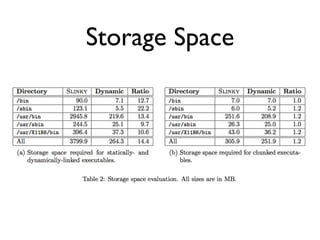
• Incorporating libraries at compile-time[^1]
• Pros
• Easy to understand, implement, and use
• Self-contained apps
• Cons
• Duplications - spatial inefficiency
[^1]: More precisely, at link-time
Dynamic Linking
• Deferring linking until run-time
• Pros
• Space efficient (disk and memory)
• Flexibility
• Cons
• Complexity (e.g., version, path, dependency, etc.)
• Potential security risks
SLINKY
• Implicit sharing of libraries and data by
deduplication
• Best of both worlds
• Sharing memory pages
• Sharing disk space
• Reducing network bandwidth
Sharing Memory Pages
• When a page modified, it is no longer valid for
other processes. Potential solution: copy-on-
write.
• Share read-only code pages
• Data pages are likely modified, thus unlikely to
be shared anyway
• slink, digest, a set of Linux kernel
modifications
Slink
• Position independent code required
• Converts a dynamically linked executable
into a statically linked executable
• Finds all necessary libraries, organizes them
in the process’s address space, and resolves
symbols
Digest
• Inserts the digests for each code page
• Linux page: 4 KB, digest: 20 bytes - less than
0.5% overhead
Kernel Modifications
• Per-process digest table (PDT) - Maps page
number to digest
• Global digest table (GDT) - Contains the
digest of every code page in memory
Security
• Possibility of inserting malicious code
• Digest verification before loading a page to
the GDT
• Memory protection hardware
• SHA-1 or a different hash function of your
choice
Sharing Disk Space
• Breaking an executable into variable-size
chunks
• Only one copy of each unique chunk is
stored
• Similar idea to LBFS
Reducing Network
Bandwidth
• Transfers only a fraction of the chunks
• The initial transfer represents a worst-case
scenario
• Deduplication!
Performance
• Measured:
• Elapsed time to build the Linux kernel
• Page fault handling in both an unmodified Linux kernel
and a modified kernel
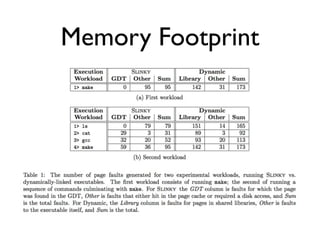
• Number of page faults - SLINKY’s effect on the page fault
rate and the memory footprints
• Suffers fewer page faults than their dynamically linked
counterparts
• Page fault rate decreased after several other executables
have added pages to the GDT
Memory Footprint
Storage Space
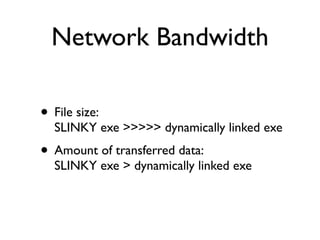
Network Bandwidth
• File size:
SLINKY exe >>>>> dynamically linked exe
• Amount of transferred data:
SLINKY exe > dynamically linked exe
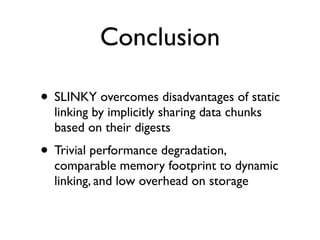
Conclusion
• SLINKY overcomes disadvantages of static
linking by implicitly sharing data chunks
based on their digests
• Trivial performance degradation,
comparable memory footprint to dynamic
linking, and low overhead on storage

SLINKY: Static Linking Reloaded

  • 1.
    SLINKY: Static Linking Reloaded ChristianCollberg, John Hartman et. al. CSC 630, Fall 2013, University of Arizona Sumin Byeon
  • 2.
    Linking • Combining aprogram and its libraries into a single executable • Resolving symbolic names of variables and functions into their resulting addresses
  • 3.
    Static Linking • Incorporatinglibraries at compile-time[^1] • Pros • Easy to understand, implement, and use • Self-contained apps • Cons • Duplications - spatial inefficiency [^1]: More precisely, at link-time
  • 4.
    Dynamic Linking • Deferringlinking until run-time • Pros • Space efficient (disk and memory) • Flexibility • Cons • Complexity (e.g., version, path, dependency, etc.) • Potential security risks
  • 5.
    SLINKY • Implicit sharingof libraries and data by deduplication • Best of both worlds • Sharing memory pages • Sharing disk space • Reducing network bandwidth
  • 6.
    Sharing Memory Pages •When a page modified, it is no longer valid for other processes. Potential solution: copy-on- write. • Share read-only code pages • Data pages are likely modified, thus unlikely to be shared anyway • slink, digest, a set of Linux kernel modifications
  • 7.
    Slink • Position independentcode required • Converts a dynamically linked executable into a statically linked executable • Finds all necessary libraries, organizes them in the process’s address space, and resolves symbols
  • 8.
    Digest • Inserts thedigests for each code page • Linux page: 4 KB, digest: 20 bytes - less than 0.5% overhead
  • 9.
    Kernel Modifications • Per-processdigest table (PDT) - Maps page number to digest • Global digest table (GDT) - Contains the digest of every code page in memory
  • 10.
    Security • Possibility ofinserting malicious code • Digest verification before loading a page to the GDT • Memory protection hardware • SHA-1 or a different hash function of your choice
  • 11.
    Sharing Disk Space •Breaking an executable into variable-size chunks • Only one copy of each unique chunk is stored • Similar idea to LBFS
  • 12.
    Reducing Network Bandwidth • Transfersonly a fraction of the chunks • The initial transfer represents a worst-case scenario • Deduplication!
  • 13.
    Performance • Measured: • Elapsedtime to build the Linux kernel • Page fault handling in both an unmodified Linux kernel and a modified kernel • Number of page faults - SLINKY’s effect on the page fault rate and the memory footprints • Suffers fewer page faults than their dynamically linked counterparts • Page fault rate decreased after several other executables have added pages to the GDT
  • 14.
  • 15.
  • 16.
    Network Bandwidth • Filesize: SLINKY exe >>>>> dynamically linked exe • Amount of transferred data: SLINKY exe > dynamically linked exe
  • 17.
    Conclusion • SLINKY overcomesdisadvantages of static linking by implicitly sharing data chunks based on their digests • Trivial performance degradation, comparable memory footprint to dynamic linking, and low overhead on storage