SCHOOL OF ARCHITECTURE, BUILDING AND DESIGN
BACHELOR OF QUANTITY SURVEYING (HONOURS)

QSB1813 – Site Surveying
Field Work ReportI
Levelling
August Semester 2013
Submission Date: 4th December 2013

Name

Student ID

Low Rong Tzuoo

0308336

Rueul Chan Ernyi

0315150

Wong Choong Ling

0314504

Yam Yih Hwan

0305861

1

Marks

Site Surveying - Report I (Leveling)
Table of Content
Cover Page

1

Table of Content

2

Introduction to Levelling

3–4

Objective

5

Outline of Apparatus

6–7

Levelling Result

8

Adjustment on Misclosure

9

Discussion

10

Conclusion

11

Learning Outcomes

2

Page

12

Site Surveying - Report I (Leveling)
Introduction to Levelling
Levelling is the art of determining the relative heights or elevations of a point on the
earth’s surface. It deals with measurements in a vertical plane.
In general terms,

Level Surfaceis any surface parallel to the mean spheroidal surface of the earth. Since
the earth is an oblate spheroid, a level surface may be regarded as a curved surface,
every point on which is equidistant from the center of the earth.
Vertical Line is a normal linelying on the level surface.
Horizontal Line is any line lying on the horizontal plane. It is usually a straight line
tangential to the level line.
Reduced Levelis a vertical distance of a point above or below the datum. The elevation
of a point is either plus or minus according to the point above or below the datum.
Benchmark (BM) is fixed reference point of known elevation.

3

Site Surveying - Report I (Leveling)
Introduction to Levelling
The line of collimation (HI)is the line intersectswith the cross hairs of the optical center
of the object glass. It is also called the line of sight.
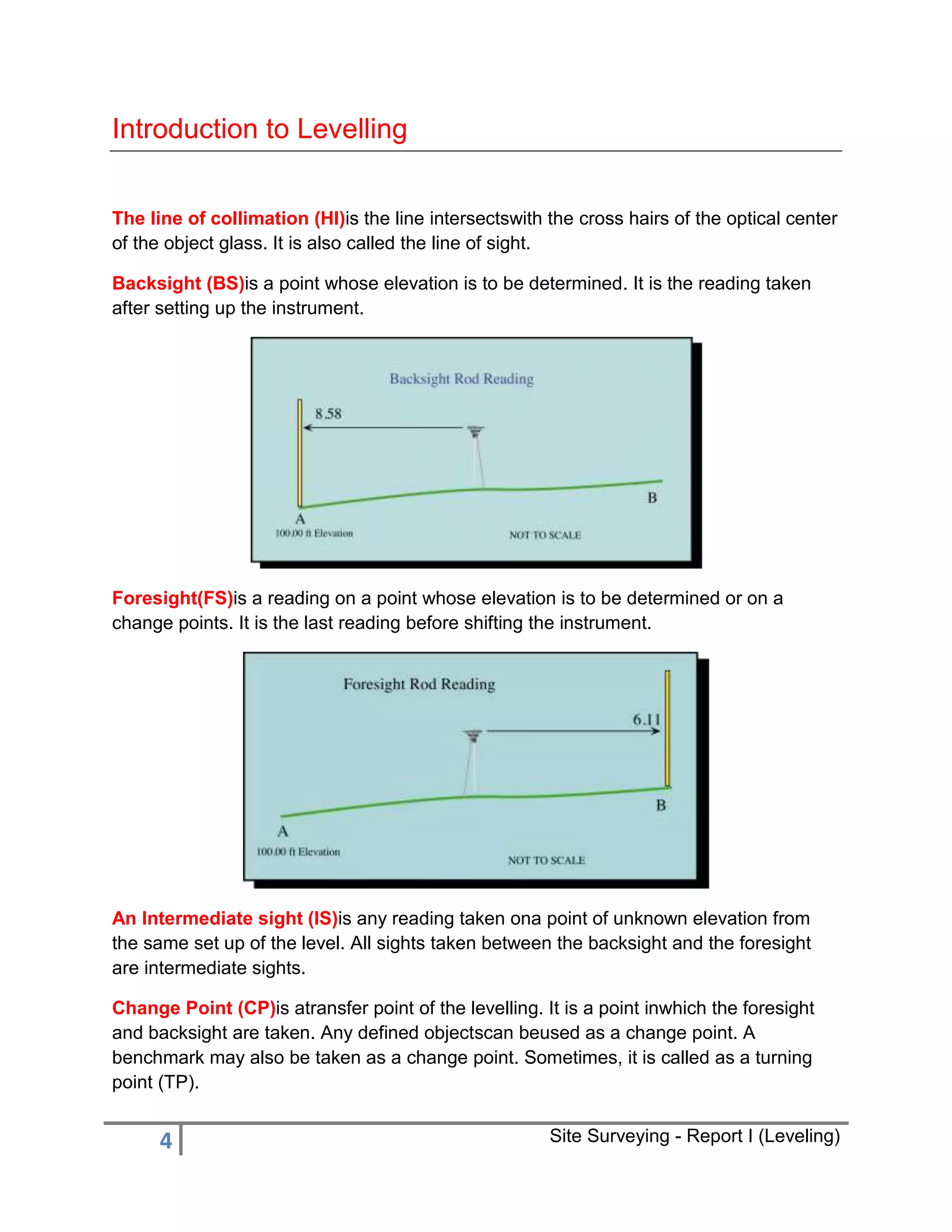
Backsight (BS)is a point whose elevation is to be determined. It is the reading taken
after setting up the instrument.

Foresight(FS)is a reading on a point whose elevation is to be determined or on a
change points. It is the last reading before shifting the instrument.

An Intermediate sight (IS)is any reading taken ona point of unknown elevation from
the same set up of the level. All sights taken between the backsight and the foresight
are intermediate sights.
Change Point (CP)is atransfer point of the levelling. It is a point inwhich the foresight
and backsight are taken. Any defined objectscan beused as a change point. A
benchmark may also be taken as a change point. Sometimes, it is called as a turning
point (TP).

4

Site Surveying - Report I (Leveling)
Objective
 To establish a new benchmark
 To determine the difference in height of discrete points
 To identify the spot relative heights
 To identify possible errors occurred

5

Site Surveying - Report I (Leveling)
Outline of Apparatus
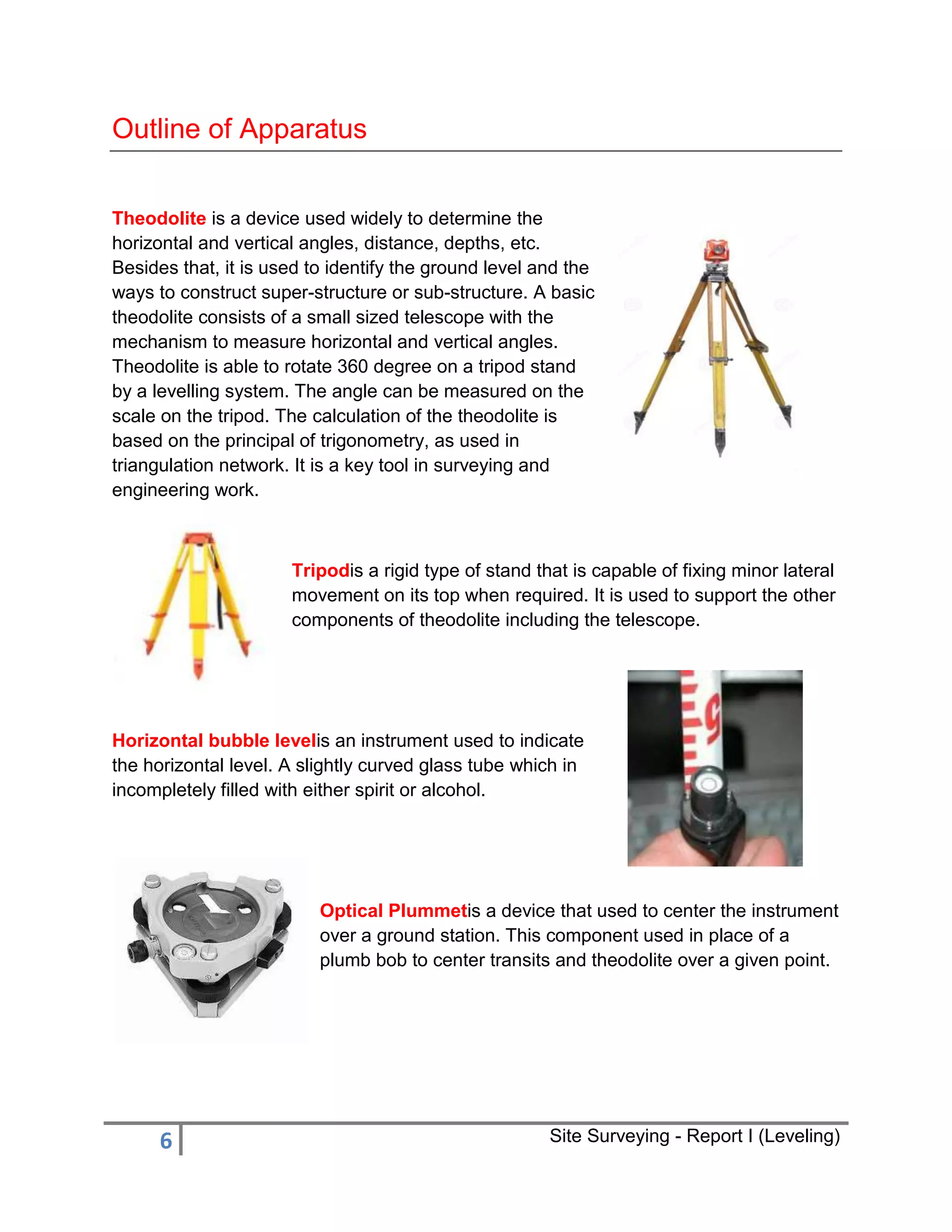
Theodolite is a device used widely to determine the
horizontal and vertical angles, distance, depths, etc.
Besides that, it is used to identify the ground level and the
ways to construct super-structure or sub-structure. A basic
theodolite consists of a small sized telescope with the
mechanism to measure horizontal and vertical angles.
Theodolite is able to rotate 360 degree on a tripod stand
by a levelling system. The angle can be measured on the
scale on the tripod. The calculation of the theodolite is
based on the principal of trigonometry, as used in
triangulation network. It is a key tool in surveying and
engineering work.

Tripodis a rigid type of stand that is capable of fixing minor lateral
movement on its top when required. It is used to support the other
components of theodolite including the telescope.

Horizontal bubble levelis an instrument used to indicate
the horizontal level. A slightly curved glass tube which in
incompletely filled with either spirit or alcohol.

Optical Plummetis a device that used to center the instrument
over a ground station. This component used in place of a
plumb bob to center transits and theodolite over a given point.

6

Site Surveying - Report I (Leveling)
Outline of Apparatus

Ruleris used to obtain the height of collimation through the scope
of theodolite.

Theodolite Telescopeis an instrument used to view distant
object. Telescope is an arrangement of lens that gather
visible light, permitting direct observation of a point through
the theodolite in a distance. There is a focusing screw to
adjust the clarity of the view in the telescope.

7

Site Surveying - Report I (Leveling)
Levelling Result
Backsight Foresight

Rise

Fall

Line of

Reduced

Collimation

Level

1.313

Remarks

100.000
101.313

99.899

TP 1

1.415

1.414

1.414

1.415

0.000

101.314

99.899

TP 2

1.414

1.313

0.101

101.313

100.000

TP 3

1.112

3.434

2.020

101.414

97.980

TP 4

1.516

1.314

0.202

99.092

97.778

TP 5

1.415

1.516

0.000

99.294

97.778

TP 6

1.515

1.313

0.102

99.193

97.880

TP 7

4.041

1.515

0.000

99.395

97.880

TP 8

1.515

1.414

2.627

101.921

100.507

TP 9

1.213

0.302

102.022

100.809

BM 1

- 15.861

3.132

0.809

=

16.670

0.101

BM 1

0.809

Correction

- 2.323
0.809

= (100.809 – 100.000) / 10
= 0.809 / 10
= 0.081

8

Site Surveying - Report I (Leveling)
Adjustment on Misclosure
Calculated

Line of

Reduced Level

Collimation

100.000

Remarks

Adjustment

Adjusted

Adjusted Line

Reduced Level

of Collimation

BM 1

(0.000)

100.000

100.000

99.899

101.313

TP 1

(0.081)

99.818

101.232

99.899

101.314

TP 2

(0.162)

99.737

101.152

100.000

101.313

TP 3

(0.243)

99.757

101.070

97.980

101.414

TP 4

(0.324)

97.656

101.090

97.778

99.092

TP 5

(0.405)

97.373

98.687

97.778

99.294

TP 6

(0.485)

97.293

98.809

97.880

99.193

TP 7

(0.566)

97.314

98.627

97.880

99.395

TP 8

(0.647)

97.233

98.748

100.507

101.921

TP 9

(0.728)

99.779

101.193

100.809

102.022

BM 1

(0.809)

100.000

101.213

9

Site Surveying - Report I (Leveling)
Discussion
Obtained data had been reduced;the copies of results and adjustment are included in
this report.
Bench Mark (BM) 1 has been held fixed at a Reduced Level (RL) of 100.00. From there,
the backsight (BS) and foresight (FS) are observed and recorded. Then, the amount of
rise and fall is gained from the subtraction of BS with FS.
Then, reduced level is being calculated through subtracting or adding the rise and fall, a
new reduced level is obtained. This process is then repeated for 9 times from different
points at the site. The final reduced level (RL) is to make sure the value is equal or
close to the initial RL.
However, in our report, the final RL is slightly more than the initial RL. Thus, there are
some errorsoccurred during the levelling process. If errors occurred, the reduced level
must be adjusted using the method we had been taught in class, loop misclosure. Loop
misclosure is the anout by which the measured height difference differs from the known
height. If the error in a level loop is unacceptable, the leveling must be repeated.
However, the error in a level loop in our leveling is acceptable, therefore the error can
be distributed according to the distances leveled (or the number of instrument
setups).Small misclosure in closed level loops is expected because of the accumulation
of errors.

10

Site Surveying - Report I (Leveling)
Conclusion
In conclusion, we are able to obtain the data through the usage of levelling equipment
provided by lecturer. Even though some errors occurred, we were able to identify it and
performed an adjustment to the data we obtained on site. Then, using the obtained data,
we were able to conduct a field work report.

11

Site Surveying - Report I (Leveling)
Learning Outcomes
 Able to conduct a fieldwork report regarding to levelling
 Get to experience the equipmenton site
 Learning the correct ways of levelling
 Able to obtain data through the usage of levelling equipment
 Able to identify the errors & conduct an adjustment

12

Site Surveying - Report I (Leveling)

Site surveying report i

  • 1.
    SCHOOL OF ARCHITECTURE,BUILDING AND DESIGN BACHELOR OF QUANTITY SURVEYING (HONOURS) QSB1813 – Site Surveying Field Work ReportI Levelling August Semester 2013 Submission Date: 4th December 2013 Name Student ID Low Rong Tzuoo 0308336 Rueul Chan Ernyi 0315150 Wong Choong Ling 0314504 Yam Yih Hwan 0305861 1 Marks Site Surveying - Report I (Leveling)
  • 2.
    Table of Content CoverPage 1 Table of Content 2 Introduction to Levelling 3–4 Objective 5 Outline of Apparatus 6–7 Levelling Result 8 Adjustment on Misclosure 9 Discussion 10 Conclusion 11 Learning Outcomes 2 Page 12 Site Surveying - Report I (Leveling)
  • 3.
    Introduction to Levelling Levellingis the art of determining the relative heights or elevations of a point on the earth’s surface. It deals with measurements in a vertical plane. In general terms, Level Surfaceis any surface parallel to the mean spheroidal surface of the earth. Since the earth is an oblate spheroid, a level surface may be regarded as a curved surface, every point on which is equidistant from the center of the earth. Vertical Line is a normal linelying on the level surface. Horizontal Line is any line lying on the horizontal plane. It is usually a straight line tangential to the level line. Reduced Levelis a vertical distance of a point above or below the datum. The elevation of a point is either plus or minus according to the point above or below the datum. Benchmark (BM) is fixed reference point of known elevation. 3 Site Surveying - Report I (Leveling)
  • 4.
    Introduction to Levelling Theline of collimation (HI)is the line intersectswith the cross hairs of the optical center of the object glass. It is also called the line of sight. Backsight (BS)is a point whose elevation is to be determined. It is the reading taken after setting up the instrument. Foresight(FS)is a reading on a point whose elevation is to be determined or on a change points. It is the last reading before shifting the instrument. An Intermediate sight (IS)is any reading taken ona point of unknown elevation from the same set up of the level. All sights taken between the backsight and the foresight are intermediate sights. Change Point (CP)is atransfer point of the levelling. It is a point inwhich the foresight and backsight are taken. Any defined objectscan beused as a change point. A benchmark may also be taken as a change point. Sometimes, it is called as a turning point (TP). 4 Site Surveying - Report I (Leveling)
  • 5.
    Objective  To establisha new benchmark  To determine the difference in height of discrete points  To identify the spot relative heights  To identify possible errors occurred 5 Site Surveying - Report I (Leveling)
  • 6.
    Outline of Apparatus Theodoliteis a device used widely to determine the horizontal and vertical angles, distance, depths, etc. Besides that, it is used to identify the ground level and the ways to construct super-structure or sub-structure. A basic theodolite consists of a small sized telescope with the mechanism to measure horizontal and vertical angles. Theodolite is able to rotate 360 degree on a tripod stand by a levelling system. The angle can be measured on the scale on the tripod. The calculation of the theodolite is based on the principal of trigonometry, as used in triangulation network. It is a key tool in surveying and engineering work. Tripodis a rigid type of stand that is capable of fixing minor lateral movement on its top when required. It is used to support the other components of theodolite including the telescope. Horizontal bubble levelis an instrument used to indicate the horizontal level. A slightly curved glass tube which in incompletely filled with either spirit or alcohol. Optical Plummetis a device that used to center the instrument over a ground station. This component used in place of a plumb bob to center transits and theodolite over a given point. 6 Site Surveying - Report I (Leveling)
  • 7.
    Outline of Apparatus Rulerisused to obtain the height of collimation through the scope of theodolite. Theodolite Telescopeis an instrument used to view distant object. Telescope is an arrangement of lens that gather visible light, permitting direct observation of a point through the theodolite in a distance. There is a focusing screw to adjust the clarity of the view in the telescope. 7 Site Surveying - Report I (Leveling)
  • 8.
    Levelling Result Backsight Foresight Rise Fall Lineof Reduced Collimation Level 1.313 Remarks 100.000 101.313 99.899 TP 1 1.415 1.414 1.414 1.415 0.000 101.314 99.899 TP 2 1.414 1.313 0.101 101.313 100.000 TP 3 1.112 3.434 2.020 101.414 97.980 TP 4 1.516 1.314 0.202 99.092 97.778 TP 5 1.415 1.516 0.000 99.294 97.778 TP 6 1.515 1.313 0.102 99.193 97.880 TP 7 4.041 1.515 0.000 99.395 97.880 TP 8 1.515 1.414 2.627 101.921 100.507 TP 9 1.213 0.302 102.022 100.809 BM 1 - 15.861 3.132 0.809 = 16.670 0.101 BM 1 0.809 Correction - 2.323 0.809 = (100.809 – 100.000) / 10 = 0.809 / 10 = 0.081 8 Site Surveying - Report I (Leveling)
  • 9.
    Adjustment on Misclosure Calculated Lineof Reduced Level Collimation 100.000 Remarks Adjustment Adjusted Adjusted Line Reduced Level of Collimation BM 1 (0.000) 100.000 100.000 99.899 101.313 TP 1 (0.081) 99.818 101.232 99.899 101.314 TP 2 (0.162) 99.737 101.152 100.000 101.313 TP 3 (0.243) 99.757 101.070 97.980 101.414 TP 4 (0.324) 97.656 101.090 97.778 99.092 TP 5 (0.405) 97.373 98.687 97.778 99.294 TP 6 (0.485) 97.293 98.809 97.880 99.193 TP 7 (0.566) 97.314 98.627 97.880 99.395 TP 8 (0.647) 97.233 98.748 100.507 101.921 TP 9 (0.728) 99.779 101.193 100.809 102.022 BM 1 (0.809) 100.000 101.213 9 Site Surveying - Report I (Leveling)
  • 10.
    Discussion Obtained data hadbeen reduced;the copies of results and adjustment are included in this report. Bench Mark (BM) 1 has been held fixed at a Reduced Level (RL) of 100.00. From there, the backsight (BS) and foresight (FS) are observed and recorded. Then, the amount of rise and fall is gained from the subtraction of BS with FS. Then, reduced level is being calculated through subtracting or adding the rise and fall, a new reduced level is obtained. This process is then repeated for 9 times from different points at the site. The final reduced level (RL) is to make sure the value is equal or close to the initial RL. However, in our report, the final RL is slightly more than the initial RL. Thus, there are some errorsoccurred during the levelling process. If errors occurred, the reduced level must be adjusted using the method we had been taught in class, loop misclosure. Loop misclosure is the anout by which the measured height difference differs from the known height. If the error in a level loop is unacceptable, the leveling must be repeated. However, the error in a level loop in our leveling is acceptable, therefore the error can be distributed according to the distances leveled (or the number of instrument setups).Small misclosure in closed level loops is expected because of the accumulation of errors. 10 Site Surveying - Report I (Leveling)
  • 11.
    Conclusion In conclusion, weare able to obtain the data through the usage of levelling equipment provided by lecturer. Even though some errors occurred, we were able to identify it and performed an adjustment to the data we obtained on site. Then, using the obtained data, we were able to conduct a field work report. 11 Site Surveying - Report I (Leveling)
  • 12.
    Learning Outcomes  Ableto conduct a fieldwork report regarding to levelling  Get to experience the equipmenton site  Learning the correct ways of levelling  Able to obtain data through the usage of levelling equipment  Able to identify the errors & conduct an adjustment 12 Site Surveying - Report I (Leveling)