www.ifpri.org
Simulation Models for Long-Term
Scenario Analysis
Sherman Robinson
International Food Policy Research Institute (IFPRI)
FAO Workshop, Rome, February 2016
www.ifpri.org
2
FAO: Long-Term Issues
 Population growth, migration, and limits to natural
resources
 Income distribution
 Investment and finance
 Structural change and global value chains
 Climate change and the energy-agriculture-climate
change nexus
www.ifpri.org
3
FAO Agenda: “A global overall model”
 A work program to develop a single, overarching model
for long-run scenario analysis is not a good idea
 Instead, the goal is to start with issues, as the FAO has
done, and then design a “suite” of models to address the
issues at different levels of economy coverage (local,
country, globe) and commodity detail; different
economic/technology specifications; and different
disciplinary roots (inter-disciplinary modelling)
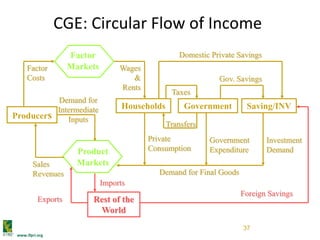
 The challenge is to “link” and/or “integrate” multi-
disciplinary models to address long-run issues
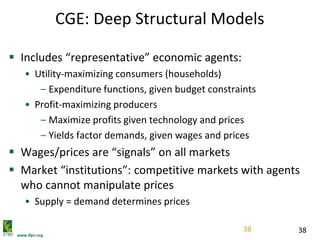
www.ifpri.org
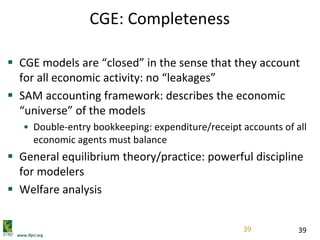
4
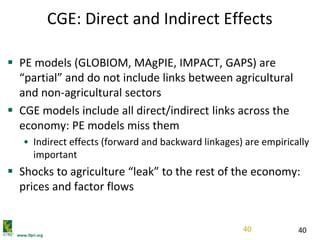
Issues, Models, and Data
 Long-run simulation models should be “issue driven”
• Institutionally, model development and use should be with, or
“close” to, units that use the models in policy analysis
 Simulation models are “data driven”—models require up-
to-date estimated parameters and data
• Model code should be data driven—designed to allow change
of data aggregation and new data with minimal effect on model
specification and code
 Data estimation and management “system” should be
institutionally “close” to model development and use
www.ifpri.org
5
FAO: Linked Issues
 Two sets of FAO issues are strongly linked:
• Climate change and the energy-agriculture-climate change
nexus
• Population growth, migration, and limits to natural resources
 Difficult to think of them separately
• “Natural resources”: land and water are a major focus
• Population growth is not generally modeled endogenously, but
treated in scenarios (e.g., IPCC SSP scenarios)
• Migration is very difficult (e.g., World Bank work did scenarios
with a global CGE model—essentially LINKAGE)
www.ifpri.org
6
The IFPRI IMPACT 3 Model
 International Model for Policy Analysis of
Agricultural Commodities and Trade
• Close cousin to FAO GAPS model
• Related to GLOBIOM and MAgPIE
 Need for a multi-disciplinary approach:
• Core economic model linked to other
disciplinary models
• CGIAR and other institutional collaborators
www.ifpri.org
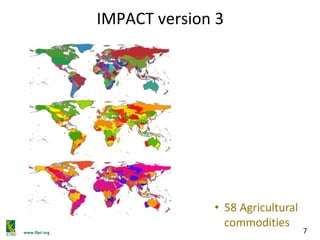
IMPACT version 3
• 58 Agricultural
commodities
7
www.ifpri.org
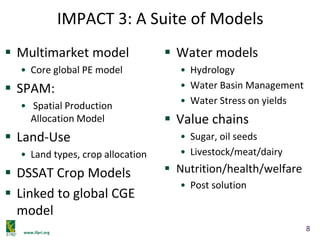
IMPACT 3: A Suite of Models
 Multimarket model
• Core global PE model
 SPAM:
• Spatial Production
Allocation Model
 Land-Use
• Land types, crop allocation
 DSSAT Crop Models
 Linked to global CGE
model
 Water models
• Hydrology
• Water Basin Management
• Water Stress on yields
 Value chains
• Sugar, oil seeds
• Livestock/meat/dairy
 Nutrition/health/welfare
• Post solution
8
www.ifpri.org
9
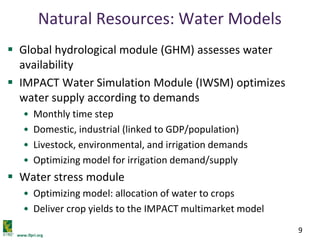
Natural Resources: Water Models
 Global hydrological module (GHM) assesses water
availability
 IMPACT Water Simulation Module (IWSM) optimizes
water supply according to demands
• Monthly time step
• Domestic, industrial (linked to GDP/population)
• Livestock, environmental, and irrigation demands
• Optimizing model for irrigation demand/supply
 Water stress module
• Optimizing model: allocation of water to crops
• Deliver crop yields to the IMPACT multimarket model
www.ifpri.org
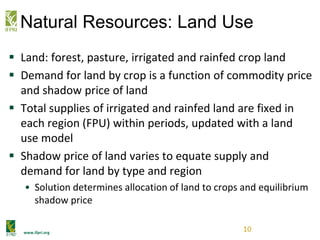
Natural Resources: Land Use
 Land: forest, pasture, irrigated and rainfed crop land
 Demand for land by crop is a function of commodity price
and shadow price of land
 Total supplies of irrigated and rainfed land are fixed in
each region (FPU) within periods, updated with a land
use model
 Shadow price of land varies to equate supply and
demand for land by type and region
• Solution determines allocation of land to crops and equilibrium
shadow price
10
www.ifpri.org
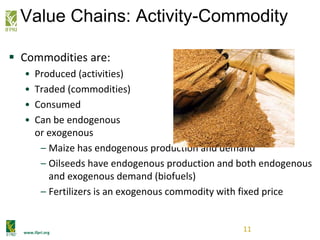
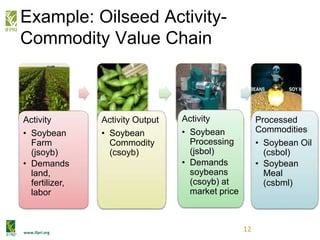
Value Chains: Activity-Commodity
 Commodities are:
• Produced (activities)
• Traded (commodities)
• Consumed
• Can be endogenous
or exogenous
– Maize has endogenous production and demand
– Oilseeds have endogenous production and both endogenous
and exogenous demand (biofuels)
– Fertilizers is an exogenous commodity with fixed price
11
www.ifpri.org
Example: Oilseed Activity-
Commodity Value Chain
12
Activity
• Soybean
Farm
(jsoyb)
• Demands
land,
fertilizer,
labor
Activity Output
• Soybean
Commodity
(csoyb)
Activity
• Soybean
Processing
(jsbol)
• Demands
soybeans
(csoyb) at
market price
Processed
Commodities
• Soybean Oil
(csbol)
• Soybean
Meal
(csbml)
www.ifpri.org
13
IMPACT 3: Potential Improvements
 New livestock module: under development with ILRI
 Fish module: joint work with World Fish
• Two stage work program underway
 Linked global CGE model: joint work with IDS
• Welfare analysis, economywide direct/indirect links
 Links to environmental models
• Biodiversity: IFPRI and Bioversity
• GHG emissions, nitrogen use efficiency: IFPRI
 Water model improvements:
• Ground water, water quality, hydropower
www.ifpri.org
14
IMPACT 3: Potential Improvements
 New crop modules: fruits/vegetables, other crops
 Nutrition module: IFPRI, PHND, A4NH, CIMSANS, Oxford,
and others
 Health module: with Oxford (Martin Centre)
 Improved land-use module: land supply/demand by type
 Variability and extreme events
• Work with UK/US collaborators
• Covariate climate shocks
• Pest/disease scenarios
www.ifpri.org
15
Linked Global CGE Model
 Link IMPACT 3 with the GLOBE CGE model
• GLOBE is based on GTAP data and written in GAMS
• Includes activity/commodity distinction, as in IMPACT 3
 One-way links: IMPACT to GLOBE
• Crop/livestock production from IMPACT 3 passed to GLOBE,
which then is run assuming those outputs are fixed
• GLOBE solves for economywide impacts (direct and indirect
links): production, employment, and prices
• All welfare analysis is done in GLOBE (EV/CV, total absorption)
• Links to labor markets, wages, and poverty done in GLOBE
www.ifpri.org
16
Linked Global CGE Model
 Two-way links: IMPACT to/from GLOBE
• Agricultural output from IMPACT: GLOBE generates GDP
originating in agriculture, and changes in total GDP
• GDP from GLOBE sent back to IMPACT, so GDP in IMPACT
reflects changes in agricultural productivity
– Currently, GDP is exogenous in IMPACT
• Energy interactions: biofuels and other energy sources
 GLOBE and IMPACT need not run on the same time step
• Both can be annual, but can run on different multiyear time
steps (e.g., annual for IMPACT, every 5 years for GLOBE)
 GLOBE linked via a standalone module that takes input
from IMPACT and runs GLOBE
www.ifpri.org
17
Modularity: Linking Modules
 Modularity; “a la carte” model system
• Use the models you need, turn off those you do not need
• Separate models can be run independently
• Modules can run with different time steps
 Standardize data transfer
• Information flows
• Dynamic or iterative interaction
 “Data driven” model specification
• IMPACT 3 multimarket model can be run at any level of
aggregation without changing the model code
• Change input data and sets only: user need not even see the
GAMS code
www.ifpri.org
18
Advantages of Modularity
 “Standalone” modules can be run independently of
IMPACT, but use inputs from IMPACT scenarios
• Can be developed, calibrated, and tested by specialists (e.g,
from various CGIAR centers).
• Designed to be used in Center research programs
 Design: separate modules can reflect their disciplines
• No need to compromise to “fit” one model into another
• E.g. water in economic models or economics in water models—
always unsatisfactory
 Model development, testing, and debugging is greatly
facilitated if the modules can be run separately
www.ifpri.org
19
Desiderata for Modular Model Systems
“Modules” should be designed to:
 Operate in “standalone” mode
 Read its own parameters
 Initialize its own variables
 Accept variables/parameters passed to it from
other modules and the environment;
 Pass variables that are computed within the
module to other modules or the main model
 Own its set of state variables
www.ifpri.org
20
Modularity: Linking Modules
 Three ways to link modules:
• Exogenous: Information flows in one direction
– To IMPACT: hydrology, DSSAT, GCMs, SPAM
– From IMPACT: welfare, nutrition/health, GLOBE/CGE
• Linked dynamically: Two-way information flow between years
– Water basin management, water stress on crops
– Land use by type
– GDP/economywide links: GLOBE
• Endogenous: Module equations are solved simultaneously
– Livestock, sugar processing, oilseeds/oils
– Land allocation to crops
www.ifpri.org
21
IMPACT 3 Modules
 Standalone modules, one-way links:
• Welfare, nutrition, GLOBE (e.g., welfare, economywide
impacts), hydrology, DSSAT, GCMs
 Standalone modules, inter-period links:
• Water models (IWSM, water stress), land use (by land type),
livestock (herds), GLOBE (e.g., GDP, non-ag prices)
 Standalone modules, intra-period links:
• Land use (cropping, irrigated/rainfed), Livestock
 Value chains, within IMPACT: sugar, oilseeds,
livestock
www.ifpri.org
22
Standalone IMPACT Module: Template
 GAMS IMPACT-compatible standalone module
• Include file with definition of relevant IMPACT parameters
• Include GDX file(s) of scenario output of IMPACT results
• Load IMPACT data needed by the module
 Data estimation and management
• Module has its own data base, in addition to IMPACT data
 Model specification and parameterization
• If module is to be integrated with IMPACT, must avoid name
collisions for parameters, variables, and equations
 Linking to IMPACT 3
• Communication: exogenous, intra-period, within-period
www.ifpri.org
Global Computable General
Equilibrium and Partial
Equilibrium Models: CGE/PE
Sherman Robinson
International Food Policy Research Institute (IFPRI)
FAO Workshop
February 2016
www.ifpri.org
33
Simulation Models & Scenario Analysis
 Given the uncertainties of climate change, researchers
have used simulation models to explore the effects of
different CC scenarios
• Integrated Assessment Models (IAM), early work
• Steady advances in the reach, size, and sophistication of CC-
scenario simulation models
– Geographic disaggregation
– Impact chains (e.g., temp, precip, extreme events)
– Economic coverage (global, national, sub-regional)
33
www.ifpri.org
34
CC Simulation Models
 Need for an interdisciplinary approach
• Climate change (GCMs)
• Civil engineering: infrastructure
• Energy (fossil fuels, renewables, hydropower)
• Hydrology, water management
• Agriculture (crop models)
• Economic models: markets matter
– Two major families of economic simulation models: CGE
(computable general equilibrium) and PE (partial equilibrium
34
www.ifpri.org
35
 Relative strengths of different global models with an
agricultural focus: CGE and PE models
• Relevance for issues of biodiversity and ecosystem services
in Foresight Models
 Exploiting comparative advantages of different model
systems
• Modularity within and between model families
• “Soft” and “hard” linking different models
 Data base estimation and management
Global CGE and PE Model Families
35
www.ifpri.org
36
Global CGE Models at IFPRI: GLOBE, MIRAGE
 Global CGE models simulate the interaction of national
economies across world markets
• Determine national and world market prices
 CGE models are “complete”: they incorporate all
economic activity in the economies simulated
• Production (supply), income to “agents” (households, govt.,
enterprises), demand (C, I, G), exports/imports, prices, wages,
land rents, exchange rates
• Markets “clear”: supply/demand equilibrium conditions
determine prices, wages, profits, land rents
36
www.ifpri.org
37
Producers
Product
Markets
Factor
Markets
Rest of the
World
Households Government Saving/INV
Factor
Costs
Wages
&
Rents
Demand for
Intermediate
Inputs
Sales
Revenues
Private
Consumption
Taxes
Domestic Private Savings
Government
Expenditure
Gov. Savings
Investment
Demand
Imports
Exports
Foreign Savings
Demand for Final Goods
Transfers
CGE: Circular Flow of Income
www.ifpri.org
38
CGE: Deep Structural Models
 Includes “representative” economic agents:
• Utility-maximizing consumers (households)
– Expenditure functions, given budget constraints
• Profit-maximizing producers
– Maximize profits given technology and prices
– Yields factor demands, given wages and prices
 Wages/prices are “signals” on all markets
 Market “institutions”: competitive markets with agents
who cannot manipulate prices
• Supply = demand determines prices
38
www.ifpri.org
39
CGE: Completeness
 CGE models are “closed” in the sense that they account
for all economic activity: no “leakages”
 SAM accounting framework: describes the economic
“universe” of the models
• Double-entry bookkeeping: expenditure/receipt accounts of all
economic agents must balance
 General equilibrium theory/practice: powerful discipline
for modelers
 Welfare analysis
39
www.ifpri.org
40
CGE: Direct and Indirect Effects
 PE models (GLOBIOM, MAgPIE, IMPACT, GAPS) are
“partial” and do not include links between agricultural
and non-agricultural sectors
 CGE models include all direct/indirect links across the
economy: PE models miss them
• Indirect effects (forward and backward linkages) are empirically
important
 Shocks to agriculture “leak” to the rest of the economy:
prices and factor flows
40
www.ifpri.org
41
PE Models: Agricultural Detail
 The PE models provide much more disaggregated
description of agriculture than the CGE models
• Regional, land, and crop disaggregation
• Focus on crop inputs and biology: seeds, water, light, heat,
nutrients: process technologies
 Better host for analysis of issues of biodiversity and
ecosystem services
• Links to land use and crop simulation models
 Potentially PE a better host for a modular system of
models, but also feasible with CGE models
41

Simulation Models for Long-Term Scenario Analysis

  • 1.
    www.ifpri.org Simulation Models forLong-Term Scenario Analysis Sherman Robinson International Food Policy Research Institute (IFPRI) FAO Workshop, Rome, February 2016
  • 2.
    www.ifpri.org 2 FAO: Long-Term Issues Population growth, migration, and limits to natural resources  Income distribution  Investment and finance  Structural change and global value chains  Climate change and the energy-agriculture-climate change nexus
  • 3.
    www.ifpri.org 3 FAO Agenda: “Aglobal overall model”  A work program to develop a single, overarching model for long-run scenario analysis is not a good idea  Instead, the goal is to start with issues, as the FAO has done, and then design a “suite” of models to address the issues at different levels of economy coverage (local, country, globe) and commodity detail; different economic/technology specifications; and different disciplinary roots (inter-disciplinary modelling)  The challenge is to “link” and/or “integrate” multi- disciplinary models to address long-run issues
  • 4.
    www.ifpri.org 4 Issues, Models, andData  Long-run simulation models should be “issue driven” • Institutionally, model development and use should be with, or “close” to, units that use the models in policy analysis  Simulation models are “data driven”—models require up- to-date estimated parameters and data • Model code should be data driven—designed to allow change of data aggregation and new data with minimal effect on model specification and code  Data estimation and management “system” should be institutionally “close” to model development and use
  • 5.
    www.ifpri.org 5 FAO: Linked Issues Two sets of FAO issues are strongly linked: • Climate change and the energy-agriculture-climate change nexus • Population growth, migration, and limits to natural resources  Difficult to think of them separately • “Natural resources”: land and water are a major focus • Population growth is not generally modeled endogenously, but treated in scenarios (e.g., IPCC SSP scenarios) • Migration is very difficult (e.g., World Bank work did scenarios with a global CGE model—essentially LINKAGE)
  • 6.
    www.ifpri.org 6 The IFPRI IMPACT3 Model  International Model for Policy Analysis of Agricultural Commodities and Trade • Close cousin to FAO GAPS model • Related to GLOBIOM and MAgPIE  Need for a multi-disciplinary approach: • Core economic model linked to other disciplinary models • CGIAR and other institutional collaborators
  • 7.
    www.ifpri.org IMPACT version 3 •58 Agricultural commodities 7
  • 8.
    www.ifpri.org IMPACT 3: ASuite of Models  Multimarket model • Core global PE model  SPAM: • Spatial Production Allocation Model  Land-Use • Land types, crop allocation  DSSAT Crop Models  Linked to global CGE model  Water models • Hydrology • Water Basin Management • Water Stress on yields  Value chains • Sugar, oil seeds • Livestock/meat/dairy  Nutrition/health/welfare • Post solution 8
  • 9.
    www.ifpri.org 9 Natural Resources: WaterModels  Global hydrological module (GHM) assesses water availability  IMPACT Water Simulation Module (IWSM) optimizes water supply according to demands • Monthly time step • Domestic, industrial (linked to GDP/population) • Livestock, environmental, and irrigation demands • Optimizing model for irrigation demand/supply  Water stress module • Optimizing model: allocation of water to crops • Deliver crop yields to the IMPACT multimarket model
  • 10.
    www.ifpri.org Natural Resources: LandUse  Land: forest, pasture, irrigated and rainfed crop land  Demand for land by crop is a function of commodity price and shadow price of land  Total supplies of irrigated and rainfed land are fixed in each region (FPU) within periods, updated with a land use model  Shadow price of land varies to equate supply and demand for land by type and region • Solution determines allocation of land to crops and equilibrium shadow price 10
  • 11.
    www.ifpri.org Value Chains: Activity-Commodity Commodities are: • Produced (activities) • Traded (commodities) • Consumed • Can be endogenous or exogenous – Maize has endogenous production and demand – Oilseeds have endogenous production and both endogenous and exogenous demand (biofuels) – Fertilizers is an exogenous commodity with fixed price 11
  • 12.
    www.ifpri.org Example: Oilseed Activity- CommodityValue Chain 12 Activity • Soybean Farm (jsoyb) • Demands land, fertilizer, labor Activity Output • Soybean Commodity (csoyb) Activity • Soybean Processing (jsbol) • Demands soybeans (csoyb) at market price Processed Commodities • Soybean Oil (csbol) • Soybean Meal (csbml)
  • 13.
    www.ifpri.org 13 IMPACT 3: PotentialImprovements  New livestock module: under development with ILRI  Fish module: joint work with World Fish • Two stage work program underway  Linked global CGE model: joint work with IDS • Welfare analysis, economywide direct/indirect links  Links to environmental models • Biodiversity: IFPRI and Bioversity • GHG emissions, nitrogen use efficiency: IFPRI  Water model improvements: • Ground water, water quality, hydropower
  • 14.
    www.ifpri.org 14 IMPACT 3: PotentialImprovements  New crop modules: fruits/vegetables, other crops  Nutrition module: IFPRI, PHND, A4NH, CIMSANS, Oxford, and others  Health module: with Oxford (Martin Centre)  Improved land-use module: land supply/demand by type  Variability and extreme events • Work with UK/US collaborators • Covariate climate shocks • Pest/disease scenarios
  • 15.
    www.ifpri.org 15 Linked Global CGEModel  Link IMPACT 3 with the GLOBE CGE model • GLOBE is based on GTAP data and written in GAMS • Includes activity/commodity distinction, as in IMPACT 3  One-way links: IMPACT to GLOBE • Crop/livestock production from IMPACT 3 passed to GLOBE, which then is run assuming those outputs are fixed • GLOBE solves for economywide impacts (direct and indirect links): production, employment, and prices • All welfare analysis is done in GLOBE (EV/CV, total absorption) • Links to labor markets, wages, and poverty done in GLOBE
  • 16.
    www.ifpri.org 16 Linked Global CGEModel  Two-way links: IMPACT to/from GLOBE • Agricultural output from IMPACT: GLOBE generates GDP originating in agriculture, and changes in total GDP • GDP from GLOBE sent back to IMPACT, so GDP in IMPACT reflects changes in agricultural productivity – Currently, GDP is exogenous in IMPACT • Energy interactions: biofuels and other energy sources  GLOBE and IMPACT need not run on the same time step • Both can be annual, but can run on different multiyear time steps (e.g., annual for IMPACT, every 5 years for GLOBE)  GLOBE linked via a standalone module that takes input from IMPACT and runs GLOBE
  • 17.
    www.ifpri.org 17 Modularity: Linking Modules Modularity; “a la carte” model system • Use the models you need, turn off those you do not need • Separate models can be run independently • Modules can run with different time steps  Standardize data transfer • Information flows • Dynamic or iterative interaction  “Data driven” model specification • IMPACT 3 multimarket model can be run at any level of aggregation without changing the model code • Change input data and sets only: user need not even see the GAMS code
  • 18.
    www.ifpri.org 18 Advantages of Modularity “Standalone” modules can be run independently of IMPACT, but use inputs from IMPACT scenarios • Can be developed, calibrated, and tested by specialists (e.g, from various CGIAR centers). • Designed to be used in Center research programs  Design: separate modules can reflect their disciplines • No need to compromise to “fit” one model into another • E.g. water in economic models or economics in water models— always unsatisfactory  Model development, testing, and debugging is greatly facilitated if the modules can be run separately
  • 19.
    www.ifpri.org 19 Desiderata for ModularModel Systems “Modules” should be designed to:  Operate in “standalone” mode  Read its own parameters  Initialize its own variables  Accept variables/parameters passed to it from other modules and the environment;  Pass variables that are computed within the module to other modules or the main model  Own its set of state variables
  • 20.
    www.ifpri.org 20 Modularity: Linking Modules Three ways to link modules: • Exogenous: Information flows in one direction – To IMPACT: hydrology, DSSAT, GCMs, SPAM – From IMPACT: welfare, nutrition/health, GLOBE/CGE • Linked dynamically: Two-way information flow between years – Water basin management, water stress on crops – Land use by type – GDP/economywide links: GLOBE • Endogenous: Module equations are solved simultaneously – Livestock, sugar processing, oilseeds/oils – Land allocation to crops
  • 21.
    www.ifpri.org 21 IMPACT 3 Modules Standalone modules, one-way links: • Welfare, nutrition, GLOBE (e.g., welfare, economywide impacts), hydrology, DSSAT, GCMs  Standalone modules, inter-period links: • Water models (IWSM, water stress), land use (by land type), livestock (herds), GLOBE (e.g., GDP, non-ag prices)  Standalone modules, intra-period links: • Land use (cropping, irrigated/rainfed), Livestock  Value chains, within IMPACT: sugar, oilseeds, livestock
  • 22.
    www.ifpri.org 22 Standalone IMPACT Module:Template  GAMS IMPACT-compatible standalone module • Include file with definition of relevant IMPACT parameters • Include GDX file(s) of scenario output of IMPACT results • Load IMPACT data needed by the module  Data estimation and management • Module has its own data base, in addition to IMPACT data  Model specification and parameterization • If module is to be integrated with IMPACT, must avoid name collisions for parameters, variables, and equations  Linking to IMPACT 3 • Communication: exogenous, intra-period, within-period
  • 23.
    www.ifpri.org Global Computable General Equilibriumand Partial Equilibrium Models: CGE/PE Sherman Robinson International Food Policy Research Institute (IFPRI) FAO Workshop February 2016
  • 24.
    www.ifpri.org 33 Simulation Models &Scenario Analysis  Given the uncertainties of climate change, researchers have used simulation models to explore the effects of different CC scenarios • Integrated Assessment Models (IAM), early work • Steady advances in the reach, size, and sophistication of CC- scenario simulation models – Geographic disaggregation – Impact chains (e.g., temp, precip, extreme events) – Economic coverage (global, national, sub-regional) 33
  • 25.
    www.ifpri.org 34 CC Simulation Models Need for an interdisciplinary approach • Climate change (GCMs) • Civil engineering: infrastructure • Energy (fossil fuels, renewables, hydropower) • Hydrology, water management • Agriculture (crop models) • Economic models: markets matter – Two major families of economic simulation models: CGE (computable general equilibrium) and PE (partial equilibrium 34
  • 26.
    www.ifpri.org 35  Relative strengthsof different global models with an agricultural focus: CGE and PE models • Relevance for issues of biodiversity and ecosystem services in Foresight Models  Exploiting comparative advantages of different model systems • Modularity within and between model families • “Soft” and “hard” linking different models  Data base estimation and management Global CGE and PE Model Families 35
  • 27.
    www.ifpri.org 36 Global CGE Modelsat IFPRI: GLOBE, MIRAGE  Global CGE models simulate the interaction of national economies across world markets • Determine national and world market prices  CGE models are “complete”: they incorporate all economic activity in the economies simulated • Production (supply), income to “agents” (households, govt., enterprises), demand (C, I, G), exports/imports, prices, wages, land rents, exchange rates • Markets “clear”: supply/demand equilibrium conditions determine prices, wages, profits, land rents 36
  • 28.
    www.ifpri.org 37 Producers Product Markets Factor Markets Rest of the World HouseholdsGovernment Saving/INV Factor Costs Wages & Rents Demand for Intermediate Inputs Sales Revenues Private Consumption Taxes Domestic Private Savings Government Expenditure Gov. Savings Investment Demand Imports Exports Foreign Savings Demand for Final Goods Transfers CGE: Circular Flow of Income
  • 29.
    www.ifpri.org 38 CGE: Deep StructuralModels  Includes “representative” economic agents: • Utility-maximizing consumers (households) – Expenditure functions, given budget constraints • Profit-maximizing producers – Maximize profits given technology and prices – Yields factor demands, given wages and prices  Wages/prices are “signals” on all markets  Market “institutions”: competitive markets with agents who cannot manipulate prices • Supply = demand determines prices 38
  • 30.
    www.ifpri.org 39 CGE: Completeness  CGEmodels are “closed” in the sense that they account for all economic activity: no “leakages”  SAM accounting framework: describes the economic “universe” of the models • Double-entry bookkeeping: expenditure/receipt accounts of all economic agents must balance  General equilibrium theory/practice: powerful discipline for modelers  Welfare analysis 39
  • 31.
    www.ifpri.org 40 CGE: Direct andIndirect Effects  PE models (GLOBIOM, MAgPIE, IMPACT, GAPS) are “partial” and do not include links between agricultural and non-agricultural sectors  CGE models include all direct/indirect links across the economy: PE models miss them • Indirect effects (forward and backward linkages) are empirically important  Shocks to agriculture “leak” to the rest of the economy: prices and factor flows 40
  • 32.
    www.ifpri.org 41 PE Models: AgriculturalDetail  The PE models provide much more disaggregated description of agriculture than the CGE models • Regional, land, and crop disaggregation • Focus on crop inputs and biology: seeds, water, light, heat, nutrients: process technologies  Better host for analysis of issues of biodiversity and ecosystem services • Links to land use and crop simulation models  Potentially PE a better host for a modular system of models, but also feasible with CGE models 41