SIMPLE
PRESENT
TENSE
INTRODUCTION
In this presentation I will talk about one
of the existing tenses in the English
language.
This time I will focus on this simple, I
hope you understand me.
We use the present simple in this case:
1. Habits (usually with frequency
adverbs).
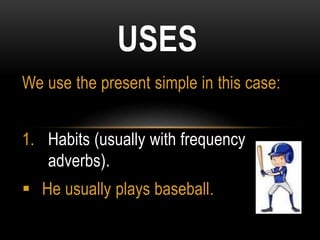
 He usually plays baseball.
USES
For things that are always / generally
true.
The Earth revolves around theSun.
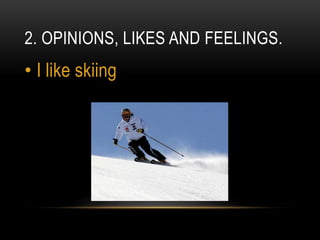
2. OPINIONS, LIKES AND FEELINGS.
• I like skiing
TIME EXPRESSIONS
• FREQUENCY ADVERBS
Always, often, generally, usually, normally,
sometimes, never.
• OTHER TIME EXPRESSIONS
Every day, every month, etc.
FORM
• AFIRMATIVE
He, She, It plays
I, You, We, They play
• NEGATIVE
He, She, It doesn’t play
I, You, We, They don’t play
• INTERROGATIVE
Does he / she / it play?
Do I / you / we / they play?
• SHORT FORMS
Does not = doesn’t
Do not = don’t
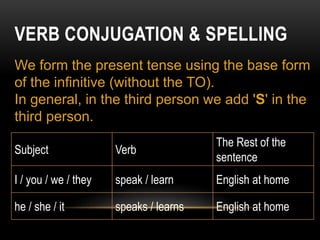
VERB CONJUGATION & SPELLING
Subject Verb
The Rest of the
sentence
I / you / we / they speak / learn English at home
he / she / it speaks / learns English at home
We form the present tense using the base form
of the infinitive (without the TO).
In general, in the third person we add 'S' in the
third person.
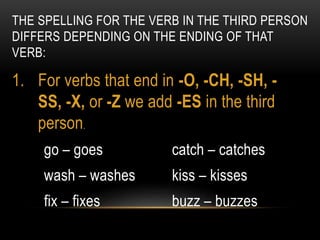
THE SPELLING FOR THE VERB IN THE THIRD PERSON
DIFFERS DEPENDING ON THE ENDING OF THAT
VERB:
1. For verbs that end in -O, -CH, -SH, -
SS, -X, or -Z we add -ES in the third
person.
go – goes catch – catches
wash – washes kiss – kisses
fix – fixes buzz – buzzes
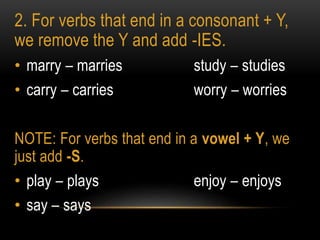
2. For verbs that end in a consonant + Y,
we remove the Y and add -IES.
• marry – marries study – studies
• carry – carries worry – worries
NOTE: For verbs that end in a vowel + Y, we
just add -S.
• play – plays enjoy – enjoys
• say – says
NEGATIVE SENTENCES IN THE SIMPLE
PRESENT TENSE
• To make a negative sentence in English we normally
use Don't or Doesn't with all verbs EXCEPT To Be
and Modal verbs (can, might, should etc.).
Affirmative: You speak French.
Negative: You don't speak French.
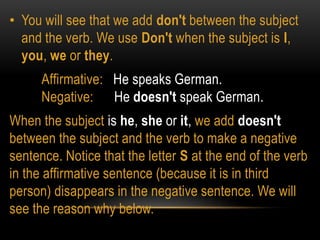
• You will see that we add don't between the subject
and the verb. We use Don't when the subject is I,
you, we or they.
Affirmative: He speaks German.
Negative: He doesn't speak German.
When the subject is he, she or it, we add doesn't
between the subject and the verb to make a negative
sentence. Notice that the letter S at the end of the verb
in the affirmative sentence (because it is in third
person) disappears in the negative sentence. We will
see the reason why below.
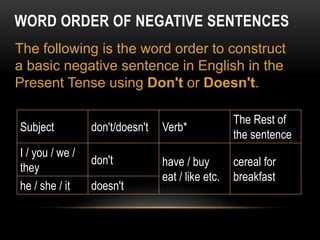
WORD ORDER OF NEGATIVE SENTENCES
Subject don't/doesn't Verb*
The Rest of
the sentence
I / you / we /
they
don't have / buy
eat / like etc.
cereal for
breakfast
he / she / it doesn't
The following is the word order to construct
a basic negative sentence in English in the
Present Tense using Don't or Doesn't.

Simple present tense

  • 1.
  • 2.
    INTRODUCTION In this presentationI will talk about one of the existing tenses in the English language. This time I will focus on this simple, I hope you understand me.
  • 3.
    We use thepresent simple in this case: 1. Habits (usually with frequency adverbs).  He usually plays baseball. USES
  • 4.
    For things thatare always / generally true. The Earth revolves around theSun.
  • 5.
    2. OPINIONS, LIKESAND FEELINGS. • I like skiing
  • 6.
    TIME EXPRESSIONS • FREQUENCYADVERBS Always, often, generally, usually, normally, sometimes, never. • OTHER TIME EXPRESSIONS Every day, every month, etc.
  • 7.
    FORM • AFIRMATIVE He, She,It plays I, You, We, They play • NEGATIVE He, She, It doesn’t play I, You, We, They don’t play
  • 8.
    • INTERROGATIVE Does he/ she / it play? Do I / you / we / they play? • SHORT FORMS Does not = doesn’t Do not = don’t
  • 9.
    VERB CONJUGATION &SPELLING Subject Verb The Rest of the sentence I / you / we / they speak / learn English at home he / she / it speaks / learns English at home We form the present tense using the base form of the infinitive (without the TO). In general, in the third person we add 'S' in the third person.
  • 10.
    THE SPELLING FORTHE VERB IN THE THIRD PERSON DIFFERS DEPENDING ON THE ENDING OF THAT VERB: 1. For verbs that end in -O, -CH, -SH, - SS, -X, or -Z we add -ES in the third person. go – goes catch – catches wash – washes kiss – kisses fix – fixes buzz – buzzes
  • 11.
    2. For verbsthat end in a consonant + Y, we remove the Y and add -IES. • marry – marries study – studies • carry – carries worry – worries NOTE: For verbs that end in a vowel + Y, we just add -S. • play – plays enjoy – enjoys • say – says
  • 12.
    NEGATIVE SENTENCES INTHE SIMPLE PRESENT TENSE • To make a negative sentence in English we normally use Don't or Doesn't with all verbs EXCEPT To Be and Modal verbs (can, might, should etc.). Affirmative: You speak French. Negative: You don't speak French.
  • 13.
    • You willsee that we add don't between the subject and the verb. We use Don't when the subject is I, you, we or they. Affirmative: He speaks German. Negative: He doesn't speak German. When the subject is he, she or it, we add doesn't between the subject and the verb to make a negative sentence. Notice that the letter S at the end of the verb in the affirmative sentence (because it is in third person) disappears in the negative sentence. We will see the reason why below.
  • 14.
    WORD ORDER OFNEGATIVE SENTENCES Subject don't/doesn't Verb* The Rest of the sentence I / you / we / they don't have / buy eat / like etc. cereal for breakfast he / she / it doesn't The following is the word order to construct a basic negative sentence in English in the Present Tense using Don't or Doesn't.

Editor's Notes