TOPIC OF PRESENTATION
SIMPLE FUTURE TENSE
GROUP MEMBERS
◦ ZARAFSHAN
◦ TUBA BATOOL
◦ AQSA MUSHTAQ
◦ HABIBA JAMEEL
◦ TANVEER ASHRAF
◦ SAJAWAL ANDAAZ
SIMPLE FUTURE
TENSE
TOPIC:
SIMPLE FUTURE TENSE
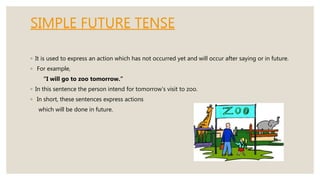
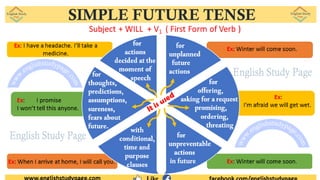
◦ It is used to express an action which has not occurred yet and will occur after saying or in future.
◦ For example,
“I will go to zoo tomorrow.”
◦ In this sentence the person intend for tomorrow’s visit to zoo.
◦ In short, these sentences express actions
which will be done in future.
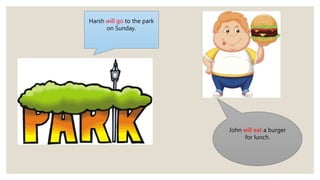
Harsh will go to the park
on Sunday.
John will eat a burger
for lunch.
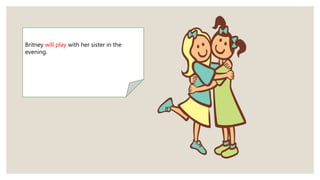
Britney will play with her sister in the
evening.
To change some verbs into
The future tense we add
“will” before the verb.
Like…….
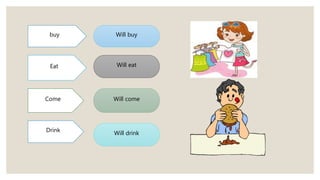
Eat
Come
Drink
buy Will buy
Will eat
Will come
Will drink
FORMING THE FUTURE INDEFINITE
◦ Positive sentence
• Subject + Auxiliary verb + Main verb + object
•Subject + will + 1st form of verb + object
Examples.
I will buy a computer tomorrow.
They will come here.
◦ Negative sentence
• Subject + Auxiliary verb+ NOT + main verb + object
• Subject + WILL +NOT + 1st form of verb or base form + object
To make negative sentence “not” is written after auxiliary verb in sentence.
Examples.
I will not buy a computer tomorrow.
They will not come here.
◦ Interrogative sentence
• Auxiliary verb + subject + main verb + object
• Will + subject + 1st form of verb or base form + object
Interrogative sentence starts with auxiliary verb “will”
Examples.
Will I buy a computer tomorrow?
Will they come here?
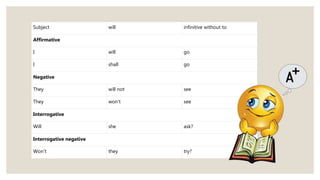
Subject will infinitive without to
Affirmative
I will go
I shall go
Negative
They will not see
They won't see
Interrogative
Will she ask?
Interrogative negative
Won't they try?
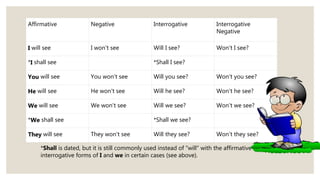
Affirmative Negative Interrogative Interrogative
Negative
I will see I won't see Will I see? Won't I see?
*I shall see *Shall I see?
You will see You won't see Will you see? Won't you see?
He will see He won't see Will he see? Won't he see?
We will see We won't see Will we see? Won't we see?
*We shall see *Shall we see?
They will see They won't see Will they see? Won't they see?
*Shall is dated, but it is still commonly used instead of "will" with the affirmative or
interrogative forms of I and we in certain cases (see above).
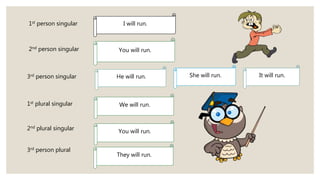
1st person singular
2nd person singular
3rd person singular
1st plural singular
2nd plural singular
3rd person plural
I will run.
You will run.
He will run.
We will run.
She will run. It will run.
They will run.
You will run.
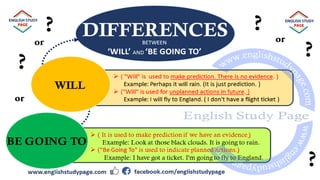
“Will” and “going to”:
◦ Simple future has two forms in English: “will” and “be
going to”
◦ Although the two forms are sometimes used
interchangeably, they often express different meaning.
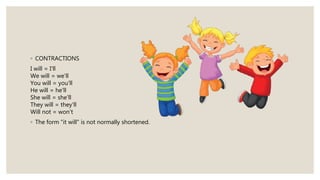
◦ CONTRACTIONS
I will = I'll
We will = we'll
You will = you'll
He will = he'll
She will = she'll
They will = they'll
Will not = won't
◦ The form "it will" is not normally shortened.
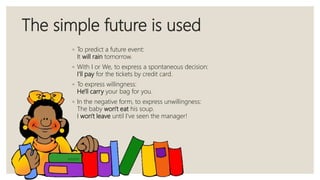
The simple future is used
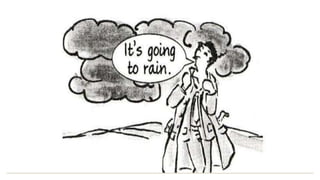
◦ To predict a future event:
It will rain tomorrow.
◦ With I or We, to express a spontaneous decision:
I'll pay for the tickets by credit card.
◦ To express willingness:
He'll carry your bag for you.
◦ In the negative form, to express unwillingness:
The baby won't eat his soup.
I won't leave until I've seen the manager!
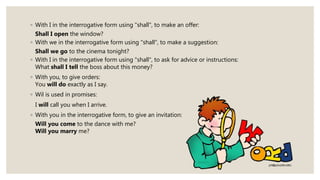
◦ With I in the interrogative form using "shall", to make an offer:
Shall I open the window?
◦ With we in the interrogative form using "shall", to make a suggestion:
Shall we go to the cinema tonight?
◦ With I in the interrogative form using "shall", to ask for advice or instructions:
What shall I tell the boss about this money?
◦ With you, to give orders:
You will do exactly as I say.
◦ Wil is used in promises:
I will call you when I arrive.
◦ With you in the interrogative form, to give an invitation:
Will you come to the dance with me?
Will you marry me?
No Plan
We use the Future Simple tense when there is no plan or decision to do something before we
speak. We make the decision spontaneously at the time of speaking. Look at these examples:
◦ Hold on. I'll get a pen.
◦ We will see what we can do to help you.
◦ Maybe we'll stay in and watch television tonight.
Prediction
We often use the Future Simple tense to make a prediction about the future. Again, there is no
firm plan. We are saying what we think will happen.
Here are some examples:
◦ It will rain tomorrow.
◦ People won't go to Jupiter before the 22nd century.
◦ Who do you think will get the job?
Be
When the main verb is be, we can use the Future Simple tense even if we have a firm plan or
decision before speaking.
Examples:
◦ I'll be in London tomorrow.
◦ I'm going shopping. I won't be very long.
◦ Will you be at work tomorrow?
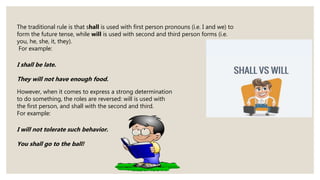
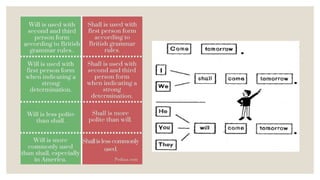
The traditional rule is that shall is used with first person pronouns (i.e. I and we) to
form the future tense, while will is used with second and third person forms (i.e.
you, he, she, it, they).
For example:
I shall be late.
They will not have enough food.
However, when it comes to express a strong determination
to do something, the roles are reversed: will is used with
the first person, and shall with the second and third.
For example:
I will not tolerate such behavior.
You shall go to the ball!
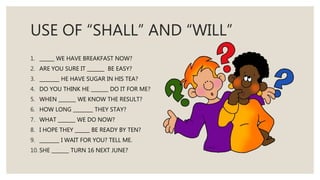
USE OF “SHALL” AND “WILL”
1. ______ WE HAVE BREAKFAST NOW?
2. ARE YOU SURE IT _______ BE EASY?
3. ________ HE HAVE SUGAR IN HIS TEA?
4. DO YOU THINK HE _______ DO IT FOR ME?
5. WHEN _______ WE KNOW THE RESULT?
6. HOW LONG ________ THEY STAY?
7. WHAT _______ WE DO NOW?
8. I HOPE THEY ______ BE READY BY TEN?
9. ________ I WAIT FOR YOU? TELL ME.
10. SHE _______ TURN 16 NEXT JUNE?
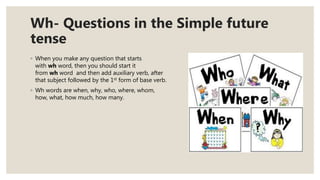
Wh- Questions in the Simple future
tense
◦ When you make any question that starts
with wh word, then you should start it
from wh word and then add auxiliary verb, after
that subject followed by the 1st form of base verb.
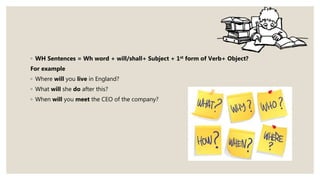
◦ Wh words are when, why, who, where, whom,
how, what, how much, how many.
◦ WH Sentences = Wh word + will/shall+ Subject + 1st form of Verb+ Object?
For example
◦ Where will you live in England?
◦ What will she do after this?
◦ When will you meet the CEO of the company?

Simple future tense

  • 1.
  • 3.
    GROUP MEMBERS ◦ ZARAFSHAN ◦TUBA BATOOL ◦ AQSA MUSHTAQ ◦ HABIBA JAMEEL ◦ TANVEER ASHRAF ◦ SAJAWAL ANDAAZ
  • 4.
  • 5.
    SIMPLE FUTURE TENSE ◦It is used to express an action which has not occurred yet and will occur after saying or in future. ◦ For example, “I will go to zoo tomorrow.” ◦ In this sentence the person intend for tomorrow’s visit to zoo. ◦ In short, these sentences express actions which will be done in future.
  • 7.
    Harsh will goto the park on Sunday. John will eat a burger for lunch.
  • 8.
    Britney will playwith her sister in the evening.
  • 9.
    To change someverbs into The future tense we add “will” before the verb. Like…….
  • 10.
    Eat Come Drink buy Will buy Willeat Will come Will drink
  • 11.
    FORMING THE FUTUREINDEFINITE ◦ Positive sentence • Subject + Auxiliary verb + Main verb + object •Subject + will + 1st form of verb + object Examples. I will buy a computer tomorrow. They will come here.
  • 12.
    ◦ Negative sentence •Subject + Auxiliary verb+ NOT + main verb + object • Subject + WILL +NOT + 1st form of verb or base form + object To make negative sentence “not” is written after auxiliary verb in sentence. Examples. I will not buy a computer tomorrow. They will not come here.
  • 13.
    ◦ Interrogative sentence •Auxiliary verb + subject + main verb + object • Will + subject + 1st form of verb or base form + object Interrogative sentence starts with auxiliary verb “will” Examples. Will I buy a computer tomorrow? Will they come here?
  • 14.
    Subject will infinitivewithout to Affirmative I will go I shall go Negative They will not see They won't see Interrogative Will she ask? Interrogative negative Won't they try?
  • 15.
    Affirmative Negative InterrogativeInterrogative Negative I will see I won't see Will I see? Won't I see? *I shall see *Shall I see? You will see You won't see Will you see? Won't you see? He will see He won't see Will he see? Won't he see? We will see We won't see Will we see? Won't we see? *We shall see *Shall we see? They will see They won't see Will they see? Won't they see? *Shall is dated, but it is still commonly used instead of "will" with the affirmative or interrogative forms of I and we in certain cases (see above).
  • 16.
    1st person singular 2ndperson singular 3rd person singular 1st plural singular 2nd plural singular 3rd person plural I will run. You will run. He will run. We will run. She will run. It will run. They will run. You will run.
  • 18.
    “Will” and “goingto”: ◦ Simple future has two forms in English: “will” and “be going to” ◦ Although the two forms are sometimes used interchangeably, they often express different meaning.
  • 22.
    ◦ CONTRACTIONS I will= I'll We will = we'll You will = you'll He will = he'll She will = she'll They will = they'll Will not = won't ◦ The form "it will" is not normally shortened.
  • 23.
    The simple futureis used ◦ To predict a future event: It will rain tomorrow. ◦ With I or We, to express a spontaneous decision: I'll pay for the tickets by credit card. ◦ To express willingness: He'll carry your bag for you. ◦ In the negative form, to express unwillingness: The baby won't eat his soup. I won't leave until I've seen the manager!
  • 24.
    ◦ With Iin the interrogative form using "shall", to make an offer: Shall I open the window? ◦ With we in the interrogative form using "shall", to make a suggestion: Shall we go to the cinema tonight? ◦ With I in the interrogative form using "shall", to ask for advice or instructions: What shall I tell the boss about this money? ◦ With you, to give orders: You will do exactly as I say. ◦ Wil is used in promises: I will call you when I arrive. ◦ With you in the interrogative form, to give an invitation: Will you come to the dance with me? Will you marry me?
  • 25.
    No Plan We usethe Future Simple tense when there is no plan or decision to do something before we speak. We make the decision spontaneously at the time of speaking. Look at these examples: ◦ Hold on. I'll get a pen. ◦ We will see what we can do to help you. ◦ Maybe we'll stay in and watch television tonight.
  • 26.
    Prediction We often usethe Future Simple tense to make a prediction about the future. Again, there is no firm plan. We are saying what we think will happen. Here are some examples: ◦ It will rain tomorrow. ◦ People won't go to Jupiter before the 22nd century. ◦ Who do you think will get the job? Be When the main verb is be, we can use the Future Simple tense even if we have a firm plan or decision before speaking. Examples: ◦ I'll be in London tomorrow. ◦ I'm going shopping. I won't be very long. ◦ Will you be at work tomorrow?
  • 29.
    The traditional ruleis that shall is used with first person pronouns (i.e. I and we) to form the future tense, while will is used with second and third person forms (i.e. you, he, she, it, they). For example: I shall be late. They will not have enough food. However, when it comes to express a strong determination to do something, the roles are reversed: will is used with the first person, and shall with the second and third. For example: I will not tolerate such behavior. You shall go to the ball!
  • 31.
    USE OF “SHALL”AND “WILL” 1. ______ WE HAVE BREAKFAST NOW? 2. ARE YOU SURE IT _______ BE EASY? 3. ________ HE HAVE SUGAR IN HIS TEA? 4. DO YOU THINK HE _______ DO IT FOR ME? 5. WHEN _______ WE KNOW THE RESULT? 6. HOW LONG ________ THEY STAY? 7. WHAT _______ WE DO NOW? 8. I HOPE THEY ______ BE READY BY TEN? 9. ________ I WAIT FOR YOU? TELL ME. 10. SHE _______ TURN 16 NEXT JUNE?
  • 32.
    Wh- Questions inthe Simple future tense ◦ When you make any question that starts with wh word, then you should start it from wh word and then add auxiliary verb, after that subject followed by the 1st form of base verb. ◦ Wh words are when, why, who, where, whom, how, what, how much, how many.
  • 33.
    ◦ WH Sentences= Wh word + will/shall+ Subject + 1st form of Verb+ Object? For example ◦ Where will you live in England? ◦ What will she do after this? ◦ When will you meet the CEO of the company?

Editor's Notes

  • #17 I will sleep You will sleep He will sleep and son