UNIVERSITY OF CALIFORNIA, SAN DIEGO 


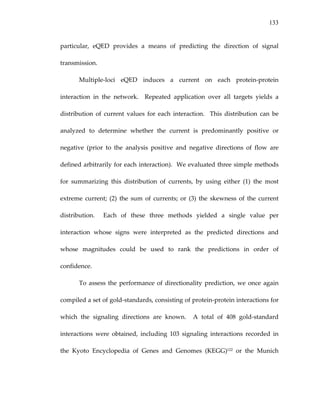
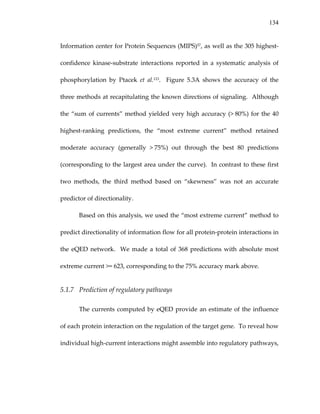
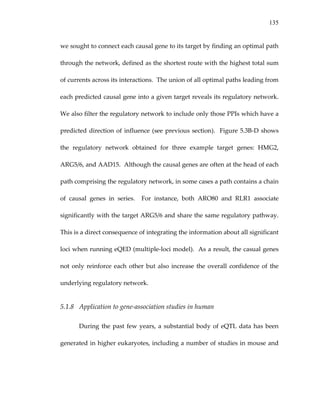
Understanding cellular function through the analysis of protein interaction 
networks 


A Dissertation submitted in partial satisfaction of the 
requirements for the degree of Doctor of Philosophy 
 
 
in 
 
 
Bioinformatics 
 
 
by 
 
 
Silpa Suthram 


Committee in charge: 
 
Professor Trey G. Ideker, Chair 
Professor Vineet Bafna 
Professor Philip Bourne 
Professor Jeff Hasty 
Professor Daniel O’Connor 
  ` 
 
2008 


Copyright 
 
Silpa Suthram, 2008 
 
All rights reserved.
 
 
The Dissertation of Silpa Suthram is approved, and it is acceptable in quality 
and form for publication on microfilm: 


Chair 
 
 
University of California, San Diego 
2008 


iii


To Sanjit 
I couldn’t have done it without you. 
iv


Aum 
Tamaso Ma Jyotir Gamaya || 
(Brhadaranyaka Upanishad — I.iii.28) 
 
 
Translation:  Lead me from darkness (ignorance) to light (knowledge). 
v
Table of Contents 
Signature Page...........................................................................................................iii
 
Dedication.................................................................................................................. iv
 
Epigraph .......................................................................................................................v
 
Table of Contents ..................................................................................................... vi
 
List of Figures.............................................................................................................ix
 
List of Tables ...............................................................................................................x
 
Acknowledgements...................................................................................................xi
 
Vita, Publications .....................................................................................................xv
 
Abstract..................................................................................................................... xvi
 
1 Introduction.........................................................................................................1
1.1 Generation and visualization of large‐scale protein interaction data..3
1.1.1 Yeast‐two hybrid assay...........................................................................3
1.1.2 Tandem Affinity Purification (TAP) followed by mass‐spectrometry...4
1.1.3 Visualization of protein interaction networks........................................5
1.2 Overview of the dissertation......................................................................6
1.2.1 Noise in the data.....................................................................................7
1.2.2 Comparative network analysis ...............................................................8
1.2.3 Network integration...............................................................................9
 
2 Assigning confidence scores to protein interactions.................................15
2.1 Estimation of interaction probabilities ...................................................18
2.2 Benchmarking analysis.............................................................................20
2.3 Quality assessment....................................................................................27
2.3.1 Presence of conserved interactions in other species..............................28
2.3.2 Expression correlation..........................................................................29
vi
2.3.3 Gene Ontology (GO) similarity...........................................................30
2.3.4 Signal‐to‐Noise Ratio of protein complexes .........................................32
2.3.5 Conservation rate coherency ................................................................33
2.4 Discussion...................................................................................................34
2.5 Methods ......................................................................................................37
2.5.1 GO databases........................................................................................37
2.5.2 Signal to noise ratio (SNR) ..................................................................38
2.5.3 Weighted average..................................................................................39
 
3 Comparative network analysis ......................................................................47
3.1 NetworkBLAST Algorithm ......................................................................49
3.1.1 Network alignment graph ....................................................................49
3.1.2 A probabilistic model of protein sub‐networks.....................................51
3.1.3 Search algorithm...................................................................................54
3.2 Complexes conserved across multiple species......................................57
3.2.1 Three‐way versus two‐way network alignment...................................61
3.2.2 Prediction of new protein functions.....................................................62
3.2.3 Prediction of new protein interactions.................................................63
3.3 Discussion...................................................................................................65
3.3.1 Comparison to existing methods ..........................................................65
3.3.2 Best BLAST hits may not imply functional conservation ...................66
3.3.3 Functional links within conserved networks........................................67
3.3.4 Validation of predicted interactions .....................................................69
3.3.5 Conclusion............................................................................................70
3.4 Methods ......................................................................................................71
3.4.1 Scoring functional enrichment.............................................................71
3.4.2 Prediction of protein functions.............................................................72
3.4.3 Prediction of protein interactions.........................................................75
3.4.4 Automatic layout of conserved complexes............................................78
 
4 Comparative network analysis of the protein network of the malaria 
parasite Plasmodium falciparum ...........................................................................94
4.1 Cross‐species comparison of the Plasmodium protein network........95
4.1.1 Data sources .........................................................................................95
4.1.2 Comparative analysis of the Plasmodium PPI network.......................96
4.1.3 Analysis of conserved and distinct complexes in Plasmodium..........101
4.1.4 Distribution of GO Cellular Components across species...................104
4.2 Discussion.................................................................................................106
vii
4.3 Methods ....................................................................................................108
4.3.1 Identification of conserved and species only complexes .....................108
4.3.2 Interaction confidence scores..............................................................109
4.3.3 Phylogenetic tree construction...........................................................109
4.3.4 SNR of protein complexes ..................................................................110
4.3.5 Simulating false‐positives and negatives in protein networks...........111
 
5 Network Integration: An efficient method for interpreting eQTL 
associations using protein networks ..................................................................124
5.1  “Electric circuit” analysis of eQTLs ......................................................126
5.1.1 Definition of terms .............................................................................126
5.1.2 Open problems motivated by previous method ..................................127
5.1.3 The eQED model ................................................................................128
5.1.4 Application to eQTL associations in yeast.........................................129
5.1.5 Combining multiple loci.....................................................................131
5.1.6 Predicting the direction of signaling along protein interactions .......132
5.1.7 Prediction of regulatory pathways .....................................................134
5.1.8 Application to gene‐association studies in human.............................135
5.2  Materials and Methods...........................................................................137
5.2.1 Electric circuits and random walks....................................................137
5.2.2 eQTL Associations .............................................................................139
5.2.3 High‐confidence physical interaction network...................................140
5.2.4 eQED Model.......................................................................................143
 
6 Conclusion .......................................................................................................150
6.1 Future directions......................................................................................151
 
7 References ........................................................................................................155
viii
List of Figures 
 
Figure 1.1:  Schematic of the yeast two‐hybrid assay...........................................12 
Figure 1.2:  Network abstraction of large‐scale protein interactions. ................13 
Figure 1.3:  Increase in the number of protein‐protein interactions...................14 
Figure 2.1  Histogram of GO similarity scores......................................................41 
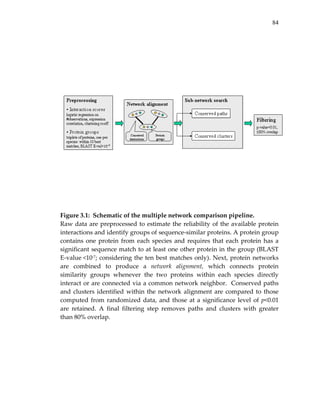
Figure 3.1:  Schematic of the multiple network comparison pipeline. ..............84 
Figure 3.2:  Representative conserved network regions. ... Error! Bookmark not 
defined. 
Figure 3.3:  Modular structure of conserved clusters among yeast, worm and 
fly. ................................................................................................................................86 
Figure 3.4:  Verification of predicted interactions by two‐hybrid testing. ........87 
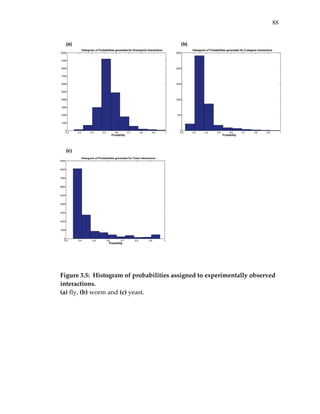
Figure 3.5:  Histogram of probabilities assigned to experimentally observed 
interactions. ................................................................................................................88 
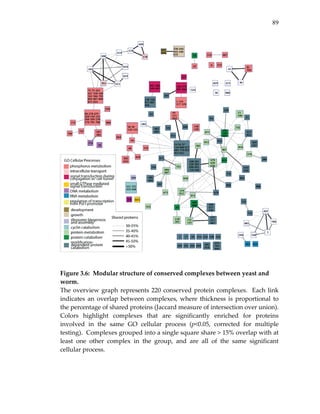
Figure 3.6:  Modular structure of conserved complexes between yeast and 
worm. ..........................................................................................................................89 
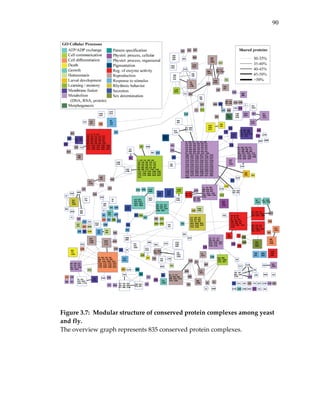
Figure 3.7:  Modular structure of conserved protein complexes among yeast 
and fly..........................................................................................................................90 
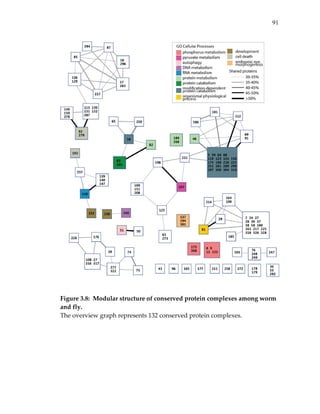
Figure 3.8:  Modular structure of conserved protein complexes among worm 
and fly..........................................................................................................................91 
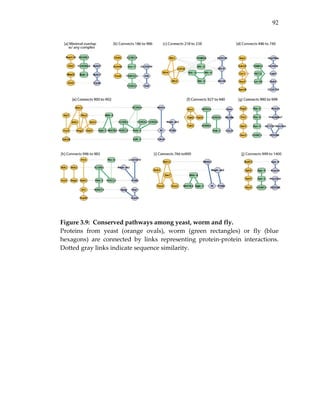
Figure 3.9:  Conserved pathways among yeast, worm and fly...........................92 
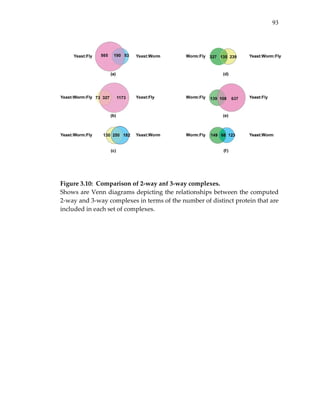
Figure 3.10:  Comparison of 2‐way anf 3‐way complexes...................................93 
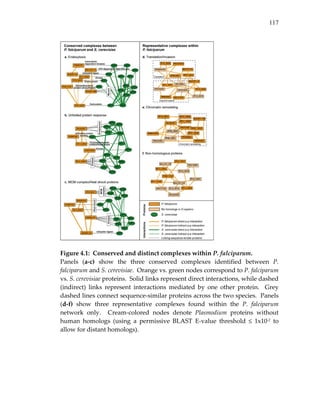
Figure 4.1:  Conserved and distinct complexes within P. falciparum. ..............117 
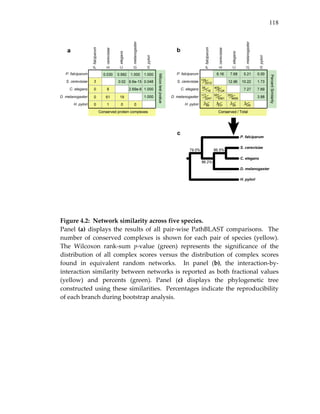
Figure 4.2:  Network similarity across five species.............................................118 
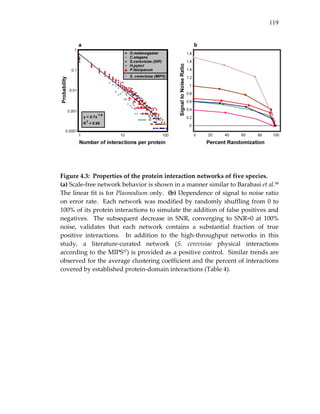
Figure 4.3:  Properties of the protein interaction networks of five species.....119 
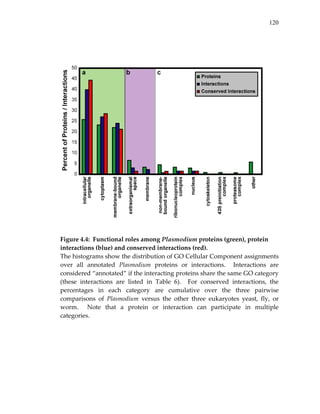
Figure 4.4:  Functional roles among Plasmodium proteins (green), protein 
interactions (blue) and conserved interactions (red)..........................................120 
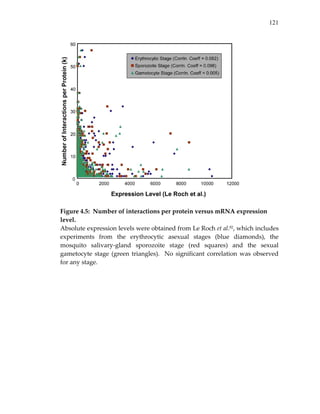
Figure 4.5:  Number of interactions per protein versus mRNA expression level.
....................................................................................................................................121 
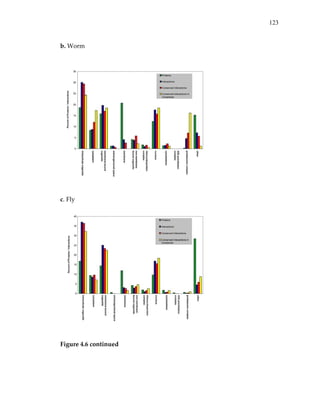
Figure 4.6:  Gene Ontology (GO) enrichment among cellular components in 
yeast (a), worm (b) ,and fly (c)...............................................................................122 
Figure 5.1:  Examples of the electrical circuit approach and the eQED model.
....................................................................................................................................147 
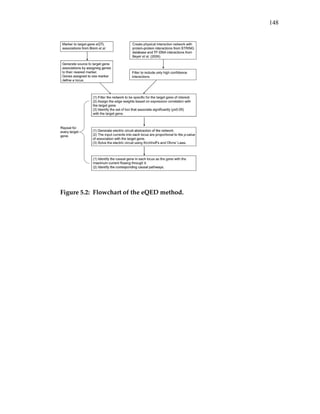
Figure 5.2:  Flowchart of the eQED method. .......................................................148 
Figure 5.3:  Inferred pathways and directionality prediction. ..........................149 
ix
List of Tables 
Table 2.1:  Summary of input attributes for the different probability schemes.
......................................................................................................................................42 
Table 2.2:  Global properties of the probability assignment schemes................42 
Table 2.3:  Correlation of different probability schemes......................................43 
Table 2.4:  Correlation of interaction probabilities with the GO similarity 
measure, mRNA expression correlation and interaction conservation.* ..........43 
Table 2.5:  Correlation of interaction probabilities with mRNA expression 
correlation.* ................................................................................................................44 
Table 2.6:  Effect of correlation between GO and mRNA expression................45 
Table 2.7:  Associations of conservation rate coherency scores and SNR with 
interaction probabilities............................................................................................46 
Table 2.8:  Fractional scores of the confidence assignment schemes in each of 
the five quality measures.*.......................................................................................46 
Table 3.1:  Cross‐validation for protein cellular process prediction. .................80 
Table 3.2:  Cross‐validation results for protein interaction predictions. ...........80 
Table 3.3:  Expanded cross‐validation results for protein interaction 
predictions. .................................................................................................................81 
Table 3.4:  Expanded cross‐validation results for predicting GO Biological 
Processes. ....................................................................................................................82 
Table 3.5:  Cross‐validation results for predicting protein GO Molecular 
Functions.....................................................................................................................82 
Table 3.6:  Protein coverage by complexes and pathways. .................................83 
Table 4.1:  Topological properties of protein interaction networks. ................113 
Table 4.2:  The Plasmodium network is enriched for proteins that have 
homologs in other species. .....................................................................................114 
Table 4.3:  Comparison of number of conserved interactions across species. 114 
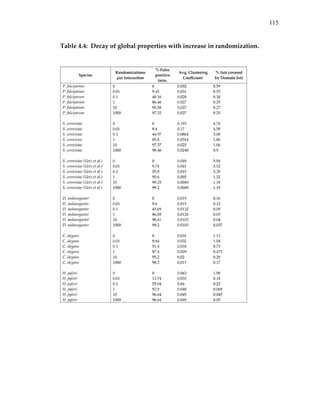
Table 4.4:  Decay of global properties with increase in randomization...........115 
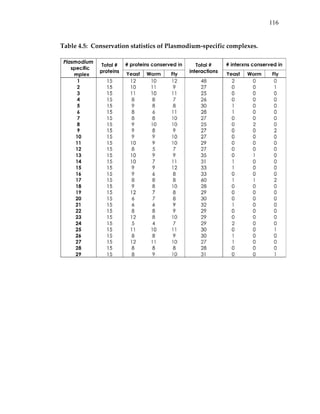
Table 4.5:  Conservation statistics of Plasmodium‐specific complexes. ..........116 
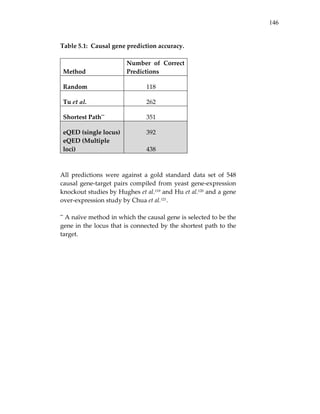
Table 5.1:  Causal gene prediction accuracy........................................................146 
x
Acknowledgements 
First and foremost, I would like to thank my advisor Dr. Trey Ideker.  
This  dissertation  would  not  have  been  possible  without  his  guidance  and 
inspiration.  His energy, lucid thinking and work ethic  have always served as 
inspiration.    Often,  discussions  with  him  helped  me  overcome 
disappointments, ready to tackle the obstacles afresh.  He also facilitated many 
collaborations which have enriched my experience in research.   
I would also like to thank all the members of my committee:  Dr. Vineet 
Bafna,  Dr.  Jeff  Hasty,  Dr.  Phil  Bourne  and,  Dr.  Dan  O’Connor.    Their 
comments  and  suggestions  during  various  committee  and  individual 
meetings have been instrumental in improving my dissertation.  I would like 
to  thank  the  Bioinformatics  program  Steering  committee,  especially  Dr. 
Shankar  Subramaniam  and  Dr.  Pavel  Pevzner,  for  accepting  me  into  the 
program and, suggesting classes and rotations to take in my first year. 
During the length of my graduate studies, I have worked with various 
collaborators,  and  my  thesis  has  benefited  greatly  from  their  insights.  
Specifically, Taylor Sittler and Dr. Andreas Beyer for always being available 
for long discussions and, the ensuing exchange of ideas has been vital to my 
research.  In addition, I also want to thank Dr. Roded Sharan for his expertise 
xi
in  algorithmic  and  statistical  techniques  which  have  inspired  me  to  work 
towards improving my understanding of them. 
I am grateful to all my colleagues in the Ideker lab for their suggestions 
and  criticisms  during  weekly  lab  meetings.    In  particular,  Dr.  Kai  Tan  and 
Sourav  Bandyopadhyay,  who  were  my  “neighbors”  in  the  lab  for  chats  on 
systems  biology  research,  and  also  for  willingly  reviewing  the  initial 
manuscripts of my papers and providing valuable comments.   
I  also  thank  my  classmates  in  the  Bioinformatics  program,  especially 
Leah Barrera and Thuy Vo, for their research insights and also for lending a 
ready ear whenever I had some questions and also for being great friends.  I 
also want to thank Han‐Yu Chuang, Alice Lee, Samantha Smeraglia, Barbara 
Mattson, Sandeep Kanumuri and Sourja Ray for their friendship.  I thank the 
Association of Indian Graduate Students (AIGS) for organizing various social 
events  over  the  years.    I  am  also  grateful  to  Mrs.  Pushpa  Reddy,  Dr.  Sekar 
Krishna, Debashish Panigrahi, Drs. Ranjita and Kanishka Lahiri who helped 
me adjust to a new environment when I first moved to San Diego. 
Lastly, I would like to thank all my family for their support.  Specially, 
my  parents,  Radha  and  Suresh,  for  instilling  in  me  an  appreciation  for 
knowledge and education from an early age and encouraging  me in all  my  
xii
pursuits.  My younger brother Sagar has always been a source of inspiration 
for me.  Finally, I thank my husband Sanjit, for always believing in me and 
encouraging me to try my best. 
Chapter 2 in part quotes sections from the Supplementary Methods of 
Sharan R, Suthram S, Kelley RM, Kuhn T, McCuine S, Uetz P, Sittler T, Karp 
RM,  Ideker  T  (2005)  Conserved  patterns  of  protein  interaction  in  multiple 
species. Proc Natl Acad Sci U S A 102: 1974‐1979.  I was the second author in 
that work and was responsible for the generation of interaction probabilities 
which  is  quoted  in  this  chapter.    This  chapter  also  contains  the  complete 
reprint of the work  Suthram S, Shlomi T, Ruppin E, Sharan R, Ideker T (2006) 
A  direct  comparison  of  protein  interaction  confidence  assignment  schemes. 
BMC Bioinformatics 7: 360.  I was the primary author of this paper. 
Chapter  3  contains  the  complete  reprint  of    the  paper  Sharan  R, 
Suthram S, Kelley RM, Kuhn T, McCuine S, Uetz P, Sittler T, Karp RM, Ideker 
T  (2005)  Conserved  patterns  of  protein  interaction  in  multiple  species.  Proc 
Natl Acad Sci U S A 102: 1974‐1979.  I was the second author in that work and 
was responsible for the generation of interaction probabilities and analysis of 
the algorithm.  I was also involved in the critical reading of the manuscript 
and analyzing the biological significance of the conserved complexes.  Roded 
xiii
Sharan  was  responsible  for  the  conception  and  implementation  of  the 
NetworkBLAST algorithm.  Ryan Kelley implemented the layout algorithm. 
Chapter 4 contains the complete reprint of the work  Suthram S, Sittler 
T,  Ideker  T.  The  Plasmodium protein  network  diverges  from  those  of  other 
eukaryotes. Nature 2005;438:108‐12.  I was the primary co‐author of this paper. 
Chapter 5 contains the complete reprint of the work Suthram S, Beyer 
A., Ideker T.  eQED: An efficient method for interpreting eQTL associations 
using  protein  networks.  Proceedings  of  3rd  Annual  RECOMB  Satellite 
Conference on Systems Biology, 2007.  I was the primary author of this paper. 
xiv
 
Vita 
2001  B.Sc (Hons.)    Indian Institute of Technology, Kharagpur (India) 
2008  Ph.D.      University of California, San Diego, (CA) 
Publications 
Suthram S., Beyer A, and Ideker T.  eQED: An efficient method for interpreting 
eQTL  associations  using  protein  networks.    Proceedings  of  3rd  RECOMB 
Satellite Workshop on Systems Biology, 2007. 
 
Suthram  S.,  Shlomi  T.,  Ruppin  E.,  Sharan  R.,  and  Ideker  T.    A  direct 
comparison  of  protein  interaction  confidence  assignment  schemes.    BMC 
Bioinformatics, 2006 July, p. 7:360. 
 
Suthram  S.,  Shlomi  T.,  Ruppin  E.,  Sharan  R.,  and  Ideker  T.    Comparison  of 
protein‐protein  interaction  confidence  assignment  schemes.    Proceedings  of  1st 
RECOMB Satellite Workshop on Systems Biology, 2005. 
 
Suthram S*., Sittler T.* and Ideker T.  The Plasmodium protein network diverges 
from those of other eukaryotes.  Nature. 2005;438(7064):108‐12. 
 
Sharan  R.,  Suthram  S.,  Kelley  RM,  Kuhn  T,  McCuine  S,  Uetz  P,  Sittler  T, 
Karp RM, and Ideker T.  Conserved Patterns of Protein Interaction in Multiple 
Species.    Proceedings  of  National  Academy  of  Sciences,  USA  (PNAS), 
2005;102(6):1974‐9. 
 
Suguna  C.,  Maithreye  R.,  Suthram  S.,  and  Sinha  S.    Dynamics  of  cellular 
processes:  From  single  cell  to  collective  behaviour.    Recent  Research 
Developments  in  Biophysical  Chemistry,  edited  by  C.A  Condat  and  A. 
Baruzzi, Research Signpost (2002). 
 
(*) Authors contributed equally 
xv


ABSTRACT OF THE DISSERTATION 
Understanding cellular function through the analysis of protein 
interaction networks 
by 
Silpa Suthram 
Doctor of Philosophy in Bioinformatics 
University of California, 2008 
 
Professor Trey Ideker, Chair 
 
A  major  challenge  of  post‐genomic  biology  is  understanding  the 
complex networks of interacting genes, proteins and small molecules that give 
rise to biological form and function.  Advances in whole‐genome approaches 
are  now  enabling  us  to  characterize  these  networks  systematically,  using 
xvi
procedures such as the two‐hybrid assay and protein co‐immunoprecipitation 
to  screen  for  protein‐protein  interactions  (PPI).    Large  protein  networks  are 
now available for many species like the baker’s yeast, worm, fruit fly and the 
malaria parasite P. falciparum.  These data also introduce a number of technical 
challenges:  how  to  separate  true  protein‐protein  interactions  from  false 
positives; how to annotate interactions with functional roles; and, ultimately, 
how to organize large‐scale interaction data into models of cellular signaling 
and machinery.  Further, as protein interactions form the backbone of cellular 
function,  they  can  potentially  be  used  in  conjunction  with  other  large‐scale 
data  types  to  get  more  insights  into  the  functioning  of  the  cell.    In  this 
dissertation, I try to address some the above questions that arise during the 
analysis of protein networks. 
First,  I  describe  a  new  method  to  assign  confidence  scores  to  protein 
interactions  derived  from  large‐scale  studies.    Subsequently,  I  perform  a 
benchmarking  analysis  to  compare  its  performance  with  other  existing 
methods.  Next, I extend the network comparison algorithm, NetworkBLAST, 
to  compare  protein  networks  across  multiple  species.    In  particular,  to 
elucidate  cellular  machinery  on  a  global  scale,  I  performed  a  multiple 
comparison  of  the  protein‐protein  interaction  networks  of  C.  elegans,  D. 
xvii
xviii
melanogaster and S. cerevisiae.  This comparison integrated protein interaction 
and sequence information to reveal 71 network regions that were conserved 
across all three species and many exclusive to the metazoans.  I then applied 
this technique to the analysis of the protein network of the malaria pathogen 
Plasmodium  falciparum  and  showed  that  its  patterns  of  interaction,  like  its 
genome sequence, set it apart from other species. 
Finally, I integrated the PPI network data with expression Quantitative 
Loci (eQTL) data in yeast to efficiently interpret them.  I present an efficient 
method, called ‘eQTL Electrical Diagrams’ (eQED), that integrates eQTLs with 
protein  interaction  networks  by  modeling  the  two  data  sets  as  a  wiring 
diagram of current sources and resistors.  eQED achieved a 79% accuracy in 
recovering  a  reference  set  of  regulator‐target  pairs  in  yeast,  which  is 
significantly higher performance than three competing methods.  eQED also 
annotates  368  protein‐protein  interactions  with  their  directionality  of 
information flow with an accuracy of approximately 75%. 


1 Introduction 
One  of  the  most  important  consequences  of  the  Human  Genome 
Project1,2 is the advent of a new field of biology called Systems Biology.  The 
“systems”  approach  involves  understanding  and  analyzing  all  aspects  of  a 
system (e.g whole cell system) simultaneously rather than studying them one 
at a time.  It has also led to the development of technologies that allow us to 
measure  levels  of  the  underlying  components  on  a  very  large  scale3,4.    For 
instance, advances in the microarray technologies let us determine the mRNA 
expression levels of all the genes in any given species at the same time5.  New 
technologies such as chromatin immunoprecipitation with microarrays (ChIP‐
chip) and protein binding microarrays (PBMs)6,7 have enabled us to discover 
the transcription factor DNA interactions on a large scale.  The availability of 
such large quantities of data requires the generation of new methods to store, 
analyze  and  understand  them.    As  a  result,  inputs  from  various  disciplines 
such  as  computer  science,  statistics  and  mathematics  are  essential  to  a 
“systems”  approach  of  analyzing  data.    For  example,  the  computer  science 
concept  of  “database”  has  been  implemented  to  create  the  GenBank8  to  not 
only store large amounts of genome sequence data that is being generated for 
1
2
many species, but also provide a free publicly available resource that everyone 
can access. 
A  major  data  set  that  has  originated  from  the  advances  in  high‐
throughput  technology  is  the  large  scale  discovery  of  protein  interactions 
within a cell.  Proteins regulate and mediate many of the processes in the cell.  
In most cases, they act in concert with other proteins as part of pathways or 
larger  molecular  assemblies  called  complexes.    Thus  to  understand  the 
function  of  a  protein,  it  is  essential  to  learn  all  its  associated  interactions.  
Extrapolating this idea, it is necessary to obtain an aggregate of all the protein 
interactions in the cell to understand cellular behavior.  Until recently, protein 
interactions  were  mainly  discovered  by  small‐scale  methods  like  GST  pull 
down9 and FRET microscopy10.  These reveal only a small number of protein 
interactions in one experiment.  Now, high‐throughput techniques like yeast 
two‐hybrid11  and  tandem  affinity  purification  (TAP)  followed  by  mass‐
spectrometry12,  reveal  protein  interactions  at  the  level  of  the  whole  species.  
Large protein networks are now available for many species including, most 
recently,  the  malaria  pathogen  P.  falciparum13.    These  data  also  introduce  a 
number  of  technical  challenges:  how  to  separate  true  protein‐protein 
interactions from false positives14; how to annotate interactions with functional 
3
roles15;  and,  ultimately,  how  to  organize  large‐scale  interaction  data  into 
models  of  cellular  signaling  and  machinery16.    In  this  dissertation,  I  try  to 
address some of these questions that arise in the analysis of protein interaction 
data. 
1.1 Generation and visualization of large‐scale protein 
interaction data 
There  are  many  methods  to  explore  the  enormous  number  protein 
interactions within a cell.  Here, I discuss two technologies, yeast‐two hybrid 
and Tandem Affinity Purification (TAP) followed by mass‐spectrometry, that 
have been used to generate the various large protein‐protein interaction (PPI) 
networks that are presently available12,17‐20.   
1.1.1 Yeast‐two hybrid assay 
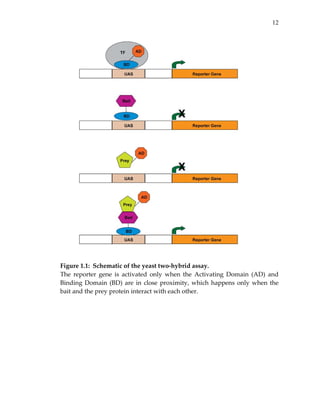
The  yeast  two‐hybrid  (Y2H)  assay  utilizes  the  yeast  cell  to  check 
whether two proteins interact or not11.  The main principle is to test whether a 
downstream  reporter  gene  is  activated  when  a  reconstituted  transcription 
factor  binds  to  its  upstream  activation  sequence  (UAS).    Generally,  the 
transcription factor consists of a DNA‐binding domain (BD) and an activation 
domain (AD) and both are essential for the activation of the reporter gene.  For 
4
many  eukaryotic  transcription  factors,  these  two  domains  (AD  and  BD)  are 
modular.  In other words, they only need to be in close proximity to function 
properly  and  not  necessarily  be  part  of  the  same  protein.    Using  this 
hypothesis, in the Y2H assay, one of the proteins (A) to be tested is genetically 
engineered to have the AD of the transcription factor and the other protein (B) 
has the BD.  Therefore, only when proteins A and B interact with each other, 
the AD and BD will be in close proximity and the downstream reported gene 
will be activated.  Generally, the GAL4 AD and BD are used in the Y2H assay 
and the reporter gene is LacZ.  Figure 1.1 shows a schematic of this process. 
1.1.2 Tandem Affinity Purification (TAP) followed by mass‐spectrometry 
The method of TAP followed by mass‐spectrometry (I shall refer to this 
method  as  mass‐spectrometry  from  here  on)  discovers  protein  complexes 
rather than binary protein interactions as in the case of Y2H12.  Specifically, a 
TAP tag is inserted at the 3’ end of the protein of interest (bait protein).  The 
protein is then immunoprecipitated invivo using an antibody against the TAP 
tag, purified and checked for binding partners.  Next, these protein assemblies 
are  separated  using  a  denaturing  gel  electrophoresis  and  digested  using 
trypsin.  The resulting peptides are then put through a mass‐spectrometer in 
5
order  to  identify  the  component  proteins.    Thus,  the  technique  of  mass‐
spectrometry identifies groups of proteins bound to the bait protein. 
1.1.3 Visualization of protein interaction networks 
Protein‐protein  interaction  networks  are  usually  represented  as  a 
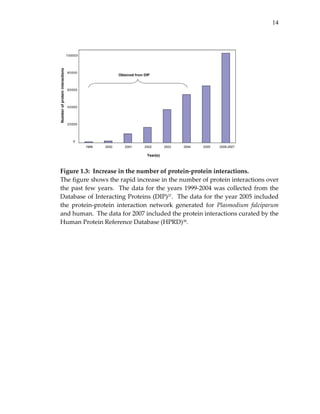
network of nodes and links (see Figure 1.2) and, I will use this representation 
throughout  this  dissertation.    The  nodes  correspond  to  proteins,  while  the 
links  between  them  correspond  to  protein  interactions.    The  protein 
interactions obtained in an Y2H assay can easily be adapted to form a protein 
network  explained  above.    However,  the  mass‐spectrometry  experiment 
provides  a  list  of  protein  complexes  rather  than  individual  interactions.  
Therefore,  for  each  protein  complex,  I  assume  that  there  exist  interactions 
between  all  members  of  the  complex.    After  this  interpolation,  it  is  easy  to 
abstract the protein complex as part of the protein network.   
Many software tools have been developed to enable the visualization of 
large‐scale protein networks21‐25.  Cytoscape (www.cytoscape.org)25 is one such 
tool  for  modeling  and  comparing  large‐scale  networks  of  molecular 
interactions  and  combining  them  with  expression  and  cellular  perturbation 
data.  Originally developed as an open‐source project by Dr. Trey Ideker and 
6
colleagues,  it  combines  the  ability  to  view  and  manipulate  genome‐sized 
networks of cellular pathways and an extensible architecture such that new 
analysis tools can be added dynamically.  I use Cytoscape for visualizing all 
the networks and results in the rest of the dissertation. 
1.2 Overview of the dissertation 
A major challenge of post‐genomic biology is to  understand how the 
complex networks of interacting genes, proteins and small molecules give rise 
to biological form and function.  This issue is of immediate importance as the 
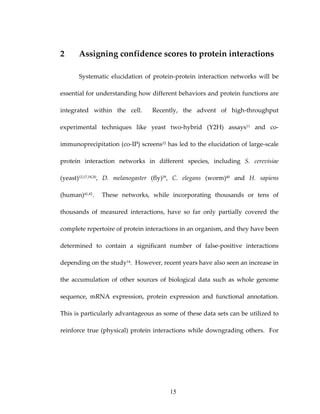
amount of data on protein interactions is increasing rapidly (see Figure 1.3).  
The wide variety and number of PPI networks motivate many questions like:  
How  do  the  networks  organize  into  regulatory  pathways  and  complexes  to 
accomplish  various  cellular  functions?    Are  some  of  these  modules  also 
present  in  other  species  and  how  does  this  translate  to  conservation  of 
function?    Can  the    conservation  of  protein  interactions  be  used  to  make 
functional  predictions?    We  are  also  interested  in  knowing  if  there  exist 
modules that are functionally important, but unique to a given species.  These 
modules  are  especially  insightful  when  picking  drug  targets  against 
pathogenic  species  like  Plasmodium  falciparum.    Moreover,  as  protein 
7
interactions  form  the  backbone  of  cellular  function,  they  can  potentially  be 
used in conjunction with other large‐scale data types to get more insights into 
the  functioning  of  the  cell.    All  the  above  questions  have  prompted  two 
different  approaches  to  analyze  protein  interaction  data:    comparative 
network analysis and network integration.  In this thesis, I present two studies 
implementing  the  comparative  network  analysis  approach.    Later,  I  also 
discuss  another  work  incorporating  the  strategy  of  network  integration.  
Overviews of the three studies are explained in the following sections. 
All  the  aforementioned  questions  can  be  addressed  only  if  the 
underlying  protein  interaction  network  is  of  good  quality.    Unfortunately, 
large‐scale  protein  networks,  like  other  high‐throughput  data,  has  a  lot  of 
false‐positives14.  Therefore, I begin this thesis by addressing the issue of noise 
in large‐scale protein networks. 
1.2.1 Noise in the data 
All large‐scale measurements and particularly new technologies suffer 
from a high level of noise.  The high‐throughput techniques of Y2H and mass‐
spectrometry result in a considerable number of false‐positive interactions14.  
These errors arise due to bias in the experimental conditions.  For instance, in 
8
a Y2H assay, if one of the proteins activates transcription on its own (auto‐
activation),  it  will  invariably  lead  to  the  inference  that  the  interaction  being 
tested is true.  Hence, tools are required to distinguish the false interactions 
from  the  true  ones.    Recent  years  have  also  seen  an  increase  in  the 
accumulation  of  other  sources  of  biological  data  such  as  whole  genome 
sequence, mRNA expression, protein expression and functional annotation13.  
This is particularly advantageous as some of these data sets can be utilized to 
reinforce  true  protein  interactions  while  downgrading  others.    For  instance, 
true  protein  interactions  have  been  shown  to  have  high  mRNA  expression 
correlation  for  the  corresponding  genes26.    In  Chapter  2,  I  propose  a  new 
method to assign confidence scores to protein interactions.  In addition, I also 
benchmark this method with other existing methods. 
1.2.2 Comparative network analysis 
The  first  method  of  protein  network  analysis,  called  Comparative 
network  analysis,  is  akin  to  the  genome  sequence  comparison  methods.  
Evolutionary conservation is a fundamental principle in biology that is widely 
used  to  infer  functional  relationships  among  species.    Conservation  of 
protein/gene sequences across species is used to make function and domain 
9
assignments27.    In  the  same  vein,  comparing  protein  interaction  networks 
across species will highlight evolutionarily conserved pathways and modules.  
I  address  these  questions  in  Chapter  3.    First,  I  explain  an  extension  of  a 
previous method28, NetworkBLAST, to align the PPI networks of two or more 
species at a time.  The method is then implemented to compare the protein 
networks of yeast, worm and the fruit fly.  The conserved modules obtained 
are  also  used  to  make  new  functional  predictions  in  the  three  species.  
Moreover,  this  comparative  method  allowed  us  to  make  new  protein 
interaction predictions.  In Chapter 4, I compared the protein network of the 
malaria parasite, Plasmodium falciparum, across three other eukaryotes and not 
only  determined  Plasmodium  protein  complexes  that  were  conserved  across 
the species, but also modules that were unique to Plasmodium.  This distinct set 
of  Plasmodium  modules  is  an  important  resource  in  understanding  the 
Plasmodium  system  and  could  probably  be  used  to  find  new  drug  targets 
against the parasite. 
1.2.3 Network integration 
Next, I attempt to analyze the PPI networks using the second approach 
called  Network  Integration.    While  comparative  network  analysis  dealt  with 
10
protein interactions spread across multiple species, network integration tries 
to understand cellular function only in one species by combining additional 
sources  of  information  on  the  same  set  of  proteins  (genes).    Network 
integration of different sources of data has been used previously to discover 
cellular machinery.  For instance, Kelley et al.29 has integrated protein‐protein 
interactions with genetic interactions in yeast to produce modules that were 
enriched  in  both  types  of  interactions.    They  found  that  most  modules 
contained  genetic  interactions  across  two  pathways  which  shared 
complementary function.  This discovery underscores the value of  combined 
analysis of protein and genetic interactions. 
In  particular,  in  Chapter  5,  I  integrate  the  PPI  network  data  in  yeast 
with  expression  Quantitative  Loci  (eQTL)  data  also  in  yeast  to  efficiently 
interpret them.  Genetic variation gives rise to changes in many quantitative 
traits  including  gene  expression.    The  technique  of  expression  quantitative 
trait  loci  (eQTL)  investigates  the  interactions  between  genetic  loci  and  the 
changes in gene expression30,31.  Specifically, a collection of genetically diverse 
strains  is  used  to  establish  correlations  between  a  quantitative  phenotype 
(such as gene expression) and polymorphisms at a specific genetic locus.  This 
method allows the detection of loci and consequently, the genes contained in 
11
them  that  regulate  the  expression  of  the  gene  downstream.    eQTLs  can  be 
mainly  divided  into  two  categories,  namely  cis‐  and  trans‐eQTLs  (or  ‘local’ 
versus  ‘distant’32.    The  cis‐eQTLs  correspond  to  DNA  variation  in  close 
proximity to the target gene.  It is assumed that in most cases, the cis‐eQTLs 
can be found in the transcriptional regulatory regions of the target gene.  On 
the other hand, trans‐eQTLs are located far away from the target gene and are 
more difficult to ascertain.  I focus on understanding the nature of these trans‐
eQTLs.    A  trans‐eQTL  imposes  directionality  of  information  flow  from  the 
locus to the affected target gene.  One might assume that transcription factors 
(TFs) result in the strongest eQTL, since their effect on down‐stream genes is 
most immediate. However, in many cases eQTLs cannot be explained by such 
simple TF – target relationships33.  Hence, in order to fully comprehend the 
mechanisms underlying significant trans‐eQTLs one has to take into account 
more  complex,  indirect  interactions  via  sequences  of  protein‐protein  and 
protein‐DNA interactions34‐36.  
12
 
 
Figure 1.1:  Schematic of the yeast two‐hybrid assay.   
The  reporter  gene  is  activated  only  when  the  Activating  Domain  (AD)  and 
Binding Domain (BD) are in close proximity, which happens only when the 
bait and the prey protein interact with each other. 
13


Figure 1.2:  Network abstraction of large‐scale protein interactions.   
The nodes correspond to proteins and the links between nodes corresponds to 
protein  interactions.    The  figure  has  been  drawn  using  the  Cytoscape 
software25. 
 
 
14


Figure 1.3:  Increase in the number of protein‐protein interactions. 
The figure shows the rapid increase in the number of protein interactions over 
the past few years.  The data for the years 1999‐2004 was collected from the 
Database of Interacting Proteins (DIP)37.  The data for the year 2005 included 
the  protein‐protein  interaction  network  generated  for  Plasmodium  falciparum 
and human.  The data for 2007 included the protein interactions curated by the 
Human Protein Reference Database (HPRD)38. 
 
 
2 Assigning confidence scores to protein interactions 
Systematic elucidation of protein‐protein interaction  networks will  be 
essential for understanding how different behaviors and protein functions are 
integrated  within  the  cell.    Recently,  the  advent  of  high‐throughput 
experimental  techniques  like  yeast  two‐hybrid  (Y2H)  assays11  and  co‐
immunoprecipitation (co‐IP) screens12 has led to the elucidation of large‐scale 
protein  interaction  networks  in  different  species,  including  S.  cerevisiae 
(yeast)12,17,18,20,  D.  melanogaster  (fly)39,  C.  elegans  (worm)40  and  H.  sapiens 
(human)41,42.    These  networks,  while  incorporating  thousands  or  tens  of 
thousands  of  measured  interactions,  have  so  far  only  partially  covered  the 
complete repertoire of protein interactions in an organism, and they have been 
determined  to  contain  a  significant  number  of  false‐positive  interactions 
depending on the study14.  However, recent years have also seen an increase in 
the  accumulation  of  other  sources  of  biological  data  such  as  whole  genome 
sequence,  mRNA  expression,  protein  expression  and  functional  annotation.  
This is particularly advantageous as some of these data sets can be utilized to 
reinforce true (physical) protein interactions while downgrading others.  For 
15
16
instance, biologically relevant protein interactions have been shown to have 
high mRNA expression correlation for the proteins involved26. 
As  a  result,  many  integrative  bioinformatic  approaches  have  been 
developed to unearth true protein‐protein interactions.  These can be mainly 
divided into two categories: (1) methods that assign reliability measurements 
to previously observed interactions; and (2) methods that predict interactions 
ab initio.  For category (1), Deane et al.43 and Deng et al.44 introduced methods 
to tackle the problem of assigning reliabilities to interactions using similarity 
in  mRNA  expression  profiles.    Subsequently,  Bader  et  al.45  used  additional 
features  of  interacting  proteins,  including  functional  similarity  and  high 
network clustering46, to assign confidence scores to protein interactions.  For 
category (2), Marcotte et al.47, von Mering et al.48, Myers et al.49 and Jansen et 
al.50 were among the first to predict new protein interactions by incorporating 
a  combination  of  different  features  like  high  mRNA  expression  correlation, 
functional  similarity,  co‐essentiality,  and  co‐evolution.    These  schemes 
calculate a log‐likelihood score for each interaction.  As yet another approach 
in this category, Qi et al.51 predicted new protein interactions using a method 
based  on  random  forests.    Presumably,  the  relative  performance  of  each  of 
these approaches versus the others involves a combination of factors such as 
17
the  types  of  evidence  used  as  inputs,  the  efficacy  of  each  classification 
algorithms, and the sets of true and false interactions used as gold standards 
during training.  Very recently, a second work by Qi et al.52 studied the effect 
of  the  underlying  classification  algorithm  by  comparing  the  accuracies  of 
different classifiers such as naïve Bayes, logistic regression, and decision trees.   
In  section  2.1,  we  first  propose  a  new  method  to  assign  confidence 
scores to protein‐protein interactions obtained from high‐throughput screens.  
In the remaining sections, we perform a benchmarking analysis to evaluate the 
published  interaction  confidence  schemes  versus  one  another.    Rather  than 
isolate  every  factor  that  could  influence  a  scheme’s  performance,  we  take  a 
practical approach and evaluate the overall accuracy of each set of confidence 
scores as reported in the literature and available from the authors’ websites.  
We  limit  ourselves  to  works  that  have  assigned  confidence  scores  to  a 
common set of experimentally‐observed interactions in yeast; this includes all 
of  the  category  (1)  schemes  above,  as  well  as  the  Qi.  et  al.  scheme  from 
category (2).  The remaining ab initio schemes are concerned with predicting 
new interactions and do not assign confidences to those interactions that have 
already been experimentally observed.  We also assess the performance of a 
“null hypothesis”, a uniform scheme that considers the same probability for 
18
all  interactions.      To  compare  the  quantitative  accuracy  of  the  methods,  we 
examine  the  correlations  between  the  confidence  estimates  and  different 
biological attributes such as function and expression.  As a further comparison 
criterion,  we  apply  the  signal  processing  concept  of  ‘Signal‐to‐Noise  Ratio’ 
(SNR)  to  evaluate  the  significance  of  protein  complexes  identified  in  the 
network based on the different schemes53.  The discovery of these complexes 
depends  on  the  connectivity  of  the  interaction  network  which,  in  turn,  is 
influenced by the underlying interaction probabilities53,54.  
2.1 Estimation of interaction probabilities 
We  assign  confidence  values  to  protein  interactions  using  a  novel 
logistic  regression  model.    For  a  given  species,  our  model  represents  the 
probability  of  true  interaction  as  a  function  of  three  observed  random 
variables  on  a  pair  of  proteins.    First,  the  number  of  times  an  interaction 
between  the  proteins  was  observed  experimentally.      The  number  of 
observations of a given interaction is an indicator of the reproducibility of an 
interaction and is a good measure of the “truth” of an interaction.  It has also 
been used as a measure to predict interaction confidence scores previously44.  
Second,  the  Pearson  correlation  coefficient  of  expression  patterns  of  the 
19
corresponding  genes.      The  similarity  in  the  mRNA  expression  profiles  has 
been associated with biologically relevant PPIs26.  Specifically, let x and y be 
two m‐long vectors of expression levels for two genes.  The Pearson correlation 
coefficient  between  the  two  vectors  is  defined  as 
yx
m
i ii yxyx
m
σσ
ρ
∑=
−
=
1
1
  where 
yx,  are the sample means and  yx σσ ,  are the standard deviations of x and y, 
respectively.  Third, the small world clustering coefficient of the two proteins.  
For proteins, v and w denote the sets of proteins that interact with them by 
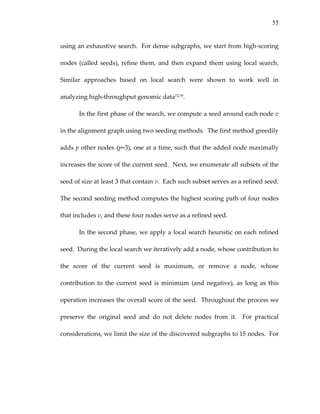
N(v)  and  N(w),  respectively.    Let  N  be  the  total  number  of  proteins  in  the 
network.  The small‐world clustering coefficient for v and w is:  
∑∩=
⎟⎟
⎠
⎞
⎜⎜
⎝
⎛
⎟⎟
⎠
⎞
⎜⎜
⎝
⎛
−
−
⎟⎟
⎠
⎞
⎜⎜
⎝
⎛
−=
)|}(|)|,(min{|
)|()(|
|)(|
|)(|
|)(||)(|
log
wNvN
wNvNi
vw
wN
N
iwN
vNN
i
vN
C   
The clustering coefficient was suggested by Goldberg et al.46 to account 
for similarity in network connections.  They also showed that higher values 
for  small‐world  clustering  coefficient  corresponded  to  biologically  relevant 
protein interactions. 
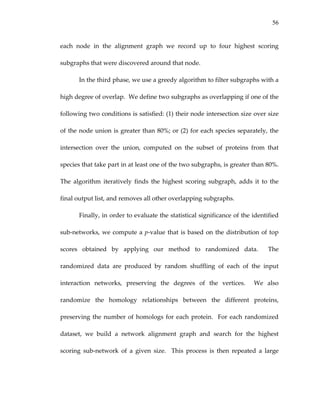
According  to  the  logistic  distribution,  the  probability  of  a  true 
interaction Tuv given the three input variables, represented by X=(X1,X2,X3), is : 
20
∑=
−−+
= 3
1
0 )exp(1
1
)|Pr(
i
ii
uv
X
XT
ββ
,  where  30 ,, ββ K   are  the  parameters 
of  the  distribution.    Given  training  data,  one  can  optimize  the  distribution 
parameters so as to maximize the likelihood of the data.  To this end we used 
the glmfit function of MATLAB55.  The training data is determined based on 
the species under consideration.  Generally, two sets of gold standard training 
data are required.  The positive training data is a set of protein interactions 
that are known to be true, while the negative training data is a set of protein 
interactions that are known to be false. 
2.2 Benchmarking analysis 
Although large‐scale protein interaction networks are being generated 
for a number of species, S. cerevisiae is perhaps the best studied among them 
and is associated with the largest variety and quantity of protein interaction 
data.  Hence, most of the interaction probability schemes have been developed 
using  the  yeast  protein  interaction  network  as  a  guide.    As  the  probability 
schemes  were  previously  computed  for  different  subsets  of  yeast  protein‐
protein  interactions,  we  compiled  a  test  set  of  11,883  yeast  interactions 
21
common  to  all  schemes.    These  yeast  interactions  were  derived  from  both 
yeast two‐hybrid18,20 and mass‐spectrometry‐based12,17  screens. 
In  total,  we  considered  seven  interaction  probability  assignment 
schemes, including  Bader et al.45, Deane et al.43, Deng et al.44, Qi et al.51 and our 
model,  descibed  in  the  previous  section  called  Sharan  et  al.54.    Bader  et  al., 
Sharan et al. and Qi et al. have assigned specific probabilities to every yeast 
interaction, while Deane et al. and Deng et al. have grouped yeast interactions 
into  high/medium/low  confidence  groups.    All  of  the  above  schemes  define 
and use some set of gold standard positive and negative interaction examples 
for the probability estimation. 
Bader et al. (BADER_LOW / BADER_HIGH) 
As  a  gold  standard  positive  training  data  set,  Bader  et  al.45  used 
interactions determined by co‐IP, in which the proteins were also one or two 
links apart in the Y2H network.  The negative training data set was selected 
from interactions reported either by co‐IP or Y2H, but whose distance (after 
excluding the interaction) was larger than the median distance in Y2H or co‐IP 
respectively.  Using these training data, they constructed a logistic regression 
model that computes the probability of each interaction based on explanatory 
variables  including  data  source,  number  of  interacting  partners,  and  other 
22
topological features like network clustering.  We refer to this scheme as Bader 
et al. (low) or BADER_LOW in our analysis.   
Initially,  the  authors  used  measures  based  on  Gene  Ontology  (GO)56 
annotations, co‐expression, and presence of genetic interactions as measures to 
validate their data.   However, they also combined these measurements into 
the  probability  score  to  bolster  their  confidence  of  true  interactions.    We 
consider these new confidence scores in our analysis as Bader et al. (high) or 
BADER_HIGH. 
Deane et al. (DEANE) 
Deane  et  al.43  estimated  the  reliability  of  protein‐protein  interactions 
using the expression profiles of the interacting partners.  Protein interactions 
observed in small‐scale experiments that were also curated in the Database of 
Interacting  Proteins  (DIP)37  were  considered  as  the  gold  standard  positive 
interactions.  As a gold standard negative, they randomly picked protein pairs 
from the yeast proteome that were not reported in DIP.  The authors used this 
information  to  compute  the  reliabilities  of  groups  of  interactions  (obtained 
from  an  experiment  or  a  database).    Higher  reliabilities  were  assigned  to 
groups  whose  combined  expression  profile  was  closer  to  the  gold  standard 
positive than the gold standard negative interactions.  Specifically, reliabilities 
23
were  assigned  to  the  whole  DIP  database,  the  set  of  all  protein  interactions 
generated  in  any  high‐throughput  genome  screen,  and  protein  interactions 
generated by Ito et al.18. 
Deng et al. (DENG) 
Deng  et  al.44  estimated  the  reliabilities  of  different  interaction  data 
sources  in  a  manner  similar  to  Deane  et  al.43.    They  separately  considered 
experiments that report pair‐wise interactions like Y2H and those that report 
complex membership like mass spectrometry.  Curated pair‐wise interactions 
from  the  literature  and  membership  in  protein  complexes  from  Munich 
Information  center  for  Protein  Sequences  (MIPS)57  were  used  as  the  gold 
standard positive set in each case.  Randomly chosen protein pairs formed the 
gold  standard  negative  data  set.    Reliabilities  for  each  data  source  were 
computed  using  a  maximum  likelihood  scheme  based  on  the  expression 
profiles  of  each  data  set.    The  authors  evaluated  reliabilities  for  Y2H  data 
sources like Uetz et al.20 and Ito et al.18, and protein complex data sources like 
Tandem  Affinity  Purification  (TAP)12  and  High‐throughput  Mass 
Spectrometric  Protein  Complex  Identification  (HMS‐PCI)17.    In  addition  to 
assigning reliabilities to each dataset, the authors also provided a conditional 
probability  scheme  to  compute  probabilities  for  groups  of  interactions 
24
observed in two or more data sources.  This calculation results in assigning a 
high  probability  (0.99)  to  yeast  interactions  observed  in  more  than  1  data 
source.    We  use  the  probabilities  generated  by  this  method  for  our 
comparative analysis. 
Sharan et al. (SHARAN) 
Recently,  Sharan  et  al.54  also  implemented  an  interaction  probability 
assignment scheme similar to the one proposed by Bader et al.  The scheme 
assigned probabilities to interactions using a logistic regression model based 
on  mRNA  expression,  interaction  clustering  and  number  of  times  an 
interaction  was  observed  in  independent  experiments.    Here,  we  use  a 
modification of this scheme, assigning probabilities to interactions based only 
on  direct  experimental  evidence.    Specifically,  interactions  with  at  least  two 
literature references or those that had a distance ≤ 2 in both the co‐IP and Y2H 
networks were defined as the gold standard positives.  Conversely, proteins at 
a distance > 4 in the entire network (after removing the interaction in question) 
were defined as the gold standard negatives.  Binary variables were used to 
denote whether the interaction was reported in a co‐IP data set, Y2H data set, 
a small‐scale experiment or a large–scale experiment.  Interaction probabilities 
25
were  then  estimated  using  logistic  regression  on  the  predictor  parameters 
similarly to Bader et al. 
Qi et al. (QI) 
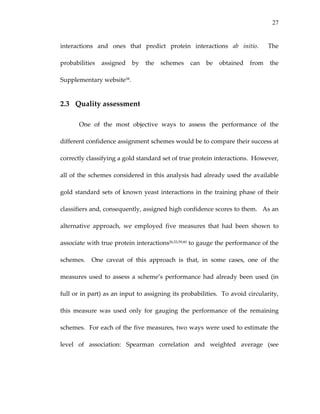
In this study, the authors used interactions that were observed in small‐
scale  experiments  and  reported  by  either  DIP  or  Bader  et  al.  as  their  gold 
standard positive training data51.  Randomly picked protein pairs were used as 
the  gold  standard  negative  training  data.    The  method  incorporates  direct 
evidence such as the type of experiment used to generate the data and indirect 
evidence  like  gene  expression,  existence  of  synthetic  lethal  interactions,  and 
domain‐domain  interactions  to  construct  a  random  forest  (a  collection  of 
decision trees).  The resulting forest is then used to calculate the probability 
that two proteins interact. 
Equal Probabilities (EQUAL) 
Finally, we also considered the case in which all observed interactions 
were considered to be equally true.  We refer to this case as EQUAL in the 
analysis. 
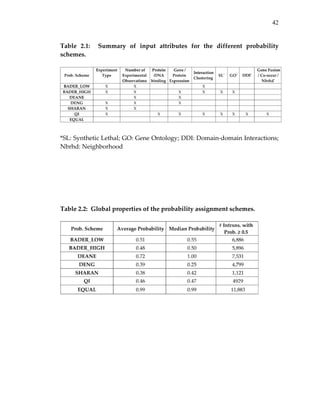
A summary of all attributes used as inputs to the different probability 
schemes  is  provided  in  Table  2.1.    It  should  be  noted  that  even  though  the 
different  probability  schemes  utilize  some  of  the  same  types  of  inputs  (e.g., 
26
experiment type, expression similarity), they may incorporate these inputs in 
different  ways.    For  instance,  both  SHARAN  and  DENG  use  “experiment 
type” as input, but SHARAN explicitly includes each type of experiment as a 
separate  indicator  variable  in  its  logistic  regression  function,  while  DENG 
pools data from each experimental type and assigns a single confidence level 
to the interactions in each pool. 
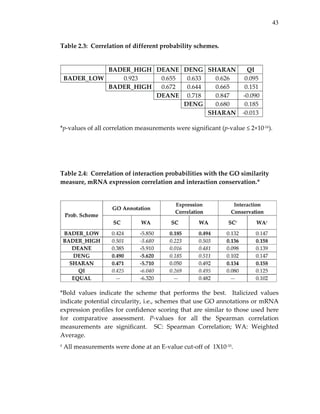
We  also  compared  global  statistics  such  as  the  average  and  median 
probability  assigned  by  each  scheme  (see  Table  2.2).    We  found  that  most 
probability schemes had an average probability in the range of [0.3 ‐ 0.5]. In 
contrast,  Deane  et  al.  (DEANE)  had  a  very  high  average  and  median 
probability:  over  half  of  the  interactions  in  the  test  set  were  assigned  a 
probability of 1. We also computed Spearman correlations among the different 
probability  schemes  to  measure their  levels  of  inter‐dependency  (Table  2.3).  
The  maximum  correlation  was  seen  between  BADER_LOW  and 
BADER_HIGH, as might be expected since both schemes were reported in the 
same  study  and  BADER_HIGH  was  derived  from  BADER_LOW.    On  the 
other hand, Qi et al. (QI) had very low Spearman correlation with any of the 
probability schemes.  The low correlation may reflect an inherent difference 
between  schemes  that  assign  probabilities  to  experimentally  observed 
27
interactions  and  ones  that  predict  protein  interactions  ab  initio.    The 
probabilities  assigned  by  the  schemes  can  be  obtained  from  the 
Supplementary website58. 
2.3 Quality assessment 
One  of  the  most  objective  ways  to  assess  the  performance  of  the 
different confidence assignment schemes would be to compare their success at 
correctly classifying a gold standard set of true protein interactions.  However, 
all of the schemes considered in this analysis had already used the available 
gold standard sets of known yeast interactions in the training phase of their 
classifiers and, consequently, assigned high confidence scores to them.   As an 
alternative  approach,  we  employed  five  measures  that  had  been  shown  to 
associate with true protein interactions26,53,59,60 to gauge the performance of the 
schemes.    One  caveat  of  this  approach  is  that,  in  some  cases,  one  of  the 
measures used to  assess a scheme’s performance had already been used (in 
full or in part) as an input to assigning its probabilities.  To avoid circularity, 
this  measure  was  used  only  for  gauging  the  performance  of  the  remaining 
schemes.  For each of the five measures, two ways were used to estimate the 
level  of  association:  Spearman  correlation  and  weighted  average  (see 
28
Methods).  Importantly, by using the Spearman correlation coefficient, we are 
in  fact  comparing  how  the  schemes  rank  the  interactions,  not  the  absolute 
scores that are assigned.  Note that the EQUAL probability scheme results in 
Spearman correlation of 0, by definition.   
2.3.1 Presence of conserved interactions in other species 
Presence  of  conserved  interactions  across  species  is  believed  to  be 
associated with biologically meaningful interactions60.  As our benchmark, we 
used yeast protein interactions that were conserved with measured C. elegans 
and  D.  melanogaster  interactions  obtained  from  the  Database  of  Interacting 
Proteins (DIP)37.  An interaction was considered conserved if homologs of the 
interacting yeast proteins were also interacting in another species.  Homologs 
were based on amino‐acid sequence similarity computed using BLAST27, thus 
allowing a protein to possibly match with multiple proteins in the opposite 
species  (if  interacting  yeast  proteins  were  homologous  to  any  pair  of 
homologs with an observed interaction, the yeast interaction was counted as 
conserved).  In particular, we allow interactions whose interacting proteins are 
themselves  homologs,  but  filter  cases  where  both  the  interacting  proteins 
pointed to the same protein in the other species.  We evaluated the weighted 
29
average  and  Spearman  correlation  between  the  probability  assignment  for 
each yeast interaction and the number of conserved interactions across worm 
and  fly  (0,  1,  or  2).    We  used  an  E‐value  cut‐off  of  1X10‐10  to  make  the 
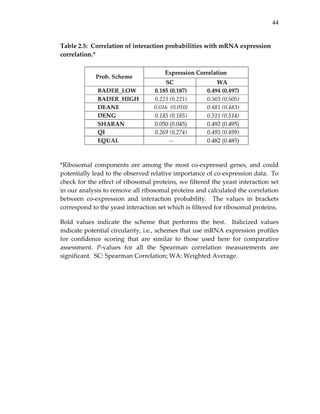
homology  assignments  (Table  2.4).    We  observed  that  SHARAN  and 
BADER_HIGH had the highest weighted average and Spearman correlation.  
Not  surprisingly,  EQUAL  had  the  lowest  weighted  average.    Note  that  the 
conserved  interactions  test  is  a  very  strong  filter  for  true  interactions  as  it 
heavily depends on the level of completeness of the interaction networks of 
other species being considered.  However, as the underlying set of interactions 
is  the  same  across  the  different  probability  schemes,  this  filter  affects  all 
schemes similarly. 
2.3.2 Expression correlation 
Yeast  expression  data  for  ~790  conditions  were  obtained  from  the 
Stanford Microarray Database (SMD)61.  For every pair of interacting proteins, 
we  computed  the  Pearson  correlation  coefficient  of  expression.    We  then 
calculated  the  Spearman  correlation  and  weighted  average  between  the 
expression  correlation  coefficients  of  interacting  proteins  and  their 
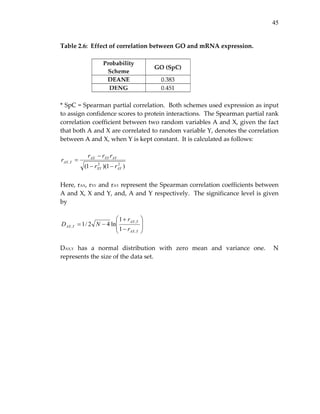
corresponding probability assignments in the different schemes (see Table 2.4 
30
and  2.5).    We  found  significant  association  between  expression  correlations 
and probabilities in the case of BADER_HIGH, BADER_LOW, QI and DENG.   
This result is expected as these schemes, with the exception of BADER_LOW, 
utilize  expression  similarity  for  interaction  probability  calculation.  
Surprisingly,  DEANE  probabilities  showed  very  little  correlation  with 
expression, even though mRNA expression profiles were used as input in the 
prediction process reflecting the difference in the way expression similarity is 
incorporated in this method.  In particular, DEANE is the only method where 
expression similarity between two interacting proteins is taken into account as 
the Euclidean distance between their expression profiles versus other methods 
which incorporated the Pearson correlation coefficient of expression.  On the 
other hand, BADER_LOW had a higher Spearman correlation than SHARAN, 
though  both  had  very  similar  weighted  averages  and  did  not  utilize 
expression data in the training phase. 
2.3.3 Gene Ontology (GO) similarity 
As a first measure, we adopted the common notion that two interacting 
proteins are frequently involved in the same process and hence should have 
similar GO assignments56.  The Gene Ontology terms are represented using a 
31
directed acyclic graph data structure in which an edge from term ‘a’ to term 
‘b’ indicates that term ‘b’ is either a more specific functional type than term ‘a’, 
or is a part of term ‘a’.  As a result, terms that appear deeper in the graph are 
more specific.  Moreover, specific terms also have fewer proteins assigned to 
them or their descendants. 
Let “Pi” and “Pj” be two proteins that have been observed to interact 
with each other.  To measure their functional similarity, we evaluated the size 
(number of proteins assigned to the term), represented as “Sij”, of the deepest 
common  GO  term  assignment  (deepest  common  ancestor  in  graph)  shared 
between  them.    Thus,  a  smaller  value  of  Sij  indicates  a  greater  functional 
similarity  between  Pi  and  Pj.    In  addition,  we  also  found  that  known  yeast 
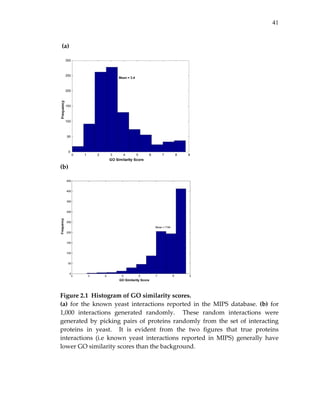
interactions generally have lower values for Sij than random background (see 
Figure 2.1).  To ensure that higher values of our GO measure correspond to 
higher performance (as is the case for other quality assessment metrics below), 
we use the negative of Sij (or –Sij) to represent the overall GO similarity. 
Table  2.4  shows  the  relationship  between  GO  similarity  and  the 
interaction  probabilities  for  each  scheme.    Of  the  schemes  that  did  not  use 
functional annotations as inputs, DENG and SHARAN both had a very high 
Spearman correlation with GO (with DENG slightly higher than SHARAN).  
32
However,  one  potential  concern  was  that  GO  functional  assignments  could 
incorporate  evidence  of  co‐expression  which  was  used  as  an  input  by  the 
DENG  scheme.    This  potential  circularity  can  be  addressed  by  use  of  the 
partial  correlation  coefficient  to  factor  out  the  dependency  of  GO  on  co‐
expression (see Table 2.6).  However, the partial correlation is almost certainly 
an overcorrection since GO similarity and co‐expression (and in fact any two 
lines  of  evidence)  are  expected  to  have  some  correlation  if  they  are  both 
predictive  of  true  interactions.    Regardless,  with  or  without  the  correction, 
DENG and SHARAN scored within 2% of each other; thus the two schemes 
are practically indistinguishable by the GO metric. 
2.3.4 Signal‐to‐Noise Ratio of protein complexes 
Most cellular processes involve proteins that act together by assembling 
into  functional  complexes.    Several  methods28,54,62‐64  have  been  developed  to 
identify complexes embedded within a protein interaction network, in which 
a complex is typically modeled as a densely‐connected protein sub‐network.  
Recently,  we  showed  that  the  quality  of  these  identified  protein  complexes 
could be estimated by computing their signal‐to‐noise ratio (SNR), a standard 
measure  used  in  information  theory  and  signal  processing  to  assess  data 
33
quality (see Methods)53.  Essentially, SNR evaluates the density of complexes 
found in the protein interaction network against a randomized version of the 
same network. 
As the SNR is independent of  the number of complexes  reported, its 
value can be directly compared across the different probability schemes.  For 
discovery  of  protein  complexes,  we  applied  a  previously‐published 
algorithm54  which  includes  interaction  probabilities  in  the  complex 
identification  process.    SNR  was  then  computed  on  the  set  of  complexes 
identified by each probability scheme.  Results are shown in Table 2.7; out of 
all of the schemes, DENG had the highest SNR of protein complex detection.   
2.3.5 Conservation rate coherency 
Interacting  proteins  have  been  shown  to  evolve  at  similar  rates, 
probably due to selection pressure to maintain the interaction over time59.  For 
every pair of interacting proteins, Pi and Pj, let “ri” and “rj” be their respective 
rates of evolution.  We then computed a “conservation rate coherency score” 
(CRij)  as  the  negative  absolute  value  of  the  difference  between  the 
evolutionary  rates  of  the  two  corresponding  genes:  CRij  =  –|  ri  –  rj  |.    The 
34
negative  absolute  value  was  used  to  ensure  that  higher  values  represent 
higher performance, consistent with other metrics.     
Evolutionary  rates  were  obtained  from  Fraser  et  al.65  and  estimated 
using  nucleotide  substitution  frequencies.    We  calculated  the  Spearman 
correlation  between  the  values  of  CR  for  the  interacting  proteins  and  their 
corresponding  probability  assignments  in  the  different  schemes  (see  Table 
2.7).    For  all  probability  assignment  schemes  we  obtained  a  statistically 
significant  correlation  (p‐value  <  0.05)  between  the  conservation  rate 
coherency scores and the corresponding probabilities, indicating that proteins 
with high probability interactions tend to have similar conservation rates.  The 
highest correlation was obtained for DENG. 
2.4 Discussion 
A  brief  review  of  the  performance  results  suggests  that  the  DENG 
method (Deng et al.) emerges as the clear winner, with top scores in three out 
of  four  non‐circular  quality  metrics.    Comprising  a  ‘second  tier’  are 
BADER_HIGH, BADER_LOW (the two Bader methods) and SHARAN, which 
perform  very  similarly  across  most  metrics  with  some  differences  in 
conservation  coherency  or  gene  expression  (for  which  SHARAN  performs 
35
better  or  worse,  respectively).    BADER_LOW,  which  considers  experiment 
type and interaction clustering as inputs, has a higher expression score than 
SHARAN,  which  considers  experiment  type  only,  implying  that  interaction 
clustering helps capture expression similarity.  Interestingly, BADER_HIGH, 
which  incorporates  more  input  attributes  than  BADER_LOW  or  SHARAN, 
does not have substantially higher rankings.  Thus, in this case, adding more 
inputs  to  a  probability  assignment  scheme  does  not  appear  to  strongly 
enhance its quality.   
As for the remaining schemes with lower overall performance (DEANE 
and QI), it is interesting to note that these were arguably the least and most 
sophisticated  schemes,  respectively.    The  DEANE  method  relied  on  only  a 
single  evidence  type  for  assigning  confidences,  that  of  gene  expression, 
whereas it appears that other factors may have been more informative (Table 
2.1).  In contrast to DEANE, QI had the largest number of inputs for assigning 
confidences  and,  among  these,  included  data  on  both  co‐expression  and 
experiment type.  However, it is well known that classifier accuracy can  be 
degraded by including many irrelevant input variables66, and perhaps this is 
the reason for QI’s lower performance.  As an alternative explanation, in Qi et 
al.’s  evaluation  of  classification  schemes,  they  concluded  that  their  method 
36
was  very  successful  in  predicting  co‐complex  membership,  but  performed 
poorly  when  considering  physical  interactions52.    In  our  analysis,  all 
interactions (even co‐complex membership) were treated as pair‐wise protein 
interactions,  and  this  assumption  may  have  contributed  to  the  poor 
performance of Qi et al.  Certainly, their classification method was among the 
most sophisticated of the schemes that we evaluated, and as such it is worthy 
of future exploration (perhaps with different sources of input data) regardless 
of its performance in the present study.   
Finally,  EQUAL  almost  always  scored  lowest,  regardless  of  quality 
metric.  Thus, utilizing any probability scheme is better than considering all 
observed interactions to be true or equally probable. 
Beyond these broad rankings, is it possible to synthesize data from five 
largely  independent  metrics  to  arrive  at  an  overall  quantitative  index  of 
performance?  As one approach, we normalized the scores for each metric as a 
fraction  of  the  best  score  achieved  within  that  metric  over  all  confidence 
assignment schemes (i.e., for each metric, the highest score was fixed to 1 and 
the  scores  of  the  remaining  schemes  were  converted  to  fractional  values 
between  0  and  1).    Table  2.8  summarizes  the  fractional  scores  for  the  six 
probability  schemes  and  five  quality  assessment  measures.    Note  that 
37
expressing scores as fractional values is an intermediate normalization which 
preserves the score distribution but compresses its range; although potentially 
more  informative  than  the  non‐parametric  analysis  above  based  only  on 
ranks, it must also be interpreted with more caution.  However, in this case, 
the fractional scores reinforce the findings reported above based on rank.  
We  have  compared  and  contrasted  seven  probability  assignment 
schemes  for  yeast  protein  interactions.    Surprisingly,  Deng  et  al.  performs 
significantly better than others while being one of the least sophisticated.  It 
assigns discrete probability scores to large groups of interactions rather than 
to individuals, and it inputs just two lines of evidence, experiment type and 
expression  similarity,  rather  than  many.    Generalizing  these  observations, 
more complex approaches are so far unable to outperform simpler variants.  
Thus, we arrive at a somewhat unexpected conclusion: At least in interaction 
confidence assignment, sometimes less means more. 
2.5 Methods 
2.5.1 GO databases 
The Gene Ontology annotations for yeast proteins were obtained from 
the July 5th, 2005 download of the Saccharomyces Genome Database (SGD)67; 
38
the graph of relations between terms was obtained from the Gene Ontology 
consortium (http://www.geneontology.org/). 
2.5.2 Signal to noise ratio (SNR) 
To compute SNR, a search for dense interaction complexes is initiated 
from  each  node  (protein)  and  the  highest  scoring  complex  from  each  is 
reported.  This yields a distribution of complex scores over all nodes in the 
network.  A score distribution is also generated for 100 randomized networks, 
which  have  identical  degree  distribution  to  the  original  network.    SNR  is 
computed using these original and random score distributions (representing 
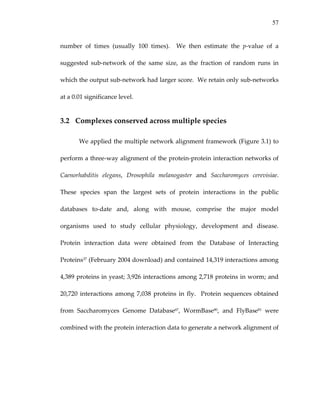
signal and noise, respectively) according to the standard formula68 using the 
root‐mean‐square (rms): 
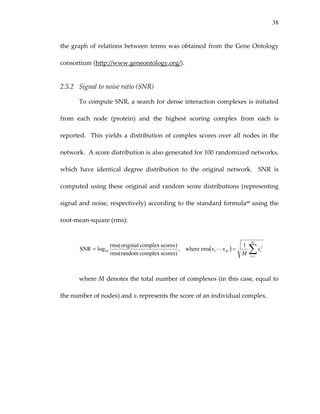
( ) ∑=
==
M
i
iM x
M
xx
1
2
110
1
rmswhere,
)scorescomplexrandom(rms
)scorescomplexoriginal(rms
logSNR L
 
where M denotes the total number of complexes (in this case, equal to 
the number of nodes) and xi represents the score of an individual complex. 
39
2.5.3 Weighted average 
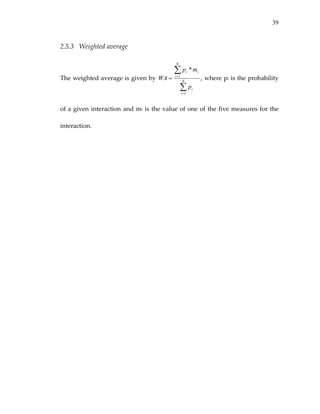
The weighted average is given by 
∑
∑
=
=
= N
i
i
N
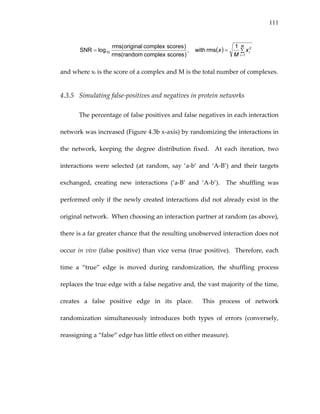
i
ii
p
mp
WA
1
1
*
, where pi is the probability 
of a given interaction and mi is the value of one of the five measures for the 
interaction. 
 
40
Acknowledgements 
Chapter 2 in part quotes sections from the Supplementary Methods of  
Sharan R, Suthram S, Kelley RM, Kuhn T, McCuine S, Uetz P, Sittler T, Karp 
RM,  Ideker  T  (2005)  Conserved  patterns  of  protein  interaction  in  multiple 
species. Proc Natl Acad Sci U S A 102: 1974‐1979.  I was the second author in 
that work and was responsible for the generation of interaction probabilities 
which  is  quoted  in  this  chapter.    This  chapter  also  contains  the  complete 
reprint of the work  Suthram S, Shlomi T, Ruppin E, Sharan R, Ideker T (2006) 
A  direct  comparison  of  protein  interaction  confidence  assignment  schemes. 
BMC Bioinformatics 7: 360.  I was the primary author of this paper. 
41
 (a)       
 
          
(b) 


Figure 2.1  Histogram of GO similarity scores. 
(a)  for  the  known  yeast  interactions  reported  in  the  MIPS  database.  (b)  for 
1,000  interactions  generated  randomly.    These  random  interactions  were 
generated  by  picking  pairs  of  proteins  randomly  from  the  set of  interacting 
proteins  in  yeast.    It  is  evident  from  the  two  figures  that  true  proteins 
interactions  (i.e  known  yeast  interactions  reported  in  MIPS)  generally  have 
lower GO similarity scores than the background.   
42
Table  2.1:    Summary  of  input  attributes  for  the  different  probability 
schemes. 
 
 
*SL: Synthetic Lethal; GO: Gene Ontology; DDI: Domain‐domain Interactions; 
Nbrhd: Neighborhood 


Table 2.2:  Global properties of the probability assignment schemes. 
 
 
43
Table 2.3:  Correlation of different probability schemes. 
 
 
*p‐values of all correlation measurements were significant (p‐value ≤ 2×10‐16). 


Table 2.4:  Correlation of interaction probabilities with the GO similarity 
measure, mRNA expression correlation and interaction conservation.* 
 
 
*Bold  values  indicate  the  scheme  that  performs  the  best.    Italicized  values 
indicate potential circularity, i.e., schemes that use GO annotations or mRNA 
expression profiles for confidence scoring that are similar to those used here 
for  comparative  assessment.  P‐values  for  all  the  Spearman  correlation 
measurements  are  significant.    SC:  Spearman  Correlation;  WA:  Weighted 
Average. 
# All measurements were done at an E‐value cut‐off of  1X10‐10. 
44
Table 2.5:  Correlation of interaction probabilities with mRNA expression 
correlation.* 


*Ribosomal components are among the most co‐expressed genes, and could 
potentially lead to the observed relative importance of co‐expression data.  To 
check for the effect of ribosomal proteins, we filtered the yeast interaction set 
in our analysis to remove all ribosomal proteins and calculated the correlation 
between  co‐expression  and  interaction  probability.    The  values  in  brackets 
correspond to the yeast interaction set which is filtered for ribosomal proteins.  
Bold  values  indicate  the  scheme  that  performs  the  best.    Italicized  values 
indicate potential circularity, i.e., schemes that use mRNA expression profiles 
for  confidence  scoring  that  are  similar  to  those  used  here  for  comparative 
assessment.  P‐values  for  all  the  Spearman  correlation  measurements  are 
significant.  SC: Spearman Correlation; WA: Weighted Average. 


45
Table 2.6:  Effect of correlation between GO and mRNA expression. 


* SpC = Spearman partial correlation.  Both schemes used expression as input 
to assign confidence scores to protein interactions.  The Spearman partial rank 
correlation coefficient between two random variables A and X, given the fact 
that both A and X are correlated to random variable Y, denotes the correlation 
between A and X, when Y is kept constant.  It is calculated as follows: 
 
)1)(1( 22
,
AYXY
AYXYAX
YAX
rr
rrr
r
−−
−
=  
 
Here, rAX, rXY and rAY represent the Spearman correlation coefficients between 
A and X, X and Y, and, A and Y respectively.  The significance level is given 
by 
 
⎟
⎟
⎠
⎞
⎜
⎜
⎝
⎛
−
+
−=
YAX
YAX
YAX
r
r
ND
,
,
,
1
1
ln42/1  
 
DAX,Y  has  a  normal  distribution  with  zero  mean  and  variance  one.    N 
represents the size of the data set. 
 
46
Table 2.7:  Associations of conservation rate coherency scores and SNR with 
interaction probabilities. 


* SC: Spearman Correlation.  Bold values indicate the scheme which performs 
the  best.    Note  that  conservation  scores  based  on  weighted  averages  were 
omitted as they were very similar across the different confidence assignment 
schemes. 
 
Table 2.8:  Fractional scores of the confidence assignment schemes in each 
of the five quality measures.* 


*Fractional scores are between [0,1] with 1 performing the best (indicated in 
bold  for  each  measure).    Cells  with  a  dash  (‐)  indicate  circularity,  i.e.,  the 
measures  used  as  (full  or  partial)  input  to  the  corresponding  probability 
schemes. SC: Spearman Correlation; SNR: Signal to Noise Ratio. 
3 Comparative network analysis 
A  major  challenge  of  post‐genomic  biology  is  to  understand  the 
complex networks of interacting genes, proteins and small molecules that give 
rise to biological form and function.  Advances in whole‐genome approaches 
are  now  enabling  us  to  characterize  these  networks  systematically,  using 
procedures  such  as  the  two‐hybrid  assay11  and  protein  co‐
immunoprecipitation69  to  screen  for  protein‐protein  interactions.    To  date, 
these  technologies  have  generated  large  interaction  networks  for  bacteria70, 
yeast 12,17,18,20 and, recently, fruit fly 39 and nematode worm 40. 
The  large  amount  of  protein  interaction  data  now  available  presents 
new  opportunities  and  challenges  in  understanding  evolution  and  function.  
Such challenges involve assigning functional roles to interactions15; separating 
true  protein‐protein  interactions  from  false  positives14;  and,  ultimately, 
organizing  large‐scale  interaction  data  into  models  of  cellular  signaling  and 
regulatory  machinery.    We  addressed  the  issue  of  distinguishing  true 
interactions  from  false  in  the  previous  chapter.    In  this  chapter,  we  try  to 
concentrate on the questions of organizing the PPIs in regulatory modules.  As 
is often the case in biology, an approach based on evolutionary cross‐species 
47
48
comparisons provides a valuable framework for addressing these challenges.  
However,  while  methods  for  comparing  DNA  and  protein  sequences  have 
been  a  mainstay  of  bioinformatics  over  the  past  30  years,  development  of 
similar  tools  at  other  levels  of  biological  information⎯protein 
interactions28,71,72, metabolic networks73‐75 or gene expression data76‐78 ⎯is just 
beginning.  
Recently,  Kelley  et  al.  devised  a  method  called  PathBLAST28  for 
comparing  the  protein  interaction  networks  of  two  species.    Just  as  BLAST 
performs  rapid  pairwise  alignment  of  protein  sequences27,  PathBLAST  is 
based  on  efficient  alignment  of  two  protein  networks  to  identify  conserved 
network regions.  In the rest of the chapter, we extend this approach to present 
the  first  computational  framework  for  alignment  and  comparison  of  more 
than  two  protein  networks.  We  apply  this  multiple  network  alignment 
strategy to compare the newly‐available protein networks for worm, fly and 
yeast,  and  show  that  while  any  single  network  contains  false‐positive 
interactions,  embedded  beneath  this  noise  are  a  repertoire  of  protein 
interaction complexes and pathways conserved across all three species.  
49
3.1 NetworkBLAST Algorithm 
3.1.1 Network alignment graph 
We  developed  a  general  framework  for  comparison  and  analysis  of 
multiple  protein  networks.    The  main  goal  was  to  identify  protein  sub‐
networks that approximate a given structure and are conserved across a group 
of k species of interest, where in the present study we focused on k=2,3.   A 
structure is specified as a property on the protein networks, e.g., being a path 
(sequence of protein interactions modeling signaling pathways) or a clique (a 
dense  cluster  of  protein  interactions  modeling  protein  complexes),  and  sets 
our  expectations  with  respect  to  a  sub‐network  that  approximated  that 
structure.    For  instance,  a  sub‐network  that  corresponds  to  a  clique  should 
involve densely interacting proteins. 
Conservation  of  a  network  structure  requires  the  fulfillment  of  two 
conditions: (1) the set of sub‐network interactions within each species should 
approximate  the  desired  structure;  and  (2)  there  should  exist  a  (many‐to‐
many) correspondence between the sets of proteins exhibiting the structure in 
the  different  species,  so  that  groups  of  k  proteins,  one  from  each  species, 
induced by this correspondence, represent k putatively homologous proteins.  
50
To capture these conservation requirements and to allow efficient search for 
conserved  sub‐networks  we  define  a  network  alignment  graph  that  integrates 
interactions with sequence information. Each node in the graph consists of a 
group of sequence‐similar proteins, one from each species; each link between a 
pair  of  nodes  represents  conserved  protein  interactions  between  the 
corresponding  protein  groups  (Figure  3.1).    The  proteins  are  considered 
homologous if their BLAST E‐value27 is smaller than 10‐7 (corresponding to an 
adjusted p‐value of 0.01), and each is among the 10 best BLAST matches of the 
other.  A group of k distinct proteins, one from each species, comprise a node, 
if the group cannot be split into two parts with no homology between them.  
For k=2,3 this condition translates to the requirement that every protein in the 
group  has  at  least  one  homolog  in  the  group.    Two  nodes    and 
  in  the  graph  are  connected  by  an  edge  if  and  only  if  one  of  the 
following  conditions  is  true  w.r.t.  the  protein  pairs 
( )kpp K1
( kqq K1 )
( )ii qp , :  (1)  one  pair  of 
proteins directly interacts and all other pairs include proteins with distance at 
most two (indirectly connected through another protein) in the corresponding 
interaction  maps;  (2)  all  protein  pairs  are  of  distance  exactly  two  in  the 
corresponding  interaction  maps;  or  (3)  at  least  max  {2,k‐1}  protein  pairs 
51
directly interact.  Note that it may be the case that for some i,  ; we then 
consider the pair  to have a distance 0. 
ii qp =
( ii qp , )
A  subgraph  of  the  network  alignment  graph  corresponds  to  a 
conserved sub‐network.  For each species S, the set of proteins included in the 
nodes of the subgraph defines the sub‐network that is induced on S.  The node 
memberships define the homology relationships between the sets of proteins 
of the different species. 
3.1.2 A probabilistic model of protein sub‐networks 
In order to detect structured sub‐networks, we score subgraphs of the 
alignment graph which corresponds to collections of conserved sub‐networks 
in different species.  Our score is based on a likelihood ratio model for the fit 
of a single sub‐network to the given structure.  The log‐likelihood ratios are 
summed  over  all  species  to  produce  the  score  of  the  collection.    In  the 
following we describe the likelihood ratio model. 
Let G be the interaction graph of a given species on a set of proteins P.  
Suppose  at  first,  that  we  have  perfect  interaction  data  i.e.,  each  edge  in  the 
interaction graph represents a true interaction and each non‐edge represents a 
true non‐interaction.  To score the fit of a subgraph to a predefined structure 
52
we formulate a log‐likelihood ratio model that is additive over the edges and 
non‐edges of G, such that high‐scoring subgraphs would correspond to likely 
structured sub‐networks.  Such a model requires specifying a null model and 
a protein sub‐network model for the node pairs.  These models extend those 
presented in Sharan et al.72 to account for any target structure, although in the 
discussion  below  we  concentrate  on  monotone  graph  properties:  if  a  graph 
satisfies it then it continues to satisfy it after adding any set of edges to it. 
Let  s  be  a  target  monotone  graph  property  (e.g.,  being  a  clique),  let 
 be a subset of the proteins, and let H be a labeled graph on PP ⊆′ P′  that 
satisfies s.  We define the two models as follows: the sub‐network model, Ms, 
corresponding to the target graph H, assumes that every two proteins that are 
connected  in  H  are  also  connected  in  G  with  some  high  probability  β .    In 
contrast,  the  null  model,  Mn,  assumes  that  each  edge  is  present  with  a 
probability that one would expect if the edges of G were randomly distributed 
but respected the degrees of the nodes.  More precisely, we let FG  be the family 
of all graphs having the same node set as G and the same degree sequence, 
and  define  the  probability  of  observing  the  edge  (u,v)  to  be  the  fraction  of 
graphs in FG that include the edge.  Note that in this way, edges incident on 
53
nodes  with  higher  degrees  have  higher  probability.    We  estimate  these 
probabilities using a Mote‐Carlo approach as described in Sharan et al.72 
Next, we refine the above models to the realistic case in which we are 
give partial, noisy observations of the true interaction data.  In this case, the 
probabilistic model must distinguish between observed interactions and true 
interactions.    For  ease  of  presentation  we  concentrate  on  the  case  that  the 
target  structure  is  a  clique  (corresponding  to  a  protein  complex),  but  the 
models generalizes to other structures as well.  Let us denote by Tuv the event 
that two proteins u,v interact, and by Fuv the event that they do not interact.  
Denote  by  Ouv  the  (possibly  empty)  set  of  available  observations  on  the 
proteins  u  and  v,  that  is,  the  set  of  experiments  in  which  an  interaction 
between u and v was or was not observed.  Given a subset U of the nodes, we 
wish to compute the likelihood of U under a sub‐network model and under a 
null model.  Denote by Ou the collection of all observations on node pairs in U.  
Under the assumption that all pairwise interactions are independent we have: 
( ) ( )
( ) ( ) ( ) ([ ]
( ) ( )[ ]∏
∏
∏
×∈
×∈
×∈
−+=
+=
=
UUvu
uvuvuvuv
UUvu
suvsuvuvsuvsuvuv
UUvu
suvsU
FOTO
MFMFOMTMTO
MOMO
),(
),(
),(
|Pr)1(|Pr
|Pr,|Pr|Pr,|Pr
|Pr|Pr(
ββ
)  
54
To compute Pr(Ou|Mn) we must update the null model, which depends 
on knowing the degree sequence of the interaction graph.  We overcome this 
difficulty by approximating the degree of each node I in the hidden interaction 
graph by its expected degree, di.  This refined model assumes that G is drawn 
uniformly at random from the collection of all graphs whose degree sequence 
is  .  This induces a probability puv for every node pair (u,v).  Thus, we 
have: 
ndd K,1
( ) ( )[ ] ( )∏×∈
−+=
UUvu
uvuvuvuvuvuvnU FOpTOpMO
),(
|Pr)1(|Pr|Pr  
Finally, the log‐likelihood ratio that we assign to a subset of nodes U is 
( )
( )
( )
( ) (
( ) (
)
)∑×∈ −+
−+
==
UUvu uvuvuvuvuvuv
uvuvuvuv
nU
sU
FOpTOp
FOTO
MO
MO
UL
),( |Pr)1(|Pr
|Pr)1(|Pr
log
|Pr
|Pr
log
ββ
 
3.1.3 Search algorithm 
Using the above model, the problem of identifying conserved protein 
networks reduces to the problem of identifying high‐scoring subgraphs of the 
network alignment graph.  This problem is computationally hard72.  Thus, we 
present a heuristic strategy for the search problem. 
We  perform  a  bottom‐up  search  for  high‐scoring  subgraphs  in  the 
alignment  graph.    The  highest  scoring  paths  with  four  nodes  are  identified 
55
using an exhaustive search.  For dense subgraphs, we start from high‐scoring 
nodes (called seeds), refine them, and then expand them using local search.  
Similar  approaches  based  on  local  search  were  shown  to  work  well  in 
analyzing high‐throughput genomic data72,79. 
In the first phase of the search, we compute a seed around each node v 
in the alignment graph using two seeding methods.  The first method greedily 
adds p other nodes (p=3), one at a time, such that the added node maximally 
increases the score of the current seed.  Next, we enumerate all subsets of the 
seed of size at least 3 that contain v.  Each such subset serves as a refined seed.  
The second seeding method computes the highest scoring path of four nodes 
that includes v, and these four nodes serve as a refined seed. 
In the second phase, we apply a local search heuristic on each refined 
seed.  During the local search we iteratively add a node, whose contribution to 
the  score  of  the  current  seed  is  maximum,  or  remove  a  node,  whose 
contribution  to  the  current  seed  is  minimum  (and  negative),  as  long  as  this 
operation increases the overall score of the seed.  Throughout the process we 
preserve  the  original  seed  and  do  not  delete  nodes  from  it.    For  practical 
considerations, we limit the size of the discovered subgraphs to 15 nodes.  For 
56
each  node  in  the  alignment  graph  we  record  up  to  four  highest  scoring 
subgraphs that were discovered around that node. 
In the third phase, we use a greedy algorithm to filter subgraphs with a 
high degree of overlap.  We define two subgraphs as overlapping if one of the 
following two conditions is satisfied: (1) their node intersection size over size 
of the node union is greater than 80%; or (2) for each species separately, the 
intersection  over  the  union,  computed  on  the  subset  of  proteins  from  that 
species that take part in at least one of the two subgraphs, is greater than 80%.  
The  algorithm  iteratively  finds  the  highest  scoring  subgraph,  adds  it  to  the 
final output list, and removes all other overlapping subgraphs. 
Finally, in order to evaluate the statistical significance of the identified 
sub‐networks, we compute a p‐value that is based on the distribution of top 
scores  obtained  by  applying  our  method  to  randomized  data.    The 
randomized  data  are  produced  by  random  shuffling  of  each  of  the  input 
interaction  networks,  preserving  the  degrees  of  the  vertices.    We  also 
randomize  the  homology  relationships  between  the  different  proteins, 
preserving the number of homologs for each protein.  For each randomized 
dataset,  we  build  a  network  alignment  graph  and  search  for  the  highest 
scoring  sub‐network  of  a  given  size.    This  process  is  then  repeated  a  large 
57
number  of  times  (usually  100  times).    We  then  estimate  the  p‐value  of  a 
suggested  sub‐network  of  the  same  size,  as  the  fraction  of  random  runs  in 
which the output sub‐network had larger score.  We retain only sub‐networks 
at a 0.01 significance level. 
3.2 Complexes conserved across multiple species 
We applied the multiple network alignment framework (Figure 3.1) to 
perform a three‐way alignment of the protein‐protein interaction networks of 
Caenorhabditis  elegans,  Drosophila  melanogaster  and  Saccharomyces  cerevisiae.  
These  species  span  the  largest  sets  of  protein  interactions  in  the  public 
databases  to‐date  and,  along  with  mouse,  comprise  the  major  model 
organisms  used  to  study  cellular  physiology,  development  and  disease.  
Protein  interaction  data  were  obtained  from  the  Database  of  Interacting 
Proteins37 (February 2004 download) and contained 14,319 interactions among 
4,389 proteins in yeast; 3,926 interactions among 2,718 proteins in worm; and 
20,720 interactions among 7,038 proteins  in  fly.   Protein  sequences obtained 
from  Saccharomyces  Genome  Database67,  WormBase80,  and  FlyBase81  were 
combined with the protein interaction data to generate a network alignment of 
58
9,011 protein similarity groups and 49,688 conserved interactions for the three 
networks.   
The  NetworkBLAST  algorithm    was  then  applied  to  find  conserved 
complexes across the three species.  Since the search is guided by reliability 
estimates  for  each  protein  interaction,  we  computed  them  for  the  protein 
interactions  in  each  species’  network  using  the  method  described  in  the 
previous  chapter.    For  gold  standard  positive  training  data,  we  used  the 
protein  interactions  from  the  Munich  Information  Center  for  Protein 
Sequences  (MIPS)57  for  yeast.    These  protein  interactions  are  generally 
considered to be true.  On the other hand, there exist no accepted set of gold 
standard  set  of  protein  interactions.    Hence,  we  considered  as  interaction 
between two proteins in worm or fly to be true if there exists an interaction 
between their homologs in yeast in the MIPS dataset.  To determine homology 
between a pair of proteins, we used a strict threshold of 10‐10 on their BLAST 
E‐value.  We tried two choices of negative training data.  The first considers 
random  pairs  of  proteins;  the  second,  motivated  by  the  abundance  of  false‐
positives  in  the  protein  interaction  data,  considers  random  observed 
interactions  as  true  negatives.    We  performed  five‐fold  cross‐validation 
experiments to evaluate the two choices.  The latter generalized better to the 
59
test data and was used in the rest of the study.  We treated the chosen negative 
data  as  noisy  indications  that  the  corresponding  interactions  are  false,  and 
assigned those interactions a probability of 0.1397 for being true, where  the 
value of this parameter was optimized using cross‐validation.  Altogether we 
collected  1006  postive  examples  and  1006  negative  examples  for  yeast;  92 
positive  and  92  negative  examples  for  fly;  and  24  positive  and  50  negative 
examples  for  worm.    Histograms  of  the  interaction  probabilities  learned  for 
each species are presented in Figure 3.5. 
Subsequently,  a  search  over  the  network  alignment  identified  183 
protein  clusters  and  240  paths  conserved  at  a  significance  level  of  p<0.01.  
These  covered  a  total  of  649  proteins  among  yeast,  worm  and  fly.  
Representative examples of conserved clusters and paths are shown in Figure 
3.3.  A database of all identified conserved clusters and paths, along with their 
graphical layouts, is available at http://www.cellcircuits.org/Sharan2004/. 
Figure  3.4  shows  a  global  map  of  all  clusters  and  paths  conserved 
among the yeast, worm and fly protein networks.  The map shows evidence of 
modular structure—groups of conserved clusters overlap to define 71 distinct 
network  regions,  most  enriched  for  one  or  more  well‐defined  biological 
functions.  The largest numbers of conserved clusters were involved in protein 
60
degradation (green boxes at lower right), RNA polyadenylation and splicing 
(blue boxes at lower left) and protein phosphorylation and signal transduction 
(red boxes at upper right).  Other significant conserved clusters were involved 
in  DNA  synthesis,  nuclear‐cytoplasmic  transport  and  protein  folding.    The 
map  also  reveals  conserved  links  between different  biological  processes, for 
instance  linking  kinase  signaling  (red)  to  protein  catabolism  (green;  lower 
right) or to regulation of transcription (yellow; upper middle).  
To  validate  our  results,  we  compared  these  conserved  clusters  to 
known complexes in yeast as annotated by the MIPS57.  We only considered 
MIPS complexes that were manually annotated  independently from the DIP 
interaction data (i.e., excluding complexes in MIPS category 550 that are based 
on high‐throughput experiments). Overall, the network alignment contained 
486  annotated  yeast  proteins  spanning  57  categories  at  level  3  of  the  MIPS 
hierarchy.    We  defined  a  cluster  to  be  pure  if  it  contained  three  or  more 
annotated  proteins  and  at  least  half  of  these  shared  the  same  annotation.  
Ninety‐four percent of the conserved clusters were pure, indicating the high 
specificity  of  our  approach,  compared  to  a  lower  percentage  of  83%  when 
applying  a  non‐comparative  variant  of  our  method  to  data  from  yeast  only 
61
(i.e., applying the same methodology to search for high‐scoring clusters within 
the yeast network only).  
We  further  checked  whether  the  conserved  clusters  were  biased  by 
spurious interactions, resulting from ‘sticky’ proteins that lead to positive two‐
hybrid  tests  without  interaction.  Of  39  proteins  with  more  than  50  network 
neighbors,  only  ten  were  included  in  conserved  clusters.  These  ten  proteins 
were involved in 60 intra‐cluster interactions, 85% of which were supported 
by co‐immunoprecipitation experiments. This indicates that the clusters were 
not biased due to artifacts of the yeast two‐hybrid assays. 
3.2.1 Three‐way versus two‐way network alignment 
In  addition  to  the  three‐way  comparison,  we  also  performed  all 
possible  pairwise  network  alignments:  yeast/worm,  yeast/fly  and  worm/fly.  
This process identified 220 significant conserved clusters for yeast/worm, 835 
for yeast/fly and 132 for worm/fly.  Several examples of these are shown in 
Figure  3.9.    Global  overviews  of  the  pairwise  conserved  clusters  (similar  to 
Figure 3.2) are provided in Figures 3.5‐3.8.   
Analysis of the proteins shared among the different pairwise and three‐
way network comparisons led to two general findings.  First, the density and 
62
number  of  conserved  clusters  found  in  the  yeast/fly  comparison  were 
considerably greater than for the other comparisons, due to the large amounts 
of interaction data for these species relative to worm (see Table 3.6 and Figure 
3.10).  Second, the worm/fly conserved clusters were largely distinct from the 
clusters arising from the other analyses.  For example, only 29% of the proteins 
in the worm/fly clusters were assigned to conserved clusters in the three‐way 
analysis  (135  out  of  462).    This  observation  is  consistent  with  the  closer 
taxonomic relationship of worm and fly compared to yeast and the particular 
selection of protein “baits” for the C. elegans protein‐protein interaction screen: 
roughly  one  quarter  were  specifically  chosen  to  be  metazoan  specific,  and 
almost two‐thirds had no clear yeast ortholog40.   
3.2.2 Prediction of new protein functions 
Conserved  sub‐networks  that  contain  many  proteins  of  the  same 
known function suggest that their remaining proteins also have that function.  
Based on this concept, we predicted new protein functions whenever the set of 
proteins  in  a  conserved  cluster  or  path  (combined  over  all  species)  was 
significantly  enriched  for  a  particular  Gene  Ontology  (GO)82  annotation 
(p<0.01) and at least half of the annotated proteins in the cluster or path had 
63
that annotation.  When these criteria were met, all remaining proteins in the 
sub‐network  were  predicted  to  have  the  enriched  GO  annotation  (see 
Methods).  
This process resulted in 4,669 predictions of new GO Biological Process 
annotations spanning 1,442 distinct proteins in yeast, worm and fly; and 3,221 
predictions  of  novel  GO  Molecular  Function  annotations  spanning  1,120 
proteins.  We estimated the specificity of these predictions using the technique 
of cross validation, in which one hides part of the data, uses the rest of the 
data for prediction, and tests the prediction success using the held‐out data 
(see Methods).  As shown in Table 3.1, depending on the species, 58‐63% of 
our predictions of GO Processes agreed with the known annotations (see also 
Tables 3.3 and 3.4). This analysis outperformed a sequence‐based method of 
annotating  proteins  based  on  the  known  functions  of  their  best  sequence 
matches, for which the accuracy ranged between 37 and 53% (see Methods). 
3.2.3 Prediction of new protein interactions 
We also used the multiple network alignment to predict new protein‐
protein physical interactions.  We predicted an interaction between a pair of 
proteins  based  on  [1]  evidence  that  proteins  with  similar  sequences  interact 
64
within  other  species  (directly,  or  via  a  common  network  neighbor)  and, 
optionally, [2] co‐occurrence of these proteins in the same conserved cluster or 
path.  The accuracy of these predictions was evaluated using five‐fold cross 
validation, as described in the Methods section.  In cross validation, strategy 
[1]  achieved  77‐84%  specificity  and  23‐50%  sensitivity,  depending  on  the 
species for which the predictions were made (see Table 3.2 and 3.5).  These 
results  were  highly  significant  for  the  three  species.    Combining  both 
strategies  [1]  and  [2]  resulted  in  eliminating  virtually  all  false  positive 
predictions  (specificity>99%),  while  greatly  reducing  the  number  of  true 
positives, yielding sensitivities of 10% and lower (see Table 3.2).  Given the 
elevated  specificity  of  the  combined  strategies,  we  were  able  to  predict  176 
new  interactions  for  yeast,  1,139  for  worm  and  1,294  for  fly  with  high 
confidence.  Thus, although protein interactions have been used previously to 
predict  interactions  among  the  orthologous  proteins  of  other  species40,60, 
screening these against conserved paths and clusters markedly improves the 
specificity of prediction.  The complete list of predicted protein interactions is 
provided on our website.   
To further evaluate the utility of protein interaction prediction based on 
network  conservation,  we  tested  experimentally  65  of  the  interactions  that 
65
were  predicted  for  yeast  using  the  combined  strategies  [1]  and  [2]  above 
(Figure  3.4a).    The  tests  were  performed  using  two‐hybrid  assays11,20,  which 
are based on a reporter gene that is transcriptionally activated if the two tested 
proteins (bait and prey) can physically interact (see Methods and Figure 3.4b).  
Five of the tests involved baits that induced reporter activity in the absence of 
any prey (Figure 3.4c).  Of the remaining 60 putative interactions, 31 tested 
positive (more conservatively, 19 out of 48—see Figure 3.4) yielding an overall 
success rate in the range of 40‐52%. 
3.3 Discussion 
3.3.1 Comparison to existing methods 
Kelley  et  al.28  previously  developed  pairwise  network  alignment 
algorithms  that  were  used  to  detect  linear  paths  and  Sharan  et  al.72  found 
dense clusters that are conserved between yeast and the bacteria H. pylori.  The 
multiple  network  alignment  scheme  that  we  have  presented  here  is  an 
extension  of  these  earlier  approaches  to  handle  more  than  two  species.  
Additional advantages of the current approach over the previous ones are: [1] 
a unified method to detect both paths and clusters, which generalizes to other 
network  structures;  [2]  incorporation  of  a  refined  probabilistic  model  for 
66
protein  interaction  data;  and  [3]  an  automatic  system  for  laying  out  and 
visualizing the resulting conserved sub‐networks.  A related method that uses 
cross‐species  data  for  predicting  protein  interactions  is  the  interolog 
approach71,78: a pair of proteins in one species is predicted to interact if their 
best  sequence  matches  in  another  species  were  reported  to  interact.    In 
comparison,  our  proposed  scheme  can  associate  proteins  that  are  not 
necessarily each other’s best sequence match.  This confers increased flexibility 
in detecting conserved function by allowing for paralogous family expansion 
and contraction, or gene loss.  Since conservation is evaluated in the context of 
a protein interaction sub‐network and not independently for each interaction, 
the high specificity of the resulting predictions can be maintained (see below 
section “Validation of predicted interactions”).  
3.3.2 Best BLAST hits may not imply functional conservation 
Frequently, the network alignment associates sequence‐similar proteins 
between species even though they are not each other’s best sequence match.  
For instance, the conserved network region in Figure 3.2[h] suggests that the 
worm  protein  exc‐7  plays  the  same  functional  role  as  yeast  Pab1  and  fly 
CG33070  (BLAST  E‐value ≈ 10 42)  based  on  the  conserved  interactions  with 
67
Asc1/F08G12.2/Rack1  (yeast/worm/fly),  Rna15/Unc‐75  (yeast/worm)  and 
T01D1.2/Tbph  (worm/fly).    However,  CG33070  is  only  the  fifth  best  BLAST 
match in fly overall (the best being CG3151 at E‐value ≈ 10 70).  Overall, out of 
679 protein triples aligned at the same position within a three‐way conserved 
cluster, only 177 contained at least one pair of best sequence matches; out of 
129  additional  triples  in  conserved  paths,  only  31  contained  best  sequence 
matches.    Clearly,  in  some  cases  the  best  matches  are  not  present  within 
conserved clusters due to missing interactions in the protein networks of one 
or more species.  However, it is unlikely that true interactions with the best‐
matching proteins would be missed repeatedly across multiple proteins in a 
cluster and across multiple species.  These observations suggest that protein 
network  comparisons  provide  essential  information  about  function 
conservation.   
3.3.3 Functional links within conserved networks 
Conserved  network  regions  enriched  for  several  functions  point  to 
cellular processes that may work together in a coordinated fashion.  Due to the 
appreciable  error  rates  inherent  in  measurements  of  protein‐protein 
interactions, an interaction in a single species linking two previously unrelated 
68
processes  would  typically  be  ignored  as  a  false  positive.    However,  an 
observation  that  two  or  three  networks  reinforce  this  interaction  is 
considerably more compelling, especially when the interaction is embedded in 
a  densely‐connected  conserved  network  region.    For  example,  Figure  3.2[h] 
links protein degradation to the process of poly‐A RNA elongation.  Although 
these  two  processes  are  not  connected  in  this  region  of  the  yeast  network, 
several protein interactions link them in the networks of worm and fly (e.g., 
Pros25‐Rack1‐Msi or Pros25‐Rack1‐Tbph).  These findings are consistent with 
previously‐documented  association  of  proteasomes  with  mRNA  binding 
proteins,  although  the  exact  nature  of  this  association  has  been 
controversial83,84.    A  related  functional  link  between  the  proteasome  and 
nucleic acid synthesis was detected in our earlier network comparison of yeast 
and the bacteria H. pylori28. 
As another example, Figure 3.9[l] shows a worm/fly conserved cluster 
for which ~40% of the proteins have no significant yeast ortholog (BLAST E‐
value > 0.01).  The cluster links functions such as proteolysis (Pros25, Pros28.1, 
Pas‐1‐7),  actin  binding  (Cher,W04D2.1),  ion  transport  (CG32810,  C40A11.7, 
C52B11.2) and axon guidance (Fra).  Taken together, these functions suggest a 
role  for  this  cluster  in  growth  cone  formation  during  axon  guidance.  
69
Guidance  of  axons  to  their  synaptic  targets  is  an  initial  step  in  the 
development  of  the  central  nervous  system85  and  is  mediated  by  special 
compartments  called  growth  cones  at  the  tips  of  the  extending  neurites.  
Formation of growth cones is induced by elevated levels of Ca2+ ions, which 
trigger local proteolysis and restructuring of the actin cytoskeleton86.  Thus, as 
implicated  by  our  findings,  axon  guidance  requires  synergy  between 
proteolysis,  actin  binding  and  ion  transport  within  an  intricate  network  of 
protein interactions. 
3.3.4 Validation of predicted interactions 
Our two‐hybrid tests of predicted interactions yielded a success rate in 
the range of 40‐52%.  These results are satisfactory for three reasons.  First, the 
performance  is  clearly  significant  compared  to  the  chance  of  identifying 
protein interactions at random (0.024%, estimated from an earlier two‐hybrid 
screen20 of 192 baits × 6000 preys that yielded 281 interacting pairs).  Second, 
two‐hybrid  analysis  is  known  to  miss  a  substantial  portion  of  true 
interactions14; this is particularly likely in our case where protein pairs were 
checked in only one orientation of bait and prey.  For instance, two of the pairs 
that  tested  negative  (YJR068W‐YOR217W;  YBL105C‐YHR030C)  have  been 
70
shown  to  interact  genetically  in  synthetic‐lethal  screens57,  suggesting  a 
possible  physical  interaction  as  well.    Third,  predicting  interactions  using  a 
multiple  network  alignment  approach  compares  favorably  to  previous 
approaches  based  on  conservation  of  individual  protein  interactions.    For 
instance, in Mathews et al.71 the interolog approach was applied to a set of 72 
reported interactions in yeast, predicting 71 new interactions in worm.  Seven 
of the predicted worm interactions tested positive using a two‐hybrid assay 
(10%),  while  19  of  the  previously‐reported  yeast  interactions  (26%)  retested 
positive. Considering only the worm interactions that were predicted based on 
the  19  confirmed  interactions  in  yeast,  six  of  these  tested  positive,  upper 
bounding  the  prediction  accuracy  at  31%.  In  tests  of  145  additional 
predictions, 28 were confirmed, obtaining an overall accuracy of 16%.  Similar 
results were obtained in a subsequent study by Yu et al.60, where the accuracies 
of the interolog approach and an extension of it were estimated at 30‐31%.  
3.3.5 Conclusion 
Nearly all comparative genomic studies of multiple species have been 
based  on  DNA  and  protein  sequence  analysis.    Here,  we  transcend  that 
framework  by  presenting  a  comparative  study  of  the  protein‐protein 
71
interaction  networks  of  three  model  eukaryotes.    These  comparisons  show 
that many circuits embedded within the protein networks are conserved over 
evolution,  and  that  these  circuits  cover  a  variety  of  well‐defined  functional 
categories.  Since measurements of protein interactions tend to be noisy and 
incomplete,  it  would  have  been  difficult  if  not  impossible  to  find  these 
mechanisms  by  looking  at  only  a  single  species.    Moreover,  many  of  these 
similarities  and  the  network  connections  they  imply  would  not  have  been 
suggested  by  sequence  similarity  alone,  as  the  proteins  involved  are 
frequently not best sequence matches.  The multiple network alignment also 
allows us to ascribe new functions to many proteins and predict previously 
unobserved  protein‐protein  interactions.  Comparative  network  analysis  is 
thus a powerful approach for elucidating network organization and function. 
3.4 Methods 
3.4.1 Scoring functional enrichment 
Protein  pathways  and  complexes  were  associated  with  known 
biological  functions  using  the  Gene  Ontology  annotations  (GO;  May  2004 
version)56.    Since  the  GO  terms  are  not  independent  but  connected  by  an 
ontology of parent‐child relationships, we computed the enrichment of each 
72
term conditioned on the enrichment of its parent terms as follows.  Define a 
protein to be below a GO term t if it is assigned or any other term that is a 
descendent of t in the GO hierarchy.  For each pathway or complex (specifying 
a  set  of  proteins)  and  candidate  GO  term  we  recorded  the  following 
quantities: (1) the number of proteins in the sub‐network that are below the 
GO term; (2) the total number of proteins below the GO term; (3) the number 
of proteins in the sub‐network that are below all parents of the GO term; and 
(4) the total number of proteins below all parents of the GO term.  Given these 
quantities, we computed a p‐value of significance using a hypergeometric test.  
The p‐value was further Bonferroni corrected for multiple testing.  All terms 
assigned to at least one protein in the set were tested. 
3.4.2 Prediction of protein functions 
We  used  the  inferred  pathways  and  complexes  for  predicting  novel 
protein functions.  A conserved complex or pathway in which many proteins 
are  of  the  same  known  function  predicts  that  the  remaining  proteins  in  the 
sub‐network will also have this function.  Based on this concept, we predicted 
new protein functions whenever the following four conditions were satisfied: 
(1) the set of proteins in a conserved complex or pathway (combined across all 
73
species) was significantly enriched for a particular GO annotation (p<0.01); (2) 
at least five of the proteins in the sub‐network has this significant annotation; 
(3) these proteins accounted for at least half of the annotated proteins in the 
sub‐network  overall;  and  (4)  the  annotation  was  sufficiently  specific  (at  GO 
level  four  or  higher).    For  every  species,  all  remaining  proteins  in  the  sub‐
network were then predicted to have the enriched GO annotation, provided 
that at least one protein from that species has the enriched annotation. 
This process resulted in 4,669 predictions of new GO Biological Process 
annotations spanning 1,442 distinct proteins in yeast, worm and fly; and 3,221 
predictions  of  novel  GO  Molecular  Function  annotations  covering  1,120 
proteins across the three species.  We tested the accuracy of our predictions 
using  the  technique  of  cross‐validation:  we  partitioned  the  set  of  known 
protein annotations into 10 parts of equal size.  We then iterated over those 
parts, where at each iteration we hid the annotations that were included in the 
current  part,  and  used  the  remaining  annotations  to  predict  the  held‐out 
annotations.  For each protein, we predicted at most one function‐that with the 
lowest p‐value.  The prediction was considered correct if the protein has some 
true annotation that lies on a path in the gene otology tree from the root to a 
leaf  that  visits  the  predicted  annotation.    As  shown  in  Tables  3.4  and  3.5, 
74
depending  on  the  networks  and  species  being  compared,  33‐63%  of  our 
predictions  were  correct.    In  particular,  our  predictions  of  GO  Biological 
Process using the three‐way complexes and pathways achieved success rates 
of 58% for yeast, 59% for worm and 63% for fly.   
We  further  compared  the  performance  of  our  function  prediction 
procedure  to  a  simpler  prediction  process,  in  which  a  protein  with  one  or 
more known functions predicts that its best sequence match in another species 
has  at  least  one  of  those  functions.    For  each  pair  of  species  yeast/worm, 
worm/fly  and  yeast/fly,  we  used  proteins  in  the  first  species  to  predict  the 
function of their best BLAST matches in the second species; the success rates 
achieved in this process were 36.5%, 40% and 53%, respectively.  Even though 
the  annotation  using  best  BLAST  matched  predicted  multiple  functions  per 
protein,  only  one  of  which  had  to  match  a  true  annotation,  the  results 
achieved in the process were comparable to those achieved using pairwaise 
alignment graphs and inferior to those achieved with thee‐way alignment (see 
Table 3.4).  This comparison demonstrated the superiority of an approach that 
takes into account the interaction data. 
75
3.4.3 Prediction of protein interactions 
We also used the alignment graph and the computed sub‐networks to 
predict  protein  interactions.    We  experimented  with  several  ways  of 
predicting interactions.  The simplest criterion that we tested is to predict as 
interaction  between  two  proteins  whenever  there  were  two  nodes  in  the 
alignment graph that contained them, such that for at least l of the species, the 
two respective proteins included in those nodes has distance at most 2 within 
that  species’  interaction  graph.    We  tried  both  l=1  and  l=2  and  tested  our 
predictions using 5‐fold cross‐validation. 
We  defined  the  training  interaction  data  for  the  cross‐validation 
experiments  as  follows:  we  considered  the  n  highest  scoring  interactions  in 
each  species  as  positive  examples,  and  the  n  lowest  scoring  interactions  as 
negative examples.  To avoid bias toward interactions within dense network 
regions due to their high clustering coefficient, we recomputed the reliabilities 
of the protein interactions excluding the clustering coefficient from the model.  
We removed from the training data interactions that were used for estimating 
the  interaction  probabilities;  we  also  removed  protein  pairs  that  were  not 
included  in  the  alignment  graph  being  analyzed.    At  each  iteration  of  the 
cross‐validation  experiments  we  hid  one  fifth  of  the  interactions  (both 
76
positives  and  negatives)  and  used  the  remaining  data  for  prediction.    Since 
yeast and fly networks were considerably richer we used n=1500 for these two 
species and n=500 for worm. 
We applied this strategy to the three‐way alignment graph and to the 
three pairwise graphs.  For yeast, l=2 gave the highest success rates (percents 
of  correct  predictions)  in  cross‐validation;  for  worm  and  fly  l=1  yielded  the 
highest  success  rates.    Denote  by  TP,  FP,  TN  and  FN  the  numbers  of  true 
positives, false positives, true negatives and false negatives, respectively.  The 
sensitivity of the predictions, which is defined as TP/(TP+FN), varied between 
19‐50%;  the  specificity  of  the  predictions,  TN/(TN+FP),  varied  between  78‐
94%.    In  addition,  we  also  computed  the  hypergeometric  p‐value  for  the 
results,  defined  as  the  probability  of  choosing  at  random  (without 
replacement) (TP+FP) balls that are labeled negative, so that at least TP balls 
are positive.  In all cases our prediction accuracy was highly significant.  The 
results of the cross‐validation experiments are summarized in Table 3.3. 
Next, we tested the utility of using information on inferred complexes 
and pathways in improving the accuracy of the predictions.  By adding the 
requirement  that  two  proteins  in  a  predicted  interaction  are  included  in  an 
inferred  complex  or  a  pathway,  we  eliminated  virtually  all  false  positives, 
77
although  at  the  price  of  greatly  reducing  the  percent  of  true  positive 
predictions.    The  performance  of  this  inference  strategy  for  three‐way 
alignment graph is summarized in Table 3.3. 
Based  on  the  high  specificity  achieved  in  the  cross‐validation 
experiments,  we  applied  our  approach  to  predict  novel  protein‐protein 
interactions  using  more  stringent  criteria  described  above.    We  computed  a 
ranked list of predictions by collecting evidence on each predicted interaction 
as  follows:  we  evaluated  the  probability  that  the  interaction  map  of  each 
species induces on the predicted interaction, and combined these into an OR 
probability for the interaction.  That is, if the probability assigned by species I 
to the interaction is pi, then the probability that we assign to the interaction if 
.    The  computation  of  the  probability  pi  assigned  to  an 
interaction in a single species was based on the two proteins that participated 
in the nodes of the alignment graph w.r.t. which the interaction was predicted.  
If  these  proteins  were  observed  to  interact,  we  used  their  probability  of 
interaction as pi.  If the distance of the two proteins in species I interaction map 
was  2,  we  computed  pi  using  an  OR  probability  on  all  paths  of  length  2 
between the two proteins, similar to Kelley et al.28.  Otherwise, we assigned pi = 
0. 
)1(1 ii pp −∏−=
78
3.4.4 Automatic layout of conserved complexes 
We  developed  a  plug‐in  for  cytoscape25  to  automatically  layout 
collections of conserved complexes for visual inspection.  An ideal layout has 
two  properties:  (1)  within  a  given  complex,  nodes  do  not  overlap;  and  (2) 
nodes that are connected by an edge are located in close proximity.  Laying 
out  several  conserved  complexes  imposes  as  additional  constraint,  namely, 
homologous  proteins  should  be  located  in  analogous  positions  in  their 
respective species’ complexes.  The first two constraints are well addressed by 
existing graph layout strategies.  One such strategy is Kamada and Kawai’s 
layout algorithm87.  In this scheme, each edge is modeled as a spring which 
exerts  a  force  attracting  its  endpoint  nodes.    In  addition,  all  nodes  exert  a 
repulsive force to discourage overlap.  Given this framework, an ideal layout 
is one with the lowest possible energy as determined by the forces exerted in 
the  system.    In  order  to  satisfy  the  additional  constraint  imposed  by  the 
conserved  complexes,  we  modify  the  basic  scheme.    First,  edges  are  added 
between all pairs of homologous proteins.  Then, the repulsive forces between 
nodes in distinct complexes are eliminated.  After applying the force directed 
layout,  each  complex  is  overlaid  with  homologous  proteins  in  similar 
79
locations.  These individual complexes are then separated to yield side‐by‐side 
layouts of conserved complexes. 
 
Acknowledgements 
Chapter  3  contains  the  complete  reprint  of    the  paper  Sharan  R, 
Suthram S, Kelley RM, Kuhn T, McCuine S, Uetz P, Sittler T, Karp RM, Ideker 
T  (2005)  Conserved  patterns  of  protein  interaction  in  multiple  species.  Proc 
Natl Acad Sci U S A 102: 1974‐1979.  I was the second author in that work and 
was responsible for the generation of interaction probabilities and analysis of 
the algorithm.  I was also involved in the critical reading of the manuscript 
and analyzing the biological significance of the conserved complexes.  Roded 
Sharan  was  responsible  for  the  conception  and  implementation  of  the 
NetworkBLAST algorithm.  Ryan Kelley implemented the layout algorithm. 
80
Table 3.1:  Cross‐validation for protein cellular process prediction. 
 
Species  #Correct #Predictions Success  rate 
(%)Yeast  114  198  58 
Worm  57  95  60 
Fly  115  184  63 
 
For  each  species  the  table  lists  the  number  of  correct  predictions,  the  total 
number of predictions and the success rate in ten‐fold cross‐validation. 


Table 3.2:  Cross‐validation results for protein interaction predictions. 
 
Species  Sensitivity  Specificity  p‐value  Strate
Yeast  50  77  1.1e‐25  [1] 
Worm  43  82  1e‐13  [1] 
Fly  23  84  5.3e‐5  [1] 
Yeast  9  99  1.2e‐6  [1]+[2] 
Worm  10  100  6e‐4  [1]+[2] 
Fly  0.4  100  0.5  [1]+[2] 
 
For each species the table lists the specificity and sensitivity of the predictions 
in five‐fold cross validation, the significance of the results and the prediction 
strategy (see text). 
81
 
Table  3.3:    Expanded  cross‐validation  results  for  protein  interaction 
predictions. 
 
Species  TP  FN  TN  FP  Sensitivity  Specificity  p‐value 
Yeast‐Worm  51  149  287  18  26%  94%  1.30E‐13 
Yeast‐Worm  42  48  29  5  47%  85%  1.30E‐13 
Yeast‐Fly  77  311  624  42  20%  94%  1.30E‐14 
Yeast‐Fly  67  88  101  28  43%  78%  3.90E‐14 
Worm‐Fly  37  161  133  16  19%  89%  3.00E‐04 
Worm‐Fly  49  141  126  15  26%  89%  1.40E‐08 
Yeast‐Worm‐Fly  117  117  262  80  50%  77%  1.10E‐25 
Yeast‐Worm‐Fly  54  72  53  12  43%  82%  1.00E‐13 
Yeast‐Worm‐Fly  54  182  178  33  23%  84%  5.30E‐05 
(*)Yeast‐Worm‐Fly  20  214  339  3  9%  99%  1.20E‐06 
(*)Yeast‐Worm‐Fly  13  113  65  0  10%  100%  6.00E‐04 
(*)Yeast‐Worm‐Fly  1  235  211  0  0.40%  100%  5.00E‐01 
 
Entries  are:  the  alignment  graph  used  for  predicting  interactions  for  the 
species that appears in bold‐type: overall numbers of true positives (TP), false 
negatives  (FN),  true  negatives  (TN),  and  false  positive  (FP)  predictions; 
specificity and sensitivity of the predictions; and a hypergeometric p‐value of 
the  results.    An  asterisk  denotes  that  the  predictions  were  made  by  further 
requiring the two proteins to be included in a conserved sub‐network. 
82
Table 3.4:  Expanded cross‐validation results for predicting GO Biological 
Processes. 
 
Species  #Correct  #Predictions  Success rate 
Yeast‐Worm  93  216  43% 
Yeast‐Worm  54  121  45% 
Yeast‐Fly  280  637  44% 
Yeast‐Fly  208  517  40% 
Worm‐Fly  22  55  40% 
Worm‐Fly  34  67  51% 
Yeast‐Worm‐Fly  114  198  58% 
Yeast‐Worm‐Fly  57  95  60% 
Yeast‐Worm‐Fly  115  184  63% 
 
Entries are the alignment graph used for predicting functions for the species 
that appears in bold‐type; the number of correct predictions; the total number 
of predictions; and the success rate. 


Table  3.5:    Cross‐validation  results  for  predicting  protein  GO  Molecular 
Functions. 
 
Species  # Correct  # Predictions  Success rate 
Yeast‐Worm  61  179  34% 
Yeast‐Worm  40  118  33% 
Yeast‐Fly  171  488  35% 
Yeast‐Fly  156  402  39% 
Worm‐Fly  37  64  58% 
Worm‐Fly  31  61  51% 
Yeast‐Worm‐Fly  79  162  49% 
Yeast‐Worm‐Fly  51  103  49.50% 
Yeast‐Worm‐Fly  77  149  52% 
 
Entries are: the alignment graph used for predicting functions for the species 
that appears in bold‐type; the number of correct predictions; the total number 
of predictions; and the success rate. 
83
Table 3.6:  Protein coverage by complexes and pathways. 
 
Species  # Proteins  # Proteins in sub‐networks  Coverage 
Yeast‐Worm  765  271  35% 
Yeast‐Worm  536  204  38% 
Yeast‐Fly  1,494  790  53% 
Yeast‐Fly  1,559  778  50% 
Worm‐Fly  852  246  29% 
Worm‐Fly  1,131  291  26% 
Yeast‐Worm‐Fly  801  219  27% 
Yeast‐Worm‐Fly  551  190  34% 
Yeast‐Worm‐Fly  911  240  26% 
 
For each alignment graph and each species (appearing in bold‐type), given are 
the number of distinct proteins for this species in the corresponding alignment 
graph, the number of proteins that are covered by significant complexes and 
pathways, and the percent of coverage. 
84
 
Figure 3.1:  Schematic of the multiple network comparison pipeline. 
Raw data are preprocessed to estimate the reliability of the available protein 
interactions and identify groups of sequence‐similar proteins. A protein group 
contains one protein from each species and requires that each protein has a 
significant sequence match to at least one other protein in the group (BLAST 
E‐value <10‐7; considering the ten best matches only). Next, protein networks 
are  combined  to  produce  a  network  alignment,  which  connects  protein 
similarity  groups  whenever  the  two  proteins  within  each  species  directly 
interact or are connected via a common network neighbor.  Conserved paths 
and clusters identified within the network alignment are compared to those 
computed from randomized data, and those at a significance level of p<0.01 
are  retained.  A  final  filtering  step  removes  paths  and  clusters  with  greater 
than 80% overlap. 
85
 
 
Figure 3.2:  Representative conserved network regions. 
Shown are conserved clusters [a‐k] and paths [l‐m] identified within the 
networks  of  yeast,  worm  and  fly.  Each  region  contains  one  or  more 
overlapping clusters or paths (see Figure 3.3). Proteins from yeast (orange 
ovals), worm (green rectangles) or fly (blue hexagons) are connected by 
direct (thick link) or indirect (connection via a common network neighbor; 
thin link) protein interactions. Horizontal dotted gray links indicate cross‐
species  sequence  similarity  between  proteins  (similar  proteins  are 
typically placed on the same row of the alignment). Automated layout of 
network  alignments  was  performed  using  a  specialized  plug‐in  to  the 
Cytoscape software25 as described in Methods. 
86


Figure 3.3:  Modular structure of conserved clusters among yeast, worm and 
fly.  
Multiple network alignment revealed 183 conserved clusters, organized into 
71 network regions represented by colored squares. Regions group together 
clusters that share >15% overlap with at least one other cluster in the group 
and  are  all  enriched  for  the  same  GO  cellular  process  (p<0.05  with  the 
enriched processes indicated by color). Cluster ID numbers are given within 
each square; numbers are not sequential due to filtering. Solid links indicate 
overlaps  between  different  regions,  where  thickness  is  proportional  to  the 
percentage  of  shared  proteins  (intersection / union).  Hashed  links  indicate 
conserved  paths  that  connect  clusters  together.  Labels  [a‐k],[m]  mark  the 
network regions exemplified in Figure 3.2. 
87


Figure 3.4:  Verification of predicted interactions by two‐hybrid testing. 
[a] 65 pairs of yeast proteins were tested for physical interaction based on their 
co‐occurrence  within  the  same  conserved  cluster  and  the  presence  of 
orthologous  interactions  in  worm  and  fly.    Each  protein  pair  is  listed  along 
with its position on the agar plates shown in [b] and [c] and the outcome of 
the  two‐hybrid  test.  [b]  Raw  test  results  are  shown,  with  each  protein  pair 
tested in quadruplicate to ensure reproducibility. Protein 1 vs. 2 of each pair 
was  used  as  prey  vs.  bait,  respectively.  [c]  This  negative  control  reveals 
activating baits, which can lead to positive tests without interaction. Protein 2 
of each pair was used as bait with an empty pOAD vector as prey. Activating 
baits are denoted by “a” in the list of predictions shown in [a]. Positive tests 
with weak signal (e.g., A1) and control colonies with marginal activation are 
denoted by “?” in the list; colonies D4, E2 and E5 show evidence of possible 
contamination and are also marked by a “?”. Discarding the activating baits, 
31  out  of  60  predictions  tested  positive  overall.  A  more  conservative  tally, 
disregarding  all  results  marked  by  a  “?”,  yields  19  out  of  48  positive 
predictions. 
 
88


Figure 3.5:  Histogram of probabilities assigned to experimentally observed 
interactions. 
(a) fly, (b) worm and (c) yeast. 
 
89


Figure 3.6:  Modular structure of conserved complexes between yeast and 
worm. 
The overview graph represents 220 conserved protein complexes.  Each link 
indicates  an  overlap  between  complexes,  where  thickness  is  proportional  to 
the percentage of shared proteins (Jaccard measure of intersection over union).  
Colors  highlight  complexes  that  are  significantly  enriched  for  proteins 
involved  in  the  same  GO  cellular  process  (p<0.05,  corrected  for  multiple 
testing).  Complexes grouped into a single square share > 15% overlap with at 
least  one  other  complex  in  the  group,  and  are  all  of  the  same  significant 
cellular process. 
90


Figure 3.7:  Modular structure of conserved protein complexes among yeast 
and fly. 
The overview graph represents 835 conserved protein complexes. 
91


Figure 3.8:  Modular structure of conserved protein complexes among worm 
and fly. 
The overview graph represents 132 conserved protein complexes. 
92


Figure 3.9:  Conserved pathways among yeast, worm and fly. 
Proteins  from  yeast  (orange  ovals),  worm  (green  rectangles)  or  fly  (blue 
hexagons)  are  connected  by  links  representing  protein‐protein  interactions.  
Dotted gray links indicate sequence similarity. 
 
93


Figure 3.10:  Comparison of 2‐way anf 3‐way complexes. 
Shows are Venn diagrams depicting the relationships between the computed 
2‐way and 3‐way complexes in terms of the number of distinct protein that are 
included in each set of complexes. 
4 Comparative  network  analysis  of  the  protein 
network of the malaria parasite Plasmodium falciparum 
With  the  recent  accumulation  of  protein  interactions  in  public 
databases, cross‐species  comparisons are becoming critical for analyzing  the 
large networks formed by these interactions to delineate protein function and 
evolution88.    At  a  fundamental  level,  protein  networks  can  be  compared  to 
identify  “interologs”,  i.e.  interactions  that  are  conserved  across  species60.  
Beyond  comparison  of  interactions  individually,  methods  such  as 
PathBLAST28,54  create  a  global  alignment  between  two  protein  networks  to 
identify  dense  clusters  of  conserved  interactions,  suggestive  of  protein 
complexes.    Such  comparative  approaches  are  important  because  they  can 
tease conserved components of cellular machinery out of a highly connected 
network  and  increase  overall  confidence  in  the  underlying  interaction 
measurements. 
Plasmodium falciparum  is  the  pathogen  responsible  for  over  90%  of 
human  deaths  from  malaria89.    As  such,  it  has  been  the  focus  of  a  major 
research  initiative,  involving  complete  DNA  sequencing  of  the  genome90, 
large‐scale expression analyses91,92, and protein characterization of its lifecycle 
94
95
stages93.  The Plasmodium genome sequence is relatively distant from those of 
most  other  eukaryotes,  with  more  than  60%  of  the  5,334  encoded  proteins 
lacking significant sequence similarity to other organisms90.  To systematically 
elucidate  functional  relationships  among  these  proteins,  a  large  two‐hybrid 
study  has  recently  mapped  a  network  of  2,847  interactions  involving  1,312 
proteins  in  Plasmodium19.    This  network  adds  to  a  growing  collection  of 
available interaction maps and raises questions about whether the divergence 
of  Plasmodium  at  the  sequence  level  is  reflected  in  the  configuration  of  its 
protein  network.    Here,  we  examine  conserved  structures  between  the 
Plasmodium protein network and those of model organisms and show that its 
patterns  of  interaction,  like  its  genome  sequence,  set  it  apart  from  other 
species. 
4.1 Cross‐species  comparison  of  the  Plasmodium  protein 
network 
4.1.1 Data sources 
We  assembled  protein‐protein  interaction  networks  for  Plasmodium 
falciparum19, the budding yeast Saccharomyces cerevisiae37, the nematode worm 
Caenorhabditis elegans40, the fruit fly Drosophila melanogaster39, and the bacterial 
96
pathogen  Helicobacter  pylori70  in  the  context  of  the  Cytoscape  network 
visualization  and  modeling  environment25.    Annotation  and  amino‐acid 
sequence  of  each  interacting  protein  in  Plasmodium  was  obtained  from 
PlasmoDB94.    To  obtain  data  for  other  species,  we  downloaded  interactions 
from the Database of Interacting Proteins (DIP)37 as of December 2004.  The 
yeast interactions were attributed to a combination of two‐hybrid studies18,20, 
co‐immunoprecipitation  studies12,17,  and  classical  small‐scale  experiments.  
Interaction sets for worm, fly, and bacteria were each drawn from single two‐
hybrid studies39,40,70.  Corresponding protein sequences were obtained from the 
Saccharomyces Genome Database67, WormBase95, FlyBase81, or The Institute for 
Genomic Research (TIGR)96, respectively. 
4.1.2 Comparative analysis of the Plasmodium PPI network 
We  compared  the  protein‐protein  interaction  network  of  Plasmodium 
reported  by  LaCount  et  al.  to  protein  networks  for  the  budding  yeast 
Saccharomyces cerevisiae, the nematode worm Caenorhabditis elegans, the fruit fly 
Drosophila  melanogaster,  and  the  bacterial  pathogen  Helicobacter  pylori.  
Surprisingly,  pair‐wise  alignment  of  these  networks  using  NetworkBLAST54 
revealed  that  Plasmodium  had  only  three  conserved  complexes  with  yeast 
97
(Figures 4.1a‐c) and had none with any other species.  However, yeast, fly, and 
worm  shared  substantial  numbers  of  conserved  complexes  with  each  other 
(Figure  4.2a).    For  instance,  yeast and fly  had  the  highest  degree  of 
conservation with 61 conserved complexes. 
The  relatively  low  similarity  between  the  Plasmodium  network  and 
those  of  other  eukaryotes  suggested  that  it  encodes  important  functional 
differences worthy of further investigation.  As an alternative explanation, it 
was  possible  that  differences  in  the  number  of  complexes  were  related  to 
network  size.    Thus,  in  addition  to  searching  for  conserved  complexes,  we 
investigated whether the observed similarities and differences were reflected 
in  the  probability  of  conservation  of  each  protein  interaction  individually 
(Figure  4.2b).    For  each  pair  of  species,  a  protein‐protein  interaction  was 
considered “conserved” if both proteins had homologs that interacted in the 
opposite  species  (BLAST  E‐value ≤ 1×10‐4,  normalized  for  genome  size).    A 
global pair‐wise similarity metric was then defined as the overall fraction of 
interactions  that  were  conserved,  restricted  to  proteins  with  at  least  one 
homolog in the opposite species. 
Figure  4.2c  expresses  the  pair‐wise  interaction  similarities  as  a 
phylogenetic tree drawn using the method of Kitsch97.  This tree was relatively 
98
robust to sampling errors as determined by bootstrap analysis: 86.2% of trials 
placed Plasmodium as an outgroup relative to yeast, worm, and fly.  Among 
the three model eukaryotes, yeast and worm were closest based on interaction 
similarity (Figure 4.2b) while yeast and fly were closest based on conserved 
complexes (Figure 4.2a).  This discrepancy was likely due to network size or 
coverage.  Nonetheless, the particular phylogenetic placement of Plasmodium 
was  consistent  across  both  analyses  and  with  the  accepted  taxonomical 
relationships  among  these  species  as  established  by  morphological  and 
sequence comparisons90.  
A second possibility for the low similarity of the Plasmodium network to 
other  species  was  that  its  interaction  network  had  been  measured 
predominantly among proteins expressed in the asexual stages of the parasite 
(see LaCount et al.19).  There are two ways in which this sampling could affect 
network  similarity.    First,  it  was  possible  that  a  high  (low)  level  of  mRNA 
expression increases (decreases) the number of interactions identified for the 
corresponding  proteins  and  thus  alters  the  topology  of  the  Plasmodium 
network  relative  to  other  species.    To  investigate  the  potential  relationship 
between protein interactions and mRNA expression, we plotted the number of 
interactions  of  each  protein  in  the  Plasmodium  network  as  a  function  of  its 
99
mRNA  expression  level.    Plasmodium  genome‐wide  expression  data  were 
obtained  from  Le  Roch  et  al.92  which  includes  experiments  from  the 
erythrocytic (asexual) stages as well as the mosquito salivary‐gland sporozoite 
stage and the sexual gametocyte stage.  As shown in Figure 4.5, we found no 
relation between the number of protein interactions and expression level (in 
any stage).  Thus, the bias in protein sampling does not appear to affect the 
specific topology of the network.  Second, it was possible that proteins from 
asexual stages tended to have lower similarity across species than did other 
stages  of  the  Plasmodium  life  cycle.    In  fact,  we  found  that  the  Plasmodium 
interaction set was enriched for proteins with homologs in other species and 
that all five protein interaction networks were enriched for yeast homologs in 
particular (Table 4.1 and 4.2).  Such enrichment was observed even in worm, 
for which baits were explicitly selected to be non‐homologous to yeast40.  This 
effect is in need of further study, but might indicate a bias of the yeast two‐
hybrid system in measuring interactions among yeast homologs, since all two‐
hybrid constructs must be expressible in the yeast cell. 
A  final  possibility  was  that  the  Plasmodium  network  might  have  a 
substantially  higher  proportion  of  false‐positive  interactions  relative  to  the 
networks  of  yeast,  fly,  and  worm.    Lacking  a  “gold  standard”  set  of  true 
100
interactions, we characterized the relative quality of the Plasmodium network 
by examining: (1) its global topological properties, and (2) the signal‐to‐noise 
ratio of its protein complexes.  Several common topological measures98 were 
computed on each network, including the average number of interactions per 
protein (average degree), the average shortest path length between proteins, 
and the average clustering coefficient (Table 4.1).  The number of interactions 
per  protein  in  the  Plasmodium  interaction  network  followed  a  scale‐free 
distribution,  similar  to  other  networks  (Figure  4.3a).    Moreover,  the 
Plasmodium  network  was  never  the  outlier  in  any  of  the  various 
measurements, suggesting that its global organization was consistent with the 
others. 
Next,  we  applied  the  PathBLAST  procedure  to  identify  dense 
interaction complexes within each species independently.  A total of 29 single‐
species complexes were identified for Plasmodium, three of which are shown in 
Figures 4.1d‐f.  This number was the median of the range observed over the 
five  species  (Table  4.1).    Single‐species  complexes  were  used  to  assess  the 
overall  quality  of  each  network  by  computing  their  signal‐to‐noise  ratio 
(SNR), a standard measure from information theory and signal processing68.  
SNR was  computed by comparing  the scores  of  complexes  identified in the 
101
observed  versus  random  interaction  data  for  each  species  (see  Methods).  
Plasmodium, worm, and fly had very similar SNR values (Figure 4.3b), while 
SNR of the yeast network was slightly higher and that of the H. pylori network 
slightly lower.  The network distances of Plasmodium versus yeast, worm, or 
fly do not appear to depend on SNR. 
4.1.3 Analysis of conserved and distinct complexes in Plasmodium 
Analysis  of  the  three  conserved  and  29  Plasmodium‐specific  protein 
complexes suggests new functional predictions for Plasmodium proteins.  For 
instance, the conserved protein complex shown in Figure 4.1a predicts that the 
proteins  PF10_0244  and  MAL6P1.286  may  play  previously  uncharacterized 
roles  in  endocytosis.    The  counterpart  of  PF10_0244  in  the  yeast  network, 
Ede1, localizes to the cortical patch99 of the cell membrane at sites of polarized 
growth and appears to be involved in endocytosis100.  Myo5 and Myo3, yeast 
counterparts  of  MAL6P1.286,  are  class  I  myosins  that  also  localize  to  actin 
cortical patches101 where the calmodulin protein Cmd1 has been implicated in 
the  uptake  step  of  receptor‐mediated  endocytosis102.    Taken  together,  this 
evidence suggests a role for this complex in calmodulin‐mediated endocytosis.  
Calmodulin  inhibitors  have  been  shown  to  attenuate  growth103  and 
102
chloroquine extrusion (effecting drug resistance)104 in malarial parasites, and 
endocytosis has recently been linked to the mechanism of anti‐malarial drugs 
including chloroquine and artemisin105.  The proximity of calmodulin to  the 
formation  of  endocytic  vacuoles  in  Plasmodium  provides  for  a  discrete 
hypothesis  linking  endocytosis,  drug  resistance,  and  drug  mechanism  of 
action.   
The  conserved  complexes  shown  in  Figures  4.1b,c  contain  yeast 
proteins  involved  in  the  unfolded  protein  response  (UPR)  pathway  in  the 
endoplasmic  reticulum,  which  is  linked  to  increased  chaperone  production, 
proteosomal  degradation  and  specific  gene  expression  changes106.    The 
proteins  Rpt1‐5  comprise  the  regulatory  subunit  of  the  proteasome  (Figure 
4.1b).    Rpt3  interacts  with  Lhs1,  which  is  regulated  by  the  UPR  pathway107.  
These  proteins  are  connected  to  a  mesh  of  mitogen‐activated  (MAP)  and 
serine/threonine kinases associated with maintenance of cell wall integrity; it 
is  possible  that  these  kinases  also  transmit  signals  to  the  mini‐chromosome 
maintenance  (MCM)  complex  as  part  of  the  UPR.      Interestingly,  the  MCM 
complex links many of the same kinases as the UPR in both species.  Whether 
these  connections  are  coordinated  with  or  independent  of  the  unfolded 
protein response remains to be investigated. 
103
Within  the  29  Plasmodium‐specific  complexes,  chromatin  remodeling 
was a prominent function, as shown in Figure 4.1e.  This complex involves the 
chromatin‐remodeling  protein  ISWI  (MAL6P1.183)  interacting  with  a 
nucleosome  assembly  protein  (PFI0930c)108.      PF11_0429  has  a  PHD  domain 
and  PFL0130c  has  an  HMG  domain,  both  postulated  to  be  involved  in  the 
remodeling  process109.    Together,  these  known  functions  suggest  that  other 
proteins  in  the  complex,  such  as  PF08_0060,  PFB0765w,  and  PFL0625c,  also 
participate  in  chromatin  remodeling.    For  instance,  although  PFL0625c  is 
annotated as a translation initiation factor, its yeast homolog has been found 
in complex with histone acetyltransferases12.  Of the 29 complexes distinct to 
Plasmodium,  three  have  the  further  distinction  that  the  majority  of  their 
proteins have no homologs in human or yeast (at a BLAST E‐value < 1×10‐2).  
One  such  example  is  shown  in  Figure  4.1f.    Six  of  the  13  proteins  in  this 
complex have predicted trans‐membrane  domains56.  PF14_0678 is a 35 kDa 
exported protein located at the membrane of the parasitophorous vacuole of 
the  infected  erythrocyte110.    The  remaining  proteins  in  this  complex  are 
unannotated due to lack of homology with other organisms.  The complex in 
Figure 4.1d suggests a link between translation (several translation initiation 
factors  and  ribosomal  subunits)  and  exported  proteins  involved  in  cell 
104
invasion.   The latter proteins include MSP1, MSP9, several rhoptry  proteins 
and antigen 332, associated with cytoadherence111.  MSP9 (PFL1385c) is central 
to this complex. 
An important question regarding the 29 Plasmodium‐specific complexes 
is whether these complexes are truly unique to the pathogen or, alternatively, 
scored  just  below  the  significance  threshold  in  other  species  despite  having 
homologous proteins  and protein interactions.  To investigate  this question, 
Table 4.5 lists the number of Plasmodium proteins covered by the Plasmodium‐
specific complexes that had homologs in yeast, fly and/or worm.  Also listed 
are the number of interactions within each complex that are conserved across 
species (BLAST E‐value ≤ 1×10‐4).   From the table, it is apparent that although 
the  complexes  unique  to  Plasmodium  have  a  number  of  proteins  with 
homologs  across  species,  these  homologs  have  very  few  interactions 
conserved.  Hence, we conclude that these complexes are not seen in yeast, 
worm or fly, at least in the interaction networks that are currently available.  It 
is not the case that these complexes scored just below a threshold cutoff. 
4.1.4 Distribution of GO Cellular Components across species. 
Several cellular components that we expected to be present, such as the 
proteasome,  were  missing  from  the  set  of  complexes  conserved  between 
105
Plasmodium  and  other  species.    To  investigate  this  issue,  we  plotted  the 
distributions  of  known  functional  annotations  (Gene  Ontology  Cellular 
Component  Level  Three)56  among  Plasmodium  proteins,  protein  interactions, 
and  conserved  interactions  (Figure  4.4  and  4.6;  note  that  a  protein  or  an 
interaction can participate in multiple categories).  Considerable fractions of 
all  three  datasets  were  associated  with  intracellular  organelles,  membrane‐
bound organelles, or the cytoplasm (Figure 4.4a).  Other cellular components, 
such as the membrane and extra‐organismal space, were represented among 
proteins and interactions but to a lesser extent among conserved interactions 
(Figure 4.4b).  Many membrane‐associated components were also reported in 
the 29 Plasmodium‐specific complexes and are suggestive of machinery unique 
to  the  organism.    Finally,  components  such  as  the  proteasome  and 
cytoskeleton  were  represented  among  proteins  but  were  absent  from  the 
interaction  set  and  hence  not  found  as  conserved  interactions  or  complexes 
(Figure 4.4c).  Interactions among proteins in these components may have yet 
to  be  uncovered.    These  observations  are  reinforced  by  a  complementary 
analysis  of  the  functional  distributions  of  yeast,  worm,  and  fly  (Figure  4.6).  
For instance, a set of  interactions among  membrane proteins  is found in all 
networks,  and  this  set  is  typically  conserved  across  yeast/worm/fly,  but  the 
106
membrane interactions set in Plasmodium shows no homology to other species 
(compare  blue  to  red  bars).    Extra‐organismal  proteins  and  protein 
interactions  are  much  more  abundant  in  Plasmodium  than  in  other  species 
(especially yeast and fly; a few are conserved between Plasmodium and worm).  
Accordingly, the functional categories listed in Figure 4.4b are of interest as 
potentially  containing  protein  interactions  that  are  unique  to  the  pathogen, 
especially  considering  that  many  of  the  proteins  known  to  participate  in 
pathogenesis and cellular invasion come from these categories.  Categories in 
Figure 4.4c were represented in the Plasmodium genome but generally absent 
from its interaction network, indicating possible false negatives.  In Figure 4.6, 
we can see that some of these categories, such as proteasome and cytoskeleton, 
are in fact well represented in the protein networks of yeast, worm, and fly. 
On  other  hand,  the  43S  preinitiation  complex  is  absent  not  only  from  the 
network  of  Plasmodium,  but  the  other  three  networks  also.  This  functional 
complex  may  have  therefore  been  consistently  missed  by  two‐hybrid 
experiments.   
4.2 Discussion 
In summary, we have characterized conserved patterns of interaction 
between the network of Plasmodium falciparum and those of other species and 
107
reported the specific network regions that are conserved.  All of the examined 
networks contain dense complex‐like structures of interactions, some of which 
are shared by yeast, worm, and fly but not Plasmodium.  These relationships 
are not clearly related to noise or bias in the Plasmodium interaction set.  Some 
of the observed differences are almost certainly due to incomplete coverage in 
one or more networks: for instance, the present Plasmodium interaction set is 
focused on the asexual lifecycle stages.  Nevertheless, our comparison reflects 
the  relative  degree  of  similarity  between  the  different  networks.    These 
differences  are  observed  even  when  considering  only  those  genes  that  are 
homologous across species. 
It is generally expected that conserved genes retain their functions and 
interactions.    From  this  comparison,  a  different  principle  emerges:  
conservation  of  specific  groups  of  related  genes  does  not  necessarily  imply 
conservation  of  interaction  among  those  genes.    Further  studies  may 
distinguish the true differences from those related to network coverage and, 
ultimately, direct new pharmaceuticals to the protein complexes unique to this 
parasite. 
108
4.3 Methods 
4.3.1 Identification of conserved and species only complexes 
Identification  of  protein  complexes  was  performed  using  the 
PathBLAST  family  of  network  alignment  tools,  as  previously  described54.  
Briefly, these methods integrate protein interaction data from two species with 
protein sequence homology to generate an “aligned network”, in which each 
node represents a pair of homologous proteins (one from  each species)  and 
each  link  represents  a  conserved  interaction.    The  network  alignment  is 
searched to identify high‐scoring subnetworks, for which the score is based on 
the  density  of  interactions  within  the  subnetwork  as  well  as  confidence 
estimates for each protein interaction (see below).  The search is then repeated 
over 100 random trials, in which the interactions of both species are arbitrarily 
reassigned  while  maintaining  the  same  number  of  interactions  per  protein, 
resulting in a distribution of random subnetwork scores pooled over all trials.  
Dense subnetworks that score in the top fifth percentile of this random score 
distribution  are  considered  significant  and  reported  as  “conserved 
complexes.”    The  search  for  “single‐species  complexes”  is  identical  to  the 
search for conserved complexes except that an individual protein network is 
109
searched  instead  of  the  network  alignment.    This  process  identifies  dense 
subnetworks constrained by the interactions of one species rather than two. 
4.3.2 Interaction confidence scores 
We estimated the probability that each measured protein interaction is 
true using a logistic regression model based on mRNA expression correlation, 
the network cluster coefficient, and the number of times the interaction had 
been  experimentally  observed  (see  Chapter  2).    For  yeast,  worm  and  fly, 
mRNA expression data was obtained from the Stanford Array Database61 as of 
5/01/2004.    Expression  correlation  among  P.  falciparum  genes  was  estimated 
from  48  arrays  of  mRNA  expression  collected  across  the  different  lifecycle 
stages by Bozdech et al.91.   
4.3.3 Phylogenetic tree construction 
The Kitsch algorithm (provided by the PHYLIP package97 assumes the 
presence of an evolutionary clock and is based on pairwise distances between 
species,  which  were  computed  as  follows.    For  each  pair  of  species,  an 
interaction  between  proteins  a  and  b  was  considered  “conserved”  if  both 
proteins had sequence‐similar counterparts a′ and b′ (BLAST E‐value < 1×10 4) 
that  interacted  in  the  opposite  species.    A  pairwise  similarity  between 
110
networks  was  computed  as  s12  =  (c1+c2) / (t1+t2),  where  c  is  the  number  of 
conserved interactions and t is the total number of interactions in species 1 or 
2,  respectively  (with  all  interactions  restricted  to  the  set  of  proteins  with 
homologs  in  the  opposite  species).    Pairwise  network  distance  was  then 
defined as 1 – s12.  The resulting phylogenetic tree reported in Figure 4.2c is the 
consensus  over  10,000  bootstrap  simulations.  Values  of  c  and  t  for  each 
network are listed in Table 4.3.   
4.3.4 SNR of protein complexes 
Signal to noise ratio (SNR) is a standard measure used in information 
theory and signal processing to assess data quality.  We compute SNR of the 
single‐species  complexes  as  follows.    The  search  for  dense  interaction 
complexes  is  initiated  from  each  node  (protein)  and  the  highest  scoring 
complex from each is reported (see the PathBLAST section above).  This yields 
a  distribution  of  complex  scores  over  all  nodes  in  the  network.    A  score 
distribution  is  also  generated  for  100  randomized  networks  which  have 
identical degree distribution as the original network.  SNR ratio is computed 
from these original and random score distributions (representing signal and 
noise, respectively) according to the standard formula68 using the root‐mean‐
square (rms): 
111
( ) ∑==
=
M
i
ix
M
x
1
2
10
1
rmswith,
)scorescomplexrandom(rms
)scorescomplexoriginal(rms
logSNR  
and where xi is the score of a complex and M is the total number of complexes. 
4.3.5 Simulating false‐positives and negatives in protein networks 
The percentage of false positives and false negatives in each interaction 
network was increased (Figure 4.3b x‐axis) by randomizing the interactions in 
the  network,  keeping  the  degree  distribution  fixed.    At  each  iteration,  two 
interactions  were  selected  (at  random,  say  ‘a‐b’  and  ‘A‐B’)  and  their  targets 
exchanged,  creating  new  interactions  (‘a‐B’  and  ‘A‐b’).    The  shuffling  was 
performed only if the newly created interactions did not already exist in the 
original network.  When choosing an interaction partner at random (as above), 
there is a far greater chance that the resulting unobserved interaction does not 
occur in vivo (false positive) than vice versa (true positive).  Therefore, each 
time  a  “true”  edge  is  moved  during  randomization,  the  shuffling  process 
replaces the true edge with a false negative and, the vast majority of the time, 
creates  a  false  positive  edge  in  its  place.    This  process  of  network 
randomization  simultaneously  introduces  both  types  of  errors  (conversely, 
reassigning a “false” edge has little effect on either measure). 
112
Decay of certain global properties and signal to noise ratio (SNR)68 was 
recorded  during  this  process.    We  calculated  the  average  clustering 
coefficient98,  and  the  overlap  of  the  data  set  with  previously  established 
domain  interactions112.    Domain  overlap  was  calculated  as  the  fraction  of 
interactions whose interacting proteins had domains that interact as defined in 
the Pfam database.  These measurements are shown in Table 4.4. 
 
Acknowledgements 
This  chapter  contains  the  complete  reprint  of  the  work    Suthram  S, 
Sittler T, Ideker T. The Plasmodium protein network diverges from those of 
other eukaryotes. Nature 2005;438:108‐12.  I was the primary co‐author of this 
paper. 
113
Table 4.1:  Topological properties of protein interaction networks. 
 
 
*Unlike other networks which are generated from single two‐hybrid studies, 
the network of yeast interactions in DIP37 consists of many experiments and 
experimental  types.  A  separate  analysis  is  included  considering  only  data 
from a single two‐hybrid screen by Uetz et al20. 
 
**The  clustering  coefficient  measures  local  density  of  the  network  around  a 
protein and is computed as previously described98. 
 
†Yeast  homologs  are  determined  using  a  conservative  BLAST  E‐value 
threshold  of  ≤1E‐10.  The  p‐values  score  the  significance  of  enrichment  for 
yeast  homologs  within  the  set  of  proteins  covered  by  each  interaction 
network,  using  the  hypergeometric  test.    These  enrichments  are  significant 
over a broad range of E‐value thresholds (data not shown). 
 
114
Table 4.2:  The Plasmodium network is enriched for proteins that have 
homologs in other species. 


Table 4.3:  Comparison of number of conserved interactions across species. 


t1  =  Species  1  interactions  whose  proteins  have  homologs  in  species  2. 
c1 = The subset of interactions from t1 that are conserved with interactions in 
species 2. 
t2  =  Species  2  interactions  whose  proteins  have  homologs  in  species  1. 
c2 = The subset of interactions from t2 that are conserved with interactions in 
species 1. 
115
Table 4.4:  Decay of global properties with increase in randomization. 


116
Table 4.5:  Conservation statistics of Plasmodium‐specific complexes. 
 
 
117
 
 
Figure 4.1:  Conserved and distinct complexes within P. falciparum. 
Panels  (a‐c)  show  the  three  conserved  complexes  identified  between  P. 
falciparum and S. cerevisiae.  Orange vs. green nodes correspond to P. falciparum 
vs. S. cerevisiae proteins.  Solid links represent direct interactions, while dashed 
(indirect)  links  represent  interactions  mediated  by  one  other  protein.    Grey 
dashed lines connect sequence‐similar proteins across the two species.  Panels 
(d‐f)  show  three  representative  complexes  found  within  the  P.  falciparum 
network  only.    Cream‐colored  nodes  denote  Plasmodium  proteins  without 
human  homologs  (using  a  permissive  BLAST  E‐value  threshold  ≤  1x10‐2  to 
allow for distant homologs). 
118


Figure 4.2:  Network similarity across five species. 
Panel (a) displays the results of all pair‐wise PathBLAST comparisons.  The 
number  of  conserved  complexes  is  shown  for  each  pair  of  species  (yellow).  
The  Wilcoxon  rank‐sum  p‐value  (green)  represents  the  significance  of  the 
distribution  of  all  complex  scores  versus  the  distribution  of  complex  scores 
found  in  equivalent  random  networks.    In  panel  (b),  the  interaction‐by‐
interaction similarity between networks is reported as both fractional values 
(yellow)  and  percents  (green).  Panel  (c)  displays  the  phylogenetic  tree 
constructed using these similarities.  Percentages indicate the reproducibility 
of each branch during bootstrap analysis.  
119
 
 
Figure 4.3:  Properties of the protein interaction networks of five species. 
(a) Scale‐free network behavior is shown in a manner similar to Barabasi et al.98  
The linear fit is for Plasmodium only.  (b) Dependence of signal to noise ratio 
on error rate.  Each network was modified by randomly shuffling from 0 to 
100% of its protein interactions to simulate the addition of false positives and 
negatives.    The  subsequent  decrease  in  SNR,  converging  to  SNR=0  at  100% 
noise,  validates  that  each  network  contains  a  substantial  fraction  of  true 
positive  interactions.    In  addition  to  the  high‐throughput  networks  in  this 
study,  a  literature‐curated  network  (S.  cerevisiae  physical  interactions 
according to the MIPS57) is provided as a positive control.  Similar trends are 
observed for the average clustering coefficient and the percent of interactions 
covered by established protein‐domain interactions (Table 4). 
120


Figure 4.4:  Functional roles among Plasmodium proteins (green), protein 
interactions (blue) and conserved interactions (red). 
The histograms show the distribution of GO Cellular Component assignments 
over  all  annotated  Plasmodium  proteins  or  interactions.    Interactions  are 
considered “annotated” if the interacting proteins share the same GO category 
(these  interactions  are  listed  in  Table  6).    For  conserved  interactions,  the 
percentages  in  each  category  are  cumulative  over  the  three  pairwise 
comparisons  of  Plasmodium  versus  the  other  three  eukaryotes  yeast,  fly,  or 
worm.    Note  that  a  protein  or  interaction  can  participate  in  multiple 
categories. 
121
 
 
Figure 4.5:  Number of interactions per protein versus mRNA expression 
level. 
Absolute expression levels were obtained from Le Roch et al.92, which includes 
experiments  from  the  erythrocytic  asexual  stages  (blue  diamonds),  the 
mosquito  salivary‐gland  sporozoite  stage  (red  squares)  and  the  sexual 
gametocyte stage (green triangles).  No significant correlation was observed 
for any stage. 
 
122
a. Yeast 


Figure 4.6:  Gene Ontology (GO) enrichment among cellular components in 
yeast (a), worm (b) ,and fly (c). 
These  histograms  are  complementary  to  Figure  4.4  and  indicate  the 
representation  of  common  cellular  components  in  each  species’  genome 
(green), set of interactions (blue), conserved interactions (red), and conserved 
complexes (yellow).  The percentages of conserved interactions are combined 
over the separate pairwise comparisons for each species (eg. in panel [a], data 
from yeast vs. worm, fly or Plasmodium comparison was used).  Note that a 
protein or interaction can participate in multiple categories. 
 
 
123
b. Worm 


c. Fly 


Figure 4.6 continued 
5 Network  Integration:  An  efficient  method  for 
interpreting eQTL associations using protein networks 
The technique of expression Quantitative Trait Loci (eQTL) is becoming 
increasingly  widespread  for  revealing  the  genetic  loci  in  control  of  specific 
changes in gene expression30,31.  eQTLs are a variant of the more basic concept 
of  Quantitative  Trait  Loci,  which  measures  the  association  between  a 
quantitative  phenotype  (such  as  height  and  weight)  and  a  panel  of 
polymorphic genetic markers distributed across the genome113.  For the special 
case  of  eQTL  analysis,  the  phenotype  of  interest  is  a  gene  expression  level 
measured with DNA microarrays30.  Since a microarray monitors expression 
levels of all genes, separate statistical tests are performed to compute scores of 
association of each genetic marker with each gene expression level. 
Two of the core challenges32,35 in understanding and explaining eQTL 
associations are: 
Fine Mapping:  Due to the spacing of genetic markers and/or linkage 
disequilibrium, several genes can reside near each marker.  Typically, no more 
than one of these genes is responsible for the observed expression phenotype.  
124
125
Identifying the true causative gene requires additional data, since all genes at 
a locus are indistinguishable based on the eQTL measurements alone. 
Lack  of  mechanistic  explanation:    A  gene‐phenotype  association 
typically lends little insight into the underlying molecular mechanism for the 
association.   
Several  bioinformatic  approaches  have  been  proposed  recently  to 
address  these  two  issues31,34,36,114,115.    For  the  problem  of  “fine  mapping”,  the 
main bioinformatic focus has been on predicting which genes within a given 
locus  are  the  true  regulators  of  expression  of  the  target  phenotype.    For 
instance,  Kulp  and  Jagalur114  sought  to  infer  the  true  causal  genes  using  a 
Bayesian  network  model  constructed  from  expression  correlations  detected 
within  the  eQTL  profiles.    Another  powerful  approach  has  been  to 
complement eQTLs with data on physical molecular interactions.  Tu et al.36 
modeled each eQTL association as a sequence of transcriptional and protein‐
protein interactions that transmits signals from the locus to the affected target.  
This method is promising since it prioritizes candidate genes by their network 
proximity  to  the  affected  target  gene  and  also  provides  a  model  of  the 
underlying regulatory pathways.  In addition, assembly of protein interaction 
networks  is  a  burgeoning  area  in  genomics  and  the  amount  and  quality  of 
126
protein interaction data are rapidly improving.  Therefore, integrating eQTL 
data  with  additional  independent  information  may  significantly  reduce  the 
noise and improve the statistical power of the analysis116.   
Here, we describe a new integrative approach (named ‘eQTL Electrical 
Diagrams’ or eQED) which also combines eQTL data with protein interaction 
networks  but  predicts  the  true  causal  gene  at  each  locus  with  substantially 
higher  accuracy  than  the  previous  method.    eQED  models  the  flow  of 
information  from  a  locus  to  target  genes  as  electric  currents  through  the 
protein  network.    Currents  can  be  simulated  simultaneously  for  all  loci 
influencing a target, allowing multiple loci to reinforce each other when they 
fall along a common regulatory pathway. 
5.1 “Electric circuit” analysis of eQTLs 
5.1.1 Definition of terms 
In  what  follows,  the  genes  near  a  polymorphic  genetic  marker  are 
called candidate genes, and the genes with an associated change in expression 
are called targets.  The particular candidate gene that is truly responsible for 
the downstream change in expression of a target is called the true causal gene.  
Collectively, the set of candidate genes near a marker define a locus.  Finally, 
127
the  proteins  and  their  interactions  in  the  protein  network  are  referred  to  as 
nodes and edges respectively. 
5.1.2 Open problems motivated by previous method 
For a given locus and associated target, the Tu et al.36 method works by 
executing a random walk through the protein network starting at the target.  
At  every  step  of  the  walk,  the  next  edge  to  be  followed  depends  on  its 
predefined weight (see Methods).  The walk ends when it reaches one of the 
candidate genes in the locus.  The random walk is repeated 10,000 times, and 
the candidate gene that is visited most often is predicted to be the true causal 
gene.  Figure 5.1A shows a sample network, while Figure 5.1B shows a sample 
random walk on this network according to the Tu et al. approach.  Gene L3 is 
visited most often and, hence, is reported as the causal gene. 
Given that the protein network is large, many random walks must be 
executed  in  order  for  the  predictions  to  be  accurate.    Moreover,  a  single 
random walk from the target to any candidate gene may require many steps.  
These two issues can lead to random walk simulations that last a prohibitively 
long time.  In Tu et al., the authors make a key approximation which allows 
them  to  achieve  feasible  simulation  times:  they  constrain  the  path  taken  by 
128
each  random  walk  to  be  acyclic  (i.e.,  no  genes  can  be  revisited).    As  a 
consequence, many walks result in “dead ends” unable to reach any candidate 
gene, but all walks are at least relatively short.  This “greedy” approximation 
may lead to different predictions from typical random walk models117 which 
may  affect  their  accuracy.    In  addition,  since  biological  networks  are  scale‐
free118,  they  contain  a  large  number  of  dead  ends  (i.e.,  nodes  with  a  single 
edge).  The many dead ends greatly reduce the absolute number of visits to 
the  candidate  genes,  thereby  reducing  the  overall  confidence  in  the  final 
causal gene prediction for a given number (e.g. 10,000) of walks. 
5.1.3 The eQED model 
The  eQED  approach  seeks  to  address  the  above  open  problems  by 
replacing the random walk model with a framework based on electric circuits.  
There is considerable prior work establishing the equivalence between electric 
networks and random walks (see Methods).  The eQTL associations and the 
corresponding  protein  network  are  abstracted  as  an  analog  electric  circuit 
model  grounded  at  a  given  target  gene.    The  weights  on  the  edges  of  the 
molecular network are modeled as conductances (1/resistance) in the electric 
circuit.  The p‐values of association between each genetic locus and expression 
129
of  the  target  are  modeled  as  independent  sources  of  current.    An  electric 
circuit abstraction is constructed for every locus‐target association (which we 
call  the  single‐locus  model,  Figure  5.1C).    Further  details  of  the  model  are 
provided in the Methods section. 
After solving the circuit for currents, the causal gene is predicted as the 
one with the highest current running through it.  Analyzing the network as an 
electric circuit provides a deterministic “steady state” solution, in contrast to a 
stochastic  random  walk.    Moreover,  the  number  of  dead‐end  nodes  in  the 
network does not affect the final result as the total current through them is 
always zero (Figure 5.1C).  
5.1.4 Application to eQTL associations in yeast 
As a proof of principle, we applied the eQED approach to analyze the 
results  of  a  genome‐wide  eQTL  study  in  yeast  by  Brem  et  al.30.    This  study 
reported  associations  between  2,956  genetic  markers  and  5,727  gene 
expression  levels  measured  across  112  yeast  strains  (Methods).    All 
locus / target  pairs  with  a  gene  association  p‐value  ≤  0.05  were  considered; 
within this set, we selected only those loci containing more than one candidate 
gene (i.e., for which the true causal gene was ambiguous).  At the same time, 
130
we  assembled  a  pooled  interaction  network  consisting  of  17,171 
transcriptional  and  protein‐protein  interactions  reported  in  previous  large‐
scale studies (Methods).  Given this network, the set of locus / target pairs was 
further  filtered  to  include  only  those  loci  for  which  at  least  two  of  their 
candidate genes had at least one transcriptional or protein‐protein interaction, 
yielding a total of 131,863 locus / target pairs.  The single‐locus model of eQED 
was applied to each locus / target pair, and a causal gene prediction was made 
in each case.  This step‐by‐step procedure is diagrammed in Figure 5.2. 
To estimate the accuracy of the predictions, we compiled a set of “gold 
standard”  cause‐effect  pairs  from  two  large  gene  knockout  expression 
profiling studies in yeast, Hughes et al.119 and Hu et al.120, as well as from a 
gene  over‐expression  study  by  Chua  et  al.121.    In  these  studies,  strains 
harboring  a  single  gene  knockout  or  over‐expression  construct  (the  “true 
causal gene”) had been analyzed using whole‐genome microarrays to identify 
a  resulting  set  of  differentially‐expressed  genes  (the  “targets”).    We  filtered 
these three data sets to include only those causal gene / target pairs that were 
present in the molecular network used by eQED and for which the causal gene 
was associated with the target gene at p ≤ 0.05 in Brem et al. (see Methods).  
The resulting gold‐standard set contained 548 causal gene / target pairs. 
131
Table 5.1 reports the number of correct predictions of the causal gene 
for each method.  The single locus model of eQED correctly predicted 392 of 
the 548 gold standards (72% accuracy).  In comparison, the approach by Tu et 
al. achieved 50% accuracy.  Both methods performed substantially better than 
random selection of a gene at a locus, which achieved 22% accuracy. 
5.1.5 Combining multiple loci 
In  our  model,  given  a  target  gene  and  a  corresponding  significant 
marker,  there  exists  only  one  causal  gene.    However,  in  eQTL  studies,  the 
expression  level  of  a  target  gene  typically  has  significant  associations  with 
more than one marker (and thus more than one causal gene).  If these causal 
genes  fall  along  common  regulatory  pathways,  considering  multiple  loci 
together in the same eQED model might increase our confidence in the causal 
gene predictions.  Motivated by these considerations, we explored a second 
circuit model, called multiple‐loci eQED, in which currents were included for 
all significant loci associated with a target (see Methods).  For example (Figure 
5.1E), let the target T associate significantly with two loci.  In the single‐locus 
model,  we  would  investigate  the  two  associations  separately,  but  in  the 
multiple loci model their information is processed as a single circuit.  Figure 
132
5.1F  shows  a  schematic  of  the  multiple‐locus  model  from  Figure  5.1E.    For 
each  locus  considered,  the  causal  gene  is  predicted  as  the  one  having  the 
highest current flowing through it.   
The accuracy of the multiple‐loci eQED model was estimated using the 
same  gold‐standard  data  set  used  for  the  single‐locus  model.    As  shown  in 
Table  5.1,  the  multiple‐loci  model  boosted  prediction  accuracy  substantially 
over the single‐locus case (80% versus 72%).  Combining information from all 
significant loci for a given target also reduces computation time, as all loci are 
processed in a single eQED simulation instead of multiple runs. 
5.1.6 Predicting the direction of signaling along protein interactions 
A direct consequence of the electric circuit model is that the currents on 
the  wires  of  the  network  suggest  a  direction  of  information  flow  in  the 
biological  system.    In  the  case  of  transcriptional  interactions,  the  current  is 
restricted to flow from the transcription factor to the regulated gene, and not 
vice  versa  (Methods).    In  contrast,  the  direction  of  information  flow  along 
protein‐protein  interactions  is  not  predetermined,  since  the  underlying 
biochemical measurements typically report only whether an interaction exists, 
not its functional consequences.  Therefore, for protein‐protein interactions in 
133
particular,  eQED  provides  a  means  of  predicting  the  direction  of  signal 
transmission.   
Multiple‐loci  eQED  induces  a  current  on  each  protein‐protein 
interaction  in  the  network.    Repeated  application  over  all  targets  yields  a 
distribution  of  current  values  for  each  interaction.    This  distribution  can  be 
analyzed  to  determine  whether  the  current  is  predominantly  positive  or 
negative  (prior  to  the  analysis  positive  and  negative  directions  of  flow  are 
defined arbitrarily for each interaction).  We evaluated three simple methods 
for  summarizing  this  distribution  of  currents,  by  using  either  (1)  the  most 
extreme  current;  (2)  the  sum  of  currents;  or  (3)  the  skewness  of  the  current 
distribution.    Each  of  these  three  methods  yielded  a  single  value  per 
interaction  whose  signs  were  interpreted  as  the  predicted  directions  and 
whose  magnitudes  could  be  used  to  rank  the  predictions  in  order  of 
confidence. 
To assess the performance of directionality prediction, we once again 
compiled a set of gold‐standards, consisting of protein‐protein interactions for 
which  the  signaling  directions  are  known.    A  total  of  408  gold‐standard 
interactions  were  obtained,  including  103  signaling  interactions  recorded  in 
the  Kyoto  Encyclopedia  of  Genes  and  Genomes  (KEGG)122  or  the  Munich 
134
Information center for Protein Sequences (MIPS)57, as well as the 305 highest‐
confidence  kinase‐substrate  interactions  reported  in  a  systematic  analysis  of 
phosphorylation  by  Ptacek  et  al.123.    Figure  5.3A  shows  the  accuracy  of  the 
three methods at recapitulating the known directions of signaling.  Although 
the “sum of currents” method yielded very high accuracy (> 80%) for the 40 
highest‐ranking  predictions,  the  “most  extreme  current”  method  retained 
moderate  accuracy  (generally  > 75%)  out  through  the  best  80  predictions 
(corresponding to the largest area under the curve).  In contrast to these first 
two  methods,  the  third  method  based  on  “skewness”  was  not  an  accurate 
predictor of directionality. 
Based on this analysis, we used the “most extreme current” method to 
predict directionality of information flow for all protein‐protein interactions in 
the eQED network.  We made a total of 368 predictions with absolute most 
extreme current >= 623, corresponding to the 75% accuracy mark above. 
5.1.7 Prediction of regulatory pathways 
The currents computed by eQED provide an estimate of the influence 
of each protein interaction on the regulation of the target gene.  To reveal how 
individual high‐current interactions might assemble into regulatory pathways, 
135
we sought to connect each causal gene to its target by finding an optimal path 
through the network, defined as the shortest route with the highest total sum 
of currents across its interactions.  The union of all optimal paths leading from 
each predicted causal gene into a given target reveals its regulatory network.  
We also filter the regulatory network to include only those PPIs which have a 
predicted direction of influence (see previous section).  Figure 5.3B‐D shows 
the  regulatory  network  obtained  for  three  example  target  genes:  HMG2, 
ARG5/6, and AAD15.  Although the causal genes are often at the head of each 
path comprising the regulatory network, in some cases a path contains a chain 
of  causal  genes  in  series.    For  instance,  both  ARO80  and  RLR1  associate 
significantly with the target ARG5/6 and share the same regulatory pathway.  
This is a direct consequence of integrating the information about all significant 
loci when running eQED (multiple‐loci model).  As a result, the casual genes 
not only reinforce each other but also increase the overall confidence of the 
underlying regulatory network. 
5.1.8 Application to gene‐association studies in human 
During the past few years, a substantial body of eQTL data has been 
generated in higher eukaryotes, including a number of studies in mouse and 
136
Arabidopsis thaliana (see www. genenetwork.org).  Large eQTL studies are now 
also available for humans124‐126.  All of these datasets associate genetic loci with 
gene expression levels without explicitly identifying the causal genes at each 
locus, raising the important question of whether they could be identified using 
an integrative network‐based approach such as eQED.   
As  for  human,  a  network‐based  analysis  of  eQTLs  will  require  a 
substantial  database  of  protein‐protein  and  transcriptional  interactions.    In 
terms  of  protein‐protein  interactions,  several  large  networks  have  recently 
been  mapped  for  humans41,42,127.    The  remaining  hurdle  is  therefore  the 
availability  of  large‐scale  measurements  of  transcriptional  interactions.  
Although no systematic study has yet been published, several such efforts are 
underway  using  systematic  chromatin  immunoprecipitation  experiments  in 
human  cell  lines  and  in‐vitro  technologies  such  as  the  protein  binding 
microarray (PBM)6.  As these networks become available, the success of eQED 
in yeast suggests that it may also provide a powerful means for identifying 
human disease genes and their associated transcriptional regulatory pathways 
in higher eukaryotes. 
137
5.2 Materials and Methods 
5.2.1 Electric circuits and random walks 
There  is  considerable  literature  establishing  the  analogy  between 
random walks and electric networks117,128,129.  In particular, Doyle and Snell117 
showed that there always exists a random walk equivalent of linear electrical 
circuits.  Random walks on a network can be abstracted as a Markov chain 
and consequently, be represented using a transition state matrix.  Consider an 
electric network E where the conductance on an edge (x,y) is represented by 
Cxy.  A random walk can then be defined on E, which has the transition state 
probabilities:  
x
xy
xy
C
C
P =  whereCx = Cxi
i∈N(x)
∑  and N(x) is the set of neighbors of x in the 
network. 
Since an electric network is a connected graph, it is possible to travel 
between any two states.  A Markov chain with such a property is known as an 
ergodic  chain.    For  an  ergodic  chain  represented  by  the  transition  matrix  P, 
there  exists  a  fixed  vector  w  =  (w1,  w2,  …,  wn)T,  such  that  wP=w,  where  wj 
represents the steady‐state proportion of times the walker remains in state j.  
138
In the case of random walks derived from electric networks, it can be shown 
that: 
C
C
w j
j = where ∑=
x
xCC  
An ergodic chain is called time‐reversible if yxyxyx PwPw = .  Thus, in the 
case of the random walk derived from an electric circuit, 
yxy
y
yx
y
y
y
y
y
yx
x
x
xy
x
xy
x
x
x
xyx Pw
C
C
C
C
C
C
C
C
C
C
C
C
Pw =====
∑∑∑∑
..  
As a result, the random walk P is also time‐reversible.  Finally, using 
the  above  properties  we  can  show  that  when  a  unit  current  flows  into  an 
electric  network  at  node  “a”  and  leaves  at  node  “b”,  then  the  amount  of 
current  through  any  intermediary  node  or  edge  is  proportional  to  the 
expected  number  of  times  a  random  walker  will  pass  through  that  node  or 
edge [see Doyle et al.117 for details]. 
We demonstrate this equivalence using the sample network of Figure 
5.1A.  Figure 5.1C is the electric network model of the sample network.  Here, 
we  add  a  new  node  L  which  is  connected  to  all  the  candidate  genes  in  the 
locus.  The edges connecting L to L1, L2 and L3 have infinite conductance and 
for all purposes, L is no different from any of L1, L2 or L3.  The conductance 
139
on the remaining edges is equal to their weight in the sample network.  The 
target  gene  T  is  treated  as  “ground”  for  the  electric  network.    There  is  an 
independent source of current sending 10,000 A of current into the network at 
L.  We solve the network using Kirchhoff’s law and Ohm’s Law130 to get the 
currents through each edge and node.  Figure 5.1D shows the sample network 
represented  as  a  random  walk  derived  from  the  electric  network  of  Figure 
5.1C.  The random walk is repeated 10,000 times.  The number of times each 
edge and node was visited in the random walk converges to the amount of 
current through those edges and nodes in the electric network (Figures 5.1C 
and 5.1D). 
5.2.2 eQTL Associations 
Yeast  eQTLs  were  obtained  from  Brem  et  al.30,  consisting  of  whole 
genome expression data for 112 yeast strains, which were genotyped across 
2,956  genetic  markers.    Genetic  similarity  between  strains,  referred  to  as 
population  substructure,  can  lead  to  false‐positive  relationships  where  the 
observed  phenotype  correlates  well  with  the  phylogenetic  relationships 
between  the  strains  and  the  markers  do  not  predict  phenotype  beyond  the 
phylogeny.  We corrected for the population substructure problem using the 
140
method  of  Zhao  et  al.131.    The  resulting  marker‐gene  associations  were 
converted to gene‐gene associations by assigning genes to their nearest marker 
(within 10 kb) on the genome.  Finally, all genes assigned to the same marker 
were defined to belong to the same locus. 
5.2.3 High‐confidence physical interaction network 
PPI  interactions  were  obtained  from  a  modified  form  of  the  STRING 
database (Search Tool for the Retrieval of Interacting Proteins, version 6.3)48, 
extended  to  incorporate  additional  information  on  potential  interactions.  
STRING  reports  a  confidence  score  for  each  protein  interaction  based  on 
numerous  experimental  and  computational  evidences.    We  implemented  a 
naïve Bayes classifier which takes the STRING score as one line of evidence.  
As a second line of evidence, we incorporated quantitative genetic interactions 
from Collins et al.132 who analyzed double‐mutants to detect both aggravating 
and alleviating genetic interactions.  Genetic interactions may also be used as 
indirect  predictors  of  physical  protein  interactions29,133.    As  a  third  and  final 
line of evidence, we used recently published protein interaction data12,134 that 
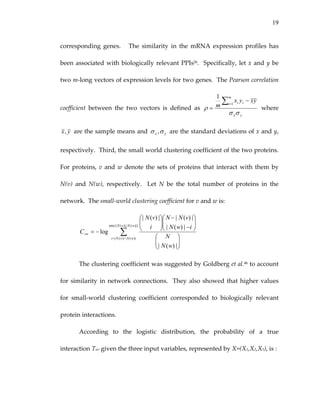
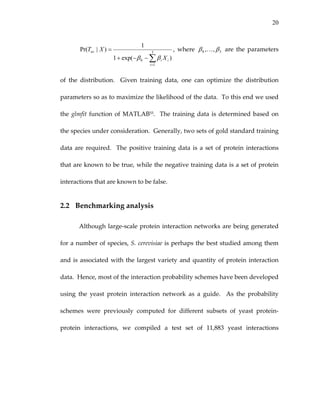
were not included in the 6.3 version of STRING.  For fitting the parameters of 
the  model,  a  positive  training  set  of  11,814  distinct  interactions  was  created 
141
from pairs of proteins falling within known pathways recorded in the Kyoto 
Encyclopedia  of  Genes  and  Genomes  (KEGG)122  as  well  as  from  small‐scale 
binary  physical  interactions  and  protein  complexes  from  the  Munich 
Information center for Protein Sequences (MIPS)57.  The negative training set 
of 35,676 interactions was obtained by randomly pairing proteins.  We filtered 
the top 22,428 interactions with log‐likelihood scores (LLS) > 3.0.   
Pooling with Transcriptional Interactions 
A  pooled  molecular interaction  network  was  constructed  by  merging 
the  above  protein‐protein  interactions  (PPIs)  with  transcription  factor‐DNA 
interactions  (TF‐DNA)  obtained  from  Beyer  et  al.135.    This  study  combined 
several lines of evidence in a Bayesian framework to assign LLS to each TF‐
DNA link.  The 11,513 TF‐DNA interactions with LLS > 3.0 were included in 
the final set. 
To  ensure  that  all  interactions  in  the  network  (PPI  and  TF‐DNA) 
represented physical binding events (as opposed to functional linkages), we 
required  that  each  included  interaction  has  been  reported  in  at  least  one 
experiment  indicating  direct  physical  interaction  between  the  proteins.    In 
addition, to enrich for interactions within regulatory pathways, the network 
was  restricted  to  regulatory  proteins.    We  included  proteins  that  were 
142
assigned  to  the  following  MIPS  categories:  (1)  regulation  of  glycolysis  and 
gluconeogenesis,  (2)  regulation  of  electron  transport  and  membrane‐
associated energy conservation, (3) regulation of respiration, (4) regulation of 
energy  conversion  /  regeneration,  (5)  regulation  of  DNA  processing,  (6) 
mitotic  cell  cycle  and  cell  cycle  control,  (7)  transcriptional  control,  (8) 
regulation  of  splicing,  (9)  translational  control,  (10)  protein  fate  (folding, 
modification, destination), (11) regulation of metabolism and protein function, 
(12)  cellular  communication  and  signal  transduction  mechanism  (13)  cell 
rescue, defense and virulence, (14) cellular sensing and response to external 
stimulus,  (15)  cell  fate,  (16)  development  (systemic),  and  (17)  cell  type 
differentiation.    Altogether,  the  final  pooled  network  consisted  of  4,466 
proteins and 17,171 non‐redundant interactions. 
Network filtering based on target‐gene 
In this study, we analyze transcriptional regulation of the target gene.  
For that purpose, we make the assumption that the expression of the target 
gene  is  modulated  by  the  causal  gene  through  a  transcription  factor  of  the 
target  gene.    Hence,  for  every  target  gene  we  filter  the  high  confidence 
network  such  that  the  target  gene  is  connected  to  the  rest  of  the  network 
through TF‐DNA interactions only.  As some of the target genes in the Brem 
143
study  do  not  have  TF‐DNA  edges,  we  cannot  use  our  approach  to  analyze 
them.    This  reduced  the  number  of  target  genes  that  were  analyzed  in  this 
study to 3,711. 
Tu  et  al.36  weighted  each  node  in  the  network  using  the  mRNA 
expression correlation between the node and the target gene.  We use the same 
idea; however, in our framework weights are most naturally placed on edges 
as  opposed  to  nodes.    The  weight  on  each  edge  (u,v)  is  defined  to  be  the 
average  mRNA  correlation  of  u  and  v  with  the  target  gene.    Thus,  our 
approach is meant to model as closely as possible the scheme of Tu et al. and 
differs only in that weights are placed on edges versus nodes. 
5.2.4 eQED Model 
The eQED model used in this paper utilizes the relationship between 
electric  circuits  and  random  walks  (see  previous  sections).    The  exact 
equivalence between electric circuits and random walks follows only when the 
network  under  consideration  is  completely  undirected.    However,  in  our 
study we also use directed edges (TF‐DNA interactions) and consequently, we 
employ a heuristic motivated by the undirected case.  Specifically, let S(N,E) 
represent the molecular interaction network (N being the set of genes in the 
144
network and E being the set of interactions.  Let C(e) denote the conductance 
on edge e, while I(L) represents the independent input current at locus L.  Let 
de be a new variable associated with the directed edge e and let D ⊆ E be the 
set of all known directed edges in the network. 
)5.........(............................................................0),(:),(
)4.(........................................))........()((),(:),(
)3..(......................................................................0),(:
)2(........................................).........,(),(),(:,
)1.(..............................))........()((),(),(:,
))()((),((:Objective
),(
≥∈∀
−≥∈∀
=≠∀
×=∈∀
−×=∉∀
−−
∑
∑∈
vudDvu
vVuVvudDvu
vuItv
vudvuCvuIDvu
vVuVvuCvuIDvu
vVuVvudMin
u
Dvu
 
where u and v are any nodes in the network and t  is the target gene 
and, V is voltage on the nodes of the electric circuit.  Here, equations (1) and 
(2) are derived from Ohm’s law which states that the current flowing through 
any  two  points  is  directly  proportional  to  the  voltage  difference  and  the 
conductance  between  them.    Further,  equation  (3)  corresponds  to  Kirchoff’s 
current law in electric circuit theory which states that the total sum of current 
through  any  point  in  the  circuit  is  zero130.    The  wires  of  a  simple  resistive 
circuit (as shown in Figure 5.1C) do not have explicit directionality, such that 
current can flow in either direction.  However, the molecular network used in 
145
this  study  includes  TF‐DNA  interactions  that,  by  definition,  transmit  signal 
from the transcription factor to the DNA and not vice versa.  Electrical circuits 
account for directed links by using diodes, which constrain current to flow in 
one  direction  only.    Equations  (4)  and  (5)  are  constraints  to  ensure  that  the 
current  only  flows  in  the  correct  direction  on  known  directed  edges.    For 
instance, let (u,v) be a directed edge with the signal going from u to v.  If V(u) > 
V(v), then to minimize the objective function, d(u,v) will take the value (V(u)‐
V(v)).  As a result, the equation becomes same as (1).  However, if V(u) < V(v), 
then due to (5), d(u,v) will be equal to 0, implying that there is no current on 
that  edge.    We  implemented  the  above  linear  programming  approach  in 
Matlab55 using the MOSEK package Version 5136. 
 
 
Acknowledgements 
This  chapter  contains  the  complete  reprint  of  the  work  Suthram  S, 
Beyer  A.,  Ideker  T.    eQED:  An  efficient  method  for  interpreting  eQTL 
associations  using  protein  networks.  Proceedings  of  3rd  Annual  RECOMB 
Satellite Conference on Systems Biology, 2007.  I was the primary author of this 
paper. 
146
Table 5.1:  Causal gene prediction accuracy. 
 
Method 
Number  of  Correct 
Predictions 
Random  118 
Tu et al. 
262 
Shortest Path** 
351 
eQED (single locus)  392 
eQED (Multiple 
loci)  438 
 
All  predictions  were  against  a  gold  standard  data  set  of  548 
causal gene‐target pairs compiled from yeast gene‐expression 
knockout studies by Hughes et al.119 and Hu et al.120 and a gene 
over‐expression study by Chua et al.121. 
 
** A naïve method in which the causal gene is selected to be the 
gene in the locus that is connected by the shortest path to the 
target. 
 
147
 
 
Figure 5.1:  Examples of the electrical circuit approach and the eQED model. 
 [A] Sample network.  [B] The “greedy” random walk approach by Tu et al.  
[C] The single locus model of eQED.  Gene T in the blue hexagon is the target 
gene.  The locus marked by the red box, containing candidate genes L1, L2 
and  L3,  associates  significantly  with  the  target  T.    The  numbers  next  to  the 
locus genes corresponds to the number of times the gene was visited in the 
random  walk  approaches  or  the  amount  of  current  through  them  in  the 
electric  circuit  approach.    [D]  The  random  walk  derived  from  [C].    [E]  The 
sample  network  with  two  significant  loci.    [F]  The  multiple  loci  model  of 
eQED. 
148


Figure 5.2:  Flowchart of the eQED method. 
149


Figure 5.3:  Inferred pathways and directionality prediction. 
 [A] The accuracy of the direction prediction methods.  The “gold” standard 
set of protein interactions were ranked according to the different metrics and, 
the  ranks  in  each  approach  was  plotted  as  the  x‐axis.  [B‐D]  The  regulatory 
networks for three example target genes.  The nodes colored in shades of red 
correspond to predicted causal genes.  The intensity of color corresponds to 
their p‐value of association with the target. 


6 Conclusion 
The  amount  data  on  protein  interactions  has  been  growing  steadily.   
Figure  1.3  shows  a  graph  of  the  vast  increase  in  the  number  of  protein 
interactions since 1999.  In fact, the number of species for which large‐scale 
protein  network  data  is  now  available  is  also  large.    Simultaneously,  high‐
throughput  technology  has  resulted  in  other  large‐scale  data  such  as 
generation of large scale generation of genetic interaction data137, protein‐DNA 
binding data7 and genome wide association data138.  The availability of these 
vast  amounts  of  data,  each  addressing  a  different  aspect  of  the  cellular 
function in various species, calls for a comprehensive approach to analyzing 
them.  As protein networks form the backbone of the all mechanisms within a 
cell, the focus of this dissertation was to get a better understanding of cellular 
function through the analysis of protein networks. 
Most high‐throughput methods contain a considerable number of false‐
positives.    Therefore,  I  first  addressed  the  issue  of  noise  in  the  large‐scale 
protein  interaction  networks  in  Chapter  2.    Specifically,  I  generated  a  new 
method  to  assign  confidence  scores  to  protein‐protein  interactions  and 
benchmarked our approach against existing methods. 
150
151
As  is  often  the  case  in  biology,  an  approach  based  on  cross‐species 
comparisons provides a valuable framework for analyzing protein networks.  
I  used  this  method  to  compare  the  protein  networks  of  the  three  model 
eukaryotes  and  also  the  parasite  Plasmodium  falciparum  in  chapters  3  and  4.  
This approach was very fruitful as I was able to identify regulatory pathways 
and modules that were conserved between them.  In addition, the conserved 
modules  were  also  used  to  make  new  predictions  of  cellular  function  and 
protein  interaction.    These  results  are  available  online  along  with  other 
modules generated by different algorithms at http://www.cellcircuits.org/139. 
In  chapter  5,  I  used  the  strategy  of  network  integration  in  order  to 
understand the functioning of the yeast cell.  I combined the knowledge of the 
protein  network  with  that  of  eQTL  data  available  for  yeast  to  explain  the 
observed gene expression associations. 
6.1 Future directions 
Cross‐species sequence comparison has been the mainstay of genome 
analysis13.  In contrast cross‐species network analysis is still in its infancy.  The 
method of NetworkBLAST suggested in chapter 3 compares protein networks 
across  three  species  successfully.    However,  this  method  becomes 
152
computationally  intensive  when  comparing  more  species  simultaneously.   
Further, the scoring model used in NetworkBLAST is simple.  I envision that 
better scoring models such as that of Koyuturk et al.140 could be applied which 
take  into  account  the  evolution  of  protein  networks  similar  to  evolutionary 
models  such  as  the  Jukes‐Cantor  Model  used  in  sequence  analysis141.  
Currently,  there  are  few  models  that  describe  how  protein  networks  evolve 
and what principles guide the loss or gain of interactions142,143.  In particular, 
Andreas  Wagner  and  colleagues  have  developed  a  model  of  evolution  of  a 
single  interaction  network143.    Their  model  includes  duplication  and 
divergence  events  affecting  the  yeast  protein  interaction  network.    Such 
models of network evolution will be important for identifying regions of the 
network  that  are  more  adaptable  to  change  due  to  environmental  pressure.  
They  may also help in designing better therapeutics by targeting regions of 
the protein network that are conserved in general categories of pathogens but 
are absent from the human host.   
High‐throughput technologies generate large measurements for many 
different aspects of cellular function. Analyzing them comprehensively using 
network  integration  provides  a  clearer  picture  of  the  entire  system.  
Integration of different sources of information has been primarily used for the 
153
inference of protein networks.  For instance, Jansen et al.50 and Lee et al.144 used 
a  probabilistic  method  to  combine  various  data  types  (such  as  mRNA 
expression, phylogenetic profiles) to predict new protein interactions in yeast.  
In  these  methods,  the  data  types  being  integrated  are  all  shown  to  be 
correlated to true protein interactions.  However, the main drawback of these 
methods is that they assume that each dataset is independent of the others.  
Therefore, new methods need to be developed that can predict new protein 
interactions by also accounting for the correlations between the different data 
types.  Another exciting direction for such network integration techniques is 
to  predict  new  protein  interactions  which  can  then  be  used  to  direct  new 
large‐scale experiments such as yeast two‐hybrid. 
Network integration of fewer data sources has been used previously to 
generate  models  of  cellular  machinery.    For  instance,  Tan  et  al.145  integrated 
protein  network  and  transcription  factor‐DNA  interactions  to  find  protein 
complexes that were not only regulated by common transcription factors, but 
also  conserved  between  yeast  and  fly.    I  also  applied  the  idea  of  network 
integration  to  identify  causal  genes  by  combining  yeast  eQTL  data  with 
protein  interactions.    With  the  availability  of  new  sources  of  data,  these 
methods of integration have to be updated and improved.  Finally, one of the 
154
main  aims  of  systems  biology  and  bioinformatics,  in  general,  is  to  identify 
plausible  drug  targets  for  various  diseases.    The  technique  of  network 
integration provides an exciting tool to tackle this issue. 
7 References 
1.  Consortium  IHG.  Initial  sequencing  and  analysis  of  the  human  genome. 
Nature 2001;409:860‐921. 
2. Team CHG. The sequence of the human genome. Science 2001;291:1304‐51. 
3.  Hood  L.  Systems  biology:  integrating  technology,  biology,  and 
computation. Mech Ageing Dev 2003;124:9‐16. 
4.  Ideker  T,  Galitski  T,  Hood  L.  A  new  approach  to  decoding  life:  systems 
biology. Annu Rev Genomics Hum Genet 2001;2:343‐72. 
5.  Watson  A,  Mazumder  A,  Stewart  M,  Balasubramanian  S.  Technology  for 
microarray analysis of gene expression. Curr Opin Biotechnol 1998;9:609‐14. 
6. Berger MF, Philippakis AA, Qureshi AM, He FS, Estep PW, 3rd, Bulyk ML. 
Compact,  universal  DNA  microarrays  to  comprehensively  determine 
transcription‐factor binding site specificities. Nat Biotechnol 2006;24:1429‐35. 
7. Harbison CT, Gordon DB, Lee TI, Rinaldi NJ, Macisaac KD, Danford TW, 
Hannett  NM,  Tagne  JB,  Reynolds  DB,  Yoo  J,  Jennings  EG,  Zeitlinger  J, 
Pokholok  DK, Kellis  M, Rolfe  PA, Takusagawa KT, Lander ES, Gifford DK, 
Fraenkel  E,  Young  RA.  Transcriptional  regulatory  code  of  a  eukaryotic 
genome. Nature 2004;431:99‐104. 
8. Benson DA, Karsch‐Mizrachi I, Lipman DJ, Ostell J, Wheeler DL. GenBank. 
Nucleic Acids Res 2007;35:D21‐5. 
9. Chatton B, Bahr A, Acker J, Kedinger C. Eukaryotic GST fusion vector for 
the study of protein‐protein associations in vivo: application to interaction of 
ATFa with Jun and Fos. Biotechniques 1995;18:142‐5. 
155
156
10. Matyus L. Fluorescence resonance energy transfer measurements on  cell 
surfaces. A spectroscopic tool for determining protein interactions. J Photochem 
Photobiol B 1992;12:323‐37. 
11.  Fields  S,  Song  O.  A  novel  genetic  system  to  detect  protein‐protein 
interactions. Nature 1989;340:245‐6. 
12. Gavin AC, Bosche M, Krause R, Grandi P, Marzioch M, Bauer A, Schultz J, 
Rick JM, Michon AM, Cruciat CM, Remor M, Hofert C, Schelder M, Brajenovic 
M,  Ruffner  H,  Merino  A,  Klein  K,  Hudak  M,  Dickson  D,  Rudi  T,  Gnau  V, 
Bauch  A,  Bastuck  S,  Huhse  B,  Leutwein  C,  Heurtier  MA,  Copley  RR, 
Edelmann A, Querfurth E, Rybin V, Drewes G, Raida M, Bouwmeester T, Bork 
P,  Seraphin  B,  Kuster  B,  Neubauer  G,  Superti‐Furga  G.  Functional 
organization  of  the  yeast  proteome  by  systematic  analysis  of  protein 
complexes. Nature 2002;415:141‐7. 
13.  Sharan  R,  Ideker  T.  Modeling  cellular  machinery  through  biological 
network comparison. Nat Biotechnol 2006;24:427‐33. 
14. von Mering C, Krause R, Snel B, Cornell M, Oliver SG, Fields S, Bork P. 
Comparative  assessment  of  large‐scale  data  sets  of  protein‐protein 
interactions. Nature 2002;417:399‐403. 
15. Samanta MP, Liang S. Predicting protein functions from redundancies in 
large‐scale  protein  interaction  networks.  Proc  Natl  Acad  Sci  U  S  A 
2003;100:12579‐83. 
16. Ideker T, Lauffenburger D. Building with a scaffold: emerging strategies 
for high‐ to low‐level cellular modeling. Trends Biotechnol 2003;21:255‐62. 
17.  Ho  Y,  Gruhler  A,  Heilbut  A,  Bader  GD,  Moore  L,  Adams  SL,  Millar  A, 
Taylor P, Bennett K, Boutilier K, Yang L, Wolting C, Donaldson I, Schandorff 
S,  Shewnarane  J,  Vo  M,  Taggart  J,  Goudreault  M,  Muskat  B,  Alfarano  C, 
Dewar  D,  Lin  Z,  Michalickova  K,  Willems  AR,  Sassi  H,  Nielsen  PA, 
157
Rasmussen  KJ,  Andersen  JR,  Johansen  LE,  Hansen  LH,  Jespersen  H, 
Podtelejnikov A, Nielsen E, Crawford J, Poulsen V, Sorensen BD, Matthiesen J, 
Hendrickson  RC,  Gleeson  F,  Pawson  T,  Moran  MF,  Durocher  D,  Mann  M, 
Hogue CW, Figeys D, Tyers M. Systematic identification of protein complexes 
in Saccharomyces cerevisiae by mass spectrometry. Nature 2002;415:180‐3. 
18.  Ito  T,  Chiba  T,  Ozawa  R,  Yoshida  M,  Hattori  M,  Sakaki  Y.  A 
comprehensive two‐hybrid analysis to explore the yeast protein interactome. 
Proc Natl Acad Sci U S A 2001;98:4569‐74. 
19. LaCount DJ, Vignali M, Chettier R, Phansalkar A, Bell R, Hesselberth JR, 
Schoenfeld LW, Ota I, Sahasrabudhe S, Kurschner C, Fields S, Hughes RE. A 
protein  interaction  network  of  the  malaria  parasite  Plasmodium  falciparum. 
Nature 2005;438:103‐7. 
20. Uetz P, Giot L, Cagney G, Mansfield TA, Judson RS, Knight JR, Lockshon 
D,  Narayan  V,  Srinivasan  M,  Pochart  P,  Qureshi‐Emili  A,  Li  Y,  Godwin  B, 
Conover D, Kalbfleisch T, Vijayadamodar G, Yang M, Johnston M, Fields S, 
Rothberg  JM.  A  comprehensive  analysis  of  protein‐protein  interactions  in 
Saccharomyces cerevisiae. Nature 2000;403:623‐7. 
21. Bang S, Choi J, Park J, Park SJ. A Hub‐protein based Visualization of Large 
Protein‐Protein  Interaction  Networks.  Conf  Proc  IEEE  Eng  Med  Biol  Soc 
2007;1:1217‐20. 
22.  Hanisch  D,  Sohler  F,  Zimmer  R.  ToPNet‐‐an  application  for  interactive 
analysis  of  expression  data  and  biological  networks.  Bioinformatics 
2004;20:1470‐1. 
23. Ho E, Webber R, Wilkins MR. Interactive Three‐Dimensional Visualization 
and Contextual Analysis of Protein Interaction Networks. J Proteome Res 2007. 
24.  Hu  Z,  Mellor  J,  Wu  J,  DeLisi  C.  VisANT:  an  online  visualization  and 
analysis tool for biological interaction data. BMC Bioinformatics 2004;5:17. 
158
25. Shannon P, Markiel A, Ozier O, Baliga NS, Wang JT, Ramage D, Amin N, 
Schwikowski  B,  Ideker  T.  Cytoscape:  a  software  environment  for  integrated 
models of biomolecular interaction networks. Genome Res 2003;13:2498‐504. 
26.  Grigoriev  A.  A  relationship  between  gene  expression  and  protein 
interactions on the proteome scale: analysis of the bacteriophage T7 and the 
yeast Saccharomyces cerevisiae. Nucleic Acids Res 2001;29:3513‐9. 
27.  Altschul  SF,  Madden  TL,  Schaffer  AA,  Zhang  J,  Zhang  Z,  Miller  W, 
Lipman  DJ.  Gapped  BLAST  and  PSI‐BLAST:  a  new  generation  of  protein 
database search programs. Nucleic Acids Res 1997;25:3389‐402. 
28. Kelley BP, Sharan R, Karp RM, Sittler T, Root DE, Stockwell BR, Ideker T. 
Conserved pathways within bacteria and yeast as revealed by global protein 
network alignment. Proc Natl Acad Sci U S A 2003;100:11394‐9. 
29. Kelley R, Ideker T. Systematic interpretation of genetic interactions using 
protein networks. Nat Biotechnol 2005;23:561‐6. 
30.  Brem  RB,  Kruglyak  L.  The  landscape  of  genetic  complexity  across  5,700 
gene expression traits in yeast. Proc Natl Acad Sci U S A 2005;102:1572‐7. 
31. Schadt EE, Lamb J, Yang X, Zhu J, Edwards S, Guhathakurta D, Sieberts 
SK,  Monks  S,  Reitman  M,  Zhang  C,  Lum  PY,  Leonardson  A,  Thieringer  R, 
Metzger JM, Yang L, Castle J, Zhu H, Kash SF, Drake TA, Sachs A, Lusis AJ. 
An integrative genomics approach to infer causal associations between gene 
expression and disease. Nat Genet 2005;37:710‐7. 
32.  Rockman  MV,  Kruglyak  L.  Genetics  of  global  gene  expression.  Nat  Rev 
Genet 2006;7:862‐72. 
33. Yvert G, Brem RB, Whittle J, Akey JM, Foss E, Smith EN, Mackelprang R, 
Kruglyak  L.  Trans‐acting  regulatory  variation  in  Saccharomyces  cerevisiae 
and the role of transcription factors. Nat Genet 2003;35:57‐64. 
159
34. Lee SI, Peʹer D, Dudley AM, Church GM, Koller D. Identifying regulatory 
mechanisms  using  individual  variation  reveals  key  role  for  chromatin 
modification. Proc Natl Acad Sci U S A 2006;103:14062‐7. 
35. Schadt EE, Lum PY. Thematic review series: systems biology approaches to 
metabolic  and  cardiovascular  disorders.  Reverse  engineering  gene  networks 
to  identify  key  drivers  of  complex  disease  phenotypes.  J  Lipid  Res 
2006;47:2601‐13. 
36. Tu Z, Wang L, Arbeitman MN, Chen T, Sun F. An integrative approach for 
causal  gene  identification  and  gene  regulatory  pathway  inference. 
Bioinformatics 2006;22:e489‐96. 
37. Xenarios I, Salwinski L, Duan XJ, Higney P, Kim SM, Eisenberg D. DIP, the 
Database of Interacting Proteins: a research tool for studying cellular networks 
of protein interactions. Nucleic Acids Res 2002;30:303‐5. 
38.  Mishra  GR,  Suresh  M,  Kumaran  K,  Kannabiran  N,  Suresh  S,  Bala  P, 
Shivakumar K, Anuradha N, Reddy R, Raghavan TM, Menon S, Hanumanthu 
G, Gupta M, Upendran S, Gupta S, Mahesh M, Jacob B, Mathew P, Chatterjee 
P,  Arun  KS,  Sharma  S,  Chandrika  KN,  Deshpande  N,  Palvankar  K, 
Raghavnath R, Krishnakanth R, Karathia H, Rekha B, Nayak R, Vishnupriya 
G, Kumar HG, Nagini M, Kumar GS, Jose R, Deepthi P, Mohan SS, Gandhi 
TK,  Harsha  HC,  Deshpande  KS,  Sarker  M,  Prasad  TS,  Pandey  A.  Human 
protein reference database‐‐2006 update. Nucleic Acids Res 2006;34:D411‐4. 
39. Giot L, Bader JS, Brouwer C, Chaudhuri A, Kuang B, Li Y, Hao YL, Ooi CE, 
Godwin  B,  Vitols  E,  Vijayadamodar  G,  Pochart  P,  Machineni  H,  Welsh  M, 
Kong  Y,  Zerhusen  B,  Malcolm  R,  Varrone  Z,  Collis  A,  Minto  M,  Burgess  S, 
McDaniel L, Stimpson E, Spriggs F, Williams J, Neurath K, Ioime N, Agee M, 
Voss  E,  Furtak  K,  Renzulli  R,  Aanensen  N,  Carrolla  S,  Bickelhaupt  E, 
Lazovatsky  Y,  DaSilva  A,  Zhong  J,  Stanyon  CA,  Finley  RL,  Jr.,  White  KP, 
Braverman M, Jarvie T, Gold  S, Leach M, Knight J, Shimkets RA, McKenna 
MP,  Chant  J,  Rothberg  JM.  A  protein  interaction  map  of  Drosophila 
melanogaster. Science 2003;302:1727‐36. 
160
40. Li S, Armstrong CM, Bertin N, Ge H, Milstein S, Boxem M, Vidalain PO, 
Han  JD,  Chesneau  A,  Hao  T,  Goldberg  DS,  Li  N,  Martinez  M,  Rual  JF, 
Lamesch P, Xu L, Tewari M, Wong SL, Zhang LV, Berriz GF, Jacotot L, Vaglio 
P, Reboul J, Hirozane‐Kishikawa T, Li Q, Gabel HW, Elewa A, Baumgartner B, 
Rose DJ, Yu H, Bosak S, Sequerra R, Fraser A, Mango SE, Saxton WM, Strome 
S, Van Den Heuvel S, Piano F, Vandenhaute J, Sardet C, Gerstein M, Doucette‐
Stamm L, Gunsalus KC, Harper JW, Cusick ME, Roth FP, Hill DE, Vidal M. A 
map  of  the  interactome  network  of  the  metazoan  C.  elegans.  Science 
2004;303:540‐3. 
41.  Rual  JF,  Venkatesan  K,  Hao  T,  Hirozane‐Kishikawa  T,  Dricot  A,  Li  N, 
Berriz GF, Gibbons FD, Dreze M, Ayivi‐Guedehoussou N, Klitgord N, Simon 
C,  Boxem  M,  Milstein  S,  Rosenberg  J,  Goldberg  DS,  Zhang  LV,  Wong  SL, 
Franklin G, Li S, Albala JS, Lim J, Fraughton C, Llamosas E, Cevik S, Bex C, 
Lamesch  P,  Sikorski  RS,  Vandenhaute  J,  Zoghbi  HY,  Smolyar  A,  Bosak  S, 
Sequerra  R,  Doucette‐Stamm  L,  Cusick  ME,  Hill  DE,  Roth  FP,  Vidal  M. 
Towards  a  proteome‐scale  map  of  the  human  protein‐protein  interaction 
network. Nature 2005;437:1173‐8. 
42.  Stelzl  U,  Worm  U,  Lalowski  M,  Haenig  C,  Brembeck  FH,  Goehler  H, 
Stroedicke  M,  Zenkner  M,  Schoenherr  A,  Koeppen  S,  Timm  J,  Mintzlaff  S, 
Abraham C, Bock N, Kietzmann S, Goedde A, Toksoz E, Droege A, Krobitsch 
S,  Korn  B,  Birchmeier  W,  Lehrach  H,  Wanker  EE.  A  human  protein‐protein 
interaction network: a resource for annotating the proteome. Cell 2005;122:957‐
68. 
43. Deane CM, Salwinski L, Xenarios I, Eisenberg D. Protein interactions: two 
methods for assessment of the reliability of high throughput observations. Mol 
Cell Proteomics 2002;1:349‐56. 
44. Deng  M, Sun F,  Chen T. Assessment of the reliability  of  protein‐protein 
interactions and protein function prediction. Pac Symp Biocomput 2003:140‐51. 
45. Bader JS, Chaudhuri A, Rothberg JM, Chant J. Gaining confidence in high‐
throughput protein interaction networks. Nat Biotechnol 2004;22:78‐85. 
161
46. Goldberg DS, Roth FP. Assessing experimentally derived interactions in a 
small world. Proc Natl Acad Sci U S A 2003;100:4372‐6. 
47.  Marcotte  EM,  Pellegrini  M,  Thompson  MJ,  Yeates  TO,  Eisenberg  D.  A 
combined algorithm for genome‐wide prediction of protein function. Nature 
1999;402:83‐6. 
48.  von  Mering  C,  Jensen  LJ,  Snel  B,  Hooper  SD,  Krupp  M,  Foglierini  M, 
Jouffre  N,  Huynen  MA,  Bork  P.  STRING:  known  and  predicted  protein‐
protein  associations,  integrated  and  transferred  across  organisms.  Nucleic 
Acids Res 2005;33:D433‐7. 
49.  Myers  CL,  Robson  D,  Wible  A,  Hibbs  MA,  Chiriac  C,  Theesfeld  CL, 
Dolinski K, Troyanskaya OG. Discovery of biological networks from diverse 
functional genomic data. Genome Biol 2005;6:R114. 
50. Jansen R, Yu H, Greenbaum D, Kluger Y, Krogan NJ, Chung S, Emili A, 
Snyder  M,  Greenblatt  JF,  Gerstein  M.  A  Bayesian  networks  approach  for 
predicting  protein‐protein  interactions  from  genomic  data.  Science 
2003;302:449‐53. 
51.  Qi  Y,  Klein‐Seetharaman  J,  Bar‐Joseph  Z.  Random  forest  similarity  for 
protein‐protein  interaction  prediction  from  multiple  sources.  Pac  Symp 
Biocomput 2005:531‐42. 
52. Qi Y, Bar‐Joseph Z, Klein‐Seetharaman J. Evaluation of different biological 
data and computational classification methods for use in protein interaction 
prediction. Proteins 2006. 
53. Suthram S, Sittler T, Ideker T. The Plasmodium protein network diverges 
from those of other eukaryotes. Nature 2005;438:108‐12. 
162
54.  Sharan  R,  Suthram  S,  Kelley  RM,  Kuhn  T,  McCuine  S,  Uetz  P,  Sittler  T, 
Karp  RM,  Ideker  T.  Conserved  patterns  of  protein  interaction  in  multiple 
species. Proc Natl Acad Sci U S A 2005;102:1974‐9. 
55. Matlab. MATLAB Software. 
56. Ashburner M, Ball CA, Blake JA, Botstein D, Butler H, Cherry JM, Davis 
AP,  Dolinski  K,  Dwight  SS,  Eppig  JT,  Harris  MA,  Hill  DP,  Issel‐Tarver  L, 
Kasarskis  A,  Lewis  S,  Matese  JC,  Richardson  JE,  Ringwald  M,  Rubin  GM, 
Sherlock  G.  Gene  ontology:  tool  for  the  unification  of  biology.  The  Gene 
Ontology Consortium. Nat Genet 2000;25:25‐9. 
57.  Mewes  HW,  Albermann  K,  Heumann  K,  Liebl  S,  Pfeiffer  F.  MIPS:  a 
database  for  protein  sequences,  homology  data  and  yeast  genome 
information. Nucleic Acids Res 1997;25:28‐30. 
58. http://chianti.ucsd.edu/Suthram2006 SW. 
59.  Pagel  P,  Mewes  HW,  Frishman  D.  Conservation  of  protein‐protein 
interactions ‐ lessons from ascomycota. Trends Genet 2004;20:72‐6. 
60. Yu H, Luscombe NM, Lu HX, Zhu X, Xia Y, Han JD, Bertin N, Chung S, 
Vidal M, Gerstein M. Annotation transfer between genomes: protein‐protein 
interologs and protein‐DNA regulogs. Genome Res 2004;14:1107‐18. 
61. Ball CA, Awad IA, Demeter J, Gollub J, Hebert JM, Hernandez‐Boussard T, 
Jin H, Matese JC, Nitzberg M, Wymore F, Zachariah ZK, Brown PO, Sherlock 
G.  The  Stanford  Microarray  Database  accommodates  additional  microarray 
platforms and data formats. Nucleic Acids Res 2005;33:D580‐2. 
62.  Bader  GD,  Hogue  CW.  An  automated  method  for  finding  molecular 
complexes in large protein interaction networks. BMC Bioinformatics 2003;4:2. 
163
63. Hu H, Yan X, Huang Y, Han J, Zhou XJ. Mining coherent dense subgraphs 
across  massive  biological  networks  for  functional  discovery.  Bioinformatics 
2005;21 Suppl 1:i213‐i221. 
64.  Spirin  V,  Mirny  LA.  Protein  complexes  and  functional  modules  in 
molecular networks. Proc Natl Acad Sci U S A 2003;100:12123‐8. 
65.  Fraser  HB,  Hirsh  AE,  Steinmetz  LM,  Scharfe  C,  Feldman  MW. 
Evolutionary rate in the protein interaction network. Science 2002;296:750‐2. 
66. Sindhwani V, Rakshit S, Deodhare D, Erdogmus D, Principe JC, Niyogi P. 
Feature selection in MLPs and SVMs based on maximum output information. 
IEEE Trans Neural Netw 2004;15:937‐48. 
67. Christie KR, Weng S, Balakrishnan R, Costanzo MC, Dolinski K, Dwight 
SS, Engel SR, Feierbach B, Fisk DG, Hirschman JE, Hong EL, Issel‐Tarver L, 
Nash R, Sethuraman A, Starr B, Theesfeld CL, Andrada R, Binkley G, Dong Q, 
Lane  C,  Schroeder  M,  Botstein  D,  Cherry  JM.  Saccharomyces  Genome 
Database  (SGD)  provides  tools  to  identify  and  analyze  sequences  from 
Saccharomyces cerevisiae and related sequences from other organisms. Nucleic 
Acids Res 2004;32:D311‐4. 
68.  Shanmugan  KS.  Digital  and  analog  communication  systems.  New  York: 
Wiley, 1979:xviii, 600. 
69.  Aebersold  R,  Mann  M.  Mass  spectrometry‐based  proteomics.  Nature 
2003;422:198‐207. 
70. Rain JC, Selig L, De Reuse H, Battaglia V, Reverdy C, Simon S, Lenzen G, 
Petel F, Wojcik J, Schachter V, Chemama Y, Labigne A, Legrain P. The protein‐
protein interaction map of Helicobacter pylori. Nature 2001;409:211‐5. 
71.  Matthews  LR,  Vaglio  P,  Reboul  J,  Ge  H,  Davis  BP,  Garrels  J,  Vincent  S, 
Vidal M. Identification of potential interaction networks using sequence‐based 
164
searches for conserved protein‐protein interactions or ʺinterologsʺ. Genome Res 
2001;11:2120‐6. 
72. Sharan R, Ideker T, Kelley B, Shamir R, Karp RM. Identification of protein 
complexes by comparative analysis of yeast and bacterial protein interaction 
data. J Comput Biol 2005;12:835‐46. 
73. Dandekar T, Schuster S, Snel B, Huynen M, Bork P. Pathway alignment: 
application  to  the  comparative  analysis  of  glycolytic  enzymes.  Biochem  J 
1999;343:115‐24. 
74.  Forst  CV,  Schulten  K.  Evolution  of  metabolisms:  a  new  method  for  the 
comparison of metabolic pathways using genomics information. J Comput Biol 
1999;6:343‐60. 
75. Ogata H, Fujibuchi W, Goto S, Kanehisa M. A heuristic graph comparison 
algorithm  and  its  application  to  detect  functionally  related  enzyme  clusters. 
Nucleic Acids Res 2000;28:4021‐8. 
76. Bergmann  S,  Ihmels J, Barkai N. Similarities  and differences  in genome‐
wide expression data of six organisms. PLoS Biol 2004;2:E9. 
77. Enard W, Khaitovich P, Klose J, Zollner S, Heissig F, Giavalisco P, Nieselt‐
Struwe K, Muchmore E, Varki A, Ravid R, Doxiadis GM, Bontrop RE, Paabo S. 
Intra‐ and interspecific variation in primate gene expression patterns. Science 
2002;296:340‐3. 
78.  Stuart  JM,  Segal  E,  Koller  D,  Kim  SK.  A  gene‐coexpression  network  for 
global discovery of conserved genetic modules. Science 2003;302:249‐55. 
79.  Tanay  A,  Sharan  R,  Kupiec  M,  Shamir  R.  Revealing  modularity  and 
organization in the yeast molecular network by integrated analysis of highly 
heterogeneous genomewide data. Proc Natl Acad Sci U S A 2004;101:2981‐6. 
165
80.  Harris  TW,  Chen  N,  Cunningham  F,  Tello‐Ruiz  M,  Antoshechkin  I, 
Bastiani C, Bieri T, Blasiar D, Bradnam K, Chan J, Chen CK, Chen WJ, Davis P, 
Kenny E, Kishore R, Lawson D, Lee R, Muller HM, Nakamura C, Ozersky P, 
Petcherski A, Rogers A, Sabo A, Schwarz EM, Van Auken K, Wang Q, Durbin 
R, Spieth J, Sternberg PW, Stein LD. WormBase: a multi‐species resource for 
nematode  biology  and  genomics.  Nucleic  Acids  Res  2004;32  Database 
issue:D411‐7. 
81.  FlybaseConsortium.  The  FlyBase  database  of  the  Drosophila  genome 
projects and community literature. Nucleic Acids Res 2003;31:172‐5. 
82. Xie H, Wasserman A, Levine Z, Novik A, Grebinskiy V, Shoshan A, Mintz 
L.  Large‐scale  protein  annotation  through  gene  ontology.  Genome  Res 
2002;12:785‐94. 
83. Gautier‐Bert K, Murol B, Jarrousse AS, Ballut L, Badaoui S, Petit F, Schmid 
HP.  Substrate  affinity  and  substrate  specificity  of  proteasomes  with  RNase 
activity. Mol Biol Rep 2003;30:1‐7. 
84. Schmid HP, Pouch MN, Petit F, Dadet MH, Badaoui S, Boissonnet G, Buri 
J, Norris V, Briand Y. Relationships between proteasomes and RNA. Mol Biol 
Rep 1995;21:43‐7. 
85. Yu TW, Bargmann CI. Dynamic regulation of axon guidance. Nat Neurosci 
2001;4 Suppl:1169‐76. 
86.  Spira  ME,  Oren  R,  Dormann  A,  Ilouz  N,  Lev  S.  Calcium,  protease 
activation, and cytoskeleton remodeling underlie growth cone formation and 
neuronal regeneration. Cell Mol Neurobiol 2001;21:591‐604. 
87. T.Kamada, S.Kawai. An algorithm for drawing general undirected graphs. 
Information Processing Letters 1989;31:7‐15. 
166
88. Conant GC, Wagner A. Convergent evolution of gene circuits. Nat Genet 
2003;34:264‐6. 
89.  Miller  LH,  Baruch  DI,  Marsh  K,  Doumbo  OK.  The  pathogenic  basis  of 
malaria. Nature 2002;415:673‐9. 
90. Gardner MJ, Hall N, Fung E, White O, Berriman M, Hyman RW, Carlton 
JM, Pain A, Nelson KE, Bowman S, Paulsen IT, James K, Eisen JA, Rutherford 
K,  Salzberg  SL,  Craig  A,  Kyes  S,  Chan  MS,  Nene  V,  Shallom  SJ,  Suh  B, 
Peterson  J,  Angiuoli  S,  Pertea  M,  Allen  J,  Selengut  J,  Haft  D,  Mather  MW, 
Vaidya  AB,  Martin  DM,  Fairlamb  AH,  Fraunholz  MJ,  Roos  DS,  Ralph  SA, 
McFadden  GI,  Cummings  LM,  Subramanian  GM,  Mungall  C,  Venter  JC, 
Carucci  DJ,  Hoffman  SL,  Newbold  C,  Davis  RW,  Fraser  CM,  Barrell  B. 
Genome  sequence  of  the  human  malaria  parasite  Plasmodium  falciparum. 
Nature 2002;419:498‐511. 
91.  Bozdech  Z,  Llinas  M,  Pulliam  BL,  Wong  ED,  Zhu  J,  DeRisi  JL.  The 
transcriptome  of  the  intraerythrocytic  developmental  cycle  of  Plasmodium 
falciparum. PLoS Biol 2003;1:E5. 
92. Le Roch KG, Zhou Y, Blair PL, Grainger M, Moch JK, Haynes JD, De La 
Vega P, Holder AA, Batalov S, Carucci DJ, Winzeler EA. Discovery of gene 
function  by  expression  profiling  of  the  malaria  parasite  life  cycle.  Science 
2003;301:1503‐8. 
93. Florens L, Washburn MP, Raine JD, Anthony RM, Grainger M, Haynes JD, 
Moch JK, Muster N, Sacci JB, Tabb DL, Witney AA, Wolters D, Wu Y, Gardner 
MJ,  Holder  AA,  Sinden  RE,  Yates  JR,  Carucci  DJ.  A  proteomic  view  of  the 
Plasmodium falciparum life cycle. Nature 2002;419:520‐6. 
94. Fraunholz MJ, Roos DS. PlasmoDB: exploring genomics and post‐genomics 
data of the malaria parasite, Plasmodium falciparum. Redox Rep 2003;8:317‐20. 
167
95.  Chen  N,  Harris  TW,  Antoshechkin  I,  Bastiani  C,  Bieri  T,  Blasiar  D, 
Bradnam K, Canaran P, Chan J, Chen CK, Chen WJ, Cunningham F, Davis P, 
Kenny  E,  Kishore  R,  Lawson  D,  Lee  R,  Muller  HM,  Nakamura  C,  Pai  S, 
Ozersky P, Petcherski A, Rogers A, Sabo A, Schwarz EM, Van Auken K, Wang 
Q, Durbin R, Spieth J, Sternberg PW, Stein LD. WormBase: a comprehensive 
data  resource  for  Caenorhabditis  biology  and  genomics.  Nucleic  Acids  Res 
2005;33 Database Issue:D383‐9. 
96. (www.tigr.org) T. 
97.  Felsenstein  J.  PHYLIP  ‐  Phylogeny  Inference  Package  (Version  3.2). 
Cladistics 1989;5:164‐166. 
98.  Barabasi  AL,  Oltvai  ZN.  Network  biology:  understanding  the  cellʹs 
functional organization. Nat Rev Genet 2004;5:101‐13. 
99. Gagny B, Wiederkehr A, Dumoulin P, Winsor B, Riezman H, Haguenauer‐
Tsapis  R.  A  novel  EH  domain  protein  of  Saccharomyces  cerevisiae,  Ede1p, 
involved in endocytosis. J Cell Sci 2000;113 ( Pt 18):3309‐19. 
100.  Engqvist‐Goldstein  AE,  Drubin  DG.  Actin  assembly  and  endocytosis: 
from yeast to mammals. Annu Rev Cell Dev Biol 2003;19:287‐332. 
101. Goodson HV, Anderson BL, Warrick HM, Pon LA, Spudich JA. Synthetic 
lethality  screen  identifies  a  novel  yeast  myosin  I  gene  (MYO5):  myosin  I 
proteins  are  required  for  polarization  of  the  actin  cytoskeleton.  J  Cell  Biol 
1996;133:1277‐91. 
102.  Salisbury  JL,  Condeelis  JS,  Maihle  NJ,  Satir  P.  Calmodulin  localization 
during capping and receptor‐mediated endocytosis. Nature 1981;294:163‐6. 
103. Scheibel LW, Colombani PM, Hess AD, Aikawa M, Atkinson CT, Milhous 
WK.  Calcium  and  calmodulin  antagonists  inhibit  human  malaria  parasites 
168
(Plasmodium falciparum): implications for drug design. Proc Natl Acad Sci U S 
A 1987;84:7310‐4. 
104.  Sanchez  CP,  McLean  JE,  Stein  W,  Lanzer  M.  Evidence  for  a  substrate 
specific  and  inhibitable  drug  efflux  system  in  chloroquine  resistant 
Plasmodium falciparum strains. Biochemistry 2004;43:16365‐73. 
105. Hoppe HC, van Schalkwyk DA, Wiehart UI, Meredith SA, Egan J, Weber 
BW.  Antimalarial  quinolines  and  artemisinin  inhibit  endocytosis  in 
Plasmodium falciparum. Antimicrob Agents Chemother 2004;48:2370‐8. 
106. Mori K. Frame switch splicing and regulated intramembrane proteolysis: 
key words to understand the unfolded protein response. Traffic 2003;4:519‐28. 
107. Baxter BK, James P, Evans T, Craig EA. SSI1 encodes a novel Hsp70 of the 
Saccharomyces  cerevisiae endoplasmic  reticulum. Mol Cell Biol 1996;16:6444‐
56. 
108. Langst G, Becker PB. Nucleosome mobilization and positioning by ISWI‐
containing chromatin‐remodeling factors. J Cell Sci 2001;114:2561‐8. 
109. Jacobson S, Pillus L. Modifying chromatin and concepts of cancer. Curr 
Opin Genet Dev 1999;9:175‐84. 
110. Johnson D, Gunther K, Ansorge I, Benting J, Kent A, Bannister L, Ridley 
R,  Lingelbach  K.  Characterization  of  membrane  proteins  exported  from 
Plasmodium  falciparum  into  the  host  erythrocyte.  Parasitology  1994;109  (  Pt 
1):1‐9. 
111. Mattei D, Scherf A. The Pf332 gene of Plasmodium falciparum codes for a 
giant  protein  that  is  translocated  from  the  parasite  to  the  membrane  of 
infected erythrocytes. Gene 1992;110:71‐9. 
169
112. Finn RD, Marshall M, Bateman A. iPfam: visualization of protein‐protein 
interactions  in  PDB  at  domain  and  amino  acid  resolutions.  Bioinformatics 
2005;21:410‐2. 
113. Griffiths AJF. Modern genetic analysis : integrating genes and genomes. 
New York: W.H. Freeman and Co., 2002:xix, 736 p. 
114. Kulp DC, Jagalur M. Causal inference of regulator‐target pairs by gene 
mapping of expression phenotypes. BMC Genomics 2006;7:125. 
115. Perez‐Enciso M, Quevedo JR, Bahamonde A. Genetical genomics: use all 
data. BMC Genomics 2007;8:69. 
116.  Beyer  A,  Bandyopadhyay  S,  Ideker  T.  Integrating  physical  and  genetic 
maps: from genomes to interaction networks. Nat Rev Genet 2007;8:699‐710. 
117. Doyle PG, Snell JL. Random walks and electric networks. [Washington, 
D.C.]: Mathematical Association of America, 1984:xiii, 159 p. 
118. Albert‐László Barabási RA. Emergence of Scaling in Random Networks. 
Science 1999;286:509 ‐ 512. 
119. Hughes TR, Marton MJ, Jones AR, Roberts CJ, Stoughton R, Armour CD, 
Bennett HA, Coffey E, Dai H, He YD, Kidd MJ, King AM, Meyer MR, Slade D, 
Lum PY, Stepaniants SB, Shoemaker DD, Gachotte D, Chakraburtty K, Simon 
J, Bard M, Friend SH. Functional discovery via a compendium of expression 
profiles. Cell 2000;102:109‐26. 
120.  Hu  Z,  Killion  PJ,  Iyer  VR.  Genetic  reconstruction  of  a  functional 
transcriptional regulatory network. Nat Genet 2007;39:683‐687. 
121. Chua G, Morris QD, Sopko R, Robinson MD, Ryan O, Chan ET, Frey BJ, 
Andrews BJ, Boone C, Hughes TR. Identifying transcription factor functions 
170
and targets by phenotypic activation. Proc Natl Acad Sci U S A 2006;103:12045‐
50. 
122. Kanehisa M. The KEGG database. Novartis Found Symp 2002;247:91‐101; 
discussion 101‐3, 119‐28, 244‐52. 
123. Ptacek J, Devgan G, Michaud G, Zhu H, Zhu X, Fasolo J, Guo H, Jona G, 
Breitkreutz A, Sopko R, McCartney RR, Schmidt MC, Rachidi N, Lee SJ, Mah 
AS, Meng L, Stark MJ, Stern DF, De Virgilio C, Tyers M, Andrews B, Gerstein 
M,  Schweitzer  B,  Predki  PF,  Snyder  M.  Global  analysis  of  protein 
phosphorylation in yeast. Nature 2005;438:679‐84. 
124. Dixon AL, Liang L, Moffatt MF, Chen W, Heath S, Wong KC, Taylor J, 
Burnett  E,  Gut  I,  Farrall  M,  Lathrop  GM,  Abecasis  GR,  Cookson  WO.  A 
genome‐wide  association  study  of  global  gene  expression.  Nat  Genet 
2007;39:1202‐7. 
125. Goring HH, Curran JE, Johnson MP, Dyer TD, Charlesworth J, Cole SA, 
Jowett JB, Abraham LJ, Rainwater DL, Comuzzie AG, Mahaney MC, Almasy 
L, MacCluer JW, Kissebah AH, Collier GR, Moses EK, Blangero J. Discovery of 
expression  QTLs  using  large‐scale  transcriptional  profiling  in  human 
lymphocytes. Nat Genet 2007;39:1208‐16. 
126. Stranger BE, Nica AC, Forrest MS, Dimas A, Bird CP, Beazley C, Ingle CE, 
Dunning  M,  Flicek  P,  Koller  D,  Montgomery  S,  Tavare  S,  Deloukas  P, 
Dermitzakis  ET.  Population  genomics  of  human  gene  expression.  Nat  Genet 
2007;39:1217‐24. 
127.  Mathivanan  S,  Periaswamy  B,  Gandhi  TK,  Kandasamy  K,  Suresh  S, 
Mohmood R, Ramachandra YL, Pandey A. An evaluation of human protein‐
protein interaction data in the public domain. BMC Bioinformatics 2006;7 Suppl 
5:S19. 
171
128. Christos Faloutsos KSM, Andrew Tomkins. Fast discovery of connection 
subgraphs.  Proceedings  of  the  tenth  ACM  SIGKDD  international  conference  on 
Knowledge discovery and data mining 2004:118 ‐ 127   
129.  Newman  MEJ.  A  measure  of  betweenness  centrality  based  on  random 
walks. elsevier/Social Networks 2005;27:39‐54. 
130. Irwin JD, Wu C‐H. Basic engineering circuit analysis. Upper Saddle River, 
N.J.: Prentice‐Hall, 1999:xiii, 976 p. 
131. Zhao K, Aranzana MJ, Kim S, Lister C, Shindo C, Tang C, Toomajian C, 
Zheng  H,  Dean  C,  Marjoram  P,  Nordborg  M.  An  Arabidopsis  example  of 
association mapping in structured samples. PLoS Genet 2007;3:e4. 
132.  Collins  SR,  Schuldiner  M,  Krogan  NJ,  Weissman  JS.  A  strategy  for 
extracting  and  analyzing  large‐scale  quantitative  epistatic  interaction  data. 
Genome Biol 2006;7:R63. 
133.  Ye  P,  Peyser  BD,  Spencer  FA,  Bader  JS.  Commensurate  distances  and 
similar motifs in genetic congruence and protein interaction networks in yeast. 
BMC Bioinformatics 2005;6:270. 
134. Krogan NJ, Cagney G, Yu H, Zhong G, Guo X, Ignatchenko A, Li J, Pu S, 
Datta  N,  Tikuisis  AP,  Punna  T,  Peregrin‐Alvarez  JM,  Shales  M,  Zhang  X, 
Davey M, Robinson MD, Paccanaro A, Bray JE, Sheung A, Beattie B, Richards 
DP,  Canadien  V,  Lalev  A,  Mena  F,  Wong  P,  Starostine  A,  Canete  MM, 
Vlasblom J, Wu S, Orsi C, Collins SR, Chandran S, Haw R, Rilstone JJ, Gandi 
K, Thompson NJ, Musso G, St Onge P, Ghanny S, Lam MH, Butland G, Altaf‐
Ul AM, Kanaya S, Shilatifard A, OʹShea E, Weissman JS, Ingles CJ, Hughes TR, 
Parkinson J, Gerstein M, Wodak SJ, Emili A, Greenblatt JF. Global landscape 
of  protein  complexes  in  the  yeast  Saccharomyces  cerevisiae.  Nature 
2006;440:637‐43. 
172
135. Beyer A, Workman C, Hollunder J, Radke D, Moller U, Wilhelm T, Ideker 
T. Integrated assessment and prediction of transcription factor binding. PLoS 
Comput Biol 2006;2:e70. 
136. Mosek P. Mosek Package. 
137. Tong AH, Lesage G, Bader GD, Ding H, Xu H, Xin X, Young J, Berriz GF, 
Brost  RL,  Chang  M,  Chen  Y,  Cheng  X,  Chua  G,  Friesen  H,  Goldberg  DS, 
Haynes J, Humphries C, He G, Hussein S, Ke L, Krogan N, Li Z, Levinson JN, 
Lu  H,  Menard  P,  Munyana  C,  Parsons  AB,  Ryan  O,  Tonikian  R,  Roberts  T, 
Sdicu AM, Shapiro J, Sheikh B, Suter B, Wong SL, Zhang LV, Zhu H, Burd CG, 
Munro S, Sander C, Rine J, Greenblatt J, Peter M, Bretscher A, Bell G, Roth FP, 
Brown  GW,  Andrews  B,  Bussey  H,  Boone  C.  Global  mapping  of  the  yeast 
genetic interaction network. Science 2004;303:808‐13. 
138. Scott LJ, Mohlke KL, Bonnycastle LL, Willer CJ, Li Y, Duren WL, Erdos 
MR,  Stringham  HM,  Chines  PS,  Jackson  AU,  Prokunina‐Olsson  L,  Ding  CJ, 
Swift AJ, Narisu N, Hu T, Pruim R, Xiao R, Li XY, Conneely KN, Riebow NL, 
Sprau AG, Tong M, White PP, Hetrick KN, Barnhart MW, Bark CW, Goldstein 
JL,  Watkins  L,  Xiang  F,  Saramies  J,  Buchanan  TA,  Watanabe  RM,  Valle  TT, 
Kinnunen L, Abecasis GR, Pugh EW, Doheny KF, Bergman RN, Tuomilehto J, 
Collins FS, Boehnke M. A genome‐wide association study of type 2 diabetes in 
Finns detects multiple susceptibility variants. Science 2007;316:1341‐5. 
139. Mak HC, Daly M, Gruebel B, Ideker T. CellCircuits: a database of protein 
network models. Nucleic Acids Res 2007;35:D538‐45. 
140. Koyuturk M, Kim Y, Topkara U, Subramaniam S, Szpankowski W, Grama 
A.  Pairwise  alignment  of  protein  interaction  networks.  J  Comput  Biol 
2006;13:182‐99. 
141. Jukes TH, Cantor CR. Evolution of protien molecules. Mammalian protein 
metabolism 1969:21‐132. 
173
142.  Teichmann  SA,  Babu  MM.  Gene  regulatory  network  growth  by 
duplication. Nat Genet 2004;36:492‐6. 
143.  Wagner  A.  How  the  global  structure  of  protein  interaction  networks 
evolves. Proc Biol Sci 2003;270:457‐66. 
144. Lee I, Date SV, Adai AT, Marcotte EM. A probabilistic functional network 
of yeast genes. Science 2004;306:1555‐8. 
145. Tan K, Shlomi T, Feizi H, Ideker T, Sharan R. Transcriptional regulation 
of  protein  complexes  within  and  across  species.  Proc  Natl  Acad  Sci  U  S  A 
2007;104:1283‐8. 


SilpaSuthram.Thesis

  • 1.
  • 2.
  • 3.
  • 4.
  • 5.
  • 6.
    Table of Contents  Signature Page...........................................................................................................iii   Dedication.................................................................................................................. iv   Epigraph .......................................................................................................................v   Table of Contents..................................................................................................... vi   List of Figures.............................................................................................................ix   List of Tables ...............................................................................................................x   Acknowledgements...................................................................................................xi   Vita, Publications .....................................................................................................xv   Abstract..................................................................................................................... xvi   1 Introduction.........................................................................................................1 1.1 Generation and visualization of large‐scale protein interaction data..3 1.1.1 Yeast‐two hybrid assay...........................................................................3 1.1.2 Tandem Affinity Purification (TAP) followed by mass‐spectrometry...4 1.1.3 Visualization of protein interaction networks........................................5 1.2 Overview of the dissertation......................................................................6 1.2.1 Noise in the data.....................................................................................7 1.2.2 Comparative network analysis ...............................................................8 1.2.3 Network integration...............................................................................9   2 Assigning confidence scores to protein interactions.................................15 2.1 Estimation of interaction probabilities ...................................................18 2.2 Benchmarking analysis.............................................................................20 2.3 Quality assessment....................................................................................27 2.3.1 Presence of conserved interactions in other species..............................28 2.3.2 Expression correlation..........................................................................29 vi
  • 7.
    2.3.3 Gene Ontology (GO) similarity...........................................................30 2.3.4 Signal‐to‐Noise Ratio of protein complexes.........................................32 2.3.5 Conservation rate coherency ................................................................33 2.4 Discussion...................................................................................................34 2.5 Methods ......................................................................................................37 2.5.1 GO databases........................................................................................37 2.5.2 Signal to noise ratio (SNR) ..................................................................38 2.5.3 Weighted average..................................................................................39   3 Comparative network analysis ......................................................................47 3.1 NetworkBLAST Algorithm ......................................................................49 3.1.1 Network alignment graph ....................................................................49 3.1.2 A probabilistic model of protein sub‐networks.....................................51 3.1.3 Search algorithm...................................................................................54 3.2 Complexes conserved across multiple species......................................57 3.2.1 Three‐way versus two‐way network alignment...................................61 3.2.2 Prediction of new protein functions.....................................................62 3.2.3 Prediction of new protein interactions.................................................63 3.3 Discussion...................................................................................................65 3.3.1 Comparison to existing methods ..........................................................65 3.3.2 Best BLAST hits may not imply functional conservation ...................66 3.3.3 Functional links within conserved networks........................................67 3.3.4 Validation of predicted interactions .....................................................69 3.3.5 Conclusion............................................................................................70 3.4 Methods ......................................................................................................71 3.4.1 Scoring functional enrichment.............................................................71 3.4.2 Prediction of protein functions.............................................................72 3.4.3 Prediction of protein interactions.........................................................75 3.4.4 Automatic layout of conserved complexes............................................78   4 Comparative network analysis of the protein network of the malaria  parasite Plasmodium falciparum ...........................................................................94 4.1 Cross‐species comparison of the Plasmodium protein network........95 4.1.1 Data sources .........................................................................................95 4.1.2 Comparative analysis of the Plasmodium PPI network.......................96 4.1.3 Analysis of conserved and distinct complexes in Plasmodium..........101 4.1.4 Distribution of GO Cellular Components across species...................104 4.2 Discussion.................................................................................................106 vii
  • 8.
    4.3 Methods ....................................................................................................108 4.3.1Identification of conserved and species only complexes .....................108 4.3.2 Interaction confidence scores..............................................................109 4.3.3 Phylogenetic tree construction...........................................................109 4.3.4 SNR of protein complexes ..................................................................110 4.3.5 Simulating false‐positives and negatives in protein networks...........111   5 Network Integration: An efficient method for interpreting eQTL  associations using protein networks ..................................................................124 5.1  “Electric circuit” analysis of eQTLs ......................................................126 5.1.1 Definition of terms .............................................................................126 5.1.2 Open problems motivated by previous method ..................................127 5.1.3 The eQED model ................................................................................128 5.1.4 Application to eQTL associations in yeast.........................................129 5.1.5 Combining multiple loci.....................................................................131 5.1.6 Predicting the direction of signaling along protein interactions .......132 5.1.7 Prediction of regulatory pathways .....................................................134 5.1.8 Application to gene‐association studies in human.............................135 5.2  Materials and Methods...........................................................................137 5.2.1 Electric circuits and random walks....................................................137 5.2.2 eQTL Associations .............................................................................139 5.2.3 High‐confidence physical interaction network...................................140 5.2.4 eQED Model.......................................................................................143   6 Conclusion .......................................................................................................150 6.1 Future directions......................................................................................151   7 References ........................................................................................................155 viii
  • 9.
    List of Figures    Figure 1.1:  Schematic of the yeast two‐hybrid assay...........................................12  Figure 1.2:  Network abstraction of large‐scale protein interactions. ................13  Figure 1.3:  Increase in the number of protein‐protein interactions...................14  Figure 2.1  Histogram of GO similarity scores......................................................41  Figure 3.1:  Schematic of the multiple network comparison pipeline. ..............84  Figure 3.2:  Representative conserved network regions.... Error! Bookmark not  defined.  Figure 3.3:  Modular structure of conserved clusters among yeast, worm and  fly. ................................................................................................................................86  Figure 3.4:  Verification of predicted interactions by two‐hybrid testing. ........87  Figure 3.5:  Histogram of probabilities assigned to experimentally observed  interactions. ................................................................................................................88  Figure 3.6:  Modular structure of conserved complexes between yeast and  worm. ..........................................................................................................................89  Figure 3.7:  Modular structure of conserved protein complexes among yeast  and fly..........................................................................................................................90  Figure 3.8:  Modular structure of conserved protein complexes among worm  and fly..........................................................................................................................91  Figure 3.9:  Conserved pathways among yeast, worm and fly...........................92  Figure 3.10:  Comparison of 2‐way anf 3‐way complexes...................................93  Figure 4.1:  Conserved and distinct complexes within P. falciparum. ..............117  Figure 4.2:  Network similarity across five species.............................................118  Figure 4.3:  Properties of the protein interaction networks of five species.....119  Figure 4.4:  Functional roles among Plasmodium proteins (green), protein  interactions (blue) and conserved interactions (red)..........................................120  Figure 4.5:  Number of interactions per protein versus mRNA expression level. ....................................................................................................................................121  Figure 4.6:  Gene Ontology (GO) enrichment among cellular components in  yeast (a), worm (b) ,and fly (c)...............................................................................122  Figure 5.1:  Examples of the electrical circuit approach and the eQED model. ....................................................................................................................................147  Figure 5.2:  Flowchart of the eQED method. .......................................................148  Figure 5.3:  Inferred pathways and directionality prediction. ..........................149  ix
  • 10.
    List of Tables  Table 2.1:  Summary of input attributes for the different probability schemes. ......................................................................................................................................42  Table 2.2:  Global properties of the probability assignment schemes................42  Table 2.3:  Correlation of different probability schemes......................................43  Table 2.4:  Correlation of interaction probabilities with the GO similarity  measure, mRNA expression correlation and interaction conservation.* ..........43  Table 2.5:  Correlation of interaction probabilities with mRNA expression  correlation.* ................................................................................................................44  Table 2.6:  Effect of correlation between GO and mRNA expression................45  Table 2.7:  Associations of conservation rate coherency scores and SNR with  interaction probabilities............................................................................................46  Table 2.8:  Fractional scores of the confidence assignment schemes in each of  the five quality measures.*.......................................................................................46  Table 3.1:  Cross‐validation for protein cellular process prediction..................80  Table 3.2:  Cross‐validation results for protein interaction predictions. ...........80  Table 3.3:  Expanded cross‐validation results for protein interaction  predictions. .................................................................................................................81  Table 3.4:  Expanded cross‐validation results for predicting GO Biological  Processes. ....................................................................................................................82  Table 3.5:  Cross‐validation results for predicting protein GO Molecular  Functions.....................................................................................................................82  Table 3.6:  Protein coverage by complexes and pathways. .................................83  Table 4.1:  Topological properties of protein interaction networks. ................113  Table 4.2:  The Plasmodium network is enriched for proteins that have  homologs in other species. .....................................................................................114  Table 4.3:  Comparison of number of conserved interactions across species. 114  Table 4.4:  Decay of global properties with increase in randomization...........115  Table 4.5:  Conservation statistics of Plasmodium‐specific complexes. ..........116  Table 5.1:  Causal gene prediction accuracy........................................................146  x
  • 11.
    Acknowledgements  First and foremost, I would like to thank my advisor Dr. Trey Ideker.   This  dissertation  would not  have  been  possible  without  his  guidance  and  inspiration.  His energy, lucid thinking and work ethic  have always served as  inspiration.    Often,  discussions  with  him  helped  me  overcome  disappointments, ready to tackle the obstacles afresh.  He also facilitated many  collaborations which have enriched my experience in research.    I would also like to thank all the members of my committee:  Dr. Vineet  Bafna,  Dr.  Jeff  Hasty,  Dr.  Phil  Bourne  and,  Dr.  Dan  O’Connor.    Their  comments  and  suggestions  during  various  committee  and  individual  meetings have been instrumental in improving my dissertation.  I would like  to  thank  the  Bioinformatics  program  Steering  committee,  especially  Dr.  Shankar  Subramaniam  and  Dr.  Pavel  Pevzner,  for  accepting  me  into  the  program and, suggesting classes and rotations to take in my first year.  During the length of my graduate studies, I have worked with various  collaborators,  and  my  thesis  has  benefited  greatly  from  their  insights.   Specifically, Taylor Sittler and Dr. Andreas Beyer for always being available  for long discussions and, the ensuing exchange of ideas has been vital to my  research.  In addition, I also want to thank Dr. Roded Sharan for his expertise  xi
  • 12.
    in  algorithmic  and statistical  techniques  which  have  inspired  me  to  work  towards improving my understanding of them.  I am grateful to all my colleagues in the Ideker lab for their suggestions  and  criticisms  during  weekly  lab  meetings.    In  particular,  Dr.  Kai  Tan  and  Sourav  Bandyopadhyay,  who  were  my  “neighbors”  in  the  lab  for  chats  on  systems  biology  research,  and  also  for  willingly  reviewing  the  initial  manuscripts of my papers and providing valuable comments.    I  also  thank  my  classmates  in  the  Bioinformatics  program,  especially  Leah Barrera and Thuy Vo, for their research insights and also for lending a  ready ear whenever I had some questions and also for being great friends.  I  also want to thank Han‐Yu Chuang, Alice Lee, Samantha Smeraglia, Barbara  Mattson, Sandeep Kanumuri and Sourja Ray for their friendship.  I thank the  Association of Indian Graduate Students (AIGS) for organizing various social  events  over  the  years.    I  am  also  grateful  to  Mrs.  Pushpa  Reddy,  Dr.  Sekar  Krishna, Debashish Panigrahi, Drs. Ranjita and Kanishka Lahiri who helped  me adjust to a new environment when I first moved to San Diego.  Lastly, I would like to thank all my family for their support.  Specially,  my  parents,  Radha  and  Suresh,  for  instilling  in  me  an  appreciation  for  knowledge and education from an early age and encouraging  me in all  my   xii
  • 13.
    pursuits.  My younger brother Sagar has always been a source of inspiration  for me.  Finally, I thank my husband Sanjit, for always believing in me and  encouraging me to try my best.  Chapter 2 in part quotes sections from the Supplementary Methods of  Sharan R, Suthram S, Kelley RM, Kuhn T, McCuine S, Uetz P, Sittler T, Karp  RM,  Ideker  T (2005)  Conserved  patterns  of  protein  interaction  in  multiple  species. Proc Natl Acad Sci U S A 102: 1974‐1979.  I was the second author in  that work and was responsible for the generation of interaction probabilities  which  is  quoted  in  this  chapter.    This  chapter  also  contains  the  complete  reprint of the work  Suthram S, Shlomi T, Ruppin E, Sharan R, Ideker T (2006)  A  direct  comparison  of  protein  interaction  confidence  assignment  schemes.  BMC Bioinformatics 7: 360.  I was the primary author of this paper.  Chapter  3  contains  the  complete  reprint  of    the  paper  Sharan  R,  Suthram S, Kelley RM, Kuhn T, McCuine S, Uetz P, Sittler T, Karp RM, Ideker  T  (2005)  Conserved  patterns  of  protein  interaction  in  multiple  species.  Proc  Natl Acad Sci U S A 102: 1974‐1979.  I was the second author in that work and  was responsible for the generation of interaction probabilities and analysis of  the algorithm.  I was also involved in the critical reading of the manuscript  and analyzing the biological significance of the conserved complexes.  Roded  xiii
  • 14.
    Sharan  was  responsible for  the  conception  and  implementation  of  the  NetworkBLAST algorithm.  Ryan Kelley implemented the layout algorithm.  Chapter 4 contains the complete reprint of the work  Suthram S, Sittler  T,  Ideker  T.  The  Plasmodium protein  network  diverges  from  those  of  other  eukaryotes. Nature 2005;438:108‐12.  I was the primary co‐author of this paper.  Chapter 5 contains the complete reprint of the work Suthram S, Beyer  A., Ideker T.  eQED: An efficient method for interpreting eQTL associations  using  protein  networks.  Proceedings  of  3rd  Annual  RECOMB  Satellite  Conference on Systems Biology, 2007.  I was the primary author of this paper.  xiv
  • 15.
      Vita  2001  B.Sc (Hons.)   Indian Institute of Technology, Kharagpur (India)  2008  Ph.D.      University of California, San Diego, (CA)  Publications  Suthram S., Beyer A, and Ideker T.  eQED: An efficient method for interpreting  eQTL  associations  using  protein  networks.    Proceedings  of  3rd  RECOMB  Satellite Workshop on Systems Biology, 2007.    Suthram  S.,  Shlomi  T.,  Ruppin  E.,  Sharan  R.,  and  Ideker  T.    A  direct  comparison  of  protein  interaction  confidence  assignment  schemes.    BMC  Bioinformatics, 2006 July, p. 7:360.    Suthram  S.,  Shlomi  T.,  Ruppin  E.,  Sharan  R.,  and  Ideker  T.    Comparison  of  protein‐protein  interaction  confidence  assignment  schemes.    Proceedings  of  1st  RECOMB Satellite Workshop on Systems Biology, 2005.    Suthram S*., Sittler T.* and Ideker T.  The Plasmodium protein network diverges  from those of other eukaryotes.  Nature. 2005;438(7064):108‐12.    Sharan  R.,  Suthram  S.,  Kelley  RM,  Kuhn  T,  McCuine  S,  Uetz  P,  Sittler  T,  Karp RM, and Ideker T.  Conserved Patterns of Protein Interaction in Multiple  Species.    Proceedings  of  National  Academy  of  Sciences,  USA  (PNAS),  2005;102(6):1974‐9.    Suguna  C.,  Maithreye  R.,  Suthram  S.,  and  Sinha  S.    Dynamics  of  cellular  processes:  From  single  cell  to  collective  behaviour.    Recent  Research  Developments  in  Biophysical  Chemistry,  edited  by  C.A  Condat  and  A.  Baruzzi, Research Signpost (2002).    (*) Authors contributed equally  xv
  • 16.
          ABSTRACT OF THE DISSERTATION  Understanding cellular function through the analysis of protein  interaction networks  by  Silpa Suthram  Doctor of Philosophy in Bioinformatics  University of California, 2008    Professor Trey Ideker, Chair    A  major  challenge of  post‐genomic  biology  is  understanding  the  complex networks of interacting genes, proteins and small molecules that give  rise to biological form and function.  Advances in whole‐genome approaches  are  now  enabling  us  to  characterize  these  networks  systematically,  using  xvi
  • 17.
    procedures such as the two‐hybrid assay and protein co‐immunoprecipitation  to  screen  for protein‐protein  interactions  (PPI).    Large  protein  networks  are  now available for many species like the baker’s yeast, worm, fruit fly and the  malaria parasite P. falciparum.  These data also introduce a number of technical  challenges:  how  to  separate  true  protein‐protein  interactions  from  false  positives; how to annotate interactions with functional roles; and, ultimately,  how to organize large‐scale interaction data into models of cellular signaling  and machinery.  Further, as protein interactions form the backbone of cellular  function,  they  can  potentially  be  used  in  conjunction  with  other  large‐scale  data  types  to  get  more  insights  into  the  functioning  of  the  cell.    In  this  dissertation, I try to address some the above questions that arise during the  analysis of protein networks.  First,  I  describe  a  new  method  to  assign  confidence  scores  to  protein  interactions  derived  from  large‐scale  studies.    Subsequently,  I  perform  a  benchmarking  analysis  to  compare  its  performance  with  other  existing  methods.  Next, I extend the network comparison algorithm, NetworkBLAST,  to  compare  protein  networks  across  multiple  species.    In  particular,  to  elucidate  cellular  machinery  on  a  global  scale,  I  performed  a  multiple  comparison  of  the  protein‐protein  interaction  networks  of  C.  elegans,  D.  xvii
  • 18.
    xviii melanogaster and S. cerevisiae.  This comparison integrated protein interaction  and sequence information to reveal 71 network regions that were conserved  across all three species and many exclusive to the metazoans.  I then applied  this technique to the analysis of the protein network of the malaria pathogen  Plasmodium  falciparum  and showed  that  its  patterns  of  interaction,  like  its  genome sequence, set it apart from other species.  Finally, I integrated the PPI network data with expression Quantitative  Loci (eQTL) data in yeast to efficiently interpret them.  I present an efficient  method, called ‘eQTL Electrical Diagrams’ (eQED), that integrates eQTLs with  protein  interaction  networks  by  modeling  the  two  data  sets  as  a  wiring  diagram of current sources and resistors.  eQED achieved a 79% accuracy in  recovering  a  reference  set  of  regulator‐target  pairs  in  yeast,  which  is  significantly higher performance than three competing methods.  eQED also  annotates  368  protein‐protein  interactions  with  their  directionality  of  information flow with an accuracy of approximately 75%.             
  • 19.
    1 Introduction  One  of the  most  important  consequences  of  the  Human  Genome  Project1,2 is the advent of a new field of biology called Systems Biology.  The  “systems”  approach  involves  understanding  and  analyzing  all  aspects  of  a  system (e.g whole cell system) simultaneously rather than studying them one  at a time.  It has also led to the development of technologies that allow us to  measure  levels  of  the  underlying  components  on  a  very  large  scale3,4.    For  instance, advances in the microarray technologies let us determine the mRNA  expression levels of all the genes in any given species at the same time5.  New  technologies such as chromatin immunoprecipitation with microarrays (ChIP‐ chip) and protein binding microarrays (PBMs)6,7 have enabled us to discover  the transcription factor DNA interactions on a large scale.  The availability of  such large quantities of data requires the generation of new methods to store,  analyze  and  understand  them.    As  a  result,  inputs  from  various  disciplines  such  as  computer  science,  statistics  and  mathematics  are  essential  to  a  “systems”  approach  of  analyzing  data.    For  example,  the  computer  science  concept  of  “database”  has  been  implemented  to  create  the  GenBank8  to  not  only store large amounts of genome sequence data that is being generated for  1
  • 20.
    2 many species, but also provide a free publicly available resource that everyone  can access.  A  major  data set  that  has  originated  from  the  advances  in  high‐ throughput  technology  is  the  large  scale  discovery  of  protein  interactions  within a cell.  Proteins regulate and mediate many of the processes in the cell.   In most cases, they act in concert with other proteins as part of pathways or  larger  molecular  assemblies  called  complexes.    Thus  to  understand  the  function  of  a  protein,  it  is  essential  to  learn  all  its  associated  interactions.   Extrapolating this idea, it is necessary to obtain an aggregate of all the protein  interactions in the cell to understand cellular behavior.  Until recently, protein  interactions  were  mainly  discovered  by  small‐scale  methods  like  GST  pull  down9 and FRET microscopy10.  These reveal only a small number of protein  interactions in one experiment.  Now, high‐throughput techniques like yeast  two‐hybrid11  and  tandem  affinity  purification  (TAP)  followed  by  mass‐ spectrometry12,  reveal  protein  interactions  at  the  level  of  the  whole  species.   Large protein networks are now available for many species including, most  recently,  the  malaria  pathogen  P.  falciparum13.    These  data  also  introduce  a  number  of  technical  challenges:  how  to  separate  true  protein‐protein  interactions from false positives14; how to annotate interactions with functional 
  • 21.
    3 roles15;  and,  ultimately, how  to  organize  large‐scale  interaction  data  into  models  of  cellular  signaling  and  machinery16.    In  this  dissertation,  I  try  to  address some of these questions that arise in the analysis of protein interaction  data.  1.1 Generation and visualization of large‐scale protein  interaction data  There  are  many  methods  to  explore  the  enormous  number  protein  interactions within a cell.  Here, I discuss two technologies, yeast‐two hybrid  and Tandem Affinity Purification (TAP) followed by mass‐spectrometry, that  have been used to generate the various large protein‐protein interaction (PPI)  networks that are presently available12,17‐20.    1.1.1 Yeast‐two hybrid assay  The  yeast  two‐hybrid  (Y2H)  assay  utilizes  the  yeast  cell  to  check  whether two proteins interact or not11.  The main principle is to test whether a  downstream  reporter  gene  is  activated  when  a  reconstituted  transcription  factor  binds  to  its  upstream  activation  sequence  (UAS).    Generally,  the  transcription factor consists of a DNA‐binding domain (BD) and an activation  domain (AD) and both are essential for the activation of the reporter gene.  For 
  • 22.
    4 many  eukaryotic  transcription factors,  these  two  domains  (AD  and  BD)  are  modular.  In other words, they only need to be in close proximity to function  properly  and  not  necessarily  be  part  of  the  same  protein.    Using  this  hypothesis, in the Y2H assay, one of the proteins (A) to be tested is genetically  engineered to have the AD of the transcription factor and the other protein (B)  has the BD.  Therefore, only when proteins A and B interact with each other,  the AD and BD will be in close proximity and the downstream reported gene  will be activated.  Generally, the GAL4 AD and BD are used in the Y2H assay  and the reporter gene is LacZ.  Figure 1.1 shows a schematic of this process.  1.1.2 Tandem Affinity Purification (TAP) followed by mass‐spectrometry  The method of TAP followed by mass‐spectrometry (I shall refer to this  method  as  mass‐spectrometry  from  here  on)  discovers  protein  complexes  rather than binary protein interactions as in the case of Y2H12.  Specifically, a  TAP tag is inserted at the 3’ end of the protein of interest (bait protein).  The  protein is then immunoprecipitated invivo using an antibody against the TAP  tag, purified and checked for binding partners.  Next, these protein assemblies  are  separated  using  a  denaturing  gel  electrophoresis  and  digested  using  trypsin.  The resulting peptides are then put through a mass‐spectrometer in 
  • 23.
    5 order  to  identify the  component  proteins.    Thus,  the  technique  of  mass‐ spectrometry identifies groups of proteins bound to the bait protein.  1.1.3 Visualization of protein interaction networks  Protein‐protein  interaction  networks  are  usually  represented  as  a  network of nodes and links (see Figure 1.2) and, I will use this representation  throughout  this  dissertation.    The  nodes  correspond  to  proteins,  while  the  links  between  them  correspond  to  protein  interactions.    The  protein  interactions obtained in an Y2H assay can easily be adapted to form a protein  network  explained  above.    However,  the  mass‐spectrometry  experiment  provides  a  list  of  protein  complexes  rather  than  individual  interactions.   Therefore,  for  each  protein  complex,  I  assume  that  there  exist  interactions  between  all  members  of  the  complex.    After  this  interpolation,  it  is  easy  to  abstract the protein complex as part of the protein network.    Many software tools have been developed to enable the visualization of  large‐scale protein networks21‐25.  Cytoscape (www.cytoscape.org)25 is one such  tool  for  modeling  and  comparing  large‐scale  networks  of  molecular  interactions  and  combining  them  with  expression  and  cellular  perturbation  data.  Originally developed as an open‐source project by Dr. Trey Ideker and 
  • 24.
    6 colleagues,  it  combines the  ability  to  view  and  manipulate  genome‐sized  networks of cellular pathways and an extensible architecture such that new  analysis tools can be added dynamically.  I use Cytoscape for visualizing all  the networks and results in the rest of the dissertation.  1.2 Overview of the dissertation  A major challenge of post‐genomic biology is to  understand how the  complex networks of interacting genes, proteins and small molecules give rise  to biological form and function.  This issue is of immediate importance as the  amount of data on protein interactions is increasing rapidly (see Figure 1.3).   The wide variety and number of PPI networks motivate many questions like:   How  do  the  networks  organize  into  regulatory  pathways  and  complexes  to  accomplish  various  cellular  functions?    Are  some  of  these  modules  also  present  in  other  species  and  how  does  this  translate  to  conservation  of  function?    Can  the    conservation  of  protein  interactions  be  used  to  make  functional  predictions?    We  are  also  interested  in  knowing  if  there  exist  modules that are functionally important, but unique to a given species.  These  modules  are  especially  insightful  when  picking  drug  targets  against  pathogenic  species  like  Plasmodium  falciparum.    Moreover,  as  protein 
  • 25.
    7 interactions  form  the backbone  of  cellular  function,  they  can  potentially  be  used in conjunction with other large‐scale data types to get more insights into  the  functioning  of  the  cell.    All  the  above  questions  have  prompted  two  different  approaches  to  analyze  protein  interaction  data:    comparative  network analysis and network integration.  In this thesis, I present two studies  implementing  the  comparative  network  analysis  approach.    Later,  I  also  discuss  another  work  incorporating  the  strategy  of  network  integration.   Overviews of the three studies are explained in the following sections.  All  the  aforementioned  questions  can  be  addressed  only  if  the  underlying  protein  interaction  network  is  of  good  quality.    Unfortunately,  large‐scale  protein  networks,  like  other  high‐throughput  data,  has  a  lot  of  false‐positives14.  Therefore, I begin this thesis by addressing the issue of noise  in large‐scale protein networks.  1.2.1 Noise in the data  All large‐scale measurements and particularly new technologies suffer  from a high level of noise.  The high‐throughput techniques of Y2H and mass‐ spectrometry result in a considerable number of false‐positive interactions14.   These errors arise due to bias in the experimental conditions.  For instance, in 
  • 26.
    8 a Y2H assay, if one of the proteins activates transcription on its own (auto‐ activation),  it  will invariably  lead  to  the  inference  that  the  interaction  being  tested is true.  Hence, tools are required to distinguish the false interactions  from  the  true  ones.    Recent  years  have  also  seen  an  increase  in  the  accumulation  of  other  sources  of  biological  data  such  as  whole  genome  sequence, mRNA expression, protein expression and functional annotation13.   This is particularly advantageous as some of these data sets can be utilized to  reinforce  true  protein  interactions  while  downgrading  others.    For  instance,  true  protein  interactions  have  been  shown  to  have  high  mRNA  expression  correlation  for  the  corresponding  genes26.    In  Chapter  2,  I  propose  a  new  method to assign confidence scores to protein interactions.  In addition, I also  benchmark this method with other existing methods.  1.2.2 Comparative network analysis  The  first  method  of  protein  network  analysis,  called  Comparative  network  analysis,  is  akin  to  the  genome  sequence  comparison  methods.   Evolutionary conservation is a fundamental principle in biology that is widely  used  to  infer  functional  relationships  among  species.    Conservation  of  protein/gene sequences across species is used to make function and domain 
  • 27.
    9 assignments27.    In the  same  vein,  comparing  protein  interaction  networks  across species will highlight evolutionarily conserved pathways and modules.   I  address  these  questions  in  Chapter  3.    First,  I  explain  an  extension  of  a  previous method28, NetworkBLAST, to align the PPI networks of two or more  species at a time.  The method is then implemented to compare the protein  networks of yeast, worm and the fruit fly.  The conserved modules obtained  are  also  used  to  make  new  functional  predictions  in  the  three  species.   Moreover,  this  comparative  method  allowed  us  to  make  new  protein  interaction predictions.  In Chapter 4, I compared the protein network of the  malaria parasite, Plasmodium falciparum, across three other eukaryotes and not  only  determined  Plasmodium  protein  complexes  that  were  conserved  across  the species, but also modules that were unique to Plasmodium.  This distinct set  of  Plasmodium  modules  is  an  important  resource  in  understanding  the  Plasmodium  system  and  could  probably  be  used  to  find  new  drug  targets  against the parasite.  1.2.3 Network integration  Next, I attempt to analyze the PPI networks using the second approach  called  Network  Integration.    While  comparative  network  analysis  dealt  with 
  • 28.
    10 protein interactions spread across multiple species, network integration tries  to understand cellular function only in one species by combining additional  sources  of  information on  the  same  set  of  proteins  (genes).    Network  integration of different sources of data has been used previously to discover  cellular machinery.  For instance, Kelley et al.29 has integrated protein‐protein  interactions with genetic interactions in yeast to produce modules that were  enriched  in  both  types  of  interactions.    They  found  that  most  modules  contained  genetic  interactions  across  two  pathways  which  shared  complementary function.  This discovery underscores the value of  combined  analysis of protein and genetic interactions.  In  particular,  in  Chapter  5,  I  integrate  the  PPI  network  data  in  yeast  with  expression  Quantitative  Loci  (eQTL)  data  also  in  yeast  to  efficiently  interpret them.  Genetic variation gives rise to changes in many quantitative  traits  including  gene  expression.    The  technique  of  expression  quantitative  trait  loci  (eQTL)  investigates  the  interactions  between  genetic  loci  and  the  changes in gene expression30,31.  Specifically, a collection of genetically diverse  strains  is  used  to  establish  correlations  between  a  quantitative  phenotype  (such as gene expression) and polymorphisms at a specific genetic locus.  This  method allows the detection of loci and consequently, the genes contained in 
  • 29.
    11 them  that  regulate the  expression  of  the  gene  downstream.    eQTLs  can  be  mainly  divided  into  two  categories,  namely  cis‐  and  trans‐eQTLs  (or  ‘local’  versus  ‘distant’32.    The  cis‐eQTLs  correspond  to  DNA  variation  in  close  proximity to the target gene.  It is assumed that in most cases, the cis‐eQTLs  can be found in the transcriptional regulatory regions of the target gene.  On  the other hand, trans‐eQTLs are located far away from the target gene and are  more difficult to ascertain.  I focus on understanding the nature of these trans‐ eQTLs.    A  trans‐eQTL  imposes  directionality  of  information  flow  from  the  locus to the affected target gene.  One might assume that transcription factors  (TFs) result in the strongest eQTL, since their effect on down‐stream genes is  most immediate. However, in many cases eQTLs cannot be explained by such  simple TF – target relationships33.  Hence, in order to fully comprehend the  mechanisms underlying significant trans‐eQTLs one has to take into account  more  complex,  indirect  interactions  via  sequences  of  protein‐protein  and  protein‐DNA interactions34‐36.  
  • 30.
    12     Figure 1.1:  Schematic of the yeast two‐hybrid assay.    The  reporter  gene is  activated  only  when  the  Activating  Domain  (AD)  and  Binding Domain (BD) are in close proximity, which happens only when the  bait and the prey protein interact with each other. 
  • 31.
  • 32.
  • 33.
    2 Assigning confidence scores to protein interactions  Systematic elucidation of protein‐protein interaction  networks will be  essential for understanding how different behaviors and protein functions are  integrated  within  the  cell.    Recently,  the  advent  of  high‐throughput  experimental  techniques  like  yeast  two‐hybrid  (Y2H)  assays11  and  co‐ immunoprecipitation (co‐IP) screens12 has led to the elucidation of large‐scale  protein  interaction  networks  in  different  species,  including  S.  cerevisiae  (yeast)12,17,18,20,  D.  melanogaster  (fly)39,  C.  elegans  (worm)40  and  H.  sapiens  (human)41,42.    These  networks,  while  incorporating  thousands  or  tens  of  thousands  of  measured  interactions,  have  so  far  only  partially  covered  the  complete repertoire of protein interactions in an organism, and they have been  determined  to  contain  a  significant  number  of  false‐positive  interactions  depending on the study14.  However, recent years have also seen an increase in  the  accumulation  of  other  sources  of  biological  data  such  as  whole  genome  sequence,  mRNA  expression,  protein  expression  and  functional  annotation.   This is particularly advantageous as some of these data sets can be utilized to  reinforce true (physical) protein interactions while downgrading others.  For  15
  • 34.
    16 instance, biologically relevant protein interactions have been shown to have  high mRNA expression correlation for the proteins involved26.  As  a  result, many  integrative  bioinformatic  approaches  have  been  developed to unearth true protein‐protein interactions.  These can be mainly  divided into two categories: (1) methods that assign reliability measurements  to previously observed interactions; and (2) methods that predict interactions  ab initio.  For category (1), Deane et al.43 and Deng et al.44 introduced methods  to tackle the problem of assigning reliabilities to interactions using similarity  in  mRNA  expression  profiles.    Subsequently,  Bader  et  al.45  used  additional  features  of  interacting  proteins,  including  functional  similarity  and  high  network clustering46, to assign confidence scores to protein interactions.  For  category (2), Marcotte et al.47, von Mering et al.48, Myers et al.49 and Jansen et  al.50 were among the first to predict new protein interactions by incorporating  a  combination  of  different  features  like  high  mRNA  expression  correlation,  functional  similarity,  co‐essentiality,  and  co‐evolution.    These  schemes  calculate a log‐likelihood score for each interaction.  As yet another approach  in this category, Qi et al.51 predicted new protein interactions using a method  based  on  random  forests.    Presumably,  the  relative  performance  of  each  of  these approaches versus the others involves a combination of factors such as 
  • 35.
    17 the  types  of evidence  used  as  inputs,  the  efficacy  of  each  classification  algorithms, and the sets of true and false interactions used as gold standards  during training.  Very recently, a second work by Qi et al.52 studied the effect  of  the  underlying  classification  algorithm  by  comparing  the  accuracies  of  different classifiers such as naïve Bayes, logistic regression, and decision trees.    In  section  2.1,  we  first  propose  a  new  method  to  assign  confidence  scores to protein‐protein interactions obtained from high‐throughput screens.   In the remaining sections, we perform a benchmarking analysis to evaluate the  published  interaction  confidence  schemes  versus  one  another.    Rather  than  isolate  every  factor  that  could  influence  a  scheme’s  performance,  we  take  a  practical approach and evaluate the overall accuracy of each set of confidence  scores as reported in the literature and available from the authors’ websites.   We  limit  ourselves  to  works  that  have  assigned  confidence  scores  to  a  common set of experimentally‐observed interactions in yeast; this includes all  of  the  category  (1)  schemes  above,  as  well  as  the  Qi.  et  al.  scheme  from  category (2).  The remaining ab initio schemes are concerned with predicting  new interactions and do not assign confidences to those interactions that have  already been experimentally observed.  We also assess the performance of a  “null hypothesis”, a uniform scheme that considers the same probability for 
  • 36.
    18 all  interactions.     To  compare  the  quantitative  accuracy  of  the  methods,  we  examine  the  correlations  between  the  confidence  estimates  and  different  biological attributes such as function and expression.  As a further comparison  criterion,  we  apply  the  signal  processing  concept  of  ‘Signal‐to‐Noise  Ratio’  (SNR)  to  evaluate  the  significance  of  protein  complexes  identified  in  the  network based on the different schemes53.  The discovery of these complexes  depends  on  the  connectivity  of  the  interaction  network  which,  in  turn,  is  influenced by the underlying interaction probabilities53,54.   2.1 Estimation of interaction probabilities  We  assign  confidence  values  to  protein  interactions  using  a  novel  logistic  regression  model.    For  a  given  species,  our  model  represents  the  probability  of  true  interaction  as  a  function  of  three  observed  random  variables  on  a  pair  of  proteins.    First,  the  number  of  times  an  interaction  between  the  proteins  was  observed  experimentally.      The  number  of  observations of a given interaction is an indicator of the reproducibility of an  interaction and is a good measure of the “truth” of an interaction.  It has also  been used as a measure to predict interaction confidence scores previously44.   Second,  the  Pearson  correlation  coefficient  of  expression  patterns  of  the 
  • 37.
    19 corresponding  genes.     The  similarity  in  the  mRNA  expression  profiles  has  been associated with biologically relevant PPIs26.  Specifically, let x and y be  two m‐long vectors of expression levels for two genes.  The Pearson correlation  coefficient  between  the  two  vectors  is  defined  as  yx m i ii yxyx m σσ ρ ∑= − = 1 1   where  yx,  are the sample means and  yx σσ ,  are the standard deviations of x and y,  respectively.  Third, the small world clustering coefficient of the two proteins.   For proteins, v and w denote the sets of proteins that interact with them by  N(v)  and  N(w),  respectively.    Let  N  be  the  total  number  of  proteins  in  the  network.  The small‐world clustering coefficient for v and w is:   ∑∩= ⎟⎟ ⎠ ⎞ ⎜⎜ ⎝ ⎛ ⎟⎟ ⎠ ⎞ ⎜⎜ ⎝ ⎛ − − ⎟⎟ ⎠ ⎞ ⎜⎜ ⎝ ⎛ −= )|}(|)|,(min{| )|()(| |)(| |)(| |)(||)(| log wNvN wNvNi vw wN N iwN vNN i vN C    The clustering coefficient was suggested by Goldberg et al.46 to account  for similarity in network connections.  They also showed that higher values  for  small‐world  clustering  coefficient  corresponded  to  biologically  relevant  protein interactions.  According  to  the  logistic  distribution,  the  probability  of  a  true  interaction Tuv given the three input variables, represented by X=(X1,X2,X3), is : 
  • 38.
    20 ∑= −−+ = 3 1 0 )exp(1 1 )|Pr( i ii uv X XT ββ , where  30 ,, ββ K   are  the  parameters  of  the  distribution.    Given  training  data,  one  can  optimize  the  distribution  parameters so as to maximize the likelihood of the data.  To this end we used  the glmfit function of MATLAB55.  The training data is determined based on  the species under consideration.  Generally, two sets of gold standard training  data are required.  The positive training data is a set of protein interactions  that are known to be true, while the negative training data is a set of protein  interactions that are known to be false.  2.2 Benchmarking analysis  Although large‐scale protein interaction networks are being generated  for a number of species, S. cerevisiae is perhaps the best studied among them  and is associated with the largest variety and quantity of protein interaction  data.  Hence, most of the interaction probability schemes have been developed  using  the  yeast  protein  interaction  network  as  a  guide.    As  the  probability  schemes  were  previously  computed  for  different  subsets  of  yeast  protein‐ protein  interactions,  we  compiled  a  test  set  of  11,883  yeast  interactions 
  • 39.
    21 common  to  all schemes.    These  yeast  interactions  were  derived  from  both  yeast two‐hybrid18,20 and mass‐spectrometry‐based12,17  screens.  In  total,  we  considered  seven  interaction  probability  assignment  schemes, including  Bader et al.45, Deane et al.43, Deng et al.44, Qi et al.51 and our  model,  descibed  in  the  previous  section  called  Sharan  et  al.54.    Bader  et  al.,  Sharan et al. and Qi et al. have assigned specific probabilities to every yeast  interaction, while Deane et al. and Deng et al. have grouped yeast interactions  into  high/medium/low  confidence  groups.    All  of  the  above  schemes  define  and use some set of gold standard positive and negative interaction examples  for the probability estimation.  Bader et al. (BADER_LOW / BADER_HIGH)  As  a  gold  standard  positive  training  data  set,  Bader  et  al.45  used  interactions determined by co‐IP, in which the proteins were also one or two  links apart in the Y2H network.  The negative training data set was selected  from interactions reported either by co‐IP or Y2H, but whose distance (after  excluding the interaction) was larger than the median distance in Y2H or co‐IP  respectively.  Using these training data, they constructed a logistic regression  model that computes the probability of each interaction based on explanatory  variables  including  data  source,  number  of  interacting  partners,  and  other 
  • 40.
    22 topological features like network clustering.  We refer to this scheme as Bader  et al. (low) or BADER_LOW in our analysis.    Initially,  the  authors used  measures  based  on  Gene  Ontology  (GO)56  annotations, co‐expression, and presence of genetic interactions as measures to  validate their data.   However, they also combined these measurements into  the  probability  score  to  bolster  their  confidence  of  true  interactions.    We  consider these new confidence scores in our analysis as Bader et al. (high) or  BADER_HIGH.  Deane et al. (DEANE)  Deane  et  al.43  estimated  the  reliability  of  protein‐protein  interactions  using the expression profiles of the interacting partners.  Protein interactions  observed in small‐scale experiments that were also curated in the Database of  Interacting  Proteins  (DIP)37  were  considered  as  the  gold  standard  positive  interactions.  As a gold standard negative, they randomly picked protein pairs  from the yeast proteome that were not reported in DIP.  The authors used this  information  to  compute  the  reliabilities  of  groups  of  interactions  (obtained  from  an  experiment  or  a  database).    Higher  reliabilities  were  assigned  to  groups  whose  combined  expression  profile  was  closer  to  the  gold  standard  positive than the gold standard negative interactions.  Specifically, reliabilities 
  • 41.
    23 were  assigned  to the  whole  DIP  database,  the  set  of  all  protein  interactions  generated  in  any  high‐throughput  genome  screen,  and  protein  interactions  generated by Ito et al.18.  Deng et al. (DENG)  Deng  et  al.44  estimated  the  reliabilities  of  different  interaction  data  sources  in  a  manner  similar  to  Deane  et  al.43.    They  separately  considered  experiments that report pair‐wise interactions like Y2H and those that report  complex membership like mass spectrometry.  Curated pair‐wise interactions  from  the  literature  and  membership  in  protein  complexes  from  Munich  Information  center  for  Protein  Sequences  (MIPS)57  were  used  as  the  gold  standard positive set in each case.  Randomly chosen protein pairs formed the  gold  standard  negative  data  set.    Reliabilities  for  each  data  source  were  computed  using  a  maximum  likelihood  scheme  based  on  the  expression  profiles  of  each  data  set.    The  authors  evaluated  reliabilities  for  Y2H  data  sources like Uetz et al.20 and Ito et al.18, and protein complex data sources like  Tandem  Affinity  Purification  (TAP)12  and  High‐throughput  Mass  Spectrometric  Protein  Complex  Identification  (HMS‐PCI)17.    In  addition  to  assigning reliabilities to each dataset, the authors also provided a conditional  probability  scheme  to  compute  probabilities  for  groups  of  interactions 
  • 42.
    24 observed in two or more data sources.  This calculation results in assigning a  high  probability  (0.99) to  yeast  interactions  observed  in  more  than  1  data  source.    We  use  the  probabilities  generated  by  this  method  for  our  comparative analysis.  Sharan et al. (SHARAN)  Recently,  Sharan  et  al.54  also  implemented  an  interaction  probability  assignment scheme similar to the one proposed by Bader et al.  The scheme  assigned probabilities to interactions using a logistic regression model based  on  mRNA  expression,  interaction  clustering  and  number  of  times  an  interaction  was  observed  in  independent  experiments.    Here,  we  use  a  modification of this scheme, assigning probabilities to interactions based only  on  direct  experimental  evidence.    Specifically,  interactions  with  at  least  two  literature references or those that had a distance ≤ 2 in both the co‐IP and Y2H  networks were defined as the gold standard positives.  Conversely, proteins at  a distance > 4 in the entire network (after removing the interaction in question)  were defined as the gold standard negatives.  Binary variables were used to  denote whether the interaction was reported in a co‐IP data set, Y2H data set,  a small‐scale experiment or a large–scale experiment.  Interaction probabilities 
  • 43.
    25 were  then  estimated using  logistic  regression  on  the  predictor  parameters  similarly to Bader et al.  Qi et al. (QI)  In this study, the authors used interactions that were observed in small‐ scale  experiments  and  reported  by  either  DIP  or  Bader  et  al.  as  their  gold  standard positive training data51.  Randomly picked protein pairs were used as  the  gold  standard  negative  training  data.    The  method  incorporates  direct  evidence such as the type of experiment used to generate the data and indirect  evidence  like  gene  expression,  existence  of  synthetic  lethal  interactions,  and  domain‐domain  interactions  to  construct  a  random  forest  (a  collection  of  decision trees).  The resulting forest is then used to calculate the probability  that two proteins interact.  Equal Probabilities (EQUAL)  Finally, we also considered the case in which all observed interactions  were considered to be equally true.  We refer to this case as EQUAL in the  analysis.  A summary of all attributes used as inputs to the different probability  schemes  is  provided  in  Table  2.1.    It  should  be  noted  that  even  though  the  different  probability  schemes  utilize  some  of  the  same  types  of  inputs  (e.g., 
  • 44.
    26 experiment type, expression similarity), they may incorporate these inputs in  different  ways.   For  instance,  both  SHARAN  and  DENG  use  “experiment  type” as input, but SHARAN explicitly includes each type of experiment as a  separate  indicator  variable  in  its  logistic  regression  function,  while  DENG  pools data from each experimental type and assigns a single confidence level  to the interactions in each pool.  We  also  compared  global  statistics  such  as  the  average  and  median  probability  assigned  by  each  scheme  (see  Table  2.2).    We  found  that  most  probability schemes had an average probability in the range of [0.3 ‐ 0.5]. In  contrast,  Deane  et  al.  (DEANE)  had  a  very  high  average  and  median  probability:  over  half  of  the  interactions  in  the  test  set  were  assigned  a  probability of 1. We also computed Spearman correlations among the different  probability  schemes  to  measure their  levels  of  inter‐dependency  (Table  2.3).   The  maximum  correlation  was  seen  between  BADER_LOW  and  BADER_HIGH, as might be expected since both schemes were reported in the  same  study  and  BADER_HIGH  was  derived  from  BADER_LOW.    On  the  other hand, Qi et al. (QI) had very low Spearman correlation with any of the  probability schemes.  The low correlation may reflect an inherent difference  between  schemes  that  assign  probabilities  to  experimentally  observed 
  • 45.
    27 interactions  and  ones that  predict  protein  interactions  ab  initio.    The  probabilities  assigned  by  the  schemes  can  be  obtained  from  the  Supplementary website58.  2.3 Quality assessment  One  of  the  most  objective  ways  to  assess  the  performance  of  the  different confidence assignment schemes would be to compare their success at  correctly classifying a gold standard set of true protein interactions.  However,  all of the schemes considered in this analysis had already used the available  gold standard sets of known yeast interactions in the training phase of their  classifiers and, consequently, assigned high confidence scores to them.   As an  alternative  approach,  we  employed  five  measures  that  had  been  shown  to  associate with true protein interactions26,53,59,60 to gauge the performance of the  schemes.    One  caveat  of  this  approach  is  that,  in  some  cases,  one  of  the  measures used to  assess a scheme’s performance had already been used (in  full or in part) as an input to assigning its probabilities.  To avoid circularity,  this  measure  was  used  only  for  gauging  the  performance  of  the  remaining  schemes.  For each of the five measures, two ways were used to estimate the  level  of  association:  Spearman  correlation  and  weighted  average  (see 
  • 46.
    28 Methods).  Importantly, by using the Spearman correlation coefficient, we are  in  fact  comparing how  the  schemes  rank  the  interactions,  not  the  absolute  scores that are assigned.  Note that the EQUAL probability scheme results in  Spearman correlation of 0, by definition.    2.3.1 Presence of conserved interactions in other species  Presence  of  conserved  interactions  across  species  is  believed  to  be  associated with biologically meaningful interactions60.  As our benchmark, we  used yeast protein interactions that were conserved with measured C. elegans  and  D.  melanogaster  interactions  obtained  from  the  Database  of  Interacting  Proteins (DIP)37.  An interaction was considered conserved if homologs of the  interacting yeast proteins were also interacting in another species.  Homologs  were based on amino‐acid sequence similarity computed using BLAST27, thus  allowing a protein to possibly match with multiple proteins in the opposite  species  (if  interacting  yeast  proteins  were  homologous  to  any  pair  of  homologs with an observed interaction, the yeast interaction was counted as  conserved).  In particular, we allow interactions whose interacting proteins are  themselves  homologs,  but  filter  cases  where  both  the  interacting  proteins  pointed to the same protein in the other species.  We evaluated the weighted 
  • 47.
    29 average  and  Spearman correlation  between  the  probability  assignment  for  each yeast interaction and the number of conserved interactions across worm  and  fly  (0,  1,  or  2).    We  used  an  E‐value  cut‐off  of  1X10‐10  to  make  the  homology  assignments  (Table  2.4).    We  observed  that  SHARAN  and  BADER_HIGH had the highest weighted average and Spearman correlation.   Not  surprisingly,  EQUAL  had  the  lowest  weighted  average.    Note  that  the  conserved  interactions  test  is  a  very  strong  filter  for  true  interactions  as  it  heavily depends on the level of completeness of the interaction networks of  other species being considered.  However, as the underlying set of interactions  is  the  same  across  the  different  probability  schemes,  this  filter  affects  all  schemes similarly.  2.3.2 Expression correlation  Yeast  expression  data  for  ~790  conditions  were  obtained  from  the  Stanford Microarray Database (SMD)61.  For every pair of interacting proteins,  we  computed  the  Pearson  correlation  coefficient  of  expression.    We  then  calculated  the  Spearman  correlation  and  weighted  average  between  the  expression  correlation  coefficients  of  interacting  proteins  and  their  corresponding probability assignments in the different schemes (see Table 2.4 
  • 48.
    30 and  2.5).   We  found  significant  association  between  expression  correlations  and probabilities in the case of BADER_HIGH, BADER_LOW, QI and DENG.    This result is expected as these schemes, with the exception of BADER_LOW,  utilize  expression  similarity  for  interaction  probability  calculation.   Surprisingly,  DEANE  probabilities  showed  very  little  correlation  with  expression, even though mRNA expression profiles were used as input in the  prediction process reflecting the difference in the way expression similarity is  incorporated in this method.  In particular, DEANE is the only method where  expression similarity between two interacting proteins is taken into account as  the Euclidean distance between their expression profiles versus other methods  which incorporated the Pearson correlation coefficient of expression.  On the  other hand, BADER_LOW had a higher Spearman correlation than SHARAN,  though  both  had  very  similar  weighted  averages  and  did  not  utilize  expression data in the training phase.  2.3.3 Gene Ontology (GO) similarity  As a first measure, we adopted the common notion that two interacting  proteins are frequently involved in the same process and hence should have  similar GO assignments56.  The Gene Ontology terms are represented using a 
  • 49.
    31 directed acyclic graph data structure in which an edge from term ‘a’ to term  ‘b’ indicates that term ‘b’ is either a more specific functional type than term ‘a’,  or is a part of term ‘a’.  As a result, terms that appear deeper in the graph are  more specific.  Moreover, specific terms also have fewer proteins assigned to  them or their descendants.  Let “Pi” and “Pj” be two proteins that have been observed to interact  with each other.  To measure their functional similarity, we evaluated the size  (number of proteins assigned to the term), represented as “Sij”, of the deepest  common  GO  term assignment  (deepest  common  ancestor  in  graph)  shared  between  them.    Thus,  a  smaller  value  of  Sij  indicates  a  greater  functional  similarity  between  Pi  and  Pj.    In  addition,  we  also  found  that  known  yeast  interactions generally have lower values for Sij than random background (see  Figure 2.1).  To ensure that higher values of our GO measure correspond to  higher performance (as is the case for other quality assessment metrics below),  we use the negative of Sij (or –Sij) to represent the overall GO similarity.  Table  2.4  shows  the  relationship  between  GO  similarity  and  the  interaction  probabilities  for  each  scheme.    Of  the  schemes  that  did  not  use  functional annotations as inputs, DENG and SHARAN both had a very high  Spearman correlation with GO (with DENG slightly higher than SHARAN).  
  • 50.
    32 However,  one  potential concern  was  that  GO  functional  assignments  could  incorporate  evidence  of  co‐expression  which  was  used  as  an  input  by  the  DENG  scheme.    This  potential  circularity  can  be  addressed  by  use  of  the  partial  correlation  coefficient  to  factor  out  the  dependency  of  GO  on  co‐ expression (see Table 2.6).  However, the partial correlation is almost certainly  an overcorrection since GO similarity and co‐expression (and in fact any two  lines  of  evidence)  are  expected  to  have  some  correlation  if  they  are  both  predictive  of  true  interactions.    Regardless,  with  or  without  the  correction,  DENG and SHARAN scored within 2% of each other; thus the two schemes  are practically indistinguishable by the GO metric.  2.3.4 Signal‐to‐Noise Ratio of protein complexes  Most cellular processes involve proteins that act together by assembling  into  functional  complexes.    Several  methods28,54,62‐64  have  been  developed  to  identify complexes embedded within a protein interaction network, in which  a complex is typically modeled as a densely‐connected protein sub‐network.   Recently,  we  showed  that  the  quality  of  these  identified  protein  complexes  could be estimated by computing their signal‐to‐noise ratio (SNR), a standard  measure  used  in  information  theory  and  signal  processing  to  assess  data 
  • 51.
    33 quality (see Methods)53.  Essentially, SNR evaluates the density of complexes  found in the protein interaction network against a randomized version of the  same network.  As the SNR is independent of  the number of complexes  reported, its  value can be directly compared across the different probability schemes.  For  discovery of  protein  complexes,  we  applied  a  previously‐published  algorithm54  which  includes  interaction  probabilities  in  the  complex  identification  process.    SNR  was  then  computed  on  the  set  of  complexes  identified by each probability scheme.  Results are shown in Table 2.7; out of  all of the schemes, DENG had the highest SNR of protein complex detection.    2.3.5 Conservation rate coherency  Interacting  proteins  have  been  shown  to  evolve  at  similar  rates,  probably due to selection pressure to maintain the interaction over time59.  For  every pair of interacting proteins, Pi and Pj, let “ri” and “rj” be their respective  rates of evolution.  We then computed a “conservation rate coherency score”  (CRij)  as  the  negative  absolute  value  of  the  difference  between  the  evolutionary  rates  of  the  two  corresponding  genes:  CRij  =  –|  ri  –  rj  |.    The 
  • 52.
    34 negative  absolute  value was  used  to  ensure  that  higher  values  represent  higher performance, consistent with other metrics.      Evolutionary  rates  were  obtained  from  Fraser  et  al.65  and  estimated  using  nucleotide  substitution  frequencies.    We  calculated  the  Spearman  correlation  between  the  values  of  CR  for  the  interacting  proteins  and  their  corresponding  probability  assignments  in  the  different  schemes  (see  Table  2.7).    For  all  probability  assignment  schemes  we  obtained  a  statistically  significant  correlation  (p‐value  <  0.05)  between  the  conservation  rate  coherency scores and the corresponding probabilities, indicating that proteins  with high probability interactions tend to have similar conservation rates.  The  highest correlation was obtained for DENG.  2.4 Discussion  A  brief  review  of  the  performance  results  suggests  that  the  DENG  method (Deng et al.) emerges as the clear winner, with top scores in three out  of  four  non‐circular  quality  metrics.    Comprising  a  ‘second  tier’  are  BADER_HIGH, BADER_LOW (the two Bader methods) and SHARAN, which  perform  very  similarly  across  most  metrics  with  some  differences  in  conservation  coherency  or  gene  expression  (for  which  SHARAN  performs 
  • 53.
    35 better  or  worse, respectively).    BADER_LOW,  which  considers  experiment  type and interaction clustering as inputs, has a higher expression score than  SHARAN,  which  considers  experiment  type  only,  implying  that  interaction  clustering helps capture expression similarity.  Interestingly, BADER_HIGH,  which  incorporates  more  input  attributes  than  BADER_LOW  or  SHARAN,  does not have substantially higher rankings.  Thus, in this case, adding more  inputs  to  a  probability  assignment  scheme  does  not  appear  to  strongly  enhance its quality.    As for the remaining schemes with lower overall performance (DEANE  and QI), it is interesting to note that these were arguably the least and most  sophisticated  schemes,  respectively.    The  DEANE  method  relied  on  only  a  single  evidence  type  for  assigning  confidences,  that  of  gene  expression,  whereas it appears that other factors may have been more informative (Table  2.1).  In contrast to DEANE, QI had the largest number of inputs for assigning  confidences  and,  among  these,  included  data  on  both  co‐expression  and  experiment type.  However, it is well known that classifier accuracy can  be  degraded by including many irrelevant input variables66, and perhaps this is  the reason for QI’s lower performance.  As an alternative explanation, in Qi et  al.’s  evaluation  of  classification  schemes,  they  concluded  that  their  method 
  • 54.
    36 was  very  successful in  predicting  co‐complex  membership,  but  performed  poorly  when  considering  physical  interactions52.    In  our  analysis,  all  interactions (even co‐complex membership) were treated as pair‐wise protein  interactions,  and  this  assumption  may  have  contributed  to  the  poor  performance of Qi et al.  Certainly, their classification method was among the  most sophisticated of the schemes that we evaluated, and as such it is worthy  of future exploration (perhaps with different sources of input data) regardless  of its performance in the present study.    Finally,  EQUAL  almost  always  scored  lowest,  regardless  of  quality  metric.  Thus, utilizing any probability scheme is better than considering all  observed interactions to be true or equally probable.  Beyond these broad rankings, is it possible to synthesize data from five  largely  independent  metrics  to  arrive  at  an  overall  quantitative  index  of  performance?  As one approach, we normalized the scores for each metric as a  fraction  of  the  best  score  achieved  within  that  metric  over  all  confidence  assignment schemes (i.e., for each metric, the highest score was fixed to 1 and  the  scores  of  the  remaining  schemes  were  converted  to  fractional  values  between  0  and  1).    Table  2.8  summarizes  the  fractional  scores  for  the  six  probability  schemes  and  five  quality  assessment  measures.    Note  that 
  • 55.
    37 expressing scores as fractional values is an intermediate normalization which  preserves the score distribution but compresses its range; although potentially  more  informative  than the  non‐parametric  analysis  above  based  only  on  ranks, it must also be interpreted with more caution.  However, in this case,  the fractional scores reinforce the findings reported above based on rank.   We  have  compared  and  contrasted  seven  probability  assignment  schemes  for  yeast  protein  interactions.    Surprisingly,  Deng  et  al.  performs  significantly better than others while being one of the least sophisticated.  It  assigns discrete probability scores to large groups of interactions rather than  to individuals, and it inputs just two lines of evidence, experiment type and  expression  similarity,  rather  than  many.    Generalizing  these  observations,  more complex approaches are so far unable to outperform simpler variants.   Thus, we arrive at a somewhat unexpected conclusion: At least in interaction  confidence assignment, sometimes less means more.  2.5 Methods  2.5.1 GO databases  The Gene Ontology annotations for yeast proteins were obtained from  the July 5th, 2005 download of the Saccharomyces Genome Database (SGD)67; 
  • 56.
    38 the graph of relations between terms was obtained from the Gene Ontology  consortium (http://www.geneontology.org/).  2.5.2 Signal to noise ratio (SNR)  To compute SNR, a search for dense interaction complexes is initiated  from  each node  (protein)  and  the  highest  scoring  complex  from  each  is  reported.  This yields a distribution of complex scores over all nodes in the  network.  A score distribution is also generated for 100 randomized networks,  which  have  identical  degree  distribution  to  the  original  network.    SNR  is  computed using these original and random score distributions (representing  signal and noise, respectively) according to the standard formula68 using the  root‐mean‐square (rms):  ( ) ∑= == M i iM x M xx 1 2 110 1 rmswhere, )scorescomplexrandom(rms )scorescomplexoriginal(rms logSNR L   where M denotes the total number of complexes (in this case, equal to  the number of nodes) and xi represents the score of an individual complex. 
  • 57.
  • 58.
    40 Acknowledgements  Chapter 2 in part quotes sections from the Supplementary Methods of   Sharan R, Suthram S, Kelley RM, Kuhn T, McCuine S, Uetz P, Sittler T, Karp  RM,  Ideker  T (2005)  Conserved  patterns  of  protein  interaction  in  multiple  species. Proc Natl Acad Sci U S A 102: 1974‐1979.  I was the second author in  that work and was responsible for the generation of interaction probabilities  which  is  quoted  in  this  chapter.    This  chapter  also  contains  the  complete  reprint of the work  Suthram S, Shlomi T, Ruppin E, Sharan R, Ideker T (2006)  A  direct  comparison  of  protein  interaction  confidence  assignment  schemes.  BMC Bioinformatics 7: 360.  I was the primary author of this paper. 
  • 59.
    41  (a)                    (b)        Figure 2.1  Histogram of GO similarity scores.  (a)  for  the  known  yeast  interactions  reported  in  the  MIPS  database.  (b)  for  1,000  interactions  generated  randomly.    These  random  interactions  were  generated  by  picking  pairs  of  proteins  randomly  from  the  set of  interacting  proteins  in  yeast.    It  is  evident  from  the  two  figures  that  true  proteins  interactions  (i.e  known  yeast  interactions  reported  in  MIPS)  generally  have  lower GO similarity scores than the background.   
  • 60.
    42 Table  2.1:   Summary  of  input  attributes  for  the  different  probability  schemes.      *SL: Synthetic Lethal; GO: Gene Ontology; DDI: Domain‐domain Interactions;  Nbrhd: Neighborhood              Table 2.2:  Global properties of the probability assignment schemes.     
  • 61.
    43 Table 2.3:  Correlation of different probability schemes.      *p‐values of all correlation measurements were significant (p‐value ≤ 2×10‐16).          Table 2.4:  Correlation of interaction probabilities with the GO similarity  measure, mRNA expression correlation and interaction conservation.*      *Bold  values  indicate the  scheme  that  performs  the  best.    Italicized  values  indicate potential circularity, i.e., schemes that use GO annotations or mRNA  expression profiles for confidence scoring that are similar to those used here  for  comparative  assessment.  P‐values  for  all  the  Spearman  correlation  measurements  are  significant.    SC:  Spearman  Correlation;  WA:  Weighted  Average.  # All measurements were done at an E‐value cut‐off of  1X10‐10. 
  • 62.
    44 Table 2.5:  Correlation of interaction probabilities with mRNA expression  correlation.*        *Ribosomal components are among the most co‐expressed genes, and could  potentially lead to the observed relative importance of co‐expression data.  To  check for the effect of ribosomal proteins, we filtered the yeast interaction set  in our analysis to remove all ribosomal proteins and calculated the correlation  between  co‐expression  and interaction  probability.    The  values  in  brackets  correspond to the yeast interaction set which is filtered for ribosomal proteins.   Bold  values  indicate  the  scheme  that  performs  the  best.    Italicized  values  indicate potential circularity, i.e., schemes that use mRNA expression profiles  for  confidence  scoring  that  are  similar  to  those  used  here  for  comparative  assessment.  P‐values  for  all  the  Spearman  correlation  measurements  are  significant.  SC: Spearman Correlation; WA: Weighted Average.             
  • 63.
    45 Table 2.6:  Effect of correlation between GO and mRNA expression.                             * SpC = Spearman partial correlation.  Both schemes used expression as input  to assign confidence scores to protein interactions.  The Spearman partial rank  correlation coefficient between two random variables A and X, given the fact  that both A and X are correlated to random variable Y, denotes the correlation  between A and X, when Y is kept constant.  It is calculated as follows:    )1)(1( 22 , AYXY AYXYAX YAX rr rrr r −− − =    Here, rAX, rXY and rAY represent the Spearman correlation coefficients between  A and X, X and Y, and, A and Y respectively.  The significance level is given  by    ⎟ ⎟ ⎠ ⎞ ⎜ ⎜ ⎝ ⎛ − + −= YAX YAX YAX r r ND , , , 1 1 ln42/1     DAX,Y  has  a  normal  distribution  with  zero  mean  and  variance  one.    N  represents the size of the data set.   
  • 64.
    46 Table 2.7:  Associations of conservation rate coherency scores and SNR with  interaction probabilities.        * SC: Spearman Correlation.  Bold values indicate the scheme which performs  the  best.   Note  that  conservation  scores  based  on  weighted  averages  were  omitted as they were very similar across the different confidence assignment  schemes.    Table 2.8:  Fractional scores of the confidence assignment schemes in each  of the five quality measures.*        *Fractional scores are between [0,1] with 1 performing the best (indicated in  bold  for  each  measure).    Cells  with  a  dash  (‐)  indicate  circularity,  i.e.,  the  measures  used  as  (full  or  partial)  input  to  the  corresponding  probability  schemes. SC: Spearman Correlation; SNR: Signal to Noise Ratio. 
  • 65.
    3 Comparative network analysis  A  major challenge  of  post‐genomic  biology  is  to  understand  the  complex networks of interacting genes, proteins and small molecules that give  rise to biological form and function.  Advances in whole‐genome approaches  are  now  enabling  us  to  characterize  these  networks  systematically,  using  procedures  such  as  the  two‐hybrid  assay11  and  protein  co‐ immunoprecipitation69  to  screen  for  protein‐protein  interactions.    To  date,  these  technologies  have  generated  large  interaction  networks  for  bacteria70,  yeast 12,17,18,20 and, recently, fruit fly 39 and nematode worm 40.  The  large  amount  of  protein  interaction  data  now  available  presents  new  opportunities  and  challenges  in  understanding  evolution  and  function.   Such challenges involve assigning functional roles to interactions15; separating  true  protein‐protein  interactions  from  false  positives14;  and,  ultimately,  organizing  large‐scale  interaction  data  into  models  of  cellular  signaling  and  regulatory  machinery.    We  addressed  the  issue  of  distinguishing  true  interactions  from  false  in  the  previous  chapter.    In  this  chapter,  we  try  to  concentrate on the questions of organizing the PPIs in regulatory modules.  As  is often the case in biology, an approach based on evolutionary cross‐species  47
  • 66.
    48 comparisons provides a valuable framework for addressing these challenges.   However,  while  methods for  comparing  DNA  and  protein  sequences  have  been  a  mainstay  of  bioinformatics  over  the  past  30  years,  development  of  similar  tools  at  other  levels  of  biological  information⎯protein  interactions28,71,72, metabolic networks73‐75 or gene expression data76‐78 ⎯is just  beginning.   Recently,  Kelley  et  al.  devised  a  method  called  PathBLAST28  for  comparing  the  protein  interaction  networks  of  two  species.    Just  as  BLAST  performs  rapid  pairwise  alignment  of  protein  sequences27,  PathBLAST  is  based  on  efficient  alignment  of  two  protein  networks  to  identify  conserved  network regions.  In the rest of the chapter, we extend this approach to present  the  first  computational  framework  for  alignment  and  comparison  of  more  than  two  protein  networks.  We  apply  this  multiple  network  alignment  strategy to compare the newly‐available protein networks for worm, fly and  yeast,  and  show  that  while  any  single  network  contains  false‐positive  interactions,  embedded  beneath  this  noise  are  a  repertoire  of  protein  interaction complexes and pathways conserved across all three species.  
  • 67.
    49 3.1 NetworkBLAST Algorithm  3.1.1 Network alignment graph  We developed  a  general  framework  for  comparison  and  analysis  of  multiple  protein  networks.    The  main  goal  was  to  identify  protein  sub‐ networks that approximate a given structure and are conserved across a group  of k species of interest, where in the present study we focused on k=2,3.   A  structure is specified as a property on the protein networks, e.g., being a path  (sequence of protein interactions modeling signaling pathways) or a clique (a  dense  cluster  of  protein  interactions  modeling  protein  complexes),  and  sets  our  expectations  with  respect  to  a  sub‐network  that  approximated  that  structure.    For  instance,  a  sub‐network  that  corresponds  to  a  clique  should  involve densely interacting proteins.  Conservation  of  a  network  structure  requires  the  fulfillment  of  two  conditions: (1) the set of sub‐network interactions within each species should  approximate  the  desired  structure;  and  (2)  there  should  exist  a  (many‐to‐ many) correspondence between the sets of proteins exhibiting the structure in  the  different  species,  so  that  groups  of  k  proteins,  one  from  each  species,  induced by this correspondence, represent k putatively homologous proteins.  
  • 68.
    50 To capture these conservation requirements and to allow efficient search for  conserved  sub‐networks  we define  a  network  alignment  graph  that  integrates  interactions with sequence information. Each node in the graph consists of a  group of sequence‐similar proteins, one from each species; each link between a  pair  of  nodes  represents  conserved  protein  interactions  between  the  corresponding  protein  groups  (Figure  3.1).    The  proteins  are  considered  homologous if their BLAST E‐value27 is smaller than 10‐7 (corresponding to an  adjusted p‐value of 0.01), and each is among the 10 best BLAST matches of the  other.  A group of k distinct proteins, one from each species, comprise a node,  if the group cannot be split into two parts with no homology between them.   For k=2,3 this condition translates to the requirement that every protein in the  group  has  at  least  one  homolog  in  the  group.    Two  nodes    and    in  the  graph  are  connected  by  an  edge  if  and  only  if  one  of  the  following  conditions  is  true  w.r.t.  the  protein  pairs  ( )kpp K1 ( kqq K1 ) ( )ii qp , :  (1)  one  pair  of  proteins directly interacts and all other pairs include proteins with distance at  most two (indirectly connected through another protein) in the corresponding  interaction  maps;  (2)  all  protein  pairs  are  of  distance  exactly  two  in  the  corresponding  interaction  maps;  or  (3)  at  least  max  {2,k‐1}  protein  pairs 
  • 69.
    51 directly interact.  Note that it may be the case that for some i,  ; we then  consider the pair  to have a distance 0.  iiqp = ( ii qp , ) A  subgraph  of  the  network  alignment  graph  corresponds  to  a  conserved sub‐network.  For each species S, the set of proteins included in the  nodes of the subgraph defines the sub‐network that is induced on S.  The node  memberships define the homology relationships between the sets of proteins  of the different species.  3.1.2 A probabilistic model of protein sub‐networks  In order to detect structured sub‐networks, we score subgraphs of the  alignment graph which corresponds to collections of conserved sub‐networks  in different species.  Our score is based on a likelihood ratio model for the fit  of a single sub‐network to the given structure.  The log‐likelihood ratios are  summed  over  all  species  to  produce  the  score  of  the  collection.    In  the  following we describe the likelihood ratio model.  Let G be the interaction graph of a given species on a set of proteins P.   Suppose  at  first,  that  we  have  perfect  interaction  data  i.e.,  each  edge  in  the  interaction graph represents a true interaction and each non‐edge represents a  true non‐interaction.  To score the fit of a subgraph to a predefined structure 
  • 70.
    52 we formulate a log‐likelihood ratio model that is additive over the edges and  non‐edges of G, such that high‐scoring subgraphs would correspond to likely  structured sub‐networks.  Such a model requires specifying a null model and  a protein sub‐network model for the node pairs.  These models extend those  presented in Sharan et al.72 to account for any target structure, although in the  discussion  below  we concentrate  on  monotone  graph  properties:  if  a  graph  satisfies it then it continues to satisfy it after adding any set of edges to it.  Let  s  be  a  target  monotone  graph  property  (e.g.,  being  a  clique),  let   be a subset of the proteins, and let H be a labeled graph on PP ⊆′ P′  that  satisfies s.  We define the two models as follows: the sub‐network model, Ms,  corresponding to the target graph H, assumes that every two proteins that are  connected  in  H  are  also  connected  in  G  with  some  high  probability  β .    In  contrast,  the  null  model,  Mn,  assumes  that  each  edge  is  present  with  a  probability that one would expect if the edges of G were randomly distributed  but respected the degrees of the nodes.  More precisely, we let FG  be the family  of all graphs having the same node set as G and the same degree sequence,  and  define  the  probability  of  observing  the  edge  (u,v)  to  be  the  fraction  of  graphs in FG that include the edge.  Note that in this way, edges incident on 
  • 71.
    53 nodes  with  higher degrees  have  higher  probability.    We  estimate  these  probabilities using a Mote‐Carlo approach as described in Sharan et al.72  Next, we refine the above models to the realistic case in which we are  give partial, noisy observations of the true interaction data.  In this case, the  probabilistic model must distinguish between observed interactions and true  interactions.    For  ease  of  presentation  we  concentrate  on  the  case  that  the  target  structure  is  a  clique  (corresponding  to  a  protein  complex),  but  the  models generalizes to other structures as well.  Let us denote by Tuv the event  that two proteins u,v interact, and by Fuv the event that they do not interact.   Denote  by  Ouv  the  (possibly  empty)  set  of  available  observations  on  the  proteins  u  and  v,  that  is,  the  set  of  experiments  in  which  an  interaction  between u and v was or was not observed.  Given a subset U of the nodes, we  wish to compute the likelihood of U under a sub‐network model and under a  null model.  Denote by Ou the collection of all observations on node pairs in U.   Under the assumption that all pairwise interactions are independent we have:  ( ) ( ) ( ) ( ) ( ) ([ ] ( ) ( )[ ]∏ ∏ ∏ ×∈ ×∈ ×∈ −+= += = UUvu uvuvuvuv UUvu suvsuvuvsuvsuvuv UUvu suvsU FOTO MFMFOMTMTO MOMO ),( ),( ),( |Pr)1(|Pr |Pr,|Pr|Pr,|Pr |Pr|Pr( ββ )  
  • 72.
    54 To compute Pr(Ou|Mn) we must update the null model, which depends  on knowing the degree sequence of the interaction graph.  We overcome this  difficulty by approximating the degree of each node I in the hidden interaction  graph by its expected degree, di.  This refined model assumes that G is drawn  uniformly at random from the collection of all graphs whose degree sequence  is  .  This induces a probability puv for every node pair (u,v).  Thus, we  have:  ndd K,1 () ( )[ ] ( )∏×∈ −+= UUvu uvuvuvuvuvuvnU FOpTOpMO ),( |Pr)1(|Pr|Pr   Finally, the log‐likelihood ratio that we assign to a subset of nodes U is  ( ) ( ) ( ) ( ) ( ( ) ( ) )∑×∈ −+ −+ == UUvu uvuvuvuvuvuv uvuvuvuv nU sU FOpTOp FOTO MO MO UL ),( |Pr)1(|Pr |Pr)1(|Pr log |Pr |Pr log ββ   3.1.3 Search algorithm  Using the above model, the problem of identifying conserved protein  networks reduces to the problem of identifying high‐scoring subgraphs of the  network alignment graph.  This problem is computationally hard72.  Thus, we  present a heuristic strategy for the search problem.  We  perform  a  bottom‐up  search  for  high‐scoring  subgraphs  in  the  alignment  graph.    The  highest  scoring  paths  with  four  nodes  are  identified 
  • 73.
    55 using an exhaustive search.  For dense subgraphs, we start from high‐scoring  nodes (called seeds), refine them, and then expand them using local search.   Similar  approaches  based on  local  search  were  shown  to  work  well  in  analyzing high‐throughput genomic data72,79.  In the first phase of the search, we compute a seed around each node v  in the alignment graph using two seeding methods.  The first method greedily  adds p other nodes (p=3), one at a time, such that the added node maximally  increases the score of the current seed.  Next, we enumerate all subsets of the  seed of size at least 3 that contain v.  Each such subset serves as a refined seed.   The second seeding method computes the highest scoring path of four nodes  that includes v, and these four nodes serve as a refined seed.  In the second phase, we apply a local search heuristic on each refined  seed.  During the local search we iteratively add a node, whose contribution to  the  score  of  the  current  seed  is  maximum,  or  remove  a  node,  whose  contribution  to  the  current  seed  is  minimum  (and  negative),  as  long  as  this  operation increases the overall score of the seed.  Throughout the process we  preserve  the  original  seed  and  do  not  delete  nodes  from  it.    For  practical  considerations, we limit the size of the discovered subgraphs to 15 nodes.  For 
  • 74.
    56 each  node  in the  alignment  graph  we  record  up  to  four  highest  scoring  subgraphs that were discovered around that node.  In the third phase, we use a greedy algorithm to filter subgraphs with a  high degree of overlap.  We define two subgraphs as overlapping if one of the  following two conditions is satisfied: (1) their node intersection size over size  of the node union is greater than 80%; or (2) for each species separately, the  intersection  over  the  union,  computed  on  the  subset  of  proteins  from  that  species that take part in at least one of the two subgraphs, is greater than 80%.   The  algorithm  iteratively  finds  the  highest  scoring  subgraph,  adds  it  to  the  final output list, and removes all other overlapping subgraphs.  Finally, in order to evaluate the statistical significance of the identified  sub‐networks, we compute a p‐value that is based on the distribution of top  scores  obtained  by  applying  our  method  to  randomized  data.    The  randomized  data  are  produced  by  random  shuffling  of  each  of  the  input  interaction  networks,  preserving  the  degrees  of  the  vertices.    We  also  randomize  the  homology  relationships  between  the  different  proteins,  preserving the number of homologs for each protein.  For each randomized  dataset,  we  build  a  network  alignment  graph  and  search  for  the  highest  scoring  sub‐network  of  a  given  size.    This  process  is  then  repeated  a  large 
  • 75.
    57 number  of  times (usually  100  times).    We  then  estimate  the  p‐value  of  a  suggested  sub‐network  of  the  same  size,  as  the  fraction  of  random  runs  in  which the output sub‐network had larger score.  We retain only sub‐networks  at a 0.01 significance level.  3.2 Complexes conserved across multiple species  We applied the multiple network alignment framework (Figure 3.1) to  perform a three‐way alignment of the protein‐protein interaction networks of  Caenorhabditis  elegans,  Drosophila  melanogaster  and  Saccharomyces  cerevisiae.   These  species  span  the  largest  sets  of  protein  interactions  in  the  public  databases  to‐date  and,  along  with  mouse,  comprise  the  major  model  organisms  used  to  study  cellular  physiology,  development  and  disease.   Protein  interaction  data  were  obtained  from  the  Database  of  Interacting  Proteins37 (February 2004 download) and contained 14,319 interactions among  4,389 proteins in yeast; 3,926 interactions among 2,718 proteins in worm; and  20,720 interactions among 7,038 proteins  in  fly.   Protein  sequences obtained  from  Saccharomyces  Genome  Database67,  WormBase80,  and  FlyBase81  were  combined with the protein interaction data to generate a network alignment of 
  • 76.
    58 9,011 protein similarity groups and 49,688 conserved interactions for the three  networks.    The  NetworkBLAST  algorithm   was  then  applied  to  find  conserved  complexes across the three species.  Since the search is guided by reliability  estimates  for  each  protein  interaction,  we  computed  them  for  the  protein  interactions  in  each  species’  network  using  the  method  described  in  the  previous  chapter.    For  gold  standard  positive  training  data,  we  used  the  protein  interactions  from  the  Munich  Information  Center  for  Protein  Sequences  (MIPS)57  for  yeast.    These  protein  interactions  are  generally  considered to be true.  On the other hand, there exist no accepted set of gold  standard  set  of  protein  interactions.    Hence,  we  considered  as  interaction  between two proteins in worm or fly to be true if there exists an interaction  between their homologs in yeast in the MIPS dataset.  To determine homology  between a pair of proteins, we used a strict threshold of 10‐10 on their BLAST  E‐value.  We tried two choices of negative training data.  The first considers  random  pairs  of  proteins;  the  second,  motivated  by  the  abundance  of  false‐ positives  in  the  protein  interaction  data,  considers  random  observed  interactions  as  true  negatives.    We  performed  five‐fold  cross‐validation  experiments to evaluate the two choices.  The latter generalized better to the 
  • 77.
    59 test data and was used in the rest of the study.  We treated the chosen negative  data  as  noisy indications  that  the  corresponding  interactions  are  false,  and  assigned those interactions a probability of 0.1397 for being true, where  the  value of this parameter was optimized using cross‐validation.  Altogether we  collected  1006  postive  examples  and  1006  negative  examples  for  yeast;  92  positive  and  92  negative  examples  for  fly;  and  24  positive  and  50  negative  examples  for  worm.    Histograms  of  the  interaction  probabilities  learned  for  each species are presented in Figure 3.5.  Subsequently,  a  search  over  the  network  alignment  identified  183  protein  clusters  and  240  paths  conserved  at  a  significance  level  of  p<0.01.   These  covered  a  total  of  649  proteins  among  yeast,  worm  and  fly.   Representative examples of conserved clusters and paths are shown in Figure  3.3.  A database of all identified conserved clusters and paths, along with their  graphical layouts, is available at http://www.cellcircuits.org/Sharan2004/.  Figure  3.4  shows  a  global  map  of  all  clusters  and  paths  conserved  among the yeast, worm and fly protein networks.  The map shows evidence of  modular structure—groups of conserved clusters overlap to define 71 distinct  network  regions,  most  enriched  for  one  or  more  well‐defined  biological  functions.  The largest numbers of conserved clusters were involved in protein 
  • 78.
    60 degradation (green boxes at lower right), RNA polyadenylation and splicing  (blue boxes at lower left) and protein phosphorylation and signal transduction  (red boxes at upper right).  Other significant conserved clusters were involved  in  DNA  synthesis, nuclear‐cytoplasmic  transport  and  protein  folding.    The  map  also  reveals  conserved  links  between different  biological  processes, for  instance  linking  kinase  signaling  (red)  to  protein  catabolism  (green;  lower  right) or to regulation of transcription (yellow; upper middle).   To  validate  our  results,  we  compared  these  conserved  clusters  to  known complexes in yeast as annotated by the MIPS57.  We only considered  MIPS complexes that were manually annotated  independently from the DIP  interaction data (i.e., excluding complexes in MIPS category 550 that are based  on high‐throughput experiments). Overall, the network alignment contained  486  annotated  yeast  proteins  spanning  57  categories  at  level  3  of  the  MIPS  hierarchy.    We  defined  a  cluster  to  be  pure  if  it  contained  three  or  more  annotated  proteins  and  at  least  half  of  these  shared  the  same  annotation.   Ninety‐four percent of the conserved clusters were pure, indicating the high  specificity  of  our  approach,  compared  to  a  lower  percentage  of  83%  when  applying  a  non‐comparative  variant  of  our  method  to  data  from  yeast  only 
  • 79.
    61 (i.e., applying the same methodology to search for high‐scoring clusters within  the yeast network only).   We  further  checked whether  the  conserved  clusters  were  biased  by  spurious interactions, resulting from ‘sticky’ proteins that lead to positive two‐ hybrid  tests  without  interaction.  Of  39  proteins  with  more  than  50  network  neighbors,  only  ten  were  included  in  conserved  clusters.  These  ten  proteins  were involved in 60 intra‐cluster interactions, 85% of which were supported  by co‐immunoprecipitation experiments. This indicates that the clusters were  not biased due to artifacts of the yeast two‐hybrid assays.  3.2.1 Three‐way versus two‐way network alignment  In  addition  to  the  three‐way  comparison,  we  also  performed  all  possible  pairwise  network  alignments:  yeast/worm,  yeast/fly  and  worm/fly.   This process identified 220 significant conserved clusters for yeast/worm, 835  for yeast/fly and 132 for worm/fly.  Several examples of these are shown in  Figure  3.9.    Global  overviews  of  the  pairwise  conserved  clusters  (similar  to  Figure 3.2) are provided in Figures 3.5‐3.8.    Analysis of the proteins shared among the different pairwise and three‐ way network comparisons led to two general findings.  First, the density and 
  • 80.
    62 number  of  conserved clusters  found  in  the  yeast/fly  comparison  were  considerably greater than for the other comparisons, due to the large amounts  of interaction data for these species relative to worm (see Table 3.6 and Figure  3.10).  Second, the worm/fly conserved clusters were largely distinct from the  clusters arising from the other analyses.  For example, only 29% of the proteins  in the worm/fly clusters were assigned to conserved clusters in the three‐way  analysis  (135  out  of  462).    This  observation  is  consistent  with  the  closer  taxonomic relationship of worm and fly compared to yeast and the particular  selection of protein “baits” for the C. elegans protein‐protein interaction screen:  roughly  one  quarter  were  specifically  chosen  to  be  metazoan  specific,  and  almost two‐thirds had no clear yeast ortholog40.    3.2.2 Prediction of new protein functions  Conserved  sub‐networks  that  contain  many  proteins  of  the  same  known function suggest that their remaining proteins also have that function.   Based on this concept, we predicted new protein functions whenever the set of  proteins  in  a  conserved  cluster  or  path  (combined  over  all  species)  was  significantly  enriched  for  a  particular  Gene  Ontology  (GO)82  annotation  (p<0.01) and at least half of the annotated proteins in the cluster or path had 
  • 81.
    63 that annotation.  When these criteria were met, all remaining proteins in the  sub‐network  were  predicted to  have  the  enriched  GO  annotation  (see  Methods).   This process resulted in 4,669 predictions of new GO Biological Process  annotations spanning 1,442 distinct proteins in yeast, worm and fly; and 3,221  predictions  of  novel  GO  Molecular  Function  annotations  spanning  1,120  proteins.  We estimated the specificity of these predictions using the technique  of cross validation, in which one hides part of the data, uses the rest of the  data for prediction, and tests the prediction success using the held‐out data  (see Methods).  As shown in Table 3.1, depending on the species, 58‐63% of  our predictions of GO Processes agreed with the known annotations (see also  Tables 3.3 and 3.4). This analysis outperformed a sequence‐based method of  annotating  proteins  based  on  the  known  functions  of  their  best  sequence  matches, for which the accuracy ranged between 37 and 53% (see Methods).  3.2.3 Prediction of new protein interactions  We also used the multiple network alignment to predict new protein‐ protein physical interactions.  We predicted an interaction between a pair of  proteins  based  on  [1]  evidence  that  proteins  with  similar  sequences  interact 
  • 82.
    64 within  other  species (directly,  or  via  a  common  network  neighbor)  and,  optionally, [2] co‐occurrence of these proteins in the same conserved cluster or  path.  The accuracy of these predictions was evaluated using five‐fold cross  validation, as described in the Methods section.  In cross validation, strategy  [1]  achieved  77‐84%  specificity  and  23‐50%  sensitivity,  depending  on  the  species for which the predictions were made (see Table 3.2 and 3.5).  These  results  were  highly  significant  for  the  three  species.    Combining  both  strategies  [1]  and  [2]  resulted  in  eliminating  virtually  all  false  positive  predictions  (specificity>99%),  while  greatly  reducing  the  number  of  true  positives, yielding sensitivities of 10% and lower (see Table 3.2).  Given the  elevated  specificity  of  the  combined  strategies,  we  were  able  to  predict  176  new  interactions  for  yeast,  1,139  for  worm  and  1,294  for  fly  with  high  confidence.  Thus, although protein interactions have been used previously to  predict  interactions  among  the  orthologous  proteins  of  other  species40,60,  screening these against conserved paths and clusters markedly improves the  specificity of prediction.  The complete list of predicted protein interactions is  provided on our website.    To further evaluate the utility of protein interaction prediction based on  network  conservation,  we  tested  experimentally  65  of  the  interactions  that 
  • 83.
    65 were  predicted  for yeast  using  the  combined  strategies  [1]  and  [2]  above  (Figure  3.4a).    The  tests  were  performed  using  two‐hybrid  assays11,20,  which  are based on a reporter gene that is transcriptionally activated if the two tested  proteins (bait and prey) can physically interact (see Methods and Figure 3.4b).   Five of the tests involved baits that induced reporter activity in the absence of  any prey (Figure 3.4c).  Of the remaining 60 putative interactions, 31 tested  positive (more conservatively, 19 out of 48—see Figure 3.4) yielding an overall  success rate in the range of 40‐52%.  3.3 Discussion  3.3.1 Comparison to existing methods  Kelley  et  al.28  previously  developed  pairwise  network  alignment  algorithms  that  were  used  to  detect  linear  paths  and  Sharan  et  al.72  found  dense clusters that are conserved between yeast and the bacteria H. pylori.  The  multiple  network  alignment  scheme  that  we  have  presented  here  is  an  extension  of  these  earlier  approaches  to  handle  more  than  two  species.   Additional advantages of the current approach over the previous ones are: [1]  a unified method to detect both paths and clusters, which generalizes to other  network  structures;  [2]  incorporation  of  a  refined  probabilistic  model  for 
  • 84.
    66 protein  interaction  data; and  [3]  an  automatic  system  for  laying  out  and  visualizing the resulting conserved sub‐networks.  A related method that uses  cross‐species  data  for  predicting  protein  interactions  is  the  interolog  approach71,78: a pair of proteins in one species is predicted to interact if their  best  sequence  matches  in  another  species  were  reported  to  interact.    In  comparison,  our  proposed  scheme  can  associate  proteins  that  are  not  necessarily each other’s best sequence match.  This confers increased flexibility  in detecting conserved function by allowing for paralogous family expansion  and contraction, or gene loss.  Since conservation is evaluated in the context of  a protein interaction sub‐network and not independently for each interaction,  the high specificity of the resulting predictions can be maintained (see below  section “Validation of predicted interactions”).   3.3.2 Best BLAST hits may not imply functional conservation  Frequently, the network alignment associates sequence‐similar proteins  between species even though they are not each other’s best sequence match.   For instance, the conserved network region in Figure 3.2[h] suggests that the  worm  protein  exc‐7  plays  the  same  functional  role  as  yeast  Pab1  and  fly  CG33070  (BLAST  E‐value ≈ 10 42)  based  on  the  conserved  interactions  with 
  • 85.
    67 Asc1/F08G12.2/Rack1  (yeast/worm/fly),  Rna15/Unc‐75 (yeast/worm)  and  T01D1.2/Tbph  (worm/fly).    However,  CG33070  is  only  the  fifth  best  BLAST  match in fly overall (the best being CG3151 at E‐value ≈ 10 70).  Overall, out of  679 protein triples aligned at the same position within a three‐way conserved  cluster, only 177 contained at least one pair of best sequence matches; out of  129  additional  triples  in  conserved  paths,  only  31  contained  best  sequence  matches.    Clearly,  in  some  cases  the  best  matches  are  not  present  within  conserved clusters due to missing interactions in the protein networks of one  or more species.  However, it is unlikely that true interactions with the best‐ matching proteins would be missed repeatedly across multiple proteins in a  cluster and across multiple species.  These observations suggest that protein  network  comparisons  provide  essential  information  about  function  conservation.    3.3.3 Functional links within conserved networks  Conserved  network  regions  enriched  for  several  functions  point  to  cellular processes that may work together in a coordinated fashion.  Due to the  appreciable  error  rates  inherent  in  measurements  of  protein‐protein  interactions, an interaction in a single species linking two previously unrelated 
  • 86.
    68 processes  would  typically be  ignored  as  a  false  positive.    However,  an  observation  that  two  or  three  networks  reinforce  this  interaction  is  considerably more compelling, especially when the interaction is embedded in  a  densely‐connected  conserved  network  region.    For  example,  Figure  3.2[h]  links protein degradation to the process of poly‐A RNA elongation.  Although  these  two  processes  are  not  connected  in  this  region  of  the  yeast  network,  several protein interactions link them in the networks of worm and fly (e.g.,  Pros25‐Rack1‐Msi or Pros25‐Rack1‐Tbph).  These findings are consistent with  previously‐documented  association  of  proteasomes  with  mRNA  binding  proteins,  although  the  exact  nature  of  this  association  has  been  controversial83,84.    A  related  functional  link  between  the  proteasome  and  nucleic acid synthesis was detected in our earlier network comparison of yeast  and the bacteria H. pylori28.  As another example, Figure 3.9[l] shows a worm/fly conserved cluster  for which ~40% of the proteins have no significant yeast ortholog (BLAST E‐ value > 0.01).  The cluster links functions such as proteolysis (Pros25, Pros28.1,  Pas‐1‐7),  actin  binding  (Cher,W04D2.1),  ion  transport  (CG32810,  C40A11.7,  C52B11.2) and axon guidance (Fra).  Taken together, these functions suggest a  role  for  this  cluster  in  growth  cone  formation  during  axon  guidance.  
  • 87.
    69 Guidance  of  axons to  their  synaptic  targets  is  an  initial  step  in  the  development  of  the  central  nervous  system85  and  is  mediated  by  special  compartments  called  growth  cones  at  the  tips  of  the  extending  neurites.   Formation of growth cones is induced by elevated levels of Ca2+ ions, which  trigger local proteolysis and restructuring of the actin cytoskeleton86.  Thus, as  implicated  by  our  findings,  axon  guidance  requires  synergy  between  proteolysis,  actin  binding  and  ion  transport  within  an  intricate  network  of  protein interactions.  3.3.4 Validation of predicted interactions  Our two‐hybrid tests of predicted interactions yielded a success rate in  the range of 40‐52%.  These results are satisfactory for three reasons.  First, the  performance  is  clearly  significant  compared  to  the  chance  of  identifying  protein interactions at random (0.024%, estimated from an earlier two‐hybrid  screen20 of 192 baits × 6000 preys that yielded 281 interacting pairs).  Second,  two‐hybrid  analysis  is  known  to  miss  a  substantial  portion  of  true  interactions14; this is particularly likely in our case where protein pairs were  checked in only one orientation of bait and prey.  For instance, two of the pairs  that  tested  negative  (YJR068W‐YOR217W;  YBL105C‐YHR030C)  have  been 
  • 88.
    70 shown  to  interact genetically  in  synthetic‐lethal  screens57,  suggesting  a  possible  physical  interaction  as  well.    Third,  predicting  interactions  using  a  multiple  network  alignment  approach  compares  favorably  to  previous  approaches  based  on  conservation  of  individual  protein  interactions.    For  instance, in Mathews et al.71 the interolog approach was applied to a set of 72  reported interactions in yeast, predicting 71 new interactions in worm.  Seven  of the predicted worm interactions tested positive using a two‐hybrid assay  (10%),  while  19  of  the  previously‐reported  yeast  interactions  (26%)  retested  positive. Considering only the worm interactions that were predicted based on  the  19  confirmed  interactions  in  yeast,  six  of  these  tested  positive,  upper  bounding  the  prediction  accuracy  at  31%.  In  tests  of  145  additional  predictions, 28 were confirmed, obtaining an overall accuracy of 16%.  Similar  results were obtained in a subsequent study by Yu et al.60, where the accuracies  of the interolog approach and an extension of it were estimated at 30‐31%.   3.3.5 Conclusion  Nearly all comparative genomic studies of multiple species have been  based  on  DNA  and  protein  sequence  analysis.    Here,  we  transcend  that  framework  by  presenting  a  comparative  study  of  the  protein‐protein 
  • 89.
    71 interaction  networks  of three  model  eukaryotes.    These  comparisons  show  that many circuits embedded within the protein networks are conserved over  evolution,  and  that  these  circuits  cover  a  variety  of  well‐defined  functional  categories.  Since measurements of protein interactions tend to be noisy and  incomplete,  it  would  have  been  difficult  if  not  impossible  to  find  these  mechanisms  by  looking  at  only  a  single  species.    Moreover,  many  of  these  similarities  and  the  network  connections  they  imply  would  not  have  been  suggested  by  sequence  similarity  alone,  as  the  proteins  involved  are  frequently not best sequence matches.  The multiple network alignment also  allows us to ascribe new functions to many proteins and predict previously  unobserved  protein‐protein  interactions.  Comparative  network  analysis  is  thus a powerful approach for elucidating network organization and function.  3.4 Methods  3.4.1 Scoring functional enrichment  Protein  pathways  and  complexes  were  associated  with  known  biological  functions  using  the  Gene  Ontology  annotations  (GO;  May  2004  version)56.    Since  the  GO  terms  are  not  independent  but  connected  by  an  ontology of parent‐child relationships, we computed the enrichment of each 
  • 90.
    72 term conditioned on the enrichment of its parent terms as follows.  Define a  protein to be below a GO term t if it is assigned or any other term that is a  descendent of t in the GO hierarchy.  For each pathway or complex (specifying  a  set  of proteins)  and  candidate  GO  term  we  recorded  the  following  quantities: (1) the number of proteins in the sub‐network that are below the  GO term; (2) the total number of proteins below the GO term; (3) the number  of proteins in the sub‐network that are below all parents of the GO term; and  (4) the total number of proteins below all parents of the GO term.  Given these  quantities, we computed a p‐value of significance using a hypergeometric test.   The p‐value was further Bonferroni corrected for multiple testing.  All terms  assigned to at least one protein in the set were tested.  3.4.2 Prediction of protein functions  We  used  the  inferred  pathways  and  complexes  for  predicting  novel  protein functions.  A conserved complex or pathway in which many proteins  are  of  the  same  known  function  predicts  that  the  remaining  proteins  in  the  sub‐network will also have this function.  Based on this concept, we predicted  new protein functions whenever the following four conditions were satisfied:  (1) the set of proteins in a conserved complex or pathway (combined across all 
  • 91.
    73 species) was significantly enriched for a particular GO annotation (p<0.01); (2)  at least five of the proteins in the sub‐network has this significant annotation;  (3) these proteins accounted for at least half of the annotated proteins in the  sub‐network  overall;  and (4)  the  annotation  was  sufficiently  specific  (at  GO  level  four  or  higher).    For  every  species,  all  remaining  proteins  in  the  sub‐ network were then predicted to have the enriched GO annotation, provided  that at least one protein from that species has the enriched annotation.  This process resulted in 4,669 predictions of new GO Biological Process  annotations spanning 1,442 distinct proteins in yeast, worm and fly; and 3,221  predictions  of  novel  GO  Molecular  Function  annotations  covering  1,120  proteins across the three species.  We tested the accuracy of our predictions  using  the  technique  of  cross‐validation:  we  partitioned  the  set  of  known  protein annotations into 10 parts of equal size.  We then iterated over those  parts, where at each iteration we hid the annotations that were included in the  current  part,  and  used  the  remaining  annotations  to  predict  the  held‐out  annotations.  For each protein, we predicted at most one function‐that with the  lowest p‐value.  The prediction was considered correct if the protein has some  true annotation that lies on a path in the gene otology tree from the root to a  leaf  that  visits  the  predicted  annotation.    As  shown  in  Tables  3.4  and  3.5, 
  • 92.
    74 depending  on  the networks  and  species  being  compared,  33‐63%  of  our  predictions  were  correct.    In  particular,  our  predictions  of  GO  Biological  Process using the three‐way complexes and pathways achieved success rates  of 58% for yeast, 59% for worm and 63% for fly.    We  further  compared  the  performance  of  our  function  prediction  procedure  to  a  simpler  prediction  process,  in  which  a  protein  with  one  or  more known functions predicts that its best sequence match in another species  has  at  least  one  of  those  functions.    For  each  pair  of  species  yeast/worm,  worm/fly  and  yeast/fly,  we  used  proteins  in  the  first  species  to  predict  the  function of their best BLAST matches in the second species; the success rates  achieved in this process were 36.5%, 40% and 53%, respectively.  Even though  the  annotation  using  best  BLAST  matched  predicted  multiple  functions  per  protein,  only  one  of  which  had  to  match  a  true  annotation,  the  results  achieved in the process were comparable to those achieved using pairwaise  alignment graphs and inferior to those achieved with thee‐way alignment (see  Table 3.4).  This comparison demonstrated the superiority of an approach that  takes into account the interaction data. 
  • 93.
    75 3.4.3 Prediction of protein interactions  We also used the alignment graph and the computed sub‐networks to  predict  protein interactions.    We  experimented  with  several  ways  of  predicting interactions.  The simplest criterion that we tested is to predict as  interaction  between  two  proteins  whenever  there  were  two  nodes  in  the  alignment graph that contained them, such that for at least l of the species, the  two respective proteins included in those nodes has distance at most 2 within  that  species’  interaction  graph.    We  tried  both  l=1  and  l=2  and  tested  our  predictions using 5‐fold cross‐validation.  We  defined  the  training  interaction  data  for  the  cross‐validation  experiments  as  follows:  we  considered  the  n  highest  scoring  interactions  in  each  species  as  positive  examples,  and  the  n  lowest  scoring  interactions  as  negative examples.  To avoid bias toward interactions within dense network  regions due to their high clustering coefficient, we recomputed the reliabilities  of the protein interactions excluding the clustering coefficient from the model.   We removed from the training data interactions that were used for estimating  the  interaction  probabilities;  we  also  removed  protein  pairs  that  were  not  included  in  the  alignment  graph  being  analyzed.    At  each  iteration  of  the  cross‐validation  experiments  we  hid  one  fifth  of  the  interactions  (both 
  • 94.
    76 positives  and  negatives) and  used  the  remaining  data  for  prediction.    Since  yeast and fly networks were considerably richer we used n=1500 for these two  species and n=500 for worm.  We applied this strategy to the three‐way alignment graph and to the  three pairwise graphs.  For yeast, l=2 gave the highest success rates (percents  of  correct  predictions)  in  cross‐validation;  for  worm  and  fly  l=1  yielded  the  highest  success  rates.    Denote  by  TP,  FP,  TN  and  FN  the  numbers  of  true  positives, false positives, true negatives and false negatives, respectively.  The  sensitivity of the predictions, which is defined as TP/(TP+FN), varied between  19‐50%;  the  specificity  of  the  predictions,  TN/(TN+FP),  varied  between  78‐ 94%.    In  addition,  we  also  computed  the  hypergeometric  p‐value  for  the  results,  defined  as  the  probability  of  choosing  at  random  (without  replacement) (TP+FP) balls that are labeled negative, so that at least TP balls  are positive.  In all cases our prediction accuracy was highly significant.  The  results of the cross‐validation experiments are summarized in Table 3.3.  Next, we tested the utility of using information on inferred complexes  and pathways in improving the accuracy of the predictions.  By adding the  requirement  that  two  proteins  in  a  predicted  interaction  are  included  in  an  inferred  complex  or  a  pathway,  we  eliminated  virtually  all  false  positives, 
  • 95.
    77 although  at  the price  of  greatly  reducing  the  percent  of  true  positive  predictions.    The  performance  of  this  inference  strategy  for  three‐way  alignment graph is summarized in Table 3.3.  Based  on  the  high  specificity  achieved  in  the  cross‐validation  experiments,  we  applied  our  approach  to  predict  novel  protein‐protein  interactions  using  more  stringent  criteria  described  above.    We  computed  a  ranked list of predictions by collecting evidence on each predicted interaction  as  follows:  we  evaluated  the  probability  that  the  interaction  map  of  each  species induces on the predicted interaction, and combined these into an OR  probability for the interaction.  That is, if the probability assigned by species I  to the interaction is pi, then the probability that we assign to the interaction if  .    The  computation  of  the  probability  pi  assigned  to  an  interaction in a single species was based on the two proteins that participated  in the nodes of the alignment graph w.r.t. which the interaction was predicted.   If  these  proteins  were  observed  to  interact,  we  used  their  probability  of  interaction as pi.  If the distance of the two proteins in species I interaction map  was  2,  we  computed  pi  using  an  OR  probability  on  all  paths  of  length  2  between the two proteins, similar to Kelley et al.28.  Otherwise, we assigned pi =  0.  )1(1 ii pp −∏−=
  • 96.
    78 3.4.4 Automatic layout of conserved complexes  We  developed a  plug‐in  for  cytoscape25  to  automatically  layout  collections of conserved complexes for visual inspection.  An ideal layout has  two  properties:  (1)  within  a  given  complex,  nodes  do  not  overlap;  and  (2)  nodes that are connected by an edge are located in close proximity.  Laying  out  several  conserved  complexes  imposes  as  additional  constraint,  namely,  homologous  proteins  should  be  located  in  analogous  positions  in  their  respective species’ complexes.  The first two constraints are well addressed by  existing graph layout strategies.  One such strategy is Kamada and Kawai’s  layout algorithm87.  In this scheme, each edge is modeled as a spring which  exerts  a  force  attracting  its  endpoint  nodes.    In  addition,  all  nodes  exert  a  repulsive force to discourage overlap.  Given this framework, an ideal layout  is one with the lowest possible energy as determined by the forces exerted in  the  system.    In  order  to  satisfy  the  additional  constraint  imposed  by  the  conserved  complexes,  we  modify  the  basic  scheme.    First,  edges  are  added  between all pairs of homologous proteins.  Then, the repulsive forces between  nodes in distinct complexes are eliminated.  After applying the force directed  layout,  each  complex  is  overlaid  with  homologous  proteins  in  similar 
  • 97.
    79 locations.  These individual complexes are then separated to yield side‐by‐side  layouts of conserved complexes.    Acknowledgements  Chapter  3  contains the  complete  reprint  of    the  paper  Sharan  R,  Suthram S, Kelley RM, Kuhn T, McCuine S, Uetz P, Sittler T, Karp RM, Ideker  T  (2005)  Conserved  patterns  of  protein  interaction  in  multiple  species.  Proc  Natl Acad Sci U S A 102: 1974‐1979.  I was the second author in that work and  was responsible for the generation of interaction probabilities and analysis of  the algorithm.  I was also involved in the critical reading of the manuscript  and analyzing the biological significance of the conserved complexes.  Roded  Sharan  was  responsible  for  the  conception  and  implementation  of  the  NetworkBLAST algorithm.  Ryan Kelley implemented the layout algorithm. 
  • 98.
    80 Table 3.1:  Cross‐validation for protein cellular process prediction.    Species  #Correct #PredictionsSuccess  rate  (%)Yeast  114  198  58  Worm  57  95  60  Fly  115  184  63    For  each  species  the  table  lists  the  number  of  correct  predictions,  the  total  number of predictions and the success rate in ten‐fold cross‐validation.        Table 3.2:  Cross‐validation results for protein interaction predictions.    Species  Sensitivity  Specificity  p‐value  Strate Yeast  50  77  1.1e‐25  [1]  Worm  43  82  1e‐13  [1]  Fly  23  84  5.3e‐5  [1]  Yeast  9  99  1.2e‐6  [1]+[2]  Worm  10  100  6e‐4  [1]+[2]  Fly  0.4  100  0.5  [1]+[2]    For each species the table lists the specificity and sensitivity of the predictions  in five‐fold cross validation, the significance of the results and the prediction  strategy (see text). 
  • 99.
    81   Table  3.3:   Expanded  cross‐validation  results  for  protein  interaction  predictions.    Species  TP  FN  TN  FP  Sensitivity  Specificity  p‐value  Yeast‐Worm  51  149  287  18  26%  94%  1.30E‐13  Yeast‐Worm  42  48  29  5  47%  85%  1.30E‐13  Yeast‐Fly  77  311  624  42  20%  94%  1.30E‐14  Yeast‐Fly  67  88  101  28  43%  78%  3.90E‐14  Worm‐Fly  37  161  133  16  19%  89%  3.00E‐04  Worm‐Fly  49  141  126  15  26%  89%  1.40E‐08  Yeast‐Worm‐Fly  117  117  262  80  50%  77%  1.10E‐25  Yeast‐Worm‐Fly  54  72  53  12  43%  82%  1.00E‐13  Yeast‐Worm‐Fly  54  182  178  33  23%  84%  5.30E‐05  (*)Yeast‐Worm‐Fly  20  214  339  3  9%  99%  1.20E‐06  (*)Yeast‐Worm‐Fly  13  113  65  0  10%  100%  6.00E‐04  (*)Yeast‐Worm‐Fly  1  235  211  0  0.40%  100%  5.00E‐01    Entries  are:  the  alignment  graph  used  for  predicting  interactions  for  the  species that appears in bold‐type: overall numbers of true positives (TP), false  negatives  (FN),  true  negatives  (TN),  and  false  positive  (FP)  predictions;  specificity and sensitivity of the predictions; and a hypergeometric p‐value of  the  results.    An  asterisk  denotes  that  the  predictions  were  made  by  further  requiring the two proteins to be included in a conserved sub‐network. 
  • 100.
    82 Table 3.4:  Expanded cross‐validation results for predicting GO Biological  Processes.    Species  #Correct  #Predictions Success rate  Yeast‐Worm  93  216  43%  Yeast‐Worm  54  121  45%  Yeast‐Fly  280  637  44%  Yeast‐Fly  208  517  40%  Worm‐Fly  22  55  40%  Worm‐Fly  34  67  51%  Yeast‐Worm‐Fly  114  198  58%  Yeast‐Worm‐Fly  57  95  60%  Yeast‐Worm‐Fly  115  184  63%    Entries are the alignment graph used for predicting functions for the species  that appears in bold‐type; the number of correct predictions; the total number  of predictions; and the success rate.        Table  3.5:    Cross‐validation  results  for  predicting  protein  GO  Molecular  Functions.    Species  # Correct  # Predictions  Success rate  Yeast‐Worm  61  179  34%  Yeast‐Worm  40  118  33%  Yeast‐Fly  171  488  35%  Yeast‐Fly  156  402  39%  Worm‐Fly  37  64  58%  Worm‐Fly  31  61  51%  Yeast‐Worm‐Fly  79  162  49%  Yeast‐Worm‐Fly  51  103  49.50%  Yeast‐Worm‐Fly  77  149  52%    Entries are: the alignment graph used for predicting functions for the species  that appears in bold‐type; the number of correct predictions; the total number  of predictions; and the success rate. 
  • 101.
    83 Table 3.6:  Protein coverage by complexes and pathways.    Species  # Proteins  # Proteins in sub‐networks Coverage  Yeast‐Worm  765  271  35%  Yeast‐Worm  536  204  38%  Yeast‐Fly  1,494  790  53%  Yeast‐Fly  1,559  778  50%  Worm‐Fly  852  246  29%  Worm‐Fly  1,131  291  26%  Yeast‐Worm‐Fly  801  219  27%  Yeast‐Worm‐Fly  551  190  34%  Yeast‐Worm‐Fly  911  240  26%    For each alignment graph and each species (appearing in bold‐type), given are  the number of distinct proteins for this species in the corresponding alignment  graph, the number of proteins that are covered by significant complexes and  pathways, and the percent of coverage. 
  • 102.
    84   Figure 3.1:  Schematic of the multiple network comparison pipeline.  Raw data are preprocessed to estimate the reliability of the available protein  interactions and identify groups of sequence‐similar proteins. A protein group  contains one protein from each species and requires that each protein has a  significant sequence match to at least one other protein in the group (BLAST  E‐value <10‐7; considering the ten best matches only). Next, protein networks  are  combined  to produce  a  network  alignment,  which  connects  protein  similarity  groups  whenever  the  two  proteins  within  each  species  directly  interact or are connected via a common network neighbor.  Conserved paths  and clusters identified within the network alignment are compared to those  computed from randomized data, and those at a significance level of p<0.01  are  retained.  A  final  filtering  step  removes  paths  and  clusters  with  greater  than 80% overlap. 
  • 103.
    85     Figure 3.2:  Representative conserved network regions.  Shown are conserved clusters [a‐k] and paths [l‐m] identified within the  networks  of  yeast, worm  and  fly.  Each  region  contains  one  or  more  overlapping clusters or paths (see Figure 3.3). Proteins from yeast (orange  ovals), worm (green rectangles) or fly (blue hexagons) are connected by  direct (thick link) or indirect (connection via a common network neighbor;  thin link) protein interactions. Horizontal dotted gray links indicate cross‐ species  sequence  similarity  between  proteins  (similar  proteins  are  typically placed on the same row of the alignment). Automated layout of  network  alignments  was  performed  using  a  specialized  plug‐in  to  the  Cytoscape software25 as described in Methods. 
  • 104.
    86       Figure 3.3:  Modular structure of conserved clusters among yeast, worm and  fly.   Multiple network alignment revealed 183 conserved clusters, organized into  71 network regions represented by colored squares. Regions group together  clusters that share >15% overlap with at least one other cluster in the group  and  are  all enriched  for  the  same  GO  cellular  process  (p<0.05  with  the  enriched processes indicated by color). Cluster ID numbers are given within  each square; numbers are not sequential due to filtering. Solid links indicate  overlaps  between  different  regions,  where  thickness  is  proportional  to  the  percentage  of  shared  proteins  (intersection / union).  Hashed  links  indicate  conserved  paths  that  connect  clusters  together.  Labels  [a‐k],[m]  mark  the  network regions exemplified in Figure 3.2. 
  • 105.
    87         Figure 3.4:  Verification of predicted interactions by two‐hybrid testing.  [a] 65 pairs of yeast proteins were tested for physical interaction based on their  co‐occurrence  within  the same  conserved  cluster  and  the  presence  of  orthologous  interactions  in  worm  and  fly.    Each  protein  pair  is  listed  along  with its position on the agar plates shown in [b] and [c] and the outcome of  the  two‐hybrid  test.  [b]  Raw  test  results  are  shown,  with  each  protein  pair  tested in quadruplicate to ensure reproducibility. Protein 1 vs. 2 of each pair  was  used  as  prey  vs.  bait,  respectively.  [c]  This  negative  control  reveals  activating baits, which can lead to positive tests without interaction. Protein 2  of each pair was used as bait with an empty pOAD vector as prey. Activating  baits are denoted by “a” in the list of predictions shown in [a]. Positive tests  with weak signal (e.g., A1) and control colonies with marginal activation are  denoted by “?” in the list; colonies D4, E2 and E5 show evidence of possible  contamination and are also marked by a “?”. Discarding the activating baits,  31  out  of  60  predictions  tested  positive  overall.  A  more  conservative  tally,  disregarding  all  results  marked  by  a  “?”,  yields  19  out  of  48  positive  predictions.   
  • 106.
  • 107.
    89       Figure 3.6:  Modular structure of conserved complexes between yeast and  worm.  The overview graph represents 220 conserved protein complexes.  Each link  indicates  an  overlap between  complexes,  where  thickness  is  proportional  to  the percentage of shared proteins (Jaccard measure of intersection over union).   Colors  highlight  complexes  that  are  significantly  enriched  for  proteins  involved  in  the  same  GO  cellular  process  (p<0.05,  corrected  for  multiple  testing).  Complexes grouped into a single square share > 15% overlap with at  least  one  other  complex  in  the  group,  and  are  all  of  the  same  significant  cellular process. 
  • 108.
  • 109.
  • 110.
    92       Figure 3.9:  Conserved pathways among yeast, worm and fly.  Proteins  from  yeast (orange  ovals),  worm  (green  rectangles)  or  fly  (blue  hexagons)  are  connected  by  links  representing  protein‐protein  interactions.   Dotted gray links indicate sequence similarity.   
  • 111.
  • 112.
    4 Comparative  network analysis  of  the  protein  network of the malaria parasite Plasmodium falciparum  With  the  recent  accumulation  of  protein  interactions  in  public  databases, cross‐species  comparisons are becoming critical for analyzing  the  large networks formed by these interactions to delineate protein function and  evolution88.    At  a  fundamental  level,  protein  networks  can  be  compared  to  identify  “interologs”,  i.e.  interactions  that  are  conserved  across  species60.   Beyond  comparison  of  interactions  individually,  methods  such  as  PathBLAST28,54  create  a  global  alignment  between  two  protein  networks  to  identify  dense  clusters  of  conserved  interactions,  suggestive  of  protein  complexes.    Such  comparative  approaches  are  important  because  they  can  tease conserved components of cellular machinery out of a highly connected  network  and  increase  overall  confidence  in  the  underlying  interaction  measurements.  Plasmodium falciparum  is  the  pathogen  responsible  for  over  90%  of  human  deaths  from  malaria89.    As  such,  it  has  been  the  focus  of  a  major  research  initiative,  involving  complete  DNA  sequencing  of  the  genome90,  large‐scale expression analyses91,92, and protein characterization of its lifecycle  94
  • 113.
    95 stages93.  The Plasmodium genome sequence is relatively distant from those of  most  other  eukaryotes, with  more  than  60%  of  the  5,334  encoded  proteins  lacking significant sequence similarity to other organisms90.  To systematically  elucidate  functional  relationships  among  these  proteins,  a  large  two‐hybrid  study  has  recently  mapped  a  network  of  2,847  interactions  involving  1,312  proteins  in  Plasmodium19.    This  network  adds  to  a  growing  collection  of  available interaction maps and raises questions about whether the divergence  of  Plasmodium  at  the  sequence  level  is  reflected  in  the  configuration  of  its  protein  network.    Here,  we  examine  conserved  structures  between  the  Plasmodium protein network and those of model organisms and show that its  patterns  of  interaction,  like  its  genome  sequence,  set  it  apart  from  other  species.  4.1 Cross‐species  comparison  of  the  Plasmodium  protein  network  4.1.1 Data sources  We  assembled  protein‐protein  interaction  networks  for  Plasmodium  falciparum19, the budding yeast Saccharomyces cerevisiae37, the nematode worm  Caenorhabditis elegans40, the fruit fly Drosophila melanogaster39, and the bacterial 
  • 114.
    96 pathogen  Helicobacter  pylori70 in  the  context  of  the  Cytoscape  network  visualization  and  modeling  environment25.    Annotation  and  amino‐acid  sequence  of  each  interacting  protein  in  Plasmodium  was  obtained  from  PlasmoDB94.    To  obtain  data  for  other  species,  we  downloaded  interactions  from the Database of Interacting Proteins (DIP)37 as of December 2004.  The  yeast interactions were attributed to a combination of two‐hybrid studies18,20,  co‐immunoprecipitation  studies12,17,  and  classical  small‐scale  experiments.   Interaction sets for worm, fly, and bacteria were each drawn from single two‐ hybrid studies39,40,70.  Corresponding protein sequences were obtained from the  Saccharomyces Genome Database67, WormBase95, FlyBase81, or The Institute for  Genomic Research (TIGR)96, respectively.  4.1.2 Comparative analysis of the Plasmodium PPI network  We  compared  the  protein‐protein  interaction  network  of  Plasmodium  reported  by  LaCount  et  al.  to  protein  networks  for  the  budding  yeast  Saccharomyces cerevisiae, the nematode worm Caenorhabditis elegans, the fruit fly  Drosophila  melanogaster,  and  the  bacterial  pathogen  Helicobacter  pylori.   Surprisingly,  pair‐wise  alignment  of  these  networks  using  NetworkBLAST54  revealed  that  Plasmodium  had  only  three  conserved  complexes  with  yeast 
  • 115.
    97 (Figures 4.1a‐c) and had none with any other species.  However, yeast, fly, and  worm  shared  substantial numbers  of  conserved  complexes  with  each  other  (Figure  4.2a).    For  instance,  yeast and fly  had  the  highest  degree  of  conservation with 61 conserved complexes.  The  relatively  low  similarity  between  the  Plasmodium  network  and  those  of  other  eukaryotes  suggested  that  it  encodes  important  functional  differences worthy of further investigation.  As an alternative explanation, it  was  possible  that  differences  in  the  number  of  complexes  were  related  to  network  size.    Thus,  in  addition  to  searching  for  conserved  complexes,  we  investigated whether the observed similarities and differences were reflected  in  the  probability  of  conservation  of  each  protein  interaction  individually  (Figure  4.2b).    For  each  pair  of  species,  a  protein‐protein  interaction  was  considered “conserved” if both proteins had homologs that interacted in the  opposite  species  (BLAST  E‐value ≤ 1×10‐4,  normalized  for  genome  size).    A  global pair‐wise similarity metric was then defined as the overall fraction of  interactions  that  were  conserved,  restricted  to  proteins  with  at  least  one  homolog in the opposite species.  Figure  4.2c  expresses  the  pair‐wise  interaction  similarities  as  a  phylogenetic tree drawn using the method of Kitsch97.  This tree was relatively 
  • 116.
    98 robust to sampling errors as determined by bootstrap analysis: 86.2% of trials  placed Plasmodium as an outgroup relative to yeast, worm, and fly.  Among  the three model eukaryotes, yeast and worm were closest based on interaction  similarity (Figure 4.2b) while yeast and fly were closest based on conserved  complexes (Figure 4.2a).  This discrepancy was likely due to network size or  coverage.  Nonetheless, the particular phylogenetic placement of Plasmodium  was  consistent  across both  analyses  and  with  the  accepted  taxonomical  relationships  among  these  species  as  established  by  morphological  and  sequence comparisons90.   A second possibility for the low similarity of the Plasmodium network to  other  species  was  that  its  interaction  network  had  been  measured  predominantly among proteins expressed in the asexual stages of the parasite  (see LaCount et al.19).  There are two ways in which this sampling could affect  network  similarity.    First,  it  was  possible  that  a  high  (low)  level  of  mRNA  expression increases (decreases) the number of interactions identified for the  corresponding  proteins  and  thus  alters  the  topology  of  the  Plasmodium  network  relative  to  other  species.    To  investigate  the  potential  relationship  between protein interactions and mRNA expression, we plotted the number of  interactions  of  each  protein  in  the  Plasmodium  network  as  a  function  of  its 
  • 117.
    99 mRNA  expression  level.   Plasmodium  genome‐wide  expression  data  were  obtained  from  Le  Roch  et  al.92  which  includes  experiments  from  the  erythrocytic (asexual) stages as well as the mosquito salivary‐gland sporozoite  stage and the sexual gametocyte stage.  As shown in Figure 4.5, we found no  relation between the number of protein interactions and expression level (in  any stage).  Thus, the bias in protein sampling does not appear to affect the  specific topology of the network.  Second, it was possible that proteins from  asexual stages tended to have lower similarity across species than did other  stages  of  the  Plasmodium  life  cycle.    In  fact,  we  found  that  the  Plasmodium  interaction set was enriched for proteins with homologs in other species and  that all five protein interaction networks were enriched for yeast homologs in  particular (Table 4.1 and 4.2).  Such enrichment was observed even in worm,  for which baits were explicitly selected to be non‐homologous to yeast40.  This  effect is in need of further study, but might indicate a bias of the yeast two‐ hybrid system in measuring interactions among yeast homologs, since all two‐ hybrid constructs must be expressible in the yeast cell.  A  final  possibility  was  that  the  Plasmodium  network  might  have  a  substantially  higher  proportion  of  false‐positive  interactions  relative  to  the  networks  of  yeast,  fly,  and  worm.    Lacking  a  “gold  standard”  set  of  true 
  • 118.
    100 interactions, we characterized the relative quality of the Plasmodium network  by examining: (1) its global topological properties, and (2) the signal‐to‐noise  ratio of its protein complexes.  Several common topological measures98 were  computed on each network, including the average number of interactions per  protein (average degree), the average shortest path length between proteins,  and the average clustering coefficient (Table 4.1).  The number of interactions  per  protein  in the  Plasmodium  interaction  network  followed  a  scale‐free  distribution,  similar  to  other  networks  (Figure  4.3a).    Moreover,  the  Plasmodium  network  was  never  the  outlier  in  any  of  the  various  measurements, suggesting that its global organization was consistent with the  others.  Next,  we  applied  the  PathBLAST  procedure  to  identify  dense  interaction complexes within each species independently.  A total of 29 single‐ species complexes were identified for Plasmodium, three of which are shown in  Figures 4.1d‐f.  This number was the median of the range observed over the  five  species  (Table  4.1).    Single‐species  complexes  were  used  to  assess  the  overall  quality  of  each  network  by  computing  their  signal‐to‐noise  ratio  (SNR), a standard measure from information theory and signal processing68.   SNR was  computed by comparing  the scores  of  complexes  identified in the 
  • 119.
    101 observed  versus  random interaction  data  for  each  species  (see  Methods).   Plasmodium, worm, and fly had very similar SNR values (Figure 4.3b), while  SNR of the yeast network was slightly higher and that of the H. pylori network  slightly lower.  The network distances of Plasmodium versus yeast, worm, or  fly do not appear to depend on SNR.  4.1.3 Analysis of conserved and distinct complexes in Plasmodium  Analysis  of  the  three  conserved  and  29  Plasmodium‐specific  protein  complexes suggests new functional predictions for Plasmodium proteins.  For  instance, the conserved protein complex shown in Figure 4.1a predicts that the  proteins  PF10_0244  and  MAL6P1.286  may  play  previously  uncharacterized  roles  in  endocytosis.    The  counterpart  of  PF10_0244  in  the  yeast  network,  Ede1, localizes to the cortical patch99 of the cell membrane at sites of polarized  growth and appears to be involved in endocytosis100.  Myo5 and Myo3, yeast  counterparts  of  MAL6P1.286,  are  class  I  myosins  that  also  localize  to  actin  cortical patches101 where the calmodulin protein Cmd1 has been implicated in  the  uptake  step  of  receptor‐mediated  endocytosis102.    Taken  together,  this  evidence suggests a role for this complex in calmodulin‐mediated endocytosis.   Calmodulin  inhibitors  have  been  shown  to  attenuate  growth103  and 
  • 120.
    102 chloroquine extrusion (effecting drug resistance)104 in malarial parasites, and  endocytosis has recently been linked to the mechanism of anti‐malarial drugs  including chloroquine and artemisin105.  The proximity of calmodulin to  the  formation  of endocytic  vacuoles  in  Plasmodium  provides  for  a  discrete  hypothesis  linking  endocytosis,  drug  resistance,  and  drug  mechanism  of  action.    The  conserved  complexes  shown  in  Figures  4.1b,c  contain  yeast  proteins  involved  in  the  unfolded  protein  response  (UPR)  pathway  in  the  endoplasmic  reticulum,  which  is  linked  to  increased  chaperone  production,  proteosomal  degradation  and  specific  gene  expression  changes106.    The  proteins  Rpt1‐5  comprise  the  regulatory  subunit  of  the  proteasome  (Figure  4.1b).    Rpt3  interacts  with  Lhs1,  which  is  regulated  by  the  UPR  pathway107.   These  proteins  are  connected  to  a  mesh  of  mitogen‐activated  (MAP)  and  serine/threonine kinases associated with maintenance of cell wall integrity; it  is  possible  that  these  kinases  also  transmit  signals  to  the  mini‐chromosome  maintenance  (MCM)  complex  as  part  of  the  UPR.      Interestingly,  the  MCM  complex links many of the same kinases as the UPR in both species.  Whether  these  connections  are  coordinated  with  or  independent  of  the  unfolded  protein response remains to be investigated. 
  • 121.
    103 Within  the  29 Plasmodium‐specific  complexes,  chromatin  remodeling  was a prominent function, as shown in Figure 4.1e.  This complex involves the  chromatin‐remodeling  protein  ISWI  (MAL6P1.183)  interacting  with  a  nucleosome  assembly  protein  (PFI0930c)108.      PF11_0429  has  a  PHD  domain  and  PFL0130c  has  an  HMG  domain,  both  postulated  to  be  involved  in  the  remodeling  process109.    Together,  these  known  functions  suggest  that  other  proteins  in  the  complex,  such  as  PF08_0060,  PFB0765w,  and  PFL0625c,  also  participate  in  chromatin  remodeling.    For  instance,  although  PFL0625c  is  annotated as a translation initiation factor, its yeast homolog has been found  in complex with histone acetyltransferases12.  Of the 29 complexes distinct to  Plasmodium,  three  have  the  further  distinction  that  the  majority  of  their  proteins have no homologs in human or yeast (at a BLAST E‐value < 1×10‐2).   One  such  example  is  shown  in  Figure  4.1f.    Six  of  the  13  proteins  in  this  complex have predicted trans‐membrane  domains56.  PF14_0678 is a 35 kDa  exported protein located at the membrane of the parasitophorous vacuole of  the  infected  erythrocyte110.    The  remaining  proteins  in  this  complex  are  unannotated due to lack of homology with other organisms.  The complex in  Figure 4.1d suggests a link between translation (several translation initiation  factors  and  ribosomal  subunits)  and  exported  proteins  involved  in  cell 
  • 122.
    104 invasion.   The latter proteins include MSP1, MSP9, several rhoptry  proteins  and antigen 332, associated with cytoadherence111.  MSP9 (PFL1385c) is central  to this complex.  An important question regarding the 29 Plasmodium‐specific complexes  is whether these complexes are truly unique to the pathogen or, alternatively,  scored just  below  the  significance  threshold  in  other  species  despite  having  homologous proteins  and protein interactions.  To investigate  this question,  Table 4.5 lists the number of Plasmodium proteins covered by the Plasmodium‐ specific complexes that had homologs in yeast, fly and/or worm.  Also listed  are the number of interactions within each complex that are conserved across  species (BLAST E‐value ≤ 1×10‐4).   From the table, it is apparent that although  the  complexes  unique  to  Plasmodium  have  a  number  of  proteins  with  homologs  across  species,  these  homologs  have  very  few  interactions  conserved.  Hence, we conclude that these complexes are not seen in yeast,  worm or fly, at least in the interaction networks that are currently available.  It  is not the case that these complexes scored just below a threshold cutoff.  4.1.4 Distribution of GO Cellular Components across species.  Several cellular components that we expected to be present, such as the  proteasome,  were  missing  from  the  set  of  complexes  conserved  between 
  • 123.
    105 Plasmodium  and  other species.    To  investigate  this  issue,  we  plotted  the  distributions  of  known  functional  annotations  (Gene  Ontology  Cellular  Component  Level  Three)56  among  Plasmodium  proteins,  protein  interactions,  and  conserved  interactions  (Figure  4.4  and  4.6;  note  that  a  protein  or  an  interaction can participate in multiple categories).  Considerable fractions of  all  three  datasets  were  associated  with  intracellular  organelles,  membrane‐ bound organelles, or the cytoplasm (Figure 4.4a).  Other cellular components,  such as the membrane and extra‐organismal space, were represented among  proteins and interactions but to a lesser extent among conserved interactions  (Figure 4.4b).  Many membrane‐associated components were also reported in  the 29 Plasmodium‐specific complexes and are suggestive of machinery unique  to  the  organism.    Finally,  components  such  as  the  proteasome  and  cytoskeleton  were  represented  among  proteins  but  were  absent  from  the  interaction  set  and  hence  not  found  as  conserved  interactions  or  complexes  (Figure 4.4c).  Interactions among proteins in these components may have yet  to  be  uncovered.    These  observations  are  reinforced  by  a  complementary  analysis  of  the  functional  distributions  of  yeast,  worm,  and  fly  (Figure  4.6).   For instance, a set of  interactions among  membrane proteins  is found in all  networks,  and  this  set  is  typically  conserved  across  yeast/worm/fly,  but  the 
  • 124.
    106 membrane interactions set in Plasmodium shows no homology to other species  (compare  blue  to red  bars).    Extra‐organismal  proteins  and  protein  interactions  are  much  more  abundant  in  Plasmodium  than  in  other  species  (especially yeast and fly; a few are conserved between Plasmodium and worm).   Accordingly, the functional categories listed in Figure 4.4b are of interest as  potentially  containing  protein  interactions  that  are  unique  to  the  pathogen,  especially  considering  that  many  of  the  proteins  known  to  participate  in  pathogenesis and cellular invasion come from these categories.  Categories in  Figure 4.4c were represented in the Plasmodium genome but generally absent  from its interaction network, indicating possible false negatives.  In Figure 4.6,  we can see that some of these categories, such as proteasome and cytoskeleton,  are in fact well represented in the protein networks of yeast, worm, and fly.  On  other  hand,  the  43S  preinitiation  complex  is  absent  not  only  from  the  network  of  Plasmodium,  but  the  other  three  networks  also.  This  functional  complex  may  have  therefore  been  consistently  missed  by  two‐hybrid  experiments.    4.2 Discussion  In summary, we have characterized conserved patterns of interaction  between the network of Plasmodium falciparum and those of other species and 
  • 125.
    107 reported the specific network regions that are conserved.  All of the examined  networks contain dense complex‐like structures of interactions, some of which  are shared by yeast, worm, and fly but not Plasmodium.  These relationships  are not clearly related to noise or bias in the Plasmodium interaction set.  Some  of the observed differences are almost certainly due to incomplete coverage in  one or more networks: for instance, the present Plasmodium interaction set is  focused on the asexual lifecycle stages.  Nevertheless, our comparison reflects  the  relative  degree of  similarity  between  the  different  networks.    These  differences  are  observed  even  when  considering  only  those  genes  that  are  homologous across species.  It is generally expected that conserved genes retain their functions and  interactions.    From  this  comparison,  a  different  principle  emerges:   conservation  of  specific  groups  of  related  genes  does  not  necessarily  imply  conservation  of  interaction  among  those  genes.    Further  studies  may  distinguish the true differences from those related to network coverage and,  ultimately, direct new pharmaceuticals to the protein complexes unique to this  parasite. 
  • 126.
    108 4.3 Methods  4.3.1 Identification of conserved and species only complexes  Identification of  protein  complexes  was  performed  using  the  PathBLAST  family  of  network  alignment  tools,  as  previously  described54.   Briefly, these methods integrate protein interaction data from two species with  protein sequence homology to generate an “aligned network”, in which each  node represents a pair of homologous proteins (one from  each species)  and  each  link  represents  a  conserved  interaction.    The  network  alignment  is  searched to identify high‐scoring subnetworks, for which the score is based on  the  density  of  interactions  within  the  subnetwork  as  well  as  confidence  estimates for each protein interaction (see below).  The search is then repeated  over 100 random trials, in which the interactions of both species are arbitrarily  reassigned  while  maintaining  the  same  number  of  interactions  per  protein,  resulting in a distribution of random subnetwork scores pooled over all trials.   Dense subnetworks that score in the top fifth percentile of this random score  distribution  are  considered  significant  and  reported  as  “conserved  complexes.”    The  search  for  “single‐species  complexes”  is  identical  to  the  search for conserved complexes except that an individual protein network is 
  • 127.
    109 searched  instead  of the  network  alignment.    This  process  identifies  dense  subnetworks constrained by the interactions of one species rather than two.  4.3.2 Interaction confidence scores  We estimated the probability that each measured protein interaction is  true using a logistic regression model based on mRNA expression correlation,  the network cluster coefficient, and the number of times the interaction had  been  experimentally  observed  (see  Chapter  2).    For  yeast,  worm  and  fly,  mRNA expression data was obtained from the Stanford Array Database61 as of  5/01/2004.    Expression  correlation  among  P.  falciparum  genes  was  estimated  from  48  arrays  of  mRNA  expression  collected  across  the  different  lifecycle  stages by Bozdech et al.91.    4.3.3 Phylogenetic tree construction  The Kitsch algorithm (provided by the PHYLIP package97 assumes the  presence of an evolutionary clock and is based on pairwise distances between  species,  which  were  computed  as  follows.    For  each  pair  of  species,  an  interaction  between  proteins  a  and  b  was  considered  “conserved”  if  both  proteins had sequence‐similar counterparts a′ and b′ (BLAST E‐value < 1×10 4)  that  interacted  in  the  opposite  species.    A  pairwise  similarity  between 
  • 128.
    110 networks  was  computed as  s12  =  (c1+c2) / (t1+t2),  where  c  is  the  number  of  conserved interactions and t is the total number of interactions in species 1 or  2,  respectively  (with  all  interactions  restricted  to  the  set  of  proteins  with  homologs  in  the  opposite  species).    Pairwise  network  distance  was  then  defined as 1 – s12.  The resulting phylogenetic tree reported in Figure 4.2c is the  consensus  over  10,000  bootstrap  simulations.  Values  of  c  and  t  for  each  network are listed in Table 4.3.    4.3.4 SNR of protein complexes  Signal to noise ratio (SNR) is a standard measure used in information  theory and signal processing to assess data quality.  We compute SNR of the  single‐species  complexes  as  follows.    The  search  for  dense  interaction  complexes  is  initiated  from  each  node  (protein)  and  the  highest  scoring  complex from each is reported (see the PathBLAST section above).  This yields  a  distribution  of  complex  scores  over  all  nodes  in  the  network.    A  score  distribution  is  also  generated  for  100  randomized  networks  which  have  identical degree distribution as the original network.  SNR ratio is computed  from these original and random score distributions (representing signal and  noise, respectively) according to the standard formula68 using the root‐mean‐ square (rms): 
  • 129.
    111 ( ) ∑== = M i ix M x 1 2 10 1 rmswith, )scorescomplexrandom(rms )scorescomplexoriginal(rms logSNR  and where xi is the score of a complex and M is the total number of complexes.  4.3.5 Simulating false‐positives and negatives in protein networks  The percentage of false positives and false negatives in each interaction  network was increased (Figure 4.3b x‐axis) by randomizing the interactions in  the  network,  keeping  the  degree  distribution  fixed.    At  each  iteration,  two  interactions  were  selected  (at  random,  say  ‘a‐b’  and  ‘A‐B’)  and  their  targets  exchanged,  creating  new  interactions  (‘a‐B’  and  ‘A‐b’).    The  shuffling  was  performed only if the newly created interactions did not already exist in the  original network.  When choosing an interaction partner at random (as above),  there is a far greater chance that the resulting unobserved interaction does not  occur in vivo (false positive) than vice versa (true positive).  Therefore, each  time  a  “true”  edge  is  moved  during  randomization,  the  shuffling  process  replaces the true edge with a false negative and, the vast majority of the time,  creates  a  false  positive  edge  in  its  place.    This  process  of  network  randomization  simultaneously  introduces  both  types  of  errors  (conversely,  reassigning a “false” edge has little effect on either measure). 
  • 130.
    112 Decay of certain global properties and signal to noise ratio (SNR)68 was  recorded  during  this process.    We  calculated  the  average  clustering  coefficient98,  and  the  overlap  of  the  data  set  with  previously  established  domain  interactions112.    Domain  overlap  was  calculated  as  the  fraction  of  interactions whose interacting proteins had domains that interact as defined in  the Pfam database.  These measurements are shown in Table 4.4.    Acknowledgements  This  chapter  contains  the  complete  reprint  of  the  work    Suthram  S,  Sittler T, Ideker T. The Plasmodium protein network diverges from those of  other eukaryotes. Nature 2005;438:108‐12.  I was the primary co‐author of this  paper. 
  • 131.
    113 Table 4.1:  Topological properties of protein interaction networks.      *Unlike other networks which are generated from single two‐hybrid studies,  the network of yeast interactions in DIP37 consists of many experiments and  experimental  types.  A separate  analysis  is  included  considering  only  data  from a single two‐hybrid screen by Uetz et al20.    **The  clustering  coefficient  measures  local  density  of  the  network  around  a  protein and is computed as previously described98.    †Yeast  homologs  are  determined  using  a  conservative  BLAST  E‐value  threshold  of  ≤1E‐10.  The  p‐values  score  the  significance  of  enrichment  for  yeast  homologs  within  the  set  of  proteins  covered  by  each  interaction  network,  using  the  hypergeometric  test.    These  enrichments  are  significant  over a broad range of E‐value thresholds (data not shown).   
  • 132.
    114 Table 4.2:  The Plasmodium network is enriched for proteins that have  homologs in other species.          Table 4.3:  Comparison of number of conserved interactions across species.        t1  =  Species 1  interactions  whose  proteins  have  homologs  in  species  2.  c1 = The subset of interactions from t1 that are conserved with interactions in  species 2.  t2  =  Species  2  interactions  whose  proteins  have  homologs  in  species  1.  c2 = The subset of interactions from t2 that are conserved with interactions in  species 1. 
  • 133.
  • 134.
  • 135.
    117     Figure 4.1:  Conserved and distinct complexes within P. falciparum.  Panels  (a‐c)  show the  three  conserved  complexes  identified  between  P.  falciparum and S. cerevisiae.  Orange vs. green nodes correspond to P. falciparum  vs. S. cerevisiae proteins.  Solid links represent direct interactions, while dashed  (indirect)  links  represent  interactions  mediated  by  one  other  protein.    Grey  dashed lines connect sequence‐similar proteins across the two species.  Panels  (d‐f)  show  three  representative  complexes  found  within  the  P.  falciparum  network  only.    Cream‐colored  nodes  denote  Plasmodium  proteins  without  human  homologs  (using  a  permissive  BLAST  E‐value  threshold  ≤  1x10‐2  to  allow for distant homologs). 
  • 136.
    118         Figure 4.2:  Network similarity across five species.  Panel (a) displays the results of all pair‐wise PathBLAST comparisons.  The  number  of conserved  complexes  is  shown  for  each  pair  of  species  (yellow).   The  Wilcoxon  rank‐sum  p‐value  (green)  represents  the  significance  of  the  distribution  of  all  complex  scores  versus  the  distribution  of  complex  scores  found  in  equivalent  random  networks.    In  panel  (b),  the  interaction‐by‐ interaction similarity between networks is reported as both fractional values  (yellow)  and  percents  (green).  Panel  (c)  displays  the  phylogenetic  tree  constructed using these similarities.  Percentages indicate the reproducibility  of each branch during bootstrap analysis.  
  • 137.
    119     Figure 4.3:  Properties of the protein interaction networks of five species.  (a) Scale‐free network behavior is shown in a manner similar to Barabasi et al.98   The linear fit is for Plasmodium only.  (b) Dependence of signal to noise ratio  on error rate.  Each network was modified by randomly shuffling from 0 to  100% of its protein interactions to simulate the addition of false positives and  negatives.    The subsequent  decrease  in  SNR,  converging  to  SNR=0  at  100%  noise,  validates  that  each  network  contains  a  substantial  fraction  of  true  positive  interactions.    In  addition  to  the  high‐throughput  networks  in  this  study,  a  literature‐curated  network  (S.  cerevisiae  physical  interactions  according to the MIPS57) is provided as a positive control.  Similar trends are  observed for the average clustering coefficient and the percent of interactions  covered by established protein‐domain interactions (Table 4). 
  • 138.
    120       Figure 4.4:  Functional roles among Plasmodium proteins (green), protein  interactions (blue) and conserved interactions (red).  The histograms show the distribution of GO Cellular Component assignments  over  all  annotated Plasmodium  proteins  or  interactions.    Interactions  are  considered “annotated” if the interacting proteins share the same GO category  (these  interactions  are  listed  in  Table  6).    For  conserved  interactions,  the  percentages  in  each  category  are  cumulative  over  the  three  pairwise  comparisons  of  Plasmodium  versus  the  other  three  eukaryotes  yeast,  fly,  or  worm.    Note  that  a  protein  or  interaction  can  participate  in  multiple  categories. 
  • 139.
    121     Figure 4.5:  Number of interactions per protein versus mRNA expression  level.  Absolute expression levels were obtained from Le Roch et al.92, which includes  experiments  from  the erythrocytic  asexual  stages  (blue  diamonds),  the  mosquito  salivary‐gland  sporozoite  stage  (red  squares)  and  the  sexual  gametocyte stage (green triangles).  No significant correlation was observed  for any stage.   
  • 140.
    122 a. Yeast        Figure 4.6:  Gene Ontology (GO) enrichment among cellular components in  yeast (a), worm (b) ,and fly (c).  These  histograms  are complementary  to  Figure  4.4  and  indicate  the  representation  of  common  cellular  components  in  each  species’  genome  (green), set of interactions (blue), conserved interactions (red), and conserved  complexes (yellow).  The percentages of conserved interactions are combined  over the separate pairwise comparisons for each species (eg. in panel [a], data  from yeast vs. worm, fly or Plasmodium comparison was used).  Note that a  protein or interaction can participate in multiple categories.     
  • 141.
  • 142.
    5 Network  Integration: An  efficient  method  for  interpreting eQTL associations using protein networks  The technique of expression Quantitative Trait Loci (eQTL) is becoming  increasingly  widespread  for  revealing  the  genetic  loci  in  control  of  specific  changes in gene expression30,31.  eQTLs are a variant of the more basic concept  of  Quantitative  Trait  Loci,  which  measures  the  association  between  a  quantitative  phenotype  (such  as  height  and  weight)  and  a  panel  of  polymorphic genetic markers distributed across the genome113.  For the special  case  of  eQTL  analysis,  the  phenotype  of  interest  is  a  gene  expression  level  measured with DNA microarrays30.  Since a microarray monitors expression  levels of all genes, separate statistical tests are performed to compute scores of  association of each genetic marker with each gene expression level.  Two of the core challenges32,35 in understanding and explaining eQTL  associations are:  Fine Mapping:  Due to the spacing of genetic markers and/or linkage  disequilibrium, several genes can reside near each marker.  Typically, no more  than one of these genes is responsible for the observed expression phenotype.   124
  • 143.
    125 Identifying the true causative gene requires additional data, since all genes at  a locus are indistinguishable based on the eQTL measurements alone.  Lack  of  mechanistic explanation:    A  gene‐phenotype  association  typically lends little insight into the underlying molecular mechanism for the  association.    Several  bioinformatic  approaches  have  been  proposed  recently  to  address  these  two  issues31,34,36,114,115.    For  the  problem  of  “fine  mapping”,  the  main bioinformatic focus has been on predicting which genes within a given  locus  are  the  true  regulators  of  expression  of  the  target  phenotype.    For  instance,  Kulp  and  Jagalur114  sought  to  infer  the  true  causal  genes  using  a  Bayesian  network  model  constructed  from  expression  correlations  detected  within  the  eQTL  profiles.    Another  powerful  approach  has  been  to  complement eQTLs with data on physical molecular interactions.  Tu et al.36  modeled each eQTL association as a sequence of transcriptional and protein‐ protein interactions that transmits signals from the locus to the affected target.   This method is promising since it prioritizes candidate genes by their network  proximity  to  the  affected  target  gene  and  also  provides  a  model  of  the  underlying regulatory pathways.  In addition, assembly of protein interaction  networks  is  a  burgeoning  area  in  genomics  and  the  amount  and  quality  of 
  • 144.
    126 protein interaction data are rapidly improving.  Therefore, integrating eQTL  data  with  additional independent  information  may  significantly  reduce  the  noise and improve the statistical power of the analysis116.    Here, we describe a new integrative approach (named ‘eQTL Electrical  Diagrams’ or eQED) which also combines eQTL data with protein interaction  networks  but  predicts  the  true  causal  gene  at  each  locus  with  substantially  higher  accuracy  than  the  previous  method.    eQED  models  the  flow  of  information  from  a  locus  to  target  genes  as  electric  currents  through  the  protein  network.    Currents  can  be  simulated  simultaneously  for  all  loci  influencing a target, allowing multiple loci to reinforce each other when they  fall along a common regulatory pathway.  5.1 “Electric circuit” analysis of eQTLs  5.1.1 Definition of terms  In  what  follows,  the  genes  near  a  polymorphic  genetic  marker  are  called candidate genes, and the genes with an associated change in expression  are called targets.  The particular candidate gene that is truly responsible for  the downstream change in expression of a target is called the true causal gene.   Collectively, the set of candidate genes near a marker define a locus.  Finally, 
  • 145.
    127 the  proteins  and their  interactions  in  the  protein  network  are  referred  to  as  nodes and edges respectively.  5.1.2 Open problems motivated by previous method  For a given locus and associated target, the Tu et al.36 method works by  executing a random walk through the protein network starting at the target.   At  every  step  of  the  walk,  the  next  edge  to  be  followed  depends  on  its  predefined weight (see Methods).  The walk ends when it reaches one of the  candidate genes in the locus.  The random walk is repeated 10,000 times, and  the candidate gene that is visited most often is predicted to be the true causal  gene.  Figure 5.1A shows a sample network, while Figure 5.1B shows a sample  random walk on this network according to the Tu et al. approach.  Gene L3 is  visited most often and, hence, is reported as the causal gene.  Given that the protein network is large, many random walks must be  executed  in  order  for  the  predictions  to  be  accurate.    Moreover,  a  single  random walk from the target to any candidate gene may require many steps.   These two issues can lead to random walk simulations that last a prohibitively  long time.  In Tu et al., the authors make a key approximation which allows  them  to  achieve  feasible  simulation  times:  they  constrain  the  path  taken  by 
  • 146.
    128 each  random  walk to  be  acyclic  (i.e.,  no  genes  can  be  revisited).    As  a  consequence, many walks result in “dead ends” unable to reach any candidate  gene, but all walks are at least relatively short.  This “greedy” approximation  may lead to different predictions from typical random walk models117 which  may  affect  their  accuracy.    In  addition,  since  biological  networks  are  scale‐ free118,  they  contain  a  large  number  of  dead  ends  (i.e.,  nodes  with  a  single  edge).  The many dead ends greatly reduce the absolute number of visits to  the  candidate  genes,  thereby  reducing  the  overall  confidence  in  the  final  causal gene prediction for a given number (e.g. 10,000) of walks.  5.1.3 The eQED model  The  eQED  approach  seeks  to  address  the  above  open  problems  by  replacing the random walk model with a framework based on electric circuits.   There is considerable prior work establishing the equivalence between electric  networks and random walks (see Methods).  The eQTL associations and the  corresponding  protein  network  are  abstracted  as  an  analog  electric  circuit  model  grounded  at  a  given  target  gene.    The  weights  on  the  edges  of  the  molecular network are modeled as conductances (1/resistance) in the electric  circuit.  The p‐values of association between each genetic locus and expression 
  • 147.
    129 of  the  target are  modeled  as  independent  sources  of  current.    An  electric  circuit abstraction is constructed for every locus‐target association (which we  call  the  single‐locus  model,  Figure  5.1C).    Further  details  of  the  model  are  provided in the Methods section.  After solving the circuit for currents, the causal gene is predicted as the  one with the highest current running through it.  Analyzing the network as an  electric circuit provides a deterministic “steady state” solution, in contrast to a  stochastic  random  walk.    Moreover,  the  number  of  dead‐end  nodes  in  the  network does not affect the final result as the total current through them is  always zero (Figure 5.1C).   5.1.4 Application to eQTL associations in yeast  As a proof of principle, we applied the eQED approach to analyze the  results  of  a  genome‐wide  eQTL  study  in  yeast  by  Brem  et  al.30.    This  study  reported  associations  between  2,956  genetic  markers  and  5,727  gene  expression  levels  measured  across  112  yeast  strains  (Methods).    All  locus / target  pairs  with  a  gene  association  p‐value  ≤  0.05  were  considered;  within this set, we selected only those loci containing more than one candidate  gene (i.e., for which the true causal gene was ambiguous).  At the same time, 
  • 148.
    130 we  assembled  a pooled  interaction  network  consisting  of  17,171  transcriptional  and  protein‐protein  interactions  reported  in  previous  large‐ scale studies (Methods).  Given this network, the set of locus / target pairs was  further  filtered  to  include  only  those  loci  for  which  at  least  two  of  their  candidate genes had at least one transcriptional or protein‐protein interaction,  yielding a total of 131,863 locus / target pairs.  The single‐locus model of eQED  was applied to each locus / target pair, and a causal gene prediction was made  in each case.  This step‐by‐step procedure is diagrammed in Figure 5.2.  To estimate the accuracy of the predictions, we compiled a set of “gold  standard”  cause‐effect  pairs  from  two  large  gene  knockout  expression  profiling studies in yeast, Hughes et al.119 and Hu et al.120, as well as from a  gene  over‐expression  study  by  Chua  et  al.121.    In  these  studies,  strains  harboring  a  single  gene  knockout  or  over‐expression  construct  (the  “true  causal gene”) had been analyzed using whole‐genome microarrays to identify  a  resulting  set  of  differentially‐expressed  genes  (the  “targets”).    We  filtered  these three data sets to include only those causal gene / target pairs that were  present in the molecular network used by eQED and for which the causal gene  was associated with the target gene at p ≤ 0.05 in Brem et al. (see Methods).   The resulting gold‐standard set contained 548 causal gene / target pairs. 
  • 149.
    131 Table 5.1 reports the number of correct predictions of the causal gene  for each method.  The single locus model of eQED correctly predicted 392 of  the 548 gold standards (72% accuracy).  In comparison, the approach by Tu et  al. achieved 50% accuracy.  Both methods performed substantially better than  random selection of a gene at a locus, which achieved 22% accuracy.  5.1.5 Combining multiple loci  In  our model,  given  a  target  gene  and  a  corresponding  significant  marker,  there  exists  only  one  causal  gene.    However,  in  eQTL  studies,  the  expression  level  of  a  target  gene  typically  has  significant  associations  with  more than one marker (and thus more than one causal gene).  If these causal  genes  fall  along  common  regulatory  pathways,  considering  multiple  loci  together in the same eQED model might increase our confidence in the causal  gene predictions.  Motivated by these considerations, we explored a second  circuit model, called multiple‐loci eQED, in which currents were included for  all significant loci associated with a target (see Methods).  For example (Figure  5.1E), let the target T associate significantly with two loci.  In the single‐locus  model,  we  would  investigate  the  two  associations  separately,  but  in  the  multiple loci model their information is processed as a single circuit.  Figure 
  • 150.
    132 5.1F  shows  a schematic  of  the  multiple‐locus  model  from  Figure  5.1E.    For  each  locus  considered,  the  causal  gene  is  predicted  as  the  one  having  the  highest current flowing through it.    The accuracy of the multiple‐loci eQED model was estimated using the  same  gold‐standard  data  set  used  for  the  single‐locus  model.    As  shown  in  Table  5.1,  the  multiple‐loci  model  boosted  prediction  accuracy  substantially  over the single‐locus case (80% versus 72%).  Combining information from all  significant loci for a given target also reduces computation time, as all loci are  processed in a single eQED simulation instead of multiple runs.  5.1.6 Predicting the direction of signaling along protein interactions  A direct consequence of the electric circuit model is that the currents on  the  wires  of  the  network  suggest  a  direction  of  information  flow  in  the  biological  system.    In  the  case  of  transcriptional  interactions,  the  current  is  restricted to flow from the transcription factor to the regulated gene, and not  vice  versa  (Methods).    In  contrast,  the  direction  of  information  flow  along  protein‐protein  interactions  is  not  predetermined,  since  the  underlying  biochemical measurements typically report only whether an interaction exists,  not its functional consequences.  Therefore, for protein‐protein interactions in 
  • 151.
    133 particular,  eQED  provides a  means  of  predicting  the  direction  of  signal  transmission.    Multiple‐loci  eQED  induces  a  current  on  each  protein‐protein  interaction  in  the  network.    Repeated  application  over  all  targets  yields  a  distribution  of  current  values  for  each  interaction.    This  distribution  can  be  analyzed  to  determine  whether  the  current  is  predominantly  positive  or  negative  (prior  to  the  analysis  positive  and  negative  directions  of  flow  are  defined arbitrarily for each interaction).  We evaluated three simple methods  for  summarizing  this  distribution  of  currents,  by  using  either  (1)  the  most  extreme  current;  (2)  the  sum  of  currents;  or  (3)  the  skewness  of  the  current  distribution.    Each  of  these  three  methods  yielded  a  single  value  per  interaction  whose  signs  were  interpreted  as  the  predicted  directions  and  whose  magnitudes  could  be  used  to  rank  the  predictions  in  order  of  confidence.  To assess the performance of directionality prediction, we once again  compiled a set of gold‐standards, consisting of protein‐protein interactions for  which  the  signaling  directions  are  known.    A  total  of  408  gold‐standard  interactions  were  obtained,  including  103  signaling  interactions  recorded  in  the  Kyoto  Encyclopedia  of  Genes  and  Genomes  (KEGG)122  or  the  Munich 
  • 152.
    134 Information center for Protein Sequences (MIPS)57, as well as the 305 highest‐ confidence  kinase‐substrate  interactions reported  in  a  systematic  analysis  of  phosphorylation  by  Ptacek  et  al.123.    Figure  5.3A  shows  the  accuracy  of  the  three methods at recapitulating the known directions of signaling.  Although  the “sum of currents” method yielded very high accuracy (> 80%) for the 40  highest‐ranking  predictions,  the  “most  extreme  current”  method  retained  moderate  accuracy  (generally  > 75%)  out  through  the  best  80  predictions  (corresponding to the largest area under the curve).  In contrast to these first  two  methods,  the  third  method  based  on  “skewness”  was  not  an  accurate  predictor of directionality.  Based on this analysis, we used the “most extreme current” method to  predict directionality of information flow for all protein‐protein interactions in  the eQED network.  We made a total of 368 predictions with absolute most  extreme current >= 623, corresponding to the 75% accuracy mark above.  5.1.7 Prediction of regulatory pathways  The currents computed by eQED provide an estimate of the influence  of each protein interaction on the regulation of the target gene.  To reveal how  individual high‐current interactions might assemble into regulatory pathways, 
  • 153.
    135 we sought to connect each causal gene to its target by finding an optimal path  through the network, defined as the shortest route with the highest total sum  of currents across its interactions.  The union of all optimal paths leading from  each predicted causal gene into a given target reveals its regulatory network.   We also filter the regulatory network to include only those PPIs which have a  predicted direction of influence (see previous section).  Figure 5.3B‐D shows  the  regulatory  network obtained  for  three  example  target  genes:  HMG2,  ARG5/6, and AAD15.  Although the causal genes are often at the head of each  path comprising the regulatory network, in some cases a path contains a chain  of  causal  genes  in  series.    For  instance,  both  ARO80  and  RLR1  associate  significantly with the target ARG5/6 and share the same regulatory pathway.   This is a direct consequence of integrating the information about all significant  loci when running eQED (multiple‐loci model).  As a result, the casual genes  not only reinforce each other but also increase the overall confidence of the  underlying regulatory network.  5.1.8 Application to gene‐association studies in human  During the past few years, a substantial body of eQTL data has been  generated in higher eukaryotes, including a number of studies in mouse and 
  • 154.
    136 Arabidopsis thaliana (see www. genenetwork.org).  Large eQTL studies are now  also available for humans124‐126.  All of these datasets associate genetic loci with  gene expression levels without explicitly identifying the causal genes at each  locus, raising the important question of whether they could be identified using  an integrative network‐based approach such as eQED.    As  for  human, a  network‐based  analysis  of  eQTLs  will  require  a  substantial  database  of  protein‐protein  and  transcriptional  interactions.    In  terms  of  protein‐protein  interactions,  several  large  networks  have  recently  been  mapped  for  humans41,42,127.    The  remaining  hurdle  is  therefore  the  availability  of  large‐scale  measurements  of  transcriptional  interactions.   Although no systematic study has yet been published, several such efforts are  underway  using  systematic  chromatin  immunoprecipitation  experiments  in  human  cell  lines  and  in‐vitro  technologies  such  as  the  protein  binding  microarray (PBM)6.  As these networks become available, the success of eQED  in yeast suggests that it may also provide a powerful means for identifying  human disease genes and their associated transcriptional regulatory pathways  in higher eukaryotes. 
  • 155.
    137 5.2 Materials and Methods  5.2.1 Electric circuits and random walks  There is  considerable  literature  establishing  the  analogy  between  random walks and electric networks117,128,129.  In particular, Doyle and Snell117  showed that there always exists a random walk equivalent of linear electrical  circuits.  Random walks on a network can be abstracted as a Markov chain  and consequently, be represented using a transition state matrix.  Consider an  electric network E where the conductance on an edge (x,y) is represented by  Cxy.  A random walk can then be defined on E, which has the transition state  probabilities:   x xy xy C C P =  whereCx = Cxi i∈N(x) ∑  and N(x) is the set of neighbors of x in the  network.  Since an electric network is a connected graph, it is possible to travel  between any two states.  A Markov chain with such a property is known as an  ergodic  chain.    For  an  ergodic  chain  represented  by  the  transition  matrix  P,  there  exists  a  fixed  vector  w  =  (w1,  w2,  …,  wn)T,  such  that  wP=w,  where  wj  represents the steady‐state proportion of times the walker remains in state j.  
  • 156.
    138 In the case of random walks derived from electric networks, it can be shown  that:  C C w j j =where ∑= x xCC   An ergodic chain is called time‐reversible if yxyxyx PwPw = .  Thus, in the  case of the random walk derived from an electric circuit,  yxy y yx y y y y y yx x x xy x xy x x x xyx Pw C C C C C C C C C C C C Pw ===== ∑∑∑∑ ..   As a result, the random walk P is also time‐reversible.  Finally, using  the  above  properties  we  can  show  that  when  a  unit  current  flows  into  an  electric  network  at  node  “a”  and  leaves  at  node  “b”,  then  the  amount  of  current  through  any  intermediary  node  or  edge  is  proportional  to  the  expected  number  of  times  a  random  walker  will  pass  through  that  node  or  edge [see Doyle et al.117 for details].  We demonstrate this equivalence using the sample network of Figure  5.1A.  Figure 5.1C is the electric network model of the sample network.  Here,  we  add  a  new  node  L  which  is  connected  to  all  the  candidate  genes  in  the  locus.  The edges connecting L to L1, L2 and L3 have infinite conductance and  for all purposes, L is no different from any of L1, L2 or L3.  The conductance 
  • 157.
    139 on the remaining edges is equal to their weight in the sample network.  The  target  gene  T is  treated  as  “ground”  for  the  electric  network.    There  is  an  independent source of current sending 10,000 A of current into the network at  L.  We solve the network using Kirchhoff’s law and Ohm’s Law130 to get the  currents through each edge and node.  Figure 5.1D shows the sample network  represented  as  a  random  walk  derived  from  the  electric  network  of  Figure  5.1C.  The random walk is repeated 10,000 times.  The number of times each  edge and node was visited in the random walk converges to the amount of  current through those edges and nodes in the electric network (Figures 5.1C  and 5.1D).  5.2.2 eQTL Associations  Yeast  eQTLs  were  obtained  from  Brem  et  al.30,  consisting  of  whole  genome expression data for 112 yeast strains, which were genotyped across  2,956  genetic  markers.    Genetic  similarity  between  strains,  referred  to  as  population  substructure,  can  lead  to  false‐positive  relationships  where  the  observed  phenotype  correlates  well  with  the  phylogenetic  relationships  between  the  strains  and  the  markers  do  not  predict  phenotype  beyond  the  phylogeny.  We corrected for the population substructure problem using the 
  • 158.
    140 method  of  Zhao et  al.131.    The  resulting  marker‐gene  associations  were  converted to gene‐gene associations by assigning genes to their nearest marker  (within 10 kb) on the genome.  Finally, all genes assigned to the same marker  were defined to belong to the same locus.  5.2.3 High‐confidence physical interaction network  PPI  interactions  were  obtained  from  a  modified  form  of  the  STRING  database (Search Tool for the Retrieval of Interacting Proteins, version 6.3)48,  extended  to  incorporate  additional  information  on  potential  interactions.   STRING  reports  a  confidence  score  for  each  protein  interaction  based  on  numerous  experimental  and  computational  evidences.    We  implemented  a  naïve Bayes classifier which takes the STRING score as one line of evidence.   As a second line of evidence, we incorporated quantitative genetic interactions  from Collins et al.132 who analyzed double‐mutants to detect both aggravating  and alleviating genetic interactions.  Genetic interactions may also be used as  indirect  predictors  of  physical  protein  interactions29,133.    As  a  third  and  final  line of evidence, we used recently published protein interaction data12,134 that  were not included in the 6.3 version of STRING.  For fitting the parameters of  the  model,  a  positive  training  set  of  11,814  distinct  interactions  was  created 
  • 159.
    141 from pairs of proteins falling within known pathways recorded in the Kyoto  Encyclopedia  of  Genes and  Genomes  (KEGG)122  as  well  as  from  small‐scale  binary  physical  interactions  and  protein  complexes  from  the  Munich  Information center for Protein Sequences (MIPS)57.  The negative training set  of 35,676 interactions was obtained by randomly pairing proteins.  We filtered  the top 22,428 interactions with log‐likelihood scores (LLS) > 3.0.    Pooling with Transcriptional Interactions  A  pooled  molecular interaction  network  was  constructed  by  merging  the  above  protein‐protein  interactions  (PPIs)  with  transcription  factor‐DNA  interactions  (TF‐DNA)  obtained  from  Beyer  et  al.135.    This  study  combined  several lines of evidence in a Bayesian framework to assign LLS to each TF‐ DNA link.  The 11,513 TF‐DNA interactions with LLS > 3.0 were included in  the final set.  To  ensure  that  all  interactions  in  the  network  (PPI  and  TF‐DNA)  represented physical binding events (as opposed to functional linkages), we  required  that  each  included  interaction  has  been  reported  in  at  least  one  experiment  indicating  direct  physical  interaction  between  the  proteins.    In  addition, to enrich for interactions within regulatory pathways, the network  was  restricted  to  regulatory  proteins.    We  included  proteins  that  were 
  • 160.
    142 assigned  to  the following  MIPS  categories:  (1)  regulation  of  glycolysis  and  gluconeogenesis,  (2)  regulation  of  electron  transport  and  membrane‐ associated energy conservation, (3) regulation of respiration, (4) regulation of  energy  conversion  /  regeneration,  (5)  regulation  of  DNA  processing,  (6)  mitotic  cell  cycle  and  cell  cycle  control,  (7)  transcriptional  control,  (8)  regulation  of  splicing,  (9)  translational  control,  (10)  protein  fate  (folding,  modification, destination), (11) regulation of metabolism and protein function,  (12)  cellular  communication  and  signal  transduction  mechanism  (13)  cell  rescue, defense and virulence, (14) cellular sensing and response to external  stimulus,  (15)  cell  fate,  (16)  development  (systemic),  and  (17)  cell  type  differentiation.    Altogether,  the  final  pooled  network  consisted  of  4,466  proteins and 17,171 non‐redundant interactions.  Network filtering based on target‐gene  In this study, we analyze transcriptional regulation of the target gene.   For that purpose, we make the assumption that the expression of the target  gene  is  modulated  by  the  causal  gene  through  a  transcription  factor  of  the  target  gene.    Hence,  for  every  target  gene  we  filter  the  high  confidence  network  such  that  the  target  gene  is  connected  to  the  rest  of  the  network  through TF‐DNA interactions only.  As some of the target genes in the Brem 
  • 161.
    143 study  do  not have  TF‐DNA  edges,  we  cannot  use  our  approach  to  analyze  them.    This  reduced  the  number  of  target  genes  that  were  analyzed  in  this  study to 3,711.  Tu  et  al.36  weighted  each  node  in  the  network  using  the  mRNA  expression correlation between the node and the target gene.  We use the same  idea; however, in our framework weights are most naturally placed on edges  as  opposed  to  nodes.    The  weight  on  each  edge  (u,v)  is  defined  to  be  the  average  mRNA  correlation  of  u  and  v  with  the  target  gene.    Thus,  our  approach is meant to model as closely as possible the scheme of Tu et al. and  differs only in that weights are placed on edges versus nodes.  5.2.4 eQED Model  The eQED model used in this paper utilizes the relationship between  electric  circuits  and  random  walks  (see  previous  sections).    The  exact  equivalence between electric circuits and random walks follows only when the  network  under  consideration  is  completely  undirected.    However,  in  our  study we also use directed edges (TF‐DNA interactions) and consequently, we  employ a heuristic motivated by the undirected case.  Specifically, let S(N,E)  represent the molecular interaction network (N being the set of genes in the 
  • 162.
    144 network and E being the set of interactions.  Let C(e) denote the conductance  on edge e, while I(L) represents the independent input current at locus L.  Let  de be a new variable associated with the directed edge e and let D ⊆ E be the  set of all known directed edges in the network.  )5.........(............................................................0),(:),( )4.(........................................))........()((),(:),( )3..(......................................................................0),(: )2(........................................).........,(),(),(:, )1.(..............................))........()((),(),(:, ))()((),((:Objective ),( ≥∈∀ −≥∈∀ =≠∀ ×=∈∀ −×=∉∀ −− ∑ ∑∈ vudDvu vVuVvudDvu vuItv vudvuCvuIDvu vVuVvuCvuIDvu vVuVvudMin u Dvu   where u and v are any nodes in the network and t  is the target gene  and, V is voltage on the nodes of the electric circuit.  Here, equations (1) and  (2) are derived from Ohm’s law which states that the current flowing through  any  two  points is  directly  proportional  to  the  voltage  difference  and  the  conductance  between  them.    Further,  equation  (3)  corresponds  to  Kirchoff’s  current law in electric circuit theory which states that the total sum of current  through  any  point  in  the  circuit  is  zero130.    The  wires  of  a  simple  resistive  circuit (as shown in Figure 5.1C) do not have explicit directionality, such that  current can flow in either direction.  However, the molecular network used in 
  • 163.
    145 this  study  includes TF‐DNA  interactions  that,  by  definition,  transmit  signal  from the transcription factor to the DNA and not vice versa.  Electrical circuits  account for directed links by using diodes, which constrain current to flow in  one  direction  only.    Equations  (4)  and  (5)  are  constraints  to  ensure  that  the  current  only  flows  in  the  correct  direction  on  known  directed  edges.    For  instance, let (u,v) be a directed edge with the signal going from u to v.  If V(u) >  V(v), then to minimize the objective function, d(u,v) will take the value (V(u)‐ V(v)).  As a result, the equation becomes same as (1).  However, if V(u) < V(v),  then due to (5), d(u,v) will be equal to 0, implying that there is no current on  that  edge.    We  implemented  the  above  linear  programming  approach  in  Matlab55 using the MOSEK package Version 5136.      Acknowledgements  This  chapter  contains  the  complete  reprint  of  the  work  Suthram  S,  Beyer  A.,  Ideker  T.    eQED:  An  efficient  method  for  interpreting  eQTL  associations  using  protein  networks.  Proceedings  of  3rd  Annual  RECOMB  Satellite Conference on Systems Biology, 2007.  I was the primary author of this  paper. 
  • 164.
    146 Table 5.1:  Causal gene prediction accuracy.    Method  Number  of  Correct  Predictions  Random 118  Tu et al.  262  Shortest Path**  351  eQED (single locus)  392  eQED (Multiple  loci)  438    All  predictions  were  against  a  gold  standard  data  set  of  548  causal gene‐target pairs compiled from yeast gene‐expression  knockout studies by Hughes et al.119 and Hu et al.120 and a gene  over‐expression study by Chua et al.121.    ** A naïve method in which the causal gene is selected to be the  gene in the locus that is connected by the shortest path to the  target.   
  • 165.
    147     Figure 5.1:  Examples of the electrical circuit approach and the eQED model.   [A] Sample network.  [B] The “greedy” random walk approach by Tu et al.   [C] The single locus model of eQED.  Gene T in the blue hexagon is the target  gene.  The locus marked by the red box, containing candidate genes L1, L2  and  L3,  associates significantly  with  the  target  T.    The  numbers  next  to  the  locus genes corresponds to the number of times the gene was visited in the  random  walk  approaches  or  the  amount  of  current  through  them  in  the  electric  circuit  approach.    [D]  The  random  walk  derived  from  [C].    [E]  The  sample  network  with  two  significant  loci.    [F]  The  multiple  loci  model  of  eQED. 
  • 166.
  • 167.
    149         Figure 5.3:  Inferred pathways and directionality prediction.   [A] The accuracy of the direction prediction methods.  The “gold” standard  set of protein interactions were ranked according to the different metrics and,  the  ranks  in each  approach  was  plotted  as  the  x‐axis.  [B‐D]  The  regulatory  networks for three example target genes.  The nodes colored in shades of red  correspond to predicted causal genes.  The intensity of color corresponds to  their p‐value of association with the target.       
  • 168.
    6 Conclusion  The  amount data  on  protein  interactions  has  been  growing  steadily.    Figure  1.3  shows  a  graph  of  the  vast  increase  in  the  number  of  protein  interactions since 1999.  In fact, the number of species for which large‐scale  protein  network  data  is  now  available  is  also  large.    Simultaneously,  high‐ throughput  technology  has  resulted  in  other  large‐scale  data  such  as  generation of large scale generation of genetic interaction data137, protein‐DNA  binding data7 and genome wide association data138.  The availability of these  vast  amounts  of  data,  each  addressing  a  different  aspect  of  the  cellular  function in various species, calls for a comprehensive approach to analyzing  them.  As protein networks form the backbone of the all mechanisms within a  cell, the focus of this dissertation was to get a better understanding of cellular  function through the analysis of protein networks.  Most high‐throughput methods contain a considerable number of false‐ positives.    Therefore,  I  first  addressed  the  issue  of  noise  in  the  large‐scale  protein  interaction  networks  in  Chapter  2.    Specifically,  I  generated  a  new  method  to  assign  confidence  scores  to  protein‐protein  interactions  and  benchmarked our approach against existing methods.  150
  • 169.
    151 As  is  often the  case  in  biology,  an  approach  based  on  cross‐species  comparisons provides a valuable framework for analyzing protein networks.   I  used  this  method  to  compare  the  protein  networks  of  the  three  model  eukaryotes  and  also  the  parasite  Plasmodium  falciparum  in  chapters  3  and  4.   This approach was very fruitful as I was able to identify regulatory pathways  and modules that were conserved between them.  In addition, the conserved  modules  were  also  used  to  make  new  predictions  of  cellular  function  and  protein  interaction.    These  results  are  available  online  along  with  other  modules generated by different algorithms at http://www.cellcircuits.org/139.  In  chapter  5,  I  used  the  strategy  of  network  integration  in  order  to  understand the functioning of the yeast cell.  I combined the knowledge of the  protein  network  with  that  of  eQTL  data  available  for  yeast  to  explain  the  observed gene expression associations.  6.1 Future directions  Cross‐species sequence comparison has been the mainstay of genome  analysis13.  In contrast cross‐species network analysis is still in its infancy.  The  method of NetworkBLAST suggested in chapter 3 compares protein networks  across  three  species  successfully.    However,  this  method  becomes 
  • 170.
    152 computationally  intensive  when comparing  more  species  simultaneously.    Further, the scoring model used in NetworkBLAST is simple.  I envision that  better scoring models such as that of Koyuturk et al.140 could be applied which  take  into  account  the  evolution  of  protein  networks  similar  to  evolutionary  models  such  as  the  Jukes‐Cantor  Model  used  in  sequence  analysis141.   Currently,  there  are  few  models  that  describe  how  protein  networks  evolve  and what principles guide the loss or gain of interactions142,143.  In particular,  Andreas  Wagner  and  colleagues  have  developed  a  model  of  evolution  of  a  single  interaction  network143.    Their  model  includes  duplication  and  divergence  events  affecting  the  yeast  protein  interaction  network.    Such  models of network evolution will be important for identifying regions of the  network  that  are  more  adaptable  to  change  due  to  environmental  pressure.   They  may also help in designing better therapeutics by targeting regions of  the protein network that are conserved in general categories of pathogens but  are absent from the human host.    High‐throughput technologies generate large measurements for many  different aspects of cellular function. Analyzing them comprehensively using  network  integration  provides  a  clearer  picture  of  the  entire  system.   Integration of different sources of information has been primarily used for the 
  • 171.
    153 inference of protein networks.  For instance, Jansen et al.50 and Lee et al.144 used  a  probabilistic  method to  combine  various  data  types  (such  as  mRNA  expression, phylogenetic profiles) to predict new protein interactions in yeast.   In  these  methods,  the  data  types  being  integrated  are  all  shown  to  be  correlated to true protein interactions.  However, the main drawback of these  methods is that they assume that each dataset is independent of the others.   Therefore, new methods need to be developed that can predict new protein  interactions by also accounting for the correlations between the different data  types.  Another exciting direction for such network integration techniques is  to  predict  new  protein  interactions  which  can  then  be  used  to  direct  new  large‐scale experiments such as yeast two‐hybrid.  Network integration of fewer data sources has been used previously to  generate  models  of  cellular  machinery.    For  instance,  Tan  et  al.145  integrated  protein  network  and  transcription  factor‐DNA  interactions  to  find  protein  complexes that were not only regulated by common transcription factors, but  also  conserved  between  yeast  and  fly.    I  also  applied  the  idea  of  network  integration  to  identify  causal  genes  by  combining  yeast  eQTL  data  with  protein  interactions.    With  the  availability  of  new  sources  of  data,  these  methods of integration have to be updated and improved.  Finally, one of the 
  • 172.
    154 main  aims  of systems  biology  and  bioinformatics,  in  general,  is  to  identify  plausible  drug  targets  for  various  diseases.    The  technique  of  network  integration provides an exciting tool to tackle this issue. 
  • 173.
    7 References  1.  Consortium IHG.  Initial  sequencing  and  analysis  of  the  human  genome.  Nature 2001;409:860‐921.  2. Team CHG. The sequence of the human genome. Science 2001;291:1304‐51.  3.  Hood  L.  Systems  biology:  integrating  technology,  biology,  and  computation. Mech Ageing Dev 2003;124:9‐16.  4.  Ideker  T,  Galitski  T,  Hood  L.  A  new  approach  to  decoding  life:  systems  biology. Annu Rev Genomics Hum Genet 2001;2:343‐72.  5.  Watson  A,  Mazumder  A,  Stewart  M,  Balasubramanian  S.  Technology  for  microarray analysis of gene expression. Curr Opin Biotechnol 1998;9:609‐14.  6. Berger MF, Philippakis AA, Qureshi AM, He FS, Estep PW, 3rd, Bulyk ML.  Compact,  universal  DNA  microarrays  to  comprehensively  determine  transcription‐factor binding site specificities. Nat Biotechnol 2006;24:1429‐35.  7. Harbison CT, Gordon DB, Lee TI, Rinaldi NJ, Macisaac KD, Danford TW,  Hannett  NM,  Tagne  JB,  Reynolds  DB,  Yoo  J,  Jennings  EG,  Zeitlinger  J,  Pokholok  DK, Kellis  M, Rolfe  PA, Takusagawa KT, Lander ES, Gifford DK,  Fraenkel  E,  Young  RA.  Transcriptional  regulatory  code  of  a  eukaryotic  genome. Nature 2004;431:99‐104.  8. Benson DA, Karsch‐Mizrachi I, Lipman DJ, Ostell J, Wheeler DL. GenBank.  Nucleic Acids Res 2007;35:D21‐5.  9. Chatton B, Bahr A, Acker J, Kedinger C. Eukaryotic GST fusion vector for  the study of protein‐protein associations in vivo: application to interaction of  ATFa with Jun and Fos. Biotechniques 1995;18:142‐5.  155
  • 174.
    156 10. Matyus L. Fluorescence resonance energy transfer measurements on  cell  surfaces. A spectroscopic tool for determining protein interactions. J Photochem  Photobiol B 1992;12:323‐37.  11.  Fields S,  Song  O.  A  novel  genetic  system  to  detect  protein‐protein  interactions. Nature 1989;340:245‐6.  12. Gavin AC, Bosche M, Krause R, Grandi P, Marzioch M, Bauer A, Schultz J,  Rick JM, Michon AM, Cruciat CM, Remor M, Hofert C, Schelder M, Brajenovic  M,  Ruffner  H,  Merino  A,  Klein  K,  Hudak  M,  Dickson  D,  Rudi  T,  Gnau  V,  Bauch  A,  Bastuck  S,  Huhse  B,  Leutwein  C,  Heurtier  MA,  Copley  RR,  Edelmann A, Querfurth E, Rybin V, Drewes G, Raida M, Bouwmeester T, Bork  P,  Seraphin  B,  Kuster  B,  Neubauer  G,  Superti‐Furga  G.  Functional  organization  of  the  yeast  proteome  by  systematic  analysis  of  protein  complexes. Nature 2002;415:141‐7.  13.  Sharan  R,  Ideker  T.  Modeling  cellular  machinery  through  biological  network comparison. Nat Biotechnol 2006;24:427‐33.  14. von Mering C, Krause R, Snel B, Cornell M, Oliver SG, Fields S, Bork P.  Comparative  assessment  of  large‐scale  data  sets  of  protein‐protein  interactions. Nature 2002;417:399‐403.  15. Samanta MP, Liang S. Predicting protein functions from redundancies in  large‐scale  protein  interaction  networks.  Proc  Natl  Acad  Sci  U  S  A  2003;100:12579‐83.  16. Ideker T, Lauffenburger D. Building with a scaffold: emerging strategies  for high‐ to low‐level cellular modeling. Trends Biotechnol 2003;21:255‐62.  17.  Ho  Y,  Gruhler  A,  Heilbut  A,  Bader  GD,  Moore  L,  Adams  SL,  Millar  A,  Taylor P, Bennett K, Boutilier K, Yang L, Wolting C, Donaldson I, Schandorff  S,  Shewnarane  J,  Vo  M,  Taggart  J,  Goudreault  M,  Muskat  B,  Alfarano  C,  Dewar  D,  Lin  Z,  Michalickova  K,  Willems  AR,  Sassi  H,  Nielsen  PA, 
  • 175.
    157 Rasmussen  KJ,  Andersen JR,  Johansen  LE,  Hansen  LH,  Jespersen  H,  Podtelejnikov A, Nielsen E, Crawford J, Poulsen V, Sorensen BD, Matthiesen J,  Hendrickson  RC,  Gleeson  F,  Pawson  T,  Moran  MF,  Durocher  D,  Mann  M,  Hogue CW, Figeys D, Tyers M. Systematic identification of protein complexes  in Saccharomyces cerevisiae by mass spectrometry. Nature 2002;415:180‐3.  18.  Ito  T,  Chiba  T,  Ozawa  R,  Yoshida  M,  Hattori  M,  Sakaki  Y.  A  comprehensive two‐hybrid analysis to explore the yeast protein interactome.  Proc Natl Acad Sci U S A 2001;98:4569‐74.  19. LaCount DJ, Vignali M, Chettier R, Phansalkar A, Bell R, Hesselberth JR,  Schoenfeld LW, Ota I, Sahasrabudhe S, Kurschner C, Fields S, Hughes RE. A  protein  interaction  network  of  the  malaria  parasite  Plasmodium  falciparum.  Nature 2005;438:103‐7.  20. Uetz P, Giot L, Cagney G, Mansfield TA, Judson RS, Knight JR, Lockshon  D,  Narayan  V,  Srinivasan  M,  Pochart  P,  Qureshi‐Emili  A,  Li  Y,  Godwin  B,  Conover D, Kalbfleisch T, Vijayadamodar G, Yang M, Johnston M, Fields S,  Rothberg  JM.  A  comprehensive  analysis  of  protein‐protein  interactions  in  Saccharomyces cerevisiae. Nature 2000;403:623‐7.  21. Bang S, Choi J, Park J, Park SJ. A Hub‐protein based Visualization of Large  Protein‐Protein  Interaction  Networks.  Conf  Proc  IEEE  Eng  Med  Biol  Soc  2007;1:1217‐20.  22.  Hanisch  D,  Sohler  F,  Zimmer  R.  ToPNet‐‐an  application  for  interactive  analysis  of  expression  data  and  biological  networks.  Bioinformatics  2004;20:1470‐1.  23. Ho E, Webber R, Wilkins MR. Interactive Three‐Dimensional Visualization  and Contextual Analysis of Protein Interaction Networks. J Proteome Res 2007.  24.  Hu  Z,  Mellor  J,  Wu  J,  DeLisi  C.  VisANT:  an  online  visualization  and  analysis tool for biological interaction data. BMC Bioinformatics 2004;5:17. 
  • 176.
    158 25. Shannon P, Markiel A, Ozier O, Baliga NS, Wang JT, Ramage D, Amin N,  Schwikowski  B,  Ideker T.  Cytoscape:  a  software  environment  for  integrated  models of biomolecular interaction networks. Genome Res 2003;13:2498‐504.  26.  Grigoriev  A.  A  relationship  between  gene  expression  and  protein  interactions on the proteome scale: analysis of the bacteriophage T7 and the  yeast Saccharomyces cerevisiae. Nucleic Acids Res 2001;29:3513‐9.  27.  Altschul  SF,  Madden  TL,  Schaffer  AA,  Zhang  J,  Zhang  Z,  Miller  W,  Lipman  DJ.  Gapped  BLAST  and  PSI‐BLAST:  a  new  generation  of  protein  database search programs. Nucleic Acids Res 1997;25:3389‐402.  28. Kelley BP, Sharan R, Karp RM, Sittler T, Root DE, Stockwell BR, Ideker T.  Conserved pathways within bacteria and yeast as revealed by global protein  network alignment. Proc Natl Acad Sci U S A 2003;100:11394‐9.  29. Kelley R, Ideker T. Systematic interpretation of genetic interactions using  protein networks. Nat Biotechnol 2005;23:561‐6.  30.  Brem  RB,  Kruglyak  L.  The  landscape  of  genetic  complexity  across  5,700  gene expression traits in yeast. Proc Natl Acad Sci U S A 2005;102:1572‐7.  31. Schadt EE, Lamb J, Yang X, Zhu J, Edwards S, Guhathakurta D, Sieberts  SK,  Monks  S,  Reitman  M,  Zhang  C,  Lum  PY,  Leonardson  A,  Thieringer  R,  Metzger JM, Yang L, Castle J, Zhu H, Kash SF, Drake TA, Sachs A, Lusis AJ.  An integrative genomics approach to infer causal associations between gene  expression and disease. Nat Genet 2005;37:710‐7.  32.  Rockman  MV,  Kruglyak  L.  Genetics  of  global  gene  expression.  Nat  Rev  Genet 2006;7:862‐72.  33. Yvert G, Brem RB, Whittle J, Akey JM, Foss E, Smith EN, Mackelprang R,  Kruglyak  L.  Trans‐acting  regulatory  variation  in  Saccharomyces  cerevisiae  and the role of transcription factors. Nat Genet 2003;35:57‐64. 
  • 177.
    159 34. Lee SI, Peʹer D, Dudley AM, Church GM, Koller D. Identifying regulatory  mechanisms  using  individual variation  reveals  key  role  for  chromatin  modification. Proc Natl Acad Sci U S A 2006;103:14062‐7.  35. Schadt EE, Lum PY. Thematic review series: systems biology approaches to  metabolic  and  cardiovascular  disorders.  Reverse  engineering  gene  networks  to  identify  key  drivers  of  complex  disease  phenotypes.  J  Lipid  Res  2006;47:2601‐13.  36. Tu Z, Wang L, Arbeitman MN, Chen T, Sun F. An integrative approach for  causal  gene  identification  and  gene  regulatory  pathway  inference.  Bioinformatics 2006;22:e489‐96.  37. Xenarios I, Salwinski L, Duan XJ, Higney P, Kim SM, Eisenberg D. DIP, the  Database of Interacting Proteins: a research tool for studying cellular networks  of protein interactions. Nucleic Acids Res 2002;30:303‐5.  38.  Mishra  GR,  Suresh  M,  Kumaran  K,  Kannabiran  N,  Suresh  S,  Bala  P,  Shivakumar K, Anuradha N, Reddy R, Raghavan TM, Menon S, Hanumanthu  G, Gupta M, Upendran S, Gupta S, Mahesh M, Jacob B, Mathew P, Chatterjee  P,  Arun  KS,  Sharma  S,  Chandrika  KN,  Deshpande  N,  Palvankar  K,  Raghavnath R, Krishnakanth R, Karathia H, Rekha B, Nayak R, Vishnupriya  G, Kumar HG, Nagini M, Kumar GS, Jose R, Deepthi P, Mohan SS, Gandhi  TK,  Harsha  HC,  Deshpande  KS,  Sarker  M,  Prasad  TS,  Pandey  A.  Human  protein reference database‐‐2006 update. Nucleic Acids Res 2006;34:D411‐4.  39. Giot L, Bader JS, Brouwer C, Chaudhuri A, Kuang B, Li Y, Hao YL, Ooi CE,  Godwin  B,  Vitols  E,  Vijayadamodar  G,  Pochart  P,  Machineni  H,  Welsh  M,  Kong  Y,  Zerhusen  B,  Malcolm  R,  Varrone  Z,  Collis  A,  Minto  M,  Burgess  S,  McDaniel L, Stimpson E, Spriggs F, Williams J, Neurath K, Ioime N, Agee M,  Voss  E,  Furtak  K,  Renzulli  R,  Aanensen  N,  Carrolla  S,  Bickelhaupt  E,  Lazovatsky  Y,  DaSilva  A,  Zhong  J,  Stanyon  CA,  Finley  RL,  Jr.,  White  KP,  Braverman M, Jarvie T, Gold  S, Leach M, Knight J, Shimkets RA, McKenna  MP,  Chant  J,  Rothberg  JM.  A  protein  interaction  map  of  Drosophila  melanogaster. Science 2003;302:1727‐36. 
  • 178.
    160 40. Li S, Armstrong CM, Bertin N, Ge H, Milstein S, Boxem M, Vidalain PO,  Han  JD,  Chesneau A,  Hao  T,  Goldberg  DS,  Li  N,  Martinez  M,  Rual  JF,  Lamesch P, Xu L, Tewari M, Wong SL, Zhang LV, Berriz GF, Jacotot L, Vaglio  P, Reboul J, Hirozane‐Kishikawa T, Li Q, Gabel HW, Elewa A, Baumgartner B,  Rose DJ, Yu H, Bosak S, Sequerra R, Fraser A, Mango SE, Saxton WM, Strome  S, Van Den Heuvel S, Piano F, Vandenhaute J, Sardet C, Gerstein M, Doucette‐ Stamm L, Gunsalus KC, Harper JW, Cusick ME, Roth FP, Hill DE, Vidal M. A  map  of  the  interactome  network  of  the  metazoan  C.  elegans.  Science  2004;303:540‐3.  41.  Rual  JF,  Venkatesan  K,  Hao  T,  Hirozane‐Kishikawa  T,  Dricot  A,  Li  N,  Berriz GF, Gibbons FD, Dreze M, Ayivi‐Guedehoussou N, Klitgord N, Simon  C,  Boxem  M,  Milstein  S,  Rosenberg  J,  Goldberg  DS,  Zhang  LV,  Wong  SL,  Franklin G, Li S, Albala JS, Lim J, Fraughton C, Llamosas E, Cevik S, Bex C,  Lamesch  P,  Sikorski  RS,  Vandenhaute  J,  Zoghbi  HY,  Smolyar  A,  Bosak  S,  Sequerra  R,  Doucette‐Stamm  L,  Cusick  ME,  Hill  DE,  Roth  FP,  Vidal  M.  Towards  a  proteome‐scale  map  of  the  human  protein‐protein  interaction  network. Nature 2005;437:1173‐8.  42.  Stelzl  U,  Worm  U,  Lalowski  M,  Haenig  C,  Brembeck  FH,  Goehler  H,  Stroedicke  M,  Zenkner  M,  Schoenherr  A,  Koeppen  S,  Timm  J,  Mintzlaff  S,  Abraham C, Bock N, Kietzmann S, Goedde A, Toksoz E, Droege A, Krobitsch  S,  Korn  B,  Birchmeier  W,  Lehrach  H,  Wanker  EE.  A  human  protein‐protein  interaction network: a resource for annotating the proteome. Cell 2005;122:957‐ 68.  43. Deane CM, Salwinski L, Xenarios I, Eisenberg D. Protein interactions: two  methods for assessment of the reliability of high throughput observations. Mol  Cell Proteomics 2002;1:349‐56.  44. Deng  M, Sun F,  Chen T. Assessment of the reliability  of  protein‐protein  interactions and protein function prediction. Pac Symp Biocomput 2003:140‐51.  45. Bader JS, Chaudhuri A, Rothberg JM, Chant J. Gaining confidence in high‐ throughput protein interaction networks. Nat Biotechnol 2004;22:78‐85. 
  • 179.
    161 46. Goldberg DS, Roth FP. Assessing experimentally derived interactions in a  small world. Proc Natl Acad Sci U S A 2003;100:4372‐6.  47.  Marcotte  EM, Pellegrini  M,  Thompson  MJ,  Yeates  TO,  Eisenberg  D.  A  combined algorithm for genome‐wide prediction of protein function. Nature  1999;402:83‐6.  48.  von  Mering  C,  Jensen  LJ,  Snel  B,  Hooper  SD,  Krupp  M,  Foglierini  M,  Jouffre  N,  Huynen  MA,  Bork  P.  STRING:  known  and  predicted  protein‐ protein  associations,  integrated  and  transferred  across  organisms.  Nucleic  Acids Res 2005;33:D433‐7.  49.  Myers  CL,  Robson  D,  Wible  A,  Hibbs  MA,  Chiriac  C,  Theesfeld  CL,  Dolinski K, Troyanskaya OG. Discovery of biological networks from diverse  functional genomic data. Genome Biol 2005;6:R114.  50. Jansen R, Yu H, Greenbaum D, Kluger Y, Krogan NJ, Chung S, Emili A,  Snyder  M,  Greenblatt  JF,  Gerstein  M.  A  Bayesian  networks  approach  for  predicting  protein‐protein  interactions  from  genomic  data.  Science  2003;302:449‐53.  51.  Qi  Y,  Klein‐Seetharaman  J,  Bar‐Joseph  Z.  Random  forest  similarity  for  protein‐protein  interaction  prediction  from  multiple  sources.  Pac  Symp  Biocomput 2005:531‐42.  52. Qi Y, Bar‐Joseph Z, Klein‐Seetharaman J. Evaluation of different biological  data and computational classification methods for use in protein interaction  prediction. Proteins 2006.  53. Suthram S, Sittler T, Ideker T. The Plasmodium protein network diverges  from those of other eukaryotes. Nature 2005;438:108‐12. 
  • 180.
    162 54.  Sharan  R, Suthram  S,  Kelley  RM,  Kuhn  T,  McCuine  S,  Uetz  P,  Sittler  T,  Karp  RM,  Ideker  T.  Conserved  patterns  of  protein  interaction  in  multiple  species. Proc Natl Acad Sci U S A 2005;102:1974‐9.  55. Matlab. MATLAB Software.  56. Ashburner M, Ball CA, Blake JA, Botstein D, Butler H, Cherry JM, Davis  AP,  Dolinski  K,  Dwight  SS,  Eppig  JT,  Harris  MA,  Hill  DP,  Issel‐Tarver  L,  Kasarskis  A,  Lewis  S,  Matese  JC,  Richardson  JE,  Ringwald  M,  Rubin  GM,  Sherlock  G.  Gene  ontology:  tool  for  the  unification  of  biology.  The  Gene  Ontology Consortium. Nat Genet 2000;25:25‐9.  57.  Mewes  HW,  Albermann  K,  Heumann  K,  Liebl  S,  Pfeiffer  F.  MIPS:  a  database  for  protein  sequences,  homology  data  and  yeast  genome  information. Nucleic Acids Res 1997;25:28‐30.  58. http://chianti.ucsd.edu/Suthram2006 SW.  59.  Pagel  P,  Mewes  HW,  Frishman  D.  Conservation  of  protein‐protein  interactions ‐ lessons from ascomycota. Trends Genet 2004;20:72‐6.  60. Yu H, Luscombe NM, Lu HX, Zhu X, Xia Y, Han JD, Bertin N, Chung S,  Vidal M, Gerstein M. Annotation transfer between genomes: protein‐protein  interologs and protein‐DNA regulogs. Genome Res 2004;14:1107‐18.  61. Ball CA, Awad IA, Demeter J, Gollub J, Hebert JM, Hernandez‐Boussard T,  Jin H, Matese JC, Nitzberg M, Wymore F, Zachariah ZK, Brown PO, Sherlock  G.  The  Stanford  Microarray  Database  accommodates  additional  microarray  platforms and data formats. Nucleic Acids Res 2005;33:D580‐2.  62.  Bader  GD,  Hogue  CW.  An  automated  method  for  finding  molecular  complexes in large protein interaction networks. BMC Bioinformatics 2003;4:2. 
  • 181.
    163 63. Hu H, Yan X, Huang Y, Han J, Zhou XJ. Mining coherent dense subgraphs  across  massive  biological networks  for  functional  discovery.  Bioinformatics  2005;21 Suppl 1:i213‐i221.  64.  Spirin  V,  Mirny  LA.  Protein  complexes  and  functional  modules  in  molecular networks. Proc Natl Acad Sci U S A 2003;100:12123‐8.  65.  Fraser  HB,  Hirsh  AE,  Steinmetz  LM,  Scharfe  C,  Feldman  MW.  Evolutionary rate in the protein interaction network. Science 2002;296:750‐2.  66. Sindhwani V, Rakshit S, Deodhare D, Erdogmus D, Principe JC, Niyogi P.  Feature selection in MLPs and SVMs based on maximum output information.  IEEE Trans Neural Netw 2004;15:937‐48.  67. Christie KR, Weng S, Balakrishnan R, Costanzo MC, Dolinski K, Dwight  SS, Engel SR, Feierbach B, Fisk DG, Hirschman JE, Hong EL, Issel‐Tarver L,  Nash R, Sethuraman A, Starr B, Theesfeld CL, Andrada R, Binkley G, Dong Q,  Lane  C,  Schroeder  M,  Botstein  D,  Cherry  JM.  Saccharomyces  Genome  Database  (SGD)  provides  tools  to  identify  and  analyze  sequences  from  Saccharomyces cerevisiae and related sequences from other organisms. Nucleic  Acids Res 2004;32:D311‐4.  68.  Shanmugan  KS.  Digital  and  analog  communication  systems.  New  York:  Wiley, 1979:xviii, 600.  69.  Aebersold  R,  Mann  M.  Mass  spectrometry‐based  proteomics.  Nature  2003;422:198‐207.  70. Rain JC, Selig L, De Reuse H, Battaglia V, Reverdy C, Simon S, Lenzen G,  Petel F, Wojcik J, Schachter V, Chemama Y, Labigne A, Legrain P. The protein‐ protein interaction map of Helicobacter pylori. Nature 2001;409:211‐5.  71.  Matthews  LR,  Vaglio  P,  Reboul  J,  Ge  H,  Davis  BP,  Garrels  J,  Vincent  S,  Vidal M. Identification of potential interaction networks using sequence‐based 
  • 182.
    164 searches for conserved protein‐protein interactions or ʺinterologsʺ. Genome Res  2001;11:2120‐6.  72. Sharan R, Ideker T, Kelley B, Shamir R, Karp RM. Identification of protein  complexes by comparative analysis of yeast and bacterial protein interaction  data. J Comput Biol 2005;12:835‐46.  73. Dandekar T, Schuster S, Snel B, Huynen M, Bork P. Pathway alignment:  application  to  the comparative  analysis  of  glycolytic  enzymes.  Biochem  J  1999;343:115‐24.  74.  Forst  CV,  Schulten  K.  Evolution  of  metabolisms:  a  new  method  for  the  comparison of metabolic pathways using genomics information. J Comput Biol  1999;6:343‐60.  75. Ogata H, Fujibuchi W, Goto S, Kanehisa M. A heuristic graph comparison  algorithm  and  its  application  to  detect  functionally  related  enzyme  clusters.  Nucleic Acids Res 2000;28:4021‐8.  76. Bergmann  S,  Ihmels J, Barkai N. Similarities  and differences  in genome‐ wide expression data of six organisms. PLoS Biol 2004;2:E9.  77. Enard W, Khaitovich P, Klose J, Zollner S, Heissig F, Giavalisco P, Nieselt‐ Struwe K, Muchmore E, Varki A, Ravid R, Doxiadis GM, Bontrop RE, Paabo S.  Intra‐ and interspecific variation in primate gene expression patterns. Science  2002;296:340‐3.  78.  Stuart  JM,  Segal  E,  Koller  D,  Kim  SK.  A  gene‐coexpression  network  for  global discovery of conserved genetic modules. Science 2003;302:249‐55.  79.  Tanay  A,  Sharan  R,  Kupiec  M,  Shamir  R.  Revealing  modularity  and  organization in the yeast molecular network by integrated analysis of highly  heterogeneous genomewide data. Proc Natl Acad Sci U S A 2004;101:2981‐6. 
  • 183.
    165 80.  Harris  TW, Chen  N,  Cunningham  F,  Tello‐Ruiz  M,  Antoshechkin  I,  Bastiani C, Bieri T, Blasiar D, Bradnam K, Chan J, Chen CK, Chen WJ, Davis P,  Kenny E, Kishore R, Lawson D, Lee R, Muller HM, Nakamura C, Ozersky P,  Petcherski A, Rogers A, Sabo A, Schwarz EM, Van Auken K, Wang Q, Durbin  R, Spieth J, Sternberg PW, Stein LD. WormBase: a multi‐species resource for  nematode  biology  and  genomics.  Nucleic  Acids  Res  2004;32  Database  issue:D411‐7.  81.  FlybaseConsortium.  The  FlyBase  database  of  the  Drosophila  genome  projects and community literature. Nucleic Acids Res 2003;31:172‐5.  82. Xie H, Wasserman A, Levine Z, Novik A, Grebinskiy V, Shoshan A, Mintz  L.  Large‐scale  protein  annotation  through  gene  ontology.  Genome  Res  2002;12:785‐94.  83. Gautier‐Bert K, Murol B, Jarrousse AS, Ballut L, Badaoui S, Petit F, Schmid  HP.  Substrate  affinity  and  substrate  specificity  of  proteasomes  with  RNase  activity. Mol Biol Rep 2003;30:1‐7.  84. Schmid HP, Pouch MN, Petit F, Dadet MH, Badaoui S, Boissonnet G, Buri  J, Norris V, Briand Y. Relationships between proteasomes and RNA. Mol Biol  Rep 1995;21:43‐7.  85. Yu TW, Bargmann CI. Dynamic regulation of axon guidance. Nat Neurosci  2001;4 Suppl:1169‐76.  86.  Spira  ME,  Oren  R,  Dormann  A,  Ilouz  N,  Lev  S.  Calcium,  protease  activation, and cytoskeleton remodeling underlie growth cone formation and  neuronal regeneration. Cell Mol Neurobiol 2001;21:591‐604.  87. T.Kamada, S.Kawai. An algorithm for drawing general undirected graphs.  Information Processing Letters 1989;31:7‐15. 
  • 184.
    166 88. Conant GC, Wagner A. Convergent evolution of gene circuits. Nat Genet  2003;34:264‐6.  89.  Miller  LH, Baruch  DI,  Marsh  K,  Doumbo  OK.  The  pathogenic  basis  of  malaria. Nature 2002;415:673‐9.  90. Gardner MJ, Hall N, Fung E, White O, Berriman M, Hyman RW, Carlton  JM, Pain A, Nelson KE, Bowman S, Paulsen IT, James K, Eisen JA, Rutherford  K,  Salzberg  SL,  Craig  A,  Kyes  S,  Chan  MS,  Nene  V,  Shallom  SJ,  Suh  B,  Peterson  J,  Angiuoli  S,  Pertea  M,  Allen  J,  Selengut  J,  Haft  D,  Mather  MW,  Vaidya  AB,  Martin  DM,  Fairlamb  AH,  Fraunholz  MJ,  Roos  DS,  Ralph  SA,  McFadden  GI,  Cummings  LM,  Subramanian  GM,  Mungall  C,  Venter  JC,  Carucci  DJ,  Hoffman  SL,  Newbold  C,  Davis  RW,  Fraser  CM,  Barrell  B.  Genome  sequence  of  the  human  malaria  parasite  Plasmodium  falciparum.  Nature 2002;419:498‐511.  91.  Bozdech  Z,  Llinas  M,  Pulliam  BL,  Wong  ED,  Zhu  J,  DeRisi  JL.  The  transcriptome  of  the  intraerythrocytic  developmental  cycle  of  Plasmodium  falciparum. PLoS Biol 2003;1:E5.  92. Le Roch KG, Zhou Y, Blair PL, Grainger M, Moch JK, Haynes JD, De La  Vega P, Holder AA, Batalov S, Carucci DJ, Winzeler EA. Discovery of gene  function  by  expression  profiling  of  the  malaria  parasite  life  cycle.  Science  2003;301:1503‐8.  93. Florens L, Washburn MP, Raine JD, Anthony RM, Grainger M, Haynes JD,  Moch JK, Muster N, Sacci JB, Tabb DL, Witney AA, Wolters D, Wu Y, Gardner  MJ,  Holder  AA,  Sinden  RE,  Yates  JR,  Carucci  DJ.  A  proteomic  view  of  the  Plasmodium falciparum life cycle. Nature 2002;419:520‐6.  94. Fraunholz MJ, Roos DS. PlasmoDB: exploring genomics and post‐genomics  data of the malaria parasite, Plasmodium falciparum. Redox Rep 2003;8:317‐20. 
  • 185.
    167 95.  Chen  N, Harris  TW,  Antoshechkin  I,  Bastiani  C,  Bieri  T,  Blasiar  D,  Bradnam K, Canaran P, Chan J, Chen CK, Chen WJ, Cunningham F, Davis P,  Kenny  E,  Kishore  R,  Lawson  D,  Lee  R,  Muller  HM,  Nakamura  C,  Pai  S,  Ozersky P, Petcherski A, Rogers A, Sabo A, Schwarz EM, Van Auken K, Wang  Q, Durbin R, Spieth J, Sternberg PW, Stein LD. WormBase: a comprehensive  data  resource  for  Caenorhabditis  biology  and  genomics.  Nucleic  Acids  Res  2005;33 Database Issue:D383‐9.  96. (www.tigr.org) T.  97.  Felsenstein  J.  PHYLIP  ‐  Phylogeny  Inference  Package  (Version  3.2).  Cladistics 1989;5:164‐166.  98.  Barabasi  AL,  Oltvai  ZN.  Network  biology:  understanding  the  cellʹs  functional organization. Nat Rev Genet 2004;5:101‐13.  99. Gagny B, Wiederkehr A, Dumoulin P, Winsor B, Riezman H, Haguenauer‐ Tsapis  R.  A  novel  EH  domain  protein  of  Saccharomyces  cerevisiae,  Ede1p,  involved in endocytosis. J Cell Sci 2000;113 ( Pt 18):3309‐19.  100.  Engqvist‐Goldstein  AE,  Drubin  DG.  Actin  assembly  and  endocytosis:  from yeast to mammals. Annu Rev Cell Dev Biol 2003;19:287‐332.  101. Goodson HV, Anderson BL, Warrick HM, Pon LA, Spudich JA. Synthetic  lethality  screen  identifies  a  novel  yeast  myosin  I  gene  (MYO5):  myosin  I  proteins  are  required  for  polarization  of  the  actin  cytoskeleton.  J  Cell  Biol  1996;133:1277‐91.  102.  Salisbury  JL,  Condeelis  JS,  Maihle  NJ,  Satir  P.  Calmodulin  localization  during capping and receptor‐mediated endocytosis. Nature 1981;294:163‐6.  103. Scheibel LW, Colombani PM, Hess AD, Aikawa M, Atkinson CT, Milhous  WK.  Calcium  and  calmodulin  antagonists  inhibit  human  malaria  parasites 
  • 186.
    168 (Plasmodium falciparum): implications for drug design. Proc Natl Acad Sci U S  A 1987;84:7310‐4.  104.  Sanchez  CP, McLean  JE,  Stein  W,  Lanzer  M.  Evidence  for  a  substrate  specific  and  inhibitable  drug  efflux  system  in  chloroquine  resistant  Plasmodium falciparum strains. Biochemistry 2004;43:16365‐73.  105. Hoppe HC, van Schalkwyk DA, Wiehart UI, Meredith SA, Egan J, Weber  BW.  Antimalarial  quinolines  and  artemisinin  inhibit  endocytosis  in  Plasmodium falciparum. Antimicrob Agents Chemother 2004;48:2370‐8.  106. Mori K. Frame switch splicing and regulated intramembrane proteolysis:  key words to understand the unfolded protein response. Traffic 2003;4:519‐28.  107. Baxter BK, James P, Evans T, Craig EA. SSI1 encodes a novel Hsp70 of the  Saccharomyces  cerevisiae endoplasmic  reticulum. Mol Cell Biol 1996;16:6444‐ 56.  108. Langst G, Becker PB. Nucleosome mobilization and positioning by ISWI‐ containing chromatin‐remodeling factors. J Cell Sci 2001;114:2561‐8.  109. Jacobson S, Pillus L. Modifying chromatin and concepts of cancer. Curr  Opin Genet Dev 1999;9:175‐84.  110. Johnson D, Gunther K, Ansorge I, Benting J, Kent A, Bannister L, Ridley  R,  Lingelbach  K.  Characterization  of  membrane  proteins  exported  from  Plasmodium  falciparum  into  the  host  erythrocyte.  Parasitology  1994;109  (  Pt  1):1‐9.  111. Mattei D, Scherf A. The Pf332 gene of Plasmodium falciparum codes for a  giant  protein  that  is  translocated  from  the  parasite  to  the  membrane  of  infected erythrocytes. Gene 1992;110:71‐9. 
  • 187.
    169 112. Finn RD, Marshall M, Bateman A. iPfam: visualization of protein‐protein  interactions  in  PDB at  domain  and  amino  acid  resolutions.  Bioinformatics  2005;21:410‐2.  113. Griffiths AJF. Modern genetic analysis : integrating genes and genomes.  New York: W.H. Freeman and Co., 2002:xix, 736 p.  114. Kulp DC, Jagalur M. Causal inference of regulator‐target pairs by gene  mapping of expression phenotypes. BMC Genomics 2006;7:125.  115. Perez‐Enciso M, Quevedo JR, Bahamonde A. Genetical genomics: use all  data. BMC Genomics 2007;8:69.  116.  Beyer  A,  Bandyopadhyay  S,  Ideker  T.  Integrating  physical  and  genetic  maps: from genomes to interaction networks. Nat Rev Genet 2007;8:699‐710.  117. Doyle PG, Snell JL. Random walks and electric networks. [Washington,  D.C.]: Mathematical Association of America, 1984:xiii, 159 p.  118. Albert‐László Barabási RA. Emergence of Scaling in Random Networks.  Science 1999;286:509 ‐ 512.  119. Hughes TR, Marton MJ, Jones AR, Roberts CJ, Stoughton R, Armour CD,  Bennett HA, Coffey E, Dai H, He YD, Kidd MJ, King AM, Meyer MR, Slade D,  Lum PY, Stepaniants SB, Shoemaker DD, Gachotte D, Chakraburtty K, Simon  J, Bard M, Friend SH. Functional discovery via a compendium of expression  profiles. Cell 2000;102:109‐26.  120.  Hu  Z,  Killion  PJ,  Iyer  VR.  Genetic  reconstruction  of  a  functional  transcriptional regulatory network. Nat Genet 2007;39:683‐687.  121. Chua G, Morris QD, Sopko R, Robinson MD, Ryan O, Chan ET, Frey BJ,  Andrews BJ, Boone C, Hughes TR. Identifying transcription factor functions 
  • 188.
    170 and targets by phenotypic activation. Proc Natl Acad Sci U S A 2006;103:12045‐ 50.  122. Kanehisa M. The KEGG database. Novartis Found Symp 2002;247:91‐101;  discussion 101‐3, 119‐28, 244‐52.  123. Ptacek J, Devgan G, Michaud G, Zhu H, Zhu X, Fasolo J, Guo H, Jona G,  Breitkreutz A, Sopko R, McCartney RR, Schmidt MC, Rachidi N, Lee SJ, Mah  AS, Meng L, Stark MJ, Stern DF, De Virgilio C, Tyers M, Andrews B, Gerstein  M,  Schweitzer  B, Predki  PF,  Snyder  M.  Global  analysis  of  protein  phosphorylation in yeast. Nature 2005;438:679‐84.  124. Dixon AL, Liang L, Moffatt MF, Chen W, Heath S, Wong KC, Taylor J,  Burnett  E,  Gut  I,  Farrall  M,  Lathrop  GM,  Abecasis  GR,  Cookson  WO.  A  genome‐wide  association  study  of  global  gene  expression.  Nat  Genet  2007;39:1202‐7.  125. Goring HH, Curran JE, Johnson MP, Dyer TD, Charlesworth J, Cole SA,  Jowett JB, Abraham LJ, Rainwater DL, Comuzzie AG, Mahaney MC, Almasy  L, MacCluer JW, Kissebah AH, Collier GR, Moses EK, Blangero J. Discovery of  expression  QTLs  using  large‐scale  transcriptional  profiling  in  human  lymphocytes. Nat Genet 2007;39:1208‐16.  126. Stranger BE, Nica AC, Forrest MS, Dimas A, Bird CP, Beazley C, Ingle CE,  Dunning  M,  Flicek  P,  Koller  D,  Montgomery  S,  Tavare  S,  Deloukas  P,  Dermitzakis  ET.  Population  genomics  of  human  gene  expression.  Nat  Genet  2007;39:1217‐24.  127.  Mathivanan  S,  Periaswamy  B,  Gandhi  TK,  Kandasamy  K,  Suresh  S,  Mohmood R, Ramachandra YL, Pandey A. An evaluation of human protein‐ protein interaction data in the public domain. BMC Bioinformatics 2006;7 Suppl  5:S19. 
  • 189.
    171 128. Christos Faloutsos KSM, Andrew Tomkins. Fast discovery of connection  subgraphs.  Proceedings  of the  tenth  ACM  SIGKDD  international  conference  on  Knowledge discovery and data mining 2004:118 ‐ 127    129.  Newman  MEJ.  A  measure  of  betweenness  centrality  based  on  random  walks. elsevier/Social Networks 2005;27:39‐54.  130. Irwin JD, Wu C‐H. Basic engineering circuit analysis. Upper Saddle River,  N.J.: Prentice‐Hall, 1999:xiii, 976 p.  131. Zhao K, Aranzana MJ, Kim S, Lister C, Shindo C, Tang C, Toomajian C,  Zheng  H,  Dean  C,  Marjoram  P,  Nordborg  M.  An  Arabidopsis  example  of  association mapping in structured samples. PLoS Genet 2007;3:e4.  132.  Collins  SR,  Schuldiner  M,  Krogan  NJ,  Weissman  JS.  A  strategy  for  extracting  and  analyzing  large‐scale  quantitative  epistatic  interaction  data.  Genome Biol 2006;7:R63.  133.  Ye  P,  Peyser  BD,  Spencer  FA,  Bader  JS.  Commensurate  distances  and  similar motifs in genetic congruence and protein interaction networks in yeast.  BMC Bioinformatics 2005;6:270.  134. Krogan NJ, Cagney G, Yu H, Zhong G, Guo X, Ignatchenko A, Li J, Pu S,  Datta  N,  Tikuisis  AP,  Punna  T,  Peregrin‐Alvarez  JM,  Shales  M,  Zhang  X,  Davey M, Robinson MD, Paccanaro A, Bray JE, Sheung A, Beattie B, Richards  DP,  Canadien  V,  Lalev  A,  Mena  F,  Wong  P,  Starostine  A,  Canete  MM,  Vlasblom J, Wu S, Orsi C, Collins SR, Chandran S, Haw R, Rilstone JJ, Gandi  K, Thompson NJ, Musso G, St Onge P, Ghanny S, Lam MH, Butland G, Altaf‐ Ul AM, Kanaya S, Shilatifard A, OʹShea E, Weissman JS, Ingles CJ, Hughes TR,  Parkinson J, Gerstein M, Wodak SJ, Emili A, Greenblatt JF. Global landscape  of  protein  complexes  in  the  yeast  Saccharomyces  cerevisiae.  Nature  2006;440:637‐43. 
  • 190.
    172 135. Beyer A, Workman C, Hollunder J, Radke D, Moller U, Wilhelm T, Ideker  T. Integrated assessment and prediction of transcription factor binding. PLoS  Comput Biol 2006;2:e70.  136. Mosek P. Mosek Package.  137. Tong AH, Lesage G, Bader GD, Ding H, Xu H, Xin X, Young J, Berriz GF,  Brost  RL,  Chang M,  Chen  Y,  Cheng  X,  Chua  G,  Friesen  H,  Goldberg  DS,  Haynes J, Humphries C, He G, Hussein S, Ke L, Krogan N, Li Z, Levinson JN,  Lu  H,  Menard  P,  Munyana  C,  Parsons  AB,  Ryan  O,  Tonikian  R,  Roberts  T,  Sdicu AM, Shapiro J, Sheikh B, Suter B, Wong SL, Zhang LV, Zhu H, Burd CG,  Munro S, Sander C, Rine J, Greenblatt J, Peter M, Bretscher A, Bell G, Roth FP,  Brown  GW,  Andrews  B,  Bussey  H,  Boone  C.  Global  mapping  of  the  yeast  genetic interaction network. Science 2004;303:808‐13.  138. Scott LJ, Mohlke KL, Bonnycastle LL, Willer CJ, Li Y, Duren WL, Erdos  MR,  Stringham  HM,  Chines  PS,  Jackson  AU,  Prokunina‐Olsson  L,  Ding  CJ,  Swift AJ, Narisu N, Hu T, Pruim R, Xiao R, Li XY, Conneely KN, Riebow NL,  Sprau AG, Tong M, White PP, Hetrick KN, Barnhart MW, Bark CW, Goldstein  JL,  Watkins  L,  Xiang  F,  Saramies  J,  Buchanan  TA,  Watanabe  RM,  Valle  TT,  Kinnunen L, Abecasis GR, Pugh EW, Doheny KF, Bergman RN, Tuomilehto J,  Collins FS, Boehnke M. A genome‐wide association study of type 2 diabetes in  Finns detects multiple susceptibility variants. Science 2007;316:1341‐5.  139. Mak HC, Daly M, Gruebel B, Ideker T. CellCircuits: a database of protein  network models. Nucleic Acids Res 2007;35:D538‐45.  140. Koyuturk M, Kim Y, Topkara U, Subramaniam S, Szpankowski W, Grama  A.  Pairwise  alignment  of  protein  interaction  networks.  J  Comput  Biol  2006;13:182‐99.  141. Jukes TH, Cantor CR. Evolution of protien molecules. Mammalian protein  metabolism 1969:21‐132. 
  • 191.
    173 142.  Teichmann  SA, Babu  MM.  Gene  regulatory  network  growth  by  duplication. Nat Genet 2004;36:492‐6.  143.  Wagner  A.  How  the  global  structure  of  protein  interaction  networks  evolves. Proc Biol Sci 2003;270:457‐66.  144. Lee I, Date SV, Adai AT, Marcotte EM. A probabilistic functional network  of yeast genes. Science 2004;306:1555‐8.  145. Tan K, Shlomi T, Feizi H, Ideker T, Sharan R. Transcriptional regulation  of  protein  complexes  within  and  across  species.  Proc  Natl  Acad  Sci  U  S  A  2007;104:1283‐8.