SIGNIFICANT PROGRESS IN CROP
BIOTECHNOLOGY
PRESENTED BY
N. RAMYA SRI
RAD/17-12
DEPARTMENT OF ENTOMOLOGY
CONTENTS
• HISTORY OF CROP BIOTECHNOLOGY
• BENEFITS AND RISKS OF GM CROPS
• ENVIRONMENTAL IMPACT AND SAFETY
• FOOD SAFETY AND NUTRITION OF GM CROPS
• SOCIALAND ECONOIMIC EFFECTS
• REGULATORY ISSUES
Biotechnology involves the modification of the basic genetic
material in the living subjects , which imparts new properties
and capabilities in organism which can be harnesed for number
of useful applications.
As the Biotechnology allows for the manipulation, synthesis and
eventual creation of genes.
agricultural biotechnology are able to engineer the plants they
desire down to the "roots.
GLOBALAREA OF BIOTECH CROPS, THE FIRST 21 YEARS, 1996 TO 2016
In 2016, global area of biotech crops was 185.1 million
hectares,representing an increase of 3% from 2015, equivalent to 5.4
million hectares.
26 countries which have adopted biotech crops
3%
Increase
from
2015
HISTORY
1983 First GM plant was created; a tobacco plant resistant to an antibiotic.
1985 GM plants resistant to viruses, bacteria, and insects were field tested.
1986 EPA approved the release of the first GM crop (herbicide resistant tobacco).
1990 First successful field trial of GM cotton (herbicide resistant).
1992 FDA decided that GM foods would be regulated as conventional foods.
1994 FlaverSavr Tomato became the first GM food to be approved for large scale.
1995 Herbicide resistant canola, corn.
2000 Cotton, soybeans, sugar beet as well as insect or viruses resitant corn , cotton,
papaya, potato, squash, tomato approved in the U.S.
2001 Goldem rice Which may help prevent millions of cases of blindness and death
caused by Vitamin A and iron deficiencies undergoes continued testing.
2002 Insect resistant cotton approved for commercial cultivation in India.
2004 Development of blue coloured rose
2005 Rice {Oryza sativa) genome sequenced
2007 -Grape (Vitis vinifera) genome sequenced
2008 -Papaya {Carica papaya) genome sequenced
2008 -Insect resistant brinjal approved for large-scale seed multiplication
2009- sorghum genome sequenced
2013- unlocked the key to plant cell transformation using recombinant
DNA. Their work led to the development of a host of genetically
enhanced crops.
2014- Development of 480 varieties disease resistant wheat
2016- :Developed the biofortified orange-fleshed sweet potato at
the CGIAR International Potato Center .
ABIOTIC STRESS RESISTANT
• Drought and soil salinity in particular are major causes in
reducing crop productivity world wide (Boyer 1982) .
• Consequently much efforts have been invested to isolate the
gene involved in mechanisms of plant responces to theese
stresses, which could be eventually used as biotechnological tool
for improvement of stress tolerance in crop plants Wang e t al.,
(2003) .
• Ex: Oxidative stress resistant superoxide dismutase (SOD) gene
Is incorporated into potato and Tobacco plant genome from
tomato plant.
• In 2013 Monsanto launched the transgenic drought
tolerance trait in a line of corn hybrids called
DroughtGard. The MON 87460 trait is provided by the
insertion of the cspB gene from the soil microbe Bacillus
subtilis.
DISEASE RESISTANCE
Biotechnology has helped to increase crop productivity by introducing
traits such as disease resistance, virus resistance into crops .
Bacterial /fungal pathogen for which resistance has been transferred in crops
Pathogen Disease Resistance gene Source of gene Transgenic
crop
Pseudomonas
syringae
Wild fire Acetyl
transferase gene
- tobacco
Alternaria
longipes
Brown
spot
Chitinase grene Serratia
marcescens
Phytophthora
infestans
Late
blight
Osmotin gene potato potato
tobacco
Examples of transgenic disease resistance projects
PUBLICATI
ON YEAR
CROP
DISEASE
RESISTANCE
MECHANISM
DEVELOPMENT
STATUS
2012
Tomat
o
Bacterial spot
R gene from
pepper
8 years of field trials
2012 Rice
Bacterial
blight and
bacterial streak
Engineered E
gene
Laboratory
2012 Wheat Powdery mildew
Overexpressed
R gene from
wheat
2 years of field trials at
time of publication
2011 Apple
Apple
scab fungus
Thionin gene
from barley
4 years of field trials at
time of publication
2011 Potato Potato virus Y
Pathogen-
derived
resistance
1 year of field trial at time
of publication
2010 Apple Fire blight
Antibacterial
protein
from moth
12 years of field trials at
time of publication
2010
Tomat Multibacterial PRR
Laboratory scale
Comparison of bacterial spot disease severity among transgenic and disease resistant
tomato genotypes.
Horvath DM,, et al. (2012)
Horsfall-Barratt defoliation scale (1 = 0%; 2 = 0–3%; 3 = 3–6%; 4 = 6–12%; 5 = 12–25%;
6 = 25–50%; 7 = 50–75%; 8 = 75–87%; 9 = 87–93%; 10 = 93–97%;11 = 97–100%; and
12 = 100% defoliation)
Virus Resistance
Virus resistance makes plants less susceptible to diseases caused by such viruses,
resulting in higher crop yields.
 phenomenon of cross protection has been used in order to reduce infection
caused by virus like TMV, Potato spindle tuber viroid, Citrus Tristeza virus.
Example- Hawaiian Papaya- Hawaiian papaya is made resistant to the
devastating effects of Papaya Ring Spot Virus (PRSV).
RING SPOT VIRUS RESISTANT PAPAYA
SUSCEPTIBLERESISTANT
Genetic Engineered papaya,
SunUp! That is resistant to the
Papaya ringspot virus (PRSV)
Homegrown papaya that is
affected by the Papaya
ringspot virus (PRSV)
Herbicide Tolerance
Over 63% of Gm crops grown globally have herbicide tolerance traits.
 Researchers realized that if a crop plant is genetically engineered to be
resistant to a broad-spectrum herbicide, weed management could be
simplified and safer chemicals could be used
GM crop
GM Crop
(Unaffected)
Weed KilledWeed
Herbicide Spray
Result Of
Herbicide Spray
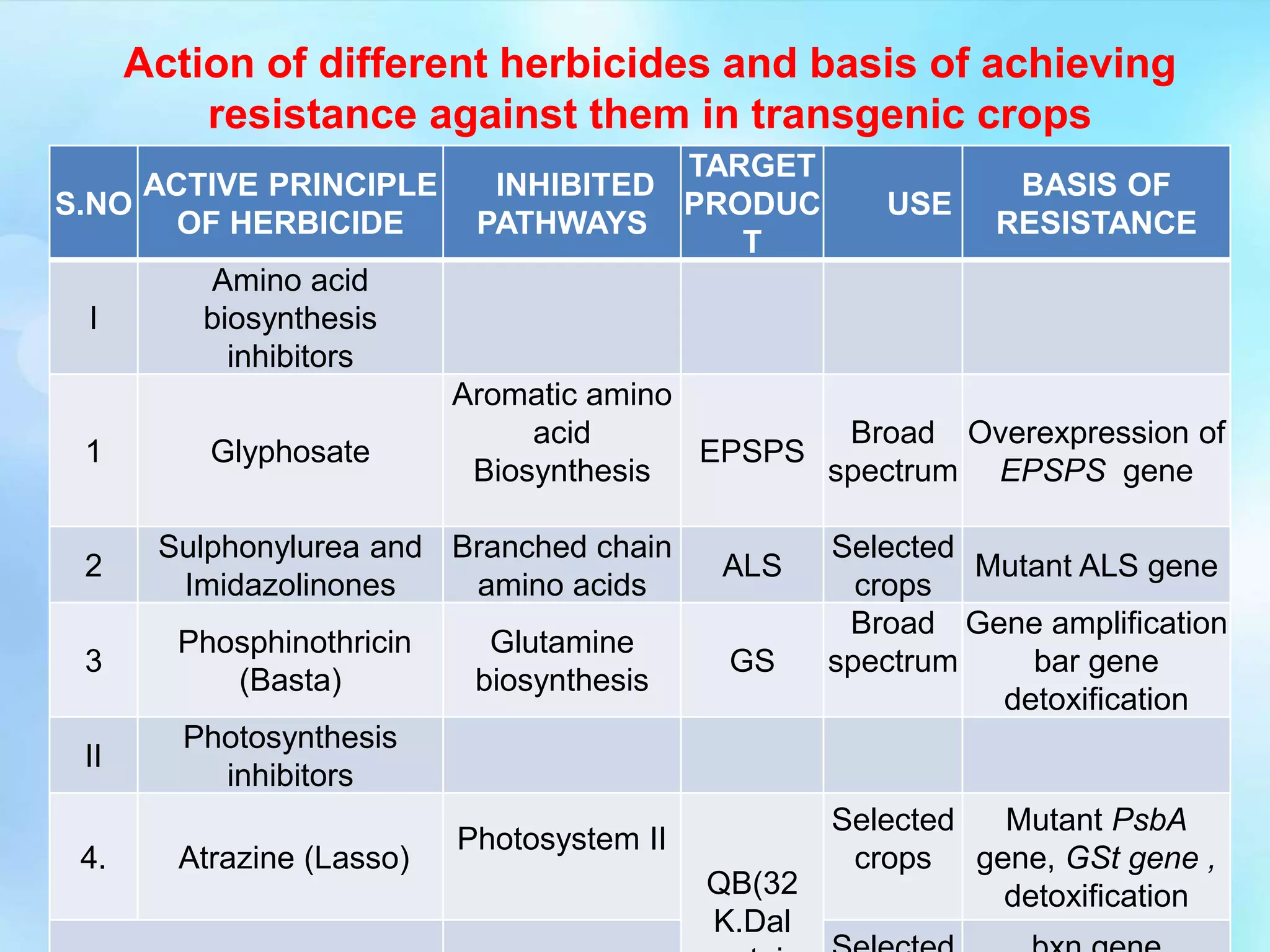
S.NO
ACTIVE PRINCIPLE
OF HERBICIDE
INHIBITED
PATHWAYS
TARGET
PRODUC
T
USE
BASIS OF
RESISTANCE
I
Amino acid
biosynthesis
inhibitors
1 Glyphosate
Aromatic amino
acid
Biosynthesis
EPSPS
Broad
spectrum
Overexpression of
EPSPS gene
2
Sulphonylurea and
Imidazolinones
Branched chain
amino acids
ALS
Selected
crops
Mutant ALS gene
3
Phosphinothricin
(Basta)
Glutamine
biosynthesis
GS
Broad
spectrum
Gene amplification
bar gene
detoxification
II
Photosynthesis
inhibitors
4. Atrazine (Lasso)
Photosystem II
QB(32
K.Dal
Selected
crops
Mutant PsbA
gene, GSt gene ,
detoxification
Action of different herbicides and basis of achieving
resistance against them in transgenic crops
GLYPHOSATE TOLERANCE
Glyphosate is a broad spectrum herbicide effective against 76
worlds worst weeds
It acts as a competitive inhibitor of enzyme EPSPS due to
similar strucrure between glyphosate and one of the substrate
of enzyme .
MODE OF ACTION OF GLYPHOSATE
CASE STUDY: Glyphosate tolerance : detoxification of heterologous
genes
•In soil micro organism ( ochromobactrum antropi) glyphosate is
degraded by cleavage of C-N bond
•Catalysed by oxidoreductase to form aminomethyl phosphonic acid
and glyoxylate.
•This gene encoding glyphosate oxidase is isolated and modified by
addition of transit peptide.
•Transgenic plants like rape shown good result in the field.
Insect Resistance (IR)
GM plant
Killed
European Corn Borer
Toxin is Present
European Corn Borer
(Insect)
In order to provide cost-effective solutions to pest problems crops such as corn,
cotton, potato have been successfully transformed through genetic engineering to
make a protein that kills certain insects when they feed on the plants.
ex : Genes for Bt toxins , gene for cowpea trypsin inhibitor.
DEVELOPMENT OF GM CORN
Improved nutritional value
Transgenics has allowed new options for improving the
nutritional value, flavor, and texture of foods.
Transgenic crops in development include soyabeans with higher
protein content, potatoes with more nutritionally available
starch content and beans with more essential amino acids.
Lysine rich canola and soyabean, golden rice and golden
musturd rich in vitamin A.
Crop Substance Benefit Protein or enyme encoded by transgene
Rice Provitamin A Anti-oxidant Phytoene synthase , Phytoene
desaturase,Lycopene cyclase
Canola Vitamin E Anti-oxidant ᵞ- tocopheral methyltransferase
Tomato Flavonoids Anti-oxidant Chalcone isomerase
Sugarbeet Fructans low calorie 1-Sucrose : Sucrose fructosyl transferase
Rice Iron
Iron
fortification
Ferritin, metallothionein, phytase
SOME TRANSGENIC PLANTS PRODUCED FOR FUNCTIONAL FOOD AND
NEUTRACEUTICALS
DEVELOPMENT OF GOLDEN RICE
Orange-fleshed sweet potato
RICH IN VITAMIN A
AmA1 gene from
Amaranthus
60% increase in protein and
essencial amino acids
DEVELOPED BY SCIENTISTS AT NIPGR
 Better flavor
Flavor can be altered by enhancing the activity of
plant enzymes that transform aroma precursors
into flavoring compounds. Transgenic peppers and
melons with improved flavor are currently in field
trials.
 Fresher produce
Genetic engineering can result in improved
keeping properties to make transport of fresh
produce easier, giving consumers access to
nutritionally valuable whole foods and preventing
decay, damage, and loss of nutrients.
Ex: flavr savr of tomato
TRANSGENIC
TOMATO
•Developed by shutting down the Lacrymatory factor syanase
gene
•This has done by scilencing the gene by rna interfearence
•By stopping sulphur compounds to convert into tearing agents
MORE CYANIDIN
LESS CYANIDIN
PETUNIA PANSY WISHBONE
Risks
• Their are potential long-term impacts. Some consumer-advocate and
environmental groups have demanded the abandonment of genetic
engineering research and development. which include some issues and
fears
Issues and fears
Health-related
issues Environmental
and ecological
issues
Social issues
Health-related issues
Allergens and toxins
• Tocicity is due to the changes which occur in the organism after
introduction of transgene.
• There are inactive pathwaya in organism due to introduction of
transgene they may reactivate thoose inactive pathways or increase in
the level of toxic genes.
• Toxic and allergic effects of some compounds
COMPOUN
D
ROLE IN PLANT
DEFENSE
TOXIC EFFECTS ALLERGENCI
TY
Lectins Fungus and insect
resistance
Weight loss and hyper
growth of intestine in
rats
Allergenic
Peotinase
inhibitors
insect resistance Pancreas enlargement Allergenic
Thionins Antifungal Toxic on intravenous
injetion
-
Alkaloids insect resistance toxic -
CASE STUDY
GM POTATO FEEDING EXPERIMENT ON RATS
• Dr. Pusztai fed the GM potato which was modified to express gene for snow drop
lectin (GNA )to rats using his new safety testing protocol, he got a shock.
• Nearly every system in the rats' bodies were adversely affected in just 10 days.
Their brains, livers, and testicles were smaller, while their pancreases and
intestines were enlarged.
GM potato created proliferative cell growth in the stomach and small and large intestines; the lining was
significantly their than controls.
CASE STUDY 2
Identification of a Brazil-Nut Allergen in Transgenic Soybeans
Methionine rich 2S storage albumin protein producing gene from the
brazil nut was incorporated into soyabean to enhance its sulphur
containing amino acids
brazil nut gene was found allergenic and raised biosafety conserns
Experiments confirmed that transgenic soyabean could trigger an
allergic response in those who were allergic to brazil nut.
Pioneer et al.,1996
Antibiotic resistance
• Antibiotic resistance genes are technique ensures that a gene
transfer during the course of genetic modification was
successful.
• Use of these markers has raised concerns that new antibiotic
resistant strains of bacteria will emerge.
• This issue have been raised during the approval of flavr savr
tomato and Bt corn 176.
Changes in nutrition levels
• This conserns about accidental change in nutrient components
of trangenic crop while incorporating other traits.
• Ex: Isoflavone levels in round up ready soyabean shown minor
difference compared to conventional varieties
RISK TO ENVIRONMENT
Gene flow or dispersal from transgenics :
Genetic traits are liable to spread beyond the cultivated variety in
which they are originally introduced.
Ex: Traditional or local varieties may contaminate with pollen of gm
crops with transfer of genes resulting in loss of traditional varieties.
Resistance or tolerance of target organism:
Insect resistant transgenic crop may offer resistace to use of
insecticide but as the seletive pressure of insect increases and starts
to feed on transgenic crop , they resist and development of resistance
occurs.
Ex: DBM to bt
Generation of super viruses
Concerns have been raised that GM virus resistant plants could
encorage virus to grow stronger and give rise to new and strong
varianta. This may be by two ways
1. Recombination
2. Transcapsidation
Effects on non-target organisms
Transgenics growing in particular ecosystem can cause direct or
indirect effect on certain microbes or insects in particular ecosystem.
Ex: Bt pollen effects Monarch Butterfly
CASE STUDY :
Losey et al. (1999) Reported that Monarch Butterfly feeding on
leaves of milk weed coated with pollen of bt Maize grew slowly and
mortality rate was high. This has raised concern on conservation of
Monarch Butterfly in US.
Ecological Concern
Increased weediness : Spread of plants beyond the fields where they
were planted.
Ex: Salt resistant gm crop become weed if it escapes into mariene
environment.
Development of super weeds
The transgenic crops pollen might cross pollinate with related
weeds, possibly resulting in “superweeds” that become more
difficult to control.
Due to development of herbicide resistant transgenic crop
resulted in use of same herbicide several times without rotation
.
Loss of biodiversity
• Many environmentalists and farmers, are very concerned about
the loss of biodiversity in our natural environment. Increased
adoption of GM crops resulting in loss of traditional nvarieties,
which led to extensive efforts to collect and store seeds of as
many varieties as possible of all major crops.
• However suseptability to any infection increases when single
variety is used in cropping system.
Social issues
Labeling
Some consumer groups argue that foods derived from
genetically engineered crops should carry a special label. In the
USA, these foods currently must be labeled only if they are
nutritionally different from a conventional food.
“Terminator” technology
Most farmers in the buy fresh seeds each season, particularly of
such crops as corn, green peppers, and tomatoes. Anyone
growing hybrid varieties must buy new seeds annually, because
seeds from last year’s hybrids grown on the farm will not
produce plants identical to the parent.
Act for Genetically modified Foods safety
• The Ministry of Health and Family Welfare (MoHFW) is
primarily responsible with ensuring the availability of food
that is safe.
• In 2006, the Food Standards and Safety Act, 2006 was
implemented by the Food Safety and Standards Authority and
includes genetically modified foods under the food category.
• The ICMR as the scientific advisory body of MoHFW, has
formulated the guidelines to establish the safety assessment of
foods derived from GE plants
Framework for safety assessment
• The safety assessment of foods derived from GE plants follows a
stepwise process aided by a series of questions.
• Factors taken into account in the safety assessment include
Identity
Source
Composition
Effects of processing/cooking
Transformation process
The recombinant DNA (e.g., stability of insertion, potential for gene
transfer)
Expression product of the novel DNA
General considerations while making GM food
1. Description of the non-transgenic host plant and its use as
food.
2. Description of the donor organisms
3. Description of the genetic modification
4. Characterization of the genetic modification
Safety assessment of GM food
1. Assessment of possible toxicity
2. Assessment of possible allergenicity
3. Biochemical analysis of protein produced after GM
4. Intended nutritional modifications
5. Unintended effects
Government
of India
Department
of
Biotechnolog
y
RDAC RCGM
Ministry of
Environment,
Forest and
Climate
Change
GEAC
Institutional
Biosafety
Committee
State
Biotechnology
Coordination
Committee
District level
Committee
Indian biosafety regulatory
framework
SOCIAL AND ECONOMIC
EFFECTS
• Even though scientists may come out with innovative
and novel techniques but by global perspective may
have wide social and economic ramifications.
• The development of genetic use restriction technology is
a prominent example.
• This is appropriate for private companies but farmers
who relay on farm seeds in developing countries it is a
bad thing.
• India banned GURT in past varieties for registration
under protection of plant varieties and farmer rights at
2001
• In developed countries they have policies.
• There will be increased inequality of income, wealth for
small farmers if transgenics are introduced as the big
farmers likely to capture most of the benefits through
early adoption of technology resulting expanded
production reduced costs.
• However Indian farmers had adopted biotech cotton
and got benefits.
• Companies at first were selling at higher price Indian
legal system intervained case was filed and companies
reduced price.
• We all well known that Mnc’s have the key technologies in
their hands and play dominant role in crop biotechnology.
• Large Mnc’s are purchasing smaller seed and
biotechnological companies.
• The fear is that the transgenic crops will prone to be
expensive for resource poor farmers due to monopolistic
behaviour.
• Public acceptance is the main hurdle in adoption of
biotechnology.
• In many countries people are cautious about transgenic
cultivars and their products.
• People arround the world accept medical biotechnology
easily than agricultural biotechnology.
• Regarding agricultural biotechnology public and scientific
community view differently.
• Scientific demonstrations of biosafety and reviews by
govt agencies play important role in public acceptance of
GM crops.
• Also depend on kind of information provided by media
debates on key rises.
• Irrespective of weather the developers are from the
public or private sector clear and understanble consumer
information is important part for public acceptance.
• Besides media, research organisations and scientific
Institutions concerned with crop improvement must
take responsibility in bringing awarenes in public
about application of genetic enginering in
agricultural benefits and risks.
56
4
Laboratory research
Growth chamber and green house
Application for Confined field trials
Confined field
trials
Application for environmental
release
Application for food safety
assessment
Event approval for cultivation and
food/ feed use
Variety/ hybrid release
Seed/plant
multiplication
Seed/plant marketing or
distribution
Cultivation
Process followed by the applicant for regulatory approval
References:
• P. K. Gupta., (2014)., Elements of Biotechnology.,
• Losey J.E., Rayor L.S., Carter M.E., (1999).,
Transgenic pollen harms monarch larvae.
399(6733):214.
• Behrokh Mohajer Maghari and Ali M. Ardekani.,
(2011)., Genetically Modified Foods and Social
Concerns., 3(3): 109-117.
Responsible biotechnology is not the enemy but starvation is
without adequate food supplies at affordable prices we
cannot expect world health and peace
THANK YOU

SIGNIFICANT PROGRESS IN CROP BIOTECHNOLOGY

  • 1.
    SIGNIFICANT PROGRESS INCROP BIOTECHNOLOGY PRESENTED BY N. RAMYA SRI RAD/17-12 DEPARTMENT OF ENTOMOLOGY
  • 2.
    CONTENTS • HISTORY OFCROP BIOTECHNOLOGY • BENEFITS AND RISKS OF GM CROPS • ENVIRONMENTAL IMPACT AND SAFETY • FOOD SAFETY AND NUTRITION OF GM CROPS • SOCIALAND ECONOIMIC EFFECTS • REGULATORY ISSUES
  • 3.
    Biotechnology involves themodification of the basic genetic material in the living subjects , which imparts new properties and capabilities in organism which can be harnesed for number of useful applications. As the Biotechnology allows for the manipulation, synthesis and eventual creation of genes. agricultural biotechnology are able to engineer the plants they desire down to the "roots.
  • 4.
    GLOBALAREA OF BIOTECHCROPS, THE FIRST 21 YEARS, 1996 TO 2016
  • 5.
    In 2016, globalarea of biotech crops was 185.1 million hectares,representing an increase of 3% from 2015, equivalent to 5.4 million hectares. 26 countries which have adopted biotech crops 3% Increase from 2015
  • 6.
    HISTORY 1983 First GMplant was created; a tobacco plant resistant to an antibiotic. 1985 GM plants resistant to viruses, bacteria, and insects were field tested. 1986 EPA approved the release of the first GM crop (herbicide resistant tobacco). 1990 First successful field trial of GM cotton (herbicide resistant). 1992 FDA decided that GM foods would be regulated as conventional foods. 1994 FlaverSavr Tomato became the first GM food to be approved for large scale. 1995 Herbicide resistant canola, corn. 2000 Cotton, soybeans, sugar beet as well as insect or viruses resitant corn , cotton, papaya, potato, squash, tomato approved in the U.S. 2001 Goldem rice Which may help prevent millions of cases of blindness and death caused by Vitamin A and iron deficiencies undergoes continued testing. 2002 Insect resistant cotton approved for commercial cultivation in India. 2004 Development of blue coloured rose 2005 Rice {Oryza sativa) genome sequenced
  • 7.
    2007 -Grape (Vitisvinifera) genome sequenced 2008 -Papaya {Carica papaya) genome sequenced 2008 -Insect resistant brinjal approved for large-scale seed multiplication 2009- sorghum genome sequenced 2013- unlocked the key to plant cell transformation using recombinant DNA. Their work led to the development of a host of genetically enhanced crops. 2014- Development of 480 varieties disease resistant wheat 2016- :Developed the biofortified orange-fleshed sweet potato at the CGIAR International Potato Center .
  • 9.
    ABIOTIC STRESS RESISTANT •Drought and soil salinity in particular are major causes in reducing crop productivity world wide (Boyer 1982) . • Consequently much efforts have been invested to isolate the gene involved in mechanisms of plant responces to theese stresses, which could be eventually used as biotechnological tool for improvement of stress tolerance in crop plants Wang e t al., (2003) . • Ex: Oxidative stress resistant superoxide dismutase (SOD) gene Is incorporated into potato and Tobacco plant genome from tomato plant.
  • 10.
    • In 2013Monsanto launched the transgenic drought tolerance trait in a line of corn hybrids called DroughtGard. The MON 87460 trait is provided by the insertion of the cspB gene from the soil microbe Bacillus subtilis.
  • 11.
    DISEASE RESISTANCE Biotechnology hashelped to increase crop productivity by introducing traits such as disease resistance, virus resistance into crops . Bacterial /fungal pathogen for which resistance has been transferred in crops Pathogen Disease Resistance gene Source of gene Transgenic crop Pseudomonas syringae Wild fire Acetyl transferase gene - tobacco Alternaria longipes Brown spot Chitinase grene Serratia marcescens Phytophthora infestans Late blight Osmotin gene potato potato tobacco
  • 12.
    Examples of transgenicdisease resistance projects PUBLICATI ON YEAR CROP DISEASE RESISTANCE MECHANISM DEVELOPMENT STATUS 2012 Tomat o Bacterial spot R gene from pepper 8 years of field trials 2012 Rice Bacterial blight and bacterial streak Engineered E gene Laboratory 2012 Wheat Powdery mildew Overexpressed R gene from wheat 2 years of field trials at time of publication 2011 Apple Apple scab fungus Thionin gene from barley 4 years of field trials at time of publication 2011 Potato Potato virus Y Pathogen- derived resistance 1 year of field trial at time of publication 2010 Apple Fire blight Antibacterial protein from moth 12 years of field trials at time of publication 2010 Tomat Multibacterial PRR Laboratory scale
  • 13.
    Comparison of bacterialspot disease severity among transgenic and disease resistant tomato genotypes. Horvath DM,, et al. (2012) Horsfall-Barratt defoliation scale (1 = 0%; 2 = 0–3%; 3 = 3–6%; 4 = 6–12%; 5 = 12–25%; 6 = 25–50%; 7 = 50–75%; 8 = 75–87%; 9 = 87–93%; 10 = 93–97%;11 = 97–100%; and 12 = 100% defoliation)
  • 14.
    Virus Resistance Virus resistancemakes plants less susceptible to diseases caused by such viruses, resulting in higher crop yields.  phenomenon of cross protection has been used in order to reduce infection caused by virus like TMV, Potato spindle tuber viroid, Citrus Tristeza virus. Example- Hawaiian Papaya- Hawaiian papaya is made resistant to the devastating effects of Papaya Ring Spot Virus (PRSV).
  • 15.
    RING SPOT VIRUSRESISTANT PAPAYA SUSCEPTIBLERESISTANT
  • 16.
    Genetic Engineered papaya, SunUp!That is resistant to the Papaya ringspot virus (PRSV) Homegrown papaya that is affected by the Papaya ringspot virus (PRSV)
  • 17.
    Herbicide Tolerance Over 63%of Gm crops grown globally have herbicide tolerance traits.  Researchers realized that if a crop plant is genetically engineered to be resistant to a broad-spectrum herbicide, weed management could be simplified and safer chemicals could be used GM crop GM Crop (Unaffected) Weed KilledWeed Herbicide Spray Result Of Herbicide Spray
  • 18.
    S.NO ACTIVE PRINCIPLE OF HERBICIDE INHIBITED PATHWAYS TARGET PRODUC T USE BASISOF RESISTANCE I Amino acid biosynthesis inhibitors 1 Glyphosate Aromatic amino acid Biosynthesis EPSPS Broad spectrum Overexpression of EPSPS gene 2 Sulphonylurea and Imidazolinones Branched chain amino acids ALS Selected crops Mutant ALS gene 3 Phosphinothricin (Basta) Glutamine biosynthesis GS Broad spectrum Gene amplification bar gene detoxification II Photosynthesis inhibitors 4. Atrazine (Lasso) Photosystem II QB(32 K.Dal Selected crops Mutant PsbA gene, GSt gene , detoxification Action of different herbicides and basis of achieving resistance against them in transgenic crops
  • 19.
    GLYPHOSATE TOLERANCE Glyphosate isa broad spectrum herbicide effective against 76 worlds worst weeds It acts as a competitive inhibitor of enzyme EPSPS due to similar strucrure between glyphosate and one of the substrate of enzyme . MODE OF ACTION OF GLYPHOSATE
  • 20.
    CASE STUDY: Glyphosatetolerance : detoxification of heterologous genes •In soil micro organism ( ochromobactrum antropi) glyphosate is degraded by cleavage of C-N bond •Catalysed by oxidoreductase to form aminomethyl phosphonic acid and glyoxylate. •This gene encoding glyphosate oxidase is isolated and modified by addition of transit peptide. •Transgenic plants like rape shown good result in the field.
  • 21.
    Insect Resistance (IR) GMplant Killed European Corn Borer Toxin is Present European Corn Borer (Insect) In order to provide cost-effective solutions to pest problems crops such as corn, cotton, potato have been successfully transformed through genetic engineering to make a protein that kills certain insects when they feed on the plants. ex : Genes for Bt toxins , gene for cowpea trypsin inhibitor.
  • 22.
  • 24.
    Improved nutritional value Transgenicshas allowed new options for improving the nutritional value, flavor, and texture of foods. Transgenic crops in development include soyabeans with higher protein content, potatoes with more nutritionally available starch content and beans with more essential amino acids. Lysine rich canola and soyabean, golden rice and golden musturd rich in vitamin A. Crop Substance Benefit Protein or enyme encoded by transgene Rice Provitamin A Anti-oxidant Phytoene synthase , Phytoene desaturase,Lycopene cyclase Canola Vitamin E Anti-oxidant ᵞ- tocopheral methyltransferase Tomato Flavonoids Anti-oxidant Chalcone isomerase Sugarbeet Fructans low calorie 1-Sucrose : Sucrose fructosyl transferase Rice Iron Iron fortification Ferritin, metallothionein, phytase SOME TRANSGENIC PLANTS PRODUCED FOR FUNCTIONAL FOOD AND NEUTRACEUTICALS
  • 25.
  • 27.
  • 29.
    AmA1 gene from Amaranthus 60%increase in protein and essencial amino acids DEVELOPED BY SCIENTISTS AT NIPGR
  • 30.
     Better flavor Flavorcan be altered by enhancing the activity of plant enzymes that transform aroma precursors into flavoring compounds. Transgenic peppers and melons with improved flavor are currently in field trials.  Fresher produce Genetic engineering can result in improved keeping properties to make transport of fresh produce easier, giving consumers access to nutritionally valuable whole foods and preventing decay, damage, and loss of nutrients. Ex: flavr savr of tomato
  • 31.
  • 32.
    •Developed by shuttingdown the Lacrymatory factor syanase gene •This has done by scilencing the gene by rna interfearence •By stopping sulphur compounds to convert into tearing agents
  • 33.
  • 35.
    Risks • Their arepotential long-term impacts. Some consumer-advocate and environmental groups have demanded the abandonment of genetic engineering research and development. which include some issues and fears Issues and fears Health-related issues Environmental and ecological issues Social issues
  • 36.
    Health-related issues Allergens andtoxins • Tocicity is due to the changes which occur in the organism after introduction of transgene. • There are inactive pathwaya in organism due to introduction of transgene they may reactivate thoose inactive pathways or increase in the level of toxic genes. • Toxic and allergic effects of some compounds COMPOUN D ROLE IN PLANT DEFENSE TOXIC EFFECTS ALLERGENCI TY Lectins Fungus and insect resistance Weight loss and hyper growth of intestine in rats Allergenic Peotinase inhibitors insect resistance Pancreas enlargement Allergenic Thionins Antifungal Toxic on intravenous injetion - Alkaloids insect resistance toxic -
  • 37.
    CASE STUDY GM POTATOFEEDING EXPERIMENT ON RATS • Dr. Pusztai fed the GM potato which was modified to express gene for snow drop lectin (GNA )to rats using his new safety testing protocol, he got a shock. • Nearly every system in the rats' bodies were adversely affected in just 10 days. Their brains, livers, and testicles were smaller, while their pancreases and intestines were enlarged. GM potato created proliferative cell growth in the stomach and small and large intestines; the lining was significantly their than controls.
  • 38.
    CASE STUDY 2 Identificationof a Brazil-Nut Allergen in Transgenic Soybeans Methionine rich 2S storage albumin protein producing gene from the brazil nut was incorporated into soyabean to enhance its sulphur containing amino acids brazil nut gene was found allergenic and raised biosafety conserns Experiments confirmed that transgenic soyabean could trigger an allergic response in those who were allergic to brazil nut. Pioneer et al.,1996
  • 39.
    Antibiotic resistance • Antibioticresistance genes are technique ensures that a gene transfer during the course of genetic modification was successful. • Use of these markers has raised concerns that new antibiotic resistant strains of bacteria will emerge. • This issue have been raised during the approval of flavr savr tomato and Bt corn 176. Changes in nutrition levels • This conserns about accidental change in nutrient components of trangenic crop while incorporating other traits. • Ex: Isoflavone levels in round up ready soyabean shown minor difference compared to conventional varieties
  • 40.
    RISK TO ENVIRONMENT Geneflow or dispersal from transgenics : Genetic traits are liable to spread beyond the cultivated variety in which they are originally introduced. Ex: Traditional or local varieties may contaminate with pollen of gm crops with transfer of genes resulting in loss of traditional varieties. Resistance or tolerance of target organism: Insect resistant transgenic crop may offer resistace to use of insecticide but as the seletive pressure of insect increases and starts to feed on transgenic crop , they resist and development of resistance occurs. Ex: DBM to bt Generation of super viruses Concerns have been raised that GM virus resistant plants could encorage virus to grow stronger and give rise to new and strong varianta. This may be by two ways 1. Recombination 2. Transcapsidation
  • 41.
    Effects on non-targetorganisms Transgenics growing in particular ecosystem can cause direct or indirect effect on certain microbes or insects in particular ecosystem. Ex: Bt pollen effects Monarch Butterfly CASE STUDY : Losey et al. (1999) Reported that Monarch Butterfly feeding on leaves of milk weed coated with pollen of bt Maize grew slowly and mortality rate was high. This has raised concern on conservation of Monarch Butterfly in US.
  • 43.
    Ecological Concern Increased weediness: Spread of plants beyond the fields where they were planted. Ex: Salt resistant gm crop become weed if it escapes into mariene environment. Development of super weeds The transgenic crops pollen might cross pollinate with related weeds, possibly resulting in “superweeds” that become more difficult to control. Due to development of herbicide resistant transgenic crop resulted in use of same herbicide several times without rotation .
  • 44.
    Loss of biodiversity •Many environmentalists and farmers, are very concerned about the loss of biodiversity in our natural environment. Increased adoption of GM crops resulting in loss of traditional nvarieties, which led to extensive efforts to collect and store seeds of as many varieties as possible of all major crops. • However suseptability to any infection increases when single variety is used in cropping system.
  • 45.
    Social issues Labeling Some consumergroups argue that foods derived from genetically engineered crops should carry a special label. In the USA, these foods currently must be labeled only if they are nutritionally different from a conventional food. “Terminator” technology Most farmers in the buy fresh seeds each season, particularly of such crops as corn, green peppers, and tomatoes. Anyone growing hybrid varieties must buy new seeds annually, because seeds from last year’s hybrids grown on the farm will not produce plants identical to the parent.
  • 46.
    Act for Geneticallymodified Foods safety • The Ministry of Health and Family Welfare (MoHFW) is primarily responsible with ensuring the availability of food that is safe. • In 2006, the Food Standards and Safety Act, 2006 was implemented by the Food Safety and Standards Authority and includes genetically modified foods under the food category. • The ICMR as the scientific advisory body of MoHFW, has formulated the guidelines to establish the safety assessment of foods derived from GE plants
  • 47.
    Framework for safetyassessment • The safety assessment of foods derived from GE plants follows a stepwise process aided by a series of questions. • Factors taken into account in the safety assessment include Identity Source Composition Effects of processing/cooking Transformation process The recombinant DNA (e.g., stability of insertion, potential for gene transfer) Expression product of the novel DNA
  • 48.
    General considerations whilemaking GM food 1. Description of the non-transgenic host plant and its use as food. 2. Description of the donor organisms 3. Description of the genetic modification 4. Characterization of the genetic modification
  • 49.
    Safety assessment ofGM food 1. Assessment of possible toxicity 2. Assessment of possible allergenicity 3. Biochemical analysis of protein produced after GM 4. Intended nutritional modifications 5. Unintended effects
  • 50.
    Government of India Department of Biotechnolog y RDAC RCGM Ministryof Environment, Forest and Climate Change GEAC Institutional Biosafety Committee State Biotechnology Coordination Committee District level Committee Indian biosafety regulatory framework
  • 51.
    SOCIAL AND ECONOMIC EFFECTS •Even though scientists may come out with innovative and novel techniques but by global perspective may have wide social and economic ramifications. • The development of genetic use restriction technology is a prominent example. • This is appropriate for private companies but farmers who relay on farm seeds in developing countries it is a bad thing. • India banned GURT in past varieties for registration under protection of plant varieties and farmer rights at 2001
  • 52.
    • In developedcountries they have policies. • There will be increased inequality of income, wealth for small farmers if transgenics are introduced as the big farmers likely to capture most of the benefits through early adoption of technology resulting expanded production reduced costs. • However Indian farmers had adopted biotech cotton and got benefits. • Companies at first were selling at higher price Indian legal system intervained case was filed and companies reduced price.
  • 53.
    • We allwell known that Mnc’s have the key technologies in their hands and play dominant role in crop biotechnology. • Large Mnc’s are purchasing smaller seed and biotechnological companies. • The fear is that the transgenic crops will prone to be expensive for resource poor farmers due to monopolistic behaviour. • Public acceptance is the main hurdle in adoption of biotechnology. • In many countries people are cautious about transgenic cultivars and their products.
  • 54.
    • People arroundthe world accept medical biotechnology easily than agricultural biotechnology. • Regarding agricultural biotechnology public and scientific community view differently. • Scientific demonstrations of biosafety and reviews by govt agencies play important role in public acceptance of GM crops. • Also depend on kind of information provided by media debates on key rises. • Irrespective of weather the developers are from the public or private sector clear and understanble consumer information is important part for public acceptance.
  • 55.
    • Besides media,research organisations and scientific Institutions concerned with crop improvement must take responsibility in bringing awarenes in public about application of genetic enginering in agricultural benefits and risks.
  • 56.
    56 4 Laboratory research Growth chamberand green house Application for Confined field trials Confined field trials Application for environmental release Application for food safety assessment Event approval for cultivation and food/ feed use Variety/ hybrid release Seed/plant multiplication Seed/plant marketing or distribution Cultivation Process followed by the applicant for regulatory approval
  • 57.
    References: • P. K.Gupta., (2014)., Elements of Biotechnology., • Losey J.E., Rayor L.S., Carter M.E., (1999)., Transgenic pollen harms monarch larvae. 399(6733):214. • Behrokh Mohajer Maghari and Ali M. Ardekani., (2011)., Genetically Modified Foods and Social Concerns., 3(3): 109-117.
  • 58.
    Responsible biotechnology isnot the enemy but starvation is without adequate food supplies at affordable prices we cannot expect world health and peace
  • 59.

Editor's Notes

  • #17 This slide shows the difference between a (genetic engineered papaya…) & a (homegrown papaya that is…)