CYBER TERRORISM
Guided By
Mr. Saurabh Jha Sir
Presented By
Shubhrat Mishra
OVERVIEW
•Introduction
•Terms
•Cyber-terrorists
•Why cyber-terrorism
•Forms of cyber-terrorism
•Impact
•Effects
•Examples
•Conclusion
INTRODUCTION
• Cyber terrorism is any act of
terrorism that uses information
systems or digital technology
(computers or computer
networks) as either an instrument
or a target.
• . Cyber terrorism can either be
"international", "domestic" or
"political", according to the nature
of the act.
TERMS
•Cyber terrorism – The use of
the Net for terrorism.
•Cyber crime – The use of the
Net for criminal actions.
•Cyber Attacks – Email
bombs, viruses, intentional
actions.
•Information Warfare –
Formalized governmental
warfare
•Techno Terrorism – Use of
CYBER-TERRORISTS
An individual that uses computernetwork
technology to control, dominate, or coerce
through the use of terror in furtherance of political
or social objectives.
Why do they
use
cyber attacks !!
Cyber terrorist prefer
using
the cyber attack methods
because of many
advantages for it .
• It is cheaper than traditional
methods .
• There are no physical barries or
check to cross .
• The action is very difficult to be
tracked
• They can hide their personalities
and location .
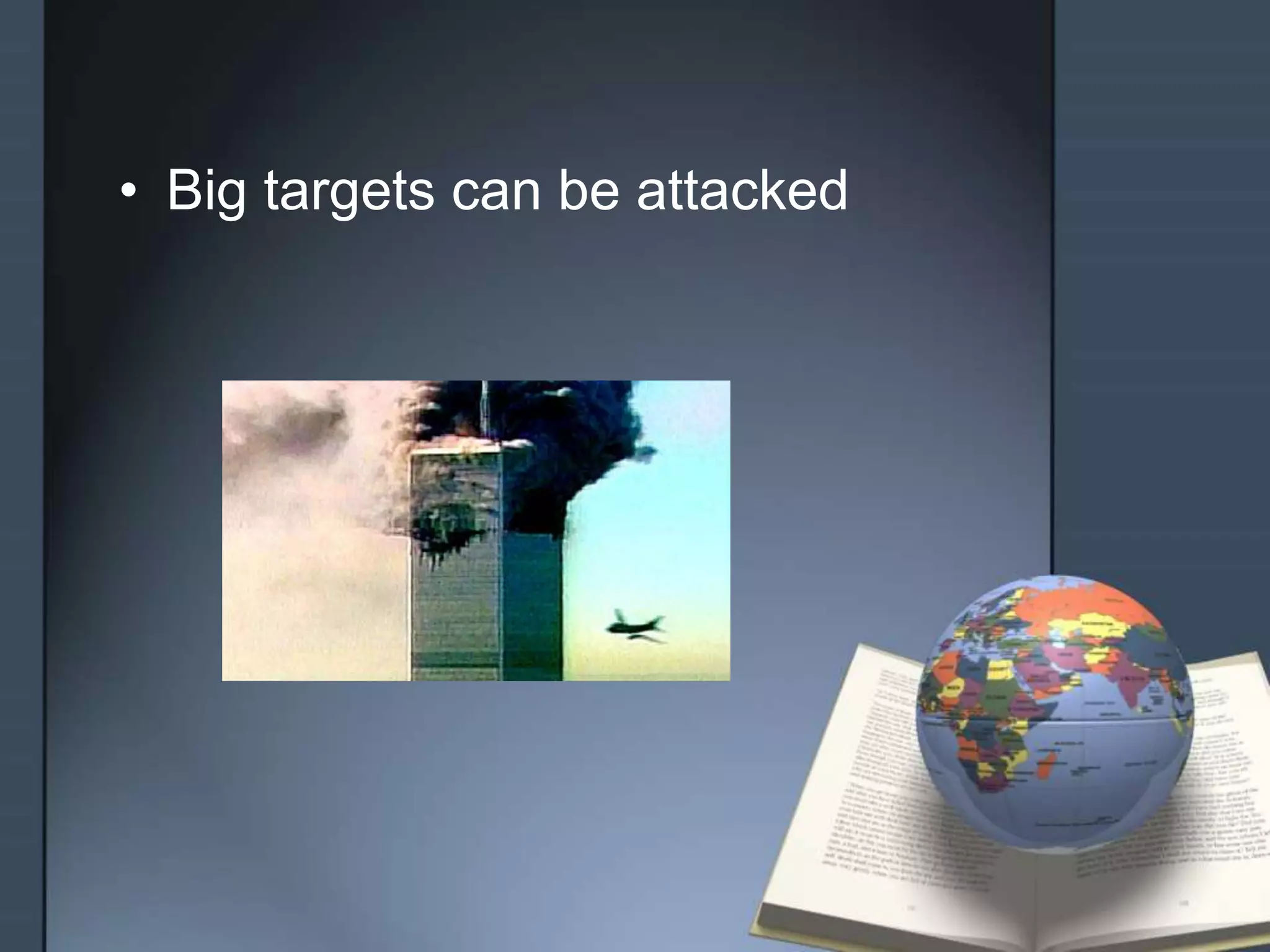
• Big targets can be attacked
Forms of Cyber terrorism
Privacy Violation
•The law of privacy is the recognition of the
individual's right to be let alone and to have his
personal space inviolate.
•Man has become sensitive to publicity.
Secret information appropriation and
data theft
•Information technology misuses the data
of private individuals
•A computer network owned by the
Government may contain valuable
information concerning defense and other
top secrets.
1) The cyber terrorists may also use the method
of distributed denial of services (DDOS) to
overburden the Government and its agencies
electronic bases.
2) This is made possible by first
infecting several unprotected
computers by way of virus attacks
and then taking control of them.
Distributed denial of Service Attack
This activity may divert the attention of the
security agencies for the time being thus
giving the terrorists extra time and makes
their task comparatively easier.
Network Damage and Disruption
What would the
Impact be!!
The intention of a cyber terrorism attack
could range from economic disruption
through the interruption of financial
networks and systems or used in support
of a physical attack to cause further
confusion and possible delays in proper
response
1.Direct Cost Implications.
2.Indirect Cost Implications.
Effects
•Cyber terrorism can have a
serious large-scale influence on
significant number of people.
•It can weaken countries'
economy greatly, thereby
stripping it of its resources and
making it more vulnerable to
military attack.
• The internet has provided a virtual war
for countries having problems with other
such.
• As taiwan aginaste China.
Israel against Palestine.
India against pakistan, China
Examples
•Terrorists in Romania gained access to
the computers controlling the life
support systems at an Antarctic
research station, endangering the 58
scientists involved.
•In 1998, ethnic Tamil guerrillas
swamped Sri Lankan embassies with
800 e-mails a day over a two-week
period. The messages read "We are
the Internet Black Tigers and we're
doing this to disrupt your
communications."
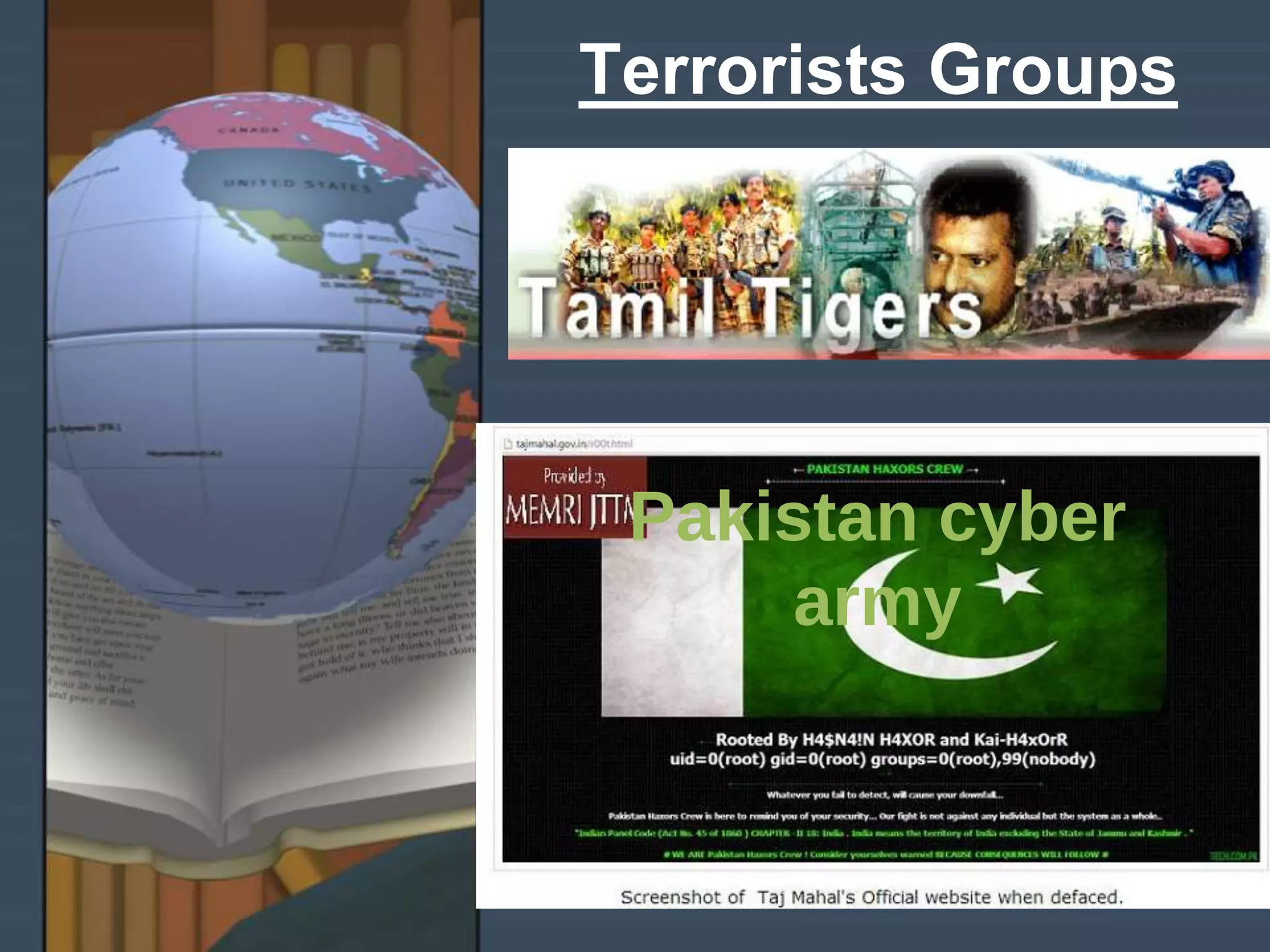
Terrorists Groups
Pakistan cyber
army
How can we protect
ourselves?
•All accounts should have
passwords and the passwords
should be unusual, difficult to
guess.
•Audit systems and check logs to
help in detecting and tracing an
intruder
•If you are ever unsure about the
safety of a site, or receive
suspicious email from an unknown
address, don't access it
CONCLUSION
• After a close look at some of the
facts, I have come to the these
conclusions. Some of my conclusions
point to the fact that Cyberterrorism
could be an actually threat. But the
other part is that there is too much
media hype created around the
possiblity of a Cyberterrorism.
References
• www.cyberlawindia.com
• www.seminarsonly.com
• www.cybercrimejournal.com
Shubhrat.presentationfor cybercrime.ppt

Shubhrat.presentationfor cybercrime.ppt

  • 1.
    CYBER TERRORISM Guided By Mr.Saurabh Jha Sir Presented By Shubhrat Mishra
  • 2.
    OVERVIEW •Introduction •Terms •Cyber-terrorists •Why cyber-terrorism •Forms ofcyber-terrorism •Impact •Effects •Examples •Conclusion
  • 3.
    INTRODUCTION • Cyber terrorismis any act of terrorism that uses information systems or digital technology (computers or computer networks) as either an instrument or a target. • . Cyber terrorism can either be "international", "domestic" or "political", according to the nature of the act.
  • 4.
    TERMS •Cyber terrorism –The use of the Net for terrorism. •Cyber crime – The use of the Net for criminal actions. •Cyber Attacks – Email bombs, viruses, intentional actions. •Information Warfare – Formalized governmental warfare •Techno Terrorism – Use of
  • 5.
    CYBER-TERRORISTS An individual thatuses computernetwork technology to control, dominate, or coerce through the use of terror in furtherance of political or social objectives.
  • 6.
  • 7.
    Cyber terrorist prefer using thecyber attack methods because of many advantages for it .
  • 8.
    • It ischeaper than traditional methods .
  • 9.
    • There areno physical barries or check to cross . • The action is very difficult to be tracked
  • 10.
    • They canhide their personalities and location .
  • 11.
    • Big targetscan be attacked
  • 12.
    Forms of Cyberterrorism Privacy Violation •The law of privacy is the recognition of the individual's right to be let alone and to have his personal space inviolate. •Man has become sensitive to publicity.
  • 13.
    Secret information appropriationand data theft •Information technology misuses the data of private individuals •A computer network owned by the Government may contain valuable information concerning defense and other top secrets.
  • 14.
    1) The cyberterrorists may also use the method of distributed denial of services (DDOS) to overburden the Government and its agencies electronic bases. 2) This is made possible by first infecting several unprotected computers by way of virus attacks and then taking control of them. Distributed denial of Service Attack
  • 15.
    This activity maydivert the attention of the security agencies for the time being thus giving the terrorists extra time and makes their task comparatively easier. Network Damage and Disruption
  • 16.
    What would the Impactbe!! The intention of a cyber terrorism attack could range from economic disruption through the interruption of financial networks and systems or used in support of a physical attack to cause further confusion and possible delays in proper response 1.Direct Cost Implications. 2.Indirect Cost Implications.
  • 17.
    Effects •Cyber terrorism canhave a serious large-scale influence on significant number of people. •It can weaken countries' economy greatly, thereby stripping it of its resources and making it more vulnerable to military attack.
  • 18.
    • The internethas provided a virtual war for countries having problems with other such. • As taiwan aginaste China. Israel against Palestine. India against pakistan, China
  • 19.
    Examples •Terrorists in Romaniagained access to the computers controlling the life support systems at an Antarctic research station, endangering the 58 scientists involved. •In 1998, ethnic Tamil guerrillas swamped Sri Lankan embassies with 800 e-mails a day over a two-week period. The messages read "We are the Internet Black Tigers and we're doing this to disrupt your communications."
  • 20.
  • 21.
    How can weprotect ourselves? •All accounts should have passwords and the passwords should be unusual, difficult to guess. •Audit systems and check logs to help in detecting and tracing an intruder •If you are ever unsure about the safety of a site, or receive suspicious email from an unknown address, don't access it
  • 22.
    CONCLUSION • After aclose look at some of the facts, I have come to the these conclusions. Some of my conclusions point to the fact that Cyberterrorism could be an actually threat. But the other part is that there is too much media hype created around the possiblity of a Cyberterrorism.
  • 23.