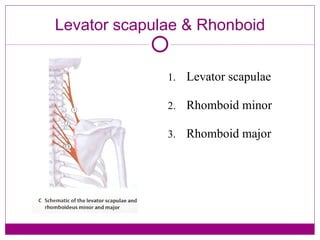
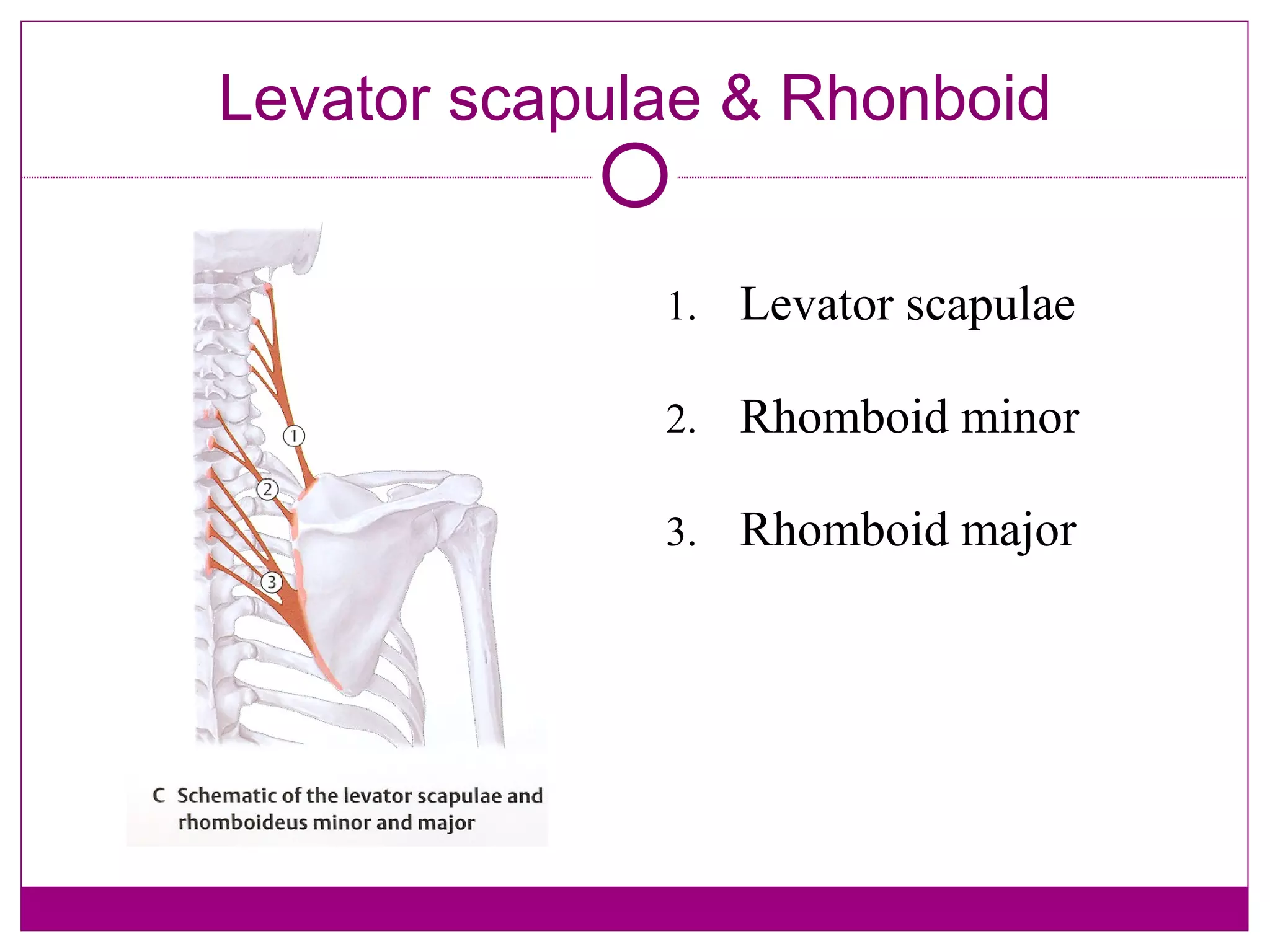
Levator scapulae & Rhonboid Levator scapulae Rhomboid minor Rhomboid major
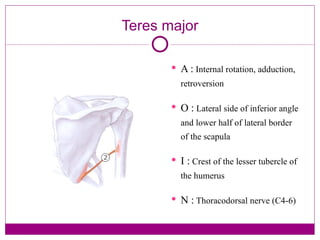
Teres major A :  Internal rotation, adduction, retroversion O :  Lateral side of inferior angle and lower half of lateral border of the scapula I :  Crest of the lesser tubercle of the humerus N :  Thoracodorsal nerve (C4-6)
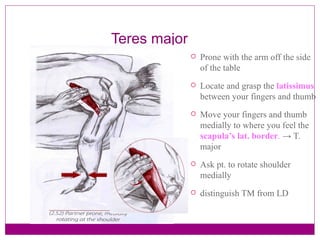
Teres major Prone with the arm off the side of the table Locate and grasp the  latissimus  between your fingers and thumb Move your fingers and thumb medially to where you feel the  scapula’s lat. border .  -> T. major Ask pt. to rotate shoulder medially  distinguish TM from LD
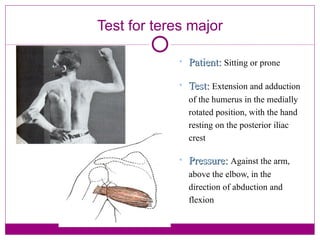
Test for teres major Patient:   Sitting or prone Test:   Extension and adduction of the humerus in the medially rotated position, with the hand resting on the posterior iliac crest Pressure:   Against the arm, above the elbow, in the direction of abduction and flexion
Rhomboid Action Adduct, elevate and downwardly rotate the scapula Origin Major  – SP of T2-T5  Minor  – SP of C7-T` Insertion Major  – Medial border of the scapula b/w spine of scapula and inferior angle Minor  – Upper portion of medial border of scapular Innervation Dorsal scapular nerve (C4-5)
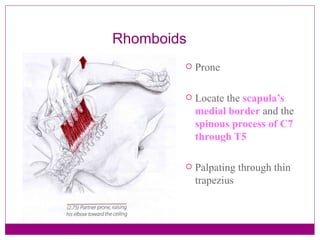
Rhomboids Prone Locate the  scapula’s medial border  and the  spinous process of C7 through T5 Palpating through thin trapezius
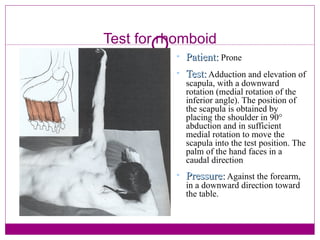
Test for rhomboid Patient:  Prone Test:  Adduction and elevation of scapula, with a downward rotation (medial rotation of the inferior angle). The position of the scapula is obtained by placing the shoulder in 90° abduction and in sufficient medial rotation to move the scapula into the test position. The palm of the hand faces in a caudal direction Pressure:  Against the forearm, in a downward direction toward the table.
Levator scapulae Action Unilaterally  – Elevate and downwardly rotate scapula, laterally flex the head and neck, rotate the head and neck to the same side Bilaterally  – Extend the head and neck  Origin TP of 1 st  through 4 th  cervical vertebrae Insertion Upper region of medial border and superior angle of scapula Innervation Dorsal scapula and cervical nerves
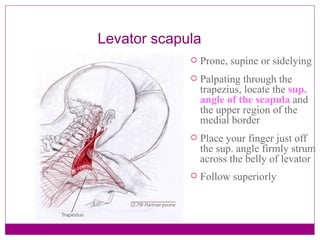
Levator scapula Prone, supine or sidelying Palpating through the trapezius, locate the  sup. angle of the scapula  and the upper region of the medial border Place your finger just off the sup. angle firmly strum across the belly of levator Follow superiorly
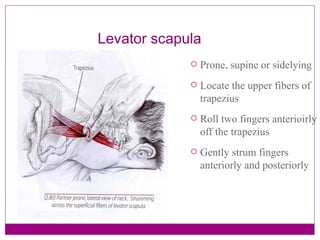
Levator scapula Prone, supine or sidelying Locate the upper fibers of trapezius Roll two fingers anterioirly off the trapezius Gently strum fingers anteriorly and posteriorly
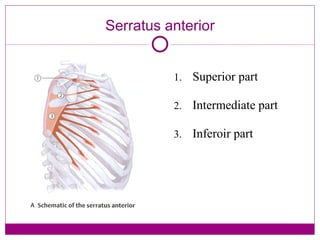
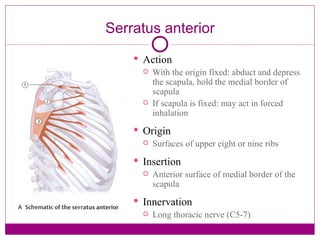
Serratus anterior Superior part Intermediate part Inferoir part
Serratus anterior Action With the origin fixed: abduct and depress the scapula, hold the medial border of scapula If scapula is fixed: may act in forced inhalation Origin Surfaces of upper eight or nine ribs Insertion Anterior surface of medial border of the scapula Innervation Long thoracic nerve (C5-7)
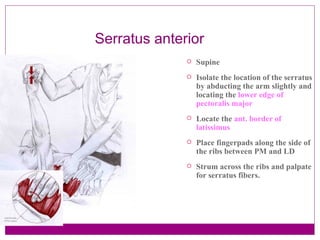
Serratus anterior Supine Isolate the location of the serratus by abducting the arm slightly and locating the  lower edge of pectoralis major Locate the  ant. border of latissimus Place fingerpads along the side of the ribs between PM and LD Strum across the ribs and palpate for serratus fibers.
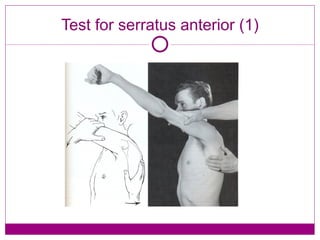
Test for serratus anterior (1)
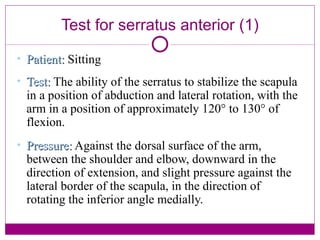
Test for serratus anterior (1) Patient:  Sitting Test:  The ability of the serratus to stabilize the scapula in a position of abduction and lateral rotation, with the arm in a position of approximately 120° to 130° of flexion.  Pressure:  Against the dorsal surface of the arm, between the shoulder and elbow, downward in the direction of extension, and slight pressure against the lateral border of the scapula, in the direction of rotating the inferior angle medially.
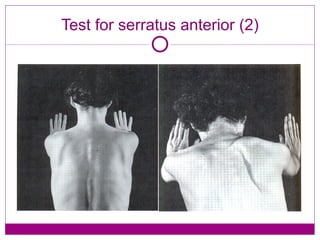
Test for serratus anterior (2)
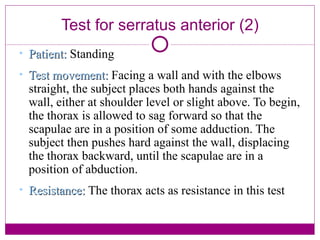
Test for serratus anterior (2) Patient:  Standing Test movement:  Facing a wall and with the elbows straight, the subject places both hands against the wall, either at shoulder level or slight above. To begin, the thorax is allowed to sag forward so that the scapulae are in a position of some adduction. The subject then pushes hard against the wall, displacing the thorax backward, until the scapulae are in a position of abduction. Resistance:  The thorax acts as resistance in this test

Shoulder & Arm 4

  • 1.
    Levator scapulae &Rhonboid Levator scapulae Rhomboid minor Rhomboid major
  • 2.
    Teres major A: Internal rotation, adduction, retroversion O : Lateral side of inferior angle and lower half of lateral border of the scapula I : Crest of the lesser tubercle of the humerus N : Thoracodorsal nerve (C4-6)
  • 3.
    Teres major Pronewith the arm off the side of the table Locate and grasp the latissimus between your fingers and thumb Move your fingers and thumb medially to where you feel the scapula’s lat. border . -> T. major Ask pt. to rotate shoulder medially distinguish TM from LD
  • 4.
    Test for teresmajor Patient: Sitting or prone Test: Extension and adduction of the humerus in the medially rotated position, with the hand resting on the posterior iliac crest Pressure: Against the arm, above the elbow, in the direction of abduction and flexion
  • 5.
    Rhomboid Action Adduct,elevate and downwardly rotate the scapula Origin Major – SP of T2-T5 Minor – SP of C7-T` Insertion Major – Medial border of the scapula b/w spine of scapula and inferior angle Minor – Upper portion of medial border of scapular Innervation Dorsal scapular nerve (C4-5)
  • 6.
    Rhomboids Prone Locatethe scapula’s medial border and the spinous process of C7 through T5 Palpating through thin trapezius
  • 7.
    Test for rhomboidPatient: Prone Test: Adduction and elevation of scapula, with a downward rotation (medial rotation of the inferior angle). The position of the scapula is obtained by placing the shoulder in 90° abduction and in sufficient medial rotation to move the scapula into the test position. The palm of the hand faces in a caudal direction Pressure: Against the forearm, in a downward direction toward the table.
  • 8.
    Levator scapulae ActionUnilaterally – Elevate and downwardly rotate scapula, laterally flex the head and neck, rotate the head and neck to the same side Bilaterally – Extend the head and neck Origin TP of 1 st through 4 th cervical vertebrae Insertion Upper region of medial border and superior angle of scapula Innervation Dorsal scapula and cervical nerves
  • 9.
    Levator scapula Prone,supine or sidelying Palpating through the trapezius, locate the sup. angle of the scapula and the upper region of the medial border Place your finger just off the sup. angle firmly strum across the belly of levator Follow superiorly
  • 10.
    Levator scapula Prone,supine or sidelying Locate the upper fibers of trapezius Roll two fingers anterioirly off the trapezius Gently strum fingers anteriorly and posteriorly
  • 11.
    Serratus anterior Superiorpart Intermediate part Inferoir part
  • 12.
    Serratus anterior ActionWith the origin fixed: abduct and depress the scapula, hold the medial border of scapula If scapula is fixed: may act in forced inhalation Origin Surfaces of upper eight or nine ribs Insertion Anterior surface of medial border of the scapula Innervation Long thoracic nerve (C5-7)
  • 13.
    Serratus anterior SupineIsolate the location of the serratus by abducting the arm slightly and locating the lower edge of pectoralis major Locate the ant. border of latissimus Place fingerpads along the side of the ribs between PM and LD Strum across the ribs and palpate for serratus fibers.
  • 14.
    Test for serratusanterior (1)
  • 15.
    Test for serratusanterior (1) Patient: Sitting Test: The ability of the serratus to stabilize the scapula in a position of abduction and lateral rotation, with the arm in a position of approximately 120° to 130° of flexion. Pressure: Against the dorsal surface of the arm, between the shoulder and elbow, downward in the direction of extension, and slight pressure against the lateral border of the scapula, in the direction of rotating the inferior angle medially.
  • 16.
    Test for serratusanterior (2)
  • 17.
    Test for serratusanterior (2) Patient: Standing Test movement: Facing a wall and with the elbows straight, the subject places both hands against the wall, either at shoulder level or slight above. To begin, the thorax is allowed to sag forward so that the scapulae are in a position of some adduction. The subject then pushes hard against the wall, displacing the thorax backward, until the scapulae are in a position of abduction. Resistance: The thorax acts as resistance in this test