The Shortest Path Problem Single source For all vertices Fundamental Knowledge
Artificial Intelligence
Shortest Path Problem
G. Guérard
Department of Nouvelles Energies
Ecole Supérieure d’Ingénieurs Léonard de Vinci
Lecture 3
GG | A.I. 1/42
The Shortest Path Problem Single source For all vertices Fundamental Knowledge
OutlineOutlineOutlineOutlineOutlineOutlineOutlineOutlineOutlineOutlineOutlineOutlineOutlineOutlineOutlineOutlineOutline
1 The Shortest Path Problem
Introduction
Dynamic Programming
2 Single source
Dijkstra’s Algorithm
DAG’s Algorithm
Bellman-Ford’s Algorithm
3 For all vertices
GG | A.I. 2/42
The Shortest Path Problem Single source For all vertices Fundamental Knowledge
OverviewOverviewOverviewOverviewOverviewOverviewOverviewOverviewOverviewOverviewOverviewOverviewOverviewOverviewOverviewOverviewOverview
Weighted Graphs
In a weighted graph, each edge has an associated numerical
value, called the weight of the edge. It may represent distances,
costs, etc.
Example
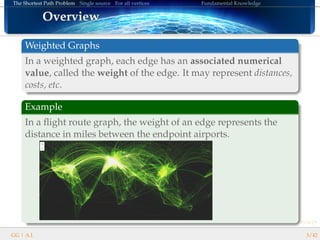
In a flight route graph, the weight of an edge represents the
distance in miles between the endpoint airports.
GG | A.I. 3/42
The Shortest Path Problem Single source For all vertices Fundamental Knowledge
ApplicationsApplicationsApplicationsApplicationsApplicationsApplicationsApplicationsApplicationsApplicationsApplicationsApplicationsApplicationsApplicationsApplicationsApplicationsApplicationsApplications
SHORTEST-PATHS is a broadly usefull problem-solving model:
Maps: traffic, traffic planning, traffic congestion pattern, robot
navigation
Telecommunication: routing, protocols, pipelining
Software: texture mapping, typesetting, subroutine
Finance: approximating piecewise linear functions, exploiting
arbitrage opportunities, scheduling.
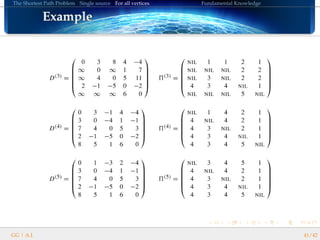
GG | A.I. 4/42
The Shortest Path Problem Single source For all vertices Fundamental Knowledge
ParadigmParadigmParadigmParadigmParadigmParadigmParadigmParadigmParadigmParadigmParadigmParadigmParadigmParadigmParadigmParadigmParadigm
Shortest path
Given a weighted graph and two vertices, we want to find a
path of minimum total weight. Length of a path is the sum of the
weights of its edges.
How can we solve this problem? Which paradigm is usefull?
1 BRUTE-FORCE: find all paths, pick the shortest.
2 NAIVE: build a spanning tree, find the unique path
between the two vertices (no optimality).
3 RECURSIVE: use graph search algorithm and store the
shortest path (no optimality).
4 DYNAMIC PROGRAMMING: we have to verify the conditions...
GG | A.I. 5/42
The Shortest Path Problem Single source For all vertices Fundamental Knowledge
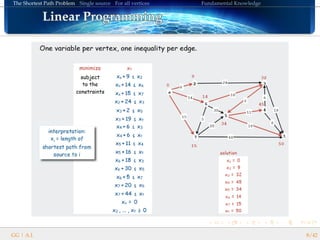
Linear ProgrammingLinear ProgrammingLinear ProgrammingLinear ProgrammingLinear ProgrammingLinear ProgrammingLinear ProgrammingLinear ProgrammingLinear ProgrammingLinear ProgrammingLinear ProgrammingLinear ProgrammingLinear ProgrammingLinear ProgrammingLinear ProgrammingLinear ProgrammingLinear Programming
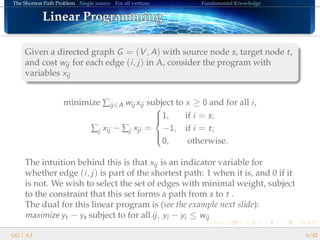
Given a directed graph G = (V , A) with source node s, target node t,
and cost wij for each edge (i, j) in A, consider the program with
variables xij
minimize ∑ij∈A wij xij subject to x ≥ 0 and for all i,
∑j xij − ∑j xji =



1, if i = s;
−1, if i = t;
0, otherwise.
The intuition behind this is that xij is an indicator variable for
whether edge (i, j) is part of the shortest path: 1 when it is, and 0 if it
is not. We wish to select the set of edges with minimal weight, subject
to the constraint that this set forms a path from s to t .
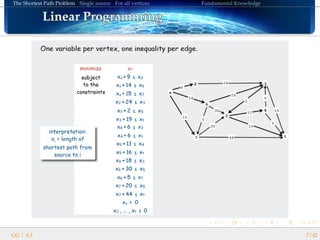
The dual for this linear program is (see the example next slide):
maximize yt − ys subject to for all ij, yi − yi ≤ wij
GG | A.I. 6/42
The Shortest Path Problem Single source For all vertices Fundamental Knowledge
Linear ProgrammingLinear ProgrammingLinear ProgrammingLinear ProgrammingLinear ProgrammingLinear ProgrammingLinear ProgrammingLinear ProgrammingLinear ProgrammingLinear ProgrammingLinear ProgrammingLinear ProgrammingLinear ProgrammingLinear ProgrammingLinear ProgrammingLinear ProgrammingLinear Programming
GG | A.I. 7/42
The Shortest Path Problem Single source For all vertices Fundamental Knowledge
Linear ProgrammingLinear ProgrammingLinear ProgrammingLinear ProgrammingLinear ProgrammingLinear ProgrammingLinear ProgrammingLinear ProgrammingLinear ProgrammingLinear ProgrammingLinear ProgrammingLinear ProgrammingLinear ProgrammingLinear ProgrammingLinear ProgrammingLinear ProgrammingLinear Programming
GG | A.I. 8/42
The Shortest Path Problem Single source For all vertices Fundamental Knowledge
Bellman’s Principle of OptimalityBellman’s Principle of OptimalityBellman’s Principle of OptimalityBellman’s Principle of OptimalityBellman’s Principle of OptimalityBellman’s Principle of OptimalityBellman’s Principle of OptimalityBellman’s Principle of OptimalityBellman’s Principle of OptimalityBellman’s Principle of OptimalityBellman’s Principle of OptimalityBellman’s Principle of OptimalityBellman’s Principle of OptimalityBellman’s Principle of OptimalityBellman’s Principle of OptimalityBellman’s Principle of OptimalityBellman’s Principle of Optimality
Principle of Optimality
An optimal policy has the property that whatever the initial state and initial
decision are, the remaining decisions must constitute an optimal policy with
regard to the state resulting from the first decision.
A problem that can be broken apart like this is said to have optimal
substructure.
Also known as a dynamic programming equation, it is a necessary
condition for optimality associated with the mathematical
optimization method known as dynamic programming. It writes the
value of a decision problem at a certain point in time in terms of the
payoff from some initial choices and the value of the remaining
decision problem that results from those initial choices. This breaks a
dynamic optimization problem into simpler subproblems.
GG | A.I. 9/42
The Shortest Path Problem Single source For all vertices Fundamental Knowledge
Bellman’s Principle of OptimalityBellman’s Principle of OptimalityBellman’s Principle of OptimalityBellman’s Principle of OptimalityBellman’s Principle of OptimalityBellman’s Principle of OptimalityBellman’s Principle of OptimalityBellman’s Principle of OptimalityBellman’s Principle of OptimalityBellman’s Principle of OptimalityBellman’s Principle of OptimalityBellman’s Principle of OptimalityBellman’s Principle of OptimalityBellman’s Principle of OptimalityBellman’s Principle of OptimalityBellman’s Principle of OptimalityBellman’s Principle of Optimality
Property 1
A SUBPATH OF A SHORTEST PATH IS ITSELF A SHORTEST PATH.
Let Ω∗(xi , xj ) be shortest path between xi ,xj ∈ V ² and xk ∈ Ω∗ a
point on the path.
Then, principle of optimality give that Ω(xi , xk ) and Ω(xk, xj )
are shortest sub-paths between xi ,xk and xk,xj .
Suppose there exits a shorter path Ω (xi , xk ). Thus,
Ω (xi , xj ) = Ω (xi , xk ) + Ω(xk, xj ) < Ω(xi , xk ) + Ω(xk, xj ).
Ω (xi , xj ) < Ω∗(xi , xj ) so there is a contradiction to t Ω∗(xi , xj )
being shortest path.
GG | A.I. 10/42
The Shortest Path Problem Single source For all vertices Fundamental Knowledge
Tree of shortest pathsTree of shortest pathsTree of shortest pathsTree of shortest pathsTree of shortest pathsTree of shortest pathsTree of shortest pathsTree of shortest pathsTree of shortest pathsTree of shortest pathsTree of shortest pathsTree of shortest pathsTree of shortest pathsTree of shortest pathsTree of shortest pathsTree of shortest pathsTree of shortest paths
Property 2
THERE IS A TREE OF SHORTEST PATHS FROM A START VERTEX
TO ALL THE OTHER VERTICES.
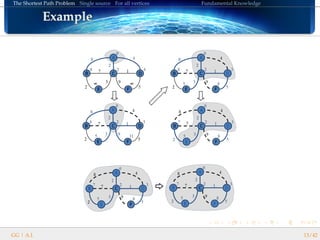
First Idea
Assume the graph is connected, edges are undirected and
weights are nonnegative. We grow a cloud of vertices,
beginning with s and eventually covering all the vertice. We
store with each vertex v a label d(v) representing the distance
of v from s in the subgraph consisting of the cloud and its
adjacent vertices. At each step: we add to the cloud the vertex u
outside the cloud with the smallest distance label; we update
the labels of the vertices adjacent to u (see spanning tree).
GG | A.I. 11/42
The Shortest Path Problem Single source For all vertices Fundamental Knowledge
Tree of shortest pathsTree of shortest pathsTree of shortest pathsTree of shortest pathsTree of shortest pathsTree of shortest pathsTree of shortest pathsTree of shortest pathsTree of shortest pathsTree of shortest pathsTree of shortest pathsTree of shortest pathsTree of shortest pathsTree of shortest pathsTree of shortest pathsTree of shortest pathsTree of shortest paths
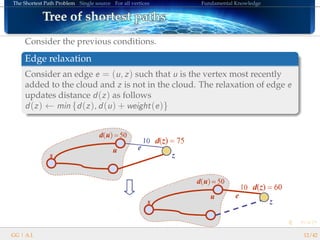
Consider the previous conditions.
Edge relaxation
Consider an edge e = (u, z) such that u is the vertex most recently
added to the cloud and z is not in the cloud. The relaxation of edge e
updates distance d(z) as follows
d(z) ← min {d(z), d(u) + weight(e)}
GG | A.I. 12/42
The Shortest Path Problem Single source For all vertices Fundamental Knowledge
ExampleExampleExampleExampleExampleExampleExampleExampleExampleExampleExampleExampleExampleExampleExampleExampleExample
GG | A.I. 13/42
The Shortest Path Problem Single source For all vertices Fundamental Knowledge
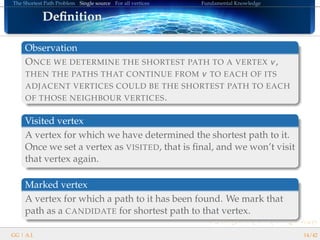
DefinitionDefinitionDefinitionDefinitionDefinitionDefinitionDefinitionDefinitionDefinitionDefinitionDefinitionDefinitionDefinitionDefinitionDefinitionDefinitionDefinition
Observation
ONCE WE DETERMINE THE SHORTEST PATH TO A VERTEX v,
THEN THE PATHS THAT CONTINUE FROM v TO EACH OF ITS
ADJACENT VERTICES COULD BE THE SHORTEST PATH TO EACH
OF THOSE NEIGHBOUR VERTICES.
Visited vertex
A vertex for which we have determined the shortest path to it.
Once we set a vertex as VISITED, that is final, and we won’t visit
that vertex again.
Marked vertex
A vertex for which a path to it has been found. We mark that
path as a CANDIDATE for shortest path to that vertex.
GG | A.I. 14/42
The Shortest Path Problem Single source For all vertices Fundamental Knowledge
AlgorithmAlgorithmAlgorithmAlgorithmAlgorithmAlgorithmAlgorithmAlgorithmAlgorithmAlgorithmAlgorithmAlgorithmAlgorithmAlgorithmAlgorithmAlgorithmAlgorithm
DIJKSTRA’s algorithm follows these steps:
Initialize: d(start) = 0, otherwise d(i) = ∞
At each iteration:
Select the unvisited vertex with smallest non-∞ distance, denoted
a. Set it as visited.
Mark each of the vertices b adjacent to a (its neighbours)
If a neighbour was not marked, set its distance to a’s distance plus
the weight of the edge going to that neighbour.
If it was marked, overwrite its distance if the result is smaller than
its current distance.
i.e. d[b] = min(d[b], d[a] + weight(a, b)).
Ends when we visit the target vertex or no more non-∞
distances.
GG | A.I. 15/42
The Shortest Path Problem Single source For all vertices Fundamental Knowledge
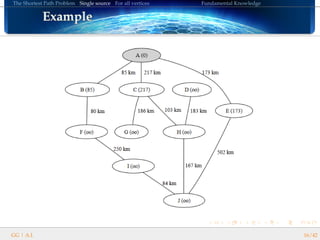
ExampleExampleExampleExampleExampleExampleExampleExampleExampleExampleExampleExampleExampleExampleExampleExampleExample
GG | A.I. 16/42
The Shortest Path Problem Single source For all vertices Fundamental Knowledge
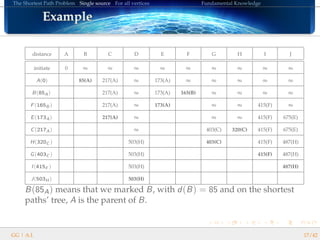
ExampleExampleExampleExampleExampleExampleExampleExampleExampleExampleExampleExampleExampleExampleExampleExampleExample
distance A B C D E F G H I J
initiate 0 ∞ ∞ ∞ ∞ ∞ ∞ ∞ ∞ ∞
A(0) 85(A) 217(A) ∞ 173(A) ∞ ∞ ∞ ∞ ∞
B(85A) 217(A) ∞ 173(A) 165(B) ∞ ∞ ∞ ∞
F(165B ) 217(A) ∞ 173(A) ∞ ∞ 415(F) ∞
E(173A) 217(A) ∞ ∞ ∞ 415(F) 675(E)
C(217A) ∞ 403(C) 320(C) 415(F) 675(E)
H(320C ) 503(H) 403(C) 415(F) 487(H)
G(403C ) 503(H) 415(F) 487(H)
I(415F ) 503(H) 487(H)
J(503H ) 503(H)
B(85A) means that we marked B, with d(B) = 85 and on the shortest
paths’ tree, A is the parent of B.
GG | A.I. 17/42
The Shortest Path Problem Single source For all vertices Fundamental Knowledge
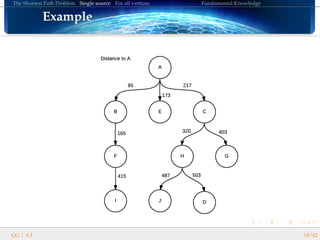
ExampleExampleExampleExampleExampleExampleExampleExampleExampleExampleExampleExampleExampleExampleExampleExampleExample
GG | A.I. 18/42
The Shortest Path Problem Single source For all vertices Fundamental Knowledge
ConditionsConditionsConditionsConditionsConditionsConditionsConditionsConditionsConditionsConditionsConditionsConditionsConditionsConditionsConditionsConditionsConditions
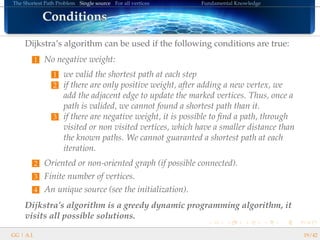
Dijkstra’s algorithm can be used if the following conditions are true:
1 No negative weight:
1 we valid the shortest path at each step
2 if there are only positive weight, after adding a new vertex, we
add the adjacent edge to update the marked vertices. Thus, once a
path is valided, we cannot found a shortest path than it.
3 if there are negative weight, it is possible to find a path, through
visited or non visited vertices, which have a smaller distance than
the known paths. We cannot guaranted a shortest path at each
iteration.
2 Oriented or non-oriented graph (if possible connected).
3 Finite number of vertices.
4 An unique source (see the initialization).
Dijkstra’s algorithm is a greedy dynamic programming algorithm, it
visits all possible solutions.
GG | A.I. 19/42
The Shortest Path Problem Single source For all vertices Fundamental Knowledge
DefinitionDefinitionDefinitionDefinitionDefinitionDefinitionDefinitionDefinitionDefinitionDefinitionDefinitionDefinitionDefinitionDefinitionDefinitionDefinitionDefinition
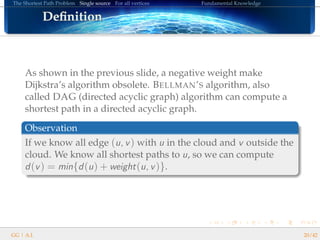
As shown in the previous slide, a negative weight make
Dijkstra’s algorithm obsolete. BELLMAN’S algorithm, also
called DAG (directed acyclic graph) algorithm can compute a
shortest path in a directed acyclic graph.
Observation
If we know all edge (u, v) with u in the cloud and v outside the
cloud. We know all shortest paths to u, so we can compute
d(v) = min{d(u) + weight(u, v)}.
GG | A.I. 20/42
The Shortest Path Problem Single source For all vertices Fundamental Knowledge
AlgorithmAlgorithmAlgorithmAlgorithmAlgorithmAlgorithmAlgorithmAlgorithmAlgorithmAlgorithmAlgorithmAlgorithmAlgorithmAlgorithmAlgorithmAlgorithmAlgorithm
BELLMAN’s algorithm follows these steps:
Initialize: d(start) = 0, otherwise d(i) = ∞
At each iteration:
Select the unvisited vertex which have all its predecessor visited.
Mark each of the vertices b adjacent to a (its neighbours)
If a neighbour was not marked, set its distance to a’s distance plus
the weight of the edge going to that neighbour.
If it was marked, overwrite its distance if the result is smaller than
its current distance.
i.e. d[b] = min(d[b], d[a] + weight(a, b)).
Ends when we visit the target vertex or no more valid vertices.
GG | A.I. 21/42
The Shortest Path Problem Single source For all vertices Fundamental Knowledge
ExampleExampleExampleExampleExampleExampleExampleExampleExampleExampleExampleExampleExampleExampleExampleExampleExample
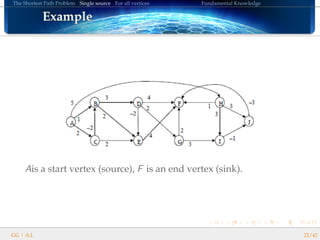
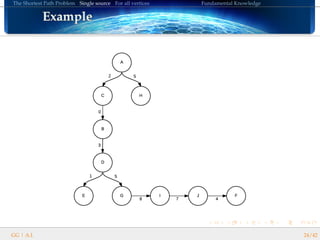
Ais a start vertex (source), F is an end vertex (sink).
GG | A.I. 22/42
The Shortest Path Problem Single source For all vertices Fundamental Knowledge
ExampleExampleExampleExampleExampleExampleExampleExampleExampleExampleExampleExampleExampleExampleExampleExampleExample
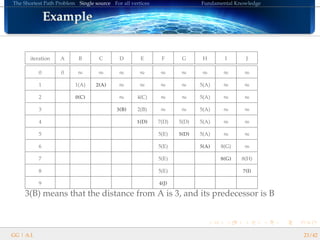
iteration A B C D E F G H I J
0 0 ∞ ∞ ∞ ∞ ∞ ∞ ∞ ∞ ∞
1 1(A) 2(A) ∞ ∞ ∞ ∞ 5(A) ∞ ∞
2 0(C) ∞ 4(C) ∞ ∞ 5(A) ∞ ∞
3 3(B) 2(B) ∞ ∞ 5(A) ∞ ∞
4 1(D) 7(D) 5(D) 5(A) ∞ ∞
5 5(E) 5(D) 5(A) ∞ ∞
6 5(E) 5(A) 8(G) ∞
7 5(E) 8(G) 8(H)
8 5(E) 7(I)
9 4(J)
3(B) means that the distance from A is 3, and its predecessor is B
GG | A.I. 23/42
The Shortest Path Problem Single source For all vertices Fundamental Knowledge
ExampleExampleExampleExampleExampleExampleExampleExampleExampleExampleExampleExampleExampleExampleExampleExampleExample
GG | A.I. 24/42
The Shortest Path Problem Single source For all vertices Fundamental Knowledge
ConditionsConditionsConditionsConditionsConditionsConditionsConditionsConditionsConditionsConditionsConditionsConditionsConditionsConditionsConditionsConditionsConditions
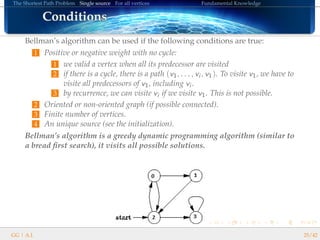
Bellman’s algorithm can be used if the following conditions are true:
1 Positive or negative weight with no cycle:
1 we valid a vertex when all its predecessor are visited
2 if there is a cycle, there is a path (v1, . . . , vi , v1). To visite v1, we have to
visite all predecessors of v1, including vi .
3 by recurrence, we can visite vi if we visite v1. This is not possible.
2 Oriented or non-oriented graph (if possible connected).
3 Finite number of vertices.
4 An unique source (see the initialization).
Bellman’s algorithm is a greedy dynamic programming algorithm (similar to
a bread first search), it visits all possible solutions.
GG | A.I. 25/42
The Shortest Path Problem Single source For all vertices Fundamental Knowledge
DefinitionDefinitionDefinitionDefinitionDefinitionDefinitionDefinitionDefinitionDefinitionDefinitionDefinitionDefinitionDefinitionDefinitionDefinitionDefinitionDefinition
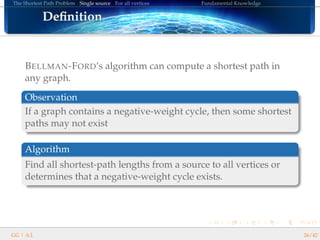
BELLMAN-FORD’s algorithm can compute a shortest path in
any graph.
Observation
If a graph contains a negative-weight cycle, then some shortest
paths may not exist
Algorithm
Find all shortest-path lengths from a source to all vertices or
determines that a negative-weight cycle exists.
GG | A.I. 26/42
The Shortest Path Problem Single source For all vertices Fundamental Knowledge
AlgorithmAlgorithmAlgorithmAlgorithmAlgorithmAlgorithmAlgorithmAlgorithmAlgorithmAlgorithmAlgorithmAlgorithmAlgorithmAlgorithmAlgorithmAlgorithmAlgorithm
BELLMAN-FORD’s algorithm follows these steps:
Initialize: d(start) = 0, otherwise d(i) = ∞
For i from 1 to |V | − 1 (the diameter of a graph is at most
|V | − 1)
d[b] = min(d[b], d[a] + weight(a, b)) for each edge (u, v) ∈ A
For each edge (u, v) ∈ A, if d[b] > d[a] + weight(a, b) then
report a negative-weight cycle.
GG | A.I. 27/42
The Shortest Path Problem Single source For all vertices Fundamental Knowledge
ExampleExampleExampleExampleExampleExampleExampleExampleExampleExampleExampleExampleExampleExampleExampleExampleExample
GG | A.I. 28/42
The Shortest Path Problem Single source For all vertices Fundamental Knowledge
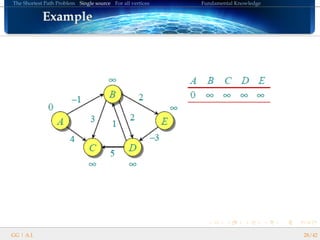
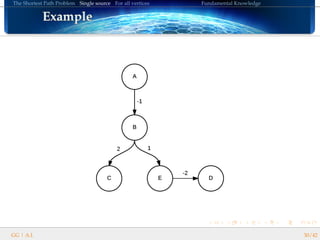
ExampleExampleExampleExampleExampleExampleExampleExampleExampleExampleExampleExampleExampleExampleExampleExampleExample
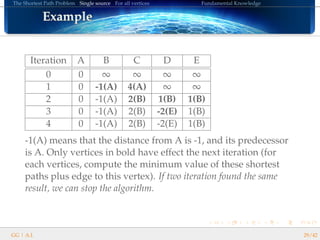
Iteration A B C D E
0 0 ∞ ∞ ∞ ∞
1 0 -1(A) 4(A) ∞ ∞
2 0 -1(A) 2(B) 1(B) 1(B)
3 0 -1(A) 2(B) -2(E) 1(B)
4 0 -1(A) 2(B) -2(E) 1(B)
-1(A) means that the distance from A is -1, and its predecessor
is A. Only vertices in bold have effect the next iteration (for
each vertices, compute the minimum value of these shortest
paths plus edge to this vertex). If two iteration found the same
result, we can stop the algorithm.
GG | A.I. 29/42
The Shortest Path Problem Single source For all vertices Fundamental Knowledge
ExampleExampleExampleExampleExampleExampleExampleExampleExampleExampleExampleExampleExampleExampleExampleExampleExample
GG | A.I. 30/42
The Shortest Path Problem Single source For all vertices Fundamental Knowledge
ConditionsConditionsConditionsConditionsConditionsConditionsConditionsConditionsConditionsConditionsConditionsConditionsConditionsConditionsConditionsConditionsConditions
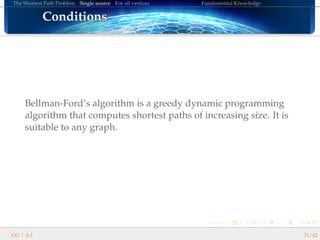
Bellman-Ford’s algorithm is a greedy dynamic programming
algorithm that computes shortest paths of increasing size. It is
suitable to any graph.
GG | A.I. 31/42
The Shortest Path Problem Single source For all vertices Fundamental Knowledge
Transitive closureTransitive closureTransitive closureTransitive closureTransitive closureTransitive closureTransitive closureTransitive closureTransitive closureTransitive closureTransitive closureTransitive closureTransitive closureTransitive closureTransitive closureTransitive closureTransitive closure
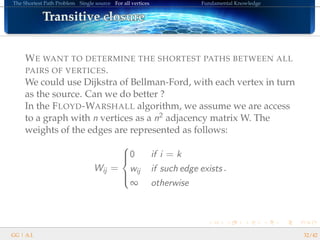
WE WANT TO DETERMINE THE SHORTEST PATHS BETWEEN ALL
PAIRS OF VERTICES.
We could use Dijkstra of Bellman-Ford, with each vertex in turn
as the source. Can we do better ?
In the FLOYD-WARSHALL algorithm, we assume we are access
to a graph with n vertices as a n2 adjacency matrix W. The
weights of the edges are represented as follows:
Wij =



0 if i = k
wij if such edge exists
∞ otherwise
.
GG | A.I. 32/42
The Shortest Path Problem Single source For all vertices Fundamental Knowledge
Transitive closureTransitive closureTransitive closureTransitive closureTransitive closureTransitive closureTransitive closureTransitive closureTransitive closureTransitive closureTransitive closureTransitive closureTransitive closureTransitive closureTransitive closureTransitive closureTransitive closure
Optimal substructure
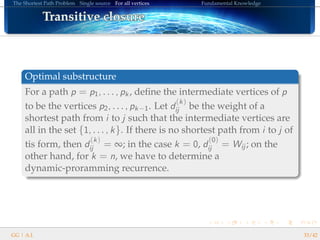
For a path p = p1, . . . , pk, define the intermediate vertices of p
to be the vertices p2, . . . , pk−1. Let d
(k)
ij be the weight of a
shortest path from i to j such that the intermediate vertices are
all in the set {1, . . . , k}. If there is no shortest path from i to j of
tis form, then d
(k)
ij = ∞; in the case k = 0, d
(0)
ij = Wij ; on the
other hand, for k = n, we have to determine a
dynamic-proramming recurrence.
GG | A.I. 33/42
The Shortest Path Problem Single source For all vertices Fundamental Knowledge
Transitive closureTransitive closureTransitive closureTransitive closureTransitive closureTransitive closureTransitive closureTransitive closureTransitive closureTransitive closureTransitive closureTransitive closureTransitive closureTransitive closureTransitive closureTransitive closureTransitive closure
Let p be a shortest path from i to j with all intermediate vertices
in the set {1, . . . , k}.
Observation
If k is not an intermediate vertex of p, then p is also a shortest
path with all intermediate vertices in the set {1, . . . , k − 1}. If k
is an intermediate vertex of p, then we decompose p into a path
p1 between i and k, and a path p2 between k and j; they are
shortest paths.
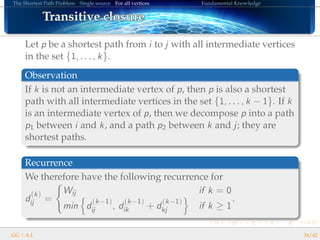
Recurrence
We therefore have the following recurrence for
d
(k)
ij =
Wij if k = 0
min d
(k−1)
ij , d
(k−1)
ik + d
(k−1)
kj if k ≥ 1
.
GG | A.I. 34/42
The Shortest Path Problem Single source For all vertices Fundamental Knowledge
AlgorithmAlgorithmAlgorithmAlgorithmAlgorithmAlgorithmAlgorithmAlgorithmAlgorithmAlgorithmAlgorithmAlgorithmAlgorithmAlgorithmAlgorithmAlgorithmAlgorithm
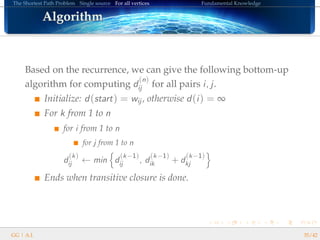
Based on the recurrence, we can give the following bottom-up
algorithm for computing d
(n)
ij for all pairs i, j.
Initialize: d(start) = wij , otherwise d(i) = ∞
For k from 1 to n
for i from 1 to n
for j from 1 to n
d
(k)
ij ← min d
(k−1)
ij , d
(k−1)
ik + d
(k−1)
kj
Ends when transitive closure is done.
GG | A.I. 35/42
The Shortest Path Problem Single source For all vertices Fundamental Knowledge
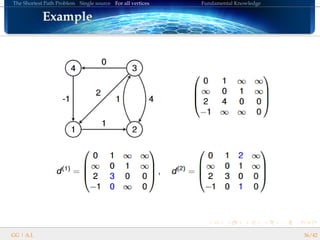
ExampleExampleExampleExampleExampleExampleExampleExampleExampleExampleExampleExampleExampleExampleExampleExampleExample
GG | A.I. 36/42
The Shortest Path Problem Single source For all vertices Fundamental Knowledge
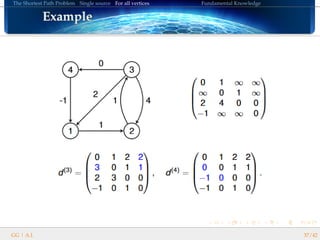
ExampleExampleExampleExampleExampleExampleExampleExampleExampleExampleExampleExampleExampleExampleExampleExampleExample
GG | A.I. 37/42
The Shortest Path Problem Single source For all vertices Fundamental Knowledge
Predecessor matrixPredecessor matrixPredecessor matrixPredecessor matrixPredecessor matrixPredecessor matrixPredecessor matrixPredecessor matrixPredecessor matrixPredecessor matrixPredecessor matrixPredecessor matrixPredecessor matrixPredecessor matrixPredecessor matrixPredecessor matrixPredecessor matrix
We know the values of shortest paths, how to determine the
tree?
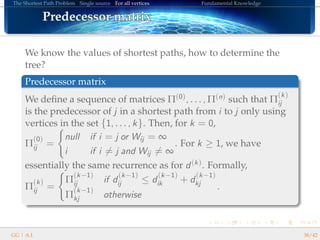
Predecessor matrix
We define a sequence of matrices Π(0), . . . , Π(n) such that Π
(k)
ij
is the predecessor of j in a shortest path from i to j only using
vertices in the set {1, . . . , k}. Then, for k = 0,
Π
(0)
ij =
null if i = j or Wij = ∞
i if i = j and Wij = ∞
. For k ≥ 1, we have
essentially the same recurrence as for d(k). Formally,
Π
(k)
ij =
Π
(k−1)
ij if d
(k−1)
ij ≤ d
(k−1)
ik + d
(k−1)
kj
Π
(k−1)
kj otherwise
.
GG | A.I. 38/42
The Shortest Path Problem Single source For all vertices Fundamental Knowledge
AlgorithmAlgorithmAlgorithmAlgorithmAlgorithmAlgorithmAlgorithmAlgorithmAlgorithmAlgorithmAlgorithmAlgorithmAlgorithmAlgorithmAlgorithmAlgorithmAlgorithm
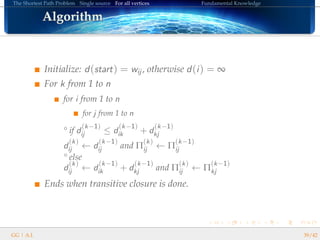
Initialize: d(start) = wij , otherwise d(i) = ∞
For k from 1 to n
for i from 1 to n
for j from 1 to n
° if d
(k−1)
ij ≤ d
(k−1)
ik + d
(k−1)
kj
d
(k)
ij ← d
(k−1)
ij and Π
(k)
ij ← Π
(k−1)
ij
° else
d
(k)
ij ← d
(k−1)
ik + d
(k−1)
kj and Π
(k)
ij ← Π
(k−1)
kj
Ends when transitive closure is done.
GG | A.I. 39/42
The Shortest Path Problem Single source For all vertices Fundamental Knowledge
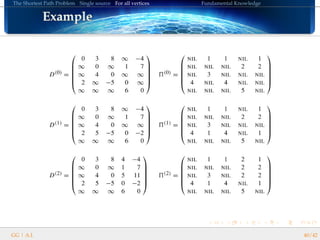
ExampleExampleExampleExampleExampleExampleExampleExampleExampleExampleExampleExampleExampleExampleExampleExampleExample
GG | A.I. 40/42
The Shortest Path Problem Single source For all vertices Fundamental Knowledge
ExampleExampleExampleExampleExampleExampleExampleExampleExampleExampleExampleExampleExampleExampleExampleExampleExample
GG | A.I. 41/42
The Shortest Path Problem Single source For all vertices Fundamental Knowledge
Fundamental knowledgeFundamental knowledgeFundamental knowledgeFundamental knowledgeFundamental knowledgeFundamental knowledgeFundamental knowledgeFundamental knowledgeFundamental knowledgeFundamental knowledgeFundamental knowledgeFundamental knowledgeFundamental knowledgeFundamental knowledgeFundamental knowledgeFundamental knowledgeFundamental knowledge
YOU HAVE TO KNOW BEFORE THE TUTORIAL:
1 Shortest path problem
2 Dynamic programming approach
3 Dijkstra’s algorithm
4 Ford-Bellman’s algorithm.
5 Know all the recurrence functions!
GG | A.I. 42/42

Shortest Path Problem

  • 1.
    The Shortest PathProblem Single source For all vertices Fundamental Knowledge Artificial Intelligence Shortest Path Problem G. Guérard Department of Nouvelles Energies Ecole Supérieure d’Ingénieurs Léonard de Vinci Lecture 3 GG | A.I. 1/42
  • 2.
    The Shortest PathProblem Single source For all vertices Fundamental Knowledge OutlineOutlineOutlineOutlineOutlineOutlineOutlineOutlineOutlineOutlineOutlineOutlineOutlineOutlineOutlineOutlineOutline 1 The Shortest Path Problem Introduction Dynamic Programming 2 Single source Dijkstra’s Algorithm DAG’s Algorithm Bellman-Ford’s Algorithm 3 For all vertices GG | A.I. 2/42
  • 3.
    The Shortest PathProblem Single source For all vertices Fundamental Knowledge OverviewOverviewOverviewOverviewOverviewOverviewOverviewOverviewOverviewOverviewOverviewOverviewOverviewOverviewOverviewOverviewOverview Weighted Graphs In a weighted graph, each edge has an associated numerical value, called the weight of the edge. It may represent distances, costs, etc. Example In a flight route graph, the weight of an edge represents the distance in miles between the endpoint airports. GG | A.I. 3/42
  • 4.
    The Shortest PathProblem Single source For all vertices Fundamental Knowledge ApplicationsApplicationsApplicationsApplicationsApplicationsApplicationsApplicationsApplicationsApplicationsApplicationsApplicationsApplicationsApplicationsApplicationsApplicationsApplicationsApplications SHORTEST-PATHS is a broadly usefull problem-solving model: Maps: traffic, traffic planning, traffic congestion pattern, robot navigation Telecommunication: routing, protocols, pipelining Software: texture mapping, typesetting, subroutine Finance: approximating piecewise linear functions, exploiting arbitrage opportunities, scheduling. GG | A.I. 4/42
  • 5.
    The Shortest PathProblem Single source For all vertices Fundamental Knowledge ParadigmParadigmParadigmParadigmParadigmParadigmParadigmParadigmParadigmParadigmParadigmParadigmParadigmParadigmParadigmParadigmParadigm Shortest path Given a weighted graph and two vertices, we want to find a path of minimum total weight. Length of a path is the sum of the weights of its edges. How can we solve this problem? Which paradigm is usefull? 1 BRUTE-FORCE: find all paths, pick the shortest. 2 NAIVE: build a spanning tree, find the unique path between the two vertices (no optimality). 3 RECURSIVE: use graph search algorithm and store the shortest path (no optimality). 4 DYNAMIC PROGRAMMING: we have to verify the conditions... GG | A.I. 5/42
  • 6.
    The Shortest PathProblem Single source For all vertices Fundamental Knowledge Linear ProgrammingLinear ProgrammingLinear ProgrammingLinear ProgrammingLinear ProgrammingLinear ProgrammingLinear ProgrammingLinear ProgrammingLinear ProgrammingLinear ProgrammingLinear ProgrammingLinear ProgrammingLinear ProgrammingLinear ProgrammingLinear ProgrammingLinear ProgrammingLinear Programming Given a directed graph G = (V , A) with source node s, target node t, and cost wij for each edge (i, j) in A, consider the program with variables xij minimize ∑ij∈A wij xij subject to x ≥ 0 and for all i, ∑j xij − ∑j xji =    1, if i = s; −1, if i = t; 0, otherwise. The intuition behind this is that xij is an indicator variable for whether edge (i, j) is part of the shortest path: 1 when it is, and 0 if it is not. We wish to select the set of edges with minimal weight, subject to the constraint that this set forms a path from s to t . The dual for this linear program is (see the example next slide): maximize yt − ys subject to for all ij, yi − yi ≤ wij GG | A.I. 6/42
  • 7.
    The Shortest PathProblem Single source For all vertices Fundamental Knowledge Linear ProgrammingLinear ProgrammingLinear ProgrammingLinear ProgrammingLinear ProgrammingLinear ProgrammingLinear ProgrammingLinear ProgrammingLinear ProgrammingLinear ProgrammingLinear ProgrammingLinear ProgrammingLinear ProgrammingLinear ProgrammingLinear ProgrammingLinear ProgrammingLinear Programming GG | A.I. 7/42
  • 8.
    The Shortest PathProblem Single source For all vertices Fundamental Knowledge Linear ProgrammingLinear ProgrammingLinear ProgrammingLinear ProgrammingLinear ProgrammingLinear ProgrammingLinear ProgrammingLinear ProgrammingLinear ProgrammingLinear ProgrammingLinear ProgrammingLinear ProgrammingLinear ProgrammingLinear ProgrammingLinear ProgrammingLinear ProgrammingLinear Programming GG | A.I. 8/42
  • 9.
    The Shortest PathProblem Single source For all vertices Fundamental Knowledge Bellman’s Principle of OptimalityBellman’s Principle of OptimalityBellman’s Principle of OptimalityBellman’s Principle of OptimalityBellman’s Principle of OptimalityBellman’s Principle of OptimalityBellman’s Principle of OptimalityBellman’s Principle of OptimalityBellman’s Principle of OptimalityBellman’s Principle of OptimalityBellman’s Principle of OptimalityBellman’s Principle of OptimalityBellman’s Principle of OptimalityBellman’s Principle of OptimalityBellman’s Principle of OptimalityBellman’s Principle of OptimalityBellman’s Principle of Optimality Principle of Optimality An optimal policy has the property that whatever the initial state and initial decision are, the remaining decisions must constitute an optimal policy with regard to the state resulting from the first decision. A problem that can be broken apart like this is said to have optimal substructure. Also known as a dynamic programming equation, it is a necessary condition for optimality associated with the mathematical optimization method known as dynamic programming. It writes the value of a decision problem at a certain point in time in terms of the payoff from some initial choices and the value of the remaining decision problem that results from those initial choices. This breaks a dynamic optimization problem into simpler subproblems. GG | A.I. 9/42
  • 10.
    The Shortest PathProblem Single source For all vertices Fundamental Knowledge Bellman’s Principle of OptimalityBellman’s Principle of OptimalityBellman’s Principle of OptimalityBellman’s Principle of OptimalityBellman’s Principle of OptimalityBellman’s Principle of OptimalityBellman’s Principle of OptimalityBellman’s Principle of OptimalityBellman’s Principle of OptimalityBellman’s Principle of OptimalityBellman’s Principle of OptimalityBellman’s Principle of OptimalityBellman’s Principle of OptimalityBellman’s Principle of OptimalityBellman’s Principle of OptimalityBellman’s Principle of OptimalityBellman’s Principle of Optimality Property 1 A SUBPATH OF A SHORTEST PATH IS ITSELF A SHORTEST PATH. Let Ω∗(xi , xj ) be shortest path between xi ,xj ∈ V ² and xk ∈ Ω∗ a point on the path. Then, principle of optimality give that Ω(xi , xk ) and Ω(xk, xj ) are shortest sub-paths between xi ,xk and xk,xj . Suppose there exits a shorter path Ω (xi , xk ). Thus, Ω (xi , xj ) = Ω (xi , xk ) + Ω(xk, xj ) < Ω(xi , xk ) + Ω(xk, xj ). Ω (xi , xj ) < Ω∗(xi , xj ) so there is a contradiction to t Ω∗(xi , xj ) being shortest path. GG | A.I. 10/42
  • 11.
    The Shortest PathProblem Single source For all vertices Fundamental Knowledge Tree of shortest pathsTree of shortest pathsTree of shortest pathsTree of shortest pathsTree of shortest pathsTree of shortest pathsTree of shortest pathsTree of shortest pathsTree of shortest pathsTree of shortest pathsTree of shortest pathsTree of shortest pathsTree of shortest pathsTree of shortest pathsTree of shortest pathsTree of shortest pathsTree of shortest paths Property 2 THERE IS A TREE OF SHORTEST PATHS FROM A START VERTEX TO ALL THE OTHER VERTICES. First Idea Assume the graph is connected, edges are undirected and weights are nonnegative. We grow a cloud of vertices, beginning with s and eventually covering all the vertice. We store with each vertex v a label d(v) representing the distance of v from s in the subgraph consisting of the cloud and its adjacent vertices. At each step: we add to the cloud the vertex u outside the cloud with the smallest distance label; we update the labels of the vertices adjacent to u (see spanning tree). GG | A.I. 11/42
  • 12.
    The Shortest PathProblem Single source For all vertices Fundamental Knowledge Tree of shortest pathsTree of shortest pathsTree of shortest pathsTree of shortest pathsTree of shortest pathsTree of shortest pathsTree of shortest pathsTree of shortest pathsTree of shortest pathsTree of shortest pathsTree of shortest pathsTree of shortest pathsTree of shortest pathsTree of shortest pathsTree of shortest pathsTree of shortest pathsTree of shortest paths Consider the previous conditions. Edge relaxation Consider an edge e = (u, z) such that u is the vertex most recently added to the cloud and z is not in the cloud. The relaxation of edge e updates distance d(z) as follows d(z) ← min {d(z), d(u) + weight(e)} GG | A.I. 12/42
  • 13.
    The Shortest PathProblem Single source For all vertices Fundamental Knowledge ExampleExampleExampleExampleExampleExampleExampleExampleExampleExampleExampleExampleExampleExampleExampleExampleExample GG | A.I. 13/42
  • 14.
    The Shortest PathProblem Single source For all vertices Fundamental Knowledge DefinitionDefinitionDefinitionDefinitionDefinitionDefinitionDefinitionDefinitionDefinitionDefinitionDefinitionDefinitionDefinitionDefinitionDefinitionDefinitionDefinition Observation ONCE WE DETERMINE THE SHORTEST PATH TO A VERTEX v, THEN THE PATHS THAT CONTINUE FROM v TO EACH OF ITS ADJACENT VERTICES COULD BE THE SHORTEST PATH TO EACH OF THOSE NEIGHBOUR VERTICES. Visited vertex A vertex for which we have determined the shortest path to it. Once we set a vertex as VISITED, that is final, and we won’t visit that vertex again. Marked vertex A vertex for which a path to it has been found. We mark that path as a CANDIDATE for shortest path to that vertex. GG | A.I. 14/42
  • 15.
    The Shortest PathProblem Single source For all vertices Fundamental Knowledge AlgorithmAlgorithmAlgorithmAlgorithmAlgorithmAlgorithmAlgorithmAlgorithmAlgorithmAlgorithmAlgorithmAlgorithmAlgorithmAlgorithmAlgorithmAlgorithmAlgorithm DIJKSTRA’s algorithm follows these steps: Initialize: d(start) = 0, otherwise d(i) = ∞ At each iteration: Select the unvisited vertex with smallest non-∞ distance, denoted a. Set it as visited. Mark each of the vertices b adjacent to a (its neighbours) If a neighbour was not marked, set its distance to a’s distance plus the weight of the edge going to that neighbour. If it was marked, overwrite its distance if the result is smaller than its current distance. i.e. d[b] = min(d[b], d[a] + weight(a, b)). Ends when we visit the target vertex or no more non-∞ distances. GG | A.I. 15/42
  • 16.
    The Shortest PathProblem Single source For all vertices Fundamental Knowledge ExampleExampleExampleExampleExampleExampleExampleExampleExampleExampleExampleExampleExampleExampleExampleExampleExample GG | A.I. 16/42
  • 17.
    The Shortest PathProblem Single source For all vertices Fundamental Knowledge ExampleExampleExampleExampleExampleExampleExampleExampleExampleExampleExampleExampleExampleExampleExampleExampleExample distance A B C D E F G H I J initiate 0 ∞ ∞ ∞ ∞ ∞ ∞ ∞ ∞ ∞ A(0) 85(A) 217(A) ∞ 173(A) ∞ ∞ ∞ ∞ ∞ B(85A) 217(A) ∞ 173(A) 165(B) ∞ ∞ ∞ ∞ F(165B ) 217(A) ∞ 173(A) ∞ ∞ 415(F) ∞ E(173A) 217(A) ∞ ∞ ∞ 415(F) 675(E) C(217A) ∞ 403(C) 320(C) 415(F) 675(E) H(320C ) 503(H) 403(C) 415(F) 487(H) G(403C ) 503(H) 415(F) 487(H) I(415F ) 503(H) 487(H) J(503H ) 503(H) B(85A) means that we marked B, with d(B) = 85 and on the shortest paths’ tree, A is the parent of B. GG | A.I. 17/42
  • 18.
    The Shortest PathProblem Single source For all vertices Fundamental Knowledge ExampleExampleExampleExampleExampleExampleExampleExampleExampleExampleExampleExampleExampleExampleExampleExampleExample GG | A.I. 18/42
  • 19.
    The Shortest PathProblem Single source For all vertices Fundamental Knowledge ConditionsConditionsConditionsConditionsConditionsConditionsConditionsConditionsConditionsConditionsConditionsConditionsConditionsConditionsConditionsConditionsConditions Dijkstra’s algorithm can be used if the following conditions are true: 1 No negative weight: 1 we valid the shortest path at each step 2 if there are only positive weight, after adding a new vertex, we add the adjacent edge to update the marked vertices. Thus, once a path is valided, we cannot found a shortest path than it. 3 if there are negative weight, it is possible to find a path, through visited or non visited vertices, which have a smaller distance than the known paths. We cannot guaranted a shortest path at each iteration. 2 Oriented or non-oriented graph (if possible connected). 3 Finite number of vertices. 4 An unique source (see the initialization). Dijkstra’s algorithm is a greedy dynamic programming algorithm, it visits all possible solutions. GG | A.I. 19/42
  • 20.
    The Shortest PathProblem Single source For all vertices Fundamental Knowledge DefinitionDefinitionDefinitionDefinitionDefinitionDefinitionDefinitionDefinitionDefinitionDefinitionDefinitionDefinitionDefinitionDefinitionDefinitionDefinitionDefinition As shown in the previous slide, a negative weight make Dijkstra’s algorithm obsolete. BELLMAN’S algorithm, also called DAG (directed acyclic graph) algorithm can compute a shortest path in a directed acyclic graph. Observation If we know all edge (u, v) with u in the cloud and v outside the cloud. We know all shortest paths to u, so we can compute d(v) = min{d(u) + weight(u, v)}. GG | A.I. 20/42
  • 21.
    The Shortest PathProblem Single source For all vertices Fundamental Knowledge AlgorithmAlgorithmAlgorithmAlgorithmAlgorithmAlgorithmAlgorithmAlgorithmAlgorithmAlgorithmAlgorithmAlgorithmAlgorithmAlgorithmAlgorithmAlgorithmAlgorithm BELLMAN’s algorithm follows these steps: Initialize: d(start) = 0, otherwise d(i) = ∞ At each iteration: Select the unvisited vertex which have all its predecessor visited. Mark each of the vertices b adjacent to a (its neighbours) If a neighbour was not marked, set its distance to a’s distance plus the weight of the edge going to that neighbour. If it was marked, overwrite its distance if the result is smaller than its current distance. i.e. d[b] = min(d[b], d[a] + weight(a, b)). Ends when we visit the target vertex or no more valid vertices. GG | A.I. 21/42
  • 22.
    The Shortest PathProblem Single source For all vertices Fundamental Knowledge ExampleExampleExampleExampleExampleExampleExampleExampleExampleExampleExampleExampleExampleExampleExampleExampleExample Ais a start vertex (source), F is an end vertex (sink). GG | A.I. 22/42
  • 23.
    The Shortest PathProblem Single source For all vertices Fundamental Knowledge ExampleExampleExampleExampleExampleExampleExampleExampleExampleExampleExampleExampleExampleExampleExampleExampleExample iteration A B C D E F G H I J 0 0 ∞ ∞ ∞ ∞ ∞ ∞ ∞ ∞ ∞ 1 1(A) 2(A) ∞ ∞ ∞ ∞ 5(A) ∞ ∞ 2 0(C) ∞ 4(C) ∞ ∞ 5(A) ∞ ∞ 3 3(B) 2(B) ∞ ∞ 5(A) ∞ ∞ 4 1(D) 7(D) 5(D) 5(A) ∞ ∞ 5 5(E) 5(D) 5(A) ∞ ∞ 6 5(E) 5(A) 8(G) ∞ 7 5(E) 8(G) 8(H) 8 5(E) 7(I) 9 4(J) 3(B) means that the distance from A is 3, and its predecessor is B GG | A.I. 23/42
  • 24.
    The Shortest PathProblem Single source For all vertices Fundamental Knowledge ExampleExampleExampleExampleExampleExampleExampleExampleExampleExampleExampleExampleExampleExampleExampleExampleExample GG | A.I. 24/42
  • 25.
    The Shortest PathProblem Single source For all vertices Fundamental Knowledge ConditionsConditionsConditionsConditionsConditionsConditionsConditionsConditionsConditionsConditionsConditionsConditionsConditionsConditionsConditionsConditionsConditions Bellman’s algorithm can be used if the following conditions are true: 1 Positive or negative weight with no cycle: 1 we valid a vertex when all its predecessor are visited 2 if there is a cycle, there is a path (v1, . . . , vi , v1). To visite v1, we have to visite all predecessors of v1, including vi . 3 by recurrence, we can visite vi if we visite v1. This is not possible. 2 Oriented or non-oriented graph (if possible connected). 3 Finite number of vertices. 4 An unique source (see the initialization). Bellman’s algorithm is a greedy dynamic programming algorithm (similar to a bread first search), it visits all possible solutions. GG | A.I. 25/42
  • 26.
    The Shortest PathProblem Single source For all vertices Fundamental Knowledge DefinitionDefinitionDefinitionDefinitionDefinitionDefinitionDefinitionDefinitionDefinitionDefinitionDefinitionDefinitionDefinitionDefinitionDefinitionDefinitionDefinition BELLMAN-FORD’s algorithm can compute a shortest path in any graph. Observation If a graph contains a negative-weight cycle, then some shortest paths may not exist Algorithm Find all shortest-path lengths from a source to all vertices or determines that a negative-weight cycle exists. GG | A.I. 26/42
  • 27.
    The Shortest PathProblem Single source For all vertices Fundamental Knowledge AlgorithmAlgorithmAlgorithmAlgorithmAlgorithmAlgorithmAlgorithmAlgorithmAlgorithmAlgorithmAlgorithmAlgorithmAlgorithmAlgorithmAlgorithmAlgorithmAlgorithm BELLMAN-FORD’s algorithm follows these steps: Initialize: d(start) = 0, otherwise d(i) = ∞ For i from 1 to |V | − 1 (the diameter of a graph is at most |V | − 1) d[b] = min(d[b], d[a] + weight(a, b)) for each edge (u, v) ∈ A For each edge (u, v) ∈ A, if d[b] > d[a] + weight(a, b) then report a negative-weight cycle. GG | A.I. 27/42
  • 28.
    The Shortest PathProblem Single source For all vertices Fundamental Knowledge ExampleExampleExampleExampleExampleExampleExampleExampleExampleExampleExampleExampleExampleExampleExampleExampleExample GG | A.I. 28/42
  • 29.
    The Shortest PathProblem Single source For all vertices Fundamental Knowledge ExampleExampleExampleExampleExampleExampleExampleExampleExampleExampleExampleExampleExampleExampleExampleExampleExample Iteration A B C D E 0 0 ∞ ∞ ∞ ∞ 1 0 -1(A) 4(A) ∞ ∞ 2 0 -1(A) 2(B) 1(B) 1(B) 3 0 -1(A) 2(B) -2(E) 1(B) 4 0 -1(A) 2(B) -2(E) 1(B) -1(A) means that the distance from A is -1, and its predecessor is A. Only vertices in bold have effect the next iteration (for each vertices, compute the minimum value of these shortest paths plus edge to this vertex). If two iteration found the same result, we can stop the algorithm. GG | A.I. 29/42
  • 30.
    The Shortest PathProblem Single source For all vertices Fundamental Knowledge ExampleExampleExampleExampleExampleExampleExampleExampleExampleExampleExampleExampleExampleExampleExampleExampleExample GG | A.I. 30/42
  • 31.
    The Shortest PathProblem Single source For all vertices Fundamental Knowledge ConditionsConditionsConditionsConditionsConditionsConditionsConditionsConditionsConditionsConditionsConditionsConditionsConditionsConditionsConditionsConditionsConditions Bellman-Ford’s algorithm is a greedy dynamic programming algorithm that computes shortest paths of increasing size. It is suitable to any graph. GG | A.I. 31/42
  • 32.
    The Shortest PathProblem Single source For all vertices Fundamental Knowledge Transitive closureTransitive closureTransitive closureTransitive closureTransitive closureTransitive closureTransitive closureTransitive closureTransitive closureTransitive closureTransitive closureTransitive closureTransitive closureTransitive closureTransitive closureTransitive closureTransitive closure WE WANT TO DETERMINE THE SHORTEST PATHS BETWEEN ALL PAIRS OF VERTICES. We could use Dijkstra of Bellman-Ford, with each vertex in turn as the source. Can we do better ? In the FLOYD-WARSHALL algorithm, we assume we are access to a graph with n vertices as a n2 adjacency matrix W. The weights of the edges are represented as follows: Wij =    0 if i = k wij if such edge exists ∞ otherwise . GG | A.I. 32/42
  • 33.
    The Shortest PathProblem Single source For all vertices Fundamental Knowledge Transitive closureTransitive closureTransitive closureTransitive closureTransitive closureTransitive closureTransitive closureTransitive closureTransitive closureTransitive closureTransitive closureTransitive closureTransitive closureTransitive closureTransitive closureTransitive closureTransitive closure Optimal substructure For a path p = p1, . . . , pk, define the intermediate vertices of p to be the vertices p2, . . . , pk−1. Let d (k) ij be the weight of a shortest path from i to j such that the intermediate vertices are all in the set {1, . . . , k}. If there is no shortest path from i to j of tis form, then d (k) ij = ∞; in the case k = 0, d (0) ij = Wij ; on the other hand, for k = n, we have to determine a dynamic-proramming recurrence. GG | A.I. 33/42
  • 34.
    The Shortest PathProblem Single source For all vertices Fundamental Knowledge Transitive closureTransitive closureTransitive closureTransitive closureTransitive closureTransitive closureTransitive closureTransitive closureTransitive closureTransitive closureTransitive closureTransitive closureTransitive closureTransitive closureTransitive closureTransitive closureTransitive closure Let p be a shortest path from i to j with all intermediate vertices in the set {1, . . . , k}. Observation If k is not an intermediate vertex of p, then p is also a shortest path with all intermediate vertices in the set {1, . . . , k − 1}. If k is an intermediate vertex of p, then we decompose p into a path p1 between i and k, and a path p2 between k and j; they are shortest paths. Recurrence We therefore have the following recurrence for d (k) ij = Wij if k = 0 min d (k−1) ij , d (k−1) ik + d (k−1) kj if k ≥ 1 . GG | A.I. 34/42
  • 35.
    The Shortest PathProblem Single source For all vertices Fundamental Knowledge AlgorithmAlgorithmAlgorithmAlgorithmAlgorithmAlgorithmAlgorithmAlgorithmAlgorithmAlgorithmAlgorithmAlgorithmAlgorithmAlgorithmAlgorithmAlgorithmAlgorithm Based on the recurrence, we can give the following bottom-up algorithm for computing d (n) ij for all pairs i, j. Initialize: d(start) = wij , otherwise d(i) = ∞ For k from 1 to n for i from 1 to n for j from 1 to n d (k) ij ← min d (k−1) ij , d (k−1) ik + d (k−1) kj Ends when transitive closure is done. GG | A.I. 35/42
  • 36.
    The Shortest PathProblem Single source For all vertices Fundamental Knowledge ExampleExampleExampleExampleExampleExampleExampleExampleExampleExampleExampleExampleExampleExampleExampleExampleExample GG | A.I. 36/42
  • 37.
    The Shortest PathProblem Single source For all vertices Fundamental Knowledge ExampleExampleExampleExampleExampleExampleExampleExampleExampleExampleExampleExampleExampleExampleExampleExampleExample GG | A.I. 37/42
  • 38.
    The Shortest PathProblem Single source For all vertices Fundamental Knowledge Predecessor matrixPredecessor matrixPredecessor matrixPredecessor matrixPredecessor matrixPredecessor matrixPredecessor matrixPredecessor matrixPredecessor matrixPredecessor matrixPredecessor matrixPredecessor matrixPredecessor matrixPredecessor matrixPredecessor matrixPredecessor matrixPredecessor matrix We know the values of shortest paths, how to determine the tree? Predecessor matrix We define a sequence of matrices Π(0), . . . , Π(n) such that Π (k) ij is the predecessor of j in a shortest path from i to j only using vertices in the set {1, . . . , k}. Then, for k = 0, Π (0) ij = null if i = j or Wij = ∞ i if i = j and Wij = ∞ . For k ≥ 1, we have essentially the same recurrence as for d(k). Formally, Π (k) ij = Π (k−1) ij if d (k−1) ij ≤ d (k−1) ik + d (k−1) kj Π (k−1) kj otherwise . GG | A.I. 38/42
  • 39.
    The Shortest PathProblem Single source For all vertices Fundamental Knowledge AlgorithmAlgorithmAlgorithmAlgorithmAlgorithmAlgorithmAlgorithmAlgorithmAlgorithmAlgorithmAlgorithmAlgorithmAlgorithmAlgorithmAlgorithmAlgorithmAlgorithm Initialize: d(start) = wij , otherwise d(i) = ∞ For k from 1 to n for i from 1 to n for j from 1 to n ° if d (k−1) ij ≤ d (k−1) ik + d (k−1) kj d (k) ij ← d (k−1) ij and Π (k) ij ← Π (k−1) ij ° else d (k) ij ← d (k−1) ik + d (k−1) kj and Π (k) ij ← Π (k−1) kj Ends when transitive closure is done. GG | A.I. 39/42
  • 40.
    The Shortest PathProblem Single source For all vertices Fundamental Knowledge ExampleExampleExampleExampleExampleExampleExampleExampleExampleExampleExampleExampleExampleExampleExampleExampleExample GG | A.I. 40/42
  • 41.
    The Shortest PathProblem Single source For all vertices Fundamental Knowledge ExampleExampleExampleExampleExampleExampleExampleExampleExampleExampleExampleExampleExampleExampleExampleExampleExample GG | A.I. 41/42
  • 42.
    The Shortest PathProblem Single source For all vertices Fundamental Knowledge Fundamental knowledgeFundamental knowledgeFundamental knowledgeFundamental knowledgeFundamental knowledgeFundamental knowledgeFundamental knowledgeFundamental knowledgeFundamental knowledgeFundamental knowledgeFundamental knowledgeFundamental knowledgeFundamental knowledgeFundamental knowledgeFundamental knowledgeFundamental knowledgeFundamental knowledge YOU HAVE TO KNOW BEFORE THE TUTORIAL: 1 Shortest path problem 2 Dynamic programming approach 3 Dijkstra’s algorithm 4 Ford-Bellman’s algorithm. 5 Know all the recurrence functions! GG | A.I. 42/42