Shifts Person, Number, Tense
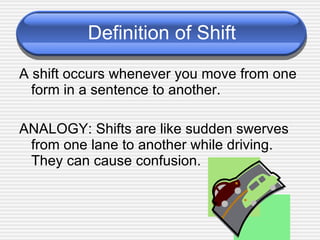
Definition of Shift A shift occurs whenever you move from one form in a sentence to another. ANALOGY: Shifts are like sudden swerves from one lane to another while driving.  They can cause confusion.
Parallel Construction vs. Shifts Parallel Construction: Parts of the sentence need to follow  the same pattern Only sentences w/  series or pairs of words Shifts: Parts of the sentence need to use the  same types of words All types of sentences
Parallelism vs. Shifts Analogy The lanes of the sentence “highway” need to be parallel (run parallel to each other following same pattern)  AND They need to have the same “format” (size of lane, pavement, painting, etc.)
Types of Shifts Always avoid distracting shifts in: person number tense mood voice discourse (type of writing)
REMEMBER… We want to AVOID and CORRECT shifts in our writing. Shifts=Bad
1) Shifts in Person Person=point of view in writing FIRST PERSON=the writer’s point of view (using “I” or “we”) SECOND PERSON=writer speaks directly to reader (uses “you”) NEVER USE SECOND PERSON IN FORMAL WRITING THIRD PERSON=writer talks about the subject separate from him/herself (using “they”, “s/he”, “it”)
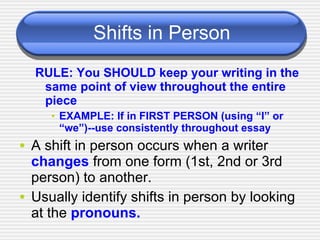
Shifts in Person RULE: You SHOULD keep your writing in the same point of view throughout the entire piece EXAMPLE: If in FIRST PERSON (using “I” or “we”)--use consistently throughout essay A shift in person occurs when a writer  changes  from one form (1st, 2nd or 3rd person) to another. Usually identify shifts in person by looking at the  pronouns.
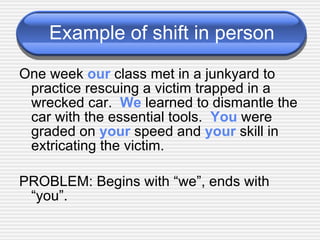
Example of shift in person One week  our  class met in a junkyard to practice rescuing a victim trapped in a wrecked car.  We  learned to dismantle the car with the essential tools.  You  were graded on  your  speed and  your  skill in extricating the victim. PROBLEM: Begins with “we”, ends with “you”.
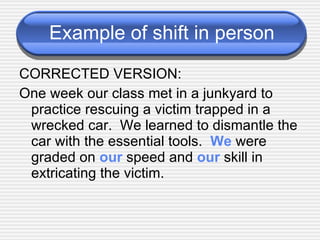
Example of shift in person CORRECTED VERSION: One week our class met in a junkyard to practice rescuing a victim trapped in a wrecked car.  We learned to dismantle the car with the essential tools.  We  were graded on  our  speed and  our  skill in extricating the victim.
2) Shifts in Number Number=number of items/people talking about in a sentence Singular=one Plural=more than one NOTE: Even first person has plural (we)
2) Shifts in Number RULE: You need to keep the number of people/objects you are discussing the same throughout the paragraph/paper.  Start singular…stay singular Start plural…stay plural. A shift in number occurs when a writer  changes from singular or plural to the opposite  in the same paragraph/paper. Ex. Start out singular…switch to plural
Example of shift in number A police officer  is often criticized for always being there when  they  aren’t needed and never being there when they are. PROBLEM: Police officer is SINGULAR.  They is PLURAL.  Not the right pronoun to replace antecedent.
Example of shift in number CORRECTED VERSION: Police officers are  often criticized for always being there when they aren’t needed and never being there when they are. OR A police officer is often criticized for always being there when  s/he isn’t  needed and never being there when  s/he is .
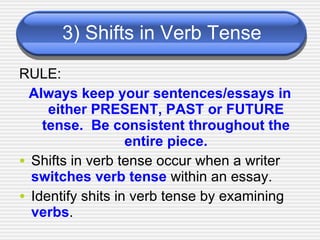
3) Shifts in Verb Tense Verb tense=time period action is happening in Present=NOW Past=ALREADY HAPPENED Future=WILL HAPPEN
3) Shifts in Verb Tense RULE: Always keep your sentences/essays in either PRESENT, PAST or FUTURE tense.  Be consistent throughout the entire piece. Shifts in verb tense occur when a writer  switches verb tense  within an essay. Identify shits in verb tense by examining  verbs .
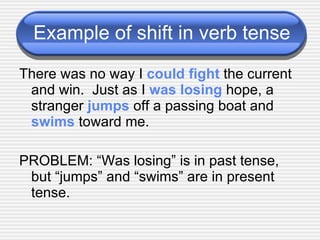
Example of shift in verb tense There was no way I  could fight  the current and win.  Just as I  was losing  hope, a stranger  jumps  off a passing boat and  swims  toward me. PROBLEM: “Was losing” is in past tense, but “jumps” and “swims” are in present tense.
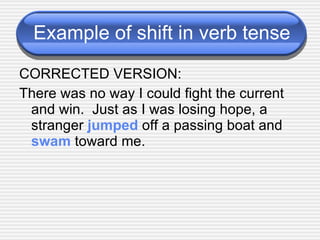
Example of shift in verb tense CORRECTED VERSION: There was no way I could fight the current and win.  Just as I was losing hope, a stranger  jumped  off a passing boat and  swam  toward me.

Shifts notes 1a powerpoint

  • 1.
  • 2.
    Definition of ShiftA shift occurs whenever you move from one form in a sentence to another. ANALOGY: Shifts are like sudden swerves from one lane to another while driving. They can cause confusion.
  • 3.
    Parallel Construction vs.Shifts Parallel Construction: Parts of the sentence need to follow the same pattern Only sentences w/ series or pairs of words Shifts: Parts of the sentence need to use the same types of words All types of sentences
  • 4.
    Parallelism vs. ShiftsAnalogy The lanes of the sentence “highway” need to be parallel (run parallel to each other following same pattern) AND They need to have the same “format” (size of lane, pavement, painting, etc.)
  • 5.
    Types of ShiftsAlways avoid distracting shifts in: person number tense mood voice discourse (type of writing)
  • 6.
    REMEMBER… We wantto AVOID and CORRECT shifts in our writing. Shifts=Bad
  • 7.
    1) Shifts inPerson Person=point of view in writing FIRST PERSON=the writer’s point of view (using “I” or “we”) SECOND PERSON=writer speaks directly to reader (uses “you”) NEVER USE SECOND PERSON IN FORMAL WRITING THIRD PERSON=writer talks about the subject separate from him/herself (using “they”, “s/he”, “it”)
  • 8.
    Shifts in PersonRULE: You SHOULD keep your writing in the same point of view throughout the entire piece EXAMPLE: If in FIRST PERSON (using “I” or “we”)--use consistently throughout essay A shift in person occurs when a writer changes from one form (1st, 2nd or 3rd person) to another. Usually identify shifts in person by looking at the pronouns.
  • 9.
    Example of shiftin person One week our class met in a junkyard to practice rescuing a victim trapped in a wrecked car. We learned to dismantle the car with the essential tools. You were graded on your speed and your skill in extricating the victim. PROBLEM: Begins with “we”, ends with “you”.
  • 10.
    Example of shiftin person CORRECTED VERSION: One week our class met in a junkyard to practice rescuing a victim trapped in a wrecked car. We learned to dismantle the car with the essential tools. We were graded on our speed and our skill in extricating the victim.
  • 11.
    2) Shifts inNumber Number=number of items/people talking about in a sentence Singular=one Plural=more than one NOTE: Even first person has plural (we)
  • 12.
    2) Shifts inNumber RULE: You need to keep the number of people/objects you are discussing the same throughout the paragraph/paper. Start singular…stay singular Start plural…stay plural. A shift in number occurs when a writer changes from singular or plural to the opposite in the same paragraph/paper. Ex. Start out singular…switch to plural
  • 13.
    Example of shiftin number A police officer is often criticized for always being there when they aren’t needed and never being there when they are. PROBLEM: Police officer is SINGULAR. They is PLURAL. Not the right pronoun to replace antecedent.
  • 14.
    Example of shiftin number CORRECTED VERSION: Police officers are often criticized for always being there when they aren’t needed and never being there when they are. OR A police officer is often criticized for always being there when s/he isn’t needed and never being there when s/he is .
  • 15.
    3) Shifts inVerb Tense Verb tense=time period action is happening in Present=NOW Past=ALREADY HAPPENED Future=WILL HAPPEN
  • 16.
    3) Shifts inVerb Tense RULE: Always keep your sentences/essays in either PRESENT, PAST or FUTURE tense. Be consistent throughout the entire piece. Shifts in verb tense occur when a writer switches verb tense within an essay. Identify shits in verb tense by examining verbs .
  • 17.
    Example of shiftin verb tense There was no way I could fight the current and win. Just as I was losing hope, a stranger jumps off a passing boat and swims toward me. PROBLEM: “Was losing” is in past tense, but “jumps” and “swims” are in present tense.
  • 18.
    Example of shiftin verb tense CORRECTED VERSION: There was no way I could fight the current and win. Just as I was losing hope, a stranger jumped off a passing boat and swam toward me.