Oaktable
   Jonathan Lewis and ORACLE_TRACE
   Oracle_Trace crashes my Database
   I start the SGA attach by searching every offset
   Anjo Kolk says James Morle wrote a program using
    x$ksmmem
   I show James my first draft using x$ksmmem
   James is baffled by why I'm hard coding offsets
   James says the offsets are in some X$ table
   I search, turn up a mail by Jonathan Lewis on x$kqfco
   Goldmine – all the offsets
   Thanks Mogens Nogard!
   Thanks to TomKyte's Decimal to Hex
http://oraperf.sourceforge.net
Direct Oracle SGA Memory
         Access

   Reading data directly from
Oracle’s shared memory segment
          using C code

  Wednesday, February 20, 2013
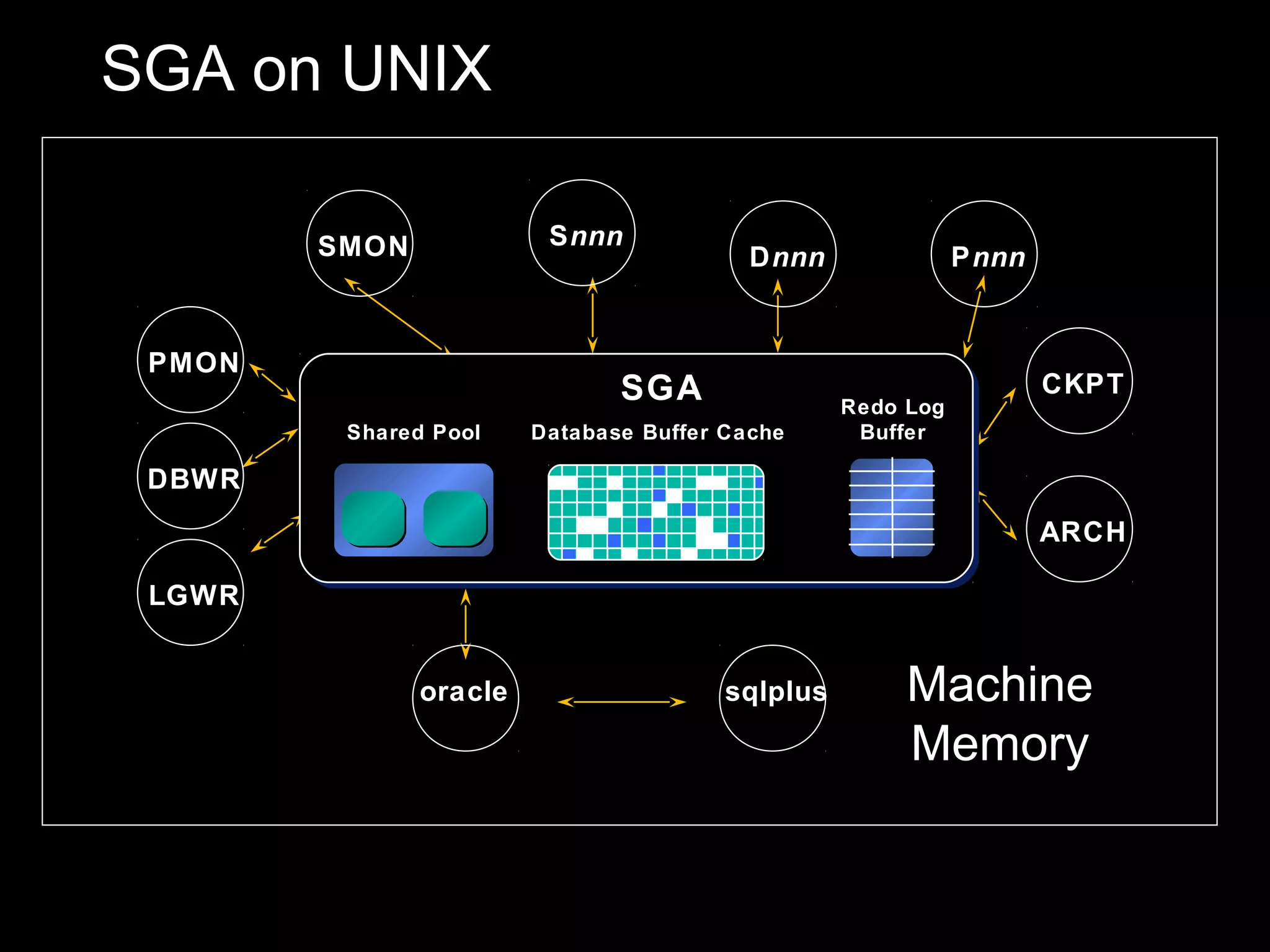
SGA on UNIX

        SMON             S nnn
                                          D nnn              P nnn


 PMON
                               SGA                                   CKPT
                                                  Redo Log
         Shared Pool    Database Buffer Cache      Buffer

 DBWR
                                                                     ARCH

 LGWR


               oracle                   sqlplus        Machine
                                                       Memory
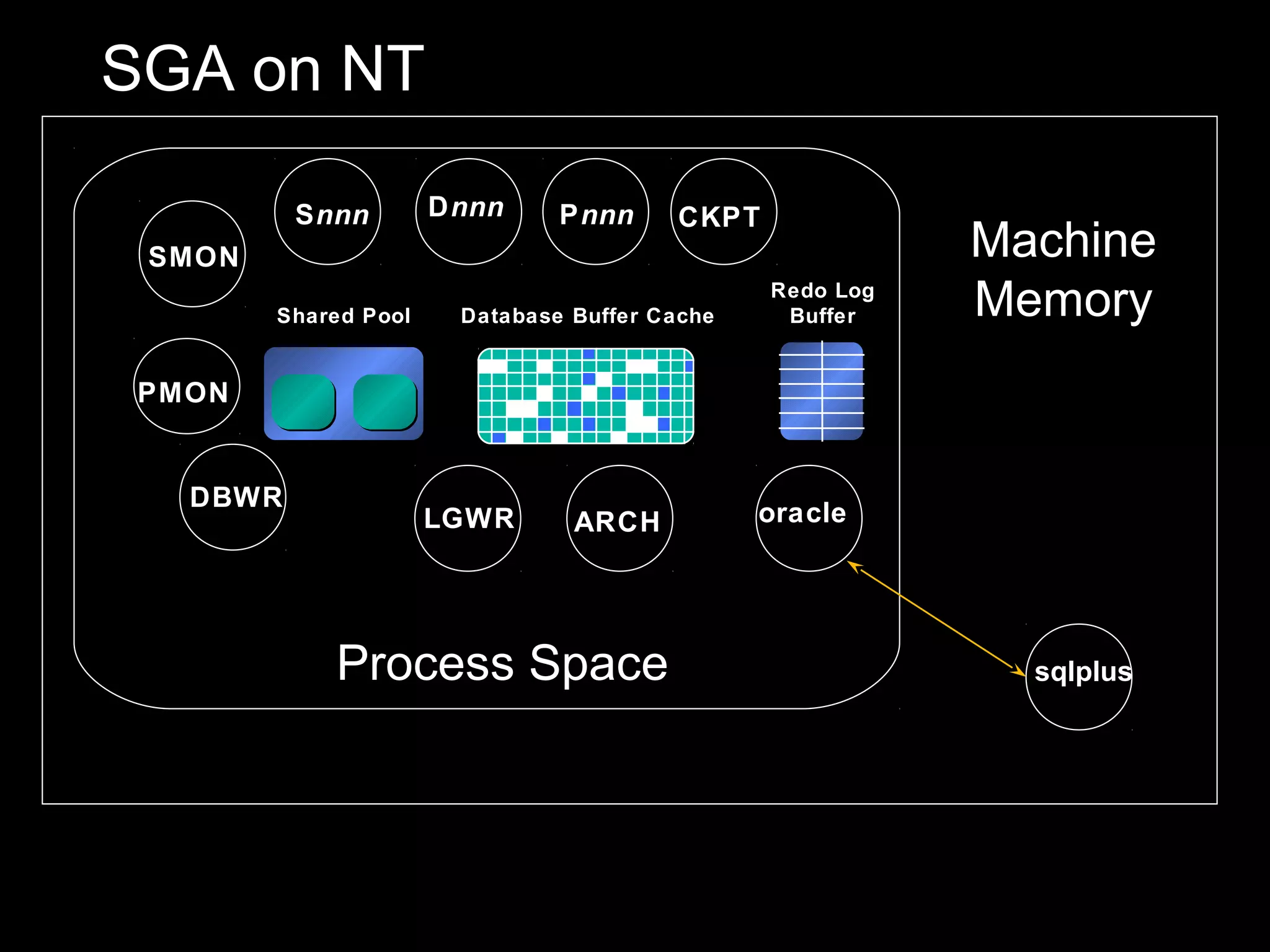
SGA on NT

          S nnn       D nnn     P nnn    CKPT
 SMON                                                      Machine
        Shared Pool     Database Buffer Cache
                                                Redo Log
                                                 Buffer    Memory
 PMON


   DBWR
                      LGWR       ARCH           oracle


            Process Space                                    sqlplus
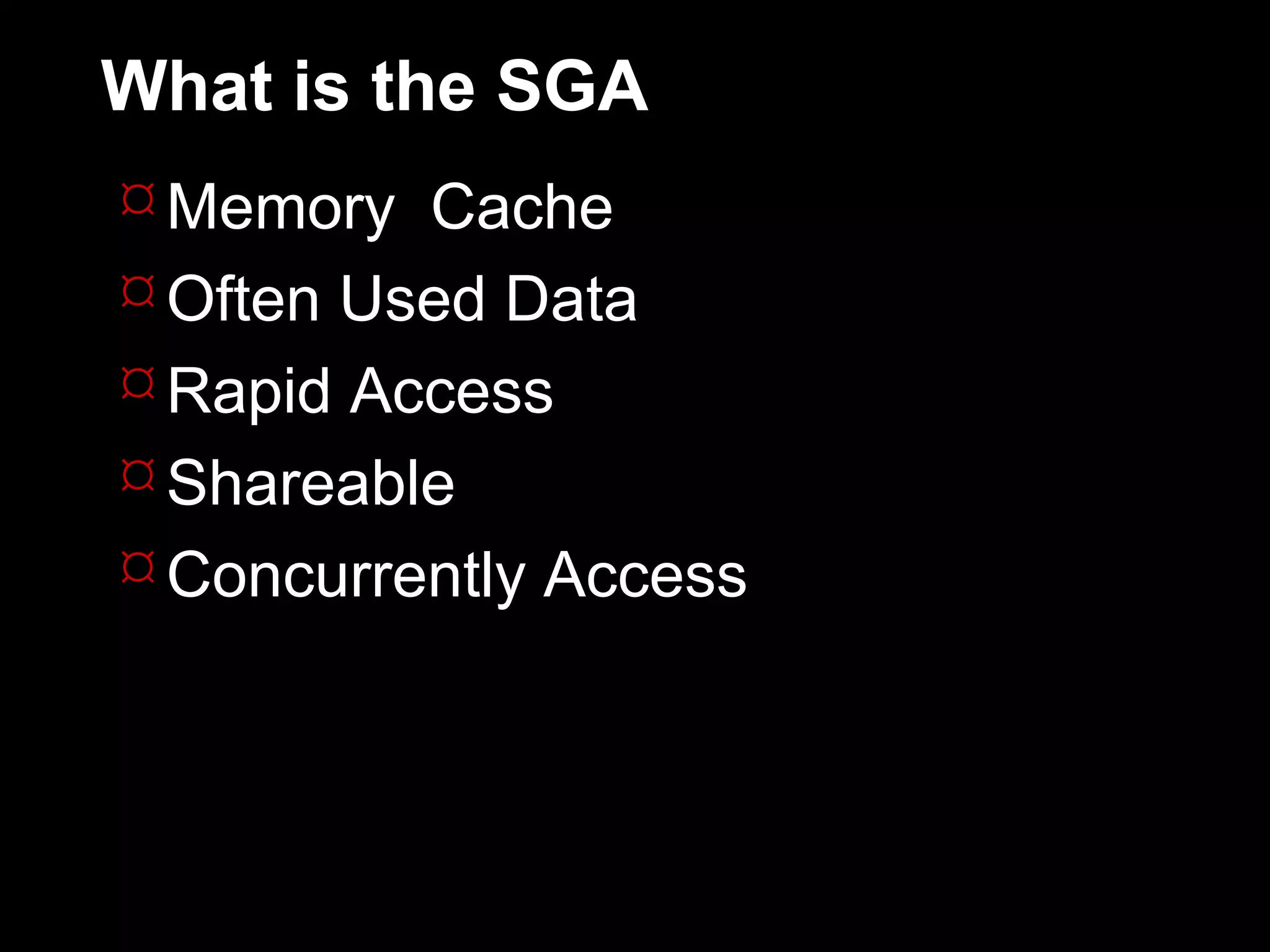
What is the SGA
 Memory Cache
 Often Used Data
 Rapid Access
 Shareable
 Concurrently Access
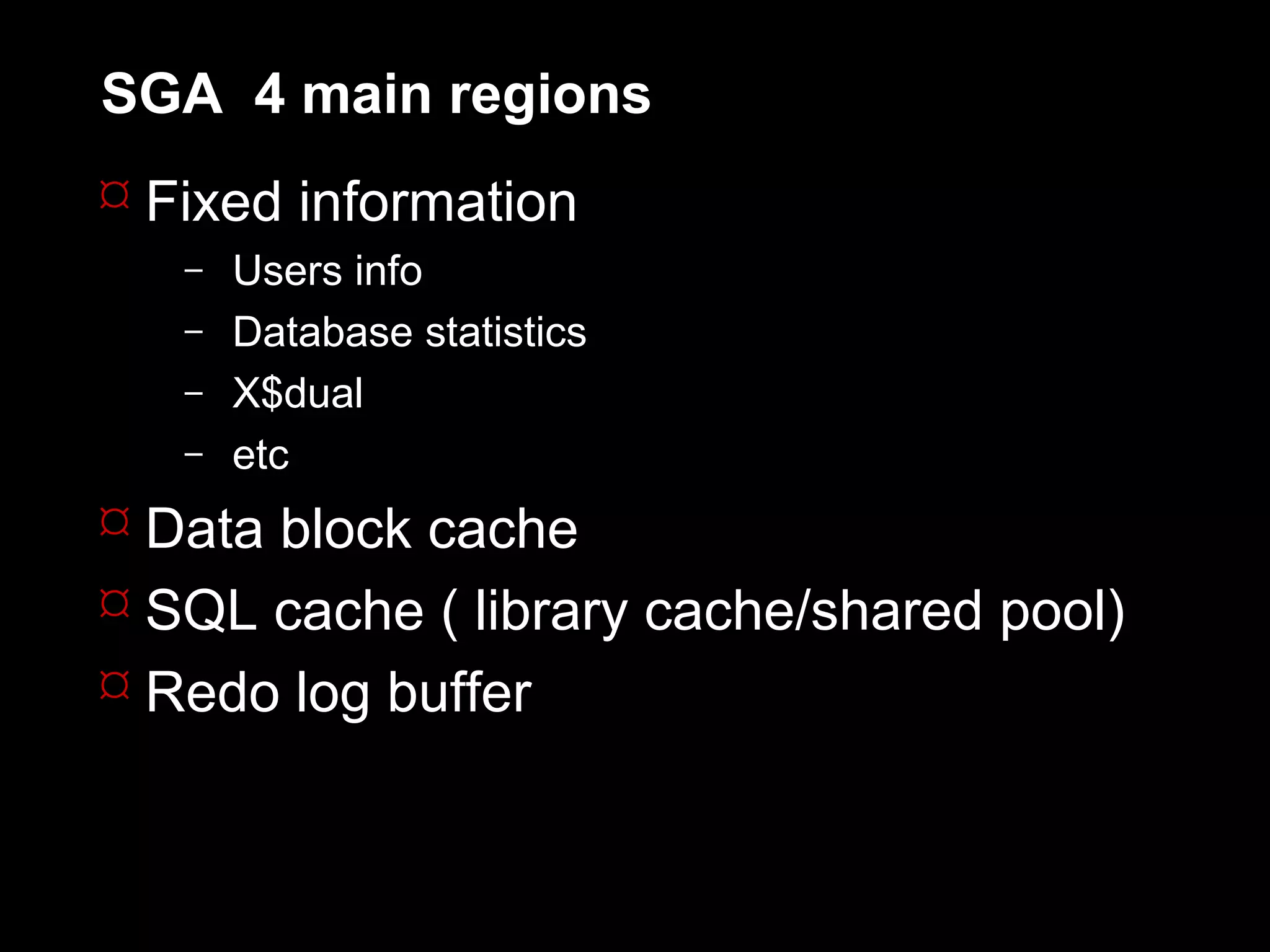
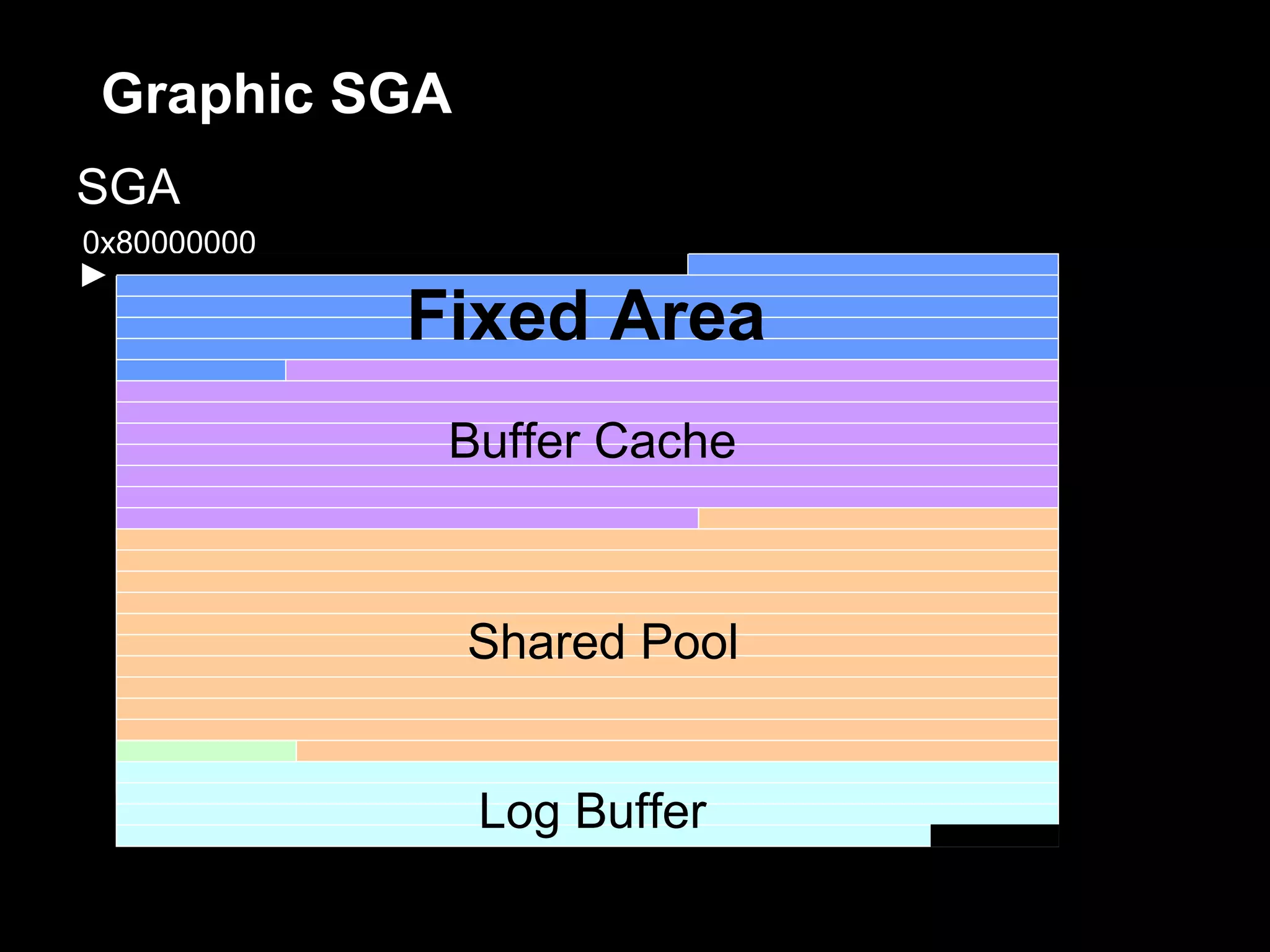
SGA 4 main regions
 Fixed information
   –   Users info
   –   Database statistics
   –   X$dual
   –   etc
 Data block cache
 SQL cache ( library cache/shared pool)
 Redo log buffer
How is the SGA info Used?
 Automatically
   –   data blocks cached
   –   Log buffer
   –   Sql cache
   –   Updates of system and user statistics

 User Queries
   –   User info v$session
   –   System info v$parameter
   –   Performance statistics v$sysstat, v$latch, v$system_event
   –   Buffer cache headers, x$bh
Why Direct Access with C?
 Reading Hidden Information
   –   Sort info on version 7
   –   OPS locking info version 8
   –   Contents of data blocks (only the headers or visible in X$)

 Access while Database is Hung
 High Speed Access
   –   Sampling User Waits, catch ephemeral data
   –   Scan LRU chain in X$bh
   –   Statistically approximate statistics
         SQL statistics per user

 Low overhead
Database Slow or Hung
Often happens at the largest sites when cutting
  edge support is expected.

   Shared Pool errors ORA 4031
   Archiver or Log file Switch Hangs
   Hang Bugs
   Library Cache Latch contention
   ORA-00379: no free buffers available in buffer
    pool DEFAULT
Statistical Sampling


  By Rapidly Sampling SQL statistics
  and the users who have the statistics
  open, one can see how much work a
  particular user does with a particular
  SQL statement
Low Overhead
 Marketing Appeal
 Clients are sensitive about their production
  databases
 Heisenberg uncertainty affect – less overhead
  less affect monitoring has on performance
  which we are monitoring
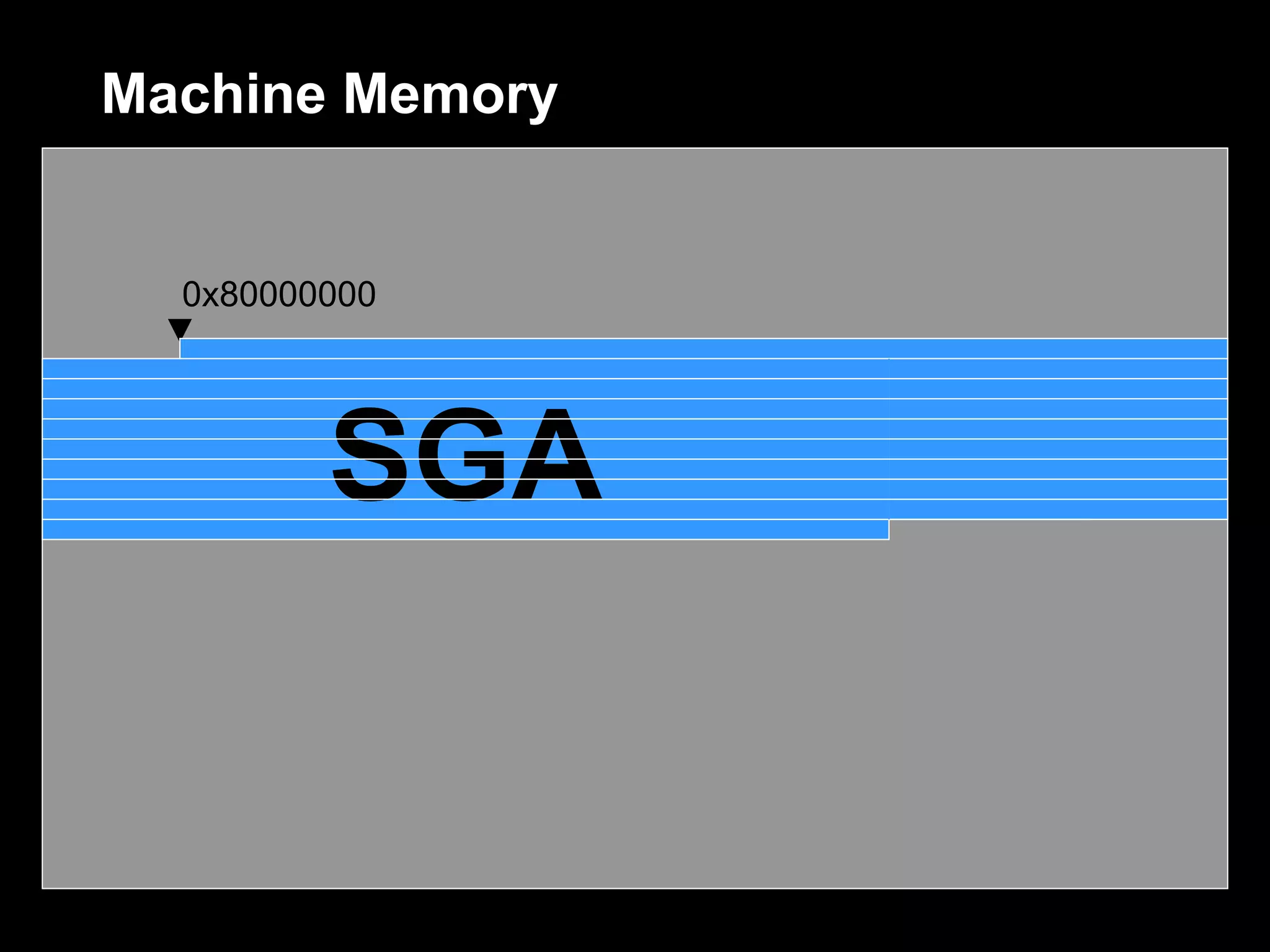
SGA made visible through x$tables

   Most of the SGA is not visible
   X$KSMMEM Exception, Raw Dump of SGA
   Information Externalized through X$ tables
   Useful or Necessary information is Externalized
   Externalized publicly through V$ Tables
Machine Memory


  0x80000000


         SGA     SGA
Buffer Cache
 Graphic SGA
SGA
0x80000000

             Fixed Area
              Buffer Cache


               Shared Pool


               Log Buffer
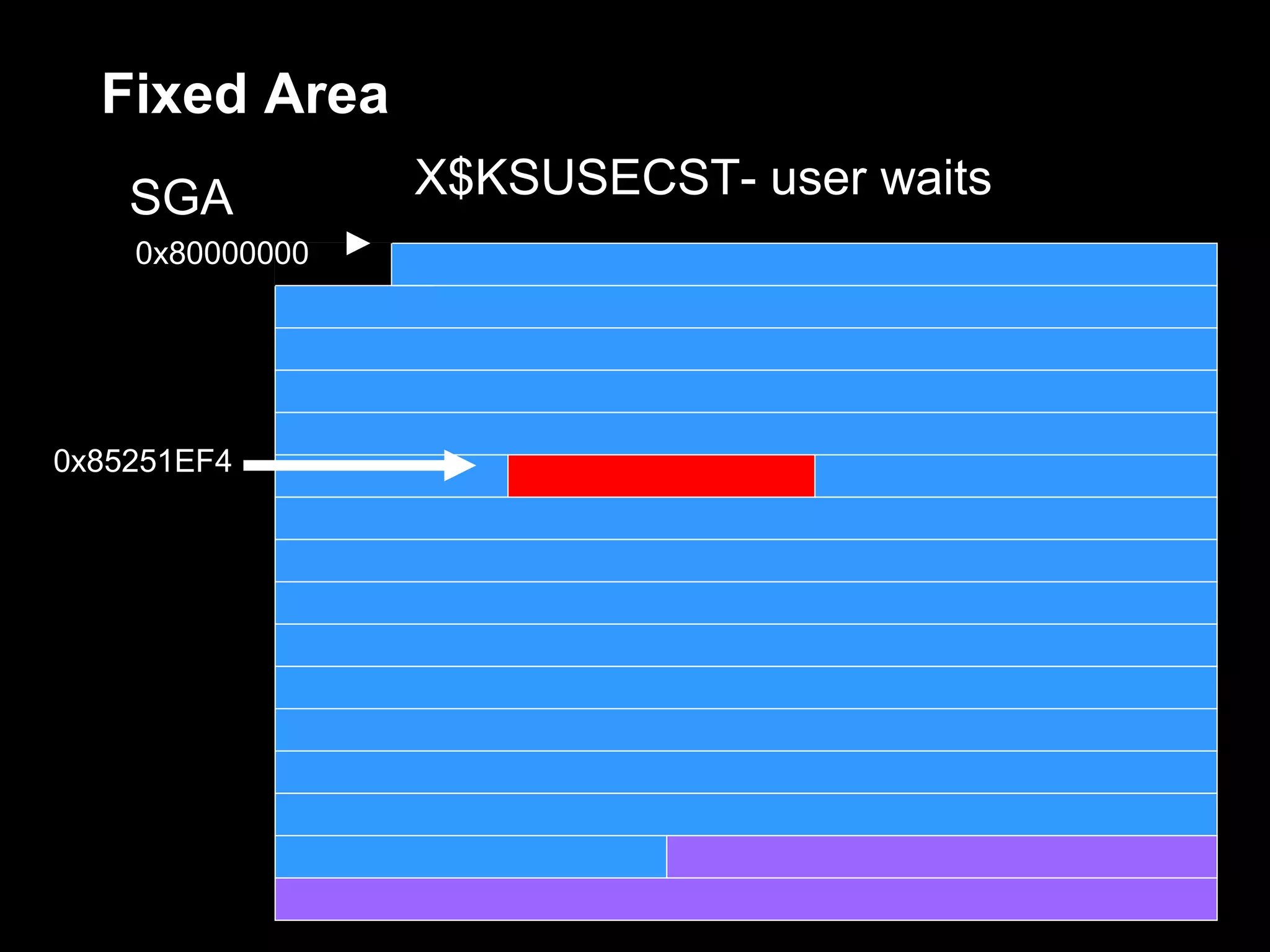
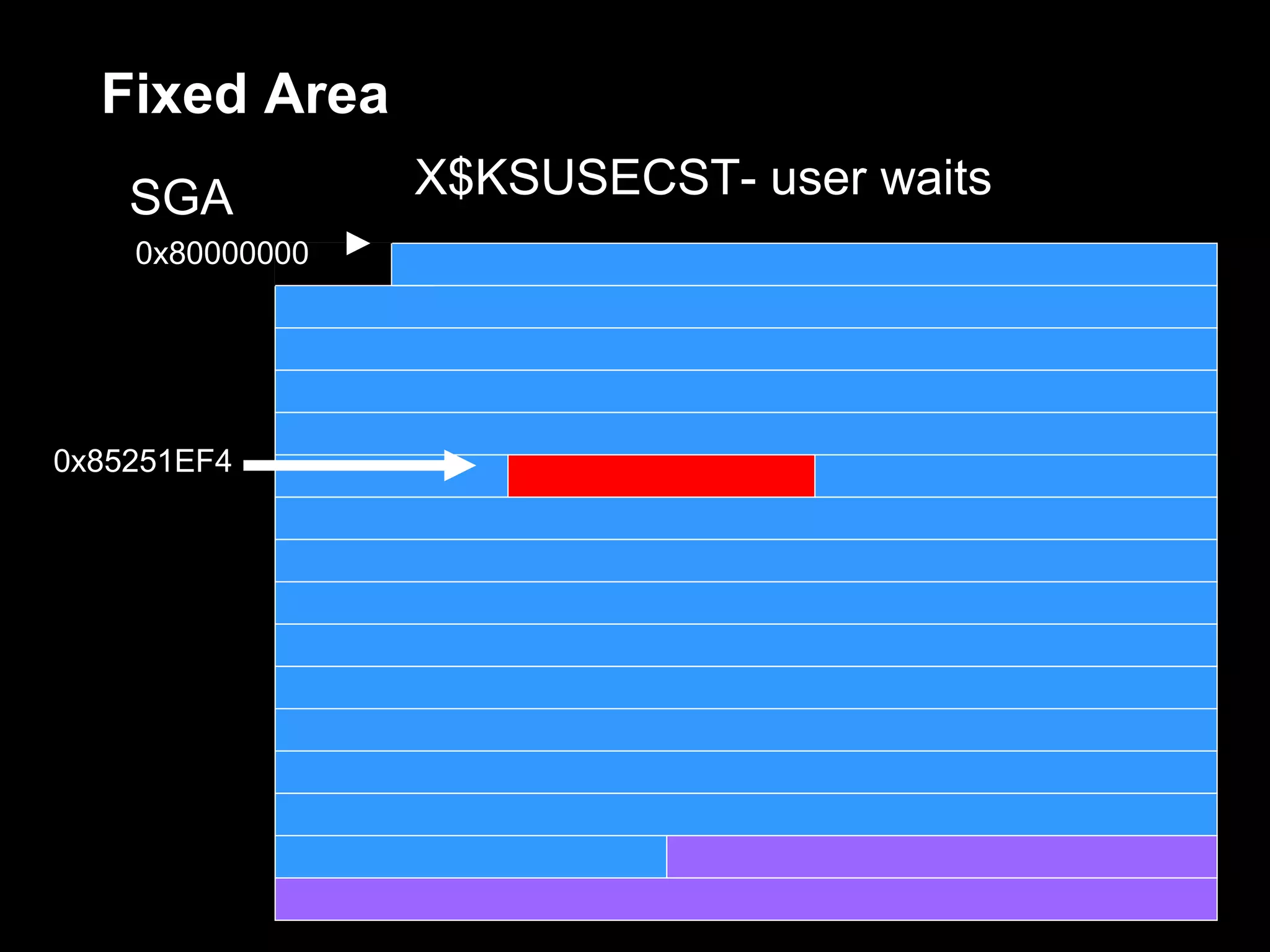
Fixed Area
    SGA          X$KSUSECST- user waits
    0x80000000


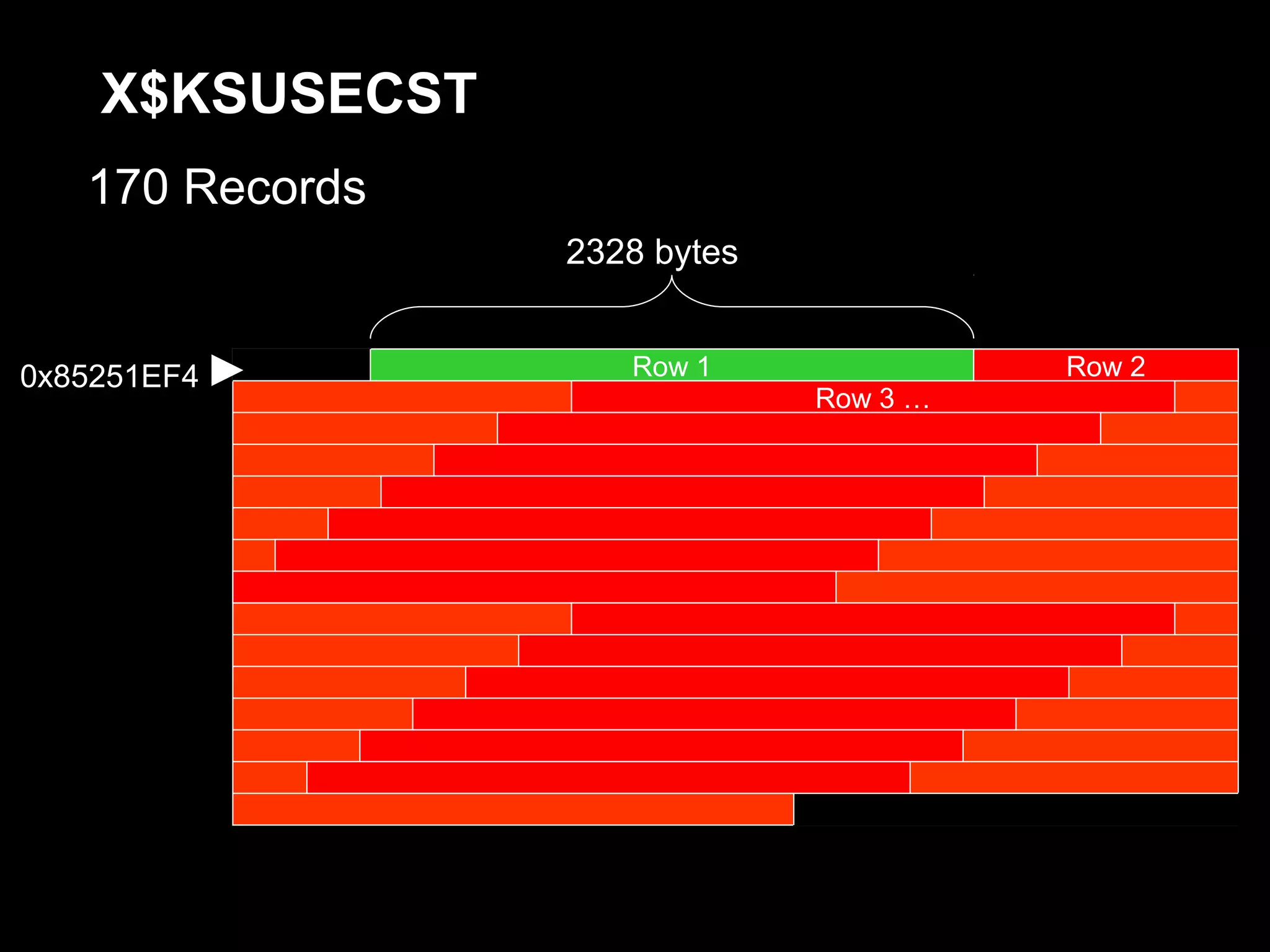
0x85251EF4
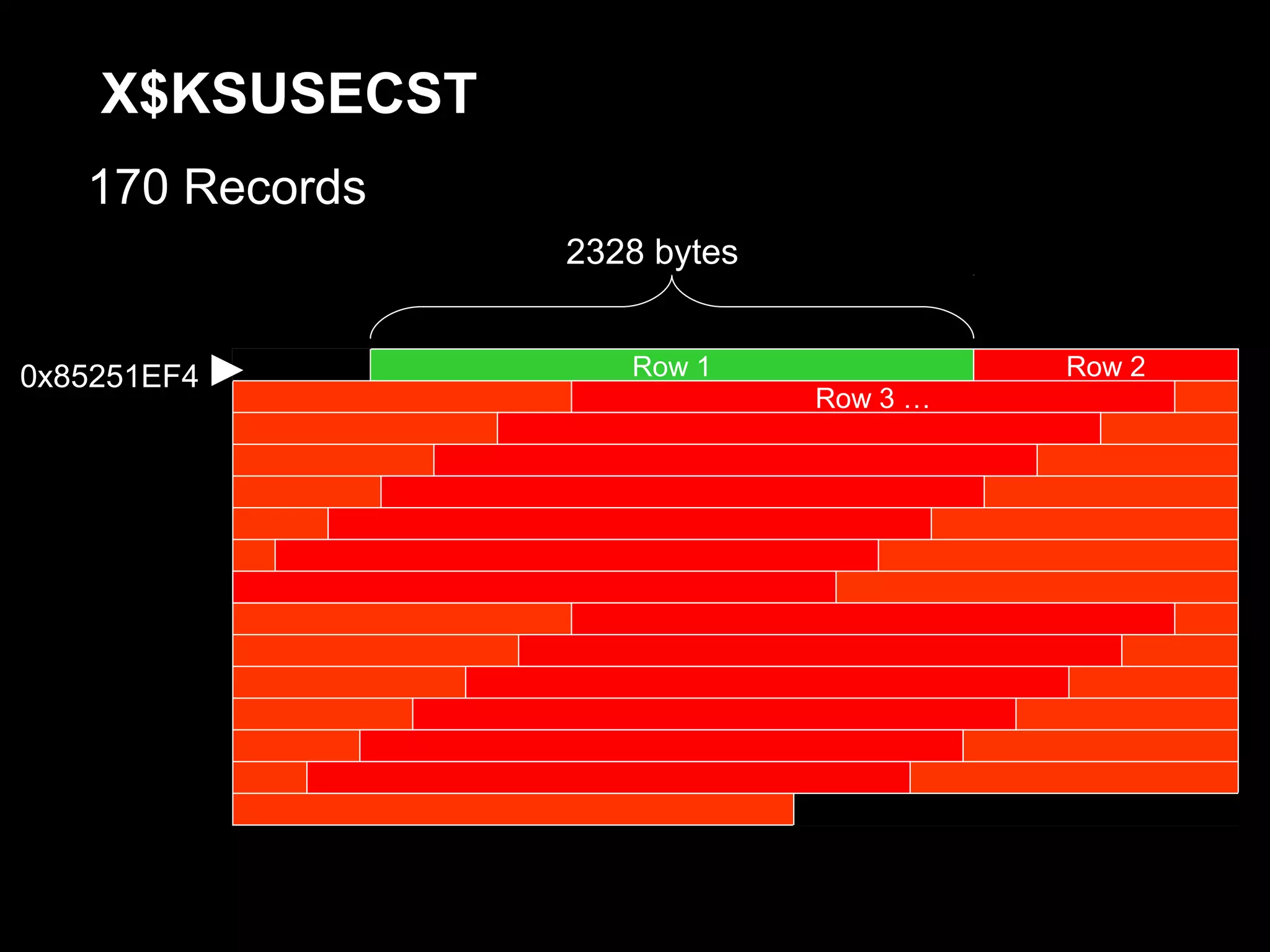
X$KSUSECST
   170 Records
                 2328 bytes


0x85251EF4          Row 1               Row 2
                              Row 3 …
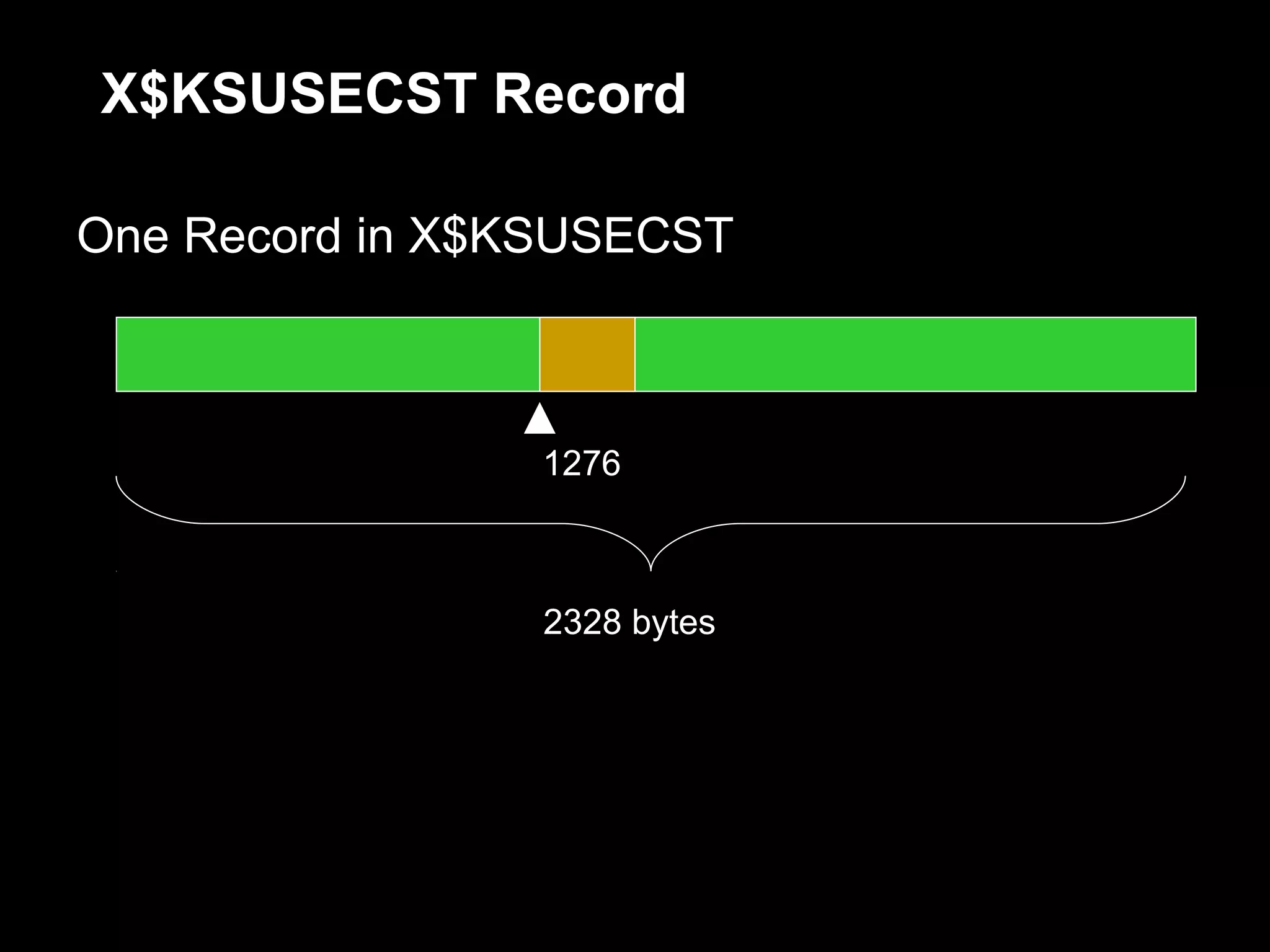
X$KSUSECST Record

One Record in X$KSUSECST


                 1276


                 2328 bytes
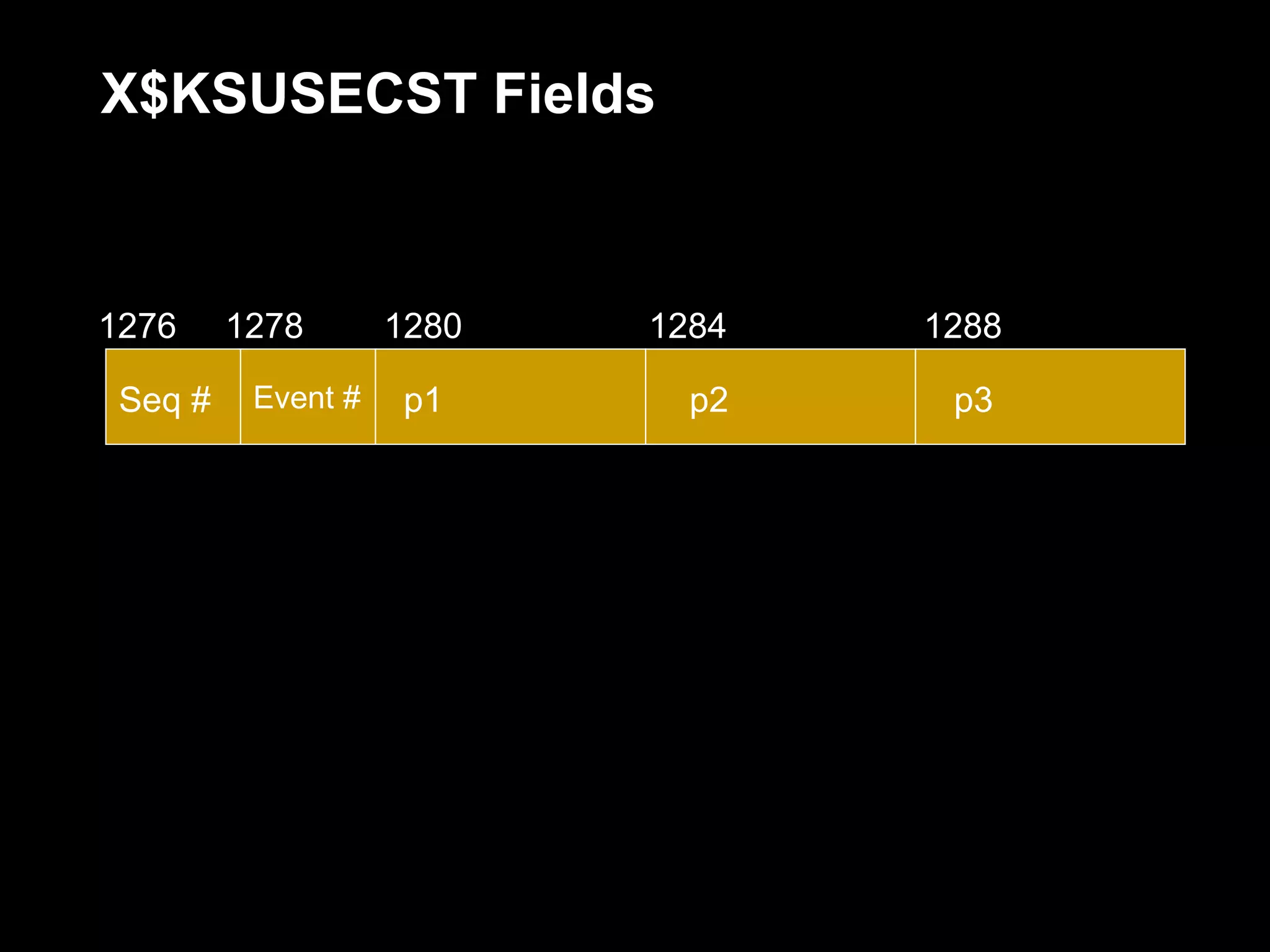
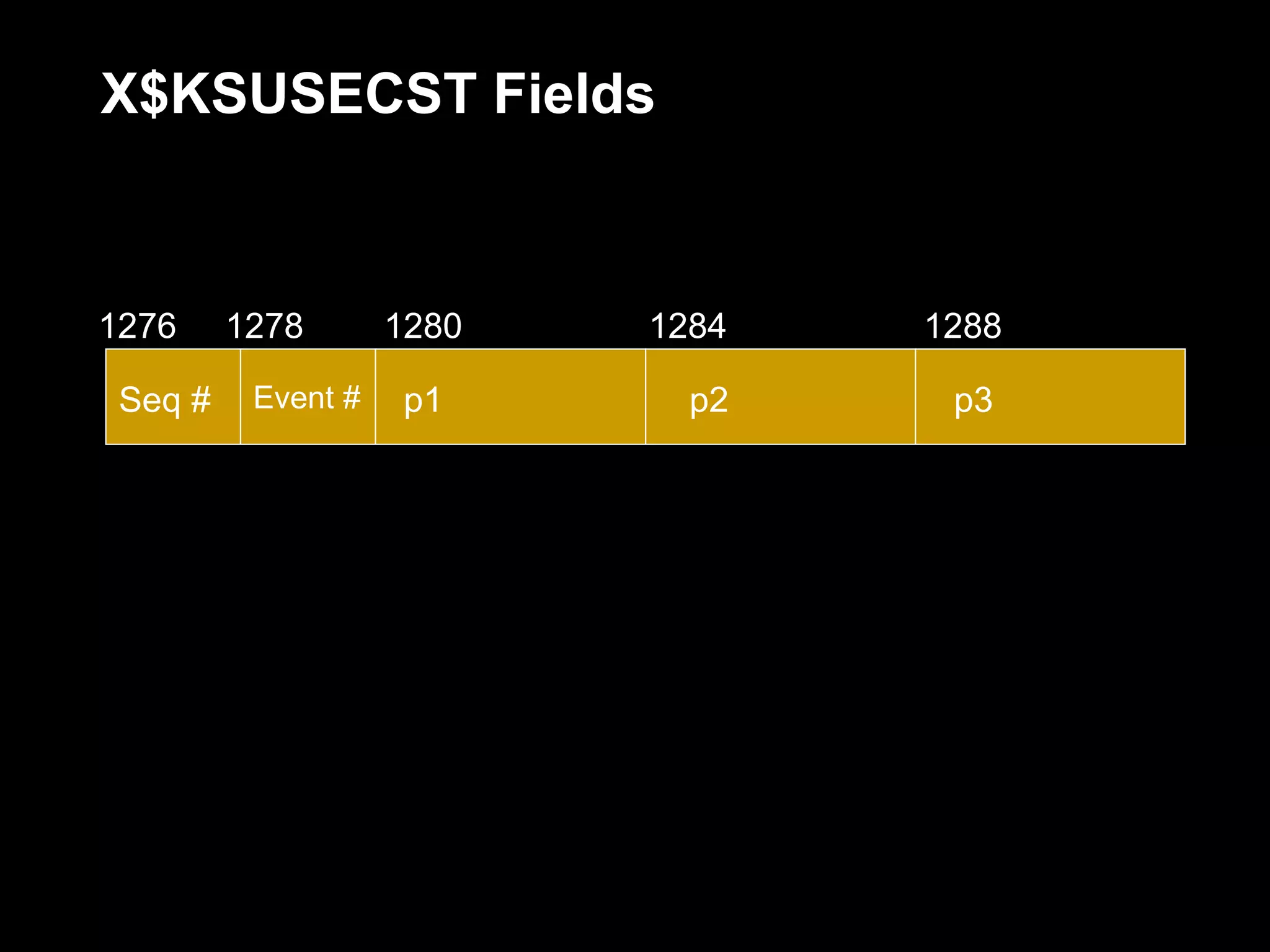
X$KSUSECST Fields


1276     1278       1280   1284   1288

 Seq #    Event #    p1      p2    p3
Externalization of C structs: X$
tables

If Structure foo was externalized in a X$
SQL> describe x$foo
Column Name                       Type
------------------------------   --------
ADDR                             RAW(8)
INDX                             NUMBER
ID                               NUMBER
B                                NUMBER
SGA is One Large C Struct

   struct foo
   {
      int id;
      int A;
      int B;
      int C;
   };
   struct foo foo[N];
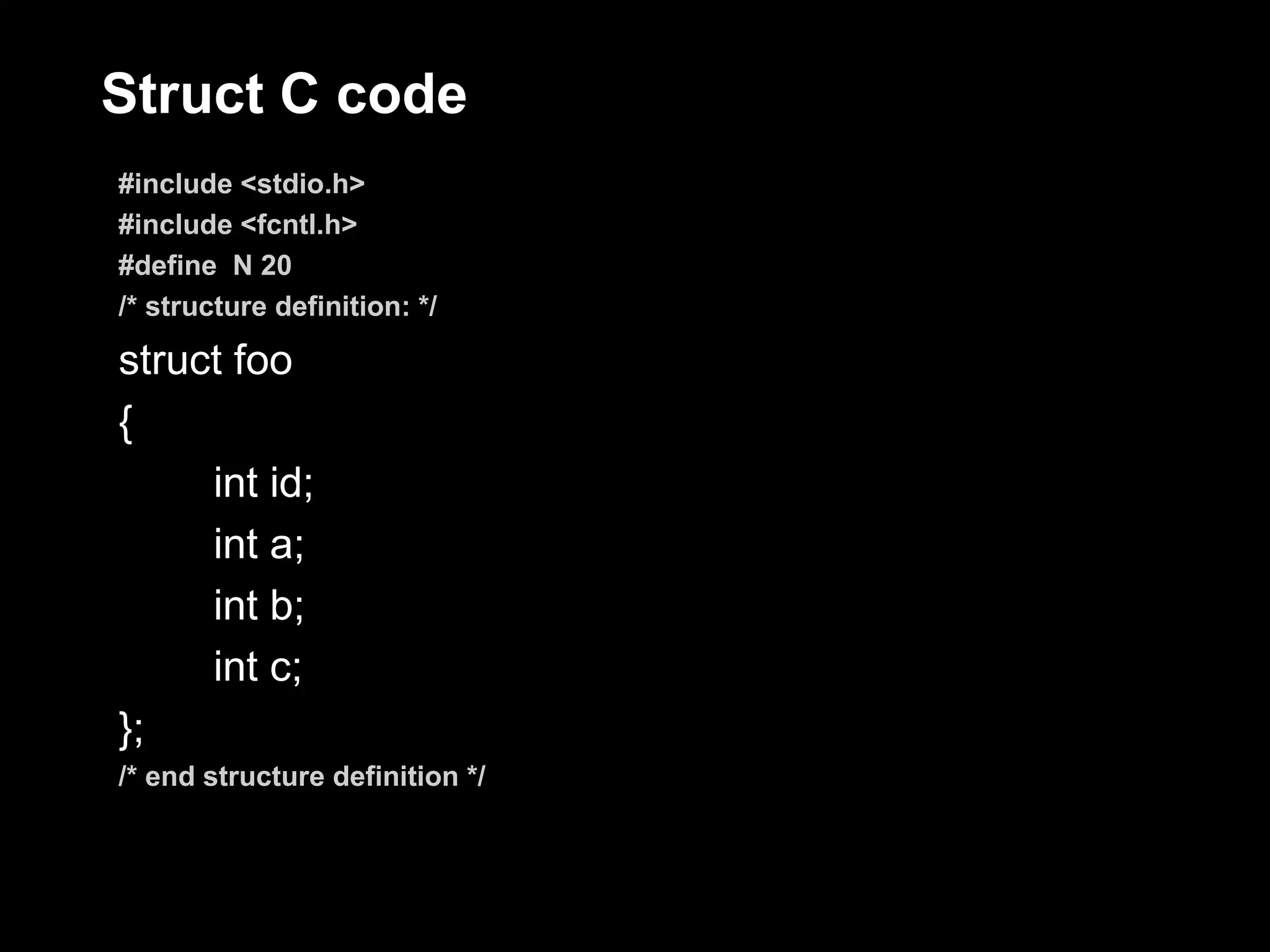
Struct C code
#include <stdio.h>
#include <fcntl.h>
#define N 20
/* structure definition: */

struct foo
{
     int id;
     int a;
     int b;
     int c;
};
/* end structure definition */
Struct Record
main(){
struct foo foo[20];
int fptr;
   /* zero out memory of struct */
   memset(foo,0,sizeof(foo));

    foo[0].id=1;                     /* row 0 */
    foo[0].a=12;
    foo[0].b=13;
    foo[0].c=13;
Struct Write to File
       foo[1].id=2;       /* row 1 */
       foo[1].a=22;
       foo[1].b=23;
       foo[1].c=24;
/* write to file, simulate SGA */
  if ((fptr = open("foo.out",O_WRONLY | O_CREAT,0777)) < 0 )
   return -1;

    write(fptr,foo,sizeof(foo));
    return 0;
}
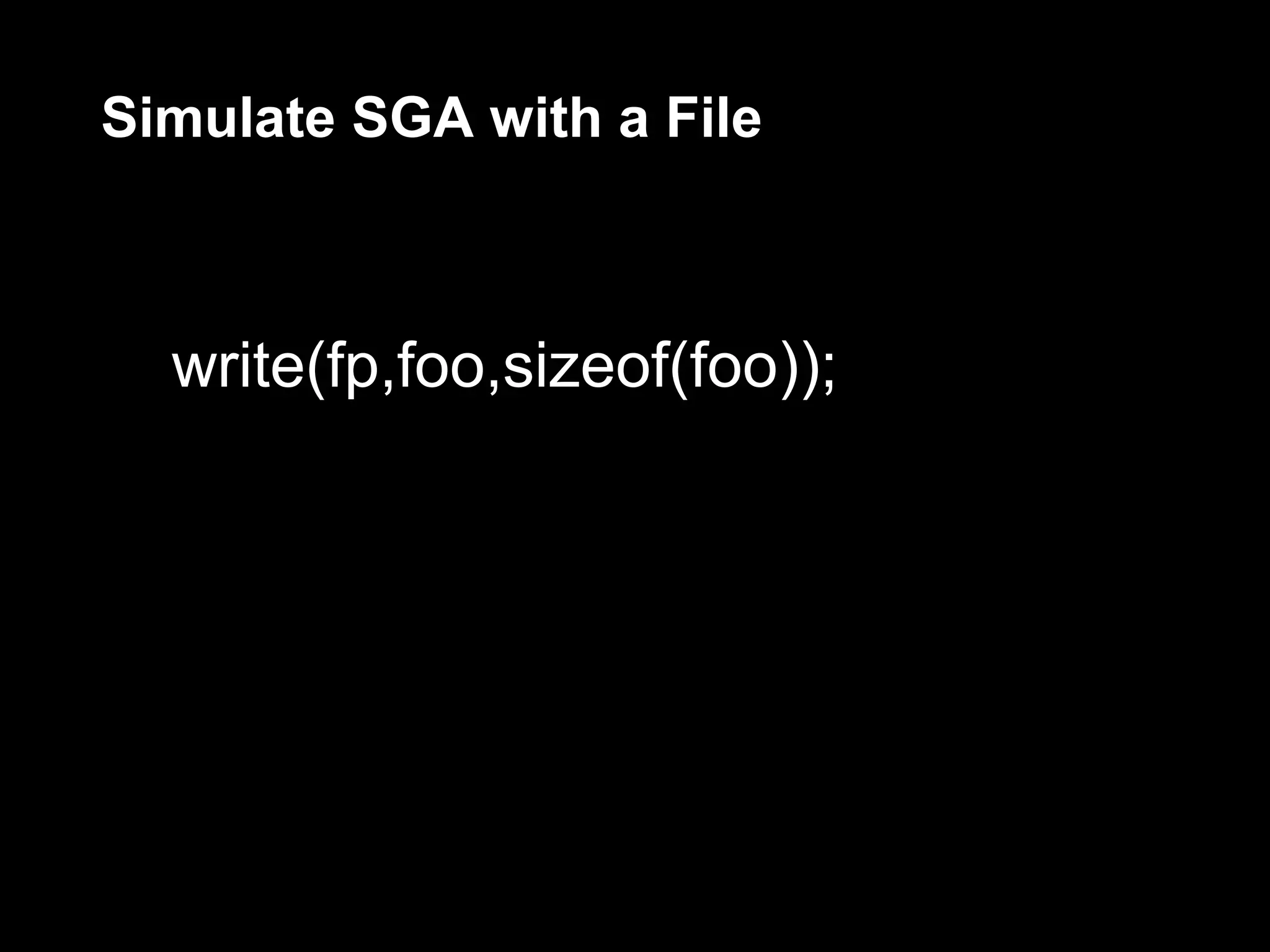
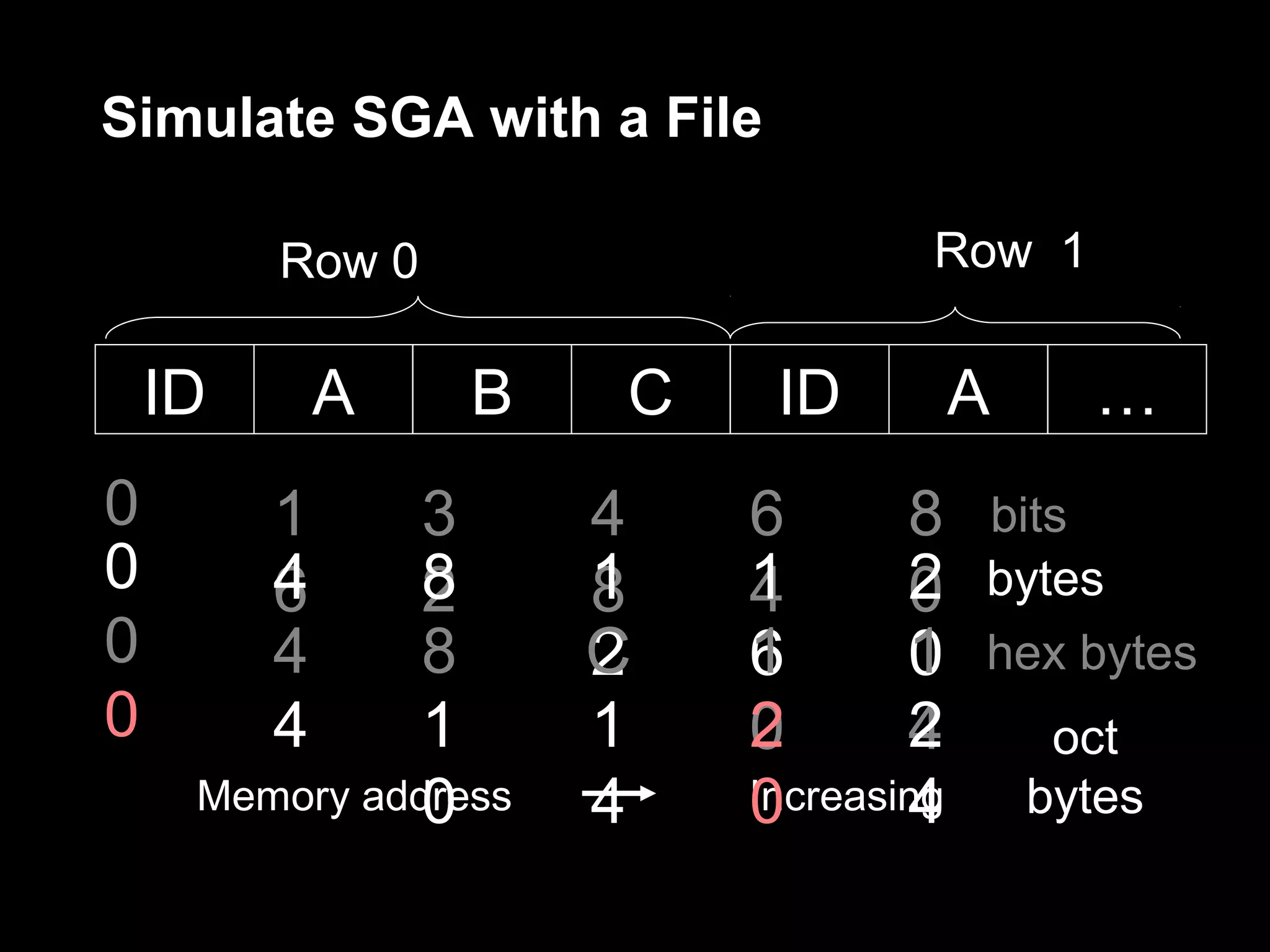
Simulate SGA with a File


  write(fp,foo,sizeof(foo));
Simulate SGA with a File

         Row 0                     Row 1

    ID       A   B    C    ID          A     …
0        1     3      4   6       8    bits
0        4
         6     8
               2      1
                      8   1
                          4       2
                                  0    bytes
0        4     8      C
                      2   1
                          6       1
                                  0    hex bytes
0        4     1      1   2
                          0       2
                                  4         oct
               0
     Memory address   4   0       4
                          Increasing       bytes
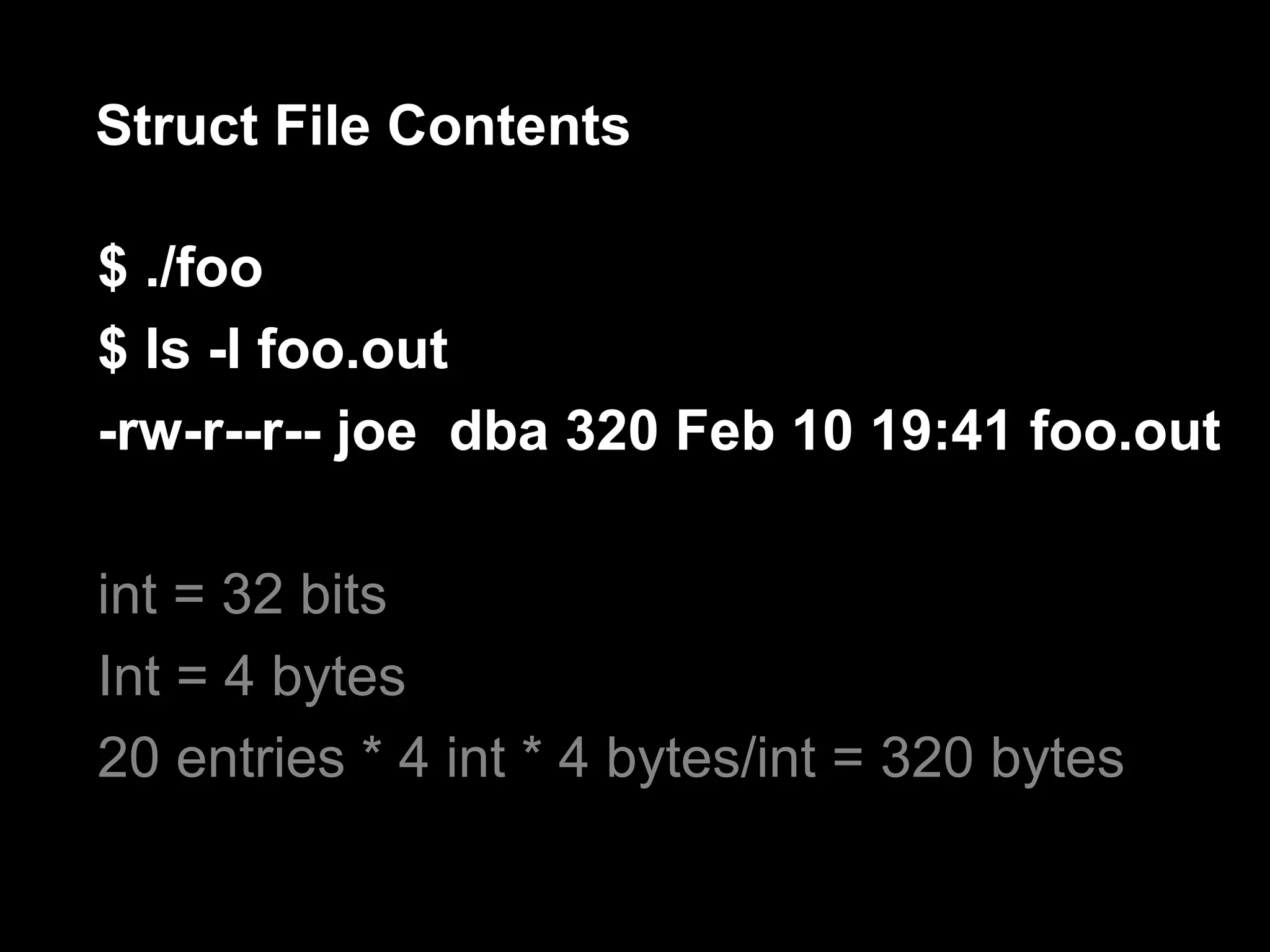
Struct File Contents

$ ./foo
$ ls -l foo.out
-rw-r--r-- joe dba 320 Feb 10 19:41 foo.out

int = 32 bits
Int = 4 bytes
20 entries * 4 int * 4 bytes/int = 320 bytes
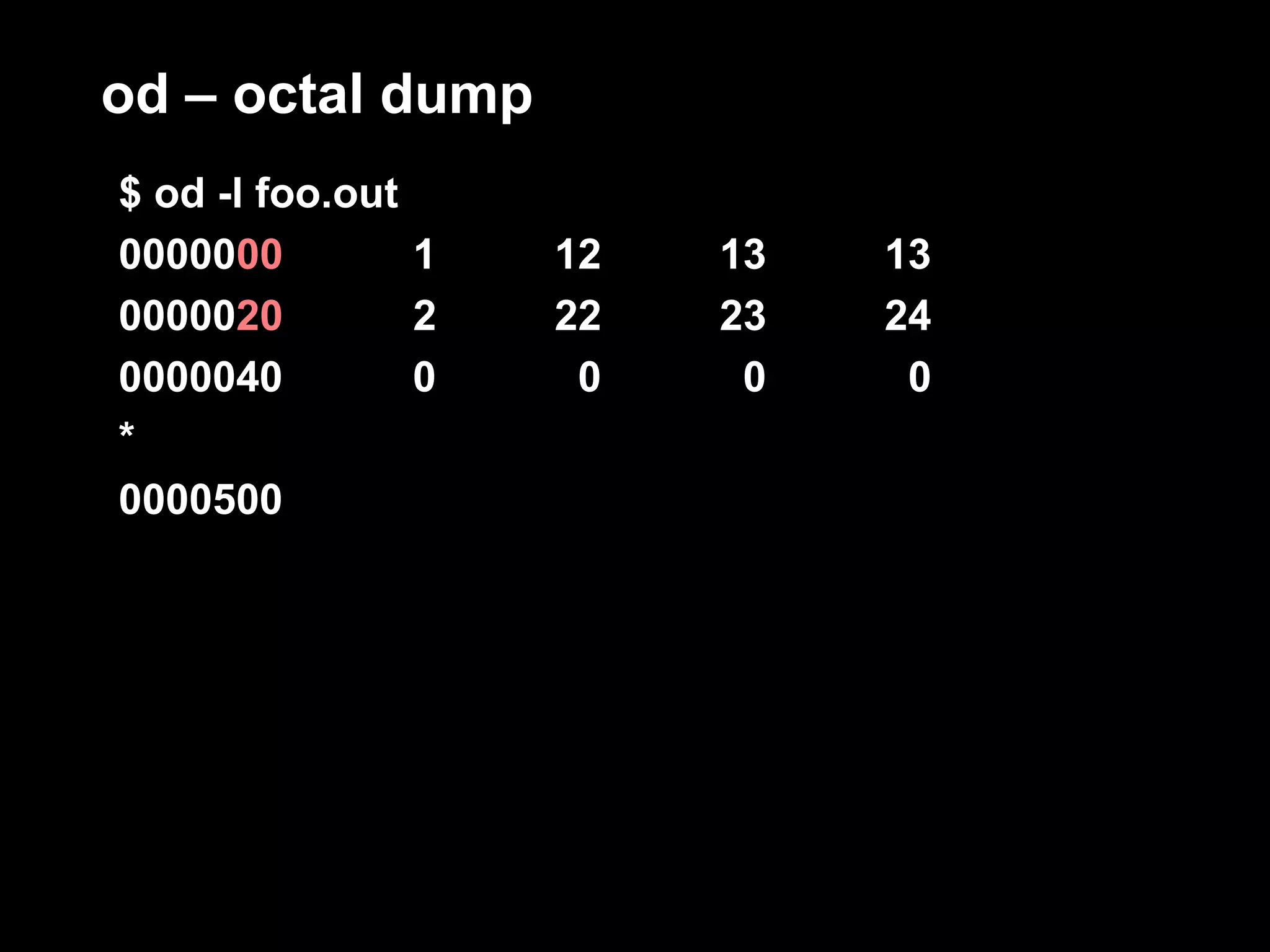
od – octal dump
$ od -l foo.out
0000000         1   12   13   13
0000020         2   22   23   24
0000040         0    0    0    0
*
0000500
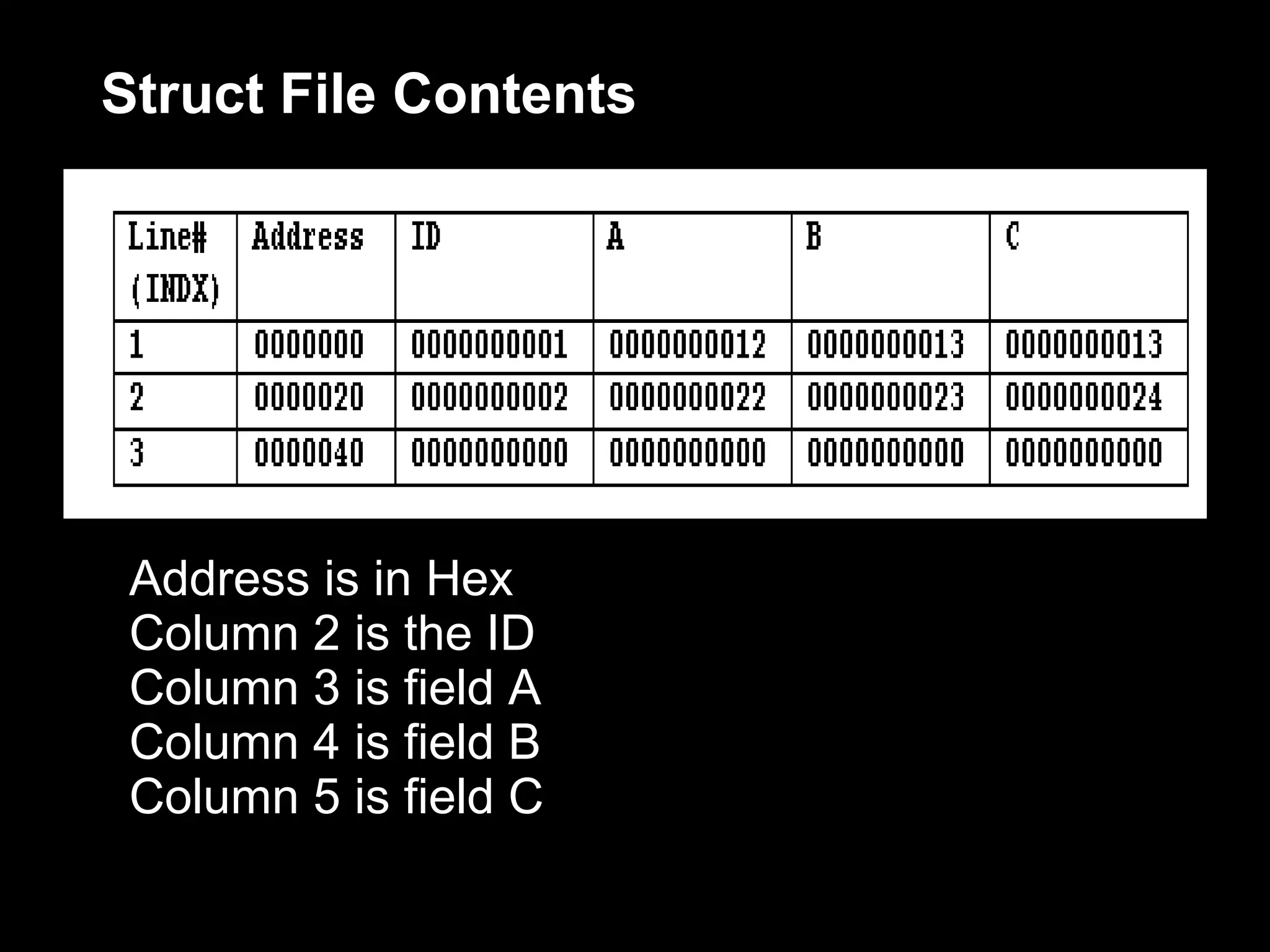
Struct File Contents


 Address is in Hex
 Column 2 is the ID
 Column 3 is field A
 Column 4 is field B
 Column 5 is field C
X$ tables ?
 Ok, x$foo =~ foo[20]
 How do I get a list of x$ tables?
 Where is each X$ located?
 V$Fixed_Tables
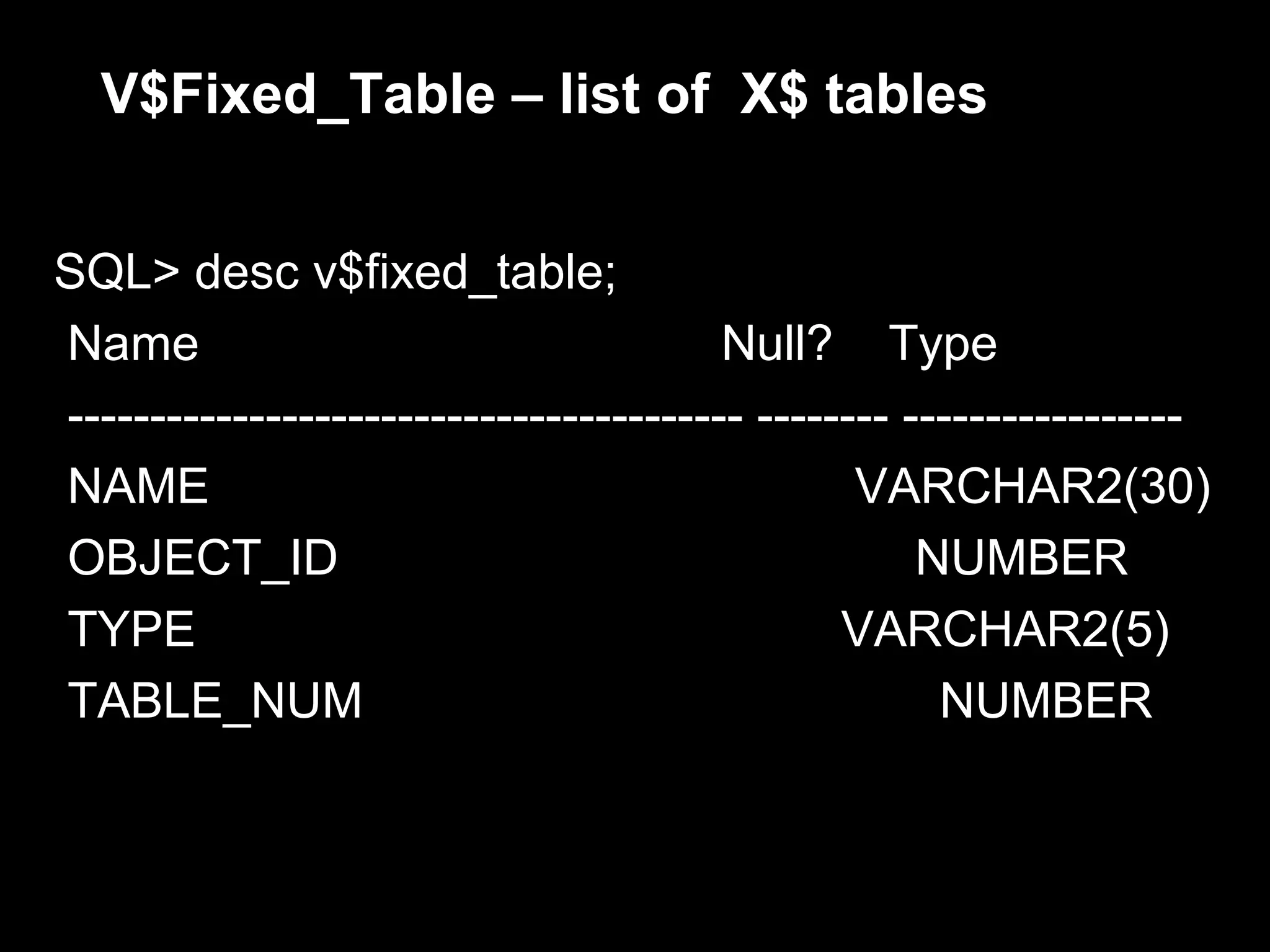
V$Fixed_Table – list of X$ tables


SQL> desc v$fixed_table;
Name                                    Null? Type
----------------------------------------- -------- -----------------
NAME                                            VARCHAR2(30)
OBJECT_ID                                           NUMBER
TYPE                                           VARCHAR2(5)
TABLE_NUM                                            NUMBER
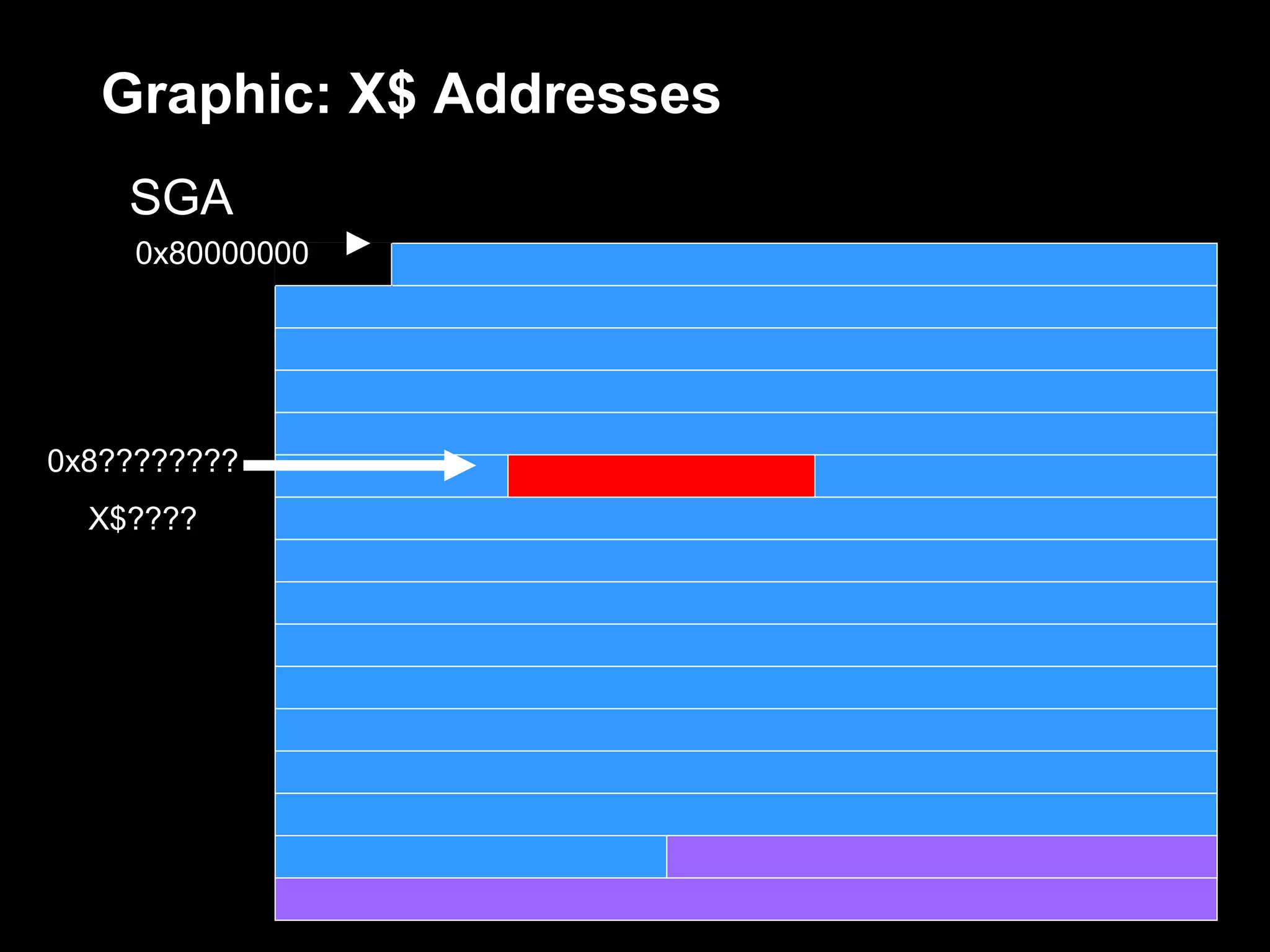
Graphic: X$ Addresses
    SGA
     0x80000000


0x8????????
  X$????
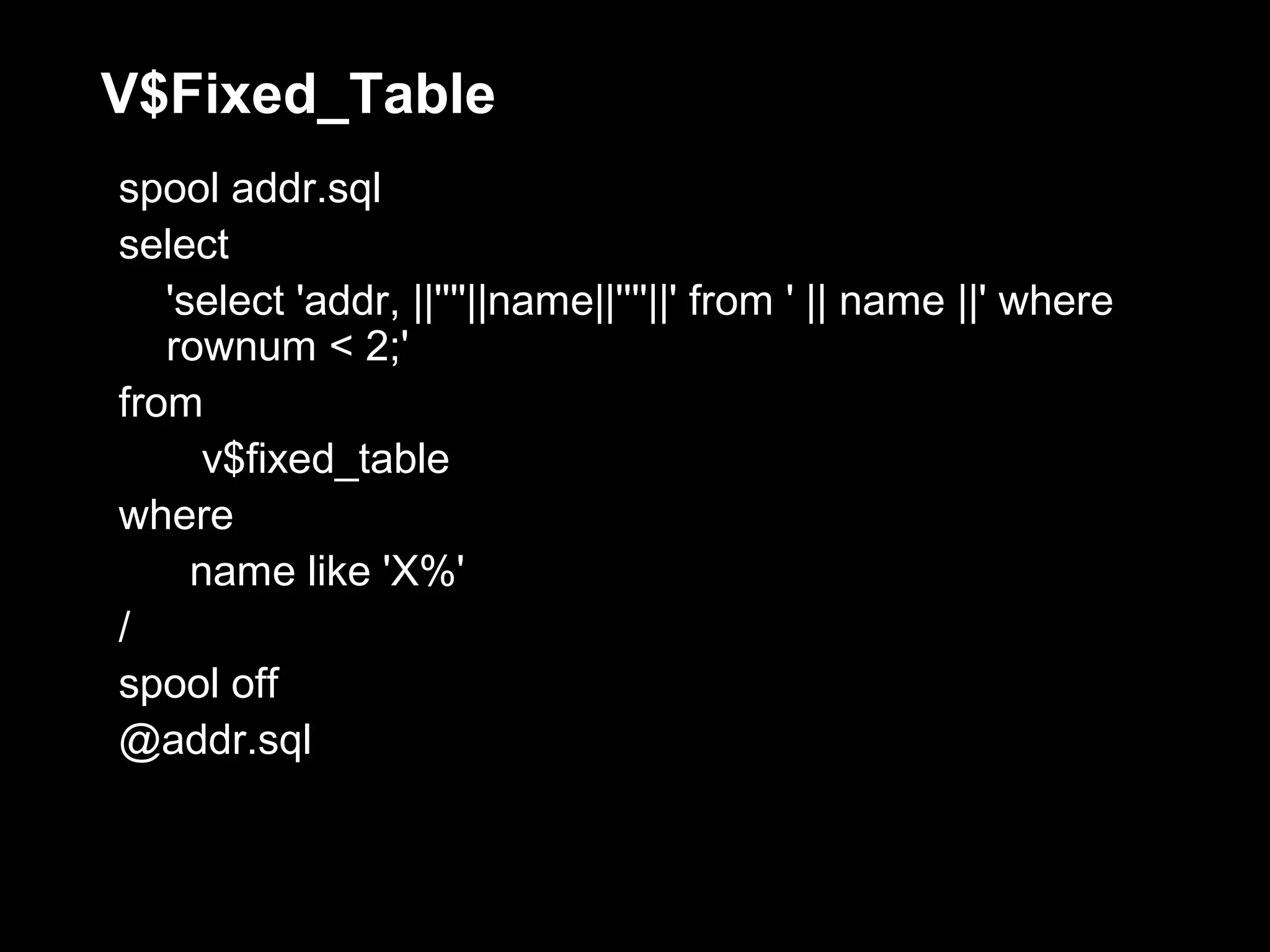
V$Fixed_Table
spool addr.sql
select
   'select 'addr, ||''''||name||''''||' from ' || name ||' where
   rownum < 2;'
from
      v$fixed_table
where
     name like 'X%'
/
spool off
@addr.sql
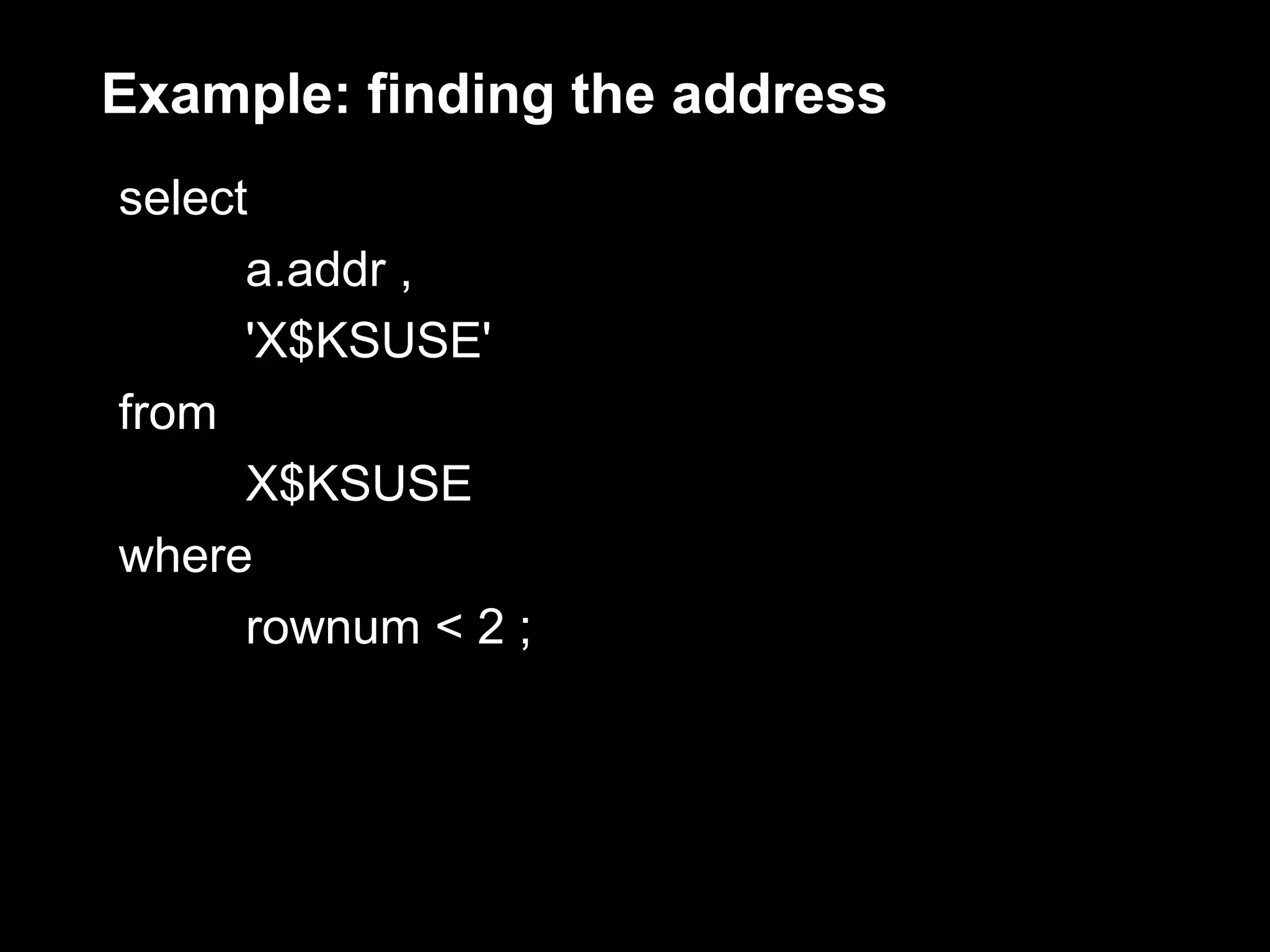
Example: finding the address
select
      a.addr ,
      'X$KSUSE'
from
      X$KSUSE
where
      rownum < 2 ;
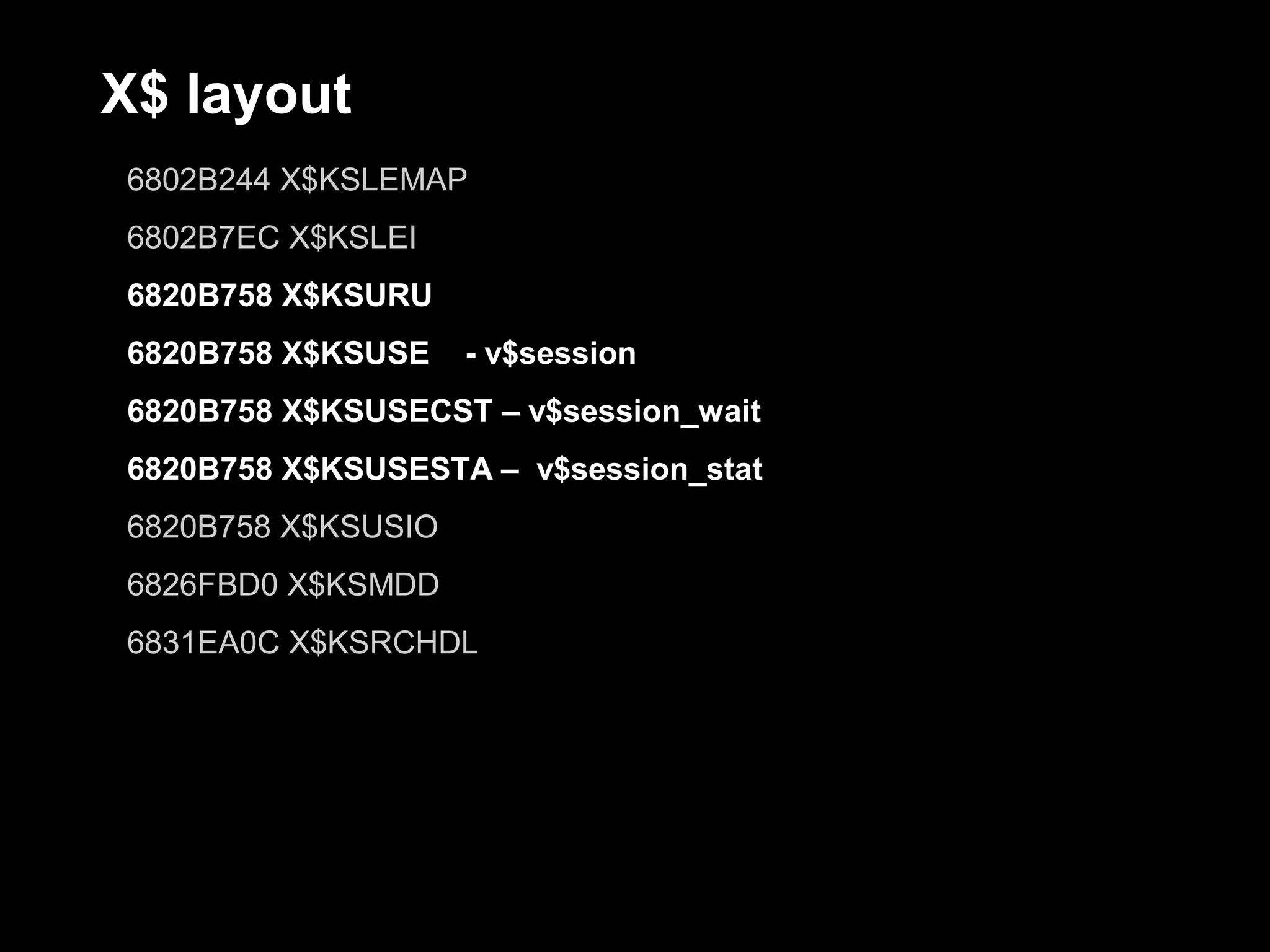
X$ layout
6802B244 X$KSLEMAP
6802B7EC X$KSLEI
6820B758 X$KSURU
6820B758 X$KSUSE    - v$session
6820B758 X$KSUSECST – v$session_wait
6820B758 X$KSUSESTA – v$session_stat
6820B758 X$KSUSIO
6826FBD0 X$KSMDD
6831EA0C X$KSRCHDL
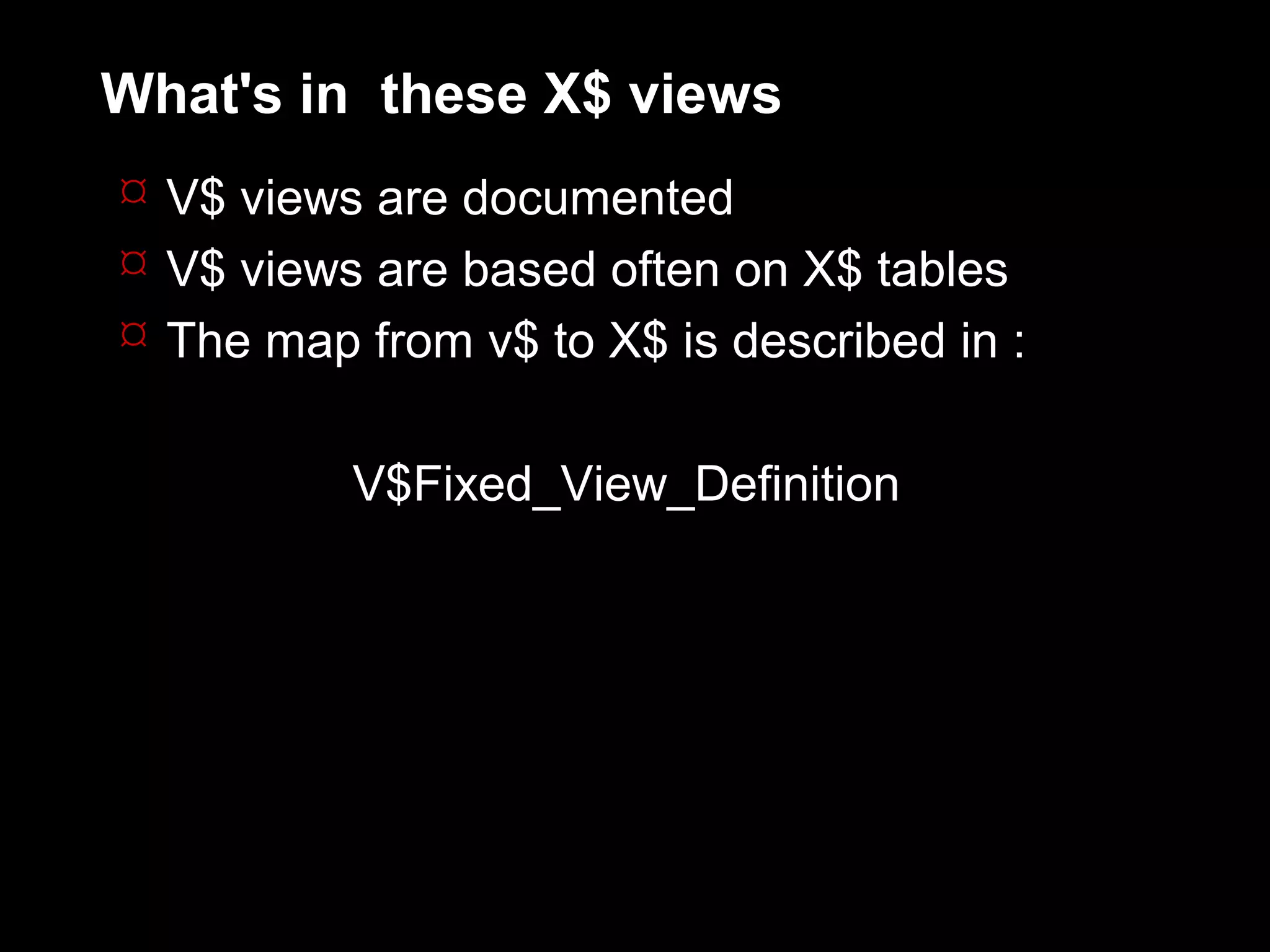
What's in these X$ views
 V$ views are documented
 V$ views are based often on X$ tables
 The map from v$ to X$ is described in :


          V$Fixed_View_Definition
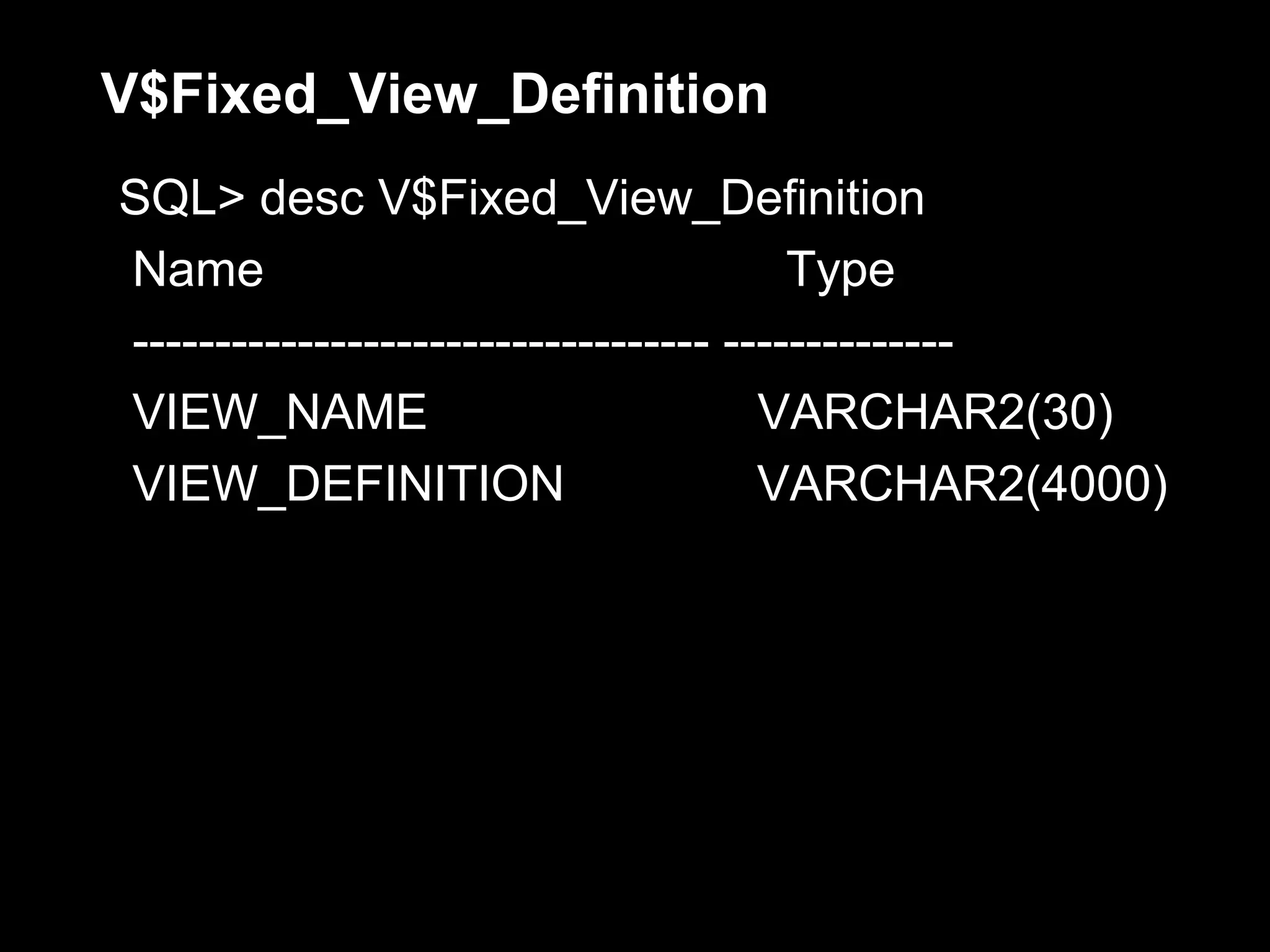
V$Fixed_View_Definition
SQL> desc V$Fixed_View_Definition
Name                                    Type
----------------------------------- --------------
VIEW_NAME                             VARCHAR2(30)
VIEW_DEFINITION                       VARCHAR2(4000)
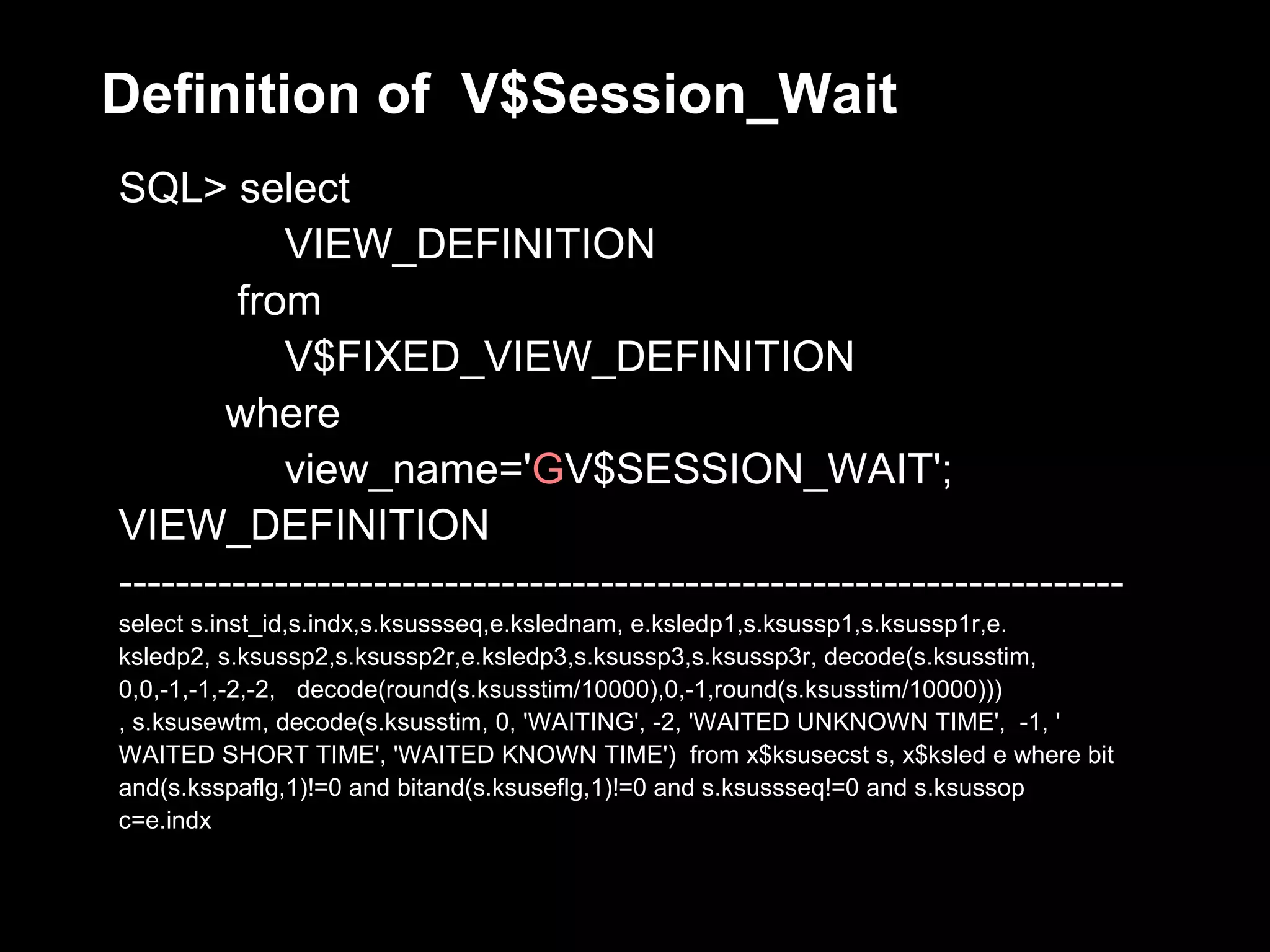
Definition of V$Session_Wait
SQL> select
            VIEW_DEFINITION
        from
            V$FIXED_VIEW_DEFINITION
        where
            view_name='GV$SESSION_WAIT';
VIEW_DEFINITION
-----------------------------------------------------------------------
select s.inst_id,s.indx,s.ksussseq,e.kslednam, e.ksledp1,s.ksussp1,s.ksussp1r,e.
ksledp2, s.ksussp2,s.ksussp2r,e.ksledp3,s.ksussp3,s.ksussp3r, decode(s.ksusstim,
0,0,-1,-1,-2,-2, decode(round(s.ksusstim/10000),0,-1,round(s.ksusstim/10000)))
, s.ksusewtm, decode(s.ksusstim, 0, 'WAITING', -2, 'WAITED UNKNOWN TIME', -1, '
WAITED SHORT TIME', 'WAITED KNOWN TIME') from x$ksusecst s, x$ksled e where bit
and(s.ksspaflg,1)!=0 and bitand(s.ksuseflg,1)!=0 and s.ksussseq!=0 and s.ksussop
c=e.indx
The Fields in X$ tables
 OK, I've picked an X$
 I've got the starting address
 Now, how do I get the fields?
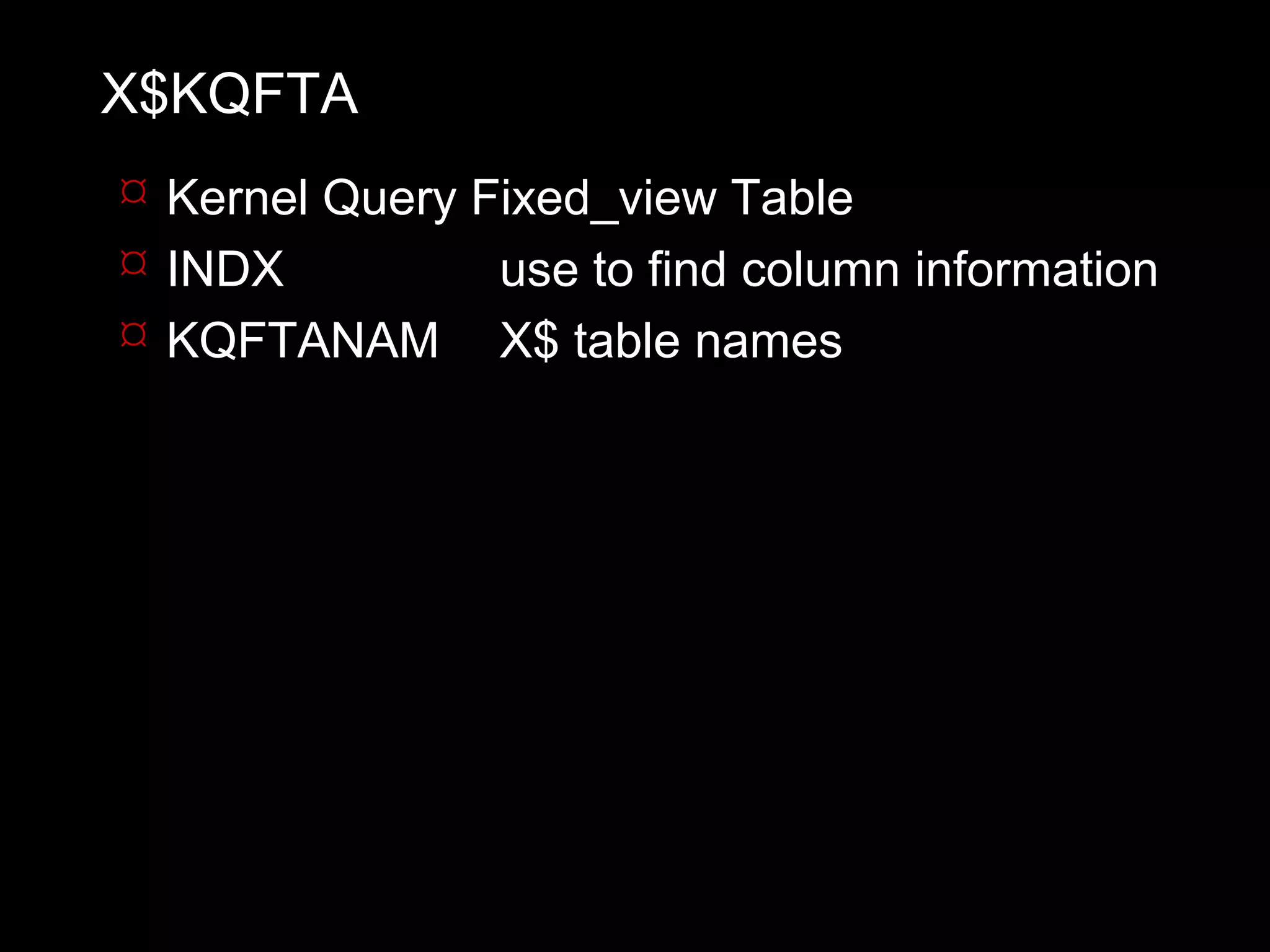
X$KQFTA
 Kernel Query Fixed_view Table
 INDX          use to find column information
 KQFTANAM X$ table names
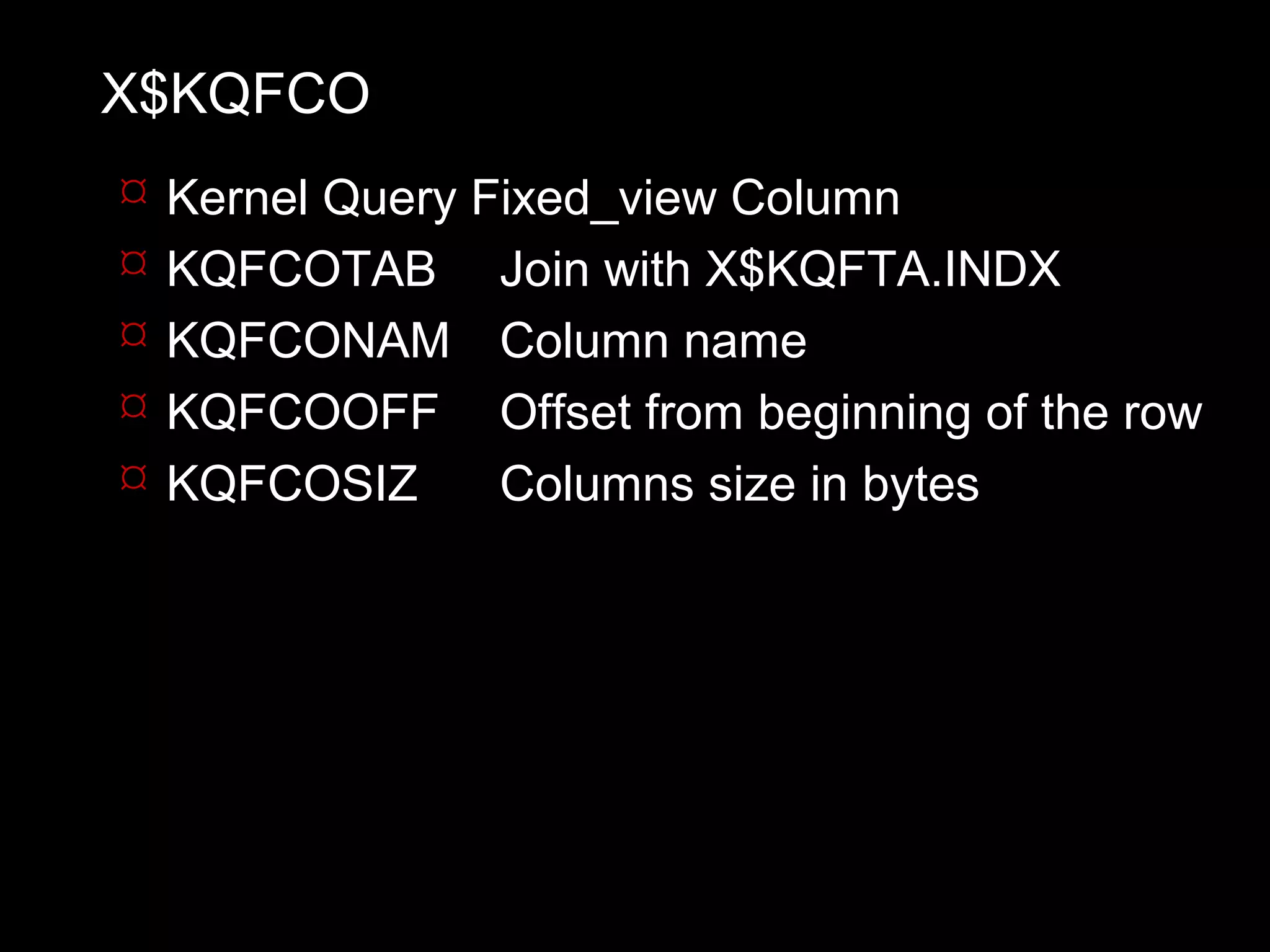
X$KQFCO
   Kernel Query Fixed_view Column
   KQFCOTAB Join with X$KQFTA.INDX
   KQFCONAM Column name
   KQFCOOFF Offset from beginning of the row
   KQFCOSIZ      Columns size in bytes
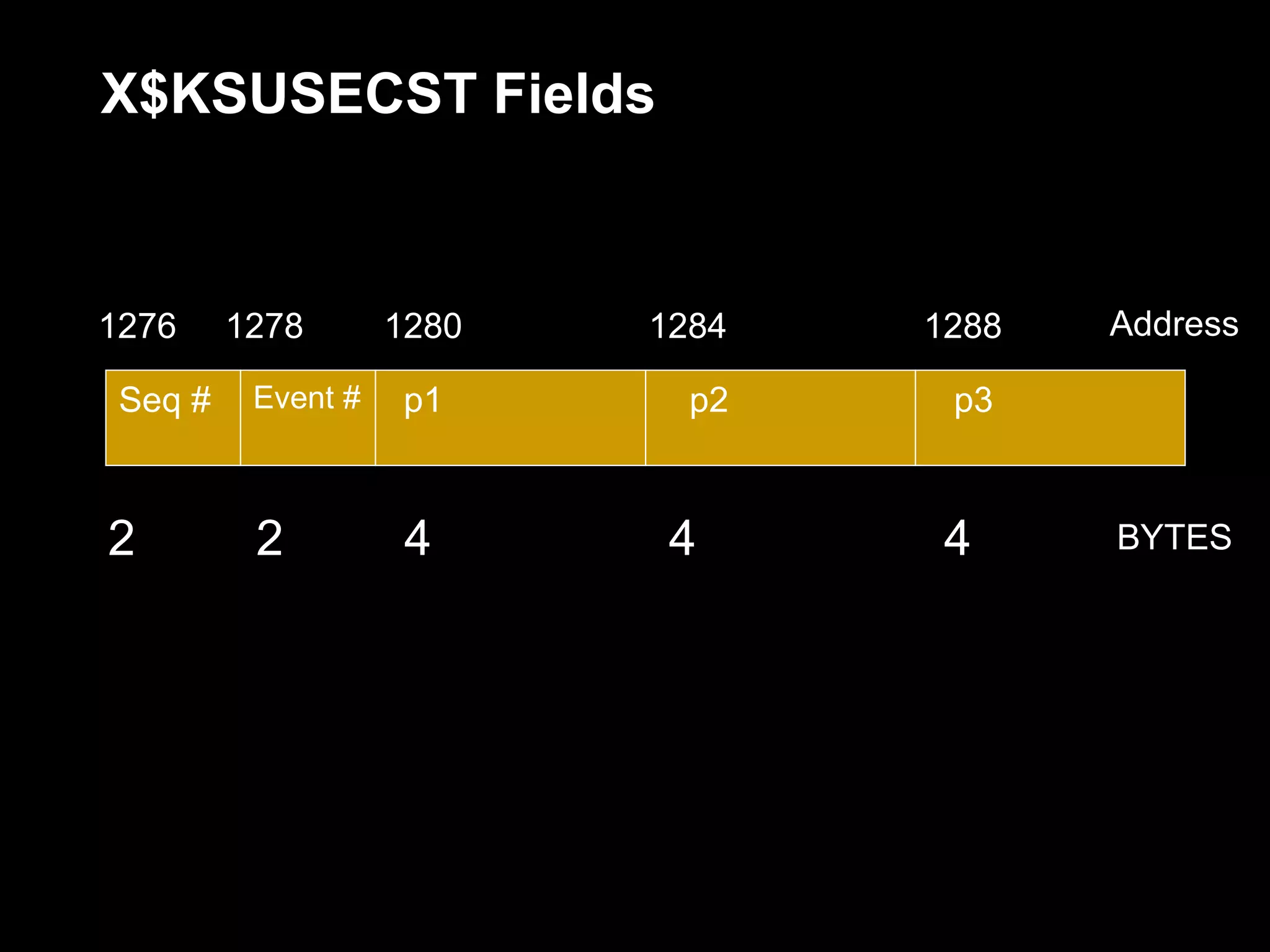
X$KSUSECST Fields


1276     1278       1280   1284   1288   Address

 Seq #    Event #    p1      p2    p3


2         2          4      4      4     BYTES
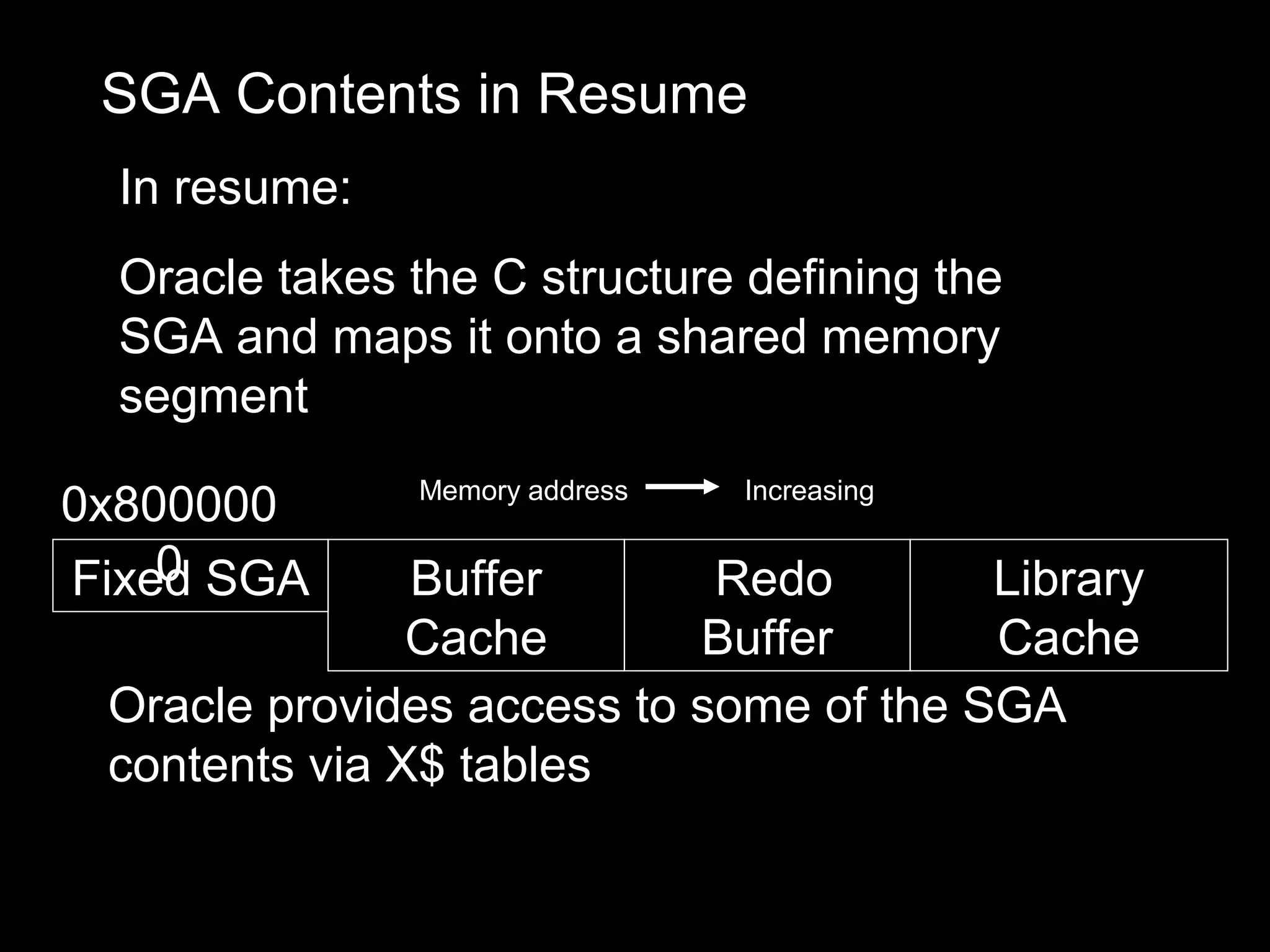
SGA Contents in Resume
  In resume:
  Oracle takes the C structure defining the
  SGA and maps it onto a shared memory
  segment
               Memory address   Increasing
0x800000
    0
Fixed SGA      Buffer       Redo        Library
               Cache       Buffer       Cache
 Oracle provides access to some of the SGA
 contents via X$ tables
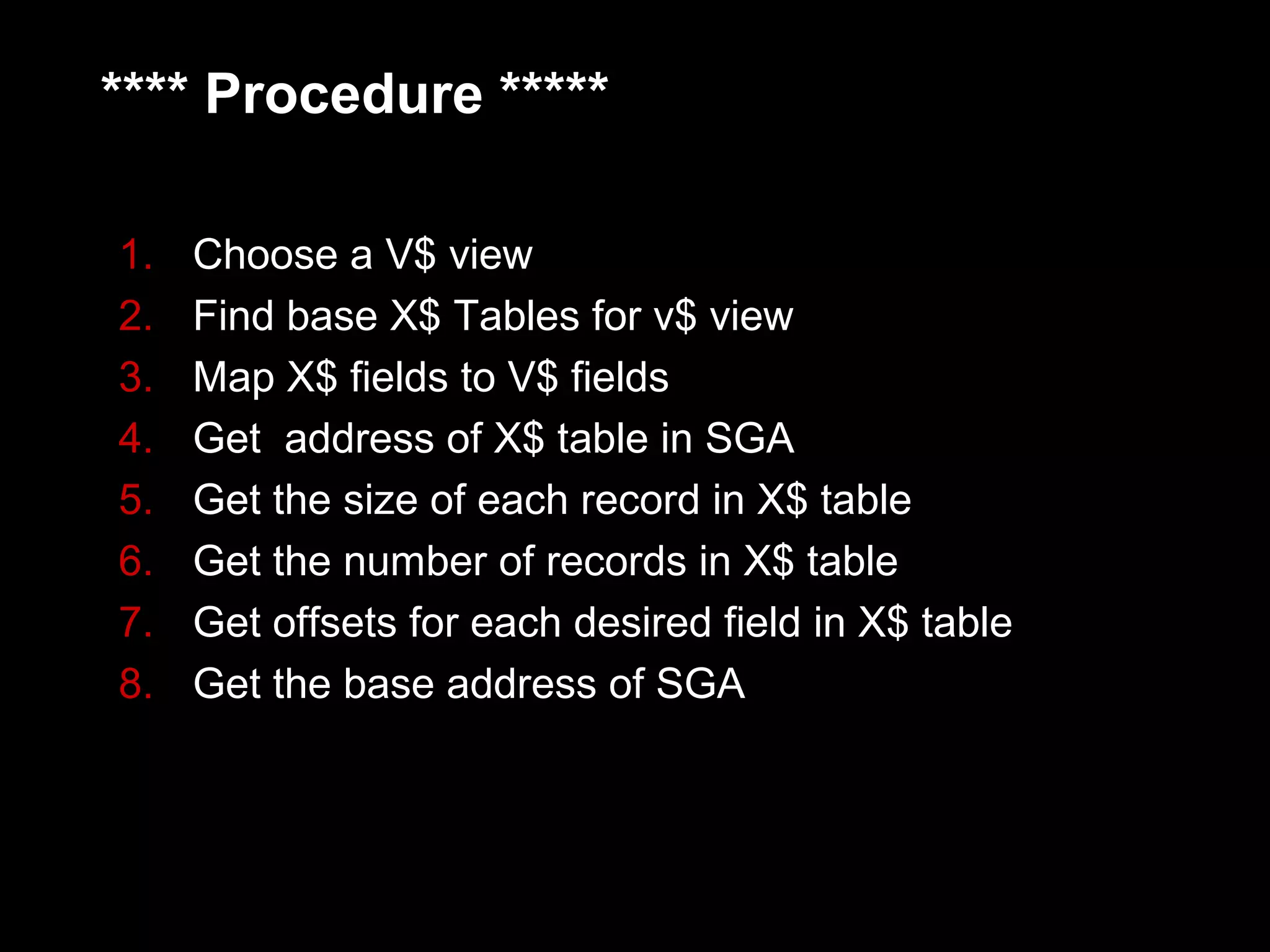
**** Procedure *****

1.   Choose a V$ view
2.   Find base X$ Tables for v$ view
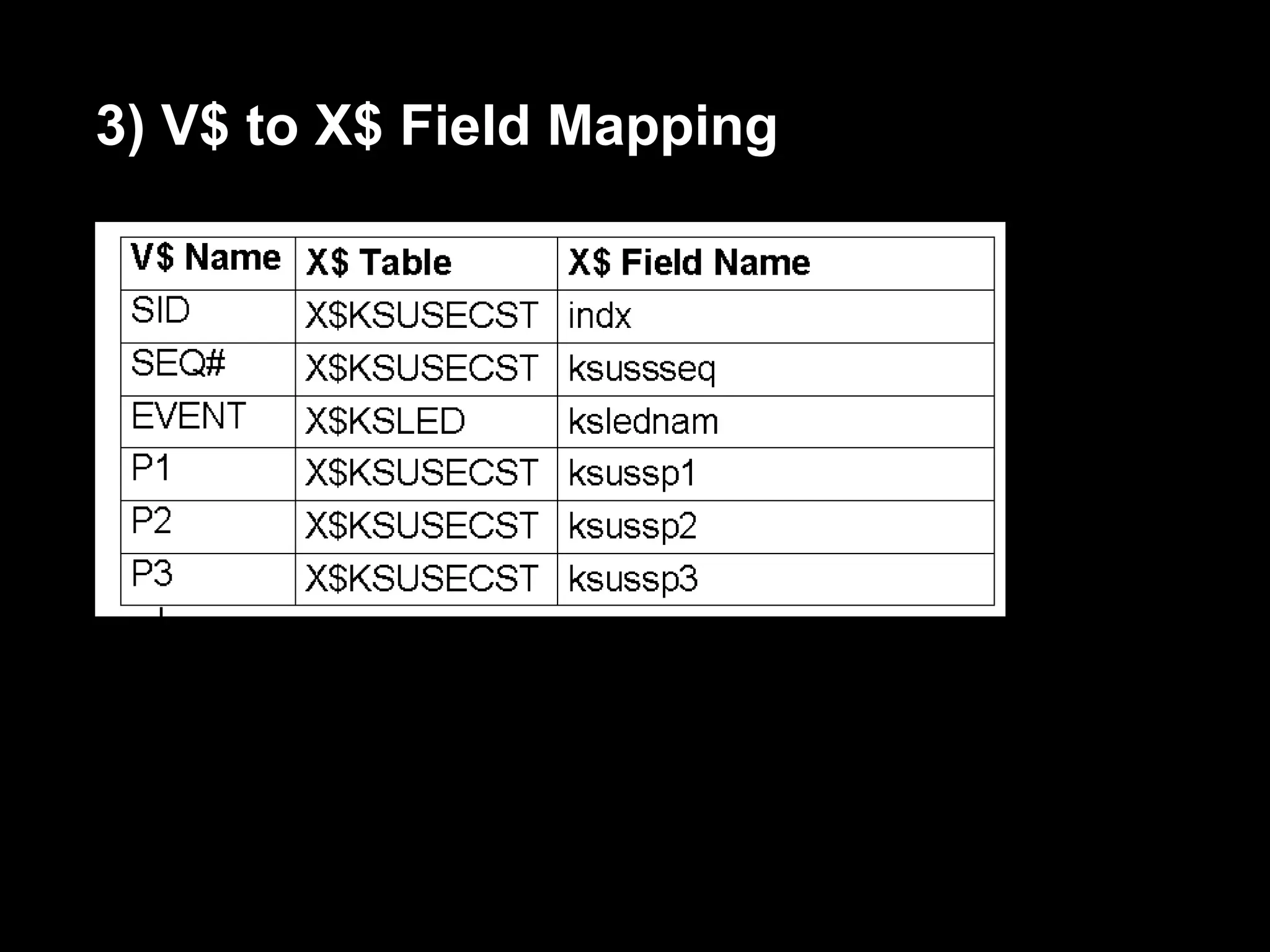
3.   Map X$ fields to V$ fields
4.   Get address of X$ table in SGA
5.   Get the size of each record in X$ table
6.   Get the number of records in X$ table
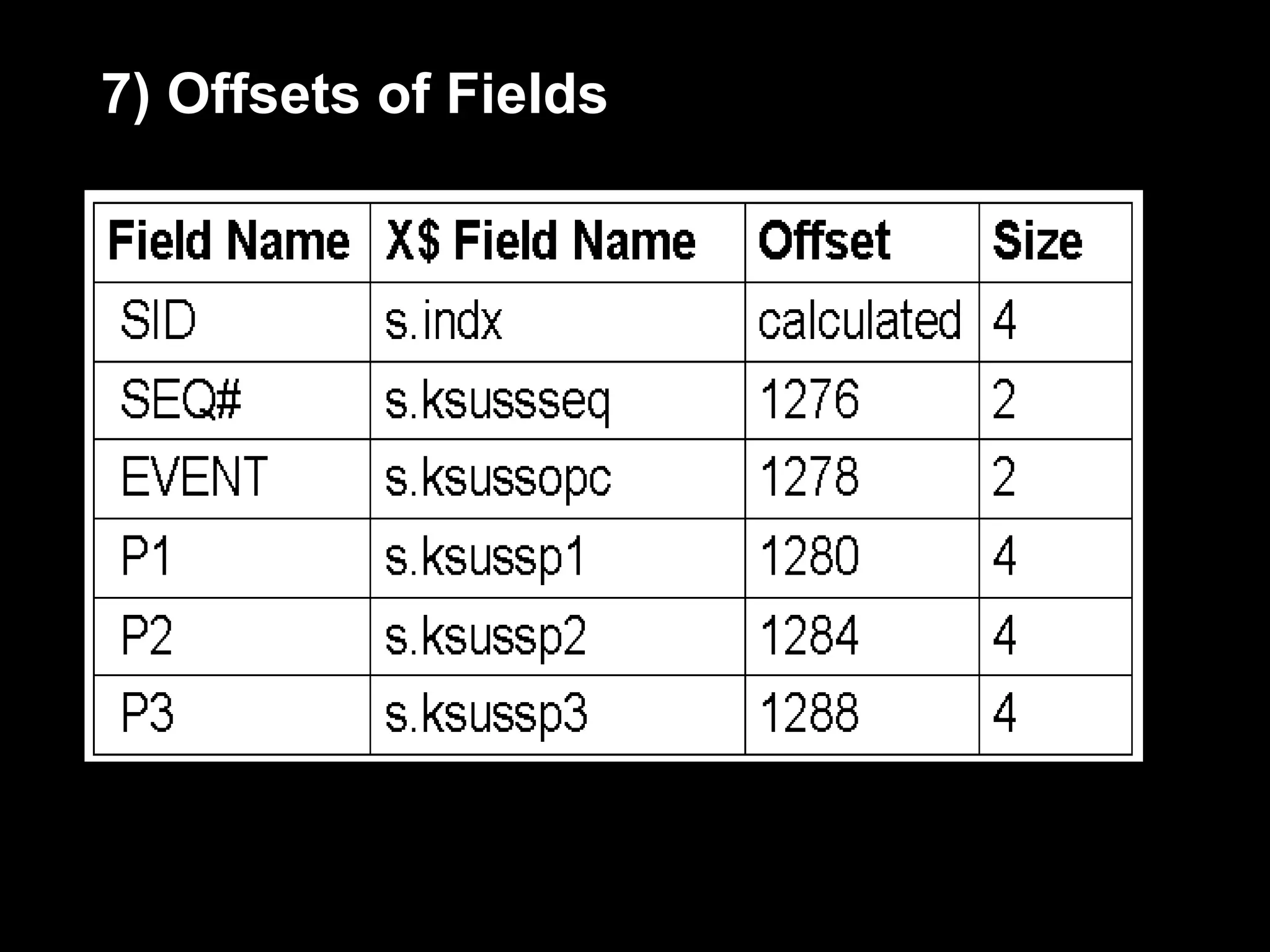
7.   Get offsets for each desired field in X$ table
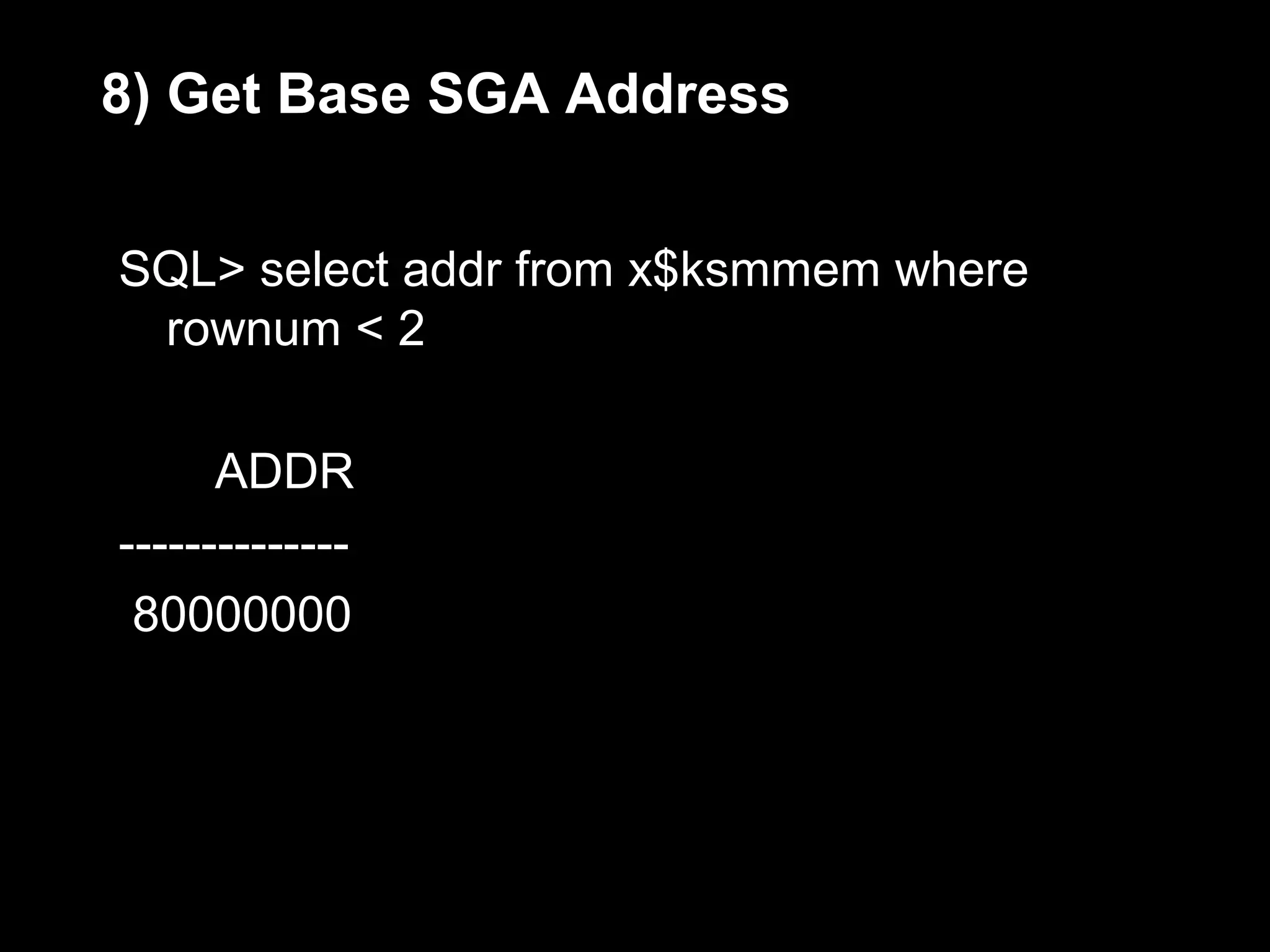
8.   Get the base address of SGA
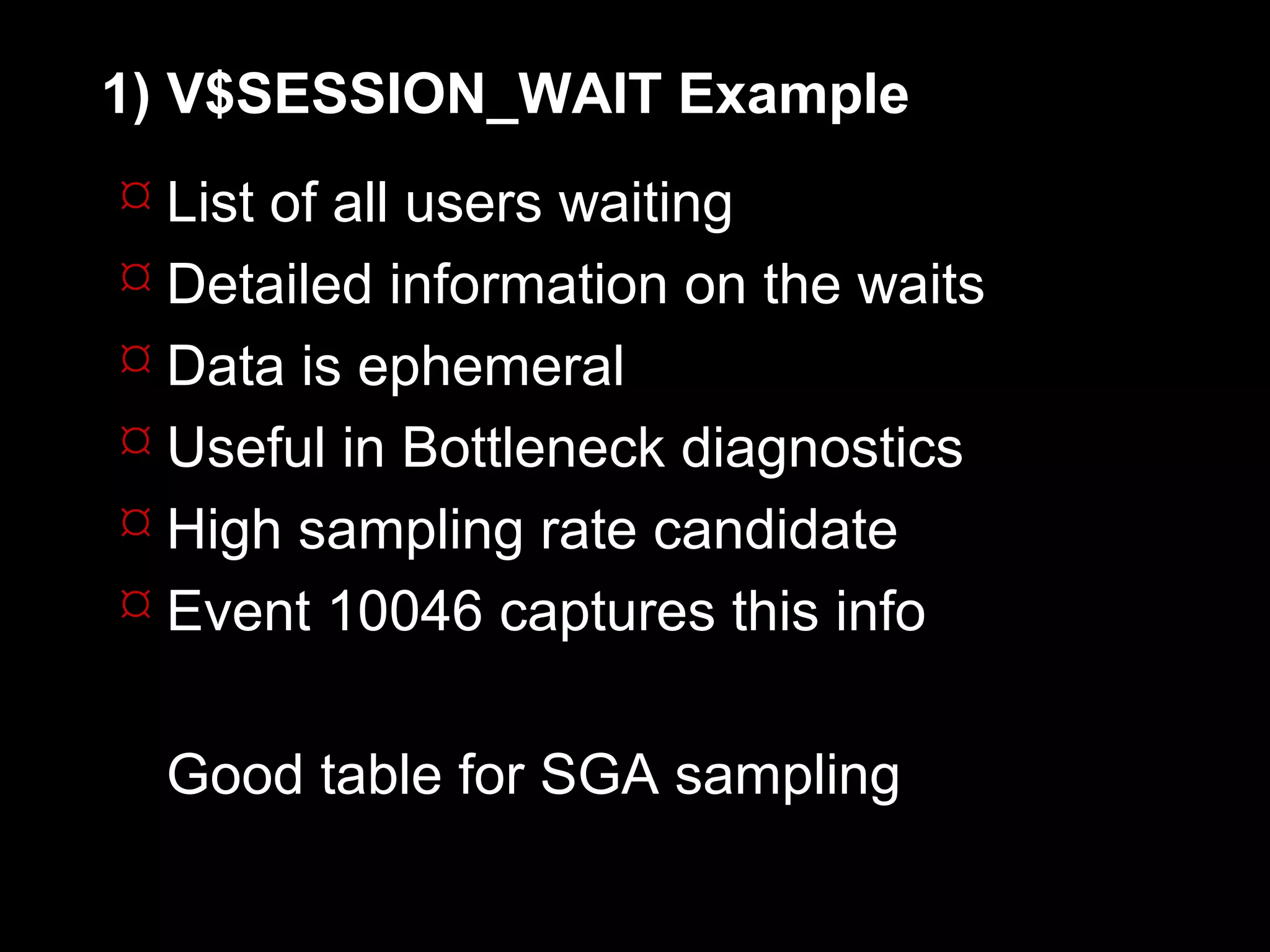
1) V$SESSION_WAIT Example
 List of all users waiting
 Detailed information on the waits
 Data is ephemeral
 Useful in Bottleneck diagnostics
 High sampling rate candidate
 Event 10046 captures this info


  Good table for SGA sampling
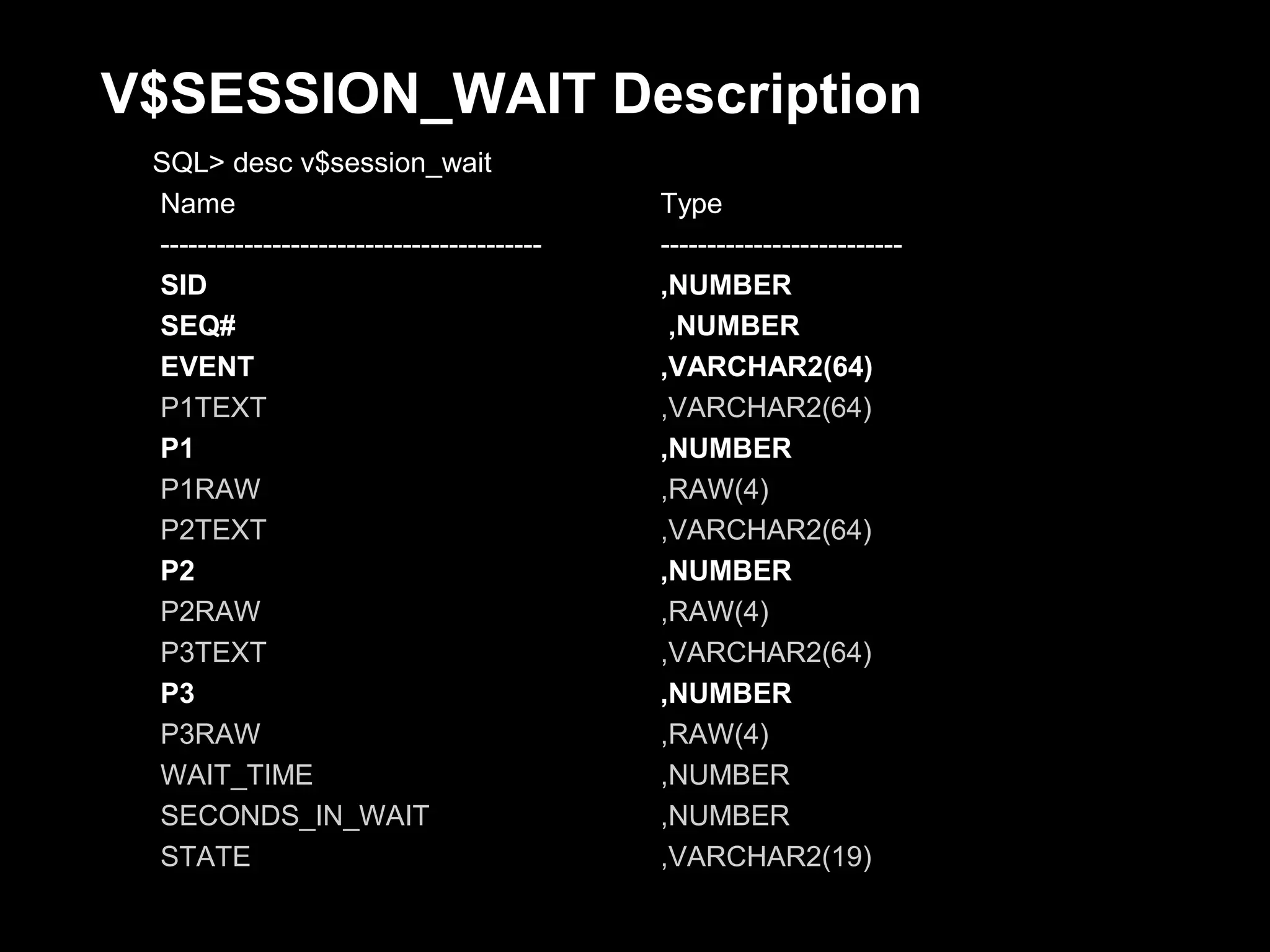
V$SESSION_WAIT Description
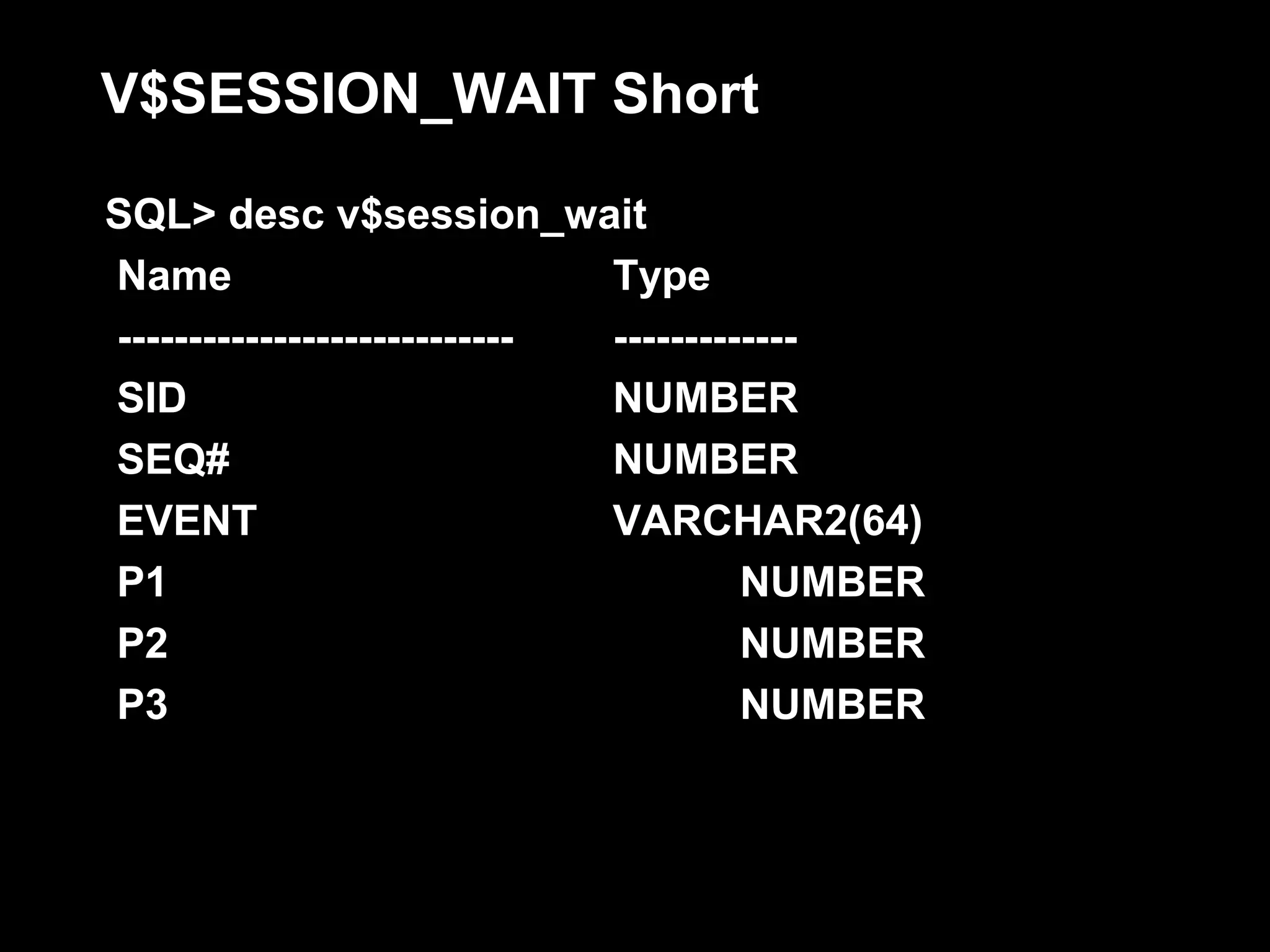
 SQL> desc v$session_wait
 Name                                        Type
 -----------------------------------------   --------------------------
 SID                                         ,NUMBER
 SEQ#                                         ,NUMBER
 EVENT                                       ,VARCHAR2(64)
 P1TEXT                                      ,VARCHAR2(64)
 P1                                          ,NUMBER
 P1RAW                                       ,RAW(4)
 P2TEXT                                      ,VARCHAR2(64)
 P2                                          ,NUMBER
 P2RAW                                       ,RAW(4)
 P3TEXT                                      ,VARCHAR2(64)
 P3                                          ,NUMBER
 P3RAW                                       ,RAW(4)
 WAIT_TIME                                   ,NUMBER
 SECONDS_IN_WAIT                             ,NUMBER
 STATE                                       ,VARCHAR2(19)
 )
V$SESSION_WAIT Short

SQL> desc v$session_wait
Name                         Type
---------------------------- -------------
SID                          NUMBER
SEQ#                         NUMBER
EVENT                        VARCHAR2(64)
P1                                    NUMBER
P2                                    NUMBER
P3                                    NUMBER)
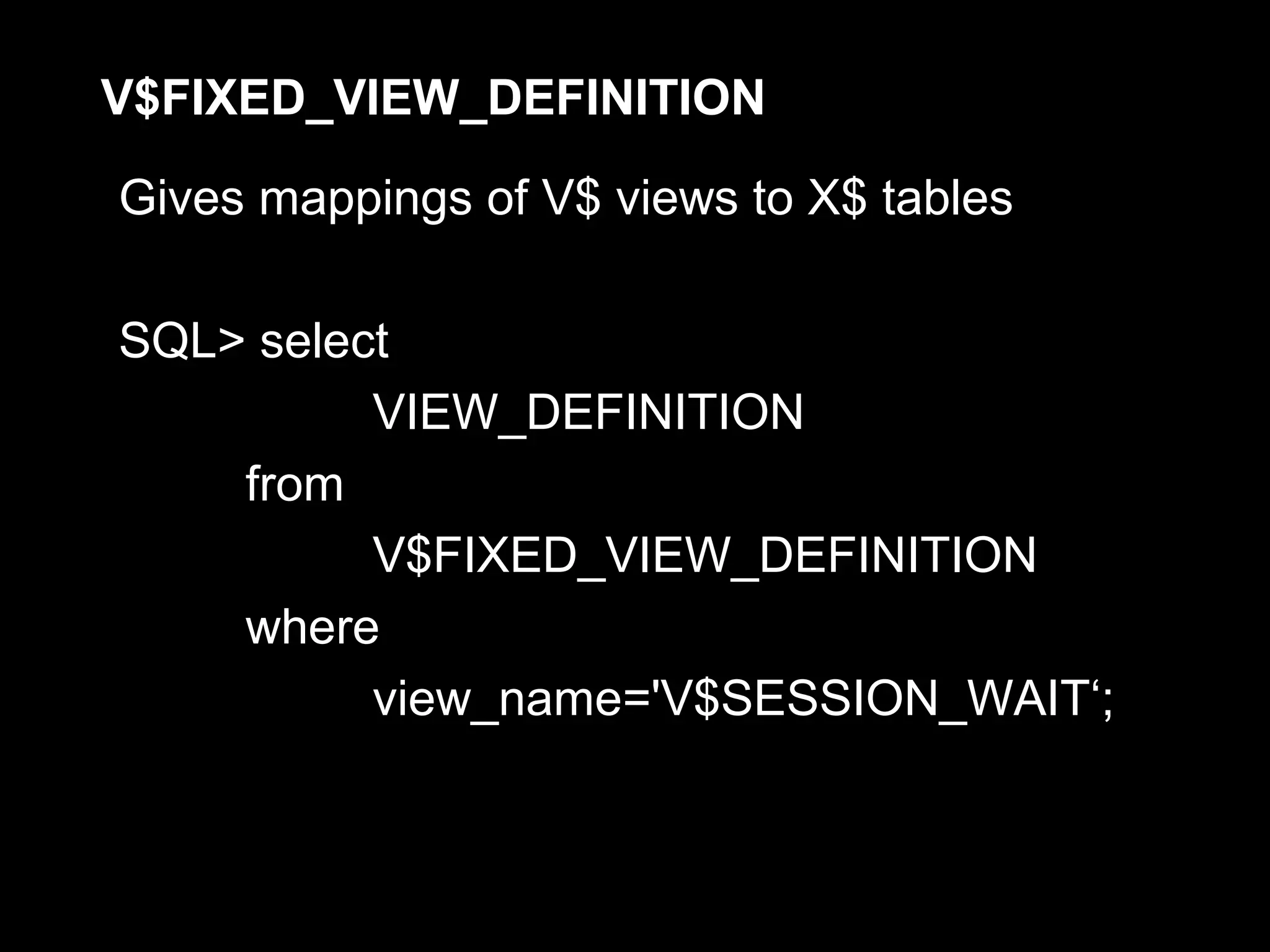
V$FIXED_VIEW_DEFINITION

Gives mappings of V$ views to X$ tables

SQL> select
          VIEW_DEFINITION
    from
          V$FIXED_VIEW_DEFINITION
    where
          view_name='V$SESSION_WAIT‘;
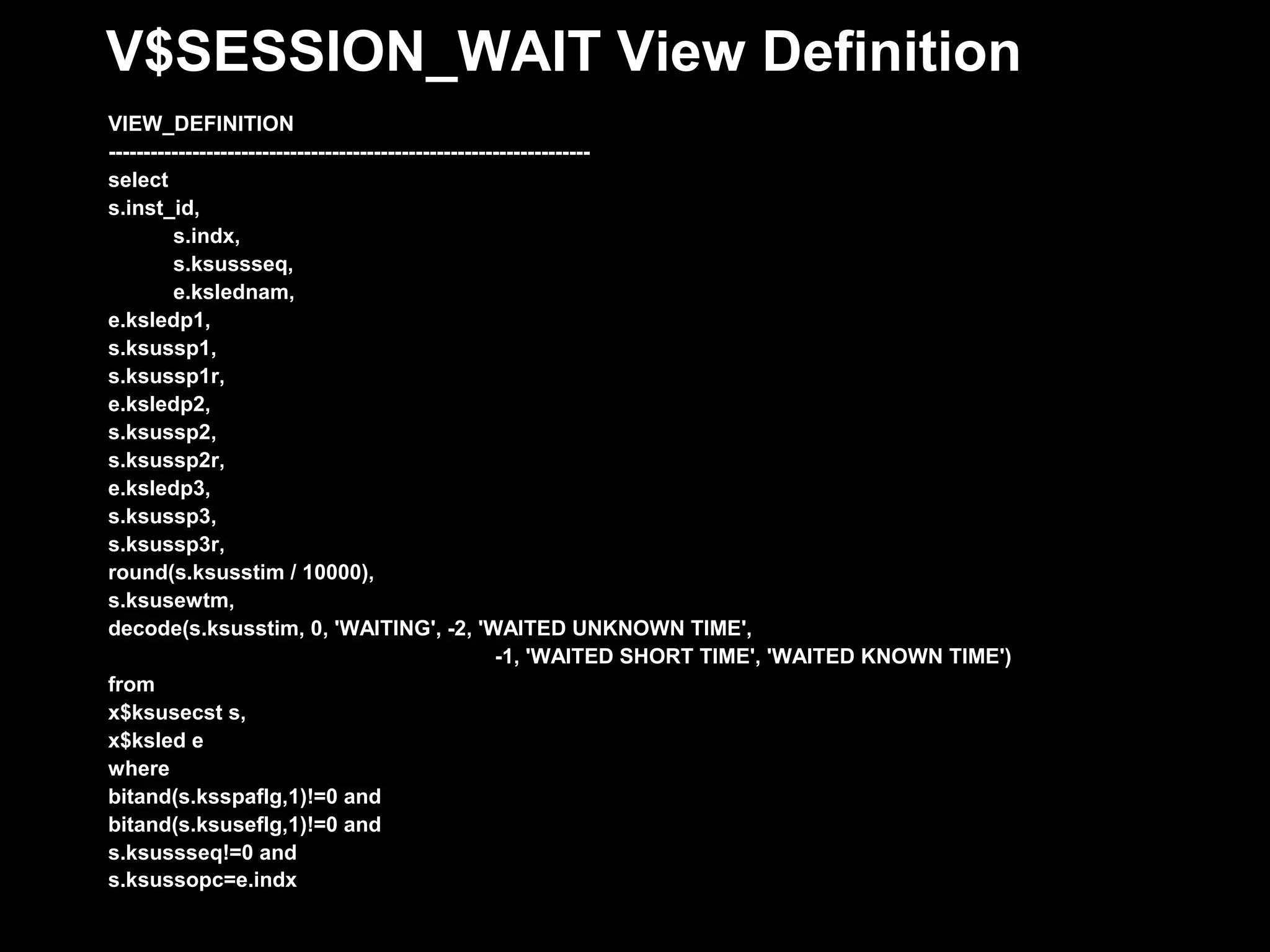
V$SESSION_WAIT View Definition
VIEW_DEFINITION
---------------------------------------------------------------------
select
s.inst_id,
         s.indx,
         s.ksussseq,
         e.kslednam,
e.ksledp1,
s.ksussp1,
s.ksussp1r,
e.ksledp2,
s.ksussp2,
s.ksussp2r,
e.ksledp3,
s.ksussp3,
s.ksussp3r,
round(s.ksusstim / 10000),
s.ksusewtm,
decode(s.ksusstim, 0, 'WAITING', -2, 'WAITED UNKNOWN TIME',
                                                       -1, 'WAITED SHORT TIME', 'WAITED KNOWN TIME')
from
x$ksusecst s,
x$ksled e
where
bitand(s.ksspaflg,1)!=0 and
bitand(s.ksuseflg,1)!=0 and
s.ksussseq!=0 and
s.ksussopc=e.indx
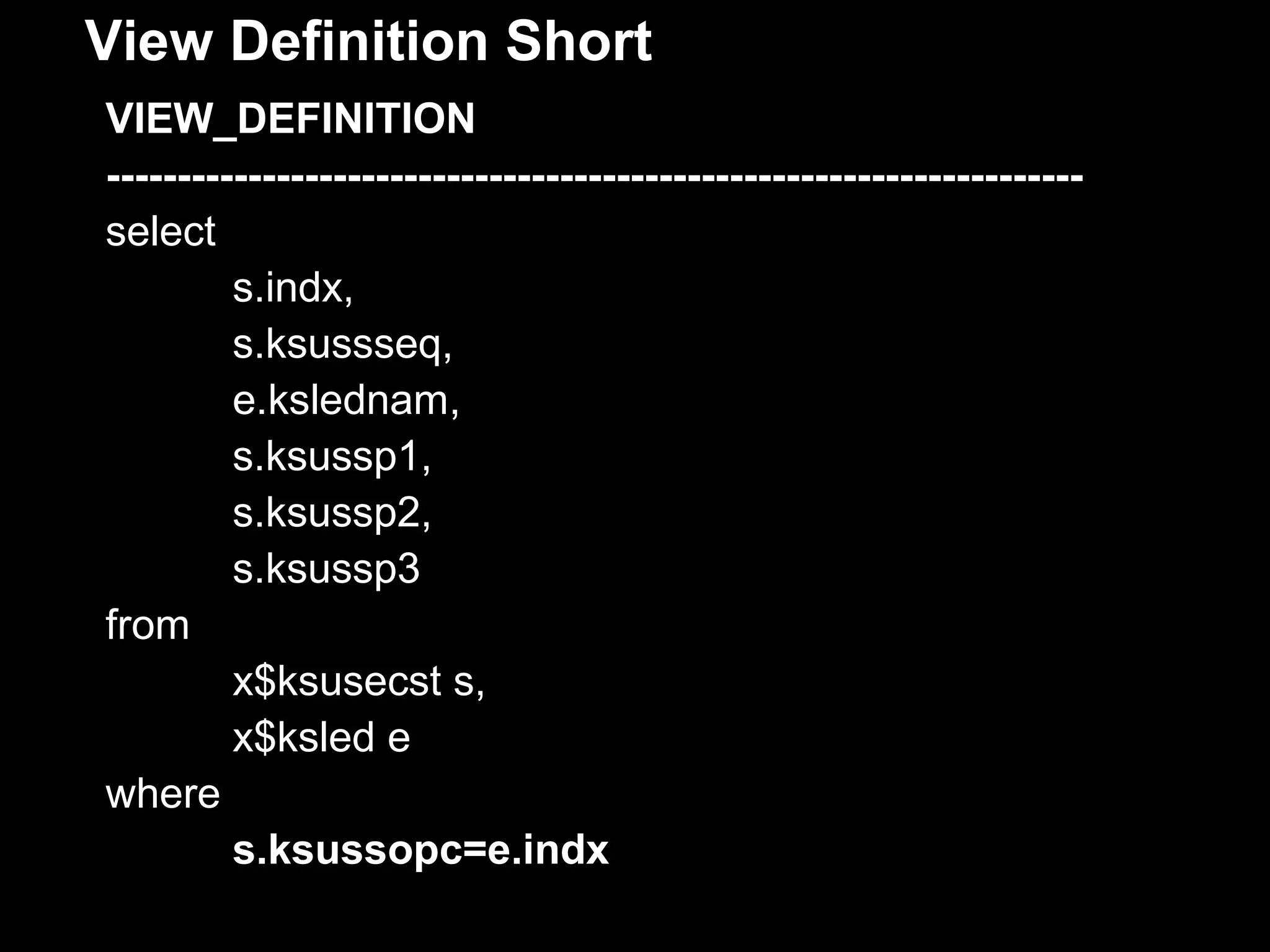
View Definition Short
VIEW_DEFINITION
---------------------------------------------------------------------
select
         s.indx,
         s.ksussseq,
         e.kslednam,
         s.ksussp1,
         s.ksussp2,
         s.ksussp3
from
         x$ksusecst s,
         x$ksled e
where
         s.ksussopc=e.indx
2) V$SESSION_WAIT Based on
X$KSUSECT
 VIEW_DEFINITION
 ---------------------------------------------------
 -
 select
          indx,
          ksussseq,
          ksussopc,
          ksussp1,
          ksussp2,
          ksussp3
 from
          x$ksusecst
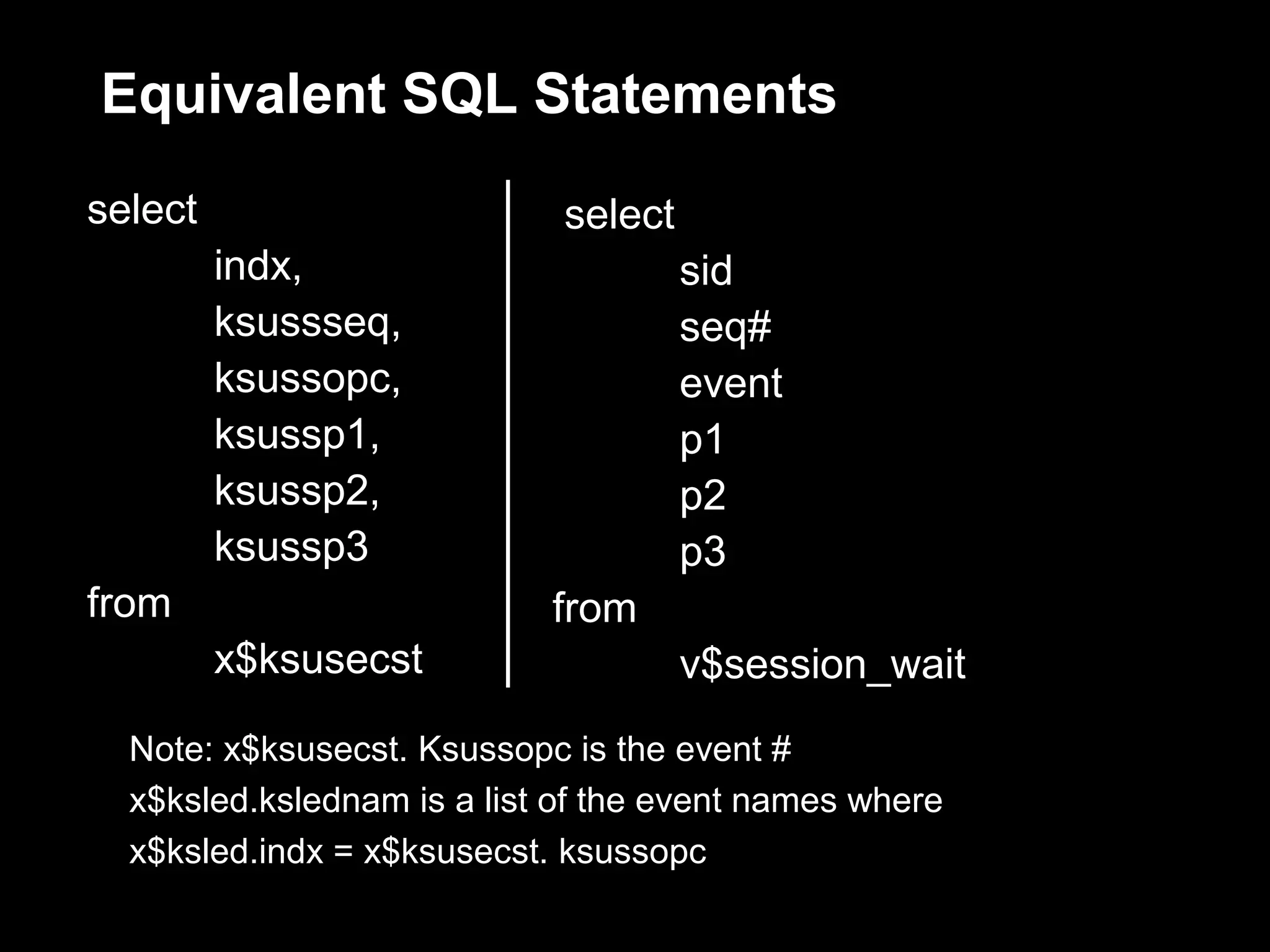
Equivalent SQL Statements
select                       select
         indx,                        sid
         ksussseq,                    seq#
         ksussopc,                    event
         ksussp1,                     p1
         ksussp2,                     p2
         ksussp3                      p3
from                        from
         x$ksusecst                   v$session_wait )
  Note: x$ksusecst. Ksussopc is the event #
  x$ksled.kslednam is a list of the event names where
  x$ksled.indx = x$ksusecst. ksussopc
3) V$ to X$ Field Mapping
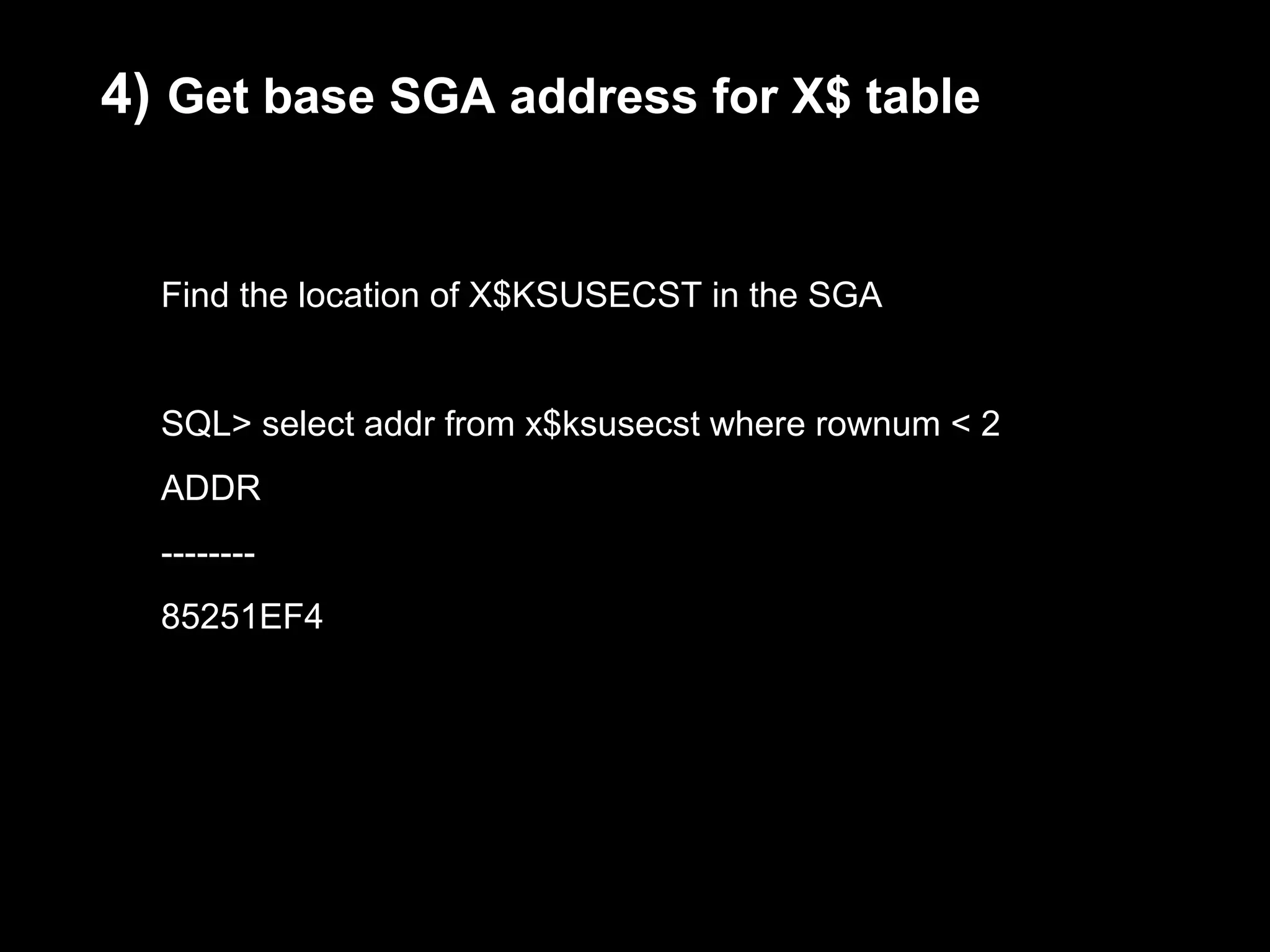
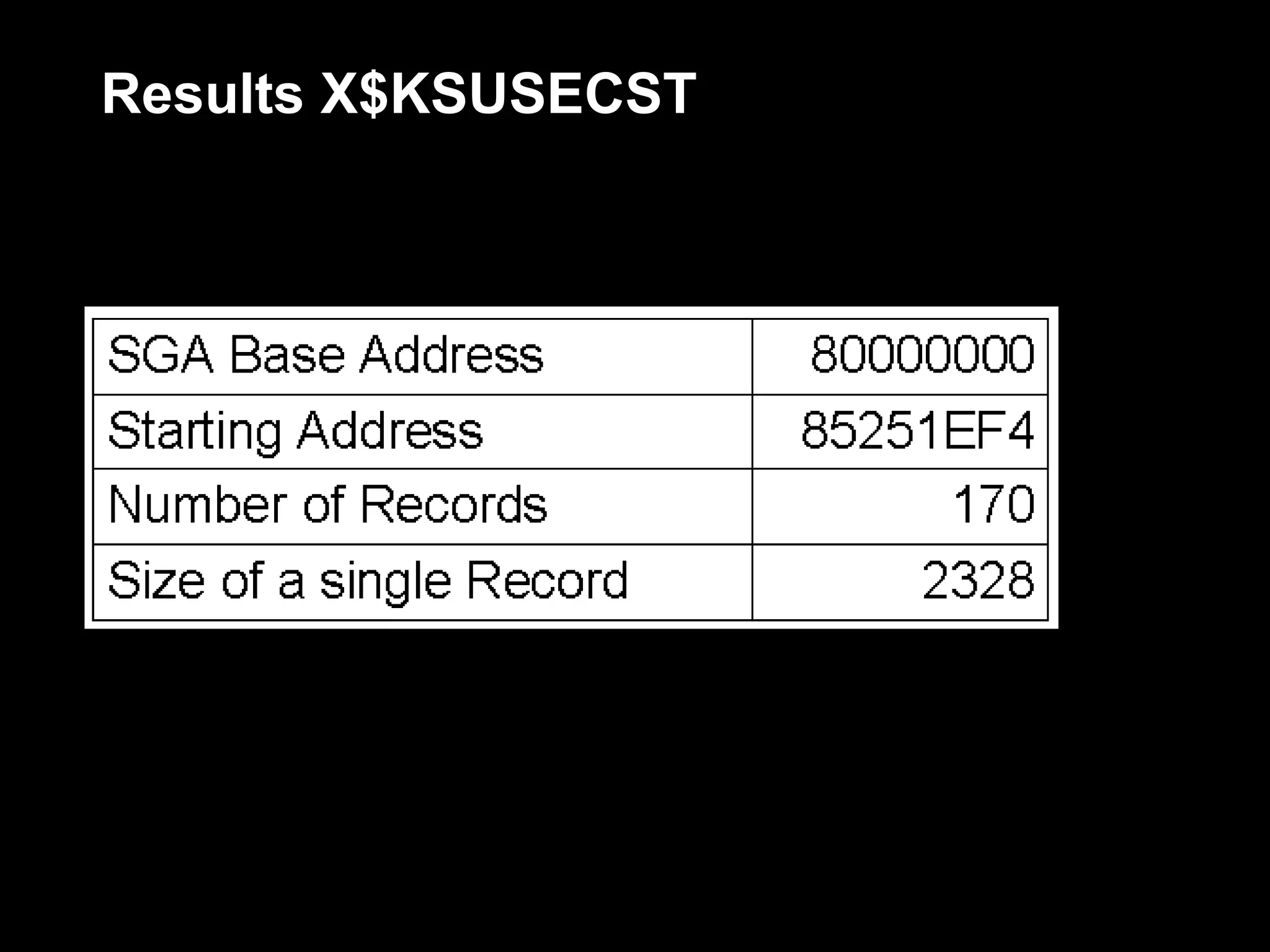
4) Get base SGA address for X$ table


  Find the location of X$KSUSECST in the SGA


  SQL> select addr from x$ksusecst where rownum < 2
  ADDR
  --------
  85251EF4
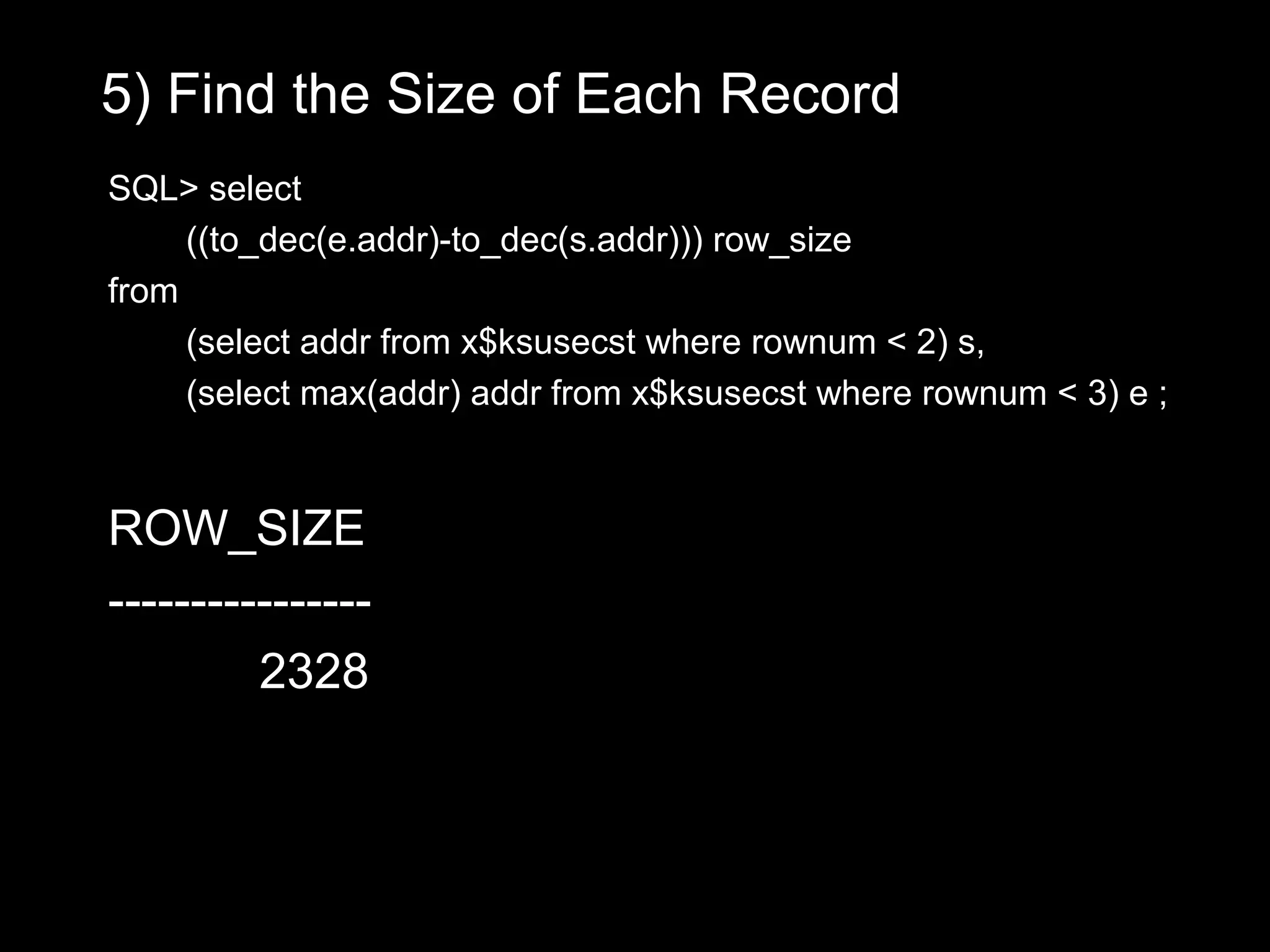
5) Find the Size of Each Record
SQL> select
     ((to_dec(e.addr)-to_dec(s.addr))) row_size
from
     (select addr from x$ksusecst where rownum < 2) s,
     (select max(addr) addr from x$ksusecst where rownum < 3) e ;


ROW_SIZE
----------------
         2328
6) Find the Number of Records in the
 structure
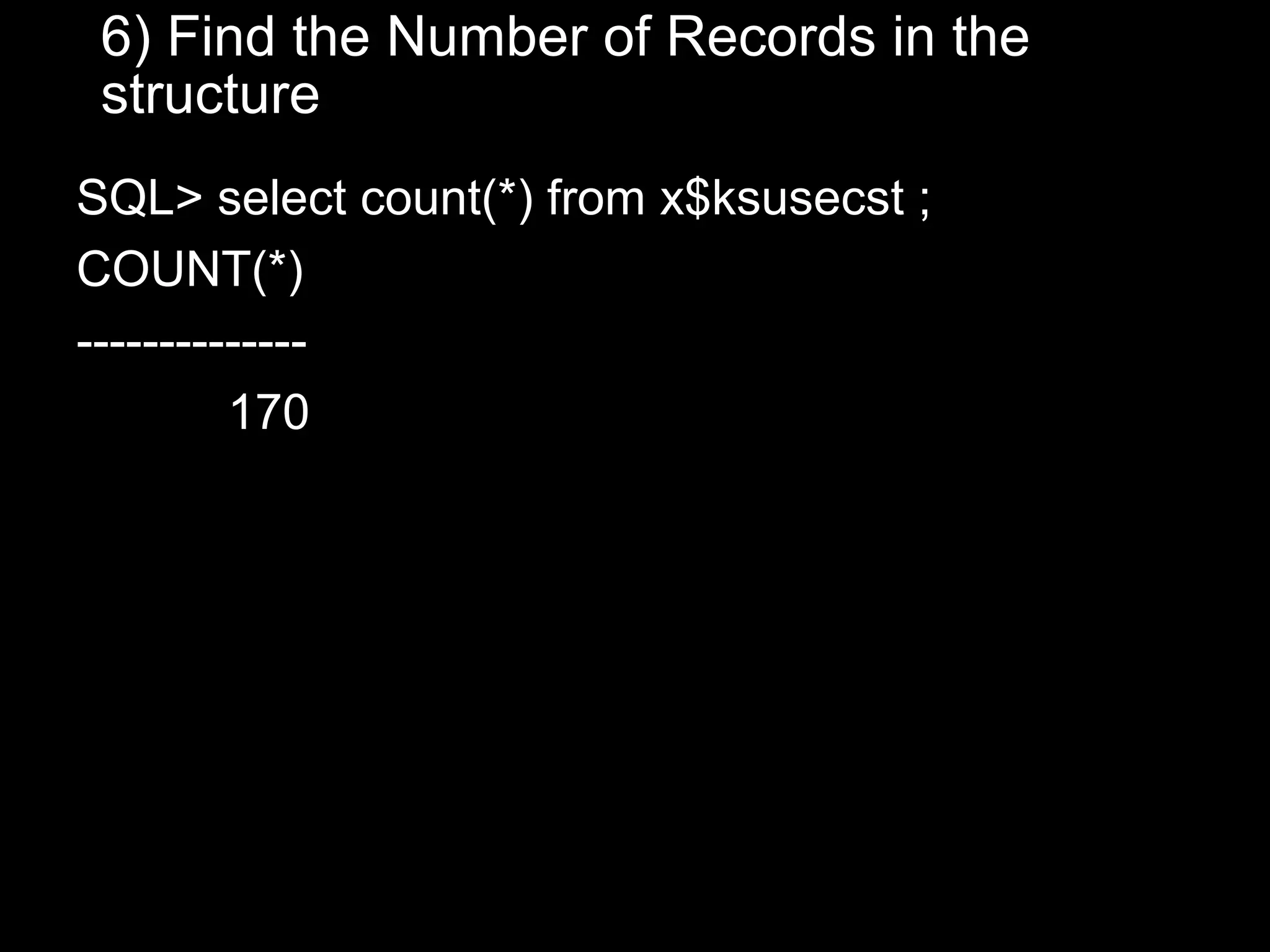
SQL> select count(*) from x$ksusecst ;
COUNT(*)
--------------
         170
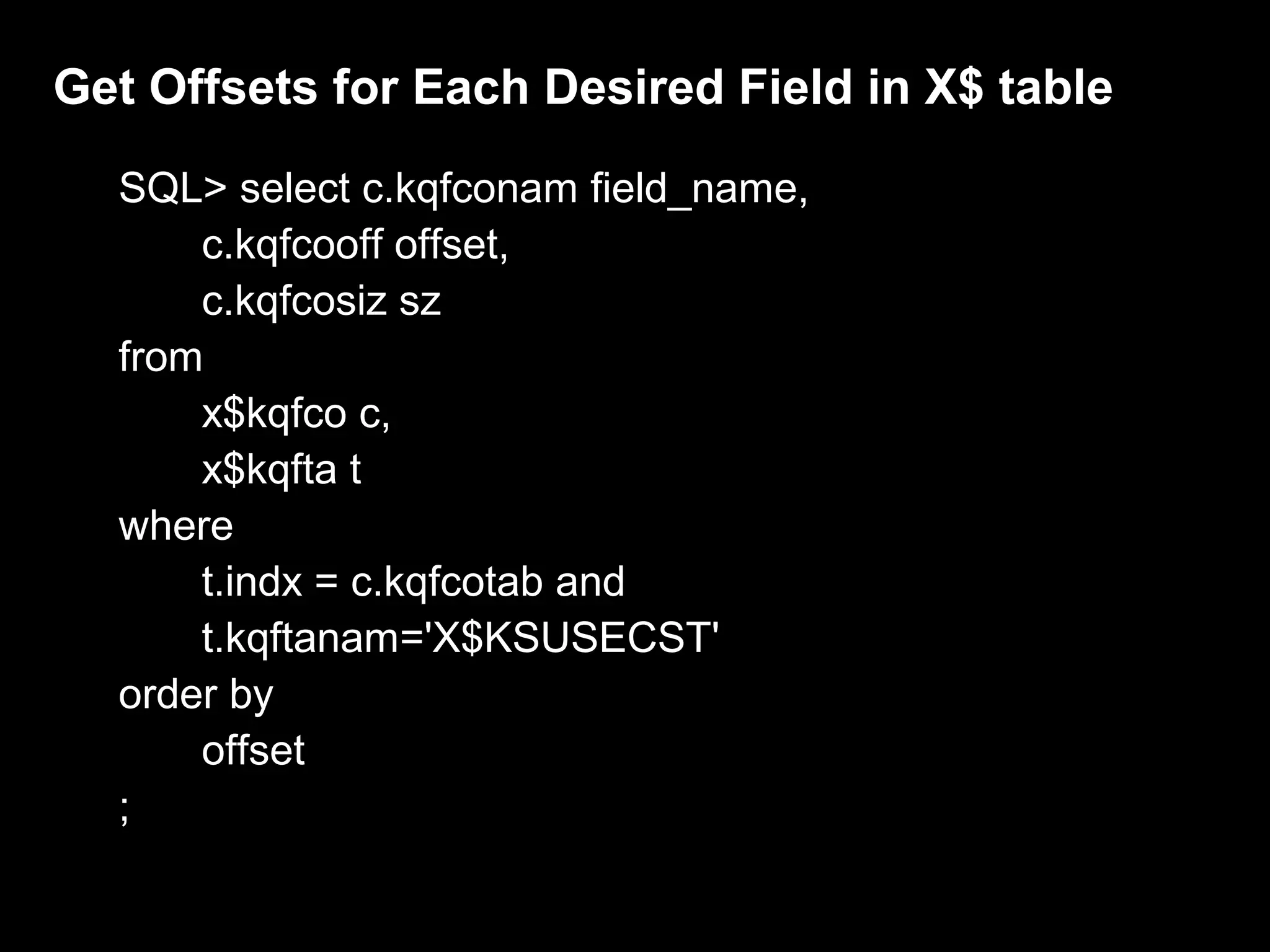
Get Offsets for Each Desired Field in X$ table
  SQL> select c.kqfconam field_name,
      c.kqfcooff offset,
      c.kqfcosiz sz
  from
      x$kqfco c,
      x$kqfta t
  where
      t.indx = c.kqfcotab and
      t.kqftanam='X$KSUSECST'
  order by
      offset
  ;
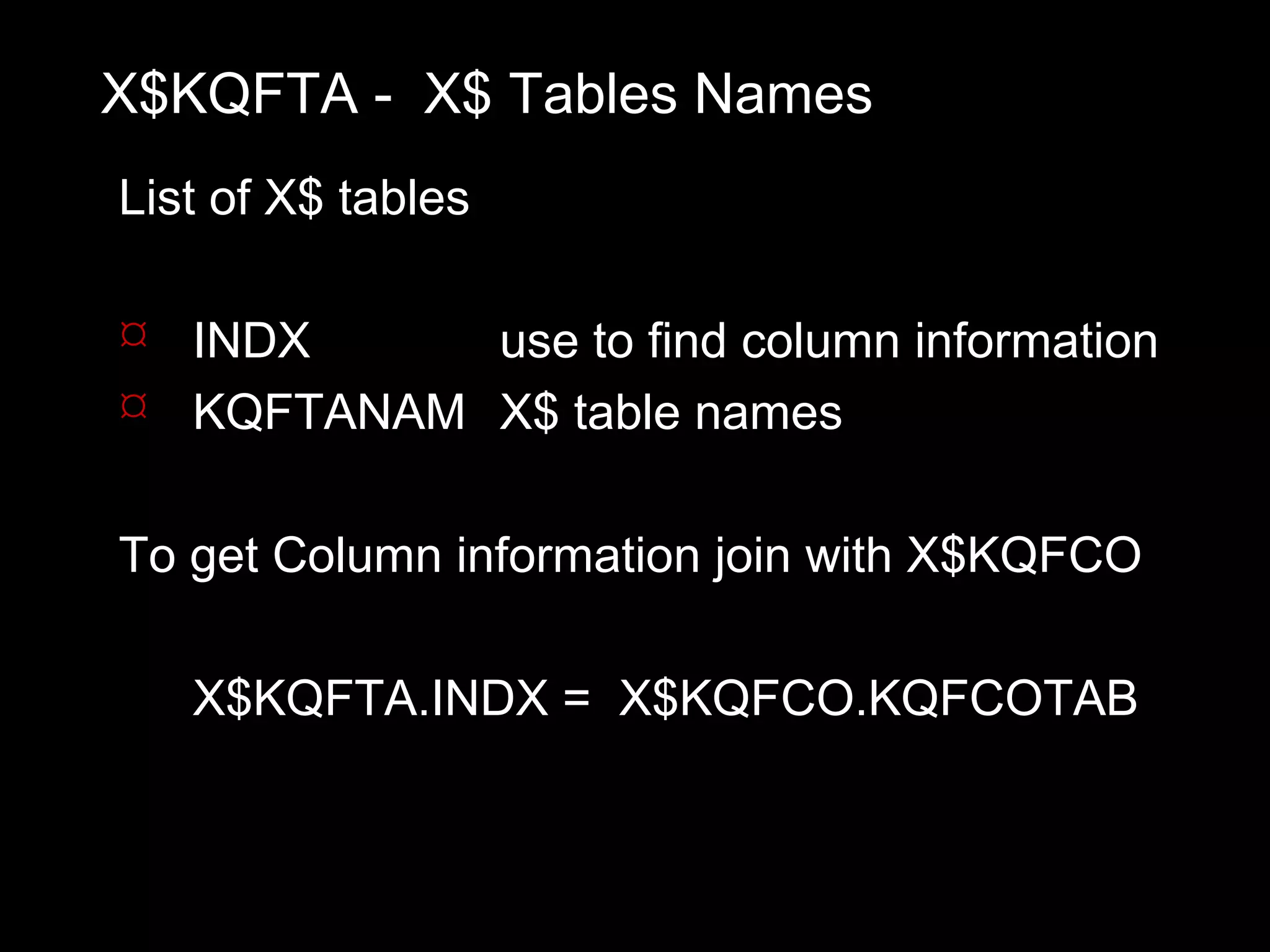
X$KQFTA - X$ Tables Names
List of X$ tables

 INDX     use to find column information
 KQFTANAM X$ table names


To get Column information join with X$KQFCO

   X$KQFTA.INDX = X$KQFCO.KQFCOTAB
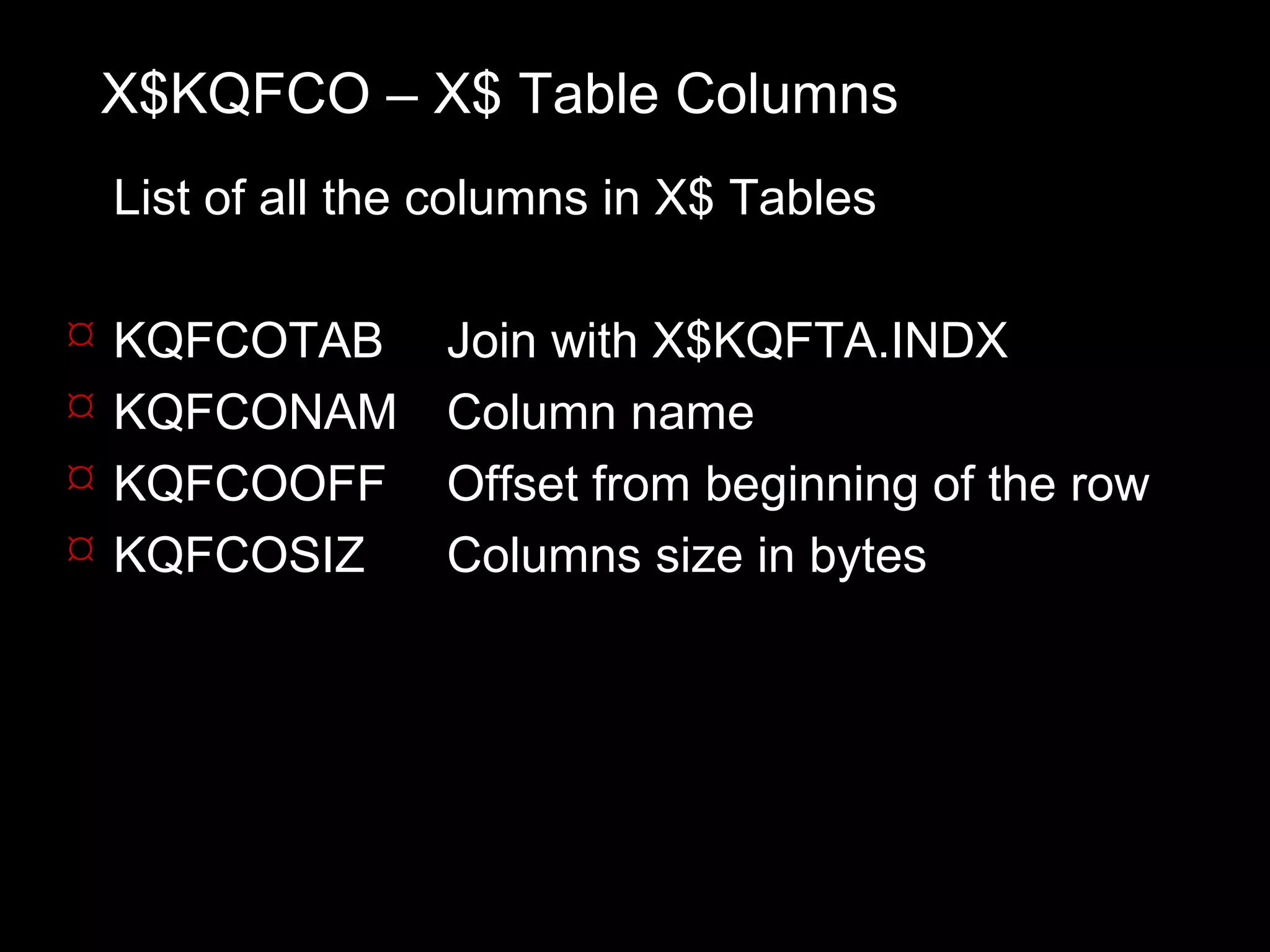
X$KQFCO – X$ Table Columns
    List of all the columns in X$ Tables

   KQFCOTAB       Join with X$KQFTA.INDX
   KQFCONAM       Column name
   KQFCOOFF       Offset from beginning of the row
   KQFCOSIZ       Columns size in bytes
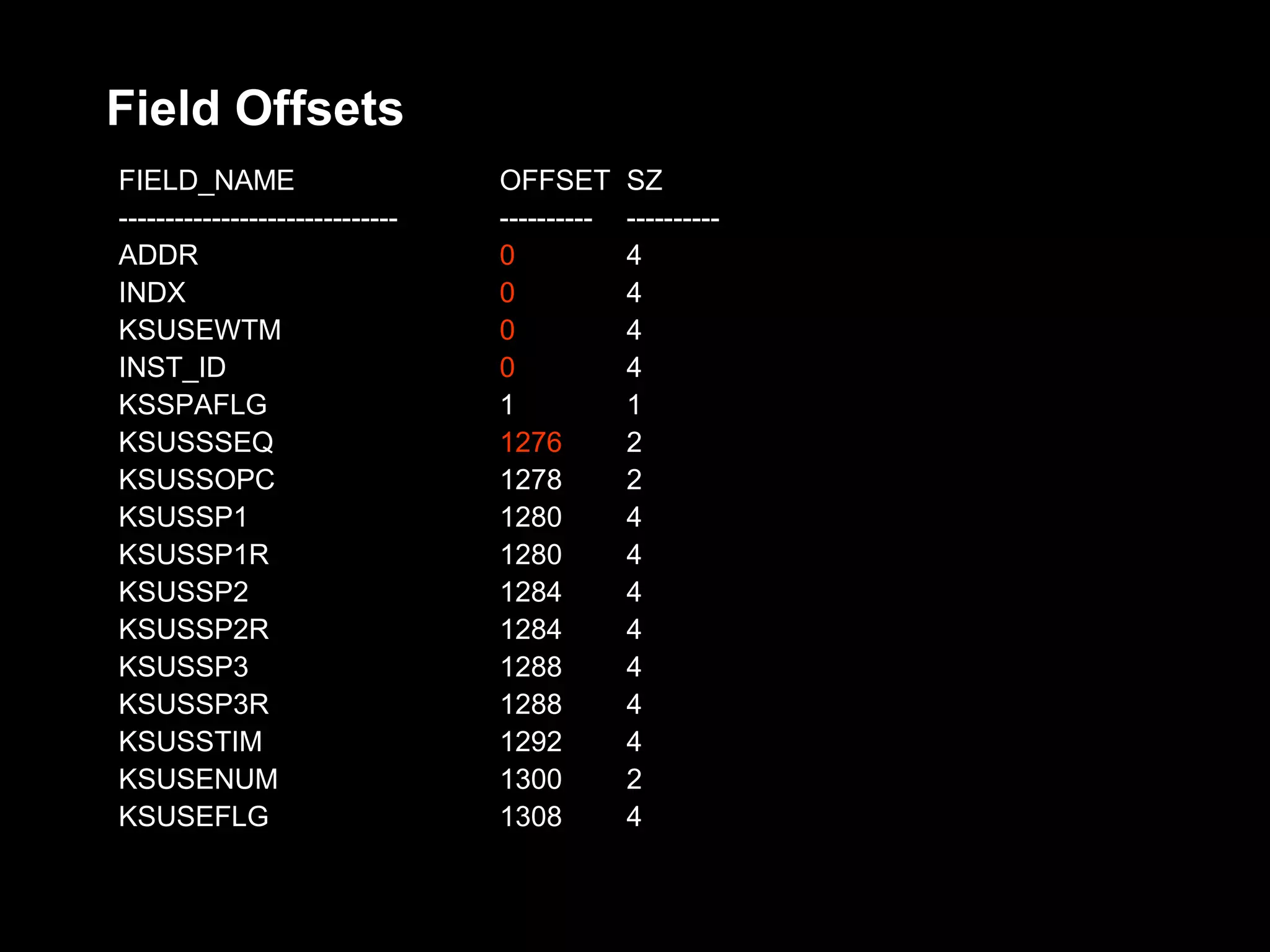
Field Offsets
FIELD_NAME                       OFFSET       SZ
------------------------------   ----------   ----------
ADDR                             0            4
INDX                             0            4
KSUSEWTM                         0            4
INST_ID                          0            4
KSSPAFLG                         1            1
KSUSSSEQ                         1276         2
KSUSSOPC                         1278         2
KSUSSP1                          1280         4
KSUSSP1R                         1280         4
KSUSSP2                          1284         4
KSUSSP2R                         1284         4
KSUSSP3                          1288         4
KSUSSP3R                         1288         4
KSUSSTIM                         1292         4
KSUSENUM                         1300         2
KSUSEFLG                         1308         4
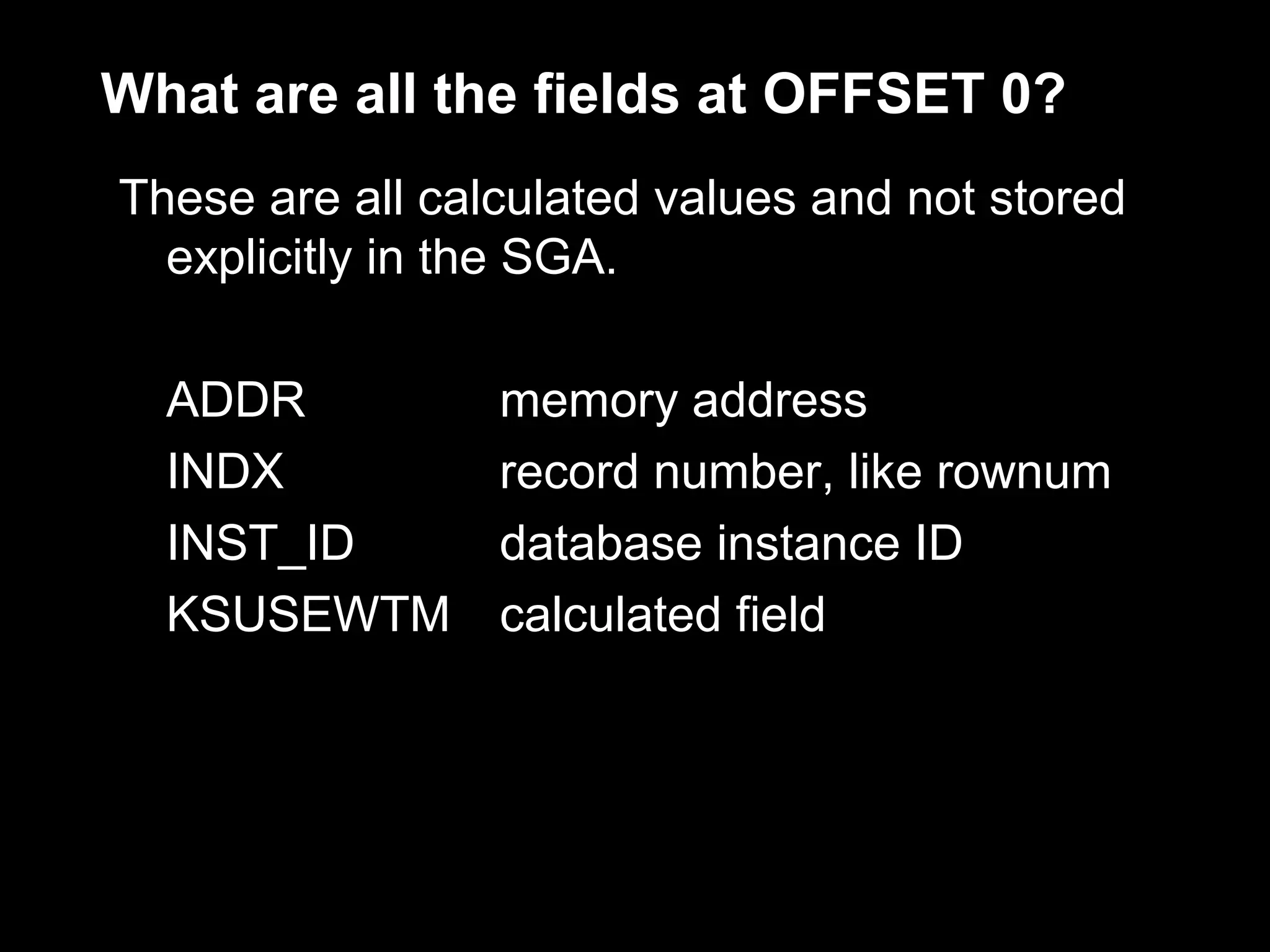
What are all the fields at OFFSET 0?
These are all calculated values and not stored
  explicitly in the SGA.

  ADDR           memory address
  INDX           record number, like rownum
  INST_ID        database instance ID
  KSUSEWTM       calculated field
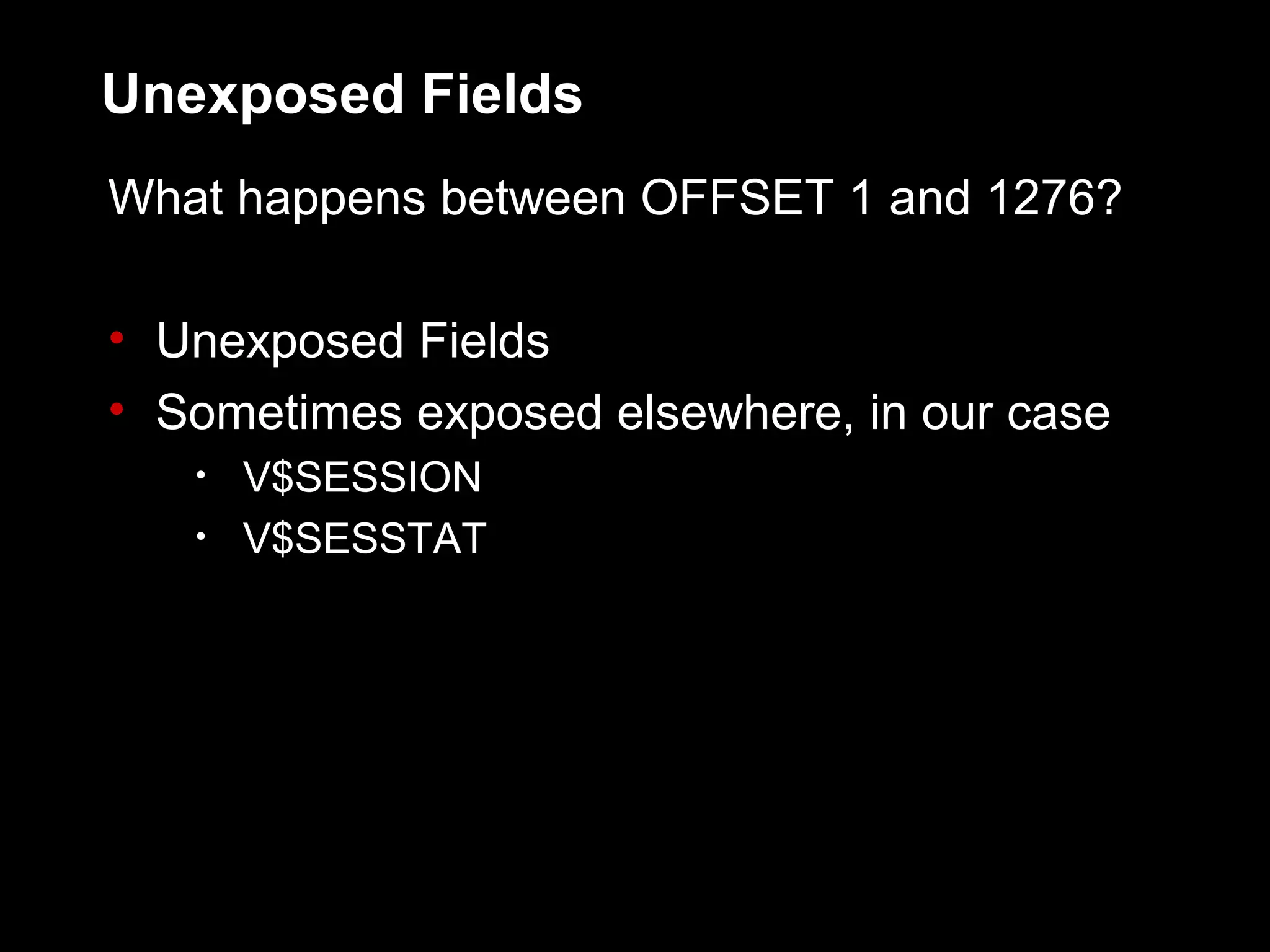
Unexposed Fields
What happens between OFFSET 1 and 1276?

• Unexposed Fields
• Sometimes exposed elsewhere, in our case
   •   V$SESSION
   •   V$SESSTAT
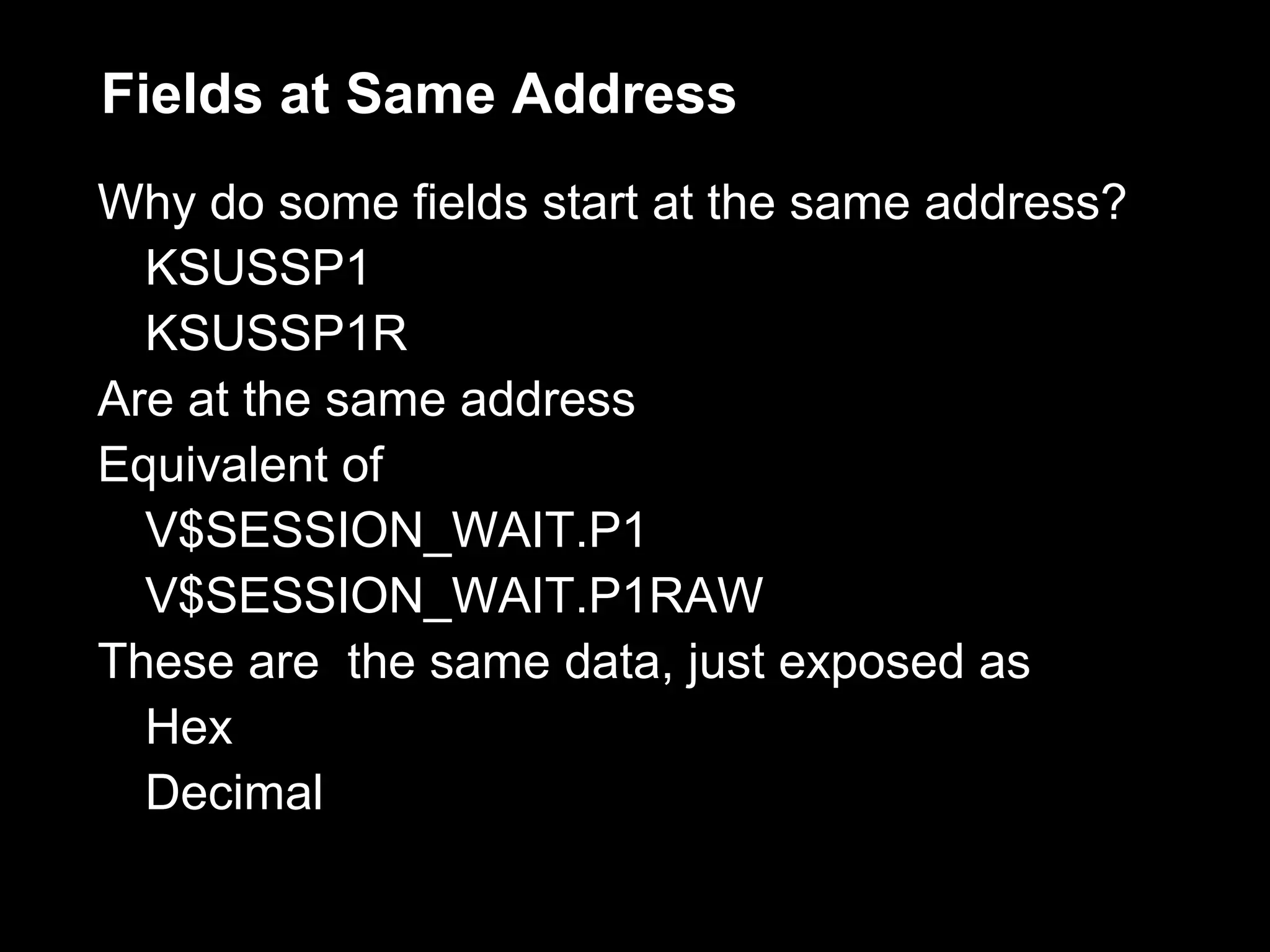
Fields at Same Address
Why do some fields start at the same address?
  KSUSSP1
  KSUSSP1R
Are at the same address
Equivalent of
  V$SESSION_WAIT.P1
  V$SESSION_WAIT.P1RAW
These are the same data, just exposed as
  Hex
  Decimal
7) Offsets of Fields
8) Get Base SGA Address


SQL> select addr from x$ksmmem where
 rownum < 2

      ADDR
--------------
 80000000
Results X$KSUSECST
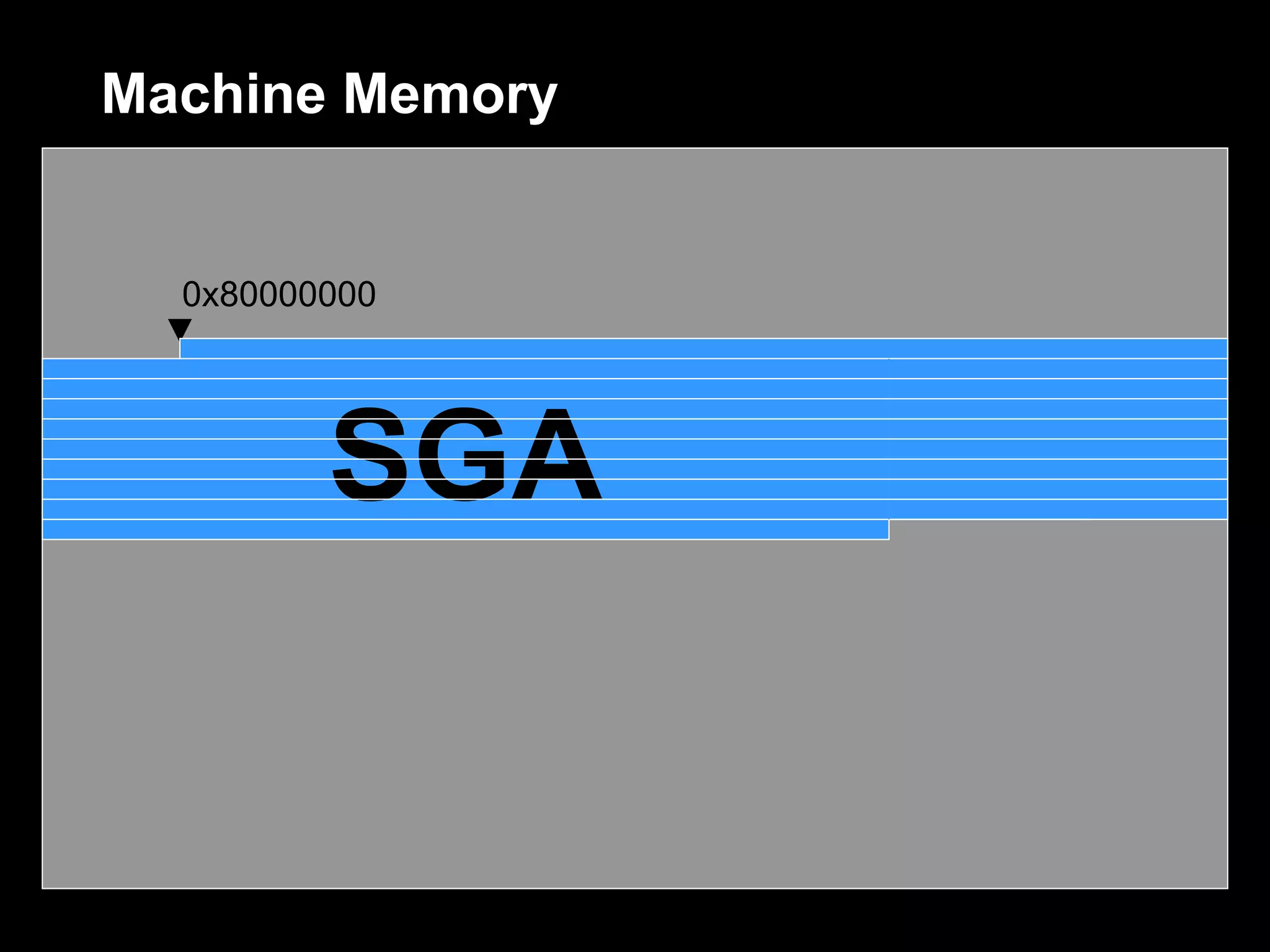
Machine Memory


  0x80000000


         SGA     SGA
Fixed Area
    SGA          X$KSUSECST- user waits
    0x80000000


0x85251EF4
X$KSUSECST
   170 Records
                 2328 bytes


0x85251EF4          Row 1               Row 2
                              Row 3 …
X$KSUSECST Record

One Record in X$KSUSECST


                 1276


                 2328 bytes
X$KSUSECST Fields


1276     1278       1280   1284   1288

 Seq #    Event #    p1      p2    p3
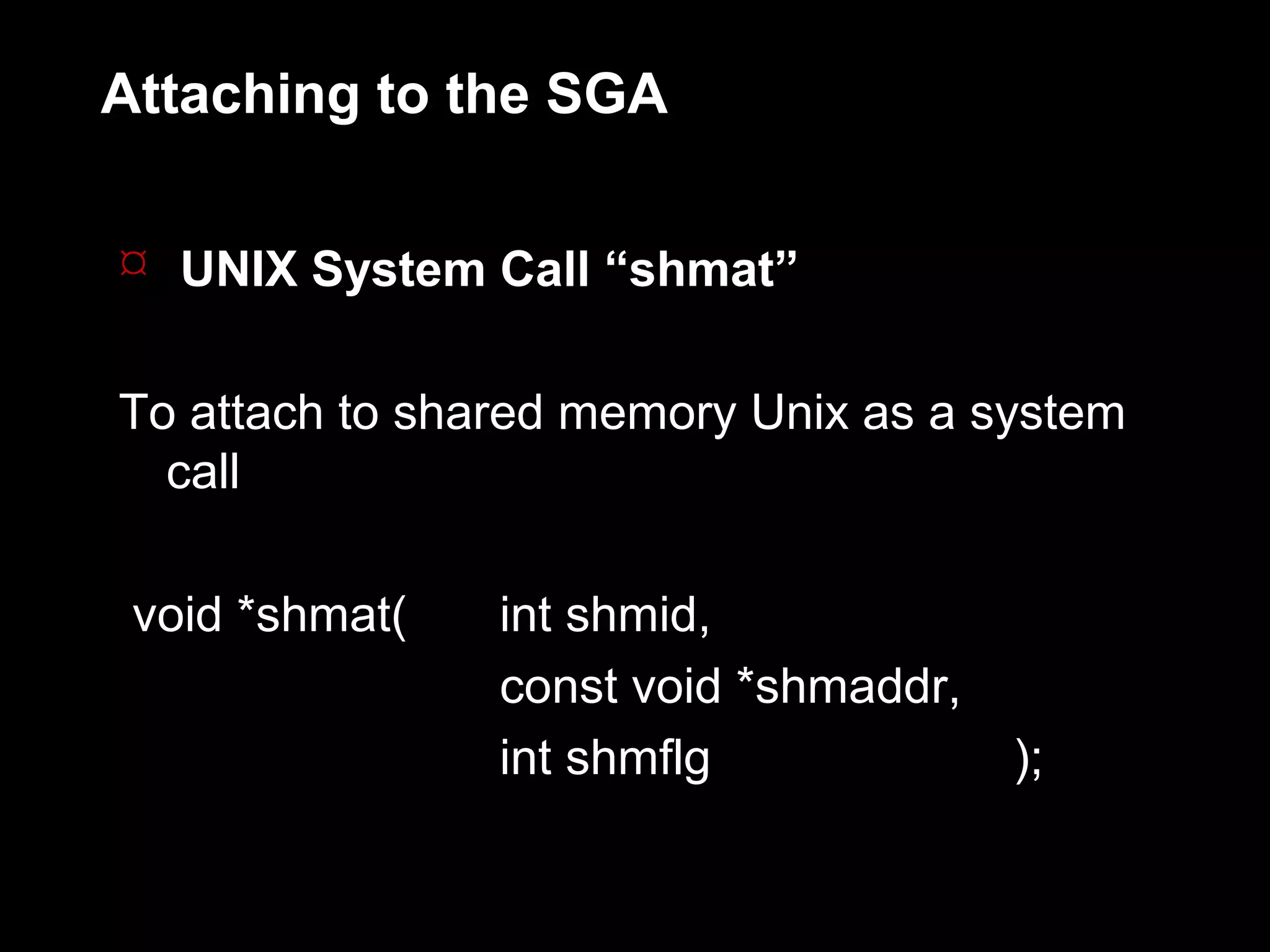
Attaching to the SGA

 UNIX System Call “shmat”


To attach to shared memory Unix as a system
  call

 void *shmat(   int shmid,
                const void *shmaddr,
                int shmflg             );
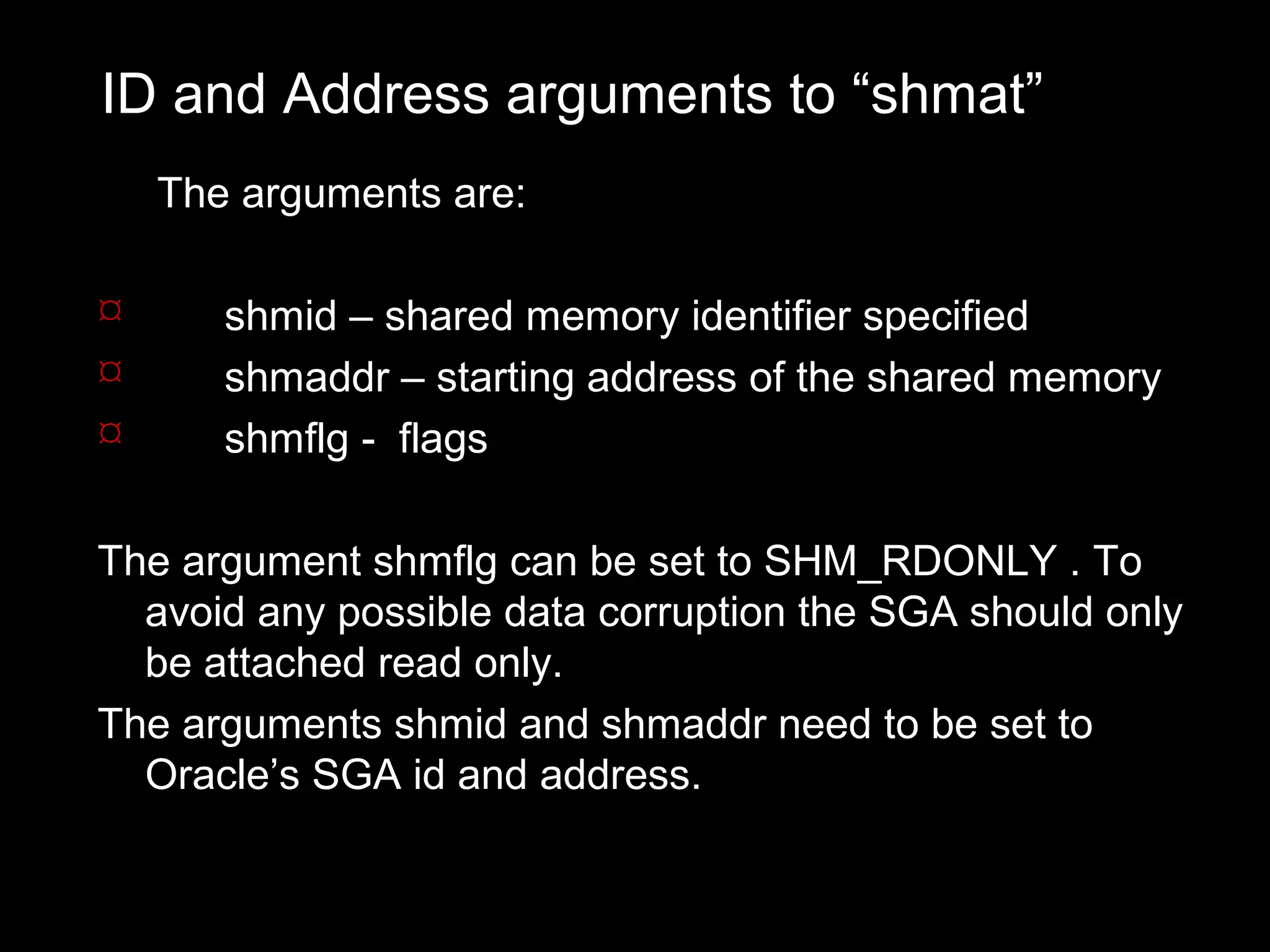
ID and Address arguments to “shmat”
    The arguments are:

      shmid – shared memory identifier specified
      shmaddr – starting address of the shared memory
      shmflg - flags

The argument shmflg can be set to SHM_RDONLY . To
  avoid any possible data corruption the SGA should only
  be attached read only.
The arguments shmid and shmaddr need to be set to
  Oracle’s SGA id and address.
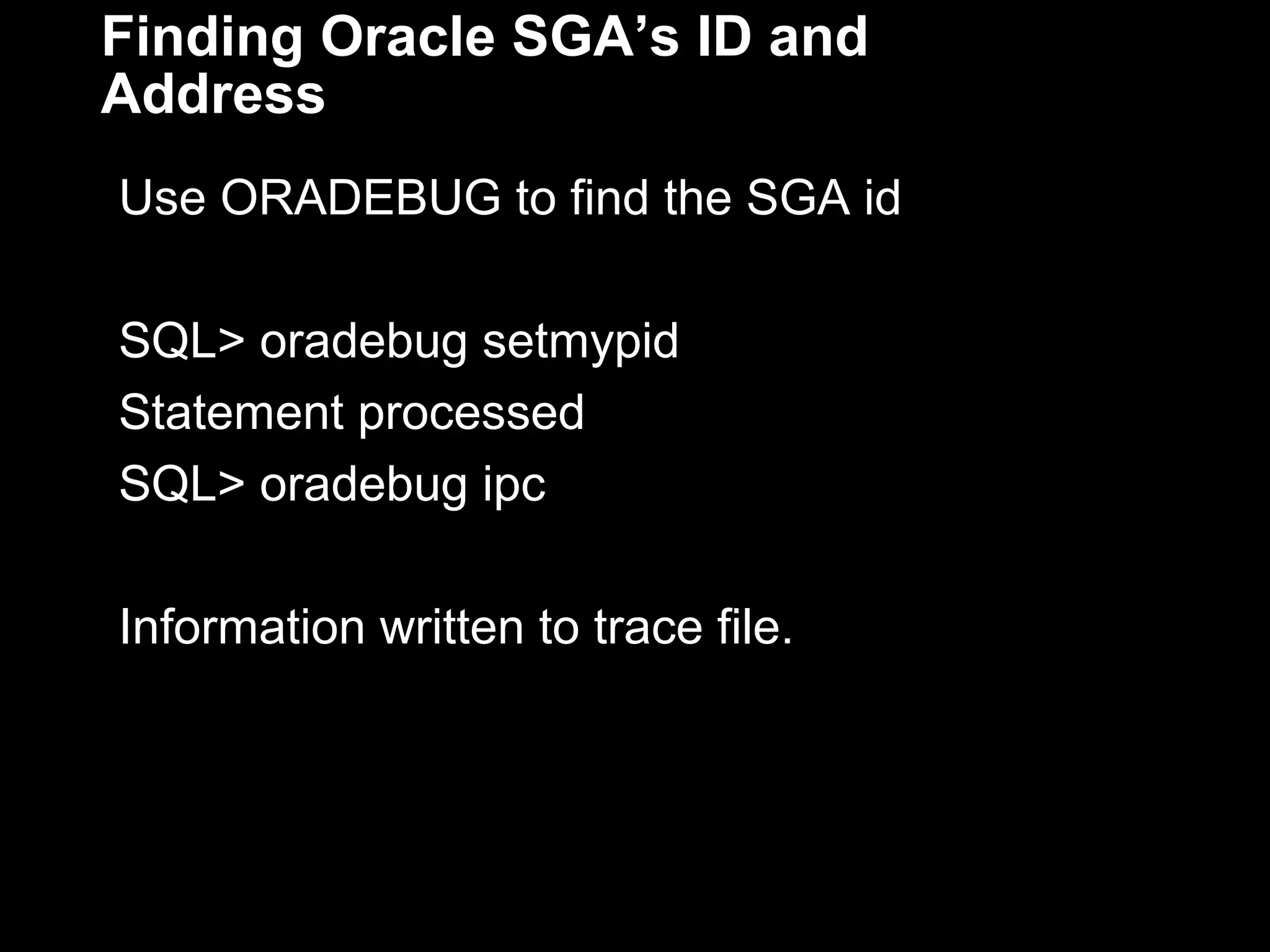
Finding Oracle SGA’s ID and
Address
Use ORADEBUG to find the SGA id

SQL> oradebug setmypid
Statement processed.
SQL> oradebug ipc

Information written to trace file.

 
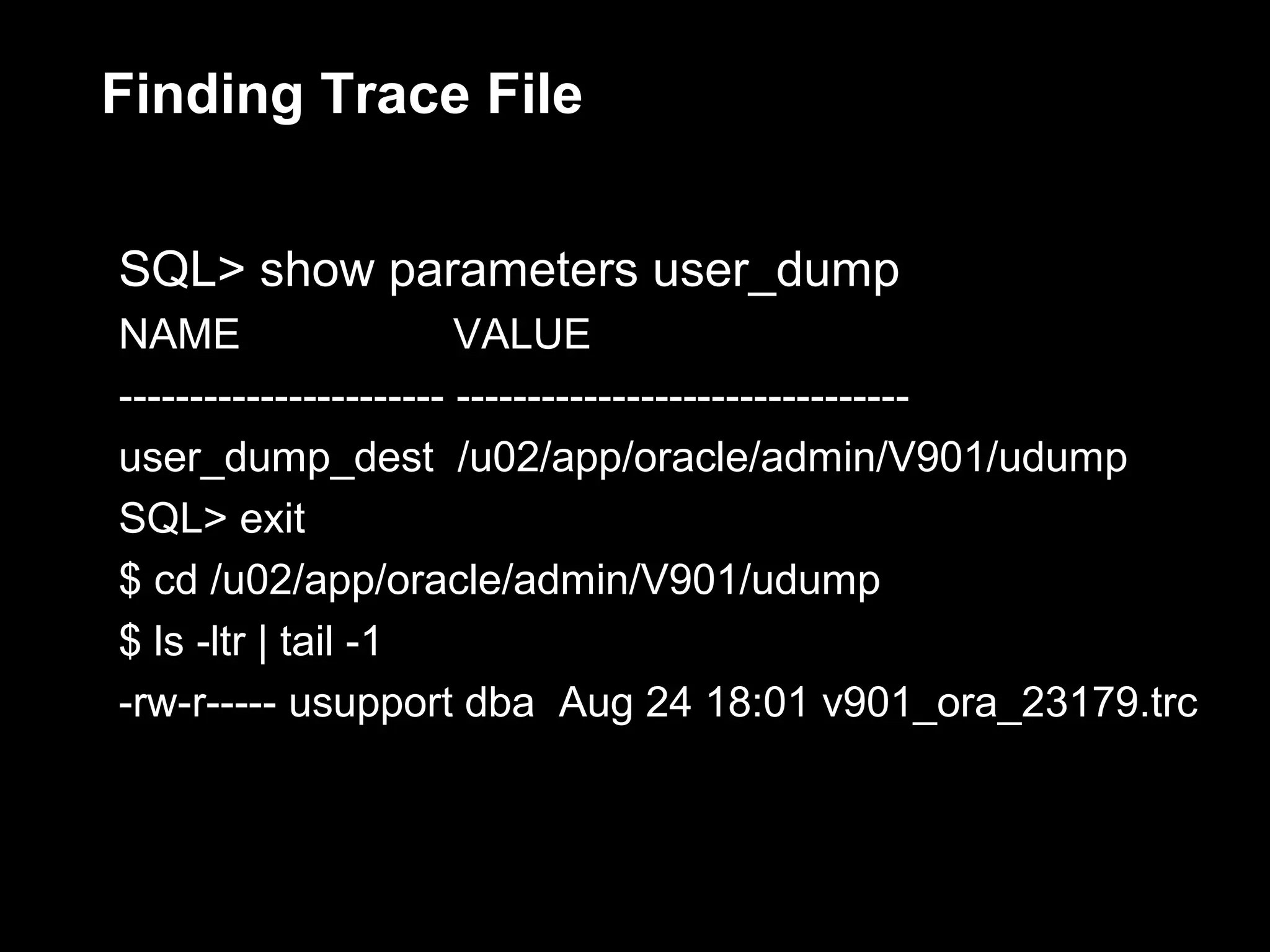
Finding Trace File


SQL> show parameters user_dump
NAME                    VALUE
----------------------- --------------------------------
user_dump_dest /u02/app/oracle/admin/V901/udump
SQL> exit
$ cd /u02/app/oracle/admin/V901/udump
$ ls -ltr | tail -1
-rw-r----- usupport dba Aug 24 18:01 v901_ora_23179.trc
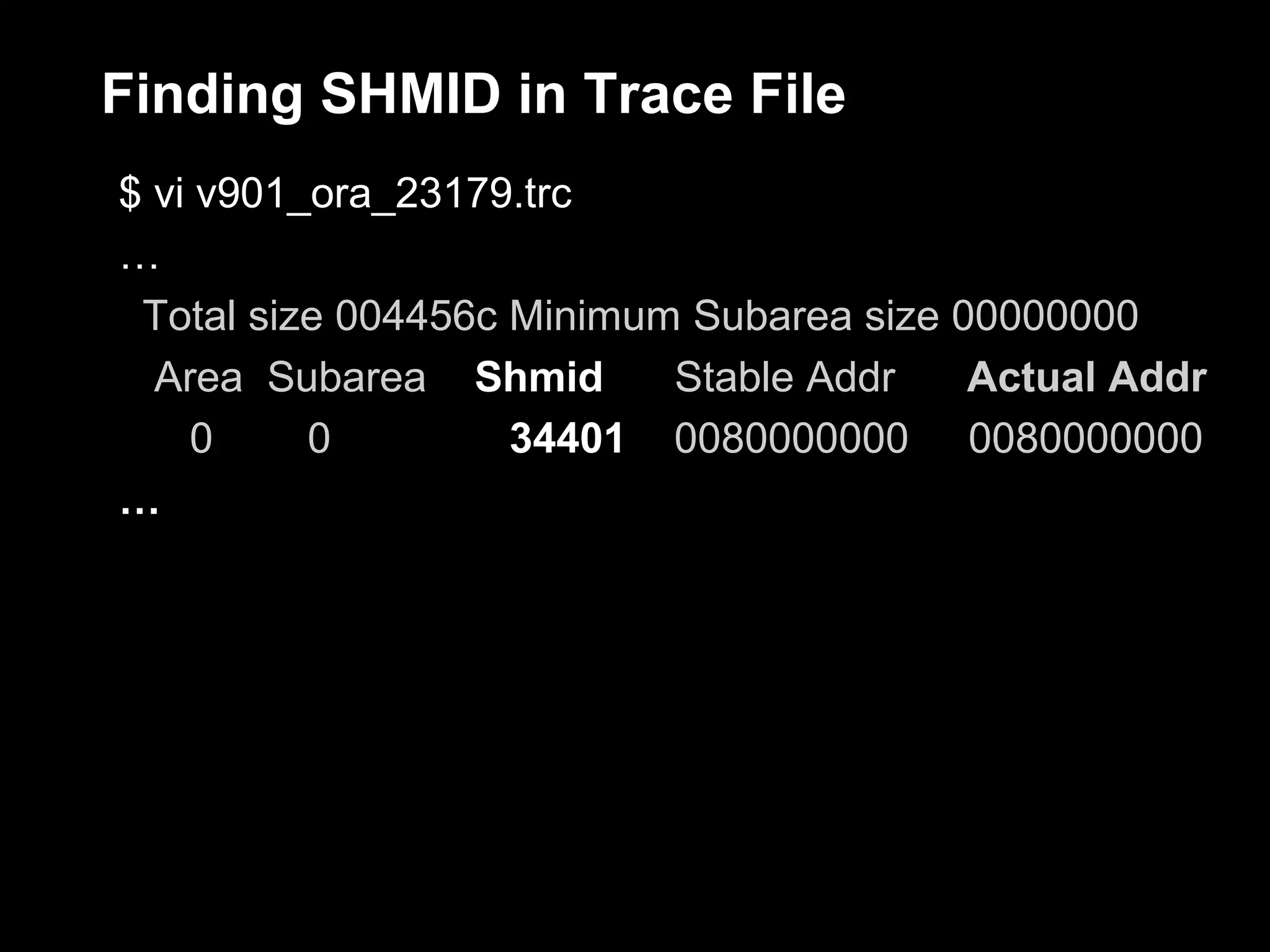
Finding SHMID in Trace File
$ vi v901_ora_23179.trc
…
 Total size 004456c Minimum Subarea size 00000000
  Area Subarea Shmid       Stable Addr    Actual Addr
    0     0         34401 0080000000 0080000000
…
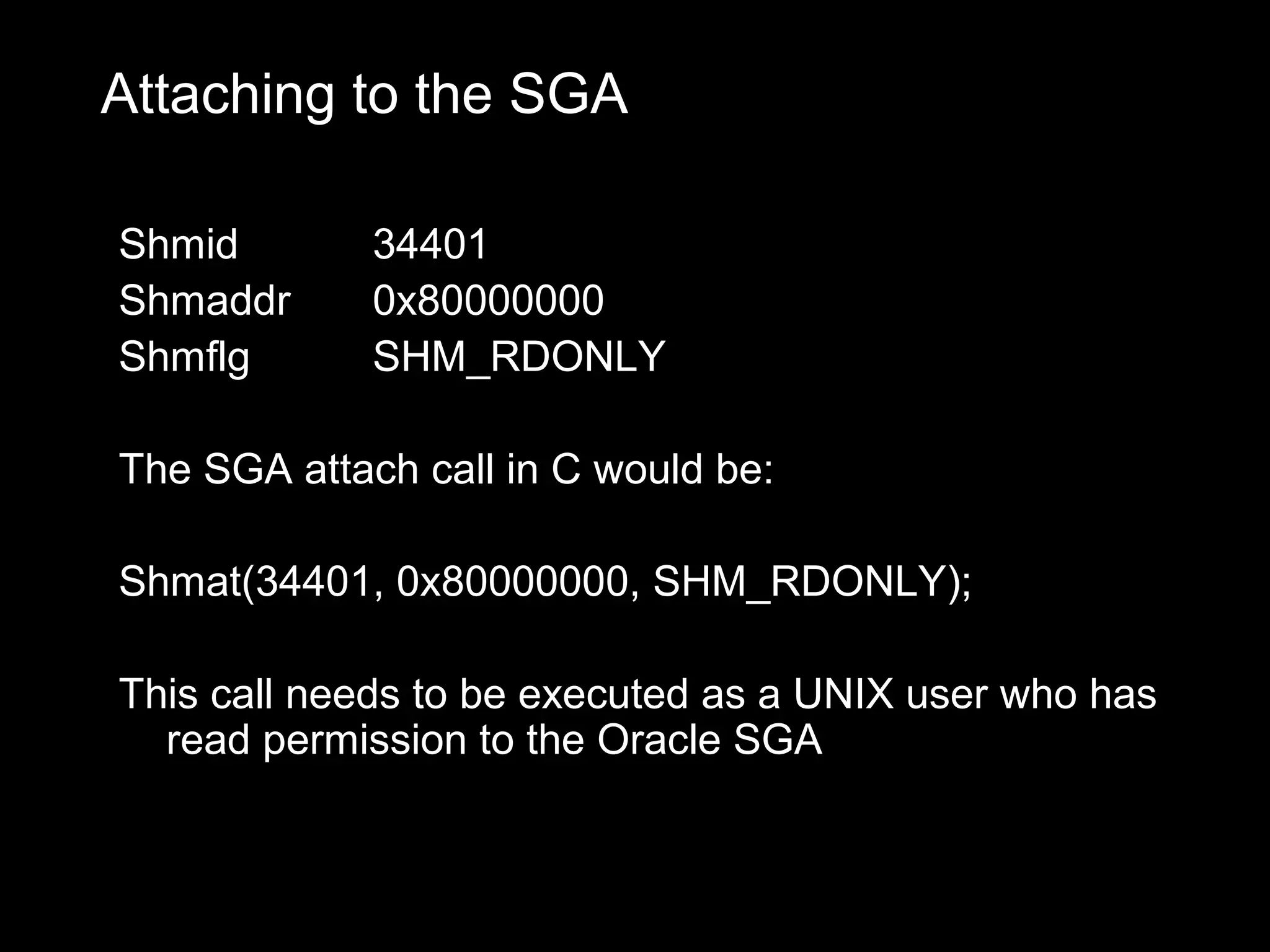
Attaching to the SGA

Shmid        34401
Shmaddr      0x80000000
Shmflg       SHM_RDONLY

The SGA attach call in C would be:

Shmat(34401, 0x80000000, SHM_RDONLY);

This call needs to be executed as a UNIX user who has
  read permission to the Oracle SGA
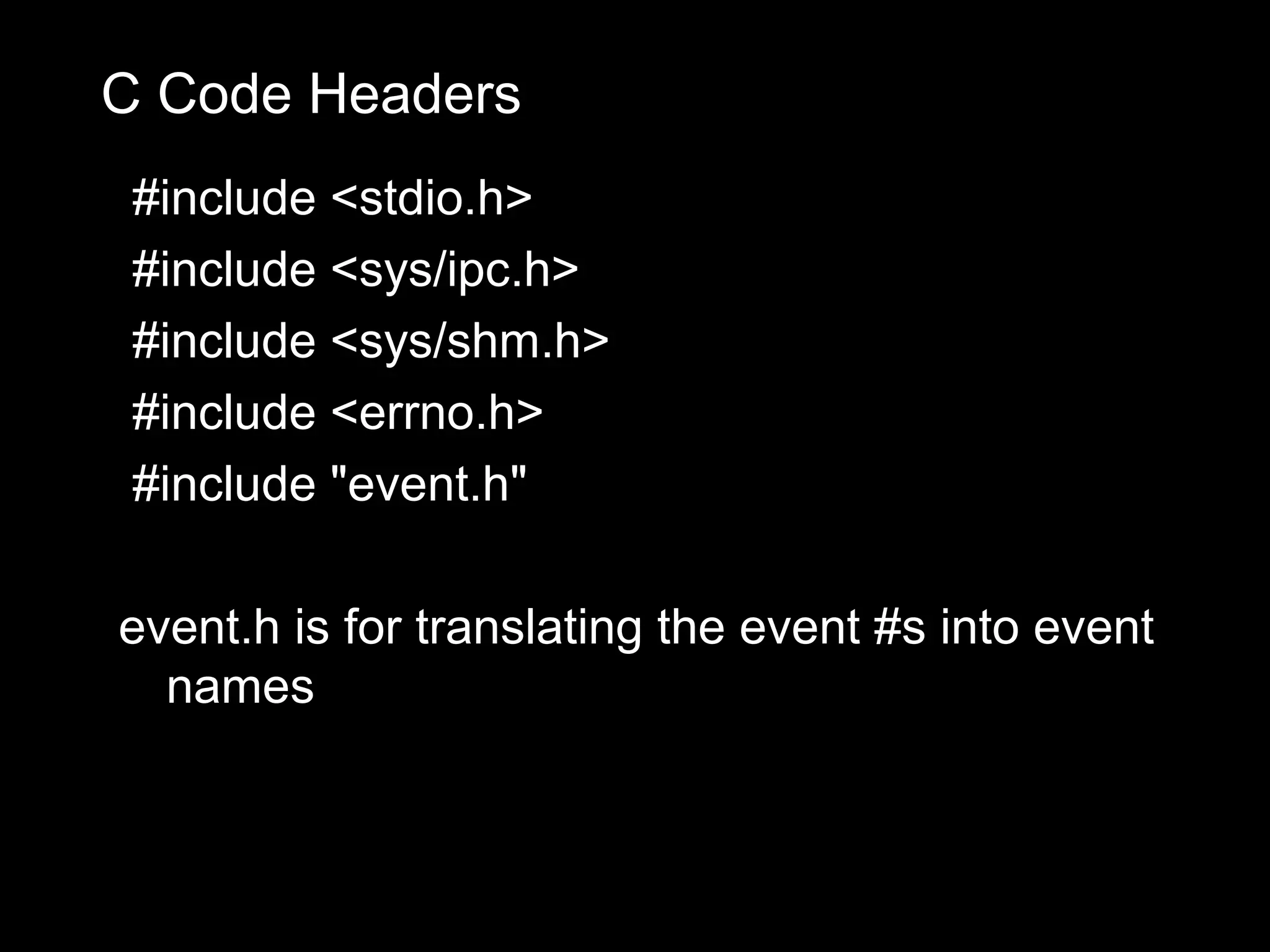
C Code Headers
 #include <stdio.h>
 #include <sys/ipc.h>
 #include <sys/shm.h>
 #include <errno.h>
 #include "event.h"

event.h is for translating the event #s into event
  names
Events.h


Spool events.h
select 'char event[][100]={' from dual;
select '"'||name||'",' from v$event_name;
select ' "" };' from dual;
spool off
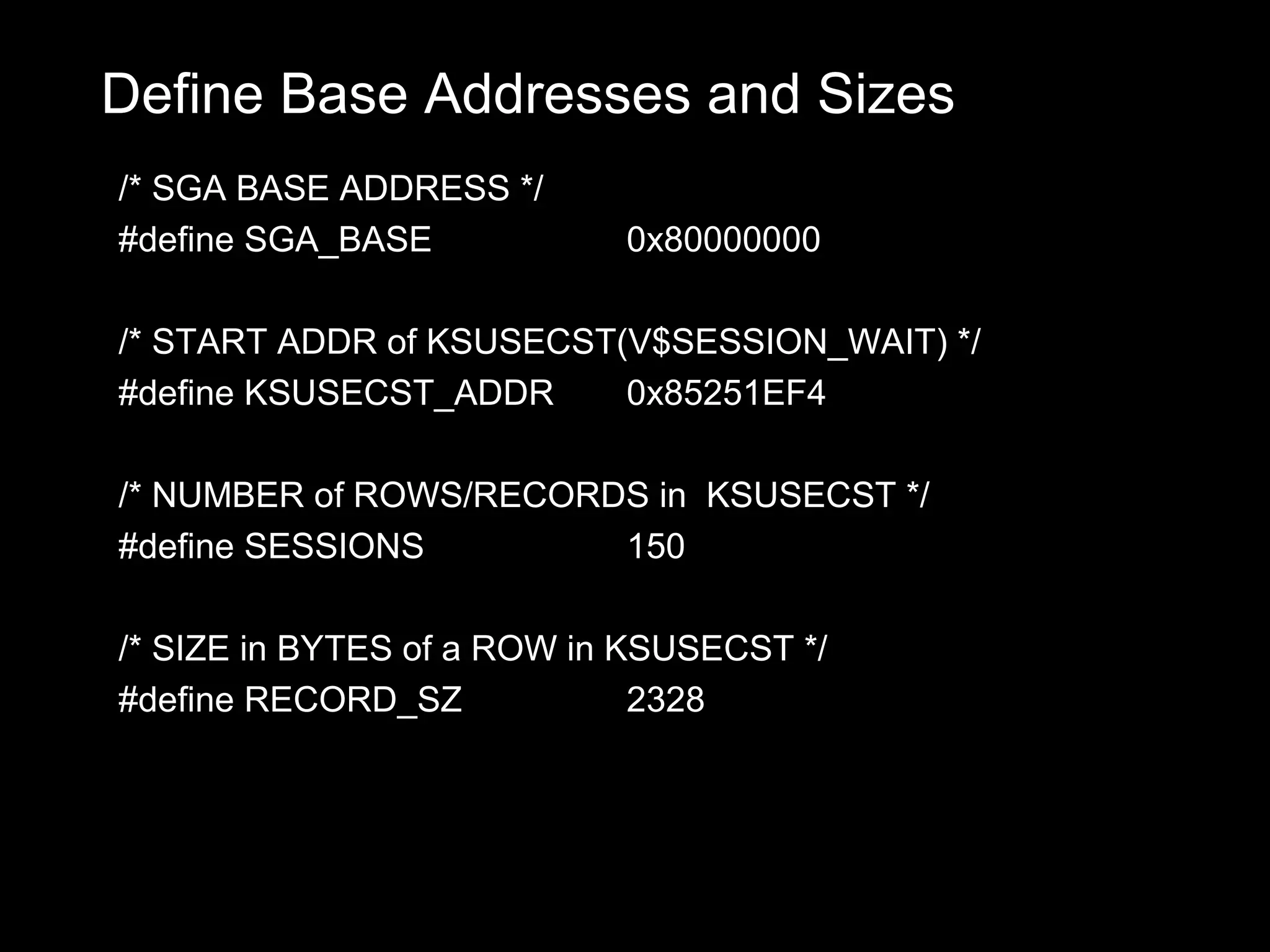
Define Base Addresses and Sizes
/* SGA BASE ADDRESS */
#define SGA_BASE            0x80000000

/* START ADDR of KSUSECST(V$SESSION_WAIT) */
#define KSUSECST_ADDR     0x85251EF4

/* NUMBER of ROWS/RECORDS in KSUSECST */
#define SESSIONS        150

/* SIZE in BYTES of a ROW in KSUSECST */
#define RECORD_SZ             2328
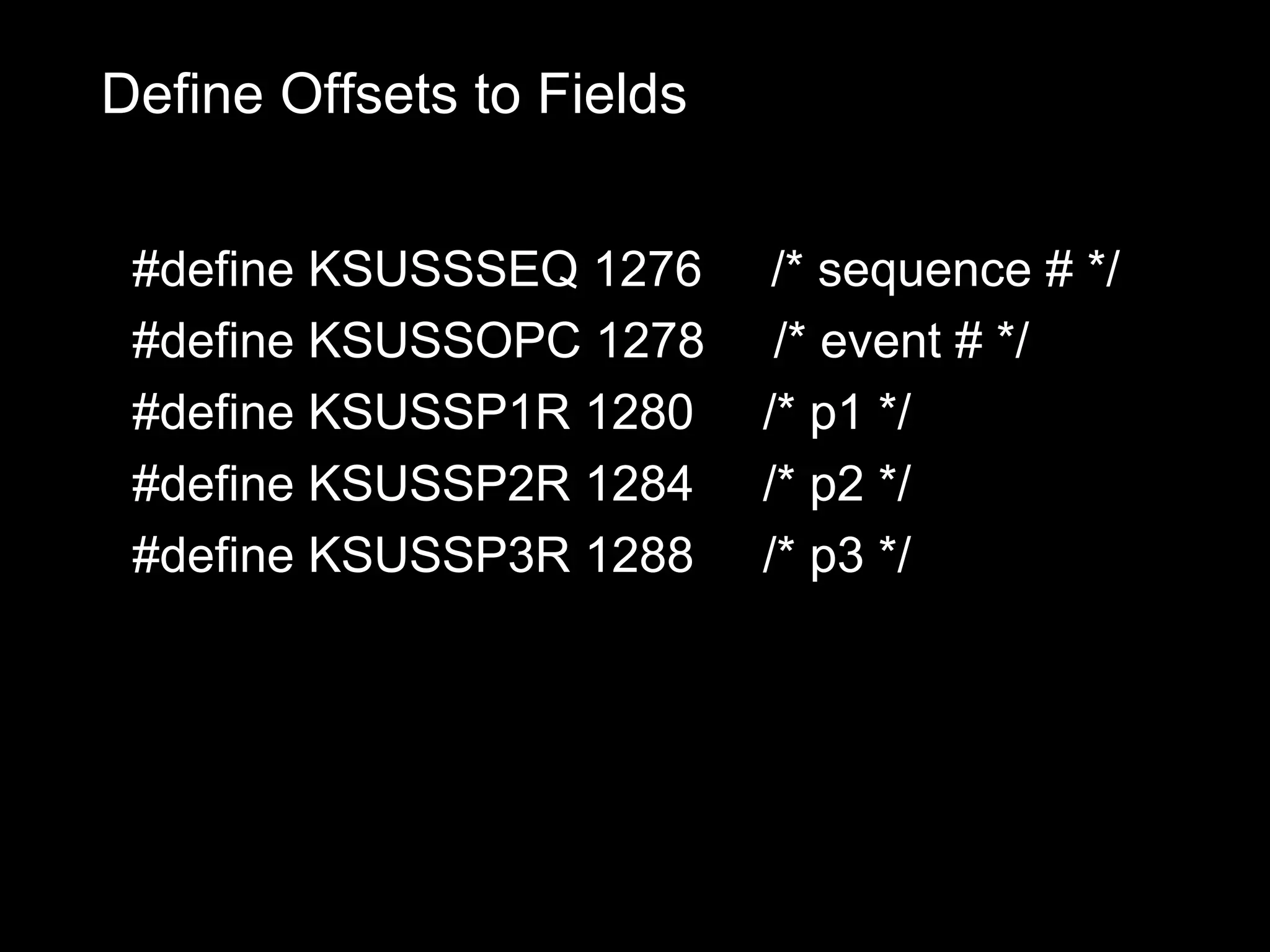
Define Offsets to Fields


 #define KSUSSSEQ 1276      /* sequence # */
 #define KSUSSOPC 1278      /* event # */
 #define KSUSSP1R 1280     /* p1 */
 #define KSUSSP2R 1284     /* p2 */
 #define KSUSSP3R 1288     /* p3 */
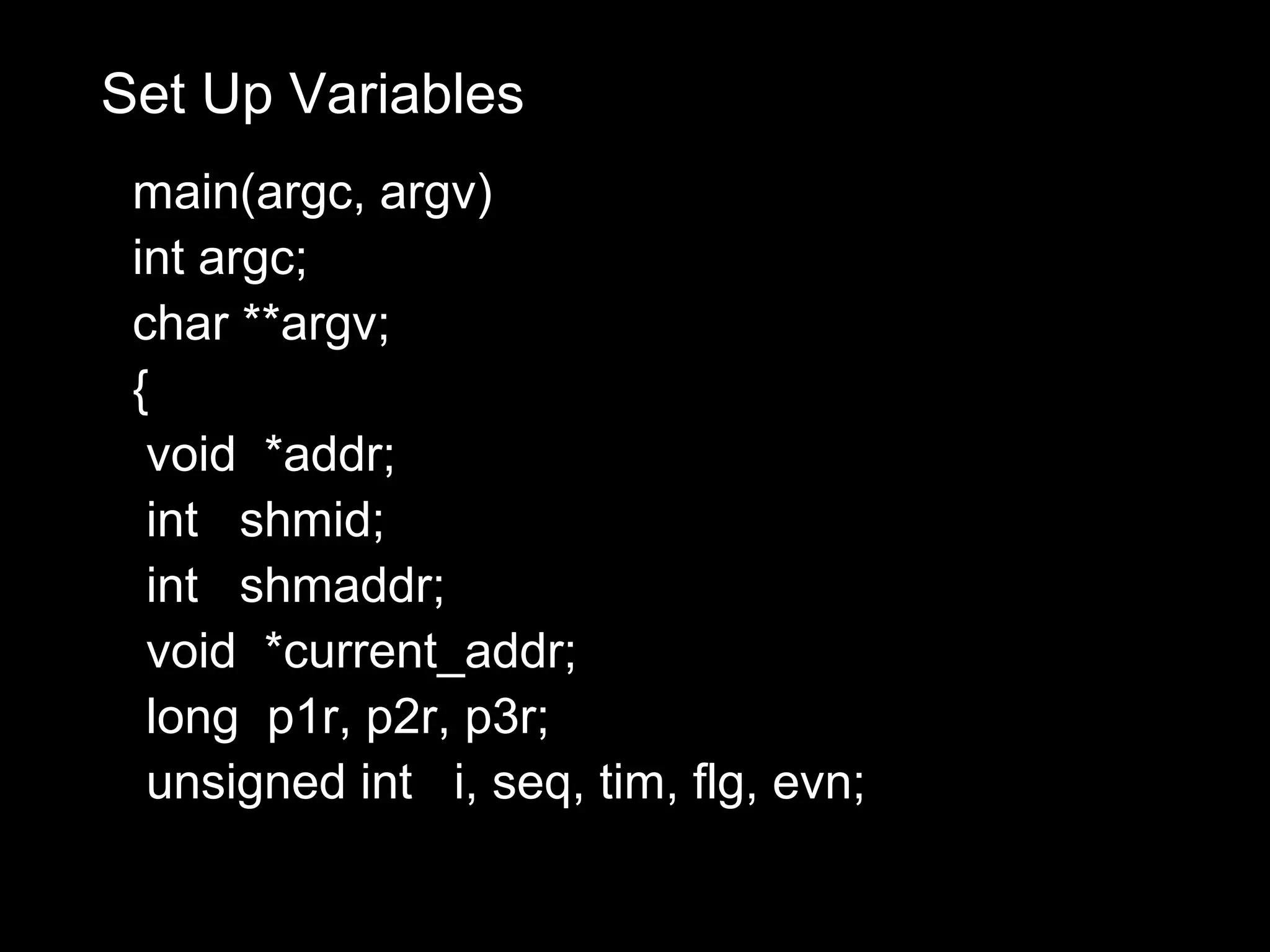
Set Up Variables
 main(argc, argv)
 int argc;
 char **argv;
 {
  void *addr;
  int shmid;
  int shmaddr;
  void *current_addr;
  long p1r, p2r, p3r;
  unsigned int i, seq, tim, flg, evn;
Attach to SGA
/* ATTACH TO SGA */
   shmid=atoi(argv[1]);
   shmaddr=SGA_BASE;
   if (
         (void *)shmat(
                        shmid,
                        (void *)shmaddr,
                        SHM_RDONLY)
                  == (void *)-1 ) {
        printf("shmat: error attatching to SGAn");
        exit();
   }
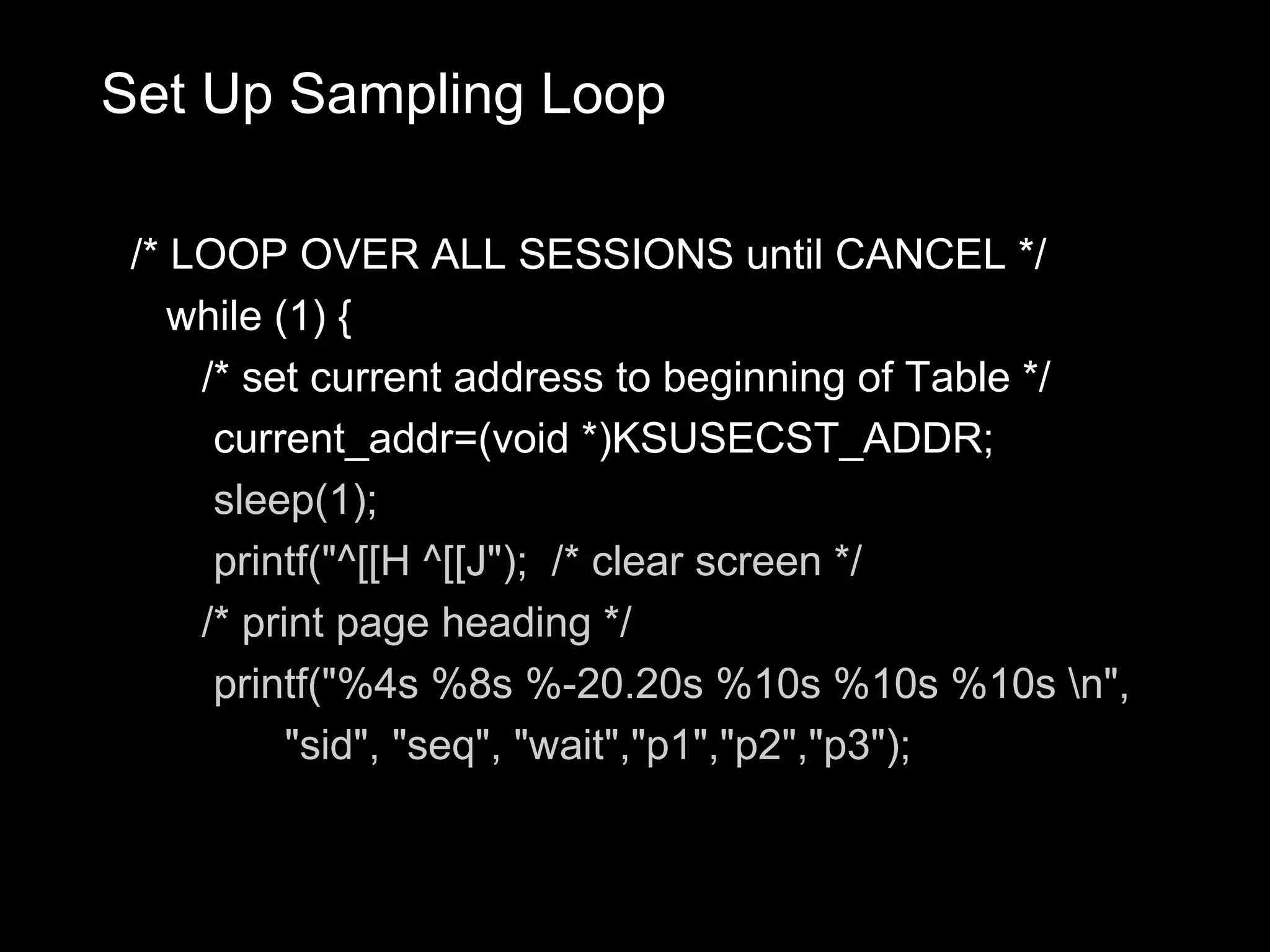
Set Up Sampling Loop

 /* LOOP OVER ALL SESSIONS until CANCEL */
    while (1) {
     /* set current address to beginning of Table */
      current_addr=(void *)KSUSECST_ADDR;
      sleep(1);
      printf("^[[H ^[[J"); /* clear screen */
     /* print page heading */
      printf("%4s %8s %-20.20s %10s %10s %10s n",
           "sid", "seq", "wait","p1","p2","p3");
Loop over all Sessions
for ( i=0; i < SESSIONS ; i++ ) {
         seq=*(unsigned short *)((int)current_addr+KSUSSSEQ);
         evn=*(short *)          ((int)current_addr+KSUSSOPC);
         p1r=*(long *)         ((int)current_addr+KSUSSP1R);
         p2r=*(long *)         ((int)current_addr+KSUSSP2R);
         p3r=*(long *)         ((int)current_addr+KSUSSP3R);
         if ( evn != 0 ) {
              printf("%4d %8u %-20.20s %10X %10X %10X n",
                i, seq, event[evn] ,p1r, p2r,p3r
              );
          }
          current_addr=(void *)((int)current_addr+RECORD_SZ);
       }
   }
 }
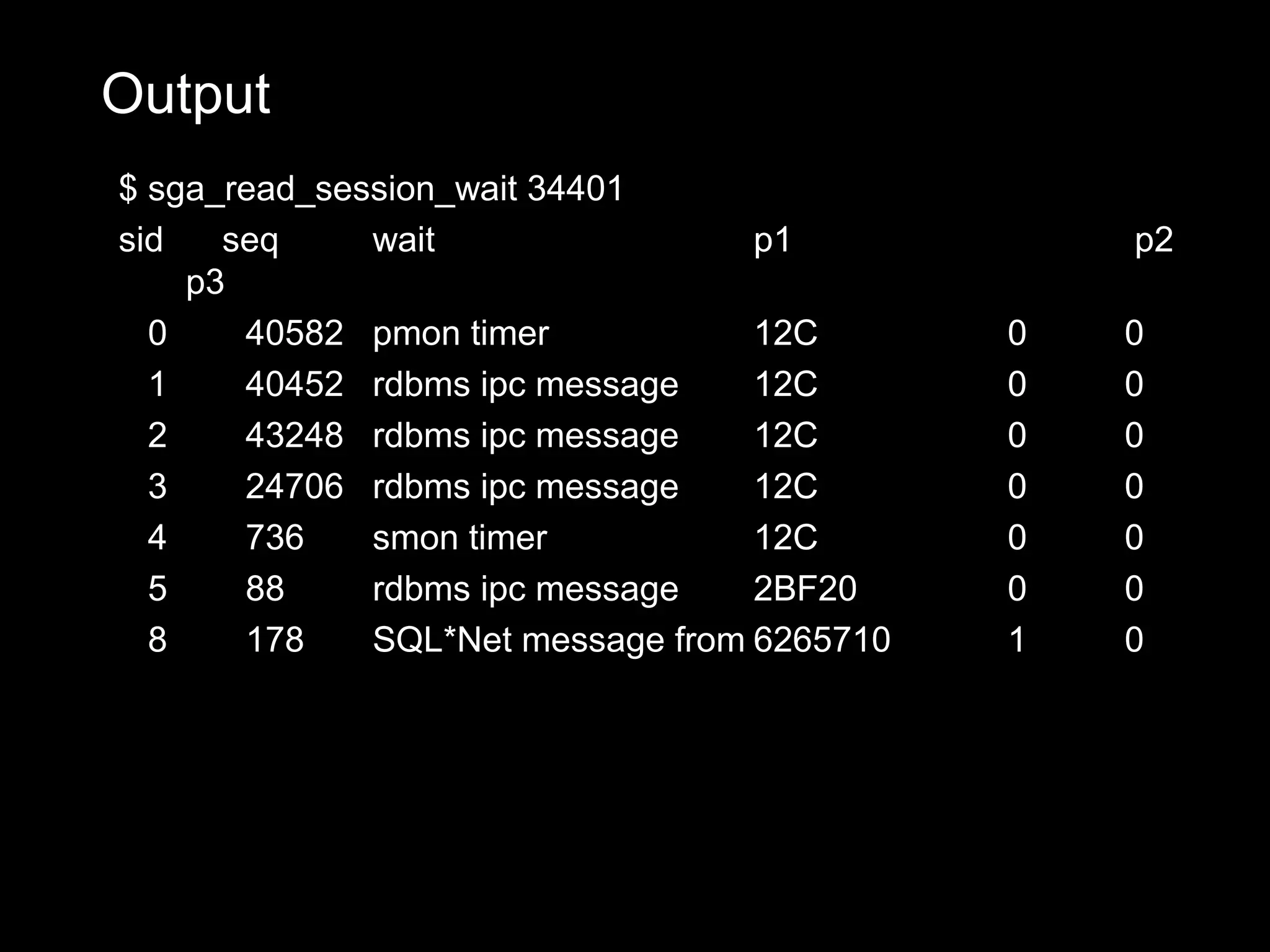
Output
$ sga_read_session_wait 34401
sid   seq     wait                 p1            p2
    p3
  0    40582 pmon timer            12C       0   0
  1    40452 rdbms ipc message     12C       0   0
  2    43248 rdbms ipc message     12C       0   0
  3    24706 rdbms ipc message     12C       0   0
  4    736    smon timer           12C       0   0
  5    88     rdbms ipc message    2BF20     0   0
  8    178    SQL*Net message from 6265710   1   0
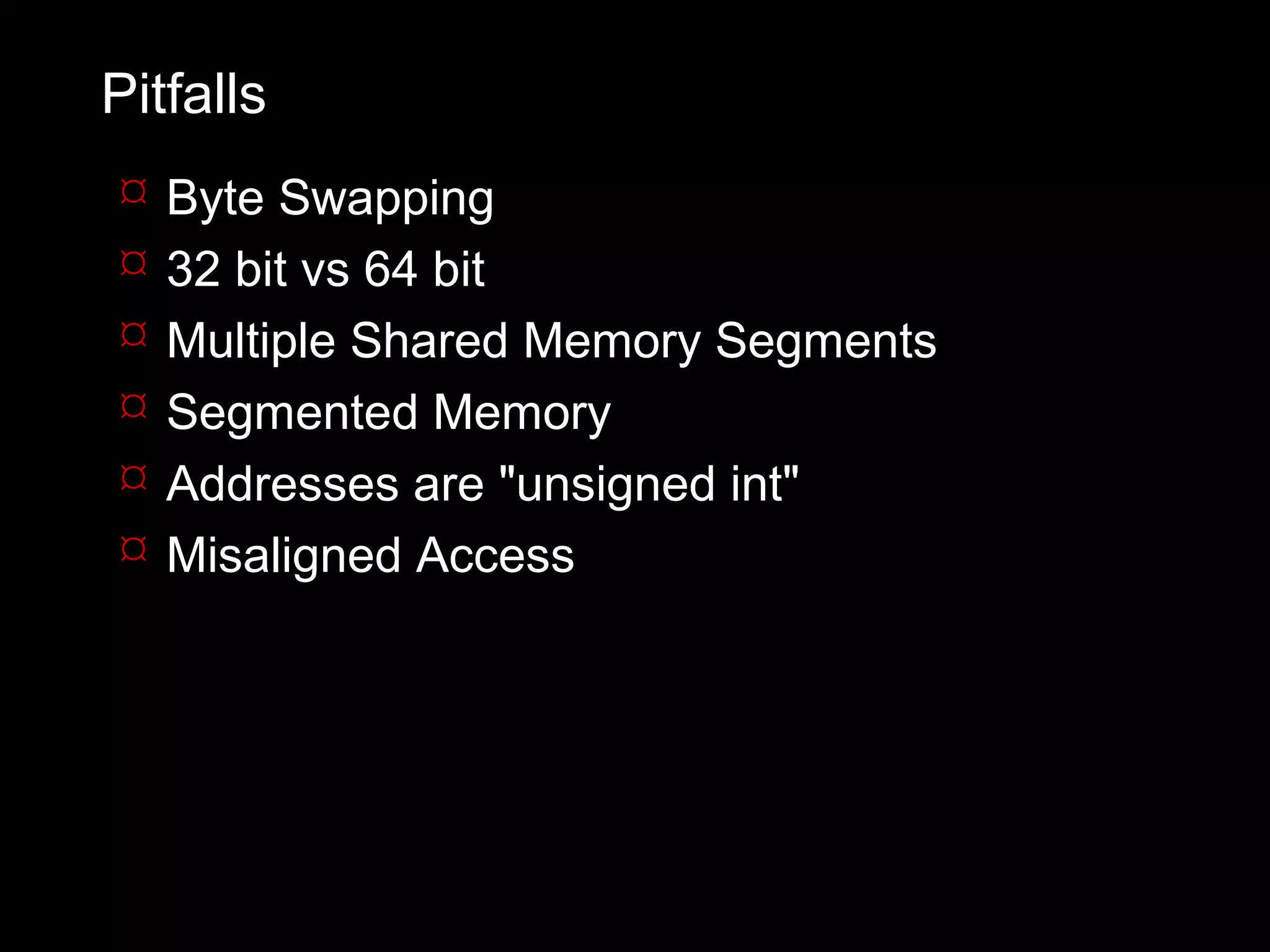
Pitfalls
   Byte Swapping
   32 bit vs 64 bit
   Multiple Shared Memory Segments
   Segmented Memory
   Addresses are "unsigned int"
   Misaligned Access
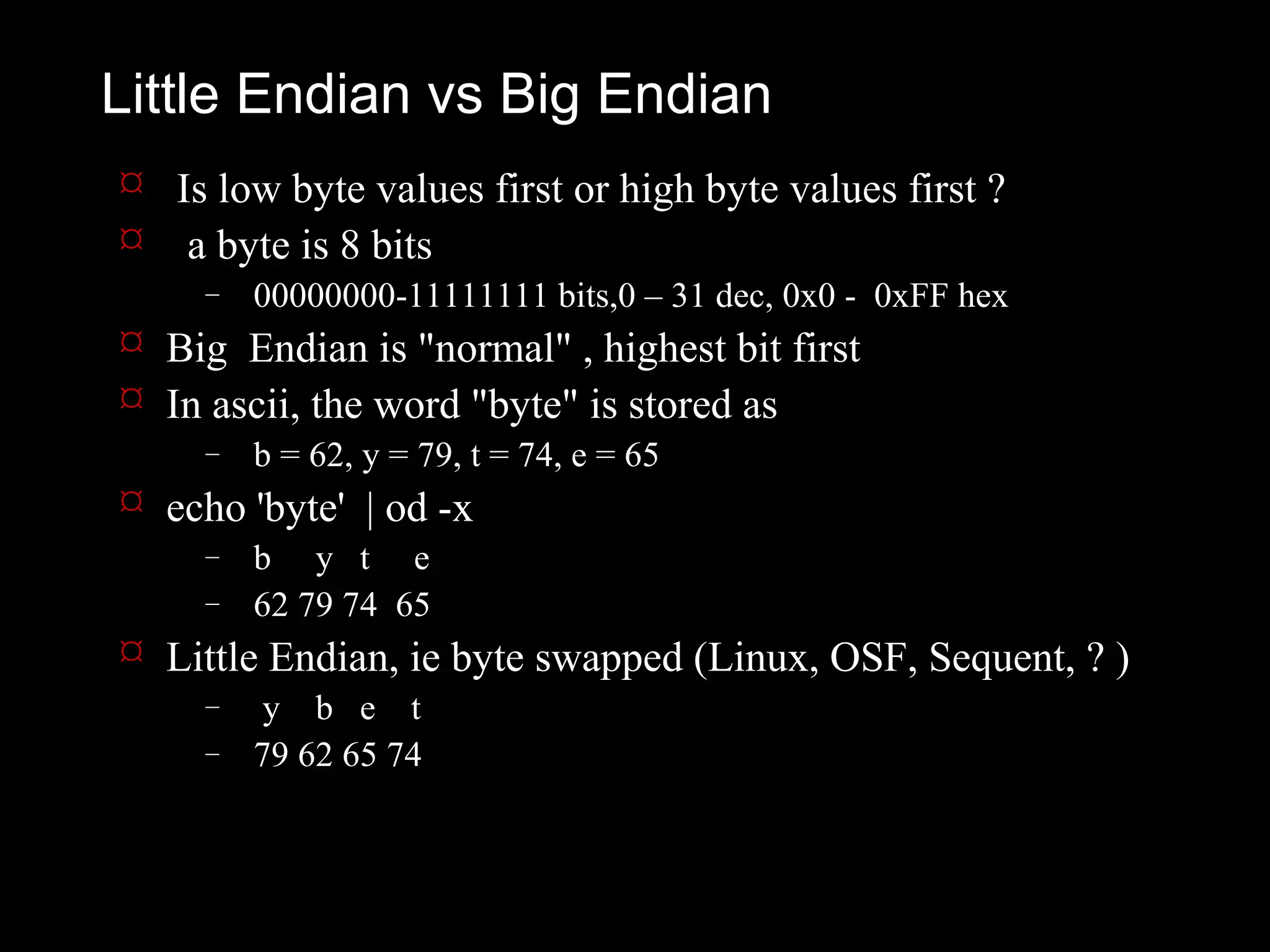
Little Endian vs Big Endian
 Is low byte values first or high byte values first ?
 a byte is 8 bits
     –   00000000-11111111 bits,0 – 31 dec, 0x0 - 0xFF hex
 Big Endian is "normal" , highest bit first
 In ascii, the word "byte" is stored as
     –   b = 62, y = 79, t = 74, e = 65
 echo 'byte' | od -x
     –   b y t e
     –   62 79 74 65
 Little Endian, ie byte swapped (Linux, OSF, Sequent, ? )
     –    y b e t
     –   79 62 65 74
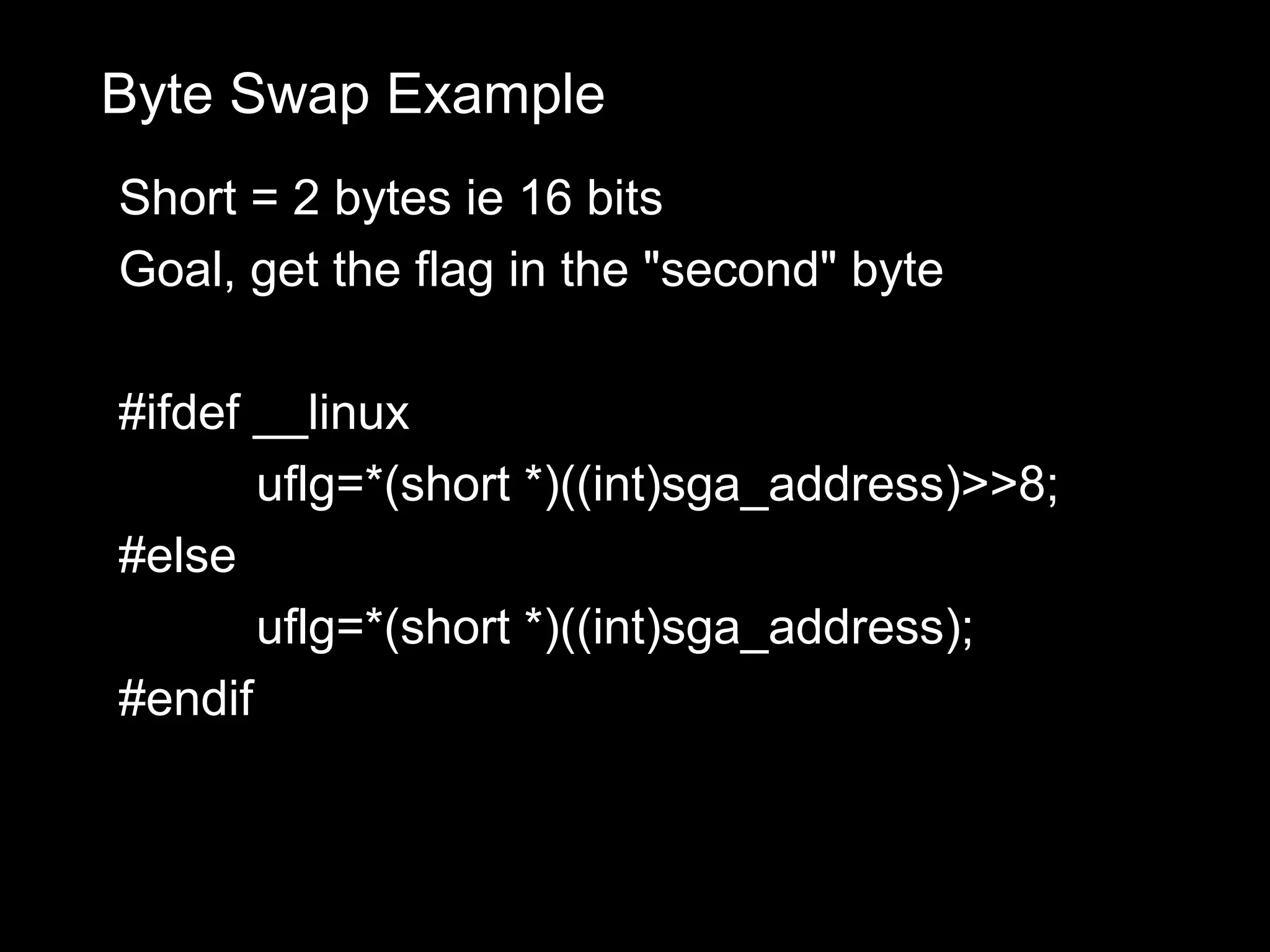
Byte Swap Example
Short = 2 bytes ie 16 bits
Goal, get the flag in the "second" byte

#ifdef __linux
       uflg=*(short *)((int)sga_address)>>8;
#else
       uflg=*(short *)((int)sga_address);
#endif
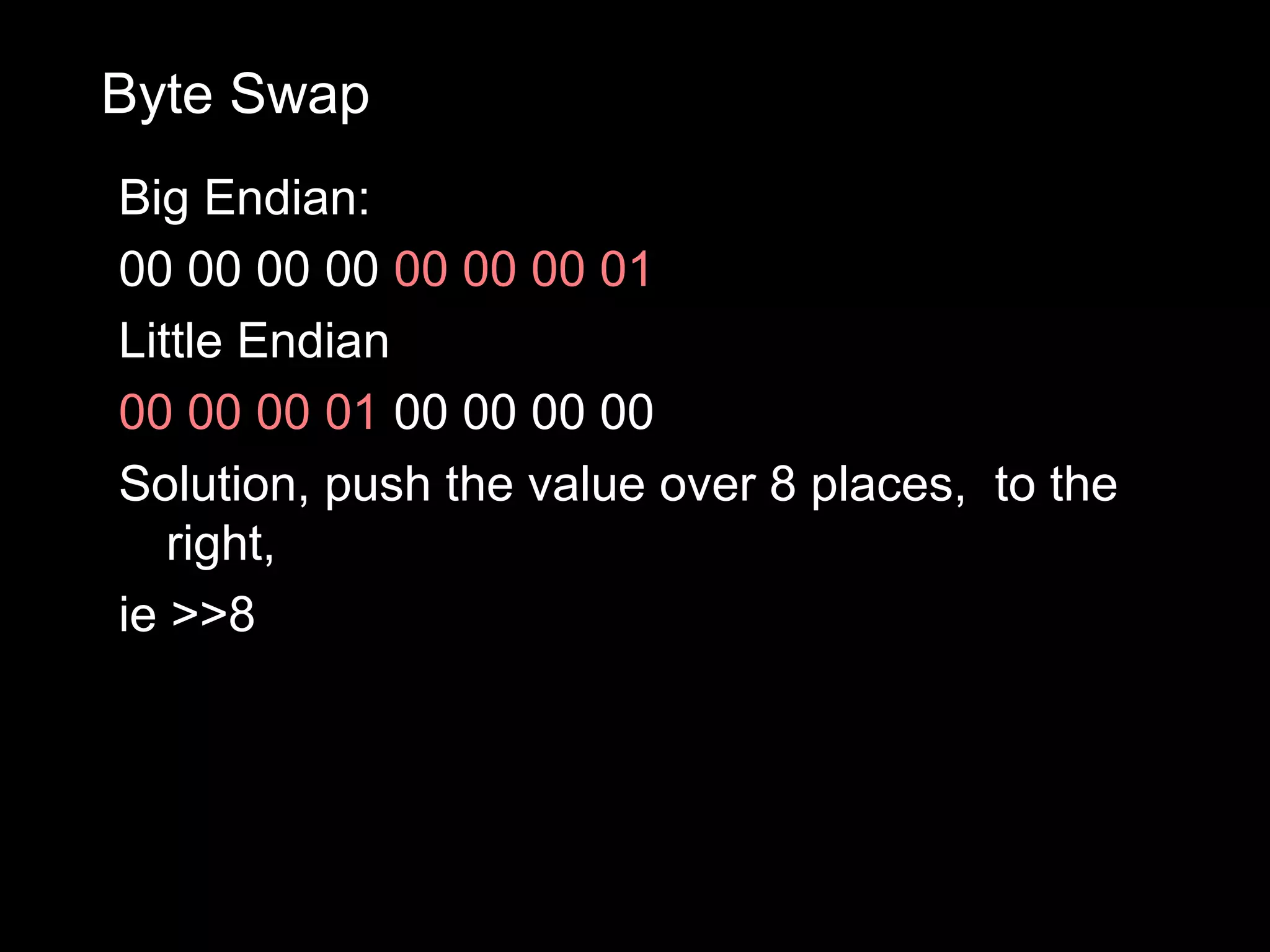
Byte Swap
Big Endian:
00 00 00 00 00 00 00 01
Little Endian
00 00 00 01 00 00 00 00
Solution, push the value over 8 places, to the
   right,
ie >>8
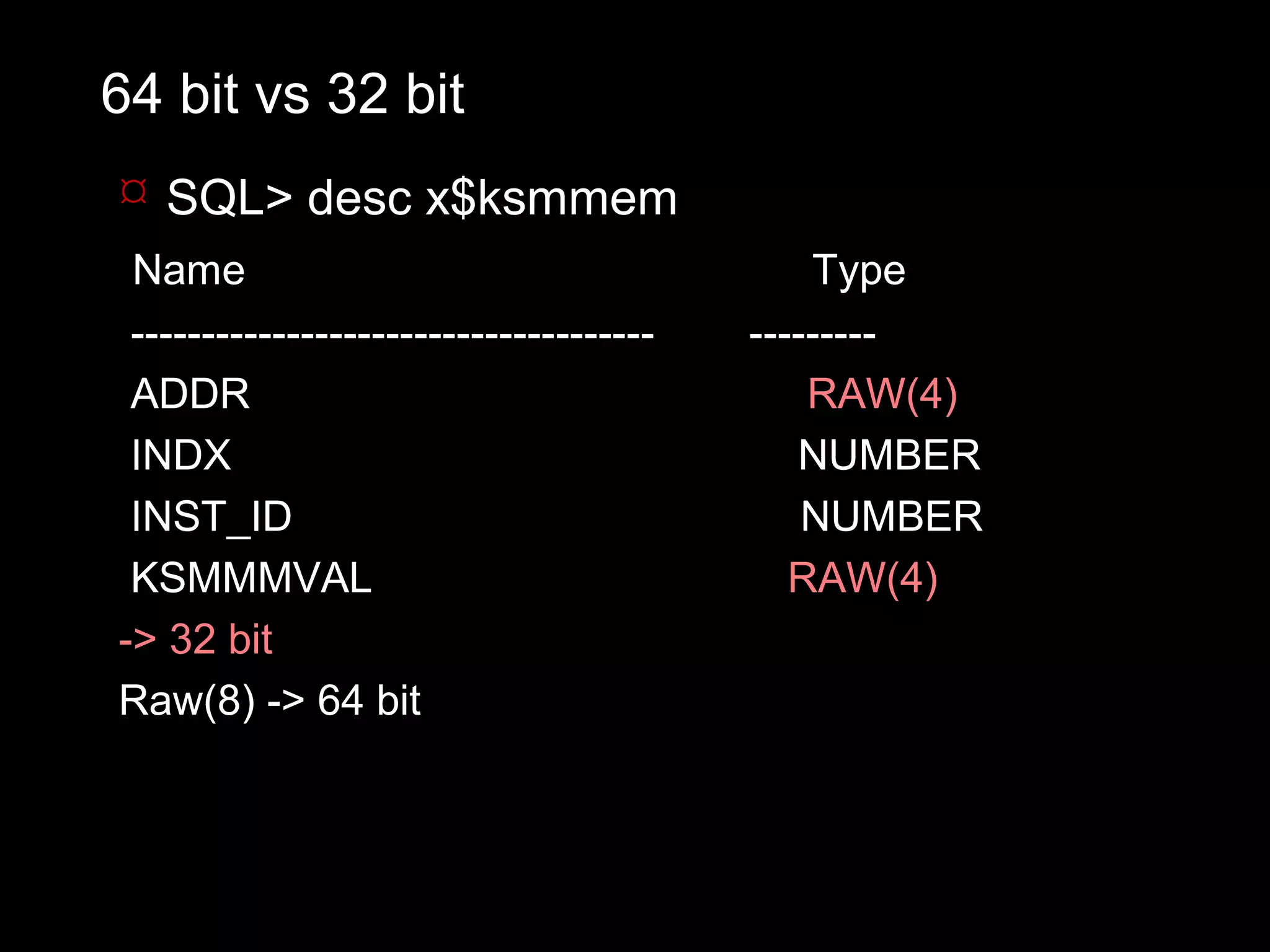
64 bit vs 32 bit
 SQL> desc x$ksmmem
 Name                                        Type
 -------------------------------------   ---------
 ADDR                                        RAW(4)
 INDX                                       NUMBER
 INST_ID                                     NUMBER
 KSMMMVAL                                   RAW(4)
-> 32 bit
Raw(8) -> 64 bit
Segmented Memory
x$ksuse – can be dis-contiguous

Work around:
select 'int users[]={' from dual;
select '0x'||addr||',' from x$ksuse;
select '0x0};' from dual;
Misaligned Access
 Some platforms seg fault when addressing
  misaligned bytes, need to read in even bytes or
  units of 4 bytes depending on platform


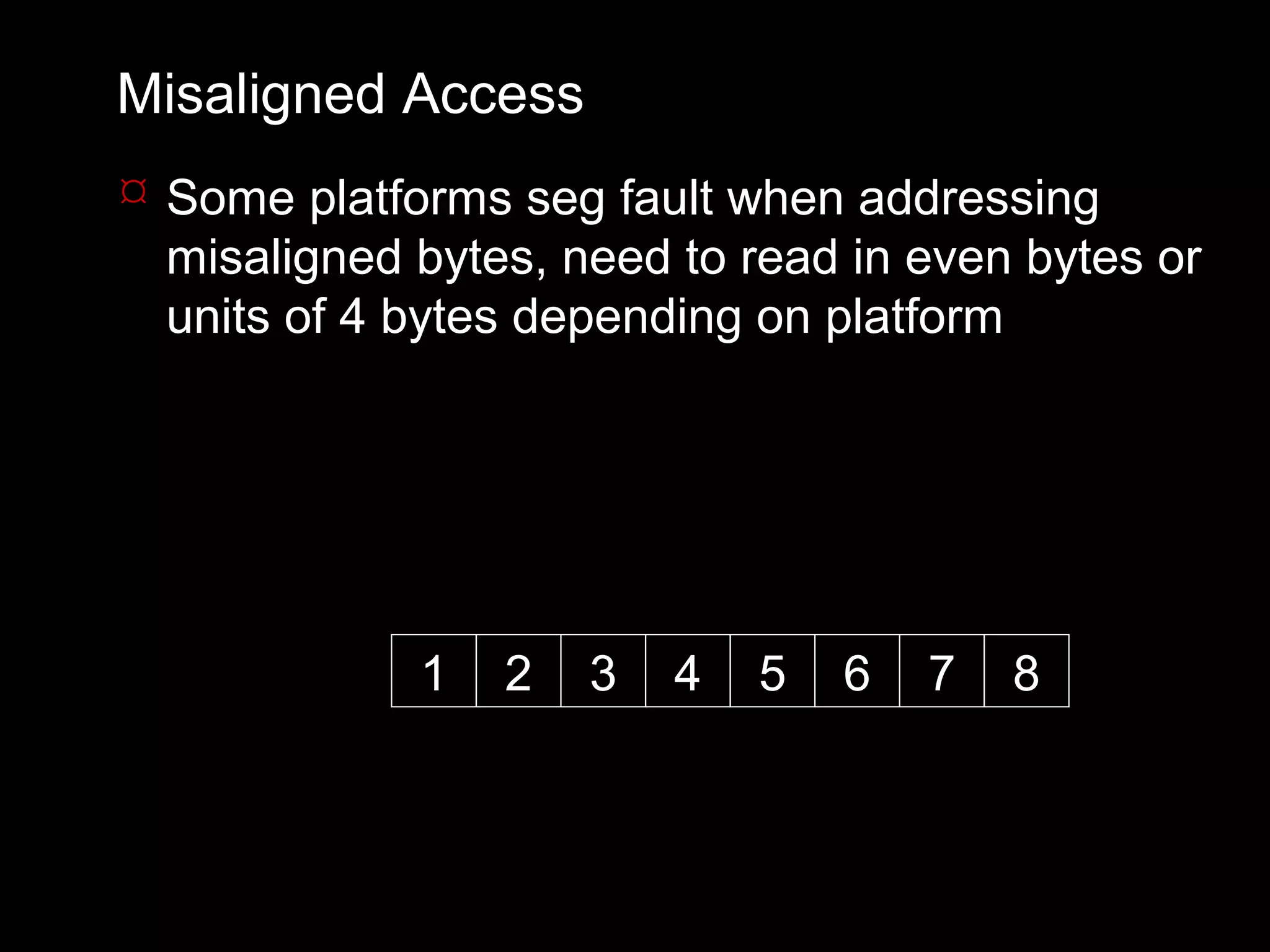
             1   2   3   4   5   6   7   8
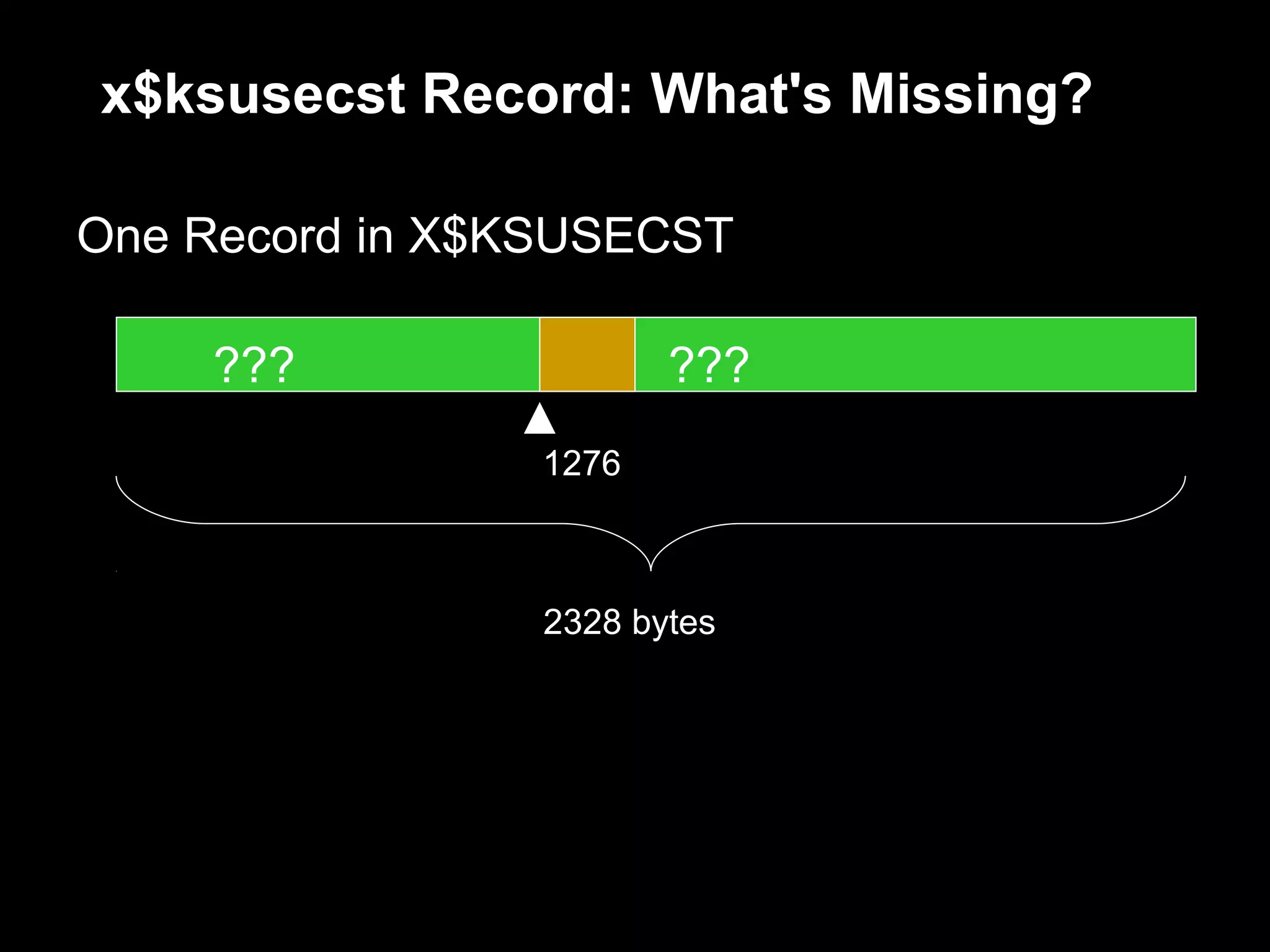
x$ksusecst Record: What's Missing?

One Record in X$KSUSECST

    ???                 ???
                 1276


                 2328 bytes
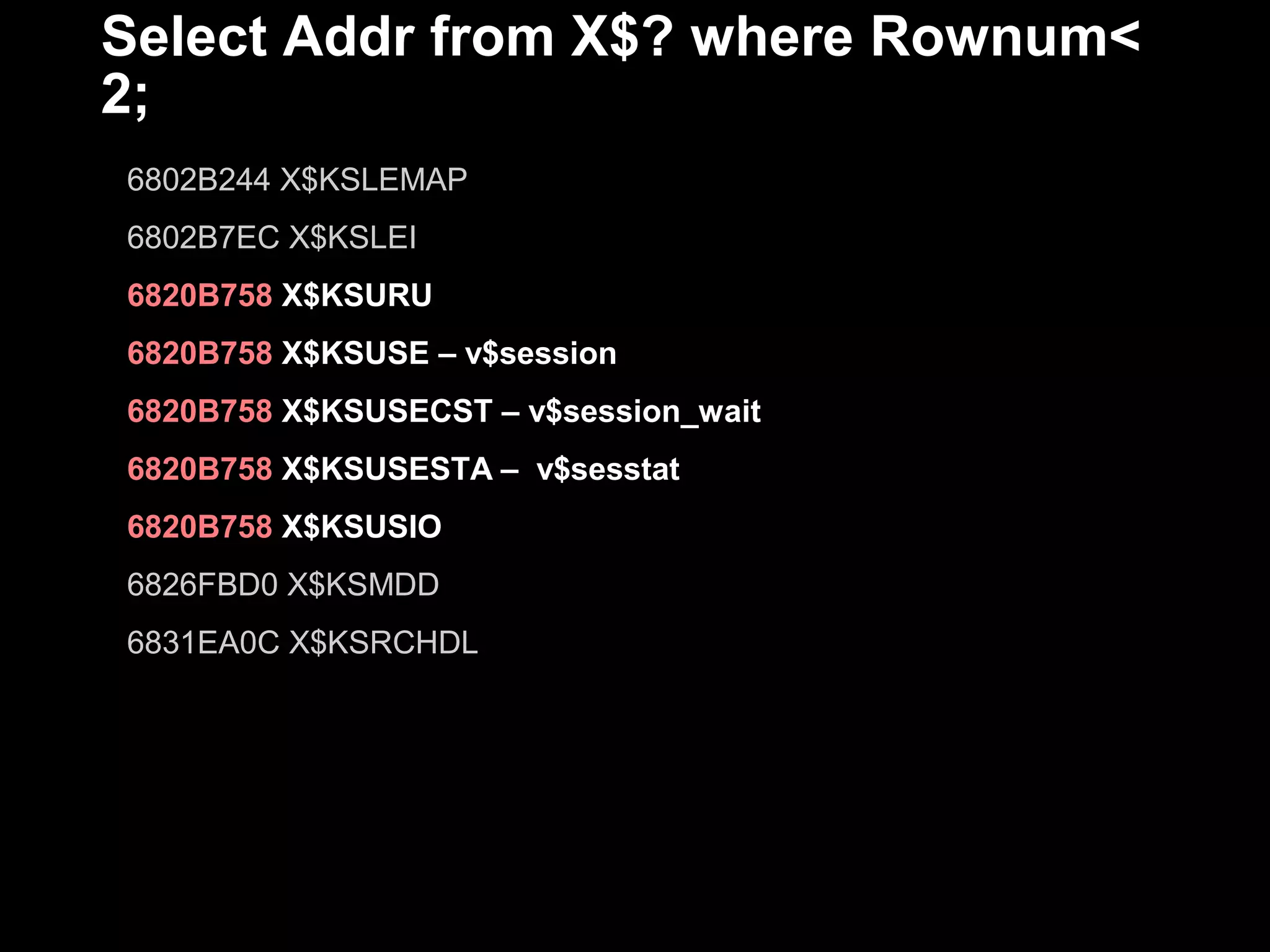
Select Addr from X$? where Rownum<
2;
6802B244 X$KSLEMAP
6802B7EC X$KSLEI
6820B758 X$KSURU
6820B758 X$KSUSE – v$session
6820B758 X$KSUSECST – v$session_wait
6820B758 X$KSUSESTA – v$sesstat
6820B758 X$KSUSIO
6826FBD0 X$KSMDD
6831EA0C X$KSRCHDL
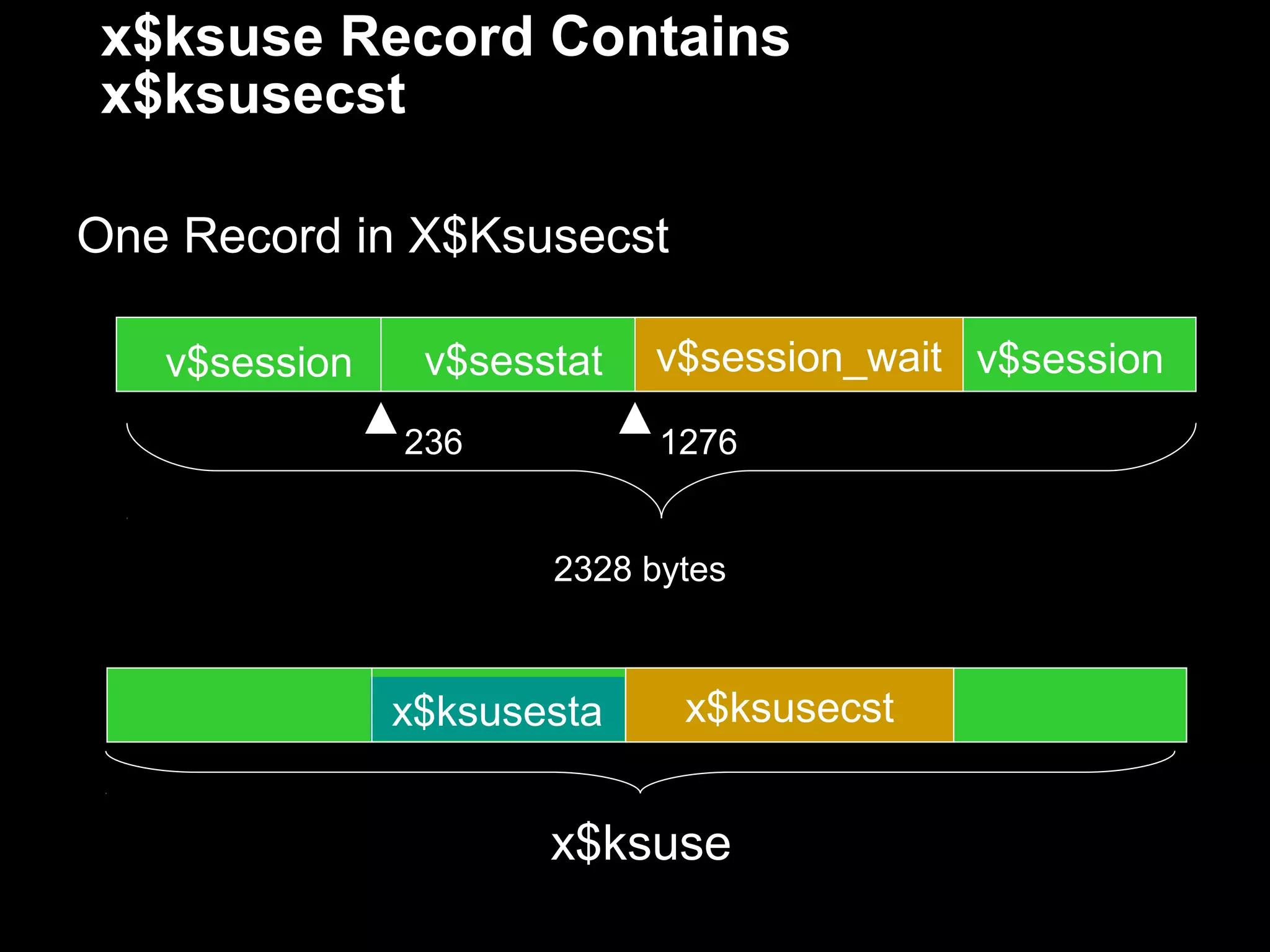
x$ksuse Record Contains
x$ksusecst

One Record in X$Ksusecst

   v$session    v$sesstat   v$session_wait v$session
               236          1276


                      2328 bytes


               x$ksusesta    x$ksusecst


                      x$ksuse
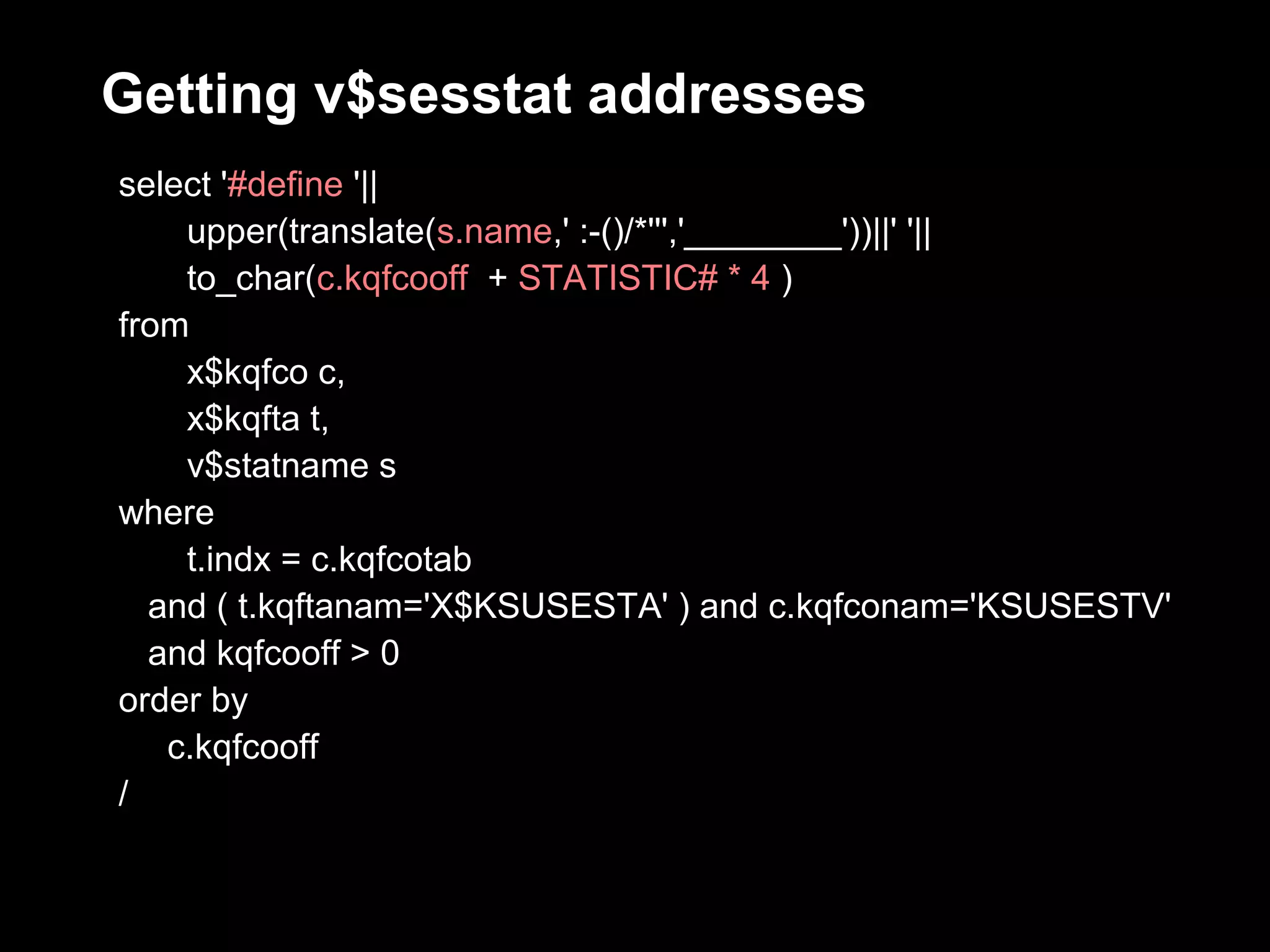
Getting v$sesstat addresses
select '#define '||
    upper(translate(s.name,' :-()/*''','________'))||' '||
    to_char(c.kqfcooff + STATISTIC# * 4 )
from
    x$kqfco c,
    x$kqfta t,
    v$statname s
where
    t.indx = c.kqfcotab
  and ( t.kqftanam='X$KSUSESTA' ) and c.kqfconam='KSUSESTV'
  and kqfcooff > 0
order by
   c.kqfcooff
/
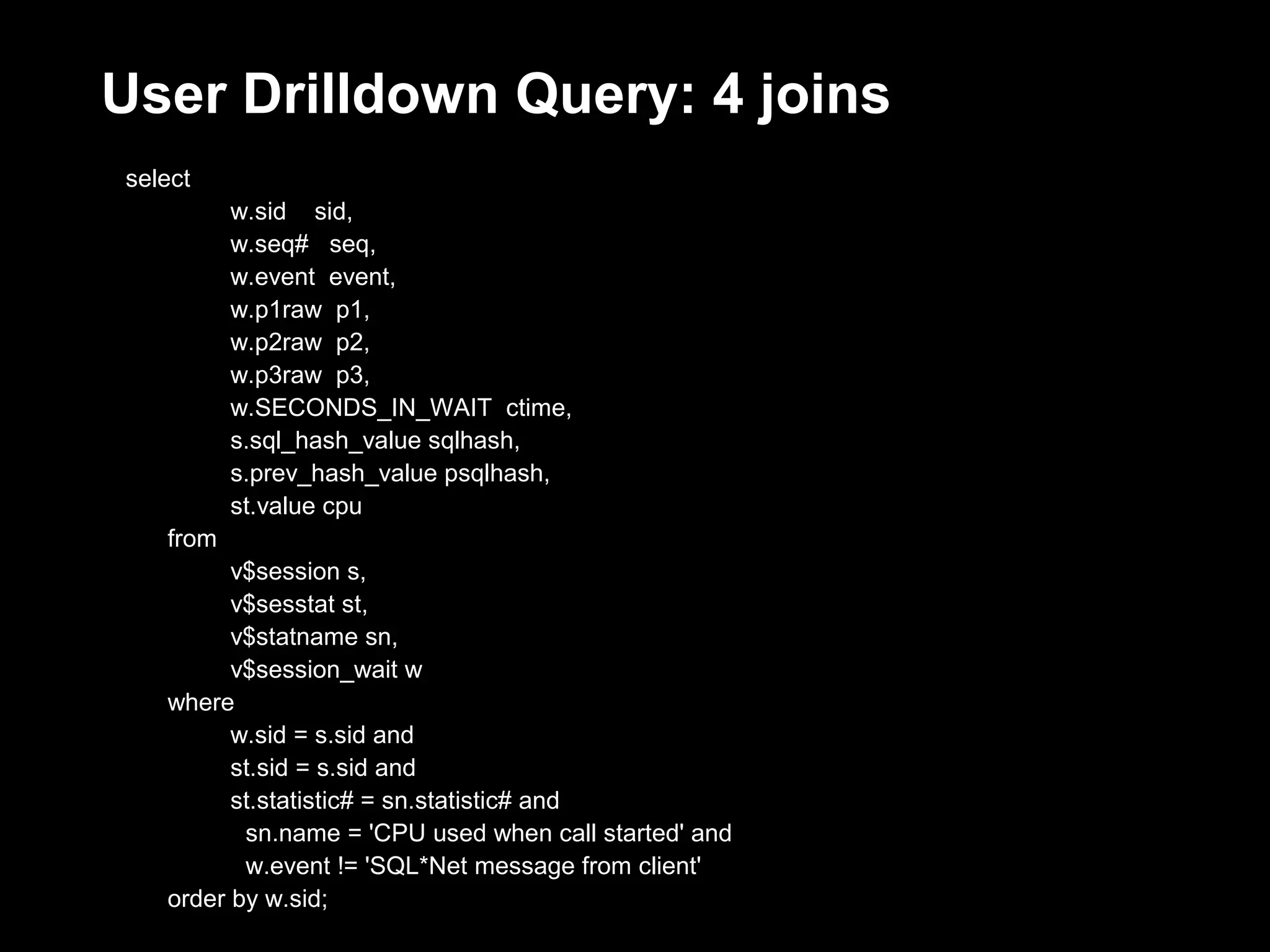
User Drilldown Query: 4 joins
select
          w.sid sid,
          w.seq# seq,
          w.event event,
          w.p1raw p1,
          w.p2raw p2,
          w.p3raw p3,
          w.SECONDS_IN_WAIT ctime,
          s.sql_hash_value sqlhash,
          s.prev_hash_value psqlhash,
          st.value cpu
   from
         v$session s,
         v$sesstat st,
         v$statname sn,
         v$session_wait w
   where
         w.sid = s.sid and
         st.sid = s.sid and
         st.statistic# = sn.statistic# and
          sn.name = 'CPU used when call started' and
          w.event != 'SQL*Net message from client'
   order by w.sid;
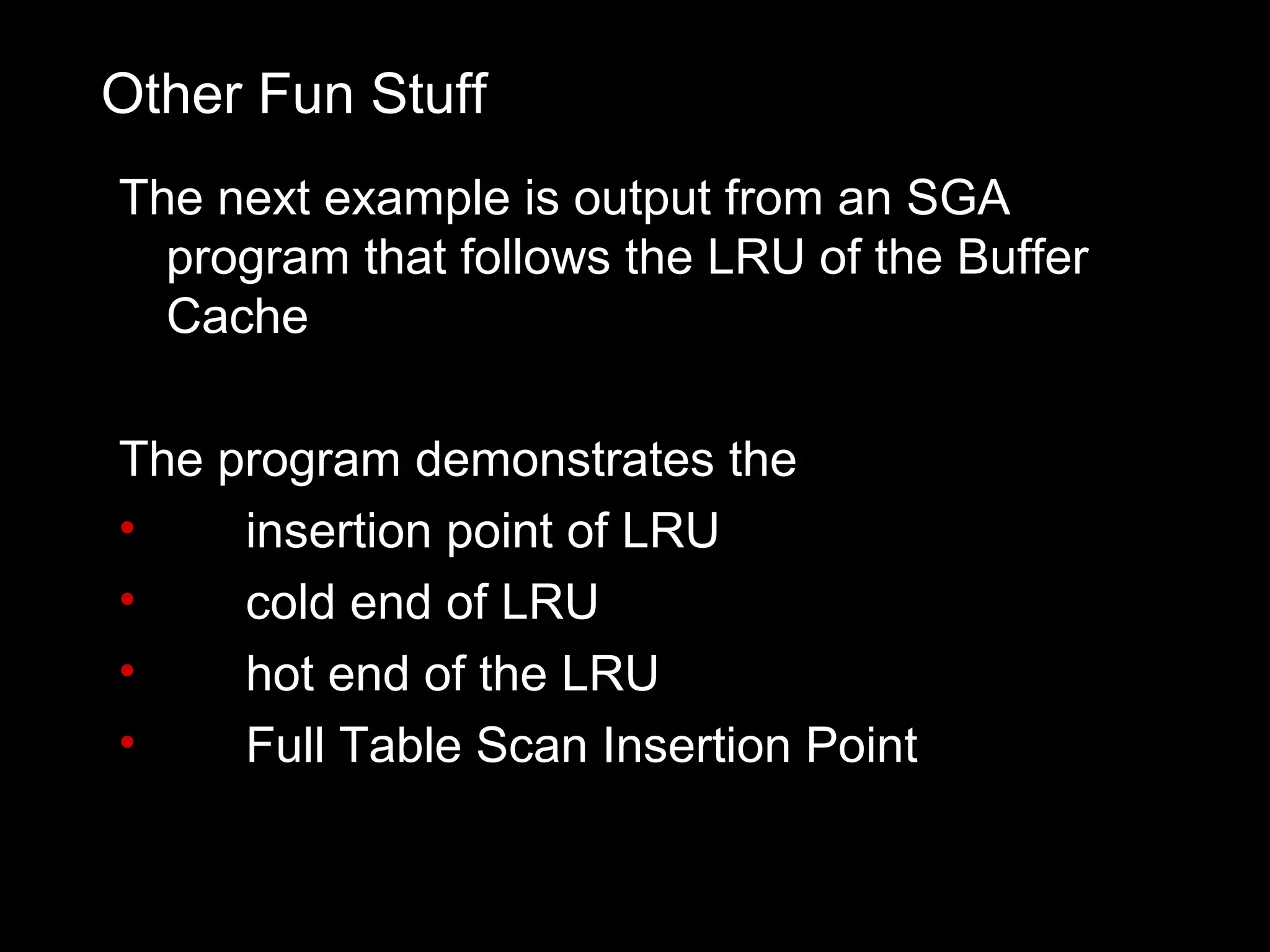
Other Fun Stuff
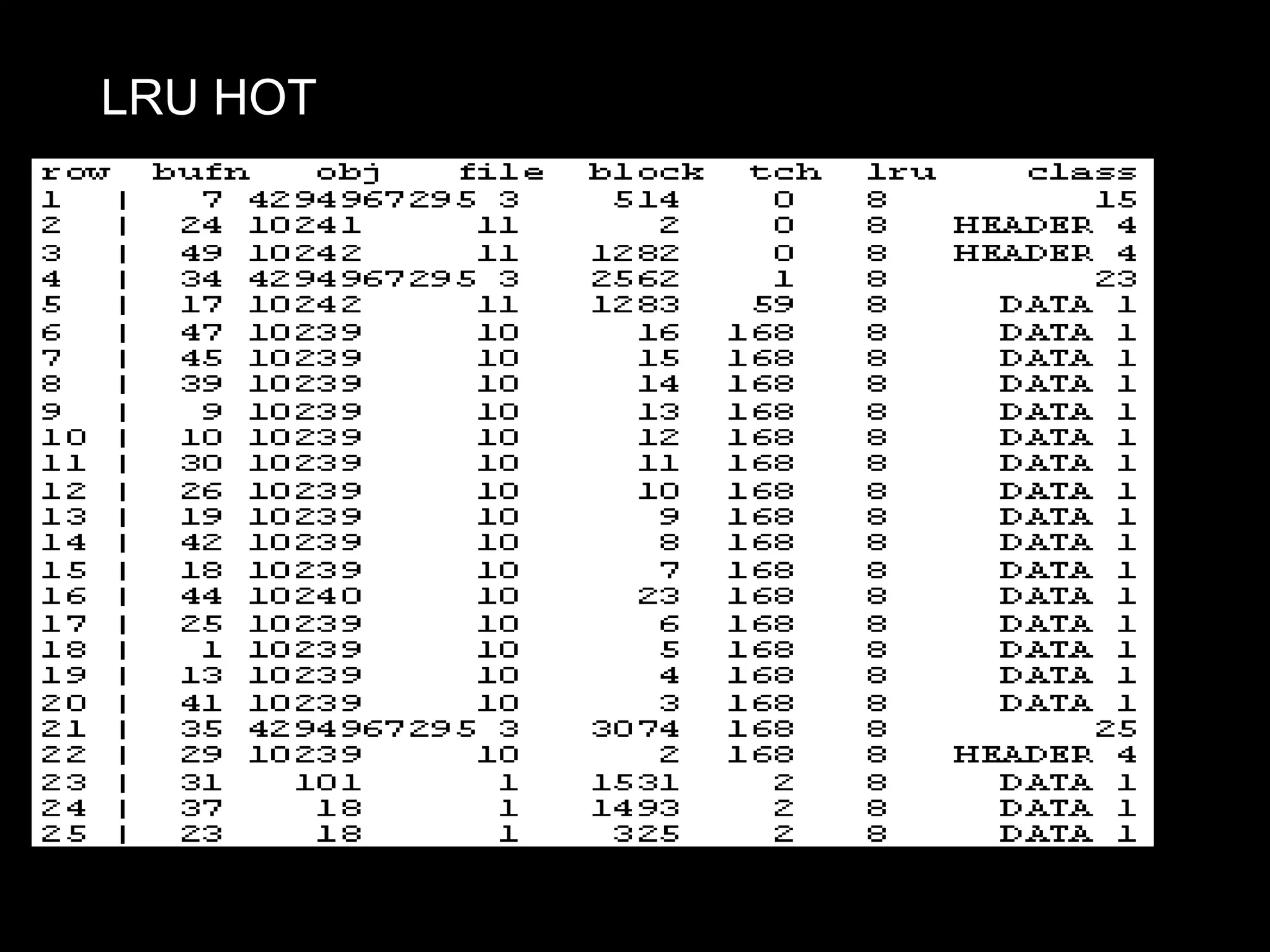
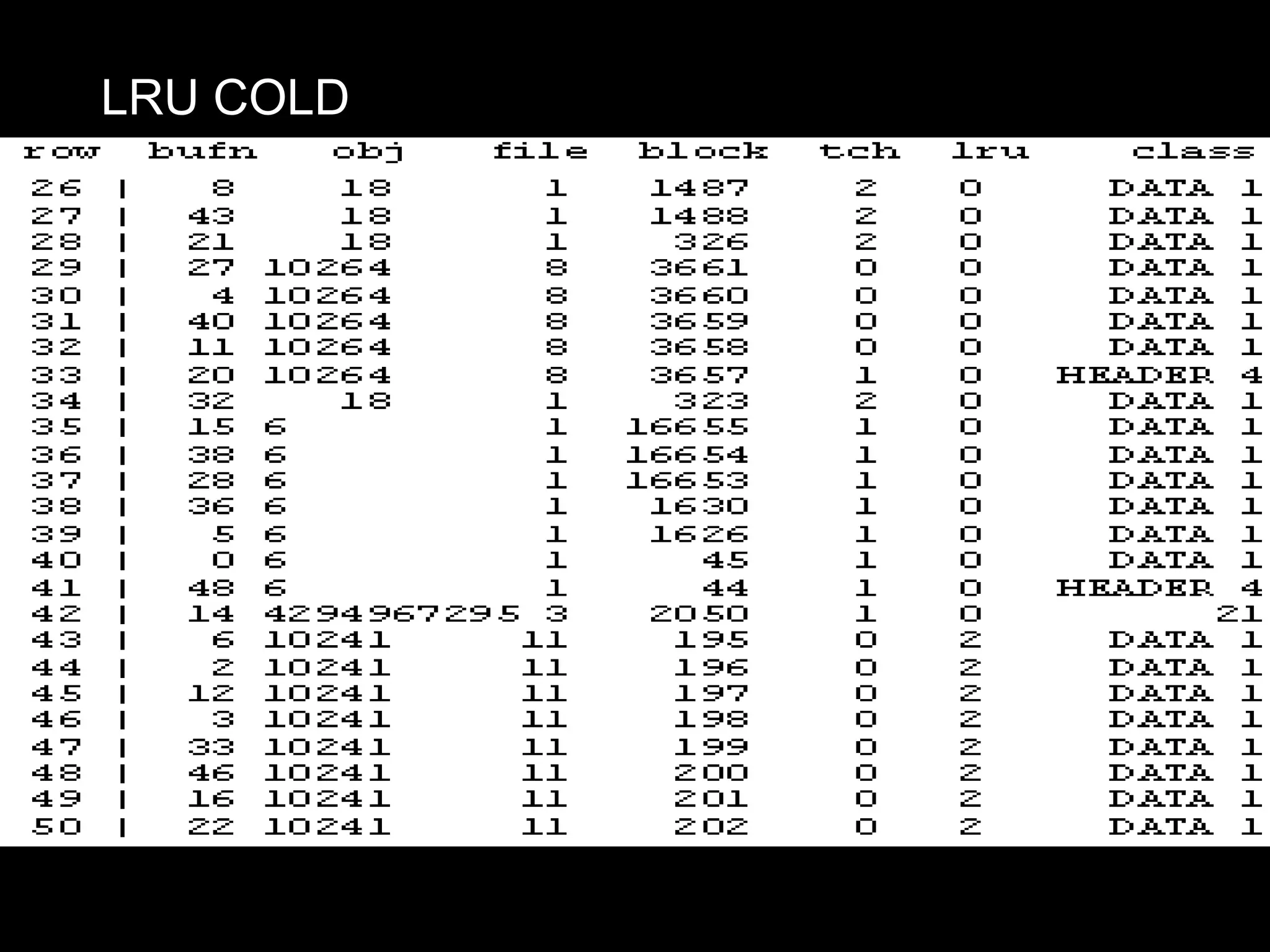
The next example is output from an SGA
  program that follows the LRU of the Buffer
  Cache

The program demonstrates the
•    insertion point of LRU
•    cold end of LRU
•    hot end of the LRU
•    Full Table Scan Insertion Point
LRU HOT
LRU COLD

Direct SGA access without SQL

  • 1.
    Oaktable  Jonathan Lewis and ORACLE_TRACE  Oracle_Trace crashes my Database  I start the SGA attach by searching every offset  Anjo Kolk says James Morle wrote a program using x$ksmmem  I show James my first draft using x$ksmmem  James is baffled by why I'm hard coding offsets  James says the offsets are in some X$ table  I search, turn up a mail by Jonathan Lewis on x$kqfco  Goldmine – all the offsets  Thanks Mogens Nogard!  Thanks to TomKyte's Decimal to Hex
  • 3.
  • 4.
    Direct Oracle SGAMemory Access Reading data directly from Oracle’s shared memory segment using C code Wednesday, February 20, 2013
  • 5.
    SGA on UNIX SMON S nnn D nnn P nnn PMON SGA CKPT Redo Log Shared Pool Database Buffer Cache Buffer DBWR ARCH LGWR oracle sqlplus Machine Memory
  • 6.
    SGA on NT S nnn D nnn P nnn CKPT SMON Machine Shared Pool Database Buffer Cache Redo Log Buffer Memory PMON DBWR LGWR ARCH oracle Process Space sqlplus
  • 7.
    What is theSGA  Memory Cache  Often Used Data  Rapid Access  Shareable  Concurrently Access
  • 8.
    SGA 4 mainregions  Fixed information – Users info – Database statistics – X$dual – etc  Data block cache  SQL cache ( library cache/shared pool)  Redo log buffer
  • 9.
    How is theSGA info Used?  Automatically – data blocks cached – Log buffer – Sql cache – Updates of system and user statistics  User Queries – User info v$session – System info v$parameter – Performance statistics v$sysstat, v$latch, v$system_event – Buffer cache headers, x$bh
  • 10.
    Why Direct Accesswith C?  Reading Hidden Information – Sort info on version 7 – OPS locking info version 8 – Contents of data blocks (only the headers or visible in X$)  Access while Database is Hung  High Speed Access – Sampling User Waits, catch ephemeral data – Scan LRU chain in X$bh – Statistically approximate statistics  SQL statistics per user  Low overhead
  • 11.
    Database Slow orHung Often happens at the largest sites when cutting edge support is expected.  Shared Pool errors ORA 4031  Archiver or Log file Switch Hangs  Hang Bugs  Library Cache Latch contention  ORA-00379: no free buffers available in buffer pool DEFAULT
  • 12.
    Statistical Sampling By Rapidly Sampling SQL statistics and the users who have the statistics open, one can see how much work a particular user does with a particular SQL statement
  • 13.
    Low Overhead  MarketingAppeal  Clients are sensitive about their production databases  Heisenberg uncertainty affect – less overhead less affect monitoring has on performance which we are monitoring
  • 14.
    SGA made visiblethrough x$tables  Most of the SGA is not visible  X$KSMMEM Exception, Raw Dump of SGA  Information Externalized through X$ tables  Useful or Necessary information is Externalized  Externalized publicly through V$ Tables
  • 15.
    Machine Memory 0x80000000 SGA SGA
  • 16.
    Buffer Cache GraphicSGA SGA 0x80000000 Fixed Area Buffer Cache Shared Pool Log Buffer
  • 17.
    Fixed Area SGA X$KSUSECST- user waits 0x80000000 0x85251EF4
  • 18.
    X$KSUSECST 170 Records 2328 bytes 0x85251EF4 Row 1 Row 2 Row 3 …
  • 19.
    X$KSUSECST Record One Recordin X$KSUSECST 1276 2328 bytes
  • 20.
    X$KSUSECST Fields 1276 1278 1280 1284 1288 Seq # Event # p1 p2 p3
  • 21.
    Externalization of Cstructs: X$ tables If Structure foo was externalized in a X$ SQL> describe x$foo Column Name Type ------------------------------ -------- ADDR RAW(8) INDX NUMBER ID NUMBER B NUMBER
  • 22.
    SGA is OneLarge C Struct struct foo { int id; int A; int B; int C; }; struct foo foo[N];
  • 23.
    Struct C code #include<stdio.h> #include <fcntl.h> #define N 20 /* structure definition: */ struct foo { int id; int a; int b; int c; }; /* end structure definition */
  • 24.
    Struct Record main(){ struct foofoo[20]; int fptr; /* zero out memory of struct */ memset(foo,0,sizeof(foo)); foo[0].id=1; /* row 0 */ foo[0].a=12; foo[0].b=13; foo[0].c=13;
  • 25.
    Struct Write toFile foo[1].id=2; /* row 1 */ foo[1].a=22; foo[1].b=23; foo[1].c=24; /* write to file, simulate SGA */ if ((fptr = open("foo.out",O_WRONLY | O_CREAT,0777)) < 0 ) return -1; write(fptr,foo,sizeof(foo)); return 0; }
  • 26.
    Simulate SGA witha File write(fp,foo,sizeof(foo));
  • 27.
    Simulate SGA witha File Row 0 Row 1 ID A B C ID A … 0 1 3 4 6 8 bits 0 4 6 8 2 1 8 1 4 2 0 bytes 0 4 8 C 2 1 6 1 0 hex bytes 0 4 1 1 2 0 2 4 oct 0 Memory address 4 0 4 Increasing bytes
  • 28.
    Struct File Contents $./foo $ ls -l foo.out -rw-r--r-- joe dba 320 Feb 10 19:41 foo.out int = 32 bits Int = 4 bytes 20 entries * 4 int * 4 bytes/int = 320 bytes
  • 29.
    od – octaldump $ od -l foo.out 0000000 1 12 13 13 0000020 2 22 23 24 0000040 0 0 0 0 * 0000500
  • 30.
    Struct File Contents Address is in Hex Column 2 is the ID Column 3 is field A Column 4 is field B Column 5 is field C
  • 31.
    X$ tables ? Ok, x$foo =~ foo[20]  How do I get a list of x$ tables?  Where is each X$ located?  V$Fixed_Tables
  • 32.
    V$Fixed_Table – listof X$ tables SQL> desc v$fixed_table; Name Null? Type ----------------------------------------- -------- ----------------- NAME VARCHAR2(30) OBJECT_ID NUMBER TYPE VARCHAR2(5) TABLE_NUM NUMBER
  • 33.
    Graphic: X$ Addresses SGA 0x80000000 0x8???????? X$????
  • 34.
    V$Fixed_Table spool addr.sql select 'select 'addr, ||''''||name||''''||' from ' || name ||' where rownum < 2;' from v$fixed_table where name like 'X%' / spool off @addr.sql
  • 35.
    Example: finding theaddress select a.addr , 'X$KSUSE' from X$KSUSE where rownum < 2 ;
  • 36.
    X$ layout 6802B244 X$KSLEMAP 6802B7ECX$KSLEI 6820B758 X$KSURU 6820B758 X$KSUSE - v$session 6820B758 X$KSUSECST – v$session_wait 6820B758 X$KSUSESTA – v$session_stat 6820B758 X$KSUSIO 6826FBD0 X$KSMDD 6831EA0C X$KSRCHDL
  • 37.
    What's in theseX$ views  V$ views are documented  V$ views are based often on X$ tables  The map from v$ to X$ is described in : V$Fixed_View_Definition
  • 38.
    V$Fixed_View_Definition SQL> desc V$Fixed_View_Definition Name Type ----------------------------------- -------------- VIEW_NAME VARCHAR2(30) VIEW_DEFINITION VARCHAR2(4000)
  • 39.
    Definition of V$Session_Wait SQL>select VIEW_DEFINITION from V$FIXED_VIEW_DEFINITION where view_name='GV$SESSION_WAIT'; VIEW_DEFINITION ----------------------------------------------------------------------- select s.inst_id,s.indx,s.ksussseq,e.kslednam, e.ksledp1,s.ksussp1,s.ksussp1r,e. ksledp2, s.ksussp2,s.ksussp2r,e.ksledp3,s.ksussp3,s.ksussp3r, decode(s.ksusstim, 0,0,-1,-1,-2,-2, decode(round(s.ksusstim/10000),0,-1,round(s.ksusstim/10000))) , s.ksusewtm, decode(s.ksusstim, 0, 'WAITING', -2, 'WAITED UNKNOWN TIME', -1, ' WAITED SHORT TIME', 'WAITED KNOWN TIME') from x$ksusecst s, x$ksled e where bit and(s.ksspaflg,1)!=0 and bitand(s.ksuseflg,1)!=0 and s.ksussseq!=0 and s.ksussop c=e.indx
  • 40.
    The Fields inX$ tables  OK, I've picked an X$  I've got the starting address  Now, how do I get the fields?
  • 41.
    X$KQFTA  Kernel QueryFixed_view Table  INDX use to find column information  KQFTANAM X$ table names
  • 42.
    X$KQFCO  Kernel Query Fixed_view Column  KQFCOTAB Join with X$KQFTA.INDX  KQFCONAM Column name  KQFCOOFF Offset from beginning of the row  KQFCOSIZ Columns size in bytes
  • 43.
    X$KSUSECST Fields 1276 1278 1280 1284 1288 Address Seq # Event # p1 p2 p3 2 2 4 4 4 BYTES
  • 44.
    SGA Contents inResume In resume: Oracle takes the C structure defining the SGA and maps it onto a shared memory segment Memory address Increasing 0x800000 0 Fixed SGA Buffer Redo Library Cache Buffer Cache Oracle provides access to some of the SGA contents via X$ tables
  • 45.
    **** Procedure ***** 1. Choose a V$ view 2. Find base X$ Tables for v$ view 3. Map X$ fields to V$ fields 4. Get address of X$ table in SGA 5. Get the size of each record in X$ table 6. Get the number of records in X$ table 7. Get offsets for each desired field in X$ table 8. Get the base address of SGA
  • 46.
    1) V$SESSION_WAIT Example List of all users waiting  Detailed information on the waits  Data is ephemeral  Useful in Bottleneck diagnostics  High sampling rate candidate  Event 10046 captures this info Good table for SGA sampling
  • 47.
    V$SESSION_WAIT Description SQL>desc v$session_wait Name Type ----------------------------------------- -------------------------- SID ,NUMBER SEQ# ,NUMBER EVENT ,VARCHAR2(64) P1TEXT ,VARCHAR2(64) P1 ,NUMBER P1RAW ,RAW(4) P2TEXT ,VARCHAR2(64) P2 ,NUMBER P2RAW ,RAW(4) P3TEXT ,VARCHAR2(64) P3 ,NUMBER P3RAW ,RAW(4) WAIT_TIME ,NUMBER SECONDS_IN_WAIT ,NUMBER STATE ,VARCHAR2(19) )
  • 48.
    V$SESSION_WAIT Short SQL> descv$session_wait Name Type ---------------------------- ------------- SID NUMBER SEQ# NUMBER EVENT VARCHAR2(64) P1 NUMBER P2 NUMBER P3 NUMBER)
  • 49.
    V$FIXED_VIEW_DEFINITION Gives mappings ofV$ views to X$ tables SQL> select VIEW_DEFINITION from V$FIXED_VIEW_DEFINITION where view_name='V$SESSION_WAIT‘;
  • 50.
    V$SESSION_WAIT View Definition VIEW_DEFINITION --------------------------------------------------------------------- select s.inst_id, s.indx, s.ksussseq, e.kslednam, e.ksledp1, s.ksussp1, s.ksussp1r, e.ksledp2, s.ksussp2, s.ksussp2r, e.ksledp3, s.ksussp3, s.ksussp3r, round(s.ksusstim / 10000), s.ksusewtm, decode(s.ksusstim, 0, 'WAITING', -2, 'WAITED UNKNOWN TIME', -1, 'WAITED SHORT TIME', 'WAITED KNOWN TIME') from x$ksusecst s, x$ksled e where bitand(s.ksspaflg,1)!=0 and bitand(s.ksuseflg,1)!=0 and s.ksussseq!=0 and s.ksussopc=e.indx
  • 51.
    View Definition Short VIEW_DEFINITION --------------------------------------------------------------------- select s.indx, s.ksussseq, e.kslednam, s.ksussp1, s.ksussp2, s.ksussp3 from x$ksusecst s, x$ksled e where s.ksussopc=e.indx
  • 52.
    2) V$SESSION_WAIT Basedon X$KSUSECT VIEW_DEFINITION --------------------------------------------------- - select indx, ksussseq, ksussopc, ksussp1, ksussp2, ksussp3 from x$ksusecst
  • 53.
    Equivalent SQL Statements select select indx, sid ksussseq, seq# ksussopc, event ksussp1, p1 ksussp2, p2 ksussp3 p3 from from x$ksusecst v$session_wait ) Note: x$ksusecst. Ksussopc is the event # x$ksled.kslednam is a list of the event names where x$ksled.indx = x$ksusecst. ksussopc
  • 54.
    3) V$ toX$ Field Mapping
  • 55.
    4) Get baseSGA address for X$ table Find the location of X$KSUSECST in the SGA SQL> select addr from x$ksusecst where rownum < 2 ADDR -------- 85251EF4
  • 56.
    5) Find theSize of Each Record SQL> select ((to_dec(e.addr)-to_dec(s.addr))) row_size from (select addr from x$ksusecst where rownum < 2) s, (select max(addr) addr from x$ksusecst where rownum < 3) e ; ROW_SIZE ---------------- 2328
  • 57.
    6) Find theNumber of Records in the structure SQL> select count(*) from x$ksusecst ; COUNT(*) -------------- 170
  • 58.
    Get Offsets forEach Desired Field in X$ table SQL> select c.kqfconam field_name, c.kqfcooff offset, c.kqfcosiz sz from x$kqfco c, x$kqfta t where t.indx = c.kqfcotab and t.kqftanam='X$KSUSECST' order by offset ;
  • 59.
    X$KQFTA - X$Tables Names List of X$ tables  INDX use to find column information  KQFTANAM X$ table names To get Column information join with X$KQFCO X$KQFTA.INDX = X$KQFCO.KQFCOTAB
  • 60.
    X$KQFCO – X$Table Columns List of all the columns in X$ Tables  KQFCOTAB Join with X$KQFTA.INDX  KQFCONAM Column name  KQFCOOFF Offset from beginning of the row  KQFCOSIZ Columns size in bytes
  • 61.
    Field Offsets FIELD_NAME OFFSET SZ ------------------------------ ---------- ---------- ADDR 0 4 INDX 0 4 KSUSEWTM 0 4 INST_ID 0 4 KSSPAFLG 1 1 KSUSSSEQ 1276 2 KSUSSOPC 1278 2 KSUSSP1 1280 4 KSUSSP1R 1280 4 KSUSSP2 1284 4 KSUSSP2R 1284 4 KSUSSP3 1288 4 KSUSSP3R 1288 4 KSUSSTIM 1292 4 KSUSENUM 1300 2 KSUSEFLG 1308 4
  • 62.
    What are allthe fields at OFFSET 0? These are all calculated values and not stored explicitly in the SGA. ADDR memory address INDX record number, like rownum INST_ID database instance ID KSUSEWTM calculated field
  • 63.
    Unexposed Fields What happensbetween OFFSET 1 and 1276? • Unexposed Fields • Sometimes exposed elsewhere, in our case • V$SESSION • V$SESSTAT
  • 64.
    Fields at SameAddress Why do some fields start at the same address? KSUSSP1 KSUSSP1R Are at the same address Equivalent of V$SESSION_WAIT.P1 V$SESSION_WAIT.P1RAW These are the same data, just exposed as Hex Decimal
  • 65.
  • 66.
    8) Get BaseSGA Address SQL> select addr from x$ksmmem where rownum < 2 ADDR -------------- 80000000
  • 67.
  • 68.
    Machine Memory 0x80000000 SGA SGA
  • 69.
    Fixed Area SGA X$KSUSECST- user waits 0x80000000 0x85251EF4
  • 70.
    X$KSUSECST 170 Records 2328 bytes 0x85251EF4 Row 1 Row 2 Row 3 …
  • 71.
    X$KSUSECST Record One Recordin X$KSUSECST 1276 2328 bytes
  • 72.
    X$KSUSECST Fields 1276 1278 1280 1284 1288 Seq # Event # p1 p2 p3
  • 73.
    Attaching to theSGA  UNIX System Call “shmat” To attach to shared memory Unix as a system call void *shmat( int shmid, const void *shmaddr, int shmflg );
  • 74.
    ID and Addressarguments to “shmat” The arguments are:  shmid – shared memory identifier specified  shmaddr – starting address of the shared memory  shmflg - flags The argument shmflg can be set to SHM_RDONLY . To avoid any possible data corruption the SGA should only be attached read only. The arguments shmid and shmaddr need to be set to Oracle’s SGA id and address.
  • 75.
    Finding Oracle SGA’sID and Address Use ORADEBUG to find the SGA id SQL> oradebug setmypid Statement processed. SQL> oradebug ipc Information written to trace file.  
  • 76.
    Finding Trace File SQL>show parameters user_dump NAME VALUE ----------------------- -------------------------------- user_dump_dest /u02/app/oracle/admin/V901/udump SQL> exit $ cd /u02/app/oracle/admin/V901/udump $ ls -ltr | tail -1 -rw-r----- usupport dba Aug 24 18:01 v901_ora_23179.trc
  • 77.
    Finding SHMID inTrace File $ vi v901_ora_23179.trc … Total size 004456c Minimum Subarea size 00000000 Area Subarea Shmid Stable Addr Actual Addr 0 0 34401 0080000000 0080000000 …
  • 78.
    Attaching to theSGA Shmid 34401 Shmaddr 0x80000000 Shmflg SHM_RDONLY The SGA attach call in C would be: Shmat(34401, 0x80000000, SHM_RDONLY); This call needs to be executed as a UNIX user who has read permission to the Oracle SGA
  • 79.
    C Code Headers #include <stdio.h> #include <sys/ipc.h> #include <sys/shm.h> #include <errno.h> #include "event.h" event.h is for translating the event #s into event names
  • 80.
    Events.h Spool events.h select 'charevent[][100]={' from dual; select '"'||name||'",' from v$event_name; select ' "" };' from dual; spool off
  • 81.
    Define Base Addressesand Sizes /* SGA BASE ADDRESS */ #define SGA_BASE 0x80000000 /* START ADDR of KSUSECST(V$SESSION_WAIT) */ #define KSUSECST_ADDR 0x85251EF4 /* NUMBER of ROWS/RECORDS in KSUSECST */ #define SESSIONS 150 /* SIZE in BYTES of a ROW in KSUSECST */ #define RECORD_SZ 2328
  • 82.
    Define Offsets toFields #define KSUSSSEQ 1276 /* sequence # */ #define KSUSSOPC 1278 /* event # */ #define KSUSSP1R 1280 /* p1 */ #define KSUSSP2R 1284 /* p2 */ #define KSUSSP3R 1288 /* p3 */
  • 83.
    Set Up Variables main(argc, argv) int argc; char **argv; { void *addr; int shmid; int shmaddr; void *current_addr; long p1r, p2r, p3r; unsigned int i, seq, tim, flg, evn;
  • 84.
    Attach to SGA /*ATTACH TO SGA */ shmid=atoi(argv[1]); shmaddr=SGA_BASE; if ( (void *)shmat( shmid, (void *)shmaddr, SHM_RDONLY) == (void *)-1 ) { printf("shmat: error attatching to SGAn"); exit(); }
  • 85.
    Set Up SamplingLoop /* LOOP OVER ALL SESSIONS until CANCEL */ while (1) { /* set current address to beginning of Table */ current_addr=(void *)KSUSECST_ADDR; sleep(1); printf("^[[H ^[[J"); /* clear screen */ /* print page heading */ printf("%4s %8s %-20.20s %10s %10s %10s n", "sid", "seq", "wait","p1","p2","p3");
  • 86.
    Loop over allSessions for ( i=0; i < SESSIONS ; i++ ) { seq=*(unsigned short *)((int)current_addr+KSUSSSEQ); evn=*(short *) ((int)current_addr+KSUSSOPC); p1r=*(long *) ((int)current_addr+KSUSSP1R); p2r=*(long *) ((int)current_addr+KSUSSP2R); p3r=*(long *) ((int)current_addr+KSUSSP3R); if ( evn != 0 ) { printf("%4d %8u %-20.20s %10X %10X %10X n", i, seq, event[evn] ,p1r, p2r,p3r ); } current_addr=(void *)((int)current_addr+RECORD_SZ); } } }
  • 87.
    Output $ sga_read_session_wait 34401 sid seq wait p1 p2 p3 0 40582 pmon timer 12C 0 0 1 40452 rdbms ipc message 12C 0 0 2 43248 rdbms ipc message 12C 0 0 3 24706 rdbms ipc message 12C 0 0 4 736 smon timer 12C 0 0 5 88 rdbms ipc message 2BF20 0 0 8 178 SQL*Net message from 6265710 1 0
  • 88.
    Pitfalls  Byte Swapping  32 bit vs 64 bit  Multiple Shared Memory Segments  Segmented Memory  Addresses are "unsigned int"  Misaligned Access
  • 89.
    Little Endian vsBig Endian  Is low byte values first or high byte values first ?  a byte is 8 bits – 00000000-11111111 bits,0 – 31 dec, 0x0 - 0xFF hex  Big Endian is "normal" , highest bit first  In ascii, the word "byte" is stored as – b = 62, y = 79, t = 74, e = 65  echo 'byte' | od -x – b y t e – 62 79 74 65  Little Endian, ie byte swapped (Linux, OSF, Sequent, ? ) – y b e t – 79 62 65 74
  • 90.
    Byte Swap Example Short= 2 bytes ie 16 bits Goal, get the flag in the "second" byte #ifdef __linux uflg=*(short *)((int)sga_address)>>8; #else uflg=*(short *)((int)sga_address); #endif
  • 91.
    Byte Swap Big Endian: 0000 00 00 00 00 00 01 Little Endian 00 00 00 01 00 00 00 00 Solution, push the value over 8 places, to the right, ie >>8
  • 92.
    64 bit vs32 bit  SQL> desc x$ksmmem Name Type ------------------------------------- --------- ADDR RAW(4) INDX NUMBER INST_ID NUMBER KSMMMVAL RAW(4) -> 32 bit Raw(8) -> 64 bit
  • 93.
    Segmented Memory x$ksuse –can be dis-contiguous Work around: select 'int users[]={' from dual; select '0x'||addr||',' from x$ksuse; select '0x0};' from dual;
  • 94.
    Misaligned Access  Someplatforms seg fault when addressing misaligned bytes, need to read in even bytes or units of 4 bytes depending on platform 1 2 3 4 5 6 7 8
  • 95.
    x$ksusecst Record: What'sMissing? One Record in X$KSUSECST ??? ??? 1276 2328 bytes
  • 96.
    Select Addr fromX$? where Rownum< 2; 6802B244 X$KSLEMAP 6802B7EC X$KSLEI 6820B758 X$KSURU 6820B758 X$KSUSE – v$session 6820B758 X$KSUSECST – v$session_wait 6820B758 X$KSUSESTA – v$sesstat 6820B758 X$KSUSIO 6826FBD0 X$KSMDD 6831EA0C X$KSRCHDL
  • 97.
    x$ksuse Record Contains x$ksusecst OneRecord in X$Ksusecst v$session v$sesstat v$session_wait v$session 236 1276 2328 bytes x$ksusesta x$ksusecst x$ksuse
  • 98.
    Getting v$sesstat addresses select'#define '|| upper(translate(s.name,' :-()/*''','________'))||' '|| to_char(c.kqfcooff + STATISTIC# * 4 ) from x$kqfco c, x$kqfta t, v$statname s where t.indx = c.kqfcotab and ( t.kqftanam='X$KSUSESTA' ) and c.kqfconam='KSUSESTV' and kqfcooff > 0 order by c.kqfcooff /
  • 99.
    User Drilldown Query:4 joins select w.sid sid, w.seq# seq, w.event event, w.p1raw p1, w.p2raw p2, w.p3raw p3, w.SECONDS_IN_WAIT ctime, s.sql_hash_value sqlhash, s.prev_hash_value psqlhash, st.value cpu from v$session s, v$sesstat st, v$statname sn, v$session_wait w where w.sid = s.sid and st.sid = s.sid and st.statistic# = sn.statistic# and sn.name = 'CPU used when call started' and w.event != 'SQL*Net message from client' order by w.sid;
  • 100.
    Other Fun Stuff Thenext example is output from an SGA program that follows the LRU of the Buffer Cache The program demonstrates the • insertion point of LRU • cold end of LRU • hot end of the LRU • Full Table Scan Insertion Point
  • 101.
  • 102.

Editor's Notes

  • #22 Notice that column A and C are missing from x$foo. Not all values in a structure used in the SGA are made visible via SQL
  • #27 If we mapped the structure on memory or dumped it in a file, we could find the different elements
  • #28 If we mapped the structure on memory or dumped it in a file, we could find the different elements
  • #64 Oracle doesn’t always expose all the fields in the structure thus if there are gaps in the offsets that are bigger than the field sizes then there is other information in the underlying structure that isn’t exposed in the X$ table. (in this case those address are exposed but in different X$ tables)