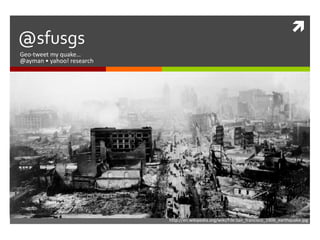
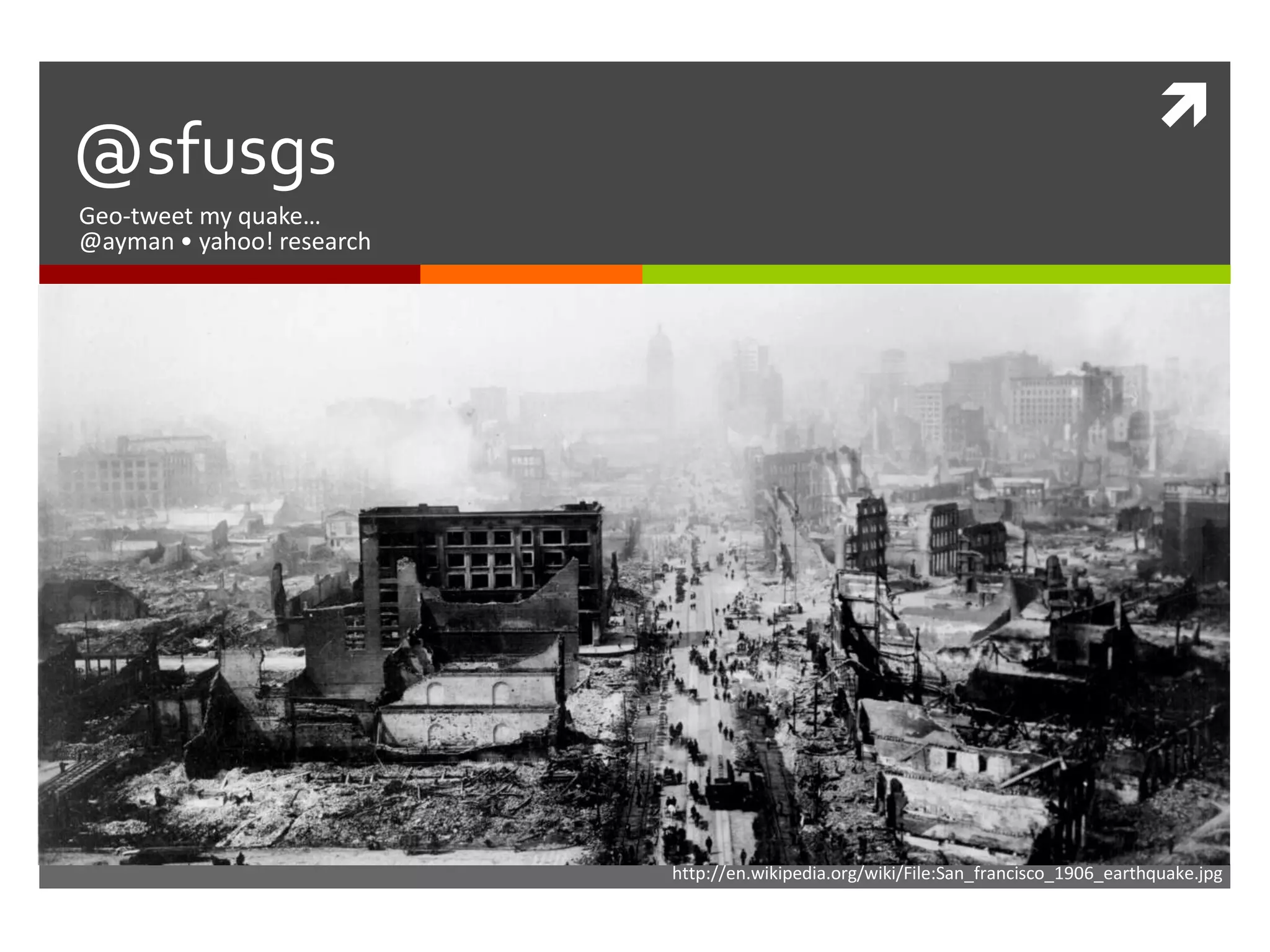

@sfusgsGeo-tweet my quake…@ayman • yahoo! researchhttp://en.wikipedia.org/wiki/File:San_francisco_1906_earthquake.jpg
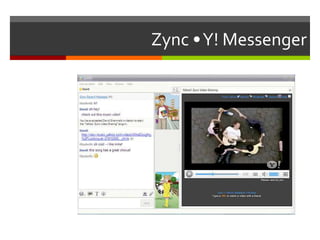
Zync • Y! Messenger
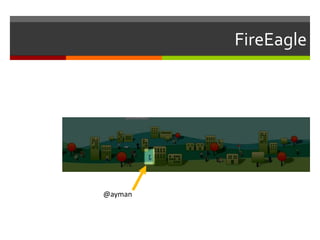
FireEagle
FireEagle@ayman
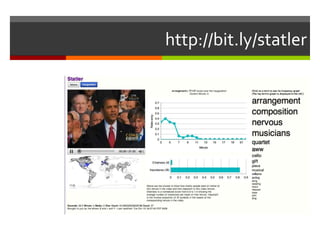
http://bit.ly/statler
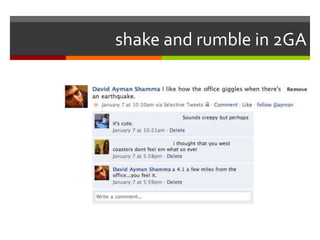
shake and rumble in 2GA
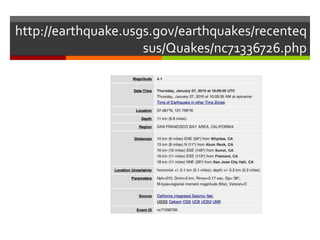
http://earthquake.usgs.gov/earthquakes/recenteqsus/Quakes/nc71336726.php
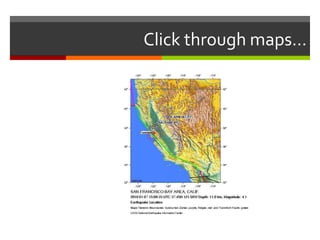
Click through maps…
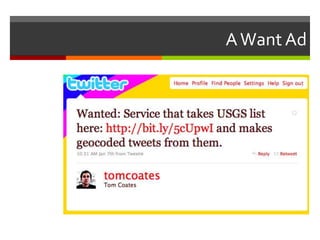
A Want Ad
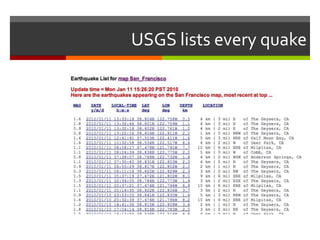
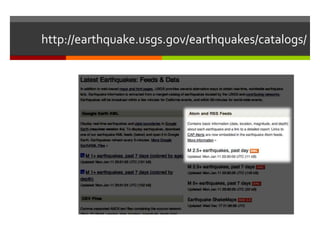
USGS lists every quake
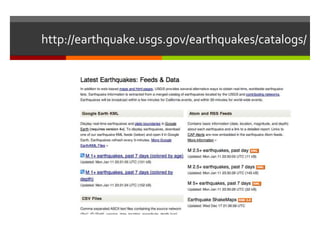
http://earthquake.usgs.gov/earthquakes/catalogs/
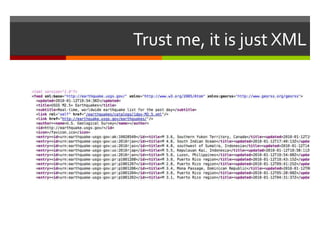
Trust me, it is just XML
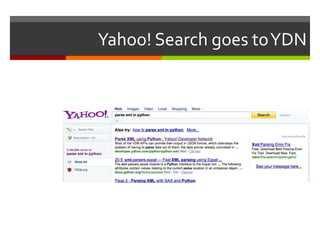
Yahoo! Search goes to YDN
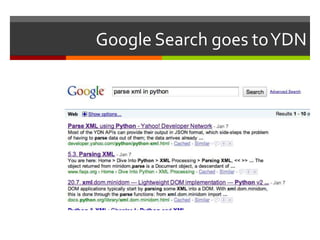
Google Search goes to YDN
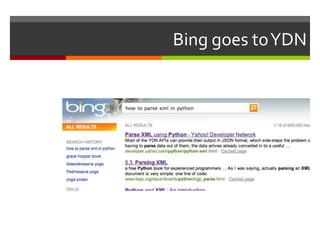
Bing goes to YDN
Using ElementTree
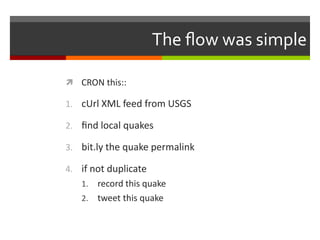
The flow was simpleCRON this::cUrl XML feed from USGSfind local quakesbit.ly the quake permalinkif not duplicaterecord this quaketweet this quake
def fetch_quakes():def fetch_quakes():api = bitly.Api(login=’ABCDEF', apikey=’12345678901234567890')rss = parse(urllib.urlopen(USGS_URL)).getroot()    quakes = []    for element in rss.findall('{%s}entry' % USGS_NS):        title = element.findtext('{%s}title' % USGS_NS)       if (title.find("San Francisco Bay") > -1):            point = element.findtext('{%s}point' % GEORSS_NS)            points = point.split(None, 1)            link = element.find('{%s}link' % USGS_NS)href = 'http://earthquakes.usgs.gov%s' % link.get('href')href = api.shorten(href)          if (is_duplicate(href) is False):f = open(‘urls.txt', 'a')f.write('%s\n' % href)f.close()                summary = element.findtext('{%s}summary' % USGS_NS)                summary = summary.split("<br>")[1]                summary = summary.replace(' at epicenter</p><p>', ' ')                summary = strip_tags(summary)quakes.append({'title': element.findtext('{%s}title' % USGS_NS),                               'link' : href,                               'updated' : element.findtext('{%s}updated' % USGS_NS),                               'long' : points[1],                               'lat' : points[0],                               'elev' : element.findtext('{%s}elev' % GEORSS_NS),                               'summary' : summary})    return quakes
def is_duplicate(url):def is_duplicate(url):    from subprocess import callif(os.path.exists(‘urls.txt') is False):        call(['/usr/bin/touch', ‘urls.txt'])r = call(['/bin/fgrep',url,              ‘urls.txt'])    if (r == 0):        return True    else:        return False
def send_tweet(t):def send_tweet(t):    import httplib2    username = ’ABCDEFG'    password = ’12345678901234567890'msg = ('%s %s %s' % (t['title'], t['link'], t['summary']))    http = httplib2.Http()http.add_credentials(username, password)    response = http.request(        "http://twitter.com/statuses/update.xml",        "POST",urllib.urlencode({"status": msg,                           "lat": t['lat'],                           "long": t['long']})    )SEE: http://code.google.com/p/httplib2/ps: you shouldn’t store your passwords like that…this is just an illustration
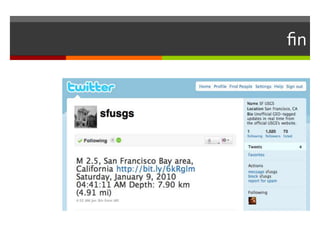
fin
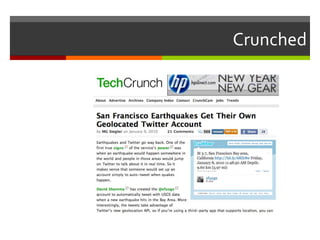
Crunched
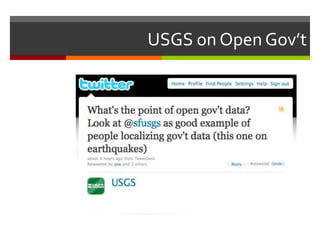
USGS on Open Gov’t
Open Questions?How can other local sources be disseminated?How can mass media be filtered so it can be consumed in a similar manner?Can we collect information around the news? For example, find all the tweets that relate to a particular quake.Thanks, @ayman.

SFUSGS

  • 1.
    @sfusgsGeo-tweet my quake…@ayman• yahoo! researchhttp://en.wikipedia.org/wiki/File:San_francisco_1906_earthquake.jpg
  • 2.
    Zync • Y!Messenger
  • 3.
  • 4.
  • 5.
  • 6.
  • 7.
  • 8.
  • 9.
  • 10.
  • 11.
  • 12.
  • 13.
    Trust me, itis just XML
  • 14.
  • 15.
  • 16.
  • 17.
  • 18.
    The flow wassimpleCRON this::cUrl XML feed from USGSfind local quakesbit.ly the quake permalinkif not duplicaterecord this quaketweet this quake
  • 19.
    def fetch_quakes():def fetch_quakes():api= bitly.Api(login=’ABCDEF', apikey=’12345678901234567890')rss = parse(urllib.urlopen(USGS_URL)).getroot() quakes = [] for element in rss.findall('{%s}entry' % USGS_NS): title = element.findtext('{%s}title' % USGS_NS) if (title.find("San Francisco Bay") > -1): point = element.findtext('{%s}point' % GEORSS_NS) points = point.split(None, 1) link = element.find('{%s}link' % USGS_NS)href = 'http://earthquakes.usgs.gov%s' % link.get('href')href = api.shorten(href) if (is_duplicate(href) is False):f = open(‘urls.txt', 'a')f.write('%s\n' % href)f.close() summary = element.findtext('{%s}summary' % USGS_NS) summary = summary.split("<br>")[1] summary = summary.replace(' at epicenter</p><p>', ' ') summary = strip_tags(summary)quakes.append({'title': element.findtext('{%s}title' % USGS_NS), 'link' : href, 'updated' : element.findtext('{%s}updated' % USGS_NS), 'long' : points[1], 'lat' : points[0], 'elev' : element.findtext('{%s}elev' % GEORSS_NS), 'summary' : summary}) return quakes
  • 20.
    def is_duplicate(url):def is_duplicate(url): from subprocess import callif(os.path.exists(‘urls.txt') is False): call(['/usr/bin/touch', ‘urls.txt'])r = call(['/bin/fgrep',url, ‘urls.txt']) if (r == 0): return True else: return False
  • 21.
    def send_tweet(t):def send_tweet(t): import httplib2 username = ’ABCDEFG' password = ’12345678901234567890'msg = ('%s %s %s' % (t['title'], t['link'], t['summary'])) http = httplib2.Http()http.add_credentials(username, password) response = http.request( "http://twitter.com/statuses/update.xml", "POST",urllib.urlencode({"status": msg, "lat": t['lat'], "long": t['long']}) )SEE: http://code.google.com/p/httplib2/ps: you shouldn’t store your passwords like that…this is just an illustration
  • 22.
  • 23.
  • 24.
  • 25.
    Open Questions?How canother local sources be disseminated?How can mass media be filtered so it can be consumed in a similar manner?Can we collect information around the news? For example, find all the tweets that relate to a particular quake.Thanks, @ayman.

Editor's Notes

  • #2 Use d to be you could look out the window…
  • #6 I’m from Y!R MESS IEG.
  • #10 Toms first quake.