Towards multi-
threaded TCG
Alex Bennée
alex.bennee@linaro.org
Linaro Connect SFO15
Introduction
Hello!
Alex Bennée
Works for Linaro
IRC: stsquad/ajb-linaro
Mostly ARM emulation, a little KVM on the side
Uses Emacs
What is multi-threaded TCG?
TCG?
Tiny Code Generator
Running non-native code on your desktop
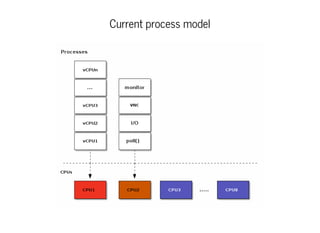
Current process model
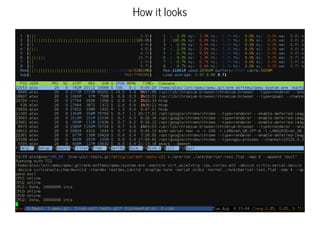
How it looks
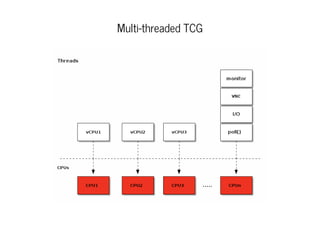
Multi-threaded TCG
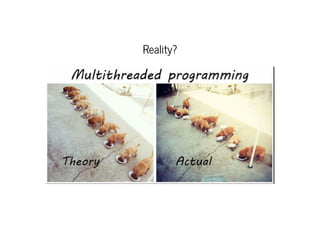
Reality?
Why do we want it?
Living in a Multi-core world
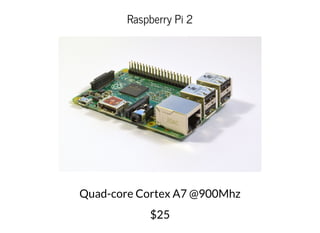
Raspberry Pi 2
Quad-core Cortex A7 @900Mhz
$25
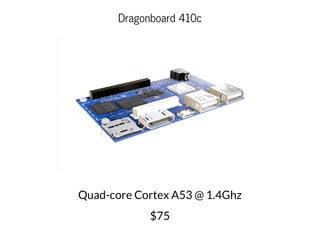
Dragonboard 410c
Quad-core Cortex A53 @ 1.4Ghz
$75
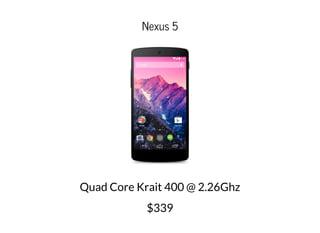
Nexus 5
Quad Core Krait 400 @ 2.26Ghz
$339
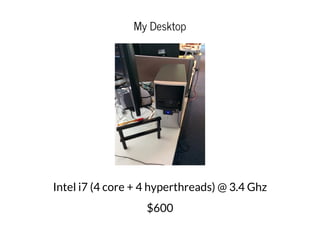
My Desktop
Intel i7 (4 core + 4 hyperthreads) @ 3.4 Ghz

$600
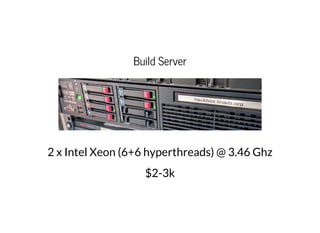
Build Server
2 x Intel Xeon (6+6 hyperthreads) @ 3.46 Ghz
$2-3k
Android Emulation
Android emulator uses QEMU as base
Most modern Android devices are multi-core
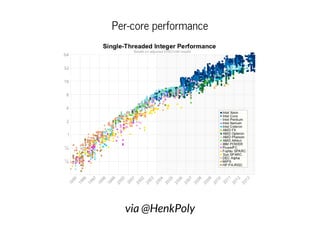
Per-core performance
via @HenkPoly
Other reasons to care
Using QEMU for System bring up
Increasingly used for prototyping
new multi-core systems
new heterogeneous systems
Want concurrent behaviour
Bad software should fail in QEMU!
As a development tool
Instrumentation and inspection
Record and playback
Reverse debugging
Cross Tooling
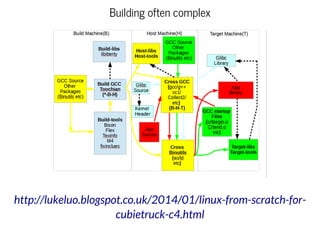
Building often complex
http://lukeluo.blogspot.co.uk/2014/01/linux-from-scratch-for-
cubietruck-c4.html
Just use qemu-linux-user?
Make sure binfmt_misc setup
Mess around with multilib/chroots
Hope threads/signals not used
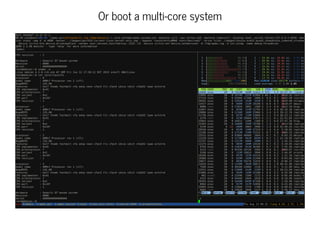
Or boot a multi-core system
Things in our way
Global State in QEMU
Guest Memory Models
Global State
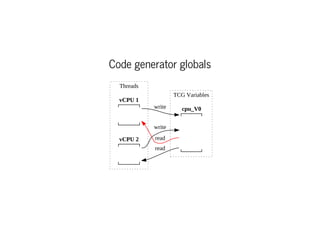
Numerous globals in TCG generation
TCG Runtime Structures
Device emulation structures
Guest Memory models
Atomic behaviour
LL/SC Semantics
Memory barriers
How can we do it?
3 broad approaches
Use threads/locks
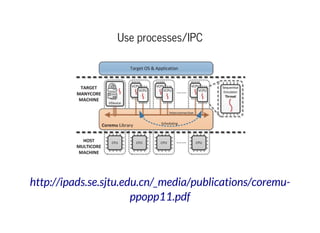
Use processes/IPC
http://ipads.se.sjtu.edu.cn/_media/publications/coremu-
ppopp11.pdf
Re-write from scratch
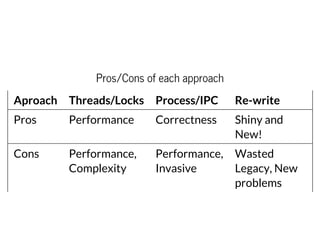
Pros/Cons of each approach
Aproach Threads/Locks Process/IPC Re-write
Pros Performance Correctness Shiny and
New!
Cons Performance,
Complexity
Performance,
Invasive
Wasted
Legacy, New
problems
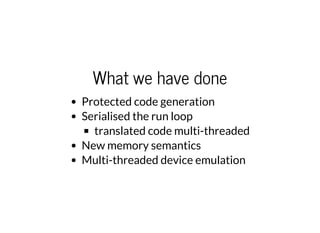
What we have done
Protected code generation
Serialised the run loop
translated code multi-threaded
New memory semantics
Multi-threaded device emulation
Things in our way
Global State in QEMU
Guest Memory Models
Code generator globals
Threads
TCG Variables
vCPU 1
cpu_V0write
vCPU 2
write
read
read
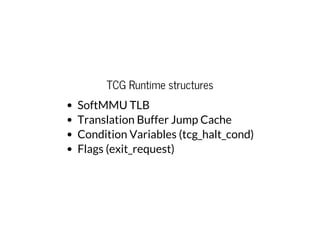
TCG Runtime structures
SoftMMU TLB
Translation Buffer Jump Cache
Condition Variables (tcg_halt_cond)
Flags (exit_request)
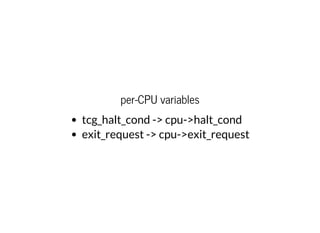
per-CPU variables
tcg_halt_cond -> cpu->halt_cond
exit_request -> cpu->exit_request
Quick reminder of how TCG works
Code Generation
target machine code
intermediate form (TCG ops)
generate host binary code
Input Code
ldr     r2, [r3]
add     r2, r2, #1
str     r2, [r3]
bx      lr
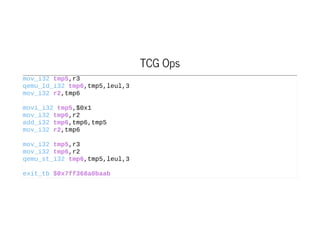
TCG Ops
mov_i32 tmp5,r3
qemu_ld_i32 tmp6,tmp5,leul,3
mov_i32 r2,tmp6
movi_i32 tmp5,$0x1
mov_i32 tmp6,r2
add_i32 tmp6,tmp6,tmp5
mov_i32 r2,tmp6
mov_i32 tmp5,r3
mov_i32 tmp6,r2
qemu_st_i32 tmp6,tmp5,leul,3
exit_tb $0x7ff368a0baab
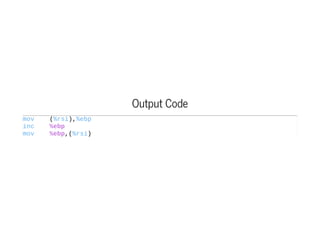
Output Code
mov    (%rsi),%ebp
inc    %ebp
mov    %ebp,(%rsi)
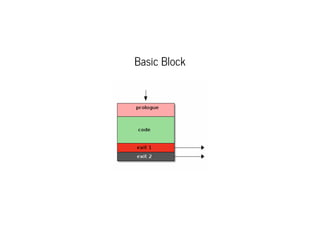
Basic Block
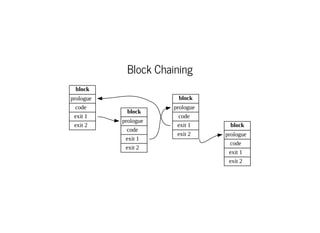
Block Chaining
block
prologue
code
exit 1
exit 2
block
prologue
code
exit 1
exit 2
block
prologue
code
exit 1
exit 2
block
prologue
code
exit 1
exit 2
TCG Global State
Code generation globals
Global runtime
Translated code is safe
Only accesses vCPU structures
We need to careful leaving the translated code
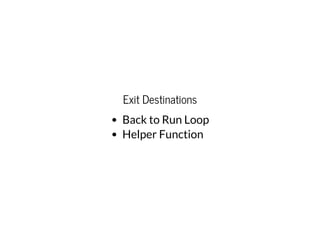
Exit Destinations
Back to Run Loop
Helper Function
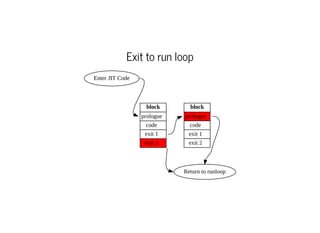
Exit to run loop
Enter JIT Code
block
prologue
code
exit 1
exit 2
block
prologue
code
exit 1
exit 2
Return to runloop
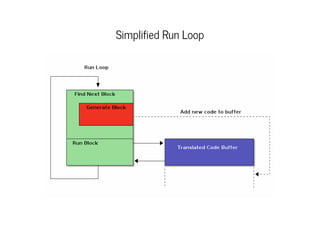
Simplified Run Loop
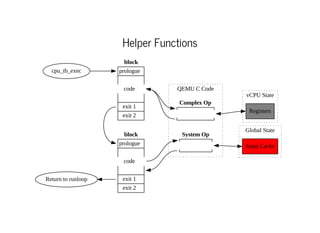
Helper Functions
QEMU C Code
vCPU State
Global State
cpu_tb_exec
block
prologue
code
exit 1
exit 2
Return to runloop
block
prologue
code
exit 1
exit 2
Complex Op
System Op
Registers
Jump Cache
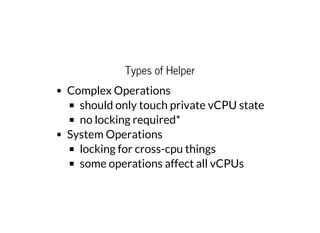
Types of Helper
Complex Operations
should only touch private vCPU state
no locking required*
System Operations
locking for cross-cpu things
some operations affect all vCPUs
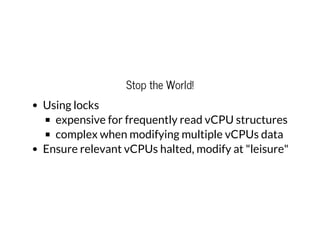
Stop the World!
Using locks
expensive for frequently read vCPU structures
complex when modifying multiple vCPUs data
Ensure relevant vCPUs halted, modify at "leisure"
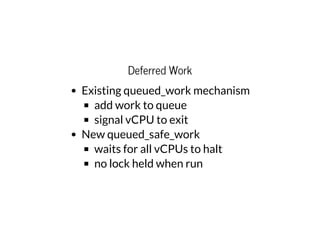
Deferred Work
Existing queued_work mechanism
add work to queue
signal vCPU to exit
New queued_safe_work
waits for all vCPUs to halt
no lock held when run
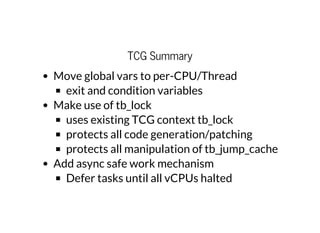
TCG Summary
Move global vars to per-CPU/Thread
exit and condition variables
Make use of tb_lock
uses existing TCG context tb_lock
protects all code generation/patching
protects all manipulation of tb_jump_cache
Add async safe work mechanism
Defer tasks until all vCPUs halted
Things in our way
Global State in QEMU
Guest Memory Models
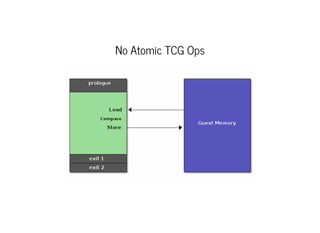
No Atomic TCG Ops
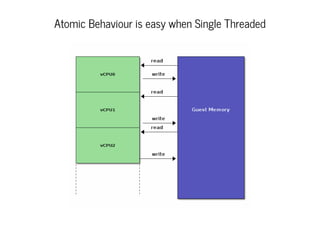
Atomic Behaviour is easy when Single Threaded
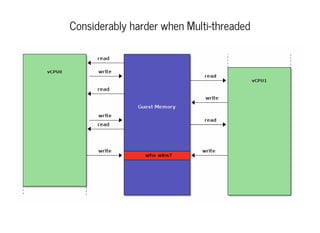
Considerably harder when Multi-threaded
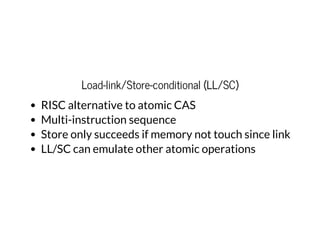
Load-link/Store-conditional (LL/SC)
RISC alternative to atomic CAS
Multi-instruction sequence
Store only succeeds if memory not touch since link
LL/SC can emulate other atomic operations
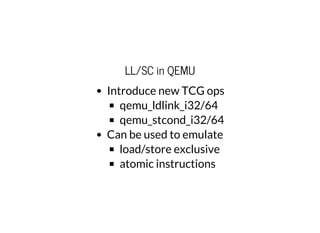
LL/SC in QEMU
Introduce new TCG ops
qemu_ldlink_i32/64
qemu_stcond_i32/64
Can be used to emulate
load/store exclusive
atomic instructions
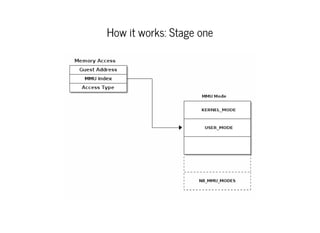
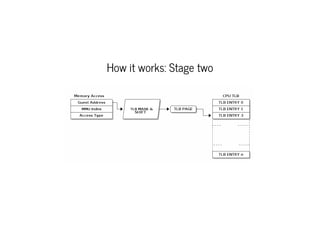
SoftMMU
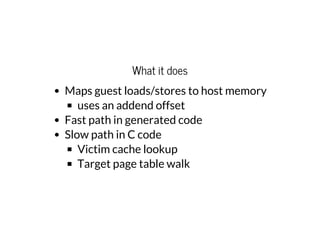
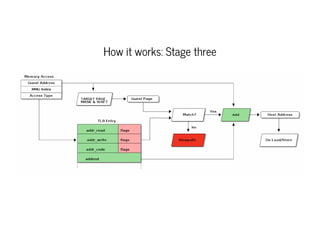
What it does
Maps guest loads/stores to host memory
uses an addend offset
Fast path in generated code
Slow path in C code
Victim cache lookup
Target page table walk
How it works: Stage one
How it works: Stage two
How it works: Stage three
How does this help with LL/SC?
Introduced new TCG ops
qemu_ldlink_i32/64
qemu_stcond_i32/64
Using the SoftMMU slow path we can implement the
backend in a generic way
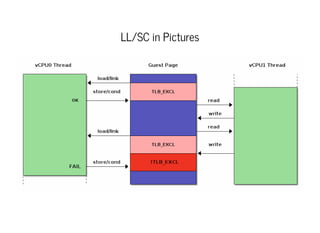
LL/SC in Pictures
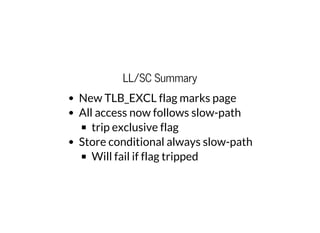
LL/SC Summary
New TLB_EXCL flag marks page
All access now follows slow-path
trip exclusive flag
Store conditional always slow-path
Will fail if flag tripped
Memory Model Summary
Multi-threading brings a number of challenges
New TCG ops to support atomic-like operations
SoftMMU allows fairly efficient implementation
Memory barriers still an issue.
Device Emulation
KVM already done it ;-)
added thread safety to a number of systems
introduced memory API
introduced I/O thread
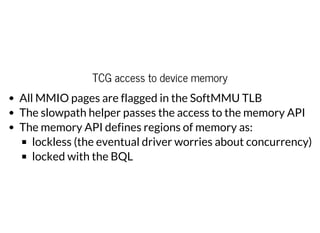
TCG access to device memory
All MMIO pages are flagged in the SoftMMU TLB
The slowpath helper passes the access to the memory API
The memory API defines regions of memory as:
lockless (the eventual driver worries about concurrency)
locked with the BQL
Thanks KVM!
Current state
What's left
LL/SC Patches
MTTCG Patches
Memory Barriers
Enabling all front/back ends
Testing & Documentation
LL/SC Patches
Majority of patch set independent from MTTCG
Been through a number of review cycles
Hope to get merged soonish now tree is open
Who/where?
Alvise Rigo of Virtual Open Systems
Latest branch: slowpath-for-atomic-v4-no-mttcg
https://git.virtualopensystems.com/dev/qemu-mt.git
MTTCG Patches
Clean-up and rationlisation patches
starting to go into maintainer trees
Delta to full MTTCG reducing
Who/where?
Frederic Konrad of Greensocs
Latest branch: multi_tcg_v7
http://git.greensocs.com/fkonrad/mttcg.git
Emilo's Patches
Recent patch series posted to list
Alternate solutions
AIE helpers for LL/SC
Example implementation of barrier semantics
Memory Barriers
Some example code (Emilo's patches)
Use a number of barrier TCG ops
Hard to trigger barrier issues on x86 backend
Enabling all front/back ends
Current testing is ARM32 on x86
Aim to enable MTTCG on all front/backends
Front-ends need to use new TCG ops
Back-ends need to support new TCG ops
may require incremental updates
Testing & Documentation
Both important for confidence in design
Torture tests
hand-rolled
using kvm-unit-tests
Want to have reference in docs/ on how it should work
Questions?
The End
Thank you
Extra Material
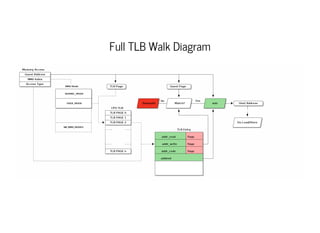
Full TLB Walk Diagram
Annotated TLB Walk Code (In)
0x40000000:  e3a00000      mov  r0, #0  ; 0x0
0x40000004:  e59f1004      ldr  r1, [pc, #4]    ; 0x40000010
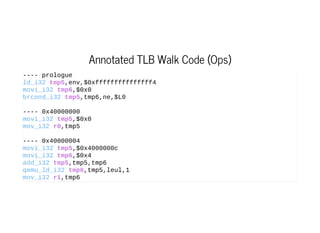
Annotated TLB Walk Code (Ops)
­­­­ prologue
ld_i32 tmp5,env,$0xfffffffffffffff4
movi_i32 tmp6,$0x0
brcond_i32 tmp5,tmp6,ne,$L0
­­­­ 0x40000000
movi_i32 tmp5,$0x0
mov_i32 r0,tmp5
­­­­ 0x40000004
movi_i32 tmp5,$0x4000000c
movi_i32 tmp6,$0x4
add_i32 tmp5,tmp5,tmp6
qemu_ld_i32 tmp6,tmp5,leul,1
mov_i32 r1,tmp6
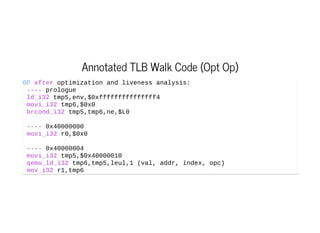
Annotated TLB Walk Code (Opt Op)
OP after optimization and liveness analysis:
 ­­­­ prologue
 ld_i32 tmp5,env,$0xfffffffffffffff4
 movi_i32 tmp6,$0x0
 brcond_i32 tmp5,tmp6,ne,$L0
 ­­­­ 0x40000000
 movi_i32 r0,$0x0
 ­­­­ 0x40000004
 movi_i32 tmp5,$0x40000010
 qemu_ld_i32 tmp6,tmp5,leul,1 (val, addr, index, opc)
 mov_i32 r1,tmp6
Annotated TLB Walk Code (Out Asm)
­­­­ prologue
 0x7fffe1ba1000:  mov    ­0xc(%r14),%ebp
 0x7fffe1ba1004:  test   %ebp,%ebp
 0x7fffe1ba1006:  jne    0x7fffe1ba10c9
   ­­­­ 0x40000000
 0x7fffe1ba100c:  xor    %ebp,%ebp
 0x7fffe1ba100e:  mov    %ebp,(%r14)
   ­­­­ 0x40000004
     ­ movi_i32
 0x7fffe1ba1011:  mov    $0x40000010,%ebp
     ­ qemu_ld_i32
 0x7fffe1ba1016:  mov    %rbp,%rdi ­ r0
 0x7fffe1ba1019:  mov    %ebp,%esi ­ r1
 0x7fffe1ba101f:  and    $0xfffffc03,%esi
     ­ index into tlb_table[mem_index][0]+target_page
 0x7fffe1ba101b:  shr    $0x5,%rdi
 0x7fffe1ba1025:  and    $0x1fe0,%edi
 0x7fffe1ba102b:  lea    0x2c18(%r14,%rdi,1),%rdi
 0x7fffe1ba1033:  cmp    (%rdi),%esi
 0x7fffe1ba1035:  mov    %ebp,%esi
 0x7fffe1ba1037:  jne    0x7fffe1ba111b
   ­­­ offset to "host address"
 0x7fffe1ba103d:  add    0x10(%rdi),%rsi
   ­­­ actual load
 0x7fffe1ba1041:  mov    (%rsi),%ebp
   ­­­ mov_i32 r1, tmp6
 0x7fffe1ba1043:  mov    %ebp,0x4(%r14)
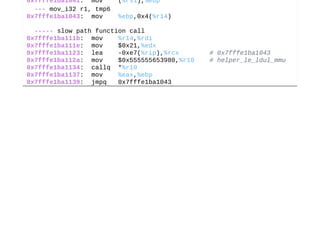
   ­­­­­ slow path function call
 0x7fffe1ba111b:  mov    %r14,%rdi
 0x7fffe1ba111e:  mov    $0x21,%edx
 0x7fffe1ba1123:  lea    ­0xe7(%rip),%rcx        # 0x7fffe1ba1043
 0x7fffe1ba112a:  mov    $0x555555653980,%r10    # helper_le_ldul_mmu
 0x7fffe1ba1134:  callq  *%r10
 0x7fffe1ba1137:  mov    %eax,%ebp
 0x7fffe1ba1139:  jmpq   0x7fffe1ba1043
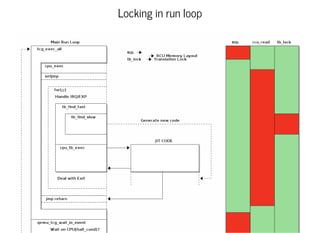
Locking in run loop
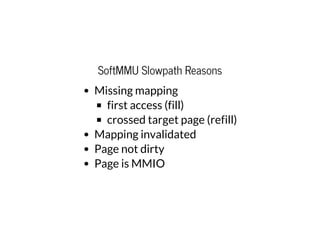
SoftMMU Slowpath Reasons
Missing mapping
first access (fill)
crossed target page (refill)
Mapping invalidated
Page not dirty
Page is MMIO

SFO15-202: Towards Multi-Threaded Tiny Code Generator (TCG) in QEMU