Goal Setting & Commitment
Presented by Mohamad Bajouk
Inspirit Academy
GoalA goal is something that we want enough that we
make an effort to reach it
Learning Objectives
• Know why you should set goals
• Get to know the different temporal horizons of goal-setting
• Know how to reach your goals with the SMART-method
• Understand Commitment
Why Should You Set Goals For
Yourself?
Goals...
determine the direction of your actions
Why Should You Set Goals For
Yourself?
Goals...
determine the direction of your actions
help you to stay on top of things
Why Should You Set Goals For
Yourself?
Goals...
determine the direction of your actions
help you stay on top of things
help you focus on the important things
Why Should You Set Goals For
Yourself?
Goals...
 determine the direction of your actions
 helps you stay on top of things
 helps you focus on the important things
 answer the question “Why do I do what I do?”
Why Should You Set Goals For
Yourself?
Goals...
 determine the direction of your actions
 helps you stay on top of things
 helps you focus on the important things
 answer the question “Why do I do what I do?”
 Helps you be the best you can be
Why Should You Set Goals For
Yourself?
Goals...
 determine the direction of your actions
 helps you stay on top of things
 helps you focus on the important things
 answer the question “Why do I do what I do?”
 Helps you be the best you can be
 serve to monitor success
Goals are the main source of MOTIVATION
Considering the Temporal Horizon
You differentiate…
• Long – Term Goals
• Medium – Term Goals
• Short – Term Goals
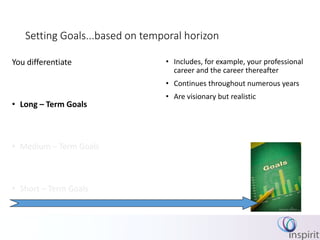
Setting Goals...based on temporal horizon
You differentiate
• Long – Term Goals
• Medium – Term Goals
• Short – Term Goals
• Includes, for example, your professional
career and the career thereafter
• Continues throughout numerous years
• Are visionary but realistic
Setting Goals...based on temporal horizon
• e.g. operative goals that are specific for a
department of a large corporation
(yearly and/or quarterly goals)
You differentiate
 Long – Term Goals
 Medium – Term Goals
 Short – Term Goals
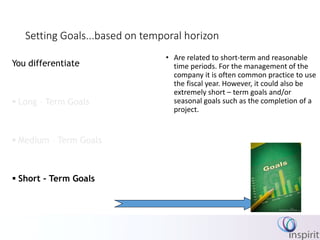
Setting Goals...based on temporal horizon
• Are related to short-term and reasonable
time periods. For the management of the
company it is often common practice to use
the fiscal year. However, it could also be
extremely short – term goals and/or
seasonal goals such as the completion of a
project.
You differentiate
 Long – Term Goals
 Medium – Term Goals
 Short – Term Goals
Setting Goals – The SMART-
Formula
• In project management you usually have the ultimate
project goal as well as intermediate goals (milestones)
• Respectively there are big goals and smaller goals, as
well as intermediate goals in your professional career
• Often times we do not reach our goals because our goals
are not clearly defined, we expect too much, or we do
not come up with intermediate goals
Setting Goals – The SMART-
Formula
• Often times management set very vague goals such as: „we
have to improve customer satisfaction, increase profitability,
and improve productivity and efficiency.“
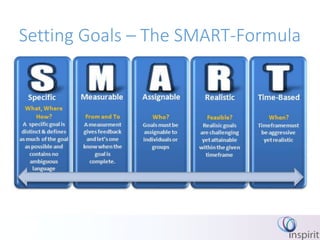
• With the implementation of „SMART“, goals turn into clear
messages that can be measured, reviewed, and monitored
which we will see in the next example...
Setting Goals – The SMART-Formula
Setting Goals – The SMART-Formula - Example
• For example, you set the followig goal: „ The goals is to
increase the revenues of product X/Y by 10 percent until June
30th.“
• This goal is specific, it is also measurable!
• The goal also has to be realistic, therefore, the 10 percent
should be obtainable by the employee. Due to the fact that
management communicates the 30th of June as a due date for
the goal it is also terminated to a specific day.
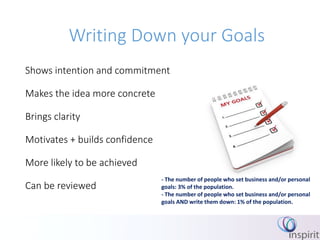
Writing Down your Goals
Shows intention and commitment
Makes the idea more concrete
Brings clarity
Motivates + builds confidence
More likely to be achieved
Can be reviewed
- The number of people who set business and/or personal
goals: 3% of the population.
- The number of people who set business and/or personal
goals AND write them down: 1% of the population.
Personal Vs. Professional
GOALS
Commitment
Commitment
Keep in Touch
Mohamad Bajouk

Setting Goals & Commitment

  • 2.
    Goal Setting &Commitment Presented by Mohamad Bajouk Inspirit Academy
  • 3.
    GoalA goal issomething that we want enough that we make an effort to reach it
  • 4.
    Learning Objectives • Knowwhy you should set goals • Get to know the different temporal horizons of goal-setting • Know how to reach your goals with the SMART-method • Understand Commitment
  • 5.
    Why Should YouSet Goals For Yourself? Goals... determine the direction of your actions
  • 6.
    Why Should YouSet Goals For Yourself? Goals... determine the direction of your actions help you to stay on top of things
  • 7.
    Why Should YouSet Goals For Yourself? Goals... determine the direction of your actions help you stay on top of things help you focus on the important things
  • 8.
    Why Should YouSet Goals For Yourself? Goals...  determine the direction of your actions  helps you stay on top of things  helps you focus on the important things  answer the question “Why do I do what I do?”
  • 9.
    Why Should YouSet Goals For Yourself? Goals...  determine the direction of your actions  helps you stay on top of things  helps you focus on the important things  answer the question “Why do I do what I do?”  Helps you be the best you can be
  • 10.
    Why Should YouSet Goals For Yourself? Goals...  determine the direction of your actions  helps you stay on top of things  helps you focus on the important things  answer the question “Why do I do what I do?”  Helps you be the best you can be  serve to monitor success
  • 11.
    Goals are themain source of MOTIVATION
  • 12.
    Considering the TemporalHorizon You differentiate… • Long – Term Goals • Medium – Term Goals • Short – Term Goals
  • 13.
    Setting Goals...based ontemporal horizon You differentiate • Long – Term Goals • Medium – Term Goals • Short – Term Goals • Includes, for example, your professional career and the career thereafter • Continues throughout numerous years • Are visionary but realistic
  • 14.
    Setting Goals...based ontemporal horizon • e.g. operative goals that are specific for a department of a large corporation (yearly and/or quarterly goals) You differentiate  Long – Term Goals  Medium – Term Goals  Short – Term Goals
  • 15.
    Setting Goals...based ontemporal horizon • Are related to short-term and reasonable time periods. For the management of the company it is often common practice to use the fiscal year. However, it could also be extremely short – term goals and/or seasonal goals such as the completion of a project. You differentiate  Long – Term Goals  Medium – Term Goals  Short – Term Goals
  • 16.
    Setting Goals –The SMART- Formula • In project management you usually have the ultimate project goal as well as intermediate goals (milestones) • Respectively there are big goals and smaller goals, as well as intermediate goals in your professional career • Often times we do not reach our goals because our goals are not clearly defined, we expect too much, or we do not come up with intermediate goals
  • 17.
    Setting Goals –The SMART- Formula • Often times management set very vague goals such as: „we have to improve customer satisfaction, increase profitability, and improve productivity and efficiency.“ • With the implementation of „SMART“, goals turn into clear messages that can be measured, reviewed, and monitored which we will see in the next example...
  • 18.
    Setting Goals –The SMART-Formula
  • 19.
    Setting Goals –The SMART-Formula - Example • For example, you set the followig goal: „ The goals is to increase the revenues of product X/Y by 10 percent until June 30th.“ • This goal is specific, it is also measurable! • The goal also has to be realistic, therefore, the 10 percent should be obtainable by the employee. Due to the fact that management communicates the 30th of June as a due date for the goal it is also terminated to a specific day.
  • 20.
    Writing Down yourGoals Shows intention and commitment Makes the idea more concrete Brings clarity Motivates + builds confidence More likely to be achieved Can be reviewed - The number of people who set business and/or personal goals: 3% of the population. - The number of people who set business and/or personal goals AND write them down: 1% of the population.
  • 21.
  • 23.
  • 24.
  • 26.